2026: ODA Holds Summit, Urges Peaceful, Issue-Based Campaign
Titilope Adako
THE Osun Development Associa on, ODA, has called on poli cal actors in Osun State to embrace peace, issue-based campaigning and accountability as the state prepares for the August 15 gubernatorial elec on.
The Chairman of ODA, Dr. Segun Aina, OFR, made the call on Thursday in Osogbo at the Osun 2026 Democra c Governance, Peace & Electoral Integrity Summit.
The summit brought together representa ves of poli cal par es, the Independent Na onal Electoral Commission (INEC), security agencies, tradi onal rulers, religious leaders, civil society organisa ons and other stakeholders to deliberate on measures to ensure a peaceful, credible and transparent governorship elec on.
Dr. Aina, whose address was read at the event by the Chairman of the associa on’s Leadership and Governance Commi ee, Dr. Tunji Olugbodi, said the forthcoming poll presents an opportunity to demonstrate that Nigeria’s democracy is maturing.
•Calls On INEC, Security Agencies To Guarantee Credible Election
•As Political Parties Sign Peace, Accountability Charter
He, however, warned that a poorly conducted poll could deepen ins tuonal distrust and civic disillusionment.
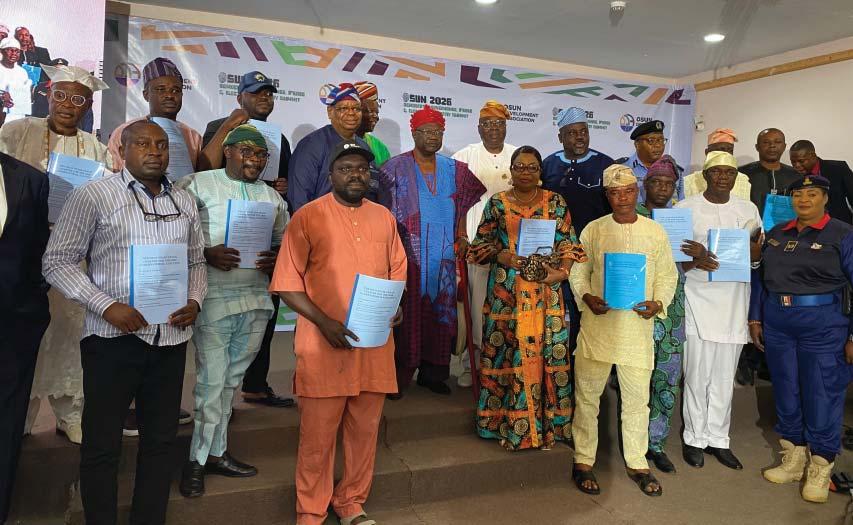
•A cross-section of the stakeholders who signed the Peace and Accountability Charter at the summit conducted poorly, could deepen the wounds of ins tu onal distrust and civic disillusionment that already afflict our poli cal landscape.
Dr. Aina said, “We are approximately four weeks from a governorship elecon that will determine who leads this state for the next four years. An elecon that, if conducted well, could become a landmark demonstra on that Nigerian democracy is maturing.
“An elec on that, if
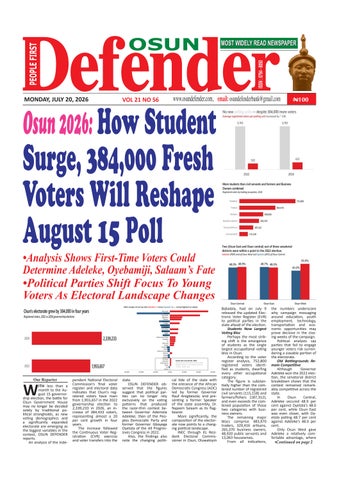
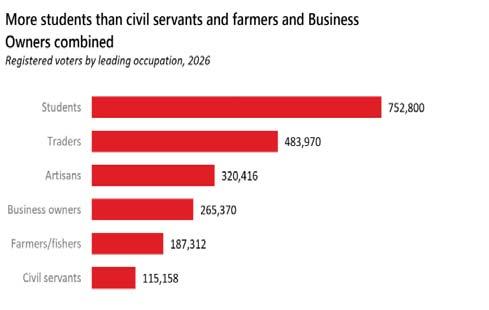
Osun 2026: How Student Surge, 384,000 Fresh Voters Will...
•Continued from page 1
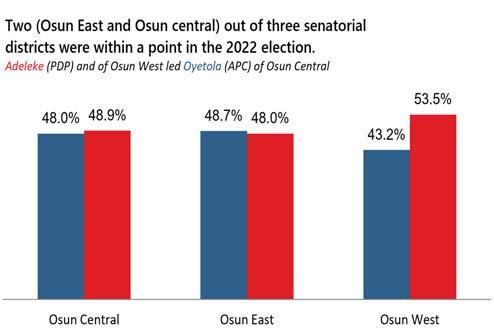
he polled 53.5 per cent against Oyetola’s 43.2 per cent.
The figures suggest that two of the state’s three senatorial districts were effecvely decided by margins of less than one percentage point.
Swing LGAS May Again Determine Winner
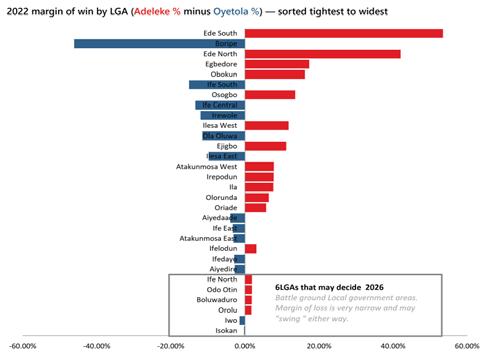
A local government analysis further highlights how narrow the margins were across several councils. Several councils were decided by only a few percentage points, making them poten al ba legrounds again in 2026.
Among the closely contested local government areas are Iwo, Ife North, Odo O n, Boluwaduro, Orolu and Isokan, where previous margins were extremely narrow.
Poli cal strategists who spoke to OSUN DEFENDER over the weekend, believe campaigns are likely to concentrate resources, mobilisa on efforts and high-profile rallies in these councils, where rela vely small voter swings could determine the overall outcome.
Bigger Electorate, Same Number Of Polling Units
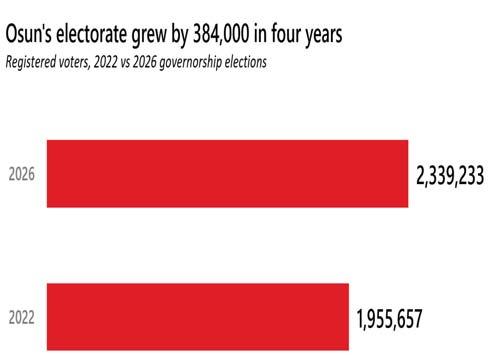
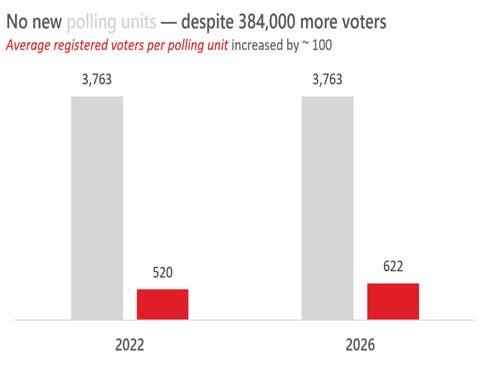
Despite the addi on of
more than 384,000 voters, the number of polling units has remained unchanged at 3,763.
The development raises fresh ques ons about voter management, queue lengths and elec on-day logis cs, par cularly in densely populated urban centres where turnout is tradi onally high.
INEC has, however, assured poli cal par es and stakeholders of its preparedness for the elec on, sta ng that elec on materials and logis cs are being deployed in line with its opera onal metable.
Campaign Calcula ons Changing
Findings by OSUN DEFENDER indicate that the changing voter profile is already forcing par es to rethink campaign strategies.
Unlike the 2022 contest, where mobilisa on largely revolved around established poli cal structures, the enlarged register means hundreds of thousands of voters will be par cipa ng in a governorship elec on for the first me.
For both the old PDP which has now metamorphosed into the Accord Party, the APC, as well as the third force ADC, victory may depend less on •Read full article on www.osundefender.com
“The Osun Development Associa on has organized this program as it has done in past governorship elec ons to intervene construc vely, responsibly, and without par san preference in the character of this electoral moment.”
He explained that the Summit, themed “Speak, Choose, Hold Accountable: Ci zens at the Centre of Osun’s Democracy”, was designed to place ci zens at the heart of the electoral process.
The ODA Chairman noted that the associa on is non-par san and has, for over three decades, invested in educa on, healthcare, infrastructure, youth empowerment and peacebuilding in the state.
Dr. Aina urged the Resident Electoral Commissioner and INEC Osun to deploy every safeguard to ensure the elec on is transparent and credible.
He also, “charged security agencies to guarantee that every voter can cast their ballot peacefully and return home safely, stressing that democracy cannot breathe in an atmosphere of fear.”
He further appealed to all governorship candidates to seek power through the force of their argument, the clarity of your vision, and the credibility of your character.
“Earn the mandate of the people. Do not buy it. Do not seize it. Earn it,” Aina advised.
Meanwhile, candidates of twelve of the 14 poli cal par es par cipa ng in next
month’s governorship elecon signed a Peace and Accountability charter at the summit, commi ng themselves to peaceful campaigns, issue-based poli cs and accountable governance ahead of the poll.
The par es that signed are Accord Party, Ac on Alliance, African Ac on Congress, Ac on Democra c Party, All Progressives Grand Alliance, Allied Peoples Movement and Ac on Peoples Party.
Others are Boot Party, New Nigeria Peoples Party, Peoples Redemp on Party, Young Progressive Party and Zenith Labour Party.
However, the major opposi on par es, All Progressives Congress and the African Democra c Congress, were absent at the signing of the documents.
Dr. Aina said the Peace and Governance Charter commits par es to non-violence, respect for electoral ins tu ons and outline cizen expecta ons on educaon, healthcare, security, youth employment, fiscal transparency and gender equity.
“This elec on presents an opportunity to demonstrate that Nigeria’s democracy is maturing. However, a poorly conducted poll could deepen ins tu onal distrust and civic disillusionment,” Aina stated.
“I commend unreservedly the poli cal par es and governorship candidates who have chosen to par cipate in this process. Your presence here today is itself a statement.
“It signals that you respect the democra c process. It signals that you understand that elec ons are won through ideas and not in mida on. And it signals that you are prepared
to be held to account for your conduct in the weeks ahead,” he added.
In his goodwill message, Governor Ademola Adeleke, represented by his Deputy, Prince Kola Adewusi, reaffirmed his administra on’s commitment to a peaceful, free and credible elec on.
“Our belief is simply that no poli cal ambion is worth the blood of any ci zen and no office is more valuable than the life of a single man, woman or child.
“As we approach the 2026 governorship elecon, I reaffirm my unwavering commitment to the rule of law, cons tu onal democracy, and peaceful poli cal engagement.
“Through my administra on, we have demonstrated that poli cal power should never be used as an instrument of in mida on or oppression.
“I therefore call on every poli cal party, every candidate, every stakeholder and every supporter to reject violence in all its forms,” Adeleke said.
Also speaking, the Orangun of Oke-Ila, Oba Adedokun Abolarin, urged poli cians to conduct their campaigns peacefully, stressing that elec ons should be contests of ideas rather than hos lity.
Describing poli cs as a call to service, the monarch said, “Poli cs is not war. Poli cs is stewardship. It is the sacred duty of choosing who will hold the lamp so that the whole house may see.”
He urged voters to focus on the future of the state rather than poli cal senments
The Director-General of the Development Agenda
for Western Nigeria (DAWN) Commission, Dr. Seye Oyeleye, described the Osun governorship elec on as a defining moment for democra c governance in the South-West.
He said the conduct of the elec on would send a strong signal ahead of the 2027 general elec ons on whether poli cal actors in the region were prepared to embrace peaceful and development-driven democracy.
“Osun, therefore, serves as a laboratory. Whether its primaries are peaceful or violent, its campaigns waged on ideas or thug violence, and its losers concede with dignity or incite disrup on, these outcomes will be read by every polician, godfather, and voter across Lagos, Ogun, Oyo, Ondo, and Eki as a signal of what is now permissible under the new electoral order,” Oyeleye said. He maintained that sustainable development could only flourish where peace and poli cal stability existed.
“We do not first develop a state and then enjoy peace as its reward. You first secure peace, and then, only then, does development become possible,” he said.
Oyeleye also lamented recent incidents of elec onrelated violence in the state, including the killing of a 14year-old boy, describing the incident as a reflec on of a poli cal culture that must be rejected.
“A fourteen-year-old boy did not choose a party. He did not contest a primary. He did not stand to gain or lose a single appointment from the outcome of this elec on.
“His death is not a stas c to be cited and moved past. It is an indictment.”
He warned that any poli cian who incites, tolerates or benefits from violence has failed the first test of leadership.
Speaking at the summit, the Resident Electoral Commissioner of INEC in Osun State, Toyin Babalola, assured stakeholders that the Commission had made adequate prepara ons to conduct a free, fair and credible elec on. She pledged that every valid vote cast during the elec on would count and reaffirmed INEC’s commitment to protec ng the integrity of the electoral process.
The summit ended with par cipants reaffirming their commitment to peaceful, credible and violence-free elec ons, urging poli cal par es, candidates and supporters to abide by the Peace Charter ahead of the August 15 governorship poll.
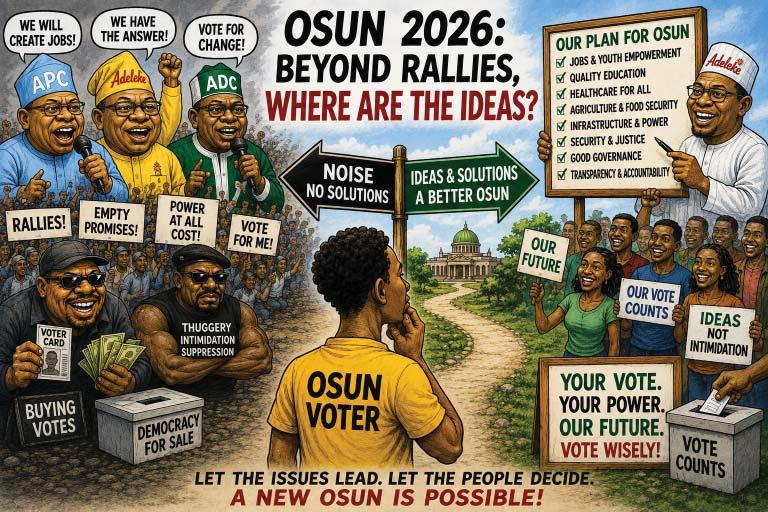
THE clock is cking relentlessly. With only weeks to the August 15 governorship elec on, Osun State stands at another defining moment in its democra c journey. The choice before the electorate is not merely about selec ng a governor; it is about determining the direc on of the state for the next four years at a me when economic hardship, ins tu onal challenges and growing public expecta ons demand visionary leadership.
Regre ably, the campaign has, so far, been largely underwhelming. Rather than eleva ng public discourse with robust debates on policy alterna ves and governance priori es, much of the poli cal ac vity has revolved around rallies, slogans and personality contests. Equally troubling are lingering concerns over the independence and impar ality of some cri cal na onal ins tu ons. Public confidence in these ins tu ons is indispensable to the credibility of the electoral process and must be restored through transparency, professionalism and strict adherence to the rule of law.
Democracy flourishes when elec ons are contests of ideas, not merely contests of poli cal machinery. Yet, with a few notable excep ons, many of the governorship candidates have failed to present detailed, prac cal and measurable programmes capable of addressing Osun’s pressing challenges. In this regard, the African Democra c Congress candidate, Dr. Najeem Folasayo Salaam, deserves commenda on for unveiling a comprehensive policy document open to public scru ny and debate. Whether one agrees with his proposals or not is immaterial; what ma ers is that he has enriched the democra c conversa on by offering voters something concrete to evaluate. Other candidates should emulate this example by placing their manifestoes before the electorate for rigorous public interroga on.
History demonstrates that prepara on, not improvisa on, is the hallmark of successful governance. The legendary administra ons of the late Alhaji Lateef Jakande in Lagos State and the late Chief Sam Mbakwe in the old
Osun 2026: Beyond Rallies, Where Are The Ideas?
Imo State remain enduring examples of what visionary leadership, backed by me culous planning, can achieve within a rela vely short period. They were not miracle workers. They simply entered office with clearly ar culated, realis c and well-costed development programmes. Even in more recent mes, successful administra ons across Nigeria have shown that transforma ve governance begins long before inaugura on day. Osun deserves nothing less.
The state today faces enormous developmental challenges. Economic opportuni es remain limited, unemployment persists, educa onal outcomes require improvement, healthcare delivery needs strengthening, agricultural produc vity must be enhanced and infrastructure requires sustained investment. At the same
me, Osun must accelerate progress towards achieving the Sustainable Development Goals, many of whose targets remain off track. Mee ng these challenges requires more than campaign rhetoric. It
“An ideas-driven campaign also serves another important democratic purpose. It exposes politicians who have little to offer beyond intimidation, vote-buying and other anti-democratic tactics. Reports of attempts to induce voters or compromise the integrity of the electoral process should concern every stakeholder”
demands innova on, strategic planning and a clear roadmap for implementa on.
Every sector of the state’s economy and public service requires fresh thinking. Agriculture must evolve beyond subsistence to become a driver of wealth crea on and food security. Educa on must equip learners with the digital, entrepreneurial and technical skills required in an increasingly compe ve global economy. Healthcare must become more accessible, affordable and efficient, while industrialisa on, tourism, technology and local government administra on deserve renewed policy a en on. These are the issues that should dominate campaign conversa ons.
A useful example of the quality of discourse required came recently from former Governor Rauf Aregbesola. Speaking at the
gradua on ceremony of Pace Setter School, he offered a though ul reflec on on the future of educaon, arguing that learning must be fundamentally reimagined to prepare children for a rapidly changing world. Whether one agrees with every aspect of his philosophy is beside the point. His interven on demonstrated the kind of intellectual engagement that enriches public debate. We recommend such issue-based conversa ons to all candidates. Osun needs a marketplace of ideas, not merely a marketplace of poli cal promises.
An ideas-driven campaign also serves another important democra c purpose. It exposes policians who have li le to offer beyond in mida on, vote-buying and other an -democra c tac cs. Reports of a empts to induce voters or compromise the integrity of the electoral process should concern every stakeholder. Elec ons must not be reduced to contests of financial inducement or coercion. The most effec ve an dote to such prac ces is an informed electorate presented with clear policy alterna ves and empowered to make ra onal choices.
The responsibility, however, does not rest with poli cians alone. Civil society organisa ons, professional bodies, the media and the electorate must insist on issuebased engagement. Candidates should be challenged through debates, policy dialogues and public interviews to explain not only what they intend to do but also how they intend to finance and implement their promises. Governance is too serious a business to be le to slogans.
As the campaigns enter their final stretch, we urge all candidates to rise above par san theatrics and focus on presen ng credible solu ons to Osun’s problems. The electorate deserves clarity, competence and vision. They deserve to know not just who seeks to govern them, but why such individuals should be entrusted with that responsibility.
OSUN DEFENDER
OSUN DEFENDER is published by Moremi Publishing House Limited, Behind Oranmiyan Building, Gbodofon,
Gbongan Road, Osogbo, Osun State.
ISSN : 0794-8050
Telephone : 0809-301-9152
Website : www.osundefender.com/index.php
e-mail : osundefenderhq@gmail.com osundefenderbank@gmail.com
All correspondence to the above email addresses.
We also call on the people of Osun State to par cipate ac vely in the democra c process. Turn out in large numbers on August 15, vote peacefully and lawfully, resist every a empt at in midaon or vote-buying, and ensure that every legi mate vote counts. The future of Osun will be shaped not by the loudest campaign rallies, but by the wisdom of the choices its people make at the ballot box.
MONDAY, JULY 20, 2026 VOL. 21 NO 56 www.osundefender.com, email: osundefenderbank@gmail.com
SINCE Nigeria’s return to democra c rule in 1999, elec ons have remained the cornerstone of poli cal legi macy. Yet, more than two decades later, a troubling pattern persists, poli cians recycle the same campaign promises, while voters, constrained by economic reali es and systemic challenges, o en appear to move on without demanding accountability.
Nowhere is this cycle more evident than in the power sector, where the promise of stable electricity has become a recurring refrain with li le corresponding progress.
From the outset of the Fourth Republic, campaign rhetoric has revolved around familiar themes: improved security, job crea on, infrastructural development, an-corrup on, and economic growth. Central among these has been the assurance of reliable electricity.
Successive candidates, across party lines, have pledged to “fix power,” “end darkness,” and deliver uninterrupted electricity to homes and businesses. However, the persistence of these promises, unchanged in substance over the years, raises serious quesons about policy innova on and poli cal sincerity.
Electricity has become the most enduring symbol of Nigeria’s recycled campaign culture. In 1999, Nigerians were assured that democra c governance would usher in rapid improvements in the power sector.
At the me, although supply was inconsistent, many urban areas experienced rela vely more stable electricity than what would later become the norm. Over the years, however, the situa on has, in many respects, deteriorated. Frequent grid collapses, erra c supply, rising tariffs, and an overdependence on generators now define the country’s power landscape.
Recycled Campaign Promises And Voter Amnesia In Nigeria Since 1999: The Electricity Paradox
For households and businesses alike, unreliable electricity has imposed heavy costs. Small-scale enterprises struggle under the burden of fuel expenses, while larger industries grapple with declining compe veness.
The broader economy suffers as produc vity is hampered and investment discouraged. Yet, despite these reali es, the promise of stable electricity con nues to dominate campaign speeches, o en presented as if it were a new idea rather than a long-standing, unmet commitment.
This raises an important ques on: why do such recycled promises persist, and why do they con nue to resonate with voters?
The answer lies partly in what is o en described as voter amnesia. However, this “amnesia” is less about forgetfulness and more about structural constraints. Widespread poverty forces many Nigerians to priori ze immediate survival over long-term poli cal accountability. During elec ons, financial inducements and patronage networks further weaken the link between performance and vo ng behaviour.
“ The story of Nigeria’s democracy since 1999 is, in many ways, a story of unfulfilled expectations. The enduring promise of stable electricity, despite worsening realities, encapsulates this challenge. Ending this cycle will require more than words; it will demand a collective resolve to replace promises with performance, and amnesia with accountability”
In addi on, declining trust in the electoral process has contributed to voter disengagement. When ci zens doubt that their votes will count, they are less likely to scrunize campaign promises or insist on accountability. This has manifested in declining voter turnout over the years, reflecting growing disillusionment with the poli cal system.
Another cri cal factor is the limited documenta on and tracking of campaign promises. In the absence of systema c performance audits, policians are able to repackage old commitments with minimal scru ny.
The media, which should serve as a custodian of public memory, has o en focused more on the immediacy of poli cal events than on longterm accountability. As a result, past failures fade from public discourse, making it easier for recycled promises to thrive.
Poli cal par es have also played a role in sustaining this cycle. With weak ideological founda ons, many par es lack clear policy dis nc ons. Their manifestos o en mirror one another, emphasizing popular issues without detailed implementa on strategies.
Candidate selec on processes, frequently driven by elite interests, further limit the emergence of leaders with the competence and vision required to address complex challenges such as power sector reform.
The consequences of this cycle are far-reaching. When promises are repeatedly made and rou nely broken, democra c accountability is weakened. Public trust erodes, and cynicism takes root. Ci zens become less inclined to par cipate in elec ons, while those
elected face diminished pressure to deliver meaningful results. In turn, poor governance reinforces voter apathy, creating a self-perpetua ng loop.
Breaking this cycle requires deliberate and sustained effort from all stakeholders. For voters, there is a need to shi towards issue-based parcipa on, demanding clear, measurable, and me-bound commitments from poli cal candidates. Civic educa on ini a ves can play a vital role in strengthening public awareness and engagement.
The media and civil society must also step up by ins tuonalizing mechanisms for tracking campaign promises. Regular “promise versus performance” assessments can help preserve public memory and hold leaders accountable. With the rise of digital platforms, there is an opportunity to create accessible databases of poli cal commitments, ensuring that they remain part of public discourse beyond elec on seasons.
Electoral reforms are equally cri cal. Enhancing the transparency and credibility of elecons can rebuild public trust and encourage greater par cipa on. When ci zens believe that their votes ma er, they are more likely to engage crically with poli cal choices and demand accountability.
Ul mately, poli cal leaders themselves must recognize that credibility is built not on rhetoric but on results. The con nued recycling of promises, especially on cri cal issues like electricity, undermines public confidence and stalls na onal development. What Nigeria needs is not another round of familiar pledges, but a commitment to con nuity, implementa on, and measurable progress.
The story of Nigeria’s democracy since 1999 is, in many ways, a story of unfulfilled expecta ons. The enduring promise of stable electricity, despite worsening reali es, encapsulates this challenge. Ending this cycle will require more than words; it will demand a collec ve resolve to replace promises with performance, and amnesia with accountability.
Only then can Nigeria’s elecons evolve from predictable rituals into genuine instruments of democra c transforma on.
•Olufunmilayo Adebomi Ojo is a Doctor of Philosophy in Mass Communication. A practicing Journalist. Member of ACSPN, NIPR, NUJ and NAWOJ