Concerns As Osun APC LG Chairmen Display, Give Out Cash As Empowerment
•Action, A Flagrant Disregard Of Nigeria’s Finance Act – CSO
ADC Slams Move, Describes It As Voter Inducement
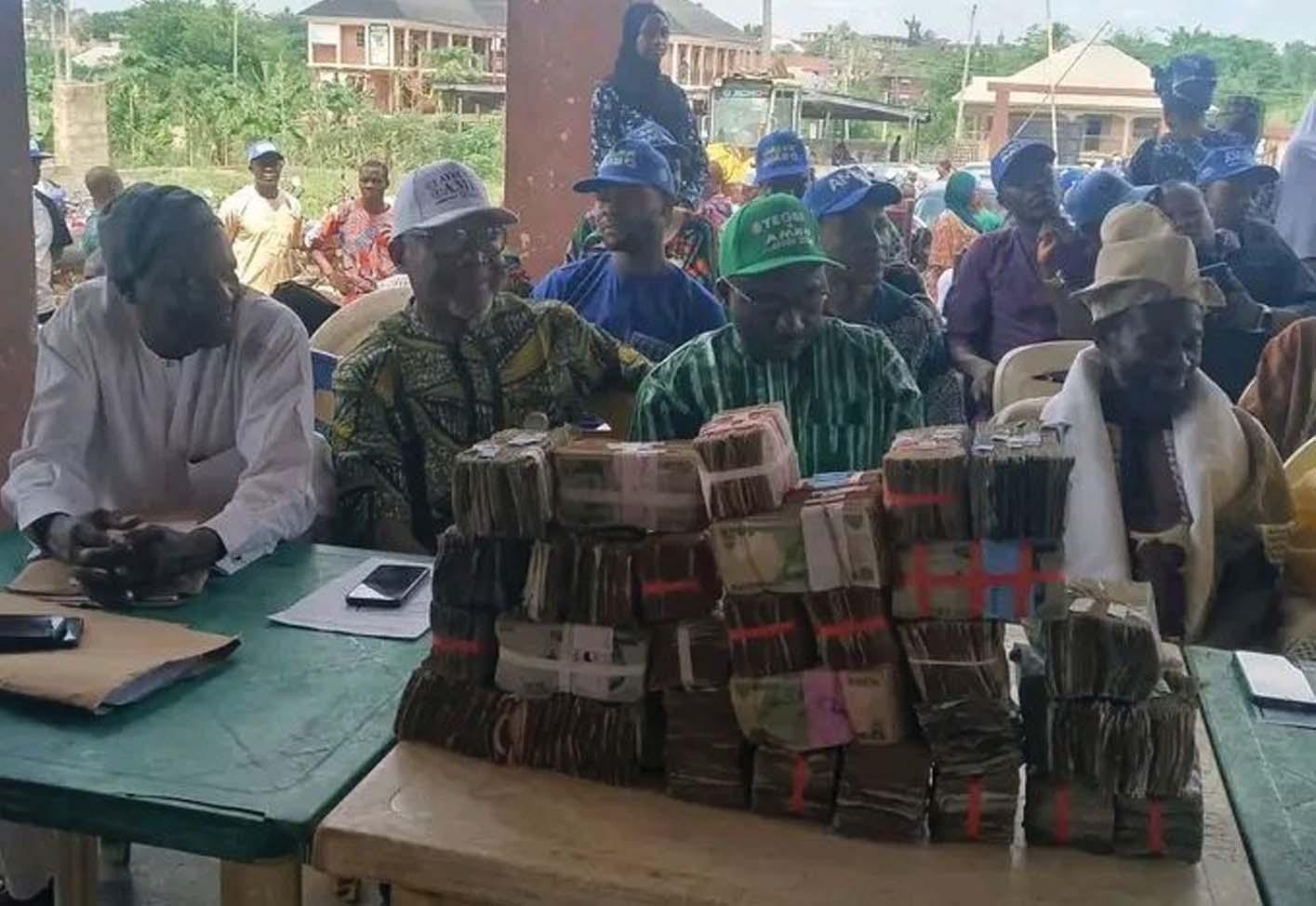
•A group of stakeholders who attended the cash disbursement programme at Ejigbo West LCDA, last week
Our Reporter
CONCERNS have begun to trail the decision of local government chairmen elected on October 15, 2022 on the pla orm of the All Progressives Congress (APC) in Osun State, following a recent empowerment programme for small-scale business owners across the state.
The chairmen, popularly described as “Yes/ No” chairmen, were said to have embarked on the distribu on of cash grants and financial support to traders and ar sans in their respecve councils.
The exercise, accord-
ing to sources who spoke with OSUN DEFENDER, was part of efforts to s mulate grassroots support for the party ahead of the August 16 gubernatorial elec on.
In a statement, leader of the chairmen’s forum, Samuel Idowu, the largescale grassroots empowerment programme targe ng more than 45,000 residents across the state’s 30 local government areas.
Idowu said the ini ave, tagged Poverty Allevia on Scheme, is designed to provide ₦50,000 cash grants to each beneficiary as startup or support capital for small-scale businesses with each local govern-
ment empowering at least 1,500 residents under the programme.
However, the exercise has drawn cri cism in several quarters, par cularly over the manner in which the funds were disbursed.
OSUN DEFENDER reports that the concerns gained momentum a er photos and videos of the programme emerged on social media, that large sums of cash were publicly displayed and shared in council areas including Ejigbo West LCDA, Olorunda, Obokun, Iwo, among others.
Some of the beneficiaries who a ended the
event told the medium that they were handed cash physically at designated venues, rather than being paid through bank transfers or other traceable financial channels.
A beneficiary who prayed not to be named added that at Olorunda local government, cash was counted and distributed in the presence of party loyalists and local officials.
“There was no structured verifica on beyond basic iden fica on, and in some cases, beneficiaries were asked to provide their voter card details before receiving the money,” the trader said.
A Facebook User, Cris Ayo also condemned the process, sta ng that it has converted the programme to an indirect means of vote buying.
Ayo wrote, “What we’re seeing in Osun now is indirect vote buying wearing the mask of “empowerment.”
“Let’s be honest: it’s 2026. We have bank transfers, USSD, Opay, Moniepoint, instant everything. Yet poli cians are s ll carrying bundles of raw cash to public squares, calling cameras, and sharing it like party rice.
“If the true goal is empowerment, why avoid traceable, transparent electronic transfers? Why not fund projects through local governments so the impact lasts beyond one afternoon? Because this isn’t about li ing people — it’s about buying memory. Give ₦5k today, so the hand that collected will remember the face that gave when elec on day comes.
“Who s ll moves like this in the age of digital money if not APC? That’s the ques on on the streets. Real empowerment is jobs, healthcare, roads, funconing schools. Not cash carnivals that disappear by nigh all and leave poverty si ng in the same spot tomorrow morning.
“LG autonomy looto. Un l councils control their funds and answer to their people, empowerment will remain a campaign costume, and the people will keep confusing handouts with development,” Ayo queried.
Reac ng to the development, a civil society organisa on, the Centre for Social Jus ce and Public Protecon (CSJPP), led by Akin Akanji, condemned the acon, describing it as a violaon of established financial regula ons in Nigeria.
He further explained that the Finance Act, alongside relevant sec ons of Nigeria’s public financial regula ons, mandates transparency, accountability and traceability in the handling of public funds, including the use of formal banking channels for disbursement.
“This development represents a flagrant disregard for the provisions of the Finance Act and other extant public finance management laws in Nigeria. Public funds, whether at the federal, state or local government level, are not to be handled or disbursed in cash in such a manner.
“By resor ng to cash distribu on, the officials have created room for opacity, poten al diversion of funds and abuse of process. This is precisely what the law seeks to prevent. Financial transac ons of this nature are expected to leave verifiable trails for audit and public scru ny,” Akanji added.
Akanji also warned that such prac ces could erode public trust in governance and undermine efforts to ins tu onalise accountability at the grassroots level.
In a related reac on, the Osun State chapter of the African Democra c Congress (ADC) cri cised the exercise, alleging that the empowerment programme was being poli cised.
The party par cularly frowned at reports that prospec ve beneficiaries were required to present their Permanent Voter Cards (PVCs) or provide voter informa on before accessing the funds.
In a press statement issued on Wednesday by its Publicity Secretary, Abosede Oluwaseun, the party warned residents to exercise cau on, alleging that the scheme lacks transparency, structure, and accountability.
The ADC said the emergence of the programme at a me when many ci zens are grappling with economic hardship and insecu-
MONDAY, APRIL 20, 2026
2026: Ogunbiyi’s Comments Ruffle Feathers In Osun APC
COMMENTS made by
Dr. Akin Ogunbiyi, a former gubernatorial aspirant under the All Progressives Congress (APC) in Osun State, during his official declara on to contest the Osun West Senatorial seat, created a s r within the party, OSUN DEFENDER reliably gathered.
OSUN DEFENDER reports that Ogunbiyi, in a viral video from last Friday in Iwo, claimed that President Bola Tinubu told the leaders of the APC that he does not expect a gubernatorial candidate from them.
In one of the video clips, the chairman of Mutual Benefits Assurance, said President Tinubu told them during a mee ng that he wanted one ‘Ademola’, whom many believed to be Osun State Governor, Senator Ademola Adeleke has the candidate for the August 15.
According to the former governorship aspirant, the President, during the meeting said he invited ‘Ademola’ because he believed he would make things easier for him.
Ogunbiyi who spoke in Yoruba language in the video, said, “When we went to meet with President Bola Tinubu. The President told us that he does not expect a candidate from us in Osun that it was Ademola that he invited so that he can spend money and make things easier for him.
“The President, said ‘Gboyega, you are the one who said you don’t want it”, so how you will win the Osun elec on,” the short viral video ended.
OSUN DEFENDER reliably gathered that while some chie ains of the APC believed Ogunbiyi spoke the truth and only said what transpired at the presiden al Villa without any harm, others were disappointed that the former PDP chie ain said such at a crucial me.
Sources who spoke with OSUN DEFENDER, said the video really ra led the party leaders, adding that the party leadership will likely convene a mee ng to address the issue and others to forestall future recurrence.
“The video took everyone by surprise. I know Dr Ogunbiyi does not mean any harm but we all know how sensi ve this period is. Any small mistake, the opponent will capitalise. That is why we need to be extra careful now. The leadership of the party will convene a mee ng to address the issue,” the APC chie ain who does not want his name in print told OSUN DEFENDER On whether the situaon might cost Ogunbiyi who was rumoured to be
the consensus candidate the Osun West senatorial cket, the APC leader said he does not expect things to change because of that.
“No, if he has been pencilled down as the consensus candidate of our party for Osun West, I don’t expect the video to change anything. As I said, he did not mean any harm and it would be an injus ce to change the decision based on a one-minute video a few months before our gubernatorial elec on,” he
added.
Meanwhile, Ogunbiyi has claimed that he was quoted out of context, adding that the video misrepresented his thought process and intended message.
In a statement signed by Engr Dare Ojo, the senatorial aspirant, said, “For the avoidance of doubt, this claim is en rely false. Dr Ogunbiyi was quoted completely out of context, and the circulated 30-second video grossly misrepresents his thought process and in-
tended message.
“At the mee ng with party leaders and stakeholders, Dr Ogunbiyi made a cri cal reference to the poli cal horse-trading and development surrounding a empts by Governor Adeleke—who, by all indica ons, fears losing his re-elec on bid in the face of the reinvigorated efforts of the Osun APC—to gain entry into the APC through the backdoor.
“Dr Ogunbiyi explained how former Governor Ade-
gboyega Oyetola, alongside leaders of the Osun APC, led a delega on to President Tinubu to firmly assure him of the party’s strength and readiness to dislodge the incumbent administra on.
“The Osun APC delegaon not only demonstrated the party’s clear pathway to victory in the August 15 governorship elec on but also exposed how the Adeleke-led government has been undermining federal government ini a ves and unfairly demonising
Rising Energy Costs Capable Of Worsening Nigeria’s
ESodiq Yusuf
CONOMIC experts have a ributed Nigeria’s latest rise in infla on to increasing fuel and energy costs, warning that the trend could worsen in the coming months if structural issues are not addressed.
Speaking with the News Agency of Nigeria in Abuja on Sunday, the experts noted that higher petrol and diesel prices have significantly increased transport fares, logis cs expenses and the cost of distribu ng goods across the country, with direct consequences for consumer prices.
A development economist, Ken Ife, said the recent up ck in infla on reflects not only rising energy costs but also deep-rooted inefficiencies in the oil and gas sector. He called for urgent policy measures to stabilise prices and ease pressure on households.
According to him, Nigeria’s infla on rate, which rose slightly to 15.38 per cent in March a er 12 consecu ve months of decline, was largely driven by increases in fuel and energy prices. He explained that energy remains central to infla on dynamics because of its role in transporta on, produc on and distribu on.
“When energy prices go up, petrol and diesel prices rise, and these drive the enre transporta on system.
The cost of moving food, goods and people increases, which translates directly into higher prices across all sectors,” he said.
He warned that the situa on could deteriorate further on a month-on-month basis. “You will see monthon-month infla on going drama cally up,” he added.
Mr Ife also pointed to rising gas prices, which are ed to interna onal benchmarks, as another factor pushing up electricity tariffs and produc on costs.
“As gas prices increase, the cost of power genera on rises, and consumers feel it in their electricity bills. Manufacturers also face higher costs due to increased energy and logis cs expenses, leading to a general price increase,” he said.
While acknowledging the impact of global factors such as tensions in the Mid-
Concerns
•Continued from page 1
rity raises ques ons about its true intent, par cularly with the governorship elecon just months away.
According to the party, the requirement for applicants to submit sensive personal informa on —including voter card details, Na onal Iden fica on Number (NIN), Bank Verifica on Number (BVN), and bank account details poses significant risks.
dle East, he stressed that Nigeria’s infla onary pressure is compounded by domes c structural challenges. He cri cised the handling of crude oil alloca on, arguing that local refining capacity is not being priori sed in line with exis ng laws.
Referencing opera ons at the Dangote Refinery, he said inadequate crude supply con nues to hinder opmal produc on.
“Local refiners require sufficient crude to operate efficiently, but current alloca ons fall short. This forces them to source crude externally at higher costs, including addi onal shipping and insurance charges, which ul mately push up domes c fuel prices,” he said.
He urged authori es to priori se crude supply to domes c refineries and ensure compliance with policies that allow transac ons
The statement read, “We are deeply concerned about the basis for requesting sensi ve personal informa on under the guise of a poverty allevia on programme. Such data could expose vulnerable ci zens to fraud, iden ty the , and undue poli cal manipulaon. These are clear red flags.”
The party accused the All Progressives Congress (APC) of orchestra ng the
the President among the Osun electorate.”
Also, the All Progressives Congress in Osun in a statement by its spokesperson, Kola Olabisi, said the video was twisted, describing Ogunbiyi as one of the dependable chie ains of the party.
“We want to state here unequivocally that Dr, Ogunbiyi is one of our credible, trusted and dependable chie ains of our party who would never be a party to the advancement of any misfortune for our party in any form.
“The Ile-Ogbo-born insurance magnate-turned poli cian has been demonstra ng this uncommon a ribute of a virtuous team worker with the mission of improving the status of our party since the me he made up his mind to be in the progressive camp in the state.
“We don’t have any reason whatsoever to doubt the uncondi onal poli cal commitment and unalloyed loyalty of Dr. Ogunbiyi, a Senatorial aspirant of our party in the West Senatorial District of the state, who has been giving its all for the upli ment of the party,” Olabisi stated.
Inflation – Experts
in naira, no ng that such steps would help reduce costs and ease infla onary pressure.
Mr Ife cau oned against returning to fuel subsidies or relying on increased borrowing to cushion economic hardship, describing both op ons as unsustainable.
“The focus should be on fixing structural issues in the energy sector to ensure long-term stability,” he said.
Another economist, Chidi Nwanze, linked the infla on increase to renewed pressures on transporta on and service costs. He said that although the rise was marginal, it highlights the con nued influence of logis cs costs, exchange rate fluctua ons and energy prices on infla on trends.
A financial analyst, Segun Ibikunle, expressed concern over the sharp increase in month-on-month
exercise as part of a broader strategy to influence voters, insis ng that any genuine social interven on should priori se data protec on and the dignity of beneficiaries.
“We strongly condemn this as yet another calculated a empt to manipulate and deceive the people of Osun State for par san gain,” the statement added.
The ADC further point-
infla on, describing it as a more immediate risk indicator.
“The jump to 4.18 per cent month-on-month shows that price increases are accelera ng in the short term. If sustained, it could reverse the gains recorded over the past year,” he said.
Data released by the Na onal Bureau of Sta s cs showed that Nigeria’s headline infla on rose to 15.38 per cent in March, up from 15.06 per cent recorded in February. On a month-onmonth basis, infla on stood at 4.18 per cent, compared with 2.01 per cent in the previous month.
The bureau iden fied food and non-alcoholic beverages, restaurants, accommoda on services and transport as the major contributors to both year-onyear and month-on-month infla on increases.
ed to ongoing controversies surrounding local government administra on in the state, no ng that unresolved legal and cons tuonal issues make any such ini a ve ques onable.
It also cri cised the broader economic situa on in the country, arguing that the Federal Government’s “renewed hope” agenda has instead resulted in increased hardship and insecurity for many Nigerians.
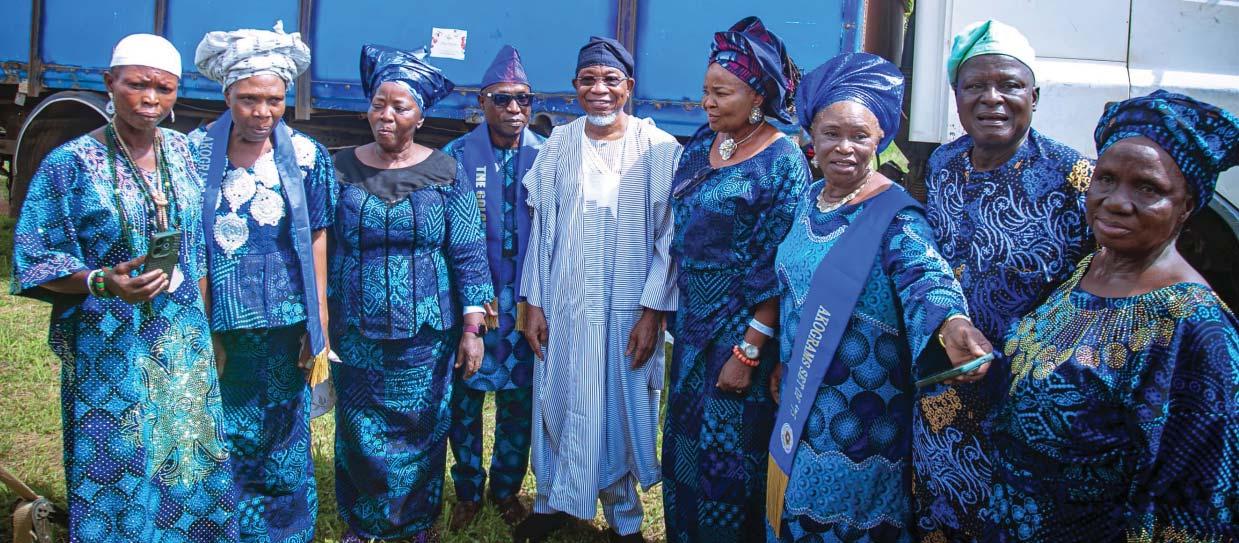
•Former Minister of Interior, Ogbeni Rauf Aregbesola, in company of some of his former classmates at Akoko Anglican Grammar School, Arigidi Akoko at a function in Ikare Akoko, Ondo State, over the weekend
WITH most banks holding na onal licenses now mee ng the new capital requirements, there is a mix of relief, expecta on and, in some quarters, something close to delusion. If history is any guide, the proper response at the end of this exercise should be one of cau ous, measured op mism.
A similar mood followed the 2005 banking reforms under Charles Soludo. That op mism, in retrospect, proved misplaced. The wider economy did not experience the transformaon many had an cipated. Today, Nigeria s ll contends with deep structural weaknesses — widespread poverty, persistent inflaonary pressure alongside slow growth, and a rising de of youth unemployment with clear implicaons for social stability. The promise of reform has not translated into broadbased prosperity.
This should not be surprising. There is a structural weakness at the heart of the system. Nigeria’s banking framework remains largely anchored to the Anglo-Saxon model, which is inherently short-term in orienta on. It priori ses liquidity and quick returns over long-term investment in produc on. Even in its home base, successive Bri sh governments since 1945 have struggled with the limita ons of this model, par cularly in driving compe veness and export growth.
It is for this reason that
“Nigeria cannot afford another cycle of inflated expectations followed by disappointment. Recapitalisation is only a step. The real work lies in building a financial system that supports long-term investment, job creation and sustained economic growth”

Recapitalising
The Banks
a en on has o en turned to alterna ves. The German “Länder” banking system is built on pa ent capital and enduring relaonships between banks and industry. It has been central to Germany’s economic resilience since the a ermath of World War II. There is an irony here: elements of long-term financial intermedia on observed in parts of Nigeria, especially in Ijesaland, were studied and adapted in Europe, reportedly drawing the interest of O o von Bismarck.
The implica on is straigh orward. Sustainable development cannot rest on short-term capital. Nigeria must place greater emphasis on development finance built on pa ence and scale. A useful reference point is Brazilian Development Bank (BNDES), established in 1952 and consistently strengthened over me. It has provided long-tenor financing, in some cases spanning decades, and remains central to Brazil’s industrial growth.
•Professor Soludo’s banking recapitalisation was not the silver bullet, it was dreamt to be. Decades after 2005 restructural dysfunction inhibiting Nigeria’s Development has no gone away.
There is also a case for reviving coopera ve finance. The reforms of 2005 strengthened the commercial banking sector but weakened community-based financial ins tu ons. Yet, these ins tu ons once played a vital role in suppor ng agriculture and small-scale enterprise, par cularly in the 1950s and 1960s. Their decline has le a gap that commercial banks have not filled.
Countries such as the Netherlands offer a useful example. Coopera ve and agricultural banks there con nue to underpin produc vity, helping a rela vely small country
HIGHLIGHTS
•The response to the strengthening of banks’ capital base must be measured; it is not yet Uhuru.
•The priority should be the mobilisation of patient, long-term capital to support sustainable development.
•New technology must be central to advancing financial inclusion and bringing the underbanked into the formal financial system.
•Nigeria has an overabundance of small businesses; finance should be directed towards scaling them up as a foundation for a competitive, increasingly export-oriented economy.
become one of the world’s leading food exporters. The lesson is not to copy wholesale, but to adapt what works.
There is, in addi on, the ques on of how the newly strengthened banks deploy their enlarged capital base. If it is channelled largely into government securi es and short-term trading, the broader economy will see li le benefit. The real test will be whether credit flows to manufacturing, agriculture and small businesses on terms that allow them to grow and compete.
Regula on must also play its part. Capital adequacy, on its own, is not a guarantee of economic impact. The authori es must ensure that lending prac ces align with na onal development priori es, without undermining pruden al standards. It is a delicate balance, but one that cannot be avoided.
OSUN DEFENDER
Publisher – Moremi Publishing House Ltd. Deputy Editor – Michael Bamigbola Asst. News Editor – Yusuf Oketola Deputy Photo Editor – Shola Aderinto Deputy Graphics Manager – Zainab Olalere Produc on Controller – Petkola Taiwo Ibitowa
OSUN DEFENDER is published by Moremi Publishing House Limited, Behind Oranmiyan Building, Gbodofon, Off Gbongan Road, Osogbo, Osun State.
ISSN : 0794-8050
Telephone : 0809-301-9152
Website : www.osundefender.com/index.php e-mail : osundefenderhq@gmail.com osundefenderbank@gmail.com All correspondence to the above email addresses.
Nigeria cannot afford another cycle of inflated expecta ons followed by disappointment. Recapitalisa on is only a step. The real work lies in building a financial system that supports longterm investment, job crea on and sustained economic growth.

MONDAY, APRIL 20, 2026 VOL. 21 NO 31 www.osundefender.com, email: osundefenderbank@gmail.com
OSUN mega schools could be part of the solu on to address the problem of out of school children in Nigeria considering the level of insecurity and school children adop on in the north today. It is said that in Nigeria, about 13.5 million children are not in school, even though primary educa on is officially free and compulsory. And though many projects have been made to reduce this frightening figure, it seems Nigeria is nowhere near tackling this issue which poses social and security problems to the whole country. But underu lised Osun mega schools have the capacity to reduce out of school children.
I want to appeal to President Tinubu that 11 Osun mega schools have the capacity to reduce the number of 13.5 million out of school children in Nigeria. There is need for President Tinubu to partner with Osun State to address the problem of out of school children in Nigeria.
Nigeria Economic Analysis
There are 11 mega schools that Rauf Aregbesola administra on constructed, 10 are being used, the 11th one is 95% completed . The schools can accommodate 3000 students each, but those schools were underu lised by former Governor Oyetola and President Tinubu can partner with Osun State to use the mega schools for out of school children in Nigeria.
I want to call for federal-state partnership to use the mega schools. Federal-State partnership could be introduced in these mega schools so that pupils could come from any part of Nigeria to Osun to learn and enjoy the facili es in these schools as a solu on to 13.5 out of school children in Nigeria. The truth now is that Aregbesola has built schools that can reduce the number of out of school children in Nigeria. I want to appeal to President Tinubu to use Osun mega schools for out of school children.
One of the landmark ini a ves of Rauf Aregbesola as former governor of Osun State was the introduc on of Osun Sukuk fund and Sovereign Sukuk in the domes c financial markets in 2013 to raise N11 billion to finance 11 Osun sukuk schools. Each of the 11 mega schools has 72 classrooms with a capacity for 3,000 pupils (one of the schools is s ll under construc on).
Three of the schools are in Osogbo, the state capital – Ataoja Grammar School, Fakunle Unity School and Osogbo Grammar School. Others are Ilesha Grammar School, Wole Soyinka Government High School, Ejigbo, Akinorun Grammar School, Ikirun, High School, Ila, Adven st Grammar School,
“History will remember Rauf Aregbesola for indeed some major developments in Nigeria, school feeding programme, Sukuk bond for national development, first governor to embrace 4th industrial revolution etc. Aregbesola has encouraged the issuance of Sukuk in Nigeria because we needed to diversify the instrument in the bond market. Aregbesola worked hard to introduce sukuk fund for education in Nigeria”
INWALOMHE
Osun Mega Schools And Out-OfSchool Children In Nigeria
Ede, Oduduwa Secondary School, Ile-Ife, Ayedaade Grammar School, Ikire. Iwo High School is s ll under construc on.
Educa on
However, the schools, which cost about N1.5billion each, were underu lised by former Governor Oyetola– with no corresponding popula on. Many of the schools have just 1,000 pupils, which means that about 2,000 spaces in some of the classrooms are deserted. The school located in Ejigbo has about 500 pupils of the 3,000 the building can accommodate. Only one school is opera ng at full capacity. Pressident Tinubu should take note that Osun State has 11 mega schools that can reduce the number of 13.5 million out of school children in Nigeria. The mega schools, which are two-storey buildings, are now underu lised. One of them, Fakunle Unity Secondary School, has over 2,000 pupils while others have below it. The majority of
THE catch phrase in the tle is credited to the unforge able Vladimir Ilyich Ulyanov [Lenin], leader of the Great October Bolshevik revolu on of 1917 in Russia. A er the February Revolu on in 1917, social and poli cal chaos characterised the Russian society increasingly. At the First All-Russia Congress of Soviets in June-July dominated by delegates of the Socialist Revolu onaries (285 seats), Mensheviks (248 seats) and Bolsheviks (105 seats), the Chairman of the Petrograds Soviets, Irakli Tsereteli, posed the historical challenge of Russian poli cs in the ques on: can any delegate name a party that would risk taking power and accep ng full responsibility for everything happening in Russia? On the second day of Congress when it was Lenin’s turn to speak, he started boldly by saying “There Is!” There was only loud applause from the Bolsheviks and laughter from the rest of the hall. However, by October, the Bolshevik revolu on and total takeover of power happened.
Fast forwards to Nigeria in 2026, the historical challenge to the social, economic and poli cal crises of Nigeria would likely be posed today in such a ques on as: can any party confidently come out to say it will return Nigeria to a Genuine Federal Republic if given power at the centre in 2027?
Expecta on of a firm posi ve answer from the All Progressives Congress (APC) was what made Nigerians, against all odds, vote out an incumbent government and party at the centre in 2015. A er 4 years of “Change” plus 4 years of “Next Level” with APC’s Buhari, and now the ongoing 3rd of 4 years with APC Na onal Leader that sold Buhari to Ni-
the remaining nine schools have about 900 pupils a ending those schools.”
It is on record that the first set of Sukuk projects emerged from Osun State, hence, the Sukuk projects in Nigeria will ever remain the bequeathed legacy of former Governor Rauf Aregbesola who was the first Nigerian to introduce it. In Osun, Sukuk funds were used to finance construc on of educa on projects, among other development ini a ves with which former Governor Aregbesola laid a solid founda on for the future of the state which helped to convince former President. President Muhammadu Buhari when he described the newly completed Sukuk steel structure Osogbo Government High school as an educa onal legacy that should be emulated by other states of the federa on, thanking the former governor for exposing Nigeria to the Sukuk market which has drawn increasing interest from sovereigns, mul lateral ins -
“There
tu ons, mul na onal and na onal corpora ons both from developed and emerging economies to finance investments in a wide range of economic ac vi es and development projects.
Nigeria Economic Analysis
When former Governor Aregbesola took sukuk bond, a sec on of the media said that Aregbesola wanted to Islamize Nigeria. Now that sukuk projects have been commissioned and used, the media is silent. It is on record that the first set of Sukuk projects emerged from Osun State, hence, the Sukuk projects in Nigeria will ever remain the bequeathed legacy of former Governor Rauf Aregbesola who was the first Nigerian to introduce it. The overall direc on and potenal of the market are certainly well recognized, par cularly in its role in contribu ng towards greater economic development of Osun. There is significant poten al for the Sukuk, With this calibre of governments following suit to obtain Sukuk, it is now crystal clear that Aregbesola is not just a leader, but a leader that set posi ve pace globally.
Educa on
History will remember Rauf Aregbesola for indeed some major developments in Nigeria, school feeding programme, sukuk bond for na onal development, first governor to embrace 4th industrial revolu on etc. Aregbesola has encouraged the issuance of sukuk in Nigeria because we needed to diversify the instrument in the bond market. Aregbesola worked hard to introduce sukuk fund for educa on in Nigeria. Osun took the ini a ve and helped in introducing it to Nigeria.
•Read full article on www.osundefender.com
•Inwalomhe Donald writes from Osogbo, Osun state. He can be reached via inwalomhe.donald@yahoo.com
Is Such A Party”
gerians: now President - Bola Ahmed Tinubu, Nigeria is as far away from a genuine federal republic as it ever was and mired in unremitted insecurity challenges, sec onal and sectarian extremisms and economic woes.
Having escaped from a party with a “stealing is not corrup on” philosophy to where we are now with an imperial party and government, the ques on remains “which party can come out boldly to commit to the return of Nigeria to a true Federal Republic if given power at the centre in 2027?” If APC of all par es can renege and fail woefully on that promise, is there then such progressive party today? If not, what is to be done, considering that the ul mate solu on to Nigeria’s mulfaceted problems, without doubt, is a return to its original self – A Federal Republic of Nigeria?
This is the key ques on young people must ask themselves to arrive at “what is to be done” today ahead of 2 years’ me - then organise around their resolu ons. They must realise and accept that a hundred more general elec ons in 800 years would never deliver anything good so long as we remain a fake and self-deceiving Federal Republic centrally hooked by the lazy, unpatrio c elites on control, sharing and mismanagement of “free” oil-rent money, without any sense of social responsibility. In the specific context of an almighty unitary, presiden al system, what we need are poli cians gathered in a fresh poli cal party commi ed to the restructuring deal!
Accordingly, young people especially and progressive popular organisa ons at large should look beyond par es as presently cons tuted and composed; they should look beyond ethnic and religious divides in the readiness to mobilise behind an assemblage of poli cians with a track record of commitment to TRUE FEDERALISM, vo ng only for such individuals for the state houses of assembly all the way to the President. Once all elec ons are done with by 2027, their task is to organise the mass pressure movement to ensure cons tuonal return to a TRUE FEDERAL REPUBLIC OF NIGERIA “by all means necessary.”
On the basis of the current virus-ridden and wrong cons tu onal opera ng system, no quantum of good inten on or “integrity” by any Governor or President can make him or her deliver sustainable democra c or development dividends. Not having any love or good inten on for the people in the first place, and being slaves of foreign powers indeed, the warped opera ng unitary system is a readymade excuse for resounding failure; whereby they can only keep looking back a er exit and contemptuously saying “I’ve done my best, Nigerians are more difficult to govern than cows.”
Once above is understood and accepted, next is organisa on and ac on! Everything else is deceit and exercise in fu lity and a delay of the “judgement day” for Nigeria.
OSUN DEFENDER is published by Moremi Publishing House Limited, Behind Oranmiyan Building, Gbodofon, Off Gbongan Road, Osogbo, Osun State. All correspondence to the Deputy Editor, MICHAEL BAMIGBOLA, Telephone: 0809-301-9152. ISSN: 0794-8050. Website: www.osundefender.com Email: osundefenderbank@gmail.com, osundefenderhq@gmail.com