MONDAY, MARCH 16, 2026
MONDAY, MARCH 16, 2026
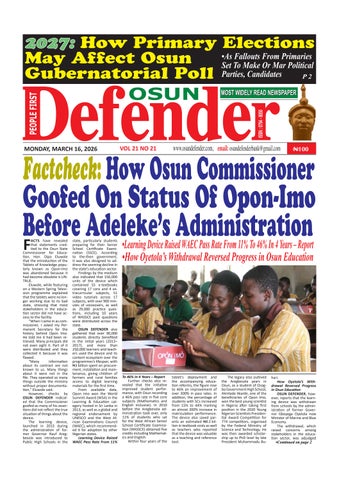
FACTS have revealed that statements credited to the Osun State Commissioner for Educaon, Hon. Dipo Eluwole that the introduc on of the Tablets of Knowledge popularly known as Opon-Imo was abandoned because it had become obsolete is UNTRUE.
Eluwole, while featuring on a Western Spring Television programme explained that the tablets were no longer working due to its bad state, stressing that most stakeholders in the educaon sector did not have access to the facility.
“When I came in as commissioner, I asked my Permanent Secretary for the history behind Opon Imo. He told me it had been retrieved. Many principals did not even sight it. Part of it were distributed and they collected it because it was flawed.
“Many informa on about its contract are not known to us. Many things about it were not in the file. They operated so many things outside the ministry without proper documentaon,” Eluwole said.
However, checks by OSUN DEFENDER indicated that the Commissioner goofed as many of his asserons did not reflect the true situa on of things about the device.
The learning device, launched in 2013 during the administra on of former Governor Rauf Aregbesola was introduced to Public High Schools in the
state, par cularly students preparing for their Senior School Cer ficate Examina on (SSCE). According to the-then government, it was also designed to address the seeming decline in the state’s educa on sector.
Findings by the medium also indicated that 150,000 units of the device which contained 55 e-textbooks covering 17 core and 4 extracurricular subjects, 51 video tutorials across 17 subjects, with over 900 minutes of voiceovers, as well as 29,000 prac ce quesons, including 10 years of WASSCE past ques ons were distributed across the state.
OSUN DEFENDER also gathered that over 90,000 students directly benefited in the ini al years (2013–2017), and more than 250,000 learners and teachers used the device and its content ecosystem over the programmes’s lifespan, with ₦3 billion spent on procurement, installa on and maintenance, giving children of farmers and rural families access to digital learning materials for the first me.
From available data, Opon Imo won the World Summit Award (WSA) in the Learning & Educa on category hosted in Sri Lanka in 2013, as well as a global and regional endorsement by UNESCO and the West African Examina ons Council (WAEC), which recommended it for adop on by other Nigerian states.
Learning Device Raised WAEC Pass Rate From 11%
•Learning Device
Pass Rate

To 46% In 4 Years – Report
Further checks also revealed that the ini a ve improved student performance, with Osun recording a 46% pass rate in five core subjects (Mathema cs and English inclusive). In 2010 before the Aregbesola administra on took over, only 11% of students who sat for the West African Senior School Cer ficate Examinaon (WASSCE) obtained five credits including Mathematics and English. Within four years of the
tablet’s deployment and the accompanying educaon reforms, the figure rose to 46% an improvement of over 300% in pass rates. In addi on, the percentage of students with 5Cs increased from 15% to 44% marking an almost 200% increase in matricula on performance. The device also saved parents an es mated ₦8.2 billion in textbook costs as well as teachers who reported that the device was valuable as a teaching and reference tool.
The legacy also outlived the Aregbesola years in Osun, as a student of Osogbo Government High School, Akintade Akanbi, one of the beneficiaries of Opon Imo, won the best young scien st in Nigeria a er taking first posi on in the 2020 Young Nigerian Scien sts Presidenal Award Compe on for 774 compe tors, organised by the Federal Ministry of Science and Technology. He was then awarded scholarship up to PhD level by late President Muhammadu Bu-
hari. How Oyetola’s Withdrawal Reversed Progress in Osun Educa on OSUN DEFENDER, however, reports that the learning device was withdrawn from schools by the administra on of former Governor Gboyega Oyetola now Minister of Marine and Blue Economy.
The withdrawal, which raised concerns among stakeholders in the educaon sector, was adjudged
MONDAY, MARCH 16, 2026
THE primary elec on to nominate candidates for various elec ve offices for the 2027 general elec ons coming up before the August 15 gubernatorial elec on in Osun State may be a major determiner in the eventual winner of the poll, OSUN DEFENDER reports.
It would be recalled that the Independent Na onal Electoral Commission (INEC) has fixed April 23 – May 30, 2026, as the date for poli cal par es to conduct primaries to nominate those who will be represen ng their par es for the various poli cal offices at the general elec ons.
As aspirants across the country gear up for the date and intensify efforts to get the support of party leaders and members to flag the banner of their poli cal pares, the situa on is already causing tension in the camp of major poli cal par es in Osun State.
Poli cal gladiators believe the a ermath of the primary elec on might have a big impact on the August 15 poll as those who feel cheated or abandoned may work against the party or adopt a sit-down and look approach if they could not leave the party.
The situa on is likely to affect the three major poli cal par es – Accord (A), All Progressives Congress (APC) and the African Democra c Congress (ADC).
However, poli cal observers said the APC might be the worst hit among the par es, par cularly with the defec on of the six Federal lawmakers from the Peoples’ Democra c Party into the party as well as the absence of the party from government in the past three years.
OSUN DEFENDER reliably gathered that there was already an internal wrangling within the APC as some party chie ains who have interest in contes ng the 2027 elecons, par cularly, the Naonal Assembly seats are already having the feeling that their aspira ons might not come to frui on.
It was also gathered that among the Na onal Assembly lawmakers who defected to the APC in 2025 from the PDP, only two - Senator Francis Fadahunsi (Osun East) and Hon Wole Oke, (Obokun/ Oriade Federal Cons tuency) are likely to get an automa c return cket to the Senate and House of Representaves. The situa on, OSUN DEFENDER gathered might create further division within the APC in Osun State as the former na onal secretary of the party, Senator Iyiola Omisore was rumoured to be eyeing the Osun East senato-
rial cket having been disqualified from contes ng the gubernatorial primaries.
However, sources within the party told OSUN DEFENDER that the choice of Mr. Benjamin Adere as the running mate to Mr Bola Oyebamiji was to prevent Omisore from ge ng the senatorial cket as both policians are from Ile-Ife.
Also, the camp of the other decampees might not be in tandem with the possibility of not returning to the Na onal Assembly.
Apart from the new members, OSUN DEFENDER gathered that there is likely to be an uproar at the camp of some party chie ains who are eyeing the Senatorial and House of Representa ves ckets as sources said there was already a plan as to who one of the leaders of the party is planning to give the ckets.
For Osun Central, OSUN DEFENDER gathered that one of the disqualified gubernatorial aspirants, Mr. Kunle Adegoke (SAN) is likely to get the senatorial cket.
However, the development may not sit well within the camps of the former commissioner for Local Government and Chie aincy Ma ers, Prince Adebayo Adeleke, who is also said to be interested in the seat. Adeleke is one of the foot soldiers of the APC in Osun State.
The situa on is likely to be the same in the camp of the Renewed Hope Ambassador Coordinator for Osun State, Mr. Sunday Akere, who is also rumoured to be interested in the seat.
Meanwhile, for the Osun West Senatorial District, an Insurance guru, Mr Akin Ogunbiyi has claimed that he has been promised the cket.
Ogunbiyi who hails from Ileogbo, headquarters of Ayedire Local Government and a former gubernatorial aspirant claimed that APC leaders have told him that he would be the consensus candidate of the party for the Senatorial District.
Giving Ogunbiyi the cket as the consensus candidate might cause fric on within the APC in Osun West as others are also eyeing the senatorial seat.
Among them is a former Corps Commander of Amotekun Corps in Osun State, Brigadier General Bashir Adewinmbi (retd.), who had already announced his inten on to contest the senatorial seat under the APC.
Meanwhile, the situa on is likely to play out for the House of Representa ves and House of Assembly seats
with rumours that some aspirants have already got the blessing of one of the leaders of the party.
Speaking with OSUN DEFENDER, a chie ain of the APC who does not want his name in print because he was not authorised to speak, confirmed that some people had been promised ckets in the party.
“It is true. Some chieftains of the party have been promised the Senatorial and House of Representa ves ckets and if we do not manage the situa on very well, it might cause a problem for Mr Bola Oyebamiji at the August 15 poll.
“Oyebamiji has no major say on who gets the cket but he would be the one to run from house to house to seek reconcilia on a er the primary if any issue arises. That is why those in charge of the party should be fair and not impose candidates on us,” the APC chie ain stated.
OSUN DEFENDER reports that the Na onal Secretary of the APC, Dr. Ajibola Basiru, had also warned the leadership of the party in Osun State against handpicking candidates.
The former Senate spokesperson warned that handpicking candidates where there are many aspirants may not spell doom for the party’s chances in the elec ons, calling for free and fair primaries.
“Let standard bearers for the posi on of the House of
Assembly, House of Representa ves and the Senate emerge through free and fair primaries. We should have winners and runnersup emerging fairly. It’s in that light that we can hold the party together,” Basiru noted.
For the Accord Party, poli cal observers believe that the situa on might not be as tense as that of the APC as most of the federal and state lawmakers are expected to get automa c return ckets.
However, the party is also said to be confronted with problems arising from the selec on of those who will get the ckets of the federal lawmakers who defected from the PDP to the APC.
OSUN DEFENDER gathered that the incumbent governor Ademola Adeleke already has those he plans to give ckets of some of the decampee seats, a situa on that other aspirants might not fully align with.
It was also learnt that giving some incumbent lawmakers ckets may cause
division within the party as some party chie ains and members are already opposed to such a scenario.
One of such issues is the ongoing cold war among members of the party in Ede North, Ede South, Egbedore and Ejigbo Federal Cons tuency who are opposing the third-term bid of the lawmaker represen ng the cons tuency, Hon. Bamidele Salam.
Salam who hails from Awo, Egbedore local government is one of the core loyalists of Governor Adeleke and is set to clinch the party’s cket again. However, there is already a strong opposi on to his bid from Ejigbo local government as party members from the area claim it is their turn to produce the candidate of the party for the federal cons tuency.
“Hon. Salam has served two terms which never happened before in the federal cons tuency and he is now seeking a third term. We are not going to accept that.
“We have people who
THE African Democra c Congress (ADC) has called on members, stakeholders and aspirants in Osun State to begin prepara ons for the party’s congresses set to commence in April.
According to a statement signed by Oluwaseun Abosede, Chairman, Directorate of Media and Publicity, Osun ADC, the schedule aligns with the direc ve issued by the party’s Na onal Headquarters for the conduct of congresses across all states of the federa on.
He said the exercise will kick off on Tuesday, April 7, 2026, with polling unit and ward congresses. This will be followed by local government congresses and the elec on of one-man delegates to the Na onal Conven on on April 9, senatorial and state congresses on April 11 and will culminate in the Na onal Conven on slated for April 14, 2026.
Oluwaseun urged members across all polling units, wards and local government areas in Osun State to mo-
bilize fully and par cipate in the process, emphasising the need for strict adherence to the guidelines from the Naonal Secretariat.
He added that the congresses form part of the ADC’s broader effort to strengthen its internal structures and ensure effec ve representa on at all levels
ahead of the 2026 Na onal Conven on.
“The metable is consistent with the na onal schedule earlier released by the party’s leadership, which aims to renew its leadership hierarchy from the grassroots to the na onal level in prepara on for future elecons,” Abosede said.
can contest and win elec ons in Ejigbo too and we are not going to sit down and allow what is ours to go to another place again. Salam should be honourable and step down for another person to contest,” Mr Adeolu Olabanji, a member of the Accord Party in Ejigbo told OSUN DEFENDER
For the African Democra c Congress, the 2027 primary elec on may not cause ripples within the party as the ADC is new and would not have many gladiators eyeing poli cal posions.
However, observers warned that the leadership of the party must guide against the imposi on of candidates and allow members to choose those who will represent the party at the polls.
“I don’t see ADC having much issue because as we all know, it is a newly formed coali on party. However, the leadership of the party should ensure that they give the members the free hand to elect whoever will represent the party in the elecons.
“This is very important as ADC might be the party that will benefit most from the fallout from the 2027 primary elec on in the APC and the Accord Party but they must ensure that their own house is in order too,” Mr. Taiwo Mogbonjubola, a poli cal analyst told OSUN DEFENDER
•Continued from page 1
more poli cal than visionary, as it further affected the rankings of the state’s students’ in local and foreign external examina ons.
Some residents of the state also decried the move, stressing that the withdrawal reversed the progress achieved over the years in the state’s educaon sector.
A parent, Mrs Felicia Adeola submi ed that the sudden withdrawal of the tablets from students by the Oyetola administra on, impeded those who had made progress with it from fully op mising its benefits.
“The tablet was supposed to make things better. Some students had actually benefi ed from it. But the withdrawal was sudden. It was just too poli cal to have disallowed students who had started preparing for WAEC in 2020 and subsequently from its usage.
“You can see the results and how the educa on sector has dwindled since then. That is what we say when we demand good governance, Opon-Imo achieved a lot, but cu ng it short hampered its lifelong projec ons,” Mrs Adeola said. Similarly, Governor
Ademola Adeleke carpeted the Oyetola administra on on the withdrawal of OponImo, saying it had increased the poor performance of students in SSCE Examinaons, direc ng the revilisa on of the nine computer centres located in selected schools across the nine federal cons tuencies of the state, where more than 10,000 Youths trained under the O’YES-Tech Scheme were domiciled to handle technical and repair issues of the e-learning gadgets.
As at the me of filing this report, Adeleke, however, has yet to reintroduce the tablets.
IN the o en quoted words of Italian poli cal philosopher Antonio Gramsci,
“The crisis lies in the inability to move away from a discredited system of relaonships; a new society therefore cannot be born. In the interregnum, all manner of morbid symptoms reveal themselves. We are in the age of monsters.”
Gramsci, who was brutally murdered by the Fascist guards of Benito Mussolini, reached the height of his influence in the 1920s. Yet his reflec ons remain painfully relevant today. He might well have been describing present day Nigeria, where even the use of the word federal in the name of the country has long been contested.
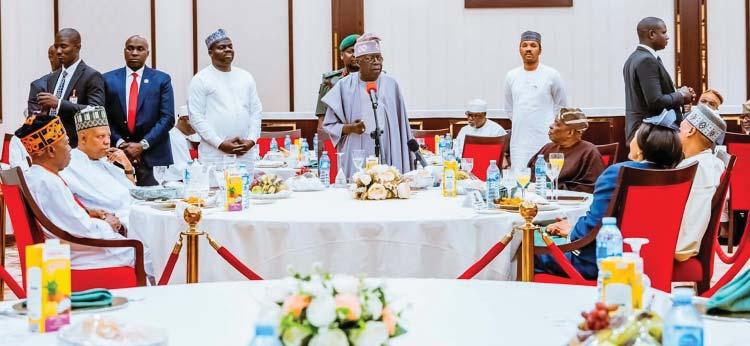
These contradic ons resurfaced during a recent interac on between the President and senior media execu ves at the Presiden al Villa. In the midst of cordial exchanges, the President stressed that cri cism should not be directed at the central government alone. He argued that subna onal governments and local councils must also be scru nised.
That point is fair. However, any serious examina on of failing subna onal governments must be viewed in the wider context of a defec ve, an federal cons tu on that inexplicably lists sixty eight responsibili es on the Exclusive Legisla ve List. Such an arrangement reflects the prac ces of a unitary state, not a federa on.
The gathering at the Villa was too
“Nigeria must confront the reality that no amount of political rhetoric can substitute for structural reform. Until the country embraces genuine federalism, empowers its constituent parts and strengthens institutions rather than individuals, the crisis of the interregnum will persist”

polite to highlight the troubling case of Ogun State, where local government funds have reportedly been withheld and the third er of government has ceased to func on effec vely. This failure has had serious consequences. It is worth recalling that when similar events occurred in Lagos State during the current President’s tenure as governor, the media was loud and uncompromising in its cri cism, and rightly so. The same standards should apply today. Meanwhile, in this interregnum,
the morbid symptoms have intensified. Criminality and violence in ungoverned spaces have grown more widespread, posing a direct challenge to the stability of the state. The recent bombardment of Iran has exposed an addi onal weakness. Nigeria, opera ng a quasi federal, consump on driven model, failed to build the fuel reserves that might have cushioned the present disrup on. Now the consequences have come home to roost, worsening an already severe cost of living crisis.
It is unfortunate that the presiden al engagement did not place these exis-
ten al issues at the centre of discussion. There were, however, some gains, parcularly the conversa ons about reviewing the tariffs that are undermining the economic viability of the media. S ll, this must be viewed within a broader na onal framework.
In addi on, the media must confront the growing culture of impunity that has taken root in public administra on. When officials at every level evade accountability without consequence, the public is le with a system that rewards failure and punishes integrity. This culture corrodes ins tu ons from within and creates ferle ground for the very monsters Gramsci warned against. A vigilant and courageous press remains the last barrier against such decay.
The public also has a role to play. A society that demands li le from its leaders receives li le in return. Ci zens must resist the normalisa on of dysfunc on, insist on transparency and refuse to be distracted by narra ves that shi blame without offering solu ons. Democra c oversight is not the responsibility of the media alone; it is a collec ve obliga on that determines whether a na on progresses or stagnates.
Finally, Nigeria must confront the reality that no amount of poli cal rhetoric can subs tute for structural reform. Un l the country embraces genuine federalism, empowers its cons tuent parts and strengthens ins tu ons rather than individuals, the crisis of the interregnum will persist. The media must therefore elevate the debate, steer it away from pla tudes and keep the focus firmly on the foundaonal issues that will determine Nigeria’s survival and cohesion.
The media, opera ng in dangerous and uncertain mes, must not allow others to set the terms of debate. It must define both the context and the boundaries of na onal discourse, guided by the interests of the country, its cohesion and its long term stability.
RISING tensions between United States and Iran have once again drawn global a en on to the dangerous economic consequences of armed conflict in strategically sensi ve regions. Beyond the immediate military implica ons, the prospect of war between both countries poses a serious threat to interna onal economic stability, par cularly at a me when many economies are s ll grappling with infla onary pressures, weak growth, and fragile fiscal condi ons.
A major source of concern is the likely disrup on of global energy supply. The Strait of Hormuz remains one of the world’s most cri cal oil transit corridors, through which a substan al percentage of global crude exports passes daily. Any military escala on in that corridor could obstruct shipping ac vi es, trigger uncertainty in global energy markets, and push crude oil prices sharply upward.
Such a development would have immediate global implica ons. Rising oil prices o en translate into higher transporta on costs, increased produc on expenses, and infla onary pressure across economies. For countries heavily dependent on imported petroleum products, the consequences could be severe, with increased pressure on exchange rates, public finances, and household purchasing power.
History offers sufficient warning about the economic burden of prolonged military engagements involving major powers.
The Vietnam War placed enormous fiscal demands on the American economy and contributed to wider macroeconomic imbalances that later coincided with global stagfla on in the 1970s. Likewise, the Gulf War contributed to a sudden rise in oil prices that worsened recessionary pressures across several economies.
The Iraq War further demonstrated how prolonged military opera ons can generate enormous fiscal liabili es. Trillions of dollars were expended over years of conflict, deepening budgetary strain and contributing to long-term debt pressures. Similarly, the extended conflict in Afghanistan consumed substan al public resources that might otherwise have supported domes c investment and economic development.
A conflict involving Iran carries addional strategic risks because of the country’s central loca on in the Middle East
“
The lessons of history remain clear: wars rarely produce economic prosperity; rather, they leave behind
debt, instability, and prolonged recovery challenges”
and its influence within regional security dynamics. A prolonged confronta on could damage oil infrastructure, disrupt mari me trade, and trigger wider instability across neighbouring states. Such uncertainty often leads investors to retreat from vulnerable markets, increasing vola lity in financial systems and weakening confidence in global growth prospects.
The consequences would extend be-
yond financial markets. Armed conflict typically results in destruc on of infrastructure, humanitarian displacement, and severe disrup on of educa on, healthcare, and produc ve economic ac vi es. For many developing na ons, especially those already facing debt burdens and infla on, any sustained increase in global oil prices could worsen poverty and deepen social vulnerability.
The ripple effects would be felt globally. Higher fuel prices would affect food supply chains, electricity genera on, transporta on, and manufacturing costs. Economies with weak buffers may experience renewed fiscal stress, while households already burdened by rising living costs would face further hardship.
The lessons of history remain clear: wars rarely produce economic prosperity; rather, they leave behind debt, instability, and prolonged recovery challenges.
•-Abiona is an economist, tax consultant, social media commentator and public affairs analyst.

MONDAY, MARCH 16, 2026 VOL. 21 NO 21 www.osundefender.com, email: osundefenderbank@gmail.com
IN recent years, more women in Nigeria have turned to cosme c surgery to enhance their appearance. Procedures such as Brazilian Bu Li s (BBLs), liposucon, and tummy tucks are increasingly common, o en performed in private clinics that adver se heavily on social media pla orms like Instagram.
These clinics showcase polished before and a er photos that promise transformaon and confidence.
Some women undergo these procedures and come out fine. Some do not. Recently, one did not.
This is not wri en to frighten anyone or to dictate what women should or should not do with their bodies. Every woman has the right to make decisions about her body. However, it is important to speak honestly about the reali es surrounding cosme c surgery in Nigeria, par cularly within a healthcare system that con nues to face significant challenges.
According to reports from UNICEF, Nigeria remains among the top five countries in the world with the highest maternal mortality rates. This sta s c alone reflects the broader weaknesses within the country’s healthcare system. When complica ons arise in medical procedures whether rou ne or cosme c the system is not always equipped to respond quickly or effec vely.
For anyone considering a BBL or any major cosme c procedure in Nigeria, there are cri cal things to understand before signing any consent form.
The Quoted Price Is Rarely the Real Cost
The price quoted by a clinic typically reflects one assump on: that the procedure will go perfectly. But perfec on is never guaranteed in surgery.
If a procedure costs ₦8 million, a paent should realis cally have access to at least ₦24 million before proceeding. Complica ons may occur, and when they do, addi onal costs arise immediately. These may include intensive care unit (ICU) admission, specialist consulta ons, emergency interven ons, medica on, and extended hospital stays.
None of these expenses are included in the ini al quote. More importantly, when complica ons happen, there is no me to begin fundraising or making fran c phone calls to secure funds. Treatment decisions must be made immediately.
If you do not have at least three mes the quoted procedure cost readily accessible, you may not be financially prepared for the reali es of surgical risk. Unfortunately, this is not something many clinics emphasize during consulta ons.
A Cosme c Surgeon Is Not the Same as a Plas c Surgeon
“When risks are hidden in fine print, when complications are quietly handled without transparency, and when accountability is absent, patients are left vulnerable. Informed choices cannot exist in an environment where critical facts are obscured”
Another crucial dis nc on many paents overlook is the difference between a cosme c surgeon and a plas c surgeon.
A plas c surgeon has undergone rigorous, specialized surgical training in both reconstruc ve and aesthe c procedures. A cosme c surgeon, however, may not have completed this same level of formal surgical training.
Before booking any procedure, one simple but essen al ques on should be asked:
Is this doctor a board-cer fied plas c surgeon?
Not a cosme c surgeon. Not an aesthe c prac oner. Not a nurse performing delegated procedures.
Pa ents should request the doctor’s registra on number with the Medical and Dental Council of Nigeria and verify it independently. It is also wise to speak with former pa ents, research the doctor’s name beyond their social media pages, and re-
ONE of the popular phrases in Nigeria’s poli cal dic on is “lack of poli cal will.” In actual fact, it is a decent way to say “lack of interest.” Yoruba have a saying for an absentminded or confused persons searching for what is not lost: “ohun a n wa lo si Sokoto wa l’apo sokoto,” literally transla ng to “what we set out to find at Sokoto town is right inside our pocket.”
But for clear lack of interest, which has occasioned untold trials, tribula ons and misery to Nigeria and Nigerians, how could successive genera ons of elites in government, with very few exemplary excep ons, make believe not to discern how to organise its ci zens to feed, clothe, educate, and house themselves, in an atmosphere of equality and jus ce, which is the panacea for peace, security and prosperity?
There is no society and no day upon earth when all fingers will be equal: there will always be the rich and well-to-do as well as those struggling to make ends meet whatever the enabling environment guaranteed by any government, but in a country fully wrapped in green (as doubly depicted in our flag), with permanent “summer” and overabundance of natural resources, something is deviously wrong with elite mentality because they can very well enjoy their many privileges in peace by simply putng in the average work in managing the human and material resources available to an over-blessed na on!
Today, we s ll keep searching for
view credible sources about their professional record.
If a clinic becomes defensive or resistant when asked these ques ons, that reac on itself may provide the answer about their incompetence.
The Healthcare System Is Not Always a Safety Net Nigeria has many skilled and dedicated doctors. That must be acknowledged clearly. However, the competence of an individual surgeon and the capacity of the healthcare system surrounding that surgeon are two en rely different ma ers.
When complica ons occur during or a er surgery, the ques on is not only about surgical skill. It is about the system that supports emergency care.
What happens if complica ons arise at 2 a.m.?
What happens if the nearest ICU is already full?
What happens if an emergency blood
transfusion is required but the blood bank is running low?
What happens if a pa ent must be transferred to another hospital without prior arrangements?
These are not hypothe cal ques ons. Families across the country have faced these reali es in moments of crisis.
For those who have the financial ability to travel abroad for such procedures, it may be worth considering countries where hospitals operate under stricter legal accountability and ins tu onal safeguards. This is not because Nigerian doctors lack skill, but because emergency systems and medical infrastructure elsewhere may be be er prepared to respond when things go wrong.
The recent death that shook Nigerian social media is not an isolated event. It reflects a pa ern that has quietly repeated itself for years in private clinics across Lagos and Abuja high-risk procedures performed in se ngs that may lack adequate emergency protocols.
Reports o en follow a similar trajectory: complica ons arise, urgent financial demands emerge during the crisis, pa ents are transferred to already overwhelmed public hospitals, and outcomes occur that should never have happened.
Regulatory bodies such as the Medical and Dental Council of Nigeria and the Na onal Agency for Food and Drug Administra on and Control must strengthen oversight in this growing sector. Clinics adver sing surgical procedures widely on social media without visible regulatory scru ny should raise serious concerns.
•Read full article on www.osundefender.com
is the Founder, Her Future Path Initiatives
what is not lost, as we had done from Independence on October 1, 1960. The land is there, flowing with milk and honey; the populace is there, vibrant, energe c and sharp-minded to the point of equally cons tu ng genius and nuisance worldwide.
So what should be done? Simply organize them for produc ve engagement. In so doing, it is clear to all well-inten oned human beings who aspire to lead people that the first port of call is educa on. Educa on is not classroom rote learning for cer ficate to which it has been reduced to. It is impac ng knowledge and skills in ci zens, so they can be useful (producve) to themselves and society.
The produc on of every kind of goods and services needs standard training – from the most menial service to astronomy and heart surgery; from making brooms and toothpicks to industrial robots. Society simply needs, through careful guidance of its commi ed and patrio c leaders, to create the enabling environment, from priority to priority, for produc vity training (educa on) and engagement of majority of its ci zens. It is no rocket science.
When properly done, Informa on and Communica on Technology, agriculture and agro-allied industry alone can sufficiently engage the majority and guarantee healthy living enough to dras cally bring down the budget for security, de-
fence and healthcare! Not only will crime rate reduce dras cally, conflict along religious, ethnic and poli cal divides will reduce to barest minimum with correct educa on, par cularly civic and cultural educa on, which should be compulsory for all at basic level.
The republic, democracy, federalism, all came under threat, no thanks to nega ve and seemingly apathe c elite’s mentality that could not manage booming oil money for the common good, oil money that then became the prizedhunt for the military brass, whose devasta ng interven ons and long rule complicated and aggravated a bad system of managing humans and material resources.
The value of that oil and the potenal “free” money it brings is going and will soon be gone! When the elite realise that there is a natural resource that is thousand mes more valuable than oil – human beings – which every Nigerian region has in abundance, perhaps they will posi vely change their mentality, realising that if they manage that resource well, there will be enough for every ci zen, and much more for them to enjoy in peace.
In just a decade, a half dozen Nigerians can create wealth in excess of oil money proceeds for fi y years; ask Jeff Bezos, Bill Gates, Mark Zuckerberg, Warren Buffet and co.
OSUN DEFENDER is published by Moremi Publishing House Limited, Behind Oranmiyan Building, Gbodofon, Off Gbongan Road, Osogbo, Osun State. All correspondence to the Deputy Editor, MICHAEL BAMIGBOLA, Telephone: 0809-301-9152. ISSN: 0794-8050. Website: www.osundefender.com Email: osundefenderbank@gmail.com, osundefenderhq@gmail.com