

Court In Adeleke’s Hometown Abandoned
•As Judges, Staff Relocate To Osogbo Amid Leaks, Flood, Collapsing Building
Our Reporter
JUDGES and staff of the Osun State High Court si ng in Ede have vacated the premises over fears of building collapse.
The court building, which was reportedly constructed during the Ibrahim Babangida era, is said to be in a bad shape, with almost all offices leaking.
Judges and staff said the ongoing road construc on by the state government has also allegedly worsened safety risks, with a 33KVA electrical pole in front of the premises said to be l ng. The premises is also allegedly flooded whenever it rains,
a development linked to the construc on.
Speaking during a court session on May 25, 2026, one of the judges raised the alarm over the danger.
The judge also spoke about the leaking roof and flooding, no ng that efforts had been made to no fy authori es.
He asked senior lawyers present, some of whom are indigenes of Ede, to step outside and assess the danger posed by the electrical pole.
The judge noted that the court was not facing some of the issues unl the road construc on started, adding that the premises was no longer
Aug 15: Omisore’s Loyalists ‘Deadwoods’, Inconsequential - Osun APC
THE Osun State chapter of the All Progressives Congress (APC) has described loyalists of former Deputy Governor, Iyiola Omisore, who recently resigned their membership of the party as “deadwoods” and poli cally inconsequen al, insis ng that their departure poses no threat to the party’s chances in the August 15 governorship elec on.
The party stated this in a press statement signed by its Director of Media and Informa on, Mogaji Kola Olabisi, while reac ng to the wave of resigna ons that has hit the party in recent days.
OSUN DEFENDER reports that more than 10 loyalists of former Deputy Governor Iyiola Omisore, including Hon. Folorunso Bamisayemi, Jamiu Olawu-
mi and Taiwo Akeju — all of whom served in the administra on of former Governor Adegboyega Oyetola — have resigned from the APC within the last one week, triggering poli cal reac ons across the state.
However, the APC maintained that the resigna ons were neither unexpected nor capable of weakening its electoral strength ahead of the governorship poll.
According to the party, the development has instead reinforced the determina on of its members to work for the victory of its governorship candidate, Asiwaju Munirudeen Bola Oyebamiji (AMBO).
The APC argued that those leaving the party had merely exposed themselves as individuals who could have cons tuted ob-
conducive.
“I want all the senior lawyers to go out and see what I have been complaining about. The risk the court is faced with. The 33 KVA pole in front of the court is in bad shape as a result of the construc on going on.
“Some offices are leaking, and the effect of the rain is too much. This court was built during the Babangida era. The gabion is about to fall.
“We have not been having any of these is-
sues un l this construcon started. This place is not conducive,” the judge said.
A er the lawyers returned from inspec ng the pole, they requested a private session with the judge in chambers. On resuming, the judge appreciated their concern and expressed hope for a quick solu on.
OSUN DEFENDER visited the Ede court premises on Friday, June 5, and met three people at the entrance.
When asked why the court was not in session, a man who claimed to be working there said proceedings had been moved to Court Seven inside the state High Court complex in Osogbo.
“We are now in Court Seven in Osogbo. That is where you will go if you have any business with the High Court, Ede, for now. They want to renovate this place,” he stated. He declined to give his name.
OSUN DEFENDER also
observed that the 33KVA pole affected by the construc on was s ll standing. A court clerk confirmed to OSUN DEFENDER during a visit to the Osun State High Court, Osogbo that proceedings would hold there un l the Ede building is renovated and made conducive.
Efforts to get reac ons from the state Ministry of Works and the state judiciary proved abor ve as of the me of filing this report.

MONDAY, JUNE 08, 2026
Osun 2026: ADC Candidate Begins LGA Tour
THE governorship candidate of the African Democra c Congress (ADC) in Osun State, Najeem Salaam, has commenced a statewide local government campaign tour, mee ng tradi onal rulers, religious leaders and other cri cal stakeholders as part of efforts to sell his vision for the state ahead of the August 15 governorship elec on.
OSUN DEFENDER reports that statewide local government tour has taken him to several council areas, including Ila, Ifedayo, Boluwaduro, Obokun, among others.
Accompanied by his running mate, Mrs Yemisi Agiri, and members of the campaign team, the tour comes on the heels of the formal presenta on of his manifesto on June 1, during which the former Speaker of the House of Assembly unveiled a comprehensive 10-point development agenda centred on educaon, healthcare, agriculture, youth empowerment, infrastructure, security, economic development and social welfare.
At various stops across the state, the ADC candidate reiterated his commitment to delivering peoplecentred governance and restoring public confidence in leadership through transparency, accountability and inclusive development.
During the engagements, Salaam met members of the Chris an Associa on of Nigeria (CAN) and the Tradi onal Religion Worshippers Associaon (TRAWSO), where he outlined plans to improve
•Continued from page 1
stacles to its electoral ambi ons, adding that their exit should be seen as an answered prayer.
“We congratulate the members and supporters of our party for their answered prayers which have revealed the Judases in our midst whose con nued membership of our party would have spelt doom for it,” the statement read.
The party further dismissed a empts to portray the resigna ons as evidence of an internal crisis, alleging that the departures were being orchestrated to create a false impression of disunity within its ranks.
Olabisi stated that the APC remained focused on securing victory in the August 15 elec on and would not be distracted by what he described as “piecemeal resigna ons.”
In a par cularly scathing assessment of the defectors, the party described them as “deadwood poli -
•Meets Traditional Rulers, Concerned Stakeholders
•Promises People-Centred, Visionary Leadership

educa onal outcomes, strengthen healthcare delivery, create employment opportuni es and provide targeted support for vulnerable groups.
He also unveiled plans to leverage the provisions of the Electricity Act to enable Osun generate and distribute electricity independently, a move he said would boost economic acvi es, support businesses and improve the quality of life of residents.
The campaign train later paid courtesy visits to tradi onal rulers, where the ADC candidate and his team received royal blessings and prayers for a successful outing in the forthcoming elecon.
Addressing residents in the places visited, Salaam promised free and accessible healthcare services, quality educa on, employment opportuni es for over
cal en es” and “inconsequen al poli cians” who possess li le electoral value and whose departure would have no impact on the fortunes of the party.
The APC also cri cised the administra on of Governor Ademola Adeleke for allegedly celebra ng the resigna ons, insis ng that it had, in recent months, a racted notable poli cal figures into its fold, including serving lawmakers and other prominent policians.
Reaffirming confidence in the candidacy of Asiwaju Oyebamiji, the opposi on party maintained that no poli cal realignment, alliance or defec on would prevent it from reclaiming power in Osun State.
OSUN DEFENDER reports that the statement comes amid heightened poli cal ac vi es ahead of the governorship elec on, with par es intensifying campaigns and strategic realignments across the state.
youths, agricultural support programmes, improved welfare for workers and senior ci zens, as well as cri cal investments in roads, water supply and
After
Adelabu’s Sister’s Rescue, Nigerians
Demand
other essen al infrastructure.
“Our vision is to build a prosperous Osun where every ci zen has access to quality educa on, healthcare, economic opportunies and a be er standard of living,” he told supporters.
His running mate, Mrs Agiri assured residents that an ADC administra on would be transparent, responsive and commi ed to the development of every community regardless of poli cal affilia on.
The campaign ac vi es have also included interacons with community leaders and religious groups, including par cipa on in Jumat prayers, reflec ng the campaign’s commitment to inclusiveness and grassroots engagement.
Swift Recovery Of Oriire Schoolchildren, Teachers
TOur Reporter
HE successful rescue of Mrs Olaide Busayo Adegoke John-Paul and her 12-year-old twin sons by opera ves of the Nigeria Police Force has sparked renewed public demands for the speedy recovery of schoolchildren and teachers abducted in Oriire Local Government Area of Oyo State.
OSUN DEFENDER reports that the rescue opera on, carried out by opera ves of the Force Intelligence DepartmentIntelligence Response Team in Ibadan on Saturday evening, has been widely celebrated across the country.
However, it has also reignited concerns over the fate of the Oriire vic ms, with many Nigerians urging security agencies to deploy similar urgency and resources towards securing their freedom.
In a statement issued by the Force Public Rela ons Officer, DCP Anthony Okon Placid, the police said Mrs Adegoke and her sons, Peter and Paul, who were abducted on June 3 while on their way to school in Ibadan, were rescued unharmed following sustained intelligence gathering, surveillance and tac cal opera ons.
The police disclosed that opera ves tracked the movement of the kidnappers and engaged them in a confronta on during which two suspected kidnappers were fatally wounded while two rifles were recovered.
“The vic ms were rescued unharmed and are now in safe custody receiving medical care and support,” the statement added.
The development immediately generated reac ons on social media, with many Nigerians commending the police for the successful opera on while calling for similar breakthroughs in the ongoing efforts to rescue pupils and teachers abducted from schools in Ori-
•‘Govt Should Not Only Care For The Influential, Connected’ •As Police Kill Two Kidnappers, Recover Rifles
ire. OSUN DEFENDER gathered that across Facebook, X and other social media pla orms, ne described the opera on as evidence that security agencies possess the capacity to rescue kidnap vic ms when sufficient intelligence and opera onal resources are deployed.
Many, however, quesoned why the same level of success had yet to be recorded in the Oriire case, with several commentators urging authori es not to relent unl every abducted child and teacher regains freedom.
The debate became more pronounced following comments by presiden al aide, Temitope Ajayi, who argued that comparisons between the rescue of Adelabu’s sister and the Oriire school abducons were misplaced because both incidents involved different opera onal circumstances and security dynamics.
Ajayi maintained that security agencies approach each kidnapping case based on prevailing intelligence, terrain, available leads and the behaviour of the criminal networks involved.
Despite that explana on, many Nigerians insisted that the successful rescue operaon had raised public expecta ons regarding the fate of the Oriire vic ms.
Community leaders and parents of the abducted pupils also renewed appeals for urgent ac on.
Among them were Aduke Balogun and Grace Ojo, who spoke during separate engagements with interna onal media on the trauma facing affected families since the abduc ons.
“We just want our children back,” Grace Ojo said, echoing the fears and frustraons of parents whose chil-
dren remain in cap vity.
Security analyst Cheta Nwanze described the abducons in Oyo State as a troubling development, warning that the spread of school kidnappings into Nigeria’s SouthWest represented a dangerous escala on of insecurity.
According to him, the incidents demonstrate how criminal networks previously concentrated in parts of the North-West and North-East are increasingly extending opera ons into other regions of the country.
Nwanze warned that insecurity and the government’s response to kidnapping would likely emerge as major issues in future poli cal contests, par cularly as ci zens con nue to demand greater accountability from public officials and security ins tu ons.
The Oriire abduc ons have a racted widespread a en on across Nigeria, with civil society groups, educa on stakeholders and community leaders expressing concern over what many describe as a growing threat to access to educa on and public safety. While the rescue of Mrs Adegoke and her children has provided a rare moment of relief amid Nigeria’s kidnapping crisis, many observers say the opera on has also intensified pressure on security agencies to secure similar outcomes for the abducted schoolchildren and teachers.
As security opera ves con nue the manhunt for fleeing members of the kidnapping syndicate responsible for the Ibadan abduc on, public a en on is increasingly shi ing towards Oriire, where anxious families connue to wait for the safe return of their loved ones.
PUBLIC NOTICE
NAME: PERSONAL ADVANCEMENT VOICE AND EQUITY INITIATIVES
THIS is to inform the general public that the above-named has applied to the Corporate Affairs Commission for registration under part “F” of the Companies and Allied Matters Act (CAMA) 2020
Names of Trustees
1.Obisakin Busayo Christiana Chairman
2.Adeyemo Isaac Babatunde Secretary
3.Adedara Adejoju Omodolapo Member
4.Lawrence-Riches Iyadunni Member
5.Francis Olubunmi Stella Member
Aim and Objectives
1.To reduce stigma associated with trauma, addiction, and mental health through survivor-led storytelling, arts, and public advocacy
2.To analyse and publish outcomes on integrated care models, and to advocate for policy changes that support holistic, longitudinal repair.
3.To train practitioners, peer navigators, and community members trauma, addiction, and mental health.
4.To support the financial and organizational sustainability of member Non-Governmental Organizations (NGO) through shared resources and fundraising.
5.To unite Non-Governmental Organizations (NGOs) working on child abuse, drug abuse, and mental health into a single integrated system of care that follows the organization’s philosophy.
6.To provide long-term, trauma-informed, evidence-based services to individuals and families affected by any combination of child abuse, substance use disorders, and mental illness.
7.To Equip Non-Governmental Organizations (NGOs) and communities in dismantling barriers to personal advancement, centering the voices of women and girls and engaging men and boys as transformative allies for lasting social justice.
Any objection to this registration should be forwarded to the Registrar General, Corporate Affairs Commission, Plot 420, Tigris Crescent, off Aguiyi Ironsi Street, Maitama, Abuja, within 28 days from the date of this publication.
SIGNED SECRETARY
•Osun ADC Governorship Candidate, Dr Najeem Salaam, and his political associates after meeting with the leadership of the Christian Association of Nigeria (CAN), in Boluwaduro local government area, recently 20,000
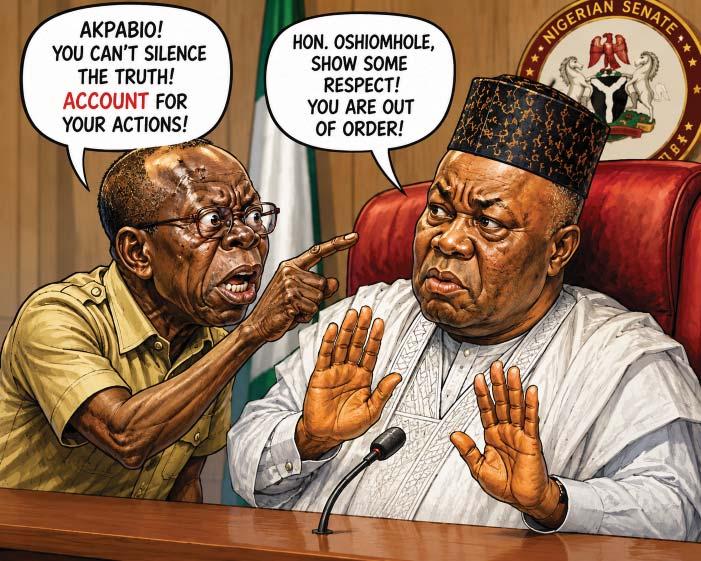
IT says much about the dysfunc on in our na onal security architecture that only one other senator publicly supported the call by Senator Adams Oshiomhole for an audit of Nigeria’s defence spending.
The majority posi on in the Senate, which favoured retreating into a secret session, raises legi mate ques ons. Legislators may need to re-examine their understanding of oversight in a cons tu onal democracy. They should also undertake a compara ve review of how parliaments across the world scru nise defence expenditures, assess opera onal effec veness and ensure that taxpayers’ resources are delivering measurable outcomes.
Oversight is not an act of hoslity towards the military; it is a democra c obliga on. Indeed, a rigorous examina on of defence spending, its costs, priories and effec veness, is itself a cri cal component of any serious na onal security strategy. Without such scru ny, the naon risks throwing good money a er bad, with poten ally catastrophic consequences.
History offers important lessons. Since the beginning of organised conflict, money and military strategy have been inseparable. Inevitably, prolonged wars and security crises create a military-commercial class whose interests become ed to the con nua on rather than the resolu on of conflict. It was this danger that former United States President Dwight D. Eisenhower famously warned against in his farewell address when he cau oned about the

IThe Oshiomhole Suggestion
growing influence of the military-industrial complex.
Significantly, his successor, John F. Kennedy, took that warning seriously. Kennedy recruited Robert McNamara, then the chief execu ve of Ford Motor Company, to reform defence
Briefly…….
NDIA’S recent decision to expand the use of ethanol as fuel for vehicles is commendable. It follows the path charted decades ago by Thailand, which pioneered cassava-based ethanol, and Brazil, where sugarcane-derived ethanol powers a significant propor on of automobiles.
As usual, Nigeria appears absent from the conversaon. A poli cal establishment largely fixated on consumpon rather than produc on remains indifferent to the transforma ve possibili es of research, innova on and value addi on. The country’s negligible investment in Research and Development speaks volumes about this mindset.
Nigeria is the world’s second-largest producer of cassava, behind Thailand. Yet the
ques on remains: what are we doing with this enormous resource? Sadly, not enough.
A robust ethanol industry built around cassava could create thousands of sustainable jobs, s mulate rural economies, generate substan al revenues for governments at all levels and provide a cheaper alterna ve to petrol. The economic and environmental benefits would be immense.
The me has come for a serious na onal conversaon. The Na onal Assembly should take up this issue as a ma er of urgency, beginning with televised public hearings that bring together researchers, farmers, investors and policymakers. Nigeria has the raw materials. What is lacking is the vision and poli cal will to turn poten al into prosperity.
management. McNamara introduced the Planning, Programming and Budge ng System (PPBS), a framework designed to align military spending with strategic objec ves and measurable outcomes. The goal was simple: ensure that every defence dollar contributed effecvely to na onal security.
Nigeria would do well to revisit similar principles. Otherwise, we risk remaining trapped in an endless cycle of insecurity sustained by those who profit, directly or indirectly, from conflict. There is precedent for such thinking in our own history. The late Omowale Kuye a empted
“Today,
the effectiveness of our security architecture must be subjected to the same scrutiny as the size of the budgets allocated to it. The key question is no longer how much is being spent, but whether the spending is producing the desired results. In a nation confronted by terrorism, banditry, kidnapping and communal violence, citizens deserve answers”
to introduce comparable reforms during his brief tenure as Federal Director of Budget under the administra on of Shehu Shagari. Unfortunately, the military interven on that ended the Second Republic also swept away many reform ini a ves that might have improved public financial management.
Today, the effec veness of our security architecture must be subjected to the same scruny as the size of the budgets allocated to it. The key ques on is no longer how much is being spent, but whether the spending is producing the desired results. In a na on confronted by terrorism, banditry, kidnapping and communal violence, ci zens deserve answers.
OSUN DEFENDER
We therefore support greater transparency, a comprehensive audit of defence expenditures and a fundamental review of Nigeria’s defence strategy. Public pa ence is wearing thin. Despite enormous alloca ons over the years, security condi ons remain troubling. The country can no longer afford business as usual.
Senator Oshiomhole’s sugges on should not be dismissed or buried behind closed doors. It should be the beginning of a longoverdue na onal conversa on on accountability, efficiency and victory in the fight against insecurity.

MONDAY, JUNE 08, 2026 VOL. 21 NO 44 www.osundefender.com, email: osundefenderbank@gmail.com
LET us imagine that the opposi on pares will boyco the forthcoming elecons scheduled for next year. How will such a boyco affect the country and our democracy. And is boyco the best opon?
Cameroun and Tanzania experienced elec on boyco by the opposi on recently, but that has not affected the overall rating of the elec on results.
In year 2000, Cote D’Ivoire experienced a massive boyco by the opposi on which resulted in 37.4% in par cipa on. Same with Gambia Parliamentary elec on in 2002 and in guinea in 2003. Same with the Ivorian Presiden al elec on in 2020.
The electoral boyco has become a regular tool for poli cal opposi on par es to use, especially since the end of the Cold War. With the rise of new democracies in Eastern Europe, La n America, and Africa, an increase in contested elec ons also has brought with it an increase in decisions to boyco . Whereas only four percent of all elec ons worldwide were boyco ed in 1989, that number had risen to 15 percent by 2002. In the decade 1995-2004, an average of nearly 10 elec ons per year was boyco ed.
The opposi on to Zimbabwean president Robert Mugabe also fractured over boyco discussions in 2005. That year, the opposi on Movement for Democra c Change (MDC) lost 16 seats in the parliamentary elec ons—in part because dithering over a possible boyco kept MDC registra on numbers down. Following that setback, MDC leader Morgan Tsvangarai made the fateful decision to boyco the elec ons for the newly-created Senate, claiming that this body would be a rubber stamp for Mugabe. Not surprisingly, this created tension within the MDC as a sizable fac on believed that choosing not to parcipate would be a fateful error. The party splintered, Tsvangarai lost his mandate, and the ruling ZANU-PF party captured 49 of 66 seats in the Senate elec on against the fractured opposi on. Tsvangarai was able to patch things up by choosing to parcipate in the 2008 elec ons—resul ng in near-parity in seats between the ZANU-PF and the MDC—but he undercut himself in
“In my view, what will save our present political situation is to arrange for a free and fair election in the immediate future. All Nigerian patriots must hang their heads in shame today. The first national post-independence general election has been the signal for assaults on the Constitution and various acts of lawlessness hitherto unknown in the history of his country. As President of Nigeria, it is my view that the disruptive forces prevailing in the country constitute a situation which cannot be tolerated any longer”
PERSPECTIVE BY ERIC TENIOLA
Boycott The Boycottables
the presiden al elec on. In the first round, Tsvangarai actually outpaced Mugabe, but the government claimed that he fell short of the 50 percent threshold necessary to avoid a runoff. In protest, Tsvangarai decided to boyco the runoff elec on, allowing Mugabe to triumph handily, turning victory into setback. While the eventual power-sharing deal gave the MDC an unprecedented stake in the government, Tsvangarai’s boyco allowed Mugabe to retain the top governmental posi on.
Given the logis cal prepara ons necessary to hold elec ons, opposi on par es must be goaded into par cipa on as early as possible to avoid missing registra on windows or harming electoral chances. Too o en, opposi on par es come to the decision to par cipate too late to achieve the full effect. The threat of a boyco can pay dividends but the opposi on par es s ll have to par cipate in order to receive the full benefits. Choosing to sit out is almost always a losing proposi on.
First, if elec ons receive a great deal of a en on from the interna onal community, then a boyco can be effec ve. Thus, the opposi on’s threat of an elec on boyco , when it a racts the a en on of interna onal audiences, increases interna onal pressure on the incumbent. As a result, the ruler or ruling party is forced to make concessions. The most striking example of this is South Africa’s vote in 1994, when president of the Freedom Party Mangosuthu Buthelezi’s decision to boyco the elec on and denounce the electoral process as unfree and unfair, led to an increase of interna onal pressure on Nelson Mandela. Consequently, the threat of boyco ng the elec on by Buthelezi caused the abolishment of the single vote system, and amendments to the cons tuon with regard to local self-government.
Secondly, if boyco s are part of the opposi on’s street protest campaign, then they can pay dividends. If the opposi on enjoys strong domes c popular support and a boyco is also part of their overall campaign involving street protests and other ac vi es, then these boyco s can yield results. An example of this is the 1996 elec on and opposi on boyco in Bangladesh. The Awami League, an opposi on party, launched massive protests that swept the country along with a boyco two days before elec on day. The general opposi on’s boyco and ongoing street protests eventually pushed the government to hold a new elec on and the opposi on fac on managed to win that elec on.
The slogan “Boyco the boyco ables” was first introduced to Nigeria poli cal vocabulary by Chief Ojike Mazi Mbonu (19121956). The slogan was a rallying cry at that
me for Na onalism. He did, in prac ce, generate greater enthusiasm for Nigerian tradi onal clothes by his “boyco ” methods which involved a preference for tradi onal clothes as opposed to English -styled ones.
Chief Ojike did not introduce the slogans for people to boyco elec ons.
Chief Ojike was born in 1912 in Akeme in Arochukwu, Southern Eastern, Nigeria. He a ended the Arochukwu Primary School, finishing in 1926 and taking up a teaching appointment with a mission. He returned to college in 1929 to train as a teacher at the Church Missionary Society (CMS) Training College in Waka. A brilliant student, he won the 1931 college annual prize which was a book--- AGGREY OF AFRICA, the biography of the renowned Ghanaian educa onist whose ideas of PanAfricanism le a las ng influence on the young Ejike.
On leaving college in 1931, Ojike resumed teaching at the Central School in Abagana. In 1933 he resigned to join the staff of Dennis Memorial Grammar School in Onitsha, becoming one of the few African teachers on the staff His involvement in poli cs commenced in 1936 when organized a successful teachers’ salary strike a er teachers were granted an increase which excluded junior members of the profession. He resigned from teaching in mission schools in 1938 in preference to private schools. That same year he met Dr. Nnamdi Azikiwe with whom he established a long personal and poli cal rela onship.
Chief Ojike le for the United States of America in 1938 to con nue his educa on at the Lincoln University. His stay there sharpened his poli cal ideology for it was then that he came with other African students like Dr. Kwame Nkrumah. Together they formed in 1941, the African Students Associa on of America and Canada to campaign against colonialism in Africa and injus ces against the Black race in general. Chief Ojike was elected its first President.
His returned to Nigeria marked an acve involvement in the na onalis c polics spearheaded by Dr. Nnamdi Azikiwe who had founded the Na onal Council of Nigerian Ci zens (NCNC) and whose newspaper, the WEST AFRICAN PILOT, had become the vocal organ of the campaign for independence, Chief Ojike joined the NCNC and contributed ar cles to the PILOT.
In 1949, he was fined 40 pounds on a charge of sedi on because of an ar cle in which he cri cized the colonial government for the shoo ng of 21 miners during a labour dispute at the Udi Coal Miners, near Enugu. In 1953, he was a member of
the NCNC delega on to the London Constu onal Conference which paved way for Nigeria’s Independence in October 1960. The following year he won an elec on on the pla orm of the NCNC to the Eastern Region House of Assembly, becoming the Region’s Minister of Finance; he held that office un l early 1956.
Mazi Ojike Mbonu died in 1956. There is now an Ojike Memorial Medical Centre at Arondizuogu, Imo State.
In 1979, the proprietor of the Medical Centre, Dr. Kingsley Ozumba Mbadiwe, a close friend of Chief Ojike honoured me by appoin ng me along with a journalist of respect, Mr. James Odafe Othinwa, as co-director of the medical centre.
In 1964, the word boyco was effecvely used for the first me in the general elec on. Since then, there has been argument whether or not, boyco has any effect.
In 1964, the NPC returned 60 of its candidates unopposed, the NCNC at that me challenged the declara on by the NPC.
On August 20, 1964, the Nigerian Naonal Alliance (NNA) was formed. The alliance was made up of the NPC, the leader, the NNDP controlling the government of Western Nigeria, the Mid-West Democratic Front, which formed an opposi on in the Mid-Western Region and some other elements including the dynamic party of Dr. Chike Obi.
On June 3, 1964, the United Progressive for Grand Alliance (UPGA) was formed. The alliance was made up of NCNC and the Ac on Group. The poli cal enmity became apparent before and a er the 1964 elec on.
The UPGA was opposed for returning 60 candidates as unopposed including the Prime Minister, the Minister for Home Affairs, Alhaji Shehu Shagari at Sokoto West; the Minister of Economic Development, Alhaji Waziri Ibrahim, at Konduga-Mafa, and the former Ambassador to the Ivory Coast, Alhaji Abdul Razak, at Ilorin Town.
To this the Eastern Region A orneyGeneral, Mr. Christopher Mojekwu, who was on a fact-finding tour of Northern Nigeria, said that for various reasons 60 UPGA candidates in the Northern Region had been unable to file their nomina on papers. It later emerged that more NPC men were being returned unopposed in the North, by virtue of Northern Progressive Front candidates withdrawing in such seats as Yerwa, where the Minister of Commerce and Industry, Alhaji Zanna Buka Dipcharima was the candidate; and in the seats of the Speaker of the Federal House, Alhaji Jalo Waziri (Gombe Central), and the Federal Minister of Works, Alhaji Inua Wada (Sumailia)
On December 21, 1964, the Central Working Commi ee of NCNC rejected the 61 unopposed candidates in the North. Secretary F. S. McEwen said “we do not regard these seats as won by the NPC,” adding that the party had decided on a “course of Ac on.” Ac on Group protested against the two NNDP unopposed candidates in Ife.
Dr. Okpara NCNC leader and Eastern Premier described elec on arrangements as a “farce.” Sir Abubakar Tafawa Balewa, the ten Prime Minister described the NCNC as a “great liability to UPGA,” said that if they lost the elec on, they would blame the AG.
•Read full article on www.osundefender.com
OSUN DEFENDER is published by Moremi Publishing House Limited, Behind Oranmiyan Building, Gbodofon, Off Gbongan Road, Osogbo, Osun State. All correspondence to the Deputy Editor, MICHAEL BAMIGBOLA, Telephone: 0809-301-9152. ISSN: 0794-8050. Website: www.osundefender.com Email: osundefenderbank@gmail.com, osundefenderhq@gmail.com