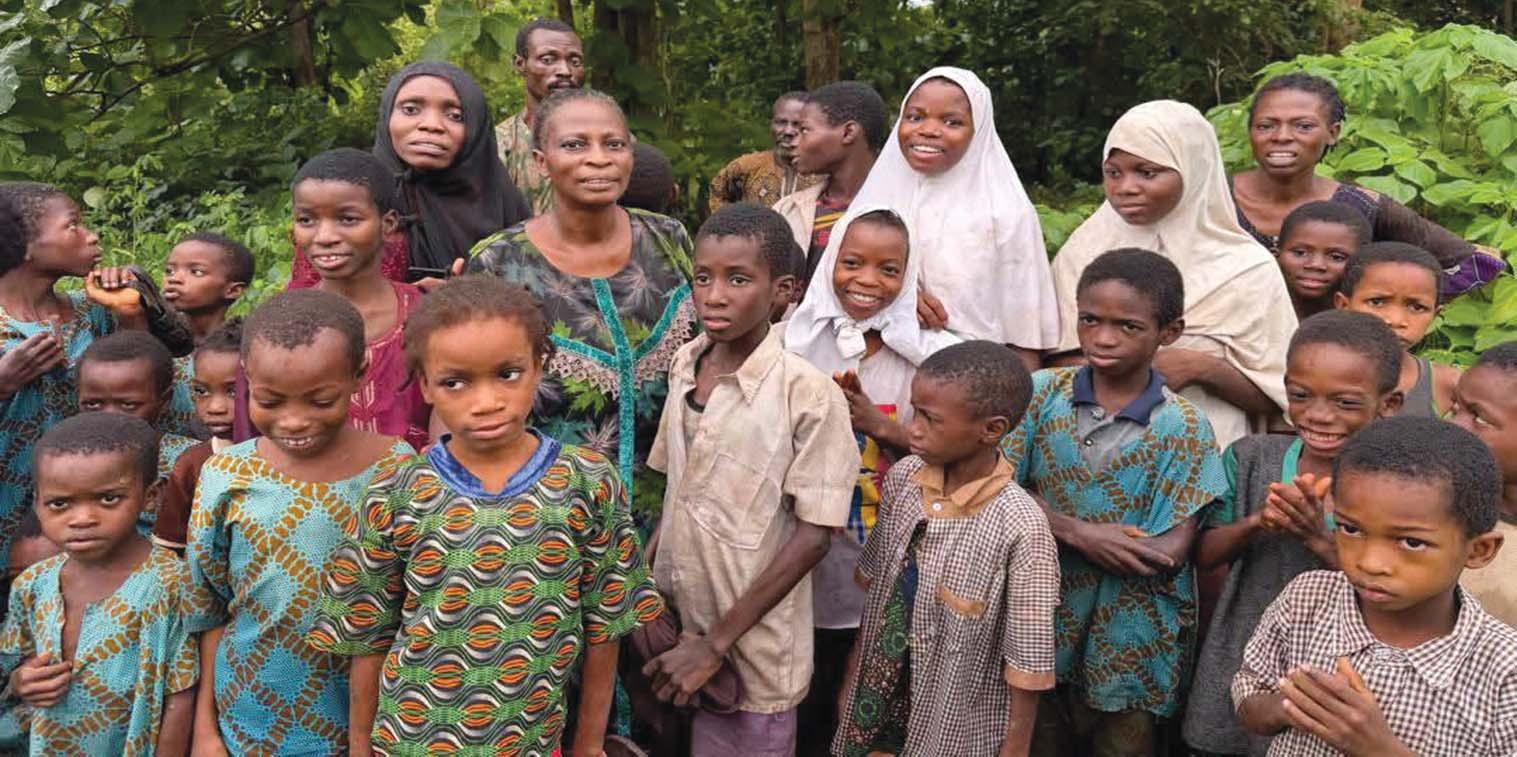
•A cross-section of the rescued schoolchildren from Oriire local government after their freedom, last Friday
•A cross-section of the rescued schoolchildren from Oriire local government after their freedom, last Friday
THE Independent Na onal Electoral Commission (INEC) has confirmed that a total of 2,339,233 people are eligible to vote on August 15, 2026, to elect the Governor who will lead Osun State for another four years.
The figure was disclosed in a document signed by Osun INEC Director of Voter Registry, Olatunde Olalere, which was presented to poli cal par es on July 09, 2026, tagged ‘Analysis of Register Of Voters’
OSUN DEFENDER reports that 14 poli cal par es will be par cipating in the forthcoming
elec on.
However, the race, according to poli cal observers, is between the incumbent governor, who is the candidate of the Accord Party, Senator Ademola Adeleke, the All Progressives Congress candidate, Mr Bola Oyebamiji and the candidate of the African Democra c Congress, Dr Najeem Salam.
According to the document, the new number shows a major expansion from the 1,954,800 voters recorded in the 2023 General Elec on.
INEC a ributed the increase to sustained voter mobilisa on and
the conclusion of the 2025/2026 Con nuous Voter Registra on exercise across the state.
According to the data presented, 395,995 people registered during the Con nuous Voter Registra on (CVR) period, with 365,356 of them validated a er audit.
The commission further recorded 26,202 voters who transferred into Osun from other states, while 7,125 transferred out of the state.
INEC in the document said the CVR was conducted in two phases to accommodate applicants across all 30 Local Government Areas.
According to the document, “Phase I ran from August 18 to December 10, 2025, and Phase II commenced on January 5, 2026.
“INEC later devolved the exercise to Registraon Area level in Osun between April 9 and April 18, 2026, followed by the display of the preliminary register for claims and objec ons from April 27 to May 3, 2026.”
The new registra ons are spread across Osun’s 30 LGAs, 332 Registraon Areas and 3,763 Polling Units.
Osogbo LGA led with 22,723 valid new reg-
istra ons, followed by Irewole with 21,024 and Ede North with 20,529.
At the lower end, Boluwaduro recorded 5,324 valid new registraons, the smallest in the state.
Osun West recorded the highest with 130,400 valid new voters across its 10 LGAs. Osun Central followed with 122,837, while Osun East had 112,119 valid new registra ons.
Women, Youths, Traders, Students To Shape Race
Meanwhile, the demographic breakdown released by INEC shows that the 2026 elec-
on will be shaped by a young and economically ac ve popula on.
Nearly 70 per cent of the eligible voters in Osun are under the age of 50.
Voters between the ages of 18 and 34, totalling 857,056 and represen ng 36.64 per cent of the register, lead the electorates, while those between 35 and 49 years are 772,854, representing 33 per cent of the register voters.
The commission added that voters aged 50 to 69 stand at 488,052, while those 70 years and above are 221,271, represen ng 9.46 per cent of the total.
In the occupa onal data, students make up the single largest bloc with 752,800 voters. They are followed by traders with 483,970 voters and ar sans with 320,416 voters.
Other categories include business owners at 265,370, farmers and fishers at 187,312 and civil servants at 115,158.
MONDAY, JULY 13, 2026
THE Osun State Governorship Campaign Council of the African Democra c Congress (ADC) has accused the All Progressives Congress (APC) of exploi ng the name and achievements of former governor Rauf Aregbesola, to gain electoral advantage ahead of the August 15 governorship elec on.
The accusa on was contained in a statement issued on Saturday by the spokesperson of the ADC Governorship Campaign Council, Hon. Nurein Adebisi, who urged the APC to campaign based on the creden als and programmes of its governorship candidate rather than what he described as Aregbesola’s “towering legacies.”
The ADC said its a enon was drawn to a viral video in which the wife of the APC governorship
candidate, Dr. Sekinat Oyebamiji, reportedly appealed to women trading in tradional herbal materials at Oja-Oba, Osogbo, to support the APC as they had done during Aregbesola’s administra on.
According to the party, the repeated references to Aregbesola by APC leaders and campaign representaves create the impression that the former governor has endorsed the party’s candidate, Mr. Bola Oyebamiji.
The party maintained that although the APC has the cons tu onal right to canvass for votes, it was irresponsible and dishonest to invoking the former governor’s name and developmental record as though he had thrown his weight behind the APC candidate.
It alleged that the APC had intensified what it
THE Federal Government has approved a new registra on fee of N50,000 for candidates si ng the Senior School Cer ficate Examina ons conducted by the West African Examina ons Council and Na onal Examina ons Council, with the new rate taking effect from the 2027 examina on cycle.
The approval was contained in a June 18 memo signed by the Director of Senior Secondary Educaon at the Federal Ministry of Educa on, Adeniji Ibrahim, following a request by WAEC for an upward review of examina on fees. The ministry also confirmed the approval through its spokesperson, Folasade Boriowo.
The new fee represents an increase of about 82 per cent from the current registra on fee of N27,500, making it the first major upward review of the examina on fee in recent years.
According to the ministry, the decision followed a mee ng between the Minister of Educa on and examina on bodies on March 31, 2026, where the need to review examina on fees was discussed.
The memo stated that the Minister directed both WAEC and NECO to adopt a uniform registra on fee for their Senior School Cer ficate Examina ons.
It read, “You may recall that at a mee ng of examina on bodies held with the Honourable Minister of Educa on on 31 March, 2026, where the need for upward review of examina on fees was discussed, the Honourable Minister directed that WAEC and NECO should
adopt a uniform fee for the conduct of WAEC and NECO SSCE.”
The ministry added, “Consequently, I am directed to convey the Honourable Minister of Educaon’s approval of the sum of Fi y Thousand Naira (N50,000.00) only, as the new examina on fee per candidate, with effect from NECO SSCE (Internal), 2027.”
The direc ve further instructed the examina on bodies to communicate the new fee to all relevant stakeholders ahead of its implementa on.
The increase is expected to spark concerns among parents, students and educa on stakeholders over the rising cost of secondary educa on, par cularly in states where governments do not pay examina on fees for candidates. Some observers also fear the hike could increase the financial burden on families and widen the number of students unable to register for the examina ons.
called a pa ern of poli cal decep on by repeatedly referring to Aregbesola’s
achievements at campaign mee ngs and women engagement programmes across the state. Adebisi said, “Let the APC campaign on its own
Our Reporter
PRESIDENT Bola Tinubu has come under cri cism from Nigerians on social media following his reac on to the rescue of schoolchildren and teachers abducted in Oriire Local Government Area of Oyo State, with many arguing that the President should apologise for the security breach rather than celebrate the rescue.
The cri cism followed a statement by the Presidency commending security agencies for securing the release of the pupils and teachers, describing the opera on as a testament to the Federal Government’s commitment to safeguarding lives and tackling insecurity.
However, many Nigerians on X, Facebook and other social media platforms faulted the President’s posi on, insis ng that the successful rescue did not excuse the failure that allowed the abduc on to occur.
Several users argued
that ci zens should not have to celebrate being rescued a er being kidnapped, stressing that the government’s primary responsibility is to prevent such incidents from happening.
Some commenters said the President ought to apologise to the vic ms, their families and Nigerians for the security lapse that led to the abduc on, rather than commend the rescue opera on.
One user wrote, “Mr President, this is not the me for celebra on. Nigerians expect an apology that innocent schoolchildren and teachers were abducted in the first place.”
Another said, “The real success is preven ng kidnappings, not congratulating ourselves a er vic ms regain their freedom.”
A third commenter wrote, “Every rescued vicm deserves gra tude to the security agencies, but every abduc on is a reminder that government must do more to keep cizens safe.”
Another post read, “Parents should never have to worry about whether their children will return home from school. Preven on is be er than rescue.”
A user also stated, “The rescue is commendable, but Nigerians want las ng solu ons to insecurity. That is what should be celebrated.”
Another commenter added, “The President should empathise with the vic ms and assure Nigerians that concrete steps are being taken to prevent another incident like this, rather than issuing celebratory statements.”
While some Nigerians praised security agencies for rescuing the abducted pupils and teachers, others maintained that the Federal Government should be judged by its ability to prevent such a acks and guarantee the safety of citizens across the country.
The Presidency has yet to issue any further response to the online cri cism beyond its ini al statement welcoming the rescue of the vic ms.
THE Socio-Economic Rights and Accountability Project (SERAP) has dragged the Independent Na onal Electoral Commission before the Federal High Court in Abuja, seeking an order compelling the electoral umpire to inves gate allega ons that some governors elected on the pla orm of the All Progressives Congress (APC) diverted about N800bn from Federa on Account Alloca on Committee alloca ons to finance poli cal ac vi es ahead of the 2027 general elec ons.
The suit, marked FHC/
ABJ/CS/1426/2026, was disclosed in a statement issued yesterday by SERAP’s Deputy Director, Kolawole Oluwadare, who said the organisa on was also asking the court to compel INEC to ensure full disclosure of the alleged campaign funds, including the iden es of donors and the sources of the money.
According to SERAP, the legal ac on followed INEC’s alleged failure to inves gate claims that APC governors had been making monthly contribu ons from their FAAC alloca ons into a cam-
paign fund reportedly linked to President Bola Tinubu’s 2027 re-elec on bid.
The organisa on said the allega ons were based on media reports and a published opinion ar cle, which raised concerns over the alleged diversion of public funds for poli cal purposes.
SERAP is seeking an order of mandamus direc ng INEC to inves gate the allega ons and compel the APC and the affected governors to disclose details of the alleged campaign fund, including the iden es of donors and the lawful sources of the money.
It is also asking the court to direct the electoral commission to review compliance with Sec on 91 of the Electoral Act on poli cal campaign financing and enforce relevant provisions where any viola ons are established.
The rights group argued that the allega ons raise serious concerns about transparency and accountability in poli cal financing, warning that the use of public resources for campaign acvi es, if proven, would undermine the integrity of Nigeria’s electoral process.
terms and use the records and personality of Gboyega Oyetola if there is any. We challenge the APC and its candidate, if they have a vision for Osun, let them bring it forward. Let them debate policies, defend their record and present a manifesto that can stand on its own.
“What we are seeing is a party that has run out of ideas and has therefore resorted to borrowing credibility. You cannot claim to be the torchbearers of Aregbesola’s legacy when you have distanced yourself from the very principles, people and associates who worked with him to build that legacy.
“Osun people are not forge ul. They remember who stood and are s ll with Ogbeni and those who walked away the moment it became poli cally convenient.
“We hereby warn the Osun APC, its candidate and all their agents to desist immediately from using the name of Ogbeni Rauf Aregbesola to promote their candidacy. Any further a empt to trade on his name, his achievements or his goodwill will be resisted with facts, with history and with the voice of the people.
“Campaigns should be about ideas, demonstra on of capacity and commitment to the people. Osun deserves be er.
“The people deserve leaders who can stand on their own record and not those engaging in iden ty fraud to gain acceptance.”
The ADC described Aregbesola’s eight-year administra on as one that laid the founda on for infrastructure development, educa on reforms, youth empowerment and people-centred governance in Osun, adding that such achievements belong to the people of the state and history, not to any poli cal party.
THEY have been freed. At last, the cap ves are home, and a na on that had been gripped by anxiety for 56 agonising days can finally breathe a collec ve sigh of relief.
Nigeria owes an immense debt of gra tude to the brave men and women of the Armed Forces whose courage, professionalism and sacrifice made this possible. Their commitment once again underscores why the welfare of our troops must become an urgent na onal priority. Those who risk their lives daily in defence of the country deserve the best equipment, adequate remunera on, quality healthcare and comprehensive support for their families.
Equally important, the families of personnel who paid the ul mate price during the rescue opera on must be generously compensated. Their sacrifice must never be forgotten. The teacher who was brutally beheaded by the abductors should also be immortalised. His death stands as the ul mate symbol of the risks teachers some mes face in the line of duty and the extraordinary sacrifices made by educators across the country. May the souls of

“If anything, the release of the captives should prompt sober reflection by government at every level on how such a tragedy was allowed to occur and what must change to prevent a recurrence. The greatest tribute to the victims would be a safer Nigeria where no community has to endure such an ordeal again”
all those who lost their lives rest in perfect peace.
Following the release of the cap-
ves, videos circula ng in the public domain appeared to show some of the vic ms expressing gra tude to
ONE of the enduring jokes on Nigerian social media is that the country has entered the era of the Olodo economy, where mediocrity is rewarded and competence is o en treated as an inconvenience. Like many jokes, it contains an uncomfortable truth. Across both the public and private sectors, standards have steadily eroded, leaving Nigeria trapped in a culture where appearance frequently triumphs over substance.
The consequences are becoming increasingly difficult to ignore.
From the shocking discovery of a fake government agency that reportedly operated for years before being uncovered, to recurring allegaons of forged academic cer ficates involving public officials, Nigeria is exposing the fragility of its ins tuons. In a society obsessed with cerficates, it is deeply ironic that the authen city of those cer ficates can so o en be taken for granted rather than rigorously verified.
These are not isolated scandals. They are symptoms of a deeper ins tu onal malaise. They point to a country whose systems of recruitment, verifica on, regula on and accountability are no longer fit for purpose. No modern state can thrive on weak ins tu ons. Na ons become prosperous not merely because they possess abundant natural resources, but because they build ins tu ons capable of enforcing standards, rewarding merit and punishing fraud.
History offers ample evidence. Countries such as China, Singapore and, increasingly, India have invested heavily in merit-based recruitment and ins tu onal integrity. Recognising that the quality of those admit-
ted into public service determines the quality of governance itself, they have con nually strengthened recruitment processes and, where necessary, engaged independent professional organisa ons to manage cri cal aspects of tes ng, screening and verifica on. Nigeria should not dismiss such models simply because they challenge entrenched interests.
The rot begins with recruitment. Once incompetent or dishonest individuals find their way into posi ons of authority through forged credenals, patronage or manipula on, the damage spreads rapidly. Ins tu ons become weaker, public confidence declines and na onal produc vity suffers. The result is an economy where mediocrity becomes normal, excellence is discouraged and fakery flourishes.
This trend must be reversed with urgency. Every educa onal qualificaon submi ed for public office or senior public service appointments should be independently verified. Recruitment into government instu ons must become more transparent, technology-driven and meritbased. There must also be swi and certain consequences for anyone found to have obtained employment or public office through fraudulent means. A na on cannot build credibility while tolera ng decep on at the highest levels.
Beyond recruitment reforms, government should demonstrate its seriousness by implemen ng longstanding recommenda ons that have gathered dust for years. The recommenda ons of the Oronsaye Commission on public sector reform deserve immediate a en on as part
of efforts to streamline government, eliminate waste and improve efficiency. Likewise, the Jus ce Mohammed Uwais Electoral Reform Commi ee report should be revisited, alongside other significant reform proposals capable of strengthening governance and public confidence.
Nigeria stands at a crossroads. The choice is between con nuing to reward mediocrity or deliberately rebuilding a culture that prizes competence, integrity and accountability. Strong ins tu ons are not built by slogans; they are built by insis ng on standards and enforcing them without fear or favour.
The era of celebra ng the Olodo must end. The era of rewarding excellence must begin. Un l Nigeria restores merit as the founda on of na onal life, the country will struggle to compete in an increasingly knowledge-driven global economy.
It is me to get serious.
President Bola Tinubu. Such expressions are understandable from people emerging from a trauma c ordeal and experiencing the relief of freedom. Yet they also expose a troubling misunderstanding of the rela onship between ci zens and those elected to govern them.
In a cons tu onal democracy, the security of lives and property is one of the foremost responsibili es of government. Ci zens should never feel indebted to the state for restoring the very freedom and safety it is duty-bound to protect. If anything, the release of the cap ves should prompt sober reflec on by government at every level on how such a tragedy was allowed to occur and what must change to prevent a recurrence. The greatest tribute to the vicms would be a safer Nigeria where no community has to endure such an ordeal again.
As is o en the case with major na onal security incidents in Nigeria, many ques ons remain unanswered. While the government must protect informa on that could compromise na onal security, it also has a responsibility to provide greater clarity on what transpired and reassure Nigerians by addressing the lingering concerns surrounding the opera on.
Government spokespersons must equally exercise restraint and sensi vity. A tragedy of this magnitude should never become an opportunity for poli cal point-scoring. A empts to exploit such a heartbreaking event for par san advantage are reprehensible and diminish the na on.
The Oriire rescue has also reinforced the strategic importance of Nigeria’s Special Forces. In the fight against terrorism and kidnapping, they remain the decisive force. Government must con nue to strengthen their capacity through be er training, intelligence, logis cs, technology and welfare. Recent events have demonstrated that these elite units are indispensable and should be fully empowered to secure the release of every Nigerian s ll languishing in capvity.
Publisher – Moremi Publishing House Ltd.
Deputy Editor – Michael Bamigbola
Asst. News Editor – Yusuf Oketola
Deputy Photo Editor – Shola Aderinto
Deputy Graphics Manager – Zainab Olalere
Produc on Controller – Petkola Taiwo Ibitowa
OSUN DEFENDER is published by Moremi Publishing House Limited, Behind Oranmiyan Building, Gbodofon, Off Gbongan Road, Osogbo, Osun State.
ISSN : 0794-8050
Telephone : 0809-301-9152
Website : www.osundefender.com/index.php e-mail : osundefenderhq@gmail.com osundefenderbank@gmail.com
All correspondence to the above email addresses.
As we celebrate the return of the Oriire pupils, teachers and other capves, our thoughts remain with the many families across the country who connue to wait and hope for the safe return of their loved ones. Their pain has not ended. Today is a day of relief, gra tude and renewed hope. But it must also be a reminder that the work is far from over. Nigeria is s ll a long way from Uhuru. The mission will only be complete when every cap ve is reunited with their family and every Nigerian can live without fear.

MONDAY, JULY 13, 2026 VOL. 21 NO 54 www.osundefender.com, email: osundefenderbank@gmail.com
AS Osun State prepares for the 2026 governorship elec on in the next 34 days or thereabout, poli cal ac vi es are gathering momentum. Campaign offices are opening, alliances are shi ing, poli cal rhetoric is becoming more strident, and the media is gradually turning its a en on to what promises to be one of Nigeria’s most closely watched offcycle elec ons.
For journalists, however, this period presents a deeper ques on beyond simply repor ng campaign events. So the ques on is what kind of elec on are we helping ci zens understand?
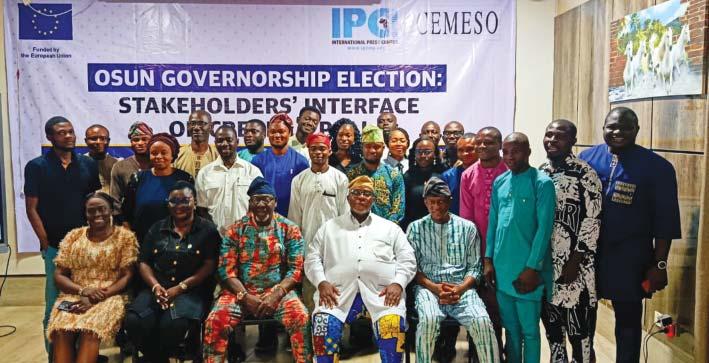
This ques on occupied my mind during a recent media engagement organised by the Interna onal Press Centre (IPC) under the European Union Support to Democra c Governance in Nigeria (EU-SDGN II) programme. Rather than beginning with theories of elec on repor ng, I invited journalists to examine their own work.
Working in groups, par cipants listed the elec on stories their respec ve organisa ons had published during the previous three weeks. About twenty-five stories emerged from the exercise. We categorised them according to subject ma er.The pa ern was revealing.
Eight stories focused on security and electoral violence. Seven centered on poli cal ac vi es and party affairs. Five dealt with voter sensi saon. Only two discussed party manifestoes. One addressed mobilisa on, another focused on persons with disabili es, while only one centered on ac vi es of the Independent Na onal Electoral Commission (INEC).
The exercise was never intended to cri cise journalists. Rather, it was designed to provoke reflec on. Collec vely, par cipants reached an important conclusion that although security and poli cs are legi mate
“The success of the 2026 governorship election will ultimately depend on many institutions: INEC, security agencies, political parties, civil society organisations and the electorate itself. The media, however, occupies a unique position. It determines, to a considerable extent, the conversations that shape democratic choice”
news, the dominant focus of elec on repor ng is not sufficient to help the people of Osun make informed electoral decisions.
That conversa on naturally led us to Agenda Se ng Theory, one of the most influen al ideas in media studies. The theory argues that while the media may not always determine what people think, it significantly influences what people think about. In electoral contexts, this influence is profound.
The issues that receive sustained media a en on become the issues ci zens discuss. Those same issues become the issues candidates are compelled to address. Eventually, they become the issues on which governments are judged. The progression is straigh orward: what the media consistently pays a en on to becomes what the public talks about, what poli cians priori se, and ulmately what governments are held accountable for.
This explains why elec on journalism deserves more careful reflec on than it o en receives. If media coverage revolves almost en rely around defec ons, campaign rallies, poli cal quarrels, endorsements and personality contests, public debate inevitably follows the same trajectory. Elecons become compe ons between poli cal actors rather than conversaons about governance.
Yet available evidence suggests that ci zens are asking different quesons. Findings from the Interna onal
Press Centre’s voter percep on poll in Osun indicate that security, employment, infrastructure, agricultural development and rural development rank among the issues that voters consider most important. These are not peripheral concerns; they are everyday governance challenges that directly affect livelihoods and quality of life.
The implica on is clear. There is o en a disconnect between what ci zens consider important and what dominates elec on repor ng. This disconnect should concern every newsroom.
Journalism performs its highest democra c func on not by amplifying every poli cal controversy but by helping ci zens evaluate competing visions for governance. Elec ons should therefore be reported as opportuni es to interrogate leadership competence rather than merely document poli cal theatre. This requires a shi from what is commonly called horse-race journalism, coverage that asks who is leading, who defected, who a racted the largest crowd, or who exchanged the sharpest poli cal insults, to journalism that interrogates policies, governance records, implementa on capacity and evidence.
When a candidate promises thousands of jobs, journalists should ask where those jobs will come from, how they will be financed, what meline has been proposed and whether similar interven ons have succeeded elsewhere.
When candidates promise improved healthcare, educa on or agricultural development, the responsibility of the media is not merely to report the promise but to examine its feasibility, costs, implementa on strategy and likely outcomes. This is where solu ons journalism becomes par cularly relevant.
Solu ons journalism does not mean advoca ng for poli cal actors or endorsing policies. Rather, it means rigorously examining credible responses to public problems, the evidence suppor ng them, and their limita ons. It moves repor ng beyond exposing problems to helping ci zens understand which proposed solu ons deserve serious considera on.
For the Osun elec on, this approach could transform electoral discourse. Instead of repeatedly asking who is winning the campaign, journalists might ask: which candidate presents the most coherent strategy for improving security? What evidence supports compe ng economic proposals? How realis c are the promises on agriculture, youth employment or rural development? How will success be measured if these promises are implemented?
These are the ques ons that strengthen democra c accountability. One encouraging outcome of our discussions was the proposal to establish the Osun Collec ve, an informal collabora ve pla orm of interested media organisa ons commi ed to producing issue-based, cizen-centered and evidence-informed electoral content.
The idea is simple but poten ally transforma ve. By collabora ng on explanatory journalism, fact-checking, governance repor ng, data visualisa on and short-form mul media content, par cipa ng media organisa ons can help simplify complex electoral issues and improve public understanding of governance choices before ci zens cast their votes.
The success of the 2026 governorship elec on will ul mately depend on many ins tu ons: INEC, security agencies, poli cal par es, civil society organisa ons and the electorate itself.
The media, however, occupies a unique posi on. It determines, to a considerable extent, the conversaons that shape democra c choice. As Osun moves closer to elec on day, perhaps the most important ques on every newsroom should ask itself is not whether it has reported every poli cal rally or campaign speech.
It is this: If the people of Osun went to the polls based only on our elec on coverage, would they have enough informa on to choose the most competent governor?
The answer to that ques on may well determine whether elec on journalism merely chronicles poli cal compe on or genuinely strengthens democracy.
•Rasheed Adebiyi, PhD is an Associate Professor at the Department of Mass Communication, Fountain University, Osogbo, Nigeria
OSUN DEFENDER is published by Moremi Publishing House Limited, Behind Oranmiyan Building, Gbodofon, Off Gbongan Road, Osogbo, Osun State. All correspondence to the Deputy Editor, MICHAEL BAMIGBOLA, Telephone: 0809-301-9152. ISSN: 0794-8050. Website: www.osundefender.com Email: osundefenderbank@gmail.com, osundefenderhq@gmail.com