
2027: From Nowhere To University?
Tinubu’s Missing Basic School Records Raise Fresh Questions
•As INEC Releases Presidential Candidates’ Academic Records
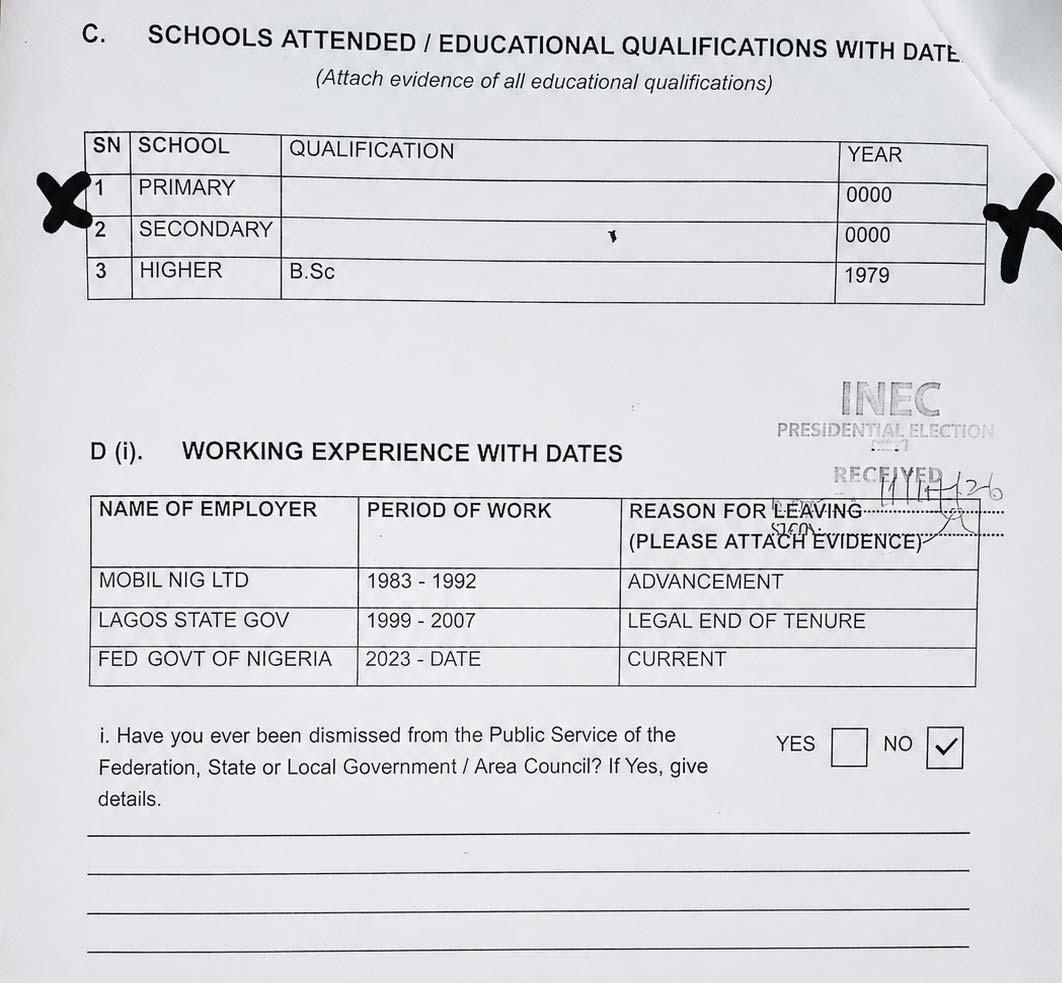
•A copy of the document
FRESH controversy has erupted over President Bola Tinubu’s educa onal history
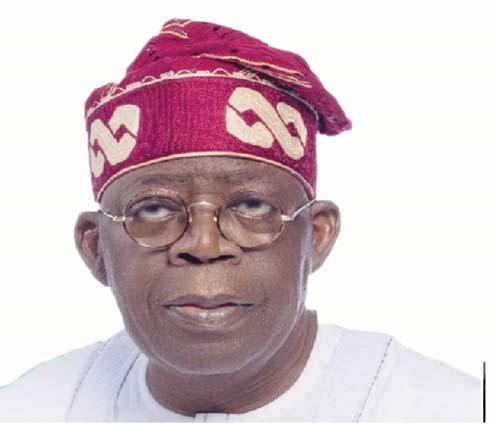
•Tinubu
comes nearly four years a er the legal and polical ba les that followed the 2023 presiden al elec on, when former Vice-President A ku Abubakar approached a United States court to obtain records from Chicago State University in an attempt to establish alleged discrepancies in academic documents submi ed by Tinubu to INEC. The issue dominated na onal discourse for months, while the President consistently maintained that his academic creden als were authen c.
Twi er) and other social media pla orms were flooded with reac ons, with many users quesoning why the President’s primary and secondary educa on records were not reflected on the published form.
Human rights ac vist and presiden al candidate of the African Ac on Congress (AAC), Omoyele Sowore, alleged that Tinubu’s background lacked verifiable records.
OSUN DEFENDER reports that the documents, published on INEC’s candidates’ portal in line with the Electoral Act, list only a Bachelor of Science de-
a er the Independent Na onal Electoral Commission (INEC) published his personal par culars and academic creden als for the 2027 presiden al elec on, with the secons designated for primary and secondary educa on le blank.
gree obtained from Chicago State University in 1979 under the “Higher” educa on category, while no entries were made under the spaces provided for primary and secondary schools.
The development has reignited public debate
over the President’s educa onal history, with opposi on figures and many Nigerians on social media ques oning the omission and demanding further clarifica on from the Presidency and the electoral commission.
The latest controversy
Similarly, the African Democra c Congress (ADC), which has posioned itself as the leading opposi on coali on ahead of the 2027 elecon, has repeatedly insisted that candidates seeking Nigeria’s highest office must subject their creden als and personal records to public scru ny.
As screenshots of the INEC documents circulated online, X (formerly
“Tinubu’s life history, his schooling, his past, his iden ty is basically that of crimes without repercussion... he has no verifiable pedigree or background, no classmates, no real names, no credible educa on history,” Sowore wrote, while reitera ng his longstanding cricism of the President,” he wrote.
Another X user, @ AnewNaija, directed ques ons at INEC, asking whether the commission would have accepted
•Continued on page 2
2026: Control Of Election Funds Sparks Disagreement In Osun
THE disbursement of funds earmarked by the All Progressives Congress (APC) for the August 15 Osun State governorship elec on has triggered disagreement within the party, OSUN DEFENDER reliably gathered.
Sources within the party said disagreements over who should control the financial resources for the elec on are threatening to derail prepara ons.
The sources said a former governor of the state is insis ng the funds be handed over to him for distribu on across the 30 local government areas.
However, the request, it was gathered, did not go down well with some of the chie ains of the party, including the inner caucus of the party’s gubernatorial candidate.
According to party insiders, some of the party chie ains would prefer the gubernatorial candidate to have direct control of the elec on war chest.
“Some of our chie ains, par cularly those in the inner caucus of the gubernatorial candidate, do not want the money released to the former governor. They would rather have the money under his campaign structure,” a source who preferred anonymity told OSUN DEFENDER
Another party member who spoke with OSUN DEFENDER referenced the 2022 governorship elec on when the then incumbent
lost, alleging that elec on funds were not properly disbursed at the me.
“The worry now is that we may be repea ng the same mistake of 2022. If the money does not get to the grassroots on me, it will affect mobilisa on and turnout,” the party member said.
Meanwhile, the inaugural mee ng of the party’s na onal campaign council for the August 15 governorship poll will hold on Monday, with stakeholders expected to be present at the mee ng.
OSUN DEFENDER reports that the Na onal Working Commi ee of the APC last Tuesday inaugurated the 276-member campaign council, chaired by Imo State Governor and Chairman of the Progressive Governors’ Forum, Mr Hope Uzodimma, in Abuja.
The council, comprising governors, ministers, Na onal Assembly members and other chie ains, was tasked with mobilising resources and ensuring victory for the party in the state.
Speaking at the inaugura on in Abuja, APC Na onal Chairman, Prof. Nentawe Yilwatda, said the party would deploy its extensive poli cal structures, grassroots network and campaign machinery to secure victory for its governorship candidate, Bola Oyebamiji, popularly known as AMBO.
Yilwatda said the council was carefully cons tuted to mobilise the human and material resources required to ensure victory in the elec on.
The APC chairman described the Osun governorship elec on as the
party’s final electoral outing before the 2027 general elec ons, saying it would serve as a rehearsal for the na onwide campaigns ahead.
“This is our litmus test. It will measure our level of preparedness for 2027. It will be our prac ce ground and our rehearsal for the poli cal machine we are preparing for the general elec on.
“That is why winning the Osun elec on is a must for the APC,” he added.
OSUN DEFENDER gathered that the issue of who should control the funds will form part of what will be discussed at the inaugural mee ng, scheduled for 3 p.m. at the Kano State Governor’s Lodge, 30 Jose Mar Street, Asokoro, Abuja.
Osun 2026: How ADC Plans To Restore People-Friendly Govt - Aregbesola
WITH just weeks to the August 15 governorship elec on in Osun State, the African Democra c Congress (ADC) has made “People-Friendly Government” the centre of its campaign message.
The party’s Na onal Secretary and former Osun State Governor, Ogbeni Rauf Aregbesola, unveiled this message during a television interview on Thursday, where he urged residents to support the ADC governorship candidate, Hon.Najeem Folasayo Sa-
laam (Iwaloye).
Rather than dwell on cri cisms of the current administra on, Aregbesola focused on what he described as the type of government the ADC intends to return to Osun if elected.
According to him, the party’s vision is built around governance that puts the welfare of the people first. “We brought what we call People-Friendly Government from 2010 ll 2018. We are returning peoplefriendly government.”
Throughout the interview, Aregbesola repeatedly argued that government
should exist mainly to improve the lives of ordinary ci zens.
He said the ADC would pursue policies that directly benefit the people instead of serving the interests of a few individuals.
“A government that is there for nothing but the good of the people in all ramifica ons, that is what we promise. That was what we delivered then and that is what we are returning now.”
While many s ll remember his administraon for programmes such as O’YES, school feeding
2027: From Nowhere To University? Tinubu’s Missing Basic School...
•Continued from page 1
similar documenta on from another presiden al candidate.
“You have just published the creden als of Bola Tinubu, which show no record of his primary and secondary educa on. My ques on is simple: Would you have published the same for Peter Obi? Would INEC employ any Nigerian who claims to have jumped from no primary and secondary record straight to university?” the user wrote.
Reac ng to the publica on, @DGreatBundee argued that Nigerians should insist on complete transparency from those seeking public office, arguing that Nigerians will no longer tolerate unverifiable candidates.
He posted, “The Cons tu on demands transparency; every aspirant must prove their records beyond doubt. Ci zens should be ready to sue and compel INEC to disqualify anyone whose informa on cannot be verified.”
Another X user, @ xfor_jesse, ques oned the omission, wri ng, “No record of Tinubu’s primary or secondary school but INEC qualifies him to contest... This is insanity.”
Similarly, @Dee_9889, who posts under the name BLESSED, cri cised the documents, wri ng, “INEC today published the creden als and personal par culars of Bola Tinubu... Is this how a document looks? We are finished as a na on.”
In another reac on, @ rwg6cdcpjx, who idenfies as Fodio, ques oned what he described as “gaps” in the President’s records.
“Explain the gaps in Tinubu’s records. You can’t get admission or employment with such gaps in your records,” the user wrote while responding to another post on the ma er.
Other Nigerians, however, urged cau on, arguing that the publica on of a nomina on form should not automa cally be in-
terpreted as evidence of wrongdoing and that the President should be allowed to respond to the concerns raised.
Legal prac oners contacted by OSUN DEFENDER said the legal implica ons, if any, would depend on the en rety of the documents submi ed to INEC and the relevant provisions of the Constu on and the Electoral Act, stressing that allegaons made on social media do not in themselves establish legal liability.
Also speaking, spokesperson for the Centre for Social Jus ce and Public Protec on (CSJPP), Akin Akanji stated that the development raises concerns not only about President Tinubu but the integrity of Nigeria’s electoral process.
His words, “This issue goes beyond the personality of President Bola Tinubu. It is about the integrity of Nigeria’s electoral process and the public’s right to verify the creden als of those seeking the na on’s highest
office.
“Where official documents raise ques ons or appear incomplete, the appropriate response is transparency and clarifica on, not silence. Public confidence in our democracy depends on the willingness of ins tu ons and candidates alike to submit themselves to public scru ny.
“The Cons tu on and the Electoral Act place enormous responsibility on INEC to ensure that informa on supplied by candidates can be verified. While it is for the courts to determine any legal consequences, Nigerians are en tled to ask legi mate ques ons about documents placed in the public domain. Democracy thrives when ci zens can interrogate public records without in mida on or par san labelling.
“The Centre for Social Jus ce and Public Protec on is not asking Nigerians to rush to conclusions or pronounce anyone guilty. Rather, we
are calling on relevant authori es to provide clear explana ons wherever gaps or ambigui es exist.
Transparency is the cornerstone of accountable governance.
“If the records are complete and there is a lawful explana on for the entries on the form, making that explana on available will strengthen public trust rather than diminish it,” Akanji noted.
As of the me of filing this report, neither the Presidency, the All Progressives Congress nor INEC had issued an official statement specifically addressing the public concerns over the blank sec ons on the nominaon form.
Poli cal observers say the latest controversy is likely to become another major issue in the buildup to the 2027 presiden al elec on, as opposi on par es intensify efforts to scru nise the creden als of candidates seeking Nigeria’s highest office.
and road construc on, the former governor appeared more interested in presenting those ini a ves as examples of a governing philosophy rather than simply lis ng achievements. He maintained that those policies were introduced because his administra on believed government should respond to the everyday needs of the people.
Aregbesola also dismissed sugges ons that some of his past policies could affect the ADC’s chances in the coming elecon. According to him, his government remained popular because its programmes were designed with the people in mind.
“Our government was people-driven and our policies were solely for the cizens.”
Another major message from the interview was Aregbesola’s endorsement of the ADC governorship candidate, Najeem Salaam. Instead of promising a completely new direc on, Aregbesola presented Salaam as the candidate who would con nue what he described as the peoplefriendly style of governance his administra on introduced between 2010 and 2018.
According to him, an ADC government would build on programmes that focused on job crea on, educa on, healthcare, road infrastructure and the welfare of ordinary people.
He recalled that his administra on employed 20,000 youths through the OYES scheme within its first 100 days in office, saying the ini a ve reduced crime, created economic opportuni es and revived
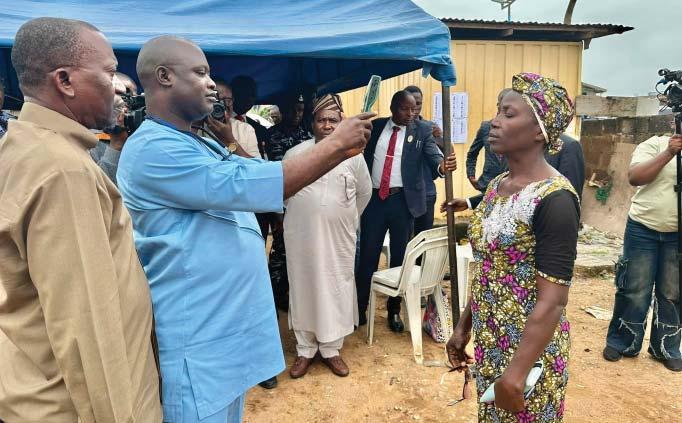
•INEC Chairman, Prof. Joash Amupitan (SAN), observing the mock accreditation conducted by the commission ahead of the Aug. 15 guber election in Osun, on Saturday
Hafsoh Isiaq
THE ritual has become so familiar that it scarcely raises eyebrows anymore. Whenever a major elec on approaches in Nigeria, parcularly a governorship poll, the public begins to an cipate changes within the na on’s security architecture. Senior officers are redeployed, command structures are reshuffled, and fresh appointments are announced, o en just days before voters head to the ballot box. Predictably, this pa ern has once again unfolded with the Osun State governorship elec on barely a fortnight away.
While such deployments are frequently presented as rou ne administra ve decisions intended to strengthen elecon security, their ming inevitably fuels public suspicion. In a democracy where confidence in ins tu ons remains fragile, every late-hour transfer is viewed through a poli cal lens. Whether jus fied or not, these percep ons undermine trust in the neutrality of the agencies responsible for safeguarding elec ons.
This recurring phenomenon exposes a deeper structural weakness within Nigeria’s democra c ins tu ons. Ins tu ons that should operate independently of par san interests too o en appear vulnerable to poli cal influence. Rather than projec ng stability and professionalism, they inadvertently reinforce the belief that key state ins tu ons can be

Musical Chairs
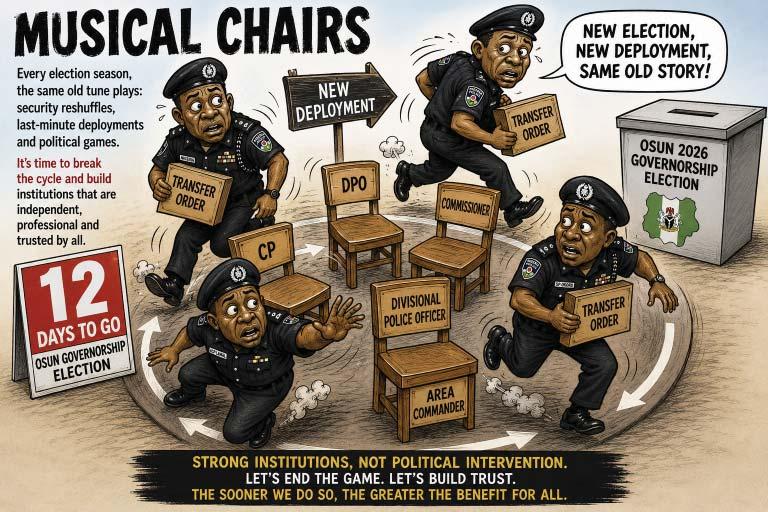
adjusted to suit prevailing poli cal circumstances.
A mature democracy is built not merely on periodic elec ons but on strong ins tu ons that command public confidence irrespec ve of which party occupies power. Security agencies, the judiciary, electoral bodies and other democra c ins tu ons must be seen to func on according to law, established procedures and professional standards not poli cal expediency.
The consequences of ins tu onal weakness extend far beyond elec on
“The country must deliberately build institutions that are insulated from political interference and capable of inspiring public confidence in every electoral cycle. Democratic governance cannot flourish where institutions appear susceptible to manipulation whenever political contests arise”
periods. Investors seek certainty. Ci zens desire fairness. Businesses thrive where the rule of law is respected, and development flourishes where ins tu ons are predictable, impar al and accountable. Countries that have achieved sustainable economic growth have done so largely because their public ins tu ons are stronger than the poli cal interests of the day.
Nigeria cannot connue to normalise prac-
ces that create avoidable doubts about the integrity of its democra c processes. Even where personnel changes are legi mate and opera onally necessary, they should be governed by transparent policies rather than occurring in ways that invite specula on. The credibility of elec ons depends not only on the fairness of the ballot but also on the perceived neutrality of those entrusted with maintaining law and order.
The Osun governorship elec on presents another opportunity for the country’s democra c ins tuons to reassure Nigerians that professionalism, not poli cs, guides their ac ons. Security agencies must discharge their cons tu onal responsibili es without fear or favour, ensuring that every voter, poli cal party and stakeholder enjoys equal protec on under the law.
Ul mately, the issue extends beyond Osun. It is about the future of Nigeria’s democracy. The country must deliberately build ins tu ons that are insulated from poli cal interference and capable of inspiring public confidence in every electoral cycle. Democra c governance cannot flourish where ins tu ons appear suscep ble to manipula on whenever poli cal contests arise.
OSUN DEFENDER
ISSN : 0794-8050
Telephone : 0809-301-9152
Website : www.osundefender.com/index.php e-mail : osundefenderhq@gmail.com osundefenderbank@gmail.com
All correspondence to the above email addresses.
The me has come to end this recurring game of musical chairs. Nigeria deserves ins tu ons that are stable, independent and accountable ins tu ons whose credibility is never ques oned because their integrity is beyond reproach. The sooner this becomes our na onal reality, the greater the dividends for democracy, poli cal stability and sustainable development.

MONDAY, AUGUST 03, 2026 VOL. 21 NO 58 www.osundefender.com, email: osundefenderbank@gmail.com
NIGERIA’S economy appears to be showing signs of recovery. Government officials frequently point to rising Gross Domes c Product (GDP), stronger foreign exchange reserves, improved tax revenues, renewed investor confidence, and farreaching fiscal reforms as evidence that the country is on the path to sustainable growth. These indicators are important and suggest that difficult policy decisions may be yielding results.
However, for millions of Nigerians, this recovery remains largely invisible.
Across the country, households con nue to grapple with rising food prices, expensive transporta on, high electricity tariffs, increasing healthcare costs, and unaffordable school fees. This disconnect between encouraging macroeconomic indicators and the daily reali es of ci zens raises a cri cal ques on: Can an economy truly be said to be growing when the majority of its people are becoming poorer?
The answer lies in understanding that economic growth does not automacally translate into shared prosperity. GDP measures the size of an economy but does not show how wealth
“Families
now spend a larger share of their earnings on basic necessities, leaving little room for savings or investment. Consequently, the costof-living crisis has overshadowed many of the government’s positive economic statistics”
PERSPECTIVE
By WAHAB ABIONA
Why Nigeria’s Economic Progress Is Still Failing The Ordinary Citizen Growth Without Prosperity:
is distributed. Growth concentrated in sectors such as oil and gas, banking, or telecommunica ons may improve na onal output without significantly benefi ng farmers, ar sans, traders, manufacturers, and small businesses that employ most Nigerians. Economic growth that enriches only a few while leaving the majority behind cannot be considered inclusive.
Infla on has further weakened the impact of whatever gains have been made. Even where incomes have remained stable, their purchasing power has declined sharply. Families now spend a larger share of their earnings on basic necessies, leaving li le room for savings or investment. Consequently, the cost-of-living crisis has overshadowed many of the government’s posi ve economic sta s cs.
Improved government revenues have also failed to inspire widespread public confidence. Ci zens judge economic progress not by higher tax collec ons but by be er public services. Yet poor roads, unreliable electricity, inadequate healthcare, underfunded schools,
and limited access to clean water remain common challenges. Without visible improvements in public infrastructure and service delivery, higher revenues mean li le to ordinary Nigerians.
Equally concerning is the labour market. Despite signs of economic expansion, unemployment and underemployment remain high, especially among young people. Many skilled professionals con nue to leave the country in search of be er opportuni es, while countless others depend on low-income informal jobs. An economy that does not create produc ve employment cannot deliver las ng prosperity.
The deprecia on of the naira has compounded these difficul es. Nigeria’s dependence on imported machinery, medicines, industrial inputs, and consumer goods means that exchange-rate instability quickly translates into higher produc on costs and increased prices. Businesses pass these costs on to consumers, placing addional pressure on already strained household budgets.
There is li le doubt that
reforms such as fuel subsidy removal, exchange-rate liberalisa on, and fiscal consolida on may strengthen the economy over me. Yet reforms must produce benefits that ci zens can see and feel. Without effec ve social protec on programmes to cushion vulnerable households, the immediate costs of reform risk outweighing its long-term promise in the eyes of the public.
Interna onal experience shows that successful economies combine sound macroeconomic management with deliberate investments in agriculture, manufacturing, educa on, healthcare, infrastructure, and job crea on. Countries that achieved inclusive growth ensured that na onal prosperity translated into rising incomes and be er living standards for ordinary cizens.
Nigeria should pursue the same path. Economic reforms must be complemented by policies that expand opportuni es, support small and medium-sized enterprises, strengthen produc ve sectors, improve public services, and promote transparent governance.
Ul mately, the true measure of economic success is not stronger GDP figures or higher government revenues but whether ci zens can afford nutri ous food, secure decent jobs, educate their children, access quality healthcare, and live with dignity and hope. Unl macroeconomic gains are reflected in higher real incomes and improved living standards, economic growth will remain a success recorded in official reports rather than one experienced in Nigerian homes.
•Abiona is an Economist, Tax-Consultant and Public Affairs Analyst