MONDAY, AUGUST 24, 2026
VOL 21 NO 67
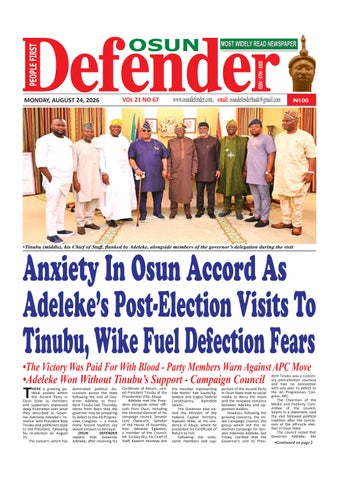
•Tinubu (middle), his Chief of Staff, flanked by Adeleke, alongside members of the governor’s delegation during the visit
Anxiety In Osun Accord As Adeleke’s Post-Election Visits To Tinubu, Wike Fuel Defection Fears •The Victory Was Paid For With Blood - Party Members Warn Against APC Move •Adeleke Won Without Tinubu’s Support - Campaign Council
T
HERE is growing poli cal anxiety within the Accord Party in Osun State as members and supporters expressed deep frustra on over what they described as Governor Ademola Adeleke’s ‘romance’ with President Bola Tinubu and poli cians loyal to the President, following his re-elec on on August 15. The concern, which has
dominated poli cal discussions across the state following the visit of Governor Adeleke to President Tinubu last Thursday, stems from fears that the governor may be preparing to defect to the All Progressives Congress — a move many Accord loyalists say would amount to betrayal. OSUN DEFENDER reports that Governor Adeleke, a er receiving his
Cer ficate of Return, visited President Tinubu at the Presiden al Villa, Abuja. Adeleke met the President alongside other officials from Osun, including the Director-General of his campaign council, Senator Lere Oyewumi; Speaker of the House of Assembly, Hon. Adewale Egbedun, a member of the Council, Mr. Sunday Bisi; his Chief of Staff, Kazeem Akinleye and
the member represen ng Ede North/ Ede South/Egbedore and Ejigbo Federal Cons tuency, Bamidele Salam. The Governor also visited the Minister of the Federal Capital Territory, Nyesom Wike, at his residence in Abuja, where he presented his Cer ficate of Return to him. Following the visits, some members and sup-
porters of the Accord Party in Osun State took to social media to decry the move and the renewed romance between Adeleke and opposi on leaders. However, following the growing concerns, the Imole Campaign Council, the group which led the reelec on campaign for Senator Ademola Adeleke, last Friday, clarified that the Governor’s visit to Presi-
dent Tinubu was a customary post-elec on courtesy and had no connec on with any plan to defect to the All Progressives Congress, APC. The Chairman of the Media and Publicity Commi ee of the council, Salam, in a statement, said the visit followed poli cal tradi on a er the conclusion of the off-cycle elecon in Osun State. The council noted that Governor Adeleke, like •Continued on page 2
MONDAY, AUGUST 24, 2026
2
News
Osun 2026: Some Of Our Supporters Betrayed Us - ADC Candidate, Salaam
T
HE African Democra c Congress (ADC) governorship candidate in the August 15 governorship elec on in Osun State, Dr Najeem Salaam, has alleged that some of his supporters betrayed him during the poll. Salaam, a former Speaker of the Osun State House of Assembly, made the allega on while speaking in a short video obtained by OSUN DEFENDER. The ADC candidate, who spoke in Yoruba, said he did not betray his supporters or compromise his ambi on by collec ng money from any poli cian to work for an opposi on party. According to him, his decision to contest the governorship elec on was driven by his desire to improve the lives and welfare of the people of Osun State. “The August 15 governorship elec on went as Almighty God wanted it to be. I never disappointed my supporters or collected money from any poli cian
to work for any opposi on party,” he said. Salaam, however, claimed that while he remained commi ed to his supporters, many of them allegedly failed to reciprocate the commitment during the elec on. “I contested the governorship elec on to better the lives of the people. I did not betray any of my supporters. However, most of my supporters betrayed me,” he stated. He did not disclose the iden ty of those he accused of betraying him or explain how they allegedly worked against his candidacy. OSUN DEFENDER reports that the incumbent governor, Ademola Adeleke of the Accord Party, was declared winner of the August 15 elec on. Salaam, in his remarks, noted that he has accepted the outcome as an act of divine will, saying the elec on ul mately went according to what Almighty God had ordained.
Fake Agencies, Evidence Of Gross Ineptitude Under Tinubu — Netizens
T
HE discovery of another alleged fake government agency opera ng from the Office of the Secretary to the Government of the Federa on (OSGF) has sparked mixed reac ons among Nigerians online, with some describing the development as evidence of confusion and poor oversight in government. OSUN DEFENDER reports that the latest discovery was made by the Independent Corrupt Prac ces and Other Related Offences Commission (ICPC) during its inves ga on into the controversial Presiden al Foreign Interven on Promo on Council (PFIPC). For some Nigerians, however, the issue has moved beyond the agency itself to the possibility of people being affected by the controversy. Godwin Abah Enebojojo wrote, “Just this month that I almost got an administra ve job under this ministry... in one of their administra ve office at Abia House in central business district Abuja.” Enebojojo added, “Na so I for dey loose my newly found job this week God,” reflec ng the uncertainty the controversy has created for people who may have interacted with the organisa on or its officials. Other commenters responded with sarcasm and disbelief. Ibrahim Muhammed Abubakar simply wrote, “Money na water and fake things,” while Paul Francis reacted, “Them s ll get more.” The discovery has also
prompted Nigerians to ques on how many such organisa ons may exist within government. Osarumwense Sunday Osagie asked, “How many fake agencies altogether now so far?” while Joseph Anthony summed up his reac on in three words: “Season of fake agency.” •Read full story on www.osundefender.com
•55 Cameroonians and Togolese who illegally entered Nigeria after their arrest by the Nigeria Immigration Service, Osun State Command, recently
Osun Govt Raises Alarm Over Alleged Plans To Ignite Fresh Crisis In LGs, Motor Parks
T
HE Osun State Government has raised the alarm over alleged plans by some stakeholders to ignite fresh rounds of crisis in local government councils and motor parks across the state. The Commissioner for Informa on and Public Enlightenment, Kolapo Alimi, in a statement on Sunday, said the government was par cularly disturbed by the reports and warned that such plans must stop immediately in the interest of public peace. The statement noted that it is me for postelec on reconcilia on and peace-building, not a return to violence.
“The Osun State Government on Sunday warned against any disrup on of public peace by any group or individuals, declaring that it is me for post-elec on reconcilia on and peace-building in the state,” Alimi stated. The government expressed condolences to vic ms of pre-elec on tensions and violence and called for healing and the avoidance of a return to conflict in the post-elec on period. It noted the immediate post-elec on disrup ons in some areas of the state and urged all residents and ci zens to allow the restora on of peaceful co-
existence and rule-based interac ons among all sectors of society. “It added that such a plan, if true, should stop immediately in the interest of public peace, stressing that Osun needs peace for development, not violence in poli cs,” the statement said. The government reminded poli cal actors that the August 15 elec on has been concluded, and that both the President and the Governor have already agreed on a peaceful way forward. “The Osun elec on has been won and lost. Mr President and Mr Governor have engaged on a peaceful
way forward. Any push towards violence represents an affront to the Presidency and the Nigerian cons tuon,” the statement said. The statement also called on security agencies to enforce the return to the rule of law by ensuring the release of poli cal detainees and an end to perceived par san policing, especially on local government and motor park management. “We call on all poli cal actors to speak and act peacefully. Osun should be in a period of healing and building. We must not allow a relapse into the preelec on era of killings and violence,” Alimi stated.
Anxiety In Osun Accord As Adeleke’s Post-Election Visits... •Continued from page 1 other victorious governors in off-cycle elec ons, had a responsibility to show apprecia on to the office of the President and Commander-in-Chief. This, the statement explained, was in recogni on of the President’s pre-elecon direc ve to the Independent Na onal Electoral Commission and security agencies to ensure a free and fair poll in Osun. “The visit also afforded Mr President, as the father of the Na on and the Osun State Governor, a pla orm to discuss issues about peace, security and progress of Osun State a er the tense elec on,” the statement said. The council dismissed insinua ons that the visit was to nego ate a move from Accord to the APC, stressing that no such discussion took place. “For the avoidance of doubt, the visit of Mr Governor and top members of his Campaign team had absolutely nothing to do with a plan to move from Accord
to the All Progressives Congress, as being insinuated in certain quarters. “We wish to state unequivocally that at no stage during the visit to Mr President was the issue of decamping to the APC discussed,” Salam said. The council expressed apprecia on to President Tinubu for gran ng the audience and reassured supporters of Governor Adeleke of his commitment to serving the people of Osun State who supported him in the August 15 elecon. But the clarifica on has done li le to reassure the base. Some of the supporters who spoke with OSUN DEFENDER recalled how difficult the pre-elec on period was for Accord party and its members in Osun. They listed the withholding of local government alloca ons for months, alleged police in mida on and the forceful takeover of motor parks and garages by suspected APC loyalists as part of the “humilia on”
the party endured. A chie ain of the Accord Party in Boripe Local Government who preferred anonymity said, “For us in Accord, this victory was paid for with blood, sweat and insults. The APC made life difficult for us. Now the same people want to dine with us? “The people of Osun voted for Adeleke and Accord, not APC. If he moves now, history will not forgive him.” Other supporters fear that a defec on would destabilise the government and might affect the chances of Accord Party candidates for the state and na onal assemblies in the general elec on. “He is the governor, and he can decide what he wants, but he should consider those who stayed with him when the road was rough,” a member of the Accord Party in Osogbo, Olaiya Aderibigbe, told OSUN DEFENDER. Aderibigbe noted that, “If the governor moves to the APC, that will affect a
lot of people, especially those contes ng under the Accord Party in the forthcoming general elecon. He should consider all these things before making a decision.” Meanwhile, the Imole Campaign Council has also dismissed insinua ons that Governor Ademola Adeleke’s recent engagement with President Bola Tinubu had any influence on his re-elec on. The group insisted that the governor won the August 15 governorship poll on his own popularity and the goodwill of the people of Osun. Spokesperson for the Council, Pelumi Olajengbesi, said that the endorsement or romance linked to the President played no role in the elec on outcome. “Governor Ademola Adeleke’s endorsement of Tinubu does not have anything to do with his victory. Adeleke is a very popular candidate. The people of Osun State voted for him. Tinubu did not provide any
support to Adeleke,” Olajengbesi stated. He added that rather than support, the All Progressives Congress deployed state resources against the Adeleke administra on during the eleconeering period. “The APC supported their candidate and released resources for him. They used the instrumentali es and machinery of government against the state government,” he said. Olajengbesi further referenced the reac on of the governor’s nephew, music star Davido, to bu ress his claim that the Adeleke camp received no federal backing. “If you look at the reac on of Davido, you will understand that he has been realis c with himself because we didn’t get any goodwill. Adeleke did not get any favour from the Federal Government. “Adeleke won the elecon on his own popularity and on the goodwill of the people of Osun,” he noted.
PEOPLE FIRST
MONDAY, AUGUST 24, 2026
3
T
HE poli cal scene in Osun State today borders on tragic comedy, if not a theatre of the absurd. In the a ermath of the recently concluded and fiercely contested governorship elec on, the dis nc on between the two appears increasingly blurred. The people of Osun State deserve commenda on and, indeed, applause for their broad-based resistance to imposi on and the deployment of what has come to be described as “Federal Might”. Their determina on to defend their democra c choice was remarkable and should not be diminished by the poli cal manoeuvrings that have followed the elec on. Ironically, the ac on has now shi ed to Abuja. Abuja was the nerve centre of efforts that, in the eyes of many Osun people, sought to undermine the free expression of their democra c will. It is therefore difficult to ignore the irony of the re-elected Governor, Ademola Adeleke, travelling to the na on’s capital to pay what was described as a courtesy visit to the FCT Minister, Nyesom Wike. The visit is par cularly difficult to ra onalise given the minister’s role in the poli cal drama surrounding the elecon. Wike did li le to conceal his hos lity towards the governor and, by extension, the poli cal posi on of a large sec on of the Osun electorate. His interven ons before the elec on were o en incendiary, provoca ve and unnecessarily comba ve. Against this background, the governor’s decision to extend a courtesy call to the minister raises legi mate ques ons. What exactly was the purpose of the visit? What message was it intended to convey? And, more importantly, what does it say to the people who stood firmly behind the governor in what they perceived as a ba le for the soul of Osun? A courtesy call on the President of the Federal Republic, who has been increasingly adorned in a regal poli cal toga, can at least be ra onalised on grounds of poli cal expediency. The President wields enormous cons tuonal and poli cal powers over the states. He controls federal alloca ons, appoints
A Bizarre Visit!
key officials, and, in extreme circumstances, possesses powers capable of fundamentally altering the poli cal and administra ve equilibrium of a state. It is therefore understandable, from a tac cal standpoint, for a governor to seek accommoda on with the centre. But Wike is not the President. It is difficult to see what significant harm the FCT Minister can inflict on Osun State or what compelling strategic advantage the governor stands to gain from such a visit. Indeed, the op cs are far more consequen al than whatever private benefit may have been intended. Governor Adeleke must understand that leadership is not only about winning elecons; it is also about respecting the sacrifices that made victory possible. The people who resisted in mida on, stood against perceived federal interference and defended their votes deserve to see their mandate treated with seriousness. The visit, therefore, was illadvised. It risked diminishing
“Governor Adeleke must understand that leadership is not only about winning elections; it is also about respecting the sacrifices that made victory possible. The people who resisted intimidation, stood against perceived federal interference and defended their votes deserve to see their mandate treated with seriousness”
strategic purpose, not by an appe te for meaningless poli cal symbolism. The governor should now turn his a en on away from courtesy calls and towards the more difficult task of governing. He should work with democra c forces, civil society organisa ons, professional groups, tradi onal ins tu ons, labour, youth organisa ons and oththe significance of a struggle er stakeholders to develop a in which many Osun ci zens genuine pro-people New Deal invested their hopes, resourc- for Osun State. The people es and, in some instances, per- have gone through enough. sonal safety. The memory of They deserve competent govthose who stood in the heat of ernance, economic opportuthat poli cal ba le must not nity, improved infrastructure, be trivialised by gestures that stronger local government adappear to reward or legi mise ministra on, be er public serthose who worked against the vices and, above all, a tangible very mandate the governor dividend from the mandate now occupies. they have given him. That said, poli cs inevitably The elec on may be over, demands engagement. Gover- but the real work has only benance also requires accommo- gun. da on, nego a on and the Governor Adeleke should ability to build bridges even therefore resist the tempta on with adversaries. But such en- to spend poli cal capital on gagement must be guided by gestures that offer li le value to the people. His OSUN DEFENDER priority should be Publisher – Moremi Publishing to consolidate the House Ltd. democra c manDeputy Editor – Michael Bamigbola date, heal the diviAsst. News Editor – Yusuf Oketola sions created by the Deputy Photo Editor – Shola Aderinto elec on and deliver Deputy Graphics Manager – Zainab Olalere a government that Produc on Controller – Petkola Taiwo Ibitowa is visibly different in OSUN DEFENDER is published by Moremi Publishing its responsiveness, House Limited, Behind Oranmiyan Building, Gbodofon, accountability and Off Gbongan Road, Osogbo, Osun State. commitment to the ISSN : 0794-8050 people. Telephone : 0809-301-9152 Osun does not Website : www.osundefender.com/index.php need more meane-mail : osundefenderhq@gmail.com ingless visits. It osundefenderbank@gmail.com All correspondence to the above email addresses. needs results.
ISSN : 0794 - 8050
News
MONDAY, AUGUST 24, 2026 VOL. 21 NO 67 www.osundefender.com, email: osundefenderbank@gmail.com
S
INCE the conclusion of the 2026 Osun State governorship elec on, a familiar argument has gained renewed momentum in public discourse, par cularly among young men and women on social media: that the APC lost the elec on because of its perceived unfriendly posture towards workers and their welfare. The argument is straigh orward. “The APC did not treat workers well. Remember the half-salary era. Workers and their families suffered. That is why Osun rejected them.” It might have remained another postelec on poli cal argument, except that it received an unexpected boost when President Bola Ahmed Tinubu, while receiving Governor Ademola Adeleke at the Presidenal Villa a er his victory, also referred to the experience of Osun workers under the previous APC administra on. That presiden al reference has given the argument a new level of poli cal and public relevance. It raises an important ques on: How much did the memory of the half-salary years influence the 2026 elec on, and what does the historical record actually tell us about the period? There is, however, a danger in remembering governments primarily through their most painful moments. The suffering of workers during the salary crisis was real, and it should neither be minimised nor explained away. But eight years of government cannot be adequately understood through one policy, one crisis or one poli cal narra ve. The Aregbesola years were also a period of ambi ous infrastructure development, social interven on, educa on reforms, revenue mobilisa on and significant public expenditure. They were equally years in which Osun’s finances came under severe pressure as federal alloca ons declined, Nigeria entered an economic crisis and the state’s obliga ons became increasingly difficult to sustain. To understand how the “half-salary” experience became such a powerful poli cal memory and whether it was sufficient to shape the APC’s fortunes in 2026 we therefore need to go beyond the poli cal rhetoric and return to the numbers. What happened to Osun’s finances? How much was spent on workers, infrastructure and social programmes? What changed when federal revenues collapsed? What choices did the government make? And, ulmately, was the salary crisis a consequence of an an -worker posture, a na onal economic shock, fiscal choices made by the administra on or a complicated combina on of all three?
“Aregbesola should be judged neither solely by the roads he built nor solely by the salaries workers did not receive in full. He should be judged by how he managed the difficult trade-off between development ambition and fiscal sustainability and whether the choices made during the good years left Osun sufficiently resilient when the bad years arrived”
Osun Govt Raises Alarm Over Alleged Plans To Ignite Fresh Crisis In LGs, Motor Parks P 2
PERSPECTIVE
By RASHEED ADEBIYI, PHD Beyond The Half Salary: What The Numbers Say About Aregbesola’s Eight Years in Osun Those ques ons are worth asking not to rewrite history, but to understand it. The Osun Aregbesola Inherited When Aregbesola assumed office in November 2010, Osun was not a wealthy state with a large independent revenue base. It was a me when the state was laregely described as the Civil Service state. The administra on said it inherited about N18.3 billion in debt and a situa on in which the state was borrowing monthly to meet salary obliga ons. That claim came from the government and should therefore be treated as part of the administra on’s account of its inheritance. What is less disputable is that Osun’s fiscal capacity was limited and heavily dependent on federal transfers. That dependence would become cri cal a few years later. The early years, however, were not defined by salary arrears. The administra on pursued an ambious development programme while attemp ng to improve internally generated revenue. Osun’s official accounts and contemporary government records show substan al spending on educa on, roads, urban renewal, health, youth employment and social programmes. The educa on reforms became par cularly prominent. The government embarked on the construc on of model schools, introduced school feeding programmes, provided uniforms, paid examina on fees and distributed the Opon Imo learning tablets. Infrastructure was another major component. The government pursued road construc on and rehabilita on across the state, including major inter-city and township roads. The scale of the ambi on was substan al for a state with a rela vely small revenue base. The model appeared straigh orward: expand the state’s economic and physical infrastructure, improve revenue generaon and use borrowing and available public funds to accelerate development. For a period, it seemed possible. Then the economic environment changed. When The Numbers Turned Against The Government One of the clearest ways to understand the crisis is to follow statutory alloca ons. Osun’s own Medium-Term Expenditure Framework shows that statutory allocaon rose to approximately N39.76 billion in 2013. It then fell to N36.16 billion in 2014, N25.67 billion in 2015 and just N18.59 billion in 2016. In other words, between 2013 and 2016, statutory alloca on fell by more than half. That was devasta ng for a state so
dependent on federal transfers. The wider Nigerian economy was experiencing an equally drama c shock. The collapse in global oil prices from late 2014 severely affected federal revenues, which in turn affected states. The World Bank noted at the me that most Nigerian states depended heavily on Federa on Account alloca ons and that more than ten states had accumulated salary arrears. Nigeria subsequently entered recession in 2016. Osun was therefore not an isolated case. But the na onal crisis does not completely se le the ques on of responsibility. It raises another one: Had Osun’s spending commitments become too large for its revenue capacity even before the crisis fully arrived? The evidence suggests that they had. The Infrastructure Gamble Osun’s expenditure figures reveal the scale of the government’s development ambi on. Actual capital expenditure was approximately N46.5 billion in 2012 and an extraordinary N82 billion in 2013. Then came the contrac on. Capital expenditure fell to approximately N23.6 billion in 2014, N17.9 billion in 2015, N28.4 billion in 2016 and N23.9 billion in 2017. The pa ern is instruc ve. The government did not simply con nue spending on infrastructure at the same level while refusing to pay workers. When revenue collapsed, capital expenditure itself was substan ally squeezed. But the commitments created during the expansionary years remained. At the same me, personnel expenditure remained substan al. Actual personnel expenditure was about N18.65 billion in 2012, N12.78 billion in 2013, N32.58 billion in 2014, N33.29 billion in 2015, N36.84 billion in 2016 and N38.26 billion in 2017, according to the state’s fiscal documenta on. The implica on is significant. Osun was carrying both a large recurrent obliga on and the legacy of an ambious capital programme at the precise moment its revenue base was collapsing. That is where the fiscal model began to break. Workers Were Not Always The Losers This is an important part of the story that is frequently forgo en. The administra on’s own records show that workers received full salaries in the early part of the crisis. According to the state’s account of its bailout disbursement, salaries were paid in full through June 2015. The government then began using bailout funds and other revenue to augment salary payments. The government had requested more than N64.3 billion from the Central Bank of
Nigeria to cover outstanding salaries, pensions and gratui es.The CBN released approximately N25.87 billion for state workers and another N9.12 billion for local-government workers, according to the state’s records. The state argued that the amount was insufficient to clear all outstanding obliga ons. This was the beginning of the most controversial phase. The government and organised labour eventually adopted a modulated salary structure. Workers on lower grades were protected from the worst effects, while higher grades received reduced payments. The government’s own account says workers on Grades 1–7 received full salaries while those on Grade 8 and above received 50 per cent during the relevant period. That is an important dis nc on. “Half salary” was therefore poli cally powerful shorthand, but it did not mean that every Osun worker received half his or her salary. For those who did receive reduced pay, however, the dis nc on probably offered li le comfort. A reduc on in salary is s ll a reducon in household income. Was Aregbesola Simply Choosing Roads Over Workers? The numbers make that interpreta on difficult to sustain in its simplest form. The government was spending heavily on workers before the crisis, while simultaneously inves ng in infrastructure and social programmes. The problem was that the two sides of the equa on became increasingly difficult to sustain together. The state’s own fiscal records indicate that statutory revenue collapsed while personnel obliga ons remained high. The government itself iden fied several contributing factors to the salary crisis, including the implementa on of the N18,000 minimum wage, investments in infrastructure and social services, low internally generated revenue and the fall in federal alloca ons. The World Bank’s analysis provides the broader context: the oil-price shock forced Nigerian states to ghten budgets drama cally, while many struggled to meet salary obliga ons. So it would be unfair to suggest that the salary crisis was simply a consequence of Aregbesola deciding that roads were more important than people. But it would be equally simplis c to absolve the administra on of all responsibility. The government’s development model involved substan al capital expenditure and borrowing at a me when Osun’s independent revenue base remained rela vely weak. The ques on was not whether infrastructure was necessary. It was whether the scale and pace of investment were fiscally sustainable. That is the more difficult ques on. The bailout and the poli cs of blame The federal bailout eventually provided some breathing space. Osun received about N34.9 billion in combined bailout funds for state and local-government workers, according to the state’s records. The government said the money was used to augment salaries and pensions. The administra on also established a commi ee involving government and labour representa ves, chaired by former NLC president Hassan Sunmonu, to examine available revenue and determine how it should be appor oned among salaries and other obliga ons. This arrangement is important because it complicates the argument that the modulated salary policy was imposed without consulta on. •Read full article on www.osundefender.com •Adebiyi, a teacher and researcher is an Associate Professor of Mass Communication at Fountain University, Osogbo
OSUN DEFENDER is published by Moremi Publishing House Limited, Behind Oranmiyan Building, Gbodofon, Off Gbongan Road, Osogbo, Osun State. All correspondence to the Deputy Editor, MICHAEL BAMIGBOLA, Telephone: 0809-301-9152. ISSN: 0794-8050. Website: www.osundefender.com Email: osundefenderbank@gmail.com, osundefenderhq@gmail.com