MONDAY, OCTOBER 26, 2026
VOL 21 NO 84
•Netizens Knock 90-Day Economic Redemption Plan •‘We Have Sufficiently Tackled Challenges’ - President
A
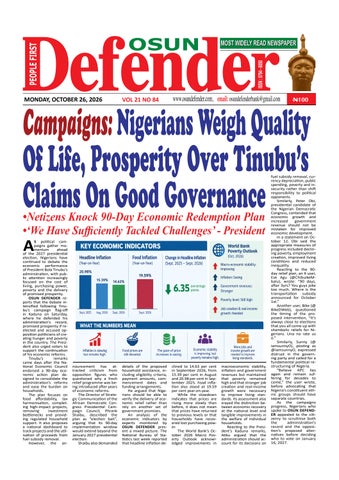
S poli cal campaigns gather momentum ahead of the 2027 presiden al elec on, Nigerians have con nued to debate the economic performance of President Bola Tinubu’s administra on, with public a en on increasingly focused on the cost of living, purchasing power, poverty and the delivery of promised prosperity. OSUN DEFENDER reports that the debate intensified following Tinubu’s campaign flag-off in Kaduna on Saturday, where he defended his administra on’s record, promised prosperity if reelected and accused opposi on poli cians of crea ng hunger and poverty in the country. The President also urged voters to support the con nua on of his economic reforms. Tinubu’s remarks came days a er the Naonal Economic Council endorsed a 90-day economic ac on plan designed to consolidate the administra on’s reforms and ease the burden on households. The plan focuses on food affordability, tax harmonisa on, completing high-impact projects, removing investment bo lenecks and providing regulated household support. It also proposes a na onal dashboard to track projects and the u lisa on of proceeds from fuel subsidy removal. However, the an-
nouncement has attracted cri cism from opposi on figures who ques oned why a fresh relief programme was being introduced a er years of economic reforms. The Director of Strategic Communica on of the African Democra c Congress Presiden al Campaign Council, Phrank Shaibu, described the plan as “elec on bait”, arguing that its 90-day implementa on window would extend beyond the January 2027 presiden al elec on. Shaibu also demanded
details of the proposed household assistance, including eligibility criteria, payment amounts, commencement dates and funding arrangements. He argued that Nigerians should be able to verify the delivery of economic relief rather than rely on another set of government promises. An analysis of the economic indicators by experts monitored by OSUN DEFENDER present a mixed picture. The Na onal Bureau of Stas cs last week reported that headline infla on de-
clined to 14.63 per cent in September 2026, from 15.39 per cent in August and 20.98 per cent in September 2025. Food inflaon also stood at 19.59 per cent year-on-year. While the slowdown indicates that prices are rising more slowly than before, it does not mean that prices have returned to previous levels or that households have recovered lost purchasing power. The World Bank’s October 2026 Macro Poverty Outlook acknowledged improvements in
macroeconomic stability, infla on and government revenues but maintained that poverty remained high and that stronger job crea on and real-income growth were necessary to improve living standards. Its assessment also xrayed the dis nc on between economic recovery at the na onal level and tangible improvements in the welfare of individual households. Reac ng to the President’s Kaduna remarks, A ku argued that the administra on should account for its decisions on
fuel subsidy removal, currency deprecia on, public spending, poverty and insecurity rather than shi responsibility to poli cal opponents. Similarly, Peter Obi, presiden al candidate of the Nigerian Democra c Congress, contended that economic growth and increased government revenue should not be mistaken for improved economic development. In a statement on October 12, Obi said the appropriate measures of progress included declining poverty, employment crea on, improved living condi ons and reduced inequality. Reac ng to the 90day relief plan, an X user, Eze Agu (@ChibuikeMbalu), wrote: “90 days, a er 3yrs? You guys joke too much. Where is the transporta on subsidy announced for October 1st.” Another user, Bike (@ BikeDWeb), ques oned the ming of the proposed interven on, “It’s always close to elec ons that you all come up with shambolic reliefs for Nigerians. Una no rate us o.” Similarly, Sunny (@ iamsunnyO), pos ng as @iamsunnyO, expressed distrust in the governing party and called for a fundamental poli cal restructuring of Nigeria. “Believe APC lies again and remain suffering for decades to come,” the user wrote, before advoca ng that Nigeria’s cons tuent ethnic groups should have separate countries. As the campaigns progress, Nigerians who spoke to OSUN DEFENDER appealed to the ci zenry to scru nise both the administra on’s record and the opposion’s proposed alterna ves before deciding who to vote on January 16, 2027.
MONDAY, OCTOBER 26, 2026
2
News
Heat Wave: Expert Urges Nigerians To Stay Hydrated, Embrace Proper Ventilation
A
medical prac oner and awareness advocate, Dr. Suleiman Akin, has urged Nigerians to stay hydrated, ensure proper ven la on in their homes and workplaces, and take necessary precauons amid concerns over rising temperatures and the health risks associated with extreme heat. The warning comes against the backdrop of a predic on of 31,000 deaths linked to the heat wave and El Niño-related condi ons, underscoring concerns about the poten al health consequences of extreme temperatures and the need for preven ve measures. Akin said prolonged exposure to excessive heat could increase the risk of dehydra on, heat exhauson and other heat-related illnesses, par cularly among children, older people, outdoor workers and individuals with underlying health condi ons. He advised Nigerians to drink water regularly, avoid excessive exposure to direct sunlight during the ho est periods of the day, wear lightweight clothing and seek shade whenever possible, stressing the importance of keeping indoor spaces adequately ven lat-
ed to reduce heat build-up. “People should not wait un l they feel thirsty before drinking water, especially when the weather is extremely hot. Regular water intake helps the body maintain its fluid balance and regulate its temperature. Everyone, par cularly those who work outdoors, should make hydra on a priority. “Proper ven la on is essen al in homes, offices, schools and other public spaces. People should allow fresh air to circulate and avoid staying for long periods in poorly ven lated rooms. Where possible, fans and other safe cooling methods should be used to make indoor environments more comfortable,” the medical prac oner said. Akin further advised residents to limit strenuous physical ac vi es during peak heat hours and, where possible, reschedule outdoor work and exercise for the early morning or evening when temperatures are generally lower. The medical prac oner warned that symptoms such as dizziness, headaches, unusual weakness, excessive swea ng and nausea could indicate heatrelated illness, urging peo-
•Beauty, after her arrest by Officials of NDLEA ple experiencing such signs to move to a cooler place and seek medical a en on when necessary. “Parents and caregivers should pay par cular a en on to children and older persons because they may be more vulnerable to the effects of extreme heat. People should also watch out for symptoms of dehydra on, including dark-coloured urine, dry mouth and reduced urina on. Anyone
who becomes confused, collapses or develops other severe symptoms needs urgent medical a en on,” Akin said. He urged Nigerians to take heat-related health warnings seriously, adopt preven ve measures and rely on credible public health informa on, stressing that awareness and simple daily precau ons could help reduce the risks associated with extreme temperatures.
SERAP Drags FG To ECOWAS Court Over N78.8bn Cash Transfer Funds
T
HE Socio-Economic Rights and Accountability Project (SERAP) has sued the Federal Government at the ECOWAS Court of Jusce over alleged financial irregulari es involving ₦78.8 billion allocated to cash-transfer and social protec on programmes for vulnerable Nigerians. The suit follows findings in the Auditor-General of the Federa on’s 2024 Annual Report, which ques oned payments and expenditures involving the Ministry of Humanitarian Affairs and Poverty Reducon, the Na onal Cash Transfer Office (NCTO) and the Na onal Social Safety Nets Coordina ng Office (NASSCO). According to the report, about ₦33.751 billion reportedly transferred to more than 3.2 million households across 35 states in 2023 could not be adequately verified due to the absence of necessary records. The report also flagged ₦36.744 billion in payments made without prepayment audits and another ₦4.616 billion in expenditure unsupported by adequate documentaon. In suit number ECW/ CCJ/APP/42/26, SERAP is asking the court to compel the Federal Government to account for the ques-
oned funds, inves gate the reported irregulari es and recover any money found to have been misappropriated or improperly spent. The organisa on is also seeking appropriate legal or administra ve sanc ons against anyone found responsible, as well as stronger financial oversight, beneficiary verifica on and audi ng procedures for future disbursements. SERAP argued that the failure to account properly for funds meant for vulnerable households raises concerns about Nigerians’ rights to social security and an adequate standard of living, including access to basic necessi es such as food, clothing and housing. It urged the government to ensure that eligible beneficiaries receive the assistance intended for them and that any harm arising from established irregulari es is addressed. SERAP said it had previously wri en to President Bola Tinubu and relevant authori es on September 5, urging them to publish the relevant financial records, inves gate the audit findings and recover any funds found to have been unlawfully spent. According to the organisa on, the deadline
given to the government expired without adequate ac on, promp ng it to approach the regional court. No hearing date has been fixed for the case.
The allega ons are yet to be determined by the court, while the audit findings do not, on their own, establish that the funds were stolen or diverted.
NDLEA Arrests South African Woman With 36.65kg Of Cocaine In Lagos
T
HE Na onal Drug Law Enforcement Agency (NDLEA) says it has arrested Qhina Beauty, a 34-year-old South African woman, with 36.65 kilogrammes of cocaine at the Murtala Muhammed Internaonal Airport (MMIA) in Lagos. Femi Babafemi, NDLEA director of media and advocacy, shared this in a statement on Sunday.
Babafemi said Beauty was arrested on October 7 at the airport’s departure hall while a emp ng to board a Qatar Airways flight to South Africa via Doha. He said a search of her two travel bags led to the discovery of 30 blocks of cocaine concealed with dried pepper, wrapped in cellophane tape and packed into seven parcels.
Ebola: NCDC Identi es Two New Suspected Cases, Approves N100,000 Weekly Support For Contacts
T
HE Nigeria Centre for Disease Control and Preven on (NCDC) has iden fied two addional suspected cases of Ebola virus disease and 53 primary contacts as part of efforts to contain the outbreak in the country. The Director-General of the agency, Dr Jide Idris, disclosed this on Sunday during a press briefing in Abuja, where he also announced an emergency payment of N100,000 per person weekly to support individuals placed in isola on or quaran ne. Idris said the financial interven on was introduced a er some contacts raised concerns about the cost of feeding, accommoda on and providing for their families while complying with public
health monitoring arrangements. According to him, the payment is intended to ease the financial burden on affected individuals and encourage their coopera on with measures aimed at preven ng further transmission of the disease. “We are paying for their accommoda on; we are paying for their feeding. Some of them are asking for a s pend to maintain their families,” he said. He added, “We are providing N100,000 per person per week just to maintain their comfort and feeding, because they were complaining.” The NCDC chief explained that the financial support was not part of the agency’s ini al response plan but became necessary
because of the circumstances surrounding the outbreak. “This was not planned for, but it is an emergency. We will con nue to review it as we go along,” Idris said. On surveillance and tes ng, the NCDC director-general said the country had about 12 public and private laboratories available for Ebola tes ng, adding that the agency had strengthened laboratory capacity to ensure suspected cases were promptly inves gated. He said isola on and quaran ne facilies had also been established, while public health teams were tracing and monitoring individuals who might have been exposed to the confirmed case for 21 days a er their last
possible exposure. Idris urged public and private healthcare facili es to strengthen screening, triage and infec on preven on measures, stressing the need to ensure that healthcare workers had adequate personal protec ve equipment. He also called on Nigerians contacted by public health officials to cooperate with contact-tracing teams and provide accurate informa on about their movements, contacts and any symptoms they might experience. The agency said heightened surveillance and other response measures were being sustained to iden fy poten al cases promptly and prevent further spread of the disease.
MONDAY, OCTOBER 26, 2026
3
T
HE Federal Government’s announcement of a 90-day drive to tackle Nigeria’s mul faceted economic challenges raises ques ons about the urgency, ming and sustainability of its response. The ini a ve, coming amid moun ng economic pressures and ahead of another electoral contest, risks being perceived as a hurried a empt to change the poli cal narra ve rather than a carefully considered strategy to improve the lives of Nigerians. The military term Blitzkrieg, associated with Germany’s rapid, concentrated offensives during the Second World War, captures the idea of a sudden and intensive assault. Applied to economic governance, however, speed alone is no guarantee of success. Complex structural problems cannot be resolved through a short burst of ac vity without a credible plan, measurable targets and sustained implementa on. The government’s predicament is partly rooted in the gap between official economic narra ves and the daily experiences of ci zens. Even where headline indicators suggest improvements, such gains mean li le to households struggling with food prices, transport costs, school fees and healthcare expenses. Economic sta s cs must ul mately be judged by their impact on living standards, not merely by their ability to produce reassuring headlines. The administra on should have an cipated the social consequences of its far-reaching economic decisions and
“A ninety-day sprint may create momentum, but it cannot erase the consequences of years of policy choices overnight. Economic recovery is a marathon requiring consistency, social protection and honest engagement with reality”
household purchasing power require coordinated policies, dependable funding and sustained poli cal commitment. A short-term programme may provide relief, but it cannot subs tute for structural reform. The ming of the ini a ve also invites scru ny. With elecons approaching, the government must demonstrate that the programme is driven by clearly defined public needs rather than the immediate demands of electoral polics. That requires transparent benchmarks, published implementa on schedules and independently verifiable evidence of progress. Nigerians should be able to dis nguish between announcements, money commi ed, projects delivered and measurable improvements in their lives. Opposi on par es, meanwhile, have an opportunity to contribute meaningfully to the na onal debate by presen ng credible, costed alterna ves rather than relying solely on cri cism of the administraon. Economic hardship demands serious policy choices, on. Where cheaper imports and compe ng poli cal actors enter the market without should be judged by the claricomplementary measures to ty, feasibility and accountabilimprove local produc vity, ity of their proposals. farmers can struggle to reUl mately, the test of the cover their produc on costs. government’s 90-day ini a ve Reports of moun ng agricul- will not be the intensity of its tural debts and the closure publicity or the number of acof rice mills underscore the vi es announced. It will be need for a more balanced ap- whether Nigerians experience proach that considers both tangible relief in food prices, consumer affordability and transporta on, agricultural the long-term viability of do- produc on, employment and mes c produc on. household purchasing power. These are not problems A government that seeks pubthat can be resolved by a lic confidence must demon90-day sprint alone. Rebuild- strate results that ci zens can ing agricultural value chains, feel and independently verify. expanding affordable public A ninety-day sprint may transport, improving rural create momentum, but it caninfrastructure and restoring not erase the consequences of years of policy OSUN DEFENDER choices overnight. Publisher – Moremi Publishing Economic recovery House Ltd. is a marathon reAc ng Deputy Editor – Sodiq Yusuf quiring consistency, Deputy Photo Editor – Shola Aderinto social protec on Deputy Graphics Manager – Zainab Olalere and honest engageProduc on Controller – Petkola Taiwo Ibitowa ment with reality. OSUN DEFENDER is published by Moremi Publishing Without these founHouse Limited, Behind Oranmiyan Building, Gbodofon, da ons, the ini ave risks becoming a Off Gbongan Road, Osogbo, Osun State. temporary exercise ISSN : 0794-8050 Telephone : 0809-301-9152 in poli cal commuWebsite : www.osundefender.com/index.php nica on rather than e-mail : osundefenderhq@gmail.com a las ng response to osundefenderbank@gmail.com Nigeria’s economic All correspondence to the above email addresses. distress.
A Ninety-Day Sprint
introduced adequate safeguards alongside them. The removal of petrol subsidies, for instance, placed considerable pressure on households and businesses. Without sufficiently accessible and reliable mass transit alternaves, the resul ng increase in transport costs spread through the economy, raising the cost of moving people, goods and services. Rural communi es have borne their own share of the burden. Smallholder and subsistence farmers, already exposed to unpredictable weather, expensive inputs and inadequate infrastructure, have faced addi onal pressures from rising producon and transporta on costs. The absence of effec ve farm-gate price guarantees, sufficient storage facili es, accessible agricultural financing and well-maintained rural roads has le many producers vulnerable to losses and exploita on. Agriculture has also been affected by trade policies that lower import tariffs without adequately protec ng domes c produc ve capacity or preparing local producers for increased compe -
News
MONDAY, OCTOBER 26, 2026 VOL. 21 NO 84 www.osundefender.com, email: osundefenderbank@gmail.com
H
AVE you heard about the super heat wave that could put thousands of Nigerians at risk of dying from extreme
heat? Imagine waking up in the middle of the night, swea ng heavily because your room is too hot. You want to switch on your fan, but there is no light. You open the window, but the air is s ll hot. You are thirsty, red and unable to sleep. This is a situa on many Nigerians could face if temperatures rise sharply in the coming months. On 23 September 2026, researchers at the University of Chicago’s Climate Impact Lab released a study es ma ng that the current El Niño could cause about 451,000 more heat-related deaths worldwide than would normally be expected through February 2027. The researchers also expect roughly 44 per cent more extremely hot days than in a typical year. Nigeria is among the countries facing serious risks. The study es mates that about 31,400 addi onal heat-related deaths could occur in the country between September 2026 and February 2027. These figures are es mates, not confirmed deaths. But they are a warning that Nigerians should take seriously. The ming is also important. We are already in October, and climate experts have warned that the El Niño event could reach its peak between October and December 2026. With many Nigerians struggling with electricity supply, high living costs and limited access to cooling, understanding this phenomenon and knowing how to stay safe have become increasingly important. What Exactly Is El Niño? El Niño is a natural climate pa ern that begins in the Pacific Ocean, far away from Nigeria. It happens when the surface water in parts of the Pacific Ocean becomes warmer than usual. This warming changes the movement of air and moisture around the world. As a result, it can affect rainfall and temperatures in different countries. Some places may experience more heat than usual. Others may experience drought, while some areas may experience unusual rainfall. But there is something important to understand. El Niño is not the heatwave itself. It is a climate pa ern that can make extreme heat more likely in some parts of the world. The problem becomes more serious because the Earth is already ge ng warmer due to climate change. When El Niño occurs against this background, it can add to the heat.
REVIEW & OUTLOOK
BY HAFSOH ISIAQ
El Niño: What To Do About Heat Wave Phenomenon
This is why scien sts are paying close a en on to the current event. The Nigerian Meteorological Agency (NiMet), in its seasonal update in August 2026, confirmed the onset of a strong El Niño and said it was expected to con nue intensifying. Earlier, a regional climate outlook forum for Africa, which met in June, reported that global forecas ng centres expected the event to peak between October and December. In other words, the period experts warned about is already here. However, this does not mean every part of Nigeria will experience the same level of heat. Local weather condi ons will influence the temperatures recorded in different states. What Do the Projec ons Say About Nigeria? The figures from the Climate Impact Lab are worrying. The researchers es mate that El Niño could contribute to about 451,000 addional heat-related deaths worldwide between June 2026 and February 2027. Nigeria alone could account for about 31,400 addi onal deaths between September 2026 and February 2027. The study also es mates that about 15,400 addi onal heat-related deaths could occur in Nigeria between December 2026 and February 2027. But what does this mean for an ordinary Nigerian? It means extreme heat could cause more people to become seriously ill or die than would normally be expected during the period. The figures do not mean that 31,400 Nigerians have already died. They also do not mean these deaths will certainly happen. They are es mates based on research into how high temperatures affect human health. The purpose of the projec ons is to warn governments and the public about the possible danger and encourage early ac on. Why is Nigeria par cularly vulnerable? Think about the people who spend hours under the sun every day. Farmers work on their farms. Traders sell goods beside roads. Construc on workers build houses. Traffic officers stand on busy roads. Commercial drivers sit in traffic for hours. Now think about families living in small rooms with poor ven la on, where the heat becomes unbearable at night. Some people cannot afford air condioners. Others cannot even depend on electricity to power their fans.
For these people, extreme heat is not just uncomfortable. It can become dangerous. However, the actual number of deaths will depend on how hot it gets, how long the heat lasts and how well people are protected. The warning is serious, but the projected deaths are not inevitable. Why the Blackout Makes It Worse? Imagine trying to sleep on a very hot night without a fan. You turn from one side of the bed to the other, but you cannot get comfortable. You open the window, hoping for fresh air, but the room remains hot. Now imagine experiencing this for several nights. Thhis is one of the concerns surrounding extreme heat in Nigeria. Many households depend on fans to stay cool. But when there is no electricity, people who cannot afford generators or solar power may have few op ons. Those living in crowded rooms and poorly ven lated buildings may suffer even more. The problem also affects hospitals, schools, offices and businesses that depend on electricity. But why is excessive heat dangerous? The human body needs to maintain a safe temperature. When the weather becomes too hot, the body sweats to cool itself. If a person loses too much water through swea ng, dehydra on can occur. This may cause headaches, dizziness, weakness and other symptoms. If the body becomes too hot and can no longer cool itself properly, a person may develop heatstroke. Heatstroke is a medical emergency that can cause death. The risk is higher for people who work under the sun, older people, babies and young children, pregnant women and people with certain health condi ons. Hot nights can also be dangerous because the body may not get enough me to cool down a er a hot day. This is why Nigerians must prepare for extreme heat, even when electricity is unavailable. What You Can Do You may not be able to control the weather. But you can take steps to protect yourself and your family. Here are some simple things you can do. 1. Drink water regularly Do not wait un l you are very thirsty before drinking water. Drink water regularly throughout the day, especially when the weather is hot. If you work outdoors, carry drinking wa-
P2 ter with you. If you begin to feel weak or dizzy while working in the heat, stop and move to a cooler place. People who have been told by their doctors to limit their water intake should follow their medical advice. 2. Avoid the hot sun when possible Try to stay indoors or under a shade during the ho est part of the day. If you work outdoors, try to do difficult tasks early in the morning or later in the evening. Take breaks. Do not con nue working when you feel dizzy, weak or sick from the heat. 3. Keep your room cool You do not always need an air condioner to reduce the heat in your room.During the day, close curtains or cover windows that allow strong sunlight to enter. Wear light clothing and use light bedsheets. You can take a cool shower or use a damp cloth to cool your skin. At night, open your windows if the air outside is cooler and it is safe to do so. If your room becomes dangerously hot, try to spend some me in a cooler place. 4. Protect babies and children Babies and young children need special a en on during extreme heat. Dress them in light clothing and keep them away from direct sunlight for long periods. Con nue breas eeding babies as usual. If a baby becomes unusually weak, feeds poorly or shows other signs of illness, seek medical care. Never leave a child alone inside a parked car. The temperature inside can rise dangerously, even when the windows are slightly open. 5. Check on older people Older people may find it harder to cope with extreme heat.Some live alone. Others have health condi ons that make the heat more dangerous. Call or visit them regularly.Make sure they have drinking water and a cool place to rest. Do not assume they are fine simply because they have not complained. A simple check can help protect someone’s life. 6. Follow reliable weather reports Do not believe everything you see on social media. Some people may exaggerate the danger or spread false informa on about the temperatures expected in Nigeria. Follow weather updates from the Nigerian Meteorological Agency and health advice from recognised medical authori es. Remember that the projec on of 31,400 addi onal heat-related deaths is an es mate. It does not mean these deaths will certainly happen.The warning is meant to help people prepare. Know the warning signs How do you know when the heat is affec ng your body? Watch out for these signs: Heavy swea ng. Headache Dizziness Weakness Muscle cramps Nausea or vomi ng These may be signs of heat exhaus on. If someone experiences these symptoms, help them move to a cooler place. Stop their physical ac vity and cool their body. •Read full article on www.osundefender.com •Isiaq is a journalist with over four years off experience in Journalism.
OSUN DEFENDER is published by Moremi Publishing House Limited, Behind Oranmiyan Building, Gbodofon, Off Gbongan Road, Osogbo, Osun State. All correspondence to the Acting Deputy Editor, SODIQ YUSUF, Telephone: 0809-301-9152. ISSN: 0794-8050. Website: www.osundefender.com Email: osundefenderbank@gmail.com, osundefenderhq@gmail.com