FRIDAY, NOVEMBER 13, 2026 VOL 21 NO 88
2027 POLLS Shola Aderinto HE Resident Electoral Commissioner, REC, of the Independent Na onal Electoral Commission, INEC, in Osun State, *Mrs. Oluwatoyin Babalola*, has declared the Commission’s readiness for the 2027 General Elec on. Mrs. Babalola said on Tuesday at a press briefing in Osogbo that the Commission has successfully executed nine of the 14 major items on the metable and schedule of acvi es. She briefed journalists on the Commission’s level of preparedness, ongoing ac vi es and strategic priori es for the elec on. Mrs. Babalola commended media prac oners in the state for their professionalism before, during and a er the August 15, 2026 governorship elec on, no ng that responsible reportage helped to douse poli cal tension, promote public confidence and sustain a peaceful atmosphere. “Your responsible coverage, restraint and adherence to the ethics of journalism contributed significantly to dousing poli cal tension, promoting public confidence and sustaining a peaceful atmosphere before, during and a er the elec on,” she said. She urged journalists to sustain the partnership by promo ng accurate informa on, responsible poli cal communica on, construc ve public discourse and voter educa on, while resis ng unverified informa on capable of undermining public confidence or threatening peace. Mrs. Babalola described the 2026 governorship elec on as a significant
T
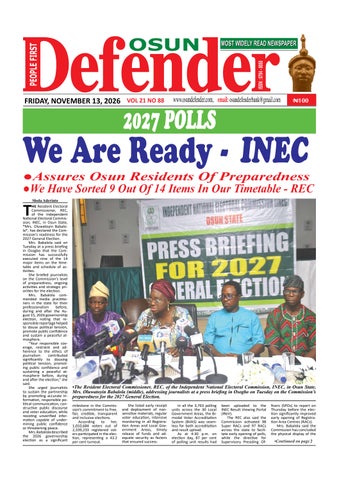
•The Resident Electoral Commissioner, REC, of the Independent National Electoral Commission, INEC, in Osun State, Mrs. Oluwatoyin Babalola (middle), addressing journalists at a press briefing in Osogbo on Tuesday on the Commission’s preparedness for the 2027 General Election. milestone in the Commission’s commitment to free, fair, credible, transparent and inclusive elec ons. According to her, 1,010,684 voters out of 2,339,233 registered voters par cipated in the elecon, represen ng a 43.2 per cent turnout.
She listed early receipt and deployment of nonsensi ve materials, regular voter educa on, intensive monitoring in all Registraon Areas and Local Government Areas, mely release of funds and adequate security as factors that ensured success.
In all the 3,763 polling units across the 30 Local Government Areas, the Bimodal Voter Accredita on System (BVAS) was seamless for both accredita on and result upload. As at 4:30 p.m. on elec on day, 87 per cent of polling unit results had
been uploaded to the INEC Result Viewing Portal (IReV). The REC also said the Commission ac vated 98 Super RACs and 97 RACs across the state to facilitate early opening of polls, while the direc ve for Supervisory Presiding Of-
ficers (SPOs) to report on Thursday before the elecon significantly improved early opening of Registraon Area Centres (RACs). Mrs. Babalola said the Commission has concluded the physical display of the
•Continued on page 2
FRIDAY, NOVEMBER 13, 2026
2
News
Training, Retraining Impetus To Erase Mass Failure In Maths - Academic
Shola Aderinto re red Professor of Mathema cs Educaon based in Cleveland, Ohio, United States, Prof. Sijuade Adegbite, has warned that Nigeria will con nue to record mass failure in mathema cs in WAEC and NECO examinaons unless the country urgently retrains its teachers and abandons the old lecture-only method of teaching. Speaking in an exclusive interview in Abuja, Prof. Adebite said failure in mathema cs is not peculiar to Nigeria, but Nigeria is making it worse by refusing to update how teachers teach. “Failing mathema cs is not about Nigeria alone. It is universal. The pressure that is in Nigeria now is everywhere in the world, even in Cleveland, America,” he said. “Why do students fail? A lot of factors. Teachers, yes. Students, yes. And then environment, that is the system.” Prof. Adebite, who taught for over 20 years in Nigeria before reloca ng to the United States, said the biggest difference between the two countries is con nuous professional development.
A
In America, he explained, every teacher must complete a compulsory number of professional development hours to renew their teaching licence every five years. “You just don’t finish from a college and then you sit and say you s ll have it. You have to refresh yourself and retrain, so that you can be abreast,” he said. “This is not happening in Nigeria. Even though before I le , there was something like professional development, people going for seminars, but it is not the same.” He recalled that he became the first Nigerian to teach in America without a teaching licence a er his employers saw his effecveness during proba on. “They said three months proba on, but a er the fourth week, they gave me my employment le er without a teaching licence because they saw that I was effec ve,” he said. Prof. Adebite blamed the culture of fear around mathema cs, worsened by teachers who beat students for failing tests. “People have already that phobia about mathema cs. Oh, it is so difficult. Most students are even scared before they step into
Advert
the classroom,” he said. “And besides this, teachers also don’t help. I have seen a system where teachers beat up students for failing mathema cs tests. If a child doesn’t do well in your class, it could be your fault. It is not the child’s fault.” He said most Nigerian classrooms s ll rely on one method, where the teacher talks while students copy notes. “They just talk, talk, talk. They take notes. But if we involve the students, students are going to be fantas c,” he said. The solu on, he said, is what American schools now call differen ated instruc on, which is teaching the same topic in different ways to reach different learners. “Differen ated instrucon talks about the content, the process, and then the product,” he explained. “Some students can be visual learners, some are auditory, and some can be kinesthe c. These are the most important areas where teachers should focus on. But how many teachers know this? Very few. That is not very common in Nigeria.” He gave a personal example: “If you tell me your
•Prof. Adegbite name, I may forget it. But if I write it now myself, I may not look at the paper, but I will remember it. I am using hearing, that is auditory. Wri ng is kinesthe c. My eyes saw what I wrote, that is visual. They all work together.” He said he recently held a three-hour session on the method for some school principals in Nigeria, but it was only a frac on of what teachers need to learn. “One method cannot be sufficient for all the students you have in front of you. All cases are not the
same,” he said. On Ar ficial Intelligence, Prof. Adebite said AI is both a saviour and a danger, depending on the student. “It can be a tool for learning. We have a lot of so wares in America today where you just put in your ques on and then you get the breakdown. If the student really wants to learn, AI can be very, very effecve,” he said. “But if you get a lazy one, they don’t want to learn, they just want the answer, then it can be
worse. So it is both ways.” He admi ed his own university students in America taught him about AI tools a er using them to complete assignments, and it took him a long me to catch them. In his final message, he urged parents to keep encouraging their children, even if they do not know mathema cs. “Keep on encouraging your kids. These days we have a lot of literate parents. Even if they don’t know maths, they can s ll encourage the kids. They need prac ce. Go over the same work from the classroom at home,” he said. To students, he said: “Keep on prac cing. Don’t just cram the formula. If you cram the formula and you apply it wrongly, you s ll get a wrong answer. You just have to understand the rule.” To teachers and government, he said: “Look for methods that are good for each student. Give teachers opportunity to train and retrain.” Prof. Adegbite began teaching in Ghana, graduated from Jackson County College of Educa on in 1973, earned his first and second degrees in America, completed his PhD in 2011, and became a Professor of Mathema cs Educa on in 2015. In America, he also served as a mentor, training teachers to get their licences.
2027 POLLS: INEC Osun Declares Readiness...
•Continued from Page 1
preliminary register of voters at Registra on Areas in the state. The register has also been published on its dedicated online portal, h p:// display.inecnigeria.org, for public scru ny, claims and objec ons. Issues raised by the public are being a ended to preparatory to the presenta on of the final register of voters on December 15, 2026. On Permanent Voter Cards (PVCs), Mrs. Babalola said 1,903,390 PVCs, represen ng 81.5 per cent, had been collected before the August 15 governorship elec on, leaving 427,216 uncollected. Between October 9 and November 3, 2026, a er the resump on of collecon at Registra on Area and LGA levels, a total of 7,547 PVCs were collected - 287 old PVCs, 5,082 new PVCs, 1,840 transfers and 338 replacements. This brings the total collec on rate to 81.74 per cent, leaving a balance of 18.26 per cent uncollected. PVC collec on is s ll
ongoing at Local Government Area offices. Mrs. Babalola said Osun State has 5,763 func onal BVAS devices for the elecon. The devices will be deployed across all 3,763 polling units and 38 split polling units for voter accredita on, to ensure that only registered voters with valid PVCs vote on elec on day. An addi onal 1,328 BVAS devices are available as back-ups. Apart from accreditaon, BVAS will be used to upload polling unit results directly to IReV for enhanced transparency. Registra on Area Technical Support Staff (RATECHs) will be deployed to all RAs to provide technical assistance, while BVAS configura on, quality assurance, charging, training of technical personnel, prin ng of voter register and mock accredita on will follow. On recruitment of elecon officials, Mrs. Babalola said the Commission’s portal, h p://pres.inecnigeria. org, opened on September 18, 2026 and will close on November 18, 2026. She said recruitment will focus on competence,
neutrality, integrity and professionalism, adding that suitable training venues at state and LGA levels have been secured. The REC also announced that the dedicated portal for media accredita on for the 2027 General Elec on was ac vated on Friday, October 30, 2026 and will close on Tuesday, December 1, 2026. Media organisa ons were urged to register via h p://imap.inecnigeria.org to par cipate in the general elec on. Mrs. Babalola stressed that despite the improved turnout in the 2026 governorship elec on, there should be no complacency, par cularly in voter educaon, no ng that a general elec on comes with peculiar challenges and heightened expecta ons requiring con nuous public engagement. She reaffirmed the Commission’s commitment to con nuous improvement, transparency, accountability and delivery of credible elec ons, and appealed for con nued coopera on from the media as cri cal partners in strengthening democracy.
MONDAY, NOVEMBER 13, 2026
3
I
N response to a le er written to him by the Osun State Government, the Oluwo of Iwoland reportedly declared: “I am not a Tradional Ruler; I am a king, and I answer to nobody but God. The God that the Governor, President, Senators and the richest man in Nigeria, Dangote, answer to.” Beyond the controversy surrounding this statement lies a fundamental misunderstanding that has persisted for more than a century: the place, authority and limita ons of tradi onal ins tu ons in the modern democra c state. Across Africa, the transi on from indigenous poli cal systems to colonial administra on and, subsequently, cons tu onal democracy has generated recurring tensions over the rela onship between tradional authority and state power. Ghana offers a notable example. Osagyefo Kwame Nkrumah’s administra on experienced significant tensions with the powerful Ashan tradi onal ins tuon. In Uganda, the posi on of the Kabaka of Buganda became a major source of poli cal fric on, culmina ng in the 1966 cons tu onal crisis. Nigeria, too, has its history. The confronta on between the government of Chief Obafemi Awolowo in the old Western Region and the Alaafin of Oyo, Oba Adeniran Adeyemi II, in the 1950s eventually resulted in the monarch’s deposi on and exile. These historical experiences demonstrate that the ques on of tradional authority in a modern state is neither new nor peculiar to Osun. It is against this historical background that the current disagreement between the Oluwo and the Osun State Government should be un-
“Traditional rulers, like other public figures, must exercise their influence with restraint, particularly on matters capable of provoking religious hostility or intercommunal conflict”
EXPLAINER
Traditional Rulers, Cultural Authority And The Realities Of Constitutional Democracy
derstood. In a le er with reference number CD.17/1/VOL. VIII/377, dated November 2026 and signed by Wale Alliyu on behalf of the Permanent Secretary, the state government expressed concern over what it described as inflammatory remarks capable of triggering religious and inter-town conflicts. It cau oned the monarch against a acking people of other faiths and fellow tradi onal rulers, warning that such conduct could heighten communal tensions, sow religious discord and undermine the cultural values of the Yoruba people. The government further reminded him that the preserva on of cultural heritage and communal harmony remains central to the responsibili es of tradional ins tu ons. While the government has a legi mate responsibility to maintain public order and prevent the escala on of communal or religious tensions, its interven on must not be interpreted as an attempt to dictate personal beliefs. Equally, freedom of expression does not confer
the French Revolu on, demonstrates the consequences of failing to accommodate changing poli cal reali es. Similarly, Britain’s Stonehenge a racts millions of visitors and contributes to its tourism economy. Its monarchy demonstrates how historical ins tu ons can coexist with cons tu onal democracy. Cultural preserva on is not an obstacle to progress; properly harnessed, it is an economic and na onal asset. Osun State, with its rich Yoruba heritage, has enormous immunity from accountability. Tradi onal rulers, like opportuni es in this regard. other public figures, must Its tradi onal ins tu ons exercise their influence with can serve as powerful instrurestraint, par cularly on mat- ments of cultural preservaters capable of provoking re- on, tourism development, ligious hos lity or intercom- conflict resolu on and community mobilisa on. munal conflict. The Oluwo and the state The custodianship of tradional culture must therefore government must therefore complement, rather than look beyond the immediate contradict, cons tu onal controversy. Neither tradiguarantees of individual lib- onal authority nor governerty. Even in cons tu on- mental power should become al monarchies such as the an instrument of in midaUnited Kingdom, Spain and on. Kings must recognise Denmark, the authority of the cons tu onal reali es of monarchs operates within the modern state, while govestablished cons tu onal ernments must respect the limits. History, par cularly historical significance and legi mate cultural roles of tradi onal OSUN DEFENDER ins tu ons. Publisher – Moremi Publishing House Ltd. U l t i m a t e l y, Ac ng Deputy Editor – Sodiq Yusuf kingship derives Deputy Photo Editor – Shola Aderinto its enduring reDeputy Graphics Manager – Zainab Olalere nown not merely from the authority Produc on Controller – Petkola Taiwo Ibitowa a monarch claims, OSUN DEFENDER is published by Moremi Publishing House Limited, Behind Oranmiyan Building, Gbodofon, but from the wisdom, dignity, tolOff Gbongan Road, Osogbo, Osun State. erance and service ISSN : 0794-8050 with which that Telephone : 0805-208-6134 authority is exerWebsite : www.osundefender.com/index.php e-mail : osundefenderhq@gmail.com cised. That is the osundefenderbank@gmail.com tradi on worth All correspondence to the above email addresses. preserving.
News P2
FRIDAY, NOVEMBER 13, 2026 VOL. 21 NO 88 www.osundefender.com, email: osundefenderbank@gmail.com
T
HE last one month or so has been a season of general elec ons in three major countries of the world, and on three con nents. Brazil South America’s largest Na on was the first to start off on 4th of October 2026. The incumbent, Luiz Inacio Lula da Silva faced Flavio Bolsonaro, the son of a former President on 4th of October. That elec on went into a second round as Flavio Bolsonaro’s 47% victory in the first ballot fell short of the 51% result he should have got to get him duly elected. Lula da Silva had 45% in that electoral encounter. The second elec on was held almost 3 weeks later. Luiz Inacio Lula da Silva, the le -wing candidate had 51.77% of the total votes to win convincingly. The former labour leader thus became the first Brazilian president to lose in the first ballot but come from behind to clinch victory in the second. There hasn’t been any such record since civil rule returned to Brazil in 1985. Flavio, his opponent is the son of convicted former president Jair Bolsonaro. Each of the two candidates scored well over 44 million votes. It was very close a poli cal contest. It is the 4th me Lula da Silva, the former Labour leader, would win elec on as President. From Brazil, the world moved on to the Middle-East region of Asia where the second general elec on came up in Israel on Monday the 26th of October. It was a test for Israel to reject or retain Benjamin Netanyahu the Prime Minister who is fondly called ‘Bie Bie’ and comes out as the longest-serving Prime Minister of Israel. Netanyahu has spent a total of 19 years as prime minister. These are across three terms. He first came on board in 1996. When the results of the keenly contested Israeli elec on were announced officially, the Likud Party that Netanyahu has led for years in power had won 54 Seats in the Knesset, that is, the parliament for Israel. The Israeli parliament has three main poli cal blocs with each being of several different poli cal groupings and coali ons. In the 2026 elec on none of the three different Blocs had the expected 61 seats majority, in the 120 member Knesset. That is the number of seats sufficient for a poli cal bloc to be declared winner and so be invited to form the government as Prime Minister. Netanyahu’s Likud Party had 54 seats. His main opposion bloc led by challenger Gadi Eisenkot had 48 seats while the Arab Coali on did well this me to gain 19 seats. That is how the three blocs stand a er the results of the elec ons were announced. As things are now in which there is no clear winner, the 120 members of Knesset are the ones who would choose who is to become Prime Minister. It would take so much consulta ons, compromises and
“Our elections have always allowed the political parties to always overwhelmingly buy over the electorate. The bigger and “deep-pocket” parties have always encouraged this and have always gotten away with it. This does not enable a larger percentage of the electorate who are the “float some and jet some” of the populace to be able to decide things on their own”
PERSPECTIVE
By SMOLETTE SHITTU-ALAMU
A Season Of General Elections
co-opera on to carry this out. Israeli process of going to the polls is much simpler than that of deciding or agreeing on who or which parliamentarian should become the Prime Minister whenever there is a hung elec on as it is now. The Lukid Party and its coali ons just cant add up their seats in the Knesset to 61 to form the new government. The numbers do not add up. But if Gadi Eisenkot can bring the 19 seats the Arab coali on has to his own 48, they would be home and dry with 67 seats. That would be 6 above the 61 seats threshold. Somehow, Israeli poli cs, cons tu on,social life, as well as its religious biases do not make the issues as simple as one could think. In spite of the opposi on’s utmost desire to get rid of Netanyahu, he remains Prime Minister un l the President is able to get one parliamentarian who could be acceptable to all the other 119 members. of the Knesset. But if the par es and the blocs can’t co-operate among themselves and get that acceptable person, who President Isaac Herzog could appoint, then the chances are that Israelis may have to return for a fresh elec on as their cons tu on allows. If the 120 member Knesset get their acts right, drop their some mes very hard line postures, re-nego ate their core principles, there could be a headway sooner than later. As things stand now it is important to note that Prime Ministership can not come from the Arab coali ons. But there is no doub ng the fact that the 19 seats the Arab bloc led by Mansour Abbas and Yousef Jabareen have and lead in parliament can change the trajectory and dynamics of Israeli poli cs. In the weeks to come, Tel-a-viv will show to the world what last gamble Netanyahu may have to play to remain not rejected by the reali es of the moment. It will call for poli cal strategy stage cra and so much horse trading The whole world that on the 3rd of this month Mid-term elec ons were held in the United States of America. The Red colour that had dominated the two chambers of the Capitol buildings in Washington DC, the seat of the US Congress, changed to blue in a sweeping manner that surprised poli cal pundits. Analysts had expected the House of Representa ve to go to the Democrats while the Senate was too close to call. But a er the results began to come in, everybody saw “it rainnig democrats” so to say all the way! In the 100 member Senate of the United State only two results were yet to be declared, as at the me of wri ng this piece. 54 seats had been won by the Democrats. Mississippi and Alaska were
the only ones whose results were yet to be declared. Even then, they remain too close-to-call as they could go either way. The number of seats required by a party to control the US senate is 51. The Democrats already have 54 and could s ll win more. The Republicans have 44 seats in the ki y. On the other hand, there are a total of 435 Seats in the US House of Representa ves. A party needs 218 to win and become the Majority. All the seats were for grabs in the mid term elec on of 3rd November 2026. For the US Senate, only 35 seats were to be won on the 3rd of November this year. A er the Mid- term elec on, the Democrats already have 240 seats while the Republicans have 145. Only 50 Seats are yet to have their results fully declared. Even as at that, the Majority seats have been won already. It looks like the scale of the Democrats blue sweep appears to be s ll sweeping and unfolding. We can say it has been a historic “blue wave” in the two chambers in the US Congress in 2026. That has given the Democrats a complete take-over of Capitol Hill. This certainly comes out as a rebuke for and of President Donald Trump as leader of the Republican Party. Many Americans see it as a New Dawn and the best Post-Midterm Elec on Day in the last 44 years. The pressure has been for the Democrats to deliver a change for the purpose of moving their country forward. We can say that change has now been gloriously delivered. The sweep of the blue waves in the US mid-term elecon has been so total that it has enabled seven Democra c Socialists to win and be elected into the House of Representaves. One of them is Chris Rabb who won in Pennsylvania. So much poli cal momentum was generated and created in this year’s midterm elec on that one can easily agree that it is indeed, “a New Dawn.” That momentum has already led to the octogenarian, former Speaker Nancy Pelosi inferring already that come January, 2027 when the House resumes, Hakeem Jeffries will be the New Speaker of the US House. Not only did Democra c Governor Josh Shapiro return to office in Pennsylvania, he won by a land-slide victory of 60.4% votes to his challenger, Stacey Garity’s 38.3 votes. The State of Georgia made history by elec ng last Tuesday, the first ever female Governor in the history of the United States. The blue waves in the Mid-term elec on got Keisha Lance Bo om duly elected as Governor. This black former Mayor of the City of Atlanta and grand daughter of a former Slave, is reported to have visited the grave of her
grandmother to pray for victory, a few days before the mid-term elec on. If we recall that strong, tradi onally Red States like Georgia, North and South Carolina, Mississippi and Alaska have now gone blue, we may readily get to know the level of electoral devasta on the 2026 mid-term elec on has caused the GOP. The late Senator Lindsey Graham, whose sister Darlene is serving as the incumbent Senator for South Carolina was defeated by Annie Andrews, 51.1% to 46.7%. Unl 2026, Mississippi had never elected a Democrat to the Senate since 1980. Barack Obama the 44th US president has reacted to the democra c sweeping by saying America wants a poli cs that unites its people and not the type that divides as Donald Trump has introduced. Although President Trump has conceded defeat, by sta ng that Americans s ll love the Republican Party, only that last Tuesday voters could not show the love they have for the Republican party Candidates in the just concluded elec on. He was quick to say that his party lost because he was not on the ballot, himself. What a Vintage Trump! On his part Vice President JD Vance has already blamed the dismantling of the red wall as a result of the war the US had entered into against Iran. Even though Mr. Trump had not said so (and is not ever likely to admit that) there are on-going efforts to want to impeach the Secretary of Defence, Pete Hegseth. His sin? Being the cheer-leader of the president in pursuing the war which many Americans believe is not necessary at all but has ended up crea ng economic problems which the country faces now With Nigeria’s General elec ons barely two months away, can there be lessons the Nigeria’s electorate could learn from? Are there also any implica ons the US Mid-term Elec on “tsunami” has brought? One can say there are many. Even though the Americans through their votes showed their resentments for the general high cost of living which Donald Trump’s policies have brought them, the two poli cal environments may look a li le similar but are not exactly the same. Founda onally, the Nigerian electorate is not as sophis cated as their American counterparts are back home. Poverty has been weaponised in Nigeria, over the years by a poli cal system which in the last 27 years has not enabled voters to pick nor choose on their own. Our elec ons have always allowed the poli cal par es to always overwhelmingly buy over the electorate. The bigger and “deep-pocket” par es have always encouraged this and have always gotten away with it. This does not enable a larger percentage of the electorate who are the “float some and jet some” of the populace to be able to decide things on their own. This is not only the dilemma our poli cs faces, it has become and may con nue to become the bane of our polics and our na onhood. Un l we take a bold step collec vely, this tragedy may con nue to stay with us and haunt us in the decades and perhaps centuries to come. In Brazil the Bolsonaro nine finger jab he gave Luiz da Silva boomerang. Even though he took it back, it contributed to his defeat and his having had to sneak out of Brazil. This is a lesson to take in by our poli cians. •Smolette Adetoyese Shittu-Alamu is Chairman, Veteran Journalists Association (VJA) in Osun State
OSUN DEFENDER is published by Moremi Publishing House Limited, Behind Oranmiyan Building, Gbodofon, Off Gbongan Road, Osogbo, Osun State. All correspondence to the Acting Deputy Editor, SODIQ YUSUF, Telephone: 0805-208-6134. ISSN: 0794-8050. Website: www.osundefender.com Email: osundefenderbank@gmail.com, osundefenderhq@gmail.comAmconseq uatissim del estrud dolortie min vent dolore dit wiscips u