
MONDAY, MAY 25, 2026
MONDAY, MAY 25, 2026
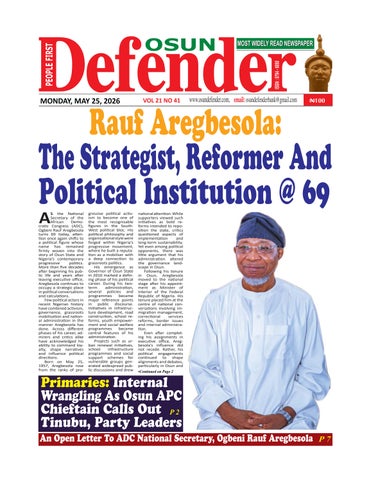
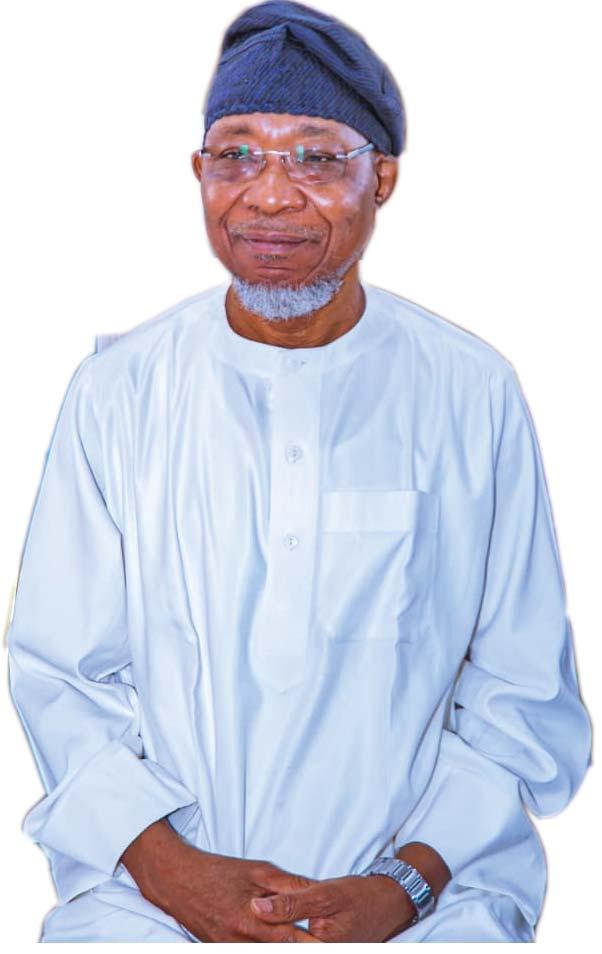
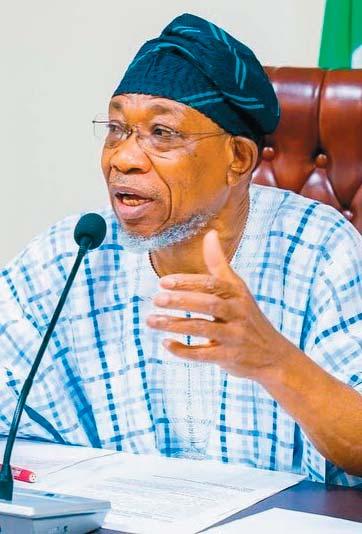
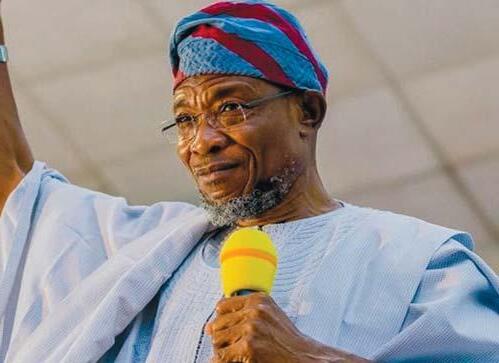
AS the Na onal Secretary of the African Democra c Congress (ADC), Ogbeni Rauf Aregbesola turns 69 today, a enon once again shi s to a poli cal figure whose name has remained firmly woven into the story of Osun State and Nigeria’s contemporary progressive poli cs.
More than five decades a er beginning his public life and years a er leaving execu ve office, Aregbesola con nues to occupy a strategic place in poli cal conversa ons and calcula ons.
Few poli cal actors in recent Nigerian history have combined ac vism, governance, grassroots mobilisa on and na onal administra on in the manner Aregbesola has done. Across different phases of his career, admirers and cri cs alike have acknowledged his ability to command loyalty, shape narra ves and influence poli cal direc ons.
Born on May 25, 1957, Aregbesola rose from the ranks of pro-
gressive poli cal ac vism to become one of the most recognisable figures in the SouthWest poli cal bloc. His poli cal philosophy and organisa onal style were forged within Nigeria’s progressive movement, where he built a reputaon as a mobiliser with a deep connec on to grassroots poli cs.
His emergence as Governor of Osun State in 2010 marked a defining phase of his poli cal career. During his twoterm administra on, several policies and programmes became major reference points in public discourse. Ini a ves in infrastructure development, road construc on, school reforms, youth empowerment and social welfare programmes became central features of his administra on.
Projects such as urban renewal ini a ves, school infrastructure programmes and social support schemes for vulnerable groups generated widespread public discussions and drew
na onal a en on. While supporters viewed such ini a ves as bold reforms intended to reposi on the state, cri cs ques oned aspects of implementa on and long-term sustainability. Yet even among poli cal opponents, there was li le argument that his administra on altered the governance landscape in Osun.
Following his tenure in Osun, Aregbesola moved to the na onal stage a er his appointment as Minister of Interior of the Federal Republic of Nigeria. His tenure placed him at the centre of na onal conversa ons involving immigra on management, correc onal services reforms, border issues and internal administraon.
Even a er completing his assignments in execu ve office, Aregbesola’s influence did not recede. Rather, his poli cal engagements con nued to shape alignments and debates, par cularly in Osun and
•Continued on Page 2
MONDAY, MAY 25, 2026
Our Reporter
THE All Progressives
Congress in Osun State may be facing an internal crisis following the primary elec ons held to elect candidates who will represent the party at the state and na onal assembly.
It would be recalled that members of the party on Saturday May 16, Monday May 18 and Wednesday May 20, trooped out to elect the candidates who will represent the party at the House of Representaves, Senate and House of Assembly respec vely.
However, following the conclusion of the primaries and announcement of results, some chie ains and members of the party have alleged irregulari es in the exercise.
Protests, allega ons and counter allega ons have followed the exercise, a development OSUN DEFENDER gathered has caused internal wrangling in the party.
In Osogbo federal cons tuency, Ayedaade/Irewole/ Isokan federal cons tuency, Obokun state cons tuency, Olaoluwa state cons tuency and some other places, some chie ains and members of the APC protested the results announced.
A chie ain of the APC in Osun, Akin Adeyi, while featuring on a private TV programme, faulted the leadership of the party in the state over what it described as inhuman treatment of members of the party during the primaries.
Adeyi said the way the leaders of the party were leading is condemnable, adding that there was no elec on in Osogbo federal cons tuency and the result was wri en.
OSUN DEFENDER reports that an Osogbo-born entrepreneur, Ibrahim Taofeek Kayode popularly called ITK was declared the winner of the elec on.
However, Adeyi claimed that the electoral body announced Kayode as the winner without conduc ng any poll.
“The way the leaders are leading is condemnable. How can you treat human beings like that? You put them under the sun, you did not go there. You went isnxjs one air condional room and started wri ng the results and then those people will revolt and you will s ll condemn them and even threaten them with the police. Are we animals?
“A day before the primary elec on, we were expec ng people from Abuja who would come and conduct the primary. That was when the game started and
they started cooking up stories.
“At the end of the day, on the day of the elec on, they were nowhere to be found. ITK went to his ward with a scanty crowd and made a video congratula ng himself and telling other aspirants to accept the result. That is even an electoral offence.
“I never expected a young man to be that desperate and those people that supported him, the leadership of the party, par cularly in Olorunda local government, they were not very clean about it.
“The electoral body just sat somewhere to make an announcement. If you look at Olorunda Local Government in par cular, they only awarded numbers to ITK leaving the other aspirants out. There was no pri-
mary in Olorunda/Osgbo/ Irepodun Orolu federal cons tuency. The people who were supposed to conduct
the elec on were nowhere to be found,” Adeyi said on the show.
The APC chie ain also queried the ra onale behind the candidates who are going to represent Osun Central and the House of Representa ves candidate for Osogbo federal cons tuency coming from the same town.
“This ITK and K-RAD who emerged as the Osun Central Senatorial District candidate are from Osogbo. How can Osogbo have a Senator and a House of Representa ves candidate at the same me? The members of the party who trooped out to protest felt disappointed about the leadership of the party and were expressing their anger,” he added.
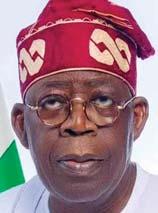
Speaking further on the programme, Adeyi faulted President Bola Tinubu and other leaders of the party for adop ng the consensus and direct primary as the two ways of selec ng candidates for the party.
“The president and the party leaders made a serious mistake in this case.
They have given the APC what I can call the ‘forbidden fruit’. The APC is not known for the idea of primaries. That is why they nicknamed the party ‘Baba Sope’ meaning (Whatever the leaders say). Now, in order to impress the interna onal community, they announced consensus and direct primary as the opons.
“However, the same people never remembered or care that if they adopt consensus, the moment one person disagrees, they will go to the field.
“Now with the power that has been given to the people that will disagree, you want to use the old method of ‘Baba Sope’. If they knew that was what they wanted, they shouldn’t have given the people the leverage,” Adeyi said.
Meanwhile, members of the APC in Obokun Local Government Area of the state last Thursday staged a protest at the state secretariat of the party in Osogbo, alleging plot to manipulate the outcome of the House of Assembly primary elec on in the area.
The protesters accused the lawmaker representing Obokun/Oriade Federal Cons tuency, Hon. Wole Oke, of a emp ng to replace the declared winner
with the first runner-up.
Carrying placards with inscrip ons such as “Give us our mandate,” “Respect the will of the people,” and “Let people’s votes count,” the demonstrators said the primary was conducted peacefully and produced a clear winner in Mr. Gbenga Falope.
Speaking on behalf of the protesters, Mr. Oyewole Oyebanji maintained that the primary was conclusive and that Falope secured a decisive victory with 2,594 votes.
Oyebanji said any attempt to overturn the result would undermine internal democracy and erode trust in the party ahead of the 2026 general elec ons.
“We have been robbed by Hon. Wole Oke and Siji Olamiju. We went for the primary elec on on Wednesday and at the end of the day, Gbenga Falope won the primary elec on with 565 votes. He scored 2594 to defeat his nearest contestant who got 2020,” he stated.
Oyebanji added, “However, a er the conclusion of the primary-process and movement to Osogbo for the issuance/documentaon of nomina on forms, the process suddenly became ques onable and
•Continued on Page 5
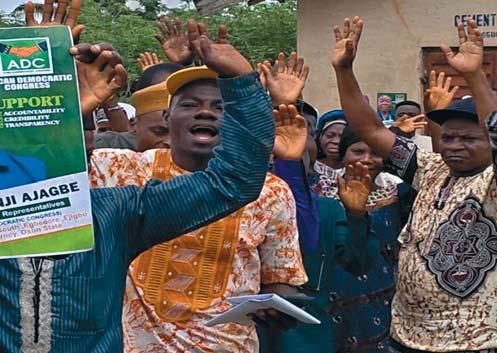
THE African Democra c Congress in Osun State has confirmed the list of its candidates for the 2027 general elec ons across the senatorial, House of Representaves and State House of Assembly categories.
The confirma on was made by the Osun ADC Publicity Secretary, Oluwaseun Abosede, during an exclusive chat with OSUN DEFENDER over the weekend.
Abosede said the
party had concluded internal processes leading to the emergence of candidates for the various elec ve posi ons across the state, no ng that the development formed part of prepara ons by the party ahead of the 2027 polls.
He explained that the party remained focused on strengthening its grassroots structure and presen ng candidates it believes possess the capacity to effec vely represent cons tuents at differ-
•Continued from Page 1
the wider South-West region. His emergence as Na onal Secretary of the na onal coali on - African Democra c Congress has further renewed public a en on around his role in the country’s changing poli cal landscape. Poli cal observers o en describe him as a man of convic on and strong poli cal ideals, while others see him as a leader whose uncompromising style has made him both influen-
al and controversial. But irrespec ve of varying opinions, Aregbesola has remained difficult to ignore in Nigeria’s polical space. At 69, his journey reflects more than personal milestones. It tells a story of poli cal resilience, ideological ba les, governance experiments and enduring relevance. In an era where many public figures gradually disappear from ac ve poli cal conversa ons a er leaving office, Aregbesola appears to re-
main firmly within the frame.
As family members, poli cal associates, supporters and admirers celebrate him today, the occasion also presents an opportunity to assess the journey of a man whose influence con nues to resonate beyond tles and offices. For many observers, the bigger ques on may no longer be what Aregbesola has done, but what role he s ll intends to play in the next chapter of Nigeria’s poli cal story.
ent levels of government.
According to him, the party is op mis c that the candidates would further deepen the ADC’s growing presence across Osun and provide alterna ve leadership choices for residents of the state.
For the Senate, the party confirmed the emergence of Hon. Akeem Olaoye for Osun Central Senatorial District, Sen. Adelere Oriolowo for Osun West Senatorial District and Babatunde Olaniyi Loye for Osun East Senatorial District.
The House of Representa ves candidates include Akinlabi Olusegun for Ifedayo/ Ila/Boluwaduro Federal Cons tuency, Barrister Olayinka Oyefusi for Ifelodun/Boripe/ Odo-O n Federal Cons tuency, Taofeek Arogundade for Osogbo/ Olorunda/Orolu/Irepodun Federal Cons tuency, Hon. Tajudeen Ajagbe for Ede North/ Ede South/Egbedore/ Ejigbo Federal Cons tuency and Hon. Gbenga Ogunkanmi for Iwo/ Olaoluwa/Ayedire Federal Cons tuency.
Others are Bolarinwa Ibraheem for Irewole/Isokan Federal Cons tuency, Hon. Sikiru Ayedun for Ife North/Ife East/Ife Central/Ife South Federal Cons tuency, Olowu Sunday for Obokun/ Oriade Federal Cons tuency and Ajibola E. Oladimeji for Ijesa South Federal Cons tuency.
The party also unveiled candidates for all the 26 State House of Assembly cons tuencies across Osun State, including Akanbi Kehinde Joshua (Ifedayo), Oyedotun Olalekan (Ila), Oyetola Kayode (Boluwaduro), Wahab Kazeem O (Ifelodun), Oluyemisi Ti layo A (Odo-O n), Muhammed Ismail A (Orolu/Irepodun), Lateef Mumini Abayomi (Olorunda), and Tiamiyu Idris (Osogbo), among others.
Abosede stated that the party would intensify mobilisa on efforts across the state while urging members and supporters to remain commi ed towards ensuring victory for the ADC in the forthcoming elec ons.
TO paraphrase a familiar historical insight, individuals who shape history are o en given only a limited period in which to make their mark. One striking example is Rauf Aregbesola, the Na onal Secretary of the African Democra c Congress (ADC), who turns 69 today.
Aregbesola entered the historical limelight in circumstances not en rely of his own making. Yet, once thrust into the arena, he emerged as a defining poli cal figure — from his role as a strategic coordinator in the Na onal Democra c Coali on (NADECO), to serving as Commissioner for Works and Infrastructure in Lagos State for two terms, and later as a two-term governor of Osun State, where he approached governance with clarity, innova on, and ideological convic on.
One of the enduring qualies of poli cal relevance is the ability to redefine the terms of public debate.
The Italian poli cal philosopher Antonio Gramsci argued that historical actors become memorable when they reshape the terrain of ideas. In the Nigerian context, this is par cularly important because poli cs has too o en been reduced to a pla orm for personal enrichment and selfaggrandisement.
What makes Aregbesola’s poli cal journey noteworthy is that he belonged to the few who dared to swim against the prevailing de in post-military Nigeria. In many respects, he represents a throwback to an earlier genera on of poli cal thinkers and movements driven not merely by ambi on, but by ideas and social purpose.
The first wave of an -colonial struggles across Africa was mo vated by vision, ideology
“One of Aregbesola’s enduring strengths has been his connection with the grassroots and his ability to mobilize through persuasive public engagement. A key task for Aregbesola is to expose the dangers entail in the current weaponization of poverty. The current misruling establishment in a distortion of the opinion of V.I.learning that the revolutions do not take place during times of mass poverty but that they take place at times of relatively increasing prosperity. People like Aregbesola must attack the institutionalization of poverty as a defense mechanism”

•Rauf Aregbesola, who turns 69 today, still has miles of service ahead in impacting a nation at a critical juncture
and collec ve advancement rather than narrow self-fulfilment. It is therefore refreshing to encounter poli cal figures who s ll see ideas as the driving force of poli cal engagement.
By the me Aregbesola rose to prominence, Nigeria’s polical and economic landscape had already been deeply altered by the effects of the Structural Adjustment Programme (SAP). The doctrine that “there is no alterna ve” to SAP was embraced by many at the me, but history has since exposed the severe consequences of that policy direc on.
For Africa, the fallout proved devasta ng. SAP accelerated de-industrialisa on, weakened local produc ve capacity, and returned many economies to dependence on raw material extrac on and exporta on. En re popula ons were effecvely reduced to what colonial historians once described as “hewers of wood and drawers of water.”
When Aregbesola became Governor of Osun State in 2010, following his widely acclaimed tenure as Lagos State’s infrastructure czar, he faced the difficult challenge of redefining governance within an environment distorted by years of post-SAP thinking. It was a herculean task that required rebuilding ins tu onal confidence almost from scratch.
He sought to challenge the no on that government had no meaningful developmental role to play. His administra on was determined to place people at the centre of governance, rather than leaving them as passive spectator in the affairs that shaped their lives.
To truly put people first, government must u lize the machinery of the state to achieve produc ve social outcomes. In underdeveloped economies
where capital forma on remains weak, strategic state interven on becomes essen al. This helps explain Aregbesola’s emphasis on human capital development, par cularly in educa on and youth empowerment.
More than a decade ago, few could have accurately projected today’s world of ar ficial intelligence, coding, automa on, and rapidly evolving technological systems. Yet Aregbesola demonstrated unusual foresight by a emp ng to posi on Osun State not merely to adapt to the future, but to compete within it.
His reforms were not limited to educa on alone. They extended across several sectors of public life, reflec ng a broader philosophy of reinven on and ins tu onal renewal. To historians, such moments o en evoke comparisons with reformist movements like the Young Turks of the declining O oman Empire or Gamal Abdel Nasser’s Free Officers Movement in Egypt — moments where new thinking a empted to redefine society and governance.
Whether one agrees en rely with his methods or not, Aregbesola undeniably le a de-
cisive imprint in both thought and prac ce.
Today, Nigeria once again stands at a cri cal crossroads. The na on faces difficult quesons about the future of its democracy, with growing concerns over authoritarian tendencies and increasing pressure on the principle of separa on of powers — o en the first warning signs on the road toward democra c erosion.
In such moments, voices associated with progressive poli cal thought are once again being called upon to provide direc on. As Na onal Secretary of the ADC, Aregbesola is well posi oned to contribute to the development of strategies capable of resis ng authoritarian dri and deepening democra c engagement.
Poli cal philosopher Hannah Arendt once described the dangers of unchecked authoritarianism as “the banality of evil.” Nigeria must avoid dri ing into such a condi on through silence, poverty, and poli cal hopelessness.
Aregbesola also has an important role to play in advancing alterna ve economic ideas centred on mass produc on, community empowerment, shared prosperity and inclusive development. Equally important is the need to communicate such ideas effec vely to ordinary ci zens.
One of Aregbesola’s enduring strengths has been his connec on with the grassroots and his ability to mobilize through persuasive public engagement. A key task for Aregbesola is to expose the dangers entail in the current weaponiza on of poverty. The current misruling establishment in a distor on of the opinion of V.I.learning that the revolu ons do not take place during mes of mass poverty but that they take place at mes of rela vely increasing prosperity. People like Aregbesola must a ack the institutionalization of poverty as a defense mechanism.
The months ahead may prove decisive for Nigeria’s poli cal future, and many believe he s ll has a role to play at the centre of na onal conversaons.
ISSN : 0794-8050
Telephone : 0809-301-9152
Website : www.osundefender.com/index.php e-mail : osundefenderhq@gmail.com osundefenderbank@gmail.com
All correspondence to the above email addresses.
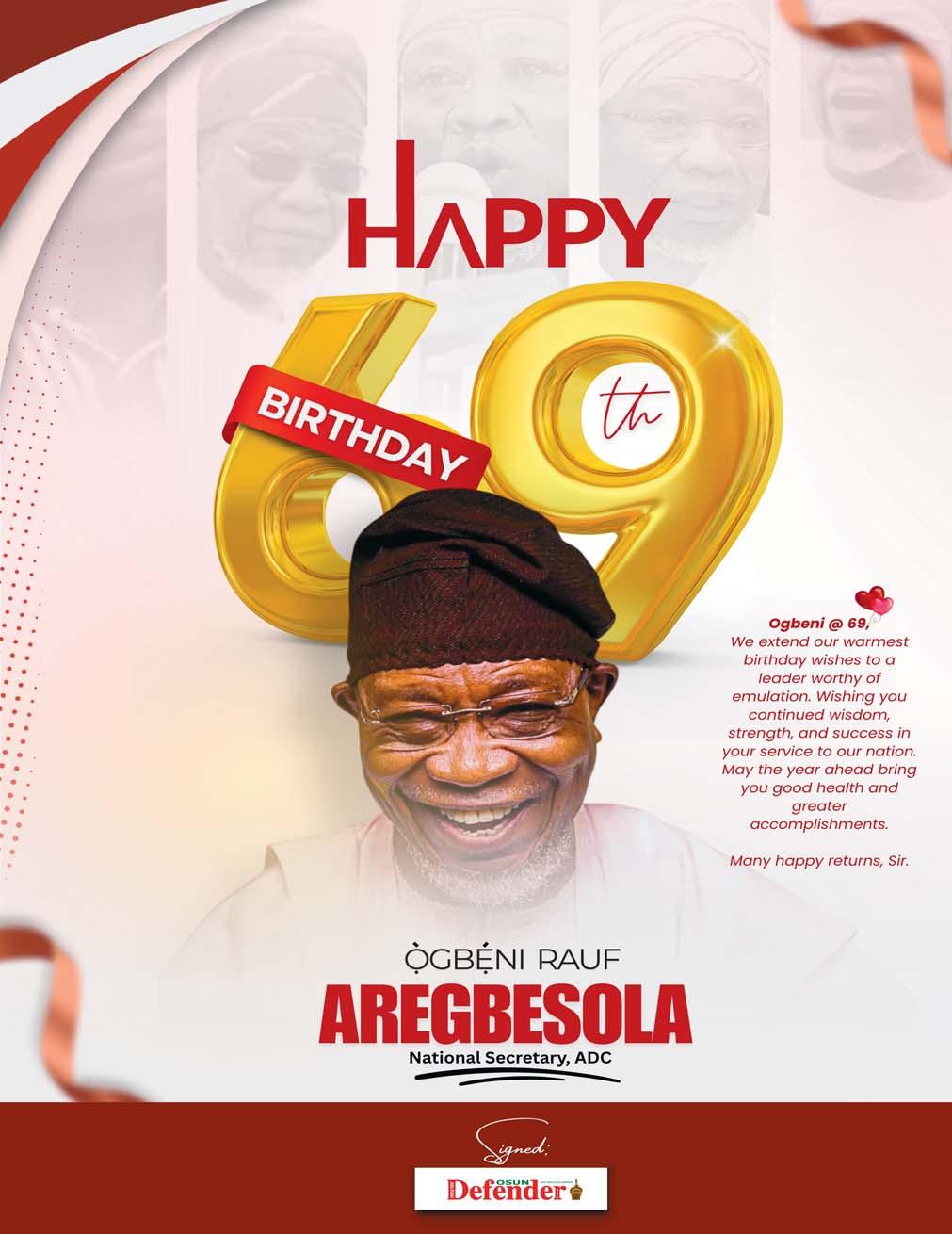
As he turns 69, we wish Rauf Aregbesola many more years in good health, strength, and con nued service to society.
MONDAY, MAY 25, 2026
TSodiq
Yusuf
HE African Democra c Congress in Osun State has congratulated its Naonal Secretary, Rauf Aregbesola, on the occasion of his 69th birthday, describing him as an exemplary leader whose life has remained dedicated to service, good governance and humanity.
In a statement signed by Osun ADC Chairman, Alhaji Issa Azeez Adesiji, the party said Aregbesola’s contribu ons to governance and naonal development have con nued to earn him admira on across poli cal, social and leadership circles.
The party noted
that Aregbesola, who served two terms as Governor of Osun State and later as Minister of Interior of the Federal Republic of Nigeria, has consistently dis nguished himself through policies and programmes that impacted the lives of ordinary cizens and strengthened ins tu ons of governance.
ADC said his leadership style, commitment to progressive ideals and unwavering dedica on to the welfare of the people have made him a respected figure whose influence extends beyond Osun State and the country’s poli cal landscape.
The party also commended his role as Na onal Secre-
tary of ADC, saying his experience, poli cal foresight and organisa onal capacity have con nued to strengthen the party and inspire members across the country.
The statement added that as the party prepares for the August 15 governorship elec on in Osun State, members remain op misc that his guidance and leadership would play a crucial role in posi oning the ADC for success.
Adesiji said the party joined family members, poli cal associates and supporters in celebrating the elder statesman while praying for more years of sound health and impac ul service.
•Continued from Page 2
suspicious.
“We strongly believe and have credible informa on that Hon. Oluwole Oke, Member representing Obokun/Oriade Federal Cons tuency in the House of Representa ves, interfered in the process and influenced the unlawful withholding/removal of the nomina on form meant for the House of Assembly po-
si on.”
The protesters called on the leadership of the APC in the state to intervene urgently and validate the outcome of the primary.
“Falope is the winner and we will not accept injus ce, manipula on, or the twis ng of the democra c voice of APC members in Obokan Local Government. The peace, unity, and future electoral success of the APC depend on
fairness, transparency, and respect for internal democracy.
“The era where the wishes of party members are ignored and replaced with personal poli cal interests must come to an end. We therefore strongly call on the leadership of APC in Obokun and Osun State to urgently intervene and ensure that the authen c outcome of the primary elec on is respect-
ed,” Oyebanji said.
Reac ng, Oke’s media aide, Tunde Omolebi-Sunday, in a chat with a journalist, described the allega ons against the federal lawmaker as misleading, “and en rely mischievous.”
Omolebi-Sunday, further disclosed that Oke should not be associated with ma ers that are clearly beyond his jurisdic on.
“As Director-General of the Osun APC Guberna-
Akeen contest is expected to unfold today as three heavyweight aspirants — A ku Abubakar, Ro mi Amaechi and Mohammed HayatuDeen — ba le for the presiden al cket of the African Democra c Congress ahead of the 2027 presiden al elec on.
OSUN DEFENDER reports that the three aspirants have been cleared by the party to par cipate in the primary elec on, setng the stage for what many observers describe as one of the most compeve internal contests in the opposi on party in recent mes. The contest comes after efforts within the party to arrive at a consensus arrangement reportedly failed, leading to a decision to allow delegates determine the party’s flag bearer through a direct and compe ve process.
Party officials have also in the last few weeks maintained that the exercise would be transparent and
credible as the ADC seeks to posi on itself as a major opposi on pla orm ahead of the next general elecon.
A ku enters the race with enormous poli cal experience and perhaps the widest na onal network among the contenders. The former Vice President has remained one of Nigeria’s most recognisable opposion figures, having contested for the presidency mulple mes and consistently demonstrated an ability to secure party nomina ons across different poli cal pla orms. His supporters argue that his established poli cal structure and naonal appeal give him a clear advantage in today’s contest.
Amaechi, however, appears determined to upset the calcula ons of his rivals. The former Rivers governor has publicly expressed confidence in his chances, insis ng that the contest should be decided on electability and fresh appeal rather than
previous poli cal records. Reports also indicate that he resisted pressures for a consensus arrangement, maintaining that democratic principles should guide the process.
On his part, HayatuDeen has projected himself as a technocra c alterna ve, anchoring his campaign on economic reforms, ins tu onal rebuilding and governance competence. In recent weeks, he moved aggressively to establish campaign structures across states, a development seen by analysts as an a empt to strengthen his grassroots reach ahead of the primaries.
Beyond the race itself, poli cal observers believe
today’s outcome may significantly influence the direcon of opposi on poli cs ahead of 2027. With the ADC increasingly a rac ng a en on amid shi ing poli cal alliances and realignments, the emergence of its presiden al candidate is expected to shape discussions on coali on building and electoral strategy in the months ahead.
ADC Na onal Publicity Secretary, Bolaji Abdullahi, in a statement over the weekend expressed confidence in the conduct of the exercise, saying arrangements had been concluded and that the aspirants had commi ed themselves to accep ng the outcome of the process.
man whose life has become a symbol of dedica on, courage and uncommon service to humanity. Your contribu ons to Osun State and Nigeria remain indelible in the hearts of millions.
torial Campaign Council, Hon. Oluwole Oke has no role whatsoever in the conduct, supervision, or determina on of State House of Assembly primary elec on outcomes. Any claim to the contrary is a gross distoron of facts and a calculated a empt to mislead the public,” Omolebi-Sunday said.
Although he acknowledged the members’ legimate right to express grievances, including through protests, he warned that such rights must be exercised responsibly. He said, “They do not extend to the propaga on of baseless accusa ons or the unwarranted targeting of individuals for issues outside their purview. All grievances should be directed to the appropriate party organs and duly cons tuted appeal committees established to address such concerns, rather than being weaponised through unfounded public a acks.
The a empt to draw Hon. Oluwole Oke into these ma ers is not only misplaced but also reflects a weak effort to mask disappointment with conspiracy.”
“As Governor of Osun State, you introduced ideas and programmes that transformed lives, expanded opportuni es and changed the narra ve of governance. As Minister of Interior, you brought experience and purpose into na onal service and le las ng footprints.
“Your leadership has consistently been driven by convicon, compassion and commitment to the people. You have remained a source of inspira on and guidance to many within and outside the polical space.
“As Na onal Secretary of our great party, your wealth of experience and strategic direc on con nue to energise and strengthen the ADC family across the country. Your passion for building a be er poli cal culture remains admirable.
“On behalf of the leadership and members of Osun ADC, we pray Almighty Allah grants you many more years in sound health, wisdom and strength. We are also confident that under your guidance and leadership, our great party shall record victory in the August 15 governorship elec on and connue on the path of progress and service to the people,” Osun ADC said.
MONDAY, MAY 25, 2026
HISTORY is a harsh and exac ng auditor. It rarely affords those who seek to shape it a limitless expanse of me in which to leave their mark. Instead, historical actors are granted brief, highly pressurised windows to impose their vision upon the fabric of their sociees. A striking exemplar of this maxim — a man who has consistently seized these flee ng moments to alter the poli cal landscape — is Rauf Aregbesola. Affec onately known as ‘The Symbol’ by his vast network of supporters, he turns 69 today. Currently serving as the Na onal Secretary of the African Democra c Congress (ADC), he remains a deeply consequen al statesman with miles of service ahead, profoundly impac ng a na on that currently finds itself at a cri cal and precarious juncture.
Aregbesola entered the vola le crucible of Nigerian public life under circumstances not en rely of his own design, but rather forged by the existen al necessi es of the era. The annulment of the June 12, 1993, presidenal elec on triggered a severe poli cal crisis, plunging the na on into a dark period of military dictatorship. It was within the trenches of this democra c struggle that Aregbesola emerged as a defining poli cal figure. Opera ng as a strategic coordinator and frontline mobiliser within the Na onal Democra c Coali on (NADECO), he demonstrated an early capacity for immense personal sacrifice and tac cal brilliance. This period codified his progressive ideology. He was not simply figh ng against military rule; he was figh ng for a dis nct vision of a more egalitarian, socially responsible Nigerian state.
When the Fourth Republic dawned in 1999, his transi on from a pro-democracy agitator to a public administrator was swi and impac ul. Appointed as the Commissioner for Works and Infrastructure in Lagos State, he confronted a sprawling metropolis groaning under the weight of decades of systemic neglect. Lagos at the turn of the millennium was defined by cri cal infrastructural deficits. During his two-term tenure, Aregbesola became the bureaucra c engine room for the state’s radical urban renewal. He fundamentally re-engineered the state’s public works execu on, replacing chao c ad-hoc repairs with long-term structural planning. The blueprint laid down during those eight years established the founda onal arteries of modern Lagos, proving that progressive governance could deliver tangible, concrete results in the most challenging of urban environments.
Yet, one of the most enduring hallmarks of genuine poli cal relevance is the capacity to elevate and redefine the parameters of public debate. The Italian poli cal philosopher Antonio Gramsci famously posited that historical actors achieve true memorability only when they manage to fundamentally reshape the terrain of ideas— when they establish a new ‘common sense’ for society. In the Nigerian context, this ideological anchoring is excep onally rare. Poli cs in the region has too o en been degraded into a transac onal enterprise, a mere pla orm for clientelism, personal enrichment, and short-term selfaggrandisement.
Deeply rooted in the progressive tradi ons of the late Obafemi Awolowo, Aregbesola’s philosophy has consistently championed the u litarian ideal of the greatest good for the greatest number. He belongs to a vanishing breed of poli cal thinkers who view governance not as an extrac ve right, but as a solemn social contract. In many respects, his career represents a refreshing throwback to the first wave of an -colonial visionaries across Africa. Leaders of that bygone era were mo vated by collec ve advancement, robust debates, and intellectual rigour, rather than narrow self-fulfilment. Aregbesola has consistently demanded that ideas remain the driving force of poli cal engagement.
To understand the necessity of this ideological stance, one must examine the economic devasta on that preceded his rise to execu ve power. By the me Aregbesola claimed his mandate, Nigeria’s socio-economic fabric had been severely frayed by the lingering effects of the Structural Adjustment Programme (SAP) of the late 1980s and 1990s. The orthodox, Washington Consensus doctrine that ‘there is no alterna ve’ to SAP was widely embraced by the poli cal elite at the me. History has since laid bare the devasta ng consequences of that policy direc on. For Africa, the fallout was catastrophic. It accelerated widespread de-industrialisa on, eviscerated local produc ve capaci es, gu ed the civil service, and relegated many economies to a perpetual, fragile dependence on the extrac on and exporta on of raw materials.
En re popula ons were effec vely reduced to what colonial historians once bleakly described as ‘hewers of wood and drawers of water’. The state retreated from its primary responsibili es, leaving the vulnerable en rely exposed to the brutal mechanisms of unregulated markets.
When Aregbesola eventually assumed office as the governor of Osun State in November 2010 following a gruelling, nearly four-year legal ba le to reclaim his stolen electoral mandate, he confronted the monumental challenge of redefining governance within an environment long distorted by this post-SAP austerity. It was a Herculean task that required the reconstruc on of ins tuonal confidence virtually from scratch. Osun was a largely agrarian, civil-service-driven state with meager federal alloca ons. Aregbesola resolutely challenged the neoliberal fallacy that government has no meaningful developmental role to play. Instead, his administra on placed the populace at the very centre of the state’s economic model, refusing to leave ci zens as passive spectators to the macroeconomic forces shaping their des nies.
To genuinely put people first, a government must wield the machinery of the state to engineer produc ve social outcomes. Recognising that strategic state interven on is indispensable in underdeveloped economies with weak capital forma on, Aregbesola priori sed aggressive, unrelen ng human capital development. His administra on pioneered trailblazing social interven on programmes that bypassed tradi onal bureaucra c bo lenecks to directly impact the grassroots.
The Osun Youth Empowerment Scheme (O’YES) was a masterstroke of social engineering. By immediately absorbing 20,000 youths into a structured public works and community service programme, the administra on drascally reduced youth unemployment, curbed urban crime, and injected vital purchasing power directly into the local economy. Similarly, the O’Meals school feeding ini ave was not a mere pallia ve charity opera on; it was a structurally sound economic policy. By manda ng that the food served to primary school children be sourced en rely from local farmers and prepared by local community women, O’Meals simultaneously boosted regional agriculture, empowered female entrepreneurs, and drascally enhanced school enrolment and reten on rates. The success was so undeniable that it provided the exact template subsequently adopted by the Federal Government of Nigeria for its na onal social investment programmes. Furthermore, Aregbesola demonstrated excep onal, almost prophe c foresight in educa on and technology. More than a decade ago, few poli cal leaders in the developing world could have accurately an cipated today’s dizzying era of ar ficial intelligence, remote learning, automa on, and rapidly evolving technological ecosystems. Yet, he ac vely sought to posi on Osun State not merely to survive this impending future, but to compete aggressively within it. He launched the Opon-Imo (Tablet of Knowledge) ini a ve, distribu ng standalone e-learning tablets loaded with textbooks, past ques ons, and tutorials to high school students. In a state with rural infrastruc-
ture challenges, providing offline digital access to worldclass educa onal materials was a revolu onary leveling of the playing field.
His sweeping reforms extended to the physical learning environment through the construc on of mega-schools, touching upon mul ple facets of public life and reflec ng a holis c philosophy of ins tu onal renewal. To historians, such transforma ve epochs o en evoke comparisons with reformist vanguards —such as the Young Turks of the twilight O oman Empire or Gamal Abdel Nasser’s Free Officers Movement in Egypt — where radical new thinking sought to comprehensively redefine society and the state apparatus from the ground up. Whether or not conserva ve cri cs en rely agreed with his unconven onal methodologies, it is indisputable that Aregbesola le an indelible, transforma ve imprint on both poli cal thought and praxis in the region.
This unparalleled track record of service later seamlessly transi oned to the federal level during his consequen al tenure as the Minister of Interior. Tasked with the formidable mandate of internal security, immigraon, and the modernisa on of paramilitary agencies, he brought his characteris c vigour to a notoriously rigid bureaucracy. Under his watch, the Nigerian Correc onal Service underwent significant legisla ve and opera onal reforms, shi ing the focus from puni ve incarcera on to genuine rehabilita on. He expanded the infrastructural capacity of the service, streamlined passport administraon under the Nigeria Immigra on Service, and elevated the opera onal readiness of the Federal Fire Service to unprecedented levels. Once again, he proved that his rigorous administra ve acumen could scale effec vely to the na onal stage.
Today, Nigeria once again finds itself at a highly precarious crossroads. The na on confronts existen al ques ons regarding the trajectory and survival of its democracy, amid moun ng anxie es over creeping authoritarianism, severe economic hardship, and the steady erosion of the separa on of powers. The poli cal landscape is dominated by heavy-handed tac cs that o en serve as the earliest harbingers of democra c backsliding. The cost of living has skyrocketed, aliena ng the masses from the poli cal elite and breeding a dangerous cynicism toward the democra c project itself.
In such turbulent mes, the clarion call for voices anchored in progressive poli cal thought and tested administra ve competence grows ever louder. The old duopoly of the establishment par es has le many ci zens yearning for a genuine ideological alterna ve. In his current capacity as the Na onal Secretary of the African Democra c Congress (ADC), Aregbesola is uniquely posi oned to help architect this alterna ve. He is tasked with building a resilient ‘third force’ capable of resis ng authoritarian dri and revitalising grassroots democra c engagement.
As the poli cal philosopher Hannah Arendt warned of the ‘banality of evil’ inherent in unchecked authoritarianism — where terrible things happen simply because the populace becomes numb and the bureaucracy complies without ques on—Nigeria must remain intensely vigilant. The country cannot afford to dri into a state of civic apathy, silenced by poverty and poli cal hopelessness. Aregbesola’s mandate now is to awaken that civic consciousness once again, u lizing his vast experience to build a coali on that priori ses the Nigerian worker, the farmer, and the youth.
Beyond safeguarding the mechanics of democracy, he bears the vital responsibility of championing alterna ve economic models. The current fiscal trajectory requires urgent recalibra on towards mass produc on, community-level empowerment, shared prosperity, and inclusive development. Crucially, Aregbesola’s enduring strength has never resided in boardrooms alone; it lies in his profound connec on with the streets and his peerless capacity for persuasive, charisma c public mobilisa on. He understands the language of the people because he has never detached himself from their daily reali es.
The months and years ahead may well prove decisive for Nigeria’s poli cal des ny. As the na on searches for a path out of its current malaise, it is evident that ‘The Symbol’ s ll commands a central, indispensable role in the na onal discourse. He remains a beacon for those who believe that public office is a sacred trust and that the power of the state must be used to upli the marginalized.
As he celebrates his 69th birthday, we wish Rauf Aregbesola many more years of robust health, enduring strength, and unimpeachable service to society. He has already secured his place in the annals of Nigerian history, yet his pen remains firmly in hand, ready to write the next chapter.
•Research assistance by ABDULLAHI IBRAHIM
MONDAY, MAY 25,
DEAR Ogbeni Rauf Aregbesola, Please sir, find below my hear elt le er concerning the state of insecurity in Nigeria and the need for experienced leaders to contribute ideas and solu ons for na onal rescue.
I write to you today as a concerned Nigerian who remembers with admira on the prac cal security measures and youth empowerment programs implemented during your tenure as Governor of Osun State.
At a me when insecurity, kidnapping, banditry, and fear have spread across many parts of Nigeria, many ci zens cannot help but reflect on the rela ve peace and proac ve security structure that existed in Osun State under your leadership. During your administra on, thousands of youths were meaningfully engaged through employment opportuni es, reducing idleness and criminal tendencies. The recruitment of about 20,000 youths into various programs gave many young people hope, purpose, and direc on.
Beyond employment, your government also demonstrated seriousness about security. Armored security vehicles, modern gadgets, surveillance support, and visible security presence across the state gave residents confidence and reassurance. Security opera ves appeared mo vated and equipped to respond effec vely to threats.
Today, Nigeria faces one of the most challenging periods in its history. Kidnapping has become rampant, communi es live in fear, farmers cannot safely access their lands, travelers are constantly at risk, and many young people feel abandoned.
Recently, the heartbreaking kill-

•Late Oginni
ing and beheading of a mathematics teacher, Oyedokun, in Oriire Local Government near Ogbomoso in Oyo State shocked many Nigerians deeply. When innocent teachers and hardworking ci zens are no longer safe, it shows how urgent the security situa on has become. Families now live in fear, and many people are losing hope in the system.
This is why I humbly appeal to you and other experienced poli cal leaders across party lines to put poli cal differences aside and join hands in rescuing Nigeria. The na on urgently needs prac cal ideas, tested strategies, and courageous leadership. Your experience in Osun State can contribute meaningfully to the na onal conversa on on security and youth development.
I also want to say something personal. When I visited Canada, I saw
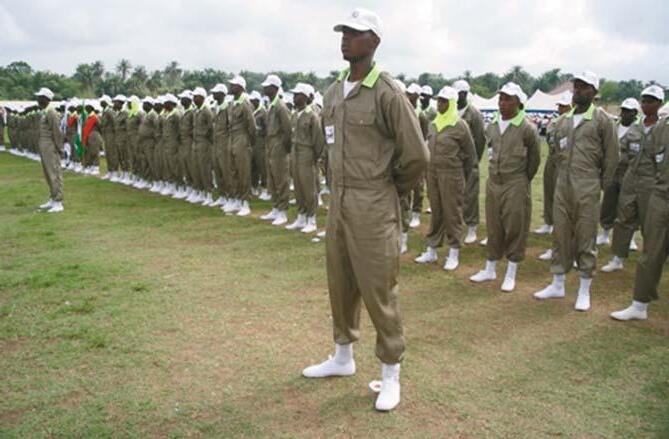
traces and replicas of many ideas that reminded me of your administraon almost everywhere I went. From sanita on culture and environmental cleanliness to organized emergency response systems, youth engagement structures, community maintenance systems, and ambulance services, I remembered your O-Clean, O-Job, and O-Ambulance ini a ves. As I walked through those clean streets and organized systems abroad, my mind sincerely prayed for you and for Nigeria. It made me reflect deeply on how visionary leadership can transform society when supported and sustained. Many people did not fully appreciate some of those ini a ves then, but me has revealed their value. Cleanliness, orderliness, youth empowerment, and community security are not luxuries; they are founda ons of a func oning society.
Nigeria needs policies that will: Engage youths produc vely through employment and skills programs.
Strengthen local intelligence gathering.
Equip security personnel with modern tools and technology.
Improve collabora on between communi es and security agencies. Restore public confidence through visible and responsive security measures.
Promote sanita on, orderliness, and social responsibility at the grassroots level.
This is not the me for division or poli cal rivalry. It is a me for patriotic sacrifice and collec ve responsibility. Nigerians are yearning for leaders who will rise above poli cs and speak boldly for the safety, dignity, and unity of the country.
May God guide and strengthen you as you con nue to contribute to the progress of our dear na on.

MONDAY, MAY 25, 2026 VOL. 21 NO 41 www.osundefender.com, email: osundefenderbank@gmail.com
MOST of life’s biggest accomplishments start as mere ideas. The mind of the journalist is a complex clockwork of curiosity and possibili es. He doesn’t need to be as strong as the bull. But he needs to be as courageous as the lion. To fight tyranny, murder, corrupon, licen ousness, nepo sm etc, he needs more than strength, he needs ferocious consistency.
The journalist cannot publish everything he knows, every me. If he does, fire may spring up in his newspaper or house or country. But as powerful as he is, the journalist, at mes, is the freedom fighter restrained by the interviewee’s censorship seal called ‘Off the Record’ or the dangling Sword of Damocles called libel.
The Chairman of a Nigerian big bank once told me a story that exemplifies the power of the media. But he gagged me with the oath of secrecy called ‘Off the Record’.
Commen ng on his court case with the Economic and Financial Crimes Commission, the bank CEO started, “In life, never look down on anyone.” He con nued, “You know, when President Muhammadu Buhari assumed power in 2015, the an -corrup on war got on stream. There was fear everywhere. People were afraid because they weren’t sure if the ancorrup on war wasn’t going to be a vehicle for vic misa on or not.
“There was this par cular prosecutor of the EFCC, who was a terror to everybody in court. Whenever he was in court, he talked to people rudely. So, everybody tried to avoid him. When he talked, everybody shivered. He had an oppressive nickname he was secretly called. He would come to court and order people around, telling them where to sit, and where not to sit.
“On this par cular day, the fearsome prosecutor, as usual, walked into court before the commencement of proceedings. Everyone was seated. He went to the press gallery and tried to change the si ng arrangement of journalists.
“One very short journalist who dressed simply just sprang up and thoroughly tongue-lashed the official, calling him unprintable names. It was as if we were watching a horror movie, everybody was rooted.
“The man couldn’t u er a word. A er the court session, the journalist walked up to the prosecutor and connued his rade of abuse, the man s ll couldn’t talk. It was as if he had gone deaf, dumb and blind. That was how we all got our freedom that day. Whenever he came to court, thereafter, he sat gently by the corner like a

debtor.”
As a reporter of PUNCH newspapers at the Lagos State Governor’s Office, Alausa, someone walked into the Bagauda Kalto Press Centre in the secretariat, one evening, and said the then Commissioner for Works, Rauf Aregbesola, wanted to see me. I went with the official to the commissioner. That was in 2001 or 2002.
A no-holds-barred interview ensued. During the interview, Aregbesola said every black man on the face of the earth should contemplate his estate, and cry for, at least, four hours a day, begging God to change the course of his life from bad to good.
A er the interview, I never spoke to or met Aregbesola again un l our paths crossed around 2005 when he began to stake his claim to the 2007
“The deaf can understand the oratory of Aregbesola. On the crest of his populist appeal and media strategy, Aregbesola made inroads in Osun politics within a short time”
governorship of Osun State, where I had been transferred to as the Osun State correspondent of PUNCH in 2003.
The deaf can understand the oratory of Aregbesola. On the crest of his populist appeal and media strategy, Aregbesola made inroads in Osun polics within a short me. The 2007 governorship elec on was fraught with killings and violence, resul ng into over three-year legal tussle between Aregbesola who was the candidate of the Ac on Congress and the incumbent governor, Olagunsoye Oyinlola, of the Peoples Democra c Party.
A er Aregbesola got victory at the Appeal Court, Ibadan, on November 26, 2010, he didn’t move into the Governor’s Office, Abere, un l 2011.
A er his inaugura on, he operated from the Oranmiyan House in Osogbo and slept in Ilesa, his hometown.
One day, an incident happened at the Oranmiyan House, which was a beehive of ac vi es for party members and supporters. The incident buttresses the power of the media and also affirms the aphorism that cauons against looking down on anyone. The incident marked the rechristening of Aregbesola, whom many had come to address as ‘Engineer’ or ‘Alhaji’.
The new governor had just finished addressing the press. He was
in his boisterous element. His media handlers suspected the governor could be red a er answering so many ques ons, thus they told journalists to round off their ques ons. But Aregbe, as he is popularly called, would have none of that. “I’m ready for them. Let them ask all their quesons. Don’t gag them,” he told Messrs Sunday Akere, Gbenga Fayemiwo and Lani Baderinwa, who were calling the shots in his media team.
So, journalists were allowed to ask some more rounds of ques ons before the curtain was finally drawn on the session. Aregbe took his me to answer all the ques ons. But, before the closing remarks were made, I raised my hand and voiced my objec on to the tle of ‘Engineer’ that had been prefixed to the name of the governor and which had gained ground in the media.
I said, “It will sound trivial if everyone in the society is addressed by their professional qualifica ons and training. I shall refer to you as ‘Alhaji’ in my stories because it is a well accepted tle across the country, but ‘Engineer’ will be too trivial. It’s funny that some people even go by the tle, ‘Town Planner’ and ‘Geographer’ in Nigeria now. Herbalists, drivers and gatemen will soon begin to demand they be addressed according to their callings. It’s trivial. PUNCH as an organisa on recognises only tles such as ‘Mr’, ‘Mrs,’ ‘Ms’, ‘Miss’, ‘Chief’, religious tles such as ‘Alhaji’, ‘Alhaja’, ‘Sheik’, ‘Imam’, ‘Pastor’, ‘Bishop’, ‘Evangelist’ and ‘Dr’ for medical doctors. Smiling, the governor said, “What do you want to call me?”
I said, “I can call you ‘Alhaji’.”
Aregbesola: “No.”
“I can call you ‘Mr’,” I said.
As he was thinking about it, I added, “I can also call you ‘Ogbeni’.”
His face brightened up, “Yes, ‘Ogbeni’ will be good! Call me ‘Ogbeni’. I prefer ‘Ogbeni’.”
I filed my story later in the day –premising it on Aregbe’s preference for being called ‘Ogbeni’. The story came out the next day with a banner headline: “Call me Ogbeni – Aregbesola”
Thus, a big-eyed journalist, who wasn’t born when the governor was christened Abdulrauf Adesoji Aregbesola in 1957, rechristened Alhaja Sherifat’s husband in Osogbo in 2010, free of charge.
A er the Jagaban of Borgu tle held by the APC Na onal Leader, Asiwaju Bola Tinubu, ‘Ogbeni’ appears to be the most popular tle in the South-West poli cal circle. Beau ful things come in small packs. They also come as simple ideas. As Aregbesola celebrates his 63rd birthday, he should also be planning the celebra on of the 10th anniversary of his Ogbeni tle. Ewe oye amori o. Happy birthday, Ogbeni.
•Odesola is a Columnist with The PUNCH Newspaper •This article written in commemoration of Aregbesola’s 63rd birthday in 2020 is republished by popular demand.
OSUN DEFENDER is published by Moremi Publishing House Limited, Behind Oranmiyan Building, Gbodofon, Off Gbongan Road, Osogbo, Osun State. All correspondence to the Deputy Editor, MICHAEL BAMIGBOLA, Telephone: 0809-301-9152. ISSN: 0794-8050. Website: www.osundefender.com Email: osundefenderbank@gmail.com, osundefenderhq@gmail.com