MONDAY, NOVEMBER 16, 2026
VOL 21 NO 89
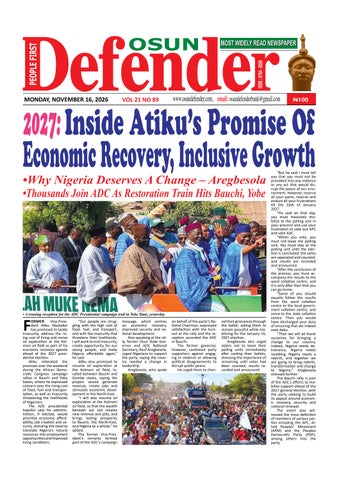
•Why Nigeria Deserves A Change – Aregbesola •Thousands Join ADC As Restoration Train Hits Bauchi, Yobe
• A rousing reception for the ADC Presidential campaign trail in Yobe State, yesterday
F
ORMER Vice-President A ku Abubakar has promised to tackle insecurity, address the rising cost of living and revive oil explora on at the Kolmani oil field as part of his economic recovery agenda ahead of the 2027 presiden al elec on. A ku reiterated the promises over the weekend during the African Democra c Congress campaign rallies in Bauchi and Yobe States, where he expressed concern over the rising cost of food, fuel and transporta on, as well as insecurity threatening the livelihoods of Nigerians. The ADC presiden al hopeful said his administra on, if elected, would priori se economic affordability, job crea on and security, stressing the need to translate Nigeria’s natural resources into employment opportuni es and improved living condi ons.
“Our people are struggling with the high cost of food, fuel, and transport, and with the insecurity that threatens their livelihoods. I will work to end insecurity, create opportunity for our young people, and make Nigeria affordable again,” he said. A ku also promised to resume oil explora on at the Kolmani oil field, located between Bauchi and Gombe states, saying the project would generate revenue, create jobs and s mulate economic development in the North-East. “I will also resume oil explora on at the Kolmani oil field, so that the wealth beneath our soil creates new revenue and jobs, and brings las ng prosperity to Bauchi, the North-East, and Nigeria as a whole,” he added. The former Vice-President’s remarks formed part of the ADC’s campaign
message, which centres on economic recovery, improved security and naonal development. Also speaking at the rally, former Osun State Governor and ADC Na onal Secretary, Rauf Aregbesola, urged Nigerians to support the party, saying the country needed a change in leadership. Aregbesola, who spoke
on behalf of the party’s Naonal Chairman, expressed sa sfac on with the turnout at the rally and the recep on accorded the ADC in Bauchi. The former governor, however, cau oned party supporters against engaging in violence or allowing poli cal disagreements to disrupt public peace. He urged them to chan-
nel their grievances through the ballot, asking them to remain peaceful while mobilising for the January 16, 2027 elec on. Aregbesola also urged voters not to leave their polling units immediately a er cas ng their ballots, stressing the importance of remaining un l votes had been counted, results recorded and announced.
“But he said I must tell you that you must not be provoked into any violence or any act that would disrupt the peace of our environment. However, reserve all your pains, reserve and endure all your frustra ons ll the 16th of January 2027. “He said on that day, you must massively mobilize to the polling unit in your precinct and use your frustra on to vote out APC and vote ADC. “When you vote, you must not leave the polling unit. You must stay at the polling unit un l the elecon is concluded, the votes are separated and counted, and results are recorded and announced. “A er the conclusion of the process, you must accompany the results to the ward colla on centre, and it is only a er then that you can go home. “Some of you should equally follow the results from the ward colla on centre to the local government colla on centre, and some to the state colla on centre. Then you would have discharged your duty of ensuring that we indeed vote A ku. “Then we will all thank ourselves for bringing a change to our country. Indeed, Nigeria needs deliverance, Nigeria needs rese ng, Nigeria needs a rebirth, and together we are going to bring rebirth, transforma on and change to Nigeria,” Aregbesola stressed further. The Bauchi rally is part of the ADC’s efforts to mobilise support ahead of the 2027 general elec on, with the party seeking to build its appeal around economic recovery, security and na onal renewal. The event also witnessed the mass defec on of members of various pares including the APC, Allied Peoples’ Movement (APM) and the Peoples Democra c Party (PDP), among others into the party.
MONDAY, NOVEMBER 16, 2026
2
News
We’ll Ground Osogbo If Govt Writes Oluwo Again Over Idolatry – Molaasan
T
HE leader of the Ta’awunu Human Rights Ini ave (THURIST), Sheikh Daood Imran Molaasan, has threatened to mobilise Muslims to occupy Osogbo, the Osun State capital, and prevent vehicular movement if the state government writes another le er to the Oluwo of Iwo, Oba Abdulrasheed Adewale Akanbi, over his comments on idolatry. Molaasan made the threat in a video posted on his Facebook page on Friday, where he cri cised the state government’s decision to monitor the monarch’s public comments following his remarks on idolatry. Speaking in Yoruba while addressing a congrega on, the Islamic cleric said the government could monitor the tradi onal ruler but would not stop him from expressing his religious views. “The person who wrote the le er said the government will be monitoring what Oluwo is saying going forward. The government can con nue to monitor him, but Oluwo will not stop talking about idolatry,” he said. Molaasan warned that another le er from the government could trigger a mass protest in Osogbo, insis ng that Muslims would sustain the demonstra on un l their demands were addressed. “If you dare write another le er, we will come out in full and ensure that no vehicle moves in Osogbo. We will occupy Osogbo ll a state of emergency is declared, even if it takes us a year. “All the Muslims will be out. That is our own right, to say we are not going to be involved in idolatry and to talk against it,” he added. The THURIST leader also challenged the authority of the state government, arguing that elected officials were accountable to the people and should not regard themselves as superior to the ci zens they govern. He said the governor and other public office holders derived their authority from the people, who also had the cons tu onal power to vote them out of office. “The Osun State Government, led by the governor, is not bigger than Osun indigenes.
•Threatens Legal Action, Electoral Challenge If Oluwo Is Removed
You are our slave, and you are serving us. Both the federal and state governments are not bigger than their ci zens,” Molaasan said. Addressing the controversy surrounding the monarch’s posi on, the cleric acknowledged that the government had the power to remove Oluwo, but maintained that the people also had the power to remove the governor through the electoral process. “It is true that the governor has the power to remove Oluwo, the same way we also have the power to remove him. We can vote that we no longer want the governor to con nue. “The government can remove Oluwo since it appointed him. Oluwo did not deny that. But he claimed that he was appointed by God. Those serving in the present administra on were not there when Oluwo was appointed,” he said. Molaasan further vowed that any a empt by the government to remove the monarch would be challenged through legal and poli cal means. He said THURIST and its supporters would approach the courts to seek an order restraining the government from implemen ng any removal decision, adding that the case could proceed through the appellate courts. “The government has the power to remove him if God wants it, but God will not allow that, and we will also not allow that,” he said. “The least you can do is to remove him, and we will go to court for a stay of execu on, and the case will not be determined ll you finish your tenure. A er the High Court, we will go to the Court of Appeal and the Supreme Court. “A er that, we will vote for a governor who will withdraw the matter,” Molaasan added. The remarks come amid growing disagreement over the Oluwo’s comments on tradi onal religious prac ces and the response of the Osun State Government, raising ques ons about religious expression, the limits of public authority and the need to prevent tensions from escala ng into confronta on.
•25.05 kilograms of methamphetamine concealed in breakfast cereal packs brought into Nigeria from South Africa, intercepted by officials of the NDLEA, in Lagos, recently
2027: SERAP Gives INEC 7 Days To Prosecute Electoral Violence Suspects
T
HE Socio-Economic Rights and Accountability Project (SERAP) has given the Chairman of the Independent Na onal Electoral Commission (INEC), Professor Joash Amupitan, seven days to obtain police inves ga on files on reported incidents of electoral violence since the commencement of campaigns for the 2027 general elec ons and prosecute suspects where sufficient evidence exists. SERAP urged Amupitan to direct INEC’s legal officers or appointed legal prac oners to review the case files and promptly prosecute those arrested in connecon with the incidents under the Electoral Act 2026. The organisa on made the demand in a le er dated November 14, 2026, and signed by its Deputy Director, Kolawole Oluwadare. The le er followed reports of several incidents of electoral and poli cal violence across the country, including the latest a ack on members and supporters of the Nigeria Democra c Congress (NDC) during a town hall mee ng in Oregun, Lagos, on November 12. SERAP also called on the INEC chairman to urge the police to intensify and conclude inves ga ons into other reported incidents, idenfy and arrest suspected perpetrators and their sponsors, and forward relevant case files and evidence to the commission for prosecu on.
It further asked Amupitan to exercise INEC’s powers under Secon 83 of the Electoral Act 2026 to demand explana ons from poli cal par es suspected of involvement in or encouraging prohibited conduct and impose the prescribed fines on par es that fail to comply with lawful direc ves. According to SERAP, the prosecu on of electoral offences is necessary to punish offenders, deter future viola ons and prevent the normalisa on of poli cal violence in Nigeria. The organisa on maintained that INEC has a statutory responsibility to prosecute electoral offences and ensure that perpetrators are held accountable, irrespec ve of their poli cal affilia ons or posi ons. It warned that failure to prosecute suspects could encourage further a acks, deepen impunity and create an atmosphere of fear capable of discouraging opposion par es from holding mee ngs, preven ng candidates from reaching voters and undermining ci zens’ par cipa on in the electoral process. SERAP said several incidents had been reported since campaigns for the 2027 general elec ons commenced on August 19, 2026. These include the reported obstruc on of the convoy of the NDC presiden al candidate, Peter Obi, in Benue State on September 8; a acks on an NDC ward mee ng and a separate Peoples
Democra c Party (PDP) rally in Enugu State on September 12; and the reported a ack on the convoy of ADC senatorial candidate, Herberta Okonofua, in Edo State on October 6. Other incidents cited by the organisa on include a acks on NDC supporters during the campaign ac vi es of its governorship candidate, Chinyeaka Ohaa, in Enugu State on October 10, which reportedly resulted in the death of a supporter. It also listed the attack on supporters of Accord governorship candidate, Oriyomi Hamzat, during a procession in Ibadan on October 14, which le one person dead, and the a ack on the convoy of NDC candidate, Rollins Offia-Nwali, in Ebonyi State on October 22, which reportedly claimed one life and le three others injured. SERAP further recalled the a ack on African Ac on Congress (AAC) presiden al candidate, Omoyele Sowore, and members of his team in Ado-Eki on October 30. It added that Peter Obi’s convoy was a acked in Calabar on November 4, while an NDC poli cal procession in Asaba on November 7 reportedly le one person dead and five others injured. The organisa on also cited the disrup on of an NDC town hall mee ng by suspected armed men in Lagos on November 12, during which journalist Samuel Adebanjo was reportedly assaulted and his equipment seized
while covering the event. It said the incidents had resulted in deaths, injuries, property destruc on, a acks on journalists and disrup ons of lawful poli cal ac vi es, posing serious threats to the safety of poli cal parcipants and the credibility of the 2027 elec ons. While acknowledging reported police arrests and inves ga ons, SERAP stressed that arrests alone were insufficient to ensure accountability, insis ng that suspects must be prosecuted whenever available evidence supports criminal charges. It also emphasised that individuals who organise, finance, direct or sponsor poli cal violence must not escape accountability. Ci ng provisions of the Electoral Act 2026, SERAP noted that Sec on 96(5) prohibits poli cal par es, aspirants and candidates from retaining, organising, training or equipping individuals or groups to use physical force or coercion to advance poli cal objecves. It added that Sec on 96(6) prohibits poli cal par es, aspirants and candidates from maintaining or using armed private security organisaons, vanguards or other groups to provide security or assist them during campaigns, rallies, processions or elec ons. The organisa on also cited Sec ons 96(7) and (8), which prescribe penal es for viola ons of Sec on 96 and for aiding or abe ng prohibited conduct.
MONDAY, NOVEMBER 16, 2026
3
T
HE democra c space in Nigeria has con nued to shrink, increasingly constrained by what appears to be a deliberate strategy of weaponising state power against poli cal opposi on and dissen ng voices. Those entrusted with the responsibility of protec ng democracy are increasingly resor ng to force and the deployment of so-called ‘federal might’ as subs tutes for democra c persuasion, poli cal engagement and the rule of law. This is not merely a troubling development; it is a crisis that threatens the very founda ons of our democracy. As the next general elecon approaches, cau ous pessimism has become the prevailing sen ment among observers and ci zens who fear that the country may be dri ing towards an electoral contest defined more by in mida on, violence and ins tu onal manipulaon than by the free expression of the people’s will. The growing normalisa on of poli cal violence is par cularly disturbing. When coercion becomes a poli cal instrument and state ins tu ons are deployed to in midate opponents, democracy is reduced to an empty ritual. Free, fair and credible elec ons cannot exist without strong, independent and impar al democra c ins tuons. The electoral umpire, security agencies, judiciary and other cri cal ins tuons must demonstrate the independence, courage and integrity required to pro-
“Ultimately, democracy cannot defend itself. It requires citizens who are conscious of their rights, institutions that are prepared to uphold the law and political leaders who understand that the mandate to govern comes from the people”
service workers whose professional responsibili es may prevent them from parcipa ng on elec on day. Security personnel, medical prac oners, electricity workers and other cri cal service providers should not be compelled to choose between fulfilling their professional obliga ons and exercising their democra c rights. A transparent and properly regulated early voting system would guarantee their par cipa on while ensuring that essen al services are not disrupted. It would also contribute to improved voter turnout and a more inclusive electoral process. These proposals are parcularly important in view of the growing concerns over voter suppression, which could assume unprecedented dimensions in the coming elec ons. From the in midaon of voters and opposi on supporters to the possible misuse of security agencies and administra ve bo lenecks, every avenue through which ci zens could be denied their franchise must be an cipated and decisively addressed. The right to vote that encourages or requires is meaningless if ci zens caneligible ci zens to par ci- not exercise it freely, safely pate in elec ons, with rea- and without fear. Ul mately, democracy sonable exemp ons, could cannot defend itself. It rehelp address voter apathy, quires ci zens who are conimprove turnout and make it more difficult for poli - scious of their rights, ins cal actors to manipulate low tu ons that are prepared to par cipa on to their ad- uphold the law and poli vantage. Such a framework cal leaders who understand must, however, be support- that the mandate to govern ed by adequate safeguards comes from the people. The to guarantee freedom of growing ins tu onalisa on choice and protect ci zens of violence must not be allowed to become the definfrom coercion. We also advocate the in- ing feature of Nigeria’s poli troduc on of early vo ng cal culture. Defending democracy rearrangements for essen al quires eternal vigilance against the OSUN DEFENDER entrenchment of Publisher – Moremi Publishing anti-democratic House Ltd. forces. Nigerians Ac ng Deputy Editor – Sodiq Yusuf Deputy Photo Editor – Shola Aderinto must remain enDeputy Graphics Manager – Zainab Olalere gaged, organised and steadfast in Produc on Controller – Petkola Taiwo Ibitowa protec ng the OSUN DEFENDER is published by Moremi Publishing democra c space. House Limited, Behind Oranmiyan Building, Gbodofon, No poli cal ambiOff Gbongan Road, Osogbo, Osun State. on, no ma er how ISSN : 0794-8050 powerful its sponTelephone : 0809-301-9152 Website : www.osundefender.com/index.php sors, should be ale-mail : osundefenderhq@gmail.com lowed to override osundefenderbank@gmail.com the sovereign will All correspondence to the above email addresses. of the people.
Mayhem Continues: The Institutionalisation Of Violence
tect the democra c process. Their loyalty must be to the Cons tu on and the Nigerian people, not to the poli cal interests of those in power. However, ins tu onal independence alone may not be sufficient if ci zens are discouraged, in midated or prevented from exercising their cons tu onal rights. There must be a massive mobilisa on of voters to ensure op mal par cipa on and strengthen the legi macy of the electoral process. Nigerians must not only turn out in their numbers to vote; they must also remain vigilant and resolute in defending their votes against manipula on, in mida on and every a empt to subvert their electoral choices. It is against this background that we support the introduc on of mandatory vo ng as part of a broader redefini on of the social contract between ci zens and the state. Vo ng should be regarded not merely as a poli cal privilege but as a civic responsibility. A system
News
MONDAY, NOVEMBER 16, 2026 VOL. 21 NO 89 www.osundefender.com, email: osundefenderbank@gmail.com
A
S Nigerians head to the polls in January 2027, the electorate has another opportunity to consolidate democra c gains by elec ng responsible leaders to poli cal office. For the most populous black na on on earth, the stakes are high, as the en re black race looks up to Nigeria for its emancipa on. However, certain issues remain germane and equally important as the na on con nues to ba le undemocra c norms and prac ces. Contrary to popular opinion, democra c backsliding seldom appears through abrupt military interregnum or state collapse; it creeps in through the subtle erosion of values essen al to a thriving democracy (Omoigberale, 2026). This interven on examines Nigeria’s subtle autocri sa on and assesses its pivotal moment to reverse the prevailing poli cal trend in the upcoming general elec ons. According to the list released by the Independent Na onal Electoral Commission (INEC), there are 19 presiden al candidates, 4,408 Na onal Assembly candidates, of whom 1,195 are seeking Senate seats, and 3,213 are contes ng House of Representa ves seats. Overall, there are 1,491 posi ons, comprising 1 Execu ve President, 109 senatorial seats (3 per state plus 1 for the Federal Capital Territory), and 360 seats in the House of Representa ves. For state elec ons, 28 state governorship elec ons are due across Nigeria’s 36 states, along with their depu es. Likewise, 993 seats are available in State Houses of Assembly across the federaon’s 36 states. For now, the elec ons are billed to hold on 16 January 2027 for the Presiden al and Na onal Assembly elec ons and 6 February 2027 for the governorship and state houses of assembly elec ons. Over the past decades, Nigeria has witnessed democra c backsliding. This is not surprising, given that only 5 per cent of the en re sub-Saharan African popula on lives under a thriving liberal democracy (The Seychelles and South Africa). Forty-nine per cent of the subsaharan popula on lives under an electoral autocracy, twenty-four per cent under an electoral democracy, and others under a closed autocracy (Nord et al., 2025). Nigeria, classified as an electoral democracy, lives in the ‘grey
PERSPECTIVE
BY ILEOWO KIKIOWO
2027 General Elections: Assessing Nigeria’s Prospects For Democratic Consolidation Beyond The ‘Grey Zone’
zone’, where key indicators of a thriving democracy are absent and, where present, are for showmanship, as poli cal elites with unchecked execu ve powers use state apparatchiks to suppress dissent, wage lawfare against real or perceived opponents and restrict poli cal par cipa on, o en through subterfuge. Though electoral democracy is the star ng point for any polyarchy, democra sa on demands further guarantees, such as the ability of opponents of government to openly and legally organise to oppose government in a free and fair elec on (Dahl, 1971). Nigeria’s democra c experience since independence from Britain in 1960 has been marked by frequent military interregnums, and its current uninterrupted democra c dispensaon is now in its 27th year. Ci zens’ experiences during these years have been constant agita on for economic and democra c freedom. In the current republic, highly influen al poli cal elites o en called the “cabals” (a metaphor which refers to an opaque, informal, secre ve, highly influen al group of people who control presidenal decisions, exert immense behindthe-scenes control over government policies, state resources, and governance (Onyia and Aroh, 2019)) use the instrument of poli cal office to usurp enormous execu ve power by coercing the legislature, judiciary and other regulatory bodies to extend cons tuonal powers, restrict par cipa on and freedom of expression. 2027 presents a fresh chance for Nigeria to posion itself as a bas on of democracy in a region surrounded by autocra c administra ons. Niger, Chad, Cameroon and, more recently, Benin Republic are ruled by military dictators or electoral autocrats who perpetuate themselves in office through military coup d’état or cons tu onal amendments on poli cal par cipa on, term limits and dura on. In fact, Nigeria ranks 57th of the 59 electoral democracies in the world and is classified in the ‘grey zone’ between an electoral democracy and an electoral autocracy (Nord et al., 2025). The 2027 general elec on presents Nigeria with a fresh opportunity to demonstrate its creden als as a genuine democracy, with electoral ac vi es that are free, fair, and open to par cipa on without in mida on or fear of
arrest. Beyond elec on day in January, the ac ons of poli cal opera ves must assure ci zens and interna onal observers of her readiness to transform Nigeria from a na on that symbolically heads to the polls every four years to endorse a leader as a fait accompli to one that makes every vote count. A free and fair elec on is sacrosanct for a liberal democracy to thrive. Already, opponents and ruling-party officials are poin ng fingers at each other over violent a acks on opposi on candidates and offices. As the elec ons approach, the news is awash with reports of daylight a acks with machetes and other dangerous weapons on an opposi on presiden al candidate and an opposion gubernatorial candidate was attacked while on campaign in different parts of the country. Likewise, state agents and non-state actors frequently arrest, harass, and in midate ordinary ci zens wearing opposi on poli cians’ campaign materials to predetermine elec on outcomes. Understandably, these allega ons raise concerns, since the ruling party in government holds the monopoly on the legi mate use of force. With the government’s power of coercion comes the tendency to autocra se. Scholars define autocra sa on as the systemic, o en gradual poli cal shi away from democracy and toward authoritarian rule. Elected leaders seldom dismantle democracy at the start; instead, they systema cally compromise checks and balances while maintaining a facade of democra c ins tuons. As Nancy Bermeo (2016) argues, modern autocra sa on o en relies on execu ve aggrandisement through strategic electoral manipula on, weakening ins tu onal checks and balances, and the incremental expansion of power. When democracies backslide, the execu ve usually undermines the independence of the judiciary, legislature, civil service, and other state ins tu ons. For example, many Nigerians today believe the lawfare being waged against certain opposi on figures amounts to the weaponisa on of the judiciary to serve such an agenda. Legisla ve oversight is minimal or absent, while many poli cal elites with corrupon cases hanging over their heads are eased of such burdens when they decamp to the ruling party. In addi on,
P2 Nigeria has witnessed most opposi on governors decamp from their par es to join the ruling party, leaving only five governors out of 36 in opposi on pares. Of the remaining five opposi on governors, four are coordinators of the re-elec on campaign of the incumbent president, while only one, who is a contestant for the posi on himself, is in the ‘real’ opposi on. So, despite the seemingly open poli cal space, organisa on and par cipa on in ac vi es opposing the ruling party are covertly forbidden while maintaining the appearance of a free and fair system. Restoring faith in the democra c system and reversing the backsliding is possible as the elec ons approach. The following can help remove Nigeria from the ‘grey zone’: 1.Legisla ve procedures manda ng a full review of all bills before a vote must be strictly upheld. Furthermore, bills should be distributed to members in advance to ensure they are adequately prepared for floor debate in the Na onal Assembly. 2.The Na onal Assembly can use the powers at its disposal to halt democratic backsliding by ensuring its leaders emerge through a fair democra c process, without execu ve interference. 3.State ins tu ons such as the judiciary, regulatory agencies, and law enforcement agencies must resist execu ve overreach, especially when execu ve decisions restrict open par cipa on and freedom of associa on. 4.Civil servants and law enforcement officials can resist an democra c or unlawful execu ve pressure through administra ve non-compliance, while maintaining technocra c neutrality and rule-of-law standards. 5.Civil society and the media have a dual role: as agents of enlightenment and mass mobilisa on. The media and civil society should act as reliable sources that counter disinforma on by autocra c forces. Through public dialogue, factual repor ng, civic educa on, and fact-checking, they can reverse democra c backsliding. Together, they can mobilise the civilian populace as a democra c force that keeps poten al autocrats at bay. Lastly, the commission charged with organising a free and fair elec on in 2027, INEC, must ensure a fair playing field for all, update its register by weeding out duplicate entries, voiding AI registra ons and preparing technological tools well in advance that will ensure its transparency, so the world can vouch for the process from end-toend. •This article was first published by Canterbury Christ Church University. •Ileowo Kikiowo is a PhD Candidate in Politics and International Relations and an Academic Sessional in the School of Business, Law and Policing at Canterbury Christ Church University. He is currently researching the relationship between oil revenue and the pursuit of true federalism in Nigeria, with a focus on understanding how the nation’s resource-based economy influences its governance, political and federal structures.
OSUN DEFENDER is published by Moremi Publishing House Limited, Behind Oranmiyan Building, Gbodofon, Off Gbongan Road, Osogbo, Osun State. All correspondence to the Acting Deputy Editor, SODIQ YUSUF, Telephone: 0809-301-9152. ISSN: 0794-8050. Website: www.osundefender.com Email: osundefenderbank@gmail.com, osundefenderhq@gmail.com