MONDAY, SEPTEMBER 07, 2026
VOL 21 NO 71
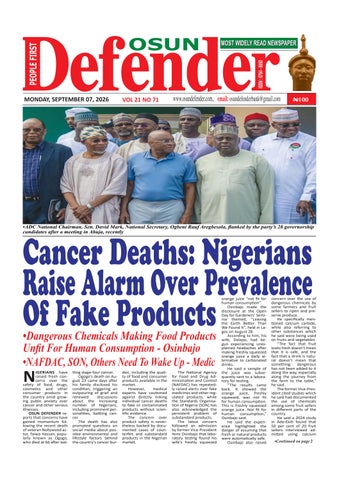
•ADC National Chairman, Sen. David Mark, National Secretary, Ogbeni Rauf Aregbesola, flanked by the party’s 28 governorship candidates after a meeting in Abuja, recently
Cancer Deaths: Nigerians Raise Alarm Over Prevalence Of Fake Products •Dangerous Chemicals Making Food Products Unfit For Human Consumption - Osinbajo •NAFDAC, SON, Others Need To Wake Up - Medic
N
IGERIANS have raised fresh concerns over the safety of food, drugs, cosme cs and other consumer products in the country amid growing public anxiety over cancer and other serious illnesses. OSUN DEFENDER reports that concerns have gained momentum following the recent death of veteran Nollywood actor, Taiwo Hassan, popularly known as Ogogo, who died at 66 a er bat-
tling stage-four cancer. Ogogo’s death on August 23 came days a er his family disclosed his condi on, triggering an outpouring of grief and renewed discussions about the increasing number of Nigerians, including prominent personali es, ba ling cancer. The death has also prompted ques ons on social media about possible environmental and lifestyle factors behind the country’s cancer bur-
den, including the quality of food and consumer products available in the market. However, medical experts have cau oned against directly linking individual cancer deaths to fake or contaminated products without scienfic evidence. The concern over product safety is nevertheless backed by documented cases of counterfeit and substandard products in the Nigerian market.
The Na onal Agency for Food and Drug Administra on and Control (NAFDAC) has repeatedly raised alerts over fake medicines and other regulated products, while the Standards Organisaon of Nigeria (SON) has also acknowledged the persistent problem of substandard products. The latest concern followed an admission by former Vice-President Yemi Osinbajo that laboratory tes ng found his wife’s freshly squeezed
orange juice “not fit for human consump on”. Osinbajo made the disclosure at the Open Day for Gardeners’ Seminar themed, “Leaving the Earth Be er Than We Found It”, held in Lagos on August 28. According to him, his wife, Dolapo, had begun experiencing unexplained headaches a er making freshly squeezed orange juice a daily alterna ve to carbonated drinks. He said a sample of the juice was subsequently sent to a laboratory for tes ng. “The results came back. It showed the orange juice, freshly squeezed, was not fit for human consump on. This is freshly squeezed orange juice. Not fit for human consump on,” Osinbajo said. He said the experience highlighted the danger of assuming that fresh or natural products were automa cally safe. Osinbajo also raised
concern over the use of dangerous chemicals by some farmers and fruit sellers to ripen and preserve produce. He specifically menoned calcium carbide, while also referring to other substances which he said were being used on fruits and vegetables. “The fact that fruit looks fresh doesn’t mean that it is safe, and the fact that a drink is natural doesn’t mean that something dangerous has not been added to it along the way, especially along the journey from the farm to the table,” he said. The former Vice-President cited studies which he said had documented the use of chemicals among some fruit sellers in different parts of the country. He said a 2024 study in Ado-Eki found that 50 per cent of 20 fruit sellers interviewed admi ed using calcium •Continued on page 2
MONDAY, SEPTEMBER 07, 2026
2
News
Osun 2026: 21 Days After, Osun APC Fails To Challenge Election Outcome
T
WENTY ONE days a er the Independent Na onal Electoral Commission (INEC) declared Governor Ademola Adeleke winner of the August 15 Osun State governorship elecon, the All Progressives Congress (APC) has yet to publicly file an elecon pe on challenging the outcome, as the cons tu onal deadline expired on Sunday, September 6. OSUN DEFENDER reports that Sec on 285(5) of the 1999 Cons tu on, as amended, provides that: “An elec on pe on shall be filed within 21 days a er the date of the declara on of the result of the elec on.” INEC had declared Adeleke, the Accord Party candidate, winner in the early hours of August 16 a er he secured 511,067 votes, defea ng the APC candidate, Bola Oyebamiji, who polled 444,815 votes. Adeleke won 19 of the state’s 30 local government areas, while Oyebamiji won 11, giving the incumbent a winning margin of 66,252 votes. Although the APC ini ally said it was reviewing the results and considering its op ons, there has been no publicly reported filing of a pe on by the party or its candidate as the cons tu onal window
closed. Oyebamiji had, on August 29, formally accepted the elec on outcome and congratulated Adeleke, while calling for an end to post-elec on violence. He also urged APC members to close ranks and begin prepara ons for the 2027 general elec ons. The development was further reinforced by the posi on of APC Naonal Secretary, Senato Ajibola Basiru, who personally visited Adeleke in Osogbo on August 30 and congratulated him on his re-elec on. Basiru acknowledged that he had campaigned vigorously against Adeleke and worked for Oyebamiji, but said that, as a democrat, he had to recognise the outcome of the contest. “I must also come as a democrat to congratulate you on your recent victory,” Basiru said, acknowledging that he had wanted Oyebamiji to win. Post-elec on developments have also produced an unusual sequence of poli cal engagements between the principal actors and President Bola Tinubu. Under Sec on 285(6) of the Cons tu on, an elec on tribunal must deliver its judgment in wri ng within 180 days
from the filing of a pe on. The development
plex disease and that it would be medically inaccurate to a ribute every cancer death to fake products. “Cancer does not have one single cause. It develops through a combina on of gene c, environmental and lifestyle factors,” he said. According to him, the presence of carcinogenic or toxic substances in the food chain remained a legi mate concern, parcularly where exposure was repeated over a long period. He called for stronger laboratory surveillance of food and consumer products, as well as greater transparency whenever dangerous substances were detected. He urged the government to improve laboratory capacity, strengthen border and market surveillance, prosecute offenders and make it easier for consumers to verify the authen city of products. Akin also advised
contests, which have repeatedly ended up in prolonged li ga on, in-
cluding the keenly contested 2007, 2014, 2018 and 2022 elec ons.
•Governor Ademola Adeleke in a group photograph with members of the newly reconstitued governing council of the Osun State University (UNIOSUN) after their inauguration, recently
2027: Makinde Will Refund State Funds ‘Wasted’ On Presidential Bid – Oyo APC
T
HE Oyo State chapter of the All Progressives Congress has warned that Governor Seyi Makinde will be made to refund any state funds allegedly spent on his reported 2027 presiden al bid. The party described Makinde’s reported presiden al ambi on as a poli cal drama designed to entertain and distract the people,
Cancer Deaths: Nigerians Raise Alarm Over Prevalence... •Continued from page 1 carbide, while another study in Uyo reportedly found that 25 per cent of sellers admi ed using the substance. The former Vice President further cited a 2023 survey of 50 fruit and vegetable retailers in Lagos, saying 22 admi ed using chemicals to preserve their produce. OSUN DEFENDER gathered that the development has intensified calls for NAFDAC, SON and other relevant agencies to strengthen surveillance and enforcement. A medical prac oner, Dr. Suleiman Akin, said the growing circulaon of fake and substandard products should be treated as a public health emergency. Akin said exposure to toxic chemicals through contaminated food, medicines, cosme cs and other products could cause serious health problems, including damage to vital organs. He, however, stressed that cancer was a com-
is par cularly significant given the history of Osun’s governorship
Nigerians to purchase food, medicines and personal-care products from reputable outlets and to report suspicious products to regulatory authori es. “NAFDAC, SON and the other regulatory agencies need to wake up. Surveillance should not only happen a er a product has gone viral on social media. Products should be randomly sampled, tested and traced before they cause widespread harm,” Akin said. His posi on is consistent with the World Health Organisa on (WHO)’s posi on that several cancers are associated with preventable environmental and lifestyle risk factors. The WHO says cancer can be caused by gene c, physical, chemical and biological factors, while tobacco, alcohol, unhealthy diets, physical inac vity, obesity, air pollu on and certain infec ons are among established risk factors.
while vowing that those behind the alleged use of public funds for the project would be made to account for them. Makinde had on Saturday hinted at his plans a er leaving office in May 2027, saying he would be available to receive more chieftaincy tles as he would have nothing serious to do a erwards. The governor made the remark while speaking a er he was installed as the Aare Asoludero of Ibarapaland by the Eleruwa of Eruwa. Although Makinde spoke for several minutes, he did not disclose his next poli cal move. However, in a statement, the APC Publicity Secretary in Oyo State, Olawale Sadare, cauoned the governor against allegedly threatening ci zens, including tradi onal rulers and
•Makinde
religious leaders, for receiving APC candidates and supporters in their palaces and places of worship. Sadare said Makinde lacked the poli cal capacity to challenge President Bola Tinubu in the 2027 presiden al elec on, describing his reported ambi on as an a empt to create noise and distract Nigerians. “It is important for us to reiterate that Gov. Makinde does not possess the wherewithal to slug it out with President Bola Tinubu in 2027, but he (Makinde) is only out to make some noise and distract the global community,” he said. The APC spokesman alleged that Makinde’s poli cal ac vi es could lead to the misuse of public resources, describing the governor as someone seeking to become the “Poli cal
Comedian of the Year.” Sadare further claimed that Makinde lacked the experience, strategy and personal quali es required to become Nigeria’s president, despite allegedly presen ng himself as the presiden al candidate of the Allied People’s Movement. He also predicted that Makinde would perform poorly in the 2027 presiden al elecon if he eventually appeared on the ballot. “Makinde can afford to display campaign posters and billboards in parts of Oyo and Bauchi states for obvious reasons, but the best he can get, even if he gets himself on the ballot, is to come in a distant 8th posi on,” Sadare said. The APC spokesman further expressed confidence in Tinubu’s chances in 2027, claiming that the President remained the preferred choice of many Nigerians. He added that the party was monitoring Makinde’s poli cal acvi es and vowed that the governor would be required to account for any public funds allegedly expended on his reported presiden al ambi on. “However, Makinde is being monitored as he embarks on a poli cal journey that has failed before its commencement, while he would be made to cough up all the public funds he wasted on it,” he said.
PEOPLE FIRST
MONDAY, SEPTEMBER 07, 2026
T
HE presiden al candidate of the African Democra c Congress (ADC) and former Vice-President, A ku Abubakar, is absolutely correct to have highlighted the harves ng of human organs as an emerging dimension of Nigeria’s deepening social crisis. It would have amounted to a derelic on of duty for a na onal poli cal leader to ignore such a disturbing development. The alleged trade in human organs cannot be viewed in isola on. Poverty is a cri cal factor, intertwined with a glaring ins tu onal deficit that raises fundamental ques ons about the efficacy and capacity of the Nigerian state. The challenge therefore requires a mul dimensional response. A genuine war on poverty must begin with an assault on its root causes, par cularly the delusion that economic growth without corresponding job crea on can meaningfully improve the lives of ci zens. Growth that does not translate into decent employment, produc ve opportuni es and improved living standards leaves millions vulnerable to despera on. Increasingly, some Nigerians are being driven by poverty to gamble not merely with their livelihoods, but with their lives and even their bodies. The government must therefore invest in massive public works programmes capable of crea ng employment while simultaneously developing and impor ng cri cal skills. The administraon of Lateef Jakande in La-
“Nigeria must urgently rebuild its weak institutions. The police must become more proactive and strengthen the use of forensic science in crime prevention, investigation and detection. This requires a comprehensive overhaul of training and retraining programmes, as well as improved equipment and professional standards”
3
must urgently rebuild its weak ins tu ons. The police must become more proac ve and strengthen the use of forensic science in crime preven on, inves ga on and detec on. This requires a comprehensive overhaul of training and retraining programmes, as well as improved equipment and professional standards. Medical regulatory ins tuons must equally become more vigilant and uncompromising. Any individuals within the health sector found facilita ng criminal ac vi es must face the full weight of the law. The same urgency should apply to agencies such as NAFDAC and other regulators whose effec veness is cri cal to protec ng ci zens. Nigeria cannot afford to dismiss early warnings un l the crisis becomes a catastrophe. We must listen to voices such as A ku’s, par cularly when they draw a en on to dangers that many would rather ignore. Preven ng a looming social cataclysm requires vigilance, ins tu onal gos State in the early 1980s generate jobs and produce reform, economic opportunidemonstrated how purpose- profound social benefits. ty and, above all, the poli cal ful public investment could At the same me, Nigeria will to act.
A Deepening Social Crisis
The Reminiscence And The Aftermath
T
HE choice of the discerning and analy cal pundit, Olakunle Abimbola, to write on the interven on of Ogbeni Rauf Aregbesola was an inspired one. He is the direct opposite of a praise singer. His involvement was therefore parcularly appropriate because it reinforces the argument that the age of interpre ng history through the adula on of the “great man” is gradually giving way to a more nuanced understanding of historical forces. History is increasingly viewed through currents of thought that translate into policies and prac ce, rather than through the prism of a demigod riding into town on a white charger to clean up the mess and round up the bad guys. The sequence ma ers. Kudos to Olakunle Abimbola for living up to the billing. It was a promise fulfilled. A hearty applause also goes to all those who contributed to the conversa ons and discourse surrounding the book in Abuja on Thursday. The a ermath is equally important. Aregbesola has transcended the realm of ordinary poli cal actors and become an important historical persona.
The book will remain relevant decades from now because it documents how Ogbeni defied the odds and stood firmly for a progressive, people-oriented agenda at a me when that posi on was under considerable pressure. Today, the onslaught against progressive ideas remains pronounced. The progressive posi on must once again be defended and placed on the front burner not through insults, brickbats or personal a acks, but through reasoned argument and the prac cal demon-
stra on of ideas. The old admoni on that men do not make history en rely by their own voli on con nues to ring true. Aregbesola con nues to “make history” in ways he may not necessarily have an cipated or desired. His journey as a standard-bearer for progressive thinking and its transla on into prac ce is far from over. Perhaps, in seeking a way forward, we should return to the last major interven on of Chief Obafemi Awolowo before his death. The Sage envisaged a consolida on of progressive forces in which “the thesis and the anOSUN DEFENDER thesis will coalesce Publisher – Moremi Publishing to form a synthesis.” House Ltd. In the light of curDeputy Editor – Michael Bamigbola Asst. News Editor – Yusuf Oketola rent developments, that proposi on deDeputy Photo Editor – Shola Aderinto serves renewed exDeputy Graphics Manager – Zainab Olalere plora on from the Produc on Controller – Petkola Taiwo Ibitowa prism of our conOSUN DEFENDER is published by Moremi Publishing temporary reali es. House Limited, Behind Oranmiyan Building, Gbodofon, The book, thereOff Gbongan Road, Osogbo, Osun State. fore, deserves a ISSN : 0794-8050 place in every liTelephone : 0809-301-9152 brary not merely as Website : www.osundefender.com/index.php a record of the past, e-mail : osundefenderhq@gmail.com but as both a guide osundefenderbank@gmail.com and a guard for the All correspondence to the above email addresses. future.
ISSN : 0794 - 8050
News
MONDAY, SEPTEMBER 07, 2026 VOL. 21 NO 71 www.osundefender.com, email: osundefenderbank@gmail.com
B
URKINA Faso’s decision to subject more than 65,000 new graduates to compulsory patrio c immersion has brought back into focus an idea that former Osun State Governor, Ogbeni Rauf Aregbesola, repeatedly advanced during his administra on: that government must not only provide services for the people, but deliberately help form the kind of people who can build society. The Burkinabè Government says its 2026 Mandatory Patrio c Immersion programme is designed to strengthen discipline, patrio sm, resilience and responsibility among young ci zens. More than 65,000 new baccalaureate holders par cipated in the programme, the second cohort since the ini a ve was adopted in 2025. At the launch of the 2026 session, Burkina Faso’s Prime Minister, Rimtalba Jean Emmanuel Ouédraogo, said the country needed to build “a new type of Burkinabè” conscious of his or her du es to the na on. That language is strikingly close to the philosophy that underpinned several of Aregbesola’s programmes in Osun between 2010 and 2018. For Aregbesola, youth empowerment was never supposed to end with giving young people money or temporary employment. When his administra on established the Osun Youth Empowerment Scheme, O’YES, one of its stated objec ves was to take young people off the streets, expose them to public service and community development, and inculcate work ethics, self-sustenance, resourcefulness, character and competence. The Osun Government itself described O’YES as a programme designed to develop youths with the virtues of an Omoluabi — honour and integrity. Aregbesola was even more explicit at the passing-out parade of the first batch of O’YES cadets in January 2013. He said the scheme was not simply about youth employment, but about giving par cipants “an orienta on about public service” and making them understand their re-
“Perhaps that is the more enduring lesson from O’YES and O’Calisthenics: development is ultimately not only about building roads, schools and institutions. It is also about building the human beings who will inherit, use and sustain them”
Osun 2026: 21 Days After, Osun APC Fails To Challenge Election Outcome P 2
REVIEW & OUTLOOK
By SODIQ YUSUF Burkina Faso’s 65,000 Youths And The Aregbesola Idea Of The ‘Complete Citizen’ sponsibility to contribute to society. He described O’YES as a mechanism for building posi ve work orienta on and ethics, self-sustenance, resourcefulness, character, competence and self-confidence. That dis nc on is important. O’YES was employment policy, but it was also social engineering in the broadest and more benign sense of the term: an a empt to reshape the rela onship between young people, work and society. The same thinking ran through Aregbesola’s educa on reforms. His administra on did not view educa on simply as the transmission of academic knowledge. Its stated objec ve was to produce the “complete child”, the “complete youth” and ul mately the “complete ci zen” — academically equipped, physically developed, culturally rooted, technically capable and morally grounded. In a 2014 explana on of the educa on reforms, Aregbesola listed O’Schools, O’Uniform, O’Meals, O’Calisthenics, Opon Imo, voca onal educa on, entrepreneurial educaon, debates, sports and other cocurricular ac vi es as parts of one integrated philosophy. That is perhaps where the comparison with Burkina Faso becomes most compelling. Not Just The Mind, But The Whole Person O’Calisthenics was par cularly revealing. The programme, which was introduced in Osun in 2012 with the assistance of Cuban experts, eventually became ins tu onalised in schools across the state. The state government said the programme was intended to promote unity, harmony, discipline, teamwork, hard work and crea vity. Aregbesola himself explained that it was much more than a colourful display by schoolchildren. He described calisthenics as a “lifestyle-change project” aimed at producing young people who were physically fit, mentally sound and socially well-adjusted. And then came the most revealing part of his explana on. Aregbesola said: “We have been raising the new man.” The objec ve, he
explained, was to use educa on as “the infrastructure of the mind” to produce young people who would become models of good character, innova on and competence — the Omoluabi. That phrase — raising the new man — offers perhaps the clearest lens through which to understand the philosophy behind the Aregbesola years. The ambi on was not simply to have a child who could pass an examina on. It was to have a young person who could think, work, create, cooperate, compete, respect society, understand his or her cultural roots and ul mately become useful to the community. This explains why programmes that might ordinarily appear unrelated — school feeding, uniforms, tablets, calisthenics, youth employment, voca onal training and community service — were presented as components of a larger project. The ul mate product was supposed to be the Omoluabi. The Burkina Faso Connec on Burkina Faso is now pursuing its own version of this philosophy, albeit in a markedly different poli cal, historical and security environment. The country’s Mandatory Patriotic Immersion is not O’YES, and there is no established evidence that the Burkinabè authori es formally adopted the Osun programme. But the intellectual similarity is difficult to miss. Burkina Faso’s government says the immersion is designed as an “educa onal and transforma ve” process i.e. an “école de citoyenneté”, or school of ci zenship intended to strengthen patrio sm, discipline, resilience and commitment to the naon. President Ibrahim Traoré also used the programme to urge young Burkinabè to reject shortcuts, develop themselves and understand their country’s circumstances and geopoli cal environment. In other words, the programme is not merely occupying young people for a month. It is an a empt to form ci zens. And that is where the Osun expe-
rience becomes relevant. Aregbesola’s approach was rooted in the belief that unemployment, indiscipline, poor educa onal outcomes and social disloca on could not be addressed sa sfactorily by isolated interven ons. The person had to be developed as a whole. The mind needed educa on. The body needed physical development. The hands needed voca onal and entrepreneurial skills. The character needed forma on. The community needed service. And the ci zen needed a sense of responsibility. From O’YES To The ‘Omoluabi’ Project O’YES therefore deserves to be remembered as more than a youth employment scheme. Its 20,000 ini al recruits were trained and deployed into publicfacing services ranging from environmental sanita on and traffic management to teaching and community development. Some were subsequently channelled into further skills and employment opportuni es. O’Calisthenics similarly represented more than gymnas cs. Together, they reflected a parcular theory of governance: that the state can deliberately create environments in which young people acquire habits, skills and values that make them more useful to themselves and society. This was the essence of Aregbesola’s Omoluabi project. It was about the crea on of what he called the new man — not a person stripped of his culture or individuality, but one who combined educa on with character, competence with crea vity, and personal advancement with social responsibility. More than a decade later, Burkina Faso’s decision to put 65,000 young people through compulsory patrio c forma on provides an unexpected African reference point for that old Osun experiment. The two programmes should not be conflated. Their poli cal contexts, objec ves and structures are different. But the underlying ques on is remarkably similar: Can government do more than provide services? Can it deliberately help produce ci zens equipped with the character, discipline, knowledge and confidence required to build the society? In Osun, Aregbesola’s answer was empha cally yes. His programmes were designed around that convic on. And in Burkina Faso, under Traoré, a new genera on of policymakers appears to be asking the same queson in a different language and under very different circumstances. Perhaps that is the more enduring lesson from O’YES and O’Calisthenics: development is ul mately not only about building roads, schools and ins tu ons. It is also about building the human beings who will inherit, use and sustain them.
OSUN DEFENDER is published by Moremi Publishing House Limited, Behind Oranmiyan Building, Gbodofon, Off Gbongan Road, Osogbo, Osun State. All correspondence to the Deputy Editor, MICHAEL BAMIGBOLA, Telephone: 0809-301-9152. ISSN: 0794-8050. Website: www.osundefender.com Email: osundefenderbank@gmail.com, osundefenderhq@gmail.com