TUESDAY, AUGUST 11, 2026
VOL 21 NO 65
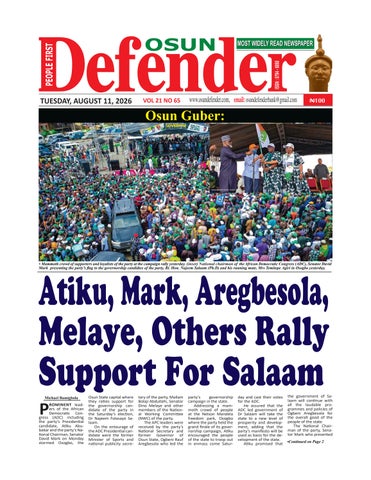
Osun Guber:
• Mammoth crowd of supporters and loyalists of the party at the campaign rally yesterday. (inset) National chairman of the African Democratic Congress (ADC), Senator David Mark presenting the party’s flag to the governorship candidtee of the party, Rt. Hon. Najeem Salaam (Ph.D) and his running mate, Mrs Temitope Agiri in Osogbo yesterday.
Atiku, Mark, Aregbesola, Melaye, Others Rally Support For Salaam Michael Bamigbola
P
ROMINENT leaders of the African Democra c Congress (ADC) including the party’s Presiden al candidate, A ku Abubakar and the party’s Naonal Chairman, Senator David Mark on Monday stormed Osogbo, the
Osun State capital where they rallies support for the governorship candidate of the party in the Saturday’s elec on, Dr Najeem Folasayo Salaam. On the entourage of the ADC Presiden al candidate were the former Minister of Sports and na onal publicity secre-
tary of the party, Mallam Bolaji Abdullahi, Senator Dino Melaye and other members of the Na onal Working Commi ee (NWC) of the party. The APC leaders were received by the party’s Na onal Secretary and former Governor of Osun State, Ogbeni Rauf Aregbesola who led the
party’s governorship campaign in the state. Addressing a mammoth crowd of people at the Nelson Mandela freedom park, Osogbo where the party held the grand finale of its governorship campaign, A ku encouraged the people of the state to troop out in enmass come Satur-
day and cast their votes for the ADC. He assured that the ADC led government of Dr Salaam will take the state to a new level of prosperity and development, adding that the party’s manifesto will be used as basis for the development of the state. A ku promised that
the government of Salaam will con nue with all the laudable programmes and policies of Ogbeni Aregbesola for the overall good of the people of the state. The Na onal Chairman of the party, Senator Mark who presented •Continued on Page 2
TUESDAY, AUGUST 11, 2026
2
News
Fresh N30m Ransom Demanded For Abducted Osun LG Vice Chairman Shola Aderinto
A
BDUCTORS of the Vice Chairman of Ifedayo Local Government Area, Hon. Debo Farounbi, have demanded another ₦30 million ransom, 59 days a er he was kidnapped. Family and community sources told OSUN DEFENDER that the kidnappers had earlier collected ₦30 million and diabe c drugs about four weeks ago, but have refused to release him. A local government official familiar with the nego a ons said the gunmen changed their terms a er receiving the first payment. “They ini ally asked for ₦30 million and diabe c drugs, probably for the vice chairman. The money and drugs were delivered four weeks ago, but instead of releasing him, they are now asking for another ₦30 million. They also demanded a car,” the source said. “I know ALGON is on top of the ma er.” The Ac ng Coordinator of Ora-Igbomina Youth Front, Omololu Abidoye, confirmed the development. “The community ini al-
ly raised ₦30 million and it was delivered. But they are s ll demanding more mon-
ey before they will release him,” he said. The Osun State Police
Public Rela ons Officer, Abiodun Ojelabi, said he was not aware of the fresh
•Presidential candidate of African Democratic Congress (ADC), Alhaji Atiku Abubakar presenting governorship candidtee of the party in Osu State, Dr. Najeem Salaam at the party’s grand rally in Osogbo yesterday.
Olojudo Debunks Osun Monarchs’ Crisis Rumour, Affirms Loyalty To Ooni Shola Aderinto
T
HE Olojudo of Ido-Osun, Oba Olayinka Jokotola, has dismissed reports of a crisis in the Osun State Council of Tradi onal Rulers, saying the monarchs remain solidly united behind the Ooni of Ife, Oba Adeyeye Enitan Ogunwusi. Speaking during the 2026 Osun Olojudo fes val held in Ido-Osun, the monarch said claims of division among tradi onal rulers in the state are unfounded. “I don’t believe there is any crisis among tradi onal rulers. We all recognise the Ooni of Ife as our tradi onal
leader across Yorubaland,” Oba Jokotola said. He accused some social media users and content creators of deliberately spreading false narra ves to cause discord within the tradi onal ins tu on. “Most of the stories about division are created by social media users who are trying to set a different agenda and create unnecessary narraves,” he added. The Olojudo described the Ooni as the supreme leader of the Yoruba tradional ins tu on and the foremost custodian of Yoruba
culture and tradi ons. “Historically, culturally and tradi onally, the Ooni is the Supreme leader of the Yoruba tradi onal ins tu on. He’s the number one custodi-
Osun Guber: Atiku, Mark, Aregbesola, Melaye, Others •Continued from Page 1 the party’s flag to the governorship hopeful urged the people of the state to be resolute and determined to bring on board a government that will serve the people, stressing that Salaam will not undermine the confidence reposed on him by the proof given the opportunity to serve. Mark who called on the people to shun money bag poli cians, also encouraged the people to defend their votes and ensure that their votes count. In his remarks, the former Governor of the state, Ogbeni Ar-
demand. He added that two persons arrested in connec on
egbesola reminded the people of the lo y programmes executed by his administra on when he was Governor and assured that the government of Salaam will con nue with the programmes. He said a vote for Salaam is a vote for the con nua on of the good works he ini ated and executed while in government. Speaking, the state Chairman of the party, Alhaji Issa Adesiji urged voters to remain at their polling units a er cas ng their ballots and ensure their votes are properly counted. The chairman said
protec ng the votes is the only way to guarantee that the will of the people prevails. He also said the ADC is not collabora ng with any poli cal party ahead of the poll. Adesiji told the crowd that reports of a empts to manipulate results and prematurely end voting in some areas made it necessary for electorates to be vigilant. He informed that party agents will be deployed to all the 30 Local Government Areas, but the presence of voters at polling units and collaon centres remains critical to stopping any form of electoral malprac ce.
an of culture and tradi ons in Yoruba land. Any other narraon is just a fallacy that can’t stand any me,” he said. Oba Jokotola also urged residents to disregard reports about the crea on of another tradi onal council in Osun State, par cularly claims of “senatorial councils.” “My kingdom is in Osun West; I can tell you that there’s nothing like Osun West tradi onal council. Yes, there exist regional groups which are only for administra ve purposes and not a council,” he clarified. He emphasized that the Osun State Council of Tradi onal Rulers remains the only recognized body, with the Ooni serving as its permanent chairman. “For emphasis, there’s no other council except the one being led by our revered father, Ooni Adeyeye Enitan Ogunwusi, the permanent Chairman of the Southern Nigeria Tradi onal Rulers Council and the Co-Chairman of the Nigeria Tradi onal Rulers Council,” he stated.
Michael Bamigbola HE Nigerian Complimentary and Alterna ve Medicine Students’ Associa on (NiCAMSA) has called on the Medical and Dental Council of Nigeria (MDCN) to regulate alterna ve medicine educa on and prac ce. The associa on made the call in a posi on paper submi ed to MDCN, seeking uniform standards for educa on, clinical training, registra on and professional prac ce. Na onal President of the associa on, Mr Ayuba Yusuf said effec ve regulaon of the course is necessary to ensure that competent prac oners are produced. “Our principal concern is to ensure that students graduate as adequately educated, clinically competent and ethically accountable professionals prepared for safe prac ce,” Yusuf said. He said the associaon’s posi on followed MDCN’s recent inclusion of a representa ve of alternave medicine prac oners on its governing board. Yusuf urged MDCN to work closely with the Naonal Universi es Commission (NUC) to harmonise academic and professional standards for universitybased complementary and alterna ve medicine programmes. According to him, the collabora on should ensure that academic ap-
T
with the abduc on have been charged to court and remanded in prison custody, and that rescue efforts are ongoing. Farounbi was abducted around 10pm on Tuesday, June 9, 2026, when gunmen invaded Ora-Igbomina, a border community between Osun and Kwara states. Four people were ini ally abducted. Military personnel and local vigilantes responded and rescued three, but the attackers escaped with Farounbi. Ora-Igbomina has recorded three kidnap cases in the last eight months. In December 2025, re red Customs officer Emmanuel Owolabi was kidnapped and released in Kwara a er about four weeks. On February 1, 2026, two other residents were abducted through the Kwara boundary and released a er a similar period. Community leaders have appealed to the state and federal governments to strengthen security along the porous OsunKwara border to prevent further a acks.
Students Association Calls For Recognition Of Alternative Medicine By MDCN proval and professional regula on develop together rather than as separate processes. Also , the associa on proposed that NUC’s Core curriculum and minimum academic standards should provide the academic founda on, while MDCN contributes professional and clinical components. “We need a framework where academic standards and professional competencies are deliberately aligned from the beginning,” he said. The associa on also called for MDCN par cipaon in accredita on, curriculum review, periodic inspec ons and quality assurance of universi es offering complementary and alterna ve medicine programmes. Besides, the associa on urged MDCN to support the adop on of Bachelor of Complementary and Alterna ve Medicine (BCAM) as the professional degree nomenclature. NiCAMSA also proposed extending the current fouryear training structure to a minimum of five years, with adequate pre-clinical and clinical components.
PEOPLE FIRST
TUESDAY, AUGUST 11, 2026
3
T
HE name of the game now is “Dibo Kosebe” This has been going on for quite some me and it will definitely be in play on Saturday, the 15th day of August 2026, when Osun State goes to the polls to presumably freely and fairly elect someone to be the Governor for the next four years. From the way things are shaping up, there are doubts whether, given what is on the ground, the state will have a free and fair elec on. What is playing out in Osun State today shows that Nigeria lacks Ins tuons of Democracy, which is totally different from ins tu ons of government. We have seen from the examples of Scandinavian countries, and to a limited extent the Republic of South Africa, that it is important to have ins tu ons of democracy. That is why the Uwais report on elec ons and the machinery of Elec ons should have been implemented both in spirit and to the le er. From what we are seeing today, which is a harbinger of what is to come in January, the Uwais report will never see the light day under the present poli cal establishment will just become another museum item. The most disturbing part of what is playing out in Osun State — and which is a dress rehearsal for the real deal in January — is that voters are, in essence, irrelevant. They are extras in another person’s movie. The real acon is with the actors and the producers. The voters will have their limited me of relevance, a er which they are expected to go back into irrelevance and be expect to be of “sensible” behavior. This is not what is expected in a democracy. There are far-reaching consequences in what is being played out, not least that we are building a highly uncompe ve economy. An economy cannot be compe ve when it is based on a mass pool of dependent voters trapped in helplessness and perpetual poverty. This is precisely why this is more than an elec on. It is, in fact, an economic statement. All of this brings us back to the po-
“On Saturday, Osun has an incredible opportunity to write the name of this state in letters of gold. To show that the people have had enough of the weaponization of poverty and vote buying. And that the people are ready to assert their independence from manipulative forces who wish to keep them down”
These are very cri cal issues. What we are seeing today in this dress rehearsal for the general elecons is a new form of coloniza on — one based on using vote buying as the ul mate weapon: the weaponizaon of poverty, and the crea on of an atmosphere where the people do not ma er. This is why we must support democra c forces. In this case, a man like *Najeem Salam*, the governorship candidate of the African Democra c Congress, ADC, stands as the arrowhead. He believes that sustainable development can only come by engineering increasing prosperity, developing the produc ve forces and capacity of the state, and pulling tens of thousands of people out of mass poverty and degrada on. trigger rebellion, and The programme of Najeem Salam To use cultural hegemony interwoven together with the weaponiza on is currently the only serious program of poverty to keep themselves in per- on offer — also recognizes one cri cal economic issue of our me: how to uppetual power. This is precisely what is playing out scale small businesses in order to create more employment opportuni es in Osun State. In Osun today, the militariza on of and enlarge the internally generated what ought to be a poli cal campaign revenue base. The Economist_ magazine of Lonshows a clear effort at voter suppression. Voter suppression favors poli cal don was very astute about a year and forces who have no interest in a mass, a half ago when it pointed out that “Africa has too many small businesses.” par cipatory turnout. Najeem Salam is clearly pledged to We have seen this in other climes. In 1933, for example, the Nazi Party in upscale small businesses into medium Germany sealed up en re streets and and, in some cases, larger en es to districts in order to keep voter turnout create the jobs that are so vitally needlow. The Nazi Party ascended to pow- ed. With the demographic base we er that year with just 37% of the votes have in Osun State and across Nigeria, cast, with disastrous consequences for we must create increasing opportuni es to absorb those coming out of the rest of the world. The lesson here is that voter sup- schools, universi es, and appren cepression can lead to a fascist regime — ship schemes. A new economy has to be devised. a regime that will use the machinery of the state to ruthlessly suppress the And Najeem Salam’s manifesto is reopposi on. We are already seeing the ally the only one prepared to face the future implica ons of our demographmanifesta ons of this. It is clear that voter suppression ic base. The people of Osun today must has now become a weapon for riding confront a stark reality. They must into victory. The more people who turn out to lead the way for the rest of the federavote, the be er. Because those who on to break out of the poli cs of the have money can use it to buy off a weaponiza on of poverty. They must show that they reject large sec on of those who bother to turn up. No one has inexhaus ble the con nua on of the poverty cycle funds. So in a case of large turnout, based on vote buying, in mida on, the amount of money needed for vote and other sinister forces. On Saturday, Osun has an incredbuying becomes so huge that it may ible opportunity to write the name become unfeasible and ineffec ve. of this state in le ers of gold. To show that the people have had Publisher – Moremi Publishing enough of the weaponiHouse Ltd. za on of poverty and Deputy Editor – Michael Bamigbola vote buying. And that Deputy Photo Editor – Shola Aderinto the people are ready to Deputy Graphics Manager – Zainab Olalere assert their independProduc on Controller – Petkola Taiwo Ibitowa ence from manipula ve forces who wish to keep OSUN DEFENDER is published by Moremi Publishing them down. House Limited, Behind Oranmiyan Building, Gbodofon, It is a historic opOff Gbongan Road, Osogbo, Osun State. portunity. And it is our ISSN : 0794-8050 prayer that the people Telephone : 0809-301-9152 of this state come out Website : www.osundefender.com/index.php in unprecedented numbers to exercise their e-mail : osundefenderhq@gmail.com democra c franchise osundefenderbank@gmail.com and say farewell to povAll correspondence to the above email addresses. erty.
OSUN 2026 AND THE POLITICS OF VOTE BUYING
Vote buying is a form of re-colonization si on stated by the Russian revolu onary Vladimir Ilyich Lenin, the architect and first head of the now-defunct Union of Soviet Socialist Republics. In his famous trea se wri en a er the failure of the 1905 uprising, Lenin observed: _”Revolu ons do not occur at mes of mass grinding poverty. Revolu ons occur during mes of rela vely increasing prosperity.”_ At first glance this does not make sense. The common assump on is that starving hordes of people who have absolutely nothing to lose — including a life that has become meaningless — will take to the streets and, with rudimentary weapons and bare hands, confront an established, wellorganized, well-fed force defending the establishment. But this only makes sense on the surface. Lenin gave very good examples from history to show that a povertystricken, starving mass of people cannot resist an organized, well-trained force. In his brilliant explana on of why this was impossible, he described such ac on as _infan lism_ — to denote that starving hordes taking on an established force is childlike and is bound to end in disaster. It is obvious if we go back in me that the poli cal establishment in Nigeria has read this lesson and interpreted it in its own way — a way that is detrimental to sustainable development in Nigeria and to the well-being of the overwhelming mass of the people and their families. The weaponiza on of poverty is now entrenched in this country. It manifests by crea ng a dependency syndrome in which the people are trapped in mass poverty forever, dependent on an establishment that gives them “handouts.” This is reinforced by cultural hegemony, as defined by the Italian philosopher Antonio Gramsci. Cultural hegemony is best translated in Yoruba as _Omowani Ejeoshe_ — “it’s our turn, please allow us.” The poli cal establishment in Nigeria is therefore using a two-pronged a ack: To ensure there will never be the rela vely rising prosperity that could
OSUN DEFENDER
TUESDAY, AUGUST 11, 2026
4
Reminiscences Of Government Unusual
From November 2010 to November 2018 when Ogbeni Rauf Adesoji Aregbesola held sway as Governor of Osun State, various laudable projects were executed accross all sectors. The projects spread accross all the 30 Local Government Areas of the State and Ife East Area Office. Below are some of the projects initiated and executed during Ogbeni Aregbesola’s eight years tenure.
TUESDAY, AUGUST 11, 2026
Reminiscences Of Government Unusual
5
TUESDAY, AUGUST 11, 2026
6
Photo Speaks
Faces at the grand campaign rally of the African Democratic Congress (ADC) held at the Nelson Mandela Freedom Park, Osogbo on Monday
PEOPLE FIRST
Photo Speaks
TUESDAY, AUGUST 11, 2026
7
ISSN : 0794 - 8050
News
TUESDAY, AUGUST 11, 2026 VOL. 21 NO 65 www.osundefender.com, email: osundefenderbank@gmail.com
Fresh N30m Ransom P 2 Demanded For Abducted Osun LG Vice Chairman
On Wednesday 28th of July a book was presented to the Nigerian public for their reading. En tled “Winning Free and Fair Elec ons in Nigeria” the joint writers of the book are Jimoh Akanni Agboola a PhD, holder and Emmanuel Olufemi Agboola. Although the two bear the same surname they are not biologically related. One is older, an octogenarian to be precise.
T
HE other is in his mid 60s. Work in the same office was what brought them together many years ago. This they are both re rees who worked for the Independent Naonal Electoral Commission (INEC) when they were in ac ve service. Both reached Management level posi ons before re ring. The older Agboola re red 20 years ago. Undoubtedly he is one of the few remarkable Nigerians with a great knowledge and understanding of ma ers concerning the conduct of elec ons in the country today. He is an intellectual and a walking-encyclopedia when it comes to Elec ons and Electoral ma ers. Hardly can any one fault his reasoning, forecast or postula ons on Electoral ma ers. Before he re red INEC under the Chairmanship of Prof Maurice Iwu gave him the free hand to set up the INEC Electoral Ins tute in Abuja. Dr. Jimoh Agboola is the Lead Writer of the Wri ng Trio of the book WINNING FREE & FAIR ELECTIONS IN NIGERIA. Well, the third of the joint authors is a veteran journalist who goes by the long name, Smole e Adetoyese Omopeninuola Shi u-Alamu. He is a broadcast- journalist who has spent over fi y years in the Radio and Television industry. If journalists are stakeholders in the Electoral Process world wide, then he certainly qualified to contribute to the 15- chapter book of some 400 pages if all the preliminary 32 pages produced in Roman numbers are added to the 371 pages that are numbered from chapter one. The public presenta on of the book was an event which took place at the Olu Osungbohun Hall of the Nigeria Union of Journalists (NUJ) Press Centre in Osogbo. INEC the na on’s Electoral Umpire was there in full force. Its Chairman Prof. Joash Amupitan sent a goodwill message that was not only instruc ve to poli cians, it equally suggested to them that elec ons in Nigeria today cannot be won by violence or in mida ons, but by hard work and poli cal enterprise. He did assure that all the electoral votes would be counted as the Electoral Body has no preferen al candidates nor par es in the exercise.
“Electoral success cannot rest solely on campaign machinery, financial resources or political alliances. It also depends on nurturing an informed electorate, strengthening political culture and encouraging citizens to participate meaningfully in the democratic process”
Elections And The Coming Of A Book Emeritus Professor, Chief Olu Aina (OFR) was Chairman of the event. He was ably represented by Dr. Michael Adeyemi-Brown who read his prepared speech for the occasion to the admira on of all. Poli cians, intellectuals, journalists and many re red and serving INEC staff a ended the book presenta on ceremony. They came from Eki , Ogun, Oyo, Kwara and Osun States. The many poli cians who a ended the event, came from both sides of the poli cal divide: From Accord, to APC to ADC and the IPAC i.e the Inter-Party Advisory Commi ee of poli cal par es in Osun State. All of them came for the launch of a book which they need and which got presented to the public just two and a half weeks to the forthcoming off-cycle elec on in Osun State. The book which is a compendium, could not have come at a be er or more auspicious me than now. But would many of our poli cians bother to read this Master class exposion on how to win elec ons? We can only wait to see. For a book that starts with a dedica on to all Nigerians whose steadfastness has kept the country’s democracy going and also in the memories of two prominent pioneer poli cians from Osun State who showed exemplary electoral integrity during their struggle for the posi on o Governor of Osun State in 1991. We speak of Governor Isiaka Adetunji Adeleke and Senator Adebayo Ayoade Salami. In this book which we see as a compendium, topics such as the legal or cons tu onal framework of elec ons, a sound knowledge of the electoral process, the roles of poli cal pares and who an acceptable candidate is, are all discussed. Equally treated are Voters as the Beau ful Bride, the Potency of an Elec on Management Body. Funding of Elec ons and “the Pound of Flesh” theory also come up. Equally looked at are the proper use of the media, godfatherism fragility of opposi on and the applica on of money. The need to enhance ci zens poli cal culture is effec vely handled. There is so much to learn from reading this book which is published by Jimilad Training Services Ltd and printed by ATMAN LTD Osogbo. The Foreword to the book is wri en by Newspaper Editor and Columnist, Lasisi Olagunju PhD. The views of this great columnist of our me is what we produce below for readers to see, read and then find out for themselves if the book is truly a compendium or not. The FOREWORD to the book reads as follows: Two of the authors of this book are dis nguished former senior officials of Nigeria’s electoral commission. The third is an accomplished journalist with decades of experience covering poli cs and elec ons. When such a combina-
on of prac cal electoral administra on, media insight and democra c experience comes together to answer the ques on, ‘How does one win an elec on?’, it deserves serious a en on. Their collec ve wisdom makes this volume par cularly valuable not only to poli cians but also to elec on managers, scholars, journalists and every ci zen interested in Nigeria’s democracy. This is not merely another book about elecons. It is a prac cal handbook on democra c compe on, electoral strategy, poli cal organisa on and voter behaviour in Nigeria. It bridges the gap between electoral theory and the reali es of poli cal contesta on in a developing democracy. Democracy is o en described as government of the people, by the people and for the people. Yet democracy is sustained not by slogans but by ins tu ons, informed par cipa on and credible elec ons. Where elec ons lose their integrity, democracy becomes hollow; where they remain free, fair and compe ve, democracy renews itself and strengthens the bond between the rulers and the ruled. The scope of this work is impressively broad. It examines virtually every significant dimension of electoral poli cs—from party forma on, candidate selec on and campaign strategy to media engagement, poli cal finance, coali on building, opposi on poli cs and the enduring influence of poli cal godfatherism. Par cularly engaging is the chapter on opposi on poli cs. The authors begin with President Bola Ahmed Tinubu’s asser on that there can be no democracy without “the vitality of the poli cal opposi on.” They then examine whether that democra c ideal has been realised in prac ce, arguing that throughout much of the developing world, especially Africa, genuinely vibrant opposi on poli cs has o en struggled to flourish. Their explora on of this ques on is one of the book’s most thought-provoking contribu ons. This volume arrives at an important moment in Nigeria’s democra c journey. More than a quarter of a century a er the return to civil rule in 1999, elec ons have become regular, governments change through the ballot, and democra c ins tu ons have grown stronger. Yet persistent concerns remain about voter educaon, poli cal organisa on, electoral violence, mone sa on of poli cs, abuse of incumbency, misinforma on and the overall quality of democra c par cipa on. The authors approach these issues from a prac cal rather than purely theore cal perspec ve. They present elec ons not as isolated cons tu onal rituals but as complex poli cal processes whose outcomes are shaped by prepara on, organisa on, legal compliance, strategic planning, effec ve communica on and sustained voter engagement. Electoral success, they argue, is seldom accidental; it is usually the
product of careful planning and disciplined execu on. That proposi on forms the intellectual founda on of this book. One of the more illumina ng sec ons of this volume is the authors’ interroga on of some of the assump ons that have long dominated Nigeria’s electoral culture. They ques on widely held beliefs that elec ons are won primarily through money, violence, incumbency, manipula on of electoral ins tu ons or poli cal patronage, and ask whether these assump ons are supported by Nigeria’s electoral history. Rather than accepting conven onal poli cal wisdom at face value, they subject it to historical scru ny, tracing the evolu on of elec ons from the colonial period to the present. This historical perspec ve enriches the book considerably, reminding readers that today’s electoral challenges did not emerge in a vacuum and that meaningful democra c reform must be grounded in a proper understanding of how Nigeria’s electoral system has evolved over me. One of the book’s major strengths is its insistence that elec ons extend far beyond polling day. Electoral outcomes are influenced by decisions taken months, some mes years, before the first ballot is cast. By trea ng elec ons as a con nuous process rather than a single event, the authors draw a en on to the ins tu ons, structures and poli cal behaviour that shape democra c outcomes. Their analysis is enriched by decades of praccal engagement with Nigeria’s electoral process. Rather than offering abstract theorising, they provide reflec ons grounded in experience. They examine, with admirable breadth, the factors that influence electoral success: knowledge of electoral law, party organisa on, candidate acceptability, voter mobilisa on, the role of elec on management bodies, campaign financing, media strategy, poli cal alliances, socio-economic condi ons, opposi on strength, poli cal culture and the con nuing influence of godfatherism. Whether one agrees with every conclusion or not, the framework they provide offers a valuable guide to understanding electoral dynamics in Nigeria. The discussion of voters as both king-makers and king-dispatchers deserves special men on. The authors argue that democracy ul mately derives its legi macy from the people. They add that poli cal par es, candidates and electoral ins tu ons may dominate the headlines, but it is the electorate that remains the decisive actor in every democra c system. Any work that reminds ci zens of both the power and the responsibility of the vote performs an important civic service. The authors are equally right to emphasise poli cal educa on. Electoral democracy cannot flourish where ignorance prevails. Ci zens must understand not only their rights but also their obliga ons within the democra c process. Equally commendable is the book’s recogni on of the growing influence of technology, digital communica on and the media in modern elec ons. Contemporary poli cal compe on is increasingly shaped by informa on flows, online pla orms and strategic messaging. Any serious study of elec ons today must take these developments into account, and this volume does so with commendable clarity. No serious reader should expect a book of this nature to provide final answers to every electoral ques on. Democracy is a living enterprise. Poli cal contexts evolve, ins tu ons adapt and voter behaviour changes. What this volume offers is a though ul, systema c and prac cal framework for understanding the factors that most profoundly influence electoral outcomes in Nigeria. •Read full article on www.osundefender.com •Smolette Adetoyese Shittu-Alamu a veteran journalist writes from Osogbo, Osun State
OSUN DEFENDER is published by Moremi Publishing House Limited, Behind Oranmiyan Building, Gbodofon, Off Gbongan Road, Osogbo, Osun State. All correspondence to the Deputy Editor, MICHAEL BAMIGBOLA, Telephone: 0809-301-9152. ISSN: 0794-8050. Website: www.osundefender.com Email: osundefenderbank@gmail.com, osundefenderhq@gmail.com