MARCH 23, 2026

MARCH 23, 2026
PRESIDENT Bola
Tinubu on Thursday signed an agreement with the United Kingdom which will enable the British authori es to dump thousands of failed asylum seekers and foreign criminals on Nigerian soil.
UK Home Office announced the landmark deal on Thursday, sta ng Nigeria’s partnership to help decongest the UK and rid the Bri sh territory of illegal immigrants, including those without a valid passport.
“Visa overstayers, foreign criminals and failed asylum seekers will be removed from Bri sh soil far more easily under a new agreement struck this week during the state visit of Nigeria’s President, Bola Tinubu,” the UK Home Office announced in a statement.
As part of the arrangement, the UK will also be able to return individuals who have overstayed their visas, with the framework offering broad opera onal flexibility to Bri sh authori es.
Officials indicate that no fewer than 2,071 Nigerians who have exhausted their asylum appeal rights, as well as convicted offenders awai ng deportaon, could be affected by the arrangement.
A key provision of the agreement is Nigeria’s acceptance, for the first me, of UK-issued le ers as valid iden fica on for deportees without passports. These documents serve as alterna ve proof of iden ty for
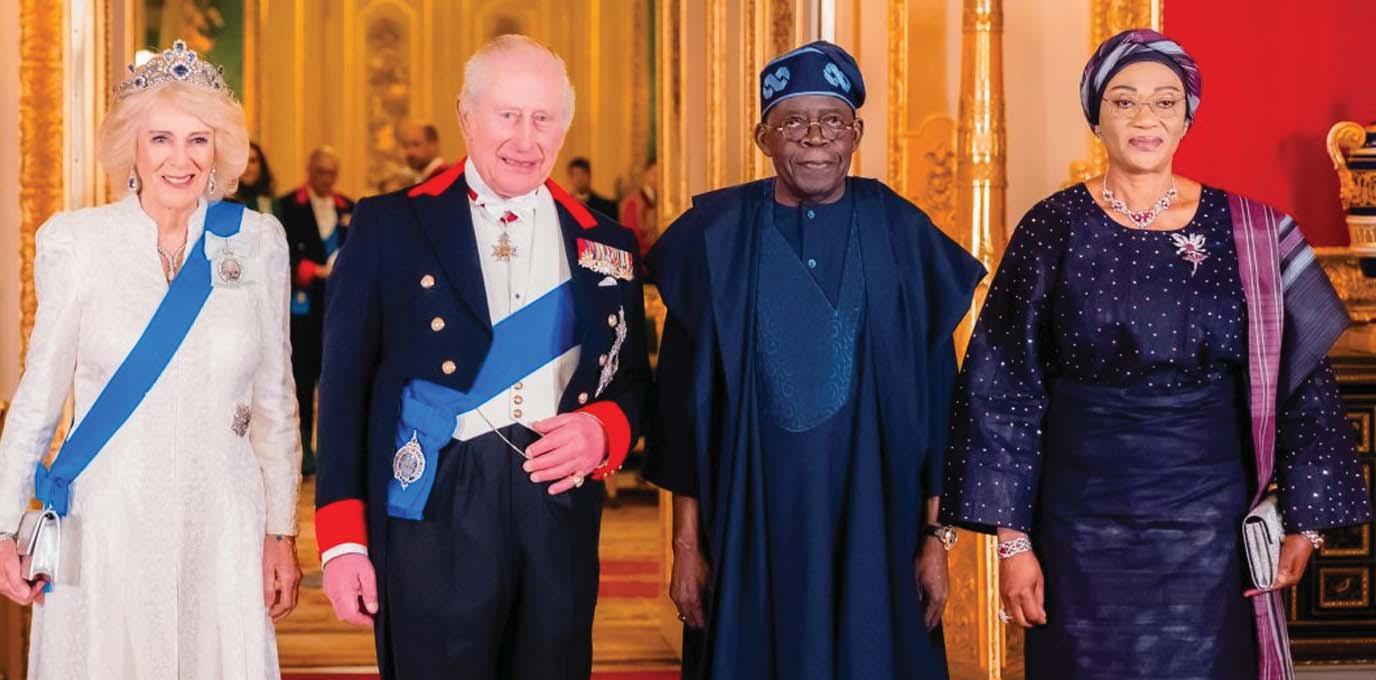
•President Bola Tinubu with King Charles flanked by their spouses, Camilla and Oluremi, during the former’s visit to the United Kingdom, last Wednesday
individuals who lack proper travel papers and are used to facilitate their return.
The Minister of Interior, Olubunmi Tunji-Ojo who is Nigeria’s signatory to the deal said “We are totally commi ed to being a responsible country in fulfilling our core obliga ons.”
“And for us to sustain that rela onship, we must remember: ‘He who comes to equity must come with clean hands.’ So, we need to be as open and as fair as possible,” the minister said.
Meanwhile, under the deal, UK Export Finance (UKEF) will guarantee a £746 million export finance
loan for the refurbishment of the Apapa and Tin Can Island port complexes.
The financing arrangement will, reportedly, be coordinated by Ci bank.
As part of the agreement, Bri sh Steel will supply 120,000 tonnes of steel for the port projects under a contract valued at £70 million.
The deal is expected to generate £236 million in supplier contracts for British companies, as at least 20 per cent of the project components must be sourced from the UK.
The UK government said the steel contract is the largest export, backed
by UKEF for Bri sh Steel.
The loan agreement was signed on behalf of Nigeria by Wale Edun, Minister of Finance, and Blair McDougall MP, the parliamentary under-secretary of state and UK minister for small business and economic transforma on, on behalf of the Bri sh government.
Commen ng on the deals with the United Kingdom, an X user, Biggest Mack, claimed the Bri sh government would be the major beneficiary of both deals signed by the Nigerian government.
He wrote, “The UK spends roughly £6 million
per day, around £2 billion a year on hotel accommoda ons for “failed asylum seekers.”
“That is the responsibility they now want to hand over to Nigeria a er praising Nigerian jollof. This same offer was made to Afghanistan, Eritrea, Sudan, Syria, Iran, Iraq, etc, and they all rejected.
“Now, out of the £2b a year the UK will be saving from this deal, they offered Nigeria £746 million to refurbish two ports in Lagos.
As part of the agreement, nearly half of the £746 million will go to Bri sh firms in supplier contracts.
“The Bri sh steel in-
dustry, which the UK government admi ed was suffering, will use this opportunity to rejuvenate. When the ports are done, the UK will control Nigeria’s exports un l that money is paid back. Yes, it’s a loan.”
However, the Special Adviser to the President on Informa on & Strategy, Bayo Onanuga in a statement on Saturday, said those who will be deported are Nigerians. According to him, “Nowhere in the 12-page memorandum is Nigeria required to accept foreign na onals other than Nigerians. Na onals to be
•Continued on page 2
MONDAY, MARCH 23, 2026
THE Osun State Government has released a supplementary list to Batch 1 of its ongoing teachers’ recruitment exercise, bringing the total number of successful applicants to 1,241.
The approval was granted by Governor Ademola Adeleke, according to a statement signed by the Permanent Secretary, Ministry of Educa on, Mr Muritala Jimoh, yesterday.
Jimoh said the release of the supplementary list raised the number of recruits above the earlier figure of 1,000, no ng that the decision was aimed at accommoda ng more qualified unemployed youths into the teaching profession.
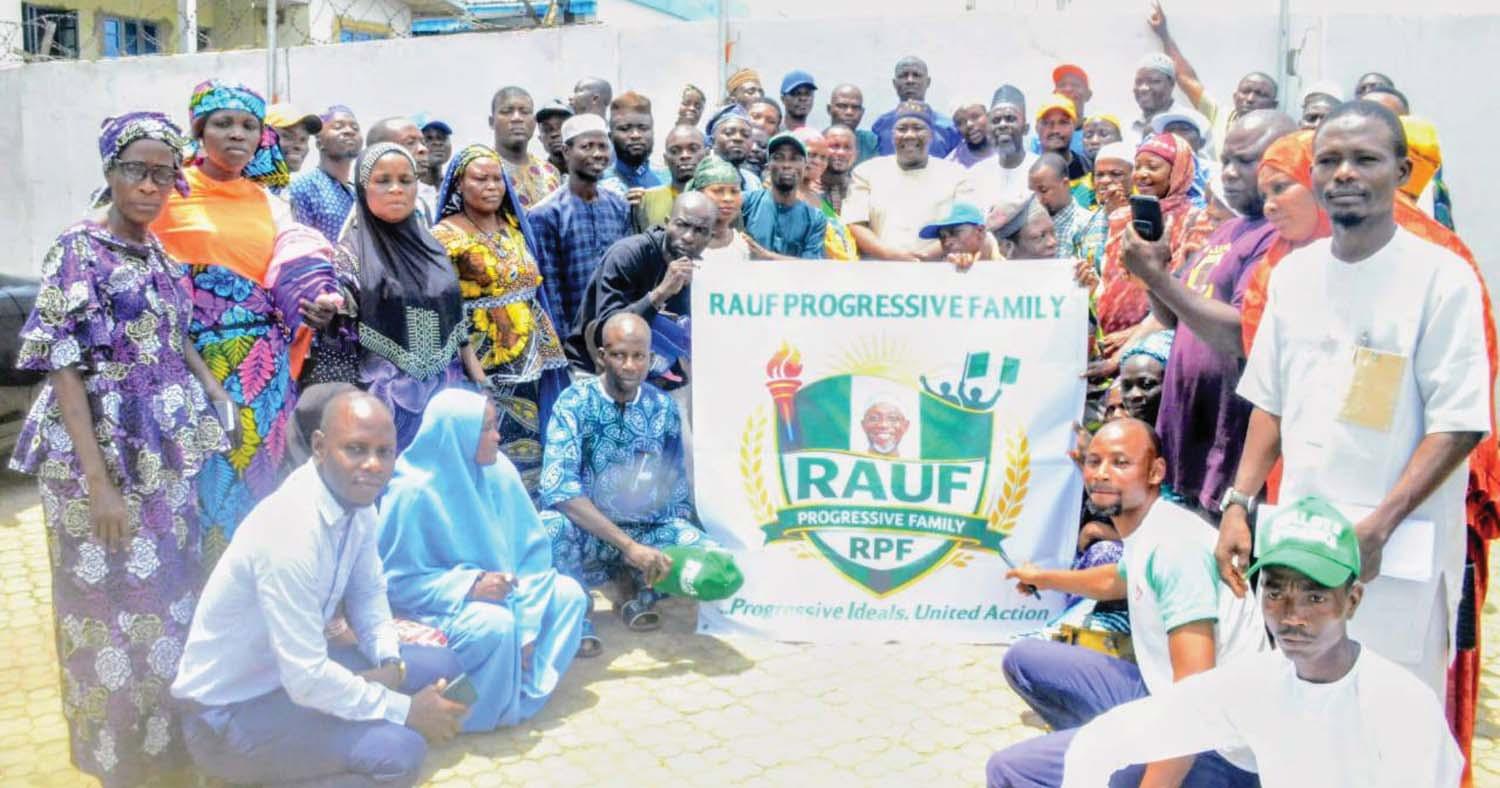
• Osun ADC Governorship Candidate, Dr. Najeem Salaam, in a group photograph with members of the Rauf Progressive Family, after a meeting, recently
He explained that the latest development was expected to strengthen the state’s educa on sector and
paid as ransom.
improve learning outcomes in both primary and secondary schools.
According to him,
the breakdown of the newly approved total shows that 660 candidates were recruited under the State Uni-
versal Basic Educa on Board (SUBEB), 526 under the Teaching Service Commission (TESCOM), while 55
were engaged as Educa on Officers.
The permanent secretary advised successful applicants to check the lists for their names and proceed with the necessary profiling and documenta on.
He congratulated the candidates and urged them to jusfy the confidence reposed in them by contribu ng meaningfully to the growth of the educa on sector through professionalism and dedicaon.
The state government had earlier, on March 6, released the first batch of successful applicants for immediate recruitment into public primary and secondary schools across Osun State.
Amotekun and local vigilante groups.
THE Cocoa Farmers Associa on of Nigeria (CFAN) says ransom was paid to secure the release of its two remaining members who were abducted during a visit to the Cocoa Research Ins tute of Nigeria (CRIN) in Ibadan.
The associa on’s Na onal President, Adeola Adegoke, said in a statement that the vic ms regained their freedom a er their families met the kidnappers’ demands, contradic ng claims that they were rescued.
According to him, the final group of abductees was released between midnight and 2:00am at an undisclosed loca on in Ogun State. Their release came a er two other vic ms, Apostle William Solomon and Rufus Megbowon, were earlier freed on health grounds in what the associa on described as a “divine arrangement”.
In the statement, CFAN said the five members of its Ogun State chapter were kidnapped during a familiarisa on visit to CRIN last Wednesday.
Mr Adegoke said the associa on was relieved that all those abducted had now regained their freedom, although he did not disclose the amount
However, Chairman of Oluyole Local Government Area, Akeem Olatunji, gave a different account, saying the vic ms were rescued through a joint operaon involving the police, the Department of State Services (DSS), nominators from across the state, including at least one from each local government area. Other state officers are required to have 20 nominators each.
He said the vic ms had since been handed over to the police, adding that the operaon was coordinated by Oyo State’s Security Adviser, re red Commissioner of Police Fatai Owoseni.
TWO men, Yakubu Kehinde, 28, and Adelusi Tope, 21, have been arraigned before a Chief Magistrate’s Court in Ado-Eki over alleged housebreaking and the involving cash and food items valued at N229,000.
The police prosecutor, ASP Akinwale Oriyomi, told the court that the defendants commi ed the offences on March 5, 2026, at Agbado-Eki
According to the prosecutor, Kehinde and others s ll at large allegedly broke into the residence of Busola Adedoyin at about 10:30am and stole N114,000, 10 rubbers of rice and three rubbers of beans.
Oriyomi also alleged that Tope broke into the residence of Adepoju Gabriel and made away with N115,000 in cash.
He said the offences contravened Sec ons 421, 322(a) and (b), and 302(1)(a) of the Criminal Law of Eki State 2021.
Counsel for the defendants, Barrister Adunni Olanipekun, urged the court to grant them bail, assuring that they would not abscond and would provide reliable sure es.
Chief Magistrate Abayomi Adeosun granted each defendant bail in the sum of N100,000 with two sure es in like sum.
The case was adjourned un l April 9, 2026, for hearing.

THE African Democratic Congress has begun the sale of nomina on and expression of interest forms ahead of its ward, local government, state congresses and naonal conven on, formally kicking off an internal electoral process that will shape the party’s structure across the country.
In a no ce signed by its Na onal Organising Secretary, Pa Idigo, and shared on X on Sunday, the party outlined the fees, nomina on requirements and metable for aspirants seeking posi ons at different levels of the organisaon.
At the ward level, the expression of interest form costs N2,000. Nomina on forms are pegged at N10,000 for Ward Chairman, N5,000 for Ward Secretary, and N3,000 for other ward officers.
For local government posi ons, nomina on fees are N40,000 for LGA Chairman, N30,000 for LGA Secretary, and N10,000 for other LGA officers.
At the state level, the party fixed nominaon fees at N500,000 for State Chairman, N300,000 for State Secretary, and N50,000 for other state officers.
For the Na onal Conven on, the ADC said nomina on fees for delegates are N10,000 per delegate, with each local government required to produce one delegate.
The party also set
nomina on thresholds for aspirants, requiring them to secure support from a specified number of nominators, each of whom must pay a non-refundable N500 fee.
Under the guidelines, aspirants for Ward Chairman must have 10 nominators, while those seeking other ward offices need five each. At the local government level, chairmanship aspirants must secure 20 nominators drawn from across the LGA, while other LGA officers require 10.
For state posi ons, those contes ng for State Chairman must obtain 50
The party said the sale and submission of forms will close on Friday, March 27, 2026, warning that late submissions will not be entertained.
It added that screening of aspirants will hold from March 30 to March 31, 2026, and urged all interested candidates to comply strictly with the approved guidelines for the congresses.
•Continued from page 1
repatriated must have undergone mul ple levels of iden fica on and verificaon, and, where errors occur, they are returned to the reques ng country at the reques ng country’s cost.
“Under the agreement, Nigeria and the United Kingdom will work together to secure the dignified return of their na onals who do not, or no longer, have the right to enter or remain in the territory of the other country.
“A clear condi on in the MoU is that the returnees concerned are bona fide na onals of the country and are treated with dignity and respect, with due regard to their human rights and fundamental freedoms.
“Law enforcement of-
ficers in each country will take the necessary ac on to protect the interests and well-being of ci zens of either party and to mi gate conflict triggers related to migra on ma ers.”
OSUN DEFENDER reports that Foreign Affairs Minister Yusuf Tuggar, in July 2025, denounced the United States of America government over a deporta on deal a er claiming the Donald Trump administra on approached Nigeria to accept 300 Venezuelan prisoners.
“In the words of the famous US rap group Public Enemy… You’ll remember a line from Flava Flav – a member of the group –who said: ‘Flava Flav has problems of his own. I can’t do nothin’ for you, man’, ” the minister said then.
THE spin doctors have had quite a week trying to sell President Tinubu’s state visit to Britain as a diploma c and economic triumph. But beyond the pomp, pageantry and polished photo opportuni es lies a far less fla ering reality: a ques onable loan, an unequal bargain, and yet another reminder that in the postcolonial order, Nigeria is too o en treated not as a genuine partner, but as a market to be exploited.
The visit itself exposed more than government handlers intended. Beneath the royal ceremony was a familiar pa ern of rela onship: patron and client, charm replacing coercion, but the outcome remaining much the same. Britain no longer needs gunboats to advance its interests. It has diplomacy, finance and elite influence. Last week, it used them effec vely.
At the heart of the controversy is the £746 million loan for the refurbishment of two ports in Lagos. Government apologists want Nigerians to see this as a major infrastructure breakthrough. But the fine print suggests otherwise. This is not a gi . It is a commercial
“Nigerians should not be dazzled by ceremony. A redcarpet reception is not development. Royal warmth is not economic strategy. And a loan designed to favour foreign industry is not a national success because government propagandists say so”

arrangement structured to serve Bri sh interests first.
The reported terms are revealing. At least 20 per cent of the contracts must be sourced from the United Kingdom. In addi on, £236 million of supplier contracts will go directly to Bri sh firms, with £70 million specifically earmarked for Bri sh steel. In plain language, Nigeria is borrowing money only to send a large por on of it straight back into the Bri sh economy.
So who wins? Bri sh banks win. Bri sh steel manufacturers win. Bri sh exporters win. Bri sh insurers and professional service firms win. Nigeria gets the debt.
That is the real issue. The problem is not only that the interest rate remains undisclosed, though that alone should concern every serious observer. The deeper problem is that the structure of the deal appears designed to s mulate Bri sh industry while leaving Nigerians with the burden of repayment. This is economic diplomacy in its most self-interested form. Britain is ac ng in its own interest, as strong states do. The
real indictment is of Nigerian leadership, which so o en enters such arrangements without the same clarity, strategy or self-respect. Even the case for the project itself is weak. Yes, ports ma er. But Apapa is not a deep-sea port and cannot accommodate the largest vessels that increasingly define modern mari me trade. If Nigeria is truly thinking about long-term compe veness, efficiency and future trade capacity, then the priority should be the development of deep-sea ports, not the costly refurbishment of infrastructure whose strategic value may already be limited.
There are also troubling quesons about transparency. Public discussion around the deal has raised concerns that poli cally connected interests may already be posi oned to benefit, without convincing evidence of a transparent procurement process. Nigerians have seen this pa ern before, including in the controversy surrounding the Lagos-Calabar Coastal Road. It reinforces the percep on that the country is dri ing
deeper into state capture, where public policy serves private interests rather than the na onal good.
This is why the work of the spin doctors is so dangerous. Their job is not merely to defend government decisions, but to blur reality: to present debt as development, dependency as partnership, and elite convenience as na onal progress. They seek to persuade Nigerians that a loan heavily lted toward foreign lenders and suppliers should be celebrated as a win.
But facts are stubborn. If Nigeria borrows on unfavourable terms, channels a significant part of the money back to British firms, neglects more strategic infrastructure priori es, and leaves serious procurement ques ons unanswered, then this is not a victory. It is vulnerability dressed up as achievement.
Britain has done what na ons that understand their interests do: use public policy to support its banks, industries, exporters and workers. The real problem is that Nigeria appears willing to incur public debt in ways that chiefly strengthen another country’s economy while ordinary Nigerians carry the cost. Nigerians should not be dazzled by ceremony. A red-carpet recep on is not development. Royal warmth is not economic strategy. And a loan designed to favour foreign industry is not a na onal success because government propagandists say so. If this is the deal, then it deserves scru ny, not applause; debate, not choreography; and truth, not spin.
Wahab Abiona
NIGERIA stands at a defining moment in its democra c journey, one that calls for a decisive departure from leadership driven by self-interest to governance anchored on public service. At a me when economic hardship, ins tuonal fragility, and public distrust con nue to challenge na onal stability, the country urgently requires leadership that places ci zens at the centre of governance.
The essence of leadership in any democracy is service. It is not a pla orm for personal comfort, poli cal en tlement, or accumula on of privilege. Yet, for too long, governance in Nigeria has o en appeared disconnected from the daily reali es of the people, with poli cal power treated more as a reward than a responsibility.
In established democracies such as United Kingdom, United States, Canada, France, and Australia, governance is largely structured around the welfare of ci zens. Public ins tu ons func on with rela ve efficiency, policies are designed with longterm na onal interest in view, and leaders are judged by their ability to provide essen al services such as healthcare, educaon, electricity, housing, clean water, and food security.
Nigeria cannot afford to expect less.
The recurring pa ern in which polical actors remain distant from the people
un l elec on cycles, when temporary relief in the form of cash, food items, and other inducements suddenly becomes widespread, reflects a troubling weakness in democra c culture. Such gestures, though momentarily relieving, do not address the structural causes of poverty, unemployment, and social inequality. Rather, they expose a system that too o en thrives on ci zens’ vulnerability.
What is required instead is responsive leadership leadership that listens, engages, and acts consistently. Governance should not be seasonal; it must be connuous, accountable, and visible in policies that improve the daily lives of ci zens. The legi macy of democra c leadership is measured not by campaign rhetoric but by prac cal outcomes that reflect public interest.
Equally important is the need for laws and policies that serve the broad major-
“ Nigeria’s democratic future depends significantly on leaders willing to strengthen institutions rather than subordinate them to personal influence. Sustainable development is built not on powerful individuals but on credible institutions capable of outlasting political cycles”
ity rather than narrow poli cal or elite interests. Democracy loses meaning when governance benefits only a privileged few while the larger popula on bears the burden of economic hardship and ins tu onal failure.
Strong ins tu ons remain central to this objec ve. In func oning democracies, the legislature legislates in the public interest, the judiciary dispenses jus ce without
fear or favour, and the execu ve operates within cons tu onal limits. Ins tu ons, when allowed to func on independently, create the checks and balances necessary for accountability and na onal progress. Nigeria’s democra c future depends significantly on leaders willing to strengthen ins tu ons rather than subordinate them to personal influence. Sustainable development is built not on powerful individuals but on credible ins tu ons capable of outlas ng poli cal cycles.
Economic leadership must also reflect prac cal understanding of ci zens’ needs. Across advanced economies, governments deliberately create environments where businesses can survive and expand. Policies encourage entrepreneurship, credit remains accessible, and interest rates are managed to support produc vity. Such measures s mulate employment, reduce poverty, and promote social stability.
•-Abiona is an economist, tax consultant, social media commentator and public affairs analyst.
MONDAY, MARCH 23, 2026 VOL. 21 NO 23 www.osundefender.com, email: osundefenderbank@gmail.com
MR. Timothy Omo-bare was deputy Inspector General of Police when he a ended the Aburi Peace mee ng held in Ghana on 4th and 5th January, 1967. The mee ng was designed to bring peace to Nigeria and prevent a possible Civil war in the country. Other senior officers that a ended the Aburi mee ng were the then Head of State, Lt-Colonel Yakubu Gowon, Colonel Adeyinka Adebayo, Lt-Colonel Odumegwu Ojukwu, Lt-Colonel David Ejoor, LtColonel Hassan Katsina, Commodore J.E.A. Wey, Major Mobolaji Johnson, Alhaji Kam Salem and Mr. T. Omo-Bare.
The Secretaries who a ended the mee ng were Mr. S.I.A. Akenzua (Permanent Under-Secretary, Federal Cabinet Office, Mr. P.T. Odumosu, Secretary to the Military Government, West, Mr. N.U. Akpan, Secretary to the Military Government, East, Mr. D.P. Lawani, Under-Secretary, Military Governor’s Office, MidWest and Alhaji Ali Akilu, Secretary to the Military Government, North.
Senior Military Officers with extremist views including Major Murtala Mohammed and Captain T.Y. Danjuma were excluded from the Aburi mee ng which was called by the Ghanian Head of State, General Joseph Arthur Ankrah (18 August 1915 – 25 November 1992).
On the second day of the mee ng, there was a serious deadlock with Mr. Omo-bare, playing the role of a peacemaker. Mr. Timothy Omo-bare was born in January 26, 1913 in Uzebba in Edo state. He had his educa on at St. Peter’s School, Benin City, Government School, Kwale and St. Peter’s Training College, Benin. He joined the Police Force in 1933, became the Commissioner of Police between 1964 and 1966, deputy Inspector General of Police, 1966-1968 and a Federal Commissioner for Rehabilita on between 1968 and 1970.
Mr. Omo-Bare told the deadlocked mee ng on that day “We cannot sit here and divide up Nigeria, because the way things are now moving is towards regionaliza on of everything, and I do not think it is safe or that we are right to divide up Nigeria at this table”. But it had appeared that Mr. Omo-bare’s appeal fell on deaf ears and in few months later, those military officers came back home to fight a senseless civil war, the scars that are s ll with us today.
I think Mr. Omo-bare’s words of wisdom are be er directed to Nigeria’s poli cal class today. It appears there is despera on in the air. Both the opposi-
“A system that gives power to the ruling party a winner takes all approach will definitely bring chaos. When we adopted the Presidential System of government, we thought it would be participatory but as it looks now, it is winner takes all kind of government. If you are in opposition in Nigeria today, you are presumed dead or classified dead”
Federal Legislature”.
The Sardauna of Sokoto of the N.P.C. and Premier of the Northern Region, Sir Ahmadu Bello GCON, had stated that he did not intend to try to enter the Federal House. It was believed that Dr. Endeley, Premier of the Southern Cameroons, would not stand as a federal candidate either.
In October, Professor Eyo Ita, a member for Calabar in the Eastern House of Assembly and the Leader of the United Na onal Independence Party resigned from the party and joined N.C.N.C.
on and the ruling party, have crossed the redline. Each is determined to finish the other by all means. They need to be reminded that they have no right to break up this great country because of the coming elec on. They need also to be reminded that there is no safe haven for them if Nigeria breaks up and that there is no country on earth where they will enjoy their loot like Nigeria.
A red line is more than just a phrase; it embodies boundaries and limits that, once crossed, signal unacceptable behaviour or ac ons. Imagine you’re in a nego a on---perhaps over something as significant as peace talks or even personal rela onships. The term red line serves as an ul matum: cross this boundary, and there will be consequences.
Historically rooted in various contexts, the concept of a red line has evolved into both metaphorical and literal interpretaons. In diploma c discussion, leaders o en establish these lines to signify nonnego able terms. For instance, when one party states they cannot accept certain condi ons because it crosses their red line, they are drawing a firm boundary around what they deem acceptable.
In everyday life, we encounter our own personal lines too----whether it’s tolera ng disrespect from friends or colleagues or se ng boundaries within family dynamics. These limits help us maintain our values and protect our well-being.
Ul mately, whether we’re discussing interna onal diplomacy or individual rights at home, understanding what cons tutes a red line’ helps clarify expectaons and responsibili es among par es involved.
Presiden al elec on in Nigeria is always awaited with much anxiety but this coming one, looks more deadly than the previous ones.
I remember with Nostalgia, the 1959 general elec on, it was held on December 12, 1959. The Governor General, Sir James Wilson Robertson (27 October 1899 – 23 September 1983) issued a declara on on October 8, 1959. I was then a student at Methodist School Otapete, Ilesha, along with Olu Malomo, Bola Olojo, Bisi Fatunwase, then Miss Bolanle Jegede, late Shiyan Malomo and others.
Our interest in poli cs grew then, because the first Na onal Vice President of the NCN, Sir Odeleye Fadahunsi’s house was at the back of our school. And because of the ac vi es in his house, we took special interests in party poli cs. My guardian and teacher at that me was late Mr. Fatunwase while our Head master was one, Mr. Esan.
Elec ons were to be held in 312 single member cons tuencies throughout the country (elec on for 8 seats for Southern Cameroons representa ves was suspended pending the outcome of the plebiscite on the future of the Territory to be held before March, 1961) of which 174 were in Northern Nigeria, 62 were in Western Nigeria, 73 were in Eastern Nigeria and 3 were in Lagos.
The dissolved House was elected in 1954 and consisted of 184 elected members and 6 special members to represent special interests (commerce, shipping, banking, etc.). On August 29, 1957, the first Prime Minister of the Federa on, Alhaji Abubakar Tafawa Balewa (December 1912 – 15 January 1966), was appointed and a coali on government was formed.
No less than 26 par es were registered to contest the elec ons but by common consent the main contests lay between the Northern People’s Congress of Northern Nigeria, the Ac on Group of Western Nigeria and the Na onal Council of Nigeria and the Cameroons of Eastern Nigeria. Each of these par es was contes ng the elec ons either directly or through its allies throughout the Federa on.
For the first me vo ng was by secret ballot throughout the country. All registered adults in Western and Eastern Nigeria were eligible to vote and all registered adult males were eligible in Northern Nigeria.
An amendment to the Cons tu on Orders in Council provided for the establishment of a Senate consis ng of not less than 56 appointed members plus those members of the Federal House of Representa ves who were Members of the Council of Ministers. The Governorin-Council of each Region and the Commissioner of the Cameroons would each appoint twelve for Lagos (one being the Oba of Lagos and one from the White Cap and War Chief of the Capital) and four were appointed by the GovernorGeneral, Senators should not be less than 40 years old.
By January 1959, the Premier of Eastern Nigeria, Dr. Nnamdi Azikiwe GCFR (16 November 1904 – 11 May 1996), and Chief Obafemi Awolowo (6 March 1909 –9 May 1987), Premier of the Western Region had decided to stand as candidates in the Federal Elec ons that would take place in December. Dr. Azikiwe’s decision followed a unanimous resolu on of the execu ve commi ee of the N.C.N.C. expressing the belief that “in the interest of the na on and the party and in consonance with the wishes of the people, Dr. Azikiwe should be a member of the
In accordance with the dictates of his conscience and in obedience to the chiefs and members of his cons tuency. The professor was for many years the first na onal Vice-President of the N.C.N.C. From 1952 to May 1953, he was the leader of Government Business and Minister of Natural Resources in the East. During the Cons tu onal Crisis in 1953, he resigned and formed the Na onal Independence Party, which later merged with Mr. Alvan Ikoku’s fac on to become the U.N.P. Professor Ita was the leader of the opposi on from then un l March 1957, when he was displaced by Mr. S.G. Ikoku of the Ac on Group. He resigned from C.O.R. state movement in September 1959.
By October 25, 1959, the Poli cal leaders were fully engaged in elec on Campaign. There were accusa ons of in mida on, bribery, hypocrisy, etc. Each Party’s representa ves had made official complaints to the Governor General about their treatment in the Regions controlled by their opponents. At a press conference held in Lagos, Mr. K. Bovell, Inspector-General of the Nigerian Police described ac ons which police were taking to ensure fair and orderly elec ons. There would be 5,000 Nigeria policemen, 1,200 L.A. police and 6,000 Special Constables to maintain order. Polling sta ons would number 25,400; 9,600 in the North;8,000 in the East, 7,500 in the West; and 300 in Lagos. Nine million people would be en tled to vote. The Sta s cs of registra on were as follows: Northern Region---3,885,000(en tled to register); 3,640,284 (Actual registra on) and 93.7% (percentage registra on), Eastern Region---3,423,000(persons en tled to register), 2,598,234 (actual registra on) and 75.7% (percentage registra on), Western Region---2,759,000 (en tled to register), 2,653, 188(actual registra on) and 96.2 (percentage registra on) and Lagos---1777,000(persons en tled to register) , 144,000 (Actual registra on) and 81.6%(percentage registra on).
In the north where the N.C.N.C. claimed that party supporters had been a acked at Bida and the N.E.P.U. claimed that N.A. had been obstruc ve, Dr. Nnamdi Azikiwe said that he hoped that the rulers of the Region would realise social upheaval could not be resolved by harsh laws and imprisonment. In their turn, the Northern Government blamed disturbances on visi ng policians for bad manners and lack of tact, although Alhaji Aliyu Makama Bida had said that Chief Obafemi Awolowo and his supporters had violated Northern tradi ons, for which they would never be forgiven.
•Read full article on www.osundefender.com
•Teniola is a former Director at the Presidency
OSUN DEFENDER is published by Moremi Publishing House Limited, Behind Oranmiyan Building, Gbodofon, Off Gbongan Road, Osogbo, Osun State. All correspondence to the Deputy Editor, MICHAEL BAMIGBOLA, Telephone: 0809-301-9152. ISSN: 0794-8050. Website: www.osundefender.com Email: osundefenderbank@gmail.com, osundefenderhq@gmail.com