COWPOKE NEWS Department of Animal and Food Sciences Oklahoma State University Spring 2026
6
15
9 58
50 COWPOKE NEWS
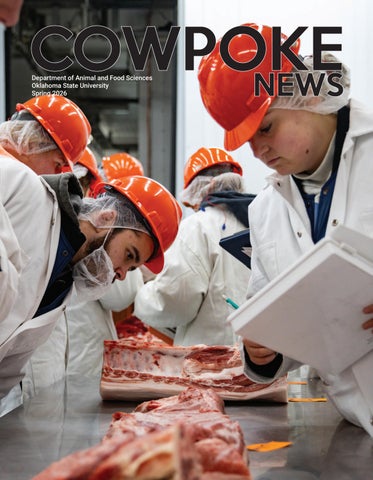
ON THE COVER This issue’s cover highlights meat judging in action, showcasing students evaluating carcasses and applying industry standards in a real-world setting. See more on page 58. Photo courtesy of Taylor Epperson. 2 | COWPOKE NEWS
COWPOKE Spring 2026
NEWS
CLANCEY KRAHN EDITOR
DR. MORGAN PFEIFFER FACULTY ADVISOR
SUBSCRIBE
To subscribe, please email us or mail in your request. Please give us your full name and either your email or mailing address. Cowpoke News is distributed through both email and mail and is available online at https://agriculture.okstate.edu/ departments-programs/afs/ about/cowpoke-news.html
STAY CONNECTED
Want to receive more information and updates about our department? Follow us on social media! @okstateafs
CONTACT US
Department of Animal and Food Sciences 101 Animal Science Building Stillwater, Okla. 74078 405.744.6062 cowpokenews@okstate.edu www.afs.okstate.edu
Oklahoma State University as an equal opportunity employer, complies with all applicable federal and state laws regarding non-discrimination. Oklahoma State University is committed to a policy of equal opportunity for all individuals and does not discriminate based on race, religion, age, sex, color, national origin, marital status, disability, or veteran status with regard to employment, educational programs and activities, and/or admissions.
DEPARTMENT HEAD NOTE
LOOKING AHEAD
Greetings alumni, friends, and support‑ ers of the Department of Animal and Food Sciences! In just a couple of weeks, we will proudly watch another outstanding group of undergraduate and graduate students cross the stage in Gallagher‑Iba Arena. Commencement is always a moment of mixed emotion—joy as our students step boldly into careers and advanced studies, and a touch of sadness as we say goodbye to the relationships built during their time in our halls, classrooms, and animal units. Yet we know they leave with the confidence, skills, and support of the Cowboy family behind them, ready to make their mark on the world. In this edition of Cowpoke News, you’ll read about the remarkable students, alumni, and supporters recognized at our annual Scholarship and Awards Banquet. Our student honorees represent the very best of Animal and Food Sciences—individuals who excel academically, lead with integrity, and contrib‑ ute meaningfully to our department’s culture and success. You will also meet alumni and industry partners whose achievements and service continue to elevate our programs and strengthen the animal and food sectors across Okla‑ homa and beyond. Their stories reflect the excellence, innovation, and impact that define our community. You will also find updates on our plans to enhance facilities and infrastructure across several of our animal units. These resources are essential to our teach‑ ing, research, and outreach missions, and they play a critical role in preparing students for hands‑on careers in the animal and food industries. While these improvements require significant investment, they are vital to ensuring our students have access to world‑class learning environments and our faculty have the tools needed to drive research that improves profitability, sustain‑ ability, and long‑term success for producers and ranchers. I look forward to sharing more with you in the months ahead and exploring opportunities for you to partner with us in bringing these projects to life. As summer approaches, we are excited to reconnect with many of you at events across the state that bring our alumni, friends, and stakeholders to‑ gether. These gatherings are among the highlights of our year as they pro‑ vide us opportunities to hear your stories, share updates from campus, and celebrate the ongoing impact of the OSU Animal and Food Sciences family. Summer also ushers in several of our signature youth programs, such as Big 3 Field Days, livestock and meat judging camps, and other events that draw young people from across Oklahoma and the nation. These experiences not only showcase the strength of our department but also inspire the next gener‑ ation to pursue their education at OSU and join the Cowboy family. As always, we welcome you to stop by the department anytime you are in Stillwater. We value your ideas, your feedback, and the chance to reconnect. Please do not hesitate to reach out if I or anyone in the department can be of support or service. Your engagement strengthens our mission, enriches our programs, and ensures that the legacy of excellence in Animal and Food Sci‑ ences continues to grow. GO POKES!
Head, Department of Animal and Food Sciences SPRING 2026 | 3
OUR FACULTY RICHARD COFFEY - Department Head
JOAO MORAES - Physiology, Teaching and Research
SABRINA AMORIM - Quantitative Genetics and Genomics, Research and Teaching
PETER MURIANA - Food Microbiology, Research, Teaching and Extension
PAUL BECK - Beef Cattle Nutrition, Research and Extension
ADEL PEZESHKI - Monogastric Nutrition, Teaching and Research
SCOTT CARTER - Swine Nutrition, Waste Management, Teaching and Research
MORGAN PFEIFFER - Meat Science, Teaching and Research, Scholarship Coordinator
STEVEN COOPER - Equine, Teaching
RANJITH RAMANATHAN - Meat Science, Teaching and Research, Research Coordinator
JUSTIN CROSSWHITE - 4-H Youth Livestock, Extension MELLISSA CROSSWHITE - Reproductive Physiology, Teaching UDAYA DESILVA - Molecular Genetics, Teaching and Research, Graduate Coordinator
RYAN REUTER - Range Beef Cattle Nutrition, Teaching and Research DAN STEIN - Livestock Production, Teaching and Extension JASON WHITE - Dairy Cattle Science, Teaching
MEGAN ECKHARDT - Meat Science, Teaching and Extension
BARRY WHITWORTH - Food and Animal Health, Extension, BQA State Coordinator
JERRY FITCH - Sheep, Teaching and Extension, Teaching Coordinator
BLAKE WILSON - Beef Cattle Nutrition, Teaching and Research
ANDREW FOOTE - Ruminant Nutrition, Teaching and Research
GLENN ZHANG - Animal Molecular Biology, Research and Teaching
DARREN HAGEN - Animal Genomics, Teaching and Research PARKER HENLEY - Teaching and Extension, Livestock Judging MASON HENSON - Sustainable Livestock Production, Teaching and Research
EMERITI FACULTY
KRIS HINEY - Equine, Teaching and Extension
JOE BERRY - Poultry, Extension
KHURSHEED IQBAL - Reproductive Biology, Research and Teaching
DAVID BUCHANAN - Animal Breeding, Teaching Coordinator
RAVI JADEJA - Food Safety, Teaching and Extension
DAVE FREEMAN - Equine, Extension, Extension Coordinator
LOGAN JOHNSON - Food Science, Teaching and Research
DON GILL - Beef Cattle Nutrition, Extension
MARK JOHNSON - Animal Breeding, Teaching and Extension
GERALD HORN - Beef Cattle Nutrition, Graduate Coordinator
DAVID LALMAN - Beef Cattle Nutrition, Research and Extension
FREDRIC OWENS - Animal Food Products, Extension
GRETCHEN MAFI - Meat Science, Teaching and Research, Advising Coordinator
GLENN SELK - Reproductive Physiology, Extension LEON SPICER - Reproductive Physiology, Research and Teaching
RILEY MESSMAN - Reproductive Physiology, Microbiome, Teaching and Research
ROBERT TEETER - Poultry Nutrition
MEAGHAN MEYER - Poultry Science, Animal Welfare and Behavior, Teaching
BOB WETTEMANN - Reproductive Physiology
4 | COWPOKE NEWS
DON WAGNER - Department Head
A G E N U I N E A N D H E A R T F E LT
THANK YOU
Dr. Fitch
F O R Y O U R Y E A R S O F S E R V I C E A N D D E D I C AT I O N T O T H E D E PA R T M E N T O F A N I M A L A N D F O O D S C I E N C E S
SPRING 2026 | 5
PHOTO COURTESY OF SYDNEY MORRIS
An Unexpected Path TO INTERNATIONAL POLO
OSU ANIMAL SCIENCE MAJOR SYDNEY MORRIS TURNED ONE UNEXPECTED POLO LESSON INTO AN OPPORTUNITY TO REPRESENT THE UNITED STATES IN HYDERABAD, INDIA.
F
or Sydney Morris, an Oklahoma State animal science major, the chance to represent the United States in international polo began with one unexpected lesson. Growing up in San Diego, California, Morris was always around horses. She rode across multiple disciplines, in‑ cluding eventing, reining, jumping and barrel racing, and spent much of her time in the equine industry. Polo, how‑ ever, was not something she expected to pursue. That changed during her freshman year of high school after she helped care for a friend’s horses while her friend was out of town. As a thank-you, Morris was offered a polo lesson.
6 | COWPOKE NEWS
It was supposed to be a one-time thing. Instead, it be‑ came the start of something much bigger. “I was hooked after that first day,” Morris said. From there, Morris committed herself to the sport. She spent the next four years competing in interscholastic polo with Poway Polo Club, learning the speed, strategy and teamwork that make the sport so different from oth‑ er riding disciplines. Polo required her to think quickly, communicate constantly and trust both her teammates and her horse in high-pressure moments. “It’s a team sport,” she said. “Being able to experience that level of teamwork, both with the horses and with
people who share the same passion, is something you country, many of whom had never played together before don’t get anywhere else.” arriving in India. There was little time to build chemistry That foundation followed Morris to Stillwater. At Oklaho‑ before the games began, so the team had to learn each ma State, she joined the women’s varsity polo team and other’s playing styles quickly. continued competing while working toward her animal science degree. Balancing practices, travel, classes and the everyday responsibilities of being a student-athlete was not always easy, but it became part of her routine.
“We didn’t have time to figure each other out before games,” she said.
The horses added another challenge. Players rode hors‑ es provided by the host club, often with very little time Then, a new opportunity came along. A mentor en‑ to get familiar with them before competing. Morris had couraged Morris to apply for an to quickly learn how each horse international polo trip through moved, responded and handled the American International Polo pressure, sometimes within only Foundation. The timing was a few minutes. not perfect. The trip would take Beyond the competition, the trip place during the semester, mean‑ gave Morris a chance to experi‑ ing Morris would have to miss ence a new culture. During the class, manage assignments from day, players explored Hyder‑ a distance and stay on top of her abad, visited landmarks, walked coursework while traveling over‑ through markets and connected seas. with people they may never have Still, it was not an opportunity she wanted to pass up. After ap‑ plying and going through the se‑ lection process, Morris was cho‑ sen to represent the United States in Hyderabad, India. “I was absolutely ecstatic,” Morris said. Once she worked through the ac‑ ademic details with her advisor, Morris made the decision to go. The travel was long, but the expe‑ rience became real when she ar‑ rived in Hyderabad and stepped into a completely unfamiliar envi‑ ronment. “Watching the tuk tuks buzzing around, it finally hit me that I was somewhere completely different,” she said.
STANDING IN THE ARENA HOLDING THE U.S. FLAG DURING THE NATIONAL ANTHEM, LOOKING OUT AT A CROWD FROM A COMPLETELY DIFFERENT CULTURE AND THEN BACK AT TEAMMATES WHO HAD BEEN STRANGERS JUST DAYS BEFORE, IT WAS ONE OF THE MOST OUT-OF-BODY EXPERIENCES I’VE EVER HAD.
met otherwise. Those moments helped make the trip about more than polo.
One moment, however, stood above the rest. During the semifinal round of the 6-goal tournament, Morris stood in the arena holding the U.S. flag as the national anthem played. Looking out at the crowd and standing beside teammates who had been strangers only days earlier, she realized the signifi‑ cance of where she was and what she was representing. “It was one of the most out-ofbody experiences I’ve ever had,” she said.
When Morris returned to Stillwa‑ ter, classes and practice picked The tournament was held at the back up, but the experience Hyderabad Polo and Riding Club, where games took stayed with her. It reminded her how important it is to place in the evening in front of large crowds. Local take advantage of opportunities, even when the timing is families, government officials and members of the U.S. not easy or the outcome is uncertain. consulate attended, making the event feel bigger than a “OSU has shown me there’s never a reason to say no to typical competition. For Morris, it was both exciting and an opportunity,” Morris said. humbling. Her advice to others is simple. She competed on both the 3-goal and 6-goal U.S. teams, playing at multiple levels throughout the tournament. “Just do it,” she said. “Even if it’s scary, even if you don’t While she was comfortable competing at those levels in know what’s going to happen, just go for it.” the United States, representing her country added a new For Morris, one polo lesson turned into years of compe‑ kind of pressure. tition, a place on OSU’s team and the opportunity to rep‑ “Everyone was giving their all for every second,” Morris resent the United States on an international stage. What began as something unplanned became a reminder that said. saying yes can lead farther than expected. The challenges were different from what she was used to. The U.S. team was made up of players from across the
WRITTEN BY: CLANCEY KRAHN
SPRING 2026 | 7
PHOTOS COURTESY OF DR. COFFEY 8 | COWPOKE NEWS
F
ACIL ITIE S fo UTU r the RE
Building modern farm units to prepare students, support research and keep OSU Animal and Food Sciences moving forward.
DAIRY CENTER SPRING 2026 | 9
O
klahoma State University’s Department of Animal and Food Sciences is looking toward the future with a fundraising campaign focused on updating several of its farm unit facilities. For Dr. Richard Coffey, department head, the need is clear. The department’s animal units have long been central to student learning, research and Ex‑ tension. Their close proximity to campus also helps set OSU apart.
three that we’re master planning for, you will not find facilities like that anymore.” As livestock production has changed, so have ex‑ pectations for ventilation, penning systems, equip‑ ment, animal care and facility efficiency. Coffey said updating the units would help students become more career-ready by giving them experience in fa‑ cilities that are closer to what they will encounter after graduation.
“One of the really key things that helps our depart‑ The campaign is expected to require a significant ment recruit students from investment, with a fundraising across the U.S. are the animal goal of about $50 million. Cof‑ units that we have and their fey said the size of the goal re‑ close proximity to campus,” flects the scale of the need. Coffey said. “Once you’ve done master Those units give students the chance to put classroom concepts into practice. For students who come from livestock backgrounds, the facilities build on knowl‑ edge they already have. For students from urban areas or those without livestock experience, they provide an opportunity to learn basic animal handling, animal be‑ havior and production prac‑ tices in a hands-on setting. That experience is especially important in a department where many students begin as pre-veterinary students or plan to enter careers tied to livestock and food produc‑ tion. “Giving them opportunities to really put into practice some of the things we’re talking about in the class‑ room is really key to their ed‑ ucational experience,” Coffey said.
“I WANT US TO BE THE ENVY OF ALL OF OUR PEERS. I WANT US TO BE FRONT OF MIND WHEN PEOPLE ARE THINKING ABOUT WHERE THEY WANT TO SEND THEIR DAUGHTER OR THEIR SON TO GO TO SCHOOL.”
planning and you’ve really put down on paper, this is what we need to build to be relevant for the next 30 years, then it’s time to start talking to your alumni, your stakeholders and those that have the ability and hope‑ fully the desire to pay forward some of what they experienced while they were here,” Coffey said. If funding goals are met, the department hopes to replace outdated facilities with practi‑ cal, industry-relevant spaces that better support teaching, research and Extension. New facilities could also improve sustainability and efficiency through updated technologies that reduce utility and operat‑ ing costs.
For Coffey, one of the projects he is especially interested in is the planned swine facility. His academic and profession‑ al career has strong ties to the swine industry, and he said the new facility could allow OSU to The department is currently focused on major up‑ study different sow housing systems side by side. dates for the sheep and goat, swine and dairy fa‑ cilities. According to Coffey, many of these facilities The goal would not be to assume one system is bet‑ have served students well for decades, but they no ter than another, Coffey said, but to evaluate them longer reflect the systems students will see in to‑ objectively and provide research that can help the day’s livestock industries. industry make informed decisions. “When those facilities were built, they probably mir‑ “I really am excited about having a facility where rored what industry looked like,” Coffey said. “The we can do some side-by-side comparison in a very objective way,” Coffey said. 10 | COWPOKE NEWS
SWINE CENTER SPRING 2026 | 11
Beyond research, Coffey said the updated farm units would also help the department show stu‑ dents, families and visitors what modern livestock production looks like. Because many people are now removed from production agriculture, univer‑ sity facilities can play a role in education and public understanding. “We want to show them this is what industry looks like,” Coffey said. “This is how modern production looks.” Coffey said alumni and supporters have an import‑ ant role in making the vision possible. Many alumni benefited from the same hands-on learning oppor‑ tunities during their time at OSU, and he said sup‑ porting the campaign is a way to help provide those experiences for future students. The investment, Coffey said, is not just about build‑ ings. It is about preparing the next generation of students for the next 30 to 40 years. “If we don’t now make the investment in these fa‑ cilities, they really are at the end of their productive life,” Coffey said. Looking ahead, Coffey hopes people walking through the facilities in five years see a department positioned at the front of animal agriculture educa‑ tion, research and outreach. “I want us to be the envy of all of our peers,” Coffey said. “I want us to be front of mind when people are thinking about where they want to send their daughter or their son to go to school.” For those considering support, Coffey said the de‑ partment is committed to using resources wisely and building facilities that are practical, relevant and similar to what students will see in the industry. “We will be good stewards of your resources,” Cof‑ fey said. For Coffey, the campaign represents more than fa‑ cility updates. It is a chance to position the depart‑ ment, its students and Oklahoma animal agriculture for long-term success. “If before I retire, we can have updated some of these facilities and positioned them for the next 30 years, I will feel like I have really done something of value,” Coffey said. “It is such an important thing that we do with teaching, research and outreach.”
WRITTEN BY: CLANCEY KRAHN 12 | COWPOKE NEWS
TO DONATE, REACH OUT TO DR. COFFEY HERE: Help build the future of OSU Animal and Food Sciences by supporting facilities that give students hands-on experience, advance industry-relevant research and prepare the next generation of agricultural leaders.
SHEEP AND GOAT CENTER SPRING 2026 | 13
14 | COWPOKE NEWS
PHOTO BY SADIE BUTLER
BUILT ON TRADITION, celebrating excellence DEPARTMENT OF ANIMAL AND FOOD SCIENCES SCHOLARSHIP AND AWARDS BANQUET
T
he Department of Animal and Food Sciences hosted its annual awards banquet, bringing together students, faculty, staff and industry leaders to recognize excellence across the department. The event served as an opportunity to highlight the work and dedication that often goes unseen throughout the year, with awards spanning academics, research, leadership and service. Undergraduate students were recognized for their academic achievement, involvement in student organizations and commitment to hands-on learn‑ ing. Many of these students balance coursework with internships, judging teams, research and leadership roles, making their recognition a reflection of both time and effort invested in the department. Graduate students were also honored for their contributions to research and innovation, as well as their role in mentoring undergraduates and supporting departmental pro‑ grams. A faculty award was presented to recognize an individual whose commit‑ ment to teaching, advising and mentorship has made a lasting impact on students within Animal and Food Sciences. The recognition reflected the important role faculty members play in supporting both the academic and professional growth of students throughout their time in the department. The banquet also honored alumni and industry partners whose contribu‑ tions have had a lasting influence on the program. Through professional leadership, advocacy and ongoing support, these individuals help strength‑ en the connection between the department and the broader animal agricul‑ ture industry. Their recognition serves as a reminder of the opportunities available to students beyond graduation and the importance of staying con‑ nected to the program. More than anything, the awards banquet served as a moment to pause and recognize the people who make the Department of Animal and Food Sci‑ ences what it is. From students putting in the work each day to faculty and industry leaders who continue to invest in the future, the event reflected the strength and momentum of the department as a whole.
SPRING 2026 | 15
David Dellin
D
avid M. Dellin grew up in Owasso, Oklahoma and graduated from OSU in 1999 with a B.S. in Animal Science/Business. While at OSU, David worked at the horse farm and competed on the horse judging team. After graduating he went to work as an assistant trainer for the leading exhibitor in AQHA/NSBA Western Pleasure events, Gil Galyean. During this time, David trained and exhibited QH Congress and AQHA World Champion horses. David also won the AQHA World Championship in the 2-year old, Junior and Senior Western Pleasure on the same horse, One Hot Krymsun. David is the only exhibitor to ever accomplish this feat in AQHA.
From the arena to the executive office.
NSBA World Championship shows for ten years and developed HorseIQ.com the leading online equine judging educational platform for carded judges and 4H and FFA judging teams.
In 2023, David was named the Chief Executive Offi‑ cer for APHA where he directed the daily operations of APHA, the APHA Foundation, and the for-prof‑ it subsidiary Marked for Greatness Properties. He managed 40+ employees and a $14M annual oper‑ ating budget. He helped develop the Chrome Cash incentive program, distributing over $1,000,000 an‑ nually to APHA-registered horses competing with APHA’s alliance partners. He also created the Paynt In 2006, David started his own performance horse Points Incentive, launching in 2025 rewarding all training operation in Purcell where he directed all exhibitors at every APHA sanctioned show world‑ phases of training and showing in the western plea‑ wide a monetary incentive in every class. sure horse industry. He won multiple AQHA World In 2026, David was named the Chief Executive Of‑ Championships as well as multiple QH Congress ficer for the American Quarter Horse Association. and Futurity championships. Furthermore, he con‑ As CEO, Dellin will oversee the Association’s op‑ ducted both national and international clinics and erations, strategic initiatives, member service pro‑ seminars for carded judges in both AQHA and the grams and continued efforts to elevate the American National Snaffle Bit Association (NSBA). David also Quarter Horse on a global stage. He will collaborate served on the executive committee and was a past with the Executive Committee to provide leadership president of the NSBA. During this time, he helped for the world’s largest equine breed registry and acquire the associations first publication (Way To membership organization. Since 1940, AQHA has Go magazine), designed payout schedules to en‑ registered over 6 million horses with 240,000 cur‑ hance cash flow for the NSBA World Show, co-de‑ rent members, and 34 International affiliates. veloped the Tomorrow’s Horseman program and co-created the Riders Cup incentive program. In David currently shares time between Amarillo and 2017, he received the Jack Benson award for out‑ the family ranch in Elmore City, Oklahoma. The ranch is home to over 600 recipient mares annually standing service to the NSBA. as a sub-contractor for Dr. Jim Bailey and Royal Vis‑ In 2012, David was named as Senior Director of ta Southwest, where his wife Julie (also an OSU grad Judges, Shows and Education for the American 2000) and his son Gage (an OSU grad 2025) and his Paint Horse Association (APHA), the world’s sec‑ daughter in law, Courtney oversee and manage op‑ ond largest equine breed registry. He led the perfor‑ erations. David is also the proud father to Lane and mance horse division with over 20 employees and Mckenna. increased the APHA World Show payouts by over $1 million dollars. He co-managed the APHA and
16 | COWPOKE NEWS
PHOTO COURTSEY OF DAVID DELLIN
SPRING 2026 | 17
Tyler Norvell T
yler Norvell, a 2006 graduate of Oklahoma State University (OSU) with a B.S. in Animal Science, grew up in Amber, Oklahoma, as the son of a dairyman. In addition to working in the family’s dairy until it was sold when he was 13, Tyler’s time was kept busy helping his grandfathers who farmed everything from cotton to alfalfa and raised beef cattle. Through 4-H and FFA he was involved in showing livestock from the moment he was old enough until he graduated high school. After graduating high school, Norvell attended Butler County Community College in Kansas on a livestock judging scholarship for a couple years before transferring to OSU. It was there, in 2005, that he and his livestock judging team won a National Championship.
Building the future of livestock, one exhibitor at a time.
2021, Cattlemen’s Congress has brought together thousands of head of cattle, exhibitors and producers from all across the world to Oklahoma City each January. Prior to his roles at OYE and Cattlemen’s Congress, Tyler worked for Oklahoma Farm Bureau (from 2005-2012). He rose through the ranks and to serve as Vice-President of Public Policy where he directed the lobbying efforts for the state’s largest grassroots agricultural organization.
It would be his time at Farm Bureau that would eventually lead Tyler to begin his own contract lobbying business, and today, he serves as the managing partner of Norvell Consulting, LLC. Norvell Consulting started with only one client in 2012 and has evolved into a firm that provides lobbying and Since 2012, Tyler has served as President of the consulting services as well as marketing strategies Oklahoma Youth Expo (OYE) and the Onward for more than thirty clients spanning several Foundation, raising funds in support of the World’s different states. Largest Junior Livestock Show, a non-profit Tyler served as the 2012-2013 OSU Animal Science organization established in 2002. As President of Alumni Board Chairman and is a proud Lifetime OYE, he oversees an annual livestock show with member of the Oklahoma State University Alumni more than 6,500 exhibitors and 13,000 animals and Association, the Oklahoma Cattlemen’s Association is responsible for the approximately $1.5 million and the Sirloin Club of Oklahoma. In 2014, Tyler in awards and scholarships annually distributed was honored with the OSU College of Agriculture’s to OYE participants. In this role, Norvell was also Early Career Achievement Award, and in 2020 he instrumental in working with the OSU Department was voted as the 2020 Best of the Barns “Industry of Animal and Food Sciences in establishing the Leader of the Year”. Oklahoma Agricultural Leadership Encounter (OALE) Program, an important leadership Tyler and his wife, Beth, currently live in Tuttle, Oklahoma, with their two daughters, Madilyn (15) development program for OSU students. and Saylor (11). Both girls are extremely active in In addition to OYE, Tyler serves as a founding the junior livestock program exhibiting cattle, hogs, board member, past Board Chairman and current sheep and goats. Tyler and his family run several Secretary/Treasurer of the newly established head of Hereford and Angus cows along with Cattlemen’s Congress. Since its inception in partnering on a handful of sows.
18 | COWPOKE NEWS
PHOTO COURTSEY OF TYLER NORVELL
SPRING 2026 | 19
ADVANCED
PHOTO BY GENESEE PHOTO
Jason W. Ross
TURNING SCIENCE INTO SOLUTIONS FOR PRODUCERS NATIONWIDE 20 | COWPOKE NEWS
D
r. Ross began his academic journey at Iowa State University, where he completed his B.S. in Animal Science. His undergraduate experience sparked a deep in‑ terest in swine reproduction and biotechnology, further fueled by hands-on work with pork produc‑ ers during his time as a student. He advanced his education at Oklahoma State University, where he earned both his Master of Science and Doctor of Philosophy degrees focusing on reproductive phys‑ iology under the direction of Dr. Rod Geisert, with a minor in biochemistry, laying the scientific founda‑ tion for his future career as a reproductive physiol‑ ogist and biotechnology researcher.
expanded its applied research, extension program‑ ming, and industry partnerships, strengthening its reputation as an essential resource for U.S. pork producers. Dr. Ross played a pivotal role in coor‑ dinating statewide industry support during the COVID-19 pandemic, helping producers navigate severe supply chain disruptions. His leadership helped mobilize rapid response research, produc‑ er outreach, economic modeling, and crisis man‑ agement tools—efforts credited with helping stabi‑ lize the Iowa pork sector during an unprecedented challenge. In addition to serving as IPIC Director, Dr. Ross also directed the Animal Gene Transfer Fa‑ cility, further reinforcing his leadership in biotech‑ Following the completion of his doctoral degree, Dr. nology and genetic innovation. Ross undertook a postdoctoral research appoint‑ As of 2022, Dr. Ross serves as Professor and Chair ment at the University of Missouri under the direc‑ of the Department of Animal Science at Iowa State tion of Dr. Randy Prather, where he spent two years University, while continuing to hold the Lloyd L. An‑ expanding his research expertise and contributing derson Professorship. In this role, he oversees de‑ to advancements in animal science. This period partmental strategy, faculty development, research sharpened his interests in genetic technologies, re‑ advancement, and industry engagement. His lead‑ productive biology, and translational approaches to ership emphasizes collaboration with producers, improve livestock productivity. development of next generation scientific talent, and Dr. Ross joined the Iowa State University faculty the integration of cutting edge biotechnology with‑ in 2008 as an Assistant Professor in Reproductive in animal agriculture. His contributions continue to Physiology and Biotechnology in the Department shape the future of animal agriculture, reinforcing of Animal Science. His early faculty role balanced Iowa State University’s position at the forefront of both teaching and research, allowing him to men‑ research and innovation in the field. tor students while establishing a rapidly growing research program. During this time, he also became affiliated with multiple interdepartmental graduate programs—including Molecular, Cellular and Devel‑ opmental Biology; Genetics; and Neuroscience— reflecting his interdisciplinary scientific reach. His research productivity and scientific contributions soon earned him broader recognition, including multiple early career awards from Iowa State Uni‑ versity and the American Society of Animal Science.
In 2024, he received the American Society of An‑ imal Science National Extension Award, acknowl‑ edging his leadership in translating complex scien‑ tific knowledge into practical strategies for livestock producers across the United States.
Dr. Jason W. Ross is a respected scholar, adminis‑ trator, and industry partner whose work bridges re‑ search, education, and applied innovation. He has been married to Rose Mary for 25 years and they have five children, Abbey (Max), Jacob, Gracie, Lane By 2014, Dr. Ross was named the inaugural Lloyd L. and Zack. Anderson Endowed Professor in Physiology at Iowa State University, signaling his emerging prominence in the field. Over his career, Dr. Ross has helped se‑ cure more than $20 million in research funding, re‑ flecting both his impact and the value of his schol‑ arly contributions to agriculture and bioscience. He has established national and international collabo‑ rations, published extensively across major animal science and reproductive physiology journals, and contributed to advances in genetic engineering, heat stress physiology, and swine reproduction. His work has been widely cited, demonstrating his in‑ fluence as both a scientist and educator. In 2015, Dr. Ross became Director of the Iowa Pork Industry Center (IPIC). Under his leadership, IPIC SPRING 2026 | 21
ADVANCED
PHOTO COURTESY OF JARED SHRIVER
Jared Shriver
LEADING WITH VISION IN A CHANGING ANIMAL HEALTH LANDSCAPE 22 | COWPOKE NEWS
J
ared Shriver holds a Bachelor of Science de‑ gree in Animal Science from the University of Missouri and a Master of Science degree in An‑ imal Nutrition from Oklahoma State University. His educational experience at OSU helped establish a strong foundation for his career in business leader‑ ship and the animal health industry. Shriver credits much of his career development to the combination of academic preparation and hands-on expertise he gained early in his professional journey.
predictive and preventative solutions to diagnos‑ tics, treatment, and performance optimization.
Shriver began his Zoetis career nearly 20 years ago, steadily advancing through a series of leadership roles across the company’s commercial organiza‑ tion. Throughout this period, he earned recognition for his ability to exceed financial targets, cultivate high performing teams, and strengthen Zoetis’ po‑ sition across its diverse business sectors. His ten‑ ure includes leadership across sales, marketing, and strategic commercial functions, where he con‑ sistently emphasized accountability, collaboration, and the development of innovative solutions for customers in both companion animal and livestock markets.
with customer needs.
A hallmark of Shriver’s leadership style is his com‑ mitment to customer centric innovation. Colleagues and partners regard him as a leader who not only understands market trends but also anticipates cus‑ tomer needs, often championing solutions that ele‑ vate product performance, streamline clinical work‑ flows, or improve animal wellbeing. His leadership has contributed to the company’s sustained success Jared Shriver is currently President of U.S. Opera‑ and its longstanding commitment to scientific ex‑ tions for Zoetis, the world’s leading animal health cellence, operational discipline, and purpose driven company and a member of the Fortune 500, and is service. responsible for U.S. commercial operations. With Throughout his career, Shriver has been known for nearly two decades of leadership experience at Zoe‑ fostering a culture of strategic thinking, responsible tis, Shriver has built a distinguished career defined decision making, and continuous improvement. He by strong commercial acumen, a customer focused is widely respected for building collaborative envi‑ mindset, and a consistent track record of driving or‑ ronments that allow teams to thrive and for articu‑ ganizational growth and operational excellence. lating a clear vision that aligns organizational goals His leadership reflects Zoetis’ broader mission to advance care for animals while supporting veteri‑ narians, producers, and animal owning communi‑ ties. As President of U.S. Operations, he continues to champion initiatives that strengthen Zoetis’ U.S. portfolio, expand market reach, and uphold the company’s longstanding commitment to innova‑ tion, integrity, and customer partnership. With nearly 20 years of dedicated service at Zoetis and a professional background rooted in strategic commercial leadership, Jared Shriver embodies the company’s values and purpose. His combination of experience, vision, and customer driven leadership has positioned him as a central force in guiding U.S. Operations and shaping the future of animal health in the country. Whether steering complex business segments or championing new approaches to an‑ imal care, Shriver continues to play a pivotal role in ensuring Zoetis remains an industry leader com‑ mitted to advancing the health and wellbeing of an‑ imals worldwide.
Before assuming his current role as President of U.S. Operations, Shriver most recently served as Senior Vice President of U.S. Livestock, Bio-devices, Equine, and Platinum Performance. In this capac‑ ity, he oversaw a broad portfolio spanning multi‑ ple industry segments, including advanced animal health technologies, performance supplements, and equine health products. His leadership helped strengthen Zoetis’ presence in key markets, broad‑ en customer engagement strategies, and reinforce the company’s reputation as a trusted partner for Jared and his wife, Lacey, are the proud parents of veterinarians, producers, and animal health profes‑ two daughters, Gracee and Lilly. In his spare time, Jared enjoys spending time with his family and out‑ sionals nationwide. doors. His family takes any opportunity they can Shriver’s professional accomplishments at Zoe‑ to get on the lake where they enjoy skiing, wake tis reflect deep, hands-on industry experience that boarding, wake surfing, and just being on the water. have prepared him for his current role leading U.S. His other favorite past-time is being in the woods or Operations. In this position, he is responsible for mountains enjoying hunting and fishing. guiding the company’s overall commercial strat‑ egy in its largest geographic market and ensuring that Zoetis delivers exceptional value to customers across the full continuum of animal health—from SPRING 2026 | 23
PHOTO BY GENESEE PHOTO
24 | COWPOKE NEWS
Secretary
Blayne Arthur S
From 4-H roots to state leadership
ecretary Blayne Arthur grew up in Chickasha, Oklahoma, where her family raised horses, cattle, wheat, alfalfa and soybeans. She was active in 4-H and production agriculture throughout her childhood including showing horses and cattle. Upon graduating from Oklahoma State University in 2004, with a bachelor’s degree in Agricultural Eco‑ nomics, Secretary Arthur took a role in small-busi‑ ness financing for Rural Enterprises, Inc. and trav‑ eled throughout Oklahoma. Her first experience at the Oklahoma Department of Agriculture, Food, and Forestry began in 2009 working for Secretary Terry Peach and later as the Deputy Commissioner of Ag‑ riculture for Secretary Jim Reese where she stayed from 2011 to 2016. From 2016 to 2019 Arthur served as the Executive Director for the Oklahoma 4-H Foundation. In this role she worked closely with student officers and ambassadors throughout the state to share how 4-H programs provide students with leadership de‑ velopment, skill building and career opportunities. Secretary Arthur continues to have a focus on sup‑ porting and encouraging Oklahoma youth. On January 14, 2019, Blayne Arthur was sworn in by Governor Kevin Stitt as the Oklahoma Secretary of Agriculture, becoming the state’s first female to hold the position. She acts as Governor Stitt’s chief advisor on policy development and implementation related to agriculture, food and forestry, and holds the titles of Oklahoma Commissioner of Agriculture and the President of the Oklahoma State Board of Agriculture.
tion have aided her well with those she serves and guides. Secretary Arthur also provides valuable ser‑ vice to higher education in Oklahoma as a member of the Board of Regents for the Oklahoma A&M Col‑ leges. Secretary Arthur currently serves as the President of Food Export-Midwest, and she served as the President of the National Association of State De‑ partments of Agriculture for the 2023-24 term and served as the President of the Midwestern Associa‑ tion of State Departments of Agriculture in 2019. She has received a number of awards honors including the Distinguished Service to Oklahoma Farm Bu‑ reau Award (2025), Journal Record Fifty Making a Difference Honoree (2019 and 2020), Oklahoma Cat‑ tlemen’s Association Distinguished Service Award (2016), Oklahoma Agricultural Woman of the Year (2014), and Journal Record Achievers Under 40 Honoree (2011). Secretary Arthur remains active in Oklahoma Farm Bureau, Diamond Hats, Oklahoma Beef Council, and Oklahoma 4-H and FFA programs. Secretary Arthur and her husband, Jerrod, live in Stillwater, Oklahoma. They own and operate Lucky Strike Show Cattle and sell prospects to 4-H and FFA exhibitors throughout the United States. The Arthur’s have two children, Kelton and Kennedy, who both enjoy showing cattle and horses.
Secretary Arthur has a distinguished record of ser‑ vice to Oklahoma agriculture. A farmer and ranch‑ er herself, Arthur acutely understands the needs of her constituents. Her humble, passionate spirit combined with big-picture vision, as well as her leadership that is marked by character and convic‑ SPRING 2026 | 25
Barry and
POLL
MASTER BR
PHOTO BY GENESEE PHOTO
d Roxanne
LARD
BREEDER AWARD
D
r. Barry Pollard is a renowned neurosurgeon, rancher, and business leader from Enid, Oklahoma. He is widely recognized for his extensive contributions to both the medical and agriculture industries. He and his wife Roxanne are also prominent philanthropists. Raised in Hennessey, Oklahoma, by educator parents, Dr. Pollard credits his early life experiences in production agriculture, 4-H and FFA as the foundation for his medical career. He earned a bachelor’s degree in biochemistry from Oklahoma State University in 1973 and a medical degree from the University of Oklahoma College of Medicine in 1977. He is married to Roxanne Pollard, a retired neurosurgical nurse who has worked alongside him for many years. Roxanne has served on the Autry Technology Board of Directors since 2016. She served as Autry’s Board President in 2018. She also was named YWCA’s Women of the Year in 2018. During his medical career, Dr. Pollard was a Boardcertified neurosurgeon who brought needed, specialized care to Northwest Oklahoma. He established his practice, Neurological Surgery Associates in Enid in 1982. During his 40 year career he performed over 20,000 surgeries and significantly improved local access to care. In 1985 he founded P&K Equipment, which has grown from one dealership into a major John Deere dealership network with 29 locations across Oklahoma, Arkansas, and Iowa, employing over 800 people. He and Roxanne own and operate Pollard Farms, a 10,000-acre farm and ranch in Waukomis, Oklahoma, raising elite registered Angus cattle. Under Dr. Pollard’s leadership, Pollard Farms has evolved into one of the premier Angus genetic suppliers in the world. Pollard Farms hosts two annual sales supplying breed leading genetics to the commercial and purebred sectors of the beef industry. A highlight of the 2025 Denim and Diamonds sale in Oklahoma City at Cattlemen’s
Congress was the sale of Pollard Farms Hennessey 3920. Two-thirds interest in this Angus bull, bred by Dr. Pollard, brought $265,000 which proved to be the highest valued animal – bull or heifer – marketed during the Cattlemen’s Congress in 2025. No matter which organization the Pollards have been involved with, they understand the importance of helping youth grow as future producers and leaders. Dr. Pollard founded the OSU Medical Cowboys scholarship program, which has raised millions to support rural healthcare students. He has funded the Barry Pollard, M.D./P&K Equipment Professorship in OSU’s Department of Agricultural Economics. He has contributed to the construction of the Ferguson College of Agriculture’s New Frontiers Agricultural Hall building. The Pollards have supported the charitable arm of the American Angus Association. In 2025, Barry and Roxanne donated an Angus heifer from the Pollard herd – Pollard Rita 4012 – which sold at the start of the National Bull Sale of the Angus breed at Cattlemen’s Congress to raise money for the Angus Foundation. The $75,000 in proceeds from the sale of this heifer went to support the youth programs, scholarships and research funded by the American Angus Foundation. In an unparallelled career noted for being a “surgeon by day and a farmer by night,” Dr. Pollard has always made himself available to provide leadership and service. Since 2018, he has served on the Oklahoma Medical Research Foundation Board of Directors. He served on the American Angus Association Board of Directors for eight years. During his final year on the Angus board, he served as president of the association in 2024. During this time the Angus breed captured a larger share of the bull market, the supply of, and demand for, Certified Angus Beef grew to unprecedented heights, and interest in Angus cattle reached an all-time high. As a result of his service, leadership, contributions and many accomplishments, Dr. Pollard has been honored and inducted by several prestigious organizations. These include induction into the Oklahoma State University Hall of Fame in 2017. In 2020, he was inducted into the Oklahoma Agriculture Hall of Fame as the recipient of the Governor’s Outstanding Achievement Award in Agriculture received for his impact on the agricultural community. In 2023, Dr. Pollard was inducted into the Oklahoma Hall of Fame for his contributions to agriculture, medicine and business.
SPRING 2026 | 27
Barry and Roxanne Pollard
ADVANCI
the Angus industry throug
INNOVAT
PHOTO COURTESY OF ADOBE STOCK
d
ING
ugh
ATION
THE
TYLER AWARD Pioneering solutions for sustainable animal health.
D
r. Glenn (Guolong) Zhang is one of the most influential figures in the Department of An‑ imal and Food Sciences at Oklahoma State University, distinguished by a career that has been defined by scientific innovation, exceptional schol‑ arship, and a sustained commitment to advancing animal health. As a Regents Professor and the Ralph and Leila Boulware Endowed Chair, Dr. Zhang has built a body of work that has shaped modern ap‑ proaches to immunity, microbiology, and antibiotic alternatives in livestock production. Dr. Zhang’s academic journey began at China Agri‑ cultural University, where he earned both his B.S. and M.S. degrees in Animal Science. He later com‑ pleted his Ph.D. in Immunophysiology at Kansas State University, followed by postdoctoral training at the Howard Hughes Medical Institute and Yale University School of Medicine. This rigorous sci‑ entific training laid the groundwork for his future contributions in molecular immunology and host– microbe interactions. In 2002, he joined Oklahoma State University as an Assistant Professor, quickly establishing a research program that would become internationally recog‑ nized. He progressed through the academic ranks— Associate Professor in 2007, Professor in 2014, and Regents Professor in 2023—reflecting both the im‑ pact and consistency of his scholarly achievements. At the core of Dr. Zhang’s research program is the study of innate immunity and intestinal microbio‑ ta, with a particular focus on developing innovative, antibiotic-free strategies to improve animal health and productivity. His work explores how endoge‑ nous host defense peptides can be modulated to en‑ hance disease resistance, a research direction that has gained global relevance as agriculture seeks
30 | COWPOKE NEWS
sustainable alternatives to traditional antimicrobi‑ als. Dr. Zhang has received $9.7 million in research funding, a majority of which was obtained from competitive federal funding agencies, and au‑ thored more than 120 peer‑reviewed publications in high-impact journals, including Science and Microbiome. His work has been cited over 16,000 times—an exceptional metric of influence in the field. His h‑index of 59 further underscores the depth and reach of his contributions to animal im‑ munology and microbiome science. His research has not only advanced fundamental scientific un‑ derstanding, leading to five patents, but has also generated practical applications for livestock pro‑ ducers, positioning OSU as a leader in antibiot‑ ic‑alternative research. Dr. Zhang’s accomplishments have been recog‑ nized through numerous prestigious awards at Oklahoma State University and beyond. Among these are Sarkeys Distinguished Professor Award (2021), Regents Distinguished Research Award (2018), James A. Whatley Award (2014), and in‑ duction into the National Academy of Inventors (2012), just to name a few. These honors reflect his sustained excellence in research, innovation, and mentorship, and led to him being appointed as a Regents Professor which is recognition of the high‑
GLENN ZHANG
est academic merit at Oklahoma State University. His appointment as the Boulware Endowed Chair in 2016 further signifies the university’s confidence in his leadership and scholarly impact. In addition to his research achievements, Dr. Zhang is a dedicated educator who teaches courses such as Application of Biotechnology in Animal Science, Ba‑ sic Molecular Biology Techniques, and Techniques in Animal Molecular Biology. His teaching portfolio spans undergraduate, graduate, and doctoral-lev‑ el instruction, including honors thesis preparation and extensive mentorship of graduate students. His commitment to student development is evident in the number of students who have advanced into successful academic, industry, and research careers under his guidance. Dr. Glenn Zhang’s career exemplifies the highest standards of scientific inquiry, innovation, and ac‑ ademic leadership. His pioneering work in innate immunity and microbiome modulation continues to influence global research directions, while his dedication to teaching and mentorship strengthens the next generation of animal and food scientists. Through his scholarship, leadership, and commit‑ ment to advancing sustainable animal health solu‑ tions, Dr. Zhang has made a profound and last‑ ing impact on Oklahoma State University and the broader scientific community.
PHOTO BY GENESEE PHOTO SPRING 2026 | 31
G N I D LEA
y c a leg THE
32 | COWPOKE NEWS
A closer look at the se work and leadership animal and food scien
senior award recipients whose hard hip continue to shape the future of ences. PHOTO BY GENESEE PHOTO SPRING 2026 | 33
Reese Bassano
PHOTO BY GENESEE PHOTO
THE
AUBRA FLORETTA A N D
WILSON
Outstanding
ANIMAL AND FOOD SCIENCE SENIOR AWARD
R
eese Bassano was born on March 1, 2005 and is the daughter of Brad and Tammie Bassano of Pattonville, Texas. She and her younger brother Grady were raised in a rural setting surrounded by agriculture. She became involved in youth development organizations like 4H and FFA at a young age through which she exhibited market sheep and goats. She also worked in a sales role at a local feed store throughout high school and helped out with her family’s cow-calf operation which led her to develop passions for the livestock industry and helping others. She graduated from Prairiland High School in 2023. It was this background along with a desire to diversify her agricultural knowledge and experience which steered her towards pursuing a bachelor’s degree of Animal Science with a minor in Agricultural Economics at Oklahoma State University. Since her first semester at Oklahoma State, Reese has worked as an administrative assistant for the Animal and Food Sciences Department. She is grateful for the opportunity to have worked alongside and supported department faculty and her fellow peers through this role. She has also served as secretary and currently serves as vice president of the Oklahoma Collegiate Cattlemen’s Association. Throughout her freshman and sophomore years, she was a member of the Undergraduate Stockmen Group through which she worked with OSU extension to facilitate various youth livestock events across the state along with the National FFA Livestock Judging contest. Last fall, she was selected to be a member of the Oklahoma Agricultural Leadership Encounter Class XXIII. This program has allowed her to gain a greater knowledge of various sectors of the agricultural industry within the state of Oklahoma. She looks forward to traveling to
the Netherlands this summer to learn more about agriculture from an international perspective. Reese has also served as an ambassador for the Ferguson College of Agriculture since her sophomore year. She has enjoyed the opportunity to play a small role in getting students just like herself to Oklahoma State. Throughout her time in Stillwater, she has attended the Stillwater Church of Christ and been involved with their campus ministry, The University Center. Reese considers herself fortunate to have had wonderful internship opportunities over the past few years which have allowed her to further refine her true passions within agriculture. In the summer of 2024, she worked as Big Country Farm Center’s inaugural livestock sales intern. Over the summer of 2025, she was a farm animal sales intern for Elanco and supported various Elanco dealer accounts in Tennessee and Arkansas. She also interned at Cattlemen’s Congress, the San Angelo Market Sheep and Goat Show, and the Texas and Southwestern Cattle Raisers Association Convention throughout her collegiate career. Upon graduating in May, Reese looks forward to working for Elanco as a farm animal sales representative. Reese is grateful for exposure to exceptional hands-on learning opportunities that challenged her as a student and extracurricular involvement that pushed her development as a young professional. However, she is most thankful for the continual support, encouragement, and comradery shared with faculty and her peers. She is overwhelmed with gratitude for the caliber of people and quality of opportunity which have been brought into her life through the Animal and Food Sciences Department at Oklahoma State University. SPRING 2025 | 35
D R A AW OF
t i r me
PHOTO BY GENESEE PHOTO
C
ole Kleckner was born on July 13, 2005, in Riverside, California. He grew up alongside his two older sisters, Kendall and Raina, who played an influential role in shaping who he is today. Although Cole was born in California, his family relocated to Fort Worth, Texas, when he was six months old, where he has lived ever since.
under Jason White during the fall semester of his sophomore year. This role provided him with the opportunity to mentor younger students while gaining additional hands-on experience in large animal handling. He later served as a teaching assistant for Dr. Pezeshki’s Principles of Animal Nutrition lecture course and for Dr. Crosswhite’s Cole was fortunate to attend a high school that Form and Function lecture and laboratory. offered animal science courses and specialized Beyond the classroom and laboratory, Cole academic pathways, which allowed him to establish explored various pathways within veterinary an early foundation in the animal industry. He medicine through diverse professional experiences. had the opportunity to shadow veterinarians who During his first summer as an undergraduate were alumni of the Oklahoma State University student, he returned home to work under the same College of Veterinary Medicine, an experience that veterinarians with whom he had interned during significantly influenced his decision to pursue his high school. Following his sophomore year, Cole undergraduate education at OSU. Following his worked at the university dairy farm over the summer graduation, Cole’s firsthand experience in animal and continued his involvement there throughout his science and veterinary medicine led him to pursue junior (final) year, further strengthening his largea bachelor’s degree in animal science with a pre- animal experience and practical skill set. veterinary emphasis at OSU. Cole is deeply grateful for his time as an Throughout his undergraduate career, Cole has been actively involved in the Undergraduate Research Scholars Program within the Department of Animal and Food Sciences under the direction of Dr. Ramanathan. He began working in Dr. Iqbal’s laboratory during the second semester of his freshman year and was later named a 2025–2026 Wentz Research Scholar. Cole’s primary research interests focus on animal reproduction, and his current project uses an in vitro model to investigate the effects of semaglutide on placental development. In addition to his research involvement, Cole has served as a teaching assistant for multiple courses in which he demonstrated academic excellence. His first teaching assistant position was in the Introductory Animal Sciences Laboratory
undergraduate student in the Department of Animal and Food Sciences, as these experiences have been instrumental in shaping his academic, professional, and personal development. The knowledge, mentorship, and opportunities provided by the department have played a critical role in preparing him for the next stage of his career in veterinary medicine.
Upon graduating in May, Cole will return to Texas to continue his education at Texas A&M University’s College of Veterinary Medicine and Biomedical Sciences. He will pursue his Doctor of Veterinary Medicine degree to become a practicing veterinarian and future professor, dedicated to educating and mentoring the next generation of students in the animal and veterinary sciences. SPRING 2025 | 37
D R A AW OF
t i r me
PHOTO BY GENESEE PHOTO
M
adison Muller is the 21-year-old daughter of Dr. Rob and Kim Muller of Lawton, Oklahoma. She grew up in Lawton, Oklahoma alongside her younger sister Lauren. Maddie developed a love of agriculture at a young age through spending time on her grandparents’ farm. It was on her grandparents’ wheat and stocker cattle operation that many of her fondest memories were formed. As an eighth grader, Maddie joined FFA and became very involved within the Lawton FFA chapter. During her time in FFA, she served as chapter president, participated in the Food Science and Agricultural Communications CDE, Agriscience Fair and Prepared Public Speaking. She also earned a national title in Agriscience Fair then later earned her American FFA Degree. It was through her time in the Food Science CDE and Agriscience Fair where she discovered her love of Food Science and research. Maddie graduated from Eisenhower High School and was excited to attend OSU and continue her family’s legacy as OSU graduates. Her involvement in FFA, along with the support of her family and mentors led her to pursue a bachelor’s degree in food science with a minor in agricultural economics.
Tobii Pro eye tracking glasses to analyze consumer perception of using high pressure processing to reverse dark-cutting beef to a normal bright red color. While at OSU, Maddie was an active member of Chi Omega, a member of Phi Kappa Phi Honor Society, served on OSU Homecoming Steering, a member of President’s Leadership Council and part of Ferguson College of Agriculture’s Freshman in Transition program. Additionally, Maddie serves as Food Science Club Vice President and Secretary of the Meat Science Association. She has also had the privilege to serve as an UNIV 1111 Student Academic Mentor and a Teaching Assistant for the Fundamentals of Food Science class. Throughout her time in these roles, Maddie has enjoyed having the opportunity to give back and serve as a mentor. Maddie has also attended The Reciprocal Meats Conference where she presented her research and competed on the Meat Science Quiz bowl Team.
Maddie describes her time in the Department of Animal and Food Sciences as defining and pivotal. She is extremely grateful for the hands-on experiences and the friends and mentors she has met throughout her time at OSU. She believes that Throughout her time as an undergraduate, Maddie without these experiences and her mentors she was involved in the Undergraduate Research would not be the person she is today. Scholars Program in the Department of Animal and Food Sciences under the direction of Dr. Upon graduation in May, Maddie will continue her Ramanathan. She began working in Dr. Ram’s lab education here in Stillwater. She will begin pursuing as a freshman research scholar. Throughout her a master’s degree in food science at OSU under the time in the lab Maddie has had the opportunity to guidance of Dr. Ranjith Ramanathan in the hopes explore several research areas including meat color of working in Food Science Research and Product but is especially interested in consumer purchasing Development. decisions. Her favorite research project was utilizing SPRING 2025 | 39
D R A AW OF
t i r me
PHOTO BY GENESEE PHOTO
I
n third grade, after a particularly competitive recess football game, Regan Smithwick ran back into the elementary hallway covered in mud. When her teacher asked, “Regan, were you raised in a barn?” she smiled and replied, “Yes ma’am, I go there every day with my dad.” That moment captures exactly how Regan was raised in the small town of Miles, Texas. She grew up on a farm and ranch alongside her parents, Kyle and Julie Smithwick, and her two younger brothers, Dawson and Curry. From the time she could walk, Regan was her parents’ sidekick, learning to care for livestock and love the land, all with a competitive spirit.
bridging agriculture and energy through policy research and professional programming.
During her collegiate career, she has remained deeply connected to production agriculture, helping on her family’s club lamb operation during the summers and hosting showmanship clinics across Texas. In Stillwater, she worked at the OSU Lamb Barn, assisted in the sheep ring at the Oklahoma Youth Expo, and gained valuable industry experience at Pfeiffer Farms. Through internships with Reproduction Specialty Group and Texas Oil and Gas Association, she expanded her perspective by working in advanced reproductive technologies across multiple states and found a love for later
a true testament to the “Ferguson Family.”
One of the most valuable lessons OSU has taught her is that listening and building others up creates connection…reminding her of the community she grew up in. She has practiced this through serving as a Ferguson College of Agriculture Ambassador, helping recruit students to the department she loves. Through the McKnight Scholars Leadership Program, she was also surrounded by life-giving leadership taking her to study abroad experiences in Peru and South Africa, and lastly but perhaps most impactful was her selection to the Oklahoma Her small-town upbringing set the standard for Agricultural Leadership Encounter Class XXIII community, showed the strength of a support system, where she got to learn from leaders across Oklahoma and the importance of family and hard work. In high Agriculture and listen as they shared their passion. school, you could find Regan in student government, Her honors, including Oklahoma State University on a court, or in the show ring. It was in the latter Outstanding Senior, Senior of Significance, and where she found her true passion. While she was Mortar Board Top Ten Freshman Woman, reflect blessed with success exhibiting market lambs, what achievement. Yet what she values most are the captivated her most was not the backdrop photos people that made Stillwater feel like home and the but the people standing in them. The barns became faculty, mentors, and peers in the Animal and Food classrooms, and conversations became life lessons Science department who challenged her to grow she still carries with her. daily and supported her every step of the way being Currently, Regan is serving as an Agricultural Legislative Intern. This has opened her eyes to a side of the industry she never anticipated would be so impactful. Upon graduation, Regan plans to stay in Oklahoma and pursue her Juris Doctorate. Her long-term goal is to serve at the intersection of agriculture, energy, and law. Through this path, she hopes to exemplify what it means to be an OSU Animal Science alum by ensuring the people who work the land are represented and protected through policies that shape their future. SPRING 2025 | 41
D R A AW OF
t i r me
PHOTO COURTESY OF ANDREA EDDINGTON
J
ayde Perea was born on April 20, 2004, and is the youngest child of John and Shana Perea of Estancia, New Mexico. She grew up alongside her five older siblings—Kerraline, Trey, Andrea, Erin, and Taisha—raising and exhibiting livestock. Grow‑ ing up in central New Mexico, Jayde developed a deep appreciation for agriculture through active in‑ volvement in 4-H and FFA. These early experienc‑ es instilled in her a strong work ethic, competitive drive, and a lasting commitment to the agricultural industry. Jayde began her collegiate career at Northern Okla‑ homa College (NOC), where she earned an Associ‑ ate of Science in Business Administration and an Associate of Science in General Agriculture. While at NOC, she served as the Sheep Center Manager, overseeing daily flock care, nutrition programs, re‑ productive management, and herd health protocols. She assisted with artificial insemination, embryo transfer, semen collection, and pregnancy checks, gaining hands-on experience in advanced repro‑ ductive technologies. In recognition of her work and leadership within the program, she received a scholarship both years as an Outstanding Herd Manager.
her team to a 2025 Reserve National Champion fin‑ ish. Through meat judging, Jayde strengthened her technical knowledge of carcass evaluation, quality and yield grading, and industry standards while further developing discipline, professionalism, and composure under pressure. In addition to competition, Jayde has gained exten‑ sive experience in meat science and livestock pro‑ duction. She served as a Student Research Worker at the Oklahoma State Meat Lab, assisting with meat quality analysis, proximate analysis, pH testing, and sensory evaluation while ensuring compliance with USDA and laboratory safety and sanitation proto‑ cols. She currently works as a Student Worker at the Food and Agriculture Products Center, where she performs humane harvest and full processing of livestock for the OSU Meat Judging Team, gen‑ eral education courses, and retail production while maintaining strict food safety standards. Jayde considers her time at Oklahoma State Uni‑ versity and within the Ferguson College of Agricul‑ ture to be transformative. She credits OSU and the Cowboy Family for providing an impactful support system within the department and believes she would not be the young woman she is today had their paths not crossed. Through rigorous academ‑ ics, national-level competition, and hands-on expe‑ rience, she has grown into a disciplined leader with a clear vision for her future in agriculture.
Jayde was also a member of the Northern Oklahoma Livestock Judging Team and Aggie Club, where she refined her livestock evaluation, decision-making, and oral communication skills. She was recognized on the President’s Honor Roll from 2022 to 2024. Upon graduation in May, Jayde will continue her ed‑ After completing her associate degrees, Jayde trans‑ ucation in Stillwater, where she will pursue a Mas‑ ferred to Oklahoma State University to pursue a ter of Science in Food Science with an emphasis in Bachelor of Science in Animal Science with an em‑ Meat Science at OSU under the guidance of Dr. Me‑ phasis in Business/Pre-Law, along with a Bachelor gan Eckhardt and Dr. Gretchen Mafi. In addition to of Science in Agricultural Business. At OSU, Jayde furthering her education, she is committed to giving was selected as a member of the 2024–2025 Okla‑ back to the program that shaped her by serving as homa State Meat Judging Team. Throughout the a coach for the 2027 Oklahoma State Meat Judging competitive season, she earned a Top 10 finish at Team. Jayde looks forward to mentoring future stu‑ the International Intercollegiate Meat Judging Con‑ dents and contributing to the continued success of test, was named a 2025 AMSA Intercollegiate Meat the program. Judger Second Team All-American, and helped lead SPRING 2026 | 43
OUTSTANDING MASTERS STUDENT AWARD
PHOTO BY GENESEE PHOTO 44 | COWPOKE NEWS
Bridging nutrition research and real-world application to better define the role of physically effective fiber in feed ingredients and finishing rations.
M
allory LeDoux is an MS student in the Department of Animal and Food Sciences at Oklahoma State University. Mallory is from Boerne, Texas, and received her BS in 2024 from Texas A&M University, where she was an active undergraduate research scholar with Dr. Fuller Bazer and Dr. Gordon Carstens. Mallory’s Master’s research is focused on evaluating different methods for estimating physically effective fiber in feed ingredients and finishing beef cattle rations, as well as the effect of altering physically effective fiber in finishing diets on cattle performance and carcass traits. Her research is important because nutritionists understand the need for roughage in finishing diets, but the methods to accurately quantify the contribution of ingredients to maintaining rumen health are incomplete. Additionally, her research will provide further insight into the balance between providing adequate physically effective fiber and maximizing production. During Mallory’s time as a graduate student, she received the Dr. Kenneth Cummings Graduate Scholarship and has attended the Midwest American Society of Animal Science (ASAS) Annual meeting and will attend the Plains Nutrition Council meeting. Mallory has mentored an Undergraduate Research Scholar and assisted countless graduate students with lab work and data collection. Mallory has presented an abstract at a regional scientific meeting and been a coauthor on several additional abstracts. In addition to her research activities, Mallory has worked as a teaching assistant for the Applied Animal Nutrition course and the Introduction to Animal Science Lab. SPRING 2026 | 45
OUTSTANDING PH.D STUDENT AWARD
PHOTO BY GENESEE PHOTO 46 | COWPOKE NEWS
Advancing antibioticfree animal health through research, mentorship and leadership in modern agriculture.
R
aised in Connecticut with a deep love for hors‑ es and livestock, Isabel Tobin transformed her early passion for animal agriculture into an extraordinary record of academic excellence, in‑ novation, and leadership. She began her academic journey at The University of Findlay, earning dual B.S. degrees in Animal Science and Biology with a minor in Chemistry in 2021. Graduating with dis‑ tinction and a 3.91 GPA, Isabel distinguished herself not only through scholarly achievement, but also through active engagement in laboratory research and campus leadership—early signs of a scientist committed to both scientific discovery and profes‑ sional service.
ors reflect not only her technical rigor, but also her rare ability to communicate complex scientific ideas with clarity and confidence.
She continued her pursuit of excellence at Oklaho‑ ma State University, where she is completing her Ph.D. in Animal Science while maintaining a perfect 4.0 GPA. Under the mentorship of Dr. Glenn Zhang, Isabel’s research explores beneficial gut microbes and natural compounds that enhance immunity and provide natural defenses against necrotic en‑ teritis and other poultry diseases. Her work ad‑ vances sustainable, antibiotic-free solutions that strengthen animal health while safeguarding food safety and security. By leading large-scale disease challenge trials and integrating microbiology, mo‑ lecular biology, and immunology, she bridges fun‑ damental discoveries with practical application for the poultry and livestock industry.
A servant leader in every sense, Isabel currently serves as President of the Animal and Food Sci‑ ences Graduate Student Association and has held multiple executive roles within the organization. She has organized several major departmental ac‑ tivities, mentored high school students, judged sci‑ ence competitions, and contributed to professional development efforts across campus. Her leadership is defined by initiative, integrity, and a sincere com‑ mitment to elevating those around her.
Isabel’s research excellence has earned national rec‑ ognition. In 2024, she was awarded the prestigious, three-year USDA NIFA Predoctoral Fellowship to investigate mechanisms of disease resistance me‑ diated by Megasphaera stantonii, a beneficial gut bacterium. She has authored or co-authored 11 peer-reviewed publications, with additional man‑ uscripts in progress, and has received numerous awards for presentations at departmental, college, university, and national conferences. These hon‑
Equally inspiring is Isabel’s commitment to teaching and mentorship. She has led the laboratory sessions of biotechnology courses (ANSI 4843 and 5573), mentored undergraduate and graduate researchers, and fostered a collaborative BSL-2 research envi‑ ronment as manager of the Animal Molecular Biol‑ ogy Laboratory. Under her guidance, mentees have earned prestigious Wentz and Niblack Undergrad‑ uate Research Scholarships at OSU, a testament to her investment in cultivating the next generation of scientists.
Isabel Tobin embodies the highest ideals of a landgrant institution—advancing knowledge through discovery, multiplying its impact through teaching, and extending its benefits through service. Through her pioneering work in antibiotic-free disease pre‑ vention and her steadfast dedication to mentorship and leadership, she represents the very best of doc‑ toral scholarship. Expected to graduate in Summer 2026, Isabel is poised to become a leader in the ad‑ vancement of sustainable animal agriculture.
SPRING 2026 | 47
PHOTO BY GENESEE PHOTO 48 | COWPOKE NEWS
WHITEMAN AWARD WINNERS FIRST PLACE
Innate Antiviral Signaling in Uterine Epithelium
SECOND PLACE
Evaluation of ForageBased Feed Efficiency in Angus Replacement Heifers Using Residual Feed Intake.
THIRD PLACE
Effects of forage particle size on performance, rumination, and digestibility in finishing beef steers
KASHIF GULAM MOHAMMAD
BAILEY TOMSON
MALLORY LEDOUX
SPRING 2026 | 49
PHOTO COURTESY OF DR. MEGAN ECKHARDT
From Contest Floor TO CLASSROOM
DR. MEGAN ECKHARDT BRINGS HER MEAT JUDGING ROOTS BACK TO OSU WITH A FOCUS ON STUDENTS AND THE FUTURE
50 | COWPOKE NEWS
F
or Megan Eckhardt, coming to the Oklahoma State University Department of Animal & Food Sciences is less about starting something new and more about stepping back into the kind of environment that shaped her.
A major priority for Eckhardt is strengthening 4-H and FFA meat judging programs across Oklahoma. She sees those programs as a starting point for many students, especially those who may not yet Originally from New Braunfels, Texas, Eckhardt realize the range of opportunities available within grew up on a farm and ranch raising sheep and animal agriculture. Brangus cattle. She was involved in 4-H and lat‑ Her first-year goals reflect that focus. She plans to er FFA, where she found her place in competitive launch the Cowboy Meat Judging Camp this sum‑ teams and hands-on learning. Those early experi‑ mer and connect with extension specialists and ences introduced her to the livestock industry and educators across the state to expand meat science gave her a clear direction early on. Meat judging be‑ education and outreach efforts. came a big part of that, offer‑ While much of her academic ing a space where she could and research background has combine technical knowl‑ centered on the beef indus‑ edge with communication try, Eckhardt also has a strong and quick decision-making. interest in the lamb sector. That carried into college, She hopes to help build more where Eckhardt got heavily awareness and demand, espe‑ involved in meat judging pro‑ cially in regions where produc‑ grams and research focused tion and processing are more on beef quality and produc‑ limited. tion. Through those expe‑ Within the department, Eck‑ riences, she built a strong hardt wants to be a resource for technical background while students at every stage, wheth‑ continuing to develop skills er they are just getting started that translate beyond the or preparing for careers be‑ classroom. Evaluating car‑ yond college. She hopes to cre‑ casses, defending decisions ate an environment where stu‑ and working as part of a dents feel comfortable asking team all shaped how she ap‑ questions, taking ownership proaches teaching and men‑ of their learning and building torship today. confidence in their abilities. “Oklahoma State has such a She also sees value in helping strong legacy in meat judg‑ connect students with faculty ing,” Eckhardt said. “I had and opportunities in research, that experience, and I wanted the chance to give it extension and graduate education. back to students.” “I want students to leave here with confidence and Eckhardt now steps into a role with a strong exten‑ the ability to make an impact,” Eckhardt said. sion focus, working across Oklahoma with educa‑ For Eckhardt, being part of OSU means contributing tors, community members and youth programs. A to a department known for its people, its programs large part of her work will center on strengthening and its impact on the industry. meat science programming and building relation‑ ships with those directly involved in the industry. “There’s a standard of excellence here,” she said. She will also assist with meat processing initiatives, “I’m excited to be part of that and keep it moving particularly efforts aimed at supporting small pro‑ forward.” cessors across the state.
I WANT STUDENTS TO LEAVE HERE WITH CONFIDENCE AND THE ABILITY TO MAKE AN IMPACT.
During the academic year, Eckhardt will work along‑ side graduate student coaches to prepare OSU’s meat judging teams for competition, continuing a program known for its consistency and success. “I’m excited to work with students who care and want to be competitive,” Eckhardt said. “That’s where you really see growth happen.”
WRITTEN BY: CLANCEY KRAHN SPRING 2026 | 51
PHOTOS COURTESY OF PRATIKCHHYA ADHIKARI
Out of my Comfort Zone HOW I FOUND MY PATH IN AIR-DRIED BEEF SAFETY. 52 | COWPOKE NEWS
I
often smile when I think about how unexpected my research journey has been. I grew up strictly vegetarian honestly closer to vegan in practice and to be true before coming to Oklahoma State University, I had never seen meat in such closer proximity. When I first started working in Dr. Peter Muriana’s lab in 2023, being around meat process‑ ing experiments was genuinely difficult for me. For the first few months, there were moments when I felt nauseated and even had to step out of the lab. But what kept me going was the purpose behind the work. I realized that I was not working with meat just for the sake of it. I keep telling my brain that this is not for you, this is for the safety of people who consume these products. Soon I became more involved in the research, my discom‑ fort slowly faded and my cu‑ riosity took over. The science was interesting, the questions were meaningful, and I did not want to lose the opportu‑ nity to contribute.
especially in relation to USDA-FSIS expectations. As they are not a cooked product and processors cannot follow the beef jerky guidelines set by US‑ DA-FSIS to produce dried meat in U.S.A. One of the most important parts of my work has been reevaluating the common assumption that ac‑ id-adapted Salmonella serovars should be used in validation studies because it is expected to be more resistant. In our controlled challenge studies, we compared acid-adapted and non-adapted Salmo‑ nella during air-dried beef processing. Interestingly, we observed the opposite of what is often assumed that is acid adaptation actually sensitized the patho‑ gen under the complex processing condition of airdried beef in which there is multiple hurdles like low pH, high salt and drying involved.
SOMETIMES THE MOST MEANINGFUL RESEARCH PATHS ARE THE ONES THAT PUSH US OUTSIDE OUR COMFORT ZONES.
In another study, I evaluated the safety of droëwors, a tra‑ ditional air-dried beef sausage processed at ambient tem‑ perature. We wanted to know whether the traditional pro‑ cess alone reliably achieves the required ≥5-log pathogen reduction. Based on our vali‑ dation data, the answer was no, not without additional an‑ timicrobial interventions. This finding is important for pro‑ cessors who rely on tradition‑ al methods but must still meet modern food safety standards.
Coming from Nepal and pur‑ suing my Ph.D. far from my family has also been a deeply personal journey. Like many international students, I have had to learn how to balance research, responsibilities, and the emotional challenges of living thousands of miles away from loved ones. Being married adds another layer, We were able to publish both my husband currently lives in of these studies in Applied Mi‑ Nevada, so managing time to‑ crobiology Journals in 2025 gether while staying focused as “Acid Adaptation Leads to on my doctoral work has not Sensitization of Salmonella always been easy. These expe‑ Challenge Cultures During riences have taught me resil‑ Processing of Air-Dried Beef ience, time management, and (Biltong, Droëwors)” and “Process Validation of the importance of staying committed to long-term Air-Dried Beef Sticks (Droëwors) to Achieve >5-log goals. Reduction of Salmonella Serovars, Listeria monocy‑ Talking about my Ph.D. research, it is focused on togenes, and E. coli O157:H7 Using Refined Liquid improving the safety validation of ambient-tem‑ Smoke Extracts”. Because this finding has regulato‑ perature dried beef products native to South Africa ry relevance, we communicated the results to US‑ such as biltong and droëwors. These products are DA-FSIS officials. While policy changes take time, high protein snack and being more popular nowa‑ generating strong scientific evidence is an import‑ days. According to Market analyses from MetaStat ant first step. Insight project the global dried meat market is ex‑ Beyond my research work, I have also contributed pected to expand from about $6.8 billion in 2025 to to several industry-sponsored food safety projects $12.4 billion by 2032. But there are still important in the Muriana Lab. My work has included studies knowledge gaps in how their safety is validated, on Condiment and Sauce Microbial Viability, Egg
and Salad Dressing Safety, Organ Meat Safety, and SPRING 2026 | 53
Validation of Air Purification Systems used in food environments. Through these projects, I have per‑ formed pathogen challenge studies, environmental monitoring and molecular work. These hands-on experiences have strengthened my interest in ap‑ plied research that directly supports both industry needs and regulatory decision-making. And, the credit goes to Dr. Peter Muriana for constant guid‑ ance and encouragement helping me push through challenges and grow more confident in my research journey. Teaching has also been a meaningful part of my graduate experience. As the primary teaching as‑ sistant for the Food Microbiology laboratory, I work closely with undergraduate and graduate students, helping and teaching them develop hands-on mi‑ crobiology skills. Looking back, it still feels surprising how far I have come from someone who had never been near raw meat to someone actively working to improve the safety of meat products. This journey has taught me that sometimes the most meaningful research paths are the ones that push us outside our comfort zones. As demand for ready-to-eat, shelf-stable, low moisture foods continue to grow, I hope my work will help support safer food systems built on strong scientific evidence.
WRITTEN BY: PRATIKCHHYA ADHIKARI
READ MORE FROM PRATIKCHHYA ADHIKARI HERE:
54 | COWPOKE NEWS
UNDERGRADUATE SCHOLARS ADVANCING ANIMAL AND FOOD SCIENCE RESEARCH
Hands-On, High Impact
UNDERGRADUATE, KYLE SALAS
T
he Undergraduate Research Scholar program aims to provide undergraduate students with practical research experience alongside facul‑ ty, graduate students, technicians, and herd manag‑ ers. The Endowment, established by former Animal and Food Science faculty members and supported by our donors, helps recognize outstanding stu‑ dents in this program. This year, Kyra Cole and Kyle Salas were honored for their exceptional work. Kyra Cole is conducting research under the mentor‑ ship of Dr. Meaghan Meyers. Kyra is from Orlando, Florida. Kyra transferred to Oklahoma State Uni‑ versity in 2024 in search of a more challenging and hands-on program. She is involved in broiler chick‑ en behavior analysis, on-farm welfare assessments, growth performance data collection, and biological sampling. Contingent upon acceptance to Michigan State University, Kyra will be pursuing a PhD in Comparative Medicine and Integrative Biology un‑ der Dr. Salak-Johnson at Michigan State University in the Fall of 2027. Kyra said, “I am deeply grateful for the experiences and connections that the Under‑ graduate Research Scholars Program granted me. The opportunity to gain hands-on research expe‑ rience alongside my peers and faculty has been the most impactful part of my education, and has been an incredible head start for my future in research.”
UNDERGRADUATE, KYRA COLE
Kyle Salas is a food science major from Perry, Okla‑ homa. Kyle’s research focuses on the factors that influence beef color within packaging. His current research investigates the role of oxygen in carboxy‑ myoglobin oxidation. Kyle said, “My research pro‑ vides me the ability to take the education that I’ve gained from a classroom setting and further expand it by applying it to a variety of real-world applica‑ tions. It means a great deal to be able to address a major problem within the meat industry, such as meat discoloration, and through hard work, strive to make a positive impact within the field of research.” He also said “I have gained an incredible amount of knowledge in both laboratory procedures and ex‑ perimental design. Additionally, I have had the op‑ portunity to meet incredible people who have been nothing but supportive of my projects, goals, and growth as an undergraduate researcher scholar.” Dr. Ram, who coordinates this program with Dr. Dan Stein, said that our Undergraduate Research Scholar Program has excellent students, and sever‑ al past students have taken on important positions in industry and academia. These scholars exemplify how hands-on research, strong mentorship, and in‑ stitutional support can shape the next generation of leaders in animal and food sciences
WRITTEN BY: DR. RAMANATHAN SPRING 2026 | 55
PHOTO COURTESY OF CARSON ATWOOD
Ranking the Flock IN MODERN SYSTEMS
NEW RESEARCH FROM OSU ANIMAL AND FOOD SCIENCES REVEALS THAT SOCIAL RANK IN BROILERS INFLUENCES BEHAVIOR, RESOURCE USE AND GROWTH PERFORMANCE.
56 | COWPOKE NEWS
C
hicken is the most consumed animal protein in the United States. In 2025, broiler production was approximately 48 billion pounds (USDA, 2025). In less than seven weeks, broilers reach a body market weight of 6 to 7 pounds, with a feed conversion ratio under 2 pounds of feed per pound of gain (National Chicken Council, 2026). This efficiency has been achieved through significant genetic advancement, optimized diets and carefully managed environments. As animal welfare standards evolve, there is increasing adoption of environmental enrichments within commercial housing systems to improve animal welfare and increase complexity in broiler houses.
Early results show that even in environments where resources are abundant and competition for feed is low, birds are not equally aggressive. Broilers were observed displaying aggressive behaviors starting in the first week of life. Most interactions involved low-intensity behaviors, including threats and pecks, while sustained fights were rare. Birds were consistently distributed across low, medium and high social ranks, and these ranks remained stable throughout the grow-out cycle. These patterns show that structured social relationships do form in growing broilers and are maintained within a group. High-ranking birds achieved greater final body weight and improved feed efficiency compared with low- and medium-ranked birds, while consistently spending more time at the feeder. In contrast, medium- and low-ranking birds spent more time engaging with environmental enrichments. Together, these results suggest that access to key resources may not be evenly distributed, even in systems with abundant resources. To further understand the behavioral and growth performance differences observed, biological samples are being analyzed to evaluate how social rank influences broilers at the physiological level, a relationship that has not yet been established in the literature.
Broiler chickens have been described as socially tolerant, with little need to compete for food and water. In commercial housing systems housing tens of thousands of birds, the formation of a stable social hierarchy is unrealistic. However, this does not prevent aggressive interactions or the emergence of dominance relationships between birds. Therefore, as the broiler industry incorporates environmental enrichments, particularly to obtain certification for welfare-focused programs, it is important to understand whether all birds have access to these limited resources. As an industry, we must consider not only whether enrichments As demand to improve are present in a house but broiler well-being continues also whether all birds benefit to grow, so does the need equally, given the flock’s social to refine how bird welfare structure. is assessed in commercial systems. This research Research in the Department of Animal and Food demonstrates that even in a six-week production Sciences, led by Dr. Meaghan Meyer and Master period, individual differences in social rank exist of Science student Carson Atwood, challenges in modern broilers. These differences matter for the assumption that social rank does not affect broiler performance, behavior, and welfare, and the welfare or performance of growing broilers. future work will continue to evaluate the dynamics Alongside a team of undergraduate researchers, the in larger broiler flocks. lab group has analyzed hundreds of hours of video This summer, Carson will present his MS thesis work footage collected during the broiler grow-out period, at the Poultry Science Association Annual Meeting tracking how birds interact with one another over and at the World’s Poultry Congress in Toronto, time. These behavioral data were then quantified Canada, an international conference held every using the Aggressive Rank Index, a tool previously three years that brings together poultry researchers used in egg-laying hens, to assign a social rank to and industry professionals from around the world. each individual broiler. Once established, social rank provides a framework for evaluating how birds vary in resource use, performance and behavioral responses.
“EVEN IN SYSTEMS WITH ABUNDANT RESOURCES, BIRDS ARE NOT BENEFITING EQUALLY.”
WRITTEN BY: CARSON ATWOOD SPRING 2026 | 57
PHOTOS COURTESY OF TAYLOR EPPERSON
100 YEARS OF MEAT JUDGING
A CENTURY OF MEAT JUDGING BUILT ON SKILL, TRADITION AND THE STUDENTS WHO CARRY IT FORWARD
F
or 100 years, meat judging has been more quality and value,” Allen said. than a contest. It has been a training ground, Prunty often explains it in simpler terms. a tradition and a defining experience for “It’s like picking the best steak at the grocery store,” students in animal and food sciences. she said. “But instead of one cut, we evaluate entire At Oklahoma State University, that legacy continues carcasses and justify those decisions.” through the 2026 Meat Judging Team, where students are not only learning how to evaluate Inside the cooler, everything moves quickly. Students carcasses but also how to think, communicate and must process large amounts of information and make decisions with confidence, often in a matter perform under pressure. of seconds. For team member Ellie Drach, being part of the program means stepping into something that has “You just have to make a decision and stand by it,” Prunty said. been built over generations. “Being on the meat judging team means hopefully Over time, that pressure changes how students continuing a tradition of excellence and representing approach problems. the university well,” Drach said.
“Learning to simplify and not overthink is something That sense of responsibility is shared across the I never would have expected,” Drach said. team. For Kiersten Wilcox, Allen said one of the most meat judging represents surprising skills she has something even bigger than developed is the ability to competition. retain and process technical information at a fast pace. “Being a part of the meat judging team means being part of something that is bigger than myself,” Wilcox said. “It’s about building relationships and supporting the future of the industry.”
While each student’s story looks different, many found their way into meat judging in unexpected ways. Drach first became interested through high school FFA, while Olivia Prunty discovered it in the classroom.
YOU JUST HAVE TO MAKE A DECISION AND STAND BY IT.
“I’ve learned how to take in complex data quickly and accurately,” she said. For Wilcox, communication and time management have been key takeaways. “Because of how much we travel, it’s important to stay on top of schoolwork and communicate with professors,” she said.
That balance is often one of the most challenging parts of the experience. Between practices, travel and “Dr. Pfeiffer’s Meat Carcass Evaluation class competitions, students are constantly managing completely opened my eyes to the opportunities their time and responsibilities. within meat judging,” Prunty said. “I felt like I had “The road to a contest isn’t always easy,” Allen said. found an interest area I never knew existed.” “It’s a major commitment to keep up with school Sadie Allen had a similar experience, noting that while on the road.” what started as a suggestion quickly became one of the most impactful decisions of her college career. Wilcox agreed. “Joining was one of the best decisions I’ve made at “It has really forced me to become effective with my time,” she said. OSU,” Allen said. At its core, meat judging is the evaluation of beef, Despite the challenges, the moments that stand out pork and lamb carcasses or primal cuts based on most are not always inside the cooler. quality, trimness and muscling. Contestants rank For Drach, one of her favorite memories was classes and aim to match official placings, but the writing a parody with teammates in a packing plant. reality of the process is far more intense than it Allen pointed to winning the National Western as a sounds. defining moment early in the season. “It’s a high-stakes, analytical evaluation of food
“It validated all the hard work we put in,” she said.
For Wilcox, the moment offers both reflection and Prunty said her first contest helped bring the team perspective. together. “It allows me to appreciate all that have come before “We all came back from that trip as one,” she said. me and look forward to what is ahead,” she said. Wilcox said some of her favorite moments happen Allen said the milestone carries a deeper meaning. between competitions, when teams connect and “We’re representing a century of excellence,” she build relationships. said.
Those experiences reflect the culture of the meat Looking ahead, each team member hopes to see the judging team, something each member described program continue to grow while holding onto what in similar ways. has made it successful. “It’s like your friend group,” Drach said.
“I hope the next 100 years is filled with students Allen described the team as competitive but developing skills and becoming part of the industry,” Drach said. supportive. “We push each other to be better while building Allen hopes to see the program continue raising the standard. each other up,” she said. For Wilcox, the relationships go even deeper.
“I want to see it push the boundaries of what we can achieve,” she said.
“Our team has become so much more than Wilcox hopes the program stays grounded in what friendships,” she said. has always mattered. “It’s like family.” “I hope it continues to That sense of connection pour into students like it is a big reason the always has,” she said. program has lasted for 100 years. While the technical skills are important, the relationships and realworld applications are what keep students and alumni invested.
WE’RE REPRESENTING A CENTURY OF EXCELLENCE.
For Prunty, the impact is simple.
“I hope it continues to make a difference in students’ lives,” she said.
After 100 years, meat judging remains rooted “I think meat judging has in the same purpose lasted because of the valuable skills participants it began with. It challenges students, builds gain and the real-world applicability,” Drach said. relationships and prepares them for the future. Allen pointed to the shared passion within the For the 2026 OSU Meat Judging Team, that legacy is program. not just something they are part of. “There is a genuine passion for the industry shared It is something they are carrying forward. by everyone involved,” she said. Wilcox added that the program’s impact creates a cycle that continues across generations. “Students stay in an industry that poured so much into them,” she said.
WRITTEN BY: CLANCEY KRAHN
Prunty emphasized the connections built along the way. “It fosters lasting relationships within the industry,” she said. As the program celebrates its 100th year, the 2026 OSU Meat Judging Team understands the significance of being part of that milestone. “It’s special to be part of the 100th year,” Drach said. SPRING 2026 | 61
A G E N U I N E A N D H E A R T F E LT
THANK YOU
Dr. Stein
F O R Y O U R Y E A R S O F S E R V I C E A N D D E D I C AT I O N T O T H E D E PA R T M E N T O F A N I M A L A N D F O O D S C I E N C E S
62 | COWPOKE NEWS
a heartfelt and genuine TO OUR SPONSORS
IF YOU WOULD LIKE TO BECOME A SPONSOR, PLEASE CONTACT randy.c.perry@okstate.edu. SPRING 2026 | 63
Cowpoke News Oklahoma State University 101 Animal Science Stillwater, OK 74078-6065
PHOTOS COURTESY OF TAYLOR EPPERSON