ASPIRE The official magazine of the College of Education and Human Sciences
FROM THE DEAN’S OFFICE Every community depends on the people who choose to serve others. Some stand in front of a classroom. Some sit beside a hospital bed. Some guide families through difficult moments, help communities solve challenges, or control aircraft carrying passengers safely home. Their work looks different, but it shares a common purpose: helping people thrive. In the College of Education and Human Sciences, those individuals are our students. They arrive on campus with different backgrounds, experiences and aspirations. Along the way, they are mentored and inspired by faculty and staff who are truly committed to their success. Together, they form a community that values leadership, service, integrity, and a passion to do what’s right, even when it’s hard. As Oklahoma faces challenges, the need for capable, compassionate professionals grows. CEHS meets that need by preparing educators, healthcare professionals, counselors, aviation leaders, researchers, designers and human service providers. In this magazine, you’ll read about students pursuing their purpose, faculty advancing research and innovation, alumni making a difference, and supporters whose generosity creates life-changing opportunities. It’s a larger story about people investing in people. That commitment is reflected in the momentum our college is experiencing. We welcomed one of the largest first-year classes in our history this fall, and for the 18th consecutive year, led every undergraduate college at OSU with the highest average student GPA. I hope you’ll see what I see every day: a college that not only prepares professionals but also helps solve the human challenges that shape the future of our communities.
STEPHEN CLARKE, PH.D. Dean, College of Education and Human Sciences stephen.clarke@okstate.edu
DEAN, COLLEGE OF EDUCATION AND HUMAN SCIENCES Dr. Stephen Clarke
ON THE FRONT
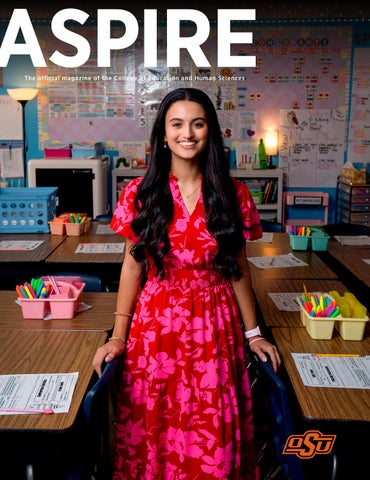
Investing in Educators A surprise scholarship from longtime donor Bryan Close lifts the burden of student debt for new teacher Gabby Olson as she begins her career in the classroom. Pages 32-35 (Cover photo: Kelly Kerr)
The new Aviation and Space and Nursing units are two growing programs and prepare professionals for the state’s workforce.
08 People Matter
New CEHS dean Stephen Clarke shares how relationships, compassion and service shape his leadership and vision for the college.
14 Paragon of Positivity
Physician assistant Keely Nickel combines medical expertise, human connection and a passion for serving OSU and rural Oklahoma.
20 More Than Advising
Meet CEHS professionals who support students as individuals, helping them navigate college and prepare for what comes next.
COMMUNICATIONS COORDINATOR Kirsi McDowell EDITOR Jordan Bishop ART DIRECTOR Dave Malec
FEATURES
02 New Schools
MARKETING AND COMMUNICATIONS DIRECTOR Christy Lang
26 Hype and the Heart
After 15 months of preparation, OSU’s Unified All-Star Flag Football team heads to the 2026 Special Olympics USA Games.
47 Smoke Screen
OSU researchers are using nanofiber technology to create safer, more functional protective clothing for wildland firefighters.
58 Eyes on the Future
Technology is helping preserve Stillwater’s Washington School as it becomes a community gathering place.
DESIGNER Cody Giles CONTRIBUTING WRITERS Christy Lang, Kirsi McDowell, Brittney Purcell, Annie Ross and Faith Frantz PHOTOGRAPHERS Kelly Kerr, Gary Lawson, Ellie Piper and Phil Shockley
ASPIRE Magazine Oklahoma State University College of Education and Human Sciences 106 Nancy Randolph Davis Stillwater, OK 74078-4033 405-744-9805 | contact.ehs@okstate.edu education.okstate.edu
ASPIRE magazine is publication of the Oklahoma State University
College of Education and Human Sciences. It provides information on college activities, changes and accomplishments while fostering communication and ties among alumni, family and friends .
The office of publication for ASPIRE is 307 Whitehurst, Stillwater, OK 74078-1024. © 2026, ASPIRE. All rights reserved. Oklahoma State University, as an equal opportunity employer, complies with all applicable federal and state laws regarding non-discrimination. OSU is committed to a policy of equal opportunity for all individuals and does not discriminate based on race, religion, age, sex, color, national origin, marital status, disability, or veteran status with regard to employment, educational programs and activities, and/or admissions. For more information, the director of equal opportunity/ Title IX coordinator is located at 201 General Academic Building and can be reached at 405-744-1156 or by visiting EEO.OKSTATE.EDU. This publication, issued by Oklahoma State University as authorized by the College of Education and Human Sciences, was printed by Slate Group, at a cost of $8,277.50/5M/October 2026.
O K L A H O M A S TAT E U N I V E R S I T Y
1
UNIVERSIT Y
SCHOOL OF AVIATION AND SPACE
NEW SCHOOLS AVIATION AND SPACE AND NURSING SOON TO BECOME THEIR OWN ACADEMIC DEPARTMENTS
STORY CHRISTY LANG PHOTOS KELLY KERR, AUDREY LAYTON, ELLIE PIPER AND BRITTNEY PURCELL
F
rom educating future aviation and aerospace leaders to preparing the next generation of nurses, two of the College of Education and Human Sciences’ fastest growing programs are entering a new chapter. On July 1, 2027, Oklahoma State University will establish the School of Aviation and Space and the School of Nursing, recognizing the remarkable growth and impact of both programs. “Establishing these schools reflects the extraordinary growth of both programs, their importance to Oklahoma’s workforce, and the opportunities ahead for students, faculty and stakeholders,” College
2
ASPIRE | 2026
of Education and Human Sciences Dean Stephen Clarke said. “It also recognizes the exceptional work of our faculty, staff, students and partners who have contributed to their success.” As the new schools are formed, both will remain part of the College of Education and Human Sciences. One program helps address Oklahoma’s growing healthcare needs, and the other supports one of the state’s largest industries, yet both share a common purpose: preparing highly skilled professionals whose work strengthens communities across Oklahoma.
Aviation has been part of OSU’s story for nearly a century. What began with the Civilian Pilot Training Program in 1935 has evolved into one of the university’s most sought-after areas of study, attracting students from across the nation and supporting Oklahoma’s thriving aviation and aerospace industry. The program’s momentum is evident. In the last decade, enrollment across undergraduate degree options has increased substantially. OSU receives more than 1,000 applications annually for the bachelor’s degree in aerospace administration and operations, now the fifth-largest major by enrollment at OSU. Graduate enrollment has also doubled in the last five
years, attracting industry professionals from across the U.S. Thanks to the generosity of many donors, the Ray and Linda Booker OSU Flight Center opened in 2022 and has further strengthened its capacity to provide outstanding aviation education and hands-on training. Currently, the program is part of the School of Educational Foundations, Leadership and Aviation. Aviation and aerospace play a vital role in Oklahoma, producing $52.5 billion in economic impact annually, according to the Oklahoma Department of Aerospace and Aeronautics. The School of Aviation and Space will strengthen OSU’s ability to support one of the state’s fastest-growing industries while expanding opportunities for education, research and industry partnerships in aviation, aerospace and the emerging space sector.
SCHOOL OF NURSING As Oklahoma continues to face a critical need for highly qualified nurses, OSU is well positioned to help meet this workforce challenge. OSU Nursing has grown remarkably in a short time. In 2023, CEHS introduced the Bachelor of Science in Nursing on the Stillwater campus, joining the online RN to BSN program. Currently, the program is within the School of Community Health Sciences, Counseling and Counseling Psychology. This fall, the university welcomed more than 350 first-year students in nursing, and total enrollment in the major surpassed 1,000 students. The Mary K. Chapman Nursing Simulation Lab opened in spring 2025 and has enhanced opportunities for students to develop the clinical skills and confidence essential to patient care. Faculty and clinical partners have been instrumental in supporting rapid growth and in preparing
students for the demands of professional nursing practice. With strong firsttime NCLEX pass rates and a 100% job placement rate, OSU is successfully preparing nurses who are ready to serve in hospitals and other healthcare settings. Establishing the School of Nursing will strengthen the visibility of the nursing degree, while supporting the development of clinical and community partnerships. It also provides a strong foundation to expanding opportunities for students pursuing careers in both patient care and advanced practice and leadership roles. Dr. Clarke says the schools reflect the college’s commitment to serving students and to building the Oklahoma workforce. “CEHS continues to evolve to meet the changing needs of Oklahoma while preparing graduates who will lead, serve and make a difference in their professions and communities,” Clarke said.
O K L A H O M A S TAT E U N I V E R S I T Y
3
E D U C AT I O N
SETTING THE SCENE | As head of OSU’s School of Teaching, Learning and Educational Sciences, Dr. Stephanie Hathcock is helping shape the next generation of educators.
Teaching Teachers
Hathcock confident in vision for School of Teaching, Learning and Educational Sciences STORY FAITH FRANTZ | PHOTO KELLY KERR
D
r. Stephanie Hathcock believes great teachers don’t just happen; they are thoughtfully prepared, supported and inspired. As head of Oklahoma State University’s School of Teaching, Learning and Educational Sciences, she is working to ensure future educators leave Stillwater ready to make a difference in classrooms and communities across Oklahoma and beyond.
4
ASPIRE | 2026
“Teaching is a very complex profession, and it requires training and thoughtfulness,” — a lesson Hathcock said she learned after stumbling into a passion for teaching middle school science while completing her bachelor’s degree at John Brown University in Siloam Springs, Arkansas. This very passion also led her to earn a master’s degree in education at the University of Arkansas.
After nearly 10 years of teaching, Hathcock realized she wanted to make an even bigger impact on schools — a revelation that called her back to pursue a Ph.D. in science education at Old Dominion University in Norfolk, Virginia. Hathcock’s goal shifted from teaching students to teaching teachers, and she joined the OSU faculty in 2014. As her career progressed, her goal transformed to include supporting the faculty
she works alongside and pushing STLES to reach its greatest potential. “I enjoy trying to solve problems at a systemic level. I enjoy working with faculty to build capacity, to honor the work they’re doing, and to make change at a level that helps faculty move in the direction they want to progress,” Hathcock said. Hathcock has spent her time at OSU focused on preparing future teachers for the profession, the district and the school they will soon belong to. “Any time I’m around our undergraduate students, I walk away with optimistic thinking,” Hathcock said. “They’re here for the right reasons. They’re excited about teaching, and I hope they enter a district and a school that values and encourages them and wants them to be there.” In her work to equip students to enter the classroom prepared for the challenges that await them, she has also been able to appreciate the students themselves and the unique environment STLES provides for them. “There are a lot of people who love being around children, and that’s a great start, but our students are here because they want to be highly trained professionals,” she said. “I appreciate that our students are here to become comprehensively trained in their profession.” STLES has a primary focus on developing graduates who leave OSU prepared to facilitate healthy and enriching learning environments for students. The School aims to equip its students to be innovative leaders who understand not only what today’s classrooms need but also how to continue searching for that information through intensive research processes.
SHAPING UP | Hands-on learning gives future educators opportunities to build the skills they will carry into their own classrooms.
“There are a lot of people who love being around children, and that’s a great start, but our students are here because they want to be highly trained professionals. I appreciate that our students are here to become comprehensively trained in their profession.” DR. STEPHANIE HATHCOCK
HEAD OF OSU’S SCHOOL OF TEACHING, LEARNING AND EDUCATIONAL SCIENCES
When it comes to the future of OSU’s teacher education programs, Hathcock and her team are working to build a strong network of partnerships with school districts to further prepare STLES students for careers in education. She is confident OSU students will meet the needs of today’s classrooms. “I hope that our students leave as thoughtful practitioners who are
data-driven and seek continuous improvement,” Hathcock said. “We are working hard to develop and launch successful pipelines to increase the number of teacher education candidates and the level of their preparedness to work in today’s schools.”
O K L A H O M A S TAT E U N I V E R S I T Y
5
FA C U LT Y
BRIGHT MIND | Dr. Chia-chen Yang received a Fulbright U.S. Scholar Award to conduct research and collaborate with scholars in Taiwan during the 2026-27 academic year.
The Future is Fulbright Improving student outcomes in the digital age STORY ANNIE ROSS | PHOTO KELLY KERR
F
or Dr. Chia-chen Yang, research has always been about understanding how people connect. She is an associate professor of educational psychology in the School of Educational Foundations, Leadership and Aviation. Yang studies the ways adolescents and emerging adults navigate relationships, identity development and general well-being in an increasingly digital world. Now,
6
ASPIRE | 2026
her work is receiving international recognition through one of the nation’s most prestigious academic honors. Yang was selected as a recipient of the Fulbright U.S. Scholar Award, a highly competitive program supporting international research and collaboration, for the 2026-27 academic year. The award will provide Yang with $25,000 in funding to spend seven months in Taiwan
— coincidentally her home country — where she will collect research data, collaborate with international scholars and expand her global research network. “Academia is full of rejection. It’s basically the default,” Yang said. “When I read that ‘Hey congratulations’ message, I thought, ‘Woah, I actually got it.’ “It felt really validating, and I also haven’t been able to spend this much time in my home country
SOMETHING TO NOTE Dr. Chia-chen Yang has been recognized among the world’s leading researchers for five consecutive years. Based on standardized citation metrics compiled by Stanford University and Elsevier, she has ranked among the world’s top 2% of scientists in her field every year from 2021 through 2025.
since I came to the States, so that is something to look forward to.” The Fulbright Program, which is sponsored by the U.S. Department of State, is designed to increase mutual understanding between nations through educational and cultural exchange. For Yang, the opportunity represents both a personal milestone and a chance to strengthen international partnerships that can benefit students, researchers and the university. During her time in Taiwan, Yang plans to advance research related to the psychosocial development of young people in the digital age. Her work examines how adolescents and emerging adults use communication technologies and social media, and how those platforms influence identity, development, social relationships and socio-emotional well-being. The research has important implications for international students, a population that often relies heavily on digital communication to maintain connections with family and friends across the globe while building new relationships within university communities. By conducting research abroad and working alongside scholars in Taiwan, Yang hopes to gain access to new data sources and
perspectives that will further deepen her understanding of how technology shapes social experiences across cultures. Prior to receiving the award, Yang had already been in contact with scholars in Taiwan who were collecting information from 2,000 parents and adolescents. Once Yang arrives in Taiwan, she will examine this data and collaborate closely with her Taiwanese colleagues. “I am going there to access the data and really use that opportunity to explore further collaborative opportunities with Taiwanese scholars,” Yang said. “It’s usually very challenging to collect that level of data by oneself. “The fact that the Taiwanese government is sponsoring the research — and they have some amazing research assistants collecting data for the team — makes the process much more manageable.” The Fulbright recognition adds to an already distinguished record of scholarly achievement. Yang’s interdisciplinary research bridges developmental science and communication studies, earning recognition across both fields. Her work has appeared in leading academic journals, including the Journal of Youth and Adolescence; the Journal of Applied Developmental Psychology; Computers in Human Behavior; and Cyberpsychology, Behavior, and Social Networking. In 2017, she received the Emerging Scholar Best Article Award from the Journal of Youth and Adolescence. More recently, her expertise gained national attention when her research was featured in a 2024 New York Times article examining technology and loneliness, where she provided insights into the relationship between digital technologies and social connection.
That sustained recognition reflects both the quality and influence of her scholarship, according to Dr. Mike Yough, professor and interim head of SEFLA. Yough, who was on the committee that hired Yang in 2019, has strongly advocated for her ability to improve OSU’s research methods. “Her scholarship continues to progress, and one thing the College of Education and Human Sciences is thrilled about is that she involves students in her research,” Yough said. “The students really aspire to have and uphold that same level of scholarship that Yang maintains. “She is just an excellent adviser and mentor.” Yough said Yang’s selection for a Fulbright U.S. Scholar Award highlights not only her individual accomplishments but also the university’s growing reputation for impactful research and international engagement. The collaborations developed through programs such as Fulbright can open doors for future research initiatives, strengthen academic networks and create new opportunities for students and faculty alike. As she prepares to leave for her Fulbright experience in December 2026, Yang’s work continues to demonstrate how research can transcend geographic boundaries while bringing together scholars, institutions and communities in pursuit of a deeper understanding of human connection in the digital world. “I enjoy what I am doing, and I owe this to my former advisor and the many wonderful mentors I have had,” Yang said. “It’s the younger generation that’s going to push the research forward. They are going to do the more cutting-edge research that will advance human well-being. “I think that’s a beautiful thing.”
O K L A H O M A S TAT E U N I V E R S I T Y
7
People Matter
LE ADERSHIP
GOT YOUR BACK | Dean Stephen Clarke presents Olivia Napier with her Orange Gown as the College of Education and Human Sciences 2026 honoree.
8
ASPIRE | 2026
New CEHS dean Clarke is focused on relationships, compassion and commitment to helping others STORY CHRISTY LANG PHOTOS KELLY KERR
B
efore serving as department head, associate dean and now dean of Oklahoma State University’s College of Education and Human Sciences, Dr. Stephen Clarke was a music student searching for direction. “I’m not afraid to say that I attended many schools before I found my path,” Clarke said. A native Oklahoman who grew up north of Enid, Clarke left the state to pursue music, studying piano and trumpet. By the time he reached his fourth college, however, he knew something wasn’t clicking. Then a general education course changed everything. “After taking the first test in an introduction to human nutrition course, I knew what I wanted to do,” he said. “It was way more fun and came easy to me. I was 100% in.” The decision redirected his career toward nutritional sciences, and eventually research and higher education. Years later, another moment of clarity would shape the kind of leader he wanted to become. While watching the Tour de France during a trip to Colorado, Clarke found himself reflecting on his professional role in a highly competitive research
environment where teaching often felt secondary. “I realized my priorities were supporting and interacting with students while also doing highquality research,” he said. That realization ultimately led him to OSU, where he has spent nearly two decades serving students, faculty and staff. In his position, Clarke’s philosophy remains rooted in the same belief that guided both turning points in his career: people matter. Whether preparing teachers, nurses, counselors, pilots or other professionals, Clarke sees the college’s mission as fundamentally human. In a time of rapid technological change and growing questions about the value of higher education, he believes success still depends on relationships, compassion and a commitment to helping others. “Somewhere in the College of Education and Human Sciences is the person who will teach a child to read, who will be in the room when a family gets hard news, who will fly the aircraft the rest of us are sitting in,” Clarke said. That belief in the power of people is central to Clarke’s leadership and vision for the future of CEHS. In the conversation below, he reflects on the challenges facing higher education, the importance of preparing compassionate professionals and the impact CEHS graduates have on Oklahoma and beyond. It’s a pivotal time with a lot of change happening in higher education. Can you talk about those challenges? We understand that confidence in higher education is at a low. Higher education is steeped in tradition, and we need to adapt.
O K L A H O M A S TAT E U N I V E R S I T Y
9
LE ADERSHIP
How people learn is different than it was 10 years ago. Assessing learning is different than five years ago. In the past, I think society has rewarded “just getting the degree.” Today, there is a need to understand that the investment is worth it, that what I’m learning will make me better, help me. More than content knowledge, it’s application. What do you want people to know about the College of Education and Human Sciences? We are a college that prepares practitioners, people who are going to work with other people. In this age of the existential threat of AI, I look at that as somewhat irrelevant (for us). AI obviously plays a role in everything we do, but I’m incredibly proud of what this college accomplishes because we are committed to training students to be effective, compassionate professionals, to be able to work with and help people. We develop the durable skills that help our graduates be successful — communication, empathy, listening to understand. All those skills make you a better pilot, teacher, nurse, health care provider and a better professional. Employers tell us those skills matter.
ORANG TIE AFFAIR | Stephen Clarke presents Virgil Williams with the 2026 CEHS Hall of Fame Award.
10
ASPIRE | 2026
We’re doing the great things that change the world and transform lives, and we do it every day. We sometimes take it for granted. We’re going to lean into it. We want people to know how our students and graduates are changing lives when they leave here and quite frankly while they are here. What is your best advice for students? Show up, go to class, do the work. Create relationships with faculty, staff and students - that’s your support network for life. Ask questions. I challenge every student - introduce yourself to the professor in the first few weeks of class. Lean into being a compassionate, caring human. You coached the OSU Unified All-Star Flag Football team that competed in the Special Olympics USA Games in Minnesota this past summer. How would you describe the experience? It was magical. We had a lot of good times. One of the other coaches said it best — for nine days everybody you are around is happy. It’s
a celebration of people coming together, competing, having a good time and creating community in a way that is incredibly special and rare. I learned more in nine days than I had in the last two years. SCAN HERE
Hear more from Dean Clarke in this episode of the We’re Only Human Podcast.
Dean Clarke
Get to Know
Roles at OSU • Professor, Nutritional Sciences (2007-present) • CEHS Senior Associate Dean for Faculty Affairs, Research and Graduate Studies (2022-26) • Department Head, Nutritional Sciences (2017-21)
Must-Listen Podcasts • College Matters • Fast Talk • Fixable
Favorite spot on the OSU campus • Edmon Low Library
Favorite Travel Destinations • Paris • New York City
O K L A H O M A S TAT E U N I V E R S I T Y
11
H E A LT H C A R E
RURAL RENEWAL | Dr. Douglas Knutson shares his vision for expanding access to behavioral healthcare by developing local workforce pathways in rural and Indigenous communities.
Closing the distance to care Maximizing well-being for Indigenous and rural communities STORY KIRSI MCDOWELL | PHOTO KELLY KERR
M
any individuals across Oklahoma have limited access to behavioral health services, which makes it difficult for life-saving interventions to reach them in critical moments. Rural youth, young adults and other subpopulations, including Indigenous people, report elevated rates of suicidal ideation, substance use, anxiety and depression, relative to urban populations.
12
ASPIRE | 2026
Dr. Douglas Knutson — associate professor and interim head of the School of Community Health Sciences, Counseling and Counseling Psychology at Oklahoma State University — recognized this shortfall and is researching a solution. As a board-certified counseling psychologist and member of the American Psychological Association Committee on Rural Health, he is well-versed in the subject.
Numerous studies show that one way to meet the elevated — and largely unmet — need for behavioral health support among rural youth and young adults is to create accessible pathways into behavioral health careers for those individuals and expand the behavioral health workforce in rural areas. Knutson works with tribal nations and other organizations to design modular, community-based, rural-accessible behavioral health
education programs to expand access throughout Oklahoma and surrounding states. Key partners in Knutson’s progress have included Payne County Youth Services, Cherokee Nation Health Services, Southern Plains Tribal Health Board (SPTHB), OSU’s Center for Sovereign Nations and the OSU Institute for Teaching and Learning Excellence (ITLE). The Bureau of Health Workforce projects massive nationwide shortages by 2038, including a deficit of 99,780 mental health counselors, 99,840 psychologists and 43,810 psychiatrists. These figures only represent current service utilization. When unmet need is considered, an additional 136,350 psychologists are needed just to close the gap. Behavioral Health Aide (BHA) models return healthcare to tribal, rural and remote locations, elevating residents of those areas to the role of care provider, recognizing that healing can happen within their own communities — at home. Dr. Kara Stone, research epidemiologist for SPTHB, is one of many experts working with Knutson to inform and evaluate the development of a BHA microcredentialing program at OSU. She helps connect the research, community engagement and workforce development pieces while ensuring that the curriculum aligns with community-based participatory research principles. “I am drawn to working with [Knutson] because his passion for serving our communities and his general love and respect for others are so apparent in every exchange we have,” Stone said. “I am confident partnering with him to explore how OSU can create an accessible, communitybased pathway for training and credentialing BHAs.”
INDIGENOUS HEALTH BY THE NUMBERS
830.6
Age-adjusted deaths per 100,000 among Indigenous Americans. Leading causes were heart disease, cancer and unintentional injury.
436
Counties served by the Southern Plains Tribal Health Board
99.8%
Counties designated Health Professional Shortage Areas
42.9
Youth injury deaths per 100,000, the nation’s highest rate
2.5X
Higher rate of serious psychological distress
2ND
Leading cause of death for Indigenous youth ages 8-24: suicide
recognizes these factors can intersect and influence one’s ability to access and benefit from care. Developing a local workforce by offering an academically rigorous, culturally responsive and practical BHA program is one strategy to address some of these factors. The goal is not simply to expand credentialing but to create a pathway into a sustainable Tribal behavioral health workforce that communities can shape and maintain. College of Education and Human Sciences Associate Dean Dr. DJ McMaughan emphasized that Knutson’s curriculum is grounded in community need for behavioral health training in rural and Indigenous populations, directly supporting the mission of the school and greater university. “The incredible resources, support and value OSU has for this sort of work is something to be celebrated,” Knutson said. “I could not do this work without passionate, dedicated partners.” SCAN HERE
Source: Centers for Disease Prevention and Control
Distance, cost, transportation and a lack of providers who understand cultural context can all create barriers to care for tribal communities. According to Indian Health Services, Indigenous people experience a lower life expectancy and a disproportionate disease burden, rooted in economic adversity and historical trauma. Much of this is avoidable with prevention and timely access to quality care. Rather than viewing behavioral health in isolation, this work
Learn more about Knutson’s department.
O K L A H O M A S TAT E U N I V E R S I T Y
13
ALUMNI
PARAGON OF POSITIVITY OSU PHYSICIAN ASSISTANT EMBODIES CAN-DO COWBOY ATTITUDE STORY ANNIE ROSS | PHOTOS BRUCE WATERFIELD AND PROVIDED
F
rom outstanding senior to outstanding professional, Keely Ratcliff Nickel has proven herself to be a true embodiment of Oklahoma State University’s medical programs. A fourth-generation Cowboy, Nickel graduated in 2020 with a bachelor’s degree in nutritional sciences and was honored as an OSU Senior of Significance. Today, she has two OSU degrees and works as a physician assistant, playing a vital role in providing medical care to Cowboy and Cowgirl student-athletes. To get to where she is now, Nickel worked above and beyond in school, which made it easy for her
14
ASPIRE | 2026
undergraduate advisor, Laura Price, to recall their time together. “Keely has always maintained the Cowboy spirit, and she has bled orange since the beginning,” Price said. “She really was such a great student with a strong work ethic and positive attitude. She set really high goals for herself and worked the whole time to achieve them. “I think she embodies everything it is to be a Cowboy.” Price said Nickel’s positivity is something she remembered most. No matter the occasion, Nickel always had a smile on her face. Although Nickel was enrolled in rigorous courses, she was determined to succeed. Her work
SMILE AS BIG AS THE SKY | Keely Ratcliff Nickel has carried a positive outlook from her undergraduate years at OSU into a career caring for patients and student-athletes.
O K L A H O M A S TAT E U N I V E R S I T Y
15
ALUMNI
ethic was noticeable from the moment she walked into Price’s office as a freshman. “I remember meeting her, and she was already so driven and committed,” Price said. “I knew she was going to be very academically inclined, but she was also so kind and easy to work with.” During Nickel’s undergraduate studies, she served on the College of Education and Human Sciences Student Council. “She really was a champion for the college when she was in that role,” Price said. “She worked hard to lead the organization, and she put in a ton of time and effort into it.” Nickel said her experience participating in extracurricular and leadership positions helped her learn skills essential in both her graduate studies and career. Along with her involvement on campus, Nickel gained experience in the medical field by volunteering with OSU Sports Nutrition, where she primarily assisted the football team. After completing her bachelor’s degree, Nickel enrolled in the PA program at the OSU Center for Health Sciences in Tulsa. Nickel credited OSU for not only preparing her for graduate school but also the professional world, noting OSU didn’t just value a passing test score but emphasized the importance of empathy and human connection. “Anyone can gain knowledge and learn information, but it’s really about knowing how to listen to people and respond to them — that’s the real skill,” Nickel said. “I think OSU really values character, and faculty want to encourage students’ growth and provide opportunities to serve other people.” Today, Nickel serves residents of rural Oklahoma at OSU Family Medicine in Mannford, Oklahoma. Nickel values her work in Mannford
16
ASPIRE | 2026
BEFORE AND AFTER | Nickel, a fourth-generation Cowgirl, earned two degrees from OSU before beginning a career in healthcare to serve the Cowboy family.
“SHE IS THE EPITOME OF WHAT WE HOPE OSU GRADUATES WILL BE, AND HOW THEY’LL GIVE BACK TO THEIR COMMUNITY.” DR. JASON MOORE
TEAM PHYSICIAN FOR OSU ATHLETICS
— a town of about 3,200 people — given her own upbringing in Amber, Oklahoma, which is home to just under 500 people. “One of the best parts of rural medicine is that the patients know everyone in the office. They’re all involved in the community,” Nickel said. Another unique aspect of rural health care is a lack of access in many communities. Nickel, who completed a Master of Science in Physician Assistant studies in 2023, said she felt prepared to join the team in Mannford because OSU’s PA program emphasized practicing
medicine in these underserved communities. PA school students are required to do rotations in rural settings throughout the state. Of the 15 rotations Nickel completed, she said only five were in urban communities, highlighting the program’s commitment to this work. As a means of expanding care options for rural residents, Nickel said OSU connects specialized medical professionals with practitioners to adequately treat patients. Although providing health care to every Oklahoman
is not a problem that can be fixed overnight, Nickel appreciates what OSU does to expand its reach. “If there is someone in Beaver, Oklahoma, who has a patient with HIV, and the local medical provider has never treated that before, or they don’t have a lot of experience, that physician could present a case to a specialist and then be instructed on how to manage the patient,” Nickel said. “Now, that patient can be taken care of by their own medical provider without traveling outside their community.” Not only is Nickel giving back to rural communities, but she has also become a vital part of the OSU Sports Medicine team. Dr. Jason Moore, a team physician for OSU Athletics, said he first met Nickel during one of her rotations during PA school, and he immediately noticed the positive energy she radiates. Nickel’s attitude made Moore’s decision to hire her a no-brainer when the athletic department decided to bring a female physician to the team. “We feel it’s important for the female student-athletes to have a physician they can relate to,” Moore said. “Keely’s personality was just spot on for this type of position. She’s just lovable and always joyous, but she is also super intelligent.” Moore said there isn’t a better person to represent the Cowboy Code. “Her legacy is being involved with OSU in general, but now she’s taking it to the next step by caring for the kids that are now a part of the OSU family as undergraduates,” Moore said. “It’s just a neat cycle to see. “She is the epitome of what we hope OSU graduates will be, and how they’ll give back to their community.”
O K L A H O M A S TAT E U N I V E R S I T Y
17
NURSING
GET BY WITH A LITTLE HELP | OSU nursing students build their skills through supplemental instruction, a peer-led program created to help students navigate the challenges of nursing school.
Taking Charge
OSU Nursing students offer peer-led supplemental instruction sessions STORY FAITH FRANTZ | PHOTOS KELLY KERR
O
klahoma State University’s four-year Bachelor of Science in Nursing program has thrived since its introduction in fall 2023, driven by the students in its first four cohorts and the professors who lead them. The 2025 grand opening of the Mary K. Chapman Nursing Simulation Laboratory attracted praise and interest for its
18
ASPIRE | 2026
specialized clinical simulation rooms that are equipped with high-fidelity manikins and stateof-the-art medical equipment. All the while, another priceless asset to the program was in development behind the scenes. Last spring, a small group of seniors recognized a need for additional support as students transitioned into the professional nursing program. Drawing on
their own experiences, they began tutoring the cohorts behind them through what they called “supplemental instruction.” “They had nothing but a vision, and they acted on it. They put together this program that will forever mark OSU nursing, and I think that’s really admirable,” said Gabriela Garcia, who is in her second semester of the professional nursing program.
Inspired by those who came before her, Garcia now serves as a supplemental instruction tutor. “The peer-to-peer instruction model is very much led by a group of students who understand the challenges of our training and want to offer supplemental instruction,” said Dr. Victoria Rusinov, clinical assistant professor. OSU nursing is known not only for its challenging classes, meticulous prerequisite requirements and hands-on learning, but also for its testing material. To earn a passing grade on a test in nursing school, students must earn 76% or higher — and are required to meet with their professors anytime they fail an exam. To develop the sessions, students drew from their own coursework and asked professors which topics students struggled with most. “The professors saw how receptive we were to their input, and they bought into it — these students did it without money, without any incentive other than purely wanting to help incoming nursing students,” Garcia said. “I thought it was so cool. It was a chance to grow in community with the tutors who are just ahead of you.” Garcia expressed that it’s all about perspective. She noted OSU’s nursing school is especially unique because right off the bat, students are given role models to follow. “We are tutors, yes, but we also get to help them navigate nursing school. It’s a big change; the classes are very different, and the culture is too. We help students embrace it and learn how to handle it,” Garcia says. Behind every nursing student and tutor is a group of professors who have poured into their
students, creating a desire to lead the next generation of nurses toward success. “It’s not just a transition into a new area of expertise and knowledge, but it’s also a big transition as a student,” Rusinov said. “A lot of these students have never had to have a direct relationship with a professor; they’ve never been encouraged to the extent that we have encouraged them to meet with instructors, to ask us questions, to have that ongoing learning experience.” As supplemental instruction sessions began to grow in popularity, Rusinov and her colleagues realized they had the opportunity to create an environment where students build one another up. She hopes her students can develop a specific perspective as they make their way through the program. “As much as we’re their professors, we’re also their peers — we are nurses, and these students are almost nurses,” she said. This semester’s tutors interviewed for their positions last
school year with the sole intention of lending a helping hand to incoming nursing students. After the tutors accepted their roles, the nursing program announced that tutors would be compensated for their efforts. The students who started the program were also reimbursed because they kick-started such an impactful program. “I think it’s so cool that everyone who signed up to be a tutor did so out of the goodness of their heart, and now they’re rewarding us even though we didn’t expect it at all,” Garcia said. “We all leaned into the program because we understand what it takes to do well, and it’s just been amazing.” SCAN HERE
Watch a video tour of the Mary K. Chapman Nursing Simulation Lab.
MEASURED SUCCESS | Peer tutors help OSU nursing students strengthen their knowledge and prepare for the demands of professional nursing.
O K L A H O M A S TAT E U N I V E R S I T Y
19
SUPPORT
More Than Advising 20
ASPIRE | 2026
Meet the people behind student success STORY ANNIE ROSS PHOTOS KELLY KERR, ELLIE PIPER AND PROVIDED
S
tudent success isn’t limited to the classroom at Oklahoma State University. Behind the scenes, the College of Education and Human Sciences has dedicated teams working to support students throughout their academic journeys, from their first campus visit to graduation and beyond. Located in the Nancy Randolph Davis Building, the Patricia Kain Knaub Center for Student Success provides academic advising and connects students with resources to help them reach their goals. Across all academic programs within CEHS, students have support from specific advisors who understand their majors and can help them plan. Kristi Seuhs, director of student academic services, oversees the center and emphasizes an approach that prioritizes students as individuals — not just as names on an advising schedule. “The work that we do is life changing for students and for some, it’s lifesaving,” Seuhs said. The center’s work extends beyond helping students select courses. Advisors help students track degree requirements, explore career opportunities and connect with campus resources when they need additional support. Seuhs, who joined OSU in 1998, said the work requires building relationships with students and understanding the challenges they face. Those relationships can develop over several years, allowing advisors to recognize when a student may need help and connect them with appropriate resources. “We didn’t go to class with you, but we felt like we were on this journey with you,” Seuhs said. For Tom Joyce, a senior academic advisor who works with aviation students, that journey involves helping students connect their coursework with their career goals.
“The work that we do is life changing for students and for some, it’s lifesaving.” Kristi Seuhs
director of student academic services Joyce works with students on academic planning, internship opportunities and professional connections. He also teaches a first-year seminar course, giving him another opportunity to build relationships with students as they adjust to college. Because aviation is a relatively small professional community, Joyce encourages students to begin networking early and connect with faculty members who have experience in their fields of interest. Those connections can help students better understand the careers they hope to pursue, and the steps required to reach them.
“Advising is much more than just making sure students are in the right class,” Joyce said. Joyce said some students pursuing aviation may not immediately see how a general education course relates to their professional goals. Advisors can help them recognize how those classes contribute to skills needed in the workplace. Joyce can also provide realistic expectations about a career in aviation, which helps students learn earlier if they are on the right track. The support also extends beyond academics.
WISE GUYS | Patrick Smith (left), manager of prospective student services, helps potential students and their families learn about academic programs and opportunities.
O K L A H O M A S TAT E U N I V E R S I T Y
21
SUPPORT
HELP YOU FACE IT | Kristi Seuhs, director of student academic services, leads the Patricia Kain Knaub Center for Student Success.
“We care about them individually as a human And we want to support them.” Scott King
director of recruitment and retention
22
ASPIRE | 2026
Joyce said advisors sometimes help students navigate stressful situations and find appropriate support from a range of campus resources. For Joyce, the relationships he builds with students and colleagues are among the most rewarding parts of the job. After briefly working at the Ray and Linda Booker OSU Flight Center, he returned to advising because he missed the environment. “I missed students,” Joyce said. “And the team is just super tight-knit.” That collaborative approach also connects the center’s work with other student support services within the college. The Watson Center for Student and Career Development focuses on prospective students, recruitment, retention and career development. Scott King, director of recruitment and retention, oversees a team that helps prospective students learn about academic
programs and assists current students in finding opportunities to grow personally and professionally. King said students often need experiences beyond earning a degree, particularly when preparing for competitive graduate programs or professional careers. “We’re trying to support extracurricular development when we think about the students that will continue on to a professional school,” King said. “They need more than just the degree” The college’s support staff help students explore career options, find internships, build professional skills and identify opportunities that align with their goals. King said the team also recognizes that each student arrives with different experiences, needs and levels of confidence. “We care about them individually as a humans,” King said. “And we want to support them.” For prospective students, that support begins before they enroll.
Patrick Smith, manager of prospective student development, works with students and families who are exploring CEHS. His responsibilities include campus visits, recruitment events and helping prospective students understand the college’s academic programs. “We want to make sure that they have a lot more information about Oklahoma State and the college when they leave than when they arrived,” Smith said. Smith said campus visits give prospective students opportunities to ask questions about academic programs, scholarships, student organizations and the resources available to help them succeed. His team also employs student recruitment assistants who can share firsthand experiences about their majors and life at OSU. Smith encourages prospective students to schedule an academic appointment during their campus visits. Those appointments allow students to learn more about their intended programs and discuss the resources and opportunities available to them. “Some may be more or less focused on their housing choices, what they can do as a student on campus for organizations — whether those are internal to the college or universitywide — things like that,” Smith said. “Coming to campus, I think, is really an important way to get a little bit of a test drive and feel that this is going to be a spot that they can vibe with and fit in.” Once students enroll, Smith’s team connects them with academic advisors, career coordinators and other staff members who can continue supporting them throughout college. King and Smith’s teams have distinct responsibilities, but their work contributes to a shared goal:
SIGNIFICANT MEMORY | Scott King (background), director of recruitment and retention, works to connect students with experiences that complement their education.
helping students make informed decisions, navigate challenges and prepare for life after graduation. For Joyce, that support is not limited to the appointments that students schedule each semester. Advisors also look for opportunities to help students
behind the scenes, from sharing information about internships to checking that students remain on track to graduate. “Because really, at the end of the day, it’s all about the students,” Joyce said.
O K L A H O M A S TAT E U N I V E R S I T Y
23
SUCCESS
FIRST AMERICA ROYALTY | Kellon Collington (left) and Elijah Grass were crowned 2026 Miss and Mister American Indian OSU.
Indigenous Amplified
CEHS students represent cultural, collegiate pride as 2026 indigenous royalty STORY ANNIE ROSS | PHOTO KELLY KERR
W
ith a new title comes an opportunity to lead. For junior Kellon Collington and senior Elijah Grass, being crowned the 2026 Miss and Mister American Indian OSU means representing more than Oklahoma State University. These new roles mean honoring their Indigenous heritage, amplifying the voices of their communities and serving as role models for other students.
24
ASPIRE | 2026
As students enrolled in the College of Education and Human Sciences, both Collington and Grass are taking a courageous leap of leadership this year while balancing their academic and professional responsibilities. A fourth-generation Cowboy, Collington said it only felt right to pursue a degree in elementary education at OSU. She will also receive a certificate in ethical leadership upon graduating.
When first presented with the opportunity to participate in the 2026 MAIOSU pageant, Collington said she wasn’t sure if it was something she could accomplish. With endless amounts of support from her family and peers at the OSU Center for Sovereign Nations, Collington ultimately felt confident in herself and also in her ability to represent the Indigenous students at OSU.
“I’m stepping into a long, long legacy of other Miss American Indians that come before me,” Collington said. “It’s special to be a part of a legacy, of something bigger than myself. “So many successful Native women have held this title, and I am blessed to be a part of that line.” During her campaign for Miss American Indian OSU, Collington advocated strongly for her platform on bettering education in Indigenous communities. Collington, who is a Cherokee citizen, said her platform was structured around three core characteristics: ensuring accurate curriculum in public schools, encouraging cultural growth among all ages and increasing the number of Indigenous students enrolled in higher education programs. Collington said it was difficult to pick only one topic for her platform, but she knew cultural pride and education were at the top of her list. “It means a lot for me to know who I am and that I am a Cherokee woman,” Collington said. “I want other people to be able to have that confidence and inner-knowledge also.” Sky Rogers, the director of the OSU’s Center for Sovereign Nations, supported Collington from the beginning of her campaign. Rogers said Collington, a member of OSU’s Native American Student Association (NASA), serves as a student leader and is a dynamic member of the center’s outreach and engagement team. Rogers noted Collington has many of the characteristics that a great MAIOSU needs, including leadership and communication skills and can’t wait to see what this year’s Mister and Miss American Indian OSU will accomplish.
“The mission of Miss and Mister American Indian OSU is to further develop the leadership, confidence and creativity of undergraduate students on the OSU campus.” SKY ROGERS OSU CENTER FOR SOVEREIGN NATIONS DIRECTOR
“The mission of Miss and Mister American Indian OSU is to further develop the leadership, confidence and creativity of undergraduate students on the OSU campus,” Rogers said. “Miss and Mister American Indian OSU represent OSU and its Native American community as both role models and ambassadors, and I have no doubt that Kellon will represent both with excellence.” Grass, a Sac and Fox Nation citizen with cultural ties to both Muskogee and Shawnee tribes, is pursuing a degree in nutritional sciences with an option in dietetics. As a transfer student from Tulsa Community College, Grass said he was able to find his community in NASA. Grass said NASA provided him with a cultural experience he feels he may have missed out on because of his upbringing in an urban city. “Whenever I came to NASA, I felt at home pretty quickly,” Grass said. “I got an invite from a classmate, and it was just like a little community for Native people. “It was nice because growing up in Tulsa, I don’t know if I got taken to one powwow as a kid.” Similar to Collington, Grass campaigned for the role of Mister American Indian OSU on a platform he felt passionate about.
Grass’ platform was focused on creating healthy behaviors for Native populations to prevent disease. In 2024, a study found that American Indian and Alaskan Indian adults were 36% more likely than U.S. adults overall to have diabetes, according to the U.S. Department of Health & Human Services. “I thought why not run on that idea as a way to raise awareness,” Grass said. “It’s a long process, like a battle that’s been fought for a while. “So something has to continue. We have to keep raising awareness about this.” Grass’s platform served as a reminder to himself to keep working to better his community and other Indigenous communities alike. After completing his undergraduate studies, Grass is hopeful he will continue his graduate education at OSU. With the skills he expects to learn at OSU, Grass will be equipped to engage with Indigenous communities with the intent of preventing diseases in the future. Together, Collington and Grass represent the next generation of Indigenous leaders, using their education, culture and passion for service to create meaningful change.
O K L A H O M A S TAT E U N I V E R S I T Y
25
OUTREACH
HYPE AND THE HEART OSU UNIFIED ALL-STAR FLAG FOOTBALL TEAM REPRESENTS THE STATE AT NATIONAL COMPETITION STORY BRITTNEY PURCELL | PHOTOS KELLY KERR AND 2026 USA GAMES
26
ASPIRE | 2026
D
odging defenders on Colorado’s All-Star Flag Football team, Oklahoma State University Unified partner Gracie Maschmeier dug deep and applied 15 months of practice and preparation during game one of the 2026 Special Olympics USA Games. Oklahoma’s quarterback Carter Pfieffer targeted Unified partner Abby McNeely until Colorado’s players covered her from all sides. Maschmeier waved vigorously at Pfieffer from the back of the end zone, catching his attention for an open 25-yard pass, and in a beat, the ball was in her hands. With the trust and chemistry built between her teammates, Maschmeier scored a touchdown for Oklahoma. Since 2022, the OSU Unified program has partnered with OSU Intramurals to offer athletic opportunities to adult Special Olympic athletes to compete alongside Unified partners, which include OSU students, staff and faculty. The 2026 Special Olympics USA Games in Minnesota marked the first time OSU Unified athletes and partners were selected to represent Oklahoma at the national level. Oklahoma’s team consisted of athletes Dominic Adkins, Alex Fruits, Garrett Jones, Jared Lowry and Pfieffer, and partners Shanovia Forbes, Maschmeier, McNeely and Emma Roy. The OSU Unified All-Star Flag Football team members prepared themselves to leave their best effort on the field as they represented their state on the national stage in June. Maschmeier’s touchdown was one of many exhilarating moments for the team; still, the play was the result of more than a year’s worth of hard work, commitment, team building and intentional inclusivity.
PUTTIN’ ON THE BLITZ | Members of OSU Unified’s flag football team joined Team Oklahoma at the Special Olympics USA Games, showing off their skills on the field.
O K L A H O M A S TAT E U N I V E R S I T Y
27
OUTREACH
TEAMING UP
“EVERYONE WHO’S A PART OF OSU UNIFIED IS PASSIONATE ABOUT INCLUSION AND PASSIONATE ABOUT INDIVIDUALS WITH DISABILITIES.” SHANOVIA FORBES OSU HUMAN DEVELOPMENT AND FAMILY SCIENCE GRADUATE STUDENT AND OSU UNIFIED PARTNER OF THE ALL-STAR FLAG FOOTBALL TEAM
28
ASPIRE | 2026
Inclusivity is the name of the game for Special Olympics Unified Champion Schools, and OSU Unified has moved the chains. Shanovia Forbes, OSU Unified partner of the All-Star Flag Football team, is a graduate of OSU’s Human Development and Family Science master’s program and a continuing doctoral student within the department. During her graduate journey, Forbes received a message from her graduate advisor, Dr. Jennifer Jones, the director of the OSU Center for Developmental Disabilities, encouraging her to consider an opportunity to become a Unified partner. After joining the program and embracing the community, Forbes became inspired to pursue a master’s thesis studying Unified Champion Schools and the impact they have on social inclusion for Special Olympics athletes in Oklahoma. Her research shed light on OSU Unified’s intentionality in its
social inclusion efforts and on how intention can set a Unified program apart. “I feel that OSU has one of the top Unified programs in the U.S.,” Forbes said. She explained that determining Unified programs’ implementation quality and whether they aid in social inclusion is measured through multiple pillars; however, inclusion is at its strongest when ‘whole school engagement’ is high. This means that the greater the engagement from communities, teachers and students, the greater the inclusion for athletes. “Everyone who’s a part of OSU Unified is passionate about inclusion and passionate about individuals with disabilities,” Forbes said. She noted that the “buyin” support the OSU Unified community has for the program and its members sets it apart from others in and outside of the state.
TALKING ABOUT PRACTICE
The OSU Unified All-Star Flag Football team was led by coaches Tim Jones and Dr. Stephen Clarke, the dean of the OSU College of Education and Human Sciences. Clarke volunteered as the team’s defensive coordinator, with Jones helming the offense. From April 2025 to June 2026, Clarke and Jones saw the team come together for practice twice a week and exude confidence, commitment and dedication to their teammates and the Special Olympics Oklahoma Delegation. “It inspired us, [the coaches] to give everything we had to support them,” Clarke said. The community surrounding the Oklahoma team increasingly amplified the spirit and energy of its players as the Special Olympics USA Games drew nearer. Friends and family of each OSU Unified partner, athlete and coach showed up to support their community and loved ones as the Oklahoma delegation took to the field for five
O K L A H O M A S TAT E U N I V E R S I T Y
29
OUTREACH
intercollegiate games throughout the week. For some OSU Unified athletes, playing on the fields of the Special Olympics USA Games meant working hard and spending valuable time with their teammates. OSU Unified athlete Garrett Jones described what playing alongside his friends on the All-Star Flag Football team meant to him. “It’s being a good teammate, being a good sport and helping cheer on my teammates,” he said. Jared Lowry, a longtime Special Olympics athlete, stated how he felt about the opportunity to compete. “It feels like we are working together to accomplish something big,” Lowry said. Clarke said the Special Olympics Oklahoma Delegation didn’t just accomplish something big; they laid the new foundation to build upon in the years to come.
A SHARED BOND
The definition of inclusivity is unique for each Unified program across the U.S.; however, OSU Unified has chosen to define inclusivity as celebrating and uplifting every athlete’s strengths and supporting each player on and off the field. Throughout 15 months of partnership and teamwork, athletes and partners of OSU Unified’s AllStar team built a familial bond that carried them through the hard work and challenges of a national competition. Maschmeier reflected on how she saw her teammates show up for one another, including their enthusiasm during the highs and perseverance during the lows. Maschmeier suffered an unfortunate injury in the middle of game four during the USA Games, setting her back from competing in the week’s remaining competitions.
30
ASPIRE | 2026
SPECIAL CELEBRATION | OSU’s supporters traveled to Minnesota to watch their Unified players take on the best of the best.
Fortunately, with the support of the team and OSU Unified community, Maschmeier felt the love and care she had for her teammates reciprocated tenfold; she was able to enjoy the conclusion of the USA Games cheering from the sidelines. OSU Unified has shown that when the support and passion of a community band together to support Special Olympics Unified Champion Schools, inclusivity and connection thrive. “Without the SOOK community, this experience would not have been possible, and we are grateful for their support to change lives through sport,” Clarke said.
Explore opportunities to get involved with Special Olympics Oklahoma and OSU Unified at okla.st/unifiedsports.
SCAN HERE
Watch a mic’d up video with the OSU Unified team.
Your gift fuels big dreams. OSUgiving.com
O K L A H O M A S TAT E U N I V E R S I T Y
31
E D U C AT I O N
STORY KI RS I MC DO
32
ASPIRE | 2026
W EL L | PH OTOS KE
LLY KE RR
W
e have a passion to do what’s right, even when it’s hard.” May 2026 elementary education graduate Gabby Olson carries that tenet of the Cowboy Code with her daily in her new career as a thirdgrade teacher. However, Olson’s journey was made easier thanks to the generosity of 1966 Oklahoma State University alumnus and longtime donor Bryan Close.
Granting unspoken wishes
Just days ahead of Olson’s commencement ceremony, a team from the OSU Foundation and the College of Education and Human Sciences, including Dean Stephen Clarke and Close, gave Olson the surprise of a lifetime under the guise of an interview about her embodiment of the Cowboy Code. Each year, a graduating elementary or secondary education major is selected to receive the Bryan Close Teaching Endowment Fund — a unique scholarship that pays off students’ outstanding loan balances, sending them off from OSU free of any school debt. That’s what Close did for an unsuspecting Olson, changing the way she’d be able to approach her first year of teaching and beyond.
A Cowboy from the start
Olson, a native of Coppell, Texas, said that upon visiting OSU as a prospective student, everything just clicked. She was seeking a close-knit school with a strong sense of community. After setting foot on the Stillwater campus, she knew this was the place for her. “What really confirmed my decision was learning more about the elementary education program,” Olson said. “I could tell it was very hands-on, relationship-focused and
intentional about preparing future teachers.” “Looking back, choosing OSU gave me exactly what I was hoping for: a place where I felt a true sense of belonging and purpose.” Olson was demonstrating the Cowboy Code long before it became a focus of a campaign. “To me, it’s about choosing to lead with integrity, perseverance and consistently showing up with purpose. It’s not something you say, but something you live out through your actions,” she said. As a college student, she implemented this by taking ownership of her learning and growth. “That looked like pushing myself in my coursework, asking questions when I didn’t understand something, and stepping outside of my comfort zone in presentations, projects and leadership opportunities,” Olson said. “It also meant holding myself accountable. Managing my time, staying committed even during stressful semesters, and always striving to give my best effort.” During her time as a student teacher in a local fifth-grade classroom, she saw how these values continued to show up in meaningful ways. She demonstrated the code by giving her full effort each day, even when she was tired or things didn’t go as planned, and building relationships with students and supporting them, especially when it required extra patience and time. “I especially connect with the idea of doing what’s right, even when it’s hard,” she said. “In the classroom, that can look like addressing behavior in a way that is supportive but firm, or taking extra time to help a student who is struggling instead of simply moving on. The Cowboy Code is threaded through everything I do as a
student and future educator.”
A new reality
Following up with Olson a few weeks after delivering the lifechanging news, she shared how the endowment had already impacted her. “Going into teaching debt-free is something I never imagined would be possible, especially entering a profession where so many educators begin their careers carrying financial stress,” she said. “Knowing that I can start this next chapter focused fully on my students, my classroom and growing as a teacher, instead of worrying about student loans, is an incredible gift and opportunity.” One of the biggest impacts felt by the scholarship award is the sense of relief for her and her family as she begins her career. “My mom was emotional immediately, and my whole family has just been overwhelmed with gratitude. My dad and sisters were so excited and proud when they found out, and the response from extended family, friends, professors and even people I don’t know has been so supportive and encouraging,” Olson said. “It’s been really special to see how many people are genuinely excited for someone entering education.” What has stuck with Olson the most is the example Close is setting through this scholarship. “Teaching is a career built around giving to others, and for him to support future educators in this way says so much. It makes me want to continue that cycle of encouragement and support throughout my own career,” she said. “I’m just incredibly grateful to Bryan, to OSU, and honestly to everyone involved in making that moment happen. It was such an
O K L A H O M A S TAT E U N I V E R S I T Y
33
E D U C AT I O N
LEARN MORE ABOUT HOW YOU CAN SUPPORT FUTURE TEACHERS Contact Sheri Carter, senior director of development for the OSU Foundation scarter@osugiving.com or 405-612-9637
emotional and meaningful surprise, and I know it’s something I’ll carry with me for the rest of my life.”
Class is in session
Now settling into life as a thirdgrade English Language Arts teacher at Stillwater’s Sangre Ridge Elementary, Olson has affirmed what she knew all along — there is no better career for her than to be an educator. “There is something really special about going from being a student teacher to walking into a classroom with my own name on the door and realizing that these students are now my kids,” she said. Since school started in August, she has learned something new every single day.
34
ASPIRE | 2026
“There are so many parts of teaching that you can prepare for in college, but there are also things you really only learn once you have a classroom of your own. Getting to know my students, watching their personalities come out, and beginning to see their growth has already made all of the work worth it,” she said. “There are certainly challenging days, but there are also so many little moments that remind me why I chose this career. I am incredibly grateful to get to start my teaching career in Stillwater and continue being part of a community that has already given me so much.” Receiving the Bryan Close Teaching Endowment Fund has impacted the way she began her teaching career in more ways than she knew how to put into words. “Graduating from college and beginning your first year of teaching already comes with so many changes, responsibilities and unknowns. Having my student loans paid off allowed me to enter this new chapter without that financial burden following me,” she said. Olson said she especially felt relief as she prepared her classroom over the summer, as a first-year teacher starting from scratch. Close’s generosity allowed her to focus on creating a classroom where
her students would feel comfortable, cared for and excited to learn, rather than worrying about student loan payments while also paying for classroom needs. More than anything, the scholarship gave her an incredible sense of encouragement going into her first year teaching. “Knowing that someone believed enough in me, and in what I was choosing to do with my future, to make that kind of investment is something I will carry with me for a very long time,” Olson said. “Bryan didn’t just relieve a financial burden, he gave me the opportunity to begin my career with a sense of freedom and excitement about what was ahead. I hope that as I continue teaching, I can carry that same spirit of generosity forward and make an impact on my students the way his generosity has impacted me.” SCAN HERE
Listen to We’re Only Human podcast episode with Olson.
IN THIS CONVERSATION • Moderator • Gabby Olson • Dr. Stephen Clarke Dean, College of Education and Human Sciences
• Bryan Close OSU alumni
• OSU Foundation Rep Moderator: “Choosing to become a teacher is a noble choice. In doing so, you’ll be giving much of yourself to others – classrooms full of students, their families and your colleagues, as you work together to support young minds. What made you decide on this career path? What are your plans postgraduation and goals for your career?” Olson: “I think it really was because of the teachers I had growing up. No one in my family is a teacher. So when I decided to go this path originally, my mom was hesitant, especially because, you know, how sometimes teachers may be treated nowadays, all that stuff... But when she saw how passionate I was about this, she knew it was the right choice for me. I think almost every teacher I had growing up knew this was what I was going to be, especially because I was a big teacher’s pet — I think I still am. I think most teachers are growing up. I had such a community growing up from all my teachers, and more than just academically, but those relationships built confidence in me and built my desire to become a teacher. And I’m still in contact with a lot of my elementary school teachers today. I think all of them have just shown me that even when things get harder, even when you might have to choose the hard thing for your students, you know that it’s right to do — because they did that for me. To answer your second question…my plans for postgraduation. I have accepted a job as a third grade teacher in Stillwater, which I’m really excited about. It’s always been a dream of mine to teach upper elementary third through fifth, and I’m really excited that I got to do that and I get to do it in the community that helped me become a teacher, it’s really rewarding. As for future goals, I just want to be that same teacher that I had growing up, where they can still come to me,
even if I’m not their current teacher, and build those relationships that last a lifetime. Dr. Stephen Clarke: “We end the day knowing we gave it everything we had.” Moderator: “As dean of the college, you’ve worked your way up many ranks, spending countless hours giving your energy to students and faculty — both in the classrooms and office, as well as in extracurriculars — you are the epitome of what it means to give all you have. What has been your motivation?” Clarke: I’m going to change my response. I think Gabby just said something that really resonated with me. I think we’ve all experienced it…we don’t get anywhere in this world alone, right? You just talked about the teachers that really influenced you for life, right? And when I think about this — we finish what we start — we do it because we have people around us who support us to be successful. And to me, I think that that’s what it really means. Sure, we’re gonna go above and beyond to make sure you have a great student experience, because that’s what we’re here to do. But we do it because we have a team of people around us who are also committed to ensuring the students succeed. So hopefully we met your standards as the state university. Bryan Close: “Being a Cowboy isn’t in our clothes, it’s in our character.” Moderator: “As a graduate of the university, you will forever be a Cowboy. However it has been your life’s work and the legacy you’ve created in giving back to OSU that demonstrate your character — your true Cowboy spirit. What has been the driving force in that and inspired you to remain so loyal to the university?” Close: That’s a question I’ve answered a number of times over years. I’ve made it no secret that when I was in school, I struggled. I struggled financially. I struggled with grades, but life gave me the opportunity to… I don’t use the term give back…I use to pay it forward.. My goal is to help students, where they don’t have to struggle as much as I did. And I have a special love for teachers, because those are the basis of the next generation. Those teachers have more influence, than even parents do in a lot of cases. So my wish is to help keep teachers in the game.
So what I’ve got is this passion for the College of Education [and Human Sciences]. Particularly in today’s environment. When I was in school, there were no such things as school loans. Or maybe there were, but I didn’t know about it because they would have had to be paid back. So that was not an option for my family. Now it’s almost common. Not to be personal, but did you? Did you have to take out loans? Olson: I did, yes. Close: I think that’s so, so wrong. I think we ought to just erase that. I think… Can we do it? Let’s do it. Olson: Can we do that? Close: Yeah. We just did it. Jayme (Ferrel, Associate Vice President of Constituent Development for OSUF) gave us permission. Awesome. There we go. Moderator: I don’t think she believes you. Olson: I’m confused now… Close: You said you have student debt. Olson: Right... Close: Okay. I think we ought to erase that. And Jayme said we could. Olson: Like, mine? Are you being serious right now? Close: Yes. Today. Olson: Are you serious? Close: Right now. I’m so serious. Olson: Seriously? Wow. Oh, wow…really? I’m sorry, I don’t believe that… Moderator: Give her a little clarification here.. OSU Foundation Representative: This is awarded to a graduating senior, really with the hope that you will start your profession with as little debt as possible to lighten the load. Bryan’s scholarship is paying off your debt. Olson: Oh, you’re going to make me cry. Thank you. This is wonderful. I had no clue this was going to happen. This is awesome. I don’t even know what to say right now. Thank you. I appreciate this a lot.
O K L A H O M A S TAT E U N I V E R S I T Y
35
E D U C AT I O N
BRING HER THE HORIZON | Rebekah Cleary is forging a path toward more inclusive classrooms as she begins a career in special education.
Forging a Path for Change Elementary education alumna looks to be positive advocate in classroom STORY ANNIE ROSS | PHOTO KELLY KERR
S
ometimes the reality of being a teacher means leaving work with a heavy heart. For Rebekah Cleary, an elementary education graduate and 2026 Oklahoma State University Outstanding Senior, that reality hit hard as she spent more time in the classroom during her student teaching experience at PerkinsTryon Intermediate School. However, her passion to do what’s right has helped her overcome the
36
ASPIRE | 2026
challenges that come with being an educator. As a teacher, Cleary pointed out, you are responsible for educating children from all walks of life — including those who have experienced trauma and adverse childhood experiences. “Every day I found out something absolutely devastating about a student’s life,” Cleary said. “But I still have to teach them and support them.”
Despite the emotional weight teachers often carry, Cleary said she has always felt drawn to education. Her motivation to prepare the next generation of students became clear when Oklahoma City’s Mount St. Mary High School — Cleary’s alma mater — introduced its first special education program. After the program’s creation, Cleary began tutoring special needs students. This experience inspired
her to pursue an undergraduate certificate in special education, which she received alongside her bachelor’s degree. In addition to working with special education students during high school, Cleary also supported Opportunity Orange Scholars (OOS), Oklahoma State University’s program for students with disabilities. She worked as a caregiver for disabled elderly individuals, further reflecting her commitment to serving others. “Once I decided I was going to go into education, the only way it would happen was if it was special education,” Cleary said. “Because that was the gap I saw. That people weren’t receiving the level of education they needed or they weren’t being treated with the dignity they deserve.” While at OSU, Cleary’s most notable roles included assisting OOS and honing her leadership skills as the College of Education and Human Sciences student council president. Kennedy Essmiller, CEHS coordinator of student and career development, serves as the student council advisor. Essmiller became the student council advisor during Cleary’s junior year, which meant Cleary was more familiar with the organization from her previous time with student council. Cleary was able to help Essmiller adjust to her new role, and the two frequently communicated about how to best support the council. “[Cleary] was the one who taught me and a former advisor about what student council is and why it’s important,” Essmiller said. “She was really instrumental in laying out what the organization needed from me at the beginning of my tenure as advisor.”
Essmiller said Cleary’s drive to do what is right extended beyond her regular duties as president. Cleary frequently checked in with her and other members to ensure life outside the council was going well. “Cleary stands by the other members of student council when they’re having harder times,” Essmiller said. “She’s a big people person and she cares deeply about those she works with.” In addition to helping improve the mental health and reduce the stress of council members, Cleary also expanded the club’s accessibility. Inclusion does not stop at the classroom for Cleary, and despite some initial pushback, she was able to bring more people into the organization. This began with Cleary’s decision to remove the business casual dress code for the initial student council interview. Cleary said she drew inspiration from the Cowboy Code tenet “Being a Cowboy isn’t in our clothes, it’s in our character,” when she decided to remove the dress requirements. “Somebody’s clothes don’t define them; it’s who they are and what they are able to do,” Cleary said. “I think by doing this, the student council has been able to reach a lot more corners of our college than we have before — by striving to make a more inclusive environment.” As a new graduate, Cleary joined the faculty at the elementary and middle school she attended at a child, St. Philip Neri Catholic School in Midwest City, Oklahoma, as its first special education teacher. Cleary said it is an honor to not only help make schools more inclusive, but also to give back to the community that set her on this path.
“Once I decided I was going to go into education, the only way it would happen was if it was special education. Because that was the gap I saw.” REBEKAH CLEARY
ELEMENTARY EDUCATION GRADUATE AND 2026 SENIOR OF SIGNIFICANCE
“It’s really an honor but also nerve-wracking going into such an administrative role right out the gate,” Cleary said. “I’m hopeful, though, because it says a lot about the administration’s trust in me, and in their understanding of the quality of OSU’s teacher education programs.”
O K L A H O M A S TAT E U N I V E R S I T Y
37
RESEARCH
SMOKE SCREEN
DEVELOPMENT OF NEW PROTECTIVE CLOTHING FOR WILDLAND FIREFIGHTERS BRINGS TOGETHER INTERDISCIPLINARY RESEARCH TEAM
STORY KIRSI MCDOWELL | PHOTOS KELLY KERR AND ERIC PRIDDY
38
ASPIRE | 2026
E
ach time firefighters respond to a fire, they’re risking more than burns — they’re facing exposure to cancer-causing chemicals that can remain on their protective clothing long after the fire is out. Dr. Sumit Mandal, an associate professor in Oklahoma State University’s Department of Design and Merchandising, leads an interdisciplinary team of OSU researchers and state agency partners working to keep first responders safer on the job. Firefighter personal protection equipment — specifically clothing — is designed to protect against heat and flames but often fails to prevent the toxic particles produced by soot and smoke from penetrating the fabric and reaching one’s skin. Mandal’s research addresses this pressing occupational health concern — exposure to carcinogenic particulate matter that penetrates PPE and contributes to elevated rates of occupational cancers, particularly skin cancer. In the Textiles and Apparel Science Laboratory, Mandal and his doctoral students developed nanofiber fabrics — fibers thousands of times thinner than a strand of human hair — that create an effective barrier against harmful airborne particles while allowing heat and sweat to escape. Graduate research assistant Ishmam Zahin Chowdhury evaluates the lightweight material’s performance under simulated conditions, such as the hazardous environments firefighters encounter. The goal is to develop PPE that minimizes on-site injuries and reduces the long-term health risks of repeated exposure.
“THE GOAL OF TRYING TO PROVIDE FUNCTIONAL PROTECTIVE GARMENTS IS VITAL TO THE SUCCESS OF FIREFIGHTERS AND THEIR ABILITY TO DO THEIR JOB.” DR. DOUG SMITH EXPERT IN HUMAN PERFORMANCE FROM THE SCHOOL OF KINESIOLOGY, APPLIED HEALTH AND RECREATION
Moving the nanofiber development from the lab to realworld application and use required a team of human physiology, fire dynamics and particle chemistry experts from OSU and representatives from Oklahoma Forestry Services.
THE HIDDEN THREAT
Wildfire smoke, while primarily consisting of released water vapor, contains many harmful chemicals, said Drew Daily, deputy fire management chief for OFS. “Due to the rigors of the work, wearing a breathing apparatus is overly cumbersome and oftentimes prohibitive to the work that needs to be accomplished — unlike structural firefighters that generally work in more confined spaces,”
O K L A H O M A S TAT E U N I V E R S I T Y
39
RESEARCH
NEW KIT ON THE BLOCK | Dr. Sumit Mandal tests protective nanofiber material to measure how effectively they block smoke and carcinogens.
40
ASPIRE | 2026
Daily said. “This causes exposure to carcinogens that continue to build up over time.” Traditionally worn PPE provides necessary thermal resistance, but it can also contain PFAS, “forever chemicals” that can be absorbed through the skin and are associated with a slew of health risks in dire need of mitigation. Experts in human performance, Drs. Doug Smith and Jay Dawes from the School of Kinesiology, Applied Health and Recreation, assess physiologic responses to wearing different types of PPE while fighting fires. Smith, an exercise physiologist, said it’s important to consider a firefighter’s physical welfare when working at high intensities in suboptimal conditions. “The goal of trying to provide functional protective garments is vital to the success of firefighters and their ability to do their job — to stop fires and prevent serious injury or death to individuals stuck in or surrounded by fire,” Smith said. Wildland firefighting PPE needs to be lightweight and flexible to facilitate strenuous work over long periods of time. “Nanofiber technology has shown promise of mitigating many of these performance concerns by maintaining breathability and facilitating movement while filtering the harmful chemicals readily found on the fireground,” Daily said. Modern turnout gear consists of multiple layers — often three primary protective layers: outer shell, moisture barrier and thermal liner — that work together to provide thermal insulation, moisture protection and mechanical durability. Protective clothing is one of the only things keeping firefighters from an extremely hazardous environment. The challenge is
LET IT BURN | Nanofibers are layered within a PPE jacket worn during an open burn. The jacket is later deconstructed to evaluate the filtration performance of the nanofibers after functional use.
balancing multiple competing needs. Dr. Haejun Park, associate professor of fire, construction and emergency management in the College of Engineering, Architecture and Technology, said the layered construction provides excellent protection against direct flame and radiant heat, but it’s not designed to be completely airtight. “Small openings around the neck, wrists, waist or interfaces between different pieces of equipment can allow hot gases and smoke particles to enter. Repeated movement during firefighting can create a pumping effect that draws contaminated air into the clothing layers,” Park said. “Even when flames never touch the skin, heat can be transferred
“I’VE HELPED DESIGN A LAB-SCALE OPEN BURN SET-UP THAT SIMULATES SMOKE EXPOSURE FROM WILDLAND FIRE ONTO FABRICS.” SAYAK NANDI
DESIGN AND MERCHANDISING DOCTORAL STUDENT
through the materials, resulting in smoke contaminants accumulating within the clothing.”
GOING SMALLER TO PROTECT BIGGER
After understanding the functional needs of firefighters and how traditional PPE behaves, the
TASL team began developing and testing the material that would solve the shortfalls of existing turnout gear. The result: nanofibers, which are produced by electrospinning, a technique that uses an electric field to create an ultra fine network of fibers.
O K L A H O M A S TAT E U N I V E R S I T Y
41
RESEARCH
“By selecting the right materials and controlling the processing conditions, we can tailor the fiber structure for specific performance characteristics, such as thermal protection, breathability and filtration,” Chowdhury said. The aim is to use these materials to develop fabrics that neutralize smoke particles, so that even if carcinogens are present, they are no longer harmful. The manufacturing approach has been established, but material design and optimization remain active areas of research.
PUTTING IT TO THE TEST
Dr. Elijah Schnitzler, an associate professor, uses his expertise in particle chemistry to focus on the chemical and physical properties of smoke from wildfires. “We first began to collaborate with Dr. Mandal when a student
42
ASPIRE | 2026
in his group needed to generate realistic smoke from controlled combustion for depositing onto fabric swatches used in PPE,” Schnitzler said. “Since then, we have gone on to measure the size and filtration of smoke particles.” Schnitzler’s group generates representative smoke particles from controlled combustion of biomass in the laboratory, measures the size distributions of the smoke particles, and measures the efficiency of particle filtration for new textiles. Schnitzler depicted how nanoparticles behave in the atmosphere, comparing them to how a skydiver experiences resistance when falling. “This slow settling is what allows smoke to remain suspended in the atmosphere, elevating risks of inhalation and long-range travel. Optimizing the
interception of particles before they reach the skin of firefighters could help reduce this risk,” Schnitzler said. Design and merchandising doctoral student Sayak Nandi leads the team’s carcinogenic exposure testing for invisible hazards. When vegetation burns, carcinogens are produced and remain present in smoke and soot, including benzo[a]pyrene — a Class 1 carcinogen — along with many other Class 2A and 2B carcinogens. “These don’t just get inhaled, they deposit on the gear and penetrate it, reaching the firefighter’s skin,” Nandi said. “In the immediate, it may lead to redness, itching and irritation. Long-term effects can be severe, leading to DNA modifications, dysfunctional immune systems,
and various other health implications, including terminal cancer.” Since wildfire itself is uncontrolled, having a controlled lab test with similar smoke conditions is tricky, but that’s where Nandi comes in. “I’ve helped design a lab-scale open burn set-up that simulates smoke exposure from wildland fire onto fabrics,” Nandi said. He is developing a standardized testing protocol that measures smoke exposure of fabrics under realistic lab conditions, with the hope that it can serve as a benchmark to evaluate and optimize nanofabrics for use in firefighting PPE. Durability of the nanofabrics remains one of the key investigations. “We are evaluating how these layers hold up after heat exposure
and mechanical wear,” Chowdhury said. “Initial results are encouraging, but longer-term testing is needed before we can state an expected service life.”
DESIGNING FOR THE REAL WORLD
The project highlights OSU’s nationally recognized expertise in functional apparel and protective clothing and demonstrates the College of Education and Human Sciences’ commitment to research that bridges fundamental science with practical application. By combining advanced nanomaterials, textile science and human-centered design with close collaboration with the firefighting community, the research has the potential to transform firefighter PPE and reduce occupational risks for thousands of first responders.
“If we can design protective clothing that blocks invisible cancer-causing contaminants while keeping firefighters cool enough to do their jobs safely and effectively, we can make a real difference in protecting the people who protect all of us,” Mandal said. SCAN HERE
Make a contribution to support ongoing textile research.
O K L A H O M A S TAT E U N I V E R S I T Y
43
STUDENT
GEARED UP | Hannah Marie Akoury competes in the Firefighter Challenge Championship Series, which tests competitors through tasks modeled after the physical demands of emergency response.
Pain Will Not Win
Applied exercise science senior pushes limits in firefighter challenge STORY ANNIE ROSS | PHOTOS PROVIDED
F
or Hannah Marie Akoury, pain is not something to fear — it is something to push through. That mindset helped the Oklahoma State University senior set a new United States record in the Firefighter Challenge League’s 18-29 Individual Female Category with a time of 4:17.56, an accomplishment reflecting years of discipline, endurance and determination.
44
ASPIRE | 2026
The Firefighter Challenge Championship Series is designed to simulate the physical demands of real-life firefighting. Competitors race through tasks that mimic emergency response scenarios while wearing heavy gear and working against the clock. Events test endurance, strength, agility and mental toughness. Preparing for those events requires extensive conditioning
and the ability to work through exhaustion and discomfort. “The offseason training was definitely huge for me as I emphasized cardio training,” Akoury said. “I am always working to catch up to and reach the same level as some of my male peers. “Setting that goal, along with being able to watch others complete the challenge and telling myself, ‘I want to do that,’ has been my source of motivation.”
“They broke the mold when they made Hannah Marie. She is one of a kind and a true inspiration to all those around her.” KIM BEARD
OSU DEPARTMENT OF WELLNESS ASSISTANT DIRECTOR OF FITNESS AND ADVISER FOR THE OSU FIREFIGHTER CHALLENGE TEAM
She set the record at the annual season opener in Indianapolis. Although it was surpassed later that day, the achievement marked a major milestone for Akoury, who serves as president of the OSU Firefighter Challenge Team while pursuing a bachelor’s degree in applied exercise science with a focus in strength and conditioning and a minor in emergency management. For Akoury, the accomplishment not only represented a fast finish time but also reflected the values she has worked to personify both inside and outside the classroom. At OSU, students are encouraged to live by the Cowboy Code — a set of principles emphasizing integrity, perseverance, courage and service. The Code includes statements such as “We know challenges come with pain, but pain will not win,” and “We finish what we start.” Few students embody those ideas more fully than Akoury, according to Kim Beard, who serves as assistant director of fitness for OSU’s Department of Wellness and adviser for the OSU Firefighter Challenge Team. “Hannah Marie truly commits herself to everything she does and uses her grit, determination and dedication to see things through to the finish,” Beard said. “She is as
passionate as they come and is the best leader, team member, student, athlete, friend and more.” She said Akoury stands apart because of her work ethic, resilience and leadership. Originally from Danvers, Massachusetts, Akoury is not just a student-athlete but also a volunteer firefighter for Yale, Oklahoma. Her long-term goal is to become a fulltime firefighter and eventually
complete the Lion’s Den firefighter fitness challenge, one of the most grueling firefighter endurance events in the country. “All of my life I have wanted to do public service,” Akoury said. “... I have a lot of family in the military, including my dad. It’s not the same, but it is similar in the sense of giving back and the mental challenges that come with this field.” Akoury intentionally designed that academic path to support her future. Akoury studies human performance, physical training and athletic conditioning — all directly connected to the physical demands firefighters face every day. Her emergency management minor adds another layer of preparation by teaching crisis response, organization and disaster management. “The minor is a good way to learn about resources and
OVER AND ABOVE | Akoury set a U.S. record in the Firefighter Challenge League’s 18-29 Individual Female Category with a time of 4:17.56 at the season opener in Indianapolis.
O K L A H O M A S TAT E U N I V E R S I T Y
45
STUDENT
SAFETY FIRST | An applied exercise science senior, Akoury uses her studies in human performance and emergency management to prepare for a career in firefighting.
various techniques for mitigating, responding and preparing during moments of crisis,” Akoury said. “With my applied exercise major, the whole program is about keeping your body healthy and getting stronger in terms of both exercise and nutrition.”
46
ASPIRE | 2026
Balancing academics, firefighter training, competitions and work responsibilities requires intense discipline. Beard said Akoury manages all of it while continuing to support others around her. “She is a positive role model for her teammates on the OSU
Firefighter Challenge Team and for her academic peers,” Beard said. “She is always willing to lend a hand to help anywhere needed, and others are inspired by her actions. “They broke the mold when they made Hannah Marie. She is one of a kind and a true inspiration to all those around her.” That willingness to endure difficulty mirrors another principle of the Cowboy Code: “We stand for what matters, even if we stand alone.” Akoury’s journey has required sacrifice and persistence, but those closest to her say she undoubtedly approaches challenges with humility and determination. In April, Akoury and her partner placed second in the Fire Department Under Age 40 Coed Tandem category at the 2026 Firefighter Challenge League Season Opener with a time of 2:01.71. She also placed second in Division 2 Female with a time of 4:12.48. Akoury’s academic and professional success is rooted in consistency, service and a willingness to keep moving forward through adversity. “I just have to push through — because it is painful, but it’s a good type of pain,” Akoury said. “It’s like when you work out, and afterward you are sore, but that soreness isn’t bad. It’s evidence of all the work you have put in.” Whether she is training for competition, studying for class or responding as a volunteer firefighter, Akoury continues to pursue her goals with the same relentless determination that helped her earn a place in the record books.
O K L A H O M A S TAT E U N I V E R S I T Y
47
"Getting to know the students, faculty and staff of our college through meaningful conversation."
T E C H N O L O GY
EYES ON THE FUTURE
Technology of today breathes new life into historic Stillwater school
STORY KIRSI MCDOWELL PHOTOS PROVIDED
48
ASPIRE | 2026
S
tillwater’s historic Booker T. Washington School is being revitalized to once again stake its claim as a lively community gathering space on 12th Avenue. The original school structure built in 1938 was a minority-serving school — for the first time allowing the Black community to attend and graduate from a high school in Stillwater. Over the years, numerous additions were made, turning the school into a larger complex including an auditorium and covered walkways for accessing the east and west wings of the building. Following the desegregation of Oklahoma schools, the final graduating class stepped across the commencement stage in 1956. The
facility later became a gathering place for the community. In the decades since the school’s closure, the building has faced general neglect and significant water damage as it sits in a flood zone, with detrimental floods striking the area from 1935 to as recently as 2019. The Washington School property was purchased by the City of Stillwater in late 2022, after 31 years of private ownership. The purchase was made possible thanks to a donation, with the stipulation that once restored, the space would once again be utilized as a community hub — this time, for all. As part of a collective effort between the City of Stillwater, various civic organizations including the Washington School Heritage
SURVEY SAYS | Lan Pham (second from left) utilized a 3D scanner to create a digital model of the Washington School, preserving the footprint without disturbing the structure.
Foundation, and numerous scholarly professionals and students from Oklahoma State University, the school redevelopment project is well underway. Washington School is one of just three remaining all-Black schools representative of the early 20th century and meets the criteria for recognition on the National Register of Historic Places. It is the only to have potential for preservation. After an initial 2021 site assessment by Dr. Laura Arata, associate professor and director of public history at OSU, with two teams of two history and eight civil and environmental engineering students, supported by several faculty, it was deemed that though damage to the additions were extensive, the original brick structure was sound enough to be saved. The project has grown to become a multidisciplinary collaboration across the university and has garnered perspective beyond the bounds of Stillwater — and the state — in the process. Interior design master’s student Lan Phan, born and raised in Vietnam, is one of many students involved. The College of Education and Human Sciences’ interior design program places focus on the development of designers who promote health, safety, welfare and innovation in the built environment. This is achieved by equipping
O K L A H O M A S TAT E U N I V E R S I T Y
49
TAEL C UH MNNOI L O GY
STANDING TOGETHER | Junior high students pose in front of the Washington School in this historical photo.
The original school contributing to the redevelopment project as Chandrasekera’s advisee. structure built in Although the original “T” structure remain, the 1938 was a minority- Washingtonwould School Heritage serving school Foundation’s goal was to immortalize — for the first the entirety of the school. Due to their poor condition, the east and time allowing the west wings, auditorium and cafeteria were demolished in early 2026. Black community Prior to the demolition is when Phan’s most crucial work took to attend and place, providing the basis for her graduate from entire digital preservation project to capture the architectural and a high school in cultural legacy of the school through virtual reconstruction. Stillwater. students with state-of-the-art, industry-utilized technologies. Phan was introduced to the Washington School project by Dr. Tilanka Chandrasekera — professor and program coordinator for interior design, associate school head for the Department of Design and Merchandising, and director of the Mixed Reality Lab. The latter is where Phan has spent countless hours
50
ASPIRE | 2026
“When I began my master’s degree, I knew I had a love for research and design thesis work about sustainability, or sustainable design. The concept of adaptive reuse, the process of repurposing a building or structure to bring it a new function, is similar to sustainability so I decided to take on this project,” Phan said. Under Chandrasekera’s supervision, Phan had the
opportunity to utilize a Leica BLK360 laser scanner. This piece of technology provides highly accurate measurement scans — within four millimeters at a 10-meter range — generating point clouds that feed directly into computer-aided design (CAD) software. “The most valuable takeaway from this project so far has been using the 3D laser scanner for evaluating historic buildings for preservation purposes,” Phan said. “With this technology, I was able to create a digital model of the school much more accurately and efficiently than traditional measuring. We were able to preserve the building’s footprint without disturbing the fragile structure.” The scans collected were transformed into a point cloud model using the TruView application. Point cloud models provide a measurable digital representation of the structure’s existing conditions, which allows project teams to evaluate spatial relationships, building proportions, circulation patterns and
site context with greater accuracy than conventional drawings or photographs. As she enters the schematic design phase of the process, Phan has conducted ample research on her own about the school and has visualized how she will preserve the building through the digital renderings, but looks forward to the valuable insight from the community of Washington School alumni about what they’d like to see the reimagined space become. This insight will be gathered via a survey distributed by Patrick Daglaris, assistant department head of the Oklahoma Oral History Research Program. To make the survey possible, Phan successfully submitted and received approval from Institutional Research Board (IRB) which monitors and provides oversight on spatial design projects that include human-centered design research — as the school redevelopment project does — to guarantee there will be no negative impact on human subjects providing vital insight. Daglaris has compiled an extensive catalog of artifacts and imagery depicting Washington School at the height of its prime, as well as oral histories directly from
school alumni, which will inform Phan’s work. The significance of Phan’s contribution to this project is that through digital preservation and reconstruction, other modern technologies can be utilized for individuals to experience the school in its former glory. 3D printed models of the school have been produced and can be put on display as fundraising efforts for the physical redevelopment continue. More impressive is that utilizing virtual and augmented reality, those who wish to support the school project or alumni who simply want to reminisce, can “walk” through the school for themselves — including the now demolished additions — through wearable technology such as the Meta Oculus Quest 2 VR headset used in the Mixed Reality Lab to test the digital walkthroughs. With significant progress coming and fundraising to enable the project to move forward, the heritage foundation has high hopes for the future of Stillwater’s Washington School. Revitalizing the space as a community center with an exhibition hall, classrooms, offices, event venue, and more is on the docket for the historic building that will become a
welcome addition to what is referred to as the “12th Avenue Health Corridor”. Projected return to use of the gymnasium is slated for 202829, with the full heritage center reopening to the public in 2030, pending funding. Phan’s work will live on long after the doors open, as guests from near and far are able to experience walking the halls of yesteryear through virtual reality walkthroughs — all thanks to modern technologies. SCAN HERE
Watch a virtual video walkthrough of the Washington school.
O K L A H O M A S TAT E U N I V E R S I T Y
51
SUCCESS
TAKING FLIGHT | Clara Womeldorph Townsend commissioned as a second lieutenant after graduating from OSU in May 2026 and is continuing to Army flight school with aspirations of piloting a Black Hawk helicopter.
Cleared for Takeoff How one OSU senior earned her ticket to the sky STORY ANNIE ROSS | PHOTOS PROVIDED
C
owboys don’t just dream big — they aim for the sky. That statement rings true for Clara Womeldorph Townsend, whose dreams of piloting a Sikorsky UH-60 Black Hawk are coming to fruition. Townsend graduated in May 2026 with a bachelor’s degree in aerospace administration and operations-aerospace security. Along with minors in both aviation management and military
52
ASPIRE | 2026
science, she has had anything but an ordinary journey. From a decade spent perfecting the craft of gymnastics to years of dedicated service as a College of Education and Human Sciences ambassador, Townsend consistently demonstrated the kind of drive and character that defines the Oklahoma State University spirit. Now, having stepped off the commencement stage, Townsend has taken that spirit with her,
straight into the skies alongside the United States Army. “My long-term goal is to make a career out of the military and retire in the army,” Townsend said. “After graduation, I commissioned as a second lieutenant and continued to Army flight school, as a step before commissioning as an aviation officer.” For the 21-year-old, the pull toward service is more than professional ambition — it is
“As a veteran looking at the scenario, one thing I always question is ‘Who are we leaving this in the hands of? When it’s people like Clara, I think, ‘Yeah, we’ll be fine.’ TOM JOYCE
ACADEMIC ADVISER AND ADJUNCT INSTRUCTOR FOR OSU’S AVIATION PROGRAM
personal. From Colleyville, Texas, Townsend grew up in a household where military service was the norm. Both of her parents served in the U.S. Navy, and their example shaped the woman Townsend would become. Her mother left the service when Townsend was born, and her father served a full 21 years before hanging up his uniform. “I always looked up to my dad and admired what he was doing,” Townsend said. “Just being able to watch my dad help people and see everything he was doing inspired me.” Townsend’s path through the university’s Army Reserve Officers’ Training Corps program was defined by excellence. While an OSU student, she attended the ROTC Advanced Camp in Fort Knox, Kentucky, a competitive evaluation that brings together cadets from programs across the country. There, she stood out among her peers, earning the distinction of top female cadet. It is this kind of recognition that speaks not only to physical and tactical ability, but to the leadership, composure and commitment that officers are expected to carry into their careers. In addition to her accomplishments
TAUGHT AND TRAINED | Townsend earned top female cadet honors at ROTC Advanced Camp at Fort Knox, Kentucky.
at Advanced Camp, Townsend was also recognized as a distinguished military graduate. “It’s a huge deal,” said Tom Joyce, an academic adviser and adjunct instructor for OSU’s aviation program. “She was selected out of thousands of cadets who will go on to be military officers. Getting branched aviation education like she did is also a huge deal and extremely challenging to do.” Joyce commended Townsend’s ability to stay motivated in school
while training for her military placement. “The fact that she was able to achieve and maintain her high standards throughout her entire college career is what got her to this point,” Joyce said. For several years, Townsend served as a CEHS ambassador, representing the college as a peer mentor to first- and second-year students, helping them adjust to college life and discover more about their future careers. Her
O K L A H O M A S TAT E U N I V E R S I T Y
53
SUCCESS
leadership skills translated well into her additional role as a local gymnastics coach, allowing her to reflect on one of her previous passions. Townsend spent roughly a decade as a competitive gymnast before her time at OSU. Gymnastics is widely regarded as one of the most physically and mentally demanding athletic disciplines, requiring years of repetitive training, resilience and the ability to perform under pressure; all of which are traits that have helped Townsend meet the expectations of an army soldier. Joyce, who served in the Army as a captain, said he feels confident knowing the military is receiving recruits like Townsend. “As a veteran looking at the scenario, one thing I always
question is ‘Who are we leaving this in the hands of?’” Joyce said. “When it’s people like Clara, I think, ‘Yeah, we’ll be fine.’ “Just knowing that there are upcoming Army officers that care about people, are motivated and are as driven as her is awesome.” Earning a pilot placement is among the most competitive outcomes available to an ROTC cadet. The selection process is rigorous. Desiring to operate a Black Hawk helicopter carries particular weight as the aircraft is one of the Army’s most well-known and critical platforms, deployed across combat, medical evacuation and special operations missions worldwide. Despite her vast list of accomplishments, Townsend said she still doubted her ability to
earn this placement. It wasn’t until she saw her name flash across the screen at branch night — a traditional ceremony to announce which branch cadets will serve in upon commission — that she knew the hard work paid off. “Being a pilot, being in aviation, was my No. 1 option, so it meant everything to me,” Townsend said. As Townsend looks back at one chapter and begins another, her story is a reminder of what OSU’s Cowboy Code looks like in practice. She dreamed as big as the sky, and then she put in the work to get there. The sky, as it turns out, is not the limit. For Townsend, it is just the beginning.
LET THE FUTURE COMMENCE | After graduating from OSU with a bachelor’s degree in aerospace administration and operations-aerospace security, Townsend is turning military service into a career in Army aviation.
54
ASPIRE | 2026
Celebrating 20 Years LIFELONG LEARNING. LIFELONG COMMUNITY. The Osher Lifelong Learning Institute (OLLI) at Oklahoma State University offers classes, tours/trips, international travel and social opportunities. While OLLI’s focus population is adults aged 50+, any adult is welcome to join for the joy of learning!
“When people ask
‘What is OLLI?’
I tell them it’s where truly top-notch learning opportunities meet genuine friendship.” - OLLI Director, Dr. Robin Fuxa
Courses are held in Stillwater, Oklahoma City, Tulsa and online. Classes vary in duration from a single 90-minute session or as long as once a week for eight weeks — and everything in between. Choose from a Premium Annual Membership ($250 per year) for unlimited courses or an À La Carte Membership ($40 per year) for those who prefer to pay per class.
Learn More and Join Today!
STUDENT
ABOUT FACE | Dietetics graduate student Juan Lopez was named the 2025 Oklahoma Army National Guard Soldier of the Year after competing in the Oklahoma Best Warrior Competition.
Soldier of the Year
Dietetics student earns Oklahoma Army National Guard recognition STORY FAITH FRANTZ | PHOTOS PROVIDED
“W
e end the day knowing we gave it everything we had” is more than a line in the Cowboy Code. It’s a principle that dietetics senior Juan Lopez proudly displayed in November 2025, when he was named the Oklahoma Army National Guard Soldier of the Year. Leading up to this achievement, Lopez competed against eight fellow soldiers from across the state in the Oklahoma Best Warrior Competition, before advancing
56
ASPIRE | 2026
to the National Guard Region V Best Warrior Competition. There, he earned third place out of 12 competitors from Oklahoma, Texas, Louisiana, Nebraska, Kansas and Missouri. The Best Warrior Competition is meant to test competitors through physical and mental challenges over several days, ranging from rigorous interviews to mental evaluations, obstacle courses, weapons assessments and more.
Lopez’s humble reflection of his victory includes both the challenge of preparing for these competitions and the long-term outcomes of completing them with excellence. “It was just so impactful, being able to put my effort into something like this and getting such a great payoff, especially because I was training on my own for the most part,” Lopez said. “It was just me coming up with a training plan and sticking to it, so it felt good to earn
“It was just so impactful, being able to put my effort into something like this and getting such a great payoff, especially because I was training on my own for the most part. It was just me coming up with a training plan and sticking to it, so it felt good to earn the fruits of my labor at the end of the day.” JUAN LOPEZ
OKLAHOMA ARMY NATIONAL GUARD SOLDIER OF THE YEAR
the fruits of my labor at the end of the day.” As a result of his achievements in the Best Warrior Competition, Lopez was also meritoriously promoted to the rank of sergeant and awarded the Army Commendation Medal, which recognizes soldiers who go above and beyond their normal duties. Lopez serves as a signal operations support specialist in the 1st Battalion, 160th Field Artillery Regiment, 45th Infantry Brigade Combat Team. While his primary role is to ensure that radios, computers and artillery function properly, Lopez is also tasked with understanding infantry basics, such as medical care, where his background in dietetics comes into play. “Having knowledge in nutrition enables me to help my soldiers fuel and perform better when we are doing exercises, and to advise them on how to improve their performance with what we have on hand if we were to be deployed,” Lopez said. Lopez advises current and future students pursuing nutrition and dietetics to study hard in class, not for the right grade, but for long-term understanding of the subjects. “In dietetics, I found a field that I believed was academically rigorous but also had a very strong human interpersonal component to it, which I thought would be a good fit for me,” Lopez said.
MARCHING AHEAD | Lopez’s performance in the Best Warrior Competition led to a meritorious promotion to sergeant and the Army Commendation Medal.
“It’s been almost four years since my introductory classes, and probably close to two years since the first physiology class I took, and I still have a really robust understanding of these subjects. Management classes can also be applied to any role. The things I learned in that class help me to take a step back when issues come up and then help improve the organization I’m part of.” Lopez looks back fondly on his undergraduate career at OSU, not only because of the classes he has benefited from, but also because of the professors who have become mentors to him. “I think I’m pretty smart, but they’ve got way more experience and intellect than me in that realm,” Lopez said. He also mentioned that his best advice for students would be to confidently connect with people who can provide help.
“Many professionals are eager to share their craft, and all it takes is a bit of courage to reach out to them,” Lopez said. Lopez graduated in May 2026 and is now pursuing a Master of Science in Dietetics Research at OSU while continuing his service in the Oklahoma National Guard. Dr. Jill Joyce, an associate professor of nutritional sciences at Oklahoma State University, speaks highly of Lopez as a student and future practitioner. “Having had Juan in a management class, we regularly geek out on leadership topics and have nerdy, fun discussions about different leadership scenarios,” Joyce said. “It’s been a lot of fun to see Juan grow and develop as a new NCO and leader, and as a future dietitian.”
O K L A H O M A S TAT E U N I V E R S I T Y
57
FA S H I O N
DROP RED GORGEOUS | OSU apparel design and technology students transformed red fabric into original garments to raise awareness of women’s heart health.
Cowboys with Heart
OSU design students partner with Oklahoma Heart Hospital for ‘Wear Red’ Campaign STORY CHRISTY LANG | PHOTOS KELLY KERR
A
t Oklahoma State University, being a Cowboy is defined by character and service. Students in the Department of Design and Merchandising are proving that by partnering with the Oklahoma Heart Hospital to turn fashion into a powerful message for women’s heart health. The red dress serves as the national symbol for the Wear Red for Women campaign, a movement dedicated to educating
58
ASPIRE | 2026
women on the risks of heart disease. Under the guidance of associate professors Dr. Adriana Petrova and Dr. Semra Peksoz, 10 student designers spent months transforming bolts of red fabric into original couture. After months of diligently sketching, cutting and sewing, the students’ completed garments are were displayed throughout February 2026 as part of exhibits in the lobbies of Oklahoma Heart
Hospital North and South in Oklahoma City. Through the red dress project, apparel design and technology students gained hands-on experience while using their creativity and skill for a greater purpose — heart disease is the No. 1 killer of women in Oklahoma. Junior Kessiah Bemis described her red dress as a symbol of “strength, visibility and support for those affected by heart disease.”
SPECIAL THREADS The red dress serves as the national symbol for the Wear Red for Women campaign, a movement dedicated to educating women on the risks of heart disease. Under the guidance of associate professors Dr. Adriana Petrova and Dr. Semra Peksoz, 10 student designers spent months transforming bolts of red fabric into original couture.
“Designing the dress allowed me to express my care in a creative and meaningful way while showing support for an important cause,” she said. Bringing awareness to heart health was personal for sophomores Camdyn Mackey and Grace Chapman. “I personally experienced a cardiovascular disorder in my teens and have since learned that heart disease has deeply impacted my family. My great-grandmother, grandpas, great-aunt, cousin and my sister have all been affected by the disease,” Mackey said. Chapman’s red garment is a tribute to her grandmother. “I wanted my design to be a symbol of elegance and femininity while also representing strength. My grandmother has had heart problems for some time — she is the one who taught me to sew. I thought of her throughout the project,” Chapman said.
SAY YES TO THIS DRESS | Months of sketching, cutting and sewing culminated in original red garments displayed at Oklahoma Heart Hospital locations.
O K L A H O M A S TAT E U N I V E R S I T Y
59
RECOGNITION
2026 College of Education and Human Sciences Alumni Awards
Best of the Best STORY CHRISTY LANG | PHOTOS KELLY KERR AND PROVIDED
The Oklahoma State University College of Education and Human Sciences annually recognizes distinguished alumni during the Hall of Fame Banquet. Six individuals were honored across three different award categories - Hall of Fame, Outstanding Alumni and Rising Star. SCAN HERE
For more information about these distinguished awards.
60
ASPIRE | 2026
Hall of Fame induction is the highest honor bestowed by the college. It is given in recognition of outstanding professional and personal achievements over the course of a life and career. Inductees exemplify the Cowboy Code, have made the world around them a better place, and brought significant recognition and honor to the university. The Outstanding Alumni honor recognizes graduates who have established a distinguished career while making impactful contributions to their profession and beyond. Recipients exemplify excellence through their accomplishments, service to the community and leadership. Reintroduced this year in 2026, the Rising Star Award recognizes young alumni who show exceptional promise in building distinguished careers, contribute meaningfully to their professions, and serve their communities with purpose.
2026 HALL OF FAME INDUCTEES
Dr. Lakhana Didyasarin
Virgil Williams
Dr. Lakhana Didyasarin followed a generational call to education after graduating from high school in Thailand. She earned an initial degree in education at OSU and a master’s degree at the University of Nebraska before beginning to teach English as a Second Language — a subject that quickly became a passion. Didyasarin is the founder of The American School of Bangkok (ASB). The K-12 school has earned international recognition from the Global Forum of Education and Learning as a top 50 school worldwide. She also founded United Communications, which produces educational television for children across Thailand. Didyasarin operates out of the fundamental belief that knowledge must be used to serve others. She has dedicated herself to humanitarian efforts in Thailand. From providing deeply impactful teaching equipment to schools to helping build libraries and homes, Didyasarin’s passion for people has been evident in the wake of national crises. Today, she serves as a leader in the Cowboy family by providing learning and mentorship opportunities to OSU student-teaching interns at ASB in Thailand and is an inspiration to future educators.
Virgil Williams graduated from OSU in the 1950s, already a recipient of the National Intercollegiate Flying Association’s “Outstanding Male Pilot” award as a proud member of the Flying Aggies. His professional career spanned more than three decades and established him as a respected leader in corporate aviation. Williams spent 35 years at the Upjohn Company as chief pilot and director of aviation. He also served on the board of directors for the National Business Aviation Association and helped establish the Michigan Business Aviation Administration. He is a recipient of the Federal Aviation Administration’s Wright Brothers “Master Pilot” Award, a recognition for 50 years of safe flying. Williams founded the Plainwell Aviation & STEM Academy, a nonprofit organization that aims to introduce young children to the possibility of pursuing a future in aviation and aerospace. Through mentoring, introductory flights and educational programming, he has helped inspire a new generation to look toward the sky and imagine what might be possible. Williams’ heart for philanthropy is evident in the Virgil and Maurine Williams Family Aviation Endowed Scholarship at OSU, which supports students who share his passion for aviation excellence. Williams published the memoir, “Come Fly With Me,” in 2020.
O K L A H O M A S TAT E U N I V E R S I T Y
61
RECOGNITION
OUTSTANDING ALUMNI HONOREES
Gwen Shaw
Dr. Gay Washington
Gwen Shaw graduated from OSU with a degree in home economics education-communications and a standout college resume. She served as homecoming steering committee chair, played on the Cowgirl basketball team and was an active member of Mortar Board, Student Senate and Angel Flight organizations. After graduating from OSU, Shaw began working at Procter & Gamble in Tulsa. She spent most of her career in foodservice packaging sales and worked alongside several American favorites, including McDonald’s, Applebee’s, KFC and M&M Mars. Her career was defined by the relationships she built and the operational strategies she created, which improved nearly every aspect of the customer experience. Shaw retired in 2017, knowing her ability to make an impact was not confined to her career. Having served as state 4-H secretary and been inducted into the Oklahoma 4-H Hall of Fame in her youth, she returned to the organization as an adviser. Shaw has served as an elder at Edmond’s First Christian Church, and with the OSU Alumni Association and Women for OSU. She founded both Edmond Democratic Women and Disciples for Water — the latter a ministry which inspired her to offer a service-learning opportunity in Kenya for students in the College of Education and Human Sciences.
Dr. Gay Washington is a third-generation graduate of OSU, where she earned not only a bachelor’s degree in special education but also a master’s degree in applied behavioral studies and a doctorate in educational administration. Washington built her career in Stillwater Public Schools, where she began as a teacher in 1978 and continued to serve in a variety of roles, such as director of special education, principal, assistant superintendent of educational services and interim superintendent. She also contributed to student success in higher education in Oklahoma by serving as an assistant professor at the University of Central Oklahoma and an adjunct professor at OSU. Washington became the executive director of the Oklahoma WONDERtorium in 2017, a children’s museum featuring interactive STEAM exhibits, and later worked with LEAD Training LLC as an educational consultant. Today, she is dedicated to giving back to the very place that shaped her, serving as president of the Stillwater Public Schools Board of Education and supporting student success by establishing the Dr. Gay Washington-Miller Endowed Scholarship.
62
ASPIRE | 2026
RISING STAR RECIPIENTS
Dr. Katherine Janike
Tina Sergi
Dr. Katherine Janike graduated summa cum laude from OSU in 2016 with a bachelor’s degree in nutritional sciences and a Spanish minor. She earned her medical degree at the University of Nebraska Medical Center, contributing to research on rheumatoid arthritis and inflammatory lung disease. During the COVID-19 pandemic, Janike completed her internal medicine residency at the University of Illinois-Chicago. She received the Lopata Legend Award for clinical excellence and also finished the academic internal medicine track to hone her teaching skills. Janike then pursued advanced gastroenterology training at the University of Oklahoma, combining her interests in nutrition and medicine while earning recognition for clinical reasoning, teamwork and patient communication. Board-certified in internal medicine and boardeligible in gastroenterology, Janike joined the Rush University faculty in Chicago in 2026. She currently serves as an assistant professor and clinical educator in the Department of Digestive Diseases and Nutrition.
Tina Sergi, MS, RD, CSSD, CSCS, TSAC-F, is a U.S. Army medical officer and registered dietitian serving as the holistic health and fitness nutrition domain lead for the 1st Armored Brigade Combat Team at Fort Bliss, Texas. After earning a bachelor’s degree in nutrition and dietetics from the University of New Hampshire, Sergi earned her master’s in nutritional sciences from OSU in 2021. Her research evaluated the impact of body mass index on performance and health among military personnel, firefighters, and law enforcement officers. Her achievements include the Women’s Faculty Council Student Research Award, a nomination for honorary graduate commencement marshal, and a dietetic internship with the 10th Special Forces Group at Fort Carson, Colorado. Sergi served on the Academy of Nutrition and Dietetics Foundation board (2022– 25) and was named Maryland’s 2025 Recognized Young Dietitian of the Year. She remains dedicated to advancing nutritional research and leadership in dietetics.
O K L A H O M A S TAT E U N I V E R S I T Y
63
NEWS & NOTES
CHINKONDENJI EARNS $25K SCHOLARSHIP Ph.D. student Alinafe Chinkondenji was awarded the American Association of University Women International Fellowship for the 2025-26 academic year. The prestigious award provided Chinkondenji with $25,000 to support her research in female sexual and reproductive health. Chinkondenji said she realized her interests as a public health professional after a tropical cyclone devastated her home country of Malawi in 2023.
MOSS WINS NATIONAL SCHOLARSHIPS Human Nutrition/Pre-Medical Sciences student Cody Moss earned two prestigious national awards in 2026. He was named a Udall Scholar and also received the Obama-Chesky Voyager Scholarship for Public Service. Both awards will support research opportunities on health in Native American communities.
OPPORTUNITY ORANGE SCHOLARS EARNS CHAMBER OF COMMERCE AWARD For its dedication to inclusivity in both academia and the workforce, the Stillwater Chamber of Commerce honored Opportunity Orange Scholars with the Earl and Bernice Mitchell Inclusive Excellence Award at the chamber’s annual award gala.
MATTHEWS NAMED FASHION SCHOLARSHIP FUND WINNER Georgia Matthews, a senior in the fashion merchandising program at OSU, was awarded a prestigious $10,000 scholarship from the Fashion Scholarship Fund for her mock collaboration between Apple and Lululemon, where she designed seven pieces of smart clothing. Her success encourages other students to strive for things that may seem out of reach.
64
ASPIRE | 2026
Established in 2022 as a two-year academic certificate program for students with disabilities at OSU, nearly all of its students either secure a job or enroll in a degree-seeking program after graduating.
LIN TABBED AS INTERIM HEAD OF NUTRITIONAL SCIENCES
Dr. Dingbo (Daniel) Lin has been selected to serve as interim head of the Department of Nutritional Sciences. An OSU faculty member since 2013, he holds the John and Sue Taylor Professorship and is a recipient of the OSU Regents Distinguished Research Award (2021). Lin’s research focuses on the role of foods and nutrients in chronic disease prevention.
DRS. BAKER AND HAMMER NAMED TO FELLOWSHIP For their dedication to research, mentorship and contributions to the field of sports medicine, two OSU professors have been recognized as distinguished Fellows of the American College of Sports Medicine. Dr. Bree Baker, an associate professor in the School of Kinesiology, Applied Health and Recreation, and Shane Hammer, an assistant professor in the school, recently earned fellow status from the organization.
MCMAUGHAN APPOINTED ASSOCIATE DEAN Dr. DJ McMaughan has been appointed associate dean for faculty affairs, graduate education and research for the College of Education and Human Sciences. A member of the OSU faculty since 2020, McMaughan holds the Joan Donelson Jacques Health Promotion Endowed Professorship, among several other awards and recognitions. They most recently served as interim head of the School of Community Health Sciences, Counseling and Counseling Psychology.
POOLE TWIRLS HER WAY TO MISS OSU Fashion merchandising junior Jaidyn Poole added a new title to her résumé in February when the Oklahoma State University feature twirler was crowned Miss OSU 2026. Encouraged by OSU Twirling Coach and former Miss OSU Aly Akers, Poole entered the pageant world with no previous experience and went on to compete for Miss Oklahoma.
Her reign has allowed her to combine her interests in fashion, service and sustainability through Closet With a Conscious, an initiative focused on reducing and reusing clothing materials. Poole says the experience has helped her grow while building skills and connections she’ll carry into her career.
O K L A H O M A S TAT E U N I V E R S I T Y
65
Non-Profit U.S. Postage
College of Education and Human Sciences
PAID
Stillwater, OK Permit #191
106 Nancy Randolph Davis Stillwater, OK 74078-4033
C O L L E G E
O F
E D U C AT I O N
A N D
H U M A N
S C I E N C E S
ALUMNI SOCIETY CONNECT. ENGAGE. JOIN. okla.st/EHSalumni
The OSU College of Education and Human Sciences Alumni Society is open to all alumni, donors and friends of the college who are active members of the OSU Alumni Association. Join us to network, participate in special events and programing and support the college!
okstate_EHS
okla.st/cehswatch