S U S TA I N I N G O N TA R I O ’ S A G G R E G AT E S U P P LY
FALL 2026
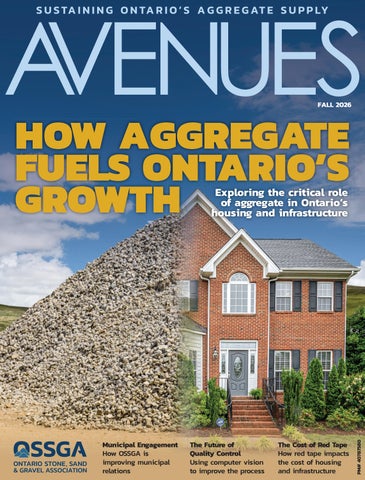
HOW AGGREGATE FUELS ONTARIO’S GROWTH
Municipal Engagement How OSSGA is improving municipal relations
AVENUES_Fall26_Sept_FINAL.indd 1
The Future of Quality Control Using computer vision to improve the process
The Cost of Red Tape How red tape impacts the cost of housing and infrastructure
PM# 40787580
Exploring the critical role of aggregate in Ontario’s housing and infrastructure
2026-09-11 9:29:36 AM
AVENUES_Fall26_Sept_FINAL.indd 2
2026-09-11 9:29:37 AM
IN STOCK, READY TO ROCK. Kleemann makes the most reliable machines out there—period. And your local Brandt dealership has them in stock right now. Maximum Productivity
More Efficient
Unmatched Support
The independent double-deck pre-screen enhances efficiency while the continuous feed system boosts flow and output.
The diesel direct drive optimizes power transmission and lowers fuel usage through electrically powered components.
Backed by Brandt, with the best-trained, most committed 24/7/365 after-sales support in the business.
brandt.ca/mineral-technology 1-888-227-2638
AVENUES_Fall26_Sept_FINAL.indd 3
2026-09-11 9:29:38 AM
CONTENTS FALL 2026
COVER STORY
11
HOUSING AND AGGREGATE:
CONNECTED AT THE FOUNDATION How the recent decline in Ontario’s housing market impacts the aggregate sector and vice-versa BY MATTHEW BRADFORD
16 The cost of red tape for
32 Environmental planning and permitting in the aggregate industry
20 An update on OSSGA’s recent
We spoke to Heather Melcher, vice president of environmental planning and permitting at Consor
How bureaucracy slows growth
municipal engagement efforts
Campaigns, events and meetings to advance relations for the industry
Computer vision in aggregate production
7 Aggregate in the supply
chain: The first link
Building the essentials of a modern society
CAREER PROFILES
Ontarians
24 Seeing the full picture FEATURES
16
27 OSSGA at the 2026 AMO Conference
A highlight of the year for connecting with municipal and infrastructure leaders
24
34 From an interest in
infrastructure to a career in the aggregate industry
Mohamed Mousa, vice president of aggregates at CRH Canada
SECTIONS 23 Marketplace 36 Professional Directory 38 Final Rehab
4 | Fall 2026 | AVENUES
AVENUES_Fall26_Sept_FINAL.indd 4
2026-09-11 9:29:40 AM
Highways, bridges, roads and airports are all built with aggregate. GravelFacts.ca AVENUES_Fall26_Sept_FINAL.indd 5
2026-09-11 9:29:40 AM
CHAIR’S MESSAGE BY DWAYNE MCKENZIE – CHAIR, ONTARIO STONE, SAND & GRAVEL ASSOCIATION AND GENERAL MANAGER, NELSON AGGREGATE CO.
A
cross Canada, housing affordability and infrastructure delivery have become defining issues. Governments are looking for ways to build more homes, expand transportation networks and support economic growth, but one essential part of that work often remains behind the scenes: the materials that make building possible. Throughout this edition of Avenues, we will examine our industry’s major priorities: accelerating licensing timelines, working more effectively with municipalities, reducing red tape and ensuring aggregate is recognized as a central part of the housing and infrastructure supply chain.
Every home, road, bridge, transit line and piece of critical infrastructure begins with stone, sand and gravel. Aggregate is the foundation of modern communities and a key ingredient in the projects Canadians rely on every day. As the country works to address housing supply challenges and deliver major infrastructure investments, it is important to recognize that these goals cannot be achieved without a secure and sustainable supply of local aggregate. The scale of the challenge is significant. Canada needs millions of new homes, alongside major investments in transportation, water, energy, community and defence infrastructure. Yet while the number of licences and total licensed hectares continue to decline, securing approval for a new aggregate site still takes years! This reinforces the importance of a resilient domestic supply chain and sourcing construction materials close to where they are needed.
Accelerating aggregate licensing
That is why accelerating licensing timelines is a central OSSGA priority. And let’s be clear — this does not mean lowering standards. Environmental stewardship, meaningful municipal engagement and the Crown’s duty to consult Indigenous communities remain fundamental. It does mean, however, creating a clearer, more predictable process — one that addresses consultation earlier, streamlines duplicative reviews, manages objections effectively and reflects the urgency of Ontario’s housing and infrastructure commitments. We are advancing that work on several fronts. OSSGA has finalized a duty to consult framework, vetted by legal counsel, and opened discussions with the Ministry of Natural Resources on practical improvements. We are also pressing for clearer archaeological requirements, more predictable environmental approvals and policy modernization that can shorten timelines without compromising responsible development. Municipal engagement is equally important. Guided by OSSGA’s Municipal Engagement Sub-Committee, we have identified priority municipalities and developed advocacy material to support our policy positions. An ongoing digital campaign in Caledon, Puslinch, North Dumfries, Milton and Ramara is reinforcing the industry’s contribution to local jobs, housing and infrastructure, while direct outreach and engagement with local officials and other stakeholders are helping us build relationships with these municipalities. That proactive approach is producing results. In Caledon, OSSGA monitored proposed official plan policies, appeared at planning meetings and raised concerns with council and the Ministry of Municipal Affairs and Housing. The province subsequently urged the town to pause their Official Plan amendment process and later removed its approval authority for the aggregate-related amendment. We have also brought industry perspectives into local discussions through local media and continued building relationships with local stakeholders at the Association of Municipalities of Ontario conference in August. The direction is clear: protect close-to-market resources, accelerate responsible licensing and build durable relationships with municipalities, Indigenous communities and provincial government. By reducing unnecessary delay and treating aggregate as strategic infrastructure, we can give Ontario the foundation it needs to build homes, deliver major projects and support future generations.
Avenues is published for
Ontario Stone, Sand & Gravel Association 365 Brunel Rd., Suite 2 Mississauga, ON L4Z 1Z5 Tel: (905) 507-0711 www.ossga.com www.GravelFacts.ca Publisher Sharon Armstrong Executive Director Editor Andres F. Ibarguen Senior Manager, Communications and Stakeholder Relations Sales Executive Sharon Headley Designer Katrina Teimo All rights reserved. The contents of this publication may not be reproduced by any means, in whole or in part, without the prior written consent of the association. Published October 2026 PUBLICATION MAIL AGREEMENT #40787580
Please return undeliverable items to: Ontario Stone, Sand & Gravel Association 365 Brunel Rd., Suite 2 Mississauga, ON L4Z 1Z5
6 | Fall 2026 | AVENUES
AVENUES_Fall26_Sept_FINAL.indd 6
2026-09-11 9:29:41 AM
THE FOUNDATION FOR GROWTH
AGGREGATE IN THE SUPPLY CHAIN: THE FIRST LINK BY MATT BRADFORD
L
ong before concrete is poured or asphalt is spread, stone, sand and gravel form the foundation of virtually every piece of infrastructure Canadians rely on. And while that role is well understood within the aggregate industry, it bears repeating as Ontario pushes forward in delivering on its increasing slate of nation-building infrastructure projects. “It all comes down to this: everything is made out of stone, sand and gravel,” says Sharon Armstrong, executive director of OSSGA. “Even though it may not be top of mind for people, sometimes even those in the construction industry, aggregate touches everything.”
Ontario’s current and future infrastructure pipeline demands enormous quantities of aggregate. The material is essential to major transportation projects such as the Ontario Line, Highway 413, the Bradford Bypass and subway extensions throughout the GTA. Aggregate is the first link in the infrastructure supply chain. While many people associate pits and quarries with roads, aggregate is equally essential to concrete, bridges, sewer systems, water infrastructure and social infrastructure: schools, hospitals and other public facilities.
Ontario Line, Highway 413, the Bradford Bypass and subway extensions throughout the GTA. It also underpins the expansion of Toronto Pearson International Airport, the province's growing nuclear energy program and, when the market recovers, the next wave of residential construction.
Ontario’s current and future infrastructure pipeline demands enormous quantities of aggregate. The material is essential to major transportation projects such as the
Yet while planners have long recognized aggregate as a provincial priority, the public rarely considers the raw materials behind the projects they depend on. AVENUES | Fall 2026 | 7
AVENUES_Fall26_Sept_FINAL.indd 7
2026-09-11 9:29:43 AM
“Aggregate is hugely important to the province’s building plans, and our provincial policy identifies protecting aggregate reserves as a provincial interest, so it's a recognized priority from the highest planning documents,” says Ellen Ferris, associate with MHBC. “That said, when it comes to these infrastructure projects, I don't necessarily think people are always thinking about the materials that go into them and where they need to come from. There's still a bit of a disconnect there.”
Alto as an example
The proposed Alto high-speed rail project illustrates the challenge. Slated to connect Toronto and Québec City, the rail line will require enormous quantities of aggregate
over several years of construction. At the same time, opposition to local aggregate operations along portions of the corridor has highlighted concerns about whether sufficient close-to-market aggregate will be available for different phases of the project. “Based on what we hear from our consultants, there are local residential groups that are not happy with local sources of aggregate along that line, and there may in fact be a little bit of a shortage of aggregate because of people not wanting aggregate close to where it's required,” says Armstrong. The issue extends far beyond a single project. Aggregate producers aren't simply
Slated to connect Toronto and Québec City, the rail line will require enormous quantities of aggregate over several years of construction. At the same time, opposition to local aggregate operations along portions of the corridor has highlighted concerns about whether sufficient closeto-market aggregate will be available for different phases of the project.
extracting material to meet today's demand. They're planning years, and often decades, into the future. “We have to remember that aggregate producers really are land managers looking at the economics of the future,” says Armstrong. “They don't get enough credit for the fact that they have to have a crystal ball and be looking at growth years ahead.” That long-term planning makes protecting close-to-market aggregate increasingly important. As Ferris notes, the issue is becoming more pronounced as reserves around the GTA are gradually depleted, forcing material to travel farther to reach construction sites: “Close-to-market supply is hugely important, and it's something that's become more of an issue with a lot of the reserves around the GTA becoming depleted and materials having to come from further away.” In short, there are obvious benefits to having licensed sites close to infrastructure projects. At the same time, there are also less-than-obvious impacts of having aggregate located at a distance from where
8 | Fall 2026 | AVENUES
AVENUES_Fall26_Sept_FINAL.indd 8
2026-09-11 9:29:44 AM
it’s needed. “When a project is in an area where there’s no local supply, or supply of sufficient quality, it has to be shipped from further afar,” Ferris explains. “Obviously, there are costs associated with transportation. There’s wear and tear on roads, and increased truck traffic and emissions, because things have to come from further apart. Frankly, it's just not as ideal.”
A broader planning challenge
Despite their critical role in Ontario’s construction supply chain, protecting local sources is becoming increasingly difficult. As Ontario’s communities expand, aggregate resources are competing with other forms of development for the same land. While provincial planning policies recognize the importance of safeguarding known aggregate reserves, they must also balance competing priorities, particularly housing.
Despite their critical role in Ontario’s construction supply chain, protecting local sources is becoming increasingly difficult. As Ontario’s communities expand, aggregate resources are competing with other forms of development for the same land.
“As communities grow and settlement areas expand, there are certainly competing pressures,” Ferris says. “Developers own land too, and they’re looking to meet those other provincial priorities, so there can be a lot of competing interests and everyone’s trying to do their best to balance them.” That balancing act continues even after a site is licensed. As new subdivisions and other sensitive developments move closer to existing operations, producers can face growing challenges continuing to operate. “We've commented on several proposed developments located within close proximity to existing operations,” Ferris explains. “There are concerns AVENUES | Fall 2026 | 9
AVENUES_Fall26_Sept_FINAL.indd 9
2026-09-11 9:29:46 AM
about the compatibility of locating new sensitive receptors near existing operations. It’s important to stay on top of what's happening.” With this in mind, there is an opportunity to improve consistency throughout Ontario’s planning process. While aggregate is one of the province’s most highly regulated industries, producers often face different requirements depending on the municipality in which they operate. As Ferris suggests, "One of the challenges is that we work at the provincial level with the Aggregate Resources Act, and then we also work at the local level with different municipalities. There are sometimes differences across all the municipalities that we work in.” Greater consistency would give producers more certainty as they move through licensing and application reviews.
Driving Canada’s construction
Steady and reliable access to aggregate in the supply chain bodes well for both the industry and the country at large. After all, Armstrong reminds us that Canada’s ability to grow its economy depends on its ability to build, and every new road, hospital, transit line and industrial project begins with the same raw materials. “People don’t equate growth, success and building with aggregate, but it’s really at the heart of everything. It creates jobs, growth and new opportunities, and all of that starts with building.”
BUILD YOUR AMBITION WITH US
Indeed, with every announcement of a new highway, hospital or transit line comes a need for the same foundation, even if it's rarely part of the conversation.
ARMSTRONG REMINDS US THAT CANADA’S ABILITY TO GROW ITS ECONOMY DEPENDS ON ITS ABILITY TO BUILD, AND EVERY NEW ROAD, HOSPITAL, TRANSIT LINE AND INDUSTRIAL PROJECT BEGINS WITH THE SAME RAW MATERIALS.
Regent Park Tower Toronto, ON
Amrize is the partner of choice for the professional builders of North America, covering every project need from foundation to rooftop. With over 1,000 sites, 19,000 teammates, and a highly efficient distribution network, we deliver advanced building solutions for infrastructure, commercial and residential projects in every U.S. state and Canadian province. We are ready to build your ambition.
Learn more at amrize.com
BUILD YOUR AMBITION
10 | Fall 2026 | AVENUES
AVENUES_Fall26_Sept_FINAL.indd 10
2026-09-11 9:29:47 AM
COVER STORY
HOUSING AND AGGREGATE: CONNECTED AT THE FOUNDATION BY MATTHEW BRADFORD
AVENUES | Fall 2026 | 11
AVENUES_Fall26_Sept_FINAL.indd 11
2026-09-11 9:29:50 AM
I
t’s hard to ignore the headlines surrounding Canada’s residential construction slowdown. The downturn has been unfolding since 2022, driven by rising construction costs, affordability challenges, economic uncertainty and softer demand following Canada’s immigration slowdown. As the market continues to cool, stakeholders across the construction industry are assessing what weaker demand means for their businesses, including Ontario’s aggregate producers.
Industry forecasts paint a similar picture. In its July 2026 outlook, the Canada Mortgage and Housing Corporation (CMHC) said Canada’s housing sector has entered a prolonged slowdown that is expected to continue weighing on new residential construction for the next few years. “In Ontario, we’re probably in the toughest shape right now in terms of residential construction. Housing starts are quite low currently, and they have been for a few years now,” says Anthony Passarelli, lead economist and spokesperson for Southern Ontario at CMHC. In a sit-down with Avenues, Passarelli points to the prolonged condominium slowdown as one of the primary drivers. “You’re not seeing new projects launched,” he says. “Developers are focused on selling inventory that’s already built or nearing completion rather than starting new projects because they need sales to move ahead, and those sales simply aren’t there.”
IN ITS JULY 2026 OUTLOOK, THE CANADA MORTGAGE AND HOUSING CORPORATION (CMHC) SAID CANADA’S HOUSING SECTOR HAS ENTERED A PROLONGED SLOWDOWN THAT IS EXPECTED TO CONTINUE WEIGHING ON NEW RESIDENTIAL CONSTRUCTION FOR THE NEXT FEW YEARS.
12 | Fall 2026 | AVENUES
AVENUES_Fall26_Sept_FINAL.indd 12
2026-09-11 9:29:51 AM
Townhouse and single-detached construction has also been constrained, with builders generally waiting until they’ve sold enough units before breaking ground. Meanwhile, although purpose-built rentals are expected to remain the largest source of new housing, this part of the sector is forecast to cool as slower population growth tempers demand.
the province’s aggregate sector may not be immediately apparent. For industry players, however, the correlation is clear: “It all starts with aggregate,” says Sharon Armstrong, executive director of OSSGA. “People don’t always make that connection, but that’s really at the heart of everything we build, especially when we’re talking about the places we live.”
All told, CMHC’s report expects housing starts to remain subdued through 2028 as high construction costs, elevated financing expenses, softer buyer demand and a growing inventory of unsold units continue to make it difficult for developers to launch new projects.
The relationship is easy to overlook because aggregate is rarely seen once a project is complete. And yet, it is there: from the underground infrastructure that services new subdivisions and the roads that connect them to the ready-mix concrete poured into foundations and the precast concrete products that finish homes and communities. Even after residential buildings are complete, aggregate continues to show up in products such as brick, patios, retaining walls, balconies and other architectural features.
It’s not all bad news, however. Homeownership demand is on a slow rebound after several years of stagnation. Moreover, the townhouse market is seeing an uptick in pre-construction sales driven in part by the province’s HST rebate for new home purchases. As Passarelli explains, “That will eventually translate into more shovels in the ground and more housing starts, particularly for townhouses. That seems to be the segment that’s really showing the biggest boost from the temporary HST rebate on new home purchases.”
Feeling the pinch in Ontario For the public, the connection between Ontario’s sluggish housing market and
No doubt, aggregate is a vital component at virtually every stage of residential construction. So, when housing slows, the effects ripple through nearly every corner of the aggregate supply chain. And in the case of Ontarians, notes Armstrong, the waters moved fast. “The industry wasn’t expecting the market to change as quickly as it did,” says Armstrong. “Some of the economists we had at the conference predicted the population would continue on an essentially straight-line trajectory. I think what
HOMEOWNERSHIP DEMAND IS ON A SLOW REBOUND AFTER SEVERAL YEARS OF STAGNATION. MOREOVER, THE TOWNHOUSE MARKET IS SEEING AN UPTICK IN PRECONSTRUCTION SALES DRIVEN IN PART BY THE PROVINCE’S HST REBATE FOR NEW HOME PURCHASES.
While companies continue planning for future demand, weaker residential construction is already showing up in lower volumes, weaker revenues and tighter operating margins, particularly at sites that rely heavily on housing activity.
happened, of course, is disruptions in the economy. Changing trade dynamics created a lot of uncertainty that threw a wrench in things.” Those market conditions are now being felt throughout Ontario’s aggregate sector. While companies continue planning for future demand, weaker residential construction is already showing up in lower volumes, weaker revenues and tighter operating margins, particularly at sites that rely heavily on housing activity. “It definitely impacts our volumes,” says Jim Petrella, vice president of sales at CRH Canada. “And depending on where your pits and quarries are located across the province, some producers aren’t close enough to participate in the big infrastructure projects. We have sites outside the GTA that are heavily dependent on residential development, and they’ve been impacted big-time in terms of volume, which naturally affects overall revenue.” Today, much of Ontario’s aggregate demand has shifted toward major infrastructure projects in the GTA. Where condo and other housing starts are stagnating, the province is moving full speed ahead on large-scale projects, be they transit and subway expansions, Highway 413 or the expansion of Toronto Pearson International AVENUES | Fall 2026 | 13
AVENUES_Fall26_Sept_FINAL.indd 13
2026-09-11 9:29:51 AM
To an industry outsider, it may seem counterintuitive for the aggregate industry to continue pursuing new pits and quarries during a housing slowdown that, on paper, points to weaker demand. For those in the business, however, it’s simply the nature of the industry.
Airport. Producers with operations close enough to supply those jobs have been better insulated from the housing slowdown, whereas those without that geographical advantage are feeling more of the pressure. Those pressures materialize in several ways. For one, reduced demand can lead to a cost squeeze for aggregate producers. Because pits and quarries carry significant fixed operating costs, selling fewer tonnes means those expenses must be spread across a smaller volume of material, eroding the economies of scale that keep operations efficient. As Petrella notes, “A lot of these pits and quarries have high fixed costs. You’ve got costs associated with water monitoring, people, taxes and all kinds of things. As your volumes shrink, it’s a challenge to get the benefit of economies of scale. It forces producers to really look at their cost structure, especially their fixed costs.” “Once you’re in,” he continues, “you’re in.” Frank Kielbowich, general manager of aggregate operations at the Waterford Group, has seen much the same thing from his perspective as a producer outside the GTA: “This has
probably been going on for 18 months, maybe pushing 24,” he says. “It isn’t just straight aggregate that’s affected. It’s the asphalt and ready-mix concrete business as well. We have one site in Niagara and one in Hamilton, and they’re both impacted pretty equally.” Whether within the GTA or across the lake, it’s hard to find an aggregate producer unaffected by the slowdown, particularly in areas where upticks in infrastructure projects aren’t enough to cushion the blow. Here, Petrella notes, “The slowdown doesn’t hit every producer at the same time. Some projects already underway continue moving forward, allowing aggregate demand to hold up temporarily, while other developers pause new work almost immediately.” As a result, he continues, some producers feel the effects right away, while others experience a more gradual slowdown.
14 | Fall 2026 | AVENUES
AVENUES_Fall26_Sept_FINAL.indd 14
2026-09-11 9:29:52 AM
Planning for the long term
To an industry outsider, it may seem counterintuitive for the aggregate industry to continue pursuing new pits and quarries during a housing slowdown that, on paper, points to weaker demand. For those in the business, however, it’s simply the nature of the industry. “I think what’s interesting is that with aggregate, it’s the first stop on the supply chain,” says Armstrong. “Sometimes the public doesn’t understand, 'Well, the housing market is slowing down. Why do you still need to be looking for more aggregate sites?' The answer to that is because we’re not looking for aggregate for today. We’re looking for aggregate for 15 years from now, and getting an aggregate licence can take eight, nine, 10, up to 12 years.” That long planning horizon makes the industry fundamentally different from most others. Rather than responding to today’s demand, producers have to anticipate where housing and infrastructure demand will be a decade or more into the future.
Adapting to the market
Slower residential activity may be affecting producers, but resilience is built into the industry. “We’ve all faced challenges before in many different forms,” says Kielbowich. “It’s a cyclical industry, so when things slow down — whether it’s because of a recession or COVID-19 — we figure out how to move on.” It’s during these times, he adds, that governments will often stimulate the economy through new projects to “soften the blow.” Already, the Ontario government is investing nearly $210 billion to address its infrastructure deficit, as well as taking steps to introduce tax breaks, cut development fees and make home ownership more affordable — all in an effort to help both Canadians and the residential sector. “Whether that makes up the balance, time will tell,” Armstrong adds. “It depends on the projects and it depends on the locations. But some companies that have typically done more road work and public work are going to continue to do well. Some companies that are more focused on housing, especially the condo market, are likely not going to turn around for a bit. Those companies may look to expand their contract offerings and do some different things.” No doubt, some companies may need to pivot. But as Petrella points out, that isn’t always as simple as changing course. Much depends on where a producer’s pits and quarries are located and whether they’re close enough to serve sectors that continue to see investment. “When you look at the downstream sectors, it’s really a question of where you can pivot. Which sectors are going to have growth, and where can you offset some of that lost volume? If infrastructure is where the investment is going, can you participate in that sector? Depending on where your pits and quarries are located, you have to pivot out of certain segments and into where the growth is going.” Pivot or not, today’s market conditions are forcing producers to take a closer look at their cost structures, particularly fixed operating costs. For some, the push to protect bottom lines can result in staff reductions when all other levers have been pulled.
Relief on the way?
Despite the headlines, it’s not all doom and gloom for Ontario’s housing sector. There are also cautious signs that conditions may be beginning to stabilize. CMHC expects purposebuilt rental construction to remain relatively strong, supported by government financing and developers converting some condominium projects into rental housing. The agency also forecasts a gradual recovery in ground-oriented housing later in the forecast period, although it cautions that affordability challenges and economic uncertainty will continue to temper demand.
RATHER THAN RESPONDING TO TODAY’S DEMAND, PRODUCERS HAVE TO ANTICIPATE WHERE HOUSING AND INFRASTRUCTURE DEMAND WILL BE A DECADE OR MORE INTO THE FUTURE.
Overall, Passarelli says, “The rental segment is really what’s keeping the construction industry going right now. The condominium market is showing no sign of improving in the near term, but we’re starting to see positive signs in the single-family market, and I would expect construction to pick up more into next year." Aggregate producers are also seeing some movement in the right direction. While the market remains well below previous highs, Kielbowich says there are early signs that some activity is beginning to return. “It remains down, but we’re starting to see some signs of it picking up. Some contractors are beginning to move on lands they own. It’s almost like they’re getting ready to go. But I think it’s all going to depend on market conditions, interest rates and that sort of stuff.” Petrella also shares a sense of cautious optimism for the industry, buoyed by increases in public infrastructure. As for whether the current pressures ease, a host of ever-shifting factors makes a clear prediction harder to make. “I don’t think there’s a crystal ball,” Petrella says. “You can talk to 10 different developers and you’ll get 10 different answers about when the market will recover.” Canada’s housing slump isn’t the first challenge the aggregate industry has faced, and it won’t be the last. With relief still on the horizon, today’s play is to keep adaptability and resilience in the mix.
AVENUES | Fall 2026 | 15
AVENUES_Fall26_Sept_FINAL.indd 15
2026-09-11 9:29:52 AM
CHALLENGES OF BUILDING IN ONTARIO
THE COST OF
RED TAPE FOR ONTARIANS BY MATTHEW BRADFORD
O
ntario has ambitious plans to build and, as a result, no shortage of demand for aggregate to make it happen. Yet before the foundations can take shape for new housing, highways, transit and other infrastructure, pits and quarries must first secure approval to operate, ideally close to where the material is needed most. When those approvals are delayed, the impacts extend far beyond aggregate producers, ultimately increasing the cost of homes, public infrastructure and virtually every construction project in Ontario. “Every one of the province’s infrastructure priorities depends on aggregate, and none of these objectives happen without aggregate projects being approved and starting,” asserts Kevin Powers, managing principal at Project Advocacy Inc. “Whether it’s a transmission line, a data centre, a transit line or housing development, they all rely on functioning approval systems. If we can’t make timely decisions on quarries and pits, many of our economic and environmental goals will remain aspirations rather than achievements.” The same challenges have surfaced across major infrastructure, energy and natural resource projects, suggesting the issue extends well beyond the aggregate sector and reflects a broader challenge within Ontario’s approvals system.
Part of the issue is that the province’s approvals process has become fragmented across multiple ministries, regulators, municipalities and agencies, leaving no one accountable for shepherding projects from application to decision.
16 | Fall 2026 | AVENUES
AVENUES_Fall26_Sept_FINAL.indd 16
2026-09-11 9:29:53 AM
The aggregate sector is hardly alone in navigating regulatory hurdles. Nevertheless, the lengthy pit and quarry approval timelines that often hinder the province’s producers can hit Ontarians especially hard, considering virtually every major construction project depends on a reliable supply of locally sourced aggregate. As such, Powers argues, “Ontario doesn’t have a shortage of good ideas and good projects. It has a shortage of timely decision-making. Our biggest challenge isn’t deciding what we want to build. It’s building institutions capable of making decisions about what we should build.” Part of the issue is that the province’s approvals process has become fragmented across multiple ministries, regulators, municipalities and agencies, leaving no one accountable for shepherding projects from application to decision. “Diffused responsibility means diffused accountability," Powers adds. "So, if a project approval takes seven years, it’s difficult to identify who is responsible for the delay.” Complicating matters further is an ongoing debate over who should ultimately decide where aggregate sites are located. As Sharon Armstrong, executive director of OSSGA argues, that responsibility belongs with the province, not municipalities, because aggregate is a provincial resource that can only be extracted where geology allows. “One community might have it, but another community might need it and aggregate only exists where nature put it.” It’s understandable that municipalities want a seat at the table. Proposed pits and quarries often face strong local opposition, and as residential development continues to push into rural communities, that opposition is only becoming more vocal. The resulting tension between provincial priorities and local political pressures can further delay approvals. The duty to consult can also extend project timelines. While consultation is an essential part of the approvals process, the absence of consistent guidelines and clear expectations can make it difficult for both proponents and Indigenous communities to know when meaningful consultation has been achieved. Armstrong says OSSGA is working with the Ontario government and First Nations partners to bring greater consistency to the process without compromising its integrity. “When our members enter into a duty to consult process, it can sometimes feel like they’re starting from the beginning. That’s why we’re trying to work with all sides to make sure that all of the important consultation is done, and that we can do it more efficiently and keep those projects moving.”
The cost of delays
Several factors can delay aggregate licensing, but regardless of the cause, the result is the same: higher costs for both producers and Ontarians. Every year spent waiting for approvals adds legal, consulting, financing and carrying costs that ripple through the construction supply chain. Armstrong says one common source of delay occurs when municipal councils avoid making politically difficult decisions by denying applications that the Ontario Land Tribunal ultimately approves.
AVENUES | Fall 2026 | 17
AVENUES_Fall26_Sept_FINAL.indd 17
2026-09-11 9:29:55 AM
“The problem with that is that it costs all of us as Ontario citizens an incredible amount of money," says Armstrong. "The producer has to pay lawyers, the municipality has to pay lawyers and the land tribunal itself has costs.” Although the tribunal approves most applications, Armstrong argues that deferring those decisions simply adds unnecessary expense to the process, with the additional costs ultimately passed on through the construction supply chain to taxpayers, homebuyers and other end users.
Ontario Stone, Sand & Gravel Association Program Cowan Insurance Group®, in partnership with the Ontario Stone, Sand & Gravel Association, has developed a comprehensive program to address the insurance and risk management needs of the aggregate producer.
Why Choose Cowan? Exclusive group discount rating
There are broader economic consequences to licensing delays as well, particularly when they force aggregate to be hauled farther from where it is needed. According to economist John O’Grady, founding partner at Prism Economics and Analysis, Ontario does not face a geological shortage of aggregate. Rather, delays in approving new sites create localized supply shortages, forcing builders to source aggregate from more distant operations. “The shortage of aggregates does not delay projects," says O’Grady. "You can get your aggregate... but the price will go up.” Projects rarely stall because aggregate cannot be sourced. Instead, the added transportation and supply costs affect the construction supply chain before ultimately being passed on to taxpayers, homebuyers and the owners of public infrastructure projects. As O’Grady explains, “Basically it just gets passed on. It’s a straight pass through to the ultimate purchaser of the constructed product.”
Profit sharing program for OSSGA members Robust coverage extension package for added security
Contact us today to learn more: programs@cowangroup.ca | Toll-free: 1-866-912-6926 cowangroup.ca/ossga
We care about what you care about.
PROJECTS RARELY STALL BECAUSE AGGREGATE CANNOT BE SOURCED. INSTEAD, THE ADDED TRANSPORTATION AND SUPPLY COSTS AFFECT THE CONSTRUCTION SUPPLY CHAIN BEFORE ULTIMATELY BEING PASSED ON TO TAXPAYERS, HOMEBUYERS AND THE OWNERS OF PUBLIC INFRASTRUCTURE PROJECTS.
18 | Fall 2026 | AVENUES
AVENUES_Fall26_Sept_FINAL.indd 18
2026-09-11 9:29:56 AM
THE PROBLEM WITH THAT IS THAT IT COSTS ALL OF US AS ONTARIO CITIZENS AN INCREDIBLE AMOUNT OF MONEY. THE PRODUCER HAS TO PAY LAWYERS, THE MUNICIPALITY HAS TO PAY LAWYERS AND THE LAND TRIBUNAL ITSELF HAS COSTS. SHARON ARMSTRONG, EXECUTIVE DIRECTOR OF OSSGA
Those longer haul distances carry environmental consequences as well. Armstrong says transportation is the single biggest cost associated with aggregate, making it both economically and environmentally advantageous to locate operations as close as possible to where the material will be used. The findings of The Long Haul reinforce that point. The report estimates that hauling 25 million tonnes of aggregate an average of 75 kilometres farther from market would add $169 million in annual transportation costs, including $101 million for public infrastructure projects alone. That translates into roughly $6.2 million added to the cost of a typical subway extension, $510,000 for a medium-sized hospital and higher costs for roads, while generating approximately 89,000 metric tonnes of additional greenhouse gas emissions. In other words, delays in the approvals process do not simply affect aggregate producers. They increase both the cost and environmental footprint of the homes, roads, hospitals and transit systems Ontarians rely on every day. The implications extend well beyond construction costs. At a time when jurisdictions around the world are competing for investment while trying to accelerate housing and infrastructure development, predictable approvals have become an economic advantage. “Investors can adapt to a yes or a no,” Powers says. “They struggle with years of uncertainty.” Environmental protections, Indigenous consultation and public participation remain essential. But if Ontario hopes to accelerate housing and infrastructure construction, it also needs a more coordinated approvals process capable of delivering timely decisions. Powers believes the issue ultimately comes down to governance. “This isn’t a debate about whether projects should be approved or rejected,” he says. “It’s whether Ontario still has the ability to make decisions.”
Weigh It Pile It Monitor It
Production Management Downtime Reporting Efficiency Analysis Inventory Control 1-877-428-3573 equipfix@equipfix.ca | www.scalelink.com
AVENUES | Fall 2026 | 19
AVENUES_Fall26_Sept_FINAL.indd 19
2026-09-11 9:29:57 AM
MUNICIPAL RELATIONS
AN UPDATE ON OSSGA’S RECENT
MUNICIPAL
ENGAGEMENT EFFORTS BY OSSGA STAFF WRITER
O
SSGA has made significant progress advancing municipal engagement efforts in 2026, building stronger relationships with local governments, improving industry awareness and developing advocacy material to support engagement efforts. Guided by the newly established Municipal Engagement Sub-Committee, the association has taken a strategic and proactive approach to ensuring municipal decision-makers better understand the essential role aggregate plays in supporting housing, infrastructure and economic growth.
One of the committee’s first priorities was establishing a clear municipal engagement strategy and identifying municipalities where additional outreach would have the greatest impact. Next came one of the major initiatives the committee has worked on so far this year – the development of OSSGA’s first municipal digital awareness campaign. The campaign takes a geo-targeted approach to focus on five of the priority municipalities identified by the sub-committee. These are: Caledon, Puslinch, North Dumfries, Milton and Ramara. Working with communications agency Mash Strategy, OSSGA created community-focused videos and graphics that drive home a positive message about the aggregate industry and its role in securing local jobs, housing and infrastructure. This also included updating GravelFacts.ca to be used as a landing page for the campaign. The committee has also invested considerable effort into developing advocacy materials that better communicate the industry’s value on a local level. New municipal impact one-pagers were prepared for the entire list of priority municipalities, providing localized information on economic, social and environmental contributions. These one-pagers will play an important role in conversations with municipal leaders and other stakeholders throughout the year, including at the Association of Municipalities of Ontario (AMO) Conference. Case studies that highlighted recent municipal policy issues and policy audits that gave OSSGA staff a better understanding 20 | Fall 2026 | AVENUES
AVENUES_Fall26_Sept_FINAL.indd 20
2026-09-11 9:29:58 AM
of where municipal planning policy may conflict with provincial regulation were also prepared for internal use. The 2026 AMO Conference was another key focus. OSSGA worked closely with industry partners, including the Ontario Road Builders’ Association, the Cement Association of Canada, the Ontario Sewer and Watermain Construction Association and the Masonry Council of Ontario, to plan another edition of the Infrastructure Industry AMO Reception. The reception, alongside OSSGA’s booth throughout the conference, provided an excellent opportunity for staff to engage directly with municipal leaders. Local media and stakeholder relations have also been a prominent part of OSSGA’s advocacy efforts. Since May, the association has prepared regular opinion pieces and letters to the editor focused on issues affecting the industry in priority municipalities. Recent examples include a letter to the editor in the London Free Press highlighting the importance of aggregate in Zorra Township, another in the Owen Sound Sun-Times, an op-ed in the Hamilton Spectator and a story in the Waterloo Region Record. These efforts have helped bring industry perspectives into public discussions and counter misinformation about aggregate operations. Caledon has remained a significant advocacy priority throughout the year. OSSGA closely monitored the town’s Official Plan Amendment process, attended planning committee meetings and engaged with the Ministry of Municipal Affairs and Housing (MMAH) about the potential amendment. The association raised concerns about the proposed policies through formal correspondence with the mayor and council and maintained ongoing engagement with provincial officials throughout the process. MMAH subsequently sent a letter directly to the mayor of Caledon, urging the municipality to pause its plans to proceed with the amendment.
LOCAL MEDIA AND STAKEHOLDER RELATIONS HAVE ALSO BEEN A PROMINENT PART OF OSSGA’S ADVOCACY EFFORTS. SINCE MAY, THE ASSOCIATION HAS PREPARED REGULAR OPINION PIECES AND LETTERS TO THE EDITOR FOCUSED ON ISSUES AFFECTING THE INDUSTRY IN PRIORITY MUNICIPALITIES.
AVENUES | Fall 2026 | 21
AVENUES_Fall26_Sept_FINAL.indd 21
2026-09-11 9:29:59 AM
In June, after the town continued its work on the amendment, the province removed the town’s approval authority for a proposed aggregate-related official plan amendment, prompting staff to stop work on it and related zoning changes. This is important for aggregate producers as the ministry is demonstrating through a tangible action that aggregate policy must remain consistent with provincial legislation and policy. Beyond Caledon, OSSGA expanded direct outreach to municipal governments through letters, stakeholder engagement and relationship-building efforts. Correspondence was sent to mayors in priority municipalities, while opportunities to engage local organizations, chambers of commerce and municipal stakeholders were also pursued. These relationships are helping establish more productive dialogue on aggregate issues before they become contentious planning matters. The sub-committee has also supported broader policy and regulatory advocacy. Members reviewed Bill 98 and proposed “as-of-right” aggregate policies, met with officials from the MMAH to better understand legislative intent and developed recommendations related to red tape reduction and approval timelines. Extensive research was undertaken to identify bottlenecks in the licensing and approvals process, helping inform future discussions with the Ministry of Natural Resources on improving regulatory efficiency. At the same time, OSSGA has continued monitoring opposition campaigns and municipal advocacy efforts by groups opposed to aggregate development to better understand emerging issues and respond proactively. Together, these initiatives have laid the foundation for a stronger municipal engagement program focused on relationship building, evidence-based advocacy and proactive communications. As the year continues, and the election passes, OSSGA will build on this momentum through its digital campaigns, AMO engagement and direct outreach to ensure aggregate remains recognized as a critical resource for Ontario’s communities and economy.
BEYOND CALEDON, OSSGA EXPANDED DIRECT OUTREACH TO MUNICIPAL GOVERNMENTS THROUGH LETTERS, STAKEHOLDER ENGAGEMENT AND RELATIONSHIP-BUILDING EFFORTS. CORRESPONDENCE WAS SENT TO MAYORS IN PRIORITY MUNICIPALITIES, WHILE OPPORTUNITIES TO ENGAGE LOCAL ORGANIZATIONS, CHAMBERS OF COMMERCE AND MUNICIPAL STAKEHOLDERS WERE ALSO PURSUED.
Shaping sustainable land use and infrastructure through: • Pit and quarry license applications • Site plan designs and amendments • Volume calculations • Traffic studies • Noise studies
Arcadis. Improving quality of life.
• Natural environment studies • Hydrogeological and environmental permitting • Excess soil management • Innovative quarry rehabilitation plans • Ontario Land Tribunal hearings Connect with us: Dave Barrett, Studio Manager, Placemaking Dave.barrett@arcadis.com Arcadis.com
22 | Fall 2026 | AVENUES
AVENUES_Fall26_Sept_FINAL.indd 22
2026-09-11 9:30:02 AM
MARKETPLACE
AME DRILL SUPPLY & SERVICES INC.
Thread Drill Bit
DTH Hammer
RC Hammer
Drill Rod
DTH Bit
RC Bit
Shank Adaptor
DTH Pipe
RC Pipe
AME DRILL
AME DRILL
Coupling Sleeve
AME DRILL
AME
AME
DRIL
DRIL
L
L
AME
DRIL
L
AME
Tel.: 1-506-855-3355 / 229-8899
DRIL
L
E-mail: amedrillservice@gmail.com
AVENUES | Fall 2026 | 23
AVENUES_Fall26_Sept_FINAL.indd 23
2026-09-11 9:30:05 AM
CUTTING EDGE OF QUALITY CONTROL
SEEING THE
FULL PICTURE: COMPUTER VISION IN AGGREGATE PRODUCTION BY MATTHEW BRADFORD
A
longside safety, quality control is one of the top priorities at any pit or quarry. Much like workplace safety, maintaining consistent quality means keeping an eye on many moving parts throughout production. Technologies like computer vision are helping producers keep the entire quality control process in sharper focus.
But first, a primer
At a high level, computer vision uses cameras and artificial intelligence (AI) to analyze visual data and provide real-time oversight of equipment, material and production processes. In aggregate production, the technology helps fill the gaps between periodic sampling, giving producers a continuous view of what’s happening throughout the production process and enabling them to respond to quality control issues as they arise. “Producers are being asked to do more with less while maintaining quality, safety and environmental responsibility. Computer vision gives operators a clearer view of the process so they can make those better decisions with better data,” says Andrew Palangio, global sales manager with WipWare Inc., a Canadian developer of computer vision systems for the mining and aggregate industries.
24 | Fall 2026 | AVENUES
AVENUES_Fall26_Sept_FINAL.indd 24
2026-09-11 9:30:06 AM
Computer vision tech has come a long way in the aggregate sector. Early versions emerged in the 1980s as researchers explored ways to analyze rock fragmentation from photographs. WipWare was founded in 1995 to commercialize and build on that technology. The company’s origins trace back to a practical challenge faced by Tom Palangio, the company’s founder, president and CEO, and engineers at DuPont Explosives. As Palangio explains: “They were sieving production-size blasts to validate blast models, and after a few months they realized there had to be a better way. That’s when they partnered with professors at the University of Waterloo, who were working on satellite image enhancement, and asked a simple question: could that technology be used to analyze photographs of rock? The answer was 'yes.'” Today, WipWare develops computer vision systems that use cameras and image analysis software to monitor material as it moves continuously through an operation. Depending on the application, producers can analyze stockpiles and muck piles using a smartphone, tablet or drone, or install automated systems, including WipWare’s Reflex and Solo platforms, over conveyors, crushers and haul trucks to provide continuous, real-time particle size analysis. “The goal at WipWare is pretty simple,” says Palangio. “It’s to help producers see what’s happening in their process continuously, not just when someone takes a manual sample. It’s about changing the basis for decision-making from single moments in time, once per day, to ongoing data.”
A complementary tool
Computer vision is meant to complement existing quality control processes, not replace them. Manual sieving remains the industry’s gold standard for verifying particle size and product quality. However, because it can only be performed periodically, it provides snapshots rather than a continuous picture of what’s happening across an operation. That is
Computer vision tech has come a long way in the aggregate sector. Early versions emerged in the 1980s as researchers explored ways to analyze rock fragmentation from photographs. WipWare was founded in 1995 to commercialize and build on that technology.
AVENUES | Fall 2026 | 25
AVENUES_Fall26_Sept_FINAL.indd 25
2026-09-11 9:30:06 AM
A screen can break or a crusher gap can get too worn down. If no one notices for several hours, you’ve just created a lot of waste material and wasted a lot of people’s time and money. That’s where the ability to get real-time data comes into play. – Andrew Palangio, Global Sales Manager with WipWare Inc.
where a hybrid approach delivers the greatest value: “The hybrid approach allows someone to keep sticking to the standard, which is sieving,” Palangio says. “But how much happens when you’re not looking? A screen can break or a crusher gap can get too worn down. If no one notices for several hours, you’ve just created a lot of waste material and wasted a lot of people’s time and money. That’s where the ability to get real-time data comes into play.” Continuous monitoring isn’t the only advantage. Computer vision can also capture information that a sieve cannot. “Take a pencil, for example,” Palangio suggests. “Obviously, we don’t have any particles that look like a pencil, but there are elongated particles in limestone. A sieve cannot tell you that long dimension. Instead, the sieve tells you the next dimension, because when the particle turns on its side and falls through the opening, that’s the size it’s considered to be. Meanwhile, computer vision will actually get an accurate size, ratio and shape.” Like manual sieving, however, computer vision has its own limitations. Rather than measuring every particle, it analyzes a highly representative sample of the material visible to the camera. Therefore, combining the two methods provides both the precision of traditional sampling and the continuous oversight needed to identify changes as they happen. “Using them together will help each method correct for each other’s blind spots,” says Palangio, insisting, “We aren’t intending to replace manual sieving. It is the gold standard.”
Supporting workers
As with any piece of tech, one concern often associated with AI and automation is the potential impact on jobs. Palangio says WipWare’s approach has always been to augment workers rather than take their roles: “We never want to replace anyone. We want to complement traditional testing methods and existing personnel. We want to give them a tool that’s in their pockets that they can use.” There are workplace safety advantages to consider as well. Palangio points to operations in other parts of the world where workers are stationed beside conveyor belts with long poles, manually pushing oversized rocks off the line. Rather than eliminating those positions, he suggests computer vision can make those workers more effective by identifying issues earlier and allowing them to focus on higher-value tasks instead of continuously monitoring material by eye.
Seeing beyond
Computer vision is just one example of how digital technologies are becoming more accessible across the aggregate industry. With the advance of smartphones, drones, automated camera systems and AI-powered image analysis, producers can now gather operational data much more quickly than in the past. As more digital tools become available, producers will have more options than ever for monitoring operations in real time. That said, technology itself is only part of the equation. The solutions that gain traction won’t necessarily be the most sophisticated, but the ones that solve practical problems while fitting naturally into the way producers already work. “The pushback against technology has actually been important,” says Palangio. “It’s forced companies like ours to build puzzle pieces that actually fit. People aren’t going to use a tool if it does 18 things they don’t need and one thing they do. They want something that does the things they need without getting in the way of the way they already work.” Whether it’s computer vision or the next generation of digital tools, the technologies that will have the greatest impact are the ones that complement existing expertise, solve real operational challenges and make better decisions easier to achieve.
26 | Fall 2026 | AVENUES
AVENUES_Fall26_Sept_FINAL.indd 26
2026-09-11 9:30:07 AM
AMO RECAP
2026 AMO OSSGA AT THE
CONFERENCE BY OSSGA STAFF WRITER
AVENUES | Fall 2026 | 27
AVENUES_Fall26_Sept_FINAL.indd 27
2026-09-11 9:30:07 AM
O
SSGA had a successful and productive presence at the 2026 Association of Municipalities of Ontario (AMO) Conference, advancing the industry's priorities and strengthening relationships with municipal and provincial decisionmakers from across the province. As part of OSSGA's broader municipal engagement strategy for 2026, the conference provided an important opportunity to connect directly with municipal leaders, senior staff, elected officials and provincial representatives on the issues that matter most to Ontario's aggregate sector and the communities it serves. Throughout the conference, OSSGA staff welcomed hundreds of delegates to the association's exhibitor booth, where conversations focused on the critical role aggregate plays in building and maintaining the infrastructure that Ontarians rely on every day. From roads, bridges and transit projects to housing, schools and hospitals, aggregate remains the essential foundation of Ontario's growth and prosperity. The booth served as a valuable forum for sharing information about the sector, answering questions and discussing the importance of maintaining a reliable supply of locally sourced aggregate to support community development. Delegates also learned more about the industry's commitment to environmental stewardship, progressive rehabilitation, community engagement and responsible resource development.
The level of engagement throughout the conference was encouraging. Municipal officials from communities large and small expressed interest in learning more about the aggregate industry's contributions to local economies and the national push for more housing, infrastructure and other major projects. Many discussions centred on the challenges municipalities face as they work to accommodate growth, improve infrastructure and deliver services efficiently in an increasingly complex fiscal environment. While the national economy and the role aggregate plays there was also an important point of discussion. OSSGA's participation at AMO provided an opportunity to highlight the importance of policies that support timely approvals, efficient project delivery and access to the resources needed to build complete communities. The conference also allowed the association to reinforce its commitment to working collaboratively with municipal partners to find practical solutions to shared challenges. A key highlight of this year's conference was the Infrastructure Industry AMO Reception, hosted by OSSGA in partnership with the Ontario Road Builders' Association, the Ontario Sewer and Watermain Construction Association, the Cement Association of Canada and the Masonry Council of Ontario. Held at Metropolitain Brasserie in Ottawa, just steps from the conference venue, the reception once again brought together a diverse group of municipal officials, industry leaders, government representatives and stakeholders for an evening of networking and relationship-building.
28 | Fall 2026 | AVENUES
AVENUES_Fall26_Sept_FINAL.indd 28
2026-09-11 9:30:12 AM
The event welcomed almost 1,100 guests throughout the evening, with municipal leaders making up the majority of attendees. The reception provided a unique opportunity for informal conversations that often prove just as valuable as formal meetings, allowing participants to discuss local priorities, infrastructure needs and opportunities for future collaboration in a relaxed setting.
As municipalities begin turning their attention to the 2026 municipal election, the relationships established and strengthened during AMO will become increasingly important. The conference offered an opportunity not only to discuss current issues but also to lay the groundwork for future engagement with both returning and prospective municipal leaders.
The strong turnout reflected the continued importance of the reception as one of the premier networking events associated with the AMO Conference. It also underscored the shared commitment among infrastructure sector leaders to supporting the municipalities that build, maintain and improve Ontario's communities.
OSSGA is encouraged by the positive reception received throughout the conference and looks forward to building on the momentum generated during the event. The association will continue engaging directly with municipal officials in the months ahead, ensuring decision-makers have access to accurate information about the aggregate sector and its vital contributions to Ontario's economy and infrastructure system.
For OSSGA, the reception was another important touchpoint in strengthening relationships with elected officials and municipal staff. The conversations held during the evening reinforced the industry's role as a trusted partner in delivering the materials and expertise needed to support housing construction, transportation networks and community infrastructure across the province.
THE STRONG TURNOUT REFLECTED THE CONTINUED IMPORTANCE OF THE RECEPTION AS ONE OF THE PREMIER NETWORKING EVENTS ASSOCIATED WITH THE AMO CONFERENCE.
AMO 2026 demonstrated once again the value of face-to-face engagement and constructive dialogue. Through its exhibitor booth, the Infrastructure Industry AMO Reception and numerous engagements with stakeholders, OSSGA successfully advanced its advocacy objectives while strengthening the relationships that are essential to long-term success. As part of its ongoing municipal engagement strategy, OSSGA remains committed to fostering meaningful partnerships with municipalities across Ontario and working collaboratively to support the responsible development of the aggregate resources needed to build the province's future.
AVENUES | Fall 2026 | 29
AVENUES_Fall26_Sept_FINAL.indd 29
2026-09-11 9:30:12 AM
proud supporters of OSSGA hmaequip.com
5
Automated Engineering Technologies Ltd. Certified Engineering and Survey Technologists
30 | Fall 2026 | AVENUES
AVENUES_Fall26_Sept_FINAL.indd 30
2026-09-11 9:30:13 AM
proud supporters of OSSGA
AVENUES | Fall 2026 | 31
AVENUES_Fall26_Sept_FINAL.indd 31
2026-09-11 9:30:14 AM
CAREER PROFILE
Environmental planning and permitting in the aggregate industry We spoke to Heather Melcher, vice president of environmental planning and permitting at Consor, about her journey in the aggregate industry and what’s driven her throughout her career.
Heather Melcher, Consor
OSSGA: How did you get started in the aggregate industry?
Heather: Early in my consulting career, I worked with a mentor who had strong connections in the aggregate industry. A lot of that work focused on natural environment assessments and impact analysis. I remember my first projects were transcribing report edits and comments from the client and the planner back into the report! I developed a strong foundation in both the technical side of the work and the people-focused side of the industry. I was also lucky that my mentor brought me along to the OSSGA AGM and committee meetings, so I was exposed to the industry early on. I learned pretty quickly that successful aggregate projects are not just about good science or knowing the regulations. They also come down to clear communication, strong relationships and understanding how to balance environmental and operational considerations.
What made you want to stay in the industry over the years?
The work is interesting and always changing. Every site has its own challenges and I really enjoy how aggregate projects require a big-picture approach across multiple disciplines. Groundwater, surface water and ecology all have to be considered together to understand that bigger picture.
I was exposed to the industry early on. I learned pretty quickly that successful aggregate projects are not just about good science or knowing the regulations. They also come down to clear communication, strong relationships and understanding how to balance environmental and operational considerations. 32 | Fall 2026 | AVENUES
AVENUES_Fall26_Sept_FINAL.indd 32
2026-09-11 9:30:14 AM
What’s the most challenging part of your role? Helping projects move forward when there are a lot of competing expectations is one of the most challenging aspects of my job. Aggregate projects often involve complex environmental issues, changing policy requirements, community interest, operational needs and tight timelines. A big part of the work is identifying issues early, being clear about risk and finding strategies that are technically sound but still realistic. My role also requires an important leadership component. I try to make sure the people I work with have the information, confidence and direction they need, while also helping clients make good decisions. That mix of technical detail, strategy, communication and leadership can be challenging, but it is also what keeps the work engaging.
What I enjoy most is helping clients work through that complexity to find a clear path forward. I like bringing together the technical work, the permitting strategy, conversations with regulators and Indigenous communities, and a realistic view of project risk.
all working toward a workable and responsible outcome. This industry has also given me the chance to build long-term relationships with clients, colleagues and mentors who care about doing the work well.
INDUSTRY AND ADVICE What advice would you give someone looking to pursue a career in the aggregate sector?
Over time, my role has grown into managing larger multidisciplinary projects that can include air, noise, archaeology, visual impact, mine planning and other related studies. The projects can be complex from an environmental, regulatory and operations perspective, so there is always a need for clear, workable problem-solving. What I enjoy most is helping clients work through that complexity to find a clear path forward. I like bringing together the technical work, the permitting strategy, conversations with regulators and Indigenous communities, and a realistic view of project risk. I also really value the collaborative partnership that develops between the producer, the consultant and the planner. Everyone brings a different perspective, but we are
Stay curious and take every opportunity to learn from different parts of the industry. The more you understand how the business operates as a whole, the more opportunities you’ll create for yourself. Technical knowledge matters, but so do communication skills, business awareness, regulatory understanding and the ability to see things from different perspectives. Visit sites when you can, ask questions, learn from the producers and pay attention to how environmental planning decisions play out on real projects. I would also encourage people to look for good mentors and keep building strong professional relationships. I learned a lot from people who were generous with their time and willing to explain both the technical details and the practical realities of the industry. Getting involved with OSSGA early in my career was especially valuable for me. It helped me meet people, learn from others and stay connected to what was happening in the industry. I would encourage others to do the same.
AVENUES | Fall 2026 | 33
AVENUES_Fall26_Sept_FINAL.indd 33
2026-09-11 9:30:15 AM
CAREER PROFILE
From an interest in infrastructure to a career in the aggregate industry OSSGA: How did you get into the aggregate industry?
Mohamed Mousa, vice president of aggregates at CRH Canada, shares how his early interest in infrastructure drove him to complete a degree in civil engineering and start his career in the aggregate sector. Mohamed Mousa, CRH Canada
Mohamed: My background is in civil engineering and my father worked in construction growing up. I’ve always been drawn to how foundational infrastructure comes to life. Entering the heavy building materials industry allowed me to bridge the gap between technical engineering learnings and large-scale commercial strategy. Joining the Dufferin team gave me the perfect environment to apply problem-solving skills, manage market dynamics and supply chains for the very materials that build Ontario’s communities.
What’s made you want to stay in the industry over the years?
It is an incredibly dynamic and resilient sector. No two days are the same. Between managing market demands and collaborating with a vast network of industry professionals, the aggregate industry keeps me constantly engaged. Beyond that, there is a sense of pride in solving problems, delivering on our business growth and seeing our success come to life into infrastructure projects after they are built.
CAREER ADVICE What advice would you give to someone considering a career in the aggregate industry? Anything you’d change about your own career?
Embrace continuous learning and look beyond the surface. People often think the aggregate industry is just about rocks, but it’s actually a massive driver of technology, sustainability
My background is in civil engineering and my father worked in construction growing up. I’ve always been drawn to how foundational infrastructure comes to life. Entering the heavy building materials industry allowed me to bridge the gap between technical engineering learnings and large-scale commercial strategy.
34 | Fall 2026 | AVENUES
AVENUES_Fall26_Sept_FINAL.indd 34
2026-09-11 9:30:16 AM
What’s the most challenging part of your role? Balancing and aligning immediate priorities and the fast-paced environment with longterm strategic plans can be challenging. However, the most challenging and most rewarding part of my job is people leadership. As I progress in my career, I’ve gone from being less “hands on” to being a coach and leading people who are problem solvers. My primary focus is keeping our people and our teams motivated, supported and aligned, especially when the pressure gets intense. It’s a constant balancing act: driving high performance and hitting aggressive targets while protecting the wellbeing of the team.
and sophisticated business strategy. There is room here for many fields: engineers, accountants, business strategists, environmental scientists, labourers, operators, electricians, welders, mechanics and many subject matter experts. Looking back, there isn’t anything I would necessarily change. Every step in my career has given me a holistic view of the business and an appreciation for every position at every level of the organization.
People often think the aggregate industry is just about rocks, but it’s actually a massive driver of technology, sustainability and sophisticated business strategy. There is room here for many fields: engineers, accountants, business strategists, environmental scientists, labourers, operators, electricians, welders, mechanics and many subject matter experts.
More than machinery. A partner on-site.
PARTS
SERVICE
SALES + RENTALS
Our inventory includes over $29 Million inventory value, with 9,500+ parts numbers, and 330+ trusted vendors.
With over 25 skilled techs, each branch has dedicated Service Managers and office support to streamline operations.
Explore one of Canada’s largest inventories of innovative machinery from trusted manufacturers.
FRO NT L INE - M ACH INERY. C O M INF O@ F L -M ACHI NERY. COM
1-855- 625- 2009
AVENUES | Fall 2026 | 35
AVENUES_Fall26_Sept_FINAL.indd 35
2026-09-11 9:30:17 AM
PROFESSIONAL SERVICES DIRECTORY AERIAL LIDAR / SURVEY TEC Surveying www.tec-survey.ca ...................................... 23
CRUSHING & SCREENING PLANTS Powerscreen of Canada Ltd. www.powerscreencanada.com ............... 40
CUSTOM CRUSHING & WASHING Assinck www.assinck.com ........................................... 2
AGGREGATES Amrize Canada Inc. www.amrize.com............................................ 10
CONVEYOR – ACCESSORIES Assinck www.assinck.com ........................................... 2
CUSTOM FABRICATION AND INSTALLATION Assinck www.assinck.com ........................................... 2
Ferma Aggregates Inc. www.fermaaggregatesinc.ca................. 31 AGGREGATE & ROAD BUILDING EQUIPMENT HMA Equipment Company of Canada www.hmaequip.com .....................................30 AGGREGATE RESOURCES Southwestern Sales Corporation Limited www.southwesternsales.ca .................... 30 BULK MATERIALS - TRANSLOADING & STORAGE Southwestern Sales Corporation Limited www.southwesternsales.ca .................... 30 CRUSHED STONE, SAND, SHIPPING, CARGO HANDLING, TRUCKING Southwestern Sales Corporation Limited www.southwesternsales.ca .................... 30 CRUSHERS Brandt Group of Companies www.brandt.ca ................................................. 3
CONVEYOR – COMPONENTS Assinck www.assinck.com ........................................... 2 CONVEYOR – PULLEYS Assinck www.assinck.com ........................................... 2 CONVEYOR REPAIRS & INSTALLATIONS Assinck www.assinck.com ........................................... 2 CONVEYOR SCALES Assinck www.assinck.com ........................................... 2 CONVEYORS Assinck www.assinck.com ........................................... 2 CUSTOM CONVEYOR SYSTEMS Assinck www.assinck.com ........................................... 2 CUSTOM CRUSHING Joe Kerr Limited www.joekerrlimited.ca ................................. 30
CUSTOM FABRICATION, INSTALLATION & MOBILE WELDING Assinck www.assinck.com ........................................... 2 DRILLING PARTS & ACCESSORIES DRILLS AME Drill Supply & Services Inc. www.amedrillsupply.ca................................. 23 ENGINEERING Assinck www.assinck.com ........................................... 2 FINE RECOVERY WASHING SYSTEMS, Powerscreen of Canada Ltd. www.powerscreencanada.com ............... 40 FEEDERS Assinck www.assinck.com ........................................... 2 INSURANCE SERVICES Cowan Group www.cowangroup.ca ............................ 18, 31
Frontline Machinery Ltd. www.frontline-machinery.com .............. 35
36 | Fall 2026 | AVENUES
AVENUES_Fall26_Sept_FINAL.indd 36
2026-09-11 9:30:20 AM
PROFESSIONAL SERVICES DIRECTORY LINERS & WEAR PARTS Brampton Brick www.bramptonbrick.com ............................ 31
PORTABLE PLANTS Haver & Boecker Niagara www.haverniagara.com .............................. 31
MANUFACTURERS & DESIGNERS Assinck www.assinck.com ........................................... 2
QUARRIES James Dick www.jamesdick.com .................................... 30
Brampton Brick www.bramptonbrick.com ........................
31
MATERIAL HANDLING Assinck www.assinck.com ........................................... 2 MATERIAL HANDLING & PROCESSING SYSTEMS Assinck www.assinck.com ........................................... 2 Haver & Boecker Niagara www.haverniagara.com .............................. 31 MOTORS Assinck www.assinck.com ........................................... 2 MOTOR CONTROL SOLUTIONS Benshaw Canada Controls www.benshaw.com....................................... 31 PORTABLE CUSTOM CRUSHING & SCREENING Assinck www.assinck.com ........................................... 2
RECYCLE AGGREGATES James Dick www.jamesdick.com .................................... 30 RECYCLE PLANTS Powerscreen of Canada Ltd. www.powerscreencanada.com ............... 40 SALES & RENTALS Powerscreen of Canada Ltd. www.powerscreencanada.com ............... 40 SAND & GRAVEL James Dick www.jamesdick.com .................................... 30 Southwestern Sales Corporation Limited www.southwesternsales.ca ...................... 30 SCREENING MEDIA & ACCESSORIES Haver & Boecker Niagara www.haverniagara.com .............................. 31
STACKER BOX-DESIGN & FABRICATION STACKERS Assinck www.assinck.com ........................................... 2 SURVEYING Automated Engineering Technologies www.autoengtech.on.ca ............................ 30 VIBRATION ANALYSIS Haver & Boecker Niagara www.haverniagara.com .............................. 31 VIBRATING SCREENS Haver & Boecker Niagara www.haverniagara.com .............................. 31 Powerscreen of Canada Ltd. www.powerscreencanada.com ............... 40 WASHING PLANTS Powerscreen of Canada Ltd. www.powerscreencanada.com ............... 40 Frontline Machinery Ltd. www.frontline-machinery.com ................ 35 WEIGH SCALE SALES/SERVICE/REPAIR Equipfix Limited www.equipfi x.ca ............................................. 19
STACKERS Powerscreen of Canada Ltd. www.powerscreencanada.com ............... 40
AVENUES | Fall 2026 | 37
AVENUES_Fall26_Sept_FINAL.indd 37
2026-09-11 9:30:23 AM
FINAL REHAB
THE FINAL REHAB DUFFERIN AGGREGATES MILTON QUARRY: THREE DECADES OF PROGRESSIVE REHABILITATION BY OSSGA STAFF WRITER
L
ocated along the Niagara Escarpment, the Dufferin
Aggregates Milton Quarry has supplied the stone needed to build Ontario’s roads, bridges, hospitals and schools since the 1960s. Equally significant is its longstanding commitment to environmental stewardship through progressive rehabilitation. Unlike traditional rehabilitation, which begins after extraction ends, progressive rehabilitation restores portions of a site as they become available during operations. This allows natural habitats to develop alongside ongoing extraction and provides opportunities to refine restoration efforts over time. Over the past 30 years, nearly 500 acres at the Milton Quarry have been rehabilitated into grasslands, wetlands and natural habitat. These areas now support more than 100 bird species, 40 butterfly species and more than 30 dragonfly and damselfly species, along with amphibians, fish and mammals. One of the most notable outcomes has been the presence of breeding pairs of bobolink, an endangered species in Ontario
that depends on healthy grassland habitat. Their presence highlights how rehabilitation can support biodiversity and create habitat for species at risk. The rehabilitation program has been shaped by decades of planning, monitoring and habitat management designed to complement the surrounding Niagara Escarpment landscape. As habitats mature, they continue to attract new species and provide long-term ecological value. While the quarry is entering its final years of extraction, rehabilitation remains a central focus. Restoration work continues alongside site operations, reflecting the aggregate industry’s commitment to responsible resource management and long-term land stewardship. The Milton Quarry demonstrates how aggregate extraction and environmental restoration can work together. More than three decades after rehabilitation began, the site continues to supply essential construction materials while creating lasting environmental benefits that will endure for generations.
FOR MORE INFORMATION ON OSSGA’S INDUSTRY RECOGNITION AWARDS, VISIT OSSGA.COM 38 | Fall 2026 | AVENUES
AVENUES_Fall26_Sept_FINAL.indd 38
2026-09-11 9:30:24 AM
Ontario’s future is built on aggregate.
GravelFacts.ca AVENUES_Fall26_Sept_FINAL.indd 39
2026-09-11 9:30:24 AM
AVENUES_Fall26_Sept_FINAL.indd 40
2026-09-11 9:30:25 AM