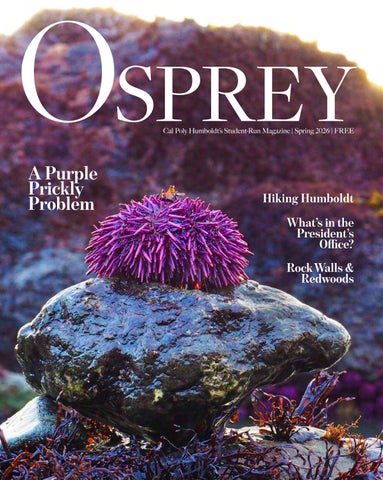
SPREY Cal Poly Humboldt’s Student-Run Magazine | Spring 2026 | FREE
A Purple Prickly Problem
Hiking Humboldt What’s in the President’s Office? Rock Walls & Redwoods
writers - photographers - editors - graphic designers
Join an award-winning student-run magazine JMC 325
2 units T/Th 11:00am-12:50pm
No experience needed
Land Acknowledgement
We acknowledge that this magazine was conceived and produced on the ancestral homelands of the Wiyot Tribe, known as Goudi’ni - this land was never ceded to the current ruling order, but taken through acts of genocide. More than just acknowledging the wrongs of the past, we encourage our readers to take steps to right the future. We would like to acknowledge the Wiyot Tribe as they continue to live, organize and care for this land. We honor them and all neighboring tribes. The staff at Osprey is mindful of our present participation and place on these
lands. It is important to understand the long history of places in which you reside and to understand your place within that history. Colonialism is not confined to the past. We encourage readers to consider how their actions and mindset can contribute to decolonization. Learn about whose land you live on. Pay the Wiyot Tribe’s honor tax. Visit Honortax. org to learn more. Support the Rou Dalagurr Food Sovereignty Lab, right here on Cal Poly Humboldt’s Campus. Support Native American owned businesses.
Bird OspreyMascot Team
OSPREY STAFF SPRING 2026
Sal
vad
Pho
re
ian ger Tat d Mana
Tae Phot
a Se
igler
ogra
or
pher
on helt or S n it
AidaCopy Ed
tor
Mariel l Marie
lle W
With
MJ Fit
Social M
zgerald
edia &
or-
Gui
Edi
Edit
llen
The S with pring 202 t to try he intent 6 Issue o f Osp ion o , tast for th e or thin f broade rey was crea ning k of em creat ing th agazine w somethin your hor ted izo gn ep as that are A erfect da to structu ew. My v ns ision y. Th dven r e it a e ture, Food re are fou round Politic , Studen r section In the t Life s s. and pursu adventur e sec e. W tion, hethe adren p the a aline whil r it’s find ick out a ir or e r ock c ing graffi skill to takin Hung limb ti, fe ga ry eatin ? Flip to hike, the ing 20 fe eling et up g the re’s s the f oo o in ra fuele d, lea inbow is d section much to d im r t o! wom n o p a le o b a r reach en’s triat out the lo tant. Aft rn why e h in unde g new h lon team cal succe r you’re ss o rst eig an mess anding ho hts. Lastly d a pole v f the ages aulte w fas , stay r and t h he ef ion can c informed In ou f o e by n c v ts of r curr e y p o the c ent w detac ultur litical orld he e wa conte that d. We off r. n t a e Ospr re develo r you orig often fee ey is ped t ls in f ast a hroug al, cura nd artific written ted ho a repo ial intellig nd produ ut the se stories r m c t e in e n e d wit ce as ster. g and For t hou he we ha versio first time nds-on jo believe f t using a urnali ever, n of o ctual s w maga ur stories e are off m matter ering s. zine on Sp acces a sible otify to m n audio Ospr t ak ey o eve ryone e the like w encourag . e State e do ever s you to wide share y sem Prima e y ry Ele ster, by v our voice ot , ction on Ju ing in the Enjoy ne 2, the m 2026 . agaz ine,
oo a M
A
to
inuk le W hief l e i r Ma in-C
e Winu
inuk,
Edito
r-in-C
spec Ospr ial thank s e e Cre y adviso to r tser-H arten stein
hief
k
E.
o ard ager n o an Le M
tion
ibu istr
D
Sh
a
ot ne og G ra ay ph le er
Ph
n wma e N or ula
Urs yout Edit La
Nic
o
Ill Pat ust ak ra i to dis r
Web Gu
Jessi
ru
Pond Noaht Editor u
Layo
CONTENTS
30 32
24 Chasing Bigfoot
The folk legend that shaped Humboldt County
8
Protecting America’s Public Lands The California Conservation Corps
14
Rock Walls and Redwoods
20
Small Town Big Graff
The inner workings of small town graffiti
SPREY
24
Bull kelp forests are in jeopardy
30
The connection between color and nutrition
36
A Purple Prickly Problem
Eat the Rainbow
Humboldt’s unique climbing scene
On The Cover A purple sea urchin, strongylocentrotus purpuratus, sits on a rock at Baker Beach in Trinidad, California. Photo by Shane Gayle
44 8
50 36 How lizzerd qween does it all
44
Cal Poly Humboldt’s Triathalon team
50
Music, Mental Health & Magic From Nothing to Nationals
A long way down
54
Humboldt’s mental health crisis
56
The Art of Pole Vault
The Response
The Politics of Fashion The Culture War
The intersection of values and expression
60 64
Manufactured to distract?
Listen to Osprey! Scan the QR code to listen to each story!
Visit ospreymagazine.com for more information. Osprey Website
Osprey Spotify
II
I
f you live in Humboldt or have ever driven through, you’ve probably seen him. That large, hairy, ape-like creature, best known for the size of the footprints he’s left all along the Pacific Northwest. In Humboldt, he’s everywhere: hand-carved wooden statues on the side of the road, a silhouette on graphic tees and tote bags accessorizing people all over Arcata, and the face or name of every few businesses in a hundred-mile radius. On March 28, 2025, Bigfoot was designated the official state cryptid of California by a bill introduced by District Assembly member Chris Rogers. “The most famous and beloved cryptid in contemporary California culture is the creature known as Bigfoot,” Rogers wrote on the legislative counsel’s digest.
8
the folk legend that shaped Humboldt County by Taea Siegler
What gives this cryptid such an esteemed status? The legend of “Bigfoot” has a long and valuable connection to the history and economy of Humboldt County, dating back to the fall of 1958.
The Origins of Bigfoot On Sept. 21, 1958, Humboldt Times journalist Andrew Genzoli read a peculiar letter, claiming to have found mysterious, large footprints at a logging site in Bluff Creek up by Klamath. Genzoli thought the letter would make for a fun story in his column, RFD, joking that “Maybe [Humboldt has] a relative of the Abominable Snowman of the Himalayas,” but to his surprise, the story spread like wildfire and interest began to grow throughout the county. Loggers in Bluff Creek have been
discovering these remarkable footprints, but most kept quiet out of fear of ridicule. They asked local Natives of the Hupa Tribe and were told of mythical, hairy, wildmen who were said to live in the Klamath mountains called “Omah.” A logger named Jerry Crew saw the prints himself and was set on collecting proof. He reached out to Bob Titmus, a taxidermist from Redding who was one of the first Sasquatch researchers, and together the two of them went down to Bluff Creek to create plaster casts of the prints to bring to The Humboldt Times. The name Bigfoot was coined in “Huge Footprints Hold Mystery of Friendly Bluff Creek Giant”, an article by Genzoli published in 1958. “Who and what is Bigfoot… the maker of those 16-inch tracks? Surely there
“Who and what is BigFoot… the maker of those 16-inch tracks? Surely there must be an answer. Maybe someone will succeed in finding it.” must be an answer. Maybe someone will succeed in finding it,” Genzoli wrote, inciting a Bigfoot craze that would continue for decades to come. Since the late fifties, a practice known as “Bigfooting” has continued to thrive in Humboldt and beyond. Various organizations, such as the Bigfoot Field Research Organization, have formed with the sole purpose of finding Bigfoot. Their first stop is the China Flat Museum in Willow Creek, whose Bigfoot room houses the majority of the original artifacts of Bigfoot’s history. Eric Nelson, a volunteer docent at the museum, welcomes these visitors enthusiastically. Nelson is a self-proclaimed Bigfoot enthusiast with love for the unique biodiversity, culture and history of Humboldt. A large part of Nelson’s job
is listening to people’s stories of alleged Bigfoot sightings and helping them come to terms with their experiences. The vast majority of people who’ve come to him with claims of seeing Bigfoot are people who were not previously believers and were not looking to find anything. Oftentimes, these people are retirees who’ve kept those stories private their whole lives and needed to unburden themselves. “For fifty-three years, I thought of this a hundred times a day,” Nelson said, referencing something he’d been told before. “I needed to tell someone.” Nelson repeatedly described the search for and belief in Bigfoot as a personal journey, something that is about so much more than proving the existence of a mythological being. For
many believers, the search for Bigfoot allows them to reconnect with the sense of wonder and curiosity that is often lost in childhood. “This whole thing has a mystique,” Nelson said. “When people walk through this door, I see a childlike exuberance. There’s a spark.” Despite the oftentimes wholesome nature of the Bigfoot world, it has received its fair share of scrutiny from the general public due to hoax claims and the belief that the entire thing was a financial scheme. This perspective is generally in response to the 1967 Patterson-Gimlin film, in which Humboldt filmmakers, Roger Patterson and Robert Gimlin, claimed to have caught Bigfoot on film at a rural site in Bluff Creek. The fifty-three-second-long film is largely
9
BIGFOOT
responsible for the depictions of Bigfoot in media and pop culture, from the shaggy fur to the wandering pose taken directly from the film. Given that it was the first visual depiction of Bigfoot, the film caused quite the uproar in both local and national news. As the Bigfoot world grew beyond Humboldt, skepticism and attempts to debunk the evidence grew too. However, Nelson didn’t care about trying to convince nonbelievers. “It’s your personal journey, not mine,” Nelson said. “It’s not my job to convince you.” Additionally, he believes the science and previously established evidence speak for themselves. He shared that Dr. Don Jeffery Meldrum, a professor of anatomy at Idaho State who studied primate bipedalism and primate locomotion, analyzed the original plaster casts of the Bigfoot prints and concluded that their characteristics were consistent with those of a large primate. According to Nelson, this is just one of the many
10
pieces of scientific evidence that back up the existence of Bigfoot. He argued that our knowledge of science is always advancing.
He went on to describe the various flora and fauna that call Humboldt home, and explained that even if you don’t find Bigfoot, the chance of seeing
“It seems like a statistical error in judgment to say there’s nothing there.” “Science is always changing,” Nelson said. “You’re only as good as what’s been discovered.” At the end of the day, regardless of your belief or skepticism, Nelson holds true that the search for Bigfoot is a positive journey that brings adventure into people’s lives. “If it gets you to go out into the woods, into our beautiful nature, and you hike, you fish, you camp, what’s the negative?” Nelson said.
everything else is there. Considering this, as well as the various Bigfooting groups that have gone on expeditions in the last few decades, it is clear that the search for Bigfoot has created a sense of community in Humboldt and beyond. Nelson added that this opportunity for social connection is crucial, especially in the height of the digital age. “The human experience, the face-toface, there’s no replica for that,” Nelson said.
An Everlasting Legacy In addition to volunteering at the museum, Nelson also starred in a documentary covering Bigfoot’s historical ties to Humboldt titled Willow Creek, directed by Michael Gilbertie. Gilbertie is a Hollywood-based director from the East Coast who likes to make short films of various genres with his self-started production company, Lexington Productions. Following the success of his last documentary, which covered the infamous Annabelle doll, Gilbertie knew he wanted his next film to cover another urban legend. “I have always been fascinated by the larger-than-life stuff,” Gilbertie said. Since he’s California-based, it only made sense for him to create a film about California’s most beloved urban legend, so Lexington Productions set off for Willow Creek in the fall of 2025. Gilbertie had never been to Humboldt prior to filming, and was taken aback by the majesty of the wilderness. “Really, my first impression was, yeah,
UNKNOWN
if Bigfoot exists, he’d be out here,” Gilbertie said. Gilbertie is a provisional Bigfoot believer, in that he is compelled by the countless personal encounters from people all over the world, but the evidence could be more supportive. The cornerstone of his belief is something Nelson said during the filming of Willow Creek, which was that out of the thousands of Bigfoot sighting claims, only one has to be true for the existence of Bigfoot to be definitive. “Bigfoot is, as a concept, everywhere,” Gilbertie said. “Every culture has their own name for it. [...] It seems like a statistical error in judgment to say there’s nothing there.” As a filmmaker who is not from Humboldt, Gilbertie has a greater perspective of Bigfoot as a figure in pop culture beyond the sphere of Humboldt County. He believes the legend took off the way it did in the 1960s because it arrived in the perfect historical sweet spot, nestled between technological and societal ad-
vancements that reshaped the cultural and political landscape of the United States. Discovery and change were occurring daily, and the country was eager to see what else was out there. “We’re on a new frontier where we’re not just going out west, we’re going to find everything,” Gilbertie said. He believes it’s in human nature to be curious about what’s lurking in the shadows and to search for something “other.” That, combined with the ingenious marketing – intentional or not – by the founding fathers of the Bigfoot world, and you get a legend that fixates itself in the hearts and minds of the nation for decades to come. “Everyone loves Bigfoot, even if they don’t believe,” Gilbertie said. Regarding the hoax narrative surrounding Bigfoot, Gilbertie argued that many people will scrutinize the evidence proving its existence, but ignore the lapses in evidence claiming to disprove it. Additionally, he thinks it’s easier to believe things like this aren’t real, as it
11
warps your perspective of the world, and most people would rather keep intact their cognitive dissonance. “The thing is with the unknown, you can’t immediately jump to a new species,” Gilbertie said. You immediately want to jump to a guy in a costume.” Though, as someone who makes films, he has his suspicions regarding the unlikelihood of Patterson and Gimlin capturing Bigfoot in their 1967 film. Still, he thinks there’s enough evidence on both sides, and it all comes down to what you are willing to believe. Gilbertie believes the legend of Bigfoot will live on as a pop culture icon through a current “dewhite-washing” of the narrative, which amplifies a Native American perspective. “I think we’re at an interesting time where the narrative of these things are changing,” Gilbertie said. “We’re experiencing this as not just the image [of Bigfoot], but the spoken history of the peoples of the world.” Additionally, he compared Bigfoot to various classic horror media that have permanently shaped pop culture. “Bigfoot has ruined the woods the same way Jaws has ruined the water, and Psycho has ruined showers,” Gilbertie said. Beyond the overall impact Bigfoot has had on the nation, it goes without saying that it has fundamentally reshaped the cultural landscape of Humboldt County, giving it a unique identity among other things. Gilbertie concluded that now it is the responsibility of those who call Humboldt home to keep the legend alive.
Current Day Relevance Humboldt has kept the legend of Bigfoot alive, nearly 70 years later. From diners to dispensaries to gift shops, the image of the beloved hairy beast has become the cryptic face of Humboldt County. Different Bigfoot-themed events have sprouted throughout the years, including Willow Creek’s annual summer Bigfoot Daze Festival, Humboldt Homebrewers’ annual Bigfoot Brewfest and
12
Bigfoot Bowl Skatepark’s Bigfoot Bash held last fall. If you head over to Froth Social in Arcata on a Monday at 7 p.m., you might catch someone sharing their own Bigfoot encounter at the weekly Paranormal open mic night. It may surprise you how many Humboldt locals have either had a Bigfoot experience or know someone who has. Rich England is a Yurok tribal member who had an experience of his own. England is from Rekwoi, a Yurok village located near the mouth of the Klamath River. The concept of “Bigfoot” has always been a part of many Humboldt Native cultures, though it has a different name depending on who you ask. In the Yurok tribe, they’re called “wildmen” or “hairy men”. England was raised on the tales of these wildmen and how the tribes ran them off to the edge of the wilderness for their own safety. He was told that these beings were often found in areas of spiritual significance for the Yurok people, and that they could either be your friend or foe. “It’s a very strong theme within our culture and mythology…” England said. “It’s part of our existence, we’re aware of them.” Despite growing up alongside plenty of friends and family who’ve had their own Bigfoot encounters, England didn’t have his own experience until he was in his thirties. England is a traditional Yurok gillnet fisherman and grew up fishing in the Klamath River. Over the years, he became very familiar with the animals that live there and the noises they make. “I’m gillnet fishing on the river, it’s about 10 o’clock at night, and I’m sitting in my truck with the doors open, relaxing,” England said. “The next thing I know, I’m hearing a [deep, guttural woosh noise].” England instantly got goosebumps and knew that none of the animals he recognized could have made that sound. “In order to make that noise, the chest cavity must’ve been huge,” England said. He quickly shut and locked his truck doors, switching the light off and
grabbing his gun, when he heard the same noise again, this time coming from further down the river. “That was very real,” England said. “The first thing I thought was that must’ve been a wild person.” England emphasized that the wildmen have been a very real part of many Native cultures for generations before Bigfoot gained national publicity. Long before the beloved figure transformed Willow Creek into the Bigfoot capital of the world, he was a central part of Native folklore passed down through generations, creating the blueprint for Humboldt to become the unique place it is. From local legends to national news, the story of Bigfoot has brought magic to Humboldt, transforming it from a once-industrialized logging town into a tourism hotspot laced with mystery. It’s safe to say Humboldt’s undeniable whimsy wouldn’t be the same without the presence of Bigfoot, real or imagined. So, regardless of whether or not you consider yourself a believer, perhaps you can appreciate Bigfoot for what he definitively is: a beloved cultural icon, a catalyst for growth and change and a symbol for the never-ending human quest to discover more. Nelson shared one final story he wanted to leave Osprey readers with, about the first time he learned of Bigfoot. He was seven years old, driving to the Trinity River with his family, when he saw a massive wooden statue depicting a large creature he’d never seen before. That night, a forest ranger told him stories of Bigfoot as they sat around a campfire and he instantly fell in love with the magical beast. Recently, he found himself driving along the same route and saw the same statue again for the first time in decades. He felt that same spark he first felt as a child, the same spark he sees in the eyes of those who walk through the museum’s doors. “That’s the essence of all this,” Nelson said. “It’s how it makes you feel.”
PR
M
OT
ost people walk along a trail without even thinking twice. Noticing the views and the destination up ahead, but rarely, the work beneath their feet. Trails appear natural, seamlessly blended into the landscape as if they have always existed and will remain as they are. What appears as a simple path through nature is the result of unseen long days of labor, teamwork, and devotion to maintain each step along the way. Building something that’s meant to last. Behind every carved switchback and set check-step stands a crew committed to protecting access to America’s public lands. These crews carry forward a legacy that began with the Civilian Conservation Corps (CCC), a program that shaped both this nation’s landscapes and its workforce. Established in 1933 by Franklin D. Roosevelt, the Civilian Conservation Corps was part of the New Deal, a series of federal initiatives that provided relief, recovery, and reform during the Great Depression.
14
EC T
IN
G A
FDR said, “I propose to create a civilian conservation corps to be used in simple work… more important, however, than the material gains will be the moral and spiritual value of such work.” At a time when many Americans were out of work and facing uncertainty, the CCC has offered young men the opportunity to serve the country through conservation efforts while earning a stable income and developing valuable skills. While the CCC was primarily for young men during the Depression, in 1993, the AmeriCorps National Civilian Community Corps (NCCC) was established as the direct successor. Now under the umbrella of AmeriCorps, members can serve two terms and are compensated with a weekly stipend, a Segal AmeriCorps Education Award, and aid in repaying college loans. With programs now open to all young adults regardless of gender, modern NCCC programs continue the “boots on the ground work” of the CCC while adapting to contemporary challenges such
I R ME
as disaster response, urban development and climate resilience. Young people work in forests, parks and wilderness areas maintaining trails, restoring habitats and protecting natural spaces for future generations. One of these dedicated stewards is Cal Poly Humboldt alumna Anna Caro. While working in the Marine Lab at Cal Poly Humboldt they became inspired to do conservation work. “It was really hands-on, and I got to see projects and research that grad students were working on in the area,” Caro said. “That got me super interested in conservation and what I could do.” After undergrad, Caro joined the AmeriCorps affiliated College Corps program and began her service, where she worked with the Jacoby Creek Land Trust supporting school gardening programs focused on food sovereignty and environmental education. Now in her second term, Caro is a Corps member of the Watershed
R
DS
’ S A IC
PU
Steward Program (WSP) working out of the California Department of Fish and Wildlife in Arcata, focused on watershed projects and monitoring salmonids in Humboldt County. Much of Caro’s fieldwork takes place within Redwood National and State Parks and the surrounding rivers. With a wide range of responsibilities and work, she and her team monitor populations of Chinook, coho and steelhead which are collectively known as salmonids. “I’m going out to the field, trying to figure out, am I going on a spawner survey today?” Caro said. “There’s times we’re in the Smith River and we go snorkeling in the creeks and count juvenile fish.” Caro’s work reaches beyond field research. The program emphasizes community engagement and environmental education. “Sometimes I have office days, and I’ve got side projects that I work on, like getting a journal published,” Caro said. “Some of our projects take us to con-
B LI C
ferences. Sometimes I’m in a classroom teaching kids about watersheds.” Caro regularly works on outreach events along with her field work. “A lot of this is a part of the program that’s helped me to bridge the gap between my passion for public lands and connecting people.” A lot of people separate humankind from nature, but Caro sees her role as a
N A L
by Tatiana Moore part of a larger effort to steward public lands and protect natural resources for future generations. Through field research, restoration projects and community education, she believes that programs like the CCC connect people to the land they depend on and inspire them to take action in protecting it. While some corps members focus on research and monitoring, others spend
“The work challenges you,but it also changes you . You leave with skills, friendships, and that knowledge that what you do matters,both for the environment and yourself.”
“As trail workers, we’re kind of an invisible force . We do our work ,and most people never think about it .”
their days shaping the very landscape. Trail crews work deep in forests and parks, building and maintaining the paths that guide visitors through our public lands. For Zeppelin Fox Estrada, trail work is more than just a job, it’s a way to understand the land beneath his feet. Estrada, who is a forestry major at Cal Poly Humboldt, has spent years working in conservation, first with CCC and now with California State Parks. After he graduated from high school, he quickly realized city work felt confining. “I knew I wanted to go to college, I was working toward that, and then I heard about the California Conservation Corps and learned about the scholarships available,” Estrada said. He saw the CCC as his escape from the harsh industrial grind. “I didn’t want to be inside,” Estrada said. “I wanted to be back in the woods.” Estrada has worked on a variety of projects with the CCC and state parks, including converting the Azaleas/Stagecoach Nature Reserve to ADA standards and trail work in the Jedediah Smith Redwood National Forest. One of his first major projects helped build a new trail through the Grove of the Titans in Jedediah Smith Redwoods State Park. The grove, home to some of the largest redwoods on Earth, was suffering from increased foot traffic after its location went viral online. “We fixed the trail all the way up to the Grove, and then from there, we built an entirely new trail,” Estrada said. “The Grove wasn’t an actual designated hiking spot. It was a hidden spot where someone dropped a Google pin, and people started walking off, trampling all over these old growths. It was noticed that this is getting destroyed, actively degraded by civilian footsteps; Why not give the community a safe and sustainable trail that they’ll be able to enjoy forever?” To protect the grove, Estrada and his crew hauled materials by hand for more than a mile into the forest, carrying heavy beams, tools and rock to construct an elevated walkway as a trail to stabilize the environment. He
remembers the scale of the work vividly. “We hand-carried everything,” Estrada said. “Tons of material. Everyone is working together to build something that people might never even notice.” That invisibility, he says, is a part of the job. “As trail workers, we’re kind of an invisible force,” Estrada said. “We do our work, and most people never think about it. But other trail workers will see it, the rock walls, the log supports and they’ll know someone put a lot of effort into it.” For many corps members, experience like Estrada’s takes years to build. Others are just beginning their journey in conservation work. One of those new stewards is current CCC member Luke Pullman, who found his own path into conservation. Pullman, a member of the CCC based in Fortuna, joined only a few months ago. In that time, he has already worked on a variety of projects across Humboldt County. “Some say CCC stands for change, change, change,” he said, explaining that working with the land is never straightforward. “You might start the day thinking you’re heading out to a job site, and then suddenly you’re back on center doing certifications.” Learning to go with the flow, he says, has become an essential part of the job. Pullman has worked across several public lands in Northern California, including projects in the Headwaters Forest Reserve, Six Rivers State Forest and coastal areas such as Clam Beach and Trinidad. One of the projects involved removing invasive beach grass from the dunes at Clam Beach. The plant, Ammophila, disrupts the fragile ecosystem and makes it difficult for endangered snowy plovers to build nests in the sand. “We spent a whole week pulling this stuff out,” Pullman said. “And you could actually see the difference once it was gone.”
The work helped restore open sand habitat that snowy plovers rely on for nesting and raising their young. Other projects have focused on salmon habitat restoration in Humboldt’s rivers. Crews work alongside watershed specialists to strategically place large logs in streams, creating calmer water that helps fish return upstream to spawn. The work is physically demanding, and crews carry heavy gear through rocky terrain and into cold water. In spite of the challenges, Pullman says the motivation behind the work is simple for him. Having spent summers in Humboldt County since childhood, he has had an affinity for NorCal landscapes. “Public lands belong to everyone....” Pullman said. “I feel like more people should get out in nature. More people should appreciate the land that we have.” The work of the Conservation Corps members depends on funding to support the programs behind them, and in spring 2025, the Trump administration cancelled roughly $400 million in AmeriCorps grants, affecting more than 1,000 programs and forcing approximately 32,000 service members out of work. Many programs operate through partnerships with state agencies and national service initiatives such as AmeriCorps. These partnerships provide members with a modest stipend and the Segal AmeriCorps Education Award, which can be used toward tuition or student loans. “The education award really helps,” Caro said. “Some people use it for grad school, while others use it for vocational programs. It gives you flexibility to keep building your career while serving. Even though the funding uncertainty was stressful, we knew that our work mattered; every Willow bundle we put in, every creek we surveyed, had a real impact on the watershed.”
Funding levels influence not only the scope of projects but also the impact on those working on them. “It was just depressing and hard to be out there loving the work while worrying if your program would even continue,” Caro said. But tangible results keep members motivated and fighting for their work. “Last year was incredible,” Caro said. “The salmon counts were the best since 2001. Seeing tagged fish take it from fry to returning adult… It’s wild, and it makes it all worth it.” These programs and the investments in funding them directly translate into protection for public lands and ecosystems and into equipping the next generation of environmental stewards. “It’s inspiring to know that the time, effort, resources we put in have had this lasting impact, and that we were a part of something bigger, protecting these places for future generations,” Pullman said. “The work challenges you, but it also changes you. You leave with skills, friendships, and that knowledge that what you do matters, both for the environment and yourself.” Despite the challenges, including uncertain funding and physically demanding work, Corps members continue to make real differences in our ecosystems and communities. Their efforts need to remind us that public lands are not only a resource, but a shared responsibility. Supporting these programs assures that the trails remain, the rivers flow clean, and young stewards continue to carry forward a tradition of conservation, connection and care.
Hiking Humboldt TRINIDAD HEAD Home of Cal Poly Humboldt’s Triathlon team’s training course, the Trinidad Head loop is a short but steep trek with ocean views. It’s easy to access, with the trail beginning just off the parking lot at Trinidad Head, with multiple benches off the sides of the trail, along with offshoots leading to cliffside spots perfect for sunset viewing. Distance: 1.8 mile loop. Terrain: Packed dirt.
McKAY TRAIL What looks like a restricted road off the side of Harris St. in Eureka is actually the entrance to an extensive trail system through the redwoods. Known as one of the main training grounds for Cal Poly Humboldt’s cross country team, the rolling hills of the McKay trail system make for a perfect place to hike, run, or mountain bike and explore. There are various loop trails, as well as the main out-and-back, which goes on for miles. Distance: The most popular loop, the North McKay Trail Unit Loop, is 5.4 miles in length. Terrain: Packed dirt and gravel trail.
Coastal view on Hammond Trail
ARCATA MARSH/BAY TRAIL
HAMMOND TRAIL
The Arcata marsh system and newly-extended Bay Trail are occupied by bikers, hikers, and runners alike. The marsh offers views of the bay, various ponds, and bird-watching opportunities, while the Bay trail extends from the south side of the Marsh towards Eureka, perfect for longer biking and running.
One of the more scenic accessible trails along the coast, the main trailhead begins at the Mad River Bridge, which can be followed along the Mad River to Clam Beach, also feeding through Hiller Park in Mckinleyville. It offers a paved path, ocean views, and coastal access from multiple points along the trail.
Distance: The Bay trail is 4.5 miles, connecting Arcata and Eureka, while the Marsh offers loops and out-and-back trails of various lengths.
Distance: 5.5 miles from south to north.
Terrain: A mix of flat packed dirt trails and pavement.
Terrain: Pavement and gravel.
Rock Walls and Redwoods
by Salvador Guillen
stood at the base of Karen rock at Moonstone beach and looked up at the 60 foot tall rock I was about to climb for the first time. My harness was tight on my waist and the climbing shoes I borrowed from a friend were even tighter on my feet. I had just moved to Arcata a week prior and already felt I was stepping far outside of my comfort zone. I had previously climbed at an indoor gym a couple of times but never outdoors. Initially, fear consumed me. “Is my harness on right?” I asked myself. “Will this rope really catch me if I fall?” My hands would’ve been drenched in sweat if it hadn’t been for the ridiculous amount of chalk that covered them. I grabbed the first hand-hold, only visible by the chalk marks left from climbers who had been there prior. I took a deep breath and looked back at the person belaying me. “Climbing!” I shouted. “Climb on!” he shouted back. When I moved to Arcata from the San Francisco Bay Area, I had little knowledge about the unique cultures of Humboldt County. I thought that everyone just hung out in the forest and collected mushrooms or something along those lines. When I got here, I started to notice just how many people partake in the hobby of rock climbing. Though the hobby itself is very well known and many people around the world participate in it, I noticed how different Arcata climbing is; whether that be because of location or community, there just seemed to be a different wind about it. Where I grew up, people definitely rock climbed, but the amount of people who rock climb here is much more concentrated based on Arcata’s small population. I’m sure while reading this you can think of at least three people you know who climb on a regular basis. Maybe you are even an avid climber yourself.
LOCAL CLIMBING SCENE Sitting on the corner of K Street and 10th is the local climbing gym, Far North, where many climbers go to practice their hobby as well as train for outdoor projects. It was enlightening to
discover how much more the small gym means to the climbing community. “Its a very loving community and everyone is there to support each other,” said Jeremiah Jackson, a senior at Cal Poly Humboldt. “Even if you’re a really experienced climber or a very new climber, everyone is there for the betterment of each other. It’s definitely a safe space in Arcata to go to.” “My favorite part about Far North is the people,” Luc Kelly, senior forestry major at Cal Poly Humboldt, said. “It’s simple. Great friendly staff who, after years of me climbing there, are all my friends now.” In addition to being a place for people to climb, Far North gym serves as a spot for people to meet other members of the community and make friends. “People are in there hacky sacking and stretching and talking and laughing,” Jackson said. “I go in there myself and I don’t even climb sometimes. I just go in there to hang out.” Aside from Far North’s tight knit community, the outdoor climbing options in or around Arcata are near endless. “You can be anywhere and have awesome climbing,” Caden Duggan, a senior at Cal Poly Humboldt, said. “The community is also willing to put up routes and give beta. Arcata definitely has the most unique culture compared to anywhere I’ve climbed.” With a closely connected community and a large variety of options for outdoor climbing, people who are interested in beginning rock climbing as a hobby may feel slightly intimidated. However, there is a great way for people to try the sport out for themselves, and it’s right here on campus.
CLIMBING CLUB Cal Poly Humboldt’s rock climbing club is a great opportunity for students to explore their passion for rock climbing as well as make new friends in the community. They meet on campus every Tuesday at 6 p.m. in the gym to train and socialize with other members. Also, club rock climbing trips to local outdoor climbing spots give members the
21
+ Ropes are capable of holding 5,620 pounds or a full-grown female African Elephant!
opportunity to experience climbing in a different environment. I had the opportunity to sit down with Sam Holtman, the president of Cal Poly Humboldt’s rock climbing club to ask him questions about the unique culture of Arcata’s rock climbing scene, as well as the mission of the rock climbing club within the community. Being from Berkeley, California, Holtman’s experience rock climbing in Arcata has been much different than where he grew up. “The climbers here are generally more friendly, and you can also just get to know everybody in the community,” Holtman said. “Whereas I feel like in the city, everyone’s a little more unfriendly maybe, or a little more distant.” The club president also mentioned his mission of making rock climbing more accessible and welcoming in the Arcata community. “My goal is to make it as accessible to everybody as possible,” Holtman said. “I want people to be able to try rock climbing and go on rock climbing trips, even if they maybe say, like, aren’t sure about if they want to spend the money to get their own gear.” Climbing gear, especially for beginners who aren’t sure if they want to commit to the hobby, is relatively expensive. The rock climbing club provides members with gear so they can enjoy the sport without having to worry about costs. “Not everybody has to have their own gear,” Holtman said. “We can share gear. Obviously you need at least two people to use gear, but not everybody should have their own gear, right? I really like climbing so I just want to spread it to as many people as possible and I want a culture that’s really inclusive.” Holtman’s mission to make a more inclusive and accessible community surrounding rock climbing has seemed to come into fruition with around 20 members in the club and growing. “Climbing club is important to me because it gave me an avenue to con-
nect with people.” Amber Palomino, a member of the climbing club said. “I’m a transfer student, so being able to have a community that I am comfortable around, and having them be so nice, has allowed me to try to make friends more confidently.” The climbing club on campus is the perfect way for students to experiment with different types of climbing as well as connect with other students who share the same passions. For someone looking to begin climbing, climbing club is an easy, no pressure way to get your foot in the door.
SAFETY What do movies like Cliffhanger, Vertical Limit, and Fall all have in common? They are all movies centered around climbing but also have major themes of people dying while climbing. Because of this negative media portrayal of the safety of recreational rock climbing, the general public has a perception that rock climbing is incredibly dangerous. Charles Bloedon, a kinesiology professor at Cal Poly Humboldt, previously worked as a climbing guide teaching people about the actual dangers of rock climbing as well as its benefits. “There is perceived risk and there’s actual risk,” Bloedon said. “And most of the time, a lot of rock climbing is a perceived risk. You know, we look at it and we think, they’re up on a hill, they’re at the edge of something. You know, that’s a cliff, it’s a big fall below. All of it has that perception of risk. The more that one knows about the equipment, the less risky it is. The ropes are capable of holding 20 kilonewtons (kN) to 25 kN. The human body starts to have issues with dismemberment and breaking around 10 kN. So our body can’t even withstand the force that these ropes could hold.” 25 kN is equivalent to 5,620 pounds of force, making the chance of them snapping virtually impossible. Though the ropes are strong enough to catch
your fall, there is still the danger of falling off of the wall which leaves you in the hands of your belayer. “People fall all the time while climbing, but on the other side of it, there’s a belayer who manages the rope and catches it,” Bloedon said. “So the fall is not significant. If accidents do happen, most likely, a lot of them are human error, not equipment error. But somebody takes the fall and the belayer does stop them in a way that keeps that person from hitting the ground or from getting hurt.” Aside from the perceived danger of rock climbing, Bloedon also talked about the immense amount of benefits that one can take from climbing regularly. “I feel like the benefits are endless,” Bloedon said. “One, you know, is some engaging in physical activity. You know, that’s the exercise of the fountain of youth for keeping us young, for keeping us moving, you know, that mobility is a big deal. The additional pieces that make climbing so unique is muscular endurance. So for somebody to engage in that activity frequently, they’re going to have good muscular endurance. There’s also muscular strength that’s required. You know, the ability to generate that power to get through some difficult moves.” Aside from physical benefits, he also mentioned the benefits of rock climbing to one’s mental and spiritual health. “The mental health that one gets, I think, from being outside and having an appreciation for nature, I think there’s a huge benefit connected with that outlook,” Bloedon said. “As well, even for one’s like emotional well-being, I’ve spent countless hours standing on small footholds and small handholds, telling myself that I’m capable and that I could do it. You know, a lot of positive self-talk comes through with challenging sections of climbing because you remind yourself that you can get through this small challenge.”
Bloedon also had a message to share for beginner climbers or people who are looking to get into climbing as a hobby or sport. “You know, like anything, it takes a little bit to get into something,” Bloedon said. “I think people have to be patient with themselves. There’s certainly a big learning curve when it comes to figuring out one’s body, for balance, for strength, for how to use our body to kind of scale up something.” Because the skill ceiling for rock climbing is so high, beginners can get discouraged or overwhelmed with feeling like they aren’t good enough. “One has to allow some opportunity for their body to get better at it,” Bloedon said. “With a lot of climbing with our muscles, we’re teaching them how to recruit, how to hold that signal stronger with our body. And also to remind people that the best climber is the one who’s having the most fun, you know, climbing is as competitive as one wants to make it. It’s as cooperative as one wants to make it. And it can as a result, it can be as fulfilling as one wants to make it.” Climbing in Arcata is much more than just a sport or hobby, it’s a community that welcomes all who are willing to try it out for themselves. With different sub communities like Far North gym and Cal Poly Humboldt’s own climbing club, there is something for everyone looking to start out. Climbing is also a great way to get your exercise as well as challenge yourself mentally and step out of your comfort zone.
“Climbing is as competitive as one wants to make it. It’s as cooperative as one wants to make it.”
M
S mall T own B ig
y heart beat out of my chest as my nostrils were flooded with the sweet chemical smell of spray paint. Even as an observer just along for the ride, I am not used to this kind of adrenaline rush, I haven’t felt this alive since I hit a homerun in high school. I watch as the paint hits the wall of the abandoned building, gently spitting into formation. It spells out ESPI. I snap a photo and the flash lights up the lot. Just then, a car passes by. “Car,” I say under my breath. We both duck down and wait for them to pass. Even though his entire face is
KUUMBA’S FUCK ICE piece in the Samoa graffiti tunnel.
covered save for his eyes, he glances over at me with a look of relief. At that moment his passion for graffiti clicked into place for me. It’s the adrenaline, the same rush that gets people addicted to skydiving and action sports can be found here, in what some consider an art form.
Ever since he was a kid ESPI has had an interest and appreciation for graffiti. Growing up in the Bay Area, he would see tags that made him feel a whole new way. “I remember going to the city with my family and coming around the corner and seeing a big ass throwie on the side of a building, and feeling something in my chest that was like, scared, but in a good way, if that makes any sense,” ESPI said. When he first started he was writing PERION with cheap markers from Amazon, but as he refined his craft he switched to a more clever tag – ESPIONAGE. ESPI is kind of a firecracker who speaks
G raff with a lot of passion, you can tell he really lives for the thrill of graffiti. The way he talks about graffiti is almost like he’s talking about a person he holds in a very high regard. ESPI is a vandal and does not mind that title at all. He simply just wants to be the most up. He wants you to see his name everywhere and doesn’t concern himself with how it makes you feel. “I am making some sort of impact on my community, and whether it’s positive or negative is up to the individual who is perceiving what I’ve done,” ESPI said. “I want to make someone feel something, whether it’s a bad or good feeling, I don’t care.” He believes it doesn’t take talent to be a graffiti artist but rather, determination. “Like, realistically, anyone could be a graffiti artist,” ESPI said. “You don’t have to be good at art. You don’t have to be good at nothing. You could just go out there be a vandal, and if you stay on that shit, like, the only thing that matters in graffiti is being up, and you could be the worst artist, but the most up and that’s that.” So is it quantity over quality? I asked. “100%,” ESPI said. His passion is well placed and he loves to scratch that painting itch. He feels like when he’s out painting, he’s doing what he’s supposed to be doing. He shared that he makes sure to go out about once a week. “When I’m out and, when I’m up, I feel accomplished,” ESPI said. “I feel like I’m doing everything I want to be doing in my life when I’m up and I don’t know it just, it just satisfies this part of me.” On my drive out to Samoa I pondered upon the spot that KUUMBA was meeting me at. Usually you can find his tags littering the square or up high on buildings throughout the Northtown area of Arcata. But today, he was showing me the infamous Samoa graff tunnel.
by Noah Pond
I pulled up to the parking lot and was met with a big dap-up and hug from KUUMBA. We walked away from the beach and towards a tunnel that went beneath the road I had just driven over. He took no time to point out all the legends in the tunnel while trying to find a spot to do his own piece. While ESPI doesn’t mind calling his work vandalism, KUUMBA calls his graffiti ‘paintings’ and ‘pieces’ and has a more artistic style and outlook on what he’s creating. We walk up and down the entire tunnel, and every inch of the whole thing is cov-
ered in paint. He finally finds a tag that he recognizes and says “I know this guy he’s cool, I can cover this.” Usually covering another artist’s work would be considered a no-no and what ESPI would call a toy, but in this case KUUMBA says he knows this guy and knows he won’t be mad about it. KUUMBA says this is how it is in a small town where there aren’t many spots. Sometimes you gotta do what you gotta do. “In small towns, people don’t talk about how hard it is to find spots,” KUUMBA said. “That’s a hella big thing. You see yourself up more, you know, it’s a small town, so it’s like less other artists, less competition. So I think maybe that, in a sense,
makes it mean more. But in the grand scheme of things, if anything, I feel like a bigger town, honestly, would be better and more beneficial for your art.” He starts spraying the wall with paint creating wispy tendrils coming from the center of a smokey eye, the tendrils stretch down the damp tunnel and hold pink letters that spell out the words “FUCK ICE”. When he isn’t painting, KUUMBA spends his time cultivating plants and chilling with his dog. “Just fucking art and plants,” KUUMBA said. “I’ve always grown plants and shit. Gardening, chilling with my dog. I’m a dog dad, bro. I’m a dog dad. That takes up all my time–on God.” Although Arcata is very accepting of the arts in many forms not everyone sees eye to eye on graffiti. Michael Winkler, former mayor of Arcata, can be found riding his bike through town and buffing graffiti, a pastime he said he’s been doing regularly since 2015. The city actually pays for his materials to do this work but he is no longer employed by them. He was not comfortable sharing his methods of removing paint. He really does it for the love of the game, and ironically has gained quite a bit of respect from local graffiti artists. ESPI even went so far as to say if he’s going to get buffed,
25
Location: Samoa graffiti tunnel
he would rather get buffed by Winkler, someone who shares a passion for altering his visual landscape. “We have the ability to go and change what we are looking at,” ESPI said. “I
Michael Winkler
mean, it is a crime, but we can do that and we can communicate through that art. On the flip side of that, people like Michael Winkler, they are just as much a graffiti
ESPI poses with a throwy on Horse Mountain.
artist as anyone else. If you’re gonna be the buff man, bro, I would rather be buffed by that dude than anyone else, because that dude is taking the time out of his day to really go change his visual landscape, and that’s exactly what I’m doing.” Sitting down on a foggy Humboldt Sunday I hopped on a call with Winkler, who preferred to meet virtually for health concerns. His voice crackled through the phone and we began to talk. Winkler is the co-owner of an energy consulting company by day and a buffing vigilante by night. Well– not necessarily. He does both during the day. Curious as to why he takes the time to do this, I asked what about graffiti bothers you? Winkler was initially bothered by graffiti when a mural on the back of what used to be the Plaza Shoe Shop was
getting tagged. He feels that it is cluttered and a juvenile style of art. “It looks cluttered,” Winkler said. “Most of it is really very poor quality art. You know, some of it, occasionally, I’ll see something that looks good, but overall, it just looks, sort of, you know, juvenile level, or, you know, not something I want to see all over the place, because it looks very unprofessional, and poor quality, and cluttered.” With this new perspective and after speaking with KUUMBA and ESPI I can understand the complex dynamic of artist vs vandal vs buff man. You see all they’re all wanting is to create something that is visually appealing to them, whether it be a super artistic piece, a tag, or simply the lack thereof.
“I want to make someone feel something, whether it’s a bad or good feeling, I don’t care.”
Location: Samoa graffiti tunnel
And what does the buff man Winkler get out of all this, peace of mind? Did he just hate graffiti? Or was there some other reason a-foot here? “I think the town looks a lot better with it removed, so rather than just being bothered by it, I feel like I’m taking action to make the town more attractive,” Winkler said. “It’s also tremendous exercise, I’m 77 years old and it’s a huge amount of exercise because I’m doing it all by bicycle.” These three characters really demonstrate the complexity of graffiti; ESPI is vandal, KUUMBA is an artist, and Michael is a buff man. All three of them feel the urge to change the visual world around them.
28
Graffiti Lingo
G et ti n g up: Pa inting . T aggi n g: A w rit ers sig na t u re in one c o lo r of spra y pa int .
Bo mbi n g: When you hit a n entire ar ea wit h a bu nch of t a g s.
T h row y : A leg ible t a g oft en w it h bu bb le o r block let t ers ma king u p t he w rit ers tag na me.
T oy: Inexperienced w rit er who ha s p oor styl e an d disre sp e ct s ot h er ar tist s.
Live Kinetic Coverage
All Memorial Day Weekend Long Tune in!!! You Too Can Be A Live Radio Reporter No prior experience necessary Email: cliff.berkowitz@humboldt.edu
A
Purple
Prickly
Problem
Bull Kelp Forests are in Jeopardy
H
umboldt’s beaches are a one of a kind experience. From the rocky fog covered cliffs of Trinidad to the expansive sand dunes of Samoa, the adventures are endless. However, it’s not always good times and symbiotic relationships. Sick and hurting, there is an unassuming but persistent danger that has fallen upon one of the state’s most important and well hidden environments. Bull kelp forests exist fully underwater, and house vital ecosystems on the West Coast of North America. As the redwoods are cherished to the people and animals on land, bull kelp is essential to many flora and fauna in the west coast of North America. These forests are in danger. They’re experiencing a decrease in growth, resulting in fingers being pointed for blame. Strongylocentrotus purpuratus are species of sea urchins that live across the Western Coast of North America, ranging from
by Shane Gayle
central California to Alaska. Their primary predators, the sea otter and the sea star, are both declining in populations due to both human and environmental factors. The sea otter population has decreased from the Pacific fur trade and ocean temperatures rising. Sea stars have also seen a decline in population from the rising temperatures, resulting in the purple sea urchins starting to overconsume bull kelp due to a lack of predators. Kelp, algae and other underwater plant life use the same method of photosynthesis, a process in which plants turn water, sunlight, and carbon dioxide into food for themselves. In turn, this process provides clean air and oxygen to all living things. This holds high significance as more than 71% of earth is covered in oceans or other bodies of water. In fact, according to the United Nations, the ocean and the plants that exist in those waters provide more than 50% of all the oxygen on earth and capture 30%
31
Bull Kelp is one of the fastest growing organisms on the planet. It can grow 10-24 inches per day!
of all carbon dioxide created, meaning that bull kelp is important for our well being as well as all living things on the west coast of North America. “Kelp takes up so much, it is like a sponge,” Annette Moulay, a graduate research assistant at the Rou Dalagurr Food Sovereignty Lab at Cal Poly Humboldt, said. “It basically just takes all the carbon and all these, like things that are in the water. It just sucks it out.” For this very reason, so many people are up in arms about the decreasing bull kelp and the population boom of sea urchins. With no major predators that live in their waters many bull kelp forests have transformed into urchin barrens. These are areas of the ocean floor that are covered in nothing but sea urchins, allowing nothing to grow or eat. This growing issue is why people who live coastally have turned to a darker solution to solve this underwater problem; culling. Culling is a word to describe the intentional removal and/or killing of a species within a specific region or environment. It’s typically carried out when humans designate a species as a problem, typically when they are overpopulating, destroying land, or become an invasive species. Ultimately it is a difficult subject for scientists, due
to the fact that without kelp to eat, the purple sea urchins starve and can’t grow properly; they become malnourished and become inedible. So for the time being, culling has been seen as an effective solution by some scientists and communities. However, human intervention is not a long term solution, especially when it comes to a native species. The purple sea urchins have been a crucial part of this ecosystem since time immemorial. So what are the long term solutions? What are the methods of remediation? One such person looking for a lasting resolution is Delaney Schroeder-Echavarria, the program coordinator for the Kelp Guardian Sea Grant Project. She works with The Kelp Guardians through Sea Grant California, a collaboration between Tolowa Dee-ni’ Nation, Reef Check Foundation, Sunken Seaweed and the Rou Dalagurr Food Sovereignty Lab. “It’s really all about self-sufficiency, sovereignty, and how the tribes are able to do their own kelp forest restoration,” Schroeder-Echavarria said. “Kelp Guardians project was created specifically because, within this region and within Northern California, it’s very difficult to do surveying and do scientific data collection because it’s a difficult place to get to.” So in response, the Kelp Guardian Sea Grant aims to help grow native support and monitoring of the bull kelp forest. By using traditional ecological knowledge and establishing social movements, they hope to create not only solutions but awareness as well. Tribal members from Tolowa Dee-ni’ are getting diving certifications to be able to monitor the bull kelp. 80% of the Tolowa
territory is on the coast meaning, they need extra resources to keep the kelp healthy. With that and in association with Moulay through the Rou Dalagurr Food Sovereignty Lab, youth programs are being created to teach kids about bull kelp and sea urchins so that the next generation can create solutions for long term problems.
the over consumption of bull kelp and allow it to slowly grow back. “We were also just doing a lot of surveying and healthy kelp forests versus urchin barrens,” Wiley said. “And we’re seeing like, oh, look like, when there’s a lot of kelp, there’s also a lot of this acid weed around.” The lab uses controlled environments called tumble cultures. The cultures are used as miniature simulations of real conditions in the coastal waters. Having a set environment allows the Kelp Guardian researchers to closely monitor the kelps and the way they behave, hoping that they might reveal the key to saving the bull kelp. “There’s probably some history there between the two,” Wiley said. “Maybe that can help inform our restoration strategies.” With new strategies, methods, and remediation projects, hope for saving bull kelp forests continues to grow. From helping us breathe to reducing carbon admissions, protection of forests are key. And though purple sea urchins may seem like a nuisance, they are a product of their environment, one that is ill and hurting. To help the bull kelp is to create homeostasis and equilibrium in the ocean including sea urchins. This is our best option to solve this purple prickly problem.
“The purple sea urchins have been a crucial part of this eco system since time immemorial.” At the same time, Braden Wiley, a California Sea Grant fellow with the Delta Stewardship Council, is working in the lab to bring a more scientific approach to the purple sea urchin dilemma. “[In my Master’s I studied] desmarestia, or acid weed, is what it’s called in its common name,” Wiley said. “It produces sulfuric acid, and its intracellular walls. It’s when, like, an urchin comes and tries to bite it, it releases that, and it’s kind of distasteful, or the urchin kind of spits it out or moves away.” Wiley and the other Sea Fellow Grants are conducting studies to find ways of implementing acid weed into the areas with bull kelp effectively using it as a “bodyguard species” so that it will stop
33
THE LOCAL SEAWEED SCENE Photos by Shane Gayle Reporting by Ursula Newman
S
unken Seaweed is a Humboldt based seaweed farming business founded by Torre Polizzi and Leslie Booher, who commercialized in 2024 after years of scientific research. Inspired by their time surveying the North Coast during the kelp forest collapse, they shifted from documenting environmental loss to supporting ocean restoration through seaweed farming. They grow seaweeds in an upland facility in Samoa and on ocean plots in the bay. Fast-growing seaweeds can double in biomass weekly, producing a large amount of food from a small footprint. Sunken Seaweed sells fresh and whole leaf dried products designed to make this sustainable, nutritious food easy to use, connecting people to the ocean. Their work also supports restoration efforts, including providing farmed bull kelp for use as urchin bait in kelp forest recovery projects. With an interest in community collaboration, they are partnered with the Rou Dalagurr Food Sovereignty Lab at HSU for the spring summer and fall of 2026, offering volunteer days to invite the public to learn about and participate in seaweed farming firsthand. You can learn more on instagram @sunkenseaweedfarm and online at sunkenseaweed.com
Supports ocean restoration through seaweed farming
“It’s something that takes no fresh water, no arable land, no herbicides, no pesticides, to produce a massive amount of food.” -Torre Polizzi, co-owner of Sunken Seaweed
Eat the N
Rainbow
ot sure what to eat for your next meal? Look to the colors of the rainbow! “Eat the rainbow” might sound an awful lot like a catchy phrase used by a popular candy brand. Unlike that marketing tactic, ‘eating the rainbow’ has a plethora of science backing its credibility. This raises the question: why does color matter? Taylor Bloeden is a dietitian by training who teaches health and nutrition courses in Cal Poly Humboldt’s kinesiology department. She conducts research on plant bioactives, examining their effects on inflammation, oxidative stress, exercise recovery and cardiometabolic health. The idea of “eating the rainbow” is meaningful because the colors of different plant foods actually signal what’s happening inside them on a chemical level.
36
The science behind color
Each color corresponds with different ‘bioactive compounds’. There are also bioactive compounds in foods that don’t correlate with specific colors. Bloeden explains that bioactive compounds are not considered essential vitamins or minerals, but they are important to human health. “I do research on blueberries and strawberries and both of those contain anthocyanins, which is a polyphenol, which has to do with the chemical structure of what makes the color red, blue and purple,” Bloeden said. She explained that many people have heard of carotenoids or beta carotenes in relation to orange foods, but there are so many more bioactive compounds than just that! The anythocyanins that Bloeden
focuses on are found in blueberries, strawberries, purple sweet potatoes, purple carrots and many more items. “You have flavonoids, flavanols, polyphenols, terpenes, all those wonderful things,” Bloeden said. “And they do correlate with the colors of the plants.” As the colors reflect the presence of different bioactive compounds, subtle differences can indicate changes in chemical composition. This means that the exact shade or hue of a fruit or vegetable can influence the mix of compounds found inside. Polyphenols are a type of bioactive compound linked to many colors of foods, with highest concentrations seen in red, purple and blue foods (anthocyanins), yellow and orange (flavonols and flavones) and brown
by Ursula Newman and other dark colors (proanthocyanidins, tannins and melanins). Bloeden explained that her studies often focus on polyphenols, and they act as powerful antioxidants in the body. They help neutralize molecules in the body called free radicals, which are unstable because they are missing an electron. They move about trying to “steal” electrons from other molecules—like from your cells or even your DNA. This can cause a chain reaction of damage contributing to things like inflammation and disease. The magic of polyphenols is that they can donate an electron to stabilize the valence of the free radical, without becoming unstable themselves. “All the colors correspond to anti-inflammatory properties and help you boost
your immune system,” Bloeden said. “When [polyphenols] scavenge free radicals, they decrease oxidative stress and they decrease inflammation. There’s a lot of really cool research out there on this.” When you aim for color diversity, you also get diversity in vitamins, fiber structures and minerals. Bloeden explained how this supports a healthy gut microbiome by increasing the diversity and quality of bacteria, leading to even more benefits. “A healthier gut microbiome changes [your] byproducts, that then helps create short chain fatty acids that come to your brain,” Bloeden said. “Those help create better pathways for neurotransmitters that can help elicit greater mood response.” Another related term is phytochemicals, or phytonutrients. They are non-essential
compounds that act as a plant’s defense system against pests or environmental stressors. They can also provide antioxidant and disease-preventing benefits to humans. “When a plant is stressed, they have to be a little bit more resilient,” Bloeden said. “That’s why wild blueberries are so amazing. They [usually] have to live in harsh environments, they get stronger and they build up the components that help them survive. Then when we eat it, we benefit from it.” Jo Bundros, a Health at Every Size Dietitian currently working as a Health Education Assistant and Nutrition Coach through the Student Health Center, agrees with Bloeden about the magic of phytochemicals.
37
“When we consume those phytochemicals, they have tons of health benefits for our bodies. A lot of them are natural antioxidants or are anti-inflammatory,” Bundros said. “Other food sources too, besides fruits and veggies, like whole grains, nuts, and beans, because those are also plant foods, are going to also have those phytonutrients.” She explains that there are thousands of types of beneficial phytochemicals, and that if someone is eating a variety of colors, they’re going to be getting a healthy mix of nutrients.
the messaging feels dramatic or urgent, is selling you a product or if it’s promoting a magical quick fix, those could be red flags.
might face when it comes to food. “We’re hearing this message, eat the rainbow,” Bundros said. “It might be exciting. It might feel fun. We read about its credibility. We say, okay, it’s so good for us. But then I think it’s so important to honor how many barriers could exist, too, between somebody being able to eat the rainbow.” Things like high cost and issues with access or transportation impact the realities of what people eat. When something might feel like a huge barrier, Bundros suggests thinking about how to make the philosophy more practical. She suggested that options such as a frozen fruit or canned vegetables can be more affordable. They have a longer shelf life and the nutrients you get from them are still very high.
“Eating the rainbow is a bridge between food science and our daily choices.”
Trends and accessibility While the concept of eating a range of colors has science behind it, not all health trends are reliable. Sometimes things that are fun and catchy don’t have a lot of credibility. Bundros explained that media literacy is important when it comes to decoding health messaging. She said that she tries to encourage people to be gentle and not get down on themselves if they’re not sure about the credibility of a health message, because it’s often tricky to figure out. If
You can also look at who created the post or article, and what their qualifications are. “This health messaging [around eating the rainbow] is unique in the fact that it’s trendy,” Bundros said. “It’s fun, there’s beautiful imaging, but if we stop and we apply those media literacy skills to that idea of the rainbow, it’s also really based in science, which is a really cool combination.” While shopping and eating with this strategy in mind is a useful tool, it’s also important to think about accessibility and potential barriers people
RED
38
Heart Health Cancer Prevention Immune Function
Bringing hue to the table A variety of colors can often be found on menus and on campus. For example, Humboldt Dining has a variety
ORANGE & YELLOW Eye Health Immune Function Skin Health
of colors showing up organically. Chef Mariano Lalica, the Campus Executive Chef for Humboldt Dining explained that through the use of seasonal ingredients and different cultural dishes, there’s always a range of options available to students. “When I first looked into [eating the rainbow], it made sense,” Lalica said. “I thought, oh we’re doing that already, I just haven’t officially termed it that way.” When it comes to plant foods Lalica has noticed how the dietary values of people in Humboldt might be unique from other areas. “I’ve never experienced an area where I’ve been a chef, where I have to order more vegetables than protein,” Lalica said. “We go through so many vegetables.” Eating the rainbow is a bridge between food science and our daily choices. Aiming for a range of colors throughout the week, or even seeing how many colors you can get in one meal can be a fun way to think about nutrition. Whether you’ve heard about it before or not, ‘eat the rainbow’ can help structure your shopping choices and connect you with the nutrients in what you eat.
GREEN Supports Liver Heart healh Detoxification
Shown here is a small portion of the health benefits linked to color. Different bioactive compounds can show up in multiple colors, leading to overaps in heath benefits. Hue also matters when determining the kinds of compounds present in a food.
BLUE & PURPLE Brain Health Heart health Anti-inflamatory
39
The Market Dictionary A guide for decoding the farmers market
GMO GMO stands for Genetically modified organism. This can apply to an animal, plant, or microbe whose DNA or genetic makeup has been changed using genetic engineering techniques. This creates combinations of genes that do not occur in nature and cannot occur through traditional crossbreeding methods. GMO crops are often bred to withstand pests, environmental stressors and pesticide & herbicide application. In 2014, Humboldt County voted in favor of Measure P to ban GMO crops from being grown in our county.
Hybrid
Heirloom
Hybrid plants are created by intentionally cross-pollinating two different plants to produce a new variety with specific desired traits, such as improved flavor, higher yield, disease resistance, or uniform appearance. This process is done through traditional breeding methods, and therefore are not GMOs. Unlike heirloom varieties, seeds saved from hybrid plants may not grow “true to type,” meaning they may not produce the same qualities in the next generation.
You might often hear the term heirloom associated with tomatoes, but any open pollinated fruit vegetable and flower that was introduced at least 50 years ago can be considered a heirloom variety. Open pollination is when the plants are fertilized by bees and other natural pollinators. Heirloom varieties are always non-GMO as they are only created through natural breeding techniques - saving seeds from an open pollinated plant.
Organic
CSA
The organic certification in the USA indicates that the product has been produced according to the USDA organic standards. Products that are allowed to use the USDA organic label have gone through an extensive verification process that includes inspections of the farm and the soil to ensure that the soil does not contain any prohibited substances (for example, synthetic fertilizers and non-organic pesticides).
CSA stands for community supported agriculture. This is often seen where the consumer subscribes to a weekly produce box. Consumers give payment at the start of the season, and share the risks of farming, meaning the exact items and quantity will fluctuate.
Dry Farm
Cottage Canning
Dry farms produce crops without irrigation during the dry season. It’s usually practiced in regions that receive at least 20 inches of annual rainfall. Dry farming practices can help producers adapt to changing water availability and climate conditions. By tilling and planting at the right times this practice can help conserve soil moisture and reduce water usage and cost.
In 2012, the state of California passed the Cottage Canning Law, allowing individuals to package and prepare certain foods in private home kitchens referred to as “cottage food operations”, or CFOs. The foods being produced and sold under this law must be on the approved list and the seller/producer must complete food processor and food handler trainings.
40
Eat Local. Ask Questions. Have fun!
AWARD-WINNING, STUDENT-RUN BILINGUAL NEWSPAPER AT CAL POLY HUMBOLDT
JMC 160 MON. & WED. 4 - 6PM
OPEN TO ANY MAJOR NO EXPERIENCE NECESSARY SPANISH NOT REQUIRED
WE NEED WRITERS . PHOTOGRAPHERS SPANISH TRANSLATORS GRAPHIC DESIGNERS . ARTISTS VIDEOGRAPHERS . COPY EDITORS SOCIAL MEDIA . PUBLIC RELATIONS
QUESTIONS/ WAIVE PRE REQ, EMAIL ADVISOR ANDREA JUAREZ AJ1252@HUMBOLDT.EDU
REQUEST MORE INFO
@ellenadornews
This list has been thoughtfully curated by avid sandwich aficionado and Osprey Layout Editor, Noah Pond.
ARCATA’S BEST
TOP TASTIEST SANDOS
BETWEEN BREAD #1 North Coast Co-op
This is the best sandwich in Arcata and if it isn’t, Brother, you made the sandwich. It is build-your-own so it’s hard to go wrong. I get smoked turkey, two slices of bacon, lettuce, pickled onion, candied jalapeños, chipotle mayo, and walnut pesto on french sliced bread. You can get the roll, but from my experience the sliced bread feels like you’re getting more fixins and less bread. This thing is so bomb, an explosion of flavor in your mouth. The nuttyness of the pesto goes really well with the smokeyness of the turkey and don’t even get me started on the sweet and spicy candied jalapeños. With those two slices of bacon it adds two dollars making the total of the sando $16.99.
42
#2 South G Kitchen The South G Smashburger; this is the best burger in Arcata and yes, a burger is a sandwich by definition. This thing is fantastic, the patties have crispy edges yet are so tender in the middle. Their special sauce really ties everything together. This sandwich cost me $14.00. I recommend getting the black truffle garlic fries as well.
#3 The Couxp The Couxp has off days for sure, that’s the only reason this guy isn’t higher up on this list, but everytime I have gotten this Nashville Hot Fried Chicken Sandwich it has been stellar. It’s crispy, spicy and well breaded with the juiciest chicken inside. I think I devoured this in less than three minutes and it cost me $13.00.
#4 Hole in the Wall Great Sandwiches I feel like Hole in the Wall is what everyone thinks of when they think of sandwiches in this town. I really like their sandwiches and it is by far the biggest sandwich on this list, but there is something missing. I got their Cobb sandwich which is turkey, bacon, avocado, and bleu cheese. I subbed the bleu for smoked cheddar and got lettuce, onion, pickle, pepperoncinis, jalapeños, mayo, mustard, and pesto. Don’t get me wrong, this is still an amazing sandwich at $18.00.
43
c i s u M
h t l a e H Mental
c i g a &M atakidis by Nico P
M
usic, radio, and a masters in integral psychology; all things that mean the most to Cal Poly Humboldt alumni Kianna Znika. Following her graduation in spring 2024, Znika has continued her efforts of following these passions, and following herself.
while working as a chiropractor in the Arcata community. Znika went on to serve KRFH for four semesters, throwing herself headfirst into community radio and serving as co-station manager before her final semester as the sole manager of the
Tuned in to KRFH
“I think that’s just who I am as a person. Everything I do is intertwined.”
Znika knew she wanted to join a radio station before coming to Humboldt. Her plan was to learn skills as a journalist in PR to pursue her aspirations in music; but Znika didn’t anticipate the degree in which she would dive deep into the universities radio station, KRFH Radio Free Humboldt. Znika always loved radio and aspired to work in the field because of the way it has an impact on the community. Radio offered her fulfilling connections and a place to exist without feeling held back. “With radio, I’m in this DJ booth and I’m connecting with everyone, the world, the universe, and I get to just be myself.” Znika said. Znika’s passion for radio emanated and those around her found their own enthusiasm for it. Nick Weil, Znika’s friend and Cal Poly Humboldt alumni, met Znika at a local music show after being introduced by a friend. The two formed a friendship. With Znika learning of Weil’s collection of vinyls, she introduced him to KRFH. Weil didn’t know that Humboldt had a radio station, and wasn’t sure how doing radio would fit in his schedule as a kinesiology major. With Znika’s encouragement, he submerged himself in the KRFH booth. “[KRFH] kind of launched my DJing career, that’s for sure.” Weil said. Starting in his last semester and following graduation, Weil was spinning vinyl as a DJ for Humboldt Hot Air before moving out of Arcata in late March. Weil moved to Hayforth to earn his Doctorate of Chiropractic at Life Chiropractic College West to become a chiropractor in Arcata. Weil said it’ll be hard to keep up with his love for DJing, but wants to keep practicing in his free time to not lose his skills. Plans change, but Weil’s goal is to get back to dropping the needle at Humboldt Hot Air
universities radio station. Under Znika’s leadership, KRFH saw growth and change like never before. “She was always something special,” KRFH adviser Cliff Berkowitz said. “There was just something about her.” When Znika first joined radio and audio production, the pre-requisite class to KRFH, Berkowitz said he was intrigued by Znika’s musical talents. Not only that, but her skills in social media and her following of nearly 20,000 on TikTok.
Znika started in KRFH on the PR team, but would clash with the other members; often pitching her new ideas about how the team should run that weren’t always well received. When Znika went on to be the PR manager the following semester, KRFH saw their social media followers grow by the hundreds and received even more engagement from their community, online and on-air. The stations social media grew, but so did the internal workings of the station in regards to how each team would lead. As station manager, Znika encouraged the managers of all teams to give a powerpoint presentation about the roles and expectations for their newest members; something that KRFH still does to this day. The responsibilities of the teams were able to grow with Znika pushing and inspiring everyone to expand their horizons and simply do more. Not only that but Znika even established the KRFH zine, something that the station had never done before. “She really encouraged students to do the best that they could,” Berkowitz said. “She just inspired people to do more.” Znika’s leadership, her encouragement, and her dedication to radio left a lasting impact; a legacy that would
45
continue to help and guide the station into the future. But despite it all, imposter syndrome is a tough beast to overcome. Znika feels confident in her skills; as a journalist, a radio host, a musician, and a leader, but still has struggled to feel like it was enough. Having a mentor like Berkowitz who believed in her and recognized her efforts inspired Znika not to hold herself back. “So many people who are really dynamic, they don’t see it the way other people see it,” Berkowitz said. “Despite the feelings of her own inadequacy she always steps up to the plate. She always feels she can do more.”
Occupation broadcast
When Znika heard about the occupation of Siemens Hall in the spring of 2024 she didn’t anticipate the event becoming as large as it did; and she certainly didn’t expect to be leading a team of new journalists, all while reporting in the midst of the action. It started the first night of the occupation when Znika rushed to the KRFH station on campus to help another DJ in reporting. Dean of College of Professional Studies, Shawna Young, arrived shortly after to inform the KRFH DJ’s that they couldn’t stay long, they would have to leave. Znika jumped in to defend their right as journalists to report and collect information, advocating for their ability to cover all that was happening from within the studio. Young, Berkowitz, and Dean of the College of Arts, Humanities & Social Sciences Jeff Crane conferred about this over the course of a few hours and ultimately agreed upon letting people stay within the station so long as they were there to report or assist in news coverage. As if it was natural, Znika said, she took on a leadership role in helping reporters cover the occupation. Znika led a meeting for those who wanted to help out, going over ethics of journalism; such as remaining respectful, being mindful not to spread misinformation or fearmonger and more. “If we’re going to be out there, we’re going to be wearing press badges.”
46
Znika said. “We can’t be a part [of the protest]. We are press.” Znika said. Most of all though, she taught reporters how to keep themselves safe while covering high-stakes conflicts and taught them their rights as journalists. Journalists from each of the university’s publications also attended a meeting hosted by Mark Mckenna and other journalism faculty to brief them on
“[Music is] this invisible force that can move through you and change you.” protest coverage. Znika implemented a buddy system on the scene for the team and made it clear to them that when it was time to leave, it was time to leave. She kept the safety of the team a high priority throughout it all. This leadership role didn’t come without its challenges. KRFH received an anonymous tip-off of police coming to
campus, though it couldn’t be wholly confirmed. Znika found herself in a moment in which the responsibility fell on her shoulders to make a call that had a possibility of yielding regrettable consequences. “I was really sitting with it, and that was such a hard decision. Even when I did report it, I didn’t feel good when I reported, I felt kind of scared…” Znika said. “What if this was wrong? What if it was misinformation?” As it turned out, the tip-off of police arrival on campus proved to be correct. Znika recalled standing near the Student Health Center at around 2 a.m, looking towards the gutserrak Student Activity Center as police officers in riot gear saturated the quad. “Out of nowhere, these drones come, and you just see police presence flooding in,” Znika said. “There was so many of them. It looked like water.” Znika saw protesters sitting in a circle hand-in-hand as to show peace and non-violence. Officers approached, zip-tying hands together and arresting them one by one. Znika said one protester in particular had both their hands and ankles zip-tied–she documented as officers carried them away. Znika persevered through fear and anxiety, fueled
Presence plays a set at Savage Henry Comedy Club in Eureka.
by a determination to fulfill her duty as a journalist– even when standing with broadcasting equipment in hand mere feet away from a cop armed with a pair of eagle-eyes and pepper ball gun. Later that same night, after eight days of student occupation of campus, the protest was disbursed and things came to a close when Znika and her reporting-buddy got inched further and further away into the library circle. “That’s when all of us were like– yeah, okay, let’s go home,” Znika said. “I completely crashed out on the couch. I didn’t even make it to my bed, and when I woke up that morning, I felt hungover.”
Heart Eyes for, and Presence in, music
Znika began writing music in 2021, however it’s always been a passion of hers from childhood. Dancing around her room, listening to pop legends like Lady Gaga and Britney Spears, mesmerized by the elaborate music videos, contributed to Znika’s aspiration to pursue music. However one artist in particular is what gave her drive– Kurt Cobain. Znika saw herself within Cobain’s writing, finding his freeness from pretense encouraging.
“At the end of the day I am committed to being the most authentic version of who I am, and inspiring others to be their most authentic version,” Znika said. “I think that is truly punk, Kurt represented that for me.” Upon her arrival to Humboldt, Znika frequently performed at open mic nights to share her music. It led to her meeting two friends after a show one night and shortly after, the trio would form their band ‘Heart Eyes’. The three had each always wanted to be in a band, and finally came together to jam out in a backyard. Although ‘Heart Eyes’ disbanded some time ago, it served an important role in giving the band members a place to express themselves. That same theme followed Znika, this time helping musician and owner of independent record label, Open Head Records, Luke Aronie fulfill the vision he has for his band Presence. Aronie recruited Znika to play the bass for his band in early March, with only three weeks of practice before their first show on March 25. “I liked that she was really into spirituality and does tarot readings,” Aronie said. “They just seemed like a real authentic person, and someone that I’d wanna hang out with.”
Presence delivers a heavy sound, reminiscent of Aronie’s doom metal, sludge punk, and psychedelic rock influences. A present theme within their song is greatly aligned with Znika’s own intrigues of mental health, spirituality, and psychedelic sound. Getting back into the music scene has been inspiring to Znika, thoroughly enjoying being back in the harmonious headspace. “With this band I feel seen, because I’m playing really heavy bass with the fuzz pedal in this doom metal band about mental health,” Znika said. “It feels so good to be in that practice space. It makes my heart happy.”
The frequen-tea with lizzerd kween
Following Znika’s graduation in the spring of 2025, she has continued to work in the radio field– now as the program director for Humboldt Hot Air. Her weekly shows, hosted as lizzerd kween, on Humboldt Hot Air consist of a 20 minute tarot reading for her listeners, followed by a set of dreamy and relaxing mix of music and ambience to create what Znika calls a ‘sensory-friendly’ radio experience. Znika expresses her love for radio; The way it has the power to bring community together, and the potential
47
to make a difference in the lives of people who happen to be tuning in. She aims to create a relaxing atmosphere for listeners to wind down every other Wednesday evening from 6 p.m. to 8 p.m., emphasizing the importance of taking space for yourself. “I want to put people in that psychedelic, relaxed, astral body type space.” Znika said. Znika sets the mood of her show with the tarot reading; the calming sounds of shuffling cards and a relaxed voice interpreting their meaning broadcasted across Humboldt county. Znika wants to make a space for the community to tune in to themselves and make mental health topics accessible through the tarot readings. “I’m very inspired by punk ethics and culture and I incorporate that [in my show] because I do think that another core of being punk is caring about mental health, wanting the best for others,” Znika said. Since attending grad school, Znika has revisited her interests in sound healing and incorporated it into her radio show more than she did previously. One of the ways she does this is by looking into ambient artists who study neuroscience and create music meant for meditation and healing. Znika explained that songs with positive and catchy lyrics can serve as affirmations that guide someone into a better headspace. “Sound moves through us. Our cells vibrate with it,” Znika said. “Music’s one of those things where it’s this invisible force that can move through you and change you.” In her graduate program, Znika is now learning more about the use of tarot as therapy, something she plans to expand on in her show.
Study of the soul
In early February, Znika began her Integral Counseling Psychology graduate program at California Institute of Integral Studies (CIIS), in pursuit of a Master
48
of Arts in Counseling Psychology. Znika chose the school because of its different approach to teaching psychology and preparing graduates to work in the mental health field. Znika describes the program to be client centered, helping people connect with and become aware of themselves by integrating different healing modalities. The program teaches the more uncommon methods for therapy with the goal of helping people who may not benefit from the typical practices. Znika feels that traditional psychology schools in the west can be limiting, that they are only focused on the science and the theory of psychology rather than the being. The program instead blends the science of psychology and contemporary methods of therapeutic practices with spiritual traditions and holistic methods. “We’re really passionate about the soul, like the root of the word psychology,” Znika said. “It’s not just the study of the mind. It’s the study of the soul.” Znika believes that psychology and music intersect; music is healing, like a form of therapy, which is something she seeks to convey in her music. Taking inspiration from Tame Impala, Znika wishes for her music to feel almost psychedelic to her audience and provide them with a way to find validation. “We are unique, but at the same time, if you’re feeling something; odds are
theres someone out there feeling the exact same things as you,” Znika said. “I just have to trust that if i keep being myself and sharing my truth, I’m gonna find the people who need it.” The graduate program Znika is in teaches integral yoga lifestyle; that not all yoga is about the stretches, but also the harmonization of mind, body and spirit. It’s the same way that she thinks about her love for music, radio and mental health– they harmonize to play a melody that can only be heard in Znika’s heart. “I feel very passionate about this program… because I feel like I have been living this way for a while,” Znika said. “Everything’s integral. I’m just growing up to be more of myself and I’m excited.” In everything she does, Znika most of all wants to connect with people. As a journalist, radio DJ, musician, and psychology graduate, Znika serves as evidence that it is possible to do anything you want to do; just as she found a way to bring each piece of herself together, entwined like wires under the desk of a DJ booth or messy cables backstage. “In everything, there is this central thread; music, mental health and magic,” Znika said. “Because every time I need to simplify my life and what’s really important to me, that’s what it always comes down to. And the magic part, I do that in everything.”
1
Photo album behind Carvajal’s desk. Carvajal has two kids and has been married for 32 years.
What’s in the President’s Office?
2
Richard Carvajal is Cal Poly Humboldt’s ninth president, joining the school on Janurary 20, 2026. 1. Photo album behind Carvajal’s desk. “These are photos of different trips that we have taken together, and it’s a great way to come in every day and remind me what matters to me,” said Carvajal. He has two children. “Crystal is 25 and Brandon is 21. And Cheryl is my wife. We met in college. She walked onto a theater stage when I was there trying to get extra credit by watching the play, and I knew I had to meet her. We’ve been married 32 years.”
Counted cross stitch of the Pinc Lady Mansion done by Cheryl Carvajal.
3
2. Counted cross stitch of the Pinc Lady Mansion. “I am from Humboldt County. I was raised here, lived here through middle school, and have been back numerous times over the year. My wife is not from here but she may love it even more than me. And I can’t even begin to say how many times we stood outside of the Carson mansion and the pinc lady. And years ago, long before we ever thought we would be here, she counted cross stitched these. And so we have them here in the office to show our love of Humboldt County.” 3. Photo of President Carvajal with Joe Biden. “At my last institution, we had a category five hurricane, and actually we had two, and the second one was really, really bad. It caused a tremendous amount of damage to the entire region, and President Biden made a visit to our campus and to our community to make a national declaration that ensured that we could get 100% reimbursement on the damages that were incurred from FEMA. It was a big, big deal to our community, and obviously I had the great opportunity to be with him when he landed on Marine One, and to spend some time with him.”
Carvajal meeting Joe Biden at Marine One in Georgia after a category five hurricane.
49
FROM NOTHING To Nationals The rise of Humboldt’s Triathlon team
T
by Matilda Fitzgerald
he sun still sits below the horizon as they take to the track. At 6 a.m., under the dense Humboldt fog, 13 women circle the Redwood Bowl, shaking out their legs, and settling into a rhythm that will define the next hour of training. At the 300-meter mark stands head coach Kinsey Mattison with her stopwatch in hand, checking the splits, offering encouragement, and analyzing her athletes with the eye of a seasoned competitor. Just four years ago, none of this existed. No triathletes, no practices, no equipment, no schedule. Just an announcement from the university that a triathlon team was coming. And Mattison, hired in July of 2022, with just eight weeks until the season was set to begin, walking into an empty office, set
on building something from nothing. “When I walked in the door, nothing was here,” Mattison said. “But it makes everything that we have now so much more meaningful.” What she was able to build out of that empty office may be one of the most quietly impressive stories in collegiate triathlon, an emerging sport in the National Collegiate Athletics Association (NCAA). The program that didn’t exist four years ago is now setting their sights on a podium finish at nationals.
From athlete to coach
Mattison’s story begins in Fairbanks, Alaska, where she was recruited to swim at the Division II collegiate level, coming off a high school career of swimming and playing water polo competitively. She was good in the water, but fell in love with endurance sports during her collegiate career. Her junior year, she spontaneously trained for a marathon, building her confidence to convince both her swim coach and the cross country coach at the University of Alaska
Fairbanks to allow her to train for and compete in both sports simultaneously. “Running gave me a sense of freedom,” she said. “And [biking] felt like the natural next step.” Mattison became enthralled by the world of endurance sports in a way that swimming hadn’t touched on its own. She began racing triathlons on the side while pursuing a master’s degree in kinesiology with a coaching emphasis, picking up a coaching job with a club swim team in Bend, Ore., after eventually leaving Alaska, where training opportunities had felt limited. “At one point in college I had a conversation with someone,“ Mattison said. “Looking back on this, I’m kind of embarrassed that I said this, but I told him I wanted to be a professional triathlete.” Mattison began to qualify for professional races, and eventually made the commitment to go full-time. Then COVID-19 hit. The pandemic erased racing opportunities, and with that, opportunities to make money. But what some may have seen as a disaster looked more like an opportunity to
NCAA Women’s Triathlon Distances 750 meter swin 12.4 mile bike 3.1 mile run
From left to right: Evelyn Higgins, Camille Shaver, Alexa Blakey, Anna Hanstveit, Emma Hanstveit, Rylee Morris
Mattison, who had always felt an interest in collegiate coaching. She pivoted, and eventually landed an assistant coaching role for triathlon and swimming at Colorado Mesa University (CMU) in Grand Junction, Colo. Within months, Mattison was elevated to head triathlon coach. “College coaching was always the direction I wanted to go back into,” Mattison said. “I loved seeing the athletes train as a team in a sport that often feels isolating.”
made possible by a donation from the IRONMAN Foundation, as well as a grant from the USA Triathlon Program.
Getting to the starting line
Mattison’s first recruits for Humboldt’s inaugural triathlon season came from a patched-together combination of sources. There were students who had expressed interest when the university announced the team, runners recommended by former cross country coach
“When I walked in the door, nothing was here. But it makes everything that we have now so much more meaningful.” CMU was a national contender team on their way to the top when Cal Poly Humboldt called. But Mattison had a three-and-a-half-month-old daughter, and the lifestyle in Grand Junction didn’t feel like the right place for them long-term. Humboldt offered her the chance to do something she’d never done before: build a program from the ground floor up, in a place she genuinely wanted to be. Humboldt would be the 40th program in the nation to add a triathlon team,
Jamey Harris, and a few athletes noticed by the rowing coach for their triathlon backgrounds. These women were enthusiastic about being a part of a brand new team, but their athleticism, particularly in the water, was another question entirely. Multiple athletes could not swim. Not in the competitive sense, but in the basic sense. Mattison recalled one athlete, Camille Shaver, who would go on to be the program’s first four-year triathlete, came to the first practice unable to swim
50 meters without stopping. Swimming was overwhelmingly the team’s weakest discipline, which would prove to be a challenge in a sport where each race begins in open water. “I was thinking, I hope those lifeguards are watching them,” Mattison said. “I didn’t know if they could finish the swim.” That was heading into the Lumberjack’s first race, the Best in the West Triathlon Festival in Oregon. Mattison went into this competition ready to face reality, and focus on getting the women across the finish line. Miraculously, all of the women finished the race. The first two seasons showed just how young Humboldt’s program was in comparison to the more established teams in the NCAA. But the team continued to show up to practice and race, proving they belonged on the starting line as much as anyone else out there. Gradually, the team culture began to take shape, something Mattison considers just as important as any time in the pool or on the bike. “They’re happy to be at practice,” Mattison said. “They like each other. They’re nice to each other. They’re encouraging, and what a difference that can make.”
51
first-ever podium finish at the West Regional Championship, just weeks prior. “They just executed it perfectly,” Mattison said.
Building team culture
Last year delivered the program’s first real breakthrough, when transfer athlete Natalie Mitchell, previously coached by Mattison at CMU, placed fourth on the national stage. It was proof that Humboldt’s triathlon program was here to stay and that they could compete at a high level. This season, the whole team stepped up to a new level. Collegiate triathlon scoring works similarly to cross country: each team’s top five finishers are assigned points based on their finishing place, and the lowest combined score wins. Each athlete completes a 750-meter swim, a 20 kilometer bike, and a 5 kilometer run. At the 2025 NCAA Women’s Collegiate Triathlon National Championships in Tempe, Ariz., Humboldt came away with a fifth-place finish across Division II, with sophomores Averill Payne and Poppy Edge crossing the line 14th and 19th overall. It was their best finish in their short history as a team, following a
52
The athletes that make up this team will be the first to tell you that their success has less to do with any particular training plan, and more to do with Mattison herself. Edge, who came from a competitive swimming background, felt burnt out by the time she got to the recruiting process and was unsure if she wanted to continue competing at a high level. Then Mattison reached out, the first coach to explain to her that collegiate triathlon was an option, and her mindset changed. “She is certainly the reason I am the athlete I am now,” Edge said. “Without her, I would not be doing a sport in college because swimming had really burnt me out.” Edge visited three schools before choosing Humboldt, and the deciding factor wasn’t the location or the facilities. It was Mattison and the environment she’d built. Team captain Payne had a different backstory in sport compared to her less experienced teammates. She’d been involved in the competitive triathlon
culture since elementary school in her home town of Atlanta, got serious in middle school, and spent her high school years racing junior elite events across the country. But much like Edge, she was in a recruiting slump by the time it came to looking at colleges, and found herself unsure if she would continue her sport in college at all. Payne was initially interested in Humboldt’s environmental science program, when she thought of looking up their triathlon team. She reached out to Mattison with little expectations. “I could immediately tell she was a super supportive coach and person,” Payne said. “And that this was a team I wanted to be a part of.” What Payne noticed was something that’s not as easily quantifiable as race results. It was the sense that Mattison was more invested in her athletes as people than as their performances. Mattison meets with each athlete individually on a weekly basis, and it’s one of her favorite parts of her job. Her relationship with the athletes extend into academic life, personal challenges and the broader experience of being a college student. The result is a team that doesn’t feel like a team in the traditional sense. These women genuinely want to spend time together, inside practice and outside of it. Payne describes the group as tight, cheering for each other but still holding each other accountable. This team culture has proven to be one of the most effective recruiting
tools. Athletes see the friendships and camaraderie between the triathletes when they visit and can feel the difference it makes. Increasingly, it seems the athletes that are the best fit for Humboldt are gravitating towards the program because of this.
An overlooked contender
Despite the swift progress this program has made, Mattison doesn’t shy away from verbalizing what they still lack. The operational budget is solid and she feels supported by the university, but scholarship money remains limited and she doesn’t yet have an officially funded assistant coach position. The assistant coach the team currently has, Natalie Mitchell, is paid through donations, primarily coming from family members of the athletes. Mattison knows this isn’t a sustainable long term solution. There’s also the question of visibility. For a program that’s only in its fourth year of existence, finishing fifth at nationals, and earning a podium finish at regionals represents swift and unprecedented progress. Not to mention, the team has a combined average GPA of 3.7, with a third of the team earning perfect 4.0s during the 2025 Fall semester, making them the most academically successful athletic program on campus. Mattison finds herself frustrated by how little attention that seems to generate. “I’m disappointed regularly in the attention that our team gets,” Mattison said. “Aren’t they doing everything right?”
She believes her team deserves more recognition, noting that it took much longer for the university to publish the press release detailing their success at nationals than it typically did for other sports. Mattison sees herself as an advocate for her athletes, and wants them to feel celebrated and seen for their hard work and dedication.
The next step
Six of the seven athletes who finished at nationals will return in the fall, and incoming recruits are expected to add depth across all three disciplines. This spring, the full roster headed to Clermont, Fla. for the Florida Triathlon Festival, a race Mattison described as a bucket list destination for triathletes, and a chance for the whole team to compete together on a bigger stage before the next fall season. The Lumberjacks finished fifth overall, and third among NCAA Division 2 teams racing in Clermont. Three Humboldt athletes, Edge, Hanstveit and Hanstveit, finished in the top 20. The goal for the fall season has been set: fourth place at nationals, which Mattison argues was within reach this season and, with the returning roster, will be more achievable next time around. Both Payne and Edge are spending the offseason targeting specific gaps in their
performance. Payne wants to improve both her swim and run and go sub-20 in the 5K off the bike. Edge has set her focus on building her strength both on the bike and in her run. As for the rest of the team, they continue building strength in all three disciplines, each athlete training to make up the slim margins between fifth and fourth place at nationals. Mattison believes a third-place finish is achievable in time. What she has built at Cal Poly Humboldt is anything but typical of a new program’s timeline. In just four years, she has taken a team that couldn’t finish a swim practice to a fifth-place finish at nationals, a regional podium, and a roster full of athletes who show up, support each other, and genuinely want to be there. “Of course I want to be competitive,” Mattison said. “But I think our focus needs to be on continuing to support one another and making this a good team environment, and the competitive goals will come with that.”
53
The Art of Pole Vault A Long Way Down
After setting the school record in the men’s pole vault at the Wildcat Invitational at Chico State on March 14 with a mark of 17 feet and 6.5 inches, or 5.35 meters, Michael Payan comfortably sits on the top of the California Collegiate Athletic Association (CCAA) conference. As of April 14 2026, this mark puts Payan as the third highest jump in the nation for Division 2. With an incredibly promising future and plenty of conversations around town about the young vaulter, it can be easy to let the pressure get to the head and face burn out. However, Payan’s light hearted attitude is able to help him continue to have fun with vaulting, even as the competition gets more intense. “I guess I just don’t take pole vault that serious,” Payan said. “Like, obviously, I’m good at my sport and I’m really passionate about it. I love it. I take it very seriously. But at the same time, like, nothing hinges on these results, nothing hinges on any of my results or poles I jump on.” The sophomore sensation broke his own school record in the pole vault for the third time. Pole vault is a technical event and requires fearlessness to send your body over the bar. Athletes get three attempts at each bar and if they clear it, they move onto the next bar height. The last person still jumping wins the competition. Payan started off his collegiate career last year with a bang. As a freshman, he hit the National Qualifying Mark for indoor pole vault, set the school record, became conference champion and placed 5th in the nation for Division 2 in the Pole Vault. A longer pole means potentially to get a higher jump, but it also comes with more risks. It can even be scary for the young talent himself. “It’s terrifying,” Payan said. “I mean, you’re taking off genuinely further out from the box. So you’re taking off further out from the box and you’re inverting further out over the box as well… It’s just sketch.” At the Humboldt Invite Payan makes his first attempt at 16 feet, or 4.88 meters, and easily clears the bar. With the treeline as his backdrop, he attempts his next jump of 16 feet and 4.75 inches, or 5 meters. Flinging himself into the sky, Payan lands gracefully on the pad as he successfully clears the bar. After three attempts with the bar at 16 feet and 10.75 inches, or 5.15 meters, Payan accepts that today isn’t his day for another school record.
How high is 17’ 6.5”? The height of an average male giraffe!
“I
was just screaming inside and I didn’t know who to talk to,” Jenny, a Humboldt County resident and veteran, said. Her direct experience of a mental health call shows dramatic differences in de-escalation approaches since the implementation of mental health crisis training for first responders. The last decade has shown a tremendous upswing in emergency calls requiring qualified personnel that do not include a crime or property damage. “Now that 988 is designated as the suicide relief help line, more folks are using that to access services before spinning out of control,” Elizabeth McCallion, administrator of Cal Poly Humboldt Counseling and Psychological Services said. “More people need to know about this number.” The July 2022 consolidation of the National Suicide Prevention Lifeline, Veterans Crisis Line, and Tribal Response networks into 988 makes it easy for anyone in the U.S. to be connected
“ I was just screaming inside and I didn’t know who to talk to ” with mental health advocates and the correct services. Confusion over calls using 911 and fear of armed response previously cloaked these emergencies in the shadow of social disregard. “What it used to be was spectacularly bad for people, especially those experiencing mental health crisis,”
Xandra Gradine, a graduate from the Cal Poly Humboldt master’s program in Public Sociology, said. “Especially for those whose crisis made them a danger to themselves or others. When you look at the early adoption of crisis intervention training, or what is known as the Memphis model, and you look at interviews of police officers who have gone through that training, the recurring theme from those interviews is, ‘I had to unlearn a lot of the de-escalation tactics I learned in [the] police academy.” De-escalation is traditionally brought to a confrontational situation by displaying a show of force. But this approach doesn’t work very well in the field with subjects that crave self-destruction, drive towards punishment, and heighten dramatic consequences during a psychotic break, chemical dependence relapse, and/or a schizophrenic episode. “If a person in crisis is hearing voices it can be difficult for them to focus on what the officer is saying,” Lieutenant
Humboldt’s mental health crisis
by e. Leonardo
Janelle Jackson of the University Police Department said. “If someone has had a prior negative experience on a mental health hold, or with law enforcement, those can impact building rapport and gaining trust.” The current approach enables community tandem response teams like Arcata’s own Mobile Intervention & Services Team (MIST). MIST is an interdepartmental partnership that operates despite Measure Z budget cuts, linking the California Department of Health and Human Services Behavioral Health associates with the Humboldt County Sheriff’s Office and tribal agencies like the Yurok Tribal Police. This synergy of mental health service focused community advocates, police, firefighters, emergency medical technicians and social workers bridge the gaps previously left in many municipalities across the county. These cross-trained responders
become proficient in the new training encompassing motivational interviewing, cultural competency and empathetic de-escalation practices. Mental health crisis training has become as important as learning cardio-pulmonary resuscitation for first responders. Crisis Intervention Training connects persons in crisis to the appropriate services and promotes inter-departmental coordination. While many of us go to class, negotiate traffic and grumble about work schedules, frontline responders are helping people back from the brink of catastrophe – sometimes many times in the course of one shift. “This was the second call like this in twenty minutes,” University Police Officer Conlin said, after assessing and passing a medication/injury call to paramedics at Gist Hall in February of 2026.
Veterans and those experiencing substance abuse disorders face complex problems that can be addressed but not solved by first responders alone. This requires community based services, like sobriety 12-step meetings and veterans’ health programs. “I have PTSD. I really didn’t know what was going to happen,” Jenny said. “After the fact, I got kind of scared. My girlfriend came over after the cops left. She took me down to the veterans’ service office. They were closed. So she took me to Sempervirens.” Humboldt County’s Sempervirens (Latin for “Ever Green/Verdant/Growing”) admits patients at risk of self-harm or those that are gravely disabled due to a psychiatric disability. The issue of an individual struggling to find peace in their life is the microcosm of municipalities struggling to find peace in their streets. This requires
57
Call 988 for the Suicide and Crisis Hotline
The North Coast region urgently needs an additional 2,420 professionals in twelve key mental health roles. 58
finding a personal network that may indeed involve family, friends, qualified professionals, and caring community members. “One participant stated the importance of ‘multiple parties coming together, bringing our thinking together and allowing all of us to move outside the box and put the bigger issues on the table,’” According to the 2023 Assessment of Research Needs in Rural California. Northern California offers many in-patient facilities for long-term recoveries, but each case reveals a customized mix of federal, state, and county services. Additional resources stem from private operating foundations like the Vesper Society, which seeks to break down barriers to regional health accommodation. “The Vesper Society, found that the North Coast region urgently needs an additional 2,420 professionals in twelve key mental health and substance use disorder (SUD) treatment roles. This shortage qualifies the region as both a Healthcare Provider Shortage Area (HPSA) and a Medically Underserved Area (MUA),” according to the 2024 Behavioral Health Pathways Report. Available services may fluctuate by the week, a casualty of radical private sector, federal, and State of California policy changes. Maneuvering through this sea of slipping insurance coverage and ephemeral abbreviations of programs currently open to an individual comes down to a case-by-case basis. To find the best action, a person in crisis needs a buddy, a neighbor, a professional advocate, or a community-based mental health navigator that knows who to talk to and where to go. “We have a place over in Redding called Alpeda,” Jenny said. “If you’re not wasted… you can go in there and
be assessed and then they’ll put you in in-patient and be transferred to Woodland.” Things can be even more complicated for minors experiencing a crisis. The services are there, but difficult to access without program aware responders on the front lines. These programs create the most impact, reducing repeat callers with lifelong-compounded trauma due to lack of proper treatment. “Implementation of the [California’s Children and Youth Behavioral Health Initiative (CYBHI)] in Humboldt County is progressing and has had positive impacts on multisector collaboration, mental health awareness, and the expansion of behavioral health services,” the Mathematica case study on CYBHI in Humboldt County states. “However, many workstreams are still in the early stages of implementation, and participating agencies and organizations have encountered some barriers.” There isn’t a magic button we can press to make our community health problems disappear. But there are enough resources to attend to Humboldt County’s mental health needs. Raising awareness and reducing negative stigma over making a 988 call normalizes the process. Citizen-community agency response forms a strong bond of support that saves more than just dollars. Things are changing for the better, but only through the hard work, specialized training, and the open minds and arms of mental health professionals and first responders. “I wanted to tell that cop, ‘thank you,’” says Jenny. “For having a little bit of empathy, a little bit of patience, and understanding. I’m incredibly grateful and it gives me a whole new outlook on law enforcement.”
The Politics of Fashion by Marielle Winuk
n a windy afternoon outside the Eureka Courthouse on Feb. 20 a group of about 15 protesters stood outside with signs with Palestinian flags, hand drawn watermelons and calls for divestment. Black and white keffiyehs wrapped around shoulders and covered faces with the fabric lifting in the coastal breeze. From a distance the group was uniformed. While signs hold striking messages, clothing and symbols are equally powerful. Fashion is one of the highest forms of expression used to make cultural statements, convey status and political advocacy. “The way we dress is very communicative,” Isa Pythian, a communications major at Cal Poly Humboldt said. “If I show up in makeup and these jeans or this shirt to a business meeting,
that’s going to create a certain type of dynamic.” Pythian is referring to wearing a punk or more gothic aesthetic. While it’s unconventional to some for the setting, one can argue it does not change the person’s capabilities. Fashion carries a political meaning and can reflect the county’s political climate. It ranges from celebrities in the spotlight wearing pins that say “Ice Out” to Humboldt community members wearing more sustainable pieces found thrifting to make a statement or using clothing and motifs for political activism. Historically, fashion has been used as a way to call attention and symbolize movements. For example, at the State of the Union address in early 2026 female Congress women wore white suits to silently protest Trump’s policies and nod to the suffragist movement where the color white was worn to protest for their right to vote. Before that members of the Black Panther Party wore leather jackets, berets, sunglasses and a gun strapped across the body to show through their clothing that their demands of equality should be taken seriously. Political movements can rally behind a symbol or a visual shorthand. An example of this is the Make America Great Again hats. The bright red now immediately signals someone’s political affiliation. A red hat signals something different today than it did in 2016. “With a lot of Trump politics, they branded it very strongly with the red hats,” Pythian said. “Red is an aggressive color. You’ve got that ‘Make America Great Again.’ They’re probably going to wear an American flag shirt too, this very Americana aesthetic.” The campaign swag is a symbol of one’s political identity and helps create a visually cohesive brand at Trump’s rallies. Trump commercialized his campaigns by selling a range from branded merchandise from bibles to red hats. At recent pro-Palestine demonstrations in Humboldt and across college campuses nationwide, the visual for solidarity has taken the form of the kef-
fiyeh and the watermelon. Traditionally worn in the Middle East, the black and white or black and red scarf has become a global symbol of Palestinian solidarity. When worn collectively the scarf amplifies a shared message. “There is a lot of unity in fashion, especially when there’s like a repetition of stuff,” Livi Lyman, Cal Poly Humboldt business student and organizer of campus club human made said in reference to the black and white keffiyehs seen at local and campus protests.
While signs hold striking messages, clothing and symbols are equally powerful. Even when identities are concealed the repetition of the garment creates recognition of solidarity with Palestine. At a glance the keffiyeh is composed of three elements. The olive leaves, bold lines and fish net like patterns. The
Keffiyeh A traditional head scarf worn for protection against the sun and also serves as a significant symbol of Palestinian nationalism/solidarity.
fish net pattern symbolizes a historic connection between the Palestinian sailor and the Mediterranean Sea. The olive leaves hold great cultural significance for Palestinians because of the significant role they play in their economy. A lot of families depend on the olive trees and produce olive oil as their main source of income. In addition, olive trees live an average of 300 - 600 years, serving as a symbol of Palestinian resilience and their commitment to the land. Lastly, the bold lines symbolize trade routes. Rick Toledo, student activist and Students for Democratic Society Organizer, frequently attends and helps organize pro-Palestine protests on campus and in the community. Toledo mentions how it is at times discouraging and isolating when they feel like they are doing all they can to share their message but yet the war is still going on. “We’re seeing horrible things on our phones happening and you’re fighting and you’re protesting and you’re advocating. But, you know, the harm is still happening,” Toledo said. “And I think that can be a mentally traumatic experience… You know, you’re like, I’m doing all these things, but it’s still happening.”
However, showing up with a like-minded community where people are dressed in symbolism, making a similar statement or promoting the same message can bring comfort. “It almost gives you a sense of belonging…You don’t have to feel like you have to defend yourself if you’re similar,” Lyman said.
“There’s so much consumerism within aesthetics and within fashion at this point that a lot of the stuff has lost a lot of its meaning.” Not everyone sees the keffiyeh as cultural clothing and some may view it more as a hate symbol. Pro-Israel individuals, especially during the war, could view it more as a hostile symbol. Ethical consumption is also part of the political conversation. Where you source your clothes from matters. Pythian mentioned how it’s hard to understand at surface level where your clothes come from. “We don’t really think about it because we just see it on the shelves,” Pythian said. “But someone had to make it, and that person had to get paid.” Political fashion requires awareness of not just the symbol but also of the supply chain. However, sometimes intentions do not match one’s appearance. “Someone can dress the part, but they may not believe in the things,” Pythian said. “You could be pierced up and wearing all black, and buying your clothes from Shein which goes against punk ideology.” Because of the large quantity of thrift stories in Humboldt county, sustainable clothing is accessible. Thrifting helps increase the lifespan of clothing items. However, when a piece of clothing
62
Rick Toledo walking down the hallway in Siemens hall wearing a keffiyeh during the two hour Pro-Palestine occupation on Feburary 20, 2026.
becomes viral it can change its meaning. Fast fashion benefits from the quick cycle of microtrends encouraging people to overconsume. People will choose to wear something even if they don’t understand the history behind it because it is trendy and everyone else is. “There’s so much consumerism within aesthetics and within fashion at this point that a lot of the stuff has lost a lot of its meaning,” Pythian said. Furthermore, if people are just reposting or wearing something to fit in without understanding the message they are conveying it dilutes the significance of the symbol or garment. “If everyone’s wearing a symbol and they don’t know what it means, that’s potentially problematic,” Pyhtian said. “Because then if nothing means anything, what are we doing?” It is important to know where you are getting symbolic pieces because it is part of the conversation. For example,
if you are ordering a shirt with a political symbol it’s better to support a local business that might also support the messaging instead of a company that doesn’t follow the message behind the symbol on the clothing item. “I think it’s very important on where you’re getting symbolic pieces like that, because it does send a message,” Lyman said. Clothing can communicate your beliefs therefore it’s important to support companies that align with your beliefs. Back at the courthouse, the small group of 15 people showed their solidarity with Palestine in between chants and honks through their symbolic clothing. In a world where words are often debated or falsely spread, clothing can make a definitive statement. Keffiyehs worn at protests silently weave in Palestinian’s history and MAGA hats worn in rallies communicate an allegiance to Trump.
Manufactured by the Elites to Distract the Masses?
I
n recent years, a certain term has grown to encompass a lot of conflict in this nation. The self proclaimed “culture war” has had impacts on the politics, culture and direction of the 2010’s beyond what we’ve fully realized. This idea that there’s an ongoing battle to define the values and worldview that our country represents, the woke progressives versus MAGA conservatives, the “true patriots” versus “radical left lunatics,” us versus them. This mindset has driven a wedge into our country and pushed citizens into two generalized, partisan boxes regardless of their nuanced beliefs. But who really wins when we fight this battle? In the pursuit of this story, I reached out to Humboldt’s Turning Point USA chapter for comments. An officer was willing to respond, but requested anonymity in fear of personal backlash. Henceforth, she will be referred to as ‘Claire.’ “‘Culture war’ is tension around social issues and social policy, especially issues that tend to be polarized and come from deeply held values,” Claire said. “I think a lot of the bigger issue is how the media handles the public discourse;
64
by Aidan Shelton
by calling it a ‘culture war,’ they can make people feel that their beliefs are being attacked and keep everyone on edge. News stations always profit when people are angry and tense, and they get more attention when there are crazy headlines to cover, like mass shootings. On a smaller scale, ‘culture war’ is more like the tension we feel around people who post different political issues.” A decade later, we’ve only gotten more divided and outraged while the elites who benefit off our fragmentation have gotten trillions of dollars richer. As evidence from the Epstein files is reluctantly released by the administration, emails have been revealed that suggest a more sinister plot than just the suspected evils of a billionaire pedophile ring. New information hints at this vile man connected to the world’s most powerful wanting to use that influence to shape society itself. It just makes me ask; is it really so crazy to question if the ones with the power, influence, and motivation to manipulate our culture into a war with itself had a hand in shaping it? “I think that I would fall victim to the naiveté of thinking that it’s not somehow strategically operated by people with
enormous means and influence,” Aaron Donaldson, lecturer in the Department of Communications Studies and the advisor to the debate club at Cal Poly Humboldt, said. This concept that there’s been a shadow hand that was steering subcultures or American society more generally is not new. After the attempted insurrection of January 6th, the concept of federal agents, or ‘glowies’ for slang, were infiltrating groups and persuading them into doing illegal acts became more popular in alt-right groups. For a more mainstream example, ‘the Illuminati,’ became a popular theory within the pop culture of the 2010’s. Oxford defines the conspiracy theory as a clandestine network of powerful individuals that supposedly control or influence world affairs and governments. The most unbelievable thing about that statement now is that this group would actually call themselves ‘the Illuminati.’ “The idea that some federal agents or outside influence was shaping the culture was a very prevailing idea at the time,” Oz Kimble, a member of the debate team at Cal Poly Humboldt, said. “So when I hear that in the files, I’m like,
yeah, that makes a lot of sense. I’m not surprised.” Like many in our generation, Kimble’s introduction into being politically aware was through the lens of the culture war and got caught up in the fiery rhetoric of fighting the ‘woke mind virus.’ He’s aware of how difficult it can be to get past the us-versus-them mindset that the culture war invigorates that paints the opposing side as a sensationalized caricature of their beliefs. “I have a very, not deep, but storied connection with the culture war because in middle school, early high school and like the tail end of Gamergate, I was like, ‘oh, I’m the culture warrior,” Kimble said. “I watched all the right wing YouTubers... And like going into high school, especially in COVID, getting more online, I was like, ‘this is kind of stupid.’ So, I’ve grown past it.” It wasn’t uncommon for an average person to get caught up in the ‘owning Social Justice Warrior’ content and not be aware of the pipeline they were falling into, as their algorithms fed them more radical content.
Understanding how the Culture War co-opted, sensationalized and Weaponized Debate The core of what makes this concept of a ‘culture war’ so volatile is the way it sensationalizes, exploits and monetizes outrage. Like creators who have structured their channels around making controversial takes or high-conflict fabricated scenarios and corporations who use intentionally divisive advertising to boost engagement. A study by Science Direct states that social media algorithms favor content with high engagement, good or bad, regardless of its factuality. Internet actors have discovered that it can be more effective to enrage your audience than captivate them, leading to a new form of content more focused on being rage-bait than entertainment. “I think that we’ve become more aware of how the right is trying to use the veneer of debate as a way to
generate clicks for what we can broadly call, you know, a culture war against the left,” Donaldson said. One of the most effective ways this has been utilized is through the medium of tabling at college campuses under the guise of debate. While Claire acknowledges the importance of encouraging college students to talk about important issues, she is also aware of the repercussions that publicized debate can have. When debate is brought to the online and global stage, the effect of the content changes. The focus becomes less on the exchange of ideas and more on clips that can generate clicks. “Debates can be really helpful to get people aware of lots of ideas, but when we view them as clips online, we don’t actually get to understand the basis behind the beliefs,” Claire said. “We just get the clips with the best one-liners.” As a competitive debater, this new form of debate that emphasises ‘getting a clip’ over logically proving your points is alien to Donaldson. “It’s weird because as someone who’s done intercollegiate debate for so long, it is so foreign to debate, as I understand it, in so many ways,” Donaldson said. “And yet, it does seem to be like a very methodical way to create a veneer of reasonability around what I would consider be pretty extreme viewpoints.” Influencers and organizations like Turning Point USA used this method to great effect to further their agenda. A speaker like Charlie Kirk would come to a college and present himself as someone seeking debate while simultaneously attempting to push the boundaries of what’s acceptable discourse in society. The oxymoron of a tolerant society is that to maintain tolerance, can you tolerate intolerance? “Whether or not a ‘tolerant society [could] allow intolerance’ would depend on what it means to be a tolerant society…” Claire said. “To tolerate something is to disagree with it or dislike it, but still be okay with it existing… We used to be able to say, ‘oh we all know
it’s unacceptable to harm children,’ but we say that of each other, not the people in power to make policies. We as community members, can strive to be tolerant of each others’ everyday social differences, but if we tell the government that we’d like to be a tolerant society, we don’t know the manner in which they might construe that given current criminal actions that have been taken by politicians on both sides of the aisle.” While some like Claire think tolerance and intolerance need to be further defined, Kimble thinks this online approach is detrimental to debate’s image. “Really, the most damning part for me is the reaction of the people when you go, yeah, I like debate,” Kimble said. “They don’t think, like, ‘oh, yes, the intercollegiate speech and debate circuit’, they think of Nick Fuentes or Charlie Kirk or someone, they think of the change my mind sign. I think of somebody out on a college campus at the table, trying to rage-bait people into getting clips.” Now that our culture has been caught up in this sort of conflict for around a decade, enough time has passed where we can begin to consider the lasting impacts on this culture war rhetoric. “As far as the ‘culture war’ goes I’d say the impacts are mostly negative,” Claire said. “If it were more of a discussion around modern culture and values, then that would be different, but the way the discussion has played out has been harmful to a lot of fami-
“The potential for manipulation is huge.”
“I’m going to fucking kill you if you answer another question with more than five words, okay?” lies and communities who have been pitted against each other when they should have been encouraged to come together.” Kirk’s greater role within the agenda of the movement was to shift the Overton Window of what’s acceptable to discuss and debate, and I believe that his impact ultimately achieved that goal.
The Roots of the Culture War: 4chan, Reddit, Politically Incorrect To understand the sparks that would later ignite this fiery war of ideology, we have to go back to the internet of the early 2010’s. As a teenager in 2003, Christopher Poole launched the imageboard website called 4chan, where users typically post images and have discussions anonymously on different imageboards. The anonymity provided users the ability to share their darkest, most vile thoughts without the fear of real life consequences. “One of the best tricks of 4chan was the notion that you would, you know, in essence, ‘both sides’ anybody,” Dr. Schnurer, the Chair of the Communications Department at Cal Poly Humboldt and is also the Chair of the Sexual Assault Prevention Commitee, said. The site was incredibly influential in shaping early internet and meme culture with many prominent memes being originally popularized on 4chan. However, the site has also been a hub for extremist, racist, sexist and other hateful ideologies to develop and seep
66
into the mainstream. The rhetoric that developed on 4chan would later be the blueprint for partisan politics and corporate media. “If you have a timeline for this, one of the crucial moments for the birth of the Trump presidency is Bannon identifying that the energy from 4chan and from Gamergate was political fuel that could win a presidential election,” Dr. Schnurer said. “And that angry, entitled men would vote in droves if you basically used the appropriate dog whistles in order to try to reach them.” As the content on 4chan became more and more volatile, Poole attempted to divert the focus of the site away from the overtly racist, sexist and xenophobic content and contain it on a board known as Politically Incorrect, or /pol/. As the board caught traction and gained in popularity, it began to encompass a new ideology, a term later referred to as the alt-right. However, was /pol/ meant as a tool to contain this extreme content, or direct it?
The Email in Question: Christopher “Moot” Poole, Jeffery Epstein and Boris Nikolic The most damning connection for this investigation is between Poole, who is known online as ‘moot’, Boris Nikolic, the former chief advisor for science and technology to Bill Gates and the cofounder of three different biotech companies, and Jeffery Epstein himself. New file releases reveal Nikolic and Epstein discussing their desire to meet
‘moot’ and their motivations behind why. On October 20, 2011, Nikolic emails Epstein about this “cool guy” he should meet and links Poole’s Wikipedia page. Four days later, Epstein emails Nikolic that he liked moot and drove him home, to which Nikolic responds to later that day. “He will be a friend,” Nikolic said. “FYI - he is one of the greatest hackers.” On October 23, 2011, /pol/ was launched. This means that Epstein met with 4chan’s creator either days before or the day that Politically Incorrect became available to the public. Maybe it was just a coincidence, right? However, one email dated on October 28, just five days after the launch of /pol/ is particularly bone chilling. “This article describes why I find moot interesting,” Nikolic said in reference to a linked Washington Post article. “The potential for manipulation is huge.” Later emails confirm that they met several more times. It’s hard to argue that the international child trafficking guy would have an altruistic desire to manipulate the site at the cutting edge of extreme content. Why not harness this outrage? 2011 had a different, less polarized political climate than what we have today. The time that Epstein and Poole were talking was around the same time that the Occupy Wall Street movement was occurring, a class based movement at its core. Is it possible they used the alt-right rhetoric to divert the focus from class inequality to political correctness?
“Epstein seems to be an equal opportunity exploiter, and he found ways and made it his point to exploit as many people as humanly possible,” Donaldson said. “And a lot of people were willing to be exploited in this capacity. Other people were just sheer victims. I think that the idea that him and others are behind a strategic move to motivate that kind of argumentation, I find that to be pretty plausible.” Beyond Epstein, there has been popular speculation online that one of the biggest Reddit moderator accounts that was the first to receive a million karma, MaxwellHill, was run by Ghislaine Maxwell. Besides the last name connection, it’s been theorized that the “Hill” part of the username either references the school textbook company her father Robert Maxwell owned, McgrawHill or her family’s estate in the UK, Headington Hill Hall. While still unconfirmed, this Reddit account was a moderator for many mainstream subreddits like r/politics, r/ worldnews, r/environment, r/technology and more. This account posted nearly every day until it mysteriously stopped posting around Maxwell’s arrest and hasn’t posted since. While what the account posted was generally considered liberal, scrubbed Reddit posts show MaxwellHill inquiring about the age of consent in different countries, complaining about child protection laws and posting an article advocating for legalizing child porn.
Considering that the Department of Justice claims they’re done releasing Epstein Files and the ones released are filled with illegal redactions, it will take time to fully understand the sheer scale of this operation. “You know, academia, we move quite slow,” Donaldson said. “It’s gonna be at least a year or two before the kinds of information that I look for, peer reviewed journals and things, can produce the takeaways that help me formulate the opinions that I have.” Society will need time to be able to process the deeper implications of this new information. But from what we know already, how deep does the rabbit hole go?
Long History of Manipulation: Is it really so crazy? If you haven’t taken an interest in history outside of what we’re taught in elementary and high school, then all of this might seem out of left field. But if you’ve dipped your toes into the wilder side of history, this might feel more familiar. “Is this new?” Donaldson said. “I don’t think this is new. I think, again, if you look at COINTELPRO, you will learn [about] manipulation of the debate in public for the sake of changing perception. That’s old school American espionage stuff, you know?” Unfortunately, real life things that the CIA does are much less James Bond-y
and closer to the crazy scientist he’s usually trying to stop. Like MKUltra, an illegal human experimentation program conducted by the CIA on unknowing American and Canadian citizens with the goal of finding procedures and drugs capable of altering human behavior. The scary thing about Epstein was his close connections and ability to influence the people who shape our politics, technology, culture and society. The first example is Bill Gates, a pioneer in the tech industry who co-founded Microsoft. He has spent his time and fortune focused on philanthropy in recent decades, running the third-wealthiest charity foundation in the world, the Gates Foundation. While seeming quite benevolent from the outside, his motives come into question after his close ties to Epstein were confirmed. From parties together to Epstein mediating a business deal worth tens of millions between Gates and Nikolic that would lead to the creation of Biomatics Capital, the two have a storied history. While Gates and his foundation give a public facade of sacrificing his own personal wealth to further the development of humanity, should we not question his motives when his sex trafficking buddy had an obsession with genetic engineering, as reported by The New York Times and the Guardian? Epstein’s interests in bioengineering, eugenics, and ‘improving human DNA’ could be an entire investigation on its own. This story only
takes one path down the rabbit hole, and I couldn’t possibly tell you how many paths there are. Gates’s suspicion of ulterior motives became more jarring after another 2011 email was revealed in a file release from Barry Josephson, American film producer behind shows like Bones. “Also, I’ve been thinking a lot about that question that you asked Bill Gates, “how do we get rid of poor people as a whole?” Josephson said to Epstein on his Blackberry. Another close associate of Epstein was his biggest financial client according to Vox, Les Wexner. Heading retail corporations like Victoria’s Secret, Bath and Body Works and Abercrombie and Fitch, Wexner had a major part in shaping mall culture and what was marketed as desirable. What does it say about our society when the people who shaped female beauty standards were clients of Epstein? On February 18, 2026, Wexner was deposed by the U.S. House Committee on Oversight and Accountability and testified on his relationship with Epstein. During the testimony, his attorney,
“Angry entitled men would vote in droves if you basically used the appropriate dog whistles in order to try to reach them.” Michael Levy, keeps berating him for giving long answers. Wexner says yes to if Epstein had other clients while working for him. Then, Wexner claims that Epstein represented the Rothschilds, a historically significant banking family dynasty. Mere minutes later, Wexner’s attorney whispered some words in his ear that were caught on mic.
“I’m going to fucking kill you if you answer another question with more than five words, okay?” Levy said. For some reason, mainstream media hasn’t done too much reporting or investigating on this concerning hot mic moment. The reporting that has been done has brushed it off as a “joke,” since the 88-year-old Wexner gave
an awkward laugh after having his life threatened. Is this the type of joke you would make to your client during an Epstein related deposition? Do you really think we’re that stupid? A shocking connection that has been revealed as of late was that between Epstein and the famous academic, Noam Chomsky, reported by BBC. A notable leftist social critic who is known as “the father of modern linguistics,” Chomsky has been well known for decades for his harsh critiques of corporate power and media manipulation. In one of his most famous books, Manufacturing Consent: The Political Economy of the Mass Media, Chomsky and his co-author Edward Herman argue that the American mass media model is a propaganda model of communication. How should we look at his work now that it’s been revealed that he was advising Epstein on his negative media coverage all the way in 2019? Was Noam Chomsky’s work about “manufacturing consent” a prediction, or a confession? “What the vultures dearly want is public response, which then provides a public opening for an onslaught of ven-
omous attacks, many from just publicity seekers or cranks of all sorts,” Chomsky said to Epstein. “That’s particularly true now with the hysteria that has developed about abuse of women, which has reached the point that even questioning a charge is a crime worse than murder.” Though he didn’t intend to with these words, Chomsky correctly identifies sensationalization as a distraction to help these horrid individuals run from the accountability of their actions. “The real thing is to prevent people from those accountability moments, to insulate people from having to think about the ways that their ideas caused harm,” Dr. Schnurer said. “And that notion of, like, how do you dehumanize a society?”
How do we move past this, rise above it? So knowing what we know, what do we do now? Considering the founding fathers revolted against a global superpower over what started with tea taxes and representation, imagine how’d they’d react to a not-so-secret group of pedophiles running society? How would
they feel about the American people going about business as usual? “But I don’t think it comes top down,” Dr. Schnurer said. “I don’t think any revolutionary change comes top down. We have to get the grips on the grassroots part of it.” Now the real question is, what was the culture war meant to distract us from? Besides all the evil billionaire island shenanigans, the purpose of the dehumanizing rhetoric, buzzwords and outrage is to distract the common person from one simple truth. You will always have more in common with a conservative, liberal, immigrant, redneck or LGBT person than you do with a billionaire, for one simple reason. You both need to work to eat. That one simple fact does more to define one’s politics, morals and ethics than any one political stance does. So when we’re all eating each other in the streets and not harnessing our rage towards the root cause behind our struggles, who enjoys the show from the skyrises? It’s not left versus right: It’s the Epstein class versus the rest of us.
How to participate in the Primary Election Vote June 2, 2026!
Read the calendar for important dates about the upcoming election!
May 4
May 4
Ballots will be mailed out.
In person voting opens at the Humboldt County Office of Elections!
May 5 Secure ballot drop-off locations open.
McKinleyville Ace Hardware: 2725 Central Avenue
Eureka Office of Elections: 2426 6th Street
Arcata Murphy’s Market: 785 Bayside Road
Murphy’s Market: 1451 Glendale Drive
Murphy’s Market: 4020 Walnut Drive
Murphy’s Market: 100 Westwood Court Ray’s Food Place: 5000 Valley West Blvd.
May 18 Last day to register to vote.
May 30 More vote centers open.
If you don’t register in time it’s okay. You can vote provisionally!
May 23 Vote centers open.
Vote centers open until June 2nd Arcata Community Center Fortuna Veterans Memorial Building
Vote centers open until June 2nd Humboldt County Office of Education McKinleyville Middle School College of the Redwoods Gym Jefferson Community Center Monument Middle School
June 2nd Election Day! Vote in person from 7:00am8:00pm at Vote centers.
Vote centers only open on Election Day Redwood Playhouse Hoopa Neighborhood Facility Humboldt County Fairgrounds- Belotti Hall Eureka Veterans Memorial Hall
Vote-by-mail ballots must be stamped by June 2nd.
d.