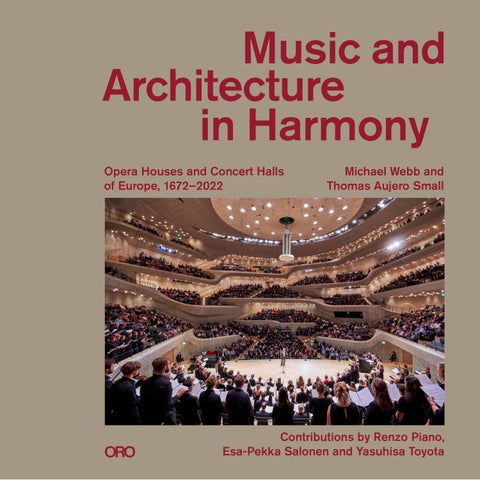
Michael Webb and Thomas Aujero Small
Music and Architecture in Harmony Opera Houses and Concert Halls of Europe, 1672–2022
Contributions by Renzo Piano, Esa-Pekka Salonen and Yasuhisa Toyota
This selection of ninety halls traces their evolution from the baroque era to the latest innovations and explains how architects and acousticians enrich the experience of playing and listening. It’s a celebration of two arts that support each other and of a glorious legacy that is constantly renewing itself. Architectural writer Michael Webb and music impresario Thomas Aujero Small travelled all over Europe, exploring theaters, talking to their artistic directors and attending performances. They chose exemplars, grand or modest, which delight the eyes and the ears, while embodying a rich heritage or building a new audience. Their account of the history, architecture and programming of each theater is illustrated with 190 vivid images. The halls are featured chronologically, with break-out chapters on the musical capitals of Berlin, Vienna, Paris, Prague and London, as well as festivals and music academies. Yasuhisa Toyota, who worked on eight of the halls, offers his insights on acoustics. Renzo Piano and Esa-Pekka Salonen contributed forewords. This is a perfect gift for opera-lovers, concertgoers, and everyone who is captivated by great architecture and design, old or new. It will also serve as a guide to inspire cultural tours of European cities, small towns and summer festivals. Authors Michael Webb Hon. AIA/LA is the author of thirty books on architecture and design and writes for leading journals in Europe, the U.S. and Asia. Thomas Small won musical fellowships to the Columbia Graduate School of Journalism and to the Sorbonne Nouvelle in Paris, and has written extensively for the French journal Concertonet and other publications. Hardcover, 25cm square, 302 pages, $60.00. ORO Editions, September, 2026 Discounts available on 10+ copies, please contact brooke@oroeditions.com
Contents Foreword 8
Renzo Piano Foreword 9
Esa-Pekka Salonen Architecture in the Service of Music Michael Webb
12
Performing for the Court 16 Haydnsaal, Eisenstadt, Austria 17 Markgräfliches Opernhaus, Bayreuth 19 Cuvilliéstheater, Munich 23 Drottningholms Slottsteater, Sweden 26 Neues Palais Theater, Potsdam 29 Opéra-Royal de Versailles 31 City of Music: Berlin 34 Staatsoper unter den Linden Deutsche Oper 39 Komische Oper 40 Konzerthaus 43 Berliner Philharmonie 46 Kammermusiksaal 50
36
Opera Goes Grand 54 Staatstheater, Meiningen 56 Teatro di San Carlo, Naples 58 Teatro La Scala, Milan 61 Grand-Théâtre de Bordeaux 65
Opéra-Municipal de Marseille 70 Teatro La Fenice, Venice 72 Teatro Malibran, Venice 74 La Monnaie, Brussels 77 Opéra-Royal de Wallonie-Liège 80 Bayerische Staatsoper, Munich 80 Gran Theatre del Liceu, Barcelona 84 Opernhaus, Zürich 92 Hessisches Staatstheater, Wiesbaden 96 Kungliga Operan, Stockholm 100 Early Memories 102 Thomas Aujero Small City of Music: Vienna 106 Wiener Staatsoper 107 Musikverein 109 Muzik Theater an der Wien Volksoper 119 Wiener Konzerthaus 119
114
Symphonic Stages 122 Concertgebouw, Amsterdam 123 Muziekgebouw aan’t IJ 123 Palau de la Música Catalana, Barcelona Die Glocke Konzerthaus, Bremen 133 Liederhalle, Stuttgart 133 Kulturpalast, Dresden 137 Brucknerhaus, Linz 142 Konzerthalle, Bamberg 144 City of Music: Paris 150 Palais Garnier 151
128
Opéra-Comique 154 Théâtre des Champs-Elysées 157 Radio-France Auditorium 160 Philharmonie de Paris 163 La Seine Musicale 163 Yasuhisa Toyota on Acoustics
168
Escape to a Festival 170 Goethe-Theater, Bad Lauchstädt, Germany 171 Festspielhaus, Bayreuth 173 Regentenbau, Bad Kissingen, Germany 175 Grosses Festspielhaus, Salzburg 175 Snape Maltings, U.K. 179 Angelika Kauffmann Saal, Schwarzenberg, Austria 182 Glyndebourne Theatre, Lewes, U.K. 184 Wolkenturm (Cloud Tower) Grafenegg, Austria 186 National Opera House, Wexford, Ireland 188 Festspielhaus Erl, Austria 192 Auditorium Giovanni Arvédi, Cremona 196 City of Music: Prague 200 Stavovské divadlo (Estates Theater) 204 Národní divadlo (National Theater) 205 Státní Opera (State Opera) 209 Music Academies 212 Salle Cortot, Paris 213 IRCAM, Paris 214 Mumuth, Graz 215 Royal Academy of Music, London 216 Haus Marteau, Lichtenberg, Germany 218 Pierre Boulez Saal, Berlin 221
City of Music: London 224 Sinfonia Smith Square 226 Covent Garden 227 Royal Albert Hall 227 Wigmore Hall 229 Royal Festival Hall 230 Barbican Concert Hall 233 Reconceiving the Opera House 236 New Hamburg Opera House 237 Teatro Regio, Turin 239 Opéra National de Lyon 239 Musiktheater im Revier, Gelsenkirchen 241 Theater St. Gallen 243 Aalto-Theater, Essen 246 Oslo Opera House, Oslo 249 Stavros Niarchos Cultural Center, Athens 254 Contemporary Concert Halls 258 KKL, Lucerne 259 Casa da Musica, Porto 262 Parco della Musica, Rome 266 DR Koncerthuset, Copenhagen 270 Harpa, Reykjavik 272 Konzerthaus, Blaibach, Germany 276 Filharmonia, Szczecin, Poland 278 CKK Jordanki, Toruń, Poland 281 Elbphilharmonie, Hamburg 285 Isarphilharmonie, Munich 298 Photo credits 294 Acknowledgments 298 Contributors 299
Foreword by Renzo Piano
I have always loved to create spaces for music. This is what architecture knows how to do. It creates acoustic chambers so that music can be heard properly, whether they are concert halls, recording studios, or sound labs. Just as a luthier crafts instruments to produce sound, architecture creates spaces so that music can be heard in the best possible conditions.
Renzo Piano Building Workshop: St Cecilia Hall, Park of Music, Rome
When designing spaces for music, there are measurable elements, such as sound intensity, clarity, and its distribution in space. But then, there is a kind of magic, and that is where collaboration with musicians becomes essential. There are so many things that bring music and architecture closer together. The same need for a geometric, sometimes mathematical, structure. The same need for order, one that can be disrupted when necessary.
8
Foreword by Esa-Pekka Salonen
The field of acoustics is partly scientific and partly subjective, yet we can still describe in broad terms what makes a hall sound good. A symphony orchestra moves from the faintest whisper to overwhelming power, and the architecture of a hall must be able to carry that entire dynamic range. But there is another element—more subjective, yet just as important, if not more so: the vibe, the atmosphere of the space, its feeling and expressive character, which profoundly shapes the listening experience. The crucial moment comes when the audience first enters the hall. If the environment feels welcoming, expressive—perhaps even exciting—it prepares them for the music. This relaxation is not passive, not switching off, but a kind of openness: settling into the experience and becoming ready for what is about to unfold. During the lockdown I realized how deeply I had missed the concert experience. When I finally returned to a hall and stood at the bar before the performance, I suddenly had the powerful sense that I was among “my people.” Many of them I did not know, yet we were bound together by our shared love of music and by the simple fact of being present in that space at that moment. What struck me was the quiet diversity of this tribe—certainly in age, but in many other ways as well. A concert hall gathers people who might otherwise never meet, and the entire experience, from arriving at the building to leaving after the final notes, feels subtly shaped and curated, preparing us to share something meaningful together. Frank Gehry observed that in music the timeline is fixed: the composer and performers determine it, and the listener simply follows its unfolding from beginning to end. In architecture, by contrast, the visitor creates
Esa-Pekka Salonen on the rostrum © Benjamin Ealovega
their own timeline through movement in the space— returning, lingering, or changing direction. Music unfolds relentlessly; architecture allows time to be shaped by the individual experience. In a great concert hall, the two ideas meet: the musical timeline is fixed, but everything surrounding it—the journey into the hall, the gathering of the audience, the atmosphere of the space, the musical program itself—is thoughtfully shaped. Frank and I agreed that the message of an ideal hall should be one of openness, excitement, and inclusivity—qualities not always associated with classical music. That, I think, is a mistake. Music needs a sense of play. Composers like Beethoven were not solemn priests of culture; their music is full of wit, energy, and surprise. A concert hall should invite that spirit. The experience should not feel reverential and glum, but alive—something shared with curiosity, openness, and joy.
9
top left Stuttgart Opera © Matthias Baus, top right San Carlo, Naples © Luciano Romano,
bottom left La Fenice, Venice © Nicola Grassetti, bottom right Hesse State Theater, Wiesbaden
10
top left Concert House, Berlin, top right Municipal Opera, Marseilles,
bottom left Garnier Opera, Paris, bottom right Estates Theater, Prague courtesy National Theater
11
Architecture in the Service of Music by Michael Webb
Verdi’s Don Carlos at the Meiningen State Theater © Christina Iberl
12
A
rchitecture and music are universal languages, and fluent practitioners are at home wherever they go. These arts can also be tightly interwoven, each intensifying what the other has to offer. “Architecture is like music: it is made to move and delight,” declared Jean Nouvel, who has designed several exemplary theaters. Frank Gehry was an architect whose passion for music produced some of the world’s best concert halls. As he explained in an interview with The Seattle Times in 2017, “In music, you’re taking sounds and putting them together to create beauty and a feeling. When you do a building, you’re taking inert materials and putting them together to create beauty and a feeling. You make the space comfortable, interactive, and humane so that people feel together in the room and people feel together with the orchestra. The orchestra feels the relationship with the people. And it makes it better.”
In this survey the focus is on classical music—an imprecise term that embraces a host of forms and styles from medieval motets to contemporary experiments; compositions that challenge, delight, inspire, and stand the test of time. For centuries in Europe, religious institutions were the principal clients for artists and composers, and even agnostics like me can thrill to plainsong in a Romanesque abbey or a cantata of Johannes Sebastian Bach performed in the church of St. Thomas, Leipzig, where he served as music director 300 years ago. Bach created music to be heard in a soaring Gothic nave; other composers scaled
their work to an intimate salon or a grand public hall. Music is a primal human expression and constantly evolving. Classical music emerged from domestic performances, steadily growing in scale and popularity, and generating an enduring repertoire. Great composers, from Handel and Bach to Haydn and Mozart, Beethoven and Wagner, Schoenberg and Stravinsky, pushed the bounds of the art, creating new sounds and structures. Opera evolved from the masques and entertainments staged to celebrate dynastic marriages. The first true operas, in which music carries the story, were composed in Florence in the late sixteenth century. Those scores have disappeared, but Monteverdi’s Orfeo, composed for the Gonzaga court in Mantua in 1607, is still revived along with later work by that master of the genre. The joy of listening to great music superbly performed is enriched by the design of purposebuilt halls. When sight and sound are perfectly matched, all your senses are engaged, and you can have a sublime experience. Greek amphitheaters may be the oldest surviving structures purpose-designed for musical dramas, and variations on that model were constructed throughout the Roman empire. The Teatro Farnese in Parma and Palladio’s Teatro Olimpico in Vicenza show how Renaissance architects were inspired by antique models. Private or public, large or small, plain or grandiose, each hall reflects the changing demands of composers, performers, and auditors over the past four centuries. A standard model quickly emerged. A rectilinear “shoebox” plan proved acoustically rewarding for concerts and the seats could be cleared when the flat floor was required for an event—such as the annual Vienna Philharmonic Ball in
13
the Musikverein of Vienna. A horseshoe of stacked boxes and galleries made the audience for opera a part of the spectacle and expressed the hierarchy of rank and wealth. These configurations survived, with subtle variations and a few radical departures, until the last century. Then, the urge to create a more democratic experience prompted architects to put the entire audience on a single bank of seats with a few token side boxes. The evocation of a Greek amphitheater in Wagner’s Bayreuth Festspielhaus was a daring departure from convention, as was the vineyard plan of Hans Scharoun’s Berlin Philharmonie where discrete blocks of seating surround the orchestra on every side. The goal of recent designs is to blur or eliminate the barrier between audience and players and to ensure that every seat enjoys the best possible sight lines and sound quality. All music lovers have their favorite performers and theaters, and Europe offers a bewildering range of options. That’s especially true in Germany where, prior to unification, a multitude of independent states, cities, and patrons fostered competition and local pride. The same constructive rivalry occurred in the city-states of Italy. In Britain, France, and other European countries that have long been centralized, the capital overshadows provincial cities. This book focuses on theaters in which architecture and programming both excel—if only for the duration of a festival—and enjoy a fruitful relationship. It’s a collection of legendary stages, personal favorites, and little-known treasures. Chapters on the evolution of concert halls and opera houses are interspersed with chapters on the varied resources of five musical cities, musical academies, and acoustics. Most historic theaters have been rebuilt at
14
least once: the dates on each entry indicate the earliest surviving shell and the last important reconstruction of the interior. Geographically the selection extends from Athens to Reykjavík, Portugal to Poland, with a concentration in German-speaking countries at the heart of Europe. There’s great variety: the horseshoes and shoeboxes come in a dazzling variety of styles. Architects have been exploring radical new solutions since the Second World War. Standards are constantly in flux. An inspiring music director may transform an underperforming company, and acousticians can remedy defective halls. Do I hear voices complaining that these art forms have lost their relevance to all but an aging minority and will soon disappear? In a world racked by uncertainty, craving novelty while vainly seeking to resurrect the past, the traditional arts are under attack. Opera and classical music, performed by dedicated individuals whose natural talent has been honed by a lifetime of training and practice, are disparaged as elitist—a diversion for the privileged few. One wonders when these naysayers last left their couches or removed their earbuds. Long gone are the days when the rich sported their finery and came to the theater to be seen, to play cards and entertain friends in their boxes, pausing occasionally to listen to a celebrated diva. Now, with few exceptions, operagoers dress for comfort. In the top houses, tickets sell out months in advance. New operas, often addressing contemporary issues, are commissioned, and a fresh approach is taken to the classics. But the sense of occasion remains. There’s a choreographed promenade to your seat, a hush as the performance begins, and rapturous applause as it ends. For a few hours, cell phones are
silenced and pocketed, and the audience is immersed in a live, unamplified experience for eye and ear. Opera qualifies for a UNESCO Intangible Cultural Heritage award, and there’s little evidence here of a dying art. In most countries, tickets for the best seats tend to be pricey—though little more than those for a pop star viewed as a speck in a stadium—because the cost of mounting opera or supporting a major orchestra is high and constantly increasing. Ticket revenue typically covers only a small percentage of the annual budget. In Germany, where generous state and municipal subsidies make all but a handful of seats quite affordable, companies offer generous discounts to youths and seniors. They invite school groups to special performances of the classics and send performers into the classroom. Though Germany has reduced arts subsidies by 10 percent as an economy and neighboring states may do the same, there’s enough public support to carry companies through this crisis. We hope that this book encourages others to share our sense of delight as we explored these venues, experienced their offerings, and spoke with the artists who plan programs, conduct, or perform. Never has great music been more universally accessible, through recordings, streaming, and live performances. Never has the partnership of architects and acousticians created better auditoriums for musicians and audiences alike. Never, in their long history, have the great halls of the past been so finely tuned and well-serviced—down to multilingual subtitles in the seat backs. The world may be teetering on the brink of catastrophe, but the fusion of architecture and music can still provide inspiration, solace, and the dream that our better angels may yet prevail.
Vivaldi’s Il Giustino at the Castle Theater, Drottningholm © Markus Gårder
15
City of Music: Berlin
34
T
o understand why Berlin is such a powerhouse in classical music today, it helps to go back— way back—to Frederick the Great. His passion for music helped lay the foundation for the city’s deep-rooted musical culture. It flourished through the nineteenth century and again during the Weimar Republic. Then came the devastation of World War II, which left much of the city (and its cultural institutions) in ruins. But Berlin’s music scene didn’t just recover—it came back stronger than ever. In the postwar years, the city cemented its status as a global capital of classical music, attracting top musicians and conductors from around the world. Many of the best talents, especially from the US, come here to study, perform, or even settle permanently. Tradition mixes with innovation in a city that operates at the highest international level while maintaining a deeply local musical identity. Berlin’s turbulent history helps explain its preeminence. As the city rose from the ashes of 1945, the arts became weapons in the Cold War. The division of Berlin brought duplication. The venerable Staatsoper unter den Linden, Komische Oper, Konzerthaus, Humbolt University, and other cultural treasures were reconstructed to boost the prestige of the communist German Democratic Republic (DDR) but were shut off by the Berlin Wall. In the 1960s, the Culture Forum was constructed as a bold response by the West. Hans Scharoun designed two innovative halls for orchestral and chamber music, as well as a soaring public library. The New National Gallery was the crowning achievement of Mies van der Rohe, who had begun his career in the early 1900s working with Peter Behrens on the Berlin Turbine Hall. Close by is the Deutsche Oper, a
brutalist concrete block containing a deliberately spare auditorium. Berliners might have preferred something more ornate—as they made clear when the Staatsoper was being rebuilt—but the West employed modernity as a symbol of democracy and to mark itself off from the Soviet bloc. A passion for music overrode political divisions, as it did throughout Germany. Kurt Masur, the long-time conductor of the Leipzig Gewandhaus Orchestra, was such a venerated figure in that city that he was able to mediate between the authorities and protestors and avert a confrontation. His calming influence did much to speed the peaceful collapse of the DDR. When the Wall came down, thousands braved the cold to stand in Berlin’s Gendarmenmarkt on Christmas Day 1989 and watch the live video of Leonard Bernstein conducting Beethoven’s Ninth in celebration of the city’s reunification. Soloists, musicians, and children’s choirs from East and West performed side by side, in an expression of harmony and reconciliation. The exhilaration of that moment quickly subsided. An impoverished city was challenged to sustain three opera houses and four important concert halls. To its great credit it has continued to do so, and spend generously on improvements and upgrades, despite a downturn in the German economy. The Schiller Theater, rebuilt in 1951, has provided a temporary home for the Staatsoper and Komische Oper while they were under restoration. In 2017 Frank Gehry designed the Pierre Boulez concert hall within the shell of a listed building, and this exciting stage for the Barenboim-Said Akademie and the Divan Orchestra will be explored in the chapter on Music Academies. A cut in arts funding in 2024 set
35
Teatro di San Carlo, Naples (1737/2009) Located across the street from the soaring Galleria Umberto I and around the corner from the vast expanse of the Piazza del Plebiscito, the Real Teatro di San Carlo is one of the grandest monuments of a storied city. Magnificence and squalor, culture and depravity have coexisted since Roman times, but Naples is now on an upswing, its landmarks scrubbed clean, and a new art-filled subway offering an alternative to traffic-clogged streets. Credit Mirella Barracco and her Fondazione Napoli 99 for launching the renaissance and boosting civic pride. San Carlo was commissioned by the Bourbon King Charles III as an adjunct to his palace in 1737, making it the world’s oldest continuously operating opera house. Destroyed by fire in 1816, the theater was immediately rebuilt, with a larger stage and the capacity of seating and standing reduced from 3,000 to 1,390, greatly improving the acoustics. Naples was then the preeminent musical city of Europe. In the nineteenth century, San Carlo became a crucible of artistic revolution. Gioachino Rossini presented his Otello and Mosè in Egitto. Gaetano Donizetti, virtually a house composer, premiered no fewer than seventeen operas here, including Lucia di Lammermoor. Giuseppe Verdi’s early ties to the theater blossomed into a lifelong association, with his mature works forming the backbone of the theater’s repertory. The twentieth century brought legends to its stage: Maria Callas, Beniamino Gigli, and Tito Schipa gave lyrical voice to Italian romanticism. Every singer aspired to perform there. The one exception was
San Carlo, Naples © Luciano Romano
58
59
and Rossini’s Il Barbiere di Siviglia—with bold contemporary offerings like the ballet Quatre tendances, Wayne McGregor’s Obsidian Tear, and music by Esa-Pekka Salonen and Philip Glass. Recitals by acclaimed artists, including baritone Matthias Goerne and the superb string quartet festival, Quatuors à Bordeaux, further enrich a season that affirms the theater’s role as a dynamic cultural force in Bordeaux and beyond.
Opéra-Municipal de Marseilles (1787/1924) The Grand-Théâtre of Marseille was inspired by that of Bordeaux and completed soon after. An electrical fire gutted the interior in 1919, and the architects Ebrard, Castel, and Raymond transformed the theater into a showcase of art deco. Renamed Opéra-Municipal, it opened in 1924 on the eve of the Paris exposition that launched the style worldwide. A frieze of gods that embody the arts was added to the eighteenth-century façade with its row of Ionic columns; the theater faces onto a square just off the waterfront. There’s an engagingly provincial character to the interior, though it makes up in invention and exuberance what it lacks in refinement. It recalls the hedonistic spirit of the French Riviera in the Jazz Age, as sunseekers flocked to beaches that their grandparents had shunned on their winter promenades. In the marble foyer, frescoes and a sculptured frieze celebrate the arts of music and dance, voluptuous nude statuary adds a note of eroticism, and there’s even a squid motif in the mosaic floor to evoke the Mediterranean. Stairs ascend to a salon where chamber music concerts are presented.
70
The horseshoe auditorium seats 1,750 in the stalls, a loggia, two balconies, and an upper gallery from which caustic critics have been known to hurl tomatoes or set off alarms. Every surface is richly modeled with stylized volutes and fluted columns, stepped parapets, and masks, alternating pink marble and silvered stucco. Sculptor Antoine Bordelle contributed a frieze. Ornament and lighting are deftly interwoven in the jeweled necklace that encloses the ceiling. The theater is celebrated not only for its exacting standards but also for its superb acoustics and rare intimacy between stage and audience—an atmosphere that inspires both precision and expressive freedom. Michele Spotti, the recently appointed music director, has conducted at many leading international opera houses and collaborated with the most distinguished stage directors of our time, including Robert Wilson and Barrie Kosky. Historically, the Opéra de Marseille has served as a critical launching ground for major artists in France. Alfredo Krauss, Plácido Domingo, and Renata Scotto gave early, career-defining performances here. The repertoire has a strong connection to the life of the city. Film composer Vladimir Cosma’s Marius et Fanny, based on Marcel Pagnol’s beloved Marseille trilogy, evokes the French chanson-like rhythms of the Vieux Port and was memorably performed by Robert Alagna and Angela Gheorghiu. General director Maurice Xiberras, also a native of Marseilles, says that he fell in love with opera at the age of seven, sitting in the notorious upper galleries with his grandparents. Looking ahead, the company plans to revive works by Ernest Reyer, a Marseille-born composer whose overlooked operas are poised for rediscovery.
The Marseilles Opera is a treasury of Art Déco
71
Palace of Catalan Music, courtesy of Barcelona Obertura
130
131
La Seine Musicale: a basket within a glass sphere. © Didier Boy de la Tour
166
167
interwoven with new construction, and it became an influential model for other schemes of adaptive reuse. Like Wagner’s Festspielhaus and the IRCAM complex in Paris, the Maltings was shaped to the preferences of a composer. The narrow, lofty room has similar dimensions to that of Britten’s favorite local church. The architects preserved the original brick walls and their openings but raised them a meter and created a new roof with a forty-five-degree pitch and exposed triangulated trusses. A double layer of pine produces the long reverberation time that Britten specified. The steeply raked bank of cane seats is designed for minimal sound absorption. Though the hall was conceived for orchestral concerts, it successfully hosts modestly scaled operas with a pit that accommodates up to sixty musicians. The immediacy of these performances is a large part of the festival’s appeal and the year-round events the Maltings now presents. In 1973, Britten’s final opera, Death in Venice, was premiered at Snape—a haunting farewell to the composer’s artistry. The festival has continued this history of daring and discovery: in 1997 Mark-Anthony Turnage’s Twice Through the Heart premiered there as a dramatic portrait of modern anguish; in 2004, Harrison Birtwistle’s The Io Passion explored myth and desire; and in 2019, Thomas Larcher’s Das Jagdgewehr brought a new poetic intensity to the stage. More recently, in 2025, Colin Matthews’ A Visit to Friends—with a libretto by William Boyd—affirmed Snape’s role as a crucible for contemporary opera.
opposite: Angelika Kauffmann Hall, Schwarzenberg. top: courtesy Bregenzerwald Tourismus; bottom: courtesy Schubertiade
182
Angelika Kauffmann Saal, Schwarzenberg, Austria (1984/2001) A picture-perfect Alpine valley is one of two venues for the Schubertiade, a summer festival of chamber music and lieder by Franz Schubert and his contemporaries, founded by German baritone Hermann Prey in 1976. Concerts are presented in the village of Schwarzenberg using the community hall named for Angelika Kauffmann, the neoclassical painter who grew up there in the mid-eighteenth century. It was designed by Bartle Moosbrugger, an architect who drew on the rich tradition of wood construction in the Bregenz Forest region near the western border of Austria. The Schubertiade began using the hall in 1994, extolling its acoustics but soon outgrowing the space. In 2001, they commissioned Herman Kaufmann, another local architect, to extend the hall by seven meters, increasing its seating capacity to 600, while adding a spacious foyer, an upper-level terrace, and other improvements. Attending a concert there in June or August can be a magical experience. From the approach on steep, winding roads there’s a constantly shifting perspective of scattered farmhouses, cows grazing in lush meadows, forests, and jagged peaks. Audiences arrive early to drink in the scenery—and a glass of Grüner Veltliner, perhaps—before the afternoon concerts. A horn duet is the signal to move indoors. The hall, constructed entirely of local fir and beech, has the aroma of a forest and the sensuous lines of a cello in its rib vault. And the sound is thrilling. Critics have ranked it among the best chamber music halls in Europe, which has drawn leading singers and instrumentalists to play there.
183
194
195
202
203
As the architect explains, the Susie Sainsbury Theatre was inspired by the curved shapes of string instruments and is lined with cherry wood. Designed to accommodate opera and musical theater as well as a wide range of instrumental and vocal performances, it has 309 seats, 40 percent more than the theater it replaced, as well as a larger orchestra pit, a stage wing, and fly tower. A galaxy of 600 fiberoptic crystals reinterprets the traditional chandelier. Immediately above is the 100-seat Angela Burgess Recital Hall, which hosts public concerts, master classes, and recording sessions. Its footprint is as large as that of the main stage, providing an ideal rehearsal space. The room is lined in pale, lime-washed oak, and a ribbed ceiling vault frames an oculus that bathes the room in natural light. Susie Sainsbury Theater in the Royal Academy of Music. © Frances Marshall
Haus Marteau, Lichtenberg, Germany (1913/2021) Violin prodigy Henri Marteau (1874–1934) made his professional debut at age ten, toured Europe and the US, and became a professor at the Royal Prussian Conservatory in Berlin in 1908. The First World War ended his career, and he retired to the villa he had built in 1913 in Upper Franconia, north of Bayreuth. There he gave lessons, and a respected music school evolved from his individual efforts. The International Music Centre Haus Marteau now offers forty master classes a year in all aspects of classical music, culminating in public recitals. The traditional villa and its original furnishings offer students a cozy domestic environment in which to study and practice, but the addition that opened in 2021 is a startling departure from convention.
218
Marteau House auditorium, Lichtenberg © Edward Beierle
219
previous spread, above, opposite: The Oslo Opera is a gathering place for the city that regenerated the harbor front. © Martina Pipprich/ courtesy Snohetta
252
253