INTRODUCTION
14
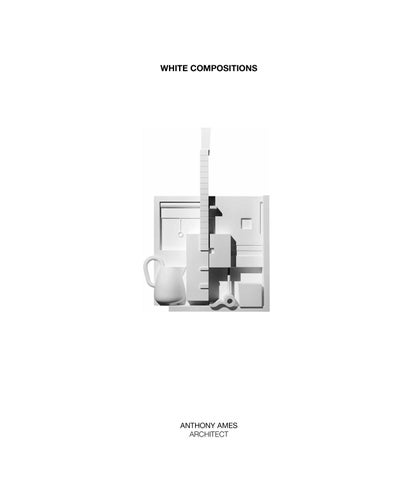
Based in Atlanta, Georgia, Anthony Ames has operated his eponymous architecture office since 1976 and began painting in 1984. Ames’ White Compositions—a series of 11 monochromatic relief wall sculptures— originate from and elaborate on the architect’s painting practice, closely attending to proportion, layout, recurring forms, and motifs found within both his artistic and built works. His paintings—as described by Courtney Coffman in her previous review of Ames’ solo exhibition at a83 Gallery in New York—“oscillate somewhere between the formality of a still life, the dynamism of sculptural relief, and the juxtaposed delight of collage.” A natural evolution in Ames’ practice, the 11 wall sculptures are accompanied by documents that provide insight into the precise and accomplished nature of Ames’ design process: from buildings to art. Despite their monochromatic simplicity, Ames’ White Compositions provide manifold readings. Emphasized by the use of an all-white palette, the 11 pieces are highly formal, operating through the play of light and shadows on volumes and within voids. Each sculpture is also a rigorous geometric and compositional exercise in which spatial complexity is expressed within a relatively shallow depth of six inches or less. Meticulously constructed, each composition is designed by Ames through sketches and then elaborated as orthographic drawings, forming a complete set of dimensioned elevations and sections (see Appendix 2 pp. 71-78). The drawing sets—one for each composition— are masterfully drafted and supremely organized. As precursors to the relief sculptures, the drawings provide a set of instructions for construction, just as they do for his buildings. The orthographic sets expertly communicate Ames’ artistic intent and his practiced manipulation
of space at varying scales. The process work emphatically presents the White Compositions as “constructed.” Preceding the execution of the physical pieces, the drawings provide insight into Ames’ working method, one greatly influenced by his educational training and professional experience. His use of architectural drawing tools to execute fine art indicates a continuity in Ames’ approach to his work—both as an artist and an architect. The pieces are symbolically charged with highly specific references that speak to Ames’ work and life as an architect in Georgia preoccupied with modernism, art, and basketball, among other cultural and literary meanings. Ames playfully collages architectural elements, such as facades organized by grids, with everyday (yet highly specific) objects— like a Morandi-esque vase, a Corbusian pair of glasses, a can of coke, a Gretsch guitar, or a basketball hoop. The contrast between the (supposedly) rational, objective, and universalizing characteristics of modernism in confrontation with the particular, the idiosyncratic, and the autobiographical quotidian communicates a uniquely Ames-ian sensibility that provides a distinctive and refreshing take on the 20th-century architectural movement. As thoughtfully described by Coffman, Ames’ artworks “...undoubtedly communicate the ‘high,’ capital-A Architecture of modernism, particularly that of media- and brand-savvy figures like Corb, but they also acknowledge figures like Michael Jordan as equally influential to Ames. The latter provides a crucial catalyst for the shifting zeitgeist in architecture discourse today: uncovering alternative histories and new architectural heroes.”
15
Just as Ames operates across boundaries—from architecture to art to basketball—with characteristic precision, diligence, and a sense of humor, his White Compositions blithely challenge the categorization of model, sculpture, painting, and drawing, fluctuating between a reading of familiarity and abstraction. Clara Syme
ENIGMA VARIATIONS
Approaching Anthony Ames’ quiet and delicate exhibition White Compositions at a83 Gallery in New York, I am reminded of a well-known anecdote concerning the composer Chopin, certainly apocryphal. After he gave an exquisite performance of his Fantasia Impromptu and after the rapturous applause had died down, someone in the audience waved their hands and stood up, and said, “That was exhilarating Herr Chopin, but what does it mean?” In response, and with great solemnity, Chopin returned to the piano and played the work again. Helped by Chopin I will not attempt to ascribe meaning to Ames’ twelve intricate constructions. I will, however, give some background on possible sources that influenced the work and offer a personal view on the sequence of transformations that gave them form. Full disclosure: I have known the artist-architect for more than forty years and am continually impressed by his singular vision. There is no concealing what inspires him, all his creations reflect an intense pleasure in the imagination and architecture of Charles-Édouard Jeanneret, later known as Le Corbusier. Year by year and decade after decade, Ames has explored interweaving themes and harmonies that essentially reinvent and extend the visual poetry of Le Corbusier. Venice Biennale 2012 In 2012, architects Tod Williams and Billie Tsien curated a Wunderkammer of inspiration in the Casa Scaffali, a small pavilion in the gardens of the Arsenale for the 2012 Venice Architecture Biennale (above left). Thirtyfive architects and artists from around the world were shipped identical wood boxes and invited to fill them by creating a work that embodied the sources of their inspiration. Amidst the extraordinary variety of stuff, much of it incomprehensible, was a stark rectangular relief sculpture by Anthony Ames (above center). The composition, which reappeared in the New York exhibition, sans box, contains many of the motifs that play games in Ames’ imagination: a hanging curtain, an array of vessels – vase, wine glass, and soda can – against a tiled wall, and two items which are, each in its own way, mysterious: a book and, jutting forward from the picture plane, a hoop. In 2024, in the back room of the a83 Gallery, alongside concept sketches
and construction drawings (possibly ignored by many), was the most recent composition, White Composition 12 (page 58). It is possibly a key to much of the earlier work. On the right side of a simple shelf are an open book, a slender wine glass, and a pair of eyeglasses with a heavy circular frame that are associated with Le Corbusier. At the far left end of the shelf is a small model of a building, which after some effort I identified as the Villa La Roche Jeanneret (home of the Le Corbusier Foundation). This led me to assume that elements of Le Corbusier’s architecture are probably present in many of Ames’ compositions. But then, projecting from the wall high above the center of the shelf is a miniature basketball hoop, calling all potential meaning into question (it is truly mysterious). So let me begin by considering the open book. Purism Charles-Édouard Jeanneret’s Still Life with Book, Glass and Pipe (above right), which now seems an elegant but unremarkable painting easily mistaken for a Cubist work, was conceived in 1918 as an exact expression of the concept of Purism It also plays a key role in considering Ames’ White Compositions. In the mind and imagination of Jeanneret and the painter Amédée Ozenfant, their concept of Purism, if widely adopted, would restore regularity in a France recovering from the destruction of the First World War. In the paintings of both men (there were few followers) objects are depicted as standardized and reproducible objét type, or object type, including everyday items like bottles, glasses, plates, and musical instruments. In Purist ideology such object types had a moral, purifying presence. The main concepts of Purism were presented in their booklet Après le Cubisme, published in 1918. In the painting Still Life with Book, Glass and Pipe, 1918 Jeanneret wrestled with giving form to the idea of Purism. The open book is reborn in a number of Ames’ White Compositions. Judging from his writings, Jeanneret appears to have taken unreasonable pleasure in the violence of the First World War (as did several other major artists) because destruction could presage a new beginning marked by a new form of painting called Purism and a new order of reality, L’Esprit
17
18
Nouveau. An intense need to purify reality must have been in the air in the first decades of the 20th century. It is present in Clive Bell’s theory of significant form explained in his extraordinary book Art, published in 1914. He begins with the question, “What quality is shared by all objects that provoke our aesthetic emotions?” The answer, he writes, is “significant form,” which he describes as “lines and colours combined in a particular way, certain forms and relations of forms, [that] stir our aesthetic emotions.” (This statement could also be applied to all of Ames’ White Compositions.) I doubt that Le Corbusier knew Bell’s theory of significant form, but similar ideas were present elsewhere in Europe. Before the First World War, and before Jeanerret became Le Corbusier, he worked briefly in the office of Peter Behrens in Berlin where he would have experienced Behrens’s “machine aesthetic” and known the Werkbund’s advocacy for the Gesamtkunstwerk, or total work of art, that was applied to all the arts. He also would have been aware of the Jugendstil ideas of Hermann Muthesius, who advocated for Typsierung, or typification, the use of standardized designs that would be both suited to industrial mass production and reflect a uniquely German style. All of which seems to have fed into the concept of Purism. Only a few days after the Armistice, signed November 11, 1918, Jeanerret and Ozenfant, published their statement of first principles toward new postwar aesthetics in Après le Cubisme, firmly relegating Cubism to the past. “Cubism has become a decorative art of romantic ornamentism. There is a hierarchy in the arts: decorative art is at the base, the human figure at the summit. Purism wants to conceive clearly, execute loyally, exactly without deceits; it abandons troubled conceptions, summary or bristling executions. A serious art must banish all techniques not faithful to the real value of the conception.” In his 1977 Artforum essay “Purism: Straightening Up after the Great War,” art historian Kenneth E. Silver writes: “Alongside the image of reason and stability exemplified by Le Corbusier’s
Purist Still-life with Stack of Plates of 1920 (above left), let us put the futility and disaggregation that is the true story of the war and its aftermath. Working back from Purism toward the tragic disorder from which it emerged, let us go even further and plunge into the heart of the dialectic: in its origins Purism—the immaculate, hermetic art of Jeanneret and Ozenfant—is anything but pure. Its look, its iconography, its theory, its raisons d’etre, and its significance can only be understood within the physical and psychological frontiers of a brutalized and defiled France during the First World War. . . . Purism was a reaction against a reality almost too terrible to bear.” Silver offers a searing critique of Jeanneret’s most ideological Purist work: “We have only to look at Jeanneret’s Still Life with Book, Glass, and Pipe of 1918, contemporary with the writing of Après le Cubisme, to see what this interpretation of history and art meant in visual terms. With only four elements arranged on an immaculate tabletop, Jeanneret announces the Purist entry into Paris and establishes himself in opposition to a work like Picasso’s Bottle of Pernod of six years earlier. In place of the profusion of signs and symbols, printed matter, indications of inebriation, and an overall surcharge of information which characterizes the Cubist picture, Jeanneret’s stark image of an open book with clean, white page[s] is a tabula rasa of the late ’teens.” He concludes, “Like the Purist book that cannot be read and the Purist guitar that cannot be strummed, Purist theory – concerned only with the construction of the well-tempered picture – appears to militate against its own significance.” Picasso’s Guitar, Glass, Bottle of Vieux Marc, 1913 (above right) is a possible source for the Jeanneret painting to which he adds only precision and a book. If his driving intention was to show that Cubism was mere ornamentism he failed. The belief that Purist painting had a moral presence that would benefit France may be absurd, but Jeanneret’s passionate belief in the “cause” (and his central role in it) comes through in the intensity of his work. It could
be argued that painting was a key step in the foundation of a modern movement that would transform the physical world, and Jeanneret, now calling himself Le Corbusier, was clear about his significance to it: witness his reply in a 1929 letter to a client asking for revisions: “The nub of the matter is this: I am the instigator of the modern architectural movement. All countries recognize this, apply my methods, exploit my ideas…” It must be noted that there were very few Purist works and that the Purism movement did not last very long, nonetheless Le Corbusier pressed on with his mission to transform the world. Of course, by this time he was delusional, but being delusional does not diminish the power of his artwork. Remember the stack of plates in all that follows… In the catalogue for the 1996 exhibition Object-Type Landscapes, Ames offered commentary on Purism when discussing his own paintings: “The paintings depict ‘object-types’ – general, yet specific, generic yet designed, familiar yet estranged. They are ‘Purist’ forms depicted in a still life landscape. The compositions employ overlap, convergence and diminution to imply depth resulting in the creation of the illusion of perspectival space. However, through the use of juxtaposition, superimposition and ambiguity of scale the perspectival effect is impaired. The result is a blurring of distinction between foreground and background that encourages a reading of pattern that reinforces the presence of surface plane. A dialogue is encouraged between the deep space and the shallow space – between the creation of implied space through perspective and the reinforcement of the surface plane though pattern. A multiple reading is fostered that rewards the careful observer.” This dense explanation reveals both what Ames gained from Purist painting and the critical process he applies to his painting scripture. His conclusion that “a multiple reading is fostered [in the resulting work] that rewards the careful observer” seems to me to be particularly true to gain the most pleasure from the White Compositions. Around 1990 Ames created his own “object types” with a set of bold and stylish tableware inspired by the Purist forms of the 1920s (above left). In Ames’ own words, the set was shaped “by notions of Morandi, a tangential cognizance of Chardin, and a nod to the vernacular ….
[and] is at once designed and generic, modern yet timeless, simple yet elegant.” There is no mention of Le Corbusier or Ozenfant, but these selfconfessed Purist pieces play a role in many of the White Compositions. White Compositions So much for Purism. Ames is not interested in Le Corbusier as a savior but as a poet of form, someone who could imbue the simplest materials with a lyrical physical presence. This has played in his imagination over many years, thus these White Compositions offer a rare opportunity to experience objects formed out of decades of exploring a narrow set of themes. And although the work may contain an echo from the imagination of Le Corbusier, they are in every case built from objects and forms created by Anthony Ames. The sculptor Brancusi called architecture “inhabited sculpture.” In a sense I see Ames’ constructions as architecture to be inhabited by the mind, to be read and enjoyed in the imagination. I have searched in vain for parallels for this work and view them as distinctly original. Though the connection is distant, I am reminded of the work of Joseph Cornell, whose boxed assemblages were created from found objects (above right). Ames’ assemblages, some of which have the appearance of being boxed, are deliberately composed from recognizable objects that have a specific meaning or symbolic presence for him. Cornell’s boxes have been likened to surrealist fantasies, and in a sense the Ames compositions similarly create formal yet surrealist puzzles for the mind. Like Cornell, Ames uses irrational juxtaposition, and though his pieces are devoid of sentiment, almost stoic, their effectiveness does derive from the presence of forms and objects that suggest a longing for a lost past. As much as I admire White Compositions, however, when compared with Cornell’s creations, Ames’ performances are so serious that moments of wit or whimsy are so subtle as to be lost to the casual observer. Again, it is multiple readings that reward the careful observer. The Work Ames’ set of White Compositions clearly invites comparison with his better known paintings composed from many of the same elements.
19
20
The paintings are complex entertainments filled with delight, whereas the relief sculptures have a more compelling presence: they are hard, clear and demand attention; they have gravitas. The work, produced over thirty years, seems to fall into two distinct sets. White Composition 1 to White Composition 5 were based on or derived from painting, White Composition 6 to White Composition 12 were conceived of as sculpture. It may be that Ames moved to conceive of the sculpture independent of the painting because it offered more freedom. The result is that the earlier group of White Compositions is an extrusion from a two-dimensional composition, whereas the latter group is able to build narratives from a wider and more complex range of motifs. In each of the twelve constructions Ames transforms the elements and proportions derived from Le Corbusier into his own language, resulting in intense, exquisite three-dimensional compositions. Identifying each element – vase, book, guitar etc. – does not interfere with finding pleasure in these dense and intricate structures, their pleasure lies beyond the literal interpretation of the collage in the way they entertain and puzzle the mind and eye. Of course, in enjoying the work we are free to offer our own interpretations, which will have no direct connection to the fictions from Ames’ imagination. Unlike music, there is no need to play these works again to reveal their nature; they are always in the present to be looked at and experienced. Garden Pavilion is the first panel where the elements are built on the surface plane (above left and right). They exist in contrast to, but harmonize with, the conventionally-painted panel on which they reside – challenging the understood 2D-3D reading of both. The title refers to a small studio/guest house, the Garden Pavilion, which the imagery reinforces. The romantic in me believes the architect was in love with this exquisite little pavilion and it was passion that moved it out of the painting into three dimensions. This was in 1990, almost thirty-five years ago. The first three White Compositions are square formats that gradually begin to push at their edges in an attempt to contain their content. White Composition 1 from 1995 is a masterly compression of the elements in
the paintings that preceded it (page 30). A window shade and sectioned vase on the left side of the square are in danger of being consumed by a wall on the right. Ames describes it as “the first panel to go in total relief,” which suggests he considers the paintings as panels. What Ames calls “mundane elements” – is this Purism again? – are arranged differently from the paintings, yet, Ames declares, “They still qualify as paintings – they are just painted white.” White Composition 2, from 1996, is a further compression and abstraction of the major motifs (page 32). It is a delicate, beautifully balanced composition in which there are a section of a vase, a fragment of the Corbusier eyeglasses, and a section through an open book. Adding mystery is a column buried in the mass of a wall. The choice of elements and their arrangement are arbitrary, Ames says, but the rules of composition are not. He writes, “The square, it’s related lexicon of proportions – the swing down diagonal, the golden section, the double square, and the grid - all dictate rules of engagement that promote compositional regularity.” The third square composition, White Composition 3 (page 34), made a decade later, in 2005, is the first to directly reflect a work of architecture, Ames’ Martinelli residence. An extruded plan becomes a form balanced against what could be elevation details in the most literal – again, Purism? – representation of architectural elements and their relationships. White Composition 4, in contrast to square compositions that have come before, is a hefty, rectangular piece of structure (page 36). It is from 2011. The concept of architectural mass suggested in the previous work now asserts itself and threatens to entomb the two surviving pictorial elements, a vase and drapes. A strange waving line from the drapes through the structure meets the massive column on the right. The composition is balanced by two small square frames, left and right, that bite into the wall, a square mass the same volume of the box frames, holds the middle. Ames notes that here elements both recede into the thickness of the surface plane and move out from it. In a sense, it anticipates the moves that he makes with White Composition 5, the piece made for the 2012 Venice Biennale exhibition.
White Composition 5 (page 40) stems from a collage (above) in which a brilliant unfurled Italian flag flutters alongside Giuseppe Terragni’s Casa Del Fascio in Como. The movement and color make the painting more dramatic than the white relief, in which the flag becomes a carefully hung curtain on one side and a red can of Coca Cola becomes a white cylindrical object on the other. Ames explains that the work was intended as a collage (recall the curators’ mandate was to fill a box with things that inspire your work) that “grew into a white composition.The elements are the same in both [painting and composition] – a view from a sliding panel ribbon window, through a transparent basketball backboard with hoop, across a book stand with volume – to the Casa Del Fascio beyond.” Painting also seems to be behind White Composition 9 (page 50), not from an Ames painting but Jeanneret’s Still-life with Stack of Plates of 1920, which also appears to have influenced most of Ames’ subsequent constructions. (I could be wrong but no matter.) Unlike the painting, in the reconstruction, space is flattened. The stack of plates (many more than in the painting) is placed in roughly the same location in relation to the guitar. Where Jeanneret’s guitar form was repeated as a shadow, Ames appears to introduce a second guitar, a crude thing perhaps made from a cigar box. Ames runs the fret board of the simplified guitar body across the center of the construction. The wine bottle on the right of the Jeanneret is replaced by a vase of Ames’ design. The rhythm of the stacked plates is picked up in the window slats on the right with a faint elevation appearing below the guitars. The two clay pipes at the heart of the Jeanneret painting are transformed into two eggs whose form is not unlike the bowls of the pipes. Although the reconstruction is overall consistent with the Purist painting, where is the book? It was the focus of Jeanneret’s 1918 painting and the focus of Ames’ work in the Biennale, yet here it is absent. Variations on the guitar also appear in White Composition 6, 2022 (page 44), White Composition 7, 2023 (page 46) and White Composition 8, 2023 (page 48) only here,rather than running horizontally across the composition, the fret boards of the guitars become vertical elements that extend upward from a square frame. In White Composition 6 the fret board and halved bodies of two different guitars divide the box into four discrete vignettes that become mentally inhabitable spaces.
White Composition 7 also divides the frame into four sections, this time with a single, if still half, guitar, a curious half opened book and the memory of the bowl of a clay pipe. Dominating all in the lower left quadrant is a depiction of Ames’ porcelain jug with its splendid handle. White Composition 8 repeats the general structure of White Composition 7 with the same jug against an abstracted background. In White Composition 10 (page 54) all these elements come together in a complex composition comprising two framed scenarios, a square set on top of a rectangle. Again, the fret board of the cigar box guitar dominates and divides the composition. The open book appears in the square as if kept in place by the extended fret board. In the lower rectangle a small box imprisons a tiny Ames jug. The new and shocking element is the presence of a curved pipe coming out of the top of the upper box to suspend a lampshade, as if to illuminate the book below it. The last “word,” however, may be in White Composition 11 (page 56) and White Composition 12 (page 58), where the book that appears in Jeanneret’s 1918 painting is the main element of the first composition, and in the second, a dominant element superseded perhaps only by the reappearance of that mysterious hoop. All serious works of art must contain a least one mystery. In the case of the White Compositions it is the hoop. A clue may be found in a small gathering of men playing basketball on a Sunday afternoon at a suburban Y in Atlanta. Those who pause and watch the game would notice only one aging white man in this group of lively older players. From the behavior and the jokes and the criticism it is clear they’ve been playing together for a long time. And the aging white man is Anthony Ames. Alan Balfour
21
WHITE COMPOSITION 2
1996 ACRYLIC ON WOOD AND PLYWOOD 24 X 24 INCHES
32
This panel, the second in relief, continues to explore the effects of the third dimension. The arrangement and choice of elements - although not arbitrary - is speculative. The rules of composition; however, are not. The square, its related lexicon of proportions - the swing down diagonal, the golden section, the double square and the grid all dictate rules of engagement that promote compositional regularity.
33
52
53
68
WHITE COMPOSITION 5 COLLAGE, 2012, MIXED MEDIA, 6 X 12 INCHES
69
WHITE COMPOSION 5 STUDY, 2012, INK ON VELLUM, 24 X 36 INCHES
74
75