

Publishers of Architecture, Art, and Design
Gordon Goff: Publisher
www.oroeditions.com info@oroeditions.com
Published by ORO Editions
Copyright © 2026 Steve Ziger and ORO Editions.
All rights reserved. No part of this book may be reproduced, stored in a retrieval system, or transmitted in any form or by any means, including electronic, mechanical, photocopying or microfilming, recording, or otherwise (except that copying permitted by Sections 107 and 108 of the U.S. Copyright Law and except by reviewers for the public press) without written permission from the publisher.
You must not circulate this book in any other binding or cover and you must impose this same condition on any acquirer.
Author: Steve Ziger
Book Design: Alex Castro
ORO Managing Editor: Jake Anderson
10 9 8 7 6 5 4 3 2 1 First Edition
ISBN: 978-1-966515-65-4
Color Separations and Printing: ORO Editions, Inc. Printed in China.
International Distribution: www.oroeditions.com/distribution
ORO Editions makes a continuous effort to minimize the overall carbon footprint of its publications. As part of this goal, ORO Editions, in association with Global ReLeaf, arranges to plant trees to replace those used in the manufacturing of the paper produced for its books. Global ReLeaf is an international campaign run by American Forests, one of the world’s oldest nonprofit conservation organizations. Global ReLeaf is American Forests’ education and action program that helps individuals, organizations, agencies, and corporations improve the local and global environment by planting and caring for trees.
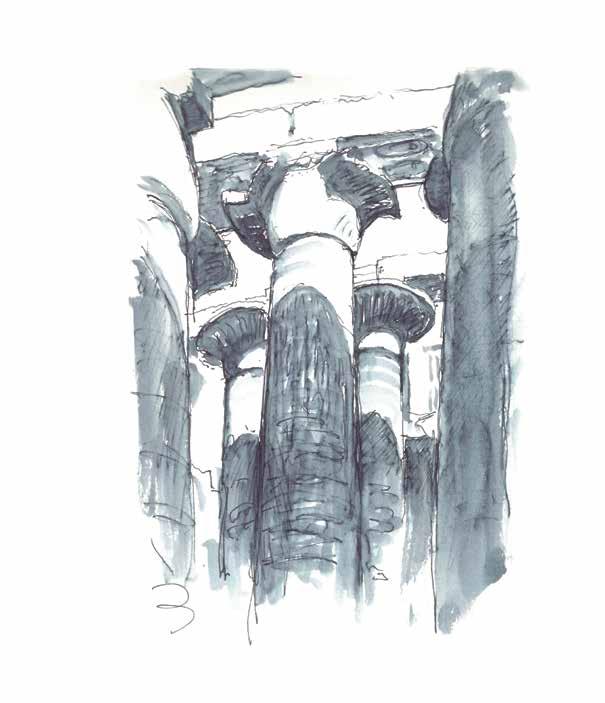
Facing page: Karnak, Egypt
February 5, 2024
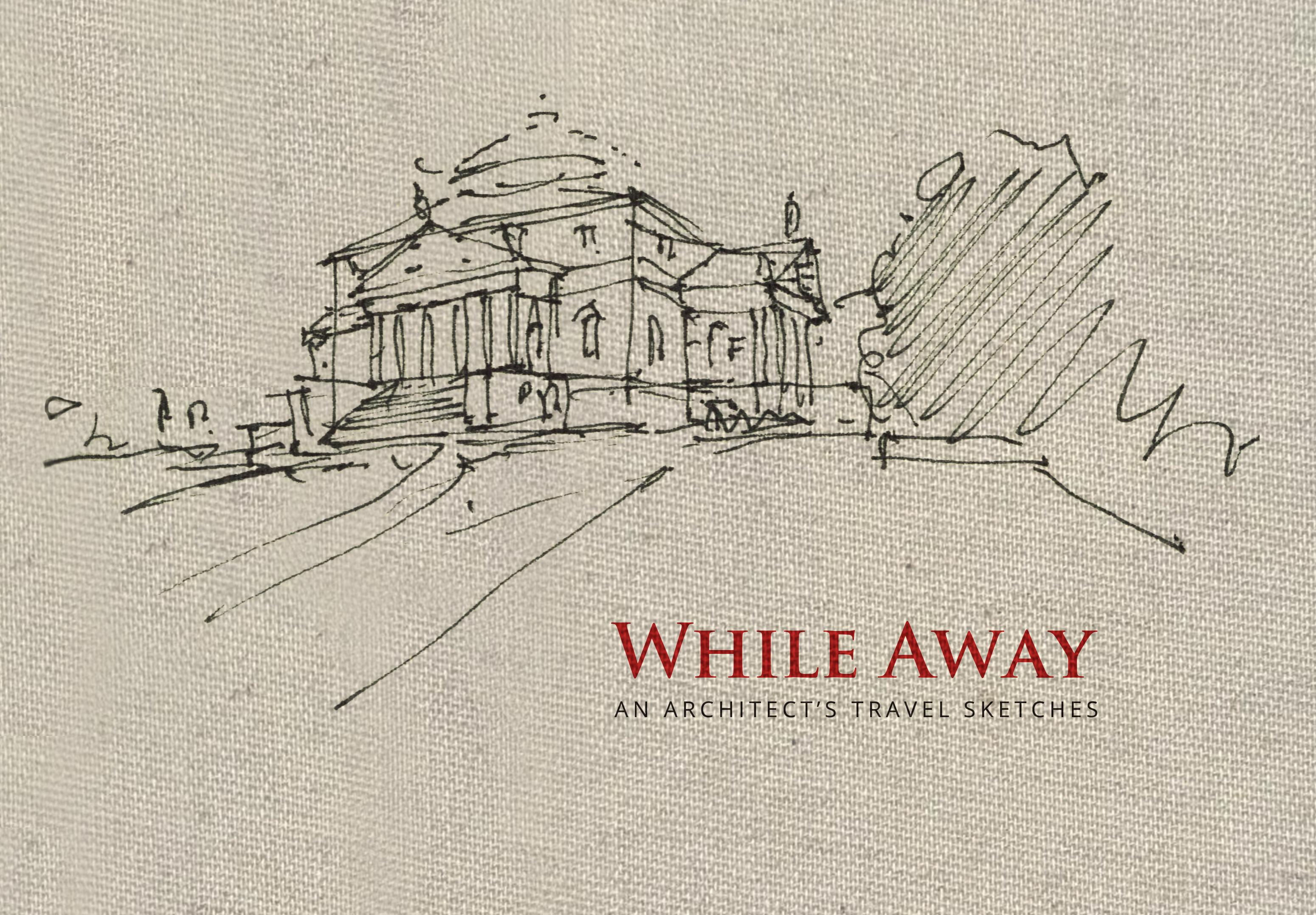
Small title page: detail, Le Due Torri Bologna, Italy
October 8, 1988
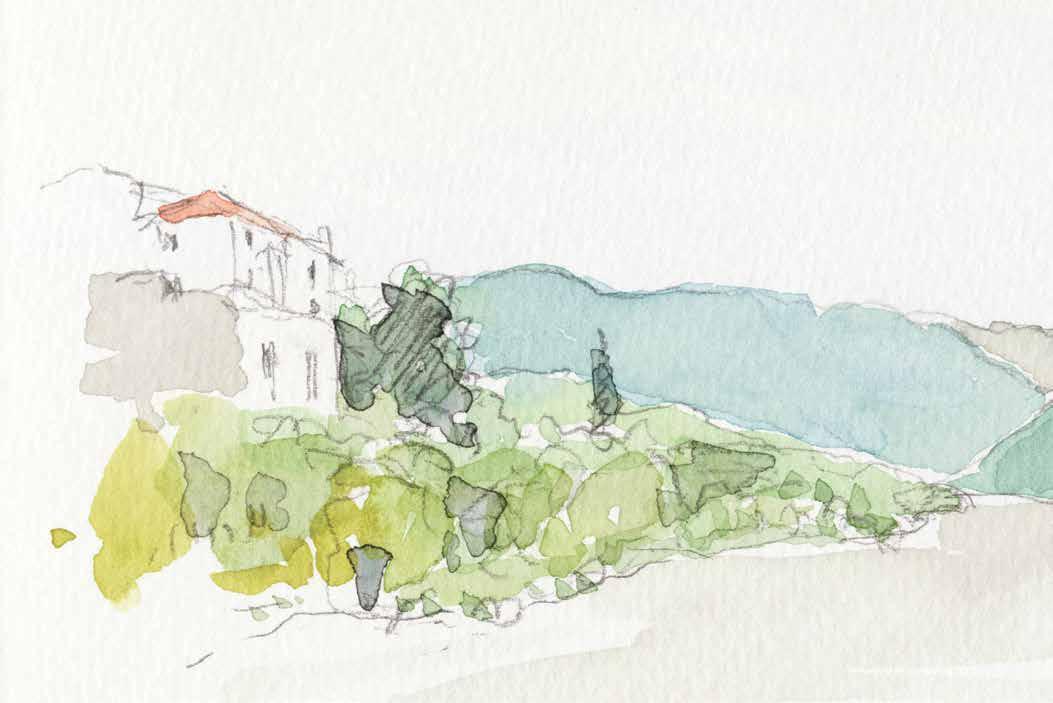
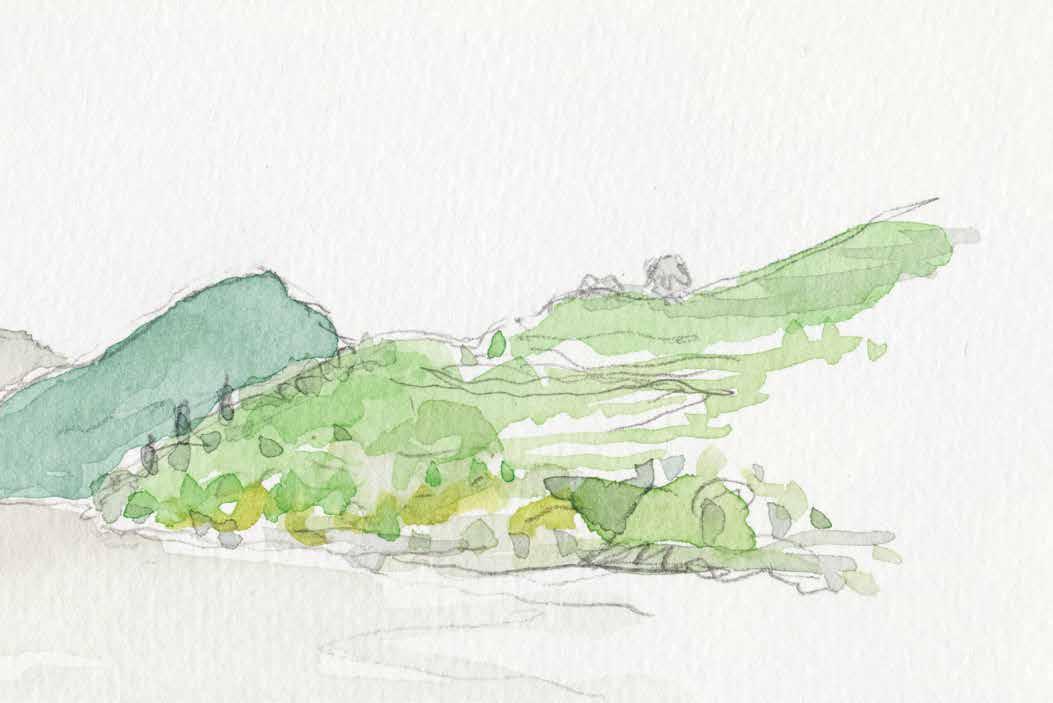
Title page: Along the Douro River
Portugal
September 24, 2019
“The more one looks, the more one will come to see.”
—Louis Kahn, architect
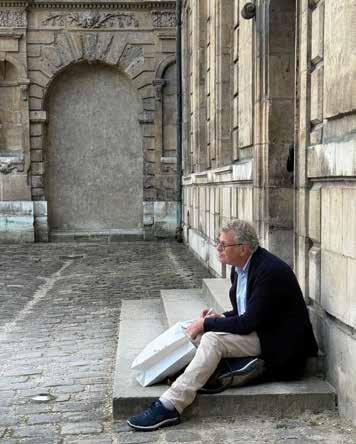
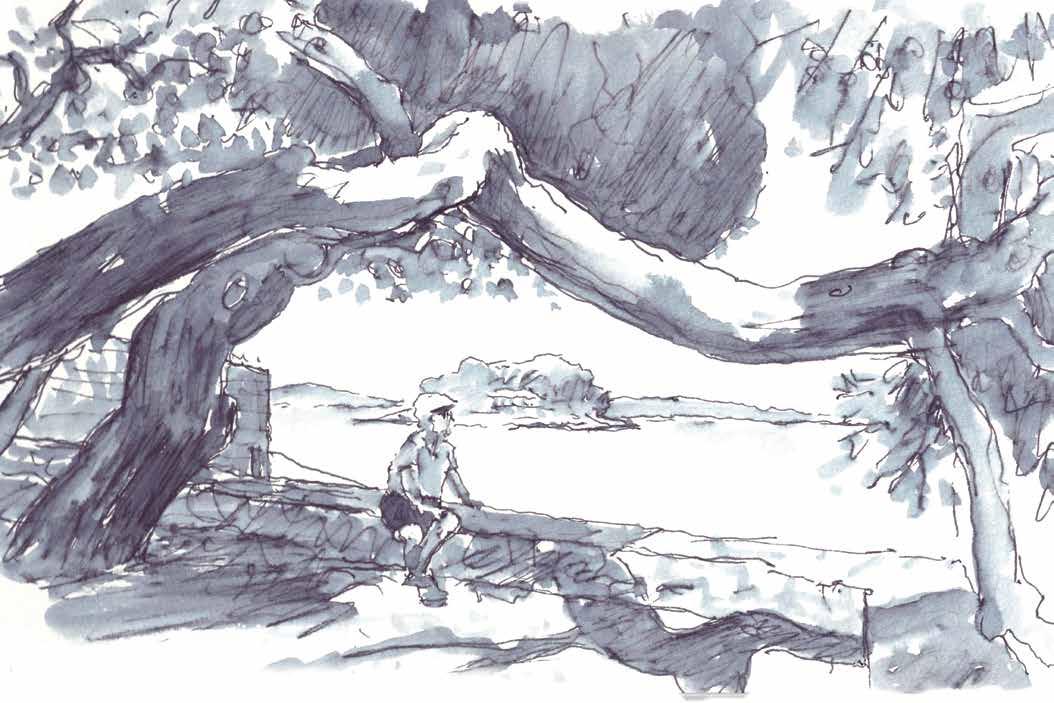
Facing page: Jamie at the Franciscan Monastery Hvar, Croatia
When traveling, there’s a sight so common now as to be ubiquitous , no matter the country or the setting: A person stands, their back turned to a stunning vista, or an ancient ruin, or a famous work of art. A stick extends from one hand, a long plastic appendage, and affixed to the other end is a smart phone, its great unblinking lens hovering above. Next, the static smile and the studied pose. Then the quick staccato of pictures taken in rapid succession. A private paparazzo of one freezing trillions of pixels into a digital approximation of the scene. Photo editing and AI will further refine the image, sloughing away the seeming errors—the shadows, the too-bright light, the blemishes—to create polished perfection. But what, in this moment, has truly been captured?
Now pull away and see a lone man sitting amid the torrent of tourists. He is perched on an ancient ledge, or sitting, his long legs folded, on the cold cobblestones of a public square. In one hand is a hard-backed sketchbook and in the other a pen. He is absorbed and focused despite the crowds, undeterred from his drawing, even as people begin to stop and watch him work.
For more than five decades, the architect Steve Ziger has traveled the world and sketched what he’s encountered. In doing so, he’s followed in the great tradition of countless artists and architects before him who translated what they saw through pen and pencil and paint. When a person draws, what they witness is “entered, registered, inscribed,” in the body, the architect Le Corbusier wrote in the 1960s. The act of seeing becomes embodied when one sketches. He believed that the camera, conversely, is “a tool for idlers, who use a machine to do their seeing for them.” Le Corbusier intuited what neuroscientists have since confirmed: Drawing activates multiple regions of the brain and triggers visual, motor, and semantic functions that leave a distinct memory. The act of sketching allows us to see more perceptively, and it wires information more deeply in our brains.
The sketchbook as travel journal has been a vital tool in the creative practice of everyone from Leonardo da Vinci to Frida Kahlo to Wassily Kandinsky, the latter of whom traveled with a folding easel, paint, and pasteboard so he could capture the landscapes he traversed. And it is, increasingly, a practice used by travelers today who are rejecting fast tourism and its consumptive approach. When we pause and look— really look—and we draw as a way to see, the world opens to us in immeasurable ways.
Steve Ziger has always perceived the world through making, drawing, and design. This was evident in his early childhood, in the suburbs outside of Washington, DC. One day, he played with Lincoln Logs on the living room floor while his father sat on the couch
and watched him build elaborate worlds. “You’re a budding young architect,” his father enthused. The word “architect” cast a magical spell over Ziger. There was a job meant to build, shape, and create places? It seemed too good to be true.
By high school, art had become his way of understanding. A teacher asked for a written book report on Chaucer’s The Canterbury Tales, and Ziger turned in detailed portraits of the characters instead. (He got an “A,” which only encouraged his outsider approach to academic assignments.) Ziger pursued his interest in architecture and attended the University of Illinois Urbana-Champaign. In August of 1976, he traveled abroad to Versailles with sixty classmates for an immersive year studying architecture in France, and he became the first in his family to leave the country. The coursework was rigorous, and Ziger learned a great deal about architecture that year. On a weekend trip to Spain he learned, too, of the wondrous joy of travel. He vowed to work as hard as he could during the week, and to spend as much time off visiting other places. This symbiosis between work and travel has fed him ever since.
After graduation, he moved to Baltimore, Maryland to join an architecture firm. It was there that he met fellow architect Jamie Snead. The two became partners in life and in work, and they opened what was to become their eponymous firm, Ziger|Snead, in 1984. Ziger diligently built his practice alongside Snead, and they traveled when they could. Today, Ziger|Snead is considered one of the premiere architecture firms in the country, known for thoughtful and sensitive adaptations of historic buildings, and for modern jewels that are as pragmatic as they are picturesque. Institutional buildings, such as the Maryland Center for History and Culture, the Living Classrooms Foundation, the SNF Parkway Theater, and the Brown Center at the Maryland Institute College of
Art, which was designed with Ziger’s friend and mentor Charles Brickbauer, have been heralded for transforming the built environment.
As Ziger’s architecture practice grew in stature and staffing, he had the ability to travel more, both for work and for pleasure. He has crisscrossed America and visited countless countries. Today, he has shelves of his sketchbooks filled with hundreds of sketches from these journeys. Architecture is highly collaborative, but his travel sketching is solo, a vital moment to pause and take stock of the world around him. Early on, Ziger developed a set of rules for himself when it came to this type of drawing. Each piece must be fast and focused, taking around 20 minutes, 40 at most. Each begins with a distinct point of view. Where is it best to sit? Where is the light, and the shadow? What is the best angle? How should the landscape be oriented on the page?
A sketch starts with a dot, with a line, with a dab of the watercolor brush. And from there it builds quickly, the mind and the hand working together to capture not just the physical landscape or building, but the essence of the place. In these sketches you see the embodiment of a moment. The shifting mercurial light of an overcast day; the smell of hot sun baking ancient stone; the peals of laughing children, the eddy of foreign languages. There is the swell of orchestral music reverberating through a centuries-old opera house with such force and beauty that tears fall and blur the ink on the page. The drawings are not precious, and Ziger does not overthink what he is doing. Over the years, he’s learned to honor his eye and to capture the essence of what he sees. There is no fixing it later, no editing. There is only the now. The sun or the shadow, the heat or the cold, the stillness and quiet or the bustle of a crowded square. All the senses are engaged as Ziger registers what’s before him and puts it on the page.
And he keeps going no matter what may happen. Over the years, this has meant sitting patiently as cracks of distant thunder announced an approaching storm. It has meant ignoring the terse guard on the grounds of the Generalife in Granada, Spain, who inexplicably insisted that he was not allowed to draw the ancient palace and fortress. Little can move Ziger from his task, not even a gun-wielding security guard.
In Chefchaouen, Morocco, school children left school for the day to discover a tall and thin bespeckled American man seated on the steps of a steep street, drawing. The children laughed and played, their voices as bright as the sparkling sunshine, and they began to climb on him to better see what he was doing. Ziger laughed, too, and he broke his concentration only long enough to tear sheets of paper from his sketchbook and hand out pencils so the children could sketch alongside him.
Drawing en plein air is an individual act, yet it is communal. It invites others in. Witnessing an artist at work, we stop in our tracks. We watch. We become absorbed by the act of a human translating what they see through their hand and onto paper. Ziger’s drawings are awash in the words of encouragement given him in myriad languages, the smiles and approving nods from passersby. He captures the energy not only of the place, but of this human exchange, which is imbued in each pen stroke, in each movement of his brush.
Even as Ziger encountered and briefly befriended these strangers, you will notice that there are few people in these works. Mostly, people appear as small daubs, meant to offer scale and perspective. Yet most everything that Ziger has sketched— from buildings to landscaped terrain—contains the human hand. Most of the places featured in this book have been made or altered by people translating their values
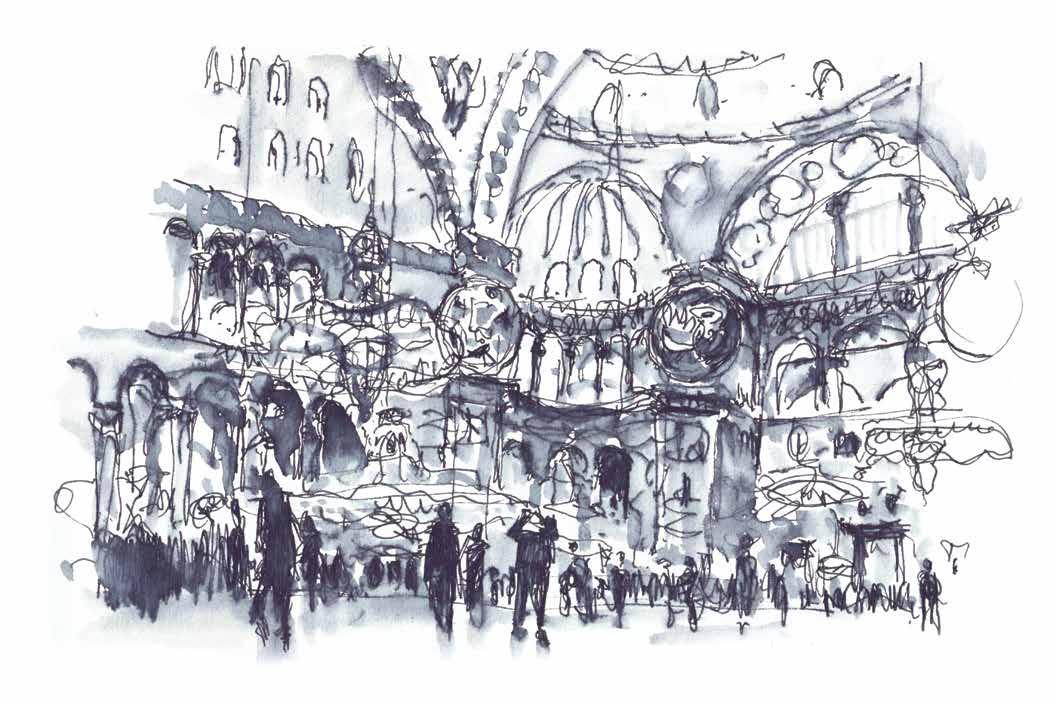
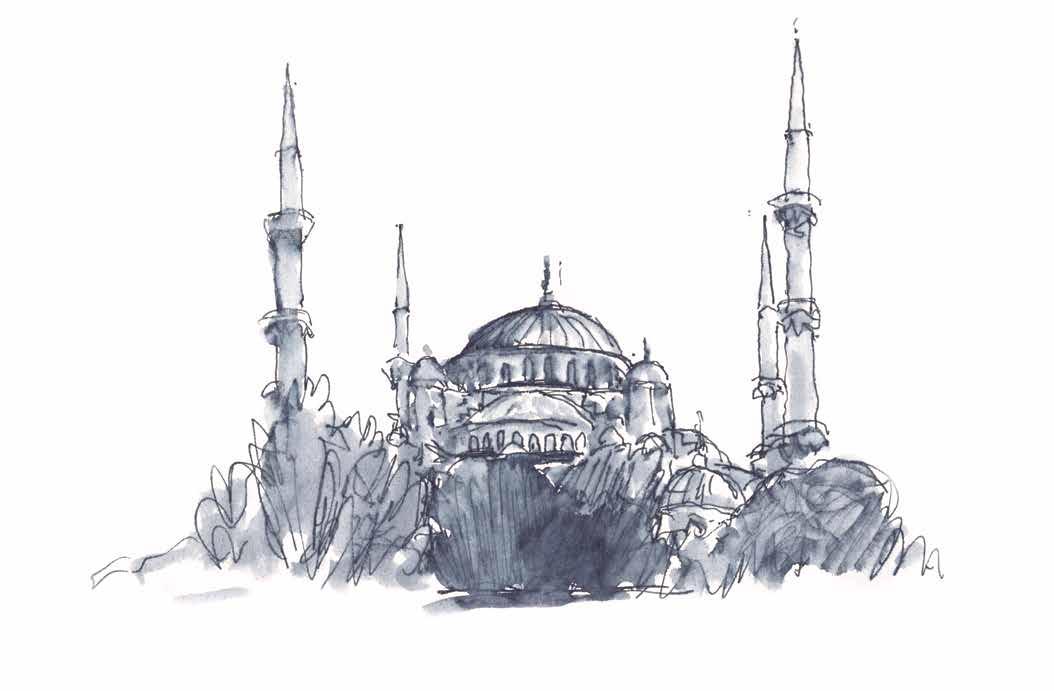
into built form. The pyramids of Egypt. The Hagia Sophia in Turkey. The remains of Incan buildings and agriculture at Machu Picchu in Peru. You can feel the people, the cultures, and the intentions that initiated these buildings and spaces.
In this way, sketching has become both an act of discovery, and a meditative process. Ziger learned that he could claim a creative agency over his life when he decided to sit and look and immerse himself in a place. It can be inconvenient to stop in a crowd and draw. It goes against the expediency, rapidity, convenience, and the editorialized perfection of contemporary life. There is something revolutionary, then, about stopping and looking. Through sketching a place, Ziger has built empathy, developed creative thinking and observational skills, and noticed details he would have missed otherwise.
There is creativity within the constraints Ziger has set for himself with his travel sketches. An urgency and immediacy. He is more interested in communing with a place than in generating beautiful art. As he draws, the scope of time expands. He becomes more than a mere tourist; he becomes part of the great span of time and human intent. And he is awe-struck.
These are not photorealistic images, and they were never meant to be perfect encapsulations of a place. They are not “art” in Ziger’s mind. As such, the sketches collected in this book were never meant to be published. He never considered publicly sharing his sketches until his partner, Jamie Snead, and fellow artist and designer, Alex Castro, convinced Ziger of their value. They understood these works to be far more than a private visual travelogue. In collaboration, Ziger and Castro have carefully sifted through hundreds of sketches created over the decades and selected a sampling.
What you now hold is the work of a singular talent, an architect whose professional work has transformed the places where his buildings reside. But these are not the studied sections and plans of the architect. These are the urgent, joyful, curious expressions of a man in thrall with his immediate environment, a man who travels not to capture and to conquer experience, but to connect with place and with humanity.
Organized roughly chronologically, you see the evolution of a life through travel and drawing. “The relation between what we see and what we know is never settled,” the art historian John Berger once wrote, and so it is with Ziger’s insatiable engagement with the world. Ziger sometimes returns to places, sitting in the exact spot he had years or decades prior to experience the place anew. It serves as a poignant reminder that what we bring to a place informs how we understand it. Who we are on that day—the emotions, the weather, carry through into the drawing. The experiences we bring to a place affect our reading of it, just as surely as a place changes us once visited. Curiosity becomes the whetstone against which we may sharpen our observations and experiences over time. First, we look. Then we see. And if we’re lucky, we discover. “Others stood indifferent,” Le Corbusier wrote near the end of his life, “but you saw!”
This prolific collection is a testimony to the richness, awe, and beauty that emerges from a life spent engaged with the world. It is a catalogue of place, of travel, of curiosity, and of what humans are capable of building. It is, at its core, a celebration of our innate human desire to make meaning of this brief and wondrous time we have on earth.
— Elizabeth Evitts Dickinson, Baltimore, Maryland, 2026
This is the decade I became an architect. After returning from an amazing year in Versailles and graduating college, I knew I wanted to live somewhere new and exciting, somewhere I’d never been, but that was close to DC so I could visit my parents. I moved to Baltimore, Maryland, where I discovered the historic Mount Vernon neighborhood. With its grand squares and fountains, its Gothic Revival churches, its museums and 19th-century mansions, it reminded me of Europe.
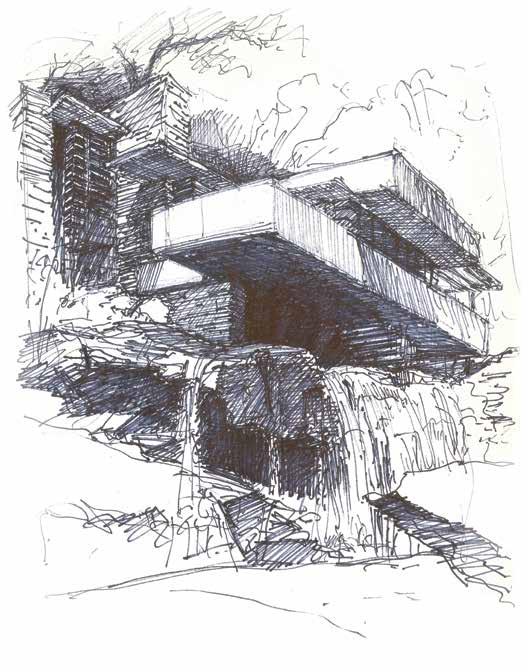
A few years later, I met and fell for Jamie Snead, a fellow architect and traveler. In 1984, Jamie and I started our architecture firm, now called Ziger|Snead. A few years into the practice, we took the entire studio to visit Frank Lloyd Wright’s masterpiece of a house, Fallingwater. There, I sat on a rock at the edge of the rushing Bear Run River in rural Pennsylvania. I occupied the very spot that Wright had stood when he imagined a cantilevered home, living in concert with the dramatic swell and dive of the Appalachian forest riven by streams and waterfalls. I sketched the house in all its magnificence. And this feels like the place to start our journey: with observation. With perspective. It was finding the right location to view the landscape that allowed Wright to conceive of Fallingwater. It’s a reminder that the first and perhaps the most important place to begin any sketch is with the proper vantage point. To understand our relationship to landscape, to situate ourselves in the world at large, we first need to learn where to stop, to still ourselves, and to observe.
Mill Run, Pennsylvania
September 10, 1987
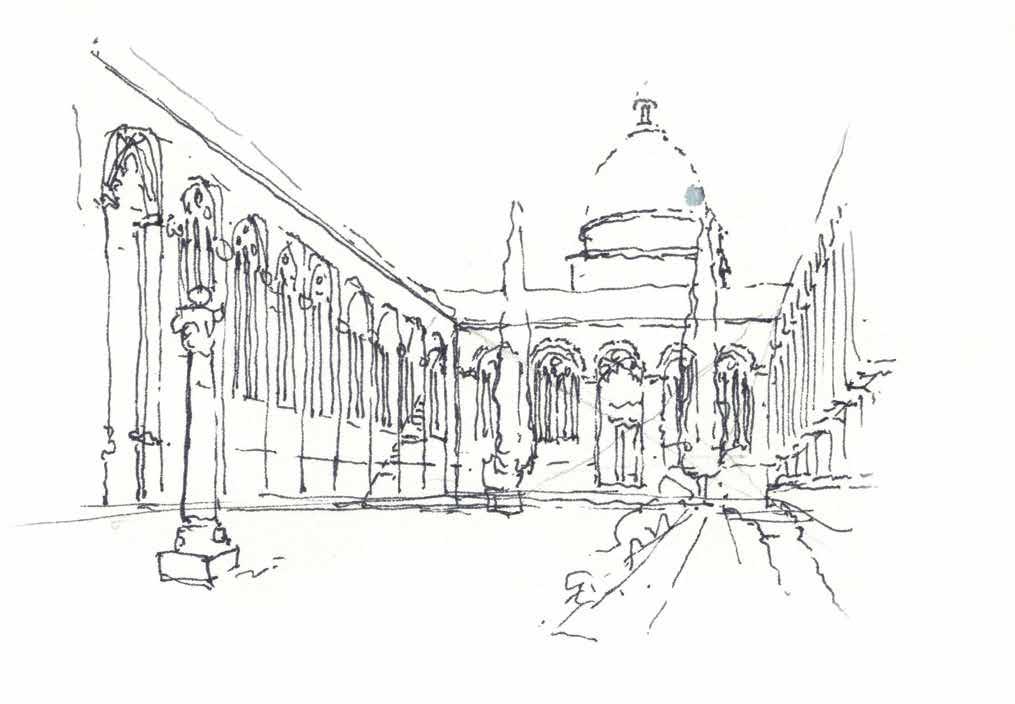
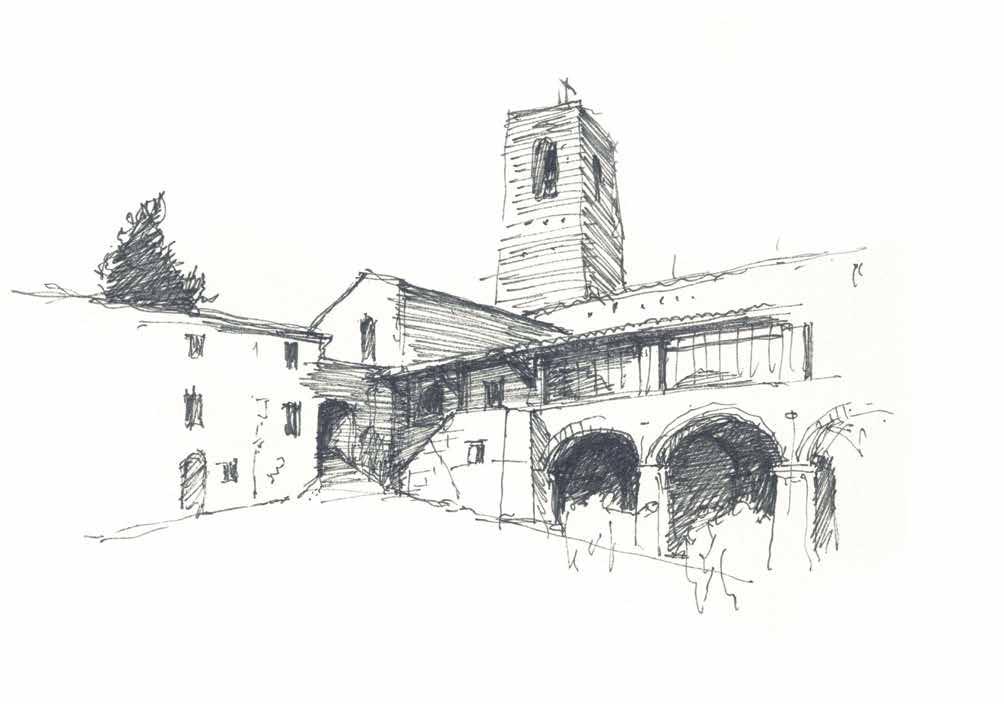
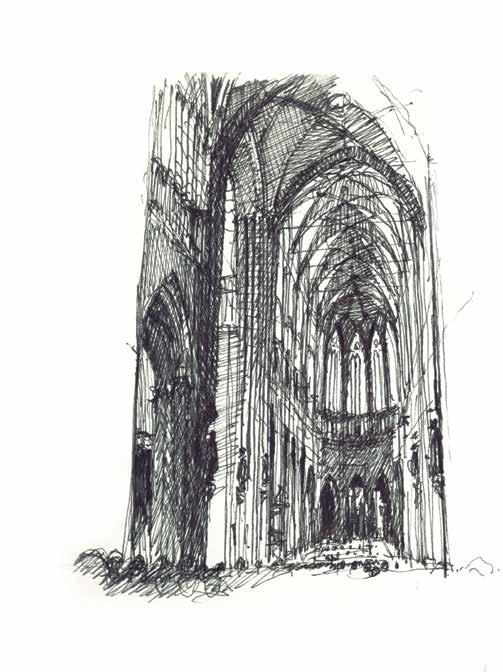
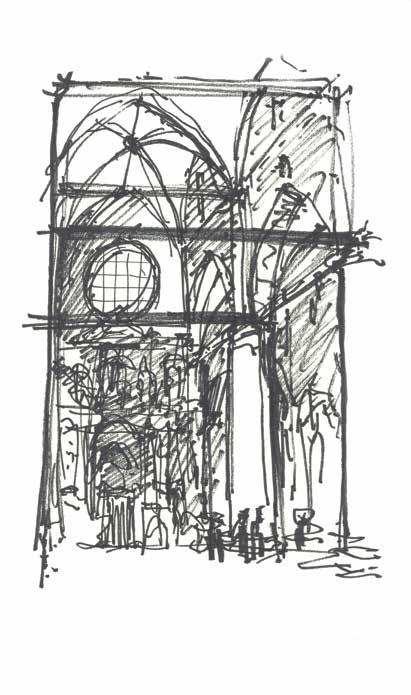
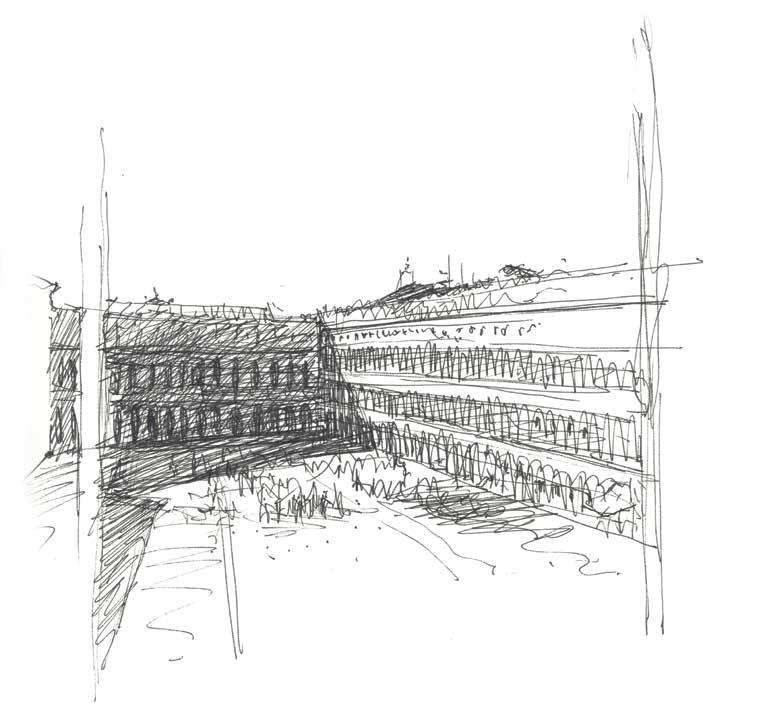
Piazza San Marco
Venice, Italy
October 27, 1992
Facing page, left: St. Vitus
Prague Castle
July 4, 1991
Facing page, right: Santi Giovanni
e Paolo
Venice, Italy
October 25, 1992
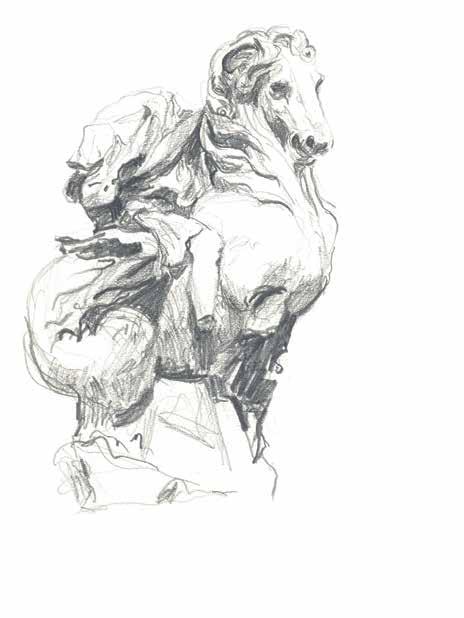
Terra cotta study for a statue of Constantine the Great by Bernini
January 3, 1995
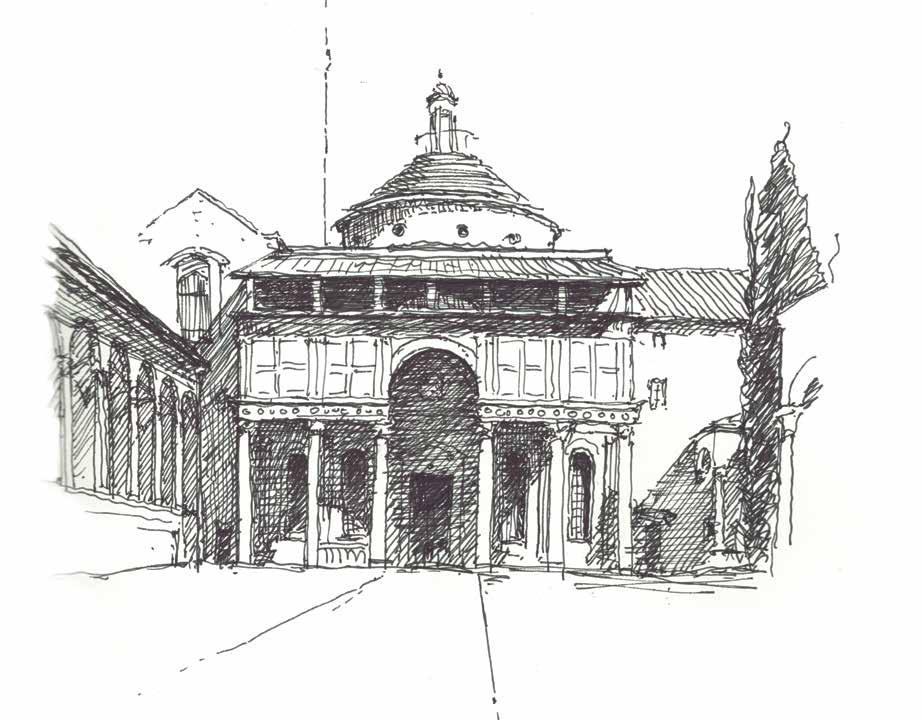
Facing page: Pazzi Chapel by Brunelleschi Florence, Italy
July 28, 1997
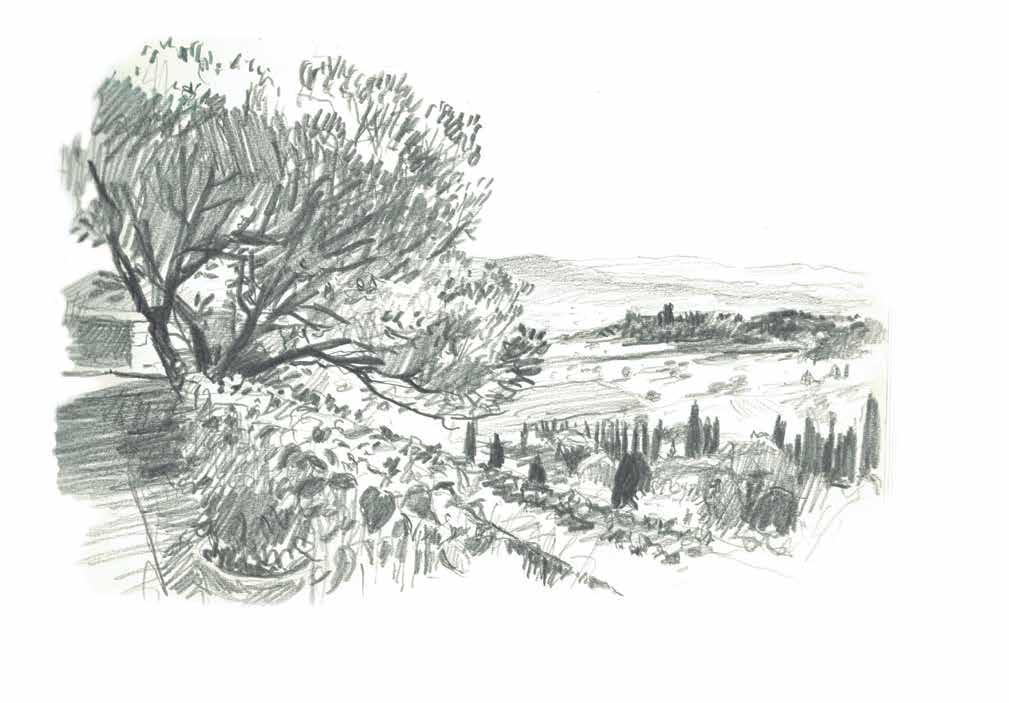
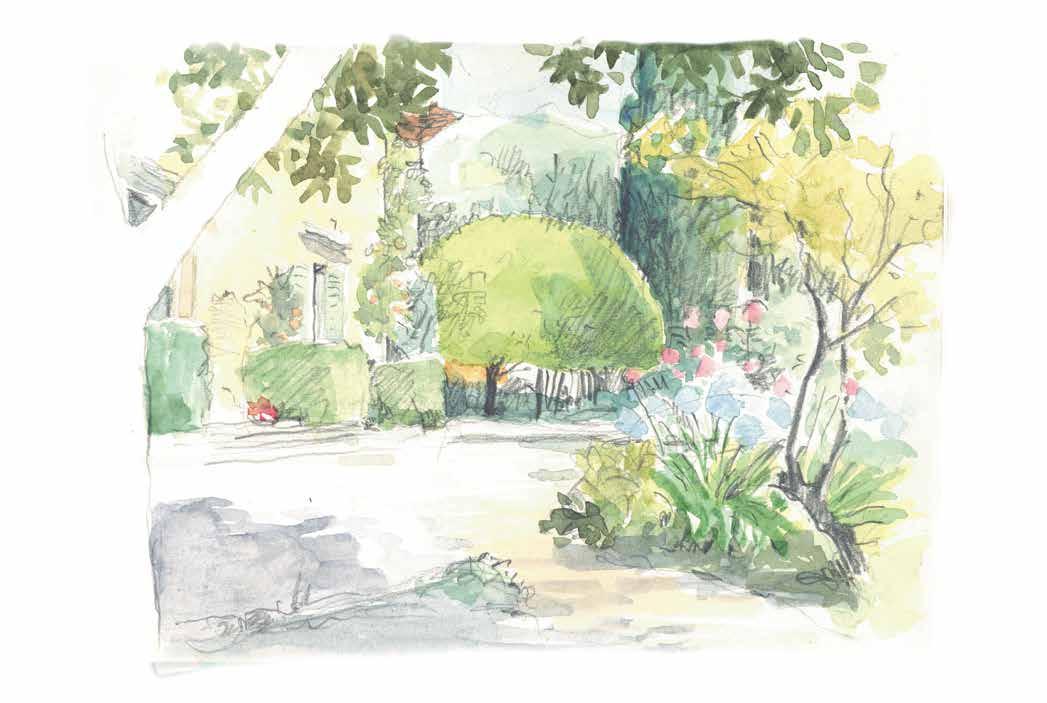
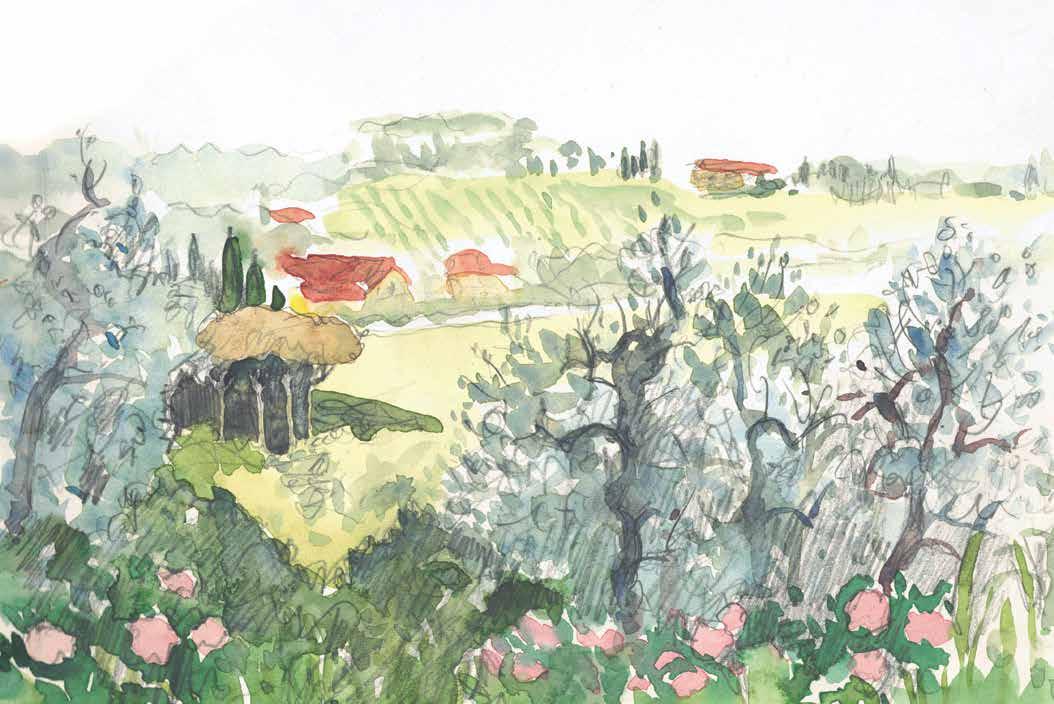
Villa le Balze
Fiesole, Italy
April 28, 2001
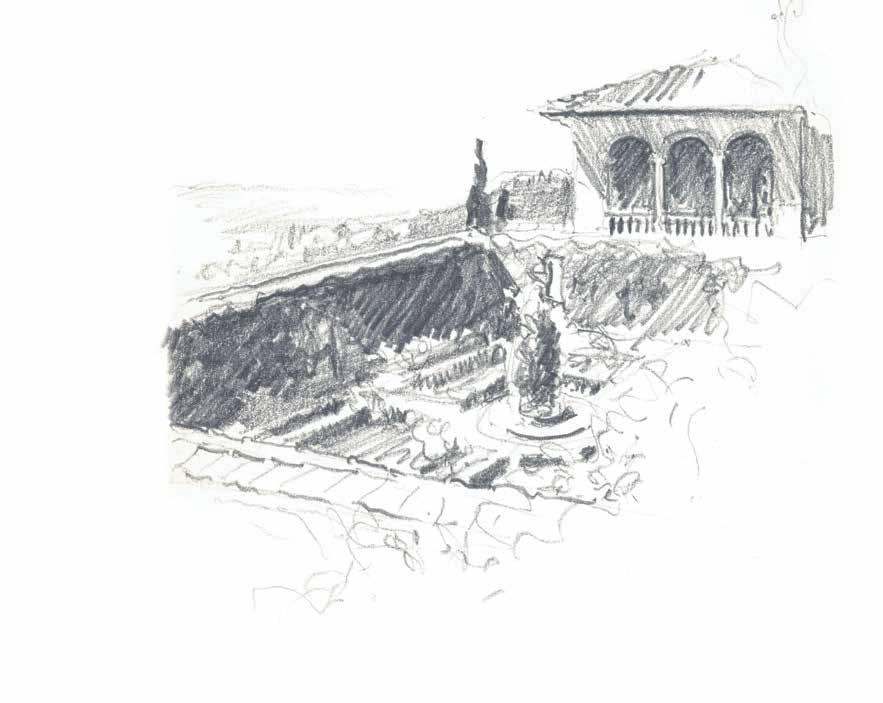
Travels in Tuscany reinforced my interest in landscape design, especially how it can define architectural space and dramatic sequences. The British landscape architect Cecil Pinsent was a master at this.
Facing page: View from Il Villino
Settignano, Italy
April 26, 2001
Following spread, left:
View from San Giorgio Maggiore Venice, Italy
October 6, 2002
Following spread, right:
View from San Giorgio Maggiore Venice, Italy
June 19, 2001
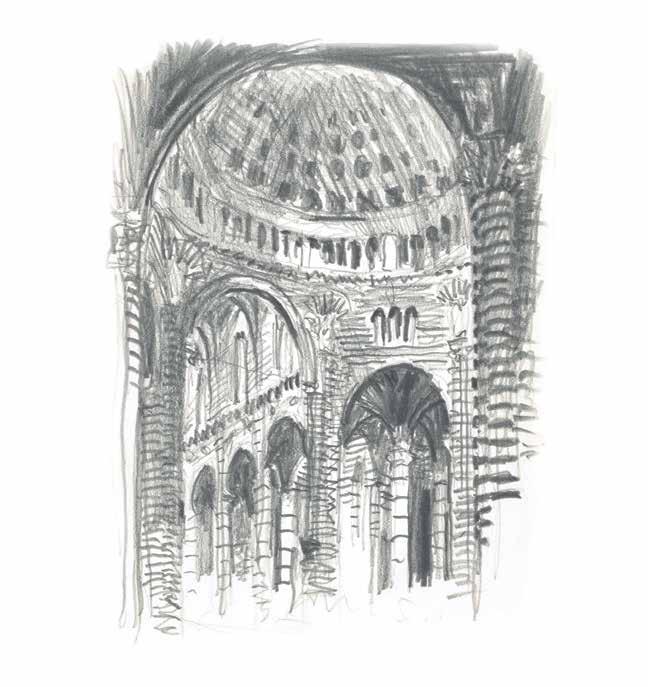
Cathedral
Siena, Italy
June 12, 2002
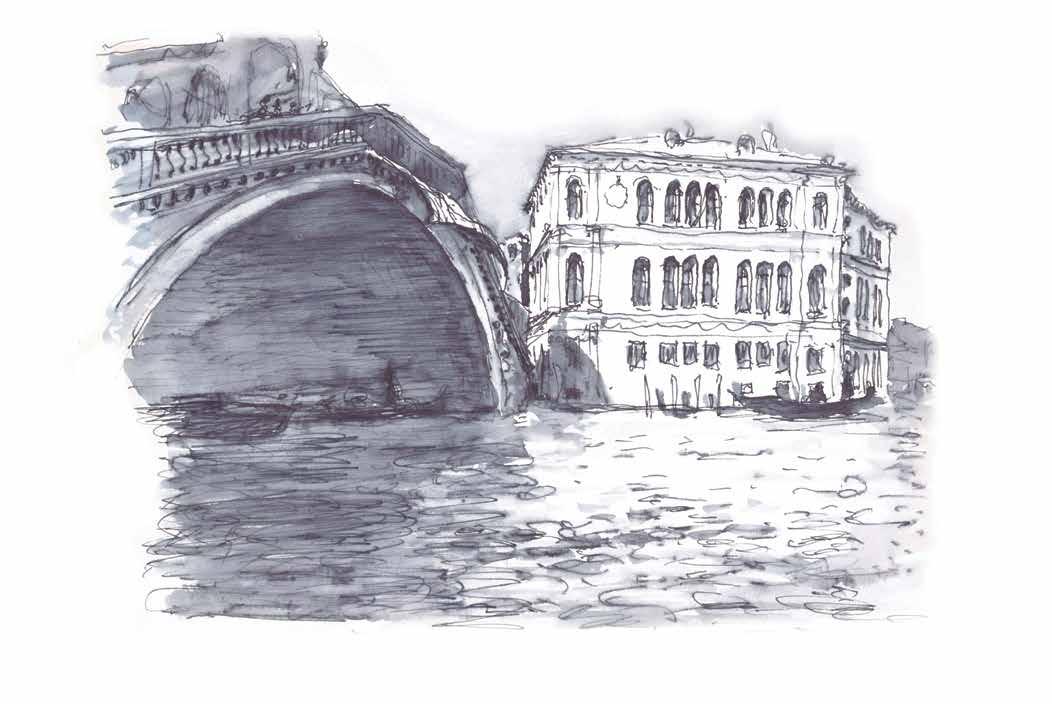
Facing page: Rialto and Corte dei Conti
Venice, Italy
October 18, 2002
Following spread: Sunset
Pink Beach, Bermuda
July 22, 2002
I had the most fun doing these quick sketches of the sunset over the Caribbean.
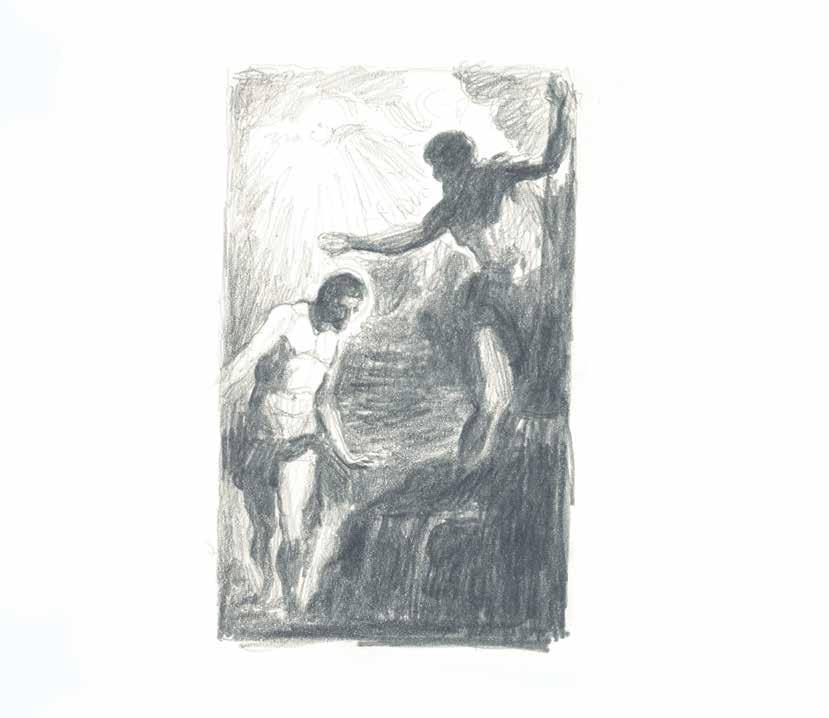
Baptism of Christ by Tintoretto, Scuola San Marco
Venice, Italy
October 17, 2002
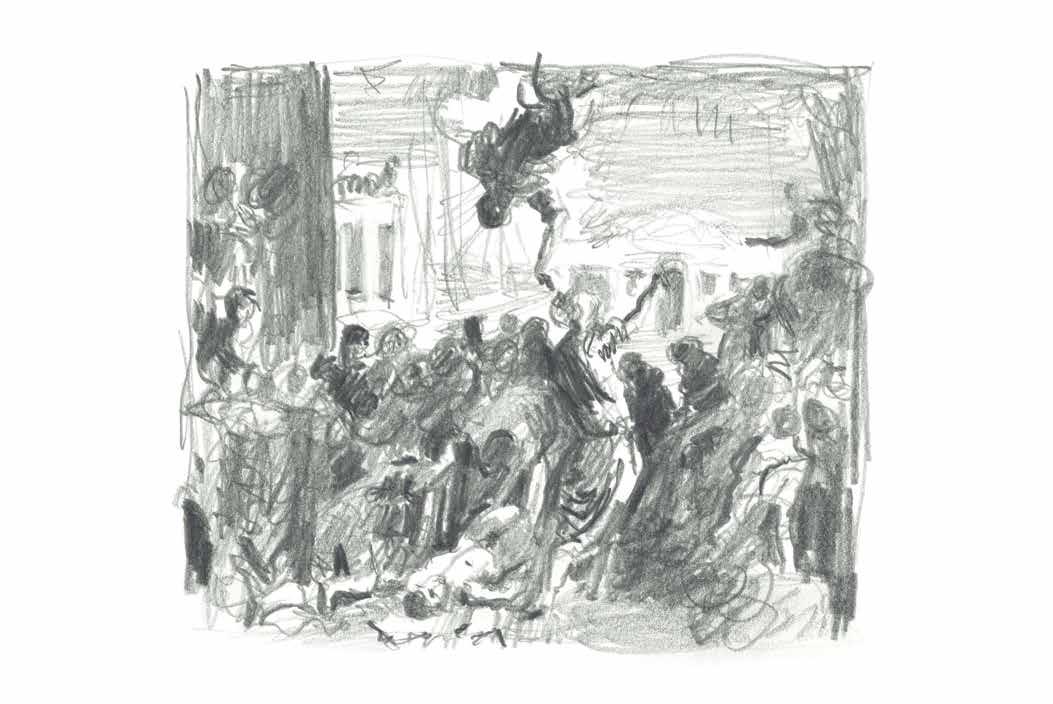
Facing page: San Marco Freeing the Slave by Tintoretto
Gallerie dell’Accademia
Venice, Italy
October 13, 2002
The Italian painter Tintoretto was a master in the use of chiaroscuro, the contrast of light and dark. I learned a lot from observing his work inside Venice’s magnificent Scuola Grande di San Rocco.
Steve Ziger, FAIA , is a distinguished architect and enthusiastic traveler. He is the cofounder, with Jamie Snead, of the Baltimore-based design studio, Ziger|Snead Architects. For more than forty years he helped to build the firm into an internationally lauded studio known for cultural, institutional, civic, and residential projects, honored with more than 250 awards for design excellence. In 2018, he was elevated to the American Institute of Architects’ College of Fellows, one of the profession’s highest honors. He is recognized for advancing the field of architecture through refined and thoughtful design that is rooted in place, and that inspires optimism while enhancing community. Ziger retired from his firm in 2025, and he leaves a legacy that extends well beyond individual projects. He serves on the board of directors for multiple nonprofit organizations and was a founding trustee of the Baltimore Design School, a pioneering public middle and high school that focuses on fashion, architecture, and graphic design. He continues to travel and sketch.