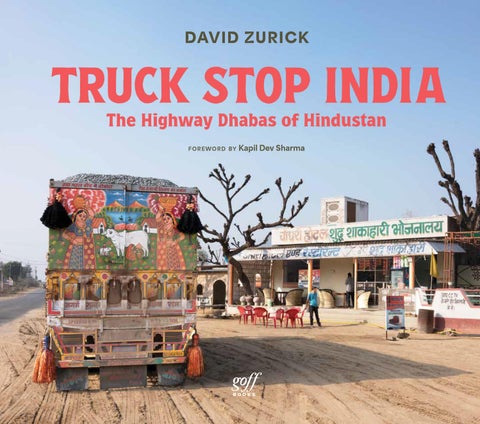
DAVID ZURICK
TRUCK STOP INDIA The Highway Dhabas of Hindustan
Foreword by KAPIL DEV SHARMA
FOREWORD • 11
HIGHWAY DHABA • 12
TRUCKERS AND TRAVELLERS • 50
DHABA WORK LIFE • 80
DHABA NIGHTS • 108
POSTSCRIPT
AN AMERICAN DHABA • 137
VEGETARIAN DHABA FOOD RECIPES • 139
ACKNOWLEDGEMENTS • 155
AUTHOR BIO • 157
10
FOREWORD
T
he highways of North India are best understood in motion, and in the pauses along the way. During my own road journeys throughout India over the many years, I have often felt that the true experience of the highway lies not only in reaching a destination at the end of it, but in the journey itself, and in the dhabas that become an essential part of it: places to stop, to eat, and to rest. Long before the rise of curated dining, these roadside kitchens became the steady pulse of the highway. They continue to serve without ceremony, welcoming truck drivers, families, and travelers into spaces shaped less by design than by habit, memory, and repetition. Their character resides in small, enduring details: the first chai of the morning in cold air, the low rhythm of passing trucks at night, the glow of a tandoor beneath an open sky. Time here is neither rushed nor measured; it simply passes.
In contrast to a world increasingly shaped by speed and modernity, the dhaba remains unchanged in its intention to offer warmth, familiarity, and pause. David Zurick has returned often to India over the years to make photographs. His images reflect a deep familiarity and patience, and a practice rooted in observation rather than interruption. Looking through these book pages reminded me of my own numerous road trips across India, the familiar sight of parked trucks at dusk, the sound of steel cups striking a counter, and the quiet comfort of a roadside stop after long hours on the highway. What emerges is a quiet accumulation of moments, where the road slows, and its deeper rhythm comes into view.
— KAPIL DEV SHARMA
11
HIGHWAY DHABA
12
I
entered my first dhaba in 1975 while traveling between Kabul and Kolkata (then Calcutta) on the Grand Trunk Road. It is one of the oldest travel routes in Asia, going back 2500 years to the Silk Road. The Moghuls expanded the route in the 15th Century, and the British extended it in the 1800s to the far-flung boundaries of their South Asian empire. I was traveling on the Grand Trunk Road in the 1970s because it was aligned with the Hippie Trail, which at the time connected Europe and Nepal for Western travelers. The Hippie Trail no longer exists, but the Grand Trunk Road is busier than ever with its continuous flow of trucks, buses, private cars, rickshaws, motorbikes, tractors, and horse-drawn wagons. The roadside eateries set up along the Grand Trunk Road to serve travelers became known as dhabas (from the Hindi word ‘dabba,’ meaning lunchbox). The one I entered in 1975 was a mud and thatch structure, with woven-rope cots, called a charpoy, to sit, rest, and eat on. My meal consisted of a bowl of lentil soup (dal) and plate of flat bread (roti). It cost a few rupees – less than 25 cents in American dollars. Refills were free of charge. The food was delicious, but the hygiene sketchy. When I finished eating, the proprietor dipped my plate in a bucket of cold rinse water and placed it on the counter for the next customer.
Initially intended for long-haul truck drivers after India’s highway system was built, dhabas now serve people of all stripes – traveling families, tourists, salesmen and traders, and local residents looking for a meal outside their homes. Some have evolved into trendy travel destinations sought by foodies using Internet apps, but most highway dhabas retain an intimate, local character. While the menus in the tourist dhabas may be more extensive, and their facilities much-improved, in the words of one patron, “if you want to know how genuine a dhaba is, count the number of trucks not cars parked outside. The truckers know the real deal.” In remote localities, dhabas tend to be geographically dispersed along a highway. They appear on the tarmac like an oasis in a food desert. On the busy highways, dhabas tend to show up in clusters, colloquially known as ‘dhaba rows.’ Some places employ elaborate architectures, manicured grounds, and garish lights to compete for travelers. More commonly, though, a dhaba is a low-slung, one-room structure with simple signage and a dirt parking lot for vehicles. They make up for their austerity with a welcoming atmosphere and tasty food at low cost.
opposite : Karni Family Dhaba, Highway 106
13
this page : Zimidara Vaishno Dhaba, Highway 10 opposite : Ganga Nayar View dhaba, Highway 7
18
19
Mannat Haveli Tourist Dhaba, Highway 44. The small town of Murthal on the Delhi to Chandigarh highway hosts a large number of highway dhabas. Many of them are quite fancy and cater to urban foodies out for a dining adventure.
30
Dining hall, Highway King Tourist Dhaba, Highway 334. The tourist dhabas geared toward middle class families on a holiday provide hygienic food and overall nicer facilities than most truck stop dhabas.
31
New Utsav Dhaba, Highway 709
38
Welcome troupe, Rocky Vaishno Dhaba, Grand Trunk Road
39
48
above : Hawai Adda (Airplane Dhaba), Highway 44. Two decommissioned Indian Airlines aircraft are
transformed into dining spaces that cater to touring families. opposite page : Guru Nanak Dhaba, Highway 5. Dhabas located near roadside temples serve pilgrims,
truckers, and tourists, many of whom stop to worship at the shrine and then proceed to a nearby dhaba for a meal.
49
top left : Long-haul truckers, Shankar Shudh Dhaba, Highway 44
top right : Zimidara Vaishno Dhaba, Highway 8. Truckers hailing from Punjab
province in northwestern India dominate the trucking industry and many of bottom left : Citi Restro Dhaba, Mogra Bypass, Highway 62
the most popular dhabas in Hindustan are run by Punjabi chefs. bottom right : Long-haul truck driver, Punjab Dhaba, Highway 10
54
Zimidara Vaishno truck stop, Highway 8. Outdoor facilities at some rural dhabas provide truckers with a place to bathe on long stretches of road travel.
55
Highway 503
58
Tobacco is smoked in a water pipe called a hubbly-bubbly, Songam Dhaba, Highway 334
59
Jaghmaba Dhaba,Highway 63
74
Truck driver, Gurpreet Vaishno Dhaba, Highway 8
Long haul trucker, Grand Trunk Road
75
Byasi Dhaba, Highway 7
84
Cooking over an open flame, Sri Ram Dhaba, Highway 62
Fry cook, Prince Dhaba, Highway 44
85
114
this page top and bottom : Dhaba row, Jhunjhunu
Bypass, Highway 8 opposite : Jai Jai Baiwani Dhaba, Highway 62
115
Mahendra Mahal (‘glass palace’), Highway 8
120
Haveli Tourist Dhaba, Highway 44. The architecture, manicured grounds, and vibrant lighting found at some tourist dhabas approaches what a traveler might expect at a holiday resort. And, in fact, with the addition of hotel rooms, children’s playgrounds, and even swimming pools, a few of the large dhabas have evolved into weekend destinations.
121
138
VEGETARIAN DHABA FOOD RECIPES
T
ruckers and travelers seek out dhabas for tasty ‘comfort food.’ Most traditional dhabas serve only vegetarian food and specialize in just a few dishes. Because food is prepared in large quantities over open fires or in tandoor ovens, many of the preparations found in dhabas do not immediately translate to ordinary household kitchens. I gathered recipes during my dhaba travels with the assistance of Raghvendra Singh Rathore — friend, foodie, travel companion, and cook extraordinaire. He and his wife Priya modified the dhaba recipes to meet the needs of a family of four. These modifications appear in this recipe section. They are examples of Indian cuisine, with a truck stop twist. If you want to go one step more and give your dish a classic dhaba flavor, place a piece of red-hot natural charcoal in a metal bowl and spoon in a few teaspoons of ghee. Place the smoking bowl inside the dish, put a lid on the pot, and let stand for 5 minutes.
opposite : Thali (traditional set meal)
139
156
AUTHOR BIO
DAVID ZURICK has been visiting India since 1975. He holds a PhD in Geography and is the author of twelve books of scholarship, literary nonfiction, travel, and photography. He is a recipient of a Nautilus Book Award, National Outdoor Book Award, and the Mount Everest Award for his lifetime achievement in Himalaya studies. His India photography books, A Fantastic State of Ruin: The Painted Towns of Rajasthan (2018) and Hippie India: Dreamers and Seekers in the Land of Nirvana (2024) were published by Goff Books.
KAPIL DEV SHARMA is a film maker and motorcycle enthusiast living in Gurugram, India. He has logged over 200,000 kilometers on the Indian highways and visited close to a thousand dhabas.
157