6
TRANSPARENT ARCHITECTURE 2
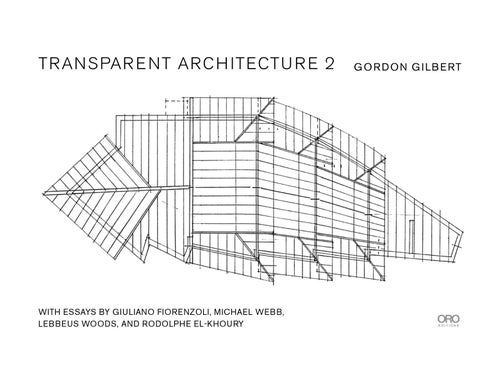
Transparent Architecture 2 is an exploration of the nature of architectural transparency, ranging from spatial and physical transparency, to a clarity of structure, to the dematerialization of the actual physical object, and further to evolving and expanding states of architectural awareness. This exploration is revealed through a juxtaposition of experimental drawing, subliminal texts, and actual constructed work. The projects in this book are an expansion of the approaches in the original Transparent Architecture, further refining and adding new expressions and projects. These projects begin with earlier experimental drawing that has been published and exhibited internationally. Then the seminal ideas and approaches earlier developed in this experimental phase come to fruition years later in actual constructed work. Even across time, a consistent architectural stance emerges and seems to permeate all the work.
The work in this new book points to an architecture that seems to suggest a multiplicity of qualities. Paradoxically, it is also architecture that reveals itself and its own singular nature clearly. Activities happen all at once, in a seamless whole, in a simultaneity of experience, where the normal boundaries and usual edges do not hold. The experimental drawings, texts, and built projects on the following pages are visual and spatial explorations. They aim toward architecture that provokes thought, refines one’s abilities to see, and embraces the ongoing confluence and mutability of things. The inhabitant then moves through and interacts, in a live and changing world.
The etymology of the word transparent is interesting. It has its origins in Latin, transparere, meaning to show through. Whereas the original Latin derivation is trans + parere, meaning to show oneself, thus suggesting both looking out, and looking in. As mentioned, the built projects are fully congruent in spirit with the earlier investigations for which construction is not an issue. The question is how the architect moves from what appears immaterial to the transformation of the ideas into something very concrete. That which appears to unite both aspects is transparency.
7
13
Opening outward and upward, the spaces inspire, literally raising up and expanding one's sensation and sight.
multi-stoned, yet darkened, ruby-like, dusty, gleaming jewel, a glistening form of the inner landscape It is a permutation upon itself, always present, pulsating, and ambiguous. 14
21
The wooden trunks and branches of the house structure parallel the structure of the forest itself, and the space within parallels the space without. In these canopied spaces, everything is present, all at once, including things reflected, or transparent, or things barely perceived. his structure can act as a land bridge, or a ledge T outcropping, as a snowbank, or an open pagoda, a screened porch or a hidden igloo, all depending on the changing climatic conditions.
22
33
The body is slight, insubstantial, and air comes through the widening cracks. That which holds concepts together begins to dissolve, and physicality is diminished. hen awareness floats free and hovers, and the T world becomes as awareness itself. In a momentary crystallization of the ephemeral, there is a shift from the numinous to the phenomenal. illusory, paradoxical, and steadfast
34
dusk
37
38
43
Planes are disjunctive and walls undermined. 44
57
58
67
This land is in a tropical hammock in a high-velocity hurricane zone, filled with the wild and dazzling foliage traditionally associated with this specific area. The structure grows from these natural qualities of the tropical site in its form, construction, interior scheme, and surface texture. As a result, the structure provides a protective containment, yet at the same time there is an inner fluidity, where the spaces are not so obviously delineated, and the rooms are floating.
68
99
100
133
This marsh is ancient, lining the lake, at the delicate boundary between water and land. dreaming a world
134
141
142
163
164