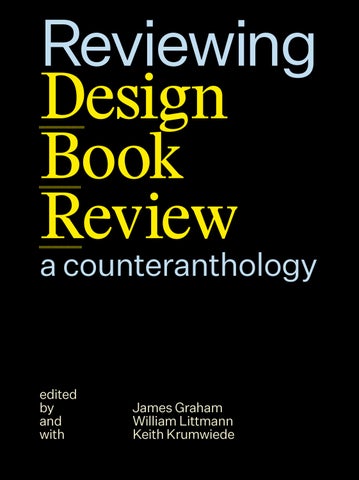
6
10
Foreword: What I Found in DBR Keith Krumwiede Why Design Book Review Matters James Graham and William Littmann
Expanding Geographies 76
ean-Louis Bourgeois J Review of Ceramic Houses, by Nader Khalili Issue 13
78
eynep Çelik Z “Third World Architects” Issue 19
Discourse About Discourse 26
Sally B. Woodbridge “Ten Collegiate Journals” Issue 5
84
Richard Ingersoll “To the West of the West” Issue 29/30
30
Manfredo Tafuri “There Is No Criticism, Only History” Issue 9
86
34
Richard Ingersoll “Zeitgeistbusters: A Mandate for Architectural Critics” Issue 9
Janet L. Abu-Lughod “The Planners’ Dilemma: What to Do with a Historic Heritage” Issue 29/30
38
“The Necessity of Critics: A Dialogue with Herbert Muschamp” Issue 9
43
Thomas Bender “Architecture and the Journalism of Ideas” Issue 15
46
Reviewing Who Cares About Architectures, Books, and Reviews John McMorrough
48
70
DBR: An Oral History, Part One After Architectural Publishing, and Other Anxieties Michael Kubo and Mimi Zeiger in Conversation
92
usana Torre S “Cultural Identity and Modernity in Latin American Architecture” Issue 32/33
98
John A. Loomis “The Barragán Phenomenon” Issue 32/33
102
DBR: An Oral History, Part Two
110
The Vector Ends Luke Bulman
114
Remembering Design Book Review Nancy Levinson
Interrogating Practice 120 Diane Ghirardo “Imitation as the Sincerest Form” Issue 2
126
ana Cuff D “The Trouble with the World’s Second Oldest Profession” Issue 8
130
Lucia Howard Review of The Jersey Devil, by Michael J. Crosbie Issue 9
131
M ary Ann Hiserman Review of Access for the Handicapped, by Peter S. Hoff, and Barrier-Free Exterior Design, ed. Gary O. Robinette Issue 9
132
lbert Pope A “The Profession, the Academy, and the Social Contract” Issue 17
134
Barbara Oldershaw “Developing a Feminist Critique of Architecture” Issue 25
137
S herry Ahrentzen and Linda Groat “Women Architects in the Academic and Professional Context” Issue 25
140 Leslie Kanes Weisman “The Spatial Dimensions of Feminism” Issue 25 144 Alice Friedman “A Feminist Practice in Architectural History?” Issue 25 148 Alice Friedman “Pipe Dreams” Issue 35/36
152
René Davids “Writing Home” Issue 37/38
154
ill Pearlman J “Designed for Success” Issue 43
158
162
nnmarie Adams A “A Firm of One’s Own” Issue 44/45 A Language for Architecture Jess Myers
192
Susan Ubbelohde “The Myth of the Ecological Vernacular” Issue 20
196
n-Kwok Lai O “Green Design Praxis” Issue 20
200 Obstacles to Historicizing Sustainability Daniel A. Barber Reading Buildings
164
BR: An Oral D History, Part Three
Vernacular Landscapes 174
180
182
David Harvey “The Essential and Vernacular Landscapes” Issue 10 Bonnie Loyd Review of Miniature Golf, by John Margolies Issue 14 Ellen Weiss “The Structure of Slavery” Issue 35/36
Architectural Ecologism 188
Martin Pawley “Victor Papanek, One-Man Messiah” Issue 11
206 Michael Sorkin Review of Skidmore, Owings and Merrill, by Albert BushBrown Issue 5 208 Richard Ingersoll “Save the (Architectural) Whale” Issue 12 210
ichael Sorkin M “The Garden in the Machine” Issue 13
212
David Grahame Shane “West Side Stories” Issue 23
218
A Good Conversation Marianela D’Aprile
220
DBR: An Oral History, Part Four
The Political Landscape 190
Victor Papanek “To the Editors” Issue 12
228
Dell Upton “Commemorating the Civil Rights Movement” Issue 40
240 Andrew Blauvelt “Tibor Kalman: Postmodern Optimist” Issue 43 244 Photo Essay by Susan Schwartzenberg Issue 44/45 250
BR’s San Francisco D Irene Cheng
252 Reviewing Design’s Discourse: The Real Legacy of Design Book Review John Parman 255
Acknowledgments
Keith Krumwiede Foreword: What I Found in DBR I first stumbled across Design Book Review as an undergraduate architecture student at Berkeley in the early 1980s. I found it in the periodicals section at Builders Booksource on 4th Street—one of several Bay Area bookstores I haunted regularly, along with Moe’s, Half Price Books, and William Stout in San Francisco. I had already caught the book bug, but DBR was a discovery: a journal about books, yes, but more importantly, a space where people thought out loud—openly, critically, generously—about the ways ideas circulate, collide, and take root. At the time, I was still coming up to speed intellectually, eager but easily intimidated by the dense journals from the East Coast. I was interested in the deep dives of Oppositions, but I was also drawn to the everyday environment around me. DBR met me where I was. It was accessible, catholic in its interests, and unmistakably grounded in the Bay Area. You didn’t already have to belong to the conversation. It invited you in. More than anything, it modeled a kind of critical generosity, a belief that reviewing books was a way of keeping design discourse honest, alive, and connected to the world. In DBR, I encountered voices that shaped how I thought and eventually how I wrote: Michael Sorkin, Dolores Hayden, Reyner Banham. I also first read reviews by people who would later become colleagues: Peggy Deamer, Alan Plattus, Michael Mostoller, Stephen Fox, Richard Ingersoll. Issue after issue, DBR and its contributors demonstrated that design advances as much through reflection as through practice—through thinking and writing about how, why, and for whom we design. One issue in particular has stayed with me all these years: Issue 9, Spring 1986, whose special section on “The Place of Criticism” 6
is reproduced here. The cover, a wild Memphis-inspired cutout house by Zuzana Licko, looked nothing like Oppositions’ rigid, orange, modernist grid. It looked like a West Coast invitation: the doors and windows flung open. The issue included interviews with Manfredo Tafuri and Herbert Muschamp alongside a wonderfully sharp essay by Richard Ingersoll called “Zeitgeistbusters.” It also featured a scathing and hilarious takedown by Sorkin of The Charlottesville Tapes and two memorable monograph reviews— Reyner Banham on Stirling, Lars Lerup on Gehry. I still have that issue. I still return to it. I sometimes wonder whether I should blame DBR for the teetering piles of books that now crowd my home and office. But in truth, it didn’t make me a collector of books—it made me a collector of voices, of perspectives, of questions. It modeled a way of thinking about architecture not as a fixed body of knowledge but as an evolving, contested, and necessarily public conversation. In its mix of reviews, polemics, offbeat histories, and speculative provocations, DBR showed me—and many of us—that writing about architecture could be both serious and accessible. Not long after I began my tenure as Dean of the Architecture Division at the California College of the Arts, I got an email from David Meckel, founding head of architecture at CCA. He told me the entire DBR archive had just been digitized—and did I know that CCA had published the final four issues of the journal? That we held the copyright? That we should do something with it? It was news I was delighted to hear. David’s message quickly sparked a broader conversation about what it might mean to bring Design Book Review back into circulation for a new generation of readers. We soon convened a meeting with John Parman and Laurie Snowden, DBR’s founding editors, along with Barry Katz, one of the editors (with John Loomis and Mitchell
7
Schwarzer) of the CCA issues, and William Littmann, the managing editor of those final four issues. Their enthusiasm was still palpable. From that meeting came the idea for an event at the Yerba Buena Center for the Arts—and soon after, this book. That was eight years ago. This anthology is the product of a lot of reading, digging, reflection, and dialogue. James Graham and William Littmann took the reins, with me cheering them on, and assembled a counteranthology that resists nostalgia in favor of critical re-engagement. The book revisits DBR’s blind spots and its breakthroughs, tracing how it reflected, and sometimes pushed, the boundaries of architectural thought in the 1980s to the cusp of the 2000s. But this isn’t about looking back. It’s an invitation. In a time when critical discourse is increasingly fragmented and fleeting, DBR reminds us of the value of careful, committed writing, of critique that takes time. It also reminds us that design doesn’t just need reviews, it needs reviewers—people willing to put their thoughts into words, and their words into circulation. It needs readers who ask hard questions, and writers who speak from a place of purpose rather than performance. So read the anthology. But more importantly: Explore the archive. Wander through it. Get lost in it. Teach with it. Argue with it. Let it challenge your assumptions about what counts as design, or history, or criticism. Let it remind you that the work of architectural thinking is not just to build but to reflect, to question, and, when needed, to unbuild.
8
9
James Graham and William Littmann Why Design Book Review Matters “Our aim in Design Book Review is a modest one,” writes John Parman in the first issue of the journal from the winter of 1983—“to review the books released each quarter for consumption by design professionals, specialists, and others with an interest in the design fields” (Issue 1, Winter 1983, 1). What followed, in both the 104 pages of its first issue and the 45 issues that spanned the next 18 years, maintained that self-deprecatory spirit even as it undertook a project that was hardly modest in scope. The decades in which DBR was published were, in some sense, a peak of architectural print culture, a time of flourishing architectural bookstores, and the journal sought to take stock of all of it. “We chose to focus on books,” Parman’s editorial goes on, “both because the discussion of books is an occasion for the exploration of ideas, and because publishing in the design fields has burgeoned to the point that a systematic evaluation of the output is desirable, if only to distinguish the good from the awful” (Issue 1, Winter 1983, 1). What emerged from this deceptively simple charge developed by DBR publishers Parman and Elizabeth Snowden was a wideranging journal of architectural ideas that took the genre of the review as its principal but not only format. Rather than situating itself as a journal of architectural theory or as a champion of particular design practices, DBR instead guided its readers through the landscape of English-language architectural publishing with a distinctly accessible voice. Over the coming decades DBR became “no less than the indispensable record and the liveliest critique of contemporary architectural consciousness,” as the late Michael Sorkin put it. Design Book Review occupied a particular and perhaps even peculiar place within late 20th-century architecture and design 10
culture. While it was inaugurated at a moment of remarkable productivity on the part of publishing houses, it also saw, particularly in its later years, the waning of print journalism and outlets for criticism of both books and buildings—and the reviewers and essayists of DBR sometimes used its pages to cover this last effluence of periodical print. DBR aimed to host a broad, disciplinewide conversation, but one that was inextricably grounded in the context of Berkeley, California. Its pages were written largely (though not exclusively) by academics, but it was not affiliated with any university in its early years, nor any particular firms, nor any theoretical position. DBR published 39 editions (some of its later iterations were double issues), each running between 68 and 156 pages—a prolificacy that rivals many of the journals of this period. With a dense layout and a sometimes wearying lack of white space in most of its years, the magazine sought to print the world. At times, in fact, DBR can feel like an 18th-century project, an architectural “republic of letters,” placing an immense value on the work of writing books, writing reviews, writing letters to the editors. It imagines a bookstore that might contain the sum total of architectural print, a readership that might be conversationally aware of the whole of it, a knowable network of discursive exchange that might map a discipline. In that sense, one could say that DBR places boundaries around the purview of architectural thought (the NA call numbers in the library, so to speak), boundaries against which today’s architects and historians might chafe. This aspect of Design Book Review—the centrality of named architects, canonical buildings, and known movements—induces a touch of claustrophobia when read start to finish. But at other moments, DBR presses against that feeling of disciplinary closure, casting its net in other directions that resonate with the expansiveness of architectural discourse today. 11
The journal warrants recognition in its own right as a document of architectural thought across those years. Recently digitized by USModernist, the journal’s issues are now freely available for revisiting in web-based PDF form—transforming one of the last fully hard-copy, paper-bound journals into a digital archive of the 1980s and 1990s. This new accessibility of Design Book Review’s pages makes for a compelling window into the print discourse of not that long ago and offers an opportunity to reflect on the changing meaning of criticism and book reviewing across the decades. In that spirit, this book offers three distinct ways of thinking about why Design Book Review matters. It contains a series of excerpts reproduced from the magazine’s pages, not as a compendium of “essential texts” but as an undoubtedly biased stocktaking of the possibilities found therein. It also contains an extensive oral history featuring many of the journal’s protagonists and readers, drawing out the material realities and personal stakes of forging a community of authors and editors, designers and readers. Finally, it contains a collection of commissioned essays by contemporary writers, each of which brings the author’s own perspective on the meaning of Design Book Review and what we might learn from it today. DBR: A Short History When Parman and Snowden first conceived of Design Book Review more than 40 years ago, their goal was to connect readers with the growing number of design publications produced each year. Their vision for the journal was a kind of New York Review of Books that would cover the whole of architecture and design publications—a kind of core sample of the vast amount of books that one could find piled high on the shelves and tables of bookstores like William Stout in San Francisco, the Urban Center in New York City, or Hennessey + Ingalls in Santa Monica. 12
Why Design Book Review Matters
What made DBR distinct from other noteworthy architectural journals of the closing decades of the 20th century was an effort to write for the public from the very start, avoiding jargon at all costs. In an era that saw design journals publish writing that was often obscure and impenetrable, the editors of DBR made sure that each article and review could be understood not just by academics or those interested in arcane French philosophy but also by “literate professionals.” In addition, the magazine took an inclusive approach to design publications and topics from the start, especially in the early years. Early issues featured reviews concerning well-known or canonical architects and firms, including Charles Rennie Mackintosh; McKim, Mead & White; Adolf Loos; Richard Neutra; Renzo Piano; and Michael Graves. But also found in the pages of DBR are reviews of topics often ignored by other academic design publications—Victorian stained glass, American horse stables, agricultural buildings in England and Wales, and early cartography—as well as reviews of such books as The Laura Ashley Book of Home Decorating and Microcomputers in Building Appraisal. Even though DBR’s headquarters were located far from New York, New Haven, London, and other centers of architectural discourse and education, Parman and Snowden managed to secure, from the earliest issues, some of the most well-known and respected names in architectural history and design, including James S. Ackerman, Reyner Banham, Zeynep Çelik, Kenneth Frampton, Spiro Kostof, Robin Middleton, Herbert Muschamp, Joan Ockman, Andrew Saint, Manfredo Tafuri, Michael Sorkin, and Dell Upton. The editors, in particular Mark Rakatansky, were “fearless” in reaching out to notable figures in architectural history to write for the journal; meanwhile, construction historian Andrew Rabeneck, who had connections with the Architectural
James Graham and William Littmann
13
Association School of Architecture as well as writers for Architectural Design, helped convince British scholars to write for DBR (though the journal was little known in England). Writers were attracted to DBR because it seemed to have little ideological bent and was willing to give them far more space than competing journals to explore themes and ideas important to the design community and historians. Parman and Snowden were far more than just the lead editors of DBR—they were also responsible for all aspects of publication, including production, advertising, printing, and distribution to bookstores and subscribers. In addition, as DBR was largely selffunded by Parman and Snowden, they worked tirelessly to make sure the magazine did not lose significant amounts of money each year. Even though they had more business experience than typical academic editors, they struggled to make sure they were breaking even on the venture. Despite their efforts to rein in costs, they still lost thousands of dollars in the early years—or as Parman remembers, “Our early losses were staggering—we were losing the equivalent of a Toyota Corolla a month at one point.” In the summer of 1985, Richard Ingersoll assumed greater control over the editorial content of DBR and, with this, he reconceptualized the magazine to feature essays and themes important to the architectural community. In the editor’s introduction to Issue 7, Ingersoll wrote that the initial novelty of the magazine seems to be wearing off, and both from inside and outside we feel an urgency to change. We don’t want the magazine to become a relentless sludge of book reviews that repeat formulas about content and offer cursory critiques but never get the chance to penetrate to the important issues. (Issue 7, Summer 1985, 3) 14
Why Design Book Review Matters
At this moment, DBR shifted away from being a vast compendium of reviews aimed at a general readership to a publication that focused on topics of interest to designers, theoreticians, and historians located within the academy. This shift came at the same time as Ingersoll, who had been with the magazine since the beginning, left Berkeley and began teaching in the architecture department at Rice University. Unlike Parman and Snowden, who worked outside of academia, Ingersoll was far more concerned with how the magazine would gain respect from leading architects engaged in the theoretical discussions of the day— or in his words from a 1985 editorial explaining the changes in the journal, “We are also concerned that readers such as Peter Eisenman are losing interest; they do not find enough direction or sufficiently polemical material” (Issue 7, Summer 1985, 3). Under Ingersoll’s direction, DBR began to place more focus on canonical architects and structures, notably Ludwig Mies van der Rohe (Fall 1987), Le Corbusier (Spring 1988), and Louis Kahn (Summer 1991). In the late 1980s, the magazine turned its eye to several major postwar buildings with its “After Architecture” special sections, beginning in the Winter 1987 issue with Kahn’s Kimbell Art Museum in Fort Worth, Texas, then moving on to the Pacific Design Center in West Hollywood by César Pelli (Spring 1987), the Ford Foundation Building in New York by Kevin Roche John Dinkeloo and Associates (Fall 1987), and Bruce Graham’s John Hancock Center in Chicago (Fall 1988). With Issue 16 in Summer 1989, the journal began to focus more on particular intellectual themes. Notable among these were the Spring 1990 issue focusing on architectural publishing, the Spring 1991 issue on sustainability and ecological design, the Summer 1992 issue focused on gender, the 1993 “Orientalism” issue on colonialism and imperialism in non-Western regions,
James Graham and William Littmann
15
and the John Loomis–edited issue, “Other Americas: Contemporary Architecture and Issues in Latin America,” from 1994, which won an award from the American Institute of Architects. Despite this effort to produce issues that cohered around particular themes, the journal continued its catholic approach to reviewing new books on architectural history, urbanism, theory, contemporary architecture, landscape, and graphic design. While Ingersoll concentrated on themes and which books to review, it was managing editor Cathy Lang Ho, working in Berkeley, who edited the texts, cajoled writers to turn in copy, worked with designers, and handled subscriptions and the distribution of DBR. Ho also had her own connections in architecture and design and brought in interns to help with production, found new reviewers, and suggested books that she thought deserved attention from the journal. Ingersoll and Ho had long vowed to leave DBR at the same time— and by the late 1990s they had both moved on. Ingersoll left Rice and moved permanently to Italy while Ho relocated to New York and became, in 1999, a senior editor for Architecture magazine. Parman and Snowden then sold the magazine to the California College of Arts and Crafts, now the California College of the Arts (CCA). The college remained committed to the general approach of DBR set by Ho, Ingersoll, Parman, and Snowden, but also hoped to give more space to disciplines taught by the college— in particular, graphic design, sculpture, and visual culture—and invited faculty to contribute essays and reviews to the journal. They selected two new editors, William Littmann (one of the editors of the present book) and Rita Crayon Huang, with CCA professors Mitchell Schwarzer, Barry Katz, and John Loomis serving as executive editors. Lucille Tenazas gave the magazine a bold 16
Why Design Book Review Matters
makeover that the college hoped would attract new readers. However, within a couple of years, the rise of the internet, combined with concerns that the journal was too costly for an expanding arts college (one that had recently moved into a converted Greyhound bus maintenance building in the Mission Bay neighborhood of San Francisco), led to the journal’s closure. DBR officially ended its run in the spring of 2001. Twenty-five years later, as this book was going to press, CCA announced its own impending closure in the spring of 2027. Architecture in Print in the 1980s and 1990s If Design Book Review was the product of a particular network of people and a particular place, it was also rooted in a particular time—a moment that saw a tremendous expansion of Anglophone architectural print culture as well as a shift away from “trade journals” aimed at professionals and toward the expansion of academic architectural history and theory. In 1976, MIT launched the first American PhD program in architectural history, theory, and criticism, soon followed by an array of others, producing a growing cadre of historians and filling the catalogs of architectural publishers, both academic and trade. The journal Oppositions, which was affiliated with the Institute for Architecture and Urban Studies (IAUS) in New York, had run from 1973 to 1984, publishing English translations of European theorists like Manfredo Tafuri and Aldo Rossi alongside an array of US-based scholars and providing ample grist for debates around the role of history within design practice. Architectural designers had become increasingly enamored of paper practices, as the 1978 founding of the Pamphlet Architecture series and the seeming unbuildability of much of Deconstructivism’s output might attest. As Beatriz Colomina dryly put it in Assemblage 30, her commitment to the US of the early 1980s was in part thanks
James Graham and William Littmann
17
to this invigorating milieu of architectural publishing—“since it is actually as difficult to make a good book in Europe as it is to make a good building in the States.” Oppositions closed along with the IAUS in 1984. Its role within the East Coast “theoretical turn” would soon be filled by Assemblage, whose run of 41 issues between 1986 and 2000 echoed that of Design Book Review, whose first issue arrived in the winter of 1983. Assemblage and Design Book Review make for compelling transcontinental cousins, published with roughly the same frequency and containing a number of shared authors. Both understood architecture to be a discursive field (or a “critical enterprise,” to borrow words from the opening editorial of Assemblage 1) that was not fully represented by the professional journals of the period. Both aimed to bring architectural history and theory into architectural practice. And both took the essay as one of their primary genres of writing, a mode of thinking-through-writing that searches out new angles on the interpretation of architecture and architectural books. The similarities may end there—DBR understood itself to be something of an antidote to the kind of theory that preoccupied many of the Assemblage circle, even as it moved away from the book review as its primary mode of discussing architecture. Reviewing architectural discourse in the 21st century has been a fraught proposition, to say the least. Vanishingly few newspapers have salaried architecture critics or regularly publish design- and architecture-related book reviews. The finances of publishing are such that relatively few imprints without academic institutional support continue to thrive. The rise of online platforms has seen the fragmentation of audiences. And yet there remains a strong urge to undertake the deep reading and inquisitive writing that DBR demanded of its reviewers. Several institutional journals— 18
Why Design Book Review Matters
Perspecta (1952), AA Files (1981), and Harvard Design Magazine (1997)—have continued in print form, while other journals of the 1980s and 1990s have pivoted to an increasingly web-based readership (Places, originally founded in 1983). In recent years, new journals like the Avery Review (2014), e-flux Architecture (2016), the New York Review of Architecture (2019, in online and physical broadsheet form), and Platform (2019) have all emerged with the aim of keeping a culture of criticism intact. Rereading the Late 20th Century As a journal of reviews—a journal that aimed to read it all, voraciously and without prescribed limits—Design Book Review offered a telling document of architectural discourse across the decades of its publication. It will be unsurprising to a reader of the 2020s that the books reviewed focused overwhelmingly on the “great genius” genre of architectural history, emphasizing familiar (white, male) names and well-trodden geographies of what was thought to constitute the discipline’s history. For example, there is no issue of DBR that does not at least passingly mention Frank Lloyd Wright. In that sense, DBR was a mirror that registered the norms of architectural publishing circa 1983–2001, as well as a set of assumptions about what counts as architectural history and theory—assumptions against which many of today’s historians, theorists, and designers are working. It is difficult to imagine a journal staking DBR’s claim to comprehensiveness today, given the welcome proliferation of fields and formats, perspectives and publications on the built environment. But at the same time as DBR reproduced the canon-making tendency of the architectural publishers of the period, it also recorded a growing resistance to that idea of architecture—both because change was afoot (in history and in practice) and, perhaps, because the journal’s sensibility gravitated toward those moments
James Graham and William Littmann
19
of change. As we (the editors of this book) read through the 45 issues of Design Book Review, these critical openings are what came to the surface (even if they were often exceptions to the bulk of the books reviewed) and shaped the organization of this book. The journal was active in interrogating the structures of architectural practice, particularly through an emerging body of feminist scholarship, unpacking the heteropatriarchy of offices, plumbing spaces of domesticity, and critiquing the modes of canon-construction at work within architectural history. It followed the work of scholars who probed the racialization of the American landscape, whether in the “structures of slavery” that sat in pointed opposition to the supposed exemplars of architecture in the American South, or in the commemoration of the Civil Rights Movement—work that was all too rare in publishers’ catalogs and in DBR’s pages. Over time, DBR increasingly supported the work of historians who sought to unsettle the rote geographies of “Western” architectural history, and its double issues of the mid-1990s were instrumental efforts in remaking the scope of US academic architectural history. DBR contains an early collection of criticism around ideas of sustainability, ecology, and “green” architecture, including the “Eco-Chic” issue of 1991. Befitting the journal’s connections to the work happening at UC Berkeley in these years, its pages took a persistent interest in common landscapes, traditional architecture, and the cultural artifacts of everyday life. Is this a rosy misreading? Yes and no. Design Book Review aimed to exist alongside the world of architectural print as it existed, not to dismantle its many gates. Blind spots abound, as they will when the current crop of architectural publishing is seen from a distance of 30 years. Many of the journal’s reviewers approached 20
Why Design Book Review Matters
their task with an imperious erudition that has aged poorly. As broadly as it sought to read, the pedigree of its authors sometimes feels narrow, largely drawn from an unsurprising network of academic institutions. And yet, in poring through DBR’s pages, it can also be surprising just how progressive and adventurous the journal was. Its interest in non-elite architectures and work happening outside the academy feels like a meaningful effort at unmaking the sociopolitical assumptions around the norms of architectural production in these decades. At its heart, this was a magazine aimed not just at academics but at a general audience of readers, a doggedly DIY community committed to the necessity of reading—a commitment that is always worth rekindling. In one of its most distinctive tendencies, Design Book Review was regularly preoccupied with discourse about discourse— taking measure of what architectural criticism was and could be. Among the excerpts published in the pages that follow, a special section in Issue 9 on “The Place of Criticism” contemplated the efficacy of the critic at a moment—one that is perhaps easy to spot from the 2020s—when print criticism was beginning to lose some of its most public platforms and institutional support. These reflections on the material media of architectural thought are evidence of a particular moment in time, but they also prod us to think about the affordances of critical discourse in our own mediapolitical environment. Perhaps this is the aspect of DBR that can be most fruitfully extended into the present—its restless self-examination, asking again and again what (and whether) its readers were reading, and how architectural discourse can engage and maybe even shape the urgencies of its moment. Reviewing Design Book Review: A Counteranthology Every anthology is a fiction written by the selection of its editors. This one has been assembled in a spirit of counteranthology—aiming
James Graham and William Littmann
21
not to produce a definitive reading list of “what DBR was” or to reprint a vast selection of the “best” of what appeared in the journal but, rather, to foreground the sense of possibility we found in its pages. Unlike some previous anthologies of architectural magazines, the articles and reviews published in DBR are easily accessed in PDF form at USModernist’s website. Thus, the online availability of DBR necessitates a new approach to the anthology format, one that can be less shy in claiming to represent a journal in full, offering instead a more polemical rereading of its subject matter. The editors of this book have had the pleasure of reading and rereading the archives of DBR over the last several years. We selected the articles in this collection for a variety of reasons: Some capture exemplary writing, but others are included because they illustrate critical moments in the direction of DBR or, in a few cases, because they are examples of the kind of ordinary reviews that constituted the preponderance of DBR’s pages. Fitting for a book produced in the digital age, this volume was not assembled in a linear fashion and need not be read that way. It is neither chronological nor comprehensive. Nevertheless, there are certain ideas—call them biases if you prefer—that tend to run through our selections. These excerpts have been interwoven with an oral history and commissioned essays. Taken together, we believe they convey, in some way, the unique, thought-provoking, and often brilliant contents of DBR over the course of 18 years. Though we celebrate the importance, history, and breadth of DBR, this book should not be thought of as a nostalgic gesture. While some might look back and see the closing decades of the 20th century as a golden age of architectural print, that moment was not superior to the critical discourses being developed today 22
Why Design Book Review Matters
by a more diverse and often less privileged cadre of writers. Our hope in assembling this book is simply that you, the reader, might share our sense that amid some of its imperfections, Design Book Review’s essayists and reviewers were, early on, engaged with issues that still matter today. DBR offers possibilities worth working on as we imagine a more equitable and inclusive discipline of architectural history, theory, and practice in the 21st century.
James Graham and William Littmann
23
Discourse About Discourse The place of criticism was one of the enduring preoccupations of Design Book Review—fitting, perhaps, for a journal about architectural print, but also distinctly self-conscious at a moment when public-facing critical writing was migrating, broadly speaking, toward the academy. Among other things, DBR documented the role that a burgeoning print culture played as architecture academia became an increasingly textual discipline—“profuse publication,” as Kenneth Frampton dryly put it in an interview, as “the revenge and triumph of processal media, so to speak,” over the fruits of “architecture” itself (Issue 8, Winter 1986, 9). Making sense of this turn toward the discursive was a task that DBR took on not only through its regular reviews but with a streak of meta-commentary on the forms and formats of architectural media production, particularly across the 1980s. In an early issue, Sally B. Woodbridge surveys the landscape of journals coming out of schools of architecture—presaging the turn from independent book publishers toward academia as a source of support for publication (Issue 5, Fall 1984). The spring of 1986 saw DBR publish a special section on the function of criticism with a text by Herbert Muschamp, an interview with Manfredo Tafuri, and an essay by Richard Ingersoll that could be read as a manifesto of sorts for DBR under his editorship (Issue 9, Spring 1986). (This same issue included Michael Sorkin’s biting verse parody of The Charlottesville Tapes, one of DBR’s more famous pieces, not included in the present volume because the editors chose not to reproduce its sometimes-problematic language.) Finally, Thomas Bender takes stock of “architectural journalism” and the role of architectural thought within the intellectual culture of 20th-century New York (Issue 15, Fall 1988).
25
Manfredo Tafuri, “There Is No Criticism, Only History” (Issue 9, Spring 1986, 8–11)
30
Discourse About Discourse
Manfredo Tafuri
31
John Parman — DBR was Laurie’s [Elizabeth Snowden’s] idea. It stemmed from Chuck’s bookstore [The Inkstone], which sold a certain number of design books; they were called on by the book representatives, people from MIT Press, etc. There were a couple of guys out here who represented a number of publishers. You have to remember that there were a lot of publishers, a lot of books, and a lot of bookstores— Bill Stout [of William Stout Architectural Books] was getting started at the time. It was kind of a moment. Elizabeth Snowden — I was ordering books for my husband’s store and by doing that I read Publishers Weekly—there were so many architecture books. I knew the market and distribution for these books, and the people who read them were different than what you might have for gardening or a literary review or something. I thought that it would be great, particularly for designers, for them to get to know [these books] and get a feeling for this kind of ferment. And it would bring the books to more people, because
I think they have trouble finding an audience. I had the idea that we could delve into a lot of really strange, interesting, obscure corners. I told John, as he is both literary and an architect. I can’t remember what about the idea he liked— it might have been just publishing—but he always had a kind of ambition for that in the back of his mind. So, he was enthusiastic. John Parman — One impetus for starting DBR was the volume of design-related titles, a considerable part of which was aimed at practitioners. We saw our audience as literate professionals, so we felt we should cover books aimed at them. Gordon Chun — I know from the start that it was a complete shot-in-the-dark venture. I remember being amused and laughing when I heard they wanted to try it. I admired them [Parman and Snowden] for being adventurous about it. There was a certain amount of skepticism on my part about whether it was going to fly. We all had young families, and
The Inkstone, the bookstore of Elizabeth Snowden’s husband, Chuck Smith, in DBR 2.
52
DBR: An Oral History
everyone was living on a shoestring. I admire that they were willing to stick their neck out financially to do this. John Parman, from the introduction to the first issue of Design Book Review (Issue 1, Winter 1983)— We chose to focus on books, both because the discussion of books is an occasion for the exploration of ideas, and because publishing in the design fields has burgeoned to the point that a systematic evaluation of the output is desirable, if only to distinguish the good from the awful. In our desire to be comprehensive, we have included books on history and aesthetics between the same covers as books on working drawings and specifications. The combination is perhaps jarring, but the design fields by nature straddle the world of ideas and the more pragmatic one of technology and management and we felt that a magazine that addressed itself to those involved or interested in these fields ought to be suitably catholic in its coverage. Andrew Rabeneck — I think John had a very good insight at a particular moment in time about the possibilities of such a thing. And he fulfilled it. That’s remarkable, because it took a huge amount of effort and quite a lot of money. There was goodwill from a lot of people to make it happen—there were a lot of people who really got behind the idea of it. John Parman — I paid the bills. To be honest, my role was to keep the circus going. Andrew Rabeneck — I thought it was revolutionary. It was an amazing act of faith. It was a very worthwhile pursuit, especially with the avalanche of architectural publications that was gathering pace at the time. There were suddenly so many titles, so much writing going on. Not much of it had any real consequence, but there was a lot going on—so I saw DBR as a very valuable thing that took the pulse of what was happening. John Parman — We never really had a set format for things—just a willingness to publish anything that was interesting.
Part One
Cathy Lang Ho — I should say too about John— he is an open, generous, and big-hearted guy; there’s no meanness or snark about him. Parman and Snowden modeled Design Book Review on several publications inside and outside the design field. Elizabeth Snowden — We had a number of models in mind for DBR, none of which it ended up resembling in the slightest. I believed that a sort of Harvard Business Review for the design world would allow us the editorial freedom of the New Yorker and the financial stability of a professional journal. Either we never had the initial capital to reach that level, or we were dreaming. John reminded me that we considered The Good Book Guide, a catalog-like resume of everything published each season. We admired the tabloid format of Skyline and Archetype—simple, cheap, stylish. Cathy Lang Ho — It was like the New York Review of Books except it was about architecture, design, landscape, and urbanism. It had a literary approach to the subject—as opposed to just reading about these books in trade magazines. This was for architects who looked at books or collected books. John Parman — It was an intellectual journal. It covered a bigger waterfront than other journals that sought to live in the space, like Assemblage. There were things [other magazines] like Skyline or Arts & Architecture, but their position was more specifically theory, and they focused more on avant-garde design. The big advantage of a book review, and this is true for the literature reviews as well, is that they operate in this very weird time-place—which is both retrospective, because it is the nature of books, and looking ahead at the same time. A detailed, good book review makes that possible. You are assessing the books, you are talking about the topic, and you are looking backwards in a funny way. It is an interesting perspective in time.
53
66
67
Jean-Louis Bourgeois, review of Ceramic Houses, by Nader Khalili (Issue 13, Fall 1987, 69–70)
76
Expanding Geographies
Nader Khalili
77
84
Expanding Geographies
Richard Ingersoll, “To the West of the West” (Editorial for Issue 29/30, Summer/Fall 1993, 4)
Richard Ingersoll
85
Interrogating Practice Throughout its run, Design Book Review took an interest in the sociology of architectural practice, featuring a range of books that sought to understand the structural conditions of how architectural offices did what they did. Several of the essays included in the following pages— Diane Ghirardo’s historiography of the “New Classicism” (Issue 2, Summer 1983), Dana Cuff’s deep dive into Judith R. Blau’s Architects and Firms of 1984 (Issue 8, Winter 1986), Albert Pope’s discussion of Robert Gutman’s desire to mend the fissure between architecture as academia and architecture as corporate practice (Issue 17, Winter 1989), and Jill Pearlman’s sharp reading of Garry Stevens’s The Favored Circle of 1998 (Issue 43, Fall 2000)—explore the nature of architectural work and, perhaps moreover, economies of architectural prestige across the 1980s and 1990s. In other reviews, alternative modes of practice, notably in Lucia Howard’s take on the architecture firm Jersey Devil, offer implicit critique of architecture’s exclusions (Issue 9, Spring 1986). Several of these more sociological pieces were grounded in feminist thought, and a number of the excerpts contained here (by Barbara Oldershaw, Sherry Ahrentzen and Linda Groat, Leslie Kanes Weisman, and Alice Friedman) are drawn from DBR’s themed issue on “Gender and Design” (Issue 25, Summer 1992). Annmarie Adams, in her lively review of a Francesca Hughes– edited volume titled The Architect: Reconstructing Her Practice, explores the idea that women are in a “unique position” to reform the architectural profession (Issue 44/45, Winter/Spring 2001). Writing from her perspective as the first wheelchair user to graduate from UC Berkeley’s M.Arch program, Mary Ann Hiserman reviews two books on barrier-free design, a rare but meaningful moment of connection between DBR and the Disability Rights Movement, of which Berkeley was one 118
gravitational center (Issue 9, Spring 1986). Finally, René Davids’s essay “Writing Home” (addressing the Wexner Center’s “House Rules” exhibition of 1994 and its affiliated publications) explores the gaps between a population that “continues to grow increasingly diverse” even as “residential environments continue to become ever more homogeneous”—critiquing, along the way, a tendency toward “avant-garde posturing” in place of architecture’s social impact (Issue 37/38, Winter 1996/1997).
119
146
Interrogating Practice
147
David Harvey, “The Essential and Vernacular Landscapes” (Issue 10, Fall 1986, 13–17)
174
Vernacular Landscapes
David Harvey
175
Lucille Tenazas, Steven Skov Holt, and Leslie Speer, so such a mission would have been accomplished seamlessly and successfully. Unfortunately, a very short-sighted and narrow-minded, not to mention mean-spirited, decision to terminate DBR was made at the highest level of the administration. A New Design for Design Book Review Once at the California College of the Arts, the new editors brought in Lucille Tenazas to update the design of the journal as well as beginning a new emphasis on allied design fields, particularly graphic design. Lucille Tenazas — At the time I was designing books, and [DBR] was like a multi-page document. It wasn’t just a one-off—and I was keen on establishing a visual system. As a designer, I was interested in the theory of design. So [I wanted to] work on a publication that addresses design with architecture and landscape design. Many of my clients in San Francisco were architects, including Bill Stout and SMWM (Simon Martin-Vegue Winkelstein Moris). I was able to arrive at a kind of common understanding of what design is. So, for me, you know, being involved [with DBR]—it was like continuing education for me. Tenazas describes her approach to the design of DBR. Lucille Tenazas — Another thing I am particular about is readability. But also, I like breaking the rules. Like with footnotes. Footnotes or endnotes—why should they be vertical? I like to play with a grid to lay out primary information, and secondary information is laid out without subjugating secondary information. I like the choreography, if you will, of typography: there’s the captions for photographs; there’s the footnotes. I think my skill is about levels of information. I don’t know how to use a computer. I don’t design on a computer. I have to be very depen-
222
dent on a student or an employee. The design is mine completely. I say to my assistants, “You do the programming; I’ll do the designing.” The Rise of the Internet and the Closure of Design Book Review Design Book Review would only survive for several more issues before it suspended publication with Issue 44–45 (Winter/Spring 2001). Mitchell Schwarzer eloquently writes below on the impact of the internet on print culture. Mitchell Schwarzer — Back then we didn’t know what we know now. The internet had only become a phenomenon in 1995. We didn’t understand how it was going to change the world, and especially publishing. Shortly around the turn of the millennium, the entirety of architectural journalism went into crisis. Many academic journals folded or changed direction. For instance, Oppositions was followed by Assemblage in the 1980s, where writers were more likely to be academics and not architects. Later, in 2000, Assemblage was followed by Grey Room, and the focus on architecture and urbanism was broadened (and diluted) to art, film, and other matters of visual culture. While Perspecta and Thresholds are still going, architectural culture of the 21st century has witnessed a shift in emphasis from history and theory to computer modeling and rendering. Students don’t consume journals the way they had before. What happened? The loss of advertising from print to the internet devastated professional magazines. In another vein, a change in the way we produce and consume information weakened academic journals. The Information Age has turned many of us into multitaskers who can’t focus on longform writing. A great many younger people, our students especially, don’t see the value in reading and memorizing facts, figures, and arguments, when they can, so they imagine, easily access almost anything from the internet. Of late, artificial intelligence portends a larger cognitive shift, where we appear to be ceding observing, analyzing, and creating,
DBR: An Oral History
reading, writing, and drawing to computational systems. Sure, some social media and internet sites are taking up the slack, like Curbed SF, but that’s a different approach, more populist and less probing. Overall, fewer new buildings are being reviewed. That’s a real problem. When you look back a hundred years, most buildings got reviewed, either in an architecture magazine or in a newspaper. The newspapers would herald new construction—they would cover them in a different perspective, not mainly about their design but more in their real estate aspects, how many units, the cost, the developer. But you are not having that covered either anymore. We live in an Information Age with, paradoxically, less reflection. Buildings keep happening. Data is created and stored. But there’s less time or inclination to sit back and make comparisons, analyses, commentaries. If what’s getting designed and built isn’t covered, how will we know about it? How will we be able to reflect critically on what’s going on? Looking to the future from a historian’s perspective, how will
Part Four
we be able to reconstruct stories from the past absent the raw data journals, magazines, and newspapers have long provided? Mitchell Schwarzer says he wasn’t surprised that the school, led by then-President Michael Roth, decided to halt publication of the magazine. Mitchell Schwarzer — They showed me statistics of how much they were putting in and how much it was bringing in. It was bleeding money. And CCA is far from a wealthy school. It took DBR on for an obvious reason, which was to increase our visibility. But we didn’t realize that it would take quite a bit of time for the journal to pick up subscribers, especially given what we now know about the decline of publications. David Meckel — I was pretty uninvolved [in the closing of the magazine]. I saw my role of working with John and Cathy to get this thing into its next version, and then protecting it— which I failed with Michael Roth—because he just was going to kill it.
223
Photo Essay by Susan Schwartzenberg (Issue 44/45, Winter/Spring 2001, 21–25)
244
The Political Landscape
Susan Schwartzenberg
245
Irene Cheng DBR’s San Francisco
In 1999, Design Book Review returned from a two-year hiatus with a new publisher and institutional home—the California College of Arts and Crafts (then CCAC, now simply CCA). The magazine had always been national— and sometimes international—in its scope, yet it also consistently manifested a local dimension, drawing on its base of San Francisco, CCAC, UC Berkeley, and the proximate architectural community for writers and readers. This local inflection can be detected in the inaugural message from the new editors (Mitchell Schwarzer, Barry Katz, and John Loomis, all faculty at CCA). Writing at the height of the dot-com boom, the editors of Issue 40 began by reflecting on “the accelerated pace of cultural and technological change” brought on by the rise of the internet, while also alluding to the growing ethnic, racial, and gender diversity of the design disciplines—a diversity, one might note, that had not always been well represented in DBR (Issue 40, Fall 1999, 4). The final issue of DBR two years later included a pair of pieces that together poignantly captured the magazine’s time and place. Rebecca Solnit’s essay “A Real Estate History of the Avant-Garde,” which was followed by a photographic essay by Susan Schwartzenberg, offers a historical sketch of how certain urban conditions (namely, cheap rent) enabled artists to make lives in the city, whether in 19th-century Paris or postwar San Francisco. The essay concludes with a trenchant critique of San Francisco’s gentrification in the wake of the late-1990s tech boom. Skyrocketing housing costs were leading to mass evictions, rendering the city out of reach to the very artists and bohemians that had given San Francisco its cultural identity. The “City by the Bay,” Solnit predicted, was fast becoming a “hollow city, a Disneyland of urbanism in which its varicolored Victorian houses and diversity of skin colors and cuisines cover up the absence of the poor, the subversive, the creative, the elderly, the free” (Issue 44/45, Winter/Spring 2001, 8).
250
Schwartzenberg’s photo essay reinforces Solnit’s diagnosis, offering concrete glimpses into the lives of Bay Area residents grappling with the transformations wrought by the economic boom. The essay artfully juxtaposes photographs, data points about wages and rents, and quotes from local residents and workers. In one spread, a photograph of an empty condominium being painted is overprinted with a quote from a painter who observes that they will never be able to afford the apartments they are renovating. In another spread, a photograph of a tiny artist’s apartment (the proximity of the bed to the refrigerator indicates the straitened circumstances) is paired with images of new (presumably luxury) housing under construction. Reading Solnit’s essay and looking at Schwartzenberg’s photographs today, one can’t help but feel a sense of history repeating itself. We can quibble with Solnit’s romanticization of artists and bohemians (a point raised by critics of her subsequent book Hollow City, from which her DBR essay drew). And her splashy and brilliant 2013 anti–Google Bus screed can perhaps be faulted for villainizing tech workers and nostalgically pitting oldtimers versus newcomers in terms that skirt the xenophobic and give a whiff of NIMBYism. But ultimately her incisive critiques of how capitalist booms harm the city and its residents remain prescient and relevant. Twenty years on, the Bay Area’s housing affordability crisis has only grown worse. The San Francisco that has emerged from the postpandemic “doom loop” eerily resembles Solnit’s “hollow city”—one in which middleand working-class people still cannot afford to live and that the wealthy increasingly don’t want to inhabit. Together, Solnit and Schwartzenberg remind us of the challenges faced by artists, designers, and cultural critics in an economic system not predisposed to value them. But these essays also highlight the resilience of those same artists and cultural workers, as well as the spaces and institutions that support them. DBR itself was one such space, one that managed to carve out
Irene Cheng
room for critical conversation and reflection long enough to make a mark. The magazine’s fortunes—the wealth of original, critical thinking and exchange in its pages—as well as its struggles, mirrored the contradictions of the city that birthed it.
Irene Cheng is an architectural historian and associate professor at the Cooper Union. She taught at CCA from 2012 to 2025.
251
John Parman Reviving Design’s Discourse: The Real Legacy of Design Book Review When then–CCA President Michael Roth killed Design Book Review, believing that the era of design book publishing it covered was over, I argued that, like the New York Review of Books, DBR was really a running (or strolling, maybe) discourse on design’s issues and ideas. He wasn’t swayed, but the book you’re reading speaks to DBR’s “reception,” as Walter Benjamin called it. While leisurely, the discourse we conducted reflected the faster tempos set by newspaper critics, magazine articles and polemics, visitors and lectures, and museum exhibits. Books were an appropriate way to capture it, as they served as an important medium of cultural exchange for the architects and designers in the 1980s and 1990s hoping to break with stale orthodoxies. It wasn’t just the importance of books that made Design Book Review possible but also that the discourse was widely shared by those who shaped it and contributed to it. That we were able to do so at such a distance reflected Berkeley’s own presence in it, “a suburb of New York,” as Lars Lerup put it. By 1987, Los Angeles and Silicon Valley were redefining the Left Coast as artinflected architecture and tech-inflected industrial design. DBR was part of a smaller movement here that included Bill Stout’s bookstore, William Stout Books; Pamphlet Architecture; and Mark Mack and Andrew Batey’s Archetype magazine. The pace here, almost hedonistically slow, favored books and took them seriously. Not that books weren’t read and taken seriously elsewhere, but the existence of DBR was wrapped up in the attentive-reflective ethos prevailing here. Around 1997, Richard Ingersoll suggested
252
with his usual prescience that we take DBR online. Roughly a decade later, Bill Menking expressed interest in buying it from CCA, to which we had given it, and relaunching it as a print supplement to the Architect’s Newspaper. Menking also believed in books’ importance to the discourse. Reading the New York Review of Architecture, with its pithy book reviews and local book talks, I think, “They’re back!” Perhaps in this case the discourse is spurring their revival. DBR made books a main event in architecture and design. I subscribe to the big four literary reviews—Bookforum, the London Review of Books, the New York Review of Books, and the Times Literary Supplement—and think often that I’d be better informed on current events by reading them than the “dailies,” as we called them, despite how we check in now, like chain smokers, on our phones. This is because they address those events in retrospect, with a degree of perspective. DBR did this, too. It gave its readers a sense of a discourse unfolding, not just lurching from one clump of ideas to the next. Design publishing has always been a mix of imagery, vanity, treatise, criticism, and polemic. The latter three are the parts of the fields’ discourse that often get short shrift. I use the word “design” deliberately, noting DBR’s interest in covering the design fields broadly. This discourse is more crucial than we realize. Designers, the humanists in the machine (or black box or dark web), will find ways through the morass because that’s what they do. Like the discourse itself, they provide successive approximations, the best they can do with what’s in front of them. Google and George Smart of USModernist made searchable archives of DBR, but in general the published history on architecture and design is walled off except to academics. As a visiting
John Parman
253
scholar at UC Berkeley, I found that even with academic standing, access is laborious. The gains the online world promised are stymied by the collapse of the old content-creation regime, and the failure of a new apparatus to replace them. Optimistic as I am, I think this interregnum is ending and that local signs of life will spread, with longform essays and reviews by serious thinkers finding their way into books like this that will find readers. The pandemic made hybrid live-and-streamed programs a natural act, which will help weave the disparate parts together. Whether this heralds a new era for books is another question. Based on my own experience watching DBR fade almost to nothingness until the online archives appeared, print needs to be “print” in the same way that “live” events need a digital, filmic, streaming, and restreaming echo. What gives books renewed possibility is their value to any discourse benefiting from thoughtful, well-informed discussion. On-demand printing, a boon for books aimed at inherently small audiences, gives readers the option of a real book instead of a digital one. I admire the craft of old-school publishers like Lars Müller, but any book is better than none at all for those of us who dislike reading on a screen and lack the patience to have a digital voice read it to us. Faced with the excesses of social media, news feeds, and other phone-ambient content, we need a slower, more deliberate discourse out of necessity. DBR exemplified local discernment, in keeping with David Harvey’s observation that global uniformity makes us value nuance. Taking back the narrative points to design books’ revival, animated by the likes of the New York Review of Architecture or the reenergized ARCADE. Books’ editorial potential, that long tradition, is ripe for rediscovery.
254
Acknowledgments Design Book Review published over a thousand book reviews across 20 years, working with many hundreds of writers (alongside editors, copyeditors, designers, publishers, board members, printers, publicists, and so on). It has been striking how many of the people we have contacted, whether for reprints, new essays, or to be interviewed, were immediately ready to assist in the project. They also offered warm recollections of DBR—not only as a journal they enjoyed reading and writing for but also as a community of shared interest and often friendship. Perhaps the present book is best understood as one long acknowledgment of the immense and multifaceted gathering of expertise, energy, and goodwill that is required to create and sustain a journal dedicated to writing about reading. Our first thanks go to John Parman and Elizabeth Snowden for having created a journal that rewards revisiting, and for their continuing assistance and guidance with this project over the last eight years. Their choice of Richard Ingersoll as editor, and later of Cathy Lang Ho, who coedited it with him in the 1990s, secured its reputation. Thanks also to Barry Katz, John Loomis, and Mitchell Schwarzer, along with managing editor William Littmann, for their stewardship of the journal after Parman and Snowden entrusted it to CCA. David Eifler, a former librarian at the UC Berkeley Environmental Design Library, told John Parman in 2018 that HathiTrust had digitized the entire run of Design Book Review. Parman then contacted David Meckel and Keith Krumwiede at CCA, marking the beginning of a series of conversations that have slowly worked their way into a book. We also thank George Smart, Executive Director of USModernist, which also digitized Design Book Review and made it available online, along with the many other architecture publications on its invaluable website. The robust digital availability of the complete journals is part of what has allowed this
project to take a more oblique approach to DBR’s archive. A panel discussion at the Yerba Buena Center for the Arts in April 2019 helped initiate this collection and celebration of Design Book Review’s history. This event, organized by James Voorhies, Director of the Curatorial Research Bureau, brought Margaret Crawford, Barry Katz, and Mimi Zeiger together with John Parman and Elizabeth Snowden; this conversation continued with the oral history contained in this book. We also thank the many interviewees of the oral history for their candor and insight. The staff of the California College of the Arts library has played an essential role in making this project possible. Teri Dowling indexed the 1,097 articles that appeared in DBR, and Eric Phetteplace created a website about DBR on the CCA Libraries page, with historical background, a searchable index, and links to USModernist’s scans. We thank them for their deeply meaningful work in expanding DBR’s retrospective audience, and we also thank Lauren MacDonald (former architecture and design librarian at CCA) and Annemarie Haar (Associate Vice-President of Instructional Services) for their roles in working with the school to preserve the memory of DBR. This project was supported by the Graham Foundation for Advanced Studies in the Fine Arts in 2022. We would like to thank Sarah Herda, James Pike, and the award committee for their support of the project, as well as Ana Miljački and Tom Weaver for their kind support. At CCA, thanks to Calder Yates, Niko Abitbol, and Ava Morton for their engagement with the grant. Anissa Nichter has offered steadfast support for this project, and for the entire architecture division at CCA, as Assistant Director of Academic Administration. Sarah Meftah was program manager when the essays were commissioned, and we are grateful for her assistance as well.
255
Materializing the book has been an incredible pleasure, in part because of the colleagues with whom we’ve worked on it. Jared Elizares provided research assistance at a particularly fruitful moment for the project. Grace Sparapani’s keen copyedits are integral to the voice of the book. Gordon Goff’s support of CCA Architecture Books has been a welcome institutional collaboration. Working with Luke Bulman (alongside Jax Wong, who worked on the design) is always a treat—the resulting book perfectly captures the tone and texture of this project. Kathryn Fritz and Kristen Wawruck have heard a great deal about this book project over the years, and the editors are grateful for their insights and forbearance.
256
Our final thanks go to everyone whose work appears in this book (whether authors, designers, editors, photographers, or booksellers), who are too numerous to name here. A special note of appreciation is owed to the invaluable Rita Crayon Huang, who served as DBR’s assistant editor after it moved to CCA. We thank the advertisers who supported the journal back then, and those who were just as willing to be a part of the visual archive contained here. Likewise, while it can be a strange feeling to resurface a text written decades ago, every author we spoke to about reprints was game for this project. All of these creative labors—back then, and today—are what make these pages worthwhile.