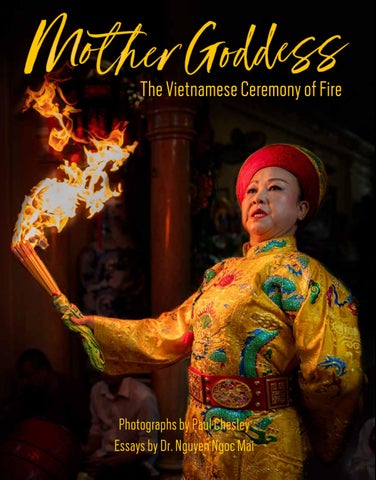
The Vietnamese Ceremony of Fire
Photographs by Paul Chesley Essays by Dr. Nguyen Ngoc Mai
6
Introduction By Paul Chesley
O
ver more than thirty years of traveling through Vietnam, I learned early on how
deeply religious ceremonies shape the daily lives of the Vietnamese people. But it wasn’t until a trip in 2018 that I encountered the Mother Goddess ceremony—an experience that opened a door into a world of astonishing beauty and spiritual intensity. I was photographing in Hanoi with a local guide, Miss Trang Nguyen, when we came upon a small temple near Ho Tay Lake. “What a shame,” she said, “we’ve just missed a beautiful, colorful ceremony—very special, and rarely seen by outsiders.” When I asked to learn more, she added almost casually, “My mother knows someone… an authority in that ceremony.” That was my first hint of a path I never could have found on my own. I asked if we might meet her. On my next trip, later that year, my guide and I were invited to sit down with this expert, Dr. Nguyen Ngoc Mai, a professor at a nearby university, in a tiny coffee shop tucked into a Hanoi side street. After sharing stories of her life and work, she surprised us with an unexpected invitation: “As it happens, there is a ceremony tomorrow at my friend’s house. If you’d like, I will take you.” Of course, I said yes. Getting there was an adventure—far from the city center, down a maze of alleys, and up four narrow flights of stairs. At the top we discovered a private temple glowing with silk, candles, and color. They invited me to sit at the edge of the small stage, with a clear view of the performance. When the ceremony began, I was completely unprepared for its power. The music rose; and the main spirit-medium appeared in shimmering silk. She sang, danced, and spun as attendants handed her flaming incense. It was mesmerizing—otherworldly. I will never forget that moment. The ceremony unfolded for hours. Between each ritual, the medium changed into new, brilliantly colored garments while the drums pulsed softly and the flames flickered around her. At the end, she hosted a traditional Vietnamese lunch for all the participants. Only then did I learn—through my interpreter—that she was Madame Hoang Minh Do, one of the most respected Mother Goddess mediums in all of Vietnam.
Madame Hoang Minh Do performs the “Initiation of a Spirit Medium”ceremony to qualify a young man to work in the medium world at her private family temple in Hanoi. 7
Over the next few years, as I photographed other ceremonies, we encountered Madame Hoang often—sometimes performing, sometimes attending with friends. She became a cherished friend and an enthusiastic supporter of my artistic endeavors. Each time we met, she urged me to create a book of my photographs devoted to the Mother Goddess. I promised her I would. Friends and colleagues back in the U.S. encouraged me as well, so I began shaping the project in earnest. When I showed Madame Hoang the first initial design in early 2025, tears streamed down her cheeks. “We are so fortunate you came to Vietnam to make these beautiful photographs of our Dear Mother,” she said. “No one has ever done anything like this for us. Thank you for following through on your promise.” The Mother Goddess ceremony was recognized by UNESCO in 2016, which helped protect it both culturally and spiritually—and limited its exposure to outsiders. During the six years I spent photographing more than thirty ceremonies, I never saw another foreigner present, nor even another photographer. To be welcomed into this tradition, and entrusted with documenting its beauty, has been the greatest honor of my career: not only witnessing the beautiful events, but also meeting the dynamic characters involved. After most ceremonies, we were invited to spend time with the medium and the performers. Those conversations—where they spoke openly about their spiritual state, their devotion, and their lives—are among my most treasured memories. I have learned so much from them about faith, love, resilience, and joy. Whenever I return to Vietnam, I will visit these extraordinary friends. And if they invite me again, I will always be happy to photograph more of these beautiful and unique ceremonies.
An actress in a ceremonial costume participates in the Mother Goddess festival at Luu Phai Temple in Hanoi. 8
9
10
The Ceremony of Fire Dr. Nguyen Ngoc Mai
G
rowing up in the city of Nam Dinh in northern Vietnam, my childhood was happy,
and seemed quite ordinary. Only later did I realize that I had been raised in the birthplace of Vietnam’s Mother Goddess indigenous folk religion. On every full moon, my friends and I would leave our parents at home and walk for kilometers on long, often muddy roads. In the distance we would begin to hear the pounding of drums, the rise of music, and excited voices drifting from the most beautiful temples imaginable. As we approached the main entrance, we would see female performers in vibrant, ornate gowns—dancing, waving flaming wands, brandishing ceremonial swords, and singing with striking, high-pitched voices. Male attendants in elegant silk shirts moved around them, supporting the central figure of the ritual. For a child, it felt like stepping into a dream. And it wasn’t enough simply to watch. Before long, we were invited to take part. The main spirit-medium would toss money into the air for us to catch, or sometimes small cakes and sweets. Through their songs and gestures, the performers were also teaching us lessons about life, love, humanity, and the ideals of womanhood. By my teenage years I was reading everything I could find about the Mother Goddess tradition, and it became an obsession. At university I wrote paper after paper on the subject, and started to become something of an expert. Eventually I decided to devote my doctoral thesis in anthropology to the Mother Goddess religion and its influence on countless lives across Vietnam. It is a profound honor for me to contribute to a tradition that has shaped my life since childhood. Mother Goddess worship in Vietnam, known as Đạo Mẫu, is not something distant or abstract. It is something lived—woven into memory, into landscape, into the rhythms of everyday life. The temples, festivals, and stories of sacred women belong to a much
Medium Madame Hoang Minh Do performs the “Dancing with Fire” Mother Goddess ceremony at her private family temple in Hanoi. 11
Believers of the Mother Goddess religion wait patiently for the Grand Procession to begin in Nha Trang, Southern Vietnam.
20
21
28
A flag dancer waits for ceremonies to begin at Ba Chua Kho Temple in Bac Ninh.
Papier-mâché horses and an elephant adorn the Bong Temple in Nam Dinh. After the ceremony they will be burned in effigy, in the hope that their spirits will bring benefits to the Mother Goddess. 29
48
Medium Anh embodies the Holy Mother of the High Mountains and Forest Realm at Tay Ho Temple on the shore of West Lake in Hanoi.
49
Medium Madame Anh throws money gifted by the Holy Mother in the air for worshipers to catch at Tay Ho Temple in Hanoi.
60
61
Lieu Hanh: The Defiant Goddess A
mong the many figures in Vietnam’s Mother Goddess tradition,
Liễu Hạnh stands apart. She is not remembered for teaching crafts or leading armies, but for something far rarer: she embodies freedom, independence, and the pursuit of happiness. In a society shaped by strict social norms, her story offers a striking vision of a woman who lived on her own terms. According to legend, Liễu Hạnh was the daughter of the Jade Emperor, banished to earth after accidentally breaking a sacred jade cup. Reborn into a Lê family in Nam Định Province, she lived briefly before mysteriously dying at the age of twenty-one. Yet death did not end her presence. She returned to the mortal realm repeatedly, revealing her divine nature and maintaining a deep connection to the human world. Unlike other deities, her later descents were voluntary. She traveled widely across the land, often appearing as a beautiful young woman. She joined scholars in poetic gatherings, testing their intellect and character, and even established a roadside inn where she challenged those journeying to imperial examinations. Through these encounters, she revealed both compassion and authority—rewarding virtue while punishing deceit and arrogance. Her defiance extended to the highest levels of power. One legend recounts a confrontation with the royal court that led to a fierce three-day battle with the Lê dynasty’s army, ending without a clear victor. In the aftermath, her power was formally acknowledged, and temples were built in her honor. Over time, Liễu Hạnh came to be revered as the supreme Mother Goddess, a figure both divine and deeply human—whose enduring legacy lies not in obedience, but in the freedom to transcend it. —N. M.
A medium wears the costume of the Holy Mother of the Forest Realm at Luu Phai Temple in Hanoi. 72
73
A traditional Vietnamese garden inside Tien Huong, a private family temple in Hanoi. 86
87
An actor falls into a spiritual trance during a classic opera performance at a Mother Goddess ceremony in the Ba Den Mountain Temple in Tay Ninh, Southern Vietnam.
120
121
Evening falls on the Hon Chen Temple Festival on the Huong River in Hue, Central Vietnam.
150
151
156
These statues, known as the“Three Holy Goddesses,” are Vietnam’s most historically important representations of the Mother Goddess. They are housed in the Imperial Secret Room at Nguyet Du Cung Temple in Hanoi.
157
PAUL CHESLEY (photographer and author) Paul comes from a family of inventors, artists, and adventures who encouraged exploration into the unknown. By the time Chesley was in his mid-twenties, he realized that he could make a larger contribution to life through his photography. For the next four decades, beginning in the late 1970s, he completed more than thirty-five projects around the world with the National Geographic Society He also freelanced for numerous American and international publications including Time, Life, Newsweek, Fortune, Forbes, New York Times, Paris Match, and Stern-Geo magazines. Chesley was honored by the inclusion of his work in the Society’s first major exhibition, The Art of Photography at National Geographic: A 100 Year Retrospective, at the Corcoran Gallery of Art in Washington, DC. Solo exhibitions of his work have appeared in museums in London, Tokyo, New York and Honolulu. In 2012 during the National Geographic Society’s 125th anniversary, Chesley’s work was included in the exhibition and auction at Christie’s in New York City. His memoir, Paul Chesley: A Photographic Voyage, won the National Ben Franklin Gold Award for America’s best coffee table book. His most recent book, Beloved Ukraine, documents the everyday life of Ukrainians before the 2022 war with Russia. His greatest enjoyment is capturing the lives of people and cultures on his international photographic assignments.
Paul Chesley with performers at Luu Phai Temple in Hanoi.
158
DR. NGUYEN NGOC MAI (essays) Dr. Mai is a Vietnamese scholar specializing in folklore, religious studies, and the history and culture of Hanoi. She was born in 1970 in Nam Dinh, Vietnam. She graduated from Hanoi University with a degree in ethnography in 1994 and received her PhD in cultural studies in 2010. She is currently affiliated with the Vietnam Academy of Social Sciences. Dr. Mai has built a strong academic reputation through her extensive research on folk beliefs and spiritual practices in Vietnam. Her work focuses particularly on spirit mediumship rituals and the transformation of folk religions in contemporary society. She has published numerous scholarly works recognized in Vietnamese academia. In 2017, she was awarded the Second Prize by the Vietnam Folk Arts Association for her research on the historical and cultural value of spirit mediumship rituals. She has also collaborated internationally, including documentary projects with JIBS Jeju Broadcasting in South Korea on a documentary film project, “The Origins of Shamanism in Vietnam and Asia.” In 2018, she was invited by CNN to participate in a program about the Mother Goddess religion in Vietnam. Dr. Mai met Paul Chesley in 2019, and the idea of creating this book about the Mother Goddess tradition was born. Through her academic and collaborative work, Dr. Nguyen Ngoc Mai has made significant contributions to the preservation and interpretation of Vietnam’s intangible cultural heritage.
159