Contents
Foreword __________________________________________________ 10 Introduction________________________________________________ 14 Los Angeles Lost and Found___________________________________ 16 What We Didn’t Lose in the Fire_______________________________ 26 What Makes a House a Home________________________________ 34 In Emak’s Room_____________________________________________ 40 Making Meaning___________________________________________ 46 Designing for Crisis__________________________________________ 52 The Neutra VDL House: A Story of Resilience and Renewal_____________________________ 56 Los Angeles as a Living Laboratory____________________________ 60 The Capital of Play__________________________________________ 70 City as Our Image__________________________________________ 78 Seek and You Shall Find_____________________________________ 84 Thoughts on Wandering…____________________________________ 92 An Interlude: The Messy Middle ____________________________ 104
An Almost Architect_______________________________________ 108 The Shape of Us__________________________________________ 114 The Places We Shape______________________________________ 122 Designing With Every Body in Mind_________________________ 128 Dear Los Angeles_________________________________________ 132 On Being an Introvert in an Extroverted City__________________ 144 My Natural Medium_______________________________________ 150 The Weight of One Voice: Navigating Motherhood, Identity, and Representation__________ 154 Liminal Los Angeles________________________________________ 160 Thank you, Los Angeles____________________________________ 164 The America That I Know___________________________________ 168 Afterword________________________________________________ 174 Acknowledgments_________________________________________ 175 References _______________________________________________ 176 About the Author__________________________________________ 178
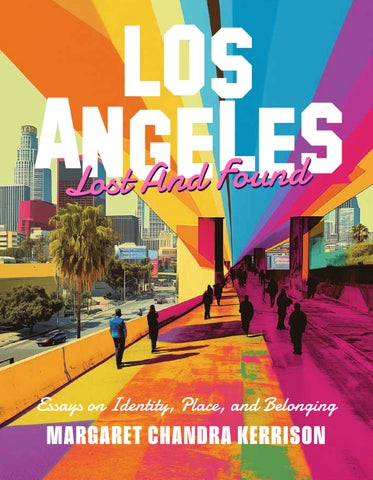
Los Angeles Lost and Found
Foreword When Margaret messaged me she was writing this collection of essays about Los Angeles and the stories it holds, it made complete sense. In the years I’ve known her, I’ve watched her grow into one of the world’s foremost immersive storytellers, shaped in no small part by the creative energy of her adopted home, Los Angeles. In the same message, she asked me to write the foreword to this book, which a year ago I would have balked at because I am but a face in this metropolis of millions. But, after an extremely challenging year for all of us in LA, I recognize the city has become part of my story too. Unlike Margaret, LA was never a place I thought I would end up, let alone call home. Sure, LA was where all of my relatives had settled after emigrating from Taiwan. I’d see my California cousins on summer breaks, their deeply tanned legs peeping from their basketball shorts from days spent outdoors when, I imagined, they weren’t stuck in their cars. After living most of my life up and down the Eastern seaboard, I envisioned settling down somewhere quieter, low-key and certainly with more cloud cover. But years later I found myself in LA. Work and family proved to be a unifying, gravitational force. I came to LA to report for a public radio station covering the city’s many diasporas. It’s where I got married on a warm October day in Chinatown and, years later, had two kids—one born in Pasadena, the other in Hollywood. My husband and I bought our first home in LA’s San Gabriel Valley, a tiny post-World War II boxy house in the foothill community of Altadena. Behind our narrow, sloped lot rose the majestic San Gabriels. And from the front porch, if you stood in the right spot, you could glimpse the twinkle of downtown LA in the far distance through our neighbors’ trees.
10
Altadena embodied everything beautiful and singular about LA. Nature trails threaded the foothills, mere minutes from the rush of the 210 freeway. The community also reflected a kind of diversity that felt special in a city defined by racial and economic boundaries. On our block alone, families came from a range of racial and cultural backgrounds. The Black homeownership rate of 81% was nearly double the national average. Our neighbors were accountants, artists, educators, and touring musicians. As I write about Altadena, I’m realizing that I’m using the past tense and the conditional and that it’s because we’re not living there at the moment. On January 7, 2025, the Eaton Fire tore through half our community, taking our home and virtually every house on our street. This year’s wildfires have unmoored tens of thousands of us across LA. For our family, what had been our little hideaway amid the city’s hum and hustle became rubble and ash overnight, heaved onto dump trucks for parts unknown. We are now renting in a town thirty-five-minutes south, although our lives still orbit around Altadena for school, playdates, and Little League. All this tumult has brought into question: What is home? Is it our old house, lost along with all the totems of our lives, from childhood photo albums to our daughter’s favorite quilt? Or is home what we hold inside, like the bonds to our dear neighbors now scattered and to those friends who rallied near and wrapped us in love and care? More and more I think it’s the latter. Paradoxically, the fires actually drew us closer to LA—not just to the place itself, but to the community it holds. Margaret’s deeply reflective and optimistic essays underscore this collective spirit of LA, while paying tribute to the individuals who make this city every day. They come as the city grapples with the aftermath of the fires and now the immigration raids on our fellow Angelenos that have made so many streets and neighborhoods go silent.
11
Los Angeles Lost and Found
Introduction When the LA wildfires struck earlier this year in 2025, every single Angeleno was affected. Many of us lost homes, businesses, schools— places of community. Places that defined who we are, both as individuals and as a collective. Even for those of us who didn’t lose these physical spaces, the impact rippled through us. We felt the pain of our friends, neighbors, and fellow Angelenos. We grieved with them in ways we had never experienced before. Because this wildfire—this level of devastation—had not been seen in recent memory. It was a disaster that struck at the heart, shook us to the core, and forced us to question what truly matters. We came together as a city-state. We poured our hearts into the communities of Altadena and Pacific Palisades—through donations, volunteering, and emotional support. We stood side by side in the streets of LA. We understood, deeply, that this could have happened to any one of us, depending on where the wind blew. During this time, I began writing essays—initially as personal reflections on the wildfires and what it means to rebuild. I approached it through my lens as an experience and environmental designer. I wondered: how do you pick up the pieces—whatever’s left—and start again? How do you tell a story not just of loss, but of community, resilience, and love? Over time, these essays became love letters to Los Angeles. A city that has given me so much. A city that welcomed me as I was—and continues to welcome me as I evolve. I remembered what brought me here in the first place, how I’ve grown alongside a city that is constantly reimagining and reinventing itself. A place I’ve chosen to call home for the past twenty-one years, alongside my husband and son. This is the only home my twelve-year-old has ever known. He is a true product of the many cities we’ve lived in across Greater LA area. My hope is that, by reading these essays, you feel a deep resonance— and a reminder of why this city is so extraordinary. LA is a city of contradictions. For all its beauty and flaws, its spirit exists only here.
14
Introduction
It’s where I’ve been both lost and found. And where I continue to be— because this city doesn’t judge. It accepts you as you are, with your strengths and your flaws. Just like itself. It welcomes those who dare to dream, to take risks, to grow, and above all—to remain incomplete.
Hollywood sign. Photo by Margaret Kerrison
15
Los Angeles Lost and Found
Essay 1 — Los Angeles Lost and Found
Los Angeles has been called many things: the City of Angels, the City of Dreams, La-La Land, and Hollyweird. Each name reflects a different part of its identity. But the nickname “Lost Angeles” has always struck a chord with me, perhaps due to its subtle irony. To some, it symbolizes a loss of identity or disillusionment with the entertainment industry. To me, it represents a place where people can lose themselves, reinvent, and emerge anew. This metaphor feels more poignant than ever in the aftermath of the devastating wildfires. The physical manifestation of “Lost Angeles” has forced us all to pause, confront our realities, and envision a new way forward. The fires created a ripple effect deeply tied to this city—a collective reckoning that shook us. They prompted reflection on what was, what is, what we’ve lost, and what we might still create. The fires reminded us of life’s impermanence: everything, everywhere, and everyone are fleeting moments and memories. So how do we live in the present while looking toward the future, honoring the past without being bound by it? How do we rebuild this city with purpose, understanding what is truly meaningful, usable, and essential? Perhaps, in losing, we’ve gained the clarity to reimagine what Los Angeles—and life—can be. I personally know friends who lost their homes in Altadena, along with the countless pieces of their lives they held. For one family, it began with a power outage, forcing them to flee in the middle of the night, with not much more than the clothes on their backs. They thought they would return in a couple of nights, like many who evacuated their homes. In the flames, they lost their daughter’s cherished electric keyboard, their son’s favorite books and toys, and so much more. A house is more than just walls—it’s a vessel for memories, a sanctuary for the physical tokens of a family’s journey. What do you do when it all disappears? And what does it mean for something to be “lost” when it wasn’t misplaced, but taken by forces beyond one’s control? Or perhaps it was misplaced—our meaning, security, and comfort— hidden in objects we never realized anchored us to a sense of stability. How do you say goodbye to the things that defined your life? This reckoning with change and impermanence reminds all of us Angelenos that this city, like life itself, is always in a state of evolving
17
What We Didn’t Lose in the Fire
Essay 2 — What We Didn’t Lose in the Fire
I imagine what we’ve lost in the fire. During the recent wildfires, my family faced the unsettling act of packing for an evacuation. While Burbank was spared from the flames, the emotional impact lingers. As we packed a week’s worth of clothes, we had to decide what we couldn’t bear to lose. Alongside essentials like passports, laptops, and birth certificates, I carefully chose items that carried emotional weight—my jewelry, gifts from my grandmother who is no longer with us, and pieces from my mother, given during happier times. These are more than objects; they are memories I treasure. I calmly told our eleven-year-old son that he could pack one duffle bag full of what he wanted to keep. He filled it with books and a Soot Sprite keychain from Spirited Away, that his Yima, my sister, gave him. He packed his iPad and Nintendo Switch, his most prized possessions. I looked around the house and paid close attention to all the “things” we own. As someone who identifies as an essentialist, I feel detached from most possessions. Like anyone, I enjoy acquiring something new now and then, but I rarely form strong attachments to objects. I let go of things easily—perhaps too easily. My husband and son are always complaining that I donate or discard items too often, too soon. Compared to a typical middle-aged woman, I don’t own much in the way of clothes, shoes, or accessories. My most valued possessions are my passport, phone, and laptop; I can’t imagine life without them. Over the past few weeks, I’ve envisioned all my belongings consumed by flames. Oddly, I feel a strange sense of liberation. Our home, while modestly filled, sometimes overwhelms me with its objects. Walking from room to room, I realize most of what surrounds me is not truly mine. Aside from the essentials, everything else feels replaceable. I only have a handful of things from my childhood. Most of the things I owned from growing up in Singapore were thrown away when my father sold our childhood home. My husband, by contrast, packed many sentimental items, including family photo albums, preserving memories from the days of film photography. In my social feeds, I see families whose lives have been devastated by the fires. Their fundamental needs—shelter and safety—are gone. All their belongings reduced to ashes. It makes me reflect on how much we value our possessions and the critical role they play in shaping
27
Los Angeles Lost and Found
Classic Singaporean shophouses— narrow and typically two to three stories tall—traditionally featuring a groundfloor shop with living quarters above. Photo by Margaret Kerrison
38
Essay 3 — What Makes a House a Home
39
Making Meaning
Essay 5 — Making Meaning
“Art holds out the promise of inner wholeness.” Alain de Botton and John Armstrong, Art as Therapy
We often speak of cities as structures—systems of transit, buildings of concrete and steel, blueprints made real. Environmental settings where our lives occur. But when we walk through a city we love, we are not charting a path through infrastructure. We are moving through memory. Urban spaces are not just built; they are felt. They carry the imprints of laughter, longing, love, and loss. And at the heart of these feelings is placemaking—the thoughtful creation and curation of spaces that invite people to not just use them, but to belong to them and become a part of their everyday lives. Placemaking is not merely the arrangement of benches and pathways. It is the art of emotional engineering. It asks: how can we turn space into place? How do we transform the forgotten into the beloved? How can we create places that we love and protect? Public art, sculpture, and utility play a vital role in transforming shared spaces. When a piece of art enters a public setting, it begins as an offering—and soon becomes a dialogue. Its significance is shaped by the public: they determine whether it becomes meaningful or fades into obscurity. Is it accessible, authentic, and connected to the community’s identity? Does it grow and evolve alongside the people it represents? When I was an undergrad at Tufts University, there was a cannon sculpture in our quad that was routinely “vandalized.” Layers of paint from previous students revealed the evolving history of the piece—a replica of a twenty-four-pound cannon from the USS Constitution. Students were free to paint over it, leave their mark, and make it their own. It was an open invitation for creativity and expression. It served as a canvas for political messages. It belonged to the students—to use as they wished.
47
Los Angeles Lost and Found
This was where I had decided to throw my cards in the air, let them scatter, and see where they landed. I didn’t have a set plan, but that was the plan. I wanted to experiment—try on new identities, step into unfamiliar roles, chase unexpected paths. I didn’t have a road map when I came to LA, just two questions: What if? Why not? The journey was supposed to begin before we arrived. My husband and I had planned a spontaneous, unstructured cross-country road trip
Southern California’s coastline. Photos by Foster Kerrison
62
Essay 8 — Los Angeles as a Living Laboratory
from Boston to Los Angeles. We didn’t book any hotel rooms. We didn’t have planned routes. We imagined a week of wandering—driving through small towns, staying in roadside motels with flickering neon signs, eating at diners that felt like movie sets. We had no real itinerary, just curiosity as our compass and the thrill of seeing where the road would literally and figuratively take us. That drive was meant to be a slow transition into our new life—an adventure in itself. But the road trip never happened. On the very first day, as we made our way to our first stop—my in-laws’ house—we were rear-ended while turning a corner. In an instant, our plans scattered. The car was damaged, the trip called off. That was our first lesson in the journey ahead: sometimes—often—plans don’t unfold the way you imagine. So,
63
Los Angeles Lost and Found
possibility—would come to feel like a once-in-a-lifetime gift. A rare window where I was allowed to find myself on my own terms, without deadlines or expectations. And LA was the perfect stage for that kind of becoming. This city didn’t demand credentials, degrees, or pedigree. In fact, just like its Hollywood movies, it loved a good underdog story. LA welcomed the unusual, the unexpected, and the unique. It welcomed personal exploration. It whispered and beckoned: Try it. Play the part. See how it feels. You didn’t need to audition to imagine yourself into a new life—you just needed the courage to show up. Now, looking back, I see that year for what it truly was—not a detour, but a foundation for my fluid, ever-evolving sense of identity and constant search for belonging. A deeply formative season where I learned to trust my instincts, to follow what sparked joy and curiosity, even when I had no idea where it might lead. It was a year of becoming—messy, magical, and entirely mine.
Sunset over LAX. Photo by Foster Kerrison
68
Essay 8 — Los Angeles as a Living Laboratory
69
Los Angeles Lost and Found
76
Essay 9 — The Capital of Play
Playing in Astra Lumina, South Coast Botanic Garden, Palos Verdes Estates, Los Angeles, CA. Photo by Margaret Kerrison
77
Los Angeles Lost and Found
they are dynamic, accessible, and filled with anonymity, making them ideal for disappearing into the crowd. There’s an energy to it: a sense of being swept up in the rush of life, carried along to unexpected and undiscovered places. Every new corner, every fleeting activity, sparks joy and curiosity—a little dopamine hit that urges me to keep exploring. So wander—with open eyes and an open heart. Let your footsteps carry you through the overlooked and the everyday, where meaning often hides in plain sight. Wandering isn’t a distraction or a detour— it’s an invitation. To slow down. To notice. To feel. To connect with the world not through ownership or belonging, but through presence. In wandering, we reclaim a quiet kind of freedom: the freedom to observe without expectation, to belong without boundaries. It’s not just how we navigate cities—it’s how we begin to see more clearly, imagine more boldly, and live more fully.
Los Angeles in the evening. Photos by Foster Kerrison
98
Essay 12 — Thoughts on Wandering…
99
An Almost Architect
Essay 14 — An Almost Architect
I couldn’t wait to leave college—not because I didn’t enjoy learning, but because I was eager to start the next chapter of my life, whatever form it might take. After graduating from Tufts University in three years with a BA in International Relations, I found myself at a curious crossroads. I was twenty years old—barely an adult by most standards—and though I held the degree, I had no clear sense of what to do next. Everyone expected me to dive headfirst into a promising career or apply to graduate school right away. But I wasn’t ready. Instead, I rented a charming brownstone apartment on Marlborough Street, just a few blocks from the bustle of Newbury Street in Boston. The building was classic New England—ivy-covered, brick-lined, and elegant in that understated way that makes you feel like you’ve stepped into a storybook. I hoped the city might help me find my footing. Maybe, if I stayed still long enough, the answer would come. That year, I worked as a project administrator for the Harvard-MIT Retinal Implant project at the Massachusetts Eye and Ear Infirmary. I spent my days transcribing medical assessments, compiling data, and helping write grants for work that I didn’t always understand. Important work, yes—but also a far cry from what I had imagined my early twenties would look like. Still, I kept at it, telling myself I was gaining experience. But truthfully, I was drifting, unsure of where I fit in a world that suddenly felt too big. Eventually, I scaled back to part-time work. I needed space—mental, emotional, and creative space—to pause and breathe. To reflect. Looking back now, I realize that year was my unofficial “gap year.” A necessary break between the intensity of academia and the unknown future. A precious, in-between time where I could explore the question that would shape the rest of my life: Who was I becoming? What kind of life did I want to build? And more importantly, what would it mean to live on my own terms? I invited my sister to move in with me. We were two young women, recent college graduates and immigrants from Singapore, both searching for something but not quite sure what. That tiny one-bedroom on the top floor became our sanctuary. The rent was $1,450 a month— steep at the time—but we didn’t care. The location was everything. The “bedroom” was so small that two twin beds barely fit, and opening
109
Dear Los Angeles
Essay 18 — Dear Los Angeles
Dear Los Angeles, City of scattered dreams and fragmented shapes, where highways hum like restless rivers, and mountains stand still, watching us beneath their quiet gaze. Your streets are a patchwork of contradictions, where mansions and tents share the same checkered horizon. High art and graffiti collide on the same streets that carry us to and fro in our endless busyness. “How are you?” “Busy,” we collectively reply. The air carries whispers of ambition, mixed with smog and salty sea air— a blend only you could call home. Your people are islands, adrift in their cars— lonely ships on an endless asphalt sea. Yet, you are more than this. You are sunsets that spill gold over the Pacific, families hitting piñatas in Griffith Park, the laughter of children on the beach the voices of taco vendors—poets of the curb, offering their craft with hands that tell stories of lands far and near. You are friends sharing brunch at sidewalk cafés in Los Feliz, anticipating a visit to the local bookstore, stealing glances at celebrities trying to lead normal lives— as we pretend not to notice.
133
Los Angeles Lost and Found
140
Essay 18 — Dear Los Angeles
141
Los Angeles Lost and Found
152
Essay 20 — My Natural Medium
Embracing my natural medium, writing and editing my book Reimagined Worlds: Narrative Placemaking for People, Play, and Purpose (ORO Editions, 2024). Photo by Margaret Kerrison
153
Los Angeles Lost and Found
About the Author Born in Indonesia and raised in Singapore, Margaret’s career spans over seventeen years of creating narratives and writing for television, film, digital media, games, brand storytelling, location-based entertainment, narrative placemaking, and immersive experiences. As a writer–creative director, she has designed experiences for some of the most beloved brands in the world and has worked on project teams that have won six Thea Awards from the Themed Entertainment Association. She is the author of Immersive Storytelling for Real and Imagined Worlds (MWP, 2022), Reimagined Worlds: Narrative Placemaking for People, Play, and Purpose (ORO Editions, 2024), and The Art of Immersive Storytelling: Strategies from the Gaming World (MWP, 2025). In 2023, she was awarded the prestigious Paul Helmle Fellowship by the Department of Architecture at California Polytechnic State University, Pomona. She lives in Los Angeles with her husband and son and is always looking for her next adventure and invitation to play.
HTTPS://MARGARETKERRISON.MY.CANVA.SITE
178
About the Author
immersivestory2022@gmail.com
www.linkedin.com/in/margaret-chandra-kerrison-1840817
179