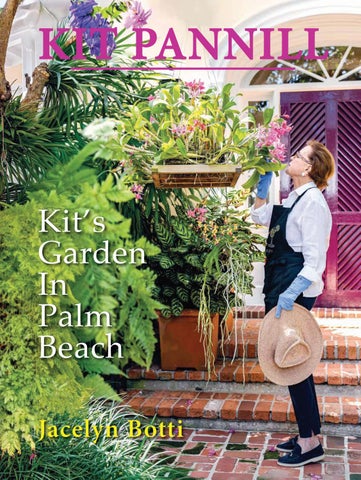
Introduction Every garden begins as an act of faith. When Kit Pannill first moved into her Lake Trail home on the island of Palm Beach over four decades ago, there were only four legacy trees anchoring her yard...nothing else. Shortly thereafter, Kit drove to a nearby nursery garden purchasing plants that she could carry herself back home one by one. There was no master garden plan, just her own sense of the yard and what she liked. Kit essentially had no formal gardening or horticultural training, nor was she a native Floridian. So coming from a northern climate, unfamiliar with a tropical climate or plants, she basically followed her instincts. Over the years, Kit gained a lot of personal experience just by “doing,” which she did daily. When it came right down to what drove her, it was the simple personal satisfaction of “watching things grow.” Kit fell in love growing orchids, eventually becoming an award-winning expert several times over. Florida’s climate is a perfect environment for these exotic flowering plants. They spoke to her, and she spoke back. She built a special SLAT House for them, which eventually expanded into a feeding ground for other eccentric species of plants and flowers—begonias, cacti, succulents, bonsai, unusual Euphorbias, and other rare Pachypodium. Kit deepened her expertise by a daily regimen of gardening, and her garden grew year by year over the decades culminating into what it has become today—a horticultural masterpiece. It’s where she finds refuge— peace and quiet where she can escape; her happy place where all her living creatures give her energy, delight, and purpose.
THE AMBER LADY BUDDHA Marlene Rose, internationally acclaimed American sculptor known for pioneering the use of sand-casting in glass art, created this Lady Buddha—“A guardian presence sharing her love and blessings over the abundant and rambunctious life flowering, growing, and blossoming below her in Kit’s Garden.” ~Marlene Rose
Kit’s love for gardening expanded to relationships with others, becoming a member and later president of the Garden Club of Palm Beach and Horticultural director of The Society of the Four Arts of Palm Beach among other notable gardening organizations. She then turned her focus to the beautification of public spaces throughout Palm Beach—advocating for plantings that honor the town's storied past while enhancing its future. She has been a steadfast voice for horticultural integrity, often working behind the scenes to ensure that decisions affecting the town's landscape are thoughtful, informed, and enduring. Equally important has been Kit’s role as a steward and educator. She has generously shared her expertise with civic leaders, fellow gardeners, and community organizations helping to elevate the collective understanding of Palm Beach’s unique horticultural character. Her guidance has shaped policies, projects, and private gardens alike—always with an emphasis on cultivating healthy, happy plants that thrive in the local environment. Kit’s garden received several prestigious accolades, most notably the 2020 Lesly S. Smith Landscape Award from the Preservation Foundation of Palm Beach. This award was particularly significant because it was the first time in the Foundation’s history that it was bestowed upon an established garden—cultivated by Kit for over forty years—rather than a new landscape design. What's most impressive is the extensive collection of hundreds of plants and flowers that comprise Kit’s Garden. All the photos of them taken for this publication were not enhanced and represent their true natural beauty—the close-up photos are truly amazing. Remarkably, they grow and bloom together in harmony—a combination rarely found in a single garden, particularly at the scale of her exotic collection. Now, step inside Kit’s Garden, and witness what happens when instinct, patience, and devotion are given decades to grow.
Contents
Chapter One - Loves to See Things Grow
14
Chapter Two - Learning the Land
50
Chapter Three - Time as a Design Partner
70
Chapter Four - The SLAT House
90
Chapter Five - Orchids on Steroids
120
Chapter Six - Gardens of Civic Responsibility
148
An intimate introduction to Kit Pannill’s philosophy of attention and restraint, revealing how her lifelong love of gardens became a way of living—and a model for stewardship in Palm Beach.
Before planting anything, Kit learned to wait and observe. This chapter explores how understanding light, soil, wind, and time laid the foundation for everything that followed.
A meditation on patience as an active design choice, showing how Kit allows landscapes to evolve slowly, gaining strength and character with age.
A look inside Kit’s beloved SLAT House—part laboratory, part sanctuary—where observation, experimentation, and care shape living works in progress.
In mid-January, Kit sounds the call—“The Orchids are on Steroids!”—and her collections erupt in peak-season bloom, filling the SLAT House with fragrance, color, and hundreds of labeled living masterpieces.
Kit’s belief that gardens extend beyond private gates, highlighting her leadership, mentorship, and lasting impact on Palm Beach’s shared landscapes.
Chapter Seven - Pannill Pipes 172
An innovative method born from necessity after a hurricane, now adopted locally as a model of banyan tree conservation and creative stewardship.
Chapter Eight - The Eccentric Side of the Plant Kingdom
186
Chapter Nine - Kit’s Open Door
218
Chapter Ten - Legacy, Continuity & the Future
244
A celebration of unusual forms and textures—where orchids share space with euphorbias, sculptural succulents, and other beautifully unexpected specimens.
A portrait of Kit’s generosity and instinct to heal—welcoming sick and struggling plants into her care, and teaching others through perserverance and example.
A moving conclusion reflecting on the horticultural foundation Kit has built for Palm Beach— and the generations of gardeners she has inspired to carry it forward.
Water Buttercup or Water-crowfoot Ranunculus aquatilis
“Look deep into nature, and you will understand everything better.”
~Ralph Waldo Emerson
Baby's Tears Soleirolia soleirolii
Fireworks Orchid Renanthera orchid
Yesterday, Today & Tomorrow Brunfelsia pauciflora
Tractor Seat Plant Farfugium japonicum
Peregrina or Spicy Jatropha Jatropha integerrimaa
Kit Pannill
M emberships , L eadership T itles , A wards & H onors Memberships & Organizational Roles
• Member, The Garden Club of America (GCA)
• Horticulture Judge, The Garden Club of America (since 1997) • Former President, The Garden Club of Palm Beach (2003–2005); Member since 1991 • Founding Member & Director, Horticultural Society of South Florida (Palm Beach Tropical Flower Show) • Board Service & Gala Leadership, Community Foundation for Palm Beach and Martin Counties • Horticulture Chairwoman, The Society of the Four Arts Demonstration Garden (since 2016) • Board Service, Preservation Foundation of Palm Beach • Board Service, The Hospice Guild • Board Service, Intracoastal Health System
Awards & Honors
• Lesly S. Smith Landscape Award (2020) – Preservation Foundation of Palm Beach • Catherine Beattie Medal – The Garden Club of America (six-time recipient) • Vanda “Kit Pannill” Orchid named in her honor by the American Orchid Society • Women of Distinction Honoree (2000) – Palm Beach Atlantic University • Best in Show – The Garden Club of Palm Beach Flower Show (ten-time recipient) • Garden Club of America Zone Horticulture Award (2016) • Horticulture Club Sweepstakes Award (2017, 2019) • Rosie Jones Horticulture Award (2025)
Banyan Tree (Lofty Fig) Ficus altissima
Before Kit ever planted anything, she learned to wait. That habit—waiting—has always set her apart, especially in Palm Beach where patience is rarely rewarded and immediacy is often expected. Mansions appear almost overnight. Landscapes arrive fully formed, rolled out and installed on cue. But Kit never trusted anything that looked finished too quickly. She wanted to know what the land would do if left alone long enough to speak. In the beginning, that meant walking the property at different times of day, sometimes doing nothing more than standing still. She noticed where the sun lingered in the afternoon and where it disappeared earlier than expected. After a storm, she paid attention to where the water collected and where it drained away without a trace. She learned how salt air moved across the garden and which plants quietly endured it without complaint. Where others might have cleared space to start fresh, she paused. Mature trees, especially, demanded her respect. They weren’t obstacles; they were elders. Their roots dictated where paths could go. The canopies determined scale and shelter. Rather than removing them to make room for something new, Kit chose to build around them, letting what already existed set the tone for everything that followed. That instinct—to preserve first—became one of her defining principles. Plant choices followed the same logic. Kit gravitated toward plants that belonged. Not delicate showpieces that required constant fussing, but species that could tolerate heat, wind, and salt without drama. She admired resilience. A plant’s ability to endure mattered as much to her as its beauty —sometimes more. If something struggled repeatedly, she didn’t force it to comply. She threw it away. And that belief—that land deserves time, attention, and respect—quietly anchors everything that comes next.
Medusa’s Head Euphorbia Euphorbia caput-medusae
Kit has never believed that a garden can be finished. That belief shapes everything she does. Where others look for completion, she looks for continuity. Time, in her view, is not something to manage or race against—it is something to work with. A garden, like a life, reveals itself slowly. You don’t rush it. You accompany it. In Kit’s Garden, time is present everywhere, though rarely announced. It shows itself in the way paths soften at the edges, where footsteps have settled the ground just enough. It appears in the gentle widening of a tree’s canopy, the way shade shifts year by year rather than day by day. These are changes that happen quietly, often unnoticed—unless you are paying attention. Kit pays attention. She understands that the most important decisions in a garden are not always the ones made with a shovel in hand. Some are made by choosing to wait. By allowing a plant to grow into its space rather than forcing it into shape. By resisting the urge to intervene simply because something looks unfinished in the moment. Early on, Kit learned that impatience leaves a mark. Plants pushed too quickly grow leggy or stressed. Trees planted without regard for their future size eventually demand drastic correction. Short-term solutions almost always lead to long-term problems. Time exposes these choices, whether we want it to or not. Not everything needs to happen at once. Not every corner needs immediate resolution. Some spaces are allowed to remain open, even uncertain, until the land signals what belongs there.
“Trees have a tendency toward immortality.” ~Neville Fay
Banyan Tree (Lofty Fig) Ficus altissima
Jamaican Poinsettia Euphorbia punicea
Chapter Four The SLAT House
Blue Vanda Orchid Vanda coerulea
Corsage Orchid (Queen of Orchids) Cattleya orchid
“Earth laughs in flowers.” ~Ralph Waldo Emerson
Main Interior Hall of the Pannill Pavilion The Society of the Four Arts Palm Beach
PANNILL PAVILION GREAT HALL CHERUB WALL FOUNTAIN Designed and integrated as an architectural element by Giacometti Architecture, Inc. of Lake Worth, Florida the fountain echos the iconic Florida Mediterranean revival style of Palm Beach.
Cherub Wall Fountain in Pannill Pavillion at the Society of the Four Arts
View of Flagler Pavilion, Palm Beach from Kit’s Garden
THE TIDAL GARDEN
The Tidal Garden, funded by the Palm Beach Garden Club and Designed by SMI Landscape Architecture, LLC, incorporates a sunken-garden system that directs water from king tides back into the water table at the four acre park. Eighty five percent of the garden is filled with native plants that thrive in water and dry conditions, like salt-tolerant green and silver buttonwood, a Lysiloma tree, and Lignum vitae trees. Flowering plants like milkweed and blue flag iris were added to attract butterflies. The area has become a natural educational play area for children to climb the cap stone boulders and learn about the king tides.
Tidal Garden in Bradley Park Palm Beach
Pannill Pipes Encased roots are allowed to strengthen gradually. Once they reach the soil, they assume their intended role—providing additional structural support, stabilizing expansive branches, and extending the life of the tree. In this way, Pannill Pipes reflect something larger than a technical solution. They embody Kit’s instinctive approach to stewardship: intervene thoughtfully, protect what is vulnerable, and trust growth to do the rest. Today, the approach aligns with broader preservation efforts outlined in resources such as the Palm Beach County Tree Protection Plan, which emphasizes preservation, structural integrity, and long-term care for the county’s most significant trees. Ficus trees are living monuments. They take decades to renew their full form, centuries to reach their greatest presence. Saving one is not just an act of gardening; it is an act of civic care. Through Pannill Pipes, Kit demonstrated once again that innovation does not always arrive with fanfare. Sometimes it arrives quietly, in response to damage, guided by knowledge and love for the land. The ficus tree survived. The method endured. And a solution created in one garden became part of Palm Beach’s shared approach to preservation. That is legacy, expressed in roots.
“Gardening is the slowest of the performing arts.” ~ Anonymous
Peanut Cactus Cleistocactus cv.
PEANUT CACTUS Cleistocactus cv.
Within the SLAT House, the Cleistocactus cv. (Peanut Cactus) proudly stands as a fascinating clustering cactus celebrated for its dense, architectural growth and ever-expanding colony of upright stems. Native to the mountainous regions of South America, members of the Cleistocactus family are admired for their sculptural forms, rhythmic repetition, and remarkable adaptability in arid environments. Over time, this awardwinning specimen has matured into a miniature landscape of countless ribbed green columns edged with delicate white areoles and tiny spines, creating the impression of a thriving desert metropolis—inspiring Kit’s longtime gardener, Gerardo Morales Tapia, who has cared for the garden for more than twenty-six years, to describe it with delight: “It’s like a city!” The smaller plant displayed beside it was propagated directly from the original mother cactus, continuing its remarkable lineage. Particularly striking are the unusual blush-pink offshoots emerging from the stems— tender new growth that appears almost coral-like in color and texture before gradually maturing to green, adding an unexpected softness and eccentric beauty to the plant’s otherwise geometric form.
Crested Euphorbia Euphorbia lactea cristata
Crested Euphorbia Euphorbia lactea cristata
CHINESE BANYAN Ficus microcarpa Ficus microcarpa—a majestic form of Banyan tree native to tropical Asia and the Pacific— stands as one of the great living anchors of Kit’s garden. When she purchased the property more than forty years ago, only four legacy trees existed on the grounds. Rather than erase them, Kit built the garden around them, allowing these mature specimens to guide the rhythm, scale, and spirit of the landscape itself. This extraordinary banyan became one of the defining architectural elements of the property, serving as both foundation and inspiration for everything that followed.
Over decades, the tree has expanded into a vast, sculptural canopy that now stretches across much of the western rear garden, its massive limbs extending outward like living architecture. The smooth silver-gray trunks twist and divide into an intricate network of branches, creating deep shade, movement, and enclosure beneath its immense crown. Like many banyans, the tree possesses an almost timeless presence—part shelter, part sculpture, part living monument. In Kit’s garden, it is more than a tree; it is the enduring framework upon which an entire landscape was imagined and allowed to grow.
“I never met anyone who was 'into' plants that I didn't like.” ~ Kit Pannill
Blue Vanda Orchid Vanda coerulea
“Gardening is the work of a lifetime: you never finish.” ~ Oscar de la Renta
More...Kit Alice “Kit” Zimmer Pannill was born and raised in Richmond, Virginia,
and to this day she still carries the unmistakable Southern drawl that has long been part of her charm and identity. Even after moving to Palm Beach in 1984, Kit never lost the gracious warmth, understated manners, and quiet hospitality rooted deeply in her Virginia upbringing. Long before she became one of Palm Beach’s most respected plantswomen and award-winning gardeners, Kit’s relationship with nature began as a child. She has often said she was gardening by the age of six. During World War II, while her father was stationed in the Pacific with the Navy, Kit and her mother moved to Petersburg, Virginia, where they lived with her beloved great-aunt Margaret, affectionately known as “Puggy.” It was there that the foundations of her lifelong passion were quietly planted.
Puggy was an avid gardener who treated the garden not merely as a backyard, but as a living classroom. She regularly took young Kit by the hand into the yard to teach her about flowers, insects, butterflies, and the rhythms of the natural world. Kit learned early that gardening was not simply about plants themselves, but about observing the intricate relationships between all living things. Puggy’s expansive gardens contained nearly every type of flower imaginable, but perhaps most magical to Kit was the basement during winter months, where delicate exotic plants were carefully protected from the cold. Those rare and unusual specimens first awakened the fascination that would later define so much of her adult life. Kit often describes herself as a mischievous child, and one family story has endured for decades. Fascinated by one especially exotic bloom in her great-aunt’s basement collection, she clipped the flower off entirely— earning herself considerable trouble. Yet even that moment revealed something deeper about her character: curiosity always outweighed caution. Rather than discouraging her, the incident only intensified her fascination with plants and their mysteries.
During those wartime years, Kit was also profoundly influenced by the household of Southern women around her. Alongside Puggy was her maternal Aunt Polly, who either lived nearby or frequently helped manage the household. Together they created a world filled with traditional Southern cooking, family rituals, and gracious hospitality. Large Thanksgiving and Christmas gatherings left a lasting impression on Kit and would later influence her own reputation in Palm Beach as one of the island’s most elegant and welcoming hostesses. To this day, friends still speak fondly of her black bean chili, cheese grits, tuna salad, and egg salad recipes—simple Southern comforts elevated by care and tradition. Back in Richmond, Kit attended the historic St. Catherine’s School, the prestigious all-girls preparatory school long associated with Virginia’s upper social circles. There she was immersed in an environment emphasizing poise, discipline, classical academics, and social grace. Her family itself was deeply rooted within Virginia society. Her father, William L. Zimmer Jr., was woven into the legal, corporate, and social fabric of both Richmond and Petersburg. The Zimmer family belonged to the longstanding traditions associated with Virginia’s “First Families,” where ancestry, manners, discretion, and civic standing were held in especially high regard. Yet despite those privileges and expectations, Kit’s greatest joys consistently returned to simpler things. After marrying, she and her husband briefly lived in a small farmhouse cottage in Shelburne, Vermont, where she embraced the role of young homemaker with characteristic energy and independence. She planted flowers around the farmer's cottage and even pushed a manual lawn mower herself across the yard. Gardening remained less about status than about personal satisfaction, beauty, and daily ritual.
Her marriage to William “Bill” Pannill further deepened her connection to the horticultural world. The Pannill family name was already synonymous with Southern industry and philanthropy through the Pannill Knitting Company, founded by Bill’s father. But Bill himself achieved international distinction in horticulture. Widely regarded as one of the world’s foremost daffodil experts, he hybridized, named, and officially registered more than 210 daffodil varieties over the course of his career while serving as president of both the American Daffodil Society and the American Horticultural Society. When Kit and Bill settled into their home along Lake Trail in Palm Beach more than four decades ago, her passion for gardening flourished once again. What began as curiosity in childhood evolved into one of the island’s most admired private gardens—a place shaped not only by horticultural expertise, but by patience, experimentation, intuition, and daily devotion. Kit raised two accomplished daughters: Talbott Bryan Maxey of Palm Beach and Anna Bryan Sullivan of Jackson Hole, Wyoming, both of whom forged successful paths of their own while inheriting the family’s strong sense of tradition, independence, and personal accomplishment. Despite a lifetime surrounded by social prominence, horticultural recognition, and civic leadership, Kit has always remained most grounded in the quieter pleasures that first shaped her as a child: tending a garden, preparing food for family and friends, observing nature closely, and finding beauty in ordinary moments. Beneath the awards, the orchids, and the public accomplishments remains the same curious little girl who once wandered through her great-aunt’s garden in Virginia—captivated by flowers, butterflies, and the endless wonder of watching things grow.
About the Author Jacelyn Botti
Jacelyn Botti is an award-winning author, dedicated philanthropist, nationally distinguished real estate executive, and internationally recognized ship designer whose career and legacy reflect exceptional leadership, integrity, and community service. A native of New Jersey, she vacationed annually on Palm Beach Island beginning in 1987, eventually becoming a seasonal resident before becoming a full-time resident in 2018. She possesses a deep love and respect for Palm Beach’s unique heritage, cultural significance, and extraordinary horticultural beauty. Jacelyn received the prestigious Maxwell Award in 2021 from the National Dog Writers Association of America for her acclaimed children’s book, Maximilian Rescues Abaco. Inspired by true events, the story celebrates courage, compassion, and community restoration in the aftermath of Hurricane Dorian in 2019. Proceeds from the book supported the rebuilding of the Every Child Counts School in Marsh Harbour, which had been devastated by the hurricane. During her lifetime, Jacelyn has pursued a remarkably diverse path, extending far beyond her recent work in the literary field. She led the sales force of what was then the nation’s largest independently owned real estate company, while also pursuing endeavors in yacht design and residential restoration and development. Her custom-designed ships earned international recognition, including nominations among the finest vessels in their class worldwide.
Throughout all of her professional and creative pursuits, philanthropy has remained a deeply personal and enduring commitment. In 2000, she established an annual charitable event benefiting the Susan G. Komen Breast Cancer Foundation, which has since raised millions of dollars and continues annually today. Her philanthropic efforts have also included building and donating a historic pavilion in her hometown park in Mendham, New Jersey, serving as a major donor to the redevelopment of Palm Beach’s Marina Park, gifting a ship to AMIkids, and serving as Chairperson of the 2026 amfAR Palm Beach Gala. Through the creation of Kit Pannill: Kit’s Garden in Palm Beach, Jacelyn now seeks to preserve Kit’s extraordinary artistry and horticultural legacy in a timeless work that will inspire generations to come, while dedicating all net proceeds from the book to The Garden Club of Palm Beach.
Acknowledgments I have always been an early bird. For as long as I can remember, mornings
have been my most inspired and productive hours. Over the past several months, waking up each day and diving into the creation of Kit’s garden book became an incredibly meaningful and energizing part of my daily routine. In truth, this book was never something that could simply be “finished.” A project like this is alive. There is always another detail to refine, another photograph to study, another page to perfect—especially when Kit entrusted us with hundreds upon hundreds of images capturing the extraordinary beauty of her garden, orchids, tropical flowers, and exotic plants. Narrowing those images to the pages of this book was both a privilege and a challenge. First and foremost, I owe enormous gratitude to my right-hand collaborator and dear friend, Lynn Eberenz, founder of Lynn Eberenz Creative. Lynn and I have worked together on several books over the years, including Maximilian Rescues Abaco, our nationally award-winning illustrated children’s book. Lynn possesses a rare instinct for design, color, composition, and visual storytelling. She understands not only how pages should look, but how they should feel as they unfold before the reader. What makes her contribution even more remarkable is that while dedicating countless hours to this project—often working late into the night and into the early morning hours—Lynn simultaneously served as the daily caregiver for both of her parents, each in their mid-nineties. Her dedication, creativity, and unwavering commitment to this book cannot be overstated. I am deeply grateful for her talent, loyalty, and friendship.
I would also like to extend a heartfelt thanks to Daniel Tanner, founder of DCT Real Estate Photography, who personally photographed every image featured throughout this book. Prior to this project, Daniel's work had primarily focused on luxury real estate photography though he came highly recommended for his artistic eye and creativity. What quickly became apparent was that Daniel brought something far more personal to the project: a genuine love of plants themselves. A passionate collector who keeps more than seventy plants in his own condominium, Daniel approached Kit’s garden not simply as a photographer, but as someone who truly appreciated the individuality and character of each specimen. His extraordinary attention to detail, texture, lighting, and composition revealed dimensions of Kit’s garden that might otherwise go unnoticed. Time and again, Daniel returned to the property at different hours of the day to capture changing light conditions across the garden’s north, south, east, and west exposures. His photographs beautifully captured not only the plants themselves, but the atmosphere and spirit of the garden. Hats off to Daniel for a truly exceptional job. A sincere thank you also goes to our publishing team at ORO Editions. From the very beginning, founder Gordon Goff embraced this project enthusiastically and without hesitation. Interestingly, his connection to the book was also deeply personal. Upon seeing Kit’s magnificent staghorn ferns, Gordon immediately recalled memories of his father, who had shared the same fascination and love for these remarkable plants. He spoke warmly of watching them grow, thriving without soil—a memory that resonated emotionally with him and helped solidify his excitement about publishing this book.
Alongside Gordon, I am especially grateful to Federica Ewing, Vice President of Business Development, and Jake Anderson, Project Manager, both of whom worked tirelessly under an extraordinarily aggressive production schedule. The demands of this project frequently tested everyone’s endurance and stress limits, yet this talented and highly professional team remained committed every step of the way. Their combined efforts, expertise, and dedication allowed this book to come together in remarkably short time. It has been a privilege working with such an accomplished group of professionals. And finally, my deepest gratitude goes to Kit herself. When the idea of creating this book was first presented to her, Kit was genuinely overwhelmed by the magnitude of the undertaking. I promised her that we would take it one step at a time and that I would guide her through the process. True to her character, Kit embraced the journey with grace, humility, and trust. Throughout the creation of this book, Kit was absolutely indispensable in ensuring the horticultural accuracy of the countless plants, flowers, trees, orchids, and rare specimens featured within these pages. More importantly, she allowed us into her world—a world shaped by decades of observation, experimentation, and love for nature. This book now stands as more than a collection of photographs and stories. It is the preservation of a living legacy. Generations from now, readers will still be able to walk through Kit’s garden within these pages and experience the beauty, curiosity, creativity, and devotion that shaped it so uniquely. ~Jacelyn Botti
Photography Daniel C. Tanner
Born and raised in South Florida, Daniel Tanner developed a love for photography at an early age, having grown up in a family of photographers. Influenced by generations of creativity and a passion for visual storytelling, he learned to appreciate the art of capturing places, people, and moments in a way that tells a story. His love of visual story-telling and an intense love for plants of all kinds, made this project a perfect fit for Daniel, combining two passions at the same time. Today, Daniel is the founder of DCT Real Estate Photography Inc., and www.TheFloridianPhotographer.com. Inspired by Florida’s natural beauty, coastal lifestyle, and unique character, he creates imagery that is both authentic and visually engaging. When he’s not working with clients, he enjoys traveling the country in search of scenic landscapes, small towns, and unique destinations to photograph.
www.TheFloridianPhotographer.com • Daniel@TheFloridianPhotographer.com
Design
Lynn Eberenz Born and raised in New Jersey, Lynn Eberenz developed a love of art— whether drawing, painting, or other artistic pursuits—at an early age. Her professional career included positions with several advertising agencies, followed by 21 years as a Marketing Communications Manager with AT&T. After her corporate career, Lynn founded her own design company, combining her lifelong passion for art with her expertise in visual communication. She was the award-winning illustrator of the children’s book Maximillian Rescues Abaco and is also an accomplished oil painter whose work is inspired by the beauty and color of the natural world. Many years spent vacationing in Sarasota, Florida deepened her appreciation for vibrant landscapes, lush gardens, and the rich palette found in nature. Lynn was especially drawn to the opportunity to design this book celebrating Kit Pannill’s extraordinary garden. The artistry, color, and beauty of the garden resonated deeply with her own creative sensibilities, while the book’s support of The Garden Club of Palm Beach aligned with her longstanding commitment to strengthening community organizations that enrich our lives.
www.lynnartstudio.com
•
lynneberenzcreative@gmail.com