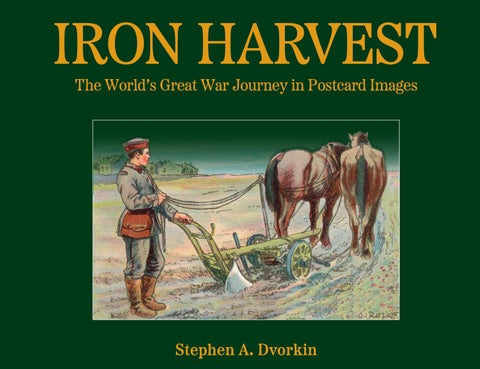
There was an aura about 1914 that caused those who sensed it to shiver for mankind. ~ Barbara Tuchman If most of the world’s men, women and children are soon to be burned to atoms, the annihilation would seem to proceed directly out of the mouths of the guns that spoke in August 1914. ~ Clifton Fadiman
IRON HARVEST The World’s Great War Journey in Postcard Images Stephen A. Dvorkin
Published by Goff Books, an Imprint of ORO Editions. Executive publisher: Gordon Goff. www.goffbooks.com info@goffbooks.com
Text Copyright © Stephen A. Dvorkin 2026
All rights reserved. No part of this book may be reproduced, stored in a retrieval system, or transmitted in any form or by any means, including electronic, mechanical, photocopying of microfilm, recording, or otherwise (except that copying permitted by Sections 107 and 108 of United States Copyright Law and except by reviewers for the public press) without written permission from the publisher.
You must not circulate this book in any other binding or cover and you must impose this same condition on any acquirer.
Goff books Project Coordinator: Kirby Anderson 10 9 8 7 6 5 4 3 2 1 First Edition Library of Congress Control Number: 2026918027 ISBN: 978-1-966515-96-8 Color separations and printing: ORO Group Ltd. Printed in China.
International distribution: www.goffbooks.com/distribution
TABLE OF CONTENTS Author’s Preface..................................................................................................................................................................................................................................xiv The Iron Harvest.....................................................................................................................................................................................................................................1
INTRODUCTION............................................................................................................................................................................................................................6 The Story . . . as They Told It................................................................................................................................................................................................................8 The Era of the Indispensable Postcard................................................................................................................................................................................................9 What Do You Think of That?......................................................................................................................................................................................................... 9 A Reader’s Guide..................................................................................................................................................................................................................................11
THE VIALS OF WRATH, FILLING.......................................................................................................................................................................................14 The Vials of Wrath, Filling..................................................................................................................................................................................................................14 Bismarck . . . and Creation of the German Empire..........................................................................................................................................................................17 The Ascent, Personality, and Policies of Kaiser Wilhelm II..............................................................................................................................................................23 France’s Grievances and Plight; the Alliance of France and Russia..............................................................................................................................................27 The Anglo-French Entente............................................................................................................................................................................................................................35 The Role of the Moroccan Crises in Sharpening International Divisions.....................................................................................................................................43 Shots Across Bows: Dreadnought Competition Between Germany and Great Britain.............................................................................................................48 Excursion: Devolution of German Foreign Policy Toward War Plans and Annexationist Ambitions....................................................................................60 Russia’s Rapprochement with Great Britain.....................................................................................................................................................................................63 Germans’ Fears of “Encirclement,” Cultivated.................................................................................................................................................................................70 Serbia, Austria-Hungary, and the Great War’s Balkan Inception..................................................................................................................................................74 Ideologies, Fabulations, and Fears as They Bore on Great War Postcard Images.......................................................................................................................87
Germany’s “Defensive War” Fabulation...................................................................................................................................................................................90 Germany’s “Defensive War” Fabulation [II]............................................................................................................................................................................92 Germans Counting Chickens....................................................................................................................................................................................................95 The Battle Recognized . . . the Battle Joined.....................................................................................................................................................................................98 Ideologies, Fabulations, and Fears [II]..............................................................................................................................................................................................99 A Web . . . and Seamless....................................................................................................................................................................................................................100
THE FANTASY WAR.................................................................................................................................................................................................................102 Early-War Attitudes and Postcard Motifs.......................................................................................................................................................................................105 Confidence in Military Leadership—Waxing and Waning..........................................................................................................................................................114 General Joffre............................................................................................................................................................................................................................115 General von Moltke..................................................................................................................................................................................................................116 General French..........................................................................................................................................................................................................................118 Lord Kitchener..........................................................................................................................................................................................................................120 Czar Nicholas II........................................................................................................................................................................................................................121 Kaiser Wilhelm II......................................................................................................................................................................................................................123 Confidence in Military Leadership—Waxing and Waning [II]...................................................................................................................................................127 Alliances Celebrated.........................................................................................................................................................................................................................130 The Central Powers..................................................................................................................................................................................................................131 The Central Powers [II]............................................................................................................................................................................................................132 The Allies...................................................................................................................................................................................................................................136 French Colonial Forces...................................................................................................................................................................................................136 The Alliances of France, Romanticized.........................................................................................................................................................................136
viii
The Allies [II].............................................................................................................................................................................................................................141 Britain: Partner . . . or Savior?........................................................................................................................................................................................141 Britain Looks to Its Empire............................................................................................................................................................................................144 The Allies [III]: Russia as an Ally............................................................................................................................................................................................148 The Central Powers’ Ottoman Alliance: Another Bloody Delusion..................................................................................................................................150 Deluded Belief in the Magical Coalition................................................................................................................................................................................151 Excursion: Neutrals and Neutrality........................................................................................................................................................................................156 The Romance of the Man in Uniform............................................................................................................................................................................................162 Pride in Uniform: French and British....................................................................................................................................................................................163 German Military Service, Glorified........................................................................................................................................................................................165 Getting the Girls.......................................................................................................................................................................................................................168 Getting the Girls [II]................................................................................................................................................................................................................168 Getting the Girls [III]...............................................................................................................................................................................................................170 This Color Does Not Run........................................................................................................................................................................................................172 The Uniform as Romantic Confection............................................................................................................................................................................................173 Illusions Respecting the Character of the Enemy, and His Ability (and Willingness) to Fight...............................................................................................182 War as Game or Lark; War as Child’s Play......................................................................................................................................................................................191 The Children at Play.................................................................................................................................................................................................................191 Fun and Games..........................................................................................................................................................................................................................197 Britain and the Metaphor of Sport..........................................................................................................................................................................................200 War as Frolic......................................................................................................................................................................................................................................202 War as Frolic [II]...............................................................................................................................................................................................................................204 Picturesque Injuries, Memorable Departures................................................................................................................................................................................210
ix
The Almighty Playing Favorites......................................................................................................................................................................................................222 Divine Sponsorship...................................................................................................................................................................................................................222 God Is With Us..........................................................................................................................................................................................................................229 Home by Christmas: The Ultimate Great War Delusion.............................................................................................................................................................232
THE WAR MADE REAL...........................................................................................................................................................................................................234 The War Begins..................................................................................................................................................................................................................................237 Battle of the Frontiers........................................................................................................................................................................................................................240 Belgium......................................................................................................................................................................................................................................240 Germany Attack on Belgium Brings Britain Into the War on the Side of the Allies, Shocking Germany: Short Version of an Incomplete—and Misleading—Account of History...................................................................................................................242 Belgium’s Sovereignty and Neutrality—and Britain’s Role and Objectives in Securing Both.................................................................................242 Germany’s Ultimatum to Belgium; the Mettle of Belgium’s King, Displayed.............................................................................................................242 Britain Enters the War . . . Over a “Scrap of Paper”?.....................................................................................................................................................244 Words That Mattered.......................................................................................................................................................................................................250 Germany’s Conquest and Occupation of Belgium......................................................................................................................................................251 War Crimes in Belgium...................................................................................................................................................................................................258 Kultur as Epithet...............................................................................................................................................................................................................272 Belgium [II]...............................................................................................................................................................................................................................278 Enter Britain—Attended by Angels.................................................................................................................................................................................................282 Manning Up: Britain’s Efforts to Fill the Ranks.............................................................................................................................................................................286 The Battle of the Frontiers [II]: The Plans of France and Germany, as Implemented, Lead to an Unexpected Battle . . . and an Unexpected War.........298 Battles in Ardennes, Lorraine, and Alsace.............................................................................................................................................................................299 First Battle of the Marne..........................................................................................................................................................................................................304 x
The Marne Victory, Celebrated...............................................................................................................................................................................................308 The Race to the Sea . . . and the End of the First “War of Movement”...........................................................................................................................................314 The Race: Its Battles..................................................................................................................................................................................................................316 The Allies as Winners of the Race...........................................................................................................................................................................................316 Into the Trenches...............................................................................................................................................................................................................................320 War of Attrition: Its Proponents and Applications.........................................................................................................................................................................325 First Battle of the Somme.........................................................................................................................................................................................................326 Verdun........................................................................................................................................................................................................................................330 Passchendaele............................................................................................................................................................................................................................334 Excursion: “Friendly Fire”—and the War’s First Casualty..............................................................................................................................................................340 Death’s Instrumentalities; Death’s Visitations................................................................................................................................................................................344 Death’s Terrain....................................................................................................................................................................................................................................352 Death’s Terrain [II].............................................................................................................................................................................................................................358 God’s Supposed Partiality, Reassessed.............................................................................................................................................................................................365 Death, Unvarnished...........................................................................................................................................................................................................................371
SOLDIERING ON (OR NOT)..................................................................................................................................................................................................378 Neverendism......................................................................................................................................................................................................................................381 Germany.............................................................................................................................................................................................................................................381 Naval Blockade..........................................................................................................................................................................................................................382 Famine........................................................................................................................................................................................................................................384 Germany’s U-Boat Blockade....................................................................................................................................................................................................387 France..................................................................................................................................................................................................................................................388
xi
Britain.................................................................................................................................................................................................................................................393 Russia...................................................................................................................................................................................................................................................401
THE UNITED STATES ENTERS THE WAR: THE PASSION—AND THE PARADOX................................................................................408 THE APPEARANCE OF PEACE..........................................................................................................................................................................................434 WHAT AWAITED THE WORLD AT THE JOURNEY’S END.................................................................................................................................460 The World External...................................................................................................................................................................................................................462 The World Internal...................................................................................................................................................................................................................472
THE APPEARANCE OF PEACE [II]...................................................................................................................................................................................484
xii
xiii
Author’s Preface
When the creation of this book was first being contemplated, I told my father that I was thinking of writing about World War I. “Why don’t you write about my war?” he asked, seeming just a little hurt by my choice of subject. He had been a soldier in the U.S. Army in the Second World War; although this was the first time I had ever heard him claim a proprietary interest in that war. I do not recall whether I thought, in the moment, to explain to my dad
The author of one of the great written treatments of the period subtitled his book, “The Great War and the Birth of the Modern Age.” Although author Modris Ecksteins directed his insights principally to the spiritual and psychological, evidence of one of the physical manifestations of that portentous transition is the period postcard showing mounted German cavalrymen—wearing the flat-topped leather Tschapka helmets developed in the 1840s—using their carbines in an attempt to bring down an Allied airplane.
the reality predicted, in virtually so many words, by French General Ferdinand Foch, in 1919: that what presented as “World War II” was in fact “World War I—Part 2.” In other words, to write about the Great War was to write about ambitions and grievances which, unresolved (indeed, amplified) over the twenty intervening years, would become history’s sorry gift to my father’s generation—and, hence, my father’s war. Appreciating that historical truth might have allowed my choice of subject to go down a little easier with my dad. But, as I confess, whether I thought to elaborate it in the moment is something I do not now recall.
What drew me to the Great War, and the images that make up the body of this volume? There is no single answer. In the forefront, certainly, is the arresting way in which evocations of humanity’s past come face-to-face with auguries of its future. Feathered headdresses and machine guns. Lance-bearing uhlans and airplanes. Plumed dragoon helmets and clouds of poison gas.
xiv
Other graphic confrontations between the conjured past and the intimated future abound in period postcard images.
A personal spur in the direction of the project that became this book may
such small mysteries were presented in the course of my project, and it is
have been provided by way of my interest in what is referred to as “so-
safe to predict that none will be solved. If there is a point to the foregoing
cial ephemera”—the artifacts of human society that were not necessarily
elaboration of ways and means it is to underscore the fact that this project
intended to survive beyond their moments of utility. Old advertisements.
could not have been undertaken before the availability of the internet.
Fruit crate labels. Political campaign pins. Restaurant matchbooks.
The undertaking that became this book permits me to share this addi-
And picture postcards.
tional observation: one’s project, if permitted, can transmute from being
This project was, from that perspective, right up my alley.
his possession into being the obsession that possesses him. That turned
I felt that I had at least some knowledge of the war before stumbling on
out to be the case with me, and postcards from the Great War. Howev-
period postcards. But the die was probably cast when my attention was first
er thoroughly I had, in my opinion, addressed a particular aspect of the
drawn to a postcard that seemed to allude to a theme (dispute; event) that
war, I would inevitably find hiding on the internet a postcard image that
did not register with me. What was this card trying to tell me? I found that
illuminated an aspect of that aspect that I had not addressed, but perhaps
I needed to know. I pursued graphic and textual breadcrumbs through the
(I supposed) should. It was thus that the creation of my manuscript ul-
pages of books until that card’s secrets were, to my satisfaction, laid bare.
timately necessitated line-drawing—required the determination, however
But then there was another card, and another quest.
arbitrarily made, that enough was enough. In considering a book of five
And then another.
hundred pages, reproducing five hundred postcard images, a reader might
My knowledge of the period increased. And then, without ceremony, the
with justification conclude that I was not sufficiently ruthless in making
exercise I had been pursuing inverted itself. I read about some period event
that determination—in drawing that line. But the book now is what it is,
or dispute and began combing the internet to see if a postcard had been
and whether it is more comprehensive than it needed to be (or should have
printed making reference to it—almost always discovering that there had
been) is a question that must be left with its readers.
been. It was by way of that new—transformed—exercise that I tumbled to the realization that postcard images could be employed to tell the story of the war period in its entirety. I purchased postcards illustrating one or another aspect of the war’s story whenever and wherever I found them. I will never know how a postcard making reference to the war-time torching of a cathedral in Reims found its way into the inventory of an antiquities dealer in Bucharest; but many
I first became acquainted with the acclaimed writer, Howard Bahr, when I wrote to inform him that I had used a line from his outstanding novel, The Year of Jubilo, as the epigraph to a journal article I had written. That began what was itself a quaint lookback to an earlier day and age: a five-year correspondence. Somewhere in the course of that correspondence (comprising
xv
more than fifty notes and letters), I mentioned to Mr. Bahr the project I was
She also read and provided feedback on every draft of every chapter. And
thinking to undertake. In his reply, Howard went beyond simple encour-
she participated in every weekly phone conference with the book’s talented
agement. As a published author (several times over), he shared with me his
designer, Malcolm McGaughy, often providing advice that was taken up to
conviction that every writer needs an editor. I could go out and engage one
the book’s advantage.
at the expense of thousands of dollars (he went on to tell me) or he would edit my manuscript, in return for a six-pack of Coors Light. Howard did, indeed, edit a draft of my manuscript, and in due course
Finally, it was Karen who suggested the book’s title. In short, in senses both literal and metaphorical, there would have been no Iron Harvest absent the contributions of my beloved wife—to whom the book is dedicated.
received the bargained-for six-pack. Of course, he cannot (and would not want to) take full responsibility for all of the sentences and paragraphs arrayed on the pages that follow. But whatever their remaining shortcomings, they are better for the touch of that master’s hand—a reality for which this book’s readers should be grateful, as its author certainly is. It is true that you do not always get what you pay for. On some occasions—however surprising, however rare—you get more.
The stone marking my father’s grave bears the inscription I composed: “Loved most by those who knew him best.” This book is additionally dedicated to the memory of Gerald Dvorkin, by one of those who knew him best. Stephen Dvorkin Dallas, Texas
It is of course a convention for the author to include in his book’s preface pro forma thanks to his spouse. These are not those. My dear wife, Karen, did much more than provide support and encouragement as this book was being written—although she certainly did that.
xvi
December 2025
• Gerald Dvorkin (ca. 1943) •
xvii
The Iron Harvest This volume’s cover image, picturing a uniformed soldier behind a plow, is
In the area around Ypres, hundreds of people have been killed by un-
taken from a German postcard published during World War I—the “Great
earthed ordnance, and hundreds more injured, decades after the war ended.
War.” The postcard is captioned, in translation, “Springtime in Enemy
That the Great War left artifacts to imperil the lives of French and Belgian
Land.”
farmers is a reality, but it may also be seen as broadly metaphorical. The war
An estimated one ton of ordnance was fired for every square meter of ter-
left artifacts other than those tons of unexploded ordnance: the failed idea
ritory on the Western Front during the Great War. In the Ypres Salient, on the
that was “Yugoslavia”; the parceling out of the Middle East provinces of the
north of that front, an estimated three hundred million British and German
former Ottoman Empire to a new set of colonial occupiers, without regard
projectiles were duds, and most have not been recovered to this day. Unex-
to their tribal or religious past; the stubbornly resurgent isolationism of the
ploded artillery shells were quickly swallowed by the battleground mud.
United States; the dispirited passivity of the liberal democracies of Western
Life being for the living, the former battlefields of Flanders and Picardy were returned to farming soon after the guns fell silent. As time passes, plowing and natural processes bring the old munitions to the surface— rusted, but still with the potential to kill.
Europe; and the rise of fascism in a revanchist Germany. The fruit of the Great War would be harvested on many fields; and the crop, wherever gathered, was poison. What was it like to live through the cataclysm that left such legacies?
The greater part of the “iron harvest” occurs during the spring plant-
Picture postcards produced and sent by members of the combatant soci-
ing and autumn harvest. Farmers gather the surfaced munitions and place
eties recorded their experiences and feelings in real time, affording us the
them at established collection points. Mine clearance departments in Bel-
opportunity to ponder them now. Some five hundred of those cards are re-
gium and France recover thousands of pounds of unexploded munitions
produced in the following pages. If we are attentive, they have a tale to tell.
every year.
1
6
INTRODUCTION
7
The Story . . . as They Told It War has been called “the trade of kings,” and history “the biography of great men.” Certainly, a number of kings and ministers worked assiduously to make the Great War unavoidable, and (depending on one’s definition of terms) it may be said that “great men” played a hand in that war, and in the political machinations leading up to it. But what of the millions of men without crowns or portfolios who dug trenches at the front, and died in or near them? What of the men who were shop clerks, farmers, or civil servants until the war made them soldiers? What did they think of the circumstances that impelled (or beguiled) them into the ranks? And what were their thoughts as the war stretched into its second year, then its third, then its fourth? The motivations and perceptions of those millions have some claim to consideration as we recall the history of the war that was the privilege of other men to orchestrate, and their lot to fight. The rank and file of the Great War are gone now: those who were not taken by bullets, shrapnel, or poison gas have been taken since by the passage of years. Still, we may have some idea of what moved them, to action or despair, because of the record they left behind in the form of picture postcards—millions of them—which yet survive. Postcards lay bare to the inhabitants of our century the passions and principles of those who stood in the trenches, and reveal the conditions in which they lived and (in staggering numbers) died. No similar record exists to document the lives of those who contended in any of the previous wars in humanity’s bloody history, and it is safe to say that no future conflict will be documented in that particular way.
8
The Era of the Indispensable Postcard The concept of the “postal card,” without pictorial elements, developed in the 1870s and 1880s. Driven by convenience and economy, no thought was given to creation of a “collectible.” Rather, the goal was to provide a way to communicate by mail that did not involve the formalities and expense of a letter. Postal rates in many countries were at that time based on the number of pages in a letter. The customs of the day obliged the letter writer to inquire into the addressee’s health, convey an account of his own health, etc.—all before getting to the substance of the communication. Everything, in short, conspired against brevity and economy. Thus, when postal authorities around the world endorsed a standardized card that could be sent at an economical rate (and imposed
A British Mailbox
brevity by the constraints of the card’s size), the concept was immediately embraced. Picture postcards were first produced in the last decades of the nineteenth century, and quickly became popular. Indeed, by the
Mail Call Behind German Lines
beginning of the twentieth century, collecting picture postcards was the most popular hobby in several countries, including England and the United States. No one would think of embarking on an adventure in an exotic locale without obliging friends and relations at home with postcards conveying some sense of the traveler’s experience, and demonstrating that the addressees were in the traveler’s thoughts. The habit of buying and sending postcards was already well-established by the time the Great War began. To the benefit of those who wish to learn about that period now, almost every aspect of the life of the times was memorialized on the face of a picture postcard.
What Do You Think of That? Postcards sent in the years preceding the outbreak of the Great War allude
German Girl Receives Mail from the Front A German girl receives a kriegspostkarten (“war postcard”) with a 1917 postmark.
to esoteric diplomatic disputes among the nations that would ultimately become combatants, suggesting that sufficient attention was given to those issues by the postcard-buying public to motivate the creation of cards adverting to them—and to inspire their purchase and use in 9
EXCURSION
1.
correspondence. That degree of political awareness may seem surprising today; but, then, there were fewer distractions in those days to compete with the news, and newspapers. Millions of postcards were written by combatants during the war to loved ones at home. Many bear the franking permitting soldiers to send postcards without a stamp; and many bear notations attesting that they had passed the military censor. Although some cards (most often written by French or German soldiers) convey lengthy messages written in a small, neat hand, not every soldier on the front was able to muster the words to make a letter. To those men, the limited message space provided by the postcard was a virtue. Many soldiers hoped the briefest of messages would suffice. “Still raining here. Hope that the weather is better there.” Or: “I am very well, and hoping you are the same . . ..” Given the brevity of the hand-written messages, the pictures on the post-
There’s a Long, Long Trail A-Winding This book treats the Great War as a journey. It is appropriate to begin an account of that journey with reference to a song popular in the British Army during the
of the card implicitly subscribed. “Our leaders are better than theirs,” the card might say (in other words . . . or in no words at all). “Our allies are
war. Stoddard King and Alonzo Elliott, two Americans, wrote There’s a Long, Long
more gallant than theirs,” the card’s image might proclaim. Or: “We are
Trail A-Winding in 1913. By 1915, it was ubiquitous in the British trenches—be-
certain to prevail because God is on our side.” Such messages the sender
coming that army’s unofficial anthem.
endorsed simply by choosing a particular postcard to mail.
A number of British publishers issued postcard series during the war which recited, and illustrated, the lyrics of popular songs. British postcard 1 illustrates There’s a Long, Long Trail. The card pictures a sleeping girl, a path visible through
The author of another book on Great War postcards made this point in the clearest possible terms—referring to a war postcard that staked out a
her bedroom window, winding toward a body of water. The water is plainly in-
charged position by way of its obverse illustration, to which the sender, on
tended to be the English Channel, beyond which the war-ravaged continent is
the card’s reverse side, added only the spare, handwritten question: “What
visible. On the pillow of the sleeping girl, pressed beneath her hand, is something
do you think of this?”
she holds dear, and wants close . . . a letter—or postcard?—from the front.
10
cards were intended to convey messages of their own to which the sender
A Reader’s Guide Taking into account “principal belligerents,” “co-belligerents,” and “affiliated state combatants,” more than thirty nations declared war during the period of the Great War, and the war was contested in a number of theaters. Huge battles were fought in Russia, on the alpine borders separating Austria and Italy, and in Turkey. German zeppelins conducted bombing raids over England, and there were skirmishes in east Africa over the entire course of the war. Pilots established their reputations, as “aces,” by prevailing in aerial dogfights. There were naval engagements sixty miles from the coast of Denmark and just a few hundred miles east of Argentina. German U-boats sank nearly five thousand merchant ships in waters from the south Atlantic to the Barents Sea within the Arctic Circle. This book, however, will largely confine itself to postcards written to and from soldiers fighting the land war on its Western Front. Thousands of postcards meet that criterion, and limiting the scope of this book in that way still presents a canvas large enough to accommodate the outlines of a large theme. The body of picture postcards sent to and from soldiers on the Western Front, considered as a whole, traces the four-year journey of the European combatants, from an astonishing naïveté in respect to the nature and duration of a war they literally welcomed to an appalled appreciation of that war’s unspeakable reality. Let us proceed forthwith, and permit those postcards to tell that story.
Mail Call Behind French Lines
11
12
Given the brevity of the hand-written messages, the pictures on the postcards were intended to convey messages of their own to which the sender of the card implicitly subscribed.
13
EXCURSION
23.
Morocco [I]: Kaiser Wilhelm Visits Tangiers Germany’s foreign ministry was unhappy when, in 1904, France and Great Britain reached an agreement on the colonial governance of extra-European territories—including, notably, Morocco—without providing some form of compensation to Germany. To emphasize how seriously Germany regarded its rights in respect of Morocco, German Chancellor von Bülow persuaded the reluctant kaiser to make an appearance in that country. Thus, on March 31, 1905, the kaiser arrived in Tangiers, proceeded directly to the German legation, and addressed a crowd assembled to hear him. Wilhelm proclaimed Germany’s desire to see Morocco remain independent under the rule of its sultan. He pointedly added that Germany knew how to safeguard its interests in Morocco and expected other nations to respect them. The French, who believed their special interests in Morocco to be universally accepted, were shocked by the kaiser’s threatening remarks. Britain’s King Edward made no secret of his view that his nephew’s appearance in Tangiers amounted to a theatrical stunt and assured the government of France that the republic had Great Britain’s support. Postcard 23 depicts the kaiser’s arrival in Tangiers. It is postmarked April 14, 1906, suggesting that the event remained news for some time after it had occurred. Colonial control of Morocco had been shared by France and Spain for years. The stamp affixed to this postcard was issued by Gibraltar, a British crown colony, but is overprinted, “Morocco Agencies”— indicating that it was procured at a British post office in Morocco. International mail from Morocco was at the time carried out by foreign postal systems under contract. Although the stamp bears the portrait of Britain’s king, it is in the denomination 10 Centimos, a unit of Spanish exchange. Such were the anomalies of the colonial world.
42
24.
The Moroccan Crises involved French efforts to make Morocco a protectorate—both to consolidate France’s colonial empire in North Africa and as a matter of prestige—and Germany’s demand for “compensation.” The broader German goal, in making an issue of French ambitions, was to provoke Britain into breaking ranks with France, thereby weakening the Entente Cordiale. In the end, Moroccan issues did not result in war. Nevertheless, developments in that long-running drama affected the alignment of the parties in the war that did erupt a few years later. That being the case, Morocco
Morocco [II]
cannot be ignored in any effort to describe the temper of those times.
French postcard 24, dated June 1905, portrays French President Loubet and Kaiser Wilhelm as litigants over the “oyster” that is Morocco. The portly King Edward is present only as a bystander. Beyond the waters, two abstracted armies are visible, but not engaged. The
In March 1905, Kaiser Wilhelm visited the sultan of Morocco, to encourage
card suggests that both men, while making threats of war, are merely posturing.
the latter to understand that Germany would support Morocco’s indepen-
The dispute, however, was destined to get worse.
dence in the face of French efforts to insinuate France more deeply into Moroccan affairs. Rather than abandoning France in the face of that show of German bellicosity, Britain—now perceiving intentions on the part of Germany to dominate continental Europe—urged France to stand firm, and hinted at British military support in the event of a German attack. Secret AngloFrench military staff talks were conducted, contemplating a military
43
EXCURSION
The Role of the Moroccan Crises in Sharpening International Divisions
72
73
EXCURSION
69.
A Gathering of the Innocent The societies embarking on the Great War entertained a set of delusions so comprehensive as to obscure in clouds of romance the less happy realities that would soon confront them. The scene featured on early-war German postcard 69 is representative of the fantasies that enthralled entire societies. The card pictures citizens of a German town jubilantly studying a board on which has been posted good news regarding the nation’s war effort. The upbeat tone of the image reflects certainty that the future was bound to provide Germany with additional opportunities for such festive gatherings. News from the front would continue to be posted—and it would always be good.
104
70.
Early-War Attitudes and Postcard Motifs The preceding chronology of events ended with the armies of Russia and Germany mobilized, and with divisions of German soldiers gathering on that nation’s border with Belgium, seen by Germany’s military as the thoroughfare into France. We will for the moment leave Europe thus—at the threshold of a war larger in scope than any the world had heretofore known. Before returning to focus on its unfolding, we will pause to examine the attitudes of the populations of the belligerent nations toward the war in prospect.
Jubilant German Families Accompany Their Young Men as They Muster for War
The populations of the major European powers greeted the prospect of the war with enthusiasm that we would find inexplicable today.
In the days of escalating tensions following Franz Ferdinand’s assassina-
They were not simply reconciled to the war: putting aside minority opposition
tion, massive pro-war demonstrations took place throughout the Habsburg
factions, they wanted it. And they made their sentiments known in the form
Empire—not only in Vienna, but also in Budapest, Cracow, and Zagreb.
of massive public demonstrations in the major cities of all the prospective
When Kaiser Wilhelm declared his support for Austria’s ultimatum to Ser-
combatants, in favor of the coming war. Indeed, as one history notes:
bia, the pro-war demonstrations in the cities of Germany were so numer-
There is evidence that the jingoist crowd scenes in Berlin, St. Petersburg, Vienna, Paris, and London, in the last days of July and the early days of August, pushed the political and military leadership of Europe toward confrontation. That was certainly the case in Germany. And Germany was the matrix of the storm.
ous and passionate that historians believe it would have been impossible for the German government to disappoint the public by arriving at a peaceful resolution of issues and grievances. Germany’s declaration of war on Russia, on August 1, 1914, resulted in a massive outpouring of jubilation from the Berlin public (see postcards 70 and 71).
105
78.
Joffre is given credit for stopping the initial advance of German forces in the First Battle of the Marne (discussed below). But the “Marne miracle” was only necessitated by the failure of French offensives on the Frontiers—an offensive campaign designed by Joffre. Joffre’s approach to war was not altered by the staggering casualties sustained by his forces in the war’s opening months. After he had authored additional costly and unsuccessful offensives in 1915 and 1916, France’s civilian government concluded that Joffre’s strategies may not, after all, have been handed down by God. First considering his demotion, Prime Minister Briand finally decided to “promote” Joffre to a position, Marshal of France, devoid of actual authority. Once he appreciated the reality of his promotion, Joffre resigned.
General von Moltke General Helmuth von Moltke the Younger (postcard 78) was chief of the German Army’s General Staff at the outbreak of the Great War. Moltke enjoyed the advantages of pedigree: his uncle, Helmuth von Moltke the Elder, was Bismarck’s military counterpart and the hero of the wars that resulted in the creation of the German Empire. His lineage gave the Younger exposure and opportunities and resulted, ultimately, in his elevation to a position for which he was not temperamentally suited. As his military career progressed, Moltke developed a close relationship with Kaiser Wilhelm II. Owing largely to that relationship, he was made chief-of-staff of the German Army on the retirement of Alfred von Schlieffen, architect of the plan for the invasion of France which Moltke would be charged with executing. 116
His lineage gave [Moltke] exposure and opportunities and resulted, ultimately, in his elevation to a position for which he was not temperamentally suited. In early August of 1914, the kaiser ordered the mobilization of German
move in direct contravention of Schlieffen’s plan.
forces on the Belgian frontier, which was the necessary prelude to execution
The objective of the Schlieffen Plan—the defeat of France in six weeks
of the Schlieffen Plan. Shortly after giving that order, however, the timo-
of combat—was not achieved. Upon the German Army’s retreat following
rous side of the kaiser’s nature, and his vision of Russian hordes on the bor-
the First Battle of the Marne, the characteristically gloomy Moltke is said to
ders of Prussia, inspired a change of heart: he directed Moltke to reverse the
have advised the kaiser, “Your Majesty, we have lost the war.” Although that
troop movement and send the German armies in the opposite direction—to
prediction was early, it was accurate: the war, by reason of Germany’s re-
Germany’s border with Russia. The enormity of the requested change over-
treat from the Marne, had become a war of attrition—and such a war Ger-
whelmed Moltke. In tears, he informed Wilhelm that the logistical machin-
many could not hope to win (especially once Germany’s actions brought
ery set in motion by the original order was too intricate to be reversed. “Your
the United States into the war on the side of the Allies).
uncle would have given me a different answer,” the kaiser told him, which
Once it became obvious that Schlieffen’s objective in the west would not
reproach served only to reinforce Moltke’s uncertainties and self-doubt.
be achieved, the exercise to affix blame began—and Moltke’s diversion of
Acknowledging that Wilhelm’s criticism “wounded [him] deeply,” Moltke
troops from Germany’s right wing made him the inevitable scapegoat.
wrote later, “I never pretended to be the equal of the old field marshal.” His health, already fragile, was permanently broken by that encounter.
Although his name made a military career all but inescapable, Moltke’s real interests were music, painting, and literature. When he was replaced
In the most telling manifestation of Moltke’s equivocal strategic instincts,
as chief of the German General Staff by Erich von Falkenhayn, barely a
he moved more than 200,000 troops from the German right wing on the
month after the German Army’s retreat from the Marne, Moltke was not
Western Front to fortify German troop-strength on the Eastern Front—a
bitter, but relieved.
117
155.
156.
187
EXCURSION
158.
157.
159.
188
189.
214
190.
191.
192.
215
198.
The Almighty, Playing Favorites Early-war postcards make it clear that each of the warring nations expected its cause to be favored by Divine Providence. In an earlier chapter, angels watch over General Joffre as he draws up his battle plans for the French military campaign (postcard 77). The far-seeing look in the general’s eyes suggests that he is, in his planning, in communication with the Higher Power. That was at least the conceit of the postcard artist. French purchasers of the card presumably believed, on some level, that there was substance to that conceit. In all likelihood there is, somewhere, a postcard picturing angels smiling on General Schlieffen as he draws up his plan for France’s defeat. Such were the times—and the beliefs entertained by those living in them.
Divine Sponsorship On German postcard 198, Christ is blessing a group of German soldiers about to go into battle. What did the artist intend us to believe Jesus is telling the soldiers before him: “Go forth and kill those Frenchmen!”? Since Germans presumably shared the Christian view of Christ as the Prince of Peace, the incongruity is striking. But the Allies, too, saw divine sponsorship of their cause. On British postcard 199, Britain’s French allies are led into battle by St. Joan, patroness of the soldiers of France. Put aside for the moment was the inconvenient fact that St. Joan had been burned at the stake as a heretic at the behest of the English—at a time, of course, when England and France
222
199.
were enemies, not allies. On French postcard 200, the kaiser is fleeing before St. George—ironically, the patron saint of England.
soldiers” under His watchful eye. On postcard 204, the “Warrior’s Angel” stands at a German soldier’s
Unsurprisingly, many French postcards portray French troops under the
shoulder. The angel on postcard 205 has actually interposed herself be-
protection of St. Joan (examples being postcards 201 and 202). On post-
tween an enemy marksman and the German soldier she is undertaking to
card 202, Joan leads the French army “on the road to victory.” Below the
protect, demonstrating her willingness literally to take a bullet for him.
card’s image appears Joan’s famous response to the tribunal that ultimately
The German soldier on postcard 206 and the French soldier on post-
condemned her, when she was asked if she believed herself to be in God’s
card 207 each has an angel showing him solicitous attention. We thus
grace: “If I am not, may God put me there.” The exchange was known to
have two soldiers shooting at each other, both having been given the
every Frenchman.
implicit assurance of divine support.
On German postcard 203, an angel asks the Almighty to keep “these fine 223
227.
The fortified city of Namur, also reduced by German artillery, surrendered on August 25, the survivors of that siege withdrawing to Antwerp, Belgium’s “National Redoubt,” where the bulk of the Belgian Army was concentrated. Against the incessant fire of German artillery, Antwerp, too, proved untenable. Most Belgian defenders withdrew still farther westward, establishing a position west of the Yser River—close to Belgium’s North Sea coast and the country’s border with France—to defend the last sliver of territory remaining in Belgian hands. Germany pressed its attack, hoping to break through to the French port cities of Calais, Boulogne, Le Havre, and Dunkirk. In the extremity, King Albert ordered that the sluices holding back the waters of the North Sea be opened, and the battlefront was inundated—a belt of seawater two miles wide and shoulder high quickly forming between the Belgian defense line and the besieging Germans. As one historian observed, “that shallow flood alone preserved the Belgian Army.” The German Army mounted several attacks on Belgian defenses on the Yser. Although the inundation of the battlefields certainly created special problems, the Germans were taught a lesson that few of the belligerents were ever fully to accept: all other factors being equal, the advantage was almost always with those defending against an attack across open land. Interestingly, King Albert stood alone among supreme commanders in repeatedly refusing to contribute Belgian troops to large-scale offensive actions, which he believed would be unsuccessful and needlessly wasteful of lives.
254
EXCURSION
228.
Liège Attacked French postcard 228 was clearly based on the first days of fighting at Liège. The message—that the German attackers were put to rout by fire from the Belgian fortresses—was at first accurate. All of that changed, however, once German heavy siege guns were brought into action. The Liège fortresses were destroyed, one after another, by explosive shells weighing two thousand pounds each, and the Belgian forces not forced to surrender fled westward. Belgian resistance did succeed in delaying the German advance for longer than had been expected, however, and Liège was admitted to the French Légion d’honneur as a tribute to the garrison’s heroic defense. The card’s imagery is fanciful. With the exception of revolving gun turrets and air intake towers, most of Liège’s fortifications were underground—having been designed that way to absorb the impact of enemy shells. When the fortresses were constructed in the 1880s, however, later advances in artillery could not have been imagined. As the German artillery barrages of August 12–16, 1914, proved, the Liège fortresses—and, indeed, all of Europe’s fixed defensive works—had been rendered obsolete by new artillery before the Great War began.
255
437.
gifted to Canada by France, in acknowledgment of the sixty-six thousand Canadians who died in the war, now makes up the Canadian Memorial Park. Two enormous columns, the Canadian National Vimy Memorial, command the hilltop at the north end of the Park (postcard 437). Inscribed into the walls of the Hall of Memory of the British Menin Gate Memorial in Ypres, Belgium (postcard 438), are the names of 54,896 British and Commonwealth soldiers killed in the Ypres salient in the war’s first three years. Every evening, all traffic through that gate into the modern town of Ypres is stopped by the Belgian police, and buglers from the town’s volunteer fire brigade, formed in a line under the memorial’s arch, play “The Last Post.” 438.
Every town had its own memorial to dedicate because every town had its dead to memorialize. On some memorials, multiples of the same patronym appear. Some family names were forever extinguished in a locality, as the entire male generation had been consumed by the war. On the facing page, British postcard 439 commemorates the dedication of a local war memorial. Postcard 440 shows a village war memorial in Germany. Just as not all war memorials are on the scale of the Menin Gate, or of the Vimy Memorial, so are there Great War cemeteries that are not on the scale of Douaumont, or Notre Dame de Lorette. In fact, there are more than one thousand military cemeteries on the Western Front. Where the identity of the interred could be ascertained, the
464
439.
440.
465
482
483
THE AUTHOR Stephen Dvorkin was a middle-school teacher in New York City before embarking on a career as an attorney. In that profession he served a tenure as chief of an enforcement branch of the U.S. Environmental Protection Agency, enforcing federal environmental laws in a four-state region. He later served as an Assistant United States Attorney for the Southern District of New York, before completing his legal career in private practice. He holds B.A., J.D., and LL.M degrees from New York University. Steve and his wife currently reside in the North Oak Cliff neighborhood of Dallas, Texas.
529