Also by Richard Francis-Jones
Truth and Lies in
Architecture
Truth and Lies is a tour de force of big architectural issues: truth, lies, theory, image, intuition and consciousness, to name a few….It is both confronting and inspiring in its scope, capturing perfectly the enormity and terror of the architect’s task.
—Chris Barton, Architecture Now
These essays, written by a leading Australian architect, represent a level of comprehensive critical awareness rarely found within the architectural profession, and one would be hard pressed to find another comparable figure in contemporary architectural practice.
—Kenneth Frampton
11 Acknowledgement of Country
21 Prologue: The Limits of Architecture
27 The Distractions of the Architect
43 Architecture and Distance
51 The Mind of Architecture
61 The Dream of Architecture and the Nightmares of the Architect
75 Architecture, Violence and Violation
83 Cabins of (Dis)Comfort
97 The Designing with Country Paradox
109 The Consciousness of Architecture and the Wilfulness of the Architect
121 The Transcendence of Architecture and the Narcissism of the Architect
133 Architecture as Material Culture
145 Architecture Without Fear
157 The Insecurity of the Architect
169 Epilogue: Digging Our Own Grave
181 Afterword: Pandora and Elpis
189 Index
196 Image Credits
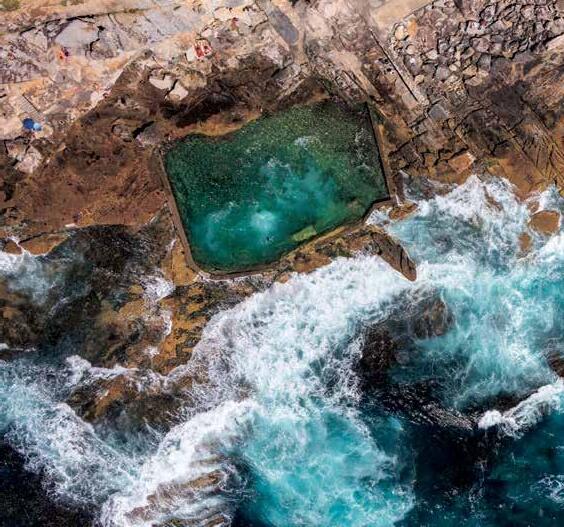
1 Mahon Pool, Maroubra, part of the coastal land south of Sydney for which the Bidjigal and Gadigal people are traditional custodians.
This series of texts was written in Maroubra, a diverse beachside suburb on the south-east coast of Sydney.
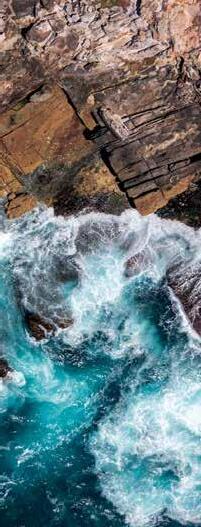
The name ‘Maroubra’ may derive from the Dharug word ‘murab-ara,’ ‘loud-noise-having’ or ‘like thunder,’1 referring perhaps to the loudness of the surf crashing against the rocks which characterises the rugged landscape. It is a beautiful and dramatic meeting of water and land, a long beach framed by windswept peninsulas. In the rock carvings at the northern headland, there is evidence of the presence of the Muru-ora-dial Aboriginal People, who camped and fished at Maroubra many years ago.
The Bidjigal and Gadigal people are the traditional custodians of this coastal land of Sydney, which includes Maroubra, and I acknowledge their custodianship of this land and waters and pay my respects to their Elders past, present and emerging.
Over the last 230 years, Aboriginal and Torres Strait Islander peoples have been systematically dispossessed, disempowered and marginalised.
European occupation and settlement imposed a modern conception of land and animal life purely in instrumental terms of possession, ownership and exploration. Lost has been the concept of custodianship and human interconnectedness with the land. Deep pre-modern cultural knowledge has been systematically and fatally undermined, overridden, or worse, commodified.
An Acknowledgement of Country represents deference to the deep histories of this place that are beyond our modern understanding. It is an acknowledgement of the injustices and oppression that have been suffered by First Nations peoples of Australia.
It is an acknowledgement and deference of respect and regret for social, cultural and environmental damage, pain and destruction beyond repair.
1 Jeremy Steele, ‘Morooberra, the person, and Maroubra, the place,’ Sydney Aboriginal Language Insights (blog), 2011, http://naabawinya.blogspot.com/2011/05/morooberra-person-and-maroubra-place.html.
However, such acknowledgements must seem a little thin or even veiled at a time when the injustice, suffering and destruction are continuing.
2 Australian Bureau of Statistics, Prisoners in Australia, 2025, https://www.abs.gov.au/statistics/people/crime-and-justice/ prisoners-australia/latest-release.
Aboriginal and Torres Strait Islander people make up less than 4 percent of the population of Australia, yet in 2025 made up 37 percent of its prison population,2 a ratio that does not appear to be diminishing.
It was in 2020 that we witnessed the destruction of the caves in Juukan Gorge, Western Australia, for mining exploration. The Juukan Gorge cave is, or was, a sacred site for the traditional owners of the land, the Puutu Kunti Kurrama and Pinikura peoples. The cave was the only inland site in Australia to show signs of continuous human occupation for over forty-six thousand years.
Aboriginal and Torres Strait Islander people should be aware that this publication may contain images or names of deceased persons in photographs and printed material that some people may find distressing.
Introduction
Architecture has never been more challenged than it is today. Addressing the sheer scale of the triple challenges of the environmental sustainability, in the form of climate change; the social, in the form of class, gender, and racial inequality; and the cultural, in terms of identity, exclusion, and prejudice, in particular against First Nations Peoples, is a seemingly overwhelming task for architecture.
At the same time, these great challenges come at a moment when architecture has never been so marginalised and diminished. The practice of architecture has been progressively desiccated, undermined, and commodified through the instrumental processes of the contemporary development industry and professional practice, together with the simplistic reductionism of media technology and market consumption demands.
How could this happen? How can the true nature of architecture have been so undermined?
This collection of essays is a series of explorations and excavations into this vexed territory in an attempt to uncover the depth and nature of the diminishment of contemporary architecture and the deep tracks that led us here.
1 Arthur Schopenhauer, The World as Will and Representation, vol. 1, trans. E. F. J. Payne (New York: Dover Publications, 1958), 319. Originally published 1818 as Die Welt als Wille und Vorstellung.
Optimism is not only a false but also a pernicious doctrine, for it presents life as a desirable state and man’s happiness as its aim and object. Starting from this, everyone then believes he has the most legitimate claim to happiness and enjoyment. If, as usually happens, these do not fall to his lot, he believes that he suffers an injustice, in fact that he misses the whole point of his existence.
—Arthur Schopenhauer (1818)1
1 Ludwig Wittgenstein, Tractatus Logico-Philosophicus, trans. C. K. Ogden, intro. Bertrand Russell (London: Routledge and Kegan Paul, 1922), 6.52.
Prologue: The Limits of Architecture
We feel that even when all possible scientific questions have been answered, the problems of life remain completely untouched.
—Ludwig Wittgenstein (1922)1
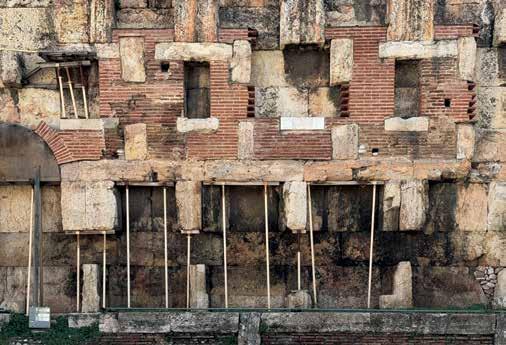
3 Propped and patched eastern boundary wall of Hadrian’s Library, AD 132, Athens, Greece.
Truth and Lies in Architecture was published in 2022 and contained a series of essays written during the first year of the global Coronavirus pandemic and associated lockdowns of 2020.
It was written both as an act of collegial camaraderie and as a personal mental-health exercise or source of solace during moments of great stress. It was a time when the boundaries of our world closed in around us, and we withdrew behind closed doors and solid walls, reaching out only through the reductive filtration of digital portals. Perhaps then it was not surprising that minds should dwell on the nature of more abstract limits and boundaries beyond the immediate and literal constraints of those strange times.
Dreams and Nightmares in Architecture is in many ways a continuation and further exploration of the essential questions and cultural challenges examined in the Truth and Lies in Architecture collection.
Taken together, these two collections of essays are an exploration of the limits of architecture, but not with the intention of breaking down, escaping or extending the boundaries of architecture.
The texts are more like a series of perimeter archaeological excavations to uncover trampled-down and obscured limitations, to pull up the lines and geometry from under the weight of flattening empirical distraction, and perhaps, in some small way, to reinstate, contract and strengthen the essential boundaries of our art.
Failure to understand and acknowledge the limits of architecture becomes a destructive act to architecture itself, as it weakens the boundaries that both define and protect its essence. When these boundaries are misunderstood, ignored and undermined, they begin to leak, and architecture is diluted and dissolved into the reductive measurability and quantification of the essential fields upon which architecture is constructed.

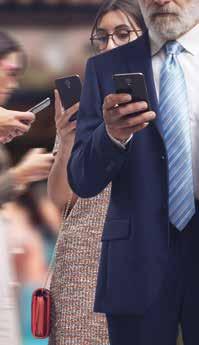
4 “The smartphone is the main information [medium] of our time. It not only makes things superfluous but also dereifies the world by reducing it to information. We present our smartphones everywhere, and even delegate our perception to these apparatuses. We perceive reality through the filter of the screen. The digital window dilutes reality into information that we register. There is no physical contact with reality. Reality is deprived of its presence. We no longer perceive the material vibrations of reality. Perception is disembodied. The smartphone de-realizes the world.”
Byung-Chul Han, Non-things, trans. Daniel Steuer (Cambridge, UK: Polity Press, 2022), 42.
2 Rebecca Moody, ‘Screen Time Statistics,’ Comparitech, 2023, https:// www.comparitech.com/tv-streaming/ screen-time-statistics/.
3 Gloria Mark, Attention Span: A Groundbreaking Way to Restore Balance, Happiness and Productivity (New York: Hanover Square Press, 2023), 10–12.
We are living in an age of distraction, an age in which attention itself has become the primary terrain of cultural and economic struggle.
Contemporary life is overwhelmed by the omnipresence of the digital screen and the incessant demands it makes for our attention. An entire generation is being raised from birth with the intimacy of a digital portal, always close, always comforting, and always ready to suck attention away from the trials and tribulations of the real world. The dependence and addiction created by such false comfort condemn us to increasing levels of social alienation, isolation, manipulation and inner despair from which we will only more desperately seek the placation of endless distraction.
Distraction and Disorientation
We seem to be living in a state of increasing distraction and disorientation. The presence of digital screens in our daily lives has proliferated, and the time we spend on them is increasing year by year.
In 2023, ‘the average person spent a total of 6 hours and 37 minutes looking at a screen each day (for internet-connected activities). This includes 2 hours and 31 minutes scrolling through social media channels, 1 hour and 38 minutes of streaming music, and 1 hour and 12 minutes of listening to podcasts. And the majority of this (3 hours and 46 minutes) is spent on mobiles.’2
It is hardly surprising then that, as we spend more time on screens, flipping almost subconsciously between emails, apps and updates, our attention spans are correspondingly shortening. Almost twenty years ago, the average duration of focused attention to an on-screen activity was approximately 2.5 minutes or 150 seconds; ten years ago, it had reduced to 75 seconds, and two years ago it was only 47 seconds.3
This is the nature of the communications and information technology we have developed, a technology that induces and then feeds a deepening state of dislocation, disorientation and distraction.
2 ‘If I am walking past a shallow pond and see a child drowning in it, I ought to wade in and pull the child out….It makes no moral difference whether the person I can help is a neighbor’s child ten yards from me or a Bengali whose name I shall never know, ten thousand miles away….
I do not think I need to say much in defense of the refusal to take proximity and distance into account. The fact that a person is physically near to us, so that we have personal contact with him, may make it more likely that we shall assist him, but this does not show that we ought to help him rather than another who happens to be further away.’
Peter Singer, ‘Famine, Affluence, and Morality,’ Philosophy and Public Affairs 1, no. 3 (1972), 229–43.
Ethical Distance
The Australian philosopher Peter Singer makes it clear that distance is irrelevant to our ethical obligation to each other. There is no difference in the moral or ethical duty we have to reduce human suffering, whether the person in need is in the street next to us or on the other side of the world. Singer famously uses the example of the suffering of a drowning child and our obligation to help, irrespective of our distance from the suffering, whether it is here next to us or ten thousand milesaway.2
The extraordinary increase in the scope of our communications media and technology would seem to reinforce the ethical irrelevance of distance as our screens and mobile devices globally interconnect us all with relative ease. The suffering of humanity throughout almost every corner of the world is made visible to us in all its detailed circumstances on the screens in our pockets whenever we care to look.
The clarity of judgement in the rational utilitarianism of Peter Singer seems immutable, beyond question; all human lives are equal, and our ethics must surely be indifferent to distance.
However, in the deeply personalised life of humanity, this rational perspective of equality and empathy seems to inevitably fade over distance, irrespective of our better utilitarian judgement.
Ethical Haze
The rational perspective of utilitarianism, with its third-person separation, allows us to see the moral obligation based on an assessment of the quantity of suffering. But paradoxically, this rational separation also breeds a sense of detachment and lack of care. We can look clearly and rationally, but with distance, a haze seems to form that diffuses and obscures our ethical sight. We look into this haze with an increasing sense of indifference, and although we look, we do not see; it is just too remote, too far away to care, and ultimately too far away to even notice such remote suffering.
Our advanced media and communications technology has not helped cut through this ethical haze to improve our sight; ironically, it has made it worse. The images detailing remote pain and suffering do not bring them close; nor do they truly collapse the distance.
Disturbingly, this graphic reach of our technology seems to have had a normalising effect that further weakens any sense of ethical responsibility. We quickly scroll on, unaffected and unmoved, merely tired of the wearing and fatigue-inducing nature of this suffering elsewhere and instead welcome more momentary, feel-good distractions of irrelevance.
Difference and Sameness
There is a dialectic between difference and sameness that should open up truth and insight, but all too often seems to induce blindness. The universalisation of life and place, particularly when it is built primarily on foundations of commercial and monetary benefit, has a flattening, equalising effect that suppresses the cultural richness of difference and oppresses the essential otherness of life.
However, a retreat deep into difference seems to breed a distance-inducing exceptionalism. Enriching cultural difference can descend into a false distance of intolerance and otherness that obscures our essential human sameness, empathy and mutual ethical responsibility.
Is it possible to compress this distance of indifference and yet at the same time preserve difference from the damage of such compression?
Closeness
Architecture is not merely the servant of a prosperity-driven sameness, of globalised financial optimisation and growth, worthy as this may be – nor is architecture merely the accommodation, acknowledgement and celebration of the unique cultures of place, of difference, of resistance and preservation, worthy as this may be.
13 In Memento (2000), the second film written and directed by Christopher Nolan, the protagonist Leonard Shelby suffers from the memory disabilities of anterograde amnesia, condemning him to both short-term memory loss and an inability to form new memories. He relies entirely on forms of extended mind maps to negotiate a path forwards and backwards in his life. A complex network of Polaroid photographs, notes and tattoos fills the gaps in his mind; they can be considered external fragments of his mind. To knowingly damage such essential elements of an external mind would perhaps be an act of violence and disablement equivalent to a personal assault.
In Inception (2010), the sixth film written and directed by Christopher Nolan, the mind of the graduate architecture student/designer Ariadne is extended like a work of design to create a series of dreamscapes. But this form of mind extension is not in the material form of architecture or the city and is therefore ultimately unreliable and unstable, even more so than the progressively manipulated memories in our own minds. The stability of Ariadne’s constructed world and its mind memories give way to disorientation, distortion and dislocation.
2 Andrew Clark and David Chalmers, ‘The Extended Mind’, Analysis 58, no. 1 (1998), 7–19.
3 Ibid.
As the skin of our bodies marks a boundary with the outside world, we similarly tend to think of our mind as limited by the boundary of our skull. It seems natural to think this way, grounded as we are in modernist thought and science. I think with the mind in my head, and I interact with the outside world through the instruments of my body: eyes, ears, nose, mouth, arms, legs, fingers, toes...it seems obvious.
However, this is a relatively new conception of our mind and our boundaries with the world, born of René Descartes’s pondering in Discourse on the Method (1637) and the emphasis on the thinking within the mind as the source of truth about the world and the truth of our existence, cogito, ergo sum.
Now, contemporary thought and technology are challenging such limited conceptions of the human mind. In their seminal paper, ‘The Extended Mind,’ Andrew Clark and David Chalmers asked, ‘Where does the mind stop and the rest of the world begin?’2
They proposed an ‘active externalism’ whereby the world around us becomes an integral part of the mind.
‘The human organism is linked with an external entity in a two-way interaction, creating a coupled system that can be seen as a cognitive system in its own right. All the components in the system play an active causal role, and they jointly govern behaviour in the same sort of way that cognition usually does.’3
Today, this is perhaps most evident in the integration of our technological devices in almost every moment of our daily lives and even with the thoughts in our minds. The ubiquitous smartphone is perhaps the most intimate portal through which our minds are supported and extended; it is part of us, and we are literally and metaphorically lost without it. If it is misplaced for even a few moments, it can induce a sense of intense stress due to the consequential loss of significant capability, enablement, and even identity. This device is most clearly an extension of our minds and also an extension of a form of the world into our minds.
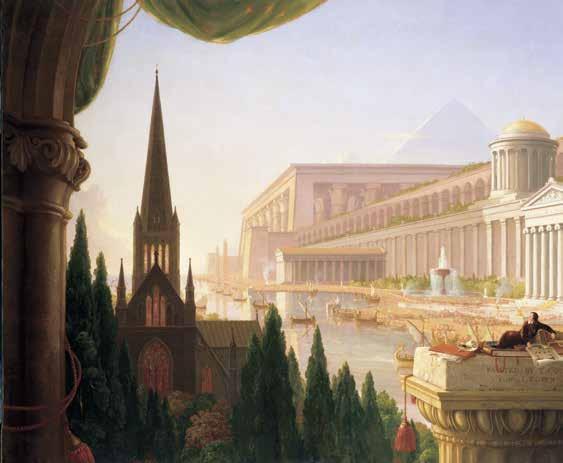
17 Thomas Cole, Architect’s Dream, 1840.
What are the dreams of the architect?
When the architect descends into deep sleep, what is it that occupies the strange space of their dreams? Is it a dream of architectural perfection, of an architecture realised on its own terms, finally free of the distortions and distractions of clients’ demands and budgets, free from the limitations of authority approvals and the objections of builders, and most of all free from the pollution of use and need, to finally realise an autonomous architecture of aesthetic perfection? Is this the dream of the architect?
The iconic painting The Architect’s Dream by Thomas Cole would seem to suggest so. It seems to capture the wistful wanting for formal perfection and independence that is surely an inevitable dream when the reality is the architect is condemned to a world of compromise in the wakeful practice of architecture.
In the foreground of this monumental painting, the architect reclines on a platform atop a vast column poised on books and plans of the craft of architecture, while visions of the great path of western architecture, Egyptian, Greek, Roman and Gothic, rise in visions of utter perfection, with nature merely a decorative counterpoint or supportive stage to such artistic purity. Cole painted this famous work in 1840 for Ithiel Town, an accomplished American architect who worked in each of these ‘styles.’ Perhaps if Cole could have included our contemporary visions of architectural future within his dream of perfection, it would have been the curvilinear white minimalist forms of a world washed and purified, clean and clear of ambiguity and complexity, that seem to be ubiquitous in our filmatic dreams of the future.
Or are these dreams of a mere architectural perfection too limited for the sleeping architect? Is it a more expanded dream of social transformational perfection that can fill the architect‘s restful mind, a dream of a perfect world, an architectural utopia to heal humanity and shape it to an ideal form – a city of towers in parkland to heal us from the crowded, dirty sites of history, or a city of a synthesised, patronising vernacular to heal us of the isolation of a city without history?
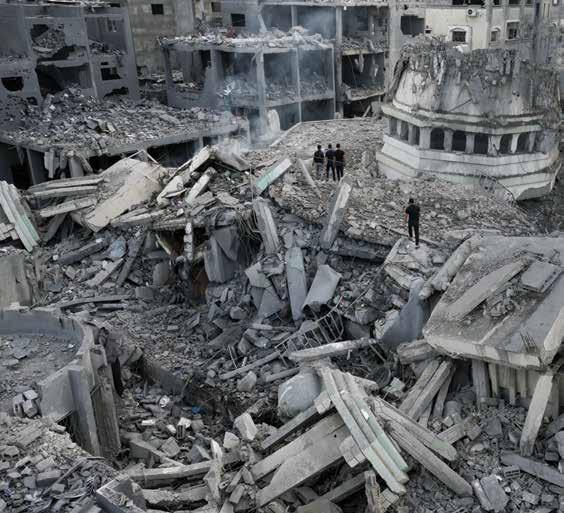
22 Palestinians inspect the rubble of the Yassin Mosque destroyed after it was hit by an Israeli airstrike at Shati refugee camp in Gaza City, early Monday, 9 October, 2023.
It is hard to think clearly in moments of extraordinary violence and destruction – hard to pull away from the scenes of needless human suffering; hard to witness, through virtual windows into the world, such disturbing events that we are powerless to stop. In such moments, we might ask: what role does the architect have in the struggle for survival and restoration?
Our daily tasks and concerns seem of little relative significance; what seemed urgent and important yesterday seems inconsequential, even frivolous today.
As architects, it may cause us to question the seemingly trivial nature of our work and concerns relative to the desperate urgency of essential human shelter and protection for those trapped within the rubble of bombed cities or for the homeless refugees fleeing the violence.
Such a desperate human need can return our attention and understanding of architecture to the most basic needs of protection, shelter, and the survival of human community. The true essential nature of architecture must be the construction of bulkheads against human suffering and oppression; this must surely come first among the duties of the architect – roofs to keep the rain and the cold from those struggling in the ruined cities and towns, and walls to protect and defend against needless violence.
The essentiality of human protection and shelter as the primary mission of architecture might make us think of our own rarefied architectural concerns as profligate and relative extravagances.
Perhaps we might even think that architecture, as we conceive it, far beyond the essentials that we take for granted, is itself an indulgence, reserved for those who have the fortune and luxury to live without such existential fear of violence and oppression.
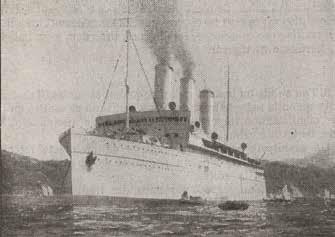
‘If we forget for a moment that a steamship is a machine for transport and look at it with a fresh eye, we shall feel that we are facing an important manifestation of temerity, of discipline, of harmony, of a beauty that is calm, vital and strong….The house of the earth-man is the expression of a circumscribed world. The steamship is the first stage in the realisation of a world organised according to the new spirit.’4
Loneliness
Le Corbusier had great artistic insight and intuition; he knew the earth was lost to us, and knew what we must do to be true to our modernity. He had no doubt; he was strong and unflinching.
Perhaps he also knew that the confrontation he professed would be too much for us, knew we would lose our way, knew the pain of the loss of the closeness of the earth, the loneliness, would be too much for us.
Perhaps in his knowing, he left more guidance and comfort in his carefully selected examples of the simplistic evolutionary processes of design and production than first appears.
26 The ‘Empress of Asia’ (Canadian Pacific).
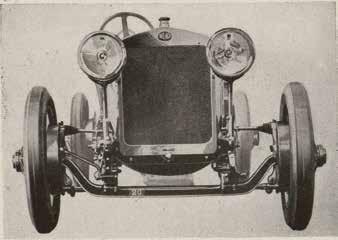
‘If the problem of the dwelling or the flat were studied in the same way that a chassis is, a speedy transformation and improvement would be seen in our houses. If houses were constructed by industrial mass-production, like chassis, unexpected but sane and defensible forms would soon appear, and a new aesthetic would be formulated with astonishing precision.’5
Transience
The ship‘s cabin, the train carriage, the automobile seat; tight autonomous spaces of travel, designed to the finest detail of personal need and individual support. In the automobile or perhaps most clearly in the aeroplane seat, all our needs of life are compressed into a single personalised space. The ergonomic seat, headrest, storage compartments, mechanical or digital levers and switches to make slight adjustments in temperature, lighting or audio stimulation are perfected in form for our comfort and consolation. We willingly give up our limited personal mobility for the vast distances and indiscrimination that these compressed spaces of mobility offer. But there is more to these spaces than mere vehicles of transportation to somewhere else; they are destinations in themselves.
27 Delage, 1921.
The entrenched inhibitors to decolonisation and the design potential for Country will be the authoritarian tendencies of the state and the exploitative tendencies of private sector development.
A consequential risk will be an embrace of a designfor-Country process that fails to acknowledge the depth and nature of colonial modernisation in architecture and promotes only superficial patterns, narratives and decorative masks appropriately sanitised for optimum brand value.
Pathway
If there is a way to escape the paradoxical nature of contemporary ‘design for Country,’ it probably begins with recognition of the scope and depth of the challenge. It may require a step back rather than a rush forward – an acknowledgement in more than words of the deep nature of embedded coercion in architectural form, space and the process of design and production.
A consequential first step should be a commitment to architectural decolonisation, an action of the empowered institutions and professionals. This work must lay the foundation and open up a space for the possibility of an authentic design with Country.
A design-with-Country process that is truly consultative, participatory and empowering to the First Nations Peoples, communities and custodians of the land is to be adjusted and transformed through architecture.
The most essential element will be the least likely to be granted: time. A turn away from short-term ends and towards the making of meaningful pathways that harbour a degree of immunity from commodification.
There is a tragic paradox to designing with Country. The truth and life of the objective is condemned to asphyxiation through the efficient and administrative instrumentalism of the process.
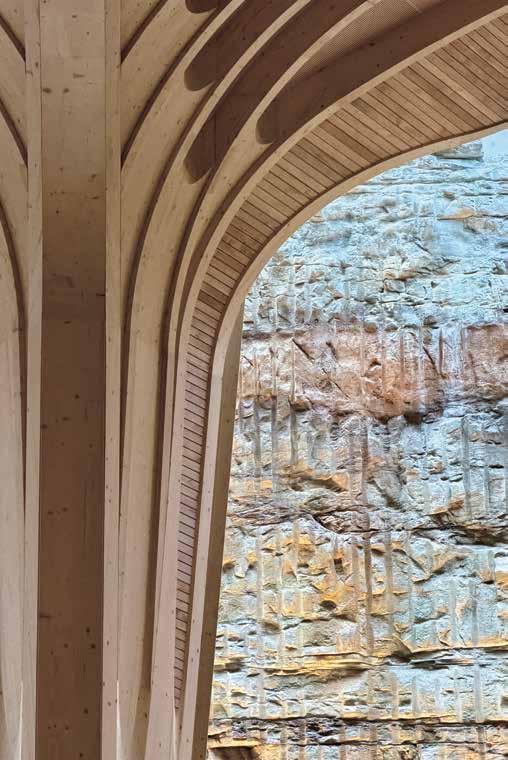
33 Right: fjcstudio, The Cutaway, Barangaroo, 2026.
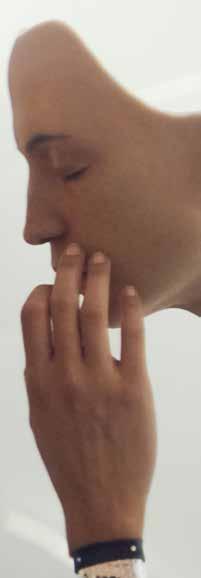
34 A scene of Alicia Vikander as robot Ava touching the lips of Sonoya Mizuno as robot Kyoko in Alex Garland’s Ex Machina (2014).
Consciousness has long been something of a blind spot in our science, hard to deny but easy to ignore; hard to explain, yet easy to intuit.
In recent years, we have seen a renewed focus on how consciousness might be explained and how central it may be to our understanding of our world and the nature of our existence.
Perhaps there is also a growing sense of urgency in understanding consciousness beyond a mere human consciousness as we attempt to come to terms with the ethical and environmental issues of our time.
As we try to understand how we value forms of life or even define life, we must extend it not only to the breadth of the natural world and natural systems, but also our own transformations of our world in the form of our inventions, automations, manufacturing, and particularly in the form of artificial intelligence.
All these developments press upon our limited definitions of consciousness.
In our modern world, we have tended to divide its inhabitants into two groups, those possessing consciousness and those who do not; more simply put, ‘persons’ and ‘things.’ Persons are afforded significant protections and rights, while non-persons or things are assigned almost none and are viewed in purely instrumental terms, their existence reduced to their use-value by the first group; they are there to be used and used up.
The boundary between these two groups is surprisingly subtle and often rests on relatively small differences.
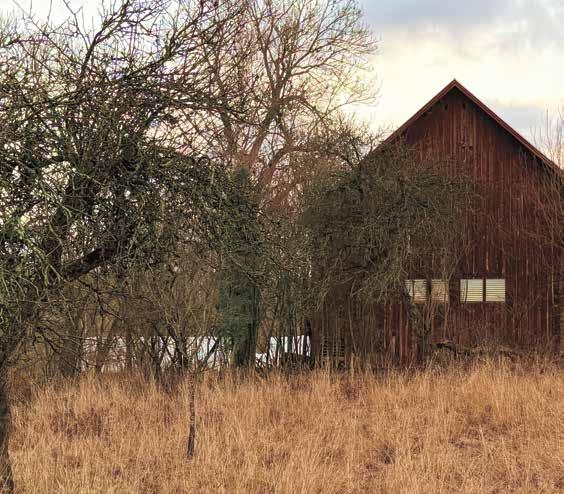
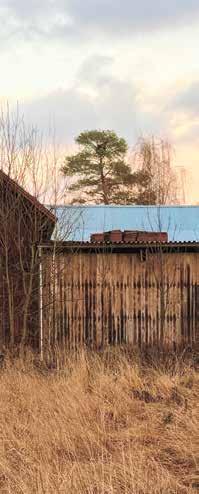
41 Olsbacka Farm Barn, Outskirts of Falun, Sweden.
Material Locale
Falun is a town of remarkable material authenticity, approximately 250 kilometres north of Stockholm. At the centre of the town and the primary source of its prosperity is the copper mine Falu Gruva, which has operated for more than a thousand years and at its peak produced two-thirds of Europe’s copper. The mine and the town of Falun sit in a vast area of pine forest fed by a series of idyllic lakes.
The architecture of Falun, the human dwelling, is that of the ‘Red House,’ röda stugan, arranged in rational grids interwoven with parkland and bisected by the river that connects Lakes Tisken and Varpen. These village buildings, barns and farmhouses are all made from the materials of the land of Falun, close, essential and immediate. They are a wooden architecture of walls and pitched roofs, harvested from the local pine forest. The distinctive red colour finish is a paint, Falun Red, Falu Rödfärg, made from the tailings of the copper mine with an iron oxide pigment, mixed with linseed oil, with the copper, iron ochre, silica and zinc forming a preserving, protective coating for the timber.
This simple, materially consistent, well-proportioned and constructed ‘red-house’ architecture creates a cohesive, culturally authentic and meaningful settlement that has become characteristic of the region of Dalarna and indeed Sweden.
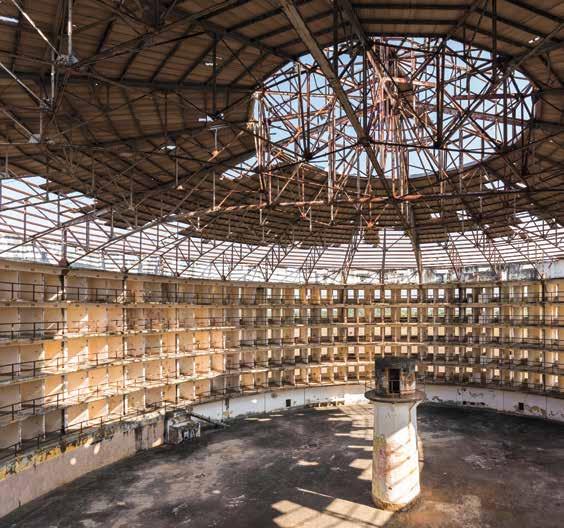
46 The Presidio Modelo, Cuba, 1931.
3