Pedagogical Approaches to Digital Material Systems
The Rain Reef
Turning & Burning Wild Digital Clay
Bodies in Flux
RECESSING
interview: Conditioning the Envelope with the Umwelt
Mutualisms
Envelope
ASSEMBLING
interview: Fusing Historical Assemblies
Hexcrete
Fused-Poly Bricks
Revitalizing Ceramics in Contemporary Architecture
Common Bond
ENCLOSING
interview: Future Traditions
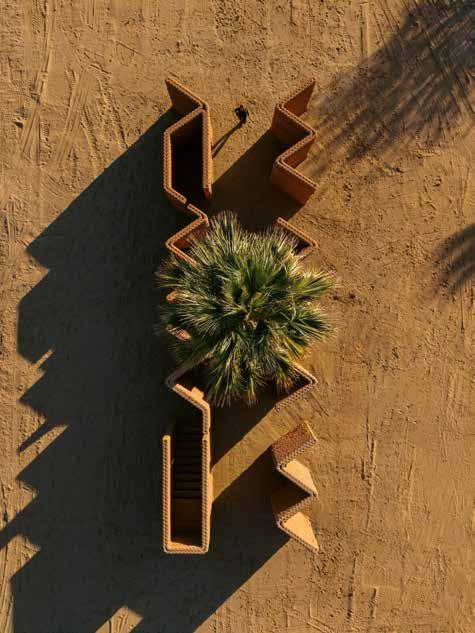
3D Printing Earth Architecture
Sueños Con Tierra/Concreto
Digital Machines, Analogue Materials
Clay Looms
afterword: Reflecting on the Decade since Data Clay contributor
ACKNOWLEDGMENTS
The Old Pink, a bar in the Allentown neighborhood of Buffalo, New York was destroyed by a fire in 2024. If the editors were to identify a place where this book began it was likely there in Buffalo during the 2022 Architectural Ceramic Assemblies Workshop (acaw ). After long days prototyping with dirty hands and latenight conversations about 3D printing clay, the beginning of our editorial kinship was formed.
The exhibition that followed, RE- Ordering Architecture: Making Machine and Material Kin, hosted by Usagi Gallery in Brooklyn, as part of NYCxDesign 2023, showcased four 3D-printed clay columns as new “orders”—each designed by one of the editors to be a seed or fragment of an entwined environmental future rather than a canonical absolute. Following the exhibition, in the process of surveying the field for a larger second exhibition it became apparent that 3D printing with clay has become as much about the machines, processes, traditions, and other beings that are entwined into the process as much as it is about the architectural objects we build. The book became a way to continue these conversations and begin new ones with our colleagues to better examine how the injection of 3D printing into our academic and professional lives has itself “re-ordered” our discipline. Books of this nature are indebted to many and the editors would like to extend our gratitude and thanks accordingly.
• We would like to thank all the contributors for their thoughtful investigations and dedicated writing for this book.
• Thank you to Rachel Armstrong, Martin Bechthold, Laura Garófalo and Omar Khan, Joyce Hwang, and Ronald Rael for generously offering their time to discuss their work and the field of clay printing with us.
• Thank you to Jenny Sabin and Joshua Stein for grounding the book with their foreword and afterword.
• Thank you to Matthew Allen for his prologue that bridges the human, earth, and our machinic processes.
• Thank you to our ORO Managing editor Jake Anderson at Applied Research + Design Publishing, ORO Editions.
• Thank you Pablo Mandel, our main book designer from Circular Studio, and Micaela Carraro for her additional typesetting assistance.
• Thank you to Shelby Doyle and Jonathan A. Scelsa for their design and production work on the graphics for the volume.
This book would not be possible without the generous financial support from our home institutions Iowa State University, Washington University in St. Louis, City College of New York, cuny, and the Pratt Institute.
• Thank you to Dean Marta Gutman. Claying Architecture is made possible through the support of the Spitzer School of Architecture at the City College of New York, the flagship campus of the City University of New York. The views and opinions expressed in the book are those of the contributors and do not necessarily reflect the attitudes and opinions of the Spitzer School.
• Thank you to Dean Quilian Riano of Pratt Institute for supporting this publication through the Pratt School of Architecture Dean’s fund.
• Thank you to Dean Carmon Colangelo and the Sam Fox School at Washington University in St. Louis for supporting this book through a Faculty Research Grant.
• Thank you to the Iowa State University Office of the Vice President for Research Publication Subvention Grants Program for supporting this book.
Thank you also to our friends and families for their patience and support as we worked through the development of the manuscript. Finally, thank you to you, the reader.
Shelby Elizabeth Doyle is a registered architect and associate professor of architecture where she is the Stan G. Thurston Professor of Design Build at Iowa State University (isu ) College of Design, co-founder of the is u Computation & Construction Lab (ccl ), and director of the isu Architectural Robotics Lab (arl ). The ccl and arl are the result of Doyle’s isu Presidential Impact Hire to rethink digital fabrication and design-build. Doyle received a Fulbright fellowship to Cambodia, a master of architecture from the Harvard University Graduate School of Design, and a bachelor of science in architecture from the University of Virginia.
Frank Melendez is the department chair and an associate professor at the Spitzer School of Architecture, City College of New York, cuny, and a partner at Augmented Architectures and bioMATTERS, ll c , based in New York City and London. Melendez is the author of Drawing from the Model (Wiley, 2019) and co-editor of Data, Matter, Design (Routledge, 2020). His work has been exhibited widely, including the London Design Festival, Manifest Gallery, and Lisbon Architecture Triennale. He has been awarded grants, residencies, and memberships, including the New York State Council on the Arts (nysca )/ Van Alen Institute, Nature Art & Habitat Residency (nahr ), MacDowell, Futureworks nyc , and new inc . Melendez holds a bachelor of architecture from the University of Arizona and a master of architecture from Yale University.
Jonathan Scelsa is a registered architect in the state of New York, where he is a partner of the practice op.Architecture Landscape, and a professor of architectural design and technology with tenure at Pratt Institute. His design research has been supported by the American Academy in Rome as a Rome Prize fellow; the New York State Council of the Arts; and the Department of State’s Fulbright program. He is a co-editor of, The Function of Style (Actar, 2018), and Pedagogical Experiments in Architecture for a Changing Climate (Routledge, 2024). Scelsa holds a bachelor of architecture from Carnegie Mellon University and a master of architecture in urban design with distinction from Harvard University.
Kelley Van Dyck Murphy is an associate professor of architecture at the Sam Fox School of Design and Visual Arts at Washington University in St. Louis and a founding partner of the architecture practice, av v a. Murphy’s research and design work has been supported by the Mellon Foundation/Divided Cities, the Regional Arts Commission, the Ann Arbor Arts Commission, and Exhibit Columbus as a 2025 University Design Research Fellow. Her research and practice has been awarded by the Architect’s Newspaper, the aia (American Institute of Architects), and the acsa (Association of Collegiate Schools of Architecture). Murphy holds a bachelor of art in Studio Art from Rhodes College and master of architecture from Washington University.
From Clay to Code
Transdisciplinary Pathways through Ceramics and Architecture
Jenny Sabin
My engagement with clay began in childhood, shaped by the creative environment fostered by my father, then a bfa ceramics student at the University of Washington. I remember visiting the studio with my mother watching as beautiful ceramic forms emerged under his hands—works that were already attracting interest from galleries like Gordon Woodside in Seattle. The Ceramic and Metal Arts (cma ) building became a second home, and it was there I encountered pioneering ceramic artists like Patti Warashina, Bob Sperry, and Howard Kottler. Years later, as a student in the University of Washington’s Rome study abroad program, I would come full circle, studying again with Warashina and Sperry while pursuing my own bfa in ceramics and BA in interdisciplinary visual arts.1 Under the mentorship of Professor Jamie Walker and the late Professors Akio Takamori and Doug Jeck, I gained a rigorous and expansive foundation in making, one that recognized clay as both a tactile material and an intellectual medium for creative practice. Though I later transitioned to architecture, the material knowledge and embodied experience of clay remained deeply embedded in my design ethos.
In 2009, while working at Sabin + Jones LabStudio at the University of Pennsylvania—an experimental research and design unit I co-founded with cell and molecular biologist Dr. Peter Lloyd Jones—clay reentered my practice in an entirely new context. Our lab operated at the intersection of architecture, biology, mathematics, and computation. Initially focused on modeling complex biological systems, we began using a ZCorp powder 3D printer to fabricate component parts from cellular datasets. It was in the process of producing these prototypes that I wondered: What if we printed with clay instead of proprietary powders?
This speculative moment led me to the work of Professor Mark Ganter, a mechanical engineer at the University of Washington, whose experiments with 3D printing ceramics were published in Ceramics Monthly. 2 When we met later that summer, he introduced me to others working at this frontier, including Ron Rael and Virginia San Fratello of Emerging Objects, whose work is featured in the fifth section of this book, “Enclosing.” Inspired, I began adapting Ganter’s clay recipe, shifting to a high-fire stoneware body, and began printing biologically informed ceramic forms. Clay was not just back, it had evolved into a medium for advanced, data-driven, and
generative architectural research. And just as I had serendipitously met Ron Rael in Ganter’s lab, others were starting to tinker with the alchemy of clay through technological innovations in 3D printing. As this book documents, a network of academics, researchers, and practitioners in architecture were simultaneously exploring the possibilities of clay, a perfect medium for additive manufacturing, through the advent and accessible use of 3D printers.
From that point on, additive manufacturing with clay became a central thread in practice and teaching for a global network of academics, architects, and researchers. Through the Sabin Lab at Cornell’s College of Architecture, Art, and Planning, I’ve continued to explore digital ceramics as a site of material innovation, structural intelligence, and formal expression. My studios and seminars—from PennDesign to Cornell—have engaged students and researchers across disciplines in these evolving processes. Our work continues to evolve through funded research into dna nanotechnology, smart glazes, and responsive environments. In integrating clay with computation, biology, and design, we are redefining a centuries-old material for a new era, one in which bricks can breathe, tiles emit light, and surfaces can respond to the local environment. As demonstrated in the extraordinary diversity of projects featured in this book, clay connects across scales, time, geologies, and species from the intimate to the immense, in tandem with technological innovation. Social, cultural, and ecological intertwinings emerge when shaping architecture from clay, from the tactile essence of the material to the grounding of built form.
The use of ceramic blocks and tiles traces a deep lineage within both technological development and architectural design. Standardized ceramic modules have long served as durable, modular building elements, historically supplanting stone while supporting the evolution of construction practices. Today, renewed interest in ceramics, coupled with advances in digital fabrication and prefabrication, has given rise to non–load-bearing ceramic façades produced with unprecedented precision.3 The history of ceramic modules—tiles, bricks, and blocks—occupies a significant position at the intersection of material culture, architectural practice, and design theory. As standardized elements, bricks have long served as both material and metric, mediating between tectonic structure and spatial articulation. Yet ceramics are more than historical artifacts or utilitarian building components; they are epistemological sites where questions of form, craft, labor, and technology converge.
Ceramic production, once entirely manual and then mechanized through industrialization, has now fully entered a digitally mediated phase. With the integration of cad/cam workflows and additive manufacturing, ceramic form-making has been revitalized—positioning clay not only as a traditional craft medium, but also as a responsive material partner in generative and parametric design. Its inherent plasticity lends itself to architectural expressions that are increasingly defined by complex morphologies, biology, curvature, and ornamentation. In recent decades, advances in prefabrication and digital fabrication have reanimated interest
in ceramics within architectural discourse. As documented in this book’s second section “Surfacing,” non–load-bearing ceramic façades, fabricated through industrial processes, have expanded the aesthetic and functional language of brickwork. Simultaneously, the “digital turn” has reframed ceramics not merely as a construction material, but as a medium through which to explore generative design logics, ornamentation, and formal complexity.4
This expanded material imagination and design culture underpins the work in this book. Work in the “Assembling” section investigates how 3D-printed ceramic modules can operate as architectural and pedagogical prototypes, speculative yet grounded in structural and material logics. These projects embody a commitment to transdisciplinary research, situating digital ceramics at the nexus of computational design, robotics, and material science. The projects engage the rich legacy of ceramic craft while leveraging contemporary design tools to enable spatial, st ructural, and performative experimentation at architectural scales.5 The theoretical underpinnings of this work are rooted in an evolving understanding of clay as both analog and algorithmic. As a material, clay offers a rich history of manual craft, but it also supports complex digital workflows—inviting new relationships between matter and code. Its malleability renders it particularly suitable for contemporary design agendas that embrace biomimicry, topological transformations, and parametric variation. Through the lens of the work featured in this book, ceramics become agents of formal expression, technological innovation, and architectural speculation.
The thesis presented by the editors also engages broader pedagogical questions. How might architectural education embrace material intelligence in tandem with digital fluency? What forms of knowledge are produced when students and researchers work at the intersection of craft traditions and advanced fabrication? This work functions as both a research platform and a pedagogical tool, inviting designers to rethink the role of material systems in a computational age. It offers a model for research-based design education in which making, modeling, culture, and theorizing are interwoven.
Interestingly, while clay has been central to conceptual modeling in industries such as automotive and marine design for decades, architecture has been slower to adopt such hybridized workflows. Analogous workflows in other design disciplines—most notably in automotive and marine industries—offer productive parallels. In automotive design, clay modeling remains essential, both as a hands-on sculptural technique and as a bridge between analog intuition and digital precision. In these fields, clay modeling continues to play a critical role in early stage concept development. Sculpted forms are scanned, digitized, and refined in virtual environments, creating a feedback loop between hand, tool, and virtual environment. Designers sculpt full-scale forms by hand or by referencing digital contours, which are then 3D scanned and refined in cad environments, allowing for iterative
feedback between physical and digital models.6 This interweaving of craft and computation underscores a broader design methodology: one that privileges material intelligence as a complement to digital exactitude. This hybrid approach illustrates how craft-based knowledge persists and evolves within digitally mediated design systems and interfaces.
By contrast, architectural ceramics in building construction has yet to fully capitalize on this hybridization. Manual forming remains labor-intensive, prompting research into robotic extrusion and 3D-printed clay systems. Despite notable advances in robotic clay extrusion and digital fabrication, the ceramic unit remains underexplored as a nonstandard, geometrically variable building block in the construction industry. The manual nature of clay has historically constrained production scalability, but new technologies are beginning to redefine what is materially and formally possible.
The projects featured in this book organized across five distinct sections materialize a path forward through biodesign and living matter, production and representation, morphological sites for multi-species inhabitation, part-to-whole assemblies and ornamentation, and large scale nonstandard architectural elements that draw new histories with vernacular construction. Evan Jones, Negar Kalantar, and Margaret Ikeda demonstrate the capacity of clay to host life through biomineralized clay and robotic 3D printing. Here, earthen techniques for construction are augmented and expanded through computational and biological methods. Or, in the case of Nathan King and Robert Stuart-Smith’s research and teaching, they argue that the characteristics and properties of clay challenge the transition between digital to physical and vice versa. These productive tensions generate what they state is a “much-needed humbling in the realm of computational design and digital fabrication.” Or, in other words, a space of productive failures and slowness that links iterative design with machines, material, making, and culture. Jennifer Birkeland and Jonathan A. Scelsa present “mutualisms through morphology” and the transdisciplinary collaborations necessary to design for multi-species habitats to support biodiversity through variegated ceramic units. Erin Hunt’s and Haley Arthur Eisenmann’s h excrete reinvents traditional formwork through the sustainable use of recycled paper clay pulp that is 3D printed to unearth new approaches to compression-only structural systems. And finally, Virginia San Fratello and Maedeh Taf vizi explore material culture and craft traditions through generative processes that build upon the historic integration of textiles with ceramic vessel production. These textile-like 3D-printed ceramic surfaces ground feminine methods of making with contemporary advancements in woven 3D-printed matrices. Collectively, these projects operate across theory and application, as both research platform and design methodology. The authors’ treatise envisions ceramics not only as architectural components, but as computational and relational systems in a larger formal and structural ecology. Through the convergence of computation, digital fabrication,
and ceramic craft, this work advocates for a more nuanced and materially expressive approach to architectural ceramics, one that responds to the challenges of contemporary design and construction with both precision and plasticity. In doing so, the projects contribute to a growing discourse around digital craft, material agency, and architectural pedagogy, offering a compelling model for how we might think, make, and teach architecture toward non-anthropocentric approaches to construction. Looking back, I am reminded of a turning point in 2001, when I packed up my Ballard ceramics studio to take a night class in physics to prepare for graduate school in architecture. At the time, I thought I was leaving clay behind. I now see that I was simply preparing to meet it again, with new questions, new collaborators, and new tools in hand. Kinship is a paradigm for exploring how architecture can be more like the characteristics of clay through methods of 3D printing. As material sites of exploration, productive relationships are revealed that share linkages between technology, environment, pedagogy, generative processes, and culture. Clay, a medium that is of the earth and fire, offers plastic characteristics that connect, humble, inspire, frustrate, and ultimately promote gathering and community towards new forms of non-anthropocentric building practices.
Notes
1. Jenny Sabin, “Digital Ceramics in Architecture and Science,” Ceramics Monthly, January 2025, 42–45.
2. Mark Ganter, Duane Storti, and Ben Utela, “The Printed Pot,” Ceramics Monthly (2009).
3. David Keuning, “Beautiful Brick Architecture,” in Brick: The Book, eds. P. Brandon and M. Betts (London: Chapman and Hall, 2007), 251–61.
4. Mario Carpo, The Digital Turn in Architecture 1992–2012, AD Reader (Chichester, GB: J. Wiley, 2013).
5 Jenny E. Sabin, Martin Miller, Nicholas Cassab, and Andrew Lucia. “PolyBrick: Variegated Additive Ceramic Component Manufacturing (accm ).” 3D Printing and Additive Manufacturing 1, no. 2 (June 2014): 78–84. https://doi.org/10.1089/3dp.2014.0012.
6. Car design Online. Clay modeling. Available at: www.cardesignonline.com/design/modelling/ clay-modelling .php (accessed July 21, 2010).
Making Machine And Material Kin
Shelby Doyle, Frank Melendez, Jonathan Scelsa, Kelley Van Dyck Murphy
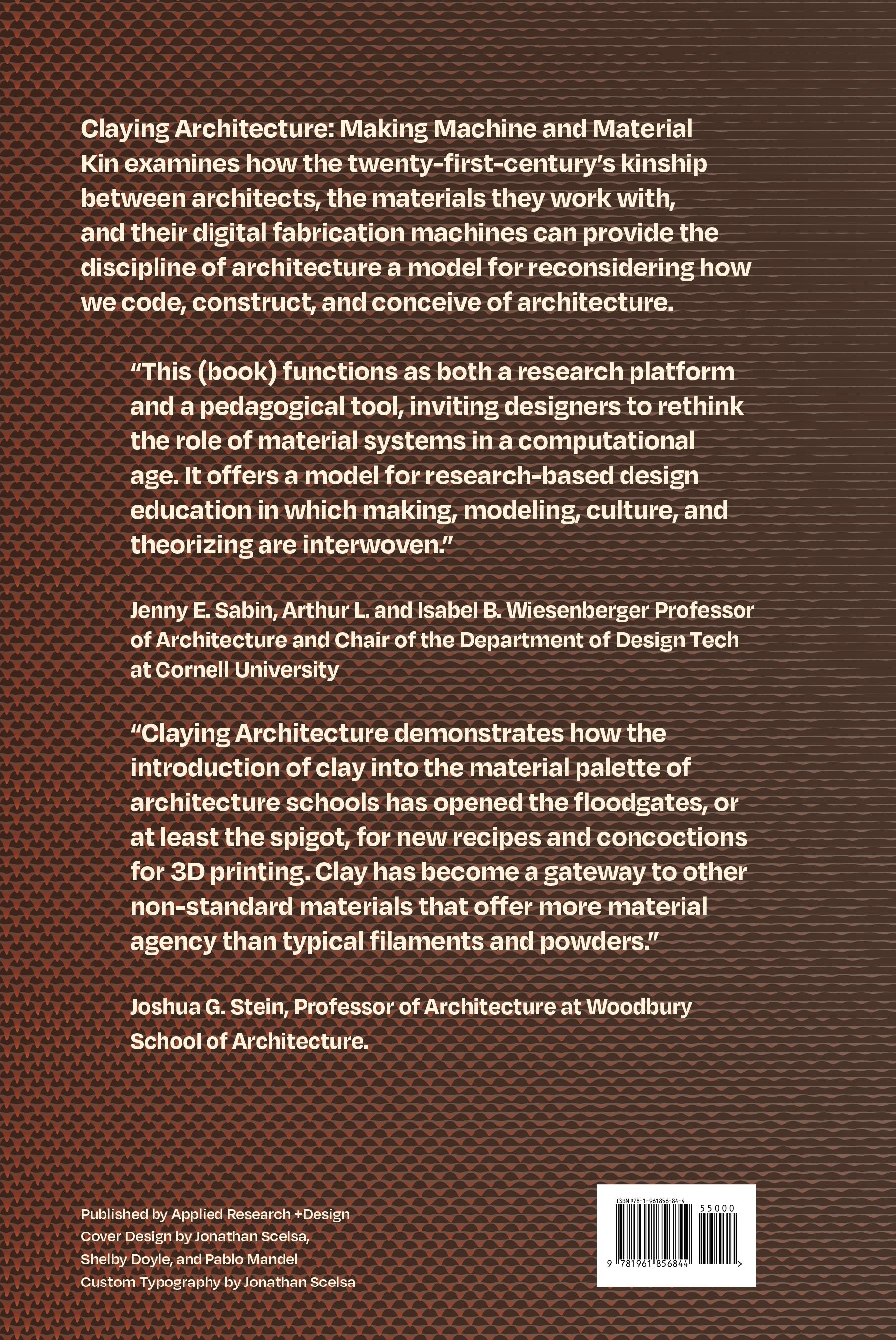
Clay, a material deeply intertwined with the histories of architecture and craftsmanship, has taken on new significance in the realm of computation and digital fabrication, driven by advancements in 3D printing. This book delves into the role of clay in modern digital practices, by exploring the concept of kinship and examining how 3D printing with clay can transform architectural processes, strengthen conne ctions with the environment, and promote non-anthropocentric approaches to construction. From kleben, German for “to stick to,” clay is made from alumina, silica, and chemically bonded water. Its abundance, plasticity, and durability after firing mean that clay is found in everything from cooking vessels and toilets to bricks and spacecraft. As craft and construction technologies, clay and architecture share millennia of history and a global footprint of often anonymous ingenuity and knowledge creation. Given this long-entwined history, why has the architectural discipline experienced a newfound resonance in the reintroduction of a seemingly old material, into its newly adopted digital processes?
Claying Architecture: Making Machine and Material Kin interrogates why clay is a protagonist in the story of architecture’s contemporary material and computational history, from modernism to the post-digital. This book repositions the material as a verb, Claying, coupled with the term kinship as a mechanism to explore how architecture can be more like clay: formally flexible, porous, plastic, and durable. Clay is an earthen material that oozes and slumps in its natural state, exposing its construction capacities when fired or formed. The book forefronts the logic and language of kinship as a treatise on the search for non-anthropocentric building practices. Kinship is presented here as an urgent task in the lineage of Donna Haraway’s “Staying with trouble which [requires] making oddkin: that is we require each other in unexpected collaborations and combinations.”1 To be “kin” is to be related in some consequential way, biologic or otherwise, and to belong to one another in such a way that flattens the hierarchy between two entities. In this sense, our kinship with the machines of digital fabrication mirrors our kinship with one another, opening up ways to reflect on how 3D printing clay is a method for reconsidering how we code, construct, and conceive of architecture.
Kinship also implies, “Where and who do (our) lines connect and disconnect, and so what?” This aspect of kinship presents an opportunity to reevaluate architecture’s lineages and legacies, to expand the discipline’s kinship, and to reconsider its relationships: to which odd kin does architecture need to be at stake? In this context, Claying Architecture is a “generative oddkin” presented neither as a techno-fix nor a techno-apocalypse but rather as an embrace of a situated technical project (clay 3D printing) and its people (architects). This is one of many possible “generative oddkins”—clay is a physical and metaphoric binder that brings together new kins between environment, process, and culture.2
What is Clay?
Clay is a fine-grained earthen material formed by the chemical weathering process of specific minerals in rocks over geological timescales. Its abundance, covering substantial portions of the earth’s surface, on land and the ocean floor, makes it the most common refractory material found in nature. Clay is an amorphous material that exhibits qualities of plasticity when wet, allowing it to be shaped by various te chniques such as hand modeling, coiling, wheel throwing, extruding, and casting. When dried and fired, clay particles are bonded together, transforming clay into ceramic, a strong, durable, and permanent material. Ceramics have been used to date archaeological digs, making clay one of the most ancient materials used in the production of objects and structures. It is also indispensable to modern living, used to make ceramic bricks, tiles, and sanitary ware, as well as an essential constituent of plastics, paints, paper, rubber, cosmetics, and more.3
Clay bodies, include earthenware, stoneware, and porcelain, and are typically classified based on their characteristics after firing, such as porosity and color.4 Earthenwares intended for low-temperature firings are non-vitreous and porous. Due to their ability to withstand firing at lower temperatures, they are widely used and available. Stonewares are made from more refractory clays, fired to high temperatures, are vitrified, harder, and less porous.5 Porcelain, which is also made from more refractory clays, is fired to even higher temperature resulting in a vitrified, hard and low porosity material.6 Porcelains are also white and glassy and can exhibit translucency qualities when surfaces are thin. Clay and earthen materials may also be seeing a resurgence in architecture and design due to anthropogenic climate change and the environmental crisis brought about by the Anthropocene. These materials offer eco-friendly and sustainable approaches for construction, due to a low carbon footprint, the ability to be reused, and availability. As a natural insulation, it provides passive methods for energy efficiency, absorbing, storing, and releasing heat slowly to keep spaces cooler in summer, and warmer in winter. These and other attributes make clay a material that promotes ecocentric practices.
Clay in Architecture
Clay materials date to the earliest periods of human construction. Clay may be shaped and molded by hand, using techniques such as pinching, coiling, and slab building, as well as with ancient tools such as paddles and scrapers made of stone, wood, and bone, which were used to shape and smooth clay. The invention of the potter’s wheel, initially foot-powered kick wheels, in ancient Mesopotamia and Egypt allowed for efficiency in production and symmetry in shape—transforming clay production. Early construction methods include building elements made from baked or fired clay, such as bricks and tiles; materials where clay is a composite material, such as wattle and daub; or applications where clay is an ingredient, such as mortar. Examples of vernacular architecture from various regions incorporate these techniques, where climate influences the feasibility of this type of construction, and sociocultural factors often play a determining role in the way resources are utilized. In Burkina Faso, Africa, domestic architecture is closely linked to the extended family, with distinctive identifying features, where context, culture, and landscape shape the built environment.7 Puebloans, indigenous peoples of the American Southwest, created structures from adobe, a mixture of earth and organic materials. In addition to providing thermally comfortable spaces in a hot climate due to their thermal mass, the dwellings reflect a cosmological worldview that recognizes multiplicity, simultaneity, inclusiveness, and interconnectedness.8 Examples of adobe construction, sun-dried, rectangular components of clay and earthen materials, stacked and bound together by mud, can be found in various regions around the world with hot, dry climates, including the Middle East, North and West Africa, South America, southwestern North America, and southwestern Europe.9
The mid-nineteenth century saw the rise of industrialization and its mechanized processes for the shaping and “machining” of clay. The invention of the hydraulic brick press and automatic brick machines enabled the production of tens of millions of bricks per year by the turn of the twentieth century. Typical industrial manufacturing techniques for the mass production of ceramics include jiggering by automated pressing into molds and extruding, the mechanized pushing of clay through dies of desired profiles. Architectural ornament in terracotta was used to decorate high-rise buildings in the usa during the nineteenth century, while functioning to protect steel frames from fire. The present manufacturing of ceramics for architectural design and fabrication is primarily produced using industrialized processes. There are several texts that trace the history of earthen constructions, clay, and ceramics in architecture. Jean Dethier’s 2020 The Art of Earth Architecture traces the continental use of Earth in Architecture from Ancient to contemporary across both monuments and little known works; while Suzanne Staubach’s Clay: The History of Humankind’s Relationship to Earth’s Most Primal Element: examine the material’s close link to advances in civilization through both architecture and other extended fields.10 Rather than repeat or summarize that work, we will focus on 3D printing as
it relates to the re-emergence of pre-modern building typologies and the evolution of clay from the early days of modernism, to post-modernism, and into the post-digital era.
The Digital Re-entwines Clay
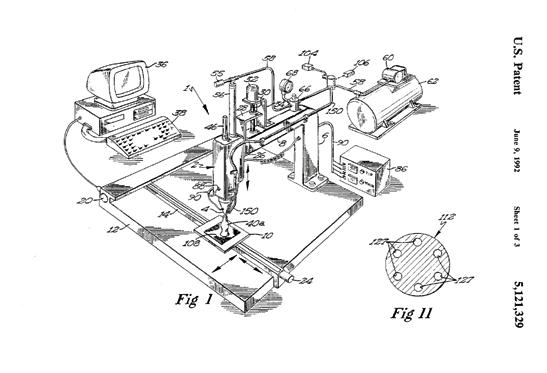
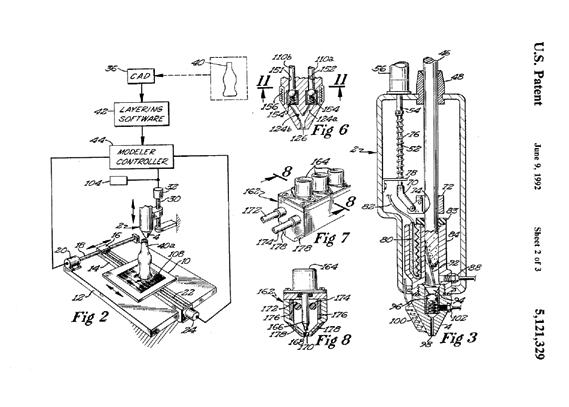
Stratasys diagrams and drawings from the 1992 US Patent for 3D printing. (Crump)
Architecture’s renewed interest in clay follows two distinct periods of digital fascination and adoption.11 As computation emerged into architecture during the latter half of the twentieth century, architects swarmed over the new and higher degrees of precision provided by the information space of the digital model.12 This first digital turn, synchronous with the ideologies such as the blob and animate form,13 ushered in pursuits of complex topological geometry that could be analyzed and identified within the 3D ca d space of the digital model.14 Simultaneously, the adoption of Computer Aided Manufacturing (cam ), allowed architects to fabricate their digital models through computer numeric controlled (cnc ) machines capable of high tolerance calibration with information from the digital model. Throughout the first de cade of the twenty-first century, the architectural discipline deeply mined this paradigm of digital making through reinvigorated pursuits of disegno, 15 mathematics, and geometry, utilizing dynamic mathematical simulations for the pursuits of more complex forms now possible through the digital process.
This pursuit of higher-order geometry was contemporaneous to the commercial availability of high-resolution Fused Deposition Modeling printers (fdm ) by Stratasys in 199216, able to readily output the complex mathematically derived digital geometry in a higher order of precision. While the early 1990s printers were cost-prohibitive, the turn of the century saw 3D printing technology costs drop dramatically as key patent protections related to such technology expired in 2008.17 The onset of 3D printers relied heavily on various plastics that eschewed traditional ideas of architectural materiality. A continuous filament spool of polylactic acid (pla ), perhaps the most common 3D printing material of the early twenty-first century, can b e melted and reconfigured ad infinitum. Much like modernity’s fascination with the plasticity of concrete, this thermoplastic can be formed into almost any shape, provided it has support during the printing process. Plastic 3D printing was the natural apotheosis for a generation of architects whose primary interest was that of complex topological geometry elastically formed within the vacuum of digital space. Having exhausted the digital investigation of geometry during the first decade of the twenty-first century, it may be argued that the architectural discipline yearned for a measure, limit, or critique of the project found autonomously in the computer— enter clay. Beginning with the first open-sourced 3D printer developed by Professor Adrian Bowyer with the Belgian Studio Unfold in 2009, the next decade saw a fastpaced adoption of clay and printing 18 with notable inclusions of the wasp, which employed the delta printing system in tandem with Liquid Deposition Modeling
(ldm ). This next period witnessed many architectural academics creating their own machines for the printing of clay, culminating in the 2015 symposium and exhibition Data Clay Symposium: Digital Strategies for Parsing the Earth held at the California College of the Arts. This symposium, followed by its 2016 exhibition, 19 served as a public discussion on the relationship between digital tools and ceramic materials for architects, artists, and designers.20 Shortly thereafter, the American company 3D Potter introduced a new printer that utilized a high-pressure system and a mechanical piston to extrude clay, moving in the Cartesian coordinate system available at a significantly reduced cost compared to the previous generation of printers and expanding access to clay printing across the academy.
Clay as a Medium for Additive Values
This wave of paste-based 3D printers entering the academic markets was contemporaneous with a period, where “digital design [was] no longer a rarified practice of ex p erimental vanguards.”21 Adam Fure observed that, unlike the first wave of digital design in the ’90s, contemporary designers “face an ecology of digital media that affects us aesthetically, but also socially, politically, and ontologically.”22 Thus, a new generation of architectural academics had broad access to tools of 3D printing, enabling questions beyond the procedural of what is possible but also how this me dium could be used to address broader entangled ecological issues than merely technical problem-solving.
Concurrently, the focus on clay within the architectural academy speaks to this generation of designers’ awareness of the science surrounding climate reports,23 which has focused on the building industry’s contribution to global warming. A return to clay, an affordable, reusable, and readily available material, serves as an architectural critique of materials such as plastic, which require high energy use to extract, manufacture, process, and transport. Waste prints can be mixed back into future prints, and their porosity means they can be used for performative experiments in growing plants, fungi, and water filtration. Furthermore, clay, a material available worldwide, brings with it the entanglements of place, removing the abstractions of material sourcing by literalizing the point and source of its origin, as well as the histories and traditions of the peoples and non-peoples it has touched. This very real and practical material has reignited disciplinary conversations rooted in building, ranging from facade design to methods for connecting computationally derived geometry generation to material constraints.
Claying the Discipline
Claying Architecture assembles a survey of the current field of architecture, bringing together essays and projects concerning clay-based 3d printing. The book begins with an essay by Matthew Allen, establishing the theoretical groundwork for computational making and printing in the new century. The book then structures itself
around five overlapping thematics that have been identified among international designers working with 3D-printed clay at various scales. The sections are arranged in ascending scalar order to investigate the social, cultural, and ecological entanglements that occur when making clay-based architecture. Each section is anchored with a conversation between the editors and an important figure in the thematic discourse of that section, followed by specific projects across the field that demonstrate that scalar investigation.
The first section, “Embedding,” acknowledges that clay as a material itself is a mixture of aggregates and investigates the potential of inlaying other forms of living matter into the material substrate process at the micro-scale toward the creation of new aesthetics and ecological benefits. The second section, “Surfacing,” explores the intersection of production and representation as an examination of new forms of architectural digital craft investigating the time of firing and weathering. The “Recessing” section examines how the morphology of clay deposition may be complicit in creating new assemblages for lifeforms inhabiting architectural surfaces, volumes, pockets, niches, and envelopes. Meanwhile, the “Assembling” section looks at clay 3D printing in relation to the part-to-whole histories of using fired clay in architectural constructions and ornamentation. Finally, “Enclosing” examines what it means for architecture to be 3D printed at the full scale of architectural elements such as the wall, the roof, or the floor.
These categories should neither be viewed as castes nor as a pure flux, but rather as a series of kinships that focus on the entangled nature of the work, while appreciating that architecture may address many different ideas. Claying Architecture enables each project to be solidified within a specific family of ideas, while acknowledging its ideological autonomy through potential other affiliations. This collection prompts the reader to acknowledge the plurality of ideas at stake in practice and illustrates the multifaceted approaches that architects employ in addressing questions of ecology, society, culture, traditions, and aesthetics by making machine and material kin.
Notes
1. Donna J. Haraway, Staying with the Trouble: Making Kin in the Chthulucene (Durham, NC: Duke University Press, 2016), 2. “Kin is a wild category that all sorts of people do their best to domesticate. Making kin as oddkin rather than, or at least in addition to, godkin and genealogical and biogenetic family troubles important matters, like to whom one is actually responsible. Who lives and who dies, and how, in this kinship rather than that one? What shape is this kinship, where and whom do its lines connect and disconnect, and so what? What must be cut and what must be tied if multispecies flourishing on earth, including human and other-than-human beings in kinship, are to have a chance?”
2. Ibid., 3, “In the face of such touching silliness about technofixes (or techno-apocalypses), it is hard to remember that it remains important to embrace situated technical projects and their people. They are not the enemy; they can do many important things for staying with the trouble and for making generative oddkin.”
3. Faïza Bergaya and Gerhard Lagaly, eds., Handbook of Clay Science: Second Edition, Fundamentals, Developments in Clay Science - Volume 5A (Amsterdam; Oxford: Elsevier, 2013), 1.
4. Anton Reijnders, The Ceramic Process: A Manual and Source of Inspiration for Ceramic Art and Design (London: A&C Black, 2005), 41.
5. M. S. Tite, “Pottery Production, Distribution, and Consumption: The Contribution of the Physical Sciences,” Journal of Archaeological Method and Theory 6, no. 3 (September 1999): 181–233.
6. Ibid., 5.
7. Lidon de Miguel, Thierry Joffroy, Camilla Mileto, and Fernando Vargas, “Burkina Faso Through Its Traditional Architecture: A Century of Research on Built Vernacular Heritage,” Heritage 5 (2022): 2370–93.
8. Rena Swentzell, “Pueblo Space, Form, and Mythology,” in Pueblo Style and Regional Architecture, ed. Nicholas C. Markovich, Wolfgang F. E. Preiser, and Fred Gillette Sturm (New York: Van Nostrand Reinhold, 1999), 23.
9. Frederick L. Olsen, The Kiln Book, 4th ed. (Originally published in Great Britain in 1983 by Chilton Book Co.; London: A&C Black, 2011), 49-59, 125-129. Pit fired kilns,
which are dug into the ground that serves as insulation continue to be used in modern times by Puebloans, Native Americans of the Southwest, as well as in parts of Western Africa. Beehive kilns, which use dome shaped structures and updrafting, originated in Asia Minor and the Middle East. Anagama kilns were developed in Korea, China, and Japan.
10. Jean Dethier, The Art of Earth Architecture: Past, Present, Future (London: Thames & Hudson, 2020); Suzanne Staubach, Clay: The History and Evolution of Humankind’s Relationship with Earth’s Most Primal Element (Lebanon, NH: University Press of New England, 2013).
11. Mario Carpo, ed., The Digital Turn in Architecture 1992–2012 (Chichester: John Wiley & Sons, 2013), 8–15.
12. Ibid., 8–15.
13. Stan Allen, “The Future that Is Now, 1990–2012,” in Architecture School: Three Centuries of Educating Architects in North America, ed. Joan Ockman (Cambridge, MA: MIT Press, 2012), 215–16; Wes Jones, “Can Tectonics Grasp Smoothness?” Log 30 (2014): 30. Early digital teaching experiments such as Columbia’s “Paperless Studio” marked the digital as erasure of material, Greg Lynn’s Blobs and the smooth double curves of Zaha Hadid’s designs removed the seemingly mundane constraints of construction in favor of geometries made possible by rapidly advancing computer aided design capabilities and increasingly affordable computational power.
14. Mario Carpo, The Second Digital Turn: Design Beyond Intelligence (Cambridge, MA: MIT Press, 2017), 1–8.
15. Pier Vittorio Aureli, Architecture and Abstraction (Cambridge, MA: MIT Press, 2023), 43.
17. Paul Gillin, “3-D Printing’s ‘Pied Piper’ Foresees Innovation Surge as Patents Expire,” SiliconAngle, July 20, 2016, http://siliconangle .com/blog/2016/07/20/3-d-printings-piedpiper-foresees-innovation-surge-as-patentsexpi re. In 2008, a key 3D Printing patent for “Fused Deposition Modeling” (fdm ) expired, while the patent for “Selective Laser Sintering” (sls ) expired in 2014.
18. Unfold Design Studio, “Ceramic 3D Printing,” accessed December 02, 2025, http://unfold .be/pages/ceramic-3d-printing.html.
19. Joshua Stein and Del Harrow, “Data Clay: Digital Strategies for Parsing the Earth,” Graham Foundation, 2014, accessed December 02, 2025, http://www .grahamfoundation.org/grantees/5147-dataclay-digital-strategies-for-parsing-the-earth. 20. Ibid.
21. Adam Fure, “ What Does It Really Mean to Be ‘Post-Digital’ in Architecture and Beyond?” The Architect’s Newspaper, May 22, 2018, https://www.archpaper.com/2018/05 /postdigital-for-the-record/. Adam Fure notes how a previous generation of scholars such as Mario Carpo only put stock in a “few progressive pioneers who challenge architectural norms through radical experimentation with new tools.” 22. Ibid.
23. Matt McGrath, “Climate Change: ipcc Report Is Code Red for Humanity,” bbc News, August 9, 2021, https://www.bbc.com/news/science -environment-58130705.
The emerging practice of biodesign incorporates living organisms as essential components of finished works.1 This approach to design and fabrication, in which technology and biology are inseparable, has led to novel biofabrication methods and techniques, many of which are based on the concept of bioreceptivity, a term introduced in 1995 to define the ability of a material to be colonized by living organisms.2 As natural materials, clays and soils are essential to the support of microorganisms through their various attributes, such as water retention, contaminant filtration, and providing mineral nutrients. The embedding and growth of microorganisms within clays and soils result in complex interconnected microecologies that play foundational roles in supporting higher food chains and larger ecosystems.
The “Embedding” section presents research projects that focus on bio-digital fabrication techniques, that merge 3D printing, clay, and living organisms, harnessing their attributes for bioreceptivity and biointegrated approaches to design. While early digital fabrication practices endeavored to fabricate extremely precise, identical replicas of digital models output in physical form, contemporary approaches to digital craft have evolved to incorporate material expression and feedback, blurring the boundaries between digital/ physical and precision/imprecision.3 Bio-digital fabrication processes expand upon these concepts, harnessing the agency of living organisms, in an effort to promote multi-species collaborations that promote sustainable and ecological design solutions. The unruliness of clay and its intrinsic properties serve as microclimates for dynamic living systems, creating ecological niches that counter negative environmental impacts brought on by Anthropocentric practices. Combined with computational design tools, these methods result in novel bio-digital workflows that reflect the complex interconnected relationships between machines, materials, environments, and biological systems.
This section begins with “The Life in Rocks”, a conversation with Rachel Armstrong on the co-evolution and relationship between minerals and organic matter. “Living Architecture Futures” develops living building materials that support plant germination by embedding seeds in soil admixtures. “Probiotic Symbiosis” considers the relationship between human health and environmental microbial diversity through the biointegration of soil microbes within ceramics. “The Algae Lab” creates a narrative portraying the growth of algae on ceramics and new kinships that emerge when designing conditions that support life. “Symbiont Substrate” explores the potential for ceramics to serve as bio-receptive materials that support fungi and promote microecologies. “Bioactive Clay” combines biomineralization and robotic fabrication to expand upon traditional earth building techniques. The “Embedding” section unpacks novel biodesign workflows that merge clay 3D printing and microorganisms to create environmentally performative, living, dynamic architecture.
Notes
1. William Myers, Biodesign: Nature + Science + Creativity (New York: Harry N. Abrams, 2012), 8.
2. Olivier Guillitte, “Bioreceptivity: A New Concept for Building Ecology Studies,” Science of the Total Environment 167, nos. 1–3 (1995): 215–20.
3. Adam Fure, “Digital Materiallurgy: On the Productive Force of Deep Codes and Vital Matter,” in acadia 11: Integration through Computation. Proceedings of the 31st Annual Conference of the Association for Computer Aided Design in Architecture (2011), 90–97, https://doi.org/10.52842/conf. acadia.2011.090.
Living Architecture Futures
Ehsan Baharlou
Earth is one of the traditional building materials that dates back to human history. The availability of earth materials and their ease of preparation for construction help to develop building components or entire building structures, from adobe blocks to the application of mud and straw admixtures. However, the characteristics of earth materials are susceptible to environmental conditions, including geological challenges such as earthquakes and atmospheric changes such as weathering. To address these challenges, conventional procedures have been developed to enhance earth properties through the use of physical or chemical stabilizers. Fibers, cement, or limes are additives that are widely used in earthen structures to bind or link earth particles to maintain their structural integrity.1 Stabilizers with biodegradability help to maintain the unique sustainable nature of earth materials. For instance, using natural fibers such as straw can enhance soil interparticle binding. Conversely, using less eco-friendly materials such as cement, while providing better stability in earthen construction, raises sustainability concerns for future construction.
The natural intelligence embedded in nature inspires the development of alternative approaches to stabilize earth structures. For example, consider a simple natural process where plant roots grow, linking soil particles and binding them together in a way that improves not only the soil’s ecology but also its mechanical and physical properties. On a larger scale, vegetation is an effective method to control landslide erosion by stabilizing forested soils.2 Implementing this approach in landscape architecture highlights its effectiveness in stabilizing soil against rain erosion. Roots, as living organisms, thrive in the earth, binding soil particles together and providing natural soil stabilization, which consequently reduces the impacts of weathering, such as soil erosion. This reciprocity between living organisms as biotic and non-living components as abiotic showcases natural intelligence, which exhibits the potential of living materials exploration.
In engineered living materials (ELMs), living organisms utilize abiotic components as a nutrition resource or a scaffold for growth, reflecting the necessary conditions for their development.3 Engineering these conditions ensures that the ELMs address their engineering purposes. Depending on the living
Exploration of linear layer by layer 3D printing to more curvilinear structures.
The Algae Lab Ceramic Bio-Scapes
Assia Crawford
Joseph, the exhibitions manager at Craft Contemporary, hands me the bottle of green culture, and I give him a meaningful look. Some of the fluid is missing, and a piece of masking tape on the bottle bears the words, this is art. How very Marcel Duchamp.
“One of the assistants thought it was a health drink,” he awkwardly says.
We are in LA. Maybe I oversold how benign my partners in crime actually are, but this part of the exhibition’s theme is Feeding, so it’s somewhat appropriate. The exhibition is entitled Material Acts: Material Experimentation in Architecture and Design. It examines the ways in which nature infiltrates, informs, and reshapes contemporary material practices across architecture, craft, and science. There are various living cultures residing in the space and many other artifacts that are byproducts of living organisms.
Now, it is the algae that need to be fed, housed, and reassured.
I am supposed to set up the exhibit to create a habitat in our artificial desert. The microalgae, unicellular photosynthetic organisms that have existed for over 3 billion years, must be maintained within a medium that facilitates their metabolic processes.1 They will be kept alive in hydrogels, immobilized within the crevices of ceramic substrates, which in turn will carry nutrients via capillary action within their porous structure.2 The ceramics themselves, fired at varying temperatures, will dictate the porosity and water retention capacity necessary for algal viability. Simple? At least there is a hastily composed text, loosely conveying the idea stenciled onto the wall, an excerpt from something I had scribbled during a faculty meeting. I grimace, catching a glimpse of it, hoping no one will read it too closely.
The reality is slightly more muddied. My first look at the diluted clay samples under the microscope revealed more than inert matter. Between the glass slide and the cover slip, are small multicellular and unicellular organisms, some drifting, others navigating with tentacles, slithering across the computer screen. More life in a square millimeter of space than ever could be imagined. Despite our hundred-year Modernist pursuit of hygiene, where we mastered the antiseptic and abiotic, now we are making a screeching U-turn toward the probiotic, the
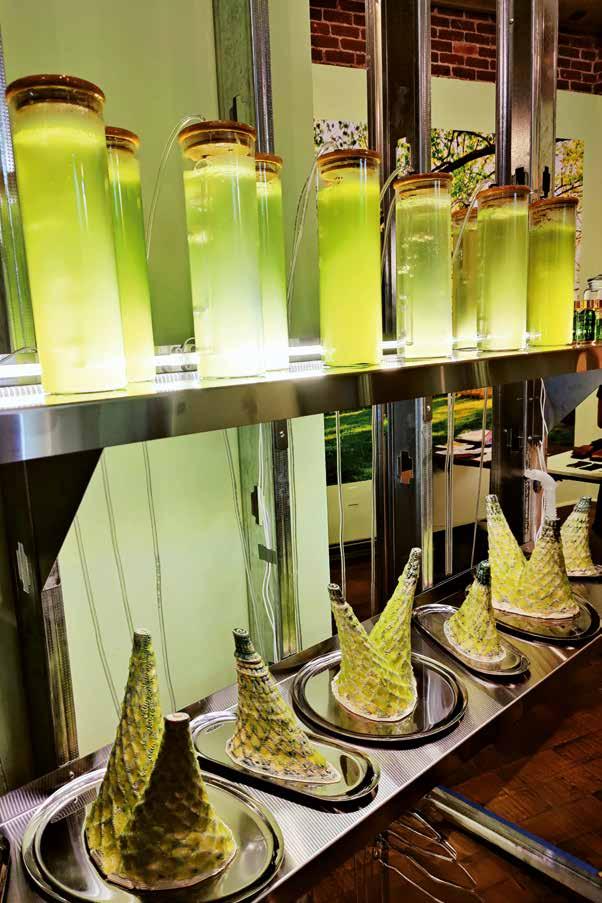
The Algae Lab. Art exhibition of liquid algae culture and ceramics coated in algae-laden hydrogels at Craft Contemporary in San Francisco. Photography by author.
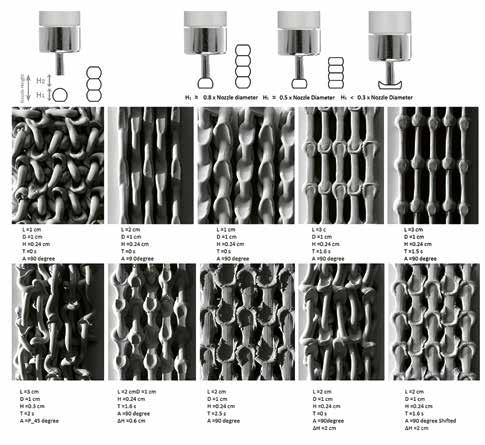
The tool paths for all geometries followed continuous curved lines generated from slicing commands. By altering wait time, flow rate, speed, nozzle angle, node distances (horizontal and vertical), and layer settings, we printed various textures to test the bonding strength between clay layers.8
conventional construction waste by extruding only the necessary amount of material, thereby reducing embodied energy and carbon impact.
The embodied energy of a building material is an increasingly critical factor in sustainable construction. While operational energy efficiency has improved, material production remains a major contributor to global CO2 emissions.9 The use of bio-cementation as an alternative to traditional cement-based binders has been explored to mitigate this issue, with microbial-driven calcium carbonate precipitation offering a low-energy solution to structural reinforcement.10 By embedding these biological mechanisms into 3D-printed clay, the potential for self-healing and enhanced durability can be realized, paving the way for a new paradigm in regenerative architecture.11
The Culture Of Upkeep: Rethinking Architectural Longevity
From Static Buildings to Living Systems
Clay and soil-based architecture, culturally developed over thousands of years, is not designed to b e maintenance-free. Traditional earthen building techniques are sustainable, durable, and malleable for complex designs, however, they require annual upkeep to strengthen these structures for generations. This is antithetical to modern construction practices desired by the public that prioritize permanence and “maintenance-free” buildings. This mindset rationalizes a building with less upkeep, longer lifespans, less liability, and less repair and replacement. Though materials like concrete, stone, and plastics have their benefits, we currently understand the high embodied carbon impact of these materials on our environment. The urgency for building practices that address the whole life cycle of construction materials leads us back to systems that rethink the ideas of architectural longevity. Can we rethink the benefits of static buildings to ones that integrate living systems that require care and a culture of upkeep as part of enhancing the well-being of its inhabitants?
Printed Clay and the Return to Upkeep Culture
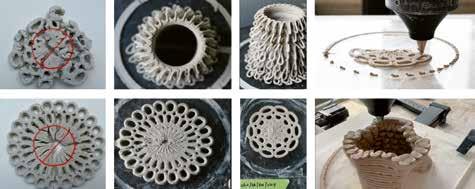
Through use of the parametric design principles of additive manufacturing, experimentation with variations in surface texture, and porosity were explored.
Photography by Jones, Kalantar, Ikeda et al., (2023).
As we move toward this new paradigm, we understand the benefits of unfired bioclays and earthen materials and accept their dynamic nature. At various points, it is expected that they will need to be maintained or augmented, necessitating attention. As a solid assembly, made of organic materials, bio-clays can be naturally repairable and upgradable. New layers can be added, or subtracted, seamlessly and re-bonded with the previous material without weakening the joints or creating visible patchwork. As we develop these methods further, we can begin to integrate bacterial processes to repair cracks and amend the material properties of our buildings.
Surfacing the Digital
An Interview with Martin Bechthold
claying architecture
editors: This conversation will begin the book’s section of “Surfacing,” which showcases work that explores the textural and morphological possibilities in the 3D printing process. Thanks so much for sitting down with us. When did you first start working with clay and what first drew you to the material digitally as distinct from other materials?
martin bechthold: I completed my doctoral dissertation around questions of digital design and production in relation to structural design. We had worked with timber, concrete, stone, which each have very specific digital fabrication processes associated with them. Compared to those materials clay is much more versatile— the industry produces ceramics utilizing processes such as using casting, extrusion, or dry pressing. We first started working with clay in 2008, and right from the start collaborated with ascer Tile of Spain, the Spanish Association of Wall and Floor Tile Manufacturers. They were interested in raising visibility for working with ceramics, while we were intrigued by a versatile material system that had not received much attention from design technologists. Combining humanity’s first humanmade material with the increasingly advanced computational methods seemed
counterintuitive at the time. There was little to no activity in that area at the time. Berok Koshnevis had extruded clay as part of his work on Contour Crafting, but he immediately moved onto concrete instead. Clay was safe and easy to use for us, and it can be manipulated in specific ways depending on its various stages of dryness, including after being fired. There were unique relationships between our digital tools and the material that forced us to rethink how we had approached teaching digital fabrication up to that point. We hadn’t really used a viscous material like concrete or clay in our digital fabrication class. Clay really expanded our material repertoire. So it was a pretty important moment pedagogically for us.
cae: How did the introduction of clay change the pedagogy of digital fabrication?
mb: Once we integrated clay we began to deal more with indirect fabrication processes, instead of primarily cutting or shaping material directly. I think it really added complexity to our teaching. We had done some work on casting with students, but clay introduced material shrinkage to a higher degree. The struggle with such a high degree of dimensional uncertainty became somewhat defining for our pedagogy. During my thesis work with shaping wood, I addressed springback and wood’s natural variations in properties through introducing corresponding fabrication approaches. When using clay that approach did not work, instead we were forced to approach design and fabrication with a different mindset. There is a second aspect to our pedagogy changes, and it has to do with how safe and pleasant it is to handle clay. I think it is at least partially for that reason that our digital fabrication course offerings gained in popularity around the same time as we included clay as a material system. Handling clay is a bit like therapy, and our work gained substance as we began to collaborate with our friends at the Harvard Ceramics Studio. The ceramicists there brought a different viewpoint into the courses, as potters, artists, and as makers. Within this triad of digital fabrication, a stubborn but pleasant material, and the presence of artists in our course, the fabrication courses really took off to embrace experimentation, frame early failures as learning, and challenge students to develop a clear research agenda in their pursuits of digital fabrication coursework.
“I’ve come to understand clay and ceramics as a microcosm of broader research questions beyond material and technical interests.”
ca e: Can you describe how your relationship to clay and technology have evolved?
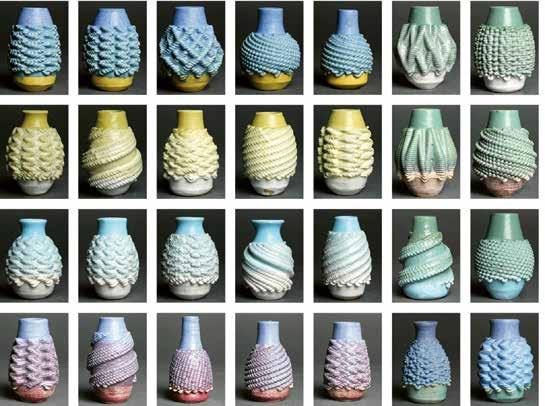
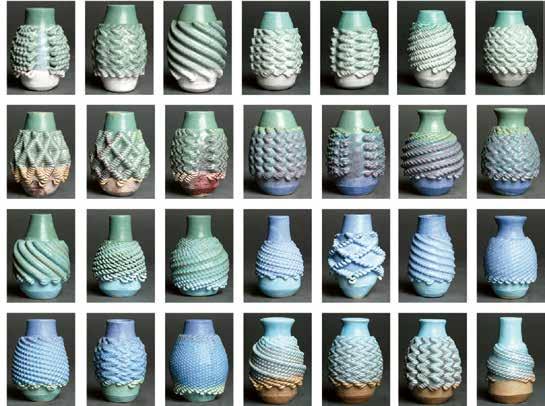
Selection from of the 80 vases in the SEKI collection.
Photography by Kelly Devitt and authors.
The premise of Claying Architecture is that architecture has much to learn from clay and its many technical and cultural configurations. In that vein, this essay and its wind glazes offer architecture the provocation of an oddkin: climatic beauty and the possibility of beneficial climate practices as a form of beauty. The following text describes two projects resulting from a collaboration between labs, people, and fields of knowledge: architecture, ceramics, and digital fabrication. The glazing projects described here were developed during an ongoing partnership between the isu Ceramics Studio and isu Computation & Construction Lab (ccl), both housed in the College of Design. The ccl is an initiative of the Department of Architecture and is home to $1 million in digital fabrication and robotics equipment that support cutting edge teaching and research. The Ceramics Studio is housed in the Department of Art and Visual Culture with a focus on sustainable practices in ceramics. Collaboration between the two groups began in 2016 with the purchase of an early model 3D Potter Potterbot clay 3D printer. Developing proficiency in 3D printing with clay created a space between disciplinary expertise
Line drawing of selected 3D print paths by authors and Erin Hunt.
Blast Barn Concept Render. Cladding colors and patterning are loosely planned out digitally before individual ceramic components are carved, bisque fired, glazed, and then fired a final time. Photography by Sutherlin Santo.
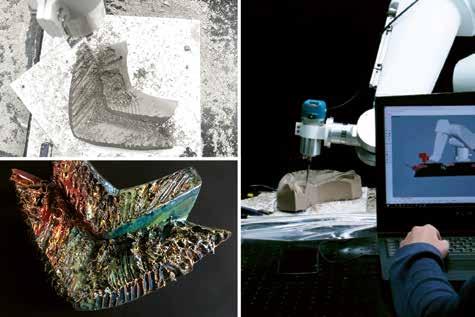
Blast Barn Clay Component (A) Ceramic glaze melts into glass during the final firing. The molten minerals respond to texture carved into the clay surface by the robotic arm resulting in a layered, visual expression. Photography by Sutherlin Santo.
intensity of fires across the western United States threatening human populations, Blast Barn considers the requirements for habitation and protection of our wildlife in an effort to extend fire preparedness infrastructure to animal co-habitants, our wild kin.
Stoneware, a clay resistant to high temperature, plays a critical role in the shelter’s design as it adds thermal resilience through the cladding components. As a strategy to mitigate heat transfer to the interior, the shelter’s ceramic shell is made of hollow units formed from thick, slip-casted clay. Robotically carved patterns and ceramic glaze are layered across the shell’s surface in textures drawn from the environment, visually embedding the shelter as an extension of the landscape.
Blast Barn takes a layered approach in the fabrication of its clay shell, alternating between techniques of ceramic and digital craft to pair robotics with clay. Casting is first used to form liquid clay into precise, repeating shapes molded from 3D-printed clay originals. When the molds are opened, each clay component is removed once it’s stiff enough to handle without deformation yet retains enough moisture to be carved into with a robotic end-mill.
Blast Barn Clay Component (B) Each ceramic component is carved while the clay is still moist. Patterns are first designed using Rhino and Grasshopper before toolpaths are uploaded to the six-axis robotic arm to be robotically milled. The carved component is bisque fired, glazed, and then fired to vitrification. Photography by Sutherlin Santo.
Masonry Mutualisms
Morphology for Multi-Species Envelopes
Jennifer Birkeland, Jonathan A. Scelsa
Masonry is inherently additive. Deep rooted in the architectural discipline—masonry is a process of adding one thing to another thing by placing one on top of the other in recursive fashion. As a process, the 3D printing of clay mimics traditional masonry in both physical and metaphorical ways. Physically, the clay 3D print designer, like the mason, becomes aware of the maximum “corbeling” angle when moving from one layer of deposed clay to the next. Metaphorically, the additive nature of the manufacturing process beckons the designer to question what else might be added into the “mix,” that may have a mutual benefit for the aggregate or the environment. As architects examine ways that their building may participate in a process of restorative ecology, it behooves the designer to not only confront how non-human matter may bring benefits to us, but also how different non-human species—both flora and fauna—bring biological benefits to each other with the resulting aesthetic oddities passed to us.
One indicator of the movement from the Holocene to the Anthropocene has been noted as the removal of spaces of refuge in which multi-species assemblages can reconstitute themselves following periods of ecological catastrophe.1 Notably in architecture the period culminating in the Anthropocene (modernity), witnessed brick walls replaced with sheet metal, shorelines of riprap supplanted by steel piles, root-based hills supplanted by plastic geocells. This shift from the thick volumetric conditions to the thin has the consequential effect of removing spaces of refuge for non-human flora and fauna both at the ecological and at the bodily scale. The architectural renaissance of thick, weighted, and masonry-based material of clay, brought forth by digital processes such 3D printing, provokes the possibility that we might question the role of the thick envelope in architecture not just for its climatic benefits, but for the comforts of the interior, and also as a space of affordance for a broader inclusivity of ecological life.
Mutualisms through Morphology
Mutualism, an ecological relationship where two or more species utilize the other is evaluated through
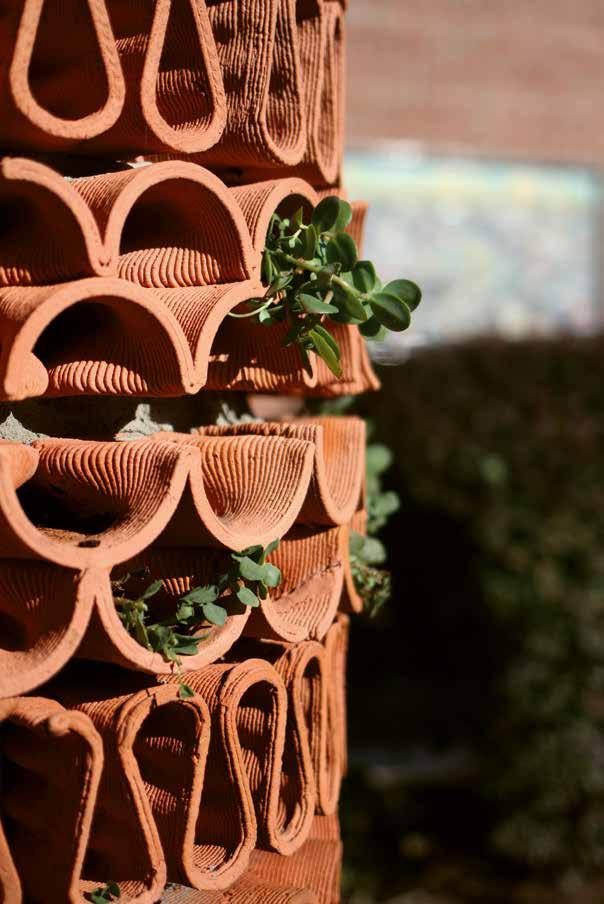
The Aeroponic Aggregate Pavilion. A pilot masonry pavilion built for the village of Haverstraw in New York, by op,Architecture Landscape in the fall of 2022. Photo by Jonathan A. Scelsa. Image Courtesy of the authors.
Envelope Stuffing
Nate Hume
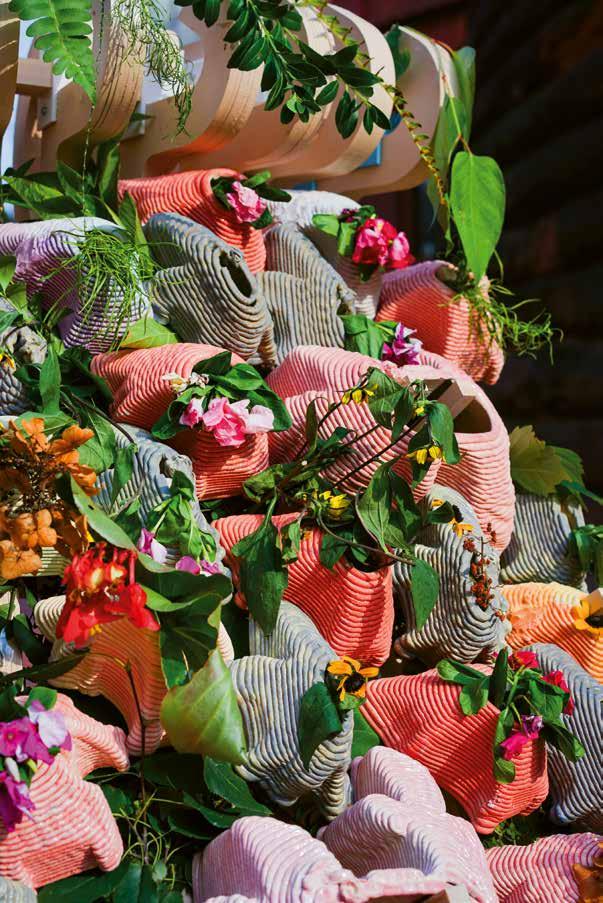
Envelope Stuffing investigates inhabitable envelopes with a potential to house new forms of food production technologies entering buildings. These stuffed envelopes build on contemporary material and façade research to produce new relationships between volumes and enclosure while also provoking traditional notions of the inside and outside.1 The binary is challenged on a literal level as well as a conceptual one including the divide between natural and artificial materials. This becomes evident in the work with clay, one of the oldest known building materials, which is now processed through robotics and new coatings and forms of firing. These material studies and the cultural questions the work draws out collapses the divide between traditional notions of nature and artifice. The work forms materials that hold multiple properties of the raw and the processed producing new aesthetics through their synthesized conditions.
Rainscreen
Where early twentieth-century buildings still prominently embraced terracotta facades and ceramic as a prominent material in design it soon became relegated to interior decorative tiles as other enclosure systems and materials took precedence. Steel, glass, and concrete formed ever thinner envelopes that expressed a sleek and minimal single unified barrier between the inside and the outside. By mid-century, concern arose over the environmental wear on these barriers as they failed to keep water out and subsequently deteriorated. Furthermore, as costs rose to heat and cool these modern buildings the sleek single barriers made these structures increasingly cost prohibitive to maintain. Research stemming from Canada in the 1950s and ’60s outlined multi-layered strategies borrowing from historical examples such as the Norwegian Stave churches with their layered wood barriers.2 The “rainscreen,” which essentially had been in use since the twelfth century in rural structures, presented itself as a strategy for protecting modern construction. The delamination of layers and addition of gaps and air cavities allowed buildings to shield themselves from solar and rain exposure and deal with the regulation of internal temperature. What began more conceptually in the mid-twentieth century
Prototype closeup by Zijie Wei, Yao Xiao. Photo courtesy of the author.
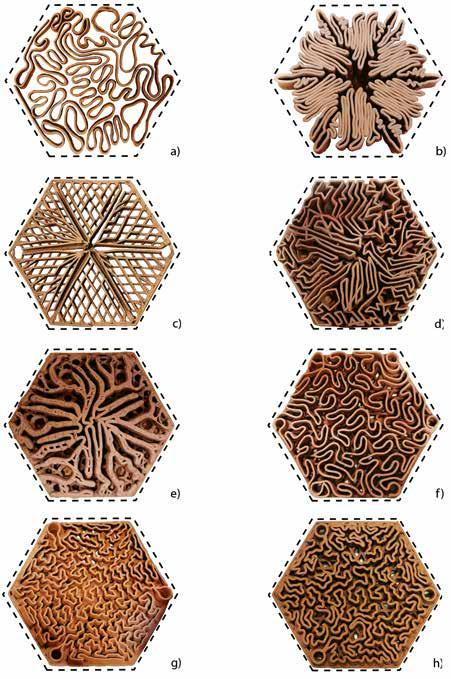
Design evolution a) to h) with h) being the final solution. Drawing by Robotic Fabrication Lab, HKU.
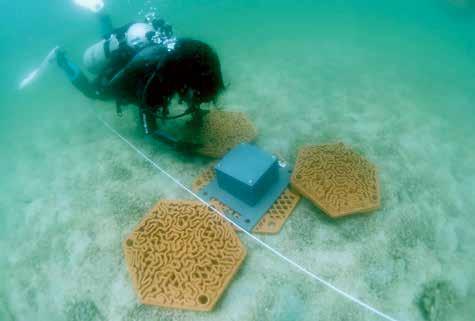
Scuba divers installing a unit on the seabed. Photography by AFCD.
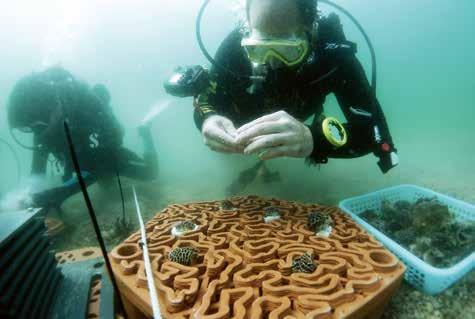
Scuba-diver planting the different coral fragments into the tile. Photography by AFCD.
Much like 3D printing, assembling is an additive process. Within the discipline of architecture, the term is used to bring discrete pieces together in a construct, or different persons together in one space. The art of how we assemble, or bring things together, is arguably the project of the architect and one that descends from various cultures and traditions of making and construction. The act of joining parts to form a greater composition within a wall, a screen, or a roof may be a metaphor for how we merge various traditions, narratives, and groups into a cohesive whole.
Beyond their functional role, architectural assemblies can also convey cultural and contextual narratives by incorporating local materials, craftsmanship, and historical influences, often expressed through ornament. In Ornament: The Politics of Architecture and Subjectivity, Antoine Picon explores the historical entanglement of ornament and assembly, tracing their cyclical separation and reintegration in both traditional craftsmanship and contemporary computational design.1 Although modernism largely severed ornament from structure, digital tools have made it possible to reintegrate ornament as an integral part of assembly, much like in the Gothic era or Louis Sullivan’s organic forms. Parallel to this revival, clay 3D printing has prompted a broader exploration of architectural tectonics, shifting from precise, repetitive modularity to flexible, loosely assembled elements that embrace variation, adaptability, and tolerance.
The projects in “Assembling” examine how clay 3D printing allows for new material expressions and innovative aggregation methods as evolving, dynamic material systems. Introducing the section, Laura Garófalo and Omar Khan discuss part-to-whole relationships, scale, and assemblies as a form of building integration. “Hexcrete” challenges conventional construction practices by reinterpreting historical formwork and vaulting techniques. Inspired by the work of sculptor Robinson Fredenthal, “Fused-Poly Bricks” investigates the irregular stacking of self-supporting polyhedral ceramic bricks. “Revitalizing Ceramics in Contemporary Architecture” reinterprets the glazed ceramic brick aggregated in an un-mortared façade in Amsterdam. “Common Bond” links traditional and emergent techniques for incorporating ornament in masonry systems. Through experimentations in color, texture, pattern, and topology alongside innovative approaches to the architectural frame, the projects engage a resurgence of ornament that is deeply integrated into the tradition of the architectural assembly.
Notes
1. Antoine Picon, Ornament: The Politics of Architecture and Subjectivity (Chichester: Wiley, 2013), 11-12.
Common Bond
Kinships with Craft Traditions
Kelley Van Dyck Murphy
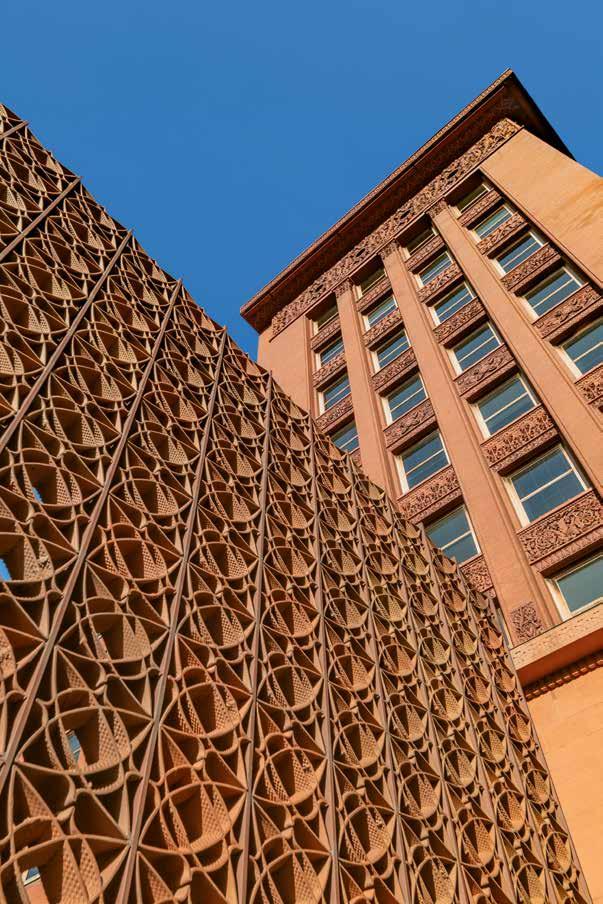
At the turn of the nineteenth century, the Wainwright Building emerged as a paradigm for a new architectural language, merging steel construction with a richly articulated terracotta façade. Designed by Louis Sullivan and Dankmar Adler for the brewer Ellis Wainwright, the ten-story structure translates its structural logic into a tripartite composition—base, shaft, and attic—that reinterprets the classical column to communicate organizational clarity and vertical expression.1 Sullivan reinforced this compositional approach with a meticulously designed system of ornament: botanical and organic motifs that enliven the building’s surface. The ornament serves as both a surface embellishment and a means of conveying the building’s verticality and structural hierarchy, merging aesthetic expression and constructive logic.2
Rendered in molded terracotta, a floral relief adorns the building’s frieze, spandrels, and column capitals, merging naturalistic imagery with a disciplined, abstract ge ometry. The motifs—comprised of curling acanthus leaves, stylized flowers, and interlacing vines—draw upon a long lineage of botanical ornamentation, reflecting Sullivan’s belief that ornament should arise naturally from its context and purpose, rather than adhere to historical precedent.3 Each piece functioned as part of a larger modular assembly, allowing for repetition and variation across the façade.
This approach aligned with Sullivan’s theoretical writings, particularly A System of Architectural Ornament, where he likened ornament to a living organism. “Each ornament, then, is an emanation from the design itself. .…its elements repeating, combining, and developing into a rhythmic and harmonious whole.”4 Ornament, in this view, was not an applied embellishment but a generative extension of the building’s structural and material order. Sullivan asserted that patterns should evolve organically from a building’s structure and material, repeating and intertwining as if arising naturally, rather than being applied arbitrarily.
The fabrication of the Wainwright Building’s terracotta ornament relied upon a highly specialized process that combined artisanal craftsmanship with serial production. Skilled mo delers first sculpted the intricate designs in clay, from which craftsmen produced plaster molds. These molds enabled the replication of decorative elements,
Flora Field installation in the courtyard of Louis Sullivan’s Wainwright Building in St. Louis. Photography by Documodern.
Architectural enclosures serve as the physical boundary between interior and exterior environments, often referred to as the “building envelope.” However, the term “enclosure” more precisely captures its function. Enclosures are designed to resist and transfer structural and dynamic loads, regulate the movement of matter and energy, and contribute to aesthetic outcomes. At the outset of modernity, Gottfried Semper identified enclosure as one of architecture’s four universal elements, hearth, roof, mound, and enclosure. While ceramics were associated with “hearth,” textiles and weaving were given to “enclosure,” and their primary role was to be “defenders of the hearth’s flame against the hostile elements of nature.”1 More recently, Jeffrey Nesbit has explored how these elements in fact intertwine, creating novel forms of architectural enclosure that integrate ceramics with earth, wood, and fire—thereby redefining enclosure as a dynamic system rather than a rigid barrier or a method of controlling nature.2 This perspective challenges Semper’s concern with the hostility of an untamed exterior by emphasizing the complex intersections of engineered logic and cultural imagination. The discourse aligns with Donna Haraway’s call to reconsider human relationships with nature, climate, and the built environment. Herein architects examine the use of green clay, mud, and earth at the scale of full elements of architectural enclosure: the floor, the wall, the roof. The act of 3d printing, which reduces clay to a continuous flow of material, in many ways resembles Semper’s original textile-based conception of the “Enclosure”, as expressed in strands and loops of continuous lines that droop and articulate themselves differently in gravity. The “Enclosing” section examines work where clay defies the traditional scale of pottery as confined to that of the kiln. Innovative techniques further expand enclosure’s role in architecture. This section begins with an interview with Ronald Rael that explores the traditions of clay as a future based material. “3D Printing Earth Architecture” proposes 3D-printed clay as a sustainable solution that reconciles construction with environmental concerns. “Sueños Con Tierra/Concreto” investigates enclosure by examining clay’s structural capability for bridging between beams within the context of the Central American traditions of timbrel vaulting. “Digital Machines, Analogue Materials” focuses a different examination of the perimeter wall through an exploration of pneumatic site-based deployment. “Clay Looms” examines enclosure through the lens of interior spatial design, pushing the boundaries of how a ceramic floor carpet may be complicit in the experience of an enclosed space. Ultimately, “Enclosing” challenges conventional notions of architectural boundaries, advocating for architectural envelopes that are adaptive, materially innovative, and culturally responsive.
Notes
1. Goffried Semper. The Four Elements of Architecture and Other Writings Translated by Harry F. Mallgrave and Wolfgang Herrmann (Cambridge University Press, 2011). 110.
2. Jeffrey S. Nesbit, “Introduction.” Nature of Enclosure. (Actar Publishers, 2022). 6-18.
And because of this clay I’m in a lot of conversations about the use of adobe in Los Angeles using 3D printing. I don’t know if I am in kinship yet, but I’m in these beautiful conversations about really thinking about how to implement earthen architecture in the rebuilding of LA. Those conversations are in kinship also with the future because we’ve seen what happens when we build without being in kinship with the future. So much architecture is in kinship with corporations. A section of a wall is filled with corporations that want to find a space within that wall. They have legal representation to allow them to fill architecture with plastics and foams and toxic material. And now we see what happens when this architecture burns in LA, and you cannot use the beaches or drink the water, or rebuild quickly because of the toxins.
I’d like to think that I’m in kinship with the future in the same way my great-grandfather was in kinship with me. I never met my great-grandfather, but I live in his house, and I appreciate it every day that I’m there. I feel like these experiments with clay, when I get a chance to make real architecture, those buildings will b e in kinship with generations after me.
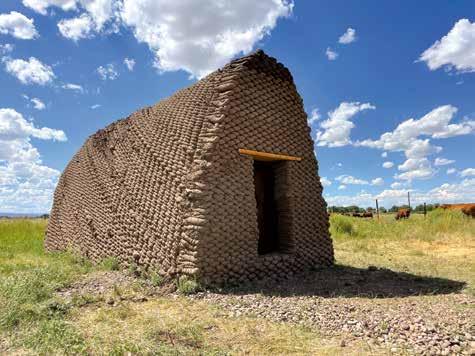
Terrano 2023. Terrano is the first in-situ 3D printed roof structure in the world. Photo courtesy Ronald Rael
Adobe Oasis 2025. Adobe Oasis demonstrates that building with the earth — intelligently, sustainably, and beautifully — is not only possible but necessary for our collective future.
Photo: Lance Gerber
(Alphabetical by Surname)
Matthew Allen is a visiting assistant professor at the Sam Fox School at Washington University in St. Louis, where he writes and teaches courses on the history and theory of architecture, technology, and visual culture.
Ehsan Baharlou is Dr.-Ing and an assistant professor at the University of Virginia School of Architecture. His research focuses on ecological construction to address climate change through sustainable materials and robotic fabrication. He explores multispecies design, utilizing organisms to biomanufacture living and regenerative architecture.
Richard Beckett is an associate professor of architecture at the Bartlett, ucl . His research is focused on design operating at the intersection of computation, biofabrication, and microbial ecologies in buildings and cities. His research on Probiotic D esign won the riba President’s Research Award in 2021.
Wessel van Beerendonk is a founder of Studio rap, an award-winning architectural design and fabrication firm based in Rotterdam, Netherlands. Since the establishment of Studio r ap, he has led various projects, including Theatre Zuidplein, The Float, New Delft Blue, and Ceramic House.
Jennifer Birkeland is a registered landscape architect in the State of New York, a founding partner of the New York-based practice, OP - Architecture Landscape, and an associate professor of Landscape Architecture at the Spitzer School of Architecture, City College of New York, cuny.
Edouard Cabay is a Belgian-Swiss architect based in Barcelona, program head and senior faculty at the Institute for Advanced Architecture of Catalonia where he co-directs 3dpa , a program that focuses on developing new housing solutions with 3D-printed earth.
Kunaljit Chadha is an architect specializing in robotic and digital fabrication, holding degrees in architecture and advanced manufacturing from Universitat Politècnica de Catalunya in Barcelona. Currently a PhD candidate at eth Zurich, Kunal has over eight years of experience as a lecturer and robotic fabrication expert.
Jan Contala is a German architectural designer and researcher at the forefront of digitally informed ceramics. Based in Innsbruck, Austria, he is the founder of ceralab , a pioneering studio dedicated to exploring the confluence of traditional craftsmanship and digital technologies.
Assia Crawford is an assistant professor at Tulane University and is an arb registered architect. She is the author of Designer’s Guide to Lab Practice and Bios in Search of Zoe.
Alexander (Sandy) Curth holds a PhD in the Design and Computation from mit, where he leads the Programmable Mud research initiative, developing methods for largescale additive manufacturing with low-carbon materials.
Nancy Diniz is a registered architect and educator. She is a founding partner of bioMATTERS, a design studio focusing on 3D-printed and robotically manufactured biomaterials. Nancy is course leader of the Masters in Biodesign at Central Saint Martins ual in London.
Shelby Elizabeth Doyle is a registered architect and associate professor of architecture where she is the Stan G. Thurston Professor of Design Build at Iowa State University College of Design and co-founder of the isu Computation & Construction Lab.
Alexandre Dubor is an architect and researcher that explores the potential of new technology, materials, and designs to improve the construction industry, with a focus on 3D printing and robotics for a sustainable architecture. He currently directs the Robotics Lab at iaac .
Haley Arthur Eisenman is an architectural designer specializing in educational architecture. Her passion for ceramics and attention to technical detail inform her innovative approach to design, particularly in the realm of digital fabrication.
Kiley Feickert is an architect and holds a PhD in Building Technology from mit, where she was a member of the Digital Structures Research Group. Her research focuses on optimizing structural systems for material efficiency and reusing structures to reduce carbon emissions and increase access to affordable construction.
Eduardo (Edu) Gascón Alvarez is an architect and holds a PhD in Building Technology from mit. He focuses on the design and simulation of low-carbon building components that improve the resiliency of buildings to heat.
Fabio Gramazio is a professor and co-founder of Gramazio Kohler Research at eth Zurich, exploring how digital manufacturing transforms architectural production. Their work integrates data and material, as outlined in Digital Materiality in Architecture (2008) and The Robotic Touch (2014).
Lucas ter Hall is a founder of Studio rap, an award-winning architectural design and fabrication firm based in Rotterdam, Netherlands. Since the establishment of Studio rap, he has led various projects, including Theatre Zuidplein, The Float, New Delft Blue, and Ceramic House.
Nate Hume is a licensed architect and principal of Hume Architecture. He is Graduate Programs Chair at SCI-Arc, the Southern California Institute of Architecture.
Erin Hunt is a digital fabricator and an architectural and computational designer. She is an assistant professor at Texas Tech University’s Huckabee College of Architecture where she teaches design studios and seminars integrating computational design and digital fabrication into architectural manufacturing.
Margaret Ikeda is an associate professor of architecture and co-director of the Architectural Ecologies Lab at c c a . She leads collaborative research bridging design, science, and manufacturing, exploring sustainable and ecological solutions for the built environment through interdisciplinary partnerships.
Mohamed Ismail is an assistant professor of architecture at uva School of Architecture. Ismail completed his PhD in the Building Technology program at mit, where he studied the application of structural and material optimization in the alleviation of housing security in the Global South with the Digital Structures research group.
David Jenny is an architect with a focus on digital technologies for design and fabrication. Besides his architecture practice in Zurich, he is a senior researcher and le cturer at the Zurich University of Applied Sciences, Department of Architecture, Design, and Civil Engineering.
Evan Jones is a senior adjunct professor of architecture, co-founder and co-director of the Architectural Ecologies Lab at cca , and co-founder of Assembly, a Berkeley, California-based architecture firm. His work blends design innovation with practical applications in contemporary architectural practice.
Negar Kalantar is an associate professor of architecture and co-director of the Digital Craft Lab at cca . Her research explores materials, robotic and additive manufacturing, integrating architecture, science, and engineering to tackle global challenges like carbon emissions and waste in the built environment.
Nathan King is Director of the Center for Design Research and associate professor of architecture at Virginia Tech; instructor of architecture at Harvard University and at the University of Pennsylvania; his global practice leverages design technologies and automation in service of remote and underserved communities.
Matthias Kohler is a professor and co-founder of Gramazio Kohler Research at eth Zurich, exploring how digital manufacturing transforms architectural production. Their work integrates data and material, as outlined in Digital Materiality in Architecture (2008) and The Robotic Touch (2014).
Andrew Kudless is a designer based in Houston, Texas, where he is the Kendall Professor at the University of Houston. Kudless is the founder and lead designer at the multidisciplinary studio Matsys.
Christian J. Lange is a registered German architect and associate professor in the faculty of architecture at the University of Hong Kong. He is the founder and leader of the Robotic Fabrication Lab—an internationally renowned research environment for architectural robotic fabrication, prototyping, and construction.
Ingrid Lilligren is a university professor in the Department of Art & Visual Culture at Iowa State University College of Design and a member of the International Academy of Ceramics. She directs the ceramics teaching studio and research lab. As a 2022–24 Innovation and Entrepreneurship Fellow, she developed wind-generated electric kiln glazes.
Adam Marcus is an architect and educator based in New Orleans. He directs the design and research studio Variable Projects, and he is an associate professor at Tulane University School of Architecture where he serves as research director for the Center on Climate Change and Urbanism.
Areti Markopoulou is a Greek PhD architect, researcher, and urban technologist of architecture and digital technologies. She is the academic director at i a ac in Barcelona, leads the Advanced Architecture Group, and runs a multidisciplinary research lab ex ploring how design and science can impact the built environment.
Dinorah Martinez Schulte is a Mexican architect and researcher, holds an masdfab from eth Zurich and a Bachelor’s in Architecture from Universidad Iberoamericana. She leads manufactura , teaches at Universidad La Salle, and has collaborated with mad Architects and ensamble Studio.
Frank Melendez is an architectural designer, educator, and researcher. He is a founding partner of bioMATTERS, ll c , a design studio focusing on 3D-printed and robotically manufactured biomaterials. Frank is the department chair and an associate professor at the Spitzer School of Architecture, City College of New York, cuny
Caitlin Mueller is an associate professor at mit ’s Department of Architecture and Department of Civil and Environmental Engineering, where she leads the Digital Structures research group developing computational design and digital fabrication methods for a more sustainable and equitable future.
Kelley Van Dyck Murphy is an architectural designer, educator, and researcher. She is an associate professor of architecture at the Sam Fox School at Washington University in St. Louis and a founding partner of the St. Louis-based architecture practice, av v a .
Pierre Oskam is an entrepreneur, nature-inclusive architect at a Dutch DSO, and vice-chair of a European COST Action on regenerative design. He founded Urban Re ef, lectures at TU Delft and is an affiliated researcher at Toronto Metropolitan University.
Shawn Protz is an assistant professor of architecture at NC State University and co-founder of the design practice Protz Studio. His work explores the frictions between digital and physical interfaces in the production of architecture navigating a wide range of media from 3D-Printed clay to inflatable structures.
Jenny E. Sabin is an American architectural designer and artist who draws upon biology and mathematics to design material structures. Sabin is the Arthur L. and Isabel B. Wiesenberger Professor of Architecture in the Department of Architecture and the Chair of the multi-college Department of Design Tech at Cornell University. In 2017, Sabin won MoMA PS1’s Young Architects Program with her submission, Lumen.
Virginia San Fratello is chair of the Department of Design at San José State University in Silicon Valley. She is a winner of the Cooper Hewitt National Design Awards for digital design and her work can be found in the permanent collections of MoMA, sfmoma , lacma , the Design Museum, and the Smithsonian.
Andrew Saunders is an associate professor of architecture at the University of Pennsylvania Stuart Weitzman School of Design and founding principal of Andrew Saunders Architecture + Design, an internationally published, award-winning architecture, design, and research practice.
Jonathan A. Scelsa is a registered architect in the State of New York, a founding partner of the New York-based practice, OP – Architecture Landscape, and a professor of Architectural Design and Technology at Pratt Institute in Brooklyn.
Alex Schofield is an associate professor, associate chair of Graduate Architecture at California College of the Arts, San Francisco, and co-director of the Architectural Ecologies Lab. He directs Objects and Ideograms, a design workshop based in Oakland, California.
Joshua G. Stein is the founder of Radical Craft (www.radical-craft.com), a Los Angeles-based studio that advances an experimental art and design practice saturated in history, archaeology, and craft. He is Professor of Architecture at Woodbury University.
Robert Stuart-Smith directs the Autonomous Manufacturing Lab at Penn (Architecture) and ucl (Computer Science) and is director of the Masters of Science in Design: Robotics and Autonomous Systems program, assistant professor of architecture, and affiliate faculty in Engineering’s grasp Lab at the University of Pennsylvania.
Garrett Sutherlin Santo co-owns and operates Sutherlin Santo, a studio exploring new paths toward futures where nature and technology are symmetrical; building relationships between emerging digital processes, ecology, and traditional craft.
Maedeh Tafvizi is an Iranian artist and designer working at the intersection of material, identity, and digital fabrication. She holds an m fa in Ceramics from the Rhode Island School of Design, where she explored the integration of traditional craft with emerging technologies like 3D printing.
Yara Tayoun is an architect and researcher specializing in the digital and technology-driven transformation of circular processes in architecture and design. As the Research and Development Manager at the Robotics Lab at iaac , her work focuses on bridging academic research and impactful market applications.
Lauren Vasey has an interdisciplinary background with degrees in engineering and architecture and a PhD on adaptive robotic construction processes. She is a co-founder and the ceo of impact build. She has worked at eth Zurich and icd Stuttgart.
INTERVIEWEE
Rachel Armstrong is professor of Regenerative Architecture at KU Leuven, Belgium, a Senior ted Fellow, and a Robert Rauschenberg Foundation Rising Waters II Fellow. She pioneers the field of living architecture, blending ecology and life-centered design to address global imbalances. She is coordinator for the Microbial Hydroponics (Horizon Europe eic Pathfinder Challenges) project.
Martin Bechthold is the Kumagai Professor of Architectural Technology in the gsd ’s Department of Architecture. He currently serves as the GSD’s Academic Dean. Bechthold is the founding Co-Director of the Master in Design Engineering Program and Faculty Affiliate at the Paulson School of Engineering and Applied Sciences (seas ).
Laura Garófalo is a founding partner of Liminal Projects, and the Lab for Architectural Ceramic Experimentation at Carnegie Mellon Architecture where she is an associate professor. She is also the co-editor of Bioclimatic Ceramic Assemblies books associated with the Architectural Ceramic Assemblies Workshop.
Joyce Hwang is a professor of architecture at the University at Buffalo suny, director of Ants of the Prairie, partner of Double Happiness, and a core organizer for Dark Matter U. Her work has been featured by a range of platforms, from MoMA to Stewart Hicks’s YouTube Channel.
Omar Khan Omar is a founding partner of Liminal Projects, and the Lab for Architectural Ceramic Experimentation at Carnegie Mellon, where he is a professor in the School of Architecture. He is a founding member of the Architectural Ceramic Assemblies Workshop (acaw ) 2015-2024 and the co-editor the Bioclimatic Ceramic Assemblies books associated with the workshop
Ronald Rael is an American visual artist known for his work in architecture, human rights and environmental advocacy along the U.S.–Mexico border, earthen architecture, and pioneering work in developing materials for 3D printing. He is the Eva Li Chair of Architecture at the University of California Berkeley
Published by Applied Research and Design Publishing, an imprint of ORO Editions. Gordon Goff: Publisher
All rights reserved. No part of this book may be reproduced, stored in a retrieval system, or transmitted in any form or by any means, including electronic, mechanical, photocopying of microfilming, recording, or otherwise (except that copying permitted by Sections 107 and 108 of the U.S. Copyright Law and except by reviewers for the public press) without written permission from the publisher.
You must not circulate this book in any other binding or cover and you must impose this same condition on any acquirer.
Edited by: Shelby Doyle, Frank Melendez, Kelley Van Dyck Murphy, and Jonathan A. Scelsa
Cover Design: Jonathan Scelsa and Shelby Doyle with Pablo Mandel
Custom Typography: Jonathan Scelsa
Book Design: Pablo Mandel, typesetting: Micaela Carraro / CircularStudio Project Manager: Jake Anderson
10 9 8 7 6 5 4 3 2 1 First Edition
ISBN: 978-1-961856-84-4
Color Separations and Printing: ORO Editions Inc. Printed in China.
International Distribution: www.appliedresearchanddesign.com/distribution
ORO Editions makes a continuous effort to minimize the overall carbon footprint of its publications. As part of this goal, ORO Editions, in association with Global ReLeaf, arranges to plant trees to replace those used in the manufacturing of the paper produced for its books. Global ReLeaf is an international campaign run by American Forests, one of the world’s oldest nonprofit conservation organizations. Global ReLeaf is American Forests’ education and action program that helps individuals, organizations, agencies, and corporations improve the local and global environment by planting and caring for trees.