Ceremonial Conjecture, earthwork, Morris Museum, Morristown. collaboration with the sculptor Penny Kaplan, 1980–1981
foreword Alma Ruiz is a former senior curator at the Museum of Contemporary Art (MOCA), Los Angeles, where she curated numerous exhibitions focusing on emerging artists and the postwar period in the United States, Italy, and Latin America. In addition to having served as the curator of the 20 Bienal de Arte Paiz in Guatemala City, she guest-curated exhibitions at the Fundación Jumex, Mexico City; the Center for Contemporary Art, Tel Aviv; the Fundación Telefónica, Buenos Aires; the Art Museum of the Americas, Washington, D.C.; the Fowler Museum at UCLA; and the Craft Contemporary. She has been a panelist for Creative Capital Foundation, the Pew Center for Arts & Heritage, the US-Mexico Fund for Culture, and Artadia Los Angeles. Alma is a coeditor and contributor to A History for the Future: The Museum of Contemporary Art, Los Angeles, 1979–2000.
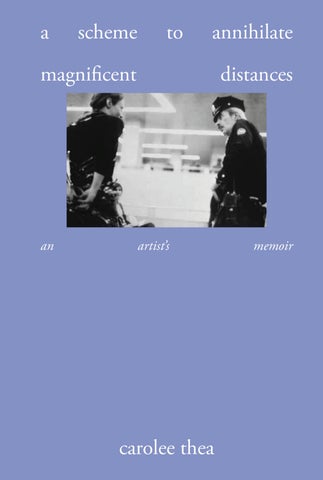
We play many roles in life, and as such, I’m a daughter, a sister, a friend, a colleague, and a mentor. I’m writing the foreword to Carolee Thea’s A Scheme to Annihilate Magnificent Distances in my role as a friend and colleague. This book, an autobiography she introduced me to during a recent trip to New York, opened my eyes to Carolee’s artistic career, a period I didn’t know much about. It’s thrilling to close the circle in which Carolee has fully experienced so many aspects of the art world, and although her artistic contributions have not been broadly recognized, they will be after this book is published; they are invaluable. Carolee and I met during a cultural exchange trip to Russia for the first Moscow Bienniale in 2005. Carolee had arrived in Moscow before me, and when I met her, she was trying to find her stolen wallet. I offered support, and it was in that situation that we became friends. Our shared experiences—our trip to St. Petersburg and our wish to visit the mythical Hermitage Museum—strengthened our bond. We discovered that although we lived in cities on opposite sides of the country, we were connected by common friends and interests. After this trip, we often saw each other and shared experiences at the Venice Biennale, Documenta, Skulptur Projekte Münster, the Istanbul Biennial, in Vietnam, and on numerous occasions in New York. When we met, Carolee had not made art for a few years. Instead, she had found inspiration in her career as a writer, and our conversations focused on her published books: Foci: Interviews with Ten International Curators (2001) and On Curating: Interviews with 10 International Curators (2009). I was familiar with many of her interviewees and was looking forward to her third book: On Curating 2: Paradigm Shifts (2016). As a Los Angeles-based curator whose practice engaged mostly with international artists, Carolee’s books were of great interest and significance to me, mapping out art in an age of globalism through international exhibitions. Later, while teaching curatorial practices at the Center for Business and Management of the Arts at Claremont Graduate University, I shared these interviews with my students and encouraged them to reflect on multiculturalism, creative thinking, and global knowledge.
5
Reading about Carolee’s life as a woman and an artist is fascinating. Her narrative kept me easily engaged because she’s an excellent writer, the next flowing smoothly, and because I was discovering a Carolee I didn’t know, aspects of her life I wasn’t familiar with. I became privy to her transformation and to the causes for that transformation. For the first time, I was reading what we didn’t discuss at length on my visits to New York—her awakening to a world beyond her life as a wife and mother, her drive to mold herself into the person she longed to be and to mold her world into “a political and feminine one.” She read feminist writers, met women artists with similar sympathies, marched, protested, and acted regarding the issues of her time. Carolee left a conventional marriage and a house in the suburbs for one as a single mother and a loft in downtown Manhattan. In her new surroundings, she made art that expressed her newfound freedom. Her concept of home was reflected in works like her Housescapes, hybrid pieces that reflected her emotional transformation. While the title conflated the words “house” and “landscape,” I thought of “house” and “escape”—from what she considered a no longer acceptable way of living. The act of creating was a kind of exorcism, a ritual that helped her stay the course in what sometimes felt like a room with flexible walls. Walls that would give way when she pushed against them. Despite her difficulties as a young mother and artist, life began to be exhilarating. She could make art, develop new friendships, and live freely. Many of us can identify with that. Like many women of her time, Carolee sacrificed a lot to fulfill her emotional and intellectual yearnings. The 1970s were a difficult decade for women artists. It was a struggle–– and surprisingly still is––to have aspirations, to combine motherhood with a creative career. While reading Carolee’s autobiography, I reflected on how much things have changed while remaining the same, and the difficult choices women continue to face today. Her artistic career is a testament to her talent and dedication, for which she received exemplary reviews by well-known critics and worked alongside other
6
artists who have since entered the canon of American art history. Her achievements are truly inspiring and worthy of our appreciation. A Scheme to Annihilate Magnificent Distances is Carolee’s most complete book on her art. She gives us plenty of images to see her creativity in full form, and we are invited to reflect on how fruitful her writing years have been. Her numerous articles, art reviews, and books on curating are a testimony that will endure and be shared with many. I’m glad Carolee found a way to the life she aspired to, even though it came with some pain. All past experiences put her on track to fulfill her desire to be creative, teach, write, and, at some point, make the difficult decision to stop making art, an act that coincided with her mother’s death. A rite of passage, a moment of rebirth and metamorphosis; the artist became the past while giving way to the writer we know today, and for that I’m thankful. A Scheme to Annihilate Magnificent Distances, which Carolee undertook to write at this stage of her life, should be seen as an opportunity to reconsider her contributions and the role she played in the New York art scene of the 1970s. We curators are always pursuing the new; however, it’s important to look back to artists who worked diligently and contributed to the dialogue of their time but did not attain the expected recognition. As a college professor of mine used to say, art history is made up of artists who are not part of the official canon. At that time, I didn’t know if she was referring to women artists, and I never asked. But after several decades in the art world, I have learned the significance of looking at artists like Carolee, whose art we should continue to celebrate. Alma Ruiz November 2025, Los Angeles
7
a
scheme
magnificent
to
annihilate distances
I Still haunted by the Nazis, you can imagine how I felt in Munich 1957. It was my first time viewing eighteenth-century architecture colored by its role as the birthplace and first capital of the Nazis. I was aware that many artists created memorials all around Germany: ideological structures created to house memories of a lost population. There was a puny one meant to mark the Holocaust itself near the square where food vendors set up on weekends. It was raining that Saturday in late October when I arrived in Munich by rail from Florence. The exquisite journey through the Italian Alps and Austria was darkened by visions of scenes from American Gestapo films. The train broke down three minutes from the Austrian border; neither the Austrians nor the Italians would fix it, so we sat on the tracks for two hours. I wasn’t alone in the parlor car; a German woman—Helga— sat observing my uneasiness. That she wore a kerchief hiding one side of her face only fueled my anxiety. Waiting for so long, my discomfort grew when the border police checked our passports and subsided a bit when the train slowly slipped onward. Helga said, in her thick accent, that the inquiry was not unusual as many immigrants from the Baltics and Turkey were attempting to enter Austria illegally. Finally in Munich, I was met by German friends who whisked me off to a restaurant in the park where the infamous 1972 Olympics were held (and where Palestinians attacked the Israeli team and killed nine of its members). My hosts, Wolfram and Ingrid, escorted me to museums, art galleries, and an open-air market where I attempted to communicate with the German-speaking fruit vendor. Do you have Fuji or Braeburn apples? They’re crisp, not too sweet and are grown in New Zealand. He understood my English—my description was correctly decoded—and later, I dispensed them into the fruit salad dessert for the dinner party held in my honor. After many bottles of wine were consumed, the conversation became incoherent, and I drifted dreamily into a fictional, all-choral Beethoven’s Ninth with vulgar lyrics of Hitler screaming in my head, and then I recalled a play we concocted as children called The German Canteen.
9
It was in the early ’50s, and the school, which was located on Ocean Parkway, had an academic program attended by a small group of mostly Jewish kids and a commercial program attended by mostly Italian and one or two Black kids. I was captain of the cheering squad, choreographer for our graduation’s Class Night (Neil Sedaka was the musical director; he would go on to become a famous pop star). I excelled in art, and for four years, I was in English honors classes. Academics and social successes were an antidote to the deprecation I felt at home. Indeed, I was smart, pretty, and wellliked, and I could present as much, even if on the inside I thought bad things about myself (shtum a bebble). There was the vivid green De Soto that bewitched my mom when she saw it parked on Girard Street. The car was a present from my dad, and this was the first time in her life she experienced the freedom that the De Soto represented. I remember too that on special holidays, Dad engaged Mom in a hide-and-seek game of stashing hundred-dollar bills around the house. I was horrified by this sport, but for Mom, who grew up poor, it felt like glory. Luxurious (although iniquitous) abundance was the dream for which my grandparents strived in escaping the pogroms and bravely sailing the seas a half-century before, in 1904. Our fathers worked constantly, our mothers, with the help of their Black maids, cooked and cared for their homes and children. They were rewarded with expensive jewelry, fur coats, beautiful clothes, and lavish vacations. I was the fortunate recipient of my parents’ wealth. I arrived at Skidmore College with a wardrobe of camel hair coats, white buck shoes, and yellow and white striped scarves … our uniforms. I met many crew-cut, white-bucked boys whose own scarves and fraternity pins we hoped to win. The boys were drunk most of the time. These pursuits were vacuous and entertaining, and when Joel from the University of Pennsylvania gave me his blue and red scarf, I felt the sharp thrill of victory. Much of my social life was
22
like this, playing a game at which I was adept. I excelled easily due to my looks and my family’s wealth. I did not yet know about the constrictions that would follow: the immanent limits of marriage, wifedom, and general womanhood. I was still a girl (a “Barbie”) from the ’50s. At Skidmore, I became a student of art, dance, and philosophy and dressed the part in black leotards, black skirts, and ballet slippers, turning my back on the wardrobe with which I arrived. (I couldn’t consider dance for my future since that would have required spending hours under a heat lamp treating scoliosis back pain.) My teacher at Skidmore was a disciple of the groundbreaking choreographer Hanya Holm, a founder of modern dance. I loved the expression, and it felt natural to dance after having spent years as a child studying under Marjorie Mazia—Woody Guthrie’s second wife—in her studio, a repurposed Quonset hut in Manhattan Beach following the departure of the Coast Guard. (Among the songs Mazia played during these classes was Guthrie’s “Old Man Trump” in which he sang of racist housing practices including discriminatory rental policies.)
23
32
Fig. 13
33
Fig. 16–18
58
Fig. 19–21
59
Fig. 34
82
Fig. 35
83
Fig. 36–37
84
Fig. 38–39
85
110
Fig. 66
111
124
Fig. 81
125
140
141