SPRING 2026
The Astronaut Making Art Universal pg. 7
Planetarium Shows Return in The Dome pg. 11
Reflections on the Moon pg. 24
TOGETHER WE CAN CREATE A PATHWAY TO THE FUTURE. Your support through the United Arts Collaborative Campaign helps provide critical access to educational programming, meaningful experiences, and the opportunity for young minds to indulge their curiosity and creativity, turning their ideas into reality.
Your generosity will help access a matching funds pool of up to $1,250,000. unitedartscfl.org/osc
777 East Princeton Street, Orlando, Florida 32803 • 407.514.2000 • www.osc.org Orlando Science Center is a private, nonprofit educational facility.
President’s Message 2 Science in Our Lives 3 Spark STEM Fest 4-5 Jason Latimer: Wonder Changes Everything 6 Space for Art & Innovation 8 New Exhibit: Mission: Astronaut 9 Films & Shows 10 The Dome 11 Calendar 12-13 Science Matters 14 Species Spotlight 15 Immerse Festival 16 Try This at Home! 17 Education Programs 18-19 STEM Summer Camps 20 Grown-Up Science 21 Scientist Spotlights 22-23 Reflections on the Moon 24-25 Ask a Scientist 26 Support 27-30 Weddings 31 Upcoming Exhibition 32
7
11
15
21
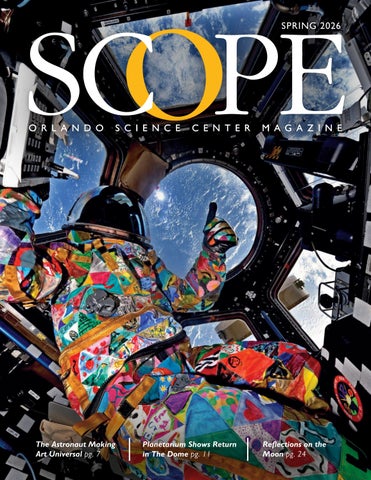
On the Cover: An astronaut dons the art spacesuit UNITY. Learn more on page 8. Photo courtesy of NASA / Space For Art Foundation. Executive Editor JoAnn Newman Editors Christina Schreiber, Jeff Stanford Contributing Writers Sydney Baker, Mac Bodden, Nicholas Chapman, Jill Goddard, Lisa Hardt, Katie Hodges, Kevin Horan, Jason Latimer, Molly Nelson, JoAnn Newman, Adriana Ocana-Lara, Gina Owen, Juanita Real, Nicole Rivera, Christina Schreiber, Dr. MJ Soileau, Jeff Stanford, Angella Van Gelder Graphic Designer Kristie Hoover Photographers Sydney Baker, Roberto Gonzalez SCOPE Magazine is published three times a year by Orlando Science Center. SCOPE accepts no responsibility for the return of unsolicited manuscripts and/or photographs and assumes no liability for products or services advertised herein. SCOPE reserves the right to edit, rewrite or refuse material and is not responsible for products. CONTACT INFORMATION Phone Number: 407.514.2000 | Website: www.osc.org | Story ideas and suggestions: pr@osc.org Orlando Science Center is supported by United Arts of Central Florida, funded in part by Orange County Government through the Arts & Cultural Affairs Program, and sponsored in part by the State of Florida through the Division of Arts and Culture and the National Endowment for the Arts. © 2026 Orlando Science Center. Title VI of the Civil Rights Act of 1964 prohibits discrimination based on race, color, or national origin including limited English proficiency, in programs or activities receiving Federal financial assistance. To learn more, please contact our Accessibility Coordinator Debra Gordon at 407.514.2029 or dgordon@osc.org, email preferred.
PRESIDENT’S MESSAGE
NEW EXPERIENCES TO INSPIRE TOMORROW’S SPACE EXPLORERS If you live in Central Florida, it’s almost impossible not to feel connected to the space industry. We’re one of the few places in the world where you can watch a rocket launch from your backyard. This region sent the first humans to the Moon, and today it’s shaping the future of commercial spaceflight, planetary science, and deep-space exploration. Orlando Science Center is an integral part of that legacy. We were founded in 1955 by passionate volunteers and educators at the dawn of the space race. From our roots as the John Young Museum and Planetarium to today, OSC has always been dedicated to encouraging our visitors to reach for the stars. This year signals an exciting chapter as we premiere new experiences primed to unlock the mysteries of space for the next generation. Leading the way is The Dome, our brand-new 8K laser-projection planetarium opening this Summer with support from Dr. Phillips Charities, Orange County Government and other generous donors. More than a simple upgrade, the Dome is a complete reinvention of our giant screen theater. The new planetarium offers a breathtaking view of the universe. Visitors will journey to the edges of the galaxy with stunning clarity and sound, being completely transported without ever leaving their seat. One floor up, Mission: Astronaut brings space training to life through immersive environments and hands-on challenges. Guests will operate a robotic arm, navigate teamwork simulations, and design off-world habitats that mirror real engineering problems astronauts tackle today. An afternoon spent in this exhibit could launch a young person on a journey culminating in a walk on another planet. But exploration isn’t powered by science alone. Creativity also plays a crucial role in moving innovation forward. Our Fusion Gallery is celebrating the connection between art and science with a remarkable installation by astronaut Nicole Stott, the Space for Art Foundation, and Space for a Better World. It includes an actual spacesuit featuring artwork from children in all 192 countries—stitched together by the same team that builds NASA’s EVA spacesuits. There’s also a collection of paintings, mixed media, and sculpture by students and astronauts alike that puts a warm, beautiful face on space exploration. These experiences all help Orlando Science Center transform curiosity into possibility. This Spring we will make space feel accessible by bringing people together to wonder, create, and explore. As humanity readies to return to the moon and beyond, we’re proud to help inspire those who will lead us into the future. Sincerely,
PRESIDENT/CEO
2
SCIENCE IN OUR LIVES
The First Step is to Wonder Imagine that for every star in the sky, there’s a question waiting to be pondered. For those keeping count, that's upwards of 100 billion unanswered questions – and that’s just for the stars in our galaxy alone. With that much to marvel at, it is no wonder we’ve been driven to explore beyond our limits; the inspiration for our wanderlust is quite literally endless! Wonder is the spark that ignites discovery, creativity, and change, but in a sea of 100 billion unanswered questions it can also make us a little less discerning. Our desire for an answer can sometimes pull us away from the answer. That’s why science matters: it gives us tools to test our ideas, to separate wonder from bias, and to turn uncertainty into understanding. Science walks a thin line between imagination and evidence. If we’re not careful, we might inadvertently seek information that confirms our beliefs rather than forming our beliefs around objective information. For example, in the late 1800s, astronomer Percival Lowell peered through his telescope and became convinced he saw vast canals carved across the surface of Mars—signs, he believed, of intelligent life. The story captured imaginations worldwide. Years later, better instruments revealed there were no canals at all. The “lines” were optical illusions, shaped by both Lowell’s expectations and the limits of his tools. His story reminds us how easily human biases can turn a faint hint into firm belief, and how science’s true strength lies in its ability to correct itself. Today, the same challenge appears in new forms. When we encounter extraordinary headlines or viral science stories online, our excitement can outrun our skepticism. Algorithms essentially curate a unique internet for each of us, and in these hyper-personalized spaces, misinformation spreads at the rate we engage with it. The algorithms feed you more of what you already believe, widening gaps in our society and pushing people apart.
Science pushes back against those biases through an iterative process we call the scientific method: wonder, research, test, revise, repeat. That's right, those five steps are not arbitrary procedures you used to pass your middle school science class; they’re the basis for critical thinking, and a guide for navigating the overabundance of information at our fingertips. Every new piece of information we encounter can either strengthen or reshape what we know. When we use the scientific method to constantly test our current understanding against new evidence, we allow for that reshaping to occur productively. The scientific method isn’t about proving ourselves right; it’s about accepting that being wrong is part of the process. That process is at the heart of what we do at Orlando Science Center. Our exhibits and programs are designed to inspire wonder, to teach visitors how to think critically about the world around them, and to let them see themselves as the scientists, engineers, doctors, and astronauts that they already are, or will become. The upcoming reopening of The Dome presented by Dr. Phillips Charities embodies that mission. Beneath its curved ceiling, guests will experience the universe as both vast and knowable; a place where imagination and evidence work together. Where wonder draws us in, but science helps us understand what we see. As science communicator Hank Green said,
“the necessary first step to uncovering truth is to not know—it is to be uncertain. We have never uncovered any truth without that first step of uncertainty.” Science begins with a willingness to admit that our first impressions might be wrong. When you combine that humility with wonder, you might be able to find the truth in 100 billion unanswered questions. For more information on why Science Matters, and resources on understanding the scientific method, visit our Mythbusting Misinformation campaign at osc.org/mythbusting-misinformation. 3
FEBRUARY 14-16
FANNING THE FLAMES OF CURIOSITY Something electric is happening at Orlando Science Center. Get ready for sensational shows, thrilling experiments, and WOW-worthy moments. Get ready for Spark STEM Fest! Every year, for one unforgettable weekend, the Science Center levels up into a palace for your imagination, bringing the buzz of discovery to new heights. Here, science is never confined to textbooks or screens – it’s alive, hands-on, and heartpounding. During Spark STEM Fest, presented by the UCF Office of Research, we take our high-energy approach and dial it up to 10 by welcoming community partners and exhibitors from Central Florida and beyond to join us in delivering exceptional STEM experiences.
What makes Spark STEM Fest so special isn’t just what you see, but what you feel. It’s the thrill of realizing that science is everywhere, in everything, and for everyone. In every corner, wonder takes root as people of all ages remember that discovery is not a one-time event, but a lifelong adventure.
NEXT-LEVEL EXPERIENCES From dance parties with robot dogs to demigod training, magic made possible through STEM or battle-bot showdowns, Spark STEM Fest has brought extraordinary experiences to our exhibit halls over the years. Whether you’re running military-grade drone simulators, participating in guided dissections, coding your own robot, or getting up close with a wildlife ambassador, every experience is designed to surprise and delight. Are you ready to see someone walk through walls? This year, we’re excited to welcome world champion magician and science educator Jason Latimer’s Impossible Science® LIVE! show back to our theater, which will include some favorites from last year, like shaping water and living art, combined with new, next-level illusions – including moving through solid objects! We don’t want to give too much away, but let’s just say you DON’T want to miss this. If space exploration is more your style, join our Upcycled Spacesuit Open Make session, put on
4
in collaboration with former astronaut Nicole Stott! Become one part astronaut, one part fashion designer as you use recycled materials to create your own wearable spacesuit for this Cosmic Upcycling themed challenge. All ages are welcome!
SPARKING SOMETHING BIGGER Beyond the exhibits and experiments, Spark STEM Fest offers something even more valuable: connection. Meet innovators from top tech and engineering organizations like Lockheed Martin, learn about STEM in action from Disney Imagineers, or transform a heart for service into life-saving skills in partnership with AdventHealth. Spark STEM Fest gives you a peek behind the curtain and a chance to try things you’ve only ever read about. You don’t need a degree to ask questions or share ideas – just curiosity.
Inspiring the Next Generation Friday, February 13, will be reserved for special Spark STEM Fest Field Trips, where students can interact with STEM professionals in Spark Labs. Teachers, make sure to book in advance! We’ll still be open to the public on Friday, but the best time for you to experience Spark STEM Fest will be between February 14 and 16.
Every spark begins small – a single question, a moment of inspiration. We’re here to help fan that spark into a flame. Come join us for a celebration of curiosity, creativity and community that reminds us all that wonder is something worth celebrating.
SCIENCE NIGHT LIVE Featuring Spark STEM Fest • February 14
Enjoy everything Spark STEM Fest has to offer – without the kids! Join us for a unique date night where we discover that love + science = magic! Or ditch the date and share the love with your friends as you explore where curiosity meets chemistry and science sparks wonder. Interact with exhibitors, community partners, and thought-provoking guest speakers, including former astronaut Nicole Stott and Christina Korp – also known as the Astronaut Wrangler – in conversation with Brendan Byrne of Central Florida Public Media's popular podcast "Are We There Yet?" Rediscover the joy of science with a Valentine’s Day twist at Orlando Science Center – where curiosity has no age limit. Get more details and tickets at www.osc.org/snl.
Presented By:
Preferred Healthcare Partner
College of Medicine | College of Sciences | CREATE (Center for Research and Education in Arts, Technology and Entertainment) Florida Interactive Entertainment Academy | Institute for Simulation and Training
5
EXHIBIT SPARK SPECIAL UPDATES GUEST
Jason Latimer Wonder Changes Everything If you attended Spark STEM Fest in 2025, you’ll no doubt remember Jason Latimer’s Impossible Science® LIVE! show, which wowed audiences with the magic of science. We’re excited to welcome Jason back in 2026, and we caught up with him in advance to hear more about what he has planned and how he sees the journey unfolding. How do you decide which scientific concepts to develop into illusions? That's a great question! Actually, it happens in reverse. I set a goal, an idea, a concept that I want to bring to life through magic, and I work backwards to figure out how to make it work through STEAM (science, technology, engineering, art, and mathematics). For instance, when I walk through a solid object... I have no superpowers, so there must be a solution, even if it's a secret. In this case, it's a mechanical solution... and now I can discuss the engineering process. My show is really about inspiring individuals to ask the questions that challenge what is possible. So, I am not deciding the concepts before I develop the illusion. I dream first, then I ask as many questions as I can to bring that idea to life. Many people think of science and magic as opposites. What would you say about how they overlap? Everything is impossible until it's not. Flight would have been considered magic – until someone asked a question about lift. Now it's possible. Even fairytales sound magical until someone asks a question that makes them real. Think of the magic mirror in Snow White. Isn’t that essentially FaceTime? If you don't understand something, you’ll call it magic, and science is the logical exploration of what is possible through curiosity and wonder.
6
How do you balance the sense of mystery with the goal of teaching real science? The art of performing magic allows me to show the power of STEAM. The illusions offer a glimpse beyond what everyone believes can and cannot happen... but with the excitement of knowing there must be a solution. This is the same thought process of finding a new cure, technology, or innovation...believing in something that is not yet
possible is the thought process that changes the world. The goal of Impossible Science is to inspire that curiosity, imagination, and critical thinking that is the backbone of all science. Has an audience member ever surprised you with a question or reaction that changed how you think about your show? All the time. I love hearing what everyone's favorite illusions are because I will tell them the science to study to figure it out. And the moment they realize that chemistry or math is not as intimidating or boring as they first thought? That's my favorite reaction. Especially when I meet them years later and they are either still working on that illusion or they have come up with their own way of doing it – or even better, the show inspired a lifelong passion. How do you hope to see your show evolve in the future? What began as a simple idea—to unite science and magic to spark curiosity—has grown into live shows, festivals, touring science centers, toys, video series, and professional development for educators. It’s been incredible to watch the impact this work is having on education. Looking ahead, I hope to bring everything we’ve built on the West Coast here as well. Our touring festivals are now traveling across the country reaching hundreds of thousands of students in rural communities. Our mission is to inspire wonder on a massive scale and remind every child, everywhere, that the next great question—the one no one has ever asked before—could come from them. And that single question could be the one that changes the world.
Come see Jason’s Impossible Science® LIVE! show at Spark STEM Fest, where he’ll walk through a sevenfoot plate glass mirror, achieve levitation, and perform illusions IN the audience. Plus, see your favorites from last year, including shaping water and bending light!
WOMEN IN STEM
Art, Space, and the Human Connection: Nicole Stott Brings the Universe Home Nicole Stott has always believed that art and science are two sides of the same coin – both rooted in curiosity and creativity. A retired NASA astronaut, aquanaut, engineer, and artist, Stott spent more than 100 days living and working in space. But it’s her mission back on Earth that continues to inspire: connecting people through the universal language of art.
artwork from youth across the globe, alongside pieces from astronauts and NASA scientists. Among the highlights is one of the Foundation’s extraordinary art spacesuits – perhaps even one touched by our own Neighborhood Science students. The celebration continues during Spark STEM Fest, when Stott will return for a fireside chat at Science Night Live. The conversation will pair Stott with her longtime collaborator Christina Korp, affectionately known as "The Astronaut Wrangler." They'll be hosted by Brendan Byrne of Central Florida Public Media's popular "Are We There Yet?" podcast. Together, they’ll share stories of spaceflight, creativity, and the future of exploration. Stott’s visit also supports another Spark STEM Fest highlight: the Upcycled Spacesuit Open Make session! Embracing the theme of Cosmic Upcycling, this challenge invites makers of all ages to craft their own wearable spacesuits from recycled materials. If scheduling permits, Stott herself will join as a expert guide, bringing her professional insight and artistic spirit to our guests.
As the founder of the Space for Art Foundation, Stott works with children in hospitals, refugee centers, and traditionally overlooked communities around the world, inviting them to create art that tells a story of hope and exploration. These works often become part of the Foundation’s celebrated “art s” – wearable canvases that have traveled from classrooms to the International Space Station.
Through every project, Nicole Stott embodies the message that science and art belong to everyone. Whether she’s floating above Earth or inspiring students here at home, she reminds us that creativity can transcend boundaries – and that the small acts of imagination we spark on this planet can ripple across the universe.
In 2023, Stott’s cosmic mission brought her right here to Orlando Science Center, where she visited students in our Neighborhood Science program. Neighborhood Science brings high-quality STEM experiences to students who might otherwise miss out, and with Stott’s guidance, participants created art that may one day become part of a future art spacesuit. For many of these young creators, it was a first step towards seeing themselves as scientists, artists, and explorers. Now, Nicole Stott is helping us take that inspiration even further. She’s helped curate a collection of art from Space for Art to be featured in Fusion: A STEAM Gallery from December 2025 through April 2026. The show features 7
EXHIBIT SPACE FOR UPDATES ART & INNOVATION
Space for Art
Showing in Fusion: A STEAM Gallery The Space for Art Foundation is on a mission of space, art, and healing. Founded by veteran astronaut and lifelong artist Nicole Stott, the Foundation envisions a world where children experiencing life’s challenges are inspired to imagine and create a positive future for themselves – a future that transcends those challenges and is brought to life through space, art, and an understanding of their role as crewmates here on Spaceship Earth. These “Artonauts” are creating art as a planetary community from hospitals, refugee centers, orphanages, and schools around the world.
Space for Art Foundation
We’re honored to bring a collection of art from Space for Art to Fusion: A STEAM Gallery from December 13, 2025 through April 4, 2026. In addition to art created by astronauts, scientists and children, we’re excited to host one of Space for Art’s art spacesuits titled BEYOND. A strikingly colorful – and functional! – spacesuit, BEYOND captures the strength and vision of the children from around the world who helped create it. Come experience the awe and wonder of how space exploration and art bring people together across our little blue orb.
Orlando Science Center Awarded 2025 City of Orlando Tech Grant to Ignite STEM Futures Orlando Science Center (OSC) is thrilled to be a 2025 recipient of the City of Orlando Tech Grant award presented by Innovate Orlando. This prestigious award will help support the upcoming 2026 Spark STEM Fest, a four-day celebration of science, technology, engineering, and math that promises to ignite curiosity and inspire the next generation of innovators. As one of our region’s most dynamic STEM experiences, Spark STEM Fest brings together local scientists, engineers, entrepreneurs, and educators for hands-on learning, live demonstrations, and interactive experiences for visitors of all ages. While this event offers guests four days of hand-on activities, presentation, and fun, it is also a catalyst for building a stronger, more inclusive STEM ecosystem in Central Florida. At the heart of Spark STEM Fest are three core goals: 1. Ignite a Passion for STEM: By showcasing the real-world applications of science and technology, OSC hopes to spark a lifelong interest in STEM, particularly among youth, so they grow into engaged, informed citizens ready to shape the future. 2. Bridge the STEM Literacy Gap: The festival will connect the public with leading local innovators, helping demystify science and foster a culture of curiosity and learning across all ages and backgrounds.
8
3. Empower Future Innovators: Through authentic interactions with STEM professionals and companies, attendees will gain insight
into exciting career pathways—and leave with the tools and confidence to pursue them. Support from the City of Orlando and Innovate Orlando helps OSC make these goals a reality. As a nonprofit dedicated to accelerating innovation and cultivating a vibrant tech ecosystem in Central Florida, Innovate Orlando plays a crucial role in shaping the region’s future. The City of Orlando Tech Grant Program aligns with the City’s vision to nurture entrepreneurship and highlight the region as a hub of creativity and technology. Spark STEM Fest is more than an event; it’s a movement. With the support from organizations like Innovate Orlando, OSC is expanding access to STEM education, celebrating local talent, and inspiring the next generation of problem-solvers, thinkers, and dreamers. In a city poised to become a national leader in innovation, initiatives like Spark STEM Fest are paving the way and ensuring that the future of STEM in Orlando is not only bright but inclusive, community-driven, and limitless.
TRAVELING EXHIBIT: JANUARY 24 - MAY 3
Produced by:
Supported by:
Sponsored by:
Mission: Astronaut is a traveling exhibition produced and toured internationally by Flying Fish, with support from The DoSeum and the Intrepid Museum.
Get ready to launch into an interstellar adventure because a brand-new exhibit has landed at Orlando Science Center! In Mission: Astronaut, presented by Florida Tech, visitors of all ages will experience what it takes to live, work, and explore beyond Earth. Through hands-on challenges and real NASA footage, you’ll train like an astronaut, experiment like a scientist, and imagine the future of space exploration. Step into your first mission briefing in Welcome to Training and meet your mentors! These fictional astronaut guides highlight the essential skills for exploring the cosmos as a team. Then conquer rocket science in Prepare for Space—pack your capsule, dock at a space station, and learn the fundamentals of aerospace engineering with this hands-on simulation. You’ll need a captain’s heart and engineer’s precision to get your crew into orbit! Next, it’s time to find out what daily life looks like far from home. Living in Space lets you experience how tricky even the simplest tasks can be when everything floats, including dinner! Try cooking, sleeping, and even just staying clean— the astronaut way! After mastering microgravity, it’s time to try Science in Space to see how research aboard the International Space Station helps us better understand our own planet. Run experiments, monitor your health, and even grow plants that could one day feed astronauts on Mars!
learning how astronauts repair and maintain spacecraft in the extreme conditions of outer space. Finally, step into The Future of Space Exploration, where your imagination is the only limit! Design habitats for future astronauts to live on distant planets and let your creativity wander to infinity and beyond! Across six immersive zones, Mission: Astronaut challenges visitors to think, move, and problem-solve like real astronauts. Each activity connects to core STEM principles in physics, biology, and engineering, while celebrating teamwork, creativity, and human ingenuity. With accessible, bilingual interpretation and universal design, this exhibit is built for explorers of all backgrounds and abilities. From firing the engines to floating in microgravity, Mission: Astronaut transforms curiosity into action, proving that the sky isn’t the limit; it’s just the beginning. So, grab your crew, power up your imagination, and get ready to blast off! Member Preview: January 24, 2026 | 10:00 a.m. – 12:00 p.m.
Your training continues in Space Operations, where you’ll assume the role of Mission Specialist and put your skills to the test, operating a robotic arm, building your own spacesuit, and 9
FEATURED FILMS Film schedule is subject to change.
DIGITAL ADVENTURE THEATER Showcasing a diverse range of shows in 25-minute, 40-minute, 2D, and 3D formats.
Going Back to Space
SPRING SEASON Cities of the Future Desert Elephants Superhuman Body: World of Medical Marvels Wings Over Water
Image credit: (ESA/Webb)
Can you tell we’re over the Moon about our plans for The Dome by Dr. Phillips Charities? One of the most exciting aspects of this project is that our upgraded 8K digital laser projection system will allow us to return to our roots as Central Florida’s premier planetarium! If you’ve never enjoyed the wonder of a planetarium, prepare for an immersive experience like no other. Our 8-story domed screen will display incredibly accurate and photorealistic recreations of the sparkling night sky. In mind-numbing detail, we will explore together astronomical phenomena like galaxies, black holes and nebulae. In our planetarium shows, visitors won’t just become space explorers
– they’ll also become time travelers. Planetariums allow us to peer back in time to see how celestial bodies have moved through the centuries, and we can explore the future thanks to advanced modeling systems. This presentation will be unlike anything you've experienced before. Humans have been gazing up at the stars for millennia for various purposes, whether they be navigating land and sea, predicting agricultural seasons, or simply wondering at our place in the universe. Our planetarium shows will bring that wonder to the heart of our Central Florida community by taking you to the edge of our galaxy and beyond. We can’t wait to embark on this journey with you.
STORYTIME CINEMA Wonder (January 10) Big Miracle (February 21)
See what is now playing, check show times, watch trailers, and more at osc.org/theaters. 10
Meet the Robinsons (March 14)) FernGully: The Last Rainforest (April 11)
THE DOME BY DR. PHILLIPS CHARITIES
The Dome: Bringing the Star Power
This Summer, Orlando Science Center will unveil a cutting edge reimagination of its iconic giant screen theater, returning the organization to its roots as a planetarium and a local leader in space science education. Thanks to a $1 million award from Dr. Phillips Charities and the support of Orange County Government and many generous donors, The Dome by Dr. Phillips Charities will premiere soon with planetarium shows, giant-screen films and laser light shows. “This contribution will help transform the Dr. Phillips CineDome into a worldclass, immersive experience that will inspire future generations of learners and innovators,” said Ken Robinson, President and CEO of Dr. Phillips Charities. “We’re proud to support a project that fosters curiosity, education, and exploration right here in Central Florida.” The renovation has been underway since August. It includes an upgrade to an 8k
ultra high-definition full dome digital laser projection system, an all-new audio system, replacement of the theater’s dome screen and installation of all new seating. There will also be a new theater lobby featuring hi-res LED screens and automated concessions, including popcorn, candy, and beverages.
projection technologies will present planetarium shows and movies that will take guests around the globe and deep into space, helping to inspire science learning for all. The reconfigured seating will also allow for guest speakers, live shows and demonstrations during special events.
Since 1997, the Dr. Phillips CineDome has thrilled almost 4 million viewers with giant screen documentaries. Its 79-foot diameter tilted screen pitched over its 300+ seats makes the Dr. Phillips CineDome one of the nation’s largest dome theaters. This new system will enable dynamic storytelling in the digital age, enabling the Science Center and its partners to showcase mindblowing imagery and engage audiences in innovative ways.
“The CineDome has amazed and engaged hundreds of thousands since 1997,” said JoAnn Newman, President & CEO of Orlando Science Center. “This incredible support from Dr. Phillips Charities, Orange County and others is revolutionizing our theater and returning planetarium shows to Loch Haven Park. The Dome will inspire curious minds of all ages and instill passion for a world of unlimited possibilities.”
This stunning, all-encompassing environment will be a launching pad for exploration on many subjects. New
Please visit www.osc.org for updates on the premiere and show schedule. 11
CALENDAR
JANUARY
FEBRUARY
HEALTH MONTH
SPARK MONTH
Join us as we explore the science of health and wellness. From interactive programs to educational films and dissections, there's something for everyone. Discover how small choices can lead to big benefits!
From explosive live shows and wild animal encounters, to ooey gooey science experiments, we're pulling out the most popular, fan-favorite programming, culminating in our BIGGEST event of the year - Spark STEM Fest!
1&2 3 3&4
7&8
SATURDAY & SUNDAY Bank of America Weekend
SATURDAY Community Partner Showcase Day
13
FRIDAY Spark STEM Fest Field Trip Day OSC closes at 3:00 pm to prepare for Spark STEM Fest
SATURDAY & SUNDAY Bank of America Weekend
5
MONDAY 1-Day Camp*
14-16
5
MONDAY Final Day 2theXtreme!
SATURDAY – MONDAY Spark STEM Fest Presented by UCF Office of Research
14
SATURDAY Storytime Cinema Wonder (2017) 11:30 am - Based on the book “Wonder” by R.J. Palaciio
SATURDAY Science Night Live Featuring Spark STEM Fest! (Ages 18+) 8:00 – 11:30 pm
21
SATURDAY Storytime Cinema Big Miracle (2012) 11:30 am - Based on the book “Big Miracle” by Tom Rose
21
SATURDAY Solar Saturday Observatory Open 11:00 am - 4:00 pm
10
10
12
THURSDAY - FRIDAY Break Camps*
SATURDAY Solar Saturday Observatory Open 11:00 am - 4:00 pm
10
SATURDAY Girl Scout Adventures* Registration required
21
WEDNESDAY Unveil Wedding Showcase 6:00 – 8:00 pm
24
SATURDAY Science on Tap* Fundraiser in Loch Haven Park 1:00 – 4:00 pm
24
SATURDAY Exhibit Premiere Mission: Astronaut Member-Only Preview 10:00 am – 12:00 pm
Member Summer Camp Pre-Sale January 1-31 Get your best discount of the year on Camps before they go on sale to the general public! See page 20 for more details.
All events subject to change *Additional fee required
MARCH
APRIL
ENGINEERING MONTH
CONSERVATION MONTH
Get ready for a celebration of innovation and imagination! Plug into the exciting world of engineering, where build-ityourself activities spark curiosity and build problem-solving skills. If you can dream it, you can build it!
Celebrate the great outdoors. Through wildlife encounters, eco-crafts, and hands-on activities, explore ways to make a difference for our planet. Come connect with nature and leave inspired to care for our world - together!
7
SATURDAY Community Partner Showcase Day SATURDAY & SUNDAY Bank of America Weekend
7&8
FRIDAY 1-Day Camp*
13
14
SATURDAY Storytime Cinema Meet the Robinsons (2007) 11:30 am - Based on the book “A Day with Wilbur Robinson” by William Joyce
14
2
THURSDAY Inspire Science Breakfast Fundraiser Registration required 8:00 – 9:00 am
4
SATURDAY Community Partner Showcase Day
4
SATURDAY Bank of America Weekend
5
SUNDAY OSC is Closed Easter Sunday
11
SATURDAY Storytime Cinema FernGully: The Last Rainforest (1992) 11:30 am - Based on the "FernGully" stories by Diana Young
SATURDAY Solar Saturday Observatory Open 11:00 am - 4:00 pm
14 & 15
SATURDAY & SUNDAY Make Fest
11
SATURDAY Solar Saturday Observatory Open 11:00 am - 4:00 pm
16 - 20
MONDAY – FRIDAY Spring Break Camps*
18
SATURDAY Girl Scout Adventures* Registration required
19
SUNDAY $15 Day Discounted Admission
24
FRIDAY 1-Day Camp*
25
SATURDAY Science & Wine* Presented by Southern Glazer’s Wine & Spirits OSC closes at 3:00 pm to prepare Fundraiser (Ages 21+) 7:00 – 10:00 pm
EVERY DAY DURING
SPRING BREAK For Orange and Seminole County Public Schools
13
SCIENCE MATTERS: HOW VACCINES WORK
A Shot at Life:
The Science Behind Vaccines Vaccines are one of science’s most powerful tools for protecting human health. They work by training our immune systems to recognize and respond to harmful germs before they can make us sick. Instead of fighting a disease after it strikes, vaccines give our bodies a “practice run,” preparing them to respond quickly and effectively in the future.
How do vaccines work?
Understanding how vaccines work and how they’ve shaped public health helps us make informed decisions for ourselves and our families. The basic idea is simple: vaccines introduce a harmless version or piece of a germ into the body. This teaches our immune system to recognize the real thing, so if we ever encounter it, our defenses are ready! Getting vaccinated is a personal choice, and there are many reasons individuals may not participate, including potential allergies, reliable access, or religious beliefs. But one great thing about vaccines is that they don’t require a 100% vaccination rate to be effective! When enough individuals in a community are vaccinated, a disease’s ability to spread is vastly diminished, contributing to a concept called herd immunity. This provides protection for all members of a community by meeting a vaccination threshold. Psst! Vaccines aren’t just for people; they protect animals, too! House pets generally receive core vaccines when they’re young. This helps protect them from viruses that impact their species, such as rabies and distemper! For example, let’s look at measles. For an unvaccinated population, one person infected with measles can infect up to 18 others on average. But if, say, 15 of those people have been vaccinated, the disease has much less opportunity to spread. To achieve herd immunity, 92-94% of a population must be immunized against measles to protect the whole group.
A (Very) Brief History of Vaccines
The idea of vaccines began centuries ago, but the first vaccine as we know it was created in 1796 by Dr. Edward Jenner, who discovered that people infected with cowpox
14
were immunized against smallpox. Throughout the 19th and 20th centuries, scientists used similar processes to develop vaccines for diseases such as rabies, polio, measles, and influenza. Modern research uses advanced methods like genetic sequencing and mRNA technology to create new vaccines. The research that supported the development of the COVID-19 vaccines was in development as early as the 1970s! For a more in-depth history of vaccines, visit our webpage.
Proof in Progress
Science is never static – it’s a process of discovery and refinement. Just as paleontologists have revised what we know about dinosaurs, immunologists continue to deepen our understanding of how the human body defends itself. Thanks to centuries of progress, diseases that once devastated communities are now preventable or nearly extinct. Here are some of the incredible things vaccines have helped accomplish: • In 1980, smallpox was officially declared eradicated by the WHO. • Polio cases have decreased by over 99% since 1988. • Worldwide, measles deaths have decreased 78% in the last ten years. • According to an article in the Journal of Paediatrics and Child Health, COVID-19 vaccines prevented an estimated 14.4 million deaths. To learn more about How Vaccines Work, our newest Science Matters campaign, visit osc.org/how-vaccines-work.
SPECIES SURVIVAL PLAN
A Tiny Arrival with a BIG IMPACT Our baby is the first to join the red-rumped agouti Species Survival Plan in 5 years - a milestone we're proud to be part of. Achievements like this represent years of careful collaboration among animal care experts, veterinarians, and conservation scientists dedicated to sustaining healthy, genetically diverse populations.
In Summer 2025, our animal care team welcomed a new baby red-rumped agouti (Dasyprocta leporina)! The little one was healthy, active, and thriving – a joyful sign of success for our animal care team and the species itself. Native to the rainforests of South America, red-rumped agoutis play a surprisingly mighty role in their ecosystems. As the only mammals in Brazil capable of cracking open Brazil nuts, agoutis are a keystone species that make a huge impact on their environment!
By the time you read this, our young agouti will have already moved to her new home as part of the SSP. Agoutis reach breeding age at about six months, so she’s now beginning the next chapter of her life, contributing to the broader conservation effort she helped revitalize. While it’s bittersweet to see her go, her journey embodies what these programs are all about: ensuring the survival of species and the health of ecosystems far beyond our walls. Our baby agouti’s story reminds us that even the smallest creatures can make a world of difference. As we continue to grow our conservation work, we look forward to the day that more baby agoutis – and the forests they help sustain – can flourish for generations to come.
By gnawing through the hard pods, eating some of the nuts, and burying others for later, they help disperse seeds and grow new trees, sustaining the forest’s health and diversity. Without agoutis, Brazil nut trees and the many species that depend on them would struggle to survive. In the wild, deforestation and hunting threaten both agoutis and the ecosystems they support. That’s why institutions like Orlando Science Center participate in cooperative conservation efforts to protect species like these! We are currently pursuing accreditation with the Association of Zoos and Aquariums (AZA) and are working closely with the AZA Species Survival Plan (SSP) for red-rumped agoutis, which helps manage populations in human care to ensure long-term sustainability for the species.
15
IMMERSE FEST DOWNTOWN ORLANDO FEBRUARY 20-22
Bringing the Heat: Orlando Science Center at IMMERSE Fest
Last year at IMMERSE, an epic interactive art festival in the heart of downtown Orlando, our Public Programs Team transformed Orange Avenue with giant foam reactions that made gas expansion and reaction rates impossible to miss. This year, we’re reaching new heights!
By applying principles of chemistry, physics, and engineering, we will create a controlled fire tornado that can reach up to 15 feet (4.5 meters) and turn a city block into a living classroom. We’re replacing bubbles with a vortex as we explore combustion and fluid dynamics, guaranteed to be a showstopper downtown. The result will be a dancing column of flame that vividly brings complex STEM ideas to life through science and creativity. A fire tornado is a rotating column of flame that forms when rising heat, inward airflow, and organized spin combine. Heat from the flame makes the air buoyant, lifting it and creating a low-pressure core. Surrounding air rushes inward to replace what has risen. If that inflow develops a steady swirl, conservation of angular momentum stretches the flame into a tall, spinning column. To demonstrate this fiery display safely, our Public Programs Team will start with the fire triangle of fuel, oxygen, and heat, using swirling airflow to organize rising hot gases into a twirling vortex. But what’s a fire tornado without a splash of color? In a flame, energy excites the outer electrons of an atom. As those electrons return to lower energy levels, they release specific packets of light called photons. The energies of these photons are unique to each element, which explains why different substances produce different colors in fire. For example, sodium salts produce a bright yellow glow when tossed over a flame, while boric acid produces a vivid green because of boron. This year we are raising the bar. We are moving from foam to flame, from reaction rates to rotating vortices, in a festival that shows how science can be playful, welcoming, and full of discovery for everyone. Whether you are seeing your first flame test or revisiting high school chemistry through a new lens, we aim to spark curiosity. Join us downtown February 20-22 and watch us light up the night during IMMERSE, where art, performance, and STEM meet. Learn more at www.immersefest.com. 16
Credit: NOAA/JPL-Caltech
RECOMMENDED FOR AGES
3+
TRY THIS AT HOME
Balloon Rockets Propel a balloon using Newton's 3rd Law! Materials:
• 1 Balloon • 1 Straw
• Tape • 10 feet (3 meters) of string
Directions: 1. Thread your string through the straw. 2. Secure each end of the string to a stable anchor point like a chair or a table with tape. Make sure the thread is level. 3. Inflate the balloon but don’t tie it! This will be your rocket. 4. Instead, keep the end pinched and tape the balloon to the bottom of the straw so that the balloon is laying on its side with the pinched end pointing towards one chair. 5. Then, let go! Watch as the balloon propels itself to the other side of the string!
What’s Happening?
Dig Deeper!
Newton’s Third Law of Motion that states “For every action, there is an equal and opposite reaction”. Because of this, as the air leaves the balloon from one direction, the balloon moves in the opposite direction!
Use different balloon shapes (long balloons, water balloons, etc.) to see how it effects the travel distance of the balloon! Does more air make it go farther? Will a lighter balloon travel faster?
17
Homeschool Program Homeschool families can choose from our Homeschool Adventure Days or our Homeschool Field Trip opportunities to expose students in Grades K-8 to a variety of topics, offering them the opportunity to engage with their peers and encounter hands-on STEM activities. For more details, including pricing and registration, visit osc.org/homeschool.
Homeschool Adventure Days
NEW! Homeschool Field Trips
Each month’s program features a unique themed lab topic.
This Field Trip is designed exclusively for homeschool co-ops and individual homeschool families!
February 2: Aerospace Engineering March 2: Environmental Science April 6: Renewable Energy May 4: Chemistry
Enjoy a guided experience that includes a hands-on lab, interactive exhibits, a show and time to enjoy lunch together. Check out our website above for available dates.
STEM starts here! Our trained preschool educators guide 3-5 year-old children as they build critical 21st century skills in a fun and safe environment.
Now enrolling 3-year-olds for the 2025-2026 School Year At Orlando Science Center’s NAEYC-accredited Preschool, children benefit from a developmentally appropriate learning space with hands-on STEM activities, skill-building centers, and exhibit experiences. Contact Reservations at 407.514.2112 or visit osc.org/preschool for more information. We are happy to accept Step Up for Students Scholarships and VPK vouchers for this school year. Licensed by the Department of Children and Families • Childcare Center C09OR0729 Voluntary PreKindergarten Provider (VPK) • Accredited by the National Association for the Education of Young Children (NAEYC)
18
Girl Scouts STEM Adventures
Girl Scouts, get ready to discover, connect, and take action! Orlando Science Center offers troops hands-on STEM adventures designed to turn curiosity into skills and badges for Daisies through Cadettes! Each session combines teamwork, problem-solving, and lots of experimentation. Spots are limited, so rally your troop and register at osc.org/girl-scouts!
JANUARY 10 Girl Scouts Sleuths: Forensic Files Think like an investigator and use evidence to solve a scientific mystery using skills like blood typing and ink sampling.
APRIL 18
RoboScouts Explore how robots "think" and communicate! Build and program a simple robot to complete a task and decode secret messages.
.
Troop Circuit Club Spark creativity as you get hands-on with circuits, sensors, and simple coding. Improve your design skills by building a robot of your own creation!
SpeedScout Lab Turn your troop into a pit crew! Design, build and test mini race cars while exploring forces, friction, and how shape affects speed.
Orlando Science Center SCIENCE COMPETITIONS
To inspire students to develop their interest in STEM fields, Orlando Science Center hosts science competitions for Grades K-12 each year. As students grow and gain experience, they can participate in more challenging competitions with the chance to win cash prizes and scholarships! Visit www.osc.org/competitions to learn more. Curtis Rising Stars Challenge (Grades K-5) A fun introduction to science competitions that builds teamwork and problem-solving skills. Classes complete preparation activities in school, and then gather for a one-day event at Orlando Science Center to demonstrate their 21st Century Skills by solving engineering challenges. Curtis Kinetic Science Competition (Grades 6-8) Teams of up to five students turn everyday objects into a functioning kinetic system inspired by Rube Goldberg. Students refine, test, and present their creations to judges for cash prizes and bragging rights.
Lockheed Martin Science Challenge (Grades 6-12) Top projects from county science fairs present to expert judges for feedback and a pathway to the state fair. This is a great next step for students looking to advance their research. Dr. Nelson Ying Science Competition (Grades 9-12) The Ying Competition celebrates outstanding individual research across STEM fields centered around one unifying theme: helping humanity through science. The competition has been a local partnership since 1999 that recognizes high school innovators with awards. 19
ORLANDO SCIENCE CENTER
STEM Camps SUMMER CAMPS Make this summer an exciting STEM adventure with camps for Preschool through Grade 6, with topics like robotics, space, engineering, nature, and many more. Offsite Camps for Grades 2-5 at the 4Roots Farm Campus are back for a second year through our partnership with 4Roots! Download the Summer Camps Guide at osc.org/summer-camps to get a sneak peek at our Camp themes that are so engaging, your camper won’t even realize they’re learning!
BREAK CAMPS From space exploration to nature expeditions, Orlando Science Center’s School Break Camps offer campers hands-on experiences that bring stories to life and reveal the wonders of STEM. Camps are offered for Preschool through Grade 5. General pricing, as well as Member pricing, is available so you can save on science! Learn about upcoming themes and register at osc.org/break-camps. 20
*Preschool is a DCF licensed center C09OR0729.
Member Pre-Sale January 1-31
Get your best discount on Camps all year and sign up before they go on sale to the general public! *Membership must be active and valid from the date of purchase through the final date of the selected camp sections
Upcoming Dates Spring Break Camps March 16-20
One-Day Camps January 5, March 13, & April 24
January 24 • Outdoor Beer Festival SUPPORTING SPONSORS: The fourth annual Science on Tap beer festival is happening on Saturday, January 24, 2026! Hop in for an afternoon of brews, food, and science while supporting a good cause. Science on Tap features local breweries from around Central Florida who will be sampling some of their best brews in Loch Haven Park. Enjoy this family-
friendly event as you sip your way through interactive science demos, check out live music, challenge your kids or your friends to lawn games, and delight in a few tasty treats purchased from several popular food trucks. Proceeds from Science on Tap support access to high-quality STEM learning at OSC. Proceeds
from Science on Tap support OSC programming that helps build important skills and illustrate the power of science to address real world challenges. Follow us at @orlandosciencecenter for more information and grab your tickets at Science on Tap. Cheers to a Happy New Year!
This project is funded in part by Orange County Government through the Arts & Cultural Affairs Program.
SATURDAY, APRIL 25 Sip, savor and support STEM with OSC's annual Science & Wine fundraiser. This exciting food and wine experience welcomes guests to enjoy an evening of live music, gourmet hors d'oeuvres, and wine tastings from diverse regions while experiencing all the Science Center has to offer. Guests will enjoy an evening of learning while engaging with professional chefs and sommeliers, attending wine seminars, networking, and participating in STEM activities
throughout the evening. Uncork your inner scientist and delight in Central Florida’s culinary community! Bid on unique items and experiences during our exciting silent auction. Our auction will feature tickets to entertaining events, stunning jewelry, and adventurous trips around the state and beyond. Enjoy this adults-only night out in support of public access to high-quality STEM learning and visit Science & Wine for updates. 21
SCIENTIST SPOTLIGHT: BLACK HISTORY MONTH
A Helping Hand for the Next Generation Hard Work is Adding Up for Jasmine Sadler While many students were still learning the basics of Algebra, Jasmine Sadler was already tutoring her middle school classmates. After her teacher complimented Jasmine on the respectful and constructive way she corrected her in class, Jasmine realized that she had a gift for math and helping others. That moment continues to inspire her choices. Raised in a tech-savvy family fluent in technology with computer specialist parents and a computer engineer brother, Jasmine was encouraged to pursue engineering. A national disaster confirmed her choices. “Just before submitting college applications, the Space Shuttle Columbia disaster inspired me to pursue Aerospace Engineering as my way to save the lives of astronauts doing the coolest job in and out of this world!” she said. An accomplished dancer, Jasmine balances her passions between science and the arts. An MBA trained as both a rocket scientist and a ballerina, she believes diversity is key to success in everything. She said, “Being 22
an African American woman in engineering energizes me because I provide a diverse perspective, which leads the team to more innovative solutions.”
A software design engineer, test engineer, and quality engineer, Jasmine described her aerospace career as being focused on “turning air into energy.” She now channels her talent and expertise through her company, The STEAM Collaborative, which reimagines STEM through an artistic lens to increase access and equity in education. Jasmine is dedicated to creating opportunities for young female engineers by mentoring her “little sisters” and paying forward the support she once received. She works to ensure the next generation enters the workforce stronger and more confident. Her leadership has earned national and global recognition, including the Moxie Theatre Awards, PLNU MBA Student of the Year, the University of Michigan Making a Difference Award, and the Hera Hub STEAM Trailblazer Award. She also shares her powerful story through workshops, panels, and speaking engagements, and recently launched Jas:Maven to connect people through inclusive, diverse experiences.
SCIENTIST SPOTLIGHT: WOMENS HISTORY MONTH
From Childhood Wonder to Cosmic Discovery Mimi Fuchs's Journey Back to Space Mimi Fuchs came home one day in 5th grade after learning about Neptune’s seasons, and she challenged her uncle to guess what she planned to be when she grew up. After several wrong answers, she proudly exclaimed that she was going to be an astrophysicist... and a dream interpreter! That bold declaration captured the essence of a curious, imaginative child who saw no limit to what she could become. But like many young women considering STEM careers, Mimi’s ambitions dimmed as she got older. By high school, she became discouraged and doubted if she could ever find her place in science. Without visible role models, her dream felt out of reach. An encounter with her college mentor changed everything by encouraging her to follow her childhood ambitions.
skillset might match up better than I thought. Now I collect data for scientists from around the world and help them investigate some of the biggest mysteries of our cosmos!” Today, Mimi spends her nights 14,000 feet above sea level atop the summit of Maunakea in Hawaii, working as a Telescope System Specialist for the James Clerk Maxwell Telescope, which is the world’s largest single-dish submillimeter telescope. She is responsible for capturing pristine observations that help scientists study how stars and planets form. She also spent several years at the Smithsonian Astrophysical Observatory’s Submillimeter Array where she helped the Event Horizon Telescope collaboration take the first picture of a black hole.
Prior to working in telescope operations, Mimi used to spend her days making science exciting for learners of all ages at the North Carolina Museum of Life and Science and Philadelphia’s The Franklin Institute. She received her B.S. in astrophysics and the Louis Green Prize in astronomy from Haverford College in 2013. When she’s not working with telescopes, she’s often found hiking or scuba diving and enjoys cooking with friends and family. Mimi’s journey shows what can happen when childhood curiosity meets encouragement at the right time. She is a powerful reminder that youth need mentors to boost their confidence, inspire their ambitions, and ignite their creativity. Only then can their dreams truly take flight.
“She invited me to her astronomy research lab, where I learned that collaboration is crucial to success and that programming was a language like any other that allowed me to express myself and solve problems that far exceeded answers found with pencil and paper,” Mimi said. “I realized my 23
SCIENTISTMATTERS: SCIENCE IN RESIDENCE SCIENTIST IN RESIDENCE
Reflections from the Moon: The Science of Retroreflection
A Guest Feature from Dr. M.J. Soileau, Scientist in Residence
Have you ever wondered what would happen if you shined a laser at the Moon? It turns out that the Apollo 11 astronauts did an experiment that directly answers that question. The experiment was to shine a laser at the Moon to determine the exact distance between the Earth and the Moon! The concept of this experiment is simple: shoot a laser pulse at the Moon and measure how long it takes for the pulse to travel from the Earth to the Moon and back, multiply by the speed of light (299,192,400.000 meters per second), then divide by two. 24
The key parts of this experiment were: 1. A ruby laser that produced 1.2 billion-watt pulses that lasted just 10 billionths of a second. The shorter the pulses, the more accurately we can measure the time. 2. A simple device called a retroreflector. A common myth about lasers is that their beams do not spread. They indeed spread, though a minimal amount, limited by a process called diffraction (spreading). There is a fundamental limit to the spreading set by the ratio of the wavelength of light to the beam diameter.
The wavelength of the laser light was 694 billionths of a meter, a deep red color. Scientists used Lick Observatory’s 120-inch (3-meter) diameter telescope to collimate (align in parallel) and direct the beam. Thus, the beam spreading angle was about a thousand times smaller (but not zero) than the light directly out of the laser. The net result was a laser spot on the Moon about 1.6 km (about a mile) in diameter. Sci-Fi has fueled myths of planet-killing lasers. The light from the 1.2-billionwatt laser irradiating a circle one mile in diameter on the Moon’s surface does absolutely nothing to the Moon! Power is energy per unit time. The energy
reflected beam equals the angle of the incident beam. Retroreflectors reflect any light striking their face directly back to the source of light, independent of the angle of incidence! There are two basic types of retroreflectors: the corner of a cube (used by the Apollo astronauts) and “cat’s eye” (small spheres). Fig. 1 Pictures Buzz Aldrin carrying the tray of corner cubes in his right hand. He only needed a
of the laser beam was 7 joules, which is about enough to heat an ounce of water half a degree Fahrenheit. The special properties of laser light allow us to deliver the energy in a short pulse, which helps measure the beam's travel time and detect the small amount of light returned to the Lick telescope. The Lick telescope has a massive mount and a sophisticated pointing and tracking system for aiming at the Apollo site, which accounts for the potentially problematic impacts of the Earth's rotation on its axis, the Moon’s movement in its elliptical orbit around the Earth, and the Moon’s rotation on its axis. Another problem to solve was that the laser light on the lunar surface would be mostly absorbed and scattered, with little laser light reflected to Earth - unless there was a highly reflecting mirror on the Moon’s surface accompanied by all the machinery to exactly point and track the reflected beam back to the Lick telescope. In other words, something as big as the Lick Observatory itself! Ridiculous, of course! However, there was a clever, simple solution: retroreflectors! For a regular mirror the angle of the
sundial to align them. Each Apollo Moon mission left behind retroreflectors, and lasers and other technologies have improved over the decades, enabling measurement of the Earth-Moon distance to seven decimal places! The retroreflectors left by the Apollo crews are still doing their jobs, unattended! Retroreflectors are common in our everyday lives. Tiny glass or plastic
spheres embedded in paint enhance traffic lane visibility. Emergency responders and police wear vests marked with retroreflectors to make them highly visible at night. Blue retroreflectors in the center traffic lanes mark fire hydrant locations along dark roads. A little aside: my father, who only attended school for two years, taught me about retroreflection. Pre-WWII, he earned part of his living catching bullfrogs in the Louisiana swamps. One mounts a headlight on the forehead, and the retroreflection from the frog eyes reveals their location. I have great memories of using optics to hunt frogs at night with my dad. About now is the time when people ask the question, “But why?” Scientists around the world use retroreflectors at the four Apollo landing sites to test the limits of General Relativity and to study the geology of the Earth and the Moon. Modern GPS depends on General Relativity and variations of Earth’s gravity for accuracy. Figure 1: Buzz Aldrin carrying the retroreflector tray in his left hand, Credits: NASA Figure 2. Retroreflector tray with lander in background, Credit: NASA-Johnson Space Center Figure 3: Lick Observatory, Credit: UC Santa Cruz University Library 25
SCIENTIST IN RESIDENCE
ASK A SCIENTIST
Our inaugural Scientist in Residence, Dr. M.J. Soileau has a passion for learning and educating the community through STEM. You’ve asked him some of your burning questions and he has answered!
How are crayons made? Crayons are made by mixing melted paraffin wax with a carefully measured amount of paint pigments to produce many colors. The mixtures of pigments and paraffin wax are then poured into special molds in the desired shape and allowed to cool and become solid.
How do you do a DNA test? Expert scientists and trained technicians do genetic tests using specialized instruments. For example, a thermocycler can split and amplify DNA, allowing scientists to create multiple copies of the same strand. A gel electrophoresis machine takes film of the scientists’ findings to allow closer examination. You must supply a blood or spit sample for testing, and results are usually ready in a few weeks.
How long does it take to be a scientist? Human children are born curious, and as soon as they can, they start observing and experimenting to try to understand how nature works. Therefore, you are born a scientist!
But how long does it take to become a professional scientist? You can get an associate’s degree (AA) in two years to become a science technician. The technicians in science work with more senior scientists to take data, setup equipment, and troubleshoot equipment in experiments or applications. Those wanting to have a career doing scientific research must first attain a baccalaureate degree (Bachelor of Science or BS degree). This takes about four years of hard 26
Image credit: NASA Goddard
(but fun!) work and lots of math. While one can get a job as a scientist with a baccalaureate degree, it takes a PhD degree in the subject matter to be able to do pioneering research and lead research teams. This takes another 4 to 6 years of work and study. However, the work is rewarding, and the career opportunities are limitless! The reality is that scientists never stop learning. One must keep up with advances and every new thing you learn in doing research presents new and exciting challenges. To be a scientist means a lifetime of learning.
What causes meteors to crash into Earth? The simple one-word answer is gravity! The gravity associated with the Earth’s mass attracts other matter. Meteors are mostly sort of space junk (mixtures of rock and ice) left over from “dead comets” (comets broken apart by the Sun’s gravity) or left over material from the formation of our solar system. Meteors from “dead” comets mostly follow the same orbit around the Sun as the comet did before it broke apart. Solar winds push some of the particles along the orbit of the former comet. When our Earth encounters this debris, we have a shower of meteors, sometimes hundreds per hour.
SUPPORT
Top 3 Reasons to Save Early 1. Beat Rising Costs
Lock in today’s tuition rates and avoid future price hikes with the Prepaid 529 Plan.
2. Budget-Friendly
Start small and grow your savings over time—every dollar counts.
3. Peace of Mind
Know you’re investing in your child’s future with guaranteed options.
Start Saving Today: Florida Prepaid Makes College Planning Simple and Stress-Free College may feel far away, but here’s the truth: the earlier you start saving, the easier it is to make your child’s dreams a reality. Florida Prepaid is here to help families like yours take the guesswork out of college planning—with two flexible, affordable options designed for every budget and every future.
Why Start Now?
Planning Made Simple
Think of saving for college like planting a tree—the sooner you start, the stronger it grows. With Florida Prepaid, you get peace of mind, wrapped in simplicity and affordability.
Not sure which plan fits your family best? Florida Prepaid’s new website features the Plan Builder Tool, a quick and interactive way to explore options and customize a savings strategy that works for you. It’s like having a financial coach at your fingertips—minus the jargon.
Two Plans. Endless Possibilities. Florida Prepaid offers two easy ways to save: • Prepaid 529 Plan: Pay for future tuition and fees at today’s prices. Choose from simple plan options—like a 1-Year Prepaid Tuition Plan or a 1-Year Dormitory Plan—and know your investment is guaranteed by the State of Florida. • Investment 529 Plan: Want flexibility? This plan lets you invest for college expenses with tax advantages and growth potential. You decide how much and how often to contribute.
Fun Fact: More than 1.3 million families have trusted Florida Prepaid to help their kids reach for the stars. Why not join them?
Ready to Get Started?
Visit myfloridaprepaid.com and see how easy it is to open a plan in minutes. Your future college graduate will thank you—and you’ll feel great knowing you’ve taken the first step toward their success.
Prepaid Plan Open Enrollment is February 1 - April 30, 2026
27
SUPPORT
A. Friends’ Foundation Trust
28
Orlando Science Center’s Ignite Discovery program brings hands-on STEM experiences to preschool students, provides educators with teacher professional development to enrich their STEM curriculum, and empowers caregivers with the tools needed to support their child’s learning journey. This program is funded in part by Orange County, Florida. We are proud to partner with Orange County Head Start to bring this dynamic programming to our youngest learners and grateful for funding provided by Orange County’s Citizen Review Panel to support this ongoing program. By sparking curiosity at an early age, Ignite Discovery lays the foundation for future success in school and beyond. Thank you, Orange County, for supporting the innovators of tomorrow through Ignite Discovery.
The generous, ongoing operating support we receive from donors like the A. Friends Foundation fuels the programs you love at the Science Center, from worldclass exhibits to hands-on demonstrations. Because of their generosity, visitors of all ages can explore, create, and build the skills they need to tackle life’s biggest challenges. The Foundation’s commitment to strengthening Central Florida through investments in education, the arts, youth development, and community well-being aligns perfectly with our mission to inspire science learning for all. Together, we’re empowering the next generation of thinkers, creators, and problem solvers. Thank you, A. Friends Foundation, for helping us be the spark that ignites innovation in our community!
The Orlando Science Center is grateful for the generous support of Orange County Arts and Cultural Affairs for the CineDome Renovation Project. This project is funded in part by Orange County Government through the Arts & Cultural Affairs Program by collections of the Tourist Development Tax (TDT). The renovation will modernize the Dr. Phillips CineDome, replacing its massive 8,000-square-foot dome screen, integrating new digital technology, updating seating, and refinishing the space to enhance comfort and accessibility. Once completed, the upgraded CineDome will deliver a stunning, immersive visual experience and expand its capabilities as a planetarium, inspiring curiosity and learning for generations to come. Thank you, Orange County Government, for investing in innovation and education through the arts.
The PNC Foundation, through its PNC Grow Up Great® initiative, plays a vital role in expanding the reach of Orlando Science Center’s Ignite Discovery early childhood outreach program. Through this collaboration, we’re strengthening early learning across our community and inspiring a new generation of problem solvers. PNC’s generous support has helped bring hands-on STEM learning to even more young children by expanding programming to AdventHealth’s West Lakes Early Learning Center. Since 2004, PNC Grow Up Great® has empowered children from birth through age 5 to develop a lifelong love of learning. Thanks to funders like the PNC Foundation, Ignite Discovery continues to nurture curiosity, confidence and creativity, building a strong foundation for future success in school, work and life.
INVEST IN THE FUTURE with a Corporate Membership
Partner with Orlando Science Center to align your brand with one of Central Florida’s most trusted community institutions and open a world of possibility for telling your own story. The Science Center offers a wide range of relatable and impactful content that provides unique opportunities to empower your message and deliver it to a diverse and deeply curious audience. As a Corporate Member, you will support a wide range of rich and dynamic programming that brings STEM education to thousands across Central Florida and beyond. This includes hands-on exhibits, compelling live shows, and impactful programs and events that reach over 660,000 guests annually.
Unlock a world of benefits designed to enrich your corporate culture, engage your employees, and cultivate your clients. Corporate Members receive a range of exclusive benefits based on the level of giving.
ALL CORPORATE MEMBERS ENJOY: • Complimentary general admission passes to Orlando Science Center. • Complimentary VIP tickets to special events. • Recognition on OSC’s Donor Wall, Community Impact Report, website, e-blasts, and newsletters. • Exclusive invitations to OSC Board Socials and special receptions. • Learn more!
29 For more information, contact Heather Mahoney, Director of Corporate Relations, at hmahoney@osc.org or 407.514.2014.
INDIVIDUAL GIVING
Supporting Young Minds and Bright Futures Mia and William Poinsette have long been committed to helping young people reach their full potential. Through the Poinsette Foundation, they focus on creating opportunities, supporting families, and strengthening communities across Central Florida. Their goal is simple but powerful: to ensure that every child has the resources and encouragement they need to explore, learn, and grow. The Poinsette Foundation takes a hands-on approach to philanthropy, known as Wraparound Philanthropy™, which invests in the full ecosystem surrounding youth. By addressing the different factors that shape a child’s success—from family support to community resources—the Poinsette Foundation helps create experiences that are both meaningful and longlasting. Their work emphasizes guidance, encouragement, and access to opportunities that ignite curiosity and confidence in young people. Mia Poinsette shares why they focus on STEM and education:
Supporting STEM education is a way to empower young people to become creators, problem-solvers, and leaders in a world that will depend on their ingenuity.
The Poinsette Foundation believes that potential exists everywhere, and every child deserves the chance to discover their passions. Their giving strategy prioritizes listening to communities, building authentic partnerships, and asking how resources can create the greatest impact over time. Through these efforts, the Poinsette Foundation hopes to spark a ripple effect: children gain confidence and skills, families feel strengthened, and communities are inspired to lead local initiatives. Partnering with organizations like Orlando Science Center allows the Poinsette Foundation to extend these opportunities even further. Through initiatives such as Science For All and Neighborhood Science, OSC brings hands-on STEM learning directly into communities. Their support helps OSC reach more children and families, complementing the Foundation’s broader goal of fostering curiosity and growth across Central Florida. Looking ahead, they envision a future where every child feels empowered to imagine what’s possible, pursue their interests, and take on challenges with confidence. Their commitment goes beyond a single program or moment — it’s about creating lasting opportunities and experiences that help shape capable, creative, and thoughtful leaders of tomorrow. The Poinsette Foundation’s dedication to youth, families, and communities demonstrates that when resources, guidance, and encouragement come together, every child can achieve more than they ever imagined Orlando Science Center is proud to welcome the Poinsette Foundation as Innovator Members. Through their guidance, leadership, and generosity, they are helping ensure that young people in our region have the support and resources they need to explore, discover, and reach their full potential. If you would like to learn more about how to become an Innovator at OSC, please visit our website at www.osc.org/support or contact Gina Owen, Director of Individual Giving at gowen@osc.org or 407.514.2183.
30
Dine with the Dinosaurs, Dance Under the Stars, Celebrate with Orlando Science Center. Orlando Science Center invites you to host an unforgettable wedding at a venue as unique as you are. Make a dramatic statement by holding your wedding in our grand five-floor facility conveniently located in beautiful Loch Haven Park. OSC.ORG/WEDDINGS
31
OSC MEMBERS DON’T MISS OUT! Renew Early and Save 10% on Another Year of Membership. Check the expiration date on your Membership to make sure it’s active through the next exciting exhibit premiere. To renew early, go to osc.org/myaccount.
MAY 17 – SEPTEMBER 7, 2026 Challenge your senses with a world of fascinating deceptions.
Question. Wonder. Discover.
32