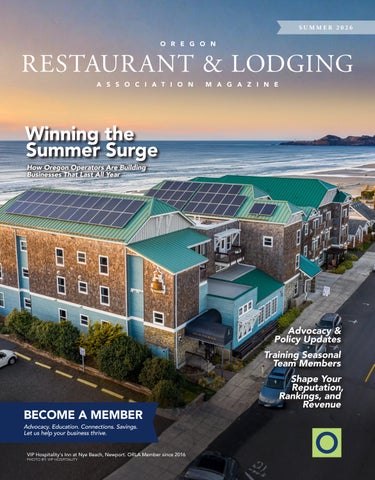
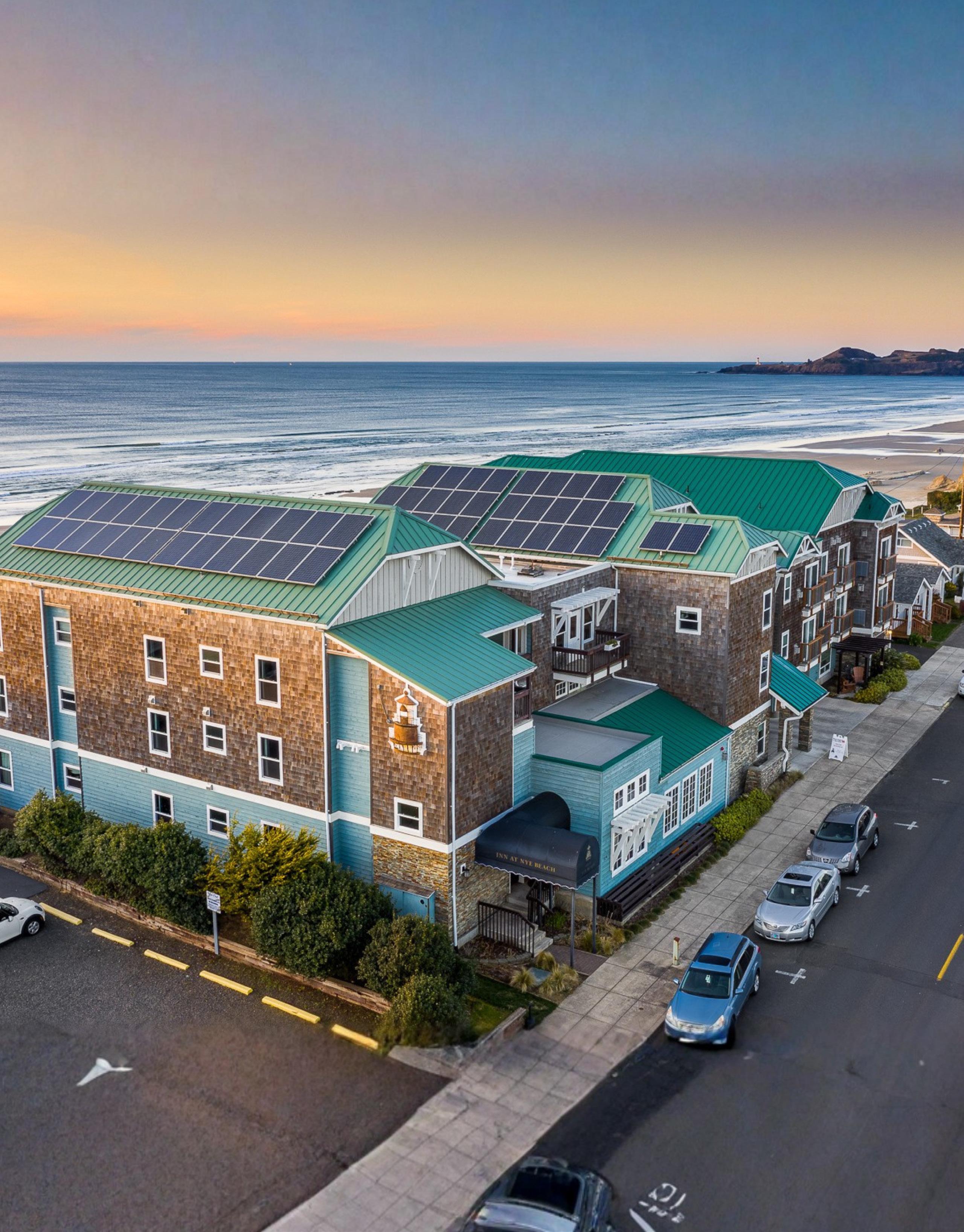
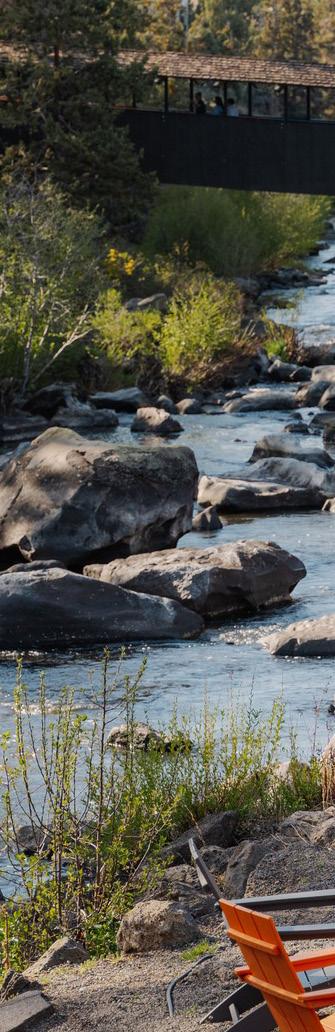
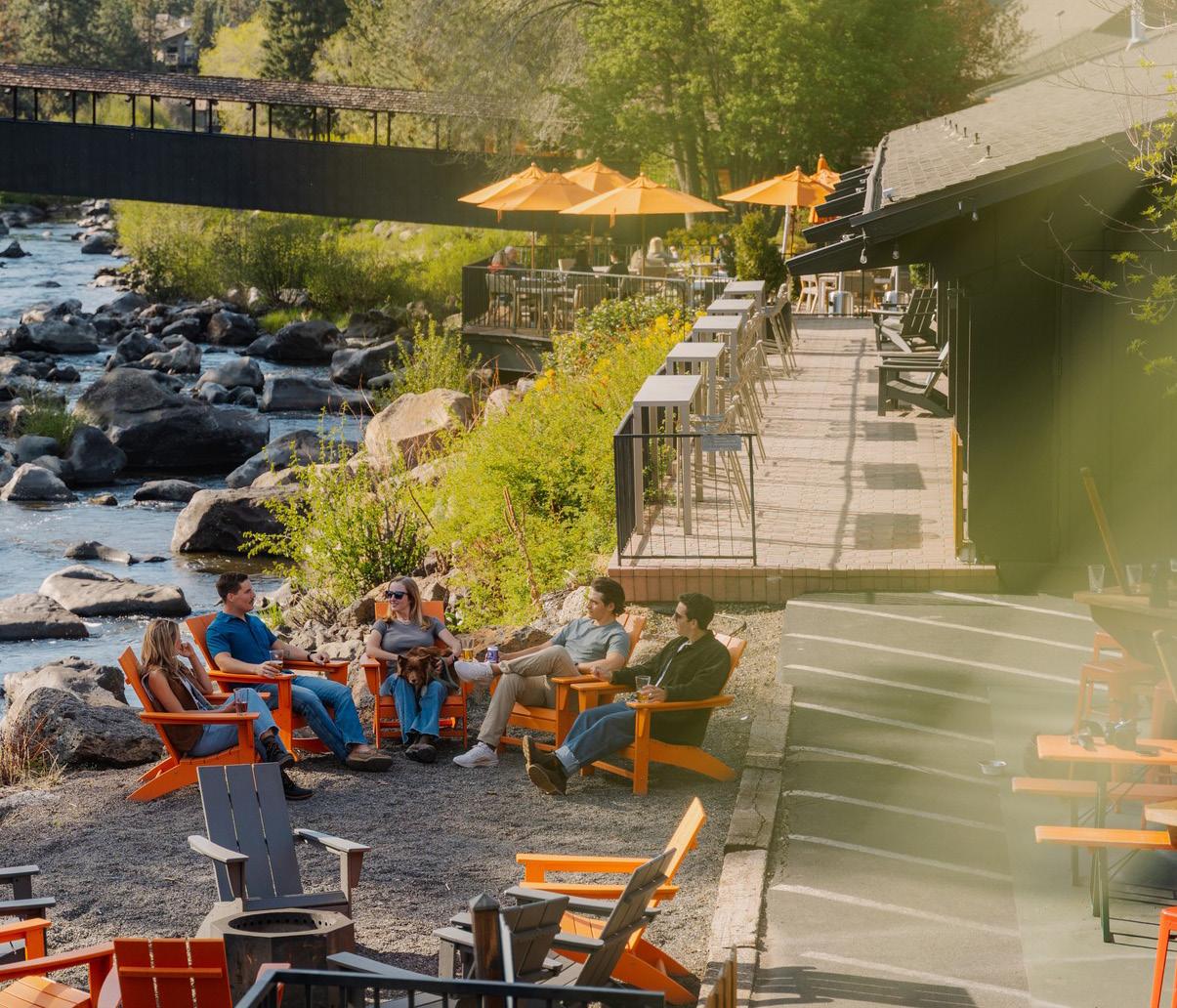
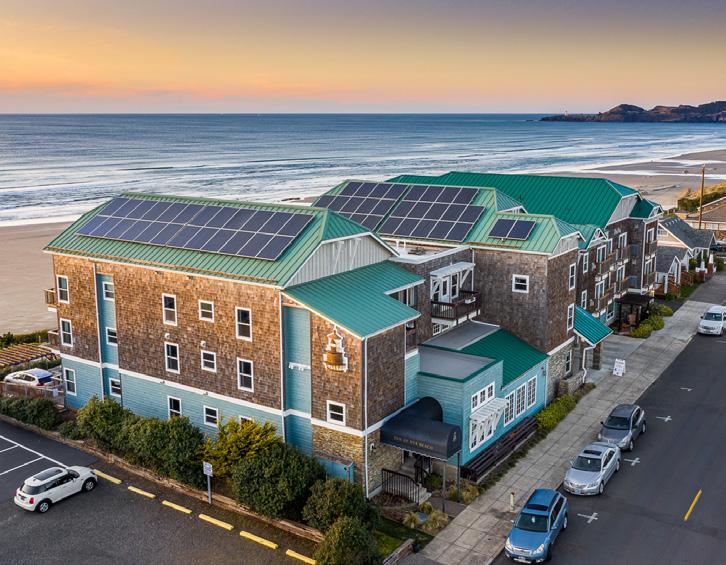
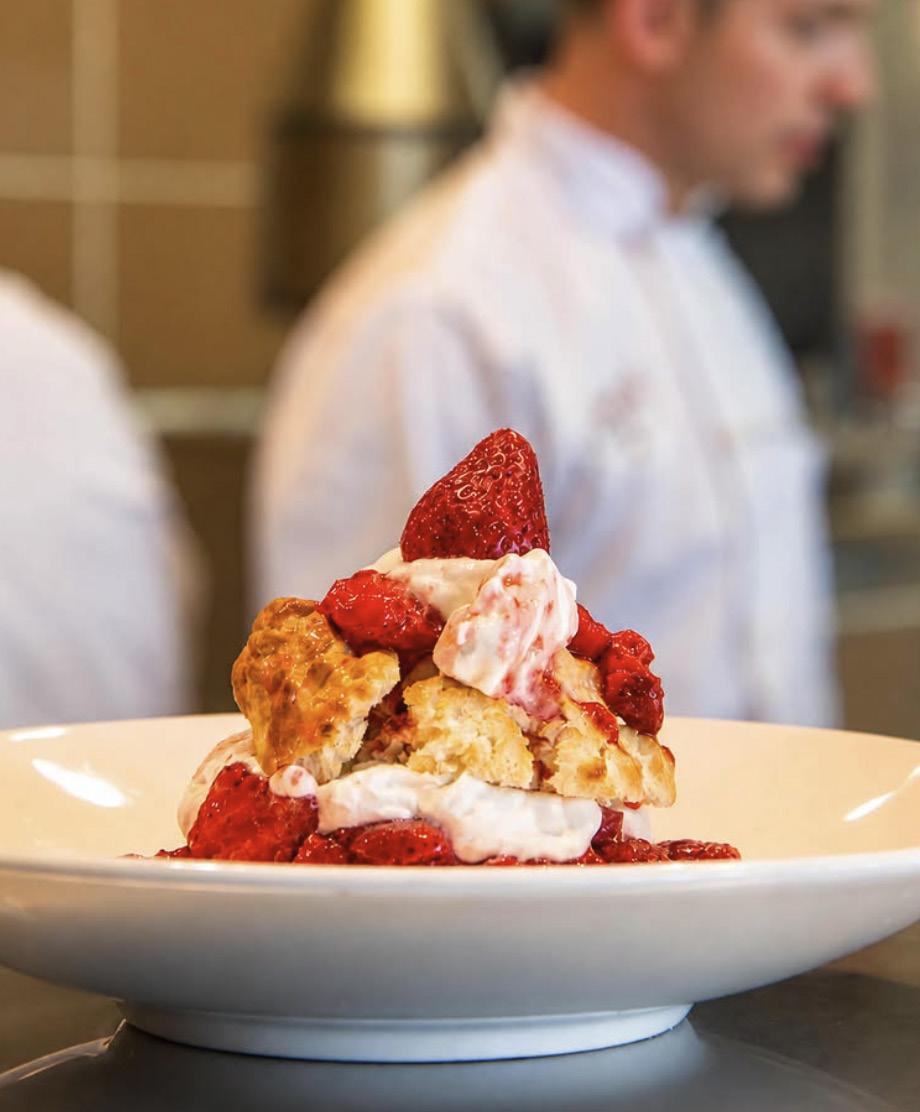
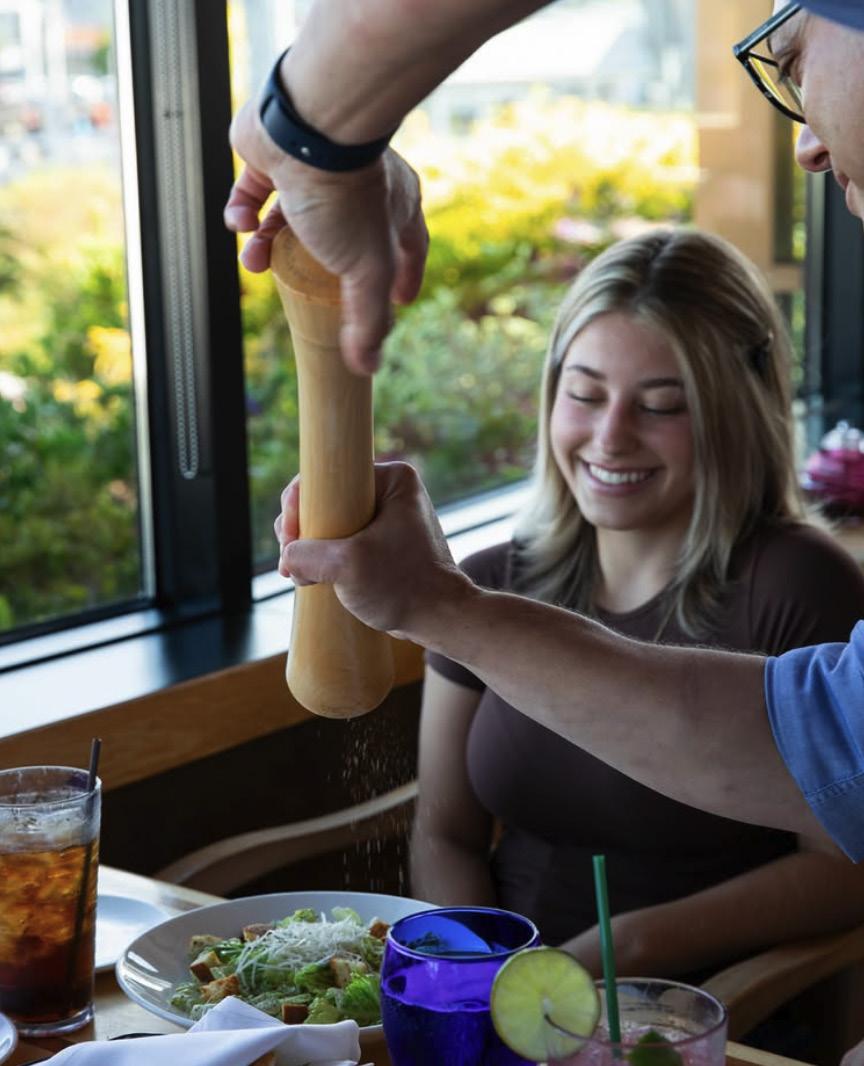
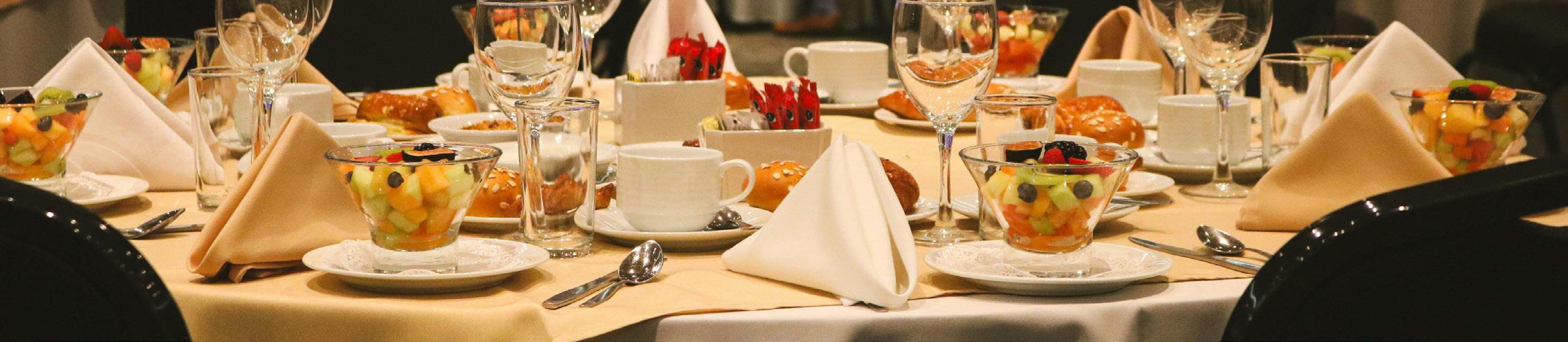
VIP Hospitality's Inn at Nye Beach, Newport. ORLA Member since 2016
PHOTO BY: VIP HOSPITALITY
Oregon Restaurant & Lodging Association (ORLA), 8565 SW Salish Lane, Suite 120, Wilsonville, Oregon, 97070 503.682.4422
learn more about ORLA visit us online at OregonRLA.org
PUBLISHER
JASON BRANDT / PRESIDENT & CEO JBrandt@OregonRLA.org
LORI LITTLE / EDITOR LLittle@OregonRLA.org
HEIDI JANKE / DESIGN HJanke@OregonRLA.org
MEMBERSHIP
To become a member of the Oregon Restaurant & Lodging Association, please contact us at info@OregonRLA.org or 503.682.4422.
ADVERTISING
Please support the advertisers herein; they have made this publication possible. For information on advertising opportunities, please contact Big Red M, serving on behalf of the Oregon Restaurant & Lodging Association (ORLA): Ronnie Jacko, Senior Advertising Account Executive, Big Red M, Ronnie@bigredm.com or 503.445.2234
SUBSCRIPTIONS
To update your digital and print subscriptions to this publication and all ORLA communications visit OregonRLA.org.
2025-26 ORLA BOARD OF DIRECTORS
Komal (Tina) Patel, Chair, ALKO Hotels
Liz Dahlager, Vice Chair, Mereté Hotel Management
Gordon Feighner, Treasurer, Jam on Hawthorne
Cheri Helt, Secretary, Zydeco Kitchen & Cocktails
Patrick Nofield, Immediate Past Chair, Escape Lodging
Marin Arreola III, Advanced Economic Solutions (AES) Inc.
John Barofsky, Beppe & Gianni's Trattoria
Terry Bichsel, Rivertide Suites Hotel
Joe Buck, Babica Hen / Lola's / Gubanc's
Gillian Duff, El Gaucho Portland
Justin Freeman, Bagel Sphere
Kurt Huffman, ChefStable
Alkesh Patel, Evergreen Hospitality Development Group
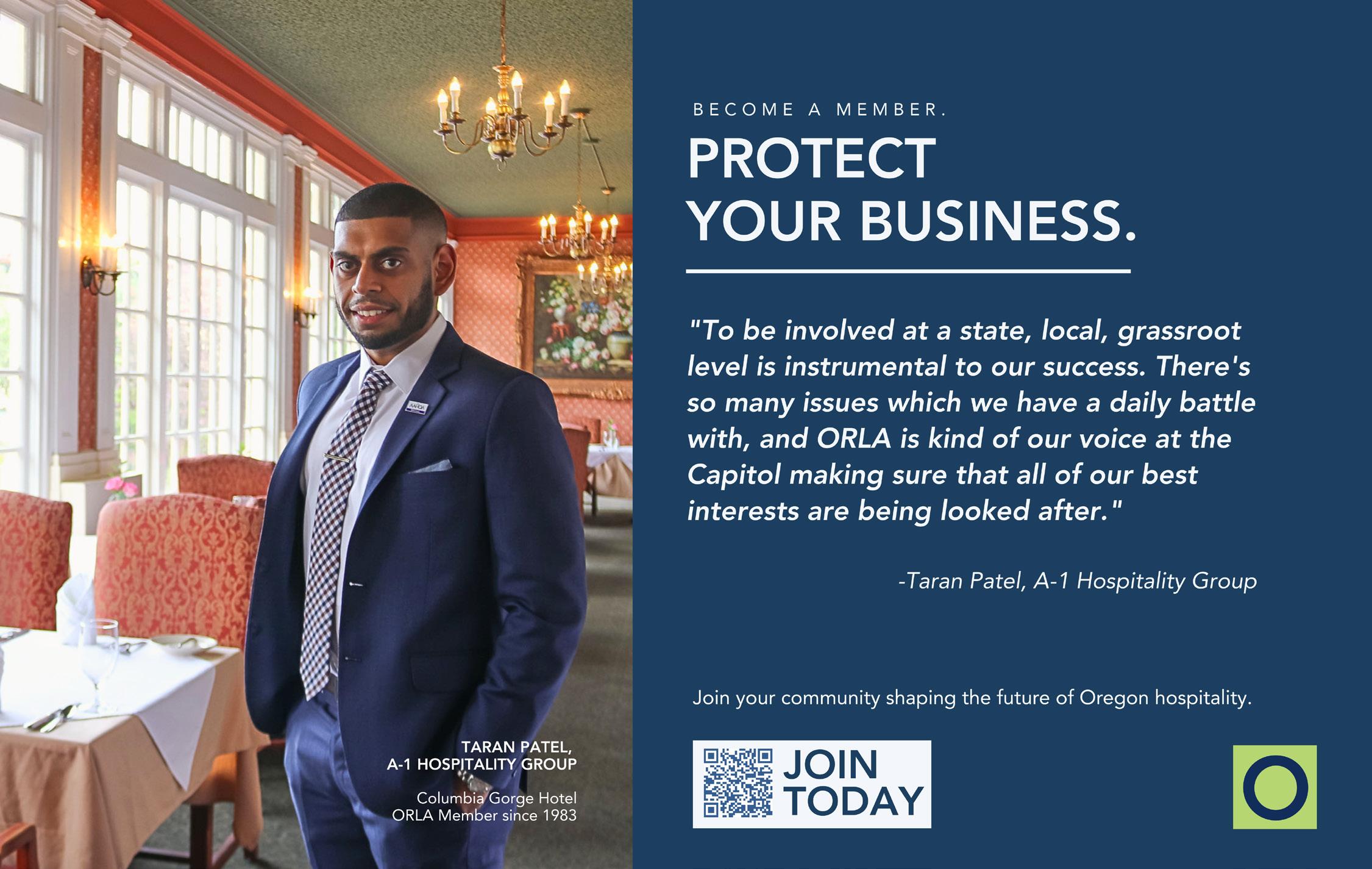
Taran Patel, A-1 Hospitality Group
George Schweitzer, West Coast Hospitality LLC
Jerry Scott, Elmer's Restaurants Inc.
Natalie Sheild, Togather Restaurant Consulting
Jim Smith, Mountain Mike's Pizza, Cascades Coffee House
Rick Takach, Vesta Hospitality
Jake Vanderveen, McDonald Wholesale Co.
Scott Youngblood, CASCADA
Dhruti Amin, Ex Officio Board Member, ALKO Hotels
Pays
ORLA Delivers Measurable Savings
and Stronger Industry Representation For Tomorrow.
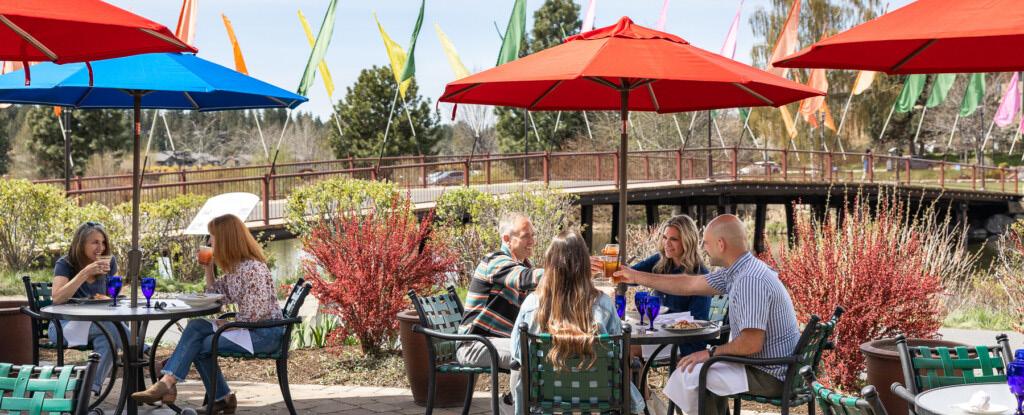
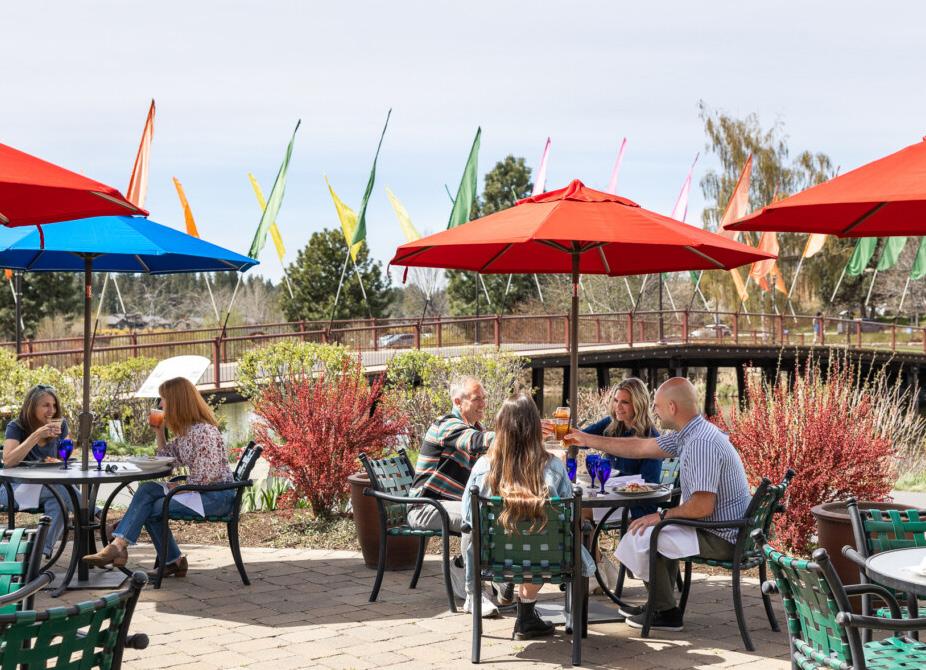
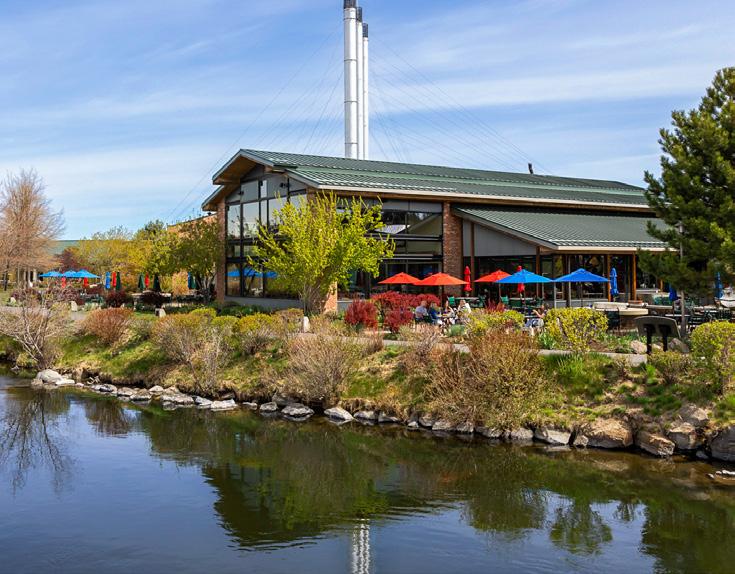
Anthony's at the Old Mill District, ORLA Member since 2005
PHOTO BY: ANTHONY’S RESTAURANTS
LEAD WITH CONFIDENCE
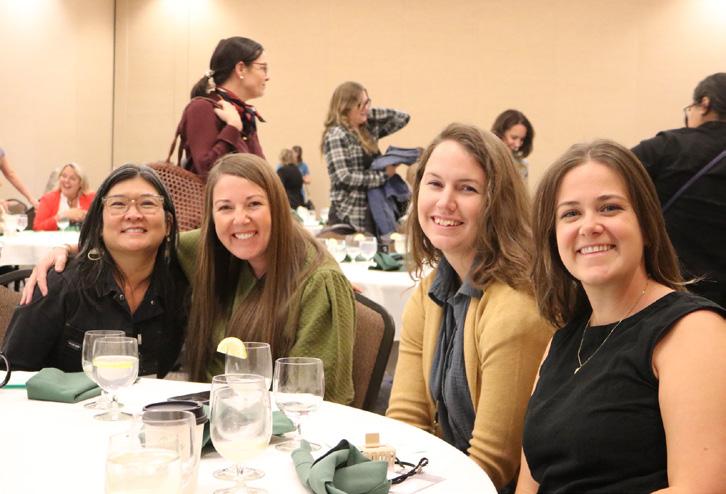
Register Now for ORLA's Third Annual Women in Tourism and Hospitality Symposium
Join us to celebrate women in our industry, strengthen leadership paths and fuel growth.
1:00pm Check-in & Networking
1:30pm Keynote Speaker: Diana Cutaia, Coaching Peace "Protecting Your Confidence: Leadership Starts Where You Are"
2:30pm Breakout Sessions
3:30pm Industry Panel: Her Journey
September 12, 2026 • The Riverhouse Lodge, Bend ORLAHospitalityConference.com/WITHSymposium
Invest in yourself and the next generation. Register yourself and the up-and-coming women on your team for a day of inspiration, leadership, and connection.
Add the Women's Symposium to your ORLA Hospitality
Conference registration, or register for this event on its own.
SYMPOSIUM SPONSORS:
Cultivators: Rainmaker:
FROM THE CEO
Your Voice. Your Leadership. Your Legislative Agenda.
Summer and fall represent one of the most important times of the year for Oregon's hospitality industry.
While legislators are back home in their districts and candidates begin preparing for the 2027 election cycle, the Oregon Restaurant & Lodging Association (ORLA) begins the work of developing the industry's 2027 Legislative Agenda. This process is one of the most important responsibilities we have as an association because it ensures that the priorities we advocate for in Salem reflect the realworld needs of restaurant and lodging businesses across Oregon.
That work starts with member engagement.
Every year, ORLA invites members from every corner of the state to participate in shaping our legislative priorities. The challenges facing a family-owned restaurant in Eastern Oregon may differ from those impacting a coastal lodging property. Our responsibility is to bring those voices together and develop a policy agenda that reflects the needs of Oregon's diverse hospitality community.
The agenda we ultimately adopt is shared directly with legislative candidates and incumbent lawmakers. It helps shape the conversations our Government Affairs team has throughout the year and serves as a foundation for the relationships we build with elected officials and their staff. Simply put, our legislative agenda is one of the most powerful tools we have to tell the story of Oregon hospitality.
That is why we encourage every member to participate in the process.
Throughout July, August, and September, ORLA will host monthly Government Affairs calls dedicated to gathering member feedback and discussing potential priorities for the 2027 legislative session. Whether you are a longtime operator or a newer member, your perspective matters. We want to hear directly from you so that ORLA's agenda reflects the issues most important to your business and your community.
The final legislative agenda will be reviewed and adopted by ORLA's Board of Directors during its September meeting, held in conjunction with the ORLA Hospitality Conference at the Riverhouse Lodge in Bend.
As we prepare for that important work, we are also reminded of the critical role industry leadership plays in guiding our association.
This year, we extend our sincere gratitude to several board members whose terms of service are concluding. We thank Immediate Past Chair Patrick Nofield of Escape Lodging Company, Jolee Bancroft, former President of Mo's Restaurants, Joe Buck, owner of Babica Hen, Gubanc's, and Lola's Café and Mayor of Lake Oswego, Marin Arreola III of Advanced Economic Solutions, Rick Takach of Vesta Hospitality, Katie Poppe of Blue Star Donuts, and Joe Lowry, former executive with Bandon Dunes Golf Resort.
These leaders have dedicated countless hours to strengthening Oregon's hospitality industry. They have lent their expertise, passion, and perspective to ORLA's work while serving as strong voices for businesses throughout the state. Their service has helped ensure that our association remains focused on advancing the success of hospitality operators and employees alike. On behalf of the entire membership, thank you for your commitment and leadership.
At the same time, healthy leadership transitions are essential to the long-term strength of any organization. Each year brings an opportunity for new leaders to step forward, contribute fresh perspectives, and help shape the future of our industry.
Applications are now open for active ORLA members interested in serving on the Board of Directors. If you have ever considered becoming more involved in advocacy, industry leadership, or helping guide one of Oregon's largest private-sector industries, I encourage you to explore this opportunity. Board service is both rewarding and impactful, and it plays a direct role in shaping the policies and priorities that affect hospitality businesses statewide.
You can learn more about ORLA's advocacy efforts and opportunities for leadership involvement by visiting the "Get Involved" section under the Membership tab at Oregonrla.org.
The strongest legislative agenda is one built by engaged members and guided by dedicated leaders. We hope you will join us this summer and fall as we work together to define the future of Oregon hospitality. JASON BRANDT, PRESIDENT & CEO, ORLA
Oregon’s Building Energy Performance Standards require large commercial and multifamily buildings to benchmark energy use and improve performance over time by meeting energy targets or implementing efficiency measures.
Extended Producer Responsibility (EPR)
Oregon's Extended Producer Responsibility (EPR) law, formally known as the Plastic Pollution and Recycling Modernization Act, remains in effect. This law requires producers of covered packaging, paper products, and food service ware to help fund the state's recycling system through fees administered by the Circular Action Alliance under Oregon Department of Environmental Quality oversight.
While most restaurants and lodging businesses are not directly regulated under the law, many may still experience indirect impacts as suppliers pass along compliancerelated costs through higher prices for packaging and other products. Businesses could also be subject to the law if they manufacture or import covered packaged products under their own brand.
A federal lawsuit challenging portions of the program continues. In February 2026, a federal court temporarily blocked enforcement against members of the National Association of Wholesaler-
Distributors while the case proceeds, but the law remains in effect for most producers.
ORLA continues to monitor implementation, rulemaking, and litigation developments, with particular attention to fee transparency, cost impacts, and potential pass-through expenses affecting hospitality operators.
Building Performance Standards (BPS)
Oregon's Building Performance Standards program is now in the implementation phase. The law applies to larger commercial buildings, including hotels and motels with more than 35,000 square feet of gross floor area.
The program is currently focused on education, benchmarking, and reporting. Compliance deadlines for covered lodging properties begin in 2028 for the largest buildings and extend through 2030 for smaller covered properties.
sq. ft June 1, 2029 • 35,000–89,999 sq. ft June 1, 2030
ORLA continues to raise concerns about how the standards apply to lodging properties, whose energy use is influenced by occupancy levels, guest amenities (such as restaurants, pools, and meeting space), and around-the-clock operations. We are also monitoring compliance costs, available incentives and rebates, and coordination with local reporting requirements to avoid duplicative regulations.
ORLA recently met with Oregon Department of Energy (ODOE) staff to discuss these issues and hosted agency representatives on a recent Government Affairs Committee call to answer questions from members. We will continue working with ODOE to provide more information, facilitate member feedback, and advocate for practical implementation of the program.
SUPPORTING HOSPITALITY IN EVERY CORNER OF OREGON
Columbia Distributing is proud to be a total beverage partner to Oregon’s restaurants, hotels, bars, resorts and local gathering places, delivering beer, wine and non-alcoholic beverages across the state.
Proud to support Oregon hospitality.
2026 Session Snapshot
Throughout the 2026 legislative session, ORLA worked to advance industry priorities, address emerging challenges, and ensure the voice of Oregon's hospitality businesses was represented in key policy discussions. From liability and taxation issues to business regulations, ORLA was actively engaged throughout the session.
Here's a snapshot of the most important outcomes:
HB 4148 – Local Lodging Tax Changes
Changes to Oregon’s existing lodging tax laws were inevitable this session but ORLA negotiated an amendment reducing the diversion of lodging tax revenues from tourism promotion. While the bill ultimately passed, advocacy efforts helped protect critical marketing investments driving visitors and supporting local hospitality businesses.
SB 1517 – Recreational Liability Waiver Reform
As an extreme outlier in the country on recreational liability waiver reform, Oregon needed to make changes to the law to preserve recreational opportunities for Oregonians or providers would face crippling insurance rates and multi-million dollar lawsuits for activities protected in other states. Several competing bills were introduced during this session on recreational liability waiver reform. Ultimately, the bill that passed strengthens liability waiver protections, helping recreation and hospitality businesses better manage risk and maintain affordable insurance coverage.
HB 4178 – Cash Rounding ("Common Cents")
Facing ongoing challenges related to the Federal government’s decision to stop producing pennies, Oregon businesses needed a way to manage this issue while still being protected. ORLA worked with other business groups to pass legislation allowing businesses and government, if they choose, to round cash transactions to the nearest nickel, simplifying operations and addressing challenges caused by coin shortages. Signage must be present, but operators now have options.
SB 1501 – Moda Center Financing
The bill to make an investment in the renovation of the Moda Center was an important one to help support a key tourism and entertainment asset. The sporting events, concerts, seminars and other activities held at the Moda Center, help attract visitors to Oregon and encourage visitors to spend dollars benefiting hospitality businesses statewide.
Election 2026: Two Races to Watch
There is not enough space in this magazine to talk about all of the races happening this fall including the Governor’s race which is a re-match (in essence) of the 2022 campaign with Christine Drazan running against incumbent Governor Tina Kotek.
However, there are two key races in the State Senate to watch that may significantly alter the makeup of that legislative body and have the potential to break the supermajority Democrats currently have in the chamber.
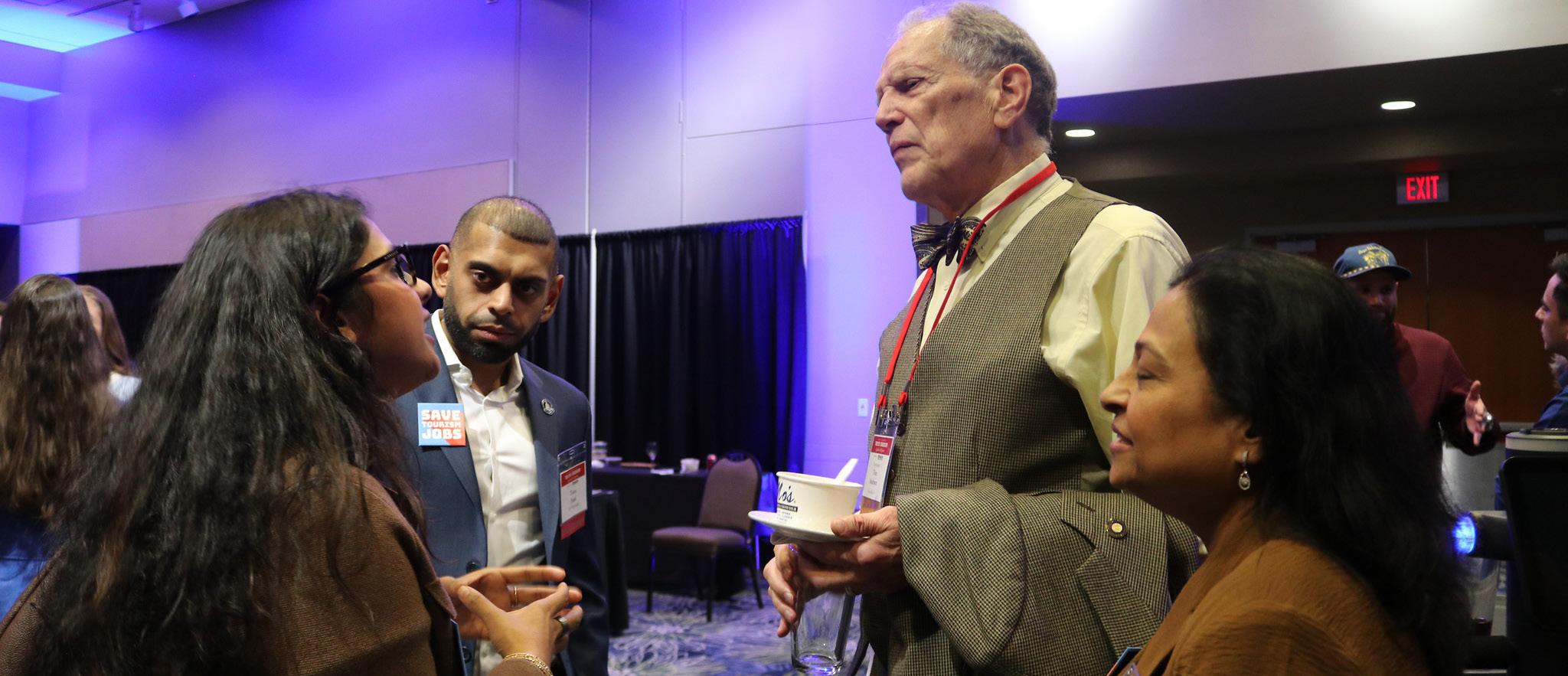
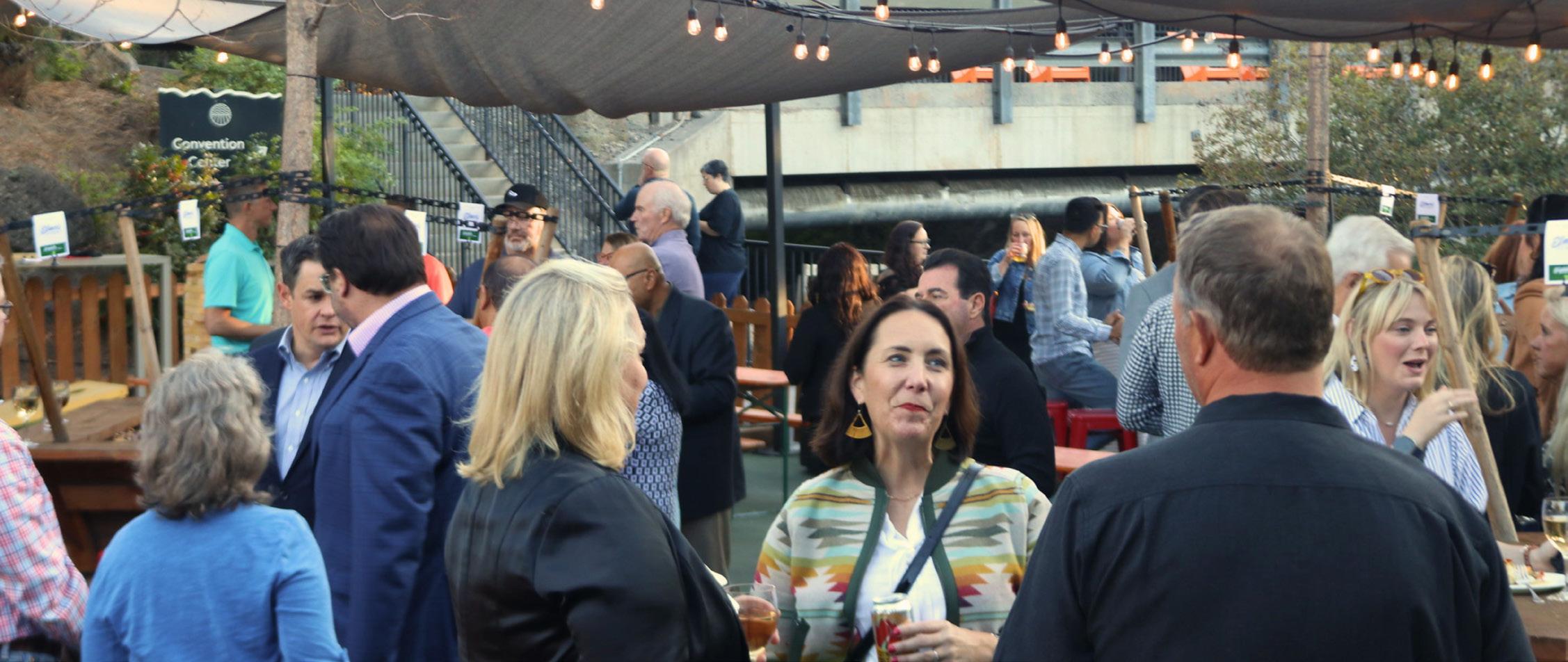
Industry members gathered at the annual Legislative Reception to meet with lawmakers and share valuable perspectives during the 2026 session.
Senate District 3 – Southern Oregon
Brad Hicks (Republican):
Brad is best known as the longtime chief executive of the Medford/Jackson County Chamber of Commerce, where he spent years advocating for Southern Oregon businesses and economic development. Before leading the Chamber, he also worked in communications and public affairs. He is focused on economic growth, reducing regulatory burdens on businesses, improving public safety, and increasing government accountability.
Denise Krause (Democrat): Denise is a retired healthcare executive and public health professional. She spent more than 25 years working in healthcare administration and population health. She is focused on improving healthcare access, strengthening public schools, and addressing housing affordability.
Senate District 11 – Keizer, Woodburn
Virginia Stapleton (Democrat): Virginia is a former Salem City Council President and Ward 1 councilor. Her campaign has focused on housing production and affordability, fully funding public schools, and expanding access to health care.
Tracy Cramer (Republican): Tracy is a former State Representative from Gervais who previously represented House District 22 from 2023-2025. Her campaign has focused on affordability for Oregonians, improving public safety, and regulatory reform.
Both seats are incredibly competitive and will be closely watched this fall as the campaigns ramp up toward November.
While ORLA does not endorse candidates for office, contributions from our political action committee are meant to elect individuals who support the hospitality industry, our members, and the issues that matter to them.
Get Involved
The last two legislative sessions underscored the importance of establishing relationships with legislators at the local level and having operators stay engaged in the issues that affect their employees and their business. To support these efforts, ORLA offers meaningful ways for hospitality professionals to get involved, advocate for their interests, and help shape the future of the industry.
Participate
in
Government Affairs Calls
ORLA members are welcome to join monthly Government Affairs Committee Zoom calls the last Friday of the month to stay informed on important issues. These virtual meetings move to a weekly cadence during the legislative session and cover topics ranging from pending legislation to new statewide rules and regulations to local issues.
Be an Oregon Hill Runner
To get involved and help make a difference in our advocacy efforts, members are invited to be a part of the Oregon Hill Runner program. This program is intended to match local operators with their legislators so they can establish a relationship beyond the occasional call or email and have regular contact.
Our goal is to have at least one restaurant or lodging operator matched to each of the 90 legislators. Quarterly contact with your legislator could include a phone call, cup of coffee, a visit to your establishment–even hosting the legislator for a campaign event or town hall.
For more information, contact me at Astley@OregonRLA.org. | GREG ASTLEY, DIRECTOR OF GOVERNMENT AFFAIRS, ORLA
HOW CAN WE SERVE YOU?
Reach out to our government affairs team with questions, share the issues impacting your business, and let us know how we can support you. We have your back. ADVOCACY CONTACTS:
CONTRACT LOBBYIST: ELIZABETH HOWE
ORLA Contract Lobbyist, President, Howe Public Affairs 503.910.3270
Elizabeth@HowePA.com
GA COMMITTEE CHAIR:
JIM SMITH
Oregon Area Developer, Mountain Mike's Pizza; Founder, Cascades Coffee House
JOIN THE CONVERSATION. Help shape ORLA’s 2027 Legislative Priorities by joining ORLA’s Government Affairs Zoom Calls. Share insights on the issues that matter most to your business. Contact Aidan Earls to learn more.
OREGON RESTAURANT & LODGING ASSOCIATION MAIN OFFICE: 503.682.4422 • info@OregonRLA.org
Connect. Learn. Be Inspired.
Join hospitality leaders from across Oregon for three days of ideas, insights, and connections designed to help your team and business thrive.
Industry Specific Educational Sessions
Emerging Trends and Innovations
Networking, Celebration and Fun
MAJOR SPONSORS INCLUDE:
PRESENTED BY:
BREAKOUT SPONSORS INCLUDE:
• Baker Tilly • Garth T. Rouse & Associates • Jordan Ramis PC • SAIF
VENDOR SHOWCASE INCLUDES:
SUPPORTING SPONSOR:
• NW Coalition for Energy Choice
• Ace Parking
• Advance Travel & Tourism
• Cloudbeds
• Crystal Investment Property
• Dairy West
• Digiwest MSP
• Fisher Phillips
• Energy Trust of Oregon;
Existing Buildings
• Flow Roofing
• Interstate Roofing
• Impact Restaurant Coaching
• Independent Merchant Brokers
• KCreative
• Mattress Recycling Council
• Northwest Mechanical Group
• Nick Alexander Films
• Oracle
• Oregon Hospitality Foundation
• Oregon Workforce Partnership
• Pacific Plaza Hotels
• PenridgeGlobal
• Roto Rooter
• Restoration Management Co.
• RobotLAB
• ServiceMaster of Salem, Corvallis, Lincoln City & Eugene
• Spectrum Business
• Stayntouch
• Studio H Architects
• The Center for Wine Education at Linfield University
• ThinkReservations.com
• Togather Restaurant Consulting
• Visit Central Oregon
• Visit Bend
• Zucchetti North America
PRESENTED BY:
ORLA Hospitality Conference
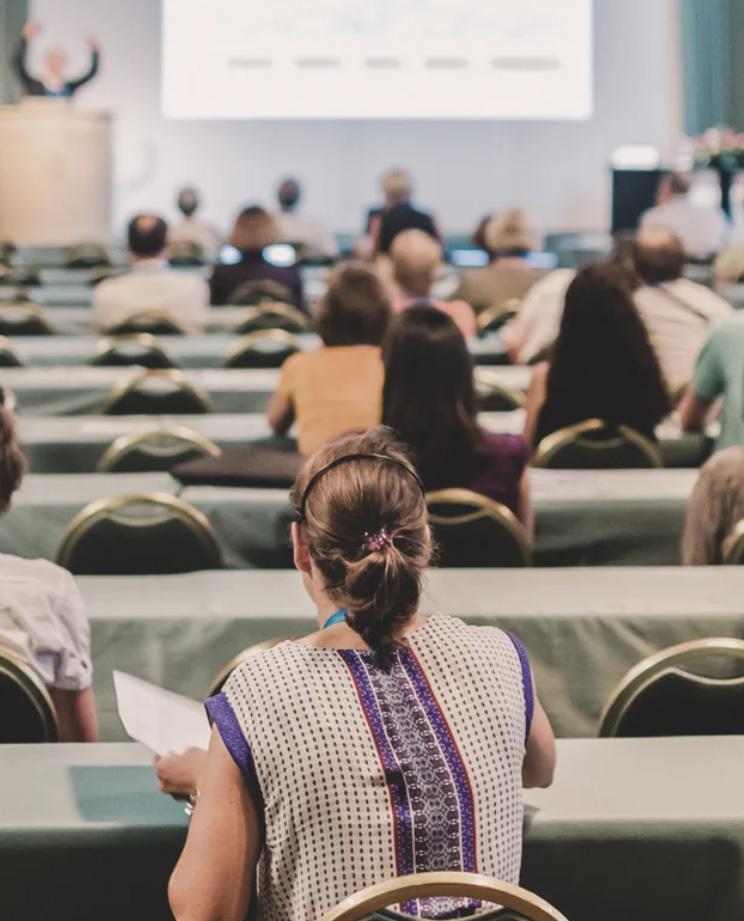
Get ready to connect, learn, and be inspired at the 2026 ORLA Hospitality Conference in Bend. From dynamic keynote speakers and practical education sessions to networking with hospitality leaders from across Oregon, this is your opportunity to gain fresh ideas and actionable strategies for the year ahead. Join us September 12–14 and invest in your team’s success.
Educational Sessions
KEYNOTE SPEAKER: Joshua Routh
A Complaint Free Workplace: Turning Complainers into Collaborators
In hospitality, complaints are part of the job—but complaint culture does not have to be. This engaging, humorous, and highly practical keynote will help you look beneath the surface of workplace complaints to understand what people are really trying to say. Is it stress? A need for support? A broken process? A desire to be heard?
Through stories, humor, and immediately usable tools, audiences learn how to redirect negative venting into useful conversations, stronger teamwork, and better service. Leave with a fresh way to reduce drama, strengthen trust, and build a workplace where people feel heard, valued, and ready to collaborate. The goal is not fake positivity. It is fewer pointless complaints, more honest conversations, and a team culture that helps people serve each other and their guests better.
GENERAL SESSION: Advocacy for Lodging & Tourism
• Chirag Shah, American Hotel & Lodging Association
Explore the policy issues shaping hospitality, from workforce and lodging tax to AI, pricing, and data privacy, and discover how advocacy drives industry success.
GENERAL SESSION:
Restaurant Outlook
• Theodore Balestreri II, Cannery Row Co., National Restaurant Association Board
Get an insider’s perspective on trends, opportunities, and policy landscape shaping the future of restaurants and hospitality.
GENERAL SESSION: ORLA Member Meeting
• Jason Brandt, Oregon Restaurant & Lodging Association
Learn how ORLA is advancing advocacy, workforce development, and member value, then take part in the election of the Association’s Boards of Directors.
BREAKOUT SESSIONS:
State & Local Advocacy in Action
• Greg Astley and Jason Brandt, ORLA,
• Elizabeth Howe, Howe Public Affairs
Get the latest on the 2026 legislative session, tourism funding, and ORLA’s advocacy priorities for 2027.
Profitability Under Pressure, Practical Strategies to Control Rising Costs and Thrive
• Seth Gruschow, Impact Restaurant Coaching
Learn proven ways to manage rising costs, optimize operations, and build a more profitable business.
Mobile Technology Panel: Turning the Hotel Tech Stack into a Profit Center
• Jacob Messina, Stayntouch
See how mobile-first technology is helping hotels increase revenue, improve efficiency, and create better guest experiences.
Employment Law Essentials: You Got a Letter from BOLI, Now What?
• Karen Anderson, Luvaas Cobb Attorneys
Gain practical insights into BOLI's investigative and enforcement processes, key employment law essentials, and effective strategies to strengthen compliance and reduce legal risk and costs.
Local Search Trends & Effective Digital Marketing Strategies for the Hospitality Industry
• Kent Lewis, NextNW
Discover seven practical strategies to improve your rankings, visibility, and qualified traffic.
Beyond Digital AI: Physical Automation and What Oregon Hospitality Operators are Learning from the Floor
• Kadhar Mohammed and Eric Arnold, RobotLAB
Explore practical, low-risk automation strategies that help hospitality businesses improve efficiency and support their teams.
Training for Retention
• Katia Costa-Black, OHSU Healthy Jobs
• Heather Ficht, Workforce Board
Explore the latest workforce research and proven strategies to attract, engage, and retain talent in today’s competitive labor market.
Unlocking Free Workforce Resources for Employers
• Andrew Larkin, OED, East Cascades
Access no-cost resources to recruit talent, reduce hiring costs, and build a stronger workforce with WorkSource Oregon.
Beyond Leisure Travel: Finding New Customers Through Events, Meetings & Sports
• Hospitality & Tourism Industry Panel
Learn how operators, destinations, and event partners are attracting visitors, extending stays, and driving year-round business.
Schedule
SATURDAY SEPTEMBER 12, 2026
Pre-Conference: (separate registration required) 1:00-5:00 p.m. Women in Tourism & Hospitality Symposium: Meaningful networking. High-value sessions.
ORLA Hospitality Conference Schedule*
5:45-6:30 p.m. Welcome Reception
Kickoff the Conference with hosted drinks and appetizers.
SUNDAY SEPTEMBER 13, 2026
9:30 a.m. Optional Activities in Bend
11:00 a.m. Registration and Check-in Open 12:00-1:30 p.m. Lunch & Keynote Presentation
1:30-2:15 p.m. Vendor Showcase
Connect with allied members supporting our industry.
2:15-3:15 p.m. Breakout Sessions (2)
3:25-4:25 p.m. Breakout Sessions (2)
5:15-6:15 p.m. Hospitality Awards Reception
6:15-8:30 p.m. Industry Awards Dinner
Celebrate individuals who are raising the bar for excellence at this reception, dinner and program.
MONDAY SEPTEMBER 14, 2026
8:00 a.m. Industry Breakfast
8:25-8:55 a.m. Member Meeting & Presentation
9:00-9:55 a.m. Keynote Presentation
10:00-11:00 a.m. Breakout Sessions (2)
11:00-12:00 p.m. Optional Activities
12:00-1:45 p.m. Lunch & Keynote Speaker
1:45-2:35 p.m. Vendor Showcase
2:35-3:35 p.m. Breakout Sessions (2)
3:45-4:45 p.m. Breakout Sessions (2)
6:15-8:15 p.m. Bend Dine Around Dinners
Choose from Bend member restaurants preparing a special menu. Requires registration.
* Schedule is subject to change; visit ORLAHospitalityConference.com for a complete schedule and up to date information.
CHAMPIONS OF THE FUTURE WORKFORCE
Industry Leaders Investing in Tomorrow's Talent
One of the greatest strengths of Oregon’s hospitality industry has always been its people. From restaurant kitchens and hotel front desks to tourism businesses and destination organizations, our industry thrives because dedicated professionals invest their time, talent, and expertise in creating memorable experiences for others.
That same spirit of investment is what drives the Oregon Hospitality Foundation’s workforce development efforts.
The Foundation’s mission is simple but critical: strengthen Oregon’s hospitality industry by investing in education, training, and workforce development. Achieving that mission requires more than programs and good intentions; it takes industry leadership. In fact, it takes businesses, partners, donors, educators, and volunteers working together to create meaningful opportunities for the next generation of hospitality professionals.
Oregonrla.org/boards-of-directors). Just as importantly, we are grateful for the many organizations and individuals who provide financial support, sponsorships, and partnership that make these programs possible.
We are fortunate to have a Foundation Board made up of industry leaders who help guide this important work
A recent example comes from Elmer’s Restaurants. During the opening weekend of its new Airport Way location in Portland, Elmer’s selected the Oregon Hospitality Foundation as the beneficiary of its preview event and matched guest donations, raising more than $1,700 to support workforce development initiatives. We sincerely appreciate Elmer’s commitment to strengthening Oregon’s hospitality workforce and investing in future industry leaders.
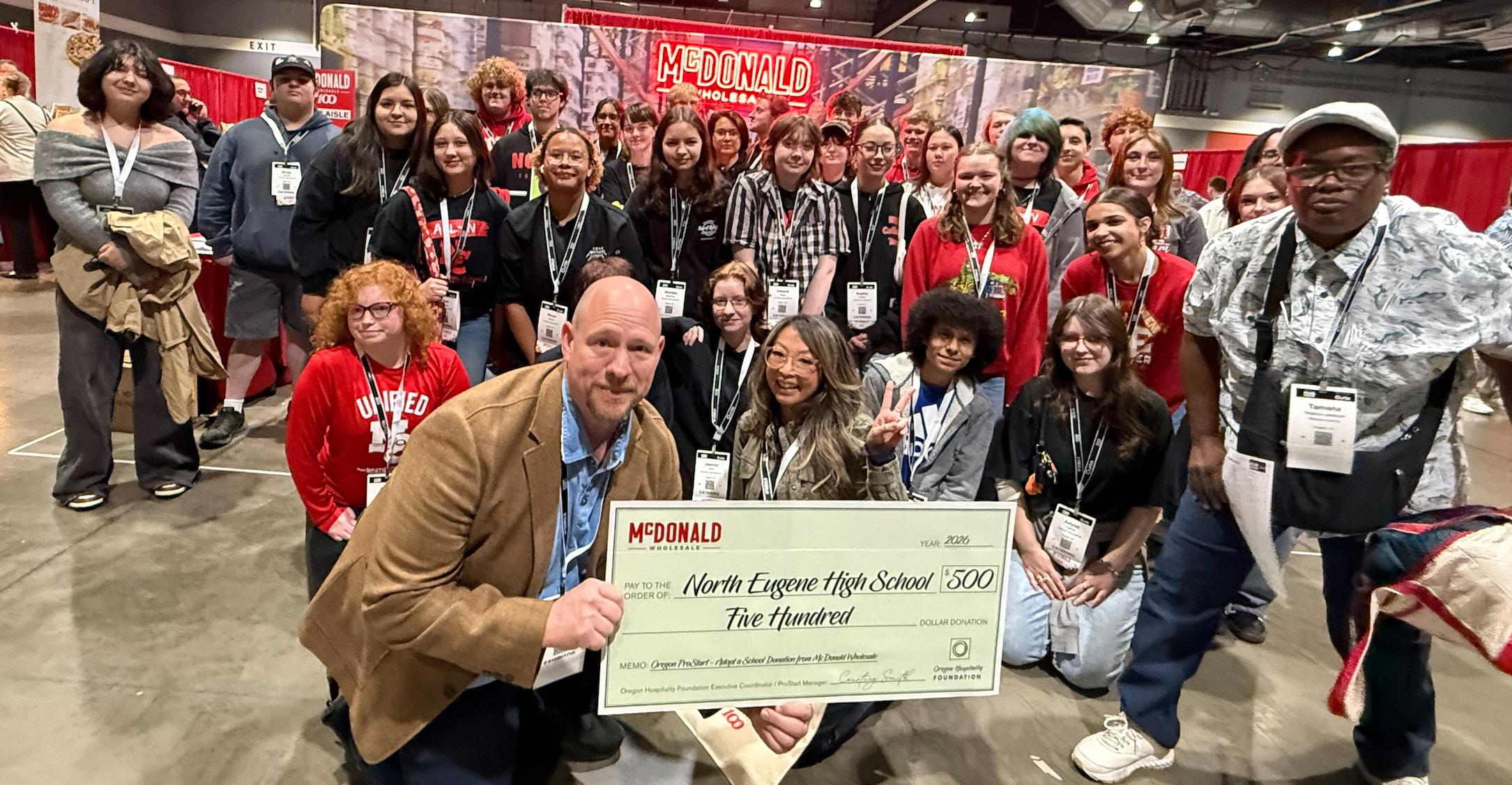
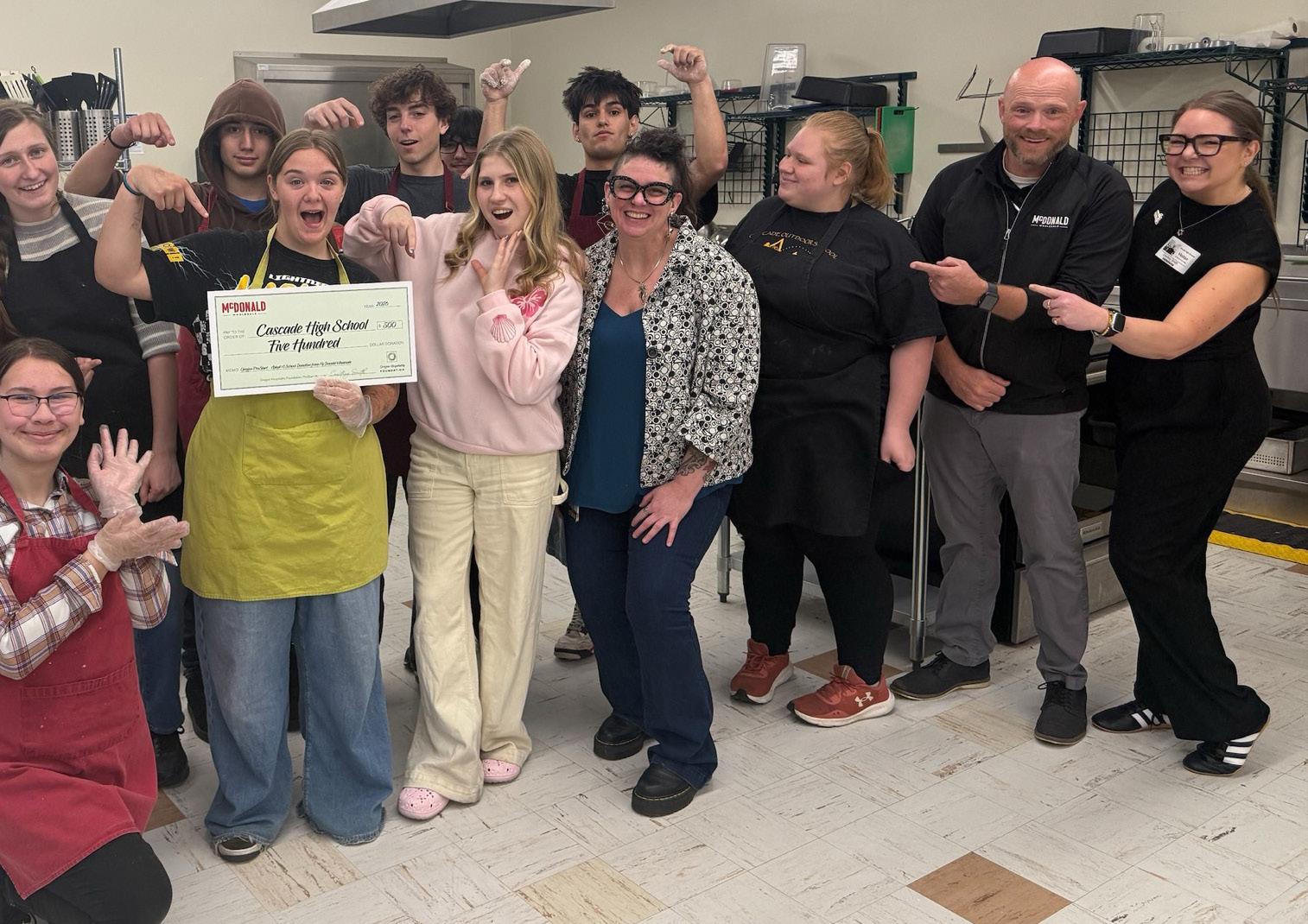
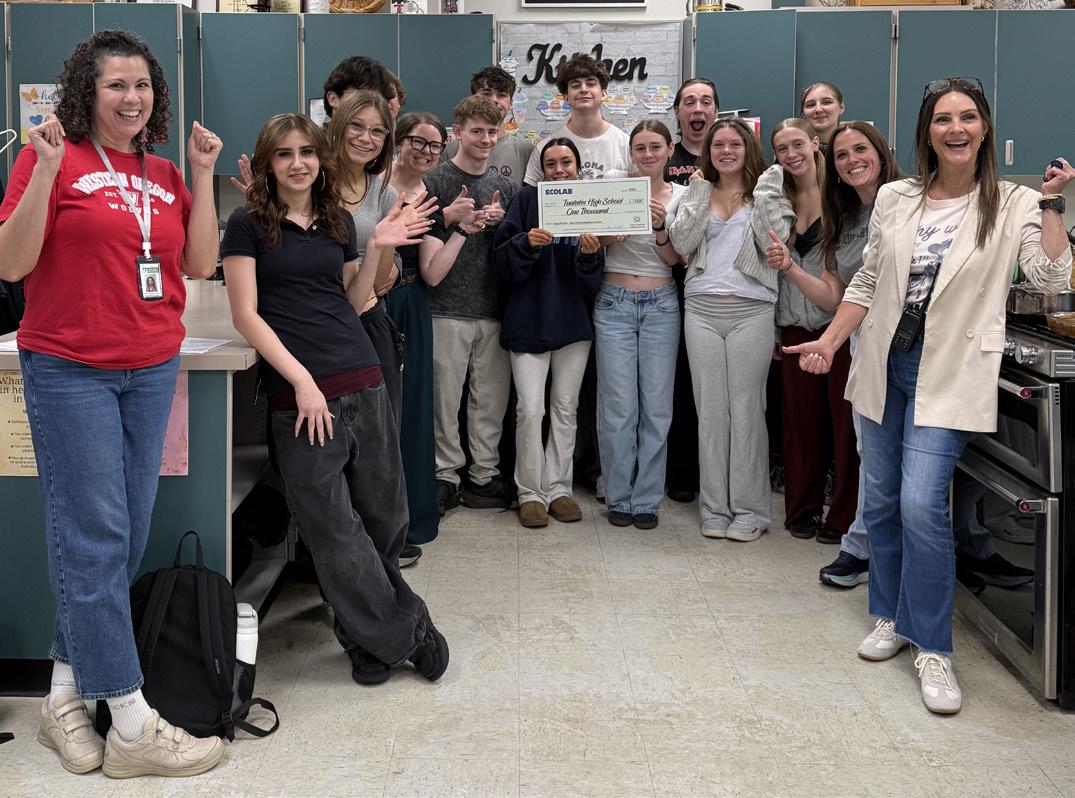
We are equally thankful for organizations that continue to support hospitality education through Oregon ProStart. Ecolab, McDonald Wholesale, Treva’s Family Restaurants, Travel Lane County, and Visit Bend have each stepped forward to sponsor ProStart schools and classrooms, helping provide valuable resources for educators and students across the state.
McDonald Wholesale, North Eugene High School
Their support strengthens career readiness programs, expands industry exposure, and helps students discover the many rewarding career pathways available in hospitality.
"At McDonald Wholesale, we believe in the future of the industry and support any endeavors that work towards building that,” shares Denise Henkelman, marketing and events coordinator for McDonald Wholesale Co. “ProStart has proven to be just the avenue for us to sponsor. Everything about the program aligns with our culture and mission. We are so proud to be part of it."
These investments have a lasting impact. Through career exploration, mentorship, classroom engagement, and industry partnerships, we are helping students better understand the opportunities available in restaurants, lodging, tourism, and related fields. At the same time, we are working collaboratively to build a stronger talent pipeline for Oregon businesses that depend on a skilled and passionate workforce.
Zavier Borja with Visit Bend explains, “ProStart is more than a culinary education program; it's an investment in Oregon’s future workforce. Through our partnership with the Oregon Hospitality Foundation and Mountain View High School, Visit Bend is proud to help students gain hands-on experience, develop professional skills, and discover meaningful career pathways in hospitality. By supporting programs like ProStart, we strengthen
the next generation of leaders who will shape Bend’s visitor economy and our community for years to come.”
Workforce development is not a one-time initiative; it is an ongoing commitment that requires sustained industry involvement. The challenges facing our workforce today will not be solved by any one organization alone. Success depends on hospitality professionals and businesses choosing to be part of the solution.
To the companies, sponsors, donors, and volunteers who have already stepped up: thank you! Your investment is creating opportunities for students, strengthening communities, and helping ensure a vibrant future for Oregon hospitality.
For those looking for ways to make a difference, we invite you to get involved. Whether through sponsorship, financial support, classroom participation, or mentorship, every contribution helps build the next generation of hospitality leaders.
Visit OregonRLA.org/Foundation for more information.
The future of Oregon’s hospitality industry depends on the investments we make today—and together, we can ensure that future is bright.
LORI LITTLE, ORLA
Treva's Restaurants, CTEC Salem-Keizer
McDonald Wholesale, Cascade High School
Ecolab, Tualatin High School
TRAINING YOUR FRONTLINE:
Tools Oregon Operators Can Use Right Now
Service is the thing people notice. Long after a guest has forgotten what they paid or how the room was laid out, they remember how your business made them feel. A guest who gets a warm welcome, whose server nails the recommendation, goes home and tells people about it. So does the guest who felt brushed off, and according to the White House Office of Consumer Affairs, a dissatisfied customer tells 9 to 15 people about their experience, while a happy customer who gets their issue resolved tells about four to six.
Your frontline staff are running that math for you every shift, whether they've been trained deliberately or just picked things up as they went. The good news is there are a couple of solid, low-cost training tools sitting right here in Oregon that you can put to work for your team.
Rose City Certified: What is it and why does it matter beyond Portland?
Travel Portland launched Rose City Certified as a free, one-hour online training for just about anyone who regularly interacts with visitors. Front desk and concierge staff, of course, but also rideshare drivers, retail workers, restaurant teams, tour guides, the folks at the reception desk of a museum. It covers the basics of navigating the city, handling difficult conversations, and welcoming guests from different cultures and backgrounds. There is no cost to take the course, and the team finishes their training feeling more confident about how to answer the sometimes tricky questions visitors ask.
That "tense conversation" piece sticks out to me as possibly the single most useful piece of training available. Years ago, I was managing the front desk of a hotel in Seattle, sitting in my office just behind
the desk, half listening to a guest checking in. She'd come from a small town, the kind of place where you might never see an unhoused person, and the city was clearly rattling her. She asked the host about homelessness, plainly nervous about it. And the staff member, trying to be helpful, agreed with her. They said, "Yeah, it's pretty out of control," and started rattling off which parts of town to steer clear of. I cringed. They thought they were giving great service by affirming what she was feeling and offering her practical tips, and as a front desk alum myself, I get the instinct. But what they actually did was confirm for her that the whole thing was hopeless, and they made the city look bad in the process. She left that desk more scared than when she walked up to it.
If something like Rose City Certified had existed back then, that would've gone differently. The frontline staff member still could have listened, and still could have let her feel heard. But they also would have had something true and useful to respond with, like what the city is actually doing about the issue, how safe she really was, where to go and what to see, all without framing whole neighborhoods as places to avoid. Same warmth, better information, and a guest who walks away curious about the city instead of afraid of it. That's the gap this kind of training closes.
The reason for sharing it across Oregon’s tourism industry, though, is how it was built. Travel Portland designed Rose City Certified so it could be picked up and reshaped for any region. The backbone of the program can travel. What gets layered on top is whatever your part of Oregon needs people to know, and that obviously changes a lot depending on where you are. On the coast, that might be seasonal King Tide safety tips. In fire country, it could be wildfire season and what to tell a nervous guest about smoke or closures. Somewhere else maybe it's local history, cultural context, the political stuff that comes up at the desk, the geography that trips visitors up every time. A regional certification can carry all of that and help prepare frontline staff to deliver a seamless and consistent guest experience across all of Oregon.
Oregon's seven Regional Destination Management Organizations are leading this kind of work across the state. If you want to find out whether a certified training program exists in your area, or if you want to help build one, your RDMO is your first call:
Eastern Oregon Visitors Association VisitEasternOregon.com
Mt. Hood & The Columbia Gorge Regional Tourism Alliance Hood-gorge.com
Oregon Coast Visitors Association VisitTheOregonCoast.com
Travel Portland
TravelPortland.com
Travel Southern Oregon
SouthernOregon.org
Visit Central Oregon VisitCentralOregon.com
Willamette Valley Visitors Association WillametteValley.org
Guest Service Gold, Refreshed
Guest Service Gold (GSG) is AHLEI's professional development program for frontline hospitality and tourism staff, and it just went through a timely refresh. The updated program streamlines its focus down to five core guest service elements: Commitment, Knowledge, Personalization, Personality, and Recovery. What I like about it is that it treats great service as a set of skills you can teach, which is good news for anyone who's ever figured some people just have it and some don't. Learners come out of it knowing how to anticipate needs, create memorable moments, and handle the hard situations confidently instead of hoping for the best.
A survey of 1,800 top-rated venues found that 72 percent of five-star reviews pointed to great service, while only 11 percent pointed to value or cleanliness. So, if you're trying to figure out where a training dollar earns its keep, that's a pretty clear answer.
Staff who complete the training and pass the 30-question CGSP exam earn the Certified Guest Service Professional credential. It's recognized worldwide, it doesn't expire, and it goes with the employee wherever they land next. In small towns across Oregon, there is a joke among hospitality and tourism employees that whenever they hire a new staff member, it's simply their "turn" to have that person on staff, with the expectation that in a season or two that staff member will rotate into another local operation and eventually cycle back again. In these kinds of landscapes, where staff rotates between businesses, having a consistent guest experience training program is not only good for your own guests, but for visitors to the area as a whole.
GSG is especially useful for small and independent operators who don't have a
dedicated training department. You don't need an HR team or a formal onboarding structure to run it. The training is available online taking about an hour or in a classroom setting, it takes about four hours to complete in a group, and is available in English and Spanish. OHF can bring it directly to your team.
So, whether you're onboarding a wave of seasonal hires or you just want to sharpen the team you've already got, GSG is one of the more practical, lower-lift investments on the table right now.
And if your interest runs more toward the kitchen than the front of house, OHF also supports ProStart and Restaurant Ready, both built around culinary career pathways. Happy to walk you through those too if that's where your need is.
Whether you want to schedule a Guest Service Gold group session, learn more about what regional training looks like in your community, or just figure out where to start, reach out to me via email at rdonley@oregonrla.org. I'm glad to connect you with the right people.
REBECCA DONLEY, OREGON HOSPITALITY FOUNDATION
HOW CAN WE SERVE YOU?
The Oregon Hospitality Foundation (OHF) exists to strengthen our industry by focusing on workforce development, education, training, and community support. We are dedicated to helping ensure hospitality businesses have the skilled workforce and resources they need to succeed now and in the future. Reach out with questions or to get involved. We have your back.
2025-26 OHF BOARD OF DIRECTORS
• Jaime Eder, Chair, Travel Oregon
• Ryan Fahey, Vice Chair, Spirit Mountain Casino
• Allen Pike, Secretary / Treasurer, Mereté Hotel Management
• Ken Henson, Immediate Past Chair, Refettorio Consulting
• Jason Bender, Outback Steakhouse, Evergreen Restaurant Group
• Jason Brandt, Oregon Restaurant & Lodging Association
• Amanda Cavitt, Garibaldi Portside Bistro
• Julie Kirksey, Sysco - Pacific Northwest
• Ron Moore, Hoagland Properties, Inc.
• Brian Olson, Beachcomber Vacation Homes
• Joshua Willis, Sunriver Resort
HIRING SUMMER SEASONAL WORKERS IN OREGON:
Tips and Precautions
With warm weather approaching, many restaurant and lodging operators are preparing for the summer. A lot of employers hire seasonal workers during the summer to account for increased customers
or an influx of labor due to school breaks. Even though employers might assume that hiring temporary workers is “easier,” it may bring a wide range of legal issues, which can be costly.
Child Labor Laws
Many teenagers work as seasonal employees during their summer breaks from school, which means employers must carefully follow federal and state child labor laws. Minors, depending on their age, have
different requirements and restrictions, and failure to meet the standard can lead to fines and penalties for employers.
Employers should be aware of the following:
• Employers hiring minors (under 18) must have a certificate to employ minors.
• Minors who are 14 and 15 years of age are prohibited from working more than 8 hours per day and 40 hours per week when school is not in session, and from working past 9:00 p.m. during the summer months.
• Minors who are 16 and 17 years of age are prohibited from working more than 44 hours per week.
• Minors are entitled to 15-minute paid rest breaks, as opposed to 10-minute rest breaks like adult employees.
• Minors are prohibited from performing certain tasks, such as those involving hazardous mixing, slicing, and baking machinery.
• Although federal law allows for a youth subminimum wage, all minors in Oregon must be paid the appropriate minimum wage, depending upon the county in which they work.
• Employers who hire minors must post their working schedules and any required notices about youth employment in a space where all minors are able to view (i.e., not behind the bar).
In light of these restrictions, employers who hire minors over the summer would be wise to ensure they follow these requirements and reach out to knowledgeable counsel if they have questions about the employment of minors.
Legal Compliance Thresholds for Certain Workplace Laws and Regulations
Many seasonal employees are hired temporarily, and employers often forget seasonal employees are protected under federal and state law just like other workers. Seasonal employees are entitled
to the same wage and hour protection as regular employees. It is important for employers to understand and follow all legal requirements for seasonal employees.
Employers need to be mindful of what laws apply to their workplaces, which often change depending upon the number of people employed.
Employers must provide protected sick time to employees, but whether that time is paid or not will be dependent upon the number of workers employed. If employers with six or more employees have a location in Portland, employers must provide at least one hour of paid, protected sick time for every thirty hours employees work (if they have fewer than six employees, the sick time may be unpaid, but still must be provided). Oregon employers that do not have a Portland location do not have to provide paid sick time unless they have ten or more employees (though unpaid sick leave must be provided). So, if summer hires push employers above those thresholds, they will need to begin paying sick leave that they otherwise would not be paying, and failure to appropriately adjust pay policies could lead to legal issues.
Also, sick leave laws are not the only thresholds employers should monitor. For example, OFLA protections would kick in at 25 employees, which is also the threshold for employer contributions to Paid Leave Oregon. Other regulations have different thresholds for when employers must follow them that could be crossed if employers hire enough summer help, and new laws would need to be followed (if not already in place in the workplace) and therefore new policies created.
Heat Hazards
Summer in various parts of Oregon can reach up to 100 degrees Fahrenheit, and occasionally hotter. This means that some of the employees who are working outside, such as lifeguards at resort pools
or servers covering outdoor dining areas, may be exposed to excessive heat during the summer. Exposure to heat can cause heat-related illnesses such as heat exhaustion and heat stroke. The Oregon Occupational Safety and Health Administration (“Oregon OSHA”) created a new rule called “Heat Illness Prevention” to provide protection for employees from heat hazards.
Oregon OSHA has created standards for employers when the heat index reaches 80 degrees Fahrenheit or greater during a workday, regardless of whether employees are working indoors or outdoors. Employers must provide at least one accessible shaded area that meets the specific Oregon OSHA rules for eligible employees working outdoors. The rule also requires employers to always provide free and accessible drinking water to employees to remain hydrated. Employers are also required to conduct heat illness prevention training for all employees and must keep written or electronic records of the training, which Oregon OSHA may request to review. Heat illness prevention plans, once implemented in accordance with specific requirements set out in the rule, should be posted where employees are able to see (such as where all other required posters are displayed).
If employers have workers who perform some of their duties outdoors, they would be wise to monitor weather forecasts and make sure that all Oregon OSHA standards are being followed, and provide adequate training for employees, making sure they are aware of heat-related illnesses and how to prevent them. SEAN RAY AND KELSEY HAHM
Sean Ray is a Partner at Barran Liebman LLP where he represents employers on a wide range of employment issues. He can be reached at 503-276-2135 or sray@barran.com.
Kelsey Hahm is a law clerk with Barran Liebman LLP. She partners with attorneys in legal research, drafting employment policies, creating client training materials, and case management.
SURGE Summer
How Oregon Operators Are Building Businesses That Last All Year
Every hospitality business has a season that makes the rest of the year possible. For a restaurant in Bend's Old Mill District, it's the moment schools let out and the Hayden Homes Amphitheater books its first sold-out show of summer. For three small hotels on the Oregon coast, it's the steady tide of visitors that fills Newport from June through September. The businesses that come out the other side of that season strongest are
not necessarily the ones that served the most guests or posted the biggest numbers. They are the ones that used the busy season to build systems that last the whole year and a company culture that keeps people coming back to work just as reliably as guests keep coming back through the door.
Noah Brandt, general manager at Anthony's Restaurant in Bend, and Jenny Nelson, regional director for VIP Hospitality, are
two operators who have thought carefully about exactly that. Their businesses are different in almost every way, one a busy riverfront restaurant in Central Oregon's busiest entertainment district, the other a collection of three small lodgings on the Oregon coast. But the strategies they have landed on share a common thread: intentional flexibility, smart cross-training, and a genuine investment in the people who make it all run.
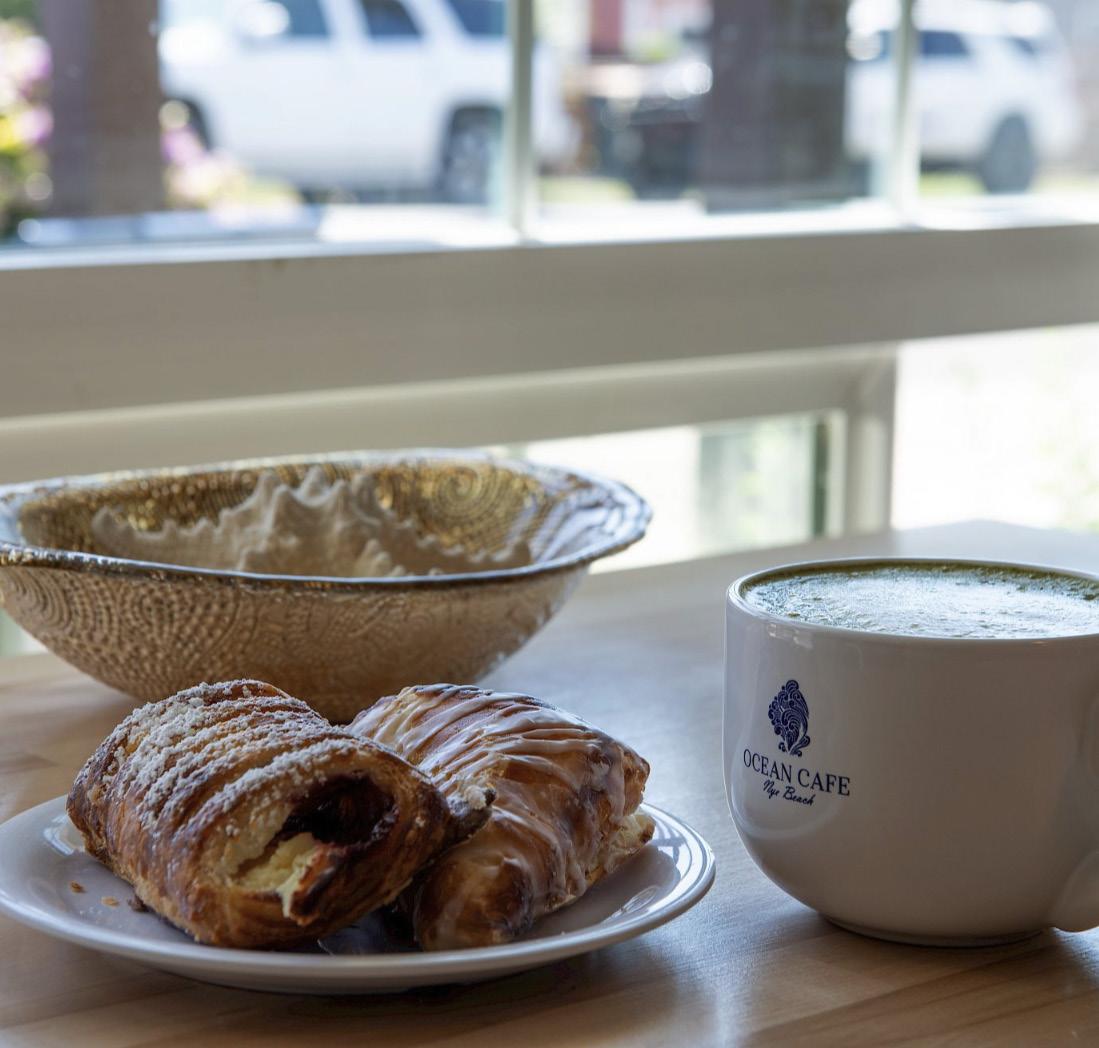
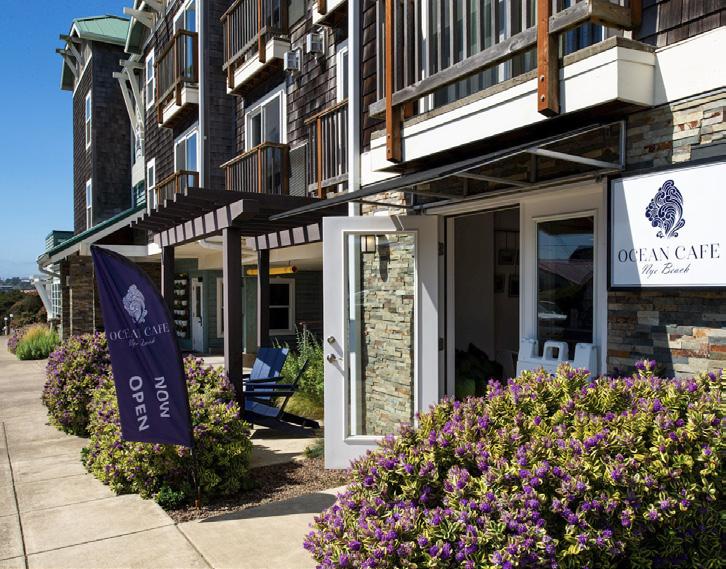
Ocean Cafe at Inn at Nye Beach, ORLA Member since 2015
PHOTOS BY: VIP HOSPITALITY
Reading the Room: Keeping Great Hospitality
Even when Busy
When the concert season hits the Old Mill District, guest traffic at Anthony's can quadruple. One week it's quiet. The next? Schools are out, Hayden Homes Amphitheater is sold out, and every seat on every patio is spoken for before the dinner rush even starts.
Brandt has managed Anthony's for five years, and he'll tell you that exceptional service at scale is more than a staffing equation. It’s about equipping each team member with the skills and mindset to make each guest feel truly seen and cared for. Even on the busiest nights, that commitment to a wonderful dining experience never wavers.
Like many restaurants, the pandemic pushed us to adopt technology faster than we ever anticipated. What started as a necessity has now become an asset. Today, those tools help streamline operations to keep pace on high-volume evenings, so we can stay focused on what matters most: the dining experience for our guests.
The result is a dining experience that meets guests wherever they are — whether they're celebrating something extraordinary or simply carving out a moment for themselves midweek.
Anthony's in Bend has team members who have been there since the day they opened in 2005. The relationships they've built with locals over the years are a genuine business asset. Those guests don't just come for the food; they come back for the people they know. That loyal local business isn't just a feel-good story — it's the consistency that keeps things on track when the amphitheater goes dark and tourist traffic slows. The summer surge brings the volume, but the regulars carry the rhythm of the year. And that commitment to knowing your guests by name, to earning their return is what Northwest Hospitality has always meant. One hundred and thirty miles to the west,
Jenny Nelson has been applying the same principle of intentional flexibility to the breakfast program at Inn at Nye Beach. When COVID protocols changed how hotels could serve guests, VIP Hospitality saw an opportunity to rethink the breakfast experience entirely. The traditional dining room was reimagined as Ocean Cafe, a grab-and-go espresso and café concept designed for the contactless moment the industry was navigating. Simultaneously, the team developed a complimentary in-room breakfast delivery program, cross-training housekeeping and house staff to prepare and deliver hot meals directly to guest rooms each morning.
Both were smart moves at the time. As the industry normalized and guest expectations evolved, VIP saw a further opportunity. By shifting to a streamlined continental breakfast, overnight oats, yogurt, fruit parfaits, freshly baked muffins, all still prepared in-house, they could fully activate Ocean Cafe as a destination in its own right. Guests who want something different from the continental now receive a $15 voucher to use at Ocean Cafe, and the morning operation became more consistent and sustainable across the board.
"We created this program during COVID to satisfy guests and serve them, which is what we are driven to do," Nelson says. "And then as things began to normalize, everything cost more, guest expectations got higher, finding team members got harder. So, we had to figure something else out."
What they figured out was that the answer to a guest experience question and a staffing question turned out to be the same answer.
Cross-Training as the Connective Tissue
The streamlined breakfast model at Inn at Nye Beach changed the labor model in a fundamental way. Where the previous program had required five people to execute each morning, the new one runs with three. Those three are year-round employees, crosstrained to move between breakfast prep, café service at Ocean Cafe, and house person duties throughout the day.
Across all three VIP properties in Newport, that cross-training philosophy has become the operational backbone of how Nelson manages her workforce. Staff at Ocean House, Inn at Nye Beach, and Hotel Sylvia are trained to work across properties, filling in where the need is greatest and building relationships with multiple small teams in the process. The cost per occupied room for housekeeping has dropped significantly as a result.
Small process changes have added up alongside the bigger structural ones. At Hotel Sylvia, front desk staff sort and bin laundry at night so housekeeping arrives in the morning with everything already staged and ready to go. Staff who know how to fold towels pitch in during peak compression periods without it costing anything extra, because the task fits naturally into a shift that is already happening.
"Cross-training increases how employees value their time with us," Nelson says. "Many people like change. They get to pitch in and get to know these small teams.
It creates even more teamwork and more of a sense of belonging because they're helping in multiple places."
At Anthony's in Bend, that philosophy shows up in how the team is built and sustained. Brandt manages a core crew of about 45 year-round team members which scales to 75 in the summer with seasonal hires. It’s the core team members that are with us year round that keep the culture and dining experience intact. Anthony's has long made room for students, welcoming them back when they're home from school and supporting their growth through scholarships and development.
The Culture Underneath It All
Neither cross-training nor service flexibility works without people who want to be there. Both operators are direct about the fact that building that kind of workforce takes real effort.
At Anthony's, Brandt credits head chef Calum Rodgers, who has been with the company for over 13 years, with building the kitchen culture that keeps everything running smoothly. "He's helped build a culture in our kitchen of people who truly want to be here," Brandt says. "We have an open kitchen, so our back of house team also gets to know the guests. That familiarity is what turns a great meal into a memorable one, and it’s what keeps people coming back. Culture is everything."
During the ramp-up weeks of May and June, when the kitchen is training new seasonal hires and covers are climbing fast, Brandt makes a point of pulling people aside individually. Not for performance reviews or staff meetings, but just to check in, acknowledge the stress of the transition, and make sure people have what they need to do their jobs. Sometimes that means talking through tension early.
That investment in people extends well beyond the season. Each fall, Anthony's closes its doors for a night to host a benefit dinner for Central Oregon Community College's Culinary Arts program — donating the food and labor so the college can raise funds for culinary scholarships. The partnership runs deep: Brandt sits on the COCC board, and a former Anthony's chef now leads the culinary program. For this team, developing the next generation of hospitality professionals isn't an afterthought, it’s part of the culture that helps keep great people coming back season after season."
At VIP Hospitality, that same commitment to people shows up in how Nelson handled the transition away from the old breakfast model. She told the story of Rudy, a tenured Inn At Nye Beach employee who had been with the company for four years and was one of the most trusted members of the morning team. When the model
Anthony's at the Old Mill District, ORLA Member since 2005
PHOTOS BY: ANTHONY’S RESTAURANTS
changed and his role needed to shift with it, VIP brought him on full time at Hotel Sylvia, where he now works in a combined maintenance and porter role and can pitch in wherever he is needed. Nobody was cut. In fact, the cross-training model created enough operational flexibility that VIP was able to bring additional staff on in other areas, strengthening the guest experience while keeping the existing team whole.
"We didn't lose anybody," Nelson says. "We actually had to hire a couple of people."
That kind of outcome is worth paying attention to. Cross-training is often framed as a way to do more with less, and it can be. But Nelson's experience at VIP suggests it can also work the other way, creating enough stability and flexibility in your core staffing pool that you have the capacity to grow, hire into new roles, and offer guests a stronger experience than you could before.
What Summer Actually Builds
The operators who navigate peak season most successfully are not simply the ones who serve the most guests or generate the most revenue during those months. They are the ones who use the busy season to build the systems, relationships, and culture that carry the business through the rest of the year.
For Anthony's, that means a benefits structure built around the summer hours core staff accumulate, a kitchen culture strong enough to absorb seasonal hires without losing its rhythm, and regular local business developed deliberately enough to keep things humming when tourist volume drops. For VIP Hospitality, it
means a cross-trained workforce that moves fluidly between properties and roles, a breakfast program that turned two separate operational challenges into one solution, and a staffing model that makes year-round employment possible in a market where that is genuinely rare.
The same logic applies whether the peak season is summer on the coast, fall in wine country, or winter at a mountain resort. Build your systems for the busy season.
Build your culture for the whole year. The guests will keep coming back if the team does. REBECCA DONLEY, OREGON HOSPITALITY FOUNDATION
CREATE A CULTURE OF FOOD SAFETY
Train Your Team with ORLA’s ServSafe® Manager Training
• Training to protect against foodborne illness
• Covers FDA Food Code / Oregon Food Code
• Meets the “Demonstration of Knowledge” requirement
• Meets “Person in Charge” requirement
• Meets “Food Handler” requirement
• Certification is valid for 5 years
PRIVATE COURSES
If you have 20 or more employees for the ServSafe course, and you have a classroom setting, we can provide the trainer at no additional cost! Companies may also combine employee groups to meet the 20-person minimum. Contact Paul Folkestad at ORLA for details at 503.753.3696.
IN-PERSON COURSES
Join other industry professionals for in-person instruction and testing. Classes are usually held throughout the state on Mondays. Find dates at OregonRLA.org/ServSafe.
UPCOMING IN-PERSON CLASSES:
• Monday July 27, Wilsonville
• Monday August 10, Wilsonville
• Monday August 24, Wilsonville
SUMMER SURGE STARTS AT THE FRONT DOOR
In Today's Digital Landscape, Every Guest Interaction Has the Potential to Shape Your Reputation, Rankings, and Revenue.
Every summer, Oregon’s hospitality industry gets tested. Dining rooms fill up. Hotel occupancy spikes. Visitors pour into the coast, wine country, Central Oregon, and everywhere in between. The businesses that are prepared usually thrive. The ones that are not, spend July wondering why traffic feels softer than expected.
I have worked in digital marketing since the mid-1990s, and one thing has become truly clear over the past few years: visibility is no longer driven primarily by advertising. It is driven by customer experience. That may sound obvious in hospitality, but the stakes are different now because every guest interaction leaves a digital trail.
A memorable meal becomes a Google review. An exceptional hotel stay turns into an Instagram post. A terrible experience shows up on Reddit, Yelp, TikTok, or TripAdvisor before the guest even gets home. Increasingly, those signals influence how businesses appear in Google Maps, AI-generated search results, and conversational tools like ChatGPT or Perplexity.
That shift has caught a lot of operators off guard. Years ago, a restaurant or hotel could survive with mediocre online visibility if the experience itself were strong enough. Today, even great businesses can struggle online if they neglect reviews, local listings, photography, or customer engagement. Meanwhile, businesses creating consistently memorable experiences are getting rewarded twice: once by the customer, and again by the algorithm.
Reviews Carry More Weight Than Ever
Hospitality has always depended on word-of-mouth marketing. The difference today is scale. One positive review used to influence a handful of people. Now it can influence hundreds, sometimes thousands, of potential guests searching online for where to eat, drink, stay, or explore.
Google pays close attention to review signals. So do AI search platforms. Volume matters. Recency matters. Photos matter. Responses matter. Consistency matters. Take two restaurants in Bend serving similar food at competitive price points. One has 1,400 recent reviews with guest photos and active owner responses. The other has outdated images and sparse engagement. The outcome is usually decided before the customer even clicks.
I still meet hospitality operators who treat reviews as something passive. Something that simply happens. That mindset no longer works. Reviews are now part of your marketing infrastructure.
The Experience Is the Content
One of the biggest shifts in hospitality marketing is how quickly experiences become searchable content. Guests photograph cocktails before taking a sip. They post room tours from boutique hotels. They share rooftop views, plated desserts, live music, and interactions with staff members who made them feel welcome. Most of that content is unpaid.
The businesses getting the most traction online are not always the ones spending the most money. Usually, they are the ones giving customers something worth talking about. And honestly, that often comes down to fundamentals: friendly staff, consistency, fast problem-solving, and small touches that feel personal instead of scripted. People remember authenticity. They also remember when a business feels checked out.
Local SEO Is Now an Operations Issue
For years, local SEO was treated like a technical checklist handed off to a marketing department or agency. That thinking is outdated. Search engines and AI tools are trying to determine which businesses deliver the best customer experience. Reviews, engagement, accurate business information, photography, and locally relevant content all help answer that question.
Every hospitality business should have an optimized Google Business Profile, current photography, accurate listings, a process for generating reviews, and a mobile-friendly website that reflects the actual experience customers can expect.
None of that advice is groundbreaking. The problem is execution. Most operators know what they should be doing. Far fewer do it consistently during peak season when operations become chaotic. That is where the advantage lives.
Human Connection Still Wins
There is an irony in all of this: as search becomes more automated, human connection matters more. AI tools can summarize reviews and recommend businesses. They cannot create genuine hospitality. They cannot replace the server who managed a difficult table perfectly or the front desk employee who helped rescue someone’s stressful travel day.
Those moments still come from people. What has changed is the long-term value of those interactions. Every memorable experience now has the potential to influence future customers online. Marketing no longer starts with an ad campaign. It starts the moment a guest walks through the front door.
The hospitality businesses that understand that will not just benefit from this summer surge. They will build stronger visibility, stronger reputations, and stronger customer loyalty long after the season ends.
I hope to see you at the ORLA Hospitality Conference in September, where I will be presenting on the topic of local search.
KENT LEWIS
ABOUT
Kent Lewis is CMO at Gravitate Design and is a former ORLA board member. GravitateDesign.com
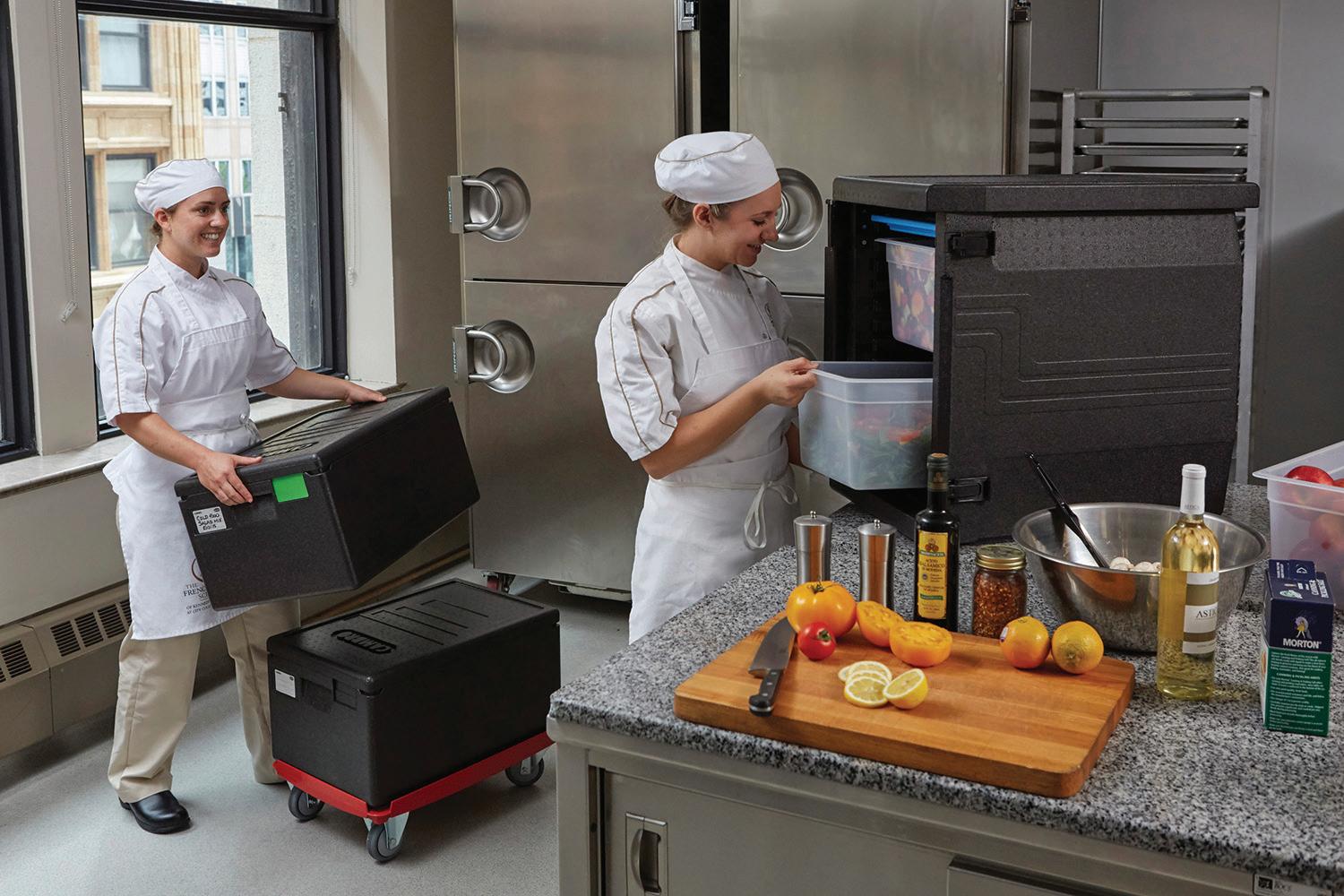
When the timeline is tight, the guest count grows, and expectations are high, your equipment matters.
Curtis Restaurant Equipment supports caterers with reliable equipment, essential supplies, expert design services, and a team that’s invested in your success.
Employee owned. Trusted for over 60 years. - Ready when you are -
With the control and convenience of natural gas, cooking is never a chore. Whether it’s your first time using a natural gas cooktop or range, or you’re a seasoned pro, enjoy cooking with natural gas equipment to create memorable experiences with the foods your customers crave.
Visit nwnatural.com to to learn more about the benefits of high-efficiency natural gas equipment for your business.
LOST IN THE RUSH: SUMMER COMMUNICATION GAPS
Practical Ways To Keep Frontline Teams Aligned In Peak Season
Last year, Oregon welcomed 4.3 million visitors, according to the 2025 Economic Impact of Travel in Oregon Report by Travel Oregon in partnership with Dean Runyan Associates. Despite ongoing economic uncertainty, industry forecasts still point to growth this year, with many travelers expected during the busy summer season across coastal towns, wine country and metro areas. For restaurant and lodging properties, that brings both opportunity and complexity. Seasonal hiring ramps up, shifts expand, and teams often include a mix of new and experienced employees working varied schedules.
In this environment, communication becomes more essential and harder to manage effectively.
Many organizations rely on familiar approaches: updates passed through managers, emails, DMs, or posting notices in shared spaces. While these methods can work during slower periods, the pace and volume of summer operations can quickly expose their limitations. Messages compete with immediate priorities such as guest service, staffing adjustments, and day-to-day problemsolving.
As a result, important information may not reach all employees consistently or in time to be useful.
One of the biggest challenges during peak season is the assumption that information will naturally flow through management layers. Supervisors and shift leads are expected to pass along updates, but their capacity is often stretched. With increased guest volume and operational demands, communication can become secondary to more urgent tasks.
This is not a reflection of effort or commitment, but of competing priorities.
To improve consistency, here are five communication approaches designed for the realities of peak-season work rather than relying on a single channel or moment.
1. Simplify messages for speed and clarity.
Long or detailed messages are less likely to be read or retained. Clear, concise communication focused on what employees need to know and do are of upmost importance in fastpaced environments. Can the message be understood in under 10 seconds? If it cannot, simplify the content.
2. Use multiple touchpoints, not just one.
This workforce includes early-morning prep teams, midday shifts, and late-night staff, so no single communication
method will reach everyone. Reinforce key messages across multiple touchpoints, such as pre-shift huddles, printed materials, and digital channels to help ensure broader coverage. Repetition, when done consistently and clearly, supports retention without adding unnecessary complexity.
3. Design communication for real work environments.
News and information is often consumed or shared in high-traffic areas such as kitchens, back offices, or break rooms. Easy-to-read, visual clarity can make all the difference. Use bullet points, short headlines, and simple layouts to improve comprehension during busy shifts. Timing also matters. Deliver key updates at the start of a shift, rather than in the middle of service, to increase the likelihood that employees will see and understand the information.
4. Support seasonal and new employees.
New, seasonal staff are less familiar with processes, expectations, or communication channels. Without intentional onboarding and reinforcement, these employees may miss critical updates. Provide clear, consistent messaging that’s easy to access.
5. Create simple feedback loops.
Frontline employees are often the first to notice when something is unclear or not working as intended. Create opportunities for quick feedback, such as brief check-ins or openended questions during huddles. Empower your people to help identify business gaps.
Effective communication during peak season supports more than information sharing. It helps create consistency across shifts, reduces uncertainty, and enables employees to focus on delivering strong guest experiences.
As Oregon’s hospitality industry navigates the demands of summer, clear and accessible communication can serve as a stabilizing force helping teams stay aligned even in the busiest moments.
LINDSI TAYLOR SHROCK
ABOUT
Lindsi is a communications consultant specializing in frontline and dispersed workforces. She focuses on helping organizations improve clarity, reach, and employee connection across complex operational environments. She can be reached at lindsitaylorshrock.com
second look. Take a
In the hospitality industry, it’s all too easy to face “death by a thousand cuts” — expenses piling up from every direction.
But you can take control over one of these line items. Your insurance.
Are you using these ORLA resources?
• Your ORLA membership comes with a complimentary insurance review. You get input on steps you can take to reduce your insurance-related expenses.
• ORLA also sponsors the Hospitality Insurance Program (HIP). HIP gives you large group purchasing power and coverage specifically tailored for the hospitality industry. Last year, ORLA members trimmed their insurance bills by an average of $3,650 with HIP. Find out if you have coverage gaps. Schedule your free review today. Rob Hoover 503-820-3415 gethip@risk-strategies.com www.gethip.biz
Your Hotel Doesn't Need More Content. It Needs More Events.
How Activations and Community Experiences Can Boost Your Social Media Presence
One of the biggest mistakes I see hotels make on social media is believing they have a content problem. They don't. They have an experience problem.
Marketing teams spend many hours trying to figure out what to post next while overlooking one of the most innovative marketing tools at their disposal: events, activations, and community experiences. The hotels creating the most engaging content aren't necessarily hiring better photographers or producing more polished videos. They're creating more opportunities for people to gather, connect, and experience the property. The content is simply a byproduct.
People share experiences, not advertisements. (Gone are the ways of influencers trying to sell you a product they were given for a trade of a review). A networking mixer, wine tasting, wellness event, local maker's market, live music night, or community fundraiser naturally creates the type of content social media was built for. Guests take photos, post Stories, tag friends, and share videos. They talk about the experience long after it's over, extending your reach far beyond the people who attended.
Many hotels evaluate events solely by the revenue generated that day. While revenue certainly matters, the marketing value is often just as important. A single activation can generate weeks of content through guest interactions, behind-the-scenes
footage, team moments, testimonials, and user-generated content. Instead of scrambling to create content from scratch, your team is documenting experiences that are already happening.
The hotels that are winning are the ones with marketing teams that are beginning to think less like places people sleep and more like places where people gather. That shift changes everything. A networking event may introduce your property to a future corporate client. A wellness workshop could attract a future leisure traveler. A community fundraiser might lead to future group business. Every activation creates another opportunity for someone to discover your property and connect with your brand.
The good news is that activations don't need to be complicated or expensive. Some of the most successful events start with local partnerships. Consider collaborating with a winery for a tasting experience, a brewery for a craft beer pairing dinner, a florist for a seasonal workshop, or a fitness instructor for a sunrise yoga class on-property. Hotels can also partner with chambers of commerce, tourism organizations, wedding vendors, nonprofits, and local creators to bring new audiences through their doors.
Looking past partnerships, find ways to create recurring experiences that become part of your community's calendar. Host a monthly women in business networking event, a live music series on the patio, a
local artisan market, a holiday-themed pop-up experience, or a community happy hour that showcases local food and beverage partners. Meeting planners and corporate clients often take notice when a hotel is actively involved in the community and creates memorable experiences beyond traditional lodging.
These events do more than fill your social media calendar. They create relationships, generate word-of-mouth marketing, and position your property as a destination rather than simply a place to stay. They also provide a steady stream of authentic content that showcases real people enjoying real experiences on your property.
One thing is true for social media, no matter how evolved it becomes: people connect with people. The hotels with successful social media accounts are creating experiences worth talking about because the best social media strategy isn't about posting more content; it's about creating more moments worth capturing.
Before you start building your next social media calendar, instead of asking yourself, "What should we post next month?" ask, "What experience can we create that people will want to attend?" The content will take care of itself.
KARA ALICIA
ABOUT
Kara is CEO of KCreative, a full-service digital marketing agency specializing in hospitality, and part of ORLA’s network of Consulting Partners.
Smart energy control
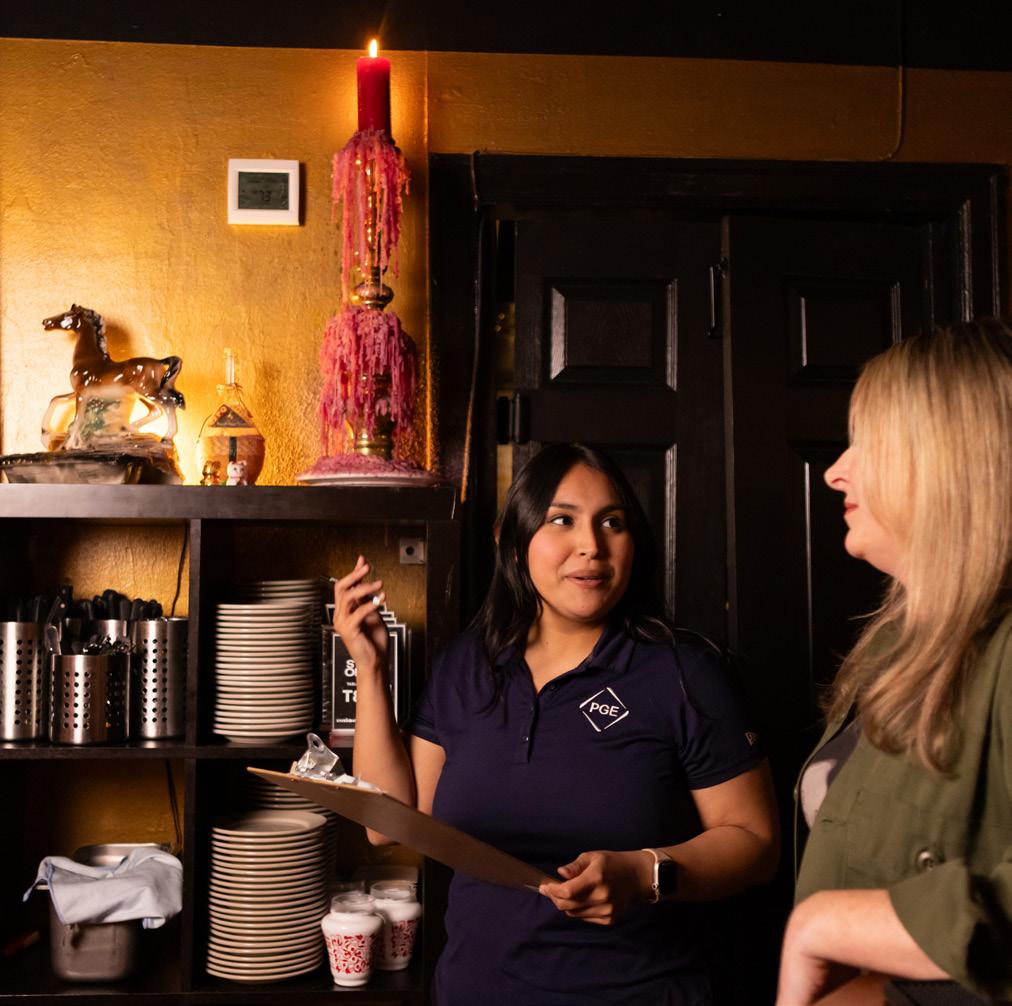
Manage energy efficiently with PGE’s Energy Partner Smart Thermostat program. Join 1,000+ businesses already enrolled.
See if you qualify for a FREE smart thermostat plus professional installation ($400 value). Control your temperature from anywhere, anytime.
portlandgeneral.com/epstnow
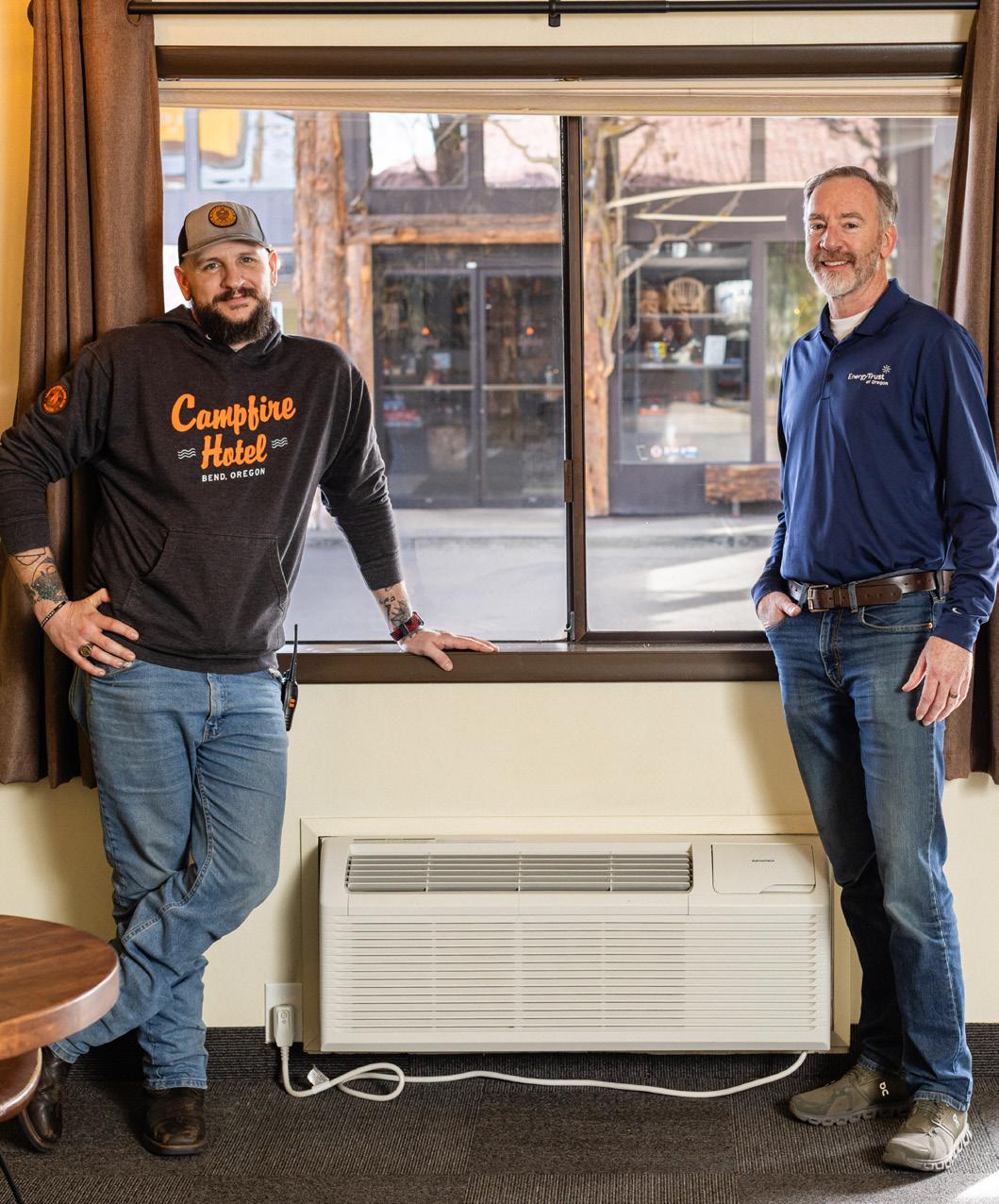
Energy Trust of Oregon offers cash incentives to support energy-efficient upgrades throughout your property. Whether you’re looking to install heat pumps, ozone laundry systems or insulation, these improvements help reduce energy use across daily operations while maintaining the comfort and service your guests expect.
Learn more at www.energytrust.org/lodging
OREGON’S WAY: FOOD & DRINK
“Why Do Bars Have To Serve Food?”
Ever wonder why food is available late night in bars and restaurants throughout Oregon? The answer isn’t just an OLCC rule, it’s written in the Oregon Constitution. Specifically, Section 39 (Sale of liquor by individual glass) of the Oregon constitution states, “The State shall have power to license… establishments where food is cooked and served, for the purpose of selling alcoholic liquor by the individual glass at retail, for consumption on the premises, including mixed drinks and cocktails…”
Oregon’s focus on hospitality as a core value to its identity has helped the industry grow to become the second largest employer in the state employing over 120,000 Oregonians. A Travel Oregon report issued this past May found that in 2025 tourism spending contributed $14.6 billion to Oregon’s economy. Oregonians themselves spent $5.9 billion on in-state travel while our neighbors to the north in Washington accounted for $3.1 billion in tourism spending in Oregon.1
It’s no wonder Oregon’s reputation as a food destination draws tourists to savor and share in the bounties of our state. Bars and restaurants approach meeting food service requirements in a variety of ways. Some chefs embrace Oregon’s abundant ingredients and plate dishes that have put Oregon’s culinary scene on the map. While some bars, breweries and wineries have even partnered with food trucks to meet this requirement–which has given patrons even more options and opportunities for symbiotic business partnerships. You can even find a Reddit on how bars share food service ideas.
But let’s talk about the details (e.g., what constitutes a meal?). Bars and restaurants (Full-On Premises licensees) that serve cocktails or distilled spirits by the drink must make at least five different meals available. These meals must be prepared or cooked on the licensed premises and be sufficient to satisfy the appetite of one individual. Each of the meals must differ in their ingredients or how they are made. For example, a beef burger differs from a turkey burger, a pepperoni pizza differs from a cheese pizza, and fried chicken differs from baked chicken.
OLCC licensing staff work directly with businesses when they apply for a license to ensure that they understand and meet the food service requirements of each license type. This also includes explaining to bars, restaurants, breweries and wineries who only serve beer, wine and cider the costs and benefits of opting to serve food or not. That’s right, these establishments are not required to serve food. If drinking is the main draw to an establishment that serves beer, wine or cider without food, then minors are not allowed on the premises after 9pm. It’s a decision a business needs
to make based upon the crowd and atmosphere they would like to attract and serve. Businesses should discuss their plans with their license investigator so they can help you develop a minor control plan that best serves the environment you wish to create.
The goal of these requirements is to mitigate overconsumption and keep minors out of businesses where adults are having drinks. Simply put, eating food while drinking enables the body to more easily absorb alcohol and aides in the elimination of alcohol from the blood stream. Plus, when people drink, they get hungry!
Monitoring and helping businesses understand the importance of food service requirements is how OLCC balances both its mission to support public health and responsible businesses. Our license investigators work in partnership with businesses to ensure they set up their business to meet the food requirements and turn ideas into a reality.
“I especially appreciate how collaborative OLCC staff are. They don’t start from the place of ‘you can’t do that.’ Instead, they adopt the approach of ‘let’s work together to figure this out.’ That is pretty remarkable,” said Commissioner Kurt Huffman, who owns ChefStable, partnering with chefs to help them build their dream restaurants and who has helped open over 100 restaurants in Oregon, Washington, and California over the past 18 years.
Our staff at the OLCC recognize the importance of the hospitality industry and its economic impact. We are modernizing our operations so that we can better serve, support and supply the industry through Oregon’s Way. While we can’t promise we’ll make you a burger with fries at midnight; we’re happy to help you set up your business so you can!
Distracted driving is no longer just a “texting while driving” problem. According to distracted-driving data published by the Oregon Department of Transportation (ODOT), Oregon recorded 28,699 distracted-driving crashes between 2019 and 2023, resulting in 221 fatalities and more than 28,000 injuries. Safety researchers increasingly point to a combination of smartphones, in-vehicle technology, constant connectivity, and multitasking that pulls drivers’ attention away from the road. For restaurants and lodging businesses, the risks extend well beyond employees behind the wheel. Distracted driving can injure guests in parking lots, disrupt staffing when employees are involved in crashes, damage property, and affect delivery operations.
Advances in Technology
Most people recognize distracted driving is dangerous. The challenge is that awareness alone does not always change behavior. Smartphones, apps, navigation systems, and messaging platforms have become woven into daily life, creating an expectation of
immediate response. A text from a coworker, a scheduling update, directions to a location, or a quick work call can feel harmless in the moment. Unfortunately, those small interruptions can pull a driver’s eyes, hands, or mind away from the road at exactly the wrong time.
Managing Complexity
Researchers are also finding that distraction is becoming more complex. Drivers are no longer managing only phones; they interact with touchscreens, voice commands, navigation systems, entertainment platforms, and connected devices. Even when technology is designed to reduce manual phone use, it can still create cognitive distraction by shifting attention away from driving. In short, modern vehicles often offer more information, more connectivity, and more opportunities for distraction than ever before.
Growing Impact
For hospitality businesses, the impact can show up in many ways. An employee may be injured while commuting to work. A manager
may be traveling between locations. A delivery driver may be rushing to complete a route. A guest may be walking through a busy parking lot or crossing a driveway. In some cases, distracted drivers have even crashed into buildings, outdoor dining spaces, and storefronts.
Beyond the immediate risk of injury, distracted-driving crashes can affect workforce availability, guest experience, and business continuity. When employees are injured or unable to report to work, teams may need to adjust schedules, cover shifts, or operate with reduced staffing. Property damage, delayed deliveries, and disruptions to operations can create additional challenges. A momentary distraction can have consequences for employees, guests, operations, and the community.
Recent research suggests another concerning trend: drivers may be more likely to interact with their phones at higher speeds than previously believed. When distraction is combined with highway speeds, drivers have less time to recognize hazards, respond to
changing conditions, or avoid a collision. That combination can increase both the likelihood and severity of crashes.
Create a culture of prevention
The good news is that distracted-driving crashes are largely preventable. Small actions can make a meaningful difference. Before driving, silence notifications or activate a do-not-disturb feature. Program navigation before putting the vehicle in motion. If a call, text, or work issue requires attention, pull over to a safe
RESTAURANTS
HOW CAN WE SERVE YOU?
Membership in ORLA means being a part of the only organization in the state devoted to protecting and promoting the interests of the entire hospitality industry. Contact us for questions; let us know what issues are affecting your business and how we can help. We have your back!
Director of Business Development 503.428.8694 MDouglas@OregonRLA.org
ORLA MEMBER SERVICES BOARD OF DIRECTORS
• Jim Hall, Chair, Independent Restaurant Concepts (IRC)
• Doug Bradley, Kensington Investment Group
• Jason Brandt, Oregon Restaurant & Lodging Association
• Ken Denfeld, Godfather's Pizza
• Chris Hein, Old Spaghetti Factory
• Allyx O’Connor, Bowline Hotel / Adrift Hospitality
• Willy So, A-1 Hospitality Group
OREGON RESTAURANT & LODGING ASSOCIATION MAIN OFFICE: 503.682.4422 • info@OregonRLA.org
POINT OF SALE & PAYMENT PROCESSING
ORLA Members get exclusive pricing models and service discounts including a free 1-on-1 needs assessment and save an average of 25% on processing fees, ranging from $2,400 to $24,000 annually.
WORKERS’ COMP INSURANCE
ORLA’s group program with SAIF affords members an additional discount if they meet the eligibility requirements.
HOSPITALITY PARTNERS
Advance Travel and Tourism - Deep savings on high impact marketing strategies
ASCAP - ORLA Members can save up to 20% off their first-year music license fees
BMI - ORLA Members can save up to 10% off their music licensing fees
Cody.MD - AI Doctor providing personalized health support, guidance and connection to human doctors
Garth T. Rouse & Associates - Comprehensive health insurance services for ORLA members
Impact Restaurant Coaching - ORLA members save $2,500 off a 12-month program
Pacific Concepts Group (DIRECTV) - ORLA Members can save 20% or more off retail DIRECTV rates
PenridgeGlobal - Progressive discounts on select custom window treatments for ORLA Members
RestaurantOwner.com - ORLA Members receive 15% off all monthly plans and 30% off all annual plans
RX Music - Members save up to 50% off normal pricing for curated music or music video programs
Stayntouch - ORLA Members save up to $5,000 property management systems and mobility solutions
CONSULTING PARTNERS
ORLA’s network of Consulting Partners provide expert guidance and industry-specific support to help members navigate challenges, optimize operations, and grow their businesses.
Baker Tilly - Accounting
Barran Liebman - Employment Law
Jordan Ramis - Business Law
Cascade Employers Association - HR Support
KCreative - Digital Marketing
Refettorio Consulting - Consulting
Beardman Technology Group - Tech Services
ONLINE VENDOR DIRECTORY
ORLA works with close to 200 Allied Members who have joined your association in support of Oregon’s restaurant and lodging operators. To search for Allied Members' products and services visit the online Vendor Directory at OregonRLA.org.
MEMBERSHIP PAYS YOU BACK
ORLA Delivers Measurable Savings Today and Stronger Industry Representation for Tomorrow. Join Us!
Operators become members of ORLA for many reasons: advocacy, workforce development, training, industry intelligence, and compliance support, among others. But what cannot be understated is the cost and time savings that go right to your bottom line. We know that more than $16,800 annually in savings exist in programs that are exclusive to members. These are not generic small business discounts recycled from some playbook. These are built specifically for Oregon restaurants and lodging properties.
If you have not taken advantage of a free coverage review through ORLA's Hospitality Insurance Program, known as HIP, you may be leaving an average of $4,593 per location on the table every year. The review costs you nothing.
For workers' compensation, qualifying members may be eligible for a six percent discount through SAIF with no minimum annual premium required. Talk with your agent to see if you qualify and ensure they are not just hitting the auto-renewal on your policies.
Credit card processing fees skyrocketing and point-of-sale system support headaches are real. ORLA has your back and has partnered with locally owned Independent Merchant Brokers (IMB). Members receive a 25 percent discount on credit card processing fees and point-of-sale equipment along with local support when you need it. Depending on the volume of activity at your establishment, that can represent anywhere from $2,400 to $24,000 returned to your operation each year. That is real money coming back on a line item every operator carries.
Lodging operators who integrate Stayntouch have the $3,000 integration fee waived along with technology upgrades valued at more than $2,000. That is $5,000
removed from the bill before the system processes its first reservation.
More Programs Available to Members
• Adesso Capital: Help members put money back into their business through federal tip tax credits and access to flexible lending solutions designed for hospitality operators
• Impact Restaurant Coaching: $2,500 off a 12-month operations coaching program designed around the specific needs of your restaurant
• DIRECTV via Pacific Concepts Group: $750 to $2,000 annually on commercial entertainment packages depending on the size and setup of your operation
• RX Music: $1,140 per year on curated music and video programs
• ASCAP and BMI: 10 percent discount on music licensing fees for both programs
• Advance Travel and Tourism: $1,400 in savings on marketing packages
• Penridge Global: Average $750 savings per order on roller shades and drapery
• ServSafe: $30 per person on manager food safety certification
• RestaurantOwner.com: Up to $120 annually depending on the plan you select
The Bigger Picture
Advocacy does not show up on a savings calculator, and it does not stop when a legislative session ends. ORLA is working on behalf of Oregon's hospitality industry wherever decisions get made, county courthouses, city halls, and local jurisdictions across the state where
policy directly affects how you operate. When more operators participate in the association, the more voice we can apply toward protecting the interests of this industry.
At present there are businesses benefiting from the work ORLA does without participating financially in that work. More members mean greater influence in every room the association walks into.
See what programs are available at OregonRLA.org/Savings
Run your own numbers at OregonRLA.org/Savings-Calculator
JOHN HAMILTON, ORLA
DINO VENTI Venti's Cafe, Salem ORLA Member since 2012
SUZANNE WILLOW Willow-Witt Ranch, Ashland ORLA Member since 2016
NEWS BRIEFS
Happenings From Around the Industry
ORLA Magazine Remains a Top-Valued Benefit
The quarterly ORLA Magazine continues to be one of the association's most trusted information resources. In a recent survey, 40 percent of Oregon restaurant and lodging members identified the magazine as a primary source of industry information, helping drive the finding that 70 percent of members rely on ORLA resources for industry news and updates. As a key member benefit, three of the four annual issues are distributed exclusively to members, delivering advocacy updates, business insights, industry trends, and member success stories. Want to continue receiving the magazine? Connect with us at info@oregonrla.org.
Oregon Featured at National Culinary Showcase
Oregon’s restaurant industry was represented at Taste of America, a Washington, D.C., event celebrating the flavors and traditions that define American cuisine. Mo’s Seafood & Chowder of Newport was selected as one of just four restaurant participants from across the country to take part in the showcase, held as part of the nation’s 250th anniversary commemoration. The event highlighted the vital role restaurants play in America’s culture, communities, and culinary heritage.
Member Resource: Oregon Lodging Operator’s Guide
ORLA lodging members have exclusive access to the updated Oregon Lodging Operator’s Guide, a practical resource covering hotel regulations, ADA compliance, employment laws, and other key operational requirements. Developed specifically for Oregon operators, the guide helps businesses stay informed, reduce risk, and navigate an evolving regulatory landscape. Members can download the guide at no cost through the ORLA Info Hub.
Oregon Jobs Report Signals Evolving Workforce Trends
To help businesses stay ahead of workforce and economic trends, ORLA shared key insights from the Oregon Jobs Report. Job postings rebounded 6.6 percent in the first quarter of 2026 following a seasonal slowdown, though hiring demand remains 10.4 percent below year-ago levels and wage growth continues to trail the national average. Reports like these provide ORLA members with valuable context on labor market conditions, compensation trends, and broader economic indicators that can inform business planning, hiring, and operational decisions.
ORLA has cultivated a network of trusted business partners that help hospitality operators reduce expenses and improve operational efficiency. Memberexclusive programs offer savings on services ranging from insurance and payment processing to HR support, technology solutions, and workforce training. ORLA’s Savings Calculator on OregonRLA.org helps businesses estimate the value of these benefits, demonstrating how industry connections and negotiated partnerships can deliver measurable bottom-line results.
NEW MEMBERS
ORLA Would Like To Welcome The Following New Members From March 2026 - May, 2026
• Albany Golf & Event Center, Albany
• Awakening Coffee LLC, West Linn
• Bargeway Pub and Catering, The Dalles
• Bottoms Up Saloon, Redmond
• Burnt Field LLC, Boardman
• Chowder House, Gold Beach
• Courtyard Cafe, Portland
• Dairy Queen, Seaside
• Darlings Marina & RV Resort, Florence
• Econo Lodge, Portland
• Filta Environmental Kitchen Solutions, Vancouver WA
• Fire on the Mountain Buffalo Wings, Portland
• Fisher Phillips, Portland
• The Frontier, Baker City
• Hawaiian Time, Eugene
• The Hideaway Tavern, Bend
• Hilton Garden Inn Portland/Beaverton
• Impact Restaurant Coaching, Eugene
• Jerry's Place Home of What'cha Brewing, Florence
This chart represents hotel performance year to date in Oregon, regionally, and compared to the U.S. Source: CoStar Group via partnership with Travel Oregon.
/
RESTAURANT INDUSTRY SNAPSHOT
Restaurant Job Postings Across Oregon
The following illustrates the number of job postings based on experience level in Oregon as of June 24, 2026. Source: Data and insights for RestaurantsWork are provided by Lightcast, a leading labor market analytics firm, under contract with the National Restaurant Association and its Educational Foundation.
Fast
Waiter / Waitress
Kitchen Staff
Bartender
Dishwasher
Busser / Banquet Worker / Cafeteria
Cashier
Host / Hostess
LOOKING AHEAD
OCTOBER
SEPTEMBER
ORLA Hospitality Conference
BUILD A STRONGER BUSINESS.
The Oregon Restaurant & Lodging Association is working every day to protect, connect, and strengthen Oregon's hospitality industry.
Membership gives you access to:
Advocacy that protects your business
Education and industry resources
Valuable connections and networking
Exclusive member benefits and savings
Join your community shaping the future of Oregon hospitality.
DREW AND KRISTIN ROSLAND
Overleaf Lodge & Spa, Yachats ORLA Member since 1997