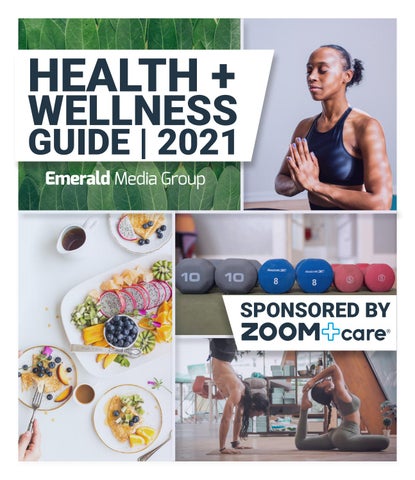
HEALTH +
WELLNESS
GUIDE | 2021
SPONSORED BY
STAFF LIST EDITOR Skyla Patton
WRITERS Kelsie Heffernan Josiah Pensado Siena Dorman PHOTO CREDIT Brooke Lark Isaac Wasserman Stephanie Studer ACCOUNT EXECUTIVES Patrick McCumber Keaton Roberts Amy Menendez
PRESIDENT AND PUBLISHER Bill Kunerth
VP OF OPERATIONS Kathy Carbone CREATIVE DIRECTOR Sam Rudkin SALES MANAGER Shelly Rondestvedt STUDENT SALES MANAGER Stella Kalomiris
HEALTH +
WELLNESS
GUIDE | 2021
Letter from the Editor
The concept of “self care” has reached new heights as we’ve navigated COVID-19, and it’s more important now than ever that we’re focusing energy on nurturing both our bodies and our minds. Whether you’re looking for ideas to help heal a lonely heart or the facts on keeping yourself and loved ones safe, the Health and Wellness Guide is here to help you find those resources. Drink some water, wash those hands, and stay safe out there!
2 | HEALTH+WELLNESS GUIDE | 2021
University
Health Services
Visit the Duck Nest Wellness Center in the EMU! and Remotely at https://health.uoregon.edu/ducknest
PLANNED PARENTHOOD
SOUTHERN
OREGON
OUR SERVICES Primary Care Acupuncture Allergy/Asthma Birth Control Colds/Flu Dental Diabetes Management Energy Healing
Massage Therapy Medical Lab Tests Medical Records Meditation Nutrition Pharmacy Physical Therapy Psychiatry
Sexual Health Sports Medicine STI Screening Clinic Stress Management Tobacco Cessation Travel Clinic Vaccinations X-ray
Follow us: @healthyUO (Facebook and Instagram) and @HealthCenterUO (Twitter) University Health Services
health@uoregon.edu • 541-346-2770 EO/AA/ADA institution committed to cultural diversity
LIMITED Y T QUANTI LE! B AVAILA
ONLY $ 39.95
ORDER TODAY! at dailyemerald.com/haywardbook New coffee table book celebrates Hayward Field’s Legends and Legacy Wonderfully written • Image rich • 140 pages, hardcover
Make an appointment by calling
541.344.9411 today!
For more information, call the Emerald at 541-346-5511, ext. 302, or email kcarbone@dailyemerald.com.
1395 University St. #302, Eugene, OR 97403
DAILYEMERALD.COM
www.ppsworegon.org HEALTH+WELLNESS GUIDE | 2021| 3
University of Oregon’s
Latest Updates on the COVID-19 Vaccine Written by : Kelsie Heffernan
Widespread distribution of the COVID-19 vaccine will be instrumental in increasing immunity and stopping the spread of the virus. Many people are eager to get the vaccine in hopes of life returning back to normal again in the coming year. If you have an underlying health condition, you may currently be eligible for the vaccine. If you’re not sure if your health condition qualifies you for a vaccine, you can contact your doctor or visit cdc.gov for a list of conditions. As soon as it becomes available to the university, President Michael Schill has pledged to make the vaccines free to students and staff.
4 | HEALTH+WELLNESS GUIDE | 2021
When Are Staff and Faculty Eligible? University of Oregon staff who are considered front line workers by the Oregon Health Authority will be eligible for the vaccine as soon as May 1 and are considered part of phase 1B. The Oregon Health Authority is currently classifying front-line workers as people in food service, public transit, government, retail, and more. The employees of the university who don’t fall under their classifications will be part of phase 2 and are able to get vaccinated July 1. University of Oregon faculty can fill out a pre-registration form online at coronavirus.uoregon.edu/vaccine.
Students and Residents of Eugene University of Oregon students and the general public will be considered in phase 2 as well and will be able to receive the vaccine starting July 1. For residents of Lane County and students not employed by the university, a more general pre-registration form is available so that you can be notified when you’re able to schedule a time to get your vaccine. The link to this form is also available at coronavirus.uoregon.edu/vaccine. When it’s time to get your vaccine, you’ll be instructed on where to go from clinics near you.
The Big Three The three vaccines currently being distributed are Pfizer-BionTech, Moderna, and Johnson and Johnson. Pfizer and Moderna require two shots both separated by a little less than a month and are made up of mRNA. Unlike a traditional vaccine that uses a weakened version of the virus, the mRNA vaccines help our immune systems replicate a protein that fights the virus if we contract it. The Johnson and Johnson vaccine is only one dose and uses the genetic material of a different virus. Side effects of the vaccines may include fever, headache, or chills, and are completely normal. All three of the vaccines are recommended and endorsed by the CDC and have undergone countless trials to ensure safety and effectiveness before being given to the public.
What to Know After Getting Your Covid Vaccine Once vaccinated, it is still important to wear your mask in public. However, when spending time with other vaccinated people, masks and social distancing are no longer required, and you’re on track to protecting your community and getting life back to normal. DAILYEMERALD.COM
HEALTH+WELLNESS GUIDE | 2021| 5
Fostering Connections
From Afar Written by : Siena Dorman
Constantly visiting friends and family has, for the length of our lifetimes, been the way we maintain community. There’s no question that we are inherently social beings. With the pandemic we’ve faced isolation in an involuntary and dramatic fashion that has exposed certain needs we never paid much attention to. But, we’re also resilient and there are still ways to maintain true connections in our lives. Many of us have experienced the awkward situation of a good friend asking to see you, but because of COVID-19, we’ve had to say no. The problems that arise from rejecting the offer to see a friend may vary from a friend not understanding, wondering, “but you see other people,” to them being completely understanding, yet you feel like a neglectful friend. What we fail to understand in these conflicts is that who we see, whether only our roommates or a selection of specific additional people, is all a part of our own risk calculations. When you find yourself in an uncomfortable situation, just remind your friend that you value them, but that there are certain safety obligations you’re practicing to keep you and those around you safe. It’s hard for some people not to take things personally, but by making your boundaries clear, new paths to maintain a healthy relationship are revealed.
6 | HEALTH+WELLNESS GUIDE | 2021
So, how can we maintain relationships even when we can’t see our friends and loved ones? First, remember who is important to you. Prior to the pandemic we could see people casually so we probably had some relationships that were both healthy and harmful. Now we have the opportunity to foster genuine relationships. Those you reach out to and those who reach out to you will tell you a lot about who you should be spending your energy on. One year in quarantine may not mean you’ve covered all your meaningful and valuable relationships yet–and that’s okay! This may feel funny, but writing out who you’ve been fortunate to stay in touch with and who you still want to reach out to is immensely helpful for using your time socializing with purpose. It’s easy to forget about the relationships you value with all of the other struggles we’re still navigating. Consider who you can help by offering your ears. Who needs to hear, “Hi, how are you doing? I miss and care about you.” When we feel down during a pandemic it often seems like there are few ways to rise above it. Offering help is a great way to get out of your own head. We are more than our thoughts, we are also humans capable of being there for others. Ask some friends if
they want to Facetime, then listen without judgement. Everyone needs someone they can openly share their struggles with. Do you have a book suggestion? Something you saw lately that reminded you of someone? It may be intimidating or shameful to reach out to someone you feel you have “neglected” but don’t get hung up in that emotion. Relationships go both ways. Anyone who cares about you and the relationship you have with them will be happy to see your name pop up on their phone… or in their mailbox. Write a letter. Letters capture emotion and feel intentional, thoughtful and personal. Even if your friend lives in the same city as you! It’s rewarding to send and receive mail. Just a few weeks ago I received a cookbook and card from a friend I hadn’t talked to once during the pandemic. I felt incredibly uplifted by their generosity and spontaneity. I was reminded that our care for others does not have to be shown constantly in order for it to exist authentically. In a card you write to someone, also let them know what you’re up to. Relationships are not simply about giving yourself to others–remember you have something to gain from communication as well. Reciprocity is fundamental to a healthy
DAILYEMERALD.COM
relationship. Sacrifices are necessary in relationships but you should never feel like your care is being taken for granted. Give what you know someone would be happy to give back to you. Take your extra alone time to remember who has helped you. If you aren’t ready to extend your hand in generosity, extend your heart in gratitude. The people that make you feel like you belong and feel like you’re loved deserve to be recognized. Sharing your gratitude for others will encourage the healthy future of your relationships and strengthen it’s foundation, even when you can’t see someone in person. There is plenty of opportunity to nurture existing relationships and to recover old ones. Everyone has fallen out of communication with some people during the pandemic–this is not a big deal. Something as small as a phone call, writing a letter, sharing old photos, or a simple text is adequate. If you want to create the momentum for further communication and community with the people you care about, try organizing a book or cooking club, share playlists, try learning new skills with them. Find anything that can strengthen your bonds through shared experiences– something we all need a bit more of.
HEALTH+WELLNESS GUIDE | 2021| 7
2021 | 9th ANNUAL Support The Daily Emerald in College Media Madness 2021 and donate today!
The Daily Emerald is joining more than 20 student-run newsrooms for a nationwide fundraising competition. Gifts made between March 15 and April 5 will help us meet our goal of finishing No. 1 in the standings at collegemediamadness.com.
Do you know an exceptional student worthy of an award? Help celebrate the ninth annual 25 Ducks and nominate a deserving student. Taking nominations until Wednesday, April 28th.
Sponsored by
8 | HEALTH+WELLNESS GUIDE | 2021
GETTING STARTED
G
Written by : Josiah Pensado
yms, you either love them or hate them. You might love the gym because of the wide variety of exercise machines, but what if the gym isn’t your thing? More often than not, gyms can be quite intimidating to newcomers; whether it be because of how fit the crowd tends to be, or because you don’t know where to start. The thing is though: that’s OK. Everyone starts somewhere! One of the best ways one can approach the gym or exercising from home would be to not sweat it too much. Try to go into it with a strong and open mind. No amount of extra stress will make your workout better, but rather make it worse. The biggest piece of advice would be this: have fun!
Start small and listen to your body
A good piece of advice would be to start small. Whether it be with small weights, small sets, or even small goals. It’s best not to start with a really high standard for yourself, especially if you are new, and nothing is worse than pulling a muscle or overwhelming your body by starting off too intensely. Go into the gym with realistic goals, and listen to your body and mind. The only real pressure is how much you put on yourself. Just as long as you focus on yourself while at the gym, you should be set.
Don’t stress — or bring a friend
Most people go there to workout, not to judge, and that seems to be the universal unspoken rule. Sometimes it is best to just put on your earbuds and listen to whatever gets you pumped. If tuning out the whole world isn’t your thing, working out with friends alleviates so much pressure. Find a friend with a similar general fitness as you, DAILYEMERALD.COM
and that way both of you can keep each other accountable and motivated. And if you ever feel intimidated by other individuals at the gym, you know your friend has your back.
Keep it clean
Personal hygiene was already a priority pre-pandemic when it comes to gym niceties, but it’s especially important now to keep yourself and your space clean when visiting a public space. Be sure to wear your mask at all times (and put extra energy into finding one that’s comfortable for your face!), wash those hands and follow all cleaning instructions at your gym to help everyone out.
Alternatively…
If gyms still aren’t your thing, there are still so many ways one can exercise without getting a membership anywhere. Skateboarding, biking, hiking, rock climbing, running and walking are all great ways to stay fit. If you want to workout without even leaving your own property, it is best to develop your own workout routine. One can easily do push ups, situps, planks etc… all while in your own space. You could also do yoga, meditation and breathing exercises as those can help remove stress, all while working out your mind, body and soul. There are also immense benefits to taking cold showers, and even taking ice baths. If you want to take your fitness and/or mindfulness to a whole new level, the Wim Hoff breathing method has got you covered. The Wim Hoff breathing method is something that can help boost the body’s natural immune response, as well as control their sympathetic nervous system.
HEALTH+WELLNESS GUIDE | 2021| 9
10 WAYS To Reduce Your Risk of
COVID-19 Written by : Kelsie Heffernan
1.
Double Mask
A study by the CDC found that double masking reduced exposure to potentially infectious aerosols by 95%1. To properly double mask, wear a disposable medical mask tightly fitted by knotting the ear loops and wear a cloth mask over the top. The cloth mask will be catching most of the particles so it should be washed after each use, and the medical mask should be thrown away.
2.
Wash Hands Regularly With Soap
Soap is more effective than hand sanitizer because it dislodges the possible virus particles and rinses them off of your hands. The CDC recommends washing your hands for a minimum of 20 seconds, but when soap and water is not available, you should use a hand sanitizer that is at least 60% alcohol2.
3.
Grocery Pick-Up
More time in the grocery store means more exposure to the virus. Many grocery stores such as Safeway and Fred Meyers offer free online ordering and pickup. Picking up your groceries reduces the amount of time you are in a closed space sharing air with the community, as well as touching carts and registers.You may even find that ordering your groceries online and picking them up works better for your schedule and helps plan your meals.
4.
Eat Healthy
A study on nutrition during the COVID-19 pandemic found that optimal nutrition keeps the immune system strong and more ready to fight the virus, and recommends certain foods to boost your immunity. A recommended serving size of two cups of fruit a day and two cups of vegetables and lentils will help your immune system. When buying fruits and vegetables, reach for items such as oranges and bell peppers that are high in vitamin C. Other dietary recommendations are to eat a variety of whole grains, nuts, and limiting your meat intake to only 2 nights of red meat and poultry 2-3 days a week3. Any restrictive or calorie-deficit diets may weaken your immune system and should be avoided. 10 | HEALTH+WELLNESS GUIDE | 2021
5.
Don’t Skimp on Sleep
Poor sleep can weaken your immune system and leave you more vulnerable to the virus. A minimum of 7 hours of sleep will keep you healthy, but anywhere from 8-10 is ideal.
6.
Sanitize Your Home
Keeping the high-traffic germ areas clean in your house and car may seem like a chore but is very important. Wiping down your door handles and light switches and washing your hands regularly ensures you’re not spreading anything around your home unknowingly. If it’s not already a habit, you may want to start taking your shoes off at the front door. When people cough or sneeze, the particles fall to the floor and you may be picking them up on your shoes.
7.
Social Distance Outdoors
Staying outside for social distancing activities keeps the air circulating and reduces your risk of transmitting or receiving the virus. It is still recommended to wear masks and stay six feet apart, even outside.
8.
Exercise Regularly
Regular exercise is a good practice at any time, but it is especially important during the pandemic. Exercise such as running, brisk walks, strength workouts, or biking helps improve your immune system function. As well as increasing cardiovascular fitness, it reduces the inflammation in your body which is good for maintaining overall health to prevent the virus. If you do find yourself having contracted COVID-19, it is not recommended to exercise until you consult with a health professional after you’ve recovered to see what will work for you.
9.
Avoid Peak Times
When running errands or spending any time in a crowded place, consider going during less busy times and avoiding the peak times. If running errands during peak times is unavoidable, try lessening your exposure by only going when necessary and staying at home when possible.
10.
Get Vaccinated (when it’s your chance)
Receiving the COVID-19 vaccine will be the most effective tool to prevent you from contracting the virus. University of Oregon students without pre-existing conditions or other cause to get the vaccine sooner will be able to receive it as soon as July 1, as well as all healthy Oregon adults who have not received it.
“Maximizing Fit for Cloth and Medical Procedure Masks to Improve Performance and Reduce SARS-CoV-2 Transmission and Exposure, 2021.” Centers for Disease Control and Prevention, March 2, 2021. https://www.cdc.gov/mmwr/volumes/70/wr/mm7007e1.htm. “How to Select and Use Hand Sanitizer.” Centers for Disease Control and Prevention, November 25, 2020. https://www.cdc.gov/coronavirus/2019-ncov/prevent-getting-sick/handsanitizer.html. Aman, Faseeha, and Sadia Masood. “How Nutrition Can Help to Fight against COVID-19 Pandemic.” Pakistan journal of medical sciences. U.S National Library of Medicine National Institute of Health, May 2020. https://www.ncbi.nlm.nih.gov/pmc/articles/PMC7306972/#:~:text=Here%20are%20some%20professional%20and,(4%20servings).
DAILYEMERALD.COM
HEALTH+WELLNESS GUIDE | 2021| 11