MAY 9, 2022 Monday Edition
Emerald Media
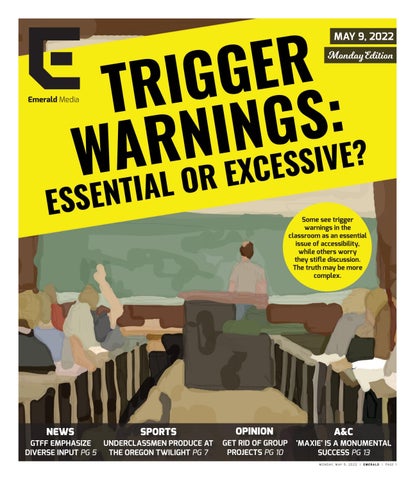
Some see trigger warnings in the classroom as an essential issue of accessibility, while others worry they stifle discussion. The truth may be more complex.
NEWS
SPORTS
GTFF EMPHASIZE UNDERCLASSMEN PRODUCE AT DIVERSE INPUT PG 5 THE OREGON TWILIGHT PG 7
OPINION GET RID OF GROUP PROJECTS PG 10
A&C
'MAXIE' IS A MONUMENTAL SUCCESS PG 13 M O N D AY, M AY 9 , 2 0 2 2
|
EMERALD
|
PA G E 1
Voted #1
Best Pizza
$
15
LARGE SINGLE TOPPING 1809 Franklin Blvd. • 284-8484 • tracktownpizza.com
*Not valid with any other offer or discount. Expires 6/30/22
mention this coupon to receive offer. Valid for walk-in or deliveries.
houseofrecords.wixsite.com/store
Made for Duck fans Take flight financially with free student checking and the Duck Debit card. Find out more at MyOCCU.org/DuckDebit
Insured by NCUA PA G E 2
|
EMERALD
|
M O N D AY, M AY 9 , 2 0 2 2
FROM YOU
TOP VIEWED STORY IN THE PAST WEEK: “PHOTOS: PROTESTERS MARCH THROUGH DOWNTOWN EUGENE TO OPPOSE DRAFT OF SUPREME COURT DECISION” BY WILL GESCHKE & MADDIE STELLINGWERF VOL. 123, ISSUE NO. 42
(Will Geschke/Emerald)
(Maddie Stellingwerf/ Emerald)
GET IN TOUCH
LOOK ONLINE Instagram poll:
Have you seen “The Secrets of Dumbledore” Yes: 9% No: 91%
Related A&C story:
EMERALD MEDIA GROUP 1395 UNIVERSITY ST., #302 EUGENE, OR 97403 541.346.5511
“‘Secrets of Dumbledore’ absorbs audiences into the magical world” by Krista Kroiss
NEWSROOM EDITOR IN CHIEF
Sarah-Mae McCullough MANAGING EDITOR
Jael Calloway ENGAGEMENT EDITOR
Sarah Matlick NEWS EDITORS
Duncan Baumgarten Leo Baudhuin A&C EDITORS
Grace Murray Nika Bartoo-Smith
(Will Geschke/Emerald)
SPORTS EDITORS
Shane Hoffmann Mojo Hill Charles Gearing
("Jude Law" by Gage Skidmore is marked with CC BY-SA 2.0.)
Second most read new story in the past week:
OPINION EDITORS
Francis O'Leary Parsa Aghel
“Hocker, Teare, Wisner and West fail to capture world record in Oregon Relays” by Eric Berniker
PHOTO EDITOR
Ian Enger
DESIGN EDITOR
Kira Chan COPY CHIEF
Amanda Lurey VIDEO EDITOR
Marcus Ren PODCAST EDITOR
Meaghan FitzPatrick DIGITAL EDITOR
Rikiya Klasen VISUALS EDITOR
Julia Stalnaker
BUSINESS PUBLISHER & PRESIDENT
Bill Kunerth X317
bkunerth@dailyemerald.com VP OPERATIONS
Kathy Carbone X302
kcarbone@dailyemerald.com DIRECTOR OF SALES & DIGITAL MARKETING
Shelly Rondestvedt X303
srondestvedt@dailyemerald.com CREATIVE & TECHNICAL DIRECTOR
Sam Rudkin X327
creative@dailyemerald.com STUDENT SALES MANAGER
Patrick McCumber ACCOUNT EXECUTIVES
Melanie Lopez Riley Valle Kevin Sullivan Amy Menendez Keaton Roberts
THE DAILY EMERALD
The Daily Emerald is published by Emerald Media Group, Inc., the independent nonprofit media company at the University of Oregon. Formerly the Oregon Daily Emerald, the news organization was founded in 1900.
ON THE COVER
(Lynette Slape/Emerald)
Student Recommends BY EVAN HUNTINGTON
MUSIC RECOMMENDATION: “Malibu” by Anderson .Paak Summary: A career defining album that put the artist on the map for mainstream stardom, Anderson .Paak’s sophomore album “Malibu” is a showcase of the Oxnard singer/rapper’s virtuosic talents not only on the mic, but behind the drums as well. Growing up as a church drummer and trained in gospel music, his wide musical influences are apparent throughout this record. He utilizes a wide array of genres from gritty hip-hop to smooth, soulful R&B with a twinge of groovy neo-soul. This album has something for everyone.
(Maddie Stellingwerf/Emerald)
Voices of UO
Scan here or visit the Emerald’s social media to participate in our next Voices of UO. Is attending commencement worth it? What do you think of UO inviting previous classes back for the 2022 commencement?
We want to hear from you:
Recommended by: Matthew Duncan, sophomore studying popular music studies
Email editor@dailyemerald.com to submit a tip or a letter to the editor. The ideal length for a letter is 200-500 words, but we publish letters of various lengths online.
“I love the blend of genres on this album as well as the songwriting,” Duncan said. “The vintage instrumentation on a lot of this album is another reason why I’m fascinated by it. Many songs on this album sound as if they could be from the 70s. Being someone from Southern California, I love the way Anderson .Paak names his albums after cities near LA.”
(Maisie Plew/Emerald)
Genre: R&B, neo-soul, hip-hop/rap
M O N D AY, M AY 9 , 2 0 2 2
|
EMERALD
|
PA G E 3
NEWS
SUPPORTING SURVIVORS Events like Sex Toy Bingo raise awareness during Sexual Assault Awareness Month. BY HANNAROSE McGUINNESS • TWITTER @SCOHANNAROSE University of Oregon students, led by members of Mujeres, march down 15th Avenue for a Take Back the Night event in 2017. Five years later, the event still happens on campus during Sexual Assault Awareness Month.
The EMU isn’t always so lively at 6 p.m., but on April 13, hundreds of people lined up outside of the Redwood auditorium, cascading all the way down three flights of stairs and ending past the first-floor information desk. Curious chatter filled the open area as students anxiously awaited the return of Sex Toy Bingo, which is part of a series of Sex Week events UO hosted to support Sexual Assault Awareness Month. University of Oregon senior Gabbi Micheli said she didn’t know what to expect from the Sex Toy Bingo event. She said after the experience, she would highly recommend others to attend future Sex Week events. “I thought it was going to be a little bit lesser-known, small. I don’t know why I thought that, but I just wasn’t expecting the community to show so much love,” Micheli said. “It was really crazy seeing the line drape down all the way down the EMU staircase. That was pretty wild.” Sex Toy Bingo has been hosted by UO’s Sexual Violence Prevention Education program and partner organizations for the past several years to raise awareness for sexual wellness resources. This year, donors such as Good Clean Love and Babeland provided prizes for bingo winners, while organizations like the HIV Alliance tabled the event and provided resource information. Ritu Roy, assistant director of the SVPE program, said the SVPE office exists as a way for students to have access to advocacy and resources dedicated to ending sexualized violence. Roy said that from 2015 to 2019, the UO campus experienced a “statistically significant reported decrease in sexual violence on our campus when the national average increased.” “The work that we’re doing collectively is creating some sort of impact,” Roy said of the statistics. “We are here to support survivors and create traumaPA G E 4
|
EMERALD
|
M O N D AY, M AY 9 , 2 0 2 2
informed spaces across the board for everybody.” Roy started working with SVPE in 2016. She said the student-centered program allows Ducks to connect with peers who may relate more to their personal experiences. Roy said SVPE created all of the SAAM events they hosted in collaboration with student leaders and campus partners to create more interactive programming. “On this campus, we have moved beyond awareness,” Roy said. “Awareness in itself can feel not as engaging or inviting, especially to survivors who have had these experiences.” Roy said SVPE’s approach to prevention on campus helps include everybody in the conversation, not just those who already take interest. “A prevention value is that everyone is part of the solution and everyone can be a part of moving toward ending violence by reducing violence,” Roy said. “For that reason, we say that SAAM is a time that is filled with hope.” Gracia Dodds, support group and education coordinator for Sexual Assault Support Services, said the nonprofit has been working since 1991 to provide survivors of sexual violence in Lane County with support services and to change societal conditions that allow for oppression such as sexual violence to exist. She said SASS’s presence at educational events like Sex Toy Bingo is important to spread the knowledge of available resources. “Creating a culture based around consent is really huge for making a foundation where people don’t experience sexual violence,” Dodds said. “It’s tough to change whole institutions, but by creating a little bit of change for each person that interacts with our services, we’re building a culture that is
more enthusiastic about consent and makes sexual violence less socially appropriate.” Dodds said SASS aims to have a multilingual and multicultural perspective, outreach and support while providing low-barrier services to survivors. She said SASS accomplishes this by providing 24-hour access to survivor resources through support groups and phone lines. “Building consent culture is huge to these educational spaces. Helping teach people that they deserve to be in control of their own bodies is prevention,” Dodds said. “Advocating for that pleasure and that autonomy helps people know that they deserve agency over their own bodies in sexual situations.” Micheli said Sex Week events provide a safe and fun environment on campus for the community to come together in a positive way to participate in Sexual Assault Awareness Month. “I really think this event is super valuable on this campus to spread awareness about not just sex positivity but sexual assault and all these kind of heavy topics,” Micheli said. “We need to normalize people speaking up about it, 100%, especially people on campus.” For Micheli, taking advantage of sexual wellness resources can be uncomfortable at times, but she says showing up for events like Sex Toy Bingo helps normalize topics of sexual wellness and violence. “Just because maybe you haven’t experienced sexual violence doesn’t mean you can’t be an ally,” Micheli said. “I think that clearly showed at the event because there were so many people, they had to shut the doors.” SAAM events on campus concluded with Take Back The Night, an annual protest raising awareness for sexual and domestic violence, and Care and Advocacy Program focus group events.
NEWS Following the vote to authorize a strike, the Graduate Teaching Fellows Federation holds a rally to demand a fair contract at Johnson Hall on Oct. 18, 2019. (Marissa Willke/Emerald)
NEW AND RETURNING GTTF LEADERSHIP EMPHASIZE
DIVERSE INPUT
Preparing to negotiate a new contract, GTFF finishes their 2022 elections. BY GAVIN GAMEZ The Graduate Teaching Fellows Federation released the results for its 2022 elections on May 6. The new leadership slate will focus on gaining input from as many members as possible in preparation for this year’s collective bargaining process, where they will work to create a new contract between the union and the University of Oregon. Current GTFF President Mel Keller said the union's new group of leaders will be integral in the bargaining process next year. “I’m really excited about the folks who are coming in, and I think they’re all really passionate and interested in making some real change,” she said. Kisa Clark won the position of GTFF president in this election. Clark served as the co-lead social science steward before being nominated for GTFF president. Previously, Clark was part of the GTFF impact bargaining team, where she helped talk with UO administration to discuss changes to working conditions based on new pandemic-related policy. Looking toward the future, Clark said GTFF is already anticipating its contract bargaining cycle this upcoming year. She said as a union, the bargaining cycle is a time to focus on setting working conditions, wages and benefits. Clark said the new executive board will be touching
base with as many new members as possible for input as they build their new contract. “For this executive board it will be a lot of touching base with as many members as we can so that we build a contract that has input from as many voices of GEs across campus,” Clark said. As a graduate student, Clark said GTFF has been one of the best group experiences she’s had. She said she sees this opportunity as a way to give back and share her experience. Along with new members elected into new positions, GTFF nominated a handful of previous members to maintain their positions. Cy Abbott became the Vice President of Grievances last year and was nominated again in the 2022 election. As VP of Grievances, Abbott said his job is to make sure the university is following the previously agreed upon contract and deal with any cases where that isn’t happening. He said unfortunately, those cases pop up frequently. “A lot of what I do is fighting for protections with the grievance process,” Abbott said. Abbott has seen grievance examples including GEs not receiving pay on their scheduled pay days and not receiving the proper work spaces as agreed upon in their contract. “We’ve had grievances where we’ve had to basically
confront the university and be like ‘why wasn’t this person paid at this time’ and try to win back wages and relief,” he said. Abbott said helping support other GEs with their everyday struggles attracted him to the role of VP for Grievances. “The union is this protective net for us to make sure we are actually looking out for each other and to make sure we are actually getting everything we need,” he said. During the election process, GTFF follows certain pre-established guidelines. According to GTFF’s website, “Any member can nominate someone to any position.” Beginning in April, members were allowed to nominate another member of their choice. Nominees were then required to submit their own statements before voting began. As a labor union, GTFF has to adhere to certain laws pertaining to how it conducts its elections, Keller said. These include notifying current members before the election and setting a time window for members to submit their nominations. Now that the 2022 election results are finalized, members in new positions will have a month overlap with the previous member who held the position. “We work with people in our new positions to make sure everything transitions really smoothly,” Keller said. M O N D AY, M AY 9 , 2 0 2 2
|
EMERALD
|
PA G E 5
HERBIVORE
CARNIVORE
LOCAVORE
New Haven inspired apizza, pub brewed beer
390 Lincoln St. @4th
541.735.3860 530 BLAIR BLVD EUGENE (541) 735-3520 PA G E 6
|
EMERALD
|
M O N D AY, M AY 9 , 2 0 2 2
TACOVOREPNW.COM
LUNCH & DINNER EVERYDAY
DINE IN | CARRY OUT thewheelapizzapub.com
SPORTS
UNDERCLASSMEN PRODUCE AT THE OREGON TWILIGHT BY ELLIOTT DEINS
The 2022 seniors of Oregon’s track and field team take a lap around the track in celebration of their accomplishments this season. The University of Oregon hosts the annual Oregon Twilight track and field event on May 6, 2022, at Hayward Field in Eugene, Ore. (Ian Enger/Emerald)
PRODUCED BY:
+ FREE BIKE VALET BY:
WITH SUPPORT FROM OUR SPONSORS:
Oregon’s Quincy Norman (left) and Steve Neumaier (right) leap over a hurdle during the men’s 3000 meter steeplechase. The University of Oregon hosts the annual Oregon Twilight track and field event on May 6, 2022, at Hayward Field in Eugene, Ore. (Ian Enger/Emerald)
A perpetual downpour set the stage for the Oregon Twilight at Hayward Field on Friday, the Ducks last meet before the Pac-12 Championships. Jaida Ross started the Ducks off with a personal best 55.51-meter discus throw. Her final throw was 2.36 meters further than her previous best, which she set two weeks ago. She took first in discus and shot put. “I felt really explosive today,” Ross said. “I was struggling in the beginning with disc and then got myself together, calmed down a little bit and came together on the last throw.” Ross focused more on technique rather than distances and was pleased the rain stopped for both of her events. “I just needed this for myself,” Ross said. “Knowing that I can throw things. I can go into competitions without worrying about my first three throws being big. I can get big throws and feel that calm confidence going in.” Freshmen Coleen Uzoekwe and Gianna Bullock took first and second in the women’s long jump. Freshman Camden Wheeler took first, 49.27, in a close men’s 400 meter. A gap of .43 seconds was the difference between Wheeler and fourth place finisher Jacob Williams. “I felt really good,” Wheeler said. “I just worked on technique and everything I did at practice. I made sure I executed during the race.” Wheeler was striving for a personal best, but felt the weather was against
him coming into the last turn. He’s looking forward to attempting it again in front of his family when they visit next week for the Pac-12 championships. Still nursing a left calf strain, Luis Peralta won the 800 meter with a time of 1:49.12. He has only been able to do underwater cross training and biking to maintain his fitness. “I had a rough season,” Peralta said. “I strained my hamstring during the indoor season. I’m not 100% and I’m not really training much.” Peralta kept his season alive running under the 1:50.00 regional qualifying time. Having former Oregon standout Cole Hocker running next to him gave Peralta extra confidence. “He definitely helped push me through the second half,” Peralta said. “I knew if I stayed with him, I was going to run something fast.” The rain began to pour at the start of the McChesney memorial 1500 meter. Cooper Teare and Cole Hocker began to separate themselves from the pack in the second lap. Hocker, the pace runner, stopped running in the final lap, leaving nothing but open track for Teare to take. Teare won the race with a 3:34.81, which qualifies him for the World Championships in Eugene this summer. The Ducks will host the Pac-12 Track & Field Championships May 13-15 at Hayward field. The men will be defending their title while the women will look to seize it from USC. M O N D AY, M AY 9 , 2 0 2 2
|
EMERALD
|
PA G E 7
COVER
TRIGGER WARNINGS AND TRAUMA-INFORMED CURRICULUM BY EVAN REYNOLDS • TWITTER @_EVANREYNOLDS
“If you’re going to teach uncomfortable material, I think you have a responsibility to the people who may be the closest and most affected by that material to make it possible to include them too,” Betsy Wheeler, a UO professor of English and disability studies, said. When UO freshman Addie Kosterman registered for her spring classes, she was excited to take a philosophy course on love and sexuality. Yet even as the term began and class kicked off, Kosterman had no idea the course would eventually include explicit discussions of sexual assault and rape. “I think there should have been a much clearer trigger warning presented during that first week,” Kosterman said. “It’s just such a touchy subject, and a lot of people come to the table bringing their own different experiences. But now it’s like week four, week five, and it’s not like you can go and drop the course.” Kosterman isn’t alone in her concerns. In recent years, students have increasingly requested that trigger warnings become a staple of their curriculum; a 2016 NPR survey found that just over half of professors nationwide had obliged. Defined by Scientific American as “statements that warn of a negative emotional response to potentially distressing stimuli,” trigger warnings were initially introduced to the classroom as an accommodation for students experiencing posttraumatic stress disorder. However, they eventually became a major source of controversy and academic discussion, particularly in response to a 2013 Oberlin College policy that encouraged instructors to avoid
potentially triggering content. “Part of the challenge with talking about content and trigger warnings is that the research is relatively mixed,” Laurel Bastian, a faculty consultant with UO’s Teaching Engagement Program, said. “Some of the research says that there might even be a slight increase in anxiety levels when students see trigger warnings.” The data on trigger warnings is not without its share of caveats. Bastian said researchers are still learning about their effects on the students they were originally intended for, such as those with mental health disorders like PTSD. Although the evidence on trigger warnings is inconclusive, they are increasing in popularity — with a growing number of students saying they need them. The pros and cons of trigger warnings While some professors advocate for the universal use of trigger warnings as a means of ensuring accessibility, others warn of their potential to stifle uncomfortable, but important, academic conversations. For Betsy Wheeler, a UO professor of English and disability studies, trigger warnings are unquestionably linked to promoting accessibility in
Laurel Bastain, a faculty consultant with the UO Teaching Engagement Program, speaks about the mixed views on the idea of trigger warnings in the classroom. She touches on misconceptions about trigger warnings and the role they play, as she believes that “discomfort is a part of learning.” Students and faculty at the University of Oregon share their thoughts on trigger warnings in the classroom and its impact on how content can be taught and learned. (Mary Grosswendt/Emerald) PA G E 8
|
EMERALD
|
M O N D AY, M AY 9 , 2 0 2 2
the classroom. “I find them to be an essential feature of universal design in learning,” Wheeler said. “I feel they are commonly misunderstood as coddling students, or treating students as if they are breakable or little snowflakes or something.” Wheeler noted that trigger warnings are designed to make classes more accessible for students who experience trauma responses, including PTSD or flashbacks. Likewise, students with marginalized identities — including women, students of color, trans and non-binary students, low-income students and disabled students — are more likely to be triggered as a result of the systemic oppression they face. Kosterman, the freshman student, said trigger warnings and trauma-informed accommodations should be a right for students at the university, regardless of their use in other spaces. “I understand the argument ‘oh, the real world’s not like that, you don’t get a trigger warning,’” Kosterman said. “But this is a class you’re taking at a school you pay for. You should know what you’re walking in for and how to be prepared for it.” Bastian said, in addition to students, faculty can be triggered or disrupted by certain material and might need additional support. “I think that most of us – students, faculty, everyone
UO English and disability studies professor Betsy Wheeler believes that trigger warnings in the classroom are beneficial and necessary. She says they are “an essential feature of universal design in learning.” Students and faculty at the University of Oregon share their thoughts on trigger warnings in the classroom and its impact on how content can be taught and learned. (Mary Grosswendt/Emerald)
COVER – have experienced in some way over the last two years what kind of toll on us, from health, emotional, financial, what kind of toll that can take on our ability to learn, our ability to be productive and present with our colleagues,” Bastian said. Other professors expressed concerns that —when applied broadly — trigger warnings might stifle discussion on certain important topics. Anita Chari, a UO professor of political science, said that while calling attention to sensitive or triggering content is important, it shouldn’t come at the expense of grappling with uncomfortable material. “The fact of the matter is, we are always dealing with content that’s activating and difficult – especially in the social sciences, but not exclusively,” Chari said. “If our goal is to have transformative conversations, what would we be talking about that has any relevance, if not the pressing issues of our time? Even if those issues might be disturbing?” Some instructors are wary of trigger warnings and their potential relation to “safe spaces,” defined by Merriam-Webster as environments “intended to be free of bias, conflict, criticism, or potentially threatening actions, ideas, or conversations.” Jose Cortez, a UO professor of English and Latinx studies, said he believes safe spaces are not suitable for classroom learning, though they may have a place in other campus environments. “I see safe spaces as places where we agree to disagree, try not to take things personally, and there’s the option to opt out of challenges that make us uncomfortable,” Cortez said. “I encourage my students to think about the classroom as a ‘brave space,’ where we can have difficult conversations — and yes, learn through materials that can be triggering — in a kind of classroom environment built on trust and vulnerability.” Bastian said there are many common misconceptions about trigger warnings, including what purpose they serve and to what extent they ask professors to regulate their content. Her characterization of trigger warnings and their ideal purpose was much narrower. “It’s not something that would necessarily change what someone would teach. It’s not trying to avoid discomfort for students – discomfort is a part of learning,” Bastian said. “We’re talking about being able to flag particular types of content that particularly relate to the experiences of violence or subjugation that different people, like those with PTSD, might experience.” The use of trigger warnings How faculty view the purpose of trigger warnings and trauma-informed teaching approaches influences their overall approach to potential traumatic responses and experiences in the classroom. Chari said calling attention to sensitive material via trigger warnings should be only one part of a broader educational response to trauma and difficult conversations. “My approach is really not just about warning people, but about giving them the tools to expand their bandwidth for what we in trauma-informed work call the ‘window of tolerance,’” Chari said. “For being able to sit with the discomfort that arises in being with that material.” Cortez said he always tells his students ahead of time that he generally does not provide contentbased accommodations like allowing students to opt out of certain materials. Instead, he hopes to promote debate and diversity of opinion in his classroom in respectful ways. “It’s difficult to have conversations with people you disagree with, but I think that’s the beauty of having a university education,” Cortez said. “And, you know, if you do choose to opt out of specific conversations,
ask questions about that. There is something to be learned about that kind of hesitation, if you interrogate that. It can be rich with information.” Cortez said students can always talk to him about course content and if his course is right for them. In the syllabus for her disability studies class, Wheeler has a trigger warning entitled “Responding Productively to Discomfort,” which provides an opportunity to reflect on why material might be found disturbing or triggering. “It talks about trigger warnings and self-care when experiencing a disturbance,” Wheeler said. “But then it gets into, what did you learn from this thing that troubled you? What is your social position in relationship to it? Are you a principal target, an ally, a bystander? Are you complicit? And how can you synthesize all these things?” Wheeler also offers detailed trigger warnings on her syllabi, with options to opt out of certain triggering content. She typically provides overarching warnings for certain themes in readings and discussions, as well as specific page numbers in many cases. For Bastian, the question of trigger warnings is ultimately about giving students agency to make their own informed decisions. “I’ll be frank: part of what comes up on this issue that makes me uncomfortable is saying that ‘it’s not necessarily good for our students to avoid this thing, they should get used to certain triggers,’” Bastian said. “That’s not our business as instructors. We want to simply give them a little more information so that they can do what they know is most useful to their learning.” Toward a trauma-informed pedagogy In response to conversations like these, some faculty are seeking to establish a trauma-informed pedagogy; a set of teaching and learning methods that are sensitive to difficult material and students’ lived experiences, while also providing space for open dialogue and honest conversation. Chari is a co-founder of Embodying Your Curriculum, a faculty training program that emphasizes the importance of trauma-informed pedagogy in the classroom. Among other things, the program hopes to “cultivate a learning environment where students feel safe and heard.” Chari said programs like these are essential in a polarized and divided political environment, where professors are often called upon to facilitate intense conversations. Wheeler said the best approach to difficult material in the classroom is to work in collaboration with students. She said she asks them what makes a good learning environment for them and discloses her own disabilities and accommodations, which help create an environment of trust and respect. “I have fibromyalgia. I have a hard time moving physical things, and I use a high chair in class so I can see everybody’s face while not having to stand,” Wheeler said. “And almost every time, a student has moved that chair up to the front of the class before I get there. That feeling that I can do this for them, and they can do this for me, has opened up the conversation. Bastian said there are a wide variety of traumainformed, wellness-centered approaches to learning that instructors can take, including making time for students to talk to each other in small groups, checking in with students who seem to be struggling and normalizing asking for help. For Chari, conversations like these are essential to ensuring best educational practices, now more than ever. “I don’t think there’s a discipline right now that doesn’t have some relationship to questions of how we create space for discomfort and accountability, and productive, transformative conflict,” Chari said. “I think it’s central to what it means to do education.”
UO professor of English and Latinx studies Jose Cortez celebrates his birthday with his students in an English class. He believes introducing trigger warnings into a classroom will give the implication that it is a safe space. Instead, wants to create a “brave space” in his classroom to allow students to sometimes have uncomfortable conversations. (Mary Grosswendt/Emerald)
Anita Chari, UO professor of political science, talks to students during her Zoom office hours. She thinks trigger warnings are important in the classroom, especially in her field. (Mary Grosswendt/Emerald)
M O N D AY, M AY 9 , 2 0 2 2
|
EMERALD
|
PA G E 9
OPINION
TAPIA’S TAKE: GET RID
OF GROUP PROJECTS BY CAITLIN TAPIA • TWITTER @CAITLINTAPIA21
Students work on a group project on the third floor of Allen Hall on the University of Oregon campus. (Will Geschke/Emerald)
My feelings on group projects used to be relatively neutral. I had good experiences with friends working on science projects at dining room tables, and I had, let’s say, “less good experiences” doing entire projects myself when my teammates bailed. Overall though, I was indifferent. I did the work I was assigned, and when it was over I didn’t think about it again. Now that I have reached college, there is no more neutrality. I despise group projects. This term I have two group projects as finals, each in a class with 200 or more students. While these group projects may save the professors and GEs from having to grade 200 papers, organizing students into groups may actually be more difficult than it’s worth. In my Gender, Media and Diversity class, one of our GEs was tasked with organizing students into groups of six to seven students. This seems like a fairly straightforward task if you randomly place students into groups. However, students were also given the option to request certain friends to be in their groups. This meant the GE had to go back and reorganize students into new groups to meet everyone’s desires. Then, when all of the groups were supposed to meet in class a few weeks back, half of the students were on Zoom and half of the students were in-person. This caused the GE to, once again, reform the groups to match the students in class with other students in class and do the same process for students online. Our GE has had the unfortunate duty of reorganizing students into groups three times, with an upcoming fourth time for students who are not currently contributing. A once-simple concept has turned into seven weeks of chaos. Group projects are difficult to organize on all sides though. In trying to schedule a time for everyone in my group to meet and work on our project, we have been unable to find a
Opinion: Getting to work with your friends on slideshows and projects may have been ideal in high school. But in college, group projects are a complete and utter nuisance that I don’t want to do. single time in which everyone is able to attend. Even though it makes working on our project harder and less coordinated, I don’t place blame on anybody for having a life outside of this one class. But I believe that professors sometimes fail to recognize that students are often way too over-scheduled. Students are expected to work on coursework for 30 hours per undergraduate credit. This means an average undergraduate student, enrolled in 16 credits does 480 hours of class work each term. With each class requiring roughly 8-10 hours of work per week, students are looking at nearly 40 hours of classwork alone. Combine those weekly 40 hours of school work with students’ part- or full-time jobs, as 43% of full-time students were employed in 2017, according to the US Department of Education. Working anywhere from 10-40 additional hours weekly leaves students little time to get the correct amount of sleep, eat, commute and actually enjoy the social aspect of college. I respect professors for all that they do to try to make complicated — and sometimes disinteresting — material enjoyable and comprehensible. However, the long-used method of group projects has to go for the sake of students and GEs. In the real, professional world, even when group projects are necessary, each of the members involved has a financial interest. If a member doesn’t contribute equally, or do a good job, they risk losing their job. But in college, the students who have a “C’s get degrees” mentality don’t have this same interest. They won’t get fired from classes or the university; they’ll hope they get a passing grade and move on. Group projects are effective at times, but college is not one of those. So, it’s time we recognize this fact and get rid of group projects once and for all.
EDITORIAL CARTOON: UO's Spring Game Festivities
Caitlin and her teammates try unsuccessfully to organize a meeting time (Caitlin Tapia/Emerald)
Caitlin Tapia is an opinion columnist for the Daily Emerald. She is a secondyear student from Colorado majoring in journalism and political science. She is most passionate about social justice and politics but loves to debate about anything.
BY PAIGE MCBANE
Paige McBane is an editorial cartoonist for the Daily Emerald. She is a first-year journalism student who typically focuses on issues that impact the UO student body. She also enjoys studying social justice issues.
No oceans in Eugene but a sea of people PA G E 1 0
|
EMERALD
|
M O N D AY, M AY 9 , 2 0 2 2
University
Health Services
Visit the Duck Nest Wellness Center in the EMU! and Remotely at https://health.uoregon.edu/ducknest
OUR SERVICES Primary Care Acupuncture Allergy/Asthma Birth Control Colds/Flu Dental Diabetes Management Energy Healing
Massage Therapy Medical Lab Tests Medical Records Meditation Nutrition Pharmacy Physical Therapy Psychiatry
Sexual Health Sports Medicine STI Screening Clinic Stress Management Tobacco Cessation Travel Clinic Vaccinations X-ray
Follow us: @healthyUO (Facebook and Instagram) and @HealthCenterUO (Twitter) University Health Services
health@uoregon.edu • 541-346-2770 EO/AA/ADA institution committed to cultural diversity
M O N D AY, M AY 9 , 2 0 2 2
|
EMERALD
|
PA G E 1 1
OPINION Students walk through the lobby in Kalapuya Ilihi. (Molly McPherson/Emerald)
ORONSKY:
AN ODE TO DORM LIFE
BY ISSAC ORONSKY • TWITTER @ISAAC_ORONSKY
Opinion: This doesn’t apply to you if you live in Barnhart. When I was a senior in high school, dorm living was one of the most talked-about aspects of college. Back then, all I could think about were the consequences of sharing my room with a stranger, and that was far from appealing. I dreaded going to college and dealing with the infamous shared bathroom, lack of privacy and roommate issues I had heard so much about. As much as I was excited to come to the University of Oregon, I couldn’t imagine giving up the amenities of home I used to take for granted. That, combined with the fact that I was moving away from the home I had known for as long as I could remember, was enough to leave little Isaac trembling in his boots. Incoming first-year student Isabella Thomas, who is from Los Angeles, has similar worries. “I’ve never even shared a room before,” Thomas said. “Sharing a bathroom and being in a completely different place… it’s definitely nerve racking.” Nothing can truly prepare you for dorm living. Packing nearly your whole life up and putting it into one room is not easy, especially when that room is surrounded by hundreds of other rooms of all-new people. However, I soon realized that this living situation is incredibly beneficial, for social, practical and emotional reasons. Living on campus could not be more convenient. I’m in Global Scholars Hall, and the ease of walking downstairs to grab a meal or snack is not lost on me. On top of that, none of my classes are more than a 15-minute walk away. While cities across the country spend millions to retrofit their infrastructure to be more walkable, I live in a place that was built with that in mind. PA G E 1 2
|
EMERALD
|
M O N D AY, M AY 9 , 2 0 2 2
The social aspect of dorm living is something I’ve loved, and I know I will never experience it again. I will never again live within a 5-10 minute walk from nearly all of my friends. It is likely that I will never again live in a place where I share my bathroom with some 30 other people, and I don’t say that as a bad thing. The playing field is leveled in the dorms; everyone is in the same boat, and it creates bonds. First-year Adele Bauer, who lives in Hamilton Hall, understands that living in the dorms is unique. “I have really liked the community my hall has built,” Bauer said. “We all say hi to each other in the bathroom and hallways.” I’ve made some of my best friends on my floor, and many of the relationships formed are just because of our living situation. It's an unmatched experience to share a living space with people that are all around the same age and stage of life as I am. The community living that dorms provide also has many emotional benefits. My love of seeing people in the elevator or hallway is backed up by science. A study by Julianne Holt-Lunstad, a professor of psychology and neuroscience at Brigham Young University, found that people who feel lonely and without community often deal with serious health and emotional consequences. “Social isolation and loneliness lead to a 30% increase in risk of mortality on average,” TIME reported on the study. Dorms do more for us than we realize. And sure, my roommate and I have had some differences in opinion
on how many alarms should be set in the morning (I’m a 1-2 alarm guy, personally), and I won’t pretend having to walk down the hall to shower is something I look forward to. But overall I’ve really enjoyed living both with him and in the dorms. Nothing can prepare you for dorm living because nothing can prepare you for the 1 a.m. night-recap conversations in the hall after getting back from going out with friends, the impromptu study sessions with someone who happened to walk into the same study room as you, or the close friends you make just because you happened to have picked rooms on the same floor in September. So, to my fellow dorm-dwellers who are soon to move out, let’s make the end of the term count. While next year we can all look forward to our own rooms and bathrooms, try to enjoy where we are now. Enjoy the benefits, because no matter your roommate or living situation, these are your last four weeks of ever living like this.
Isaac Oronsky Isaac is a first-year opinion columnist for the Daily Emerald. A political science major from the Bay Area, he enjoys soccer, duck games and writing.
A&C
'MAXIE' IS A MONUMENTAL SUCCESS
The locally cast and directed film is paving the way for Eugene cinema. BY SAMMY PIEROTTI TWITTER @SAMMYPIEROTTI (Mia McCall/Emerald)
Maxie and Sid can do it today. Get clean, that is. They’re two teen addicts roaming the streets of Eugene and Springfield, bogged down by drug addiction and the traumas of their early lives. The two couldn’t be more different: Maxie’s family is wealthy, wholesome and from the hills of Eugene. Sid’s is trauma-torn and from a Springfield trailer park. Through the judgment-free lens of director Jarrett Byrant, viewers watch Maxie and Sid's relationship develop through the highs and lows of their addiction over the course of a tumultuous weekend. “Maxie,” a Drama film released on April 29, 2021, was filmed in the early days of the pandemic by Bryant, a Eugene-based director. Filming started on February 15, 2020, but when COVID hit, the production was shut down for three weeks. Bryant then went through a massive rewrite, cutting characters and scenes that involved more people. “When I rewrote, I wanted to drive home the idea of a relationship based on convenience rather than actual love or affection,” he said. “Maxie” changed the way I look at Eugene. As a college student, my world pretty much spans from Franklin Boulevard to West 24th Avenue. But “Maxie” opened my eyes to the parts of Eugene I don’t see, and what I ignore because I’m uncomfortable looking at it. The role COVID plays in “Maxie” almost makes it a period piece. Downtown Eugene was deserted, gas prices were notably low and almost no one was out and about. Bryant incorporated the pandemic into the script as almost a throwaway, because to Maxie and Sid, news about COVID means next to nothing. “You as an audience member will realize that, yeah, you’re right, most homeless people aren’t watching CNN,” Bryant said. “I just wanted to touch on it, sprinkle it in, but not have it be a major thrust in the film.” Despite its small presence in the film, COVID is apparent in the background of the film, giving it a haunting tone.
One of my favorite parts of “Maxie” was the slew of Eugene and Springfield landmarks that were scattered throughout. Seeing these Easter eggs made me feel involved in the movie; it was almost like I was traversing Eugene with Maxie and Sid. The Eugene Library, downtown district and riverfront are all featured. Bryant was particular about the places he shot, driving to locations days or even weeks ahead to scout out the best spots for each scene. “Henry [the director of photography] and I would drive around for hours scouting out locations, angles, mood and what time we wanted to reach the spot before we shot,” Bryant said.
A crucial part of playing Maxie was feeling really lonely, and I think the physical setup helped with that.” MILES DIXON
Played Maxie in the film
Eugene locations also played a large role in how actors in “Maxie” executed their roles. Malakhai Schnell played Sid’s older brother Nathan, a fresh out of jail 20-something who is indebted to some sketchy dudes from Eugene. He explained that when doing guerilla filmmaking or smaller indie films in public locations, it’s normal for people to come up and ask about the film. “But during ‘Maxie,’ it was actually people coming up to ask about our two leads, who were dressed as homeless youth, and offer genuine
help,” Schnell said. Miles Dixon, who played Maxie in the film, incorporated the Eugene landscape into his preparation for his character. “I would go to the [homeless] encampment under the bridge in Whitaker and just try to fit in,” Dixon said. When he walked around downtown Eugene in character, often talking or shouting to himself, people would approach him and offer assistance. Schnell had his own way of getting into character. “I did a lot of research on the way people get into a lifestyle where they start having more and more criminal activity, especially people that end up murdering someone, to try to get into the headspace,” he said. Schnell’s research included watching documentaries and reading articles about true crime. Bryant nailed the physical characterization of Maxie and Sid though strong makeup and costume choices. Addiction is sometimes glamorized in popular media, but Bryant didn’t shy away from giving his leads unwashed hair and yellow teeth. “A crucial part of playing Maxie was feeling really lonely, and I think the physical setup helped with that,” Dixon said. Fake blood was used to create acne splotches on the teen’s skin, and players swished food coloring in their mouths to botch their teeth. “I remember Jarett showed up with baby oil, and he was like ‘I’m putting it in your hair,’” Hope Garcia said. Garcia played Desirre, another young addict in the movie. “I loved feeling all gross and gnarly because I performed my best that way,” she said. “The whole idea behind [Maxie] was to show the underbelly of Eugene and Springfield, but that’s any city, USA,” Bryant said. “There’s always that undercurrent that people don’t see because we just drive by it. You’re going to work, or you’re going to school, or whatever, and until it affects us directly, we don’t acknowledge it.” M O N D AY, M AY 9 , 2 0 2 2
|
EMERALD
|
PA G E 1 3
A&C
A STORE OF ACTIONPACKED STORYLINES
Nostalgia Collectibles houses comics and memorabilia from a wide variety of fan bases. Customers float in and out of the unique store. (Ali Watson/Emerald)
Nostalgia Collectibles offers a plethora of magazines that are catered to fiction lovers. (Ali Watson/Emerald)
Customers who visit Nostalgia Collectables reflect on the history of comic books and discover complex storylines that are always up for interpretation. BY BRANDON ROTH Have you ever tried picking up a comic book? At Nostalgia Collectibles, customers are immersed with all kinds of visually stunning comic book covers. Iconic figures such as Batman, Wonder Woman and the X-Men line the shelves as one searches for something to read. The space has a nostalgic past with brick walls and wooden floors, suggesting there have been generations of comic book fans who have traversed through here. The store also sells collectible items such as Magic: The Gathering trading cards, minted superhero action figures and rare statues such as the gold and blue painted “Egyptian Queen” by science fiction artist Frank Frazetta. Carrie Braun, a sales clerk at Nostalgia Collectibles, has worked for the store for over 30 years. Braun said the current location has been operating for four years. Although Nostalgia has been in service since 1987, their previous storefront that merged with Nostalgia a few years ago, Emerald City, opened in the early 1970s. Braun said their business is the oldest comic book store in Oregon. Loyal customers from all over the country come to Eugene to buy the unique items from the store, Braun said. Nostalgia has a box subscriber program for customers who request items to be saved in the slot files behind the cashier desk. If a customer can’t find something on the store floor, they can ask Braun and other employees for help and have them look in the back. Their back room is an endless hall of graphics PA G E 1 4
|
EMERALD
|
M O N D AY, M AY 9 , 2 0 2 2
that are arranged by genre and stacked to the ceiling. “We have a good niche of people who come to Eugene, such as our box subscribers,” Braun said. “They come in once a week, sometimes once a month to pick up the comics. They also buy graphic novels and toys. There's one guy who comes from New York once every year or so just to come and see if there are any throwback editions.” Comics were historically an accessible and easily produced piece of media for children, Braun said. In the Golden and Silver Age of comics from 1938 to 1970, comics were not taken seriously as a form of adult entertainment. Children would just throw out their stories or recycle them for the war effort in World War II, Braun said. The comics that survived this period are considered rare because the majority of them were destroyed or in bad condition. “Comics back in the beginning were just for kids and not really taken as any kind of adult entertainment,” Braun said. “The kids would fold them in half, write their names on them or throw them around. So when you can find one of those other comics in good condition, that's why they go for over a million dollars.” Braun suffers from memory loss due to multiple sclerosis and finds the imagery of comics or graphic novels “stick with you longer than the words will.” She believes people with reading issues such as dyslexia need alternative ways of comprehending language.
There is a comic book for everyone, from Braun’s favorite Neil Gaiman's fantasy series to Japanese artist Junji Ito’s manga series about cats, Braun said, and they only get better as you read them. “The first time you read something, it doesn't quite penetrate as much as it does the second time because there are things you can miss,” Braun said. “If you have a favorite movie and you watched it a whole bunch of times, you may notice stuff in the background the third or fourth time around. There are things you just won't notice at first, and with comics, you can keep reading it again.” Sean Coats, a local high school student and first time Nostalgia customer, said ever since he was little, the Flash has been a character he could always relate to because of “the morale that can be learned from him.” Coats was a previous customer of the old Emerald City location before it closed. Coats said his last time at a comic book store was before the pandemic. His favorite thing about comics is the guidance they provide for people of any age. “I think comics are a moral compass for showing people how to find the good in others,” Coats said. “Comics for me bring me back to my inner child but also gives me hope about the world.” Nostalgia Collectibles is located at 1280 Charnelton Street, Eugene, OR 97401. It is open Monday through Saturday from 10:30 a.m. to 6 p.m.
A one day conference highlighting the research, scholarship and creative expressions of UO graduate students
Eugene’s Weekly Handcrafted Marketplace
Every Saturday X Rain or Shine X 10am-4pm X 8th & Oak eugenesaturdaymarket.org 541-686-8885
Sudoku
herbivore. Carnivore. Locavore.
tacovorepnw.com 541.735.3518 12pm-9pm daily 530 Blair Blvd. Eugene OR 97401 M O N D AY, M AY 9 , 2 0 2 2
|
EMERALD
|
PA G E 1 5
THE ORIGINAL NORTHWEST SUSHI BURRITO
VOTE US
2022 SUSHI BURRITOS
TRY OUR
AND BOWLS STARTING AT
FAMOUS GARLIC & CAJUN CHICKEN
$8.50
Order online at eatsubo.com for exclusive Specials
Burrito sized sushi rolls Delicious Bowls and salads Famous House made sauces
3
LOCATIONS TO SATISFY YOUR
CRAVINGS
SPRINGFIELD 42nd and Main
PA G E 1 6
|
EMERALD
|
M O N D AY, M AY 9 , 2 0 2 2
EUGENE 3rd and Van Buren
NEW LOCATION 2568 Willamette