Opinion: Public defenders struggle to meet the demands of the criminal justice system. They have been underfunded, overworked and are running out of resources – leading to a constitutional crisis.
EDITOR IN CHIEF
Tarek Anthony
PRINT MANAGING EDITOR
Ryan Ehrhart
DIGITAL MANAGING EDITOR
Ysabella Sosa
NEWS EDITOR
Reilly Norgren
INVESTIGATIONS EDITOR
Ana Narayan
A&C EDITOR
Claire Coit
SPORTS EDITOR
Jack Lazarus
OPINION EDITOR
Gracie Cox
PHOTO MANAGING EDITOR
Corey Hoffman
PHOTO EDITOR
Saj Sundaram
COPY CHIEF
Olivia Ellerbruch
VIDEO EDITOR
Jake Nolan
PODCAST EDITOR
Stephanie Hensley
SOCIALS EDITOR
Ysabella Sosa
VISUALS EDITOR
Noa Schwartz
DESIGN EDITOR
Adaleah Carman
DESIGNERS
Asha Mohan
Ellery Burton-Tillson
Eva Andrews
Izzy Smith
Nina Rose
BUSINESS
PUBLISHER AND PRESIDENT
Eric Henry (X317) ehenry@dailyemerald.com
VP OPERATIONS
Kathy Carbone (X302) kcarbone@dailyemerald.com
DIRECTOR OF SALES & DIGITAL MARKETING
Shelly Rondestvedt (X303) srondestvedt@dailyemerald. com
CREATIVE & TECHNICAL
DIRECTOR
Anna Smith (X327) creative@dailyemerald.com
ACCOUNT EXECUTIVES
Torin Chevalier
Camcole Pereira
Ava Stephanian
Elliot Byrne
THE DAILY EMERALD
The Daily Emerald is published by Emerald Media Group, Inc., the independent nonprofit media company at the University of Oregon. Formerly the Oregon Daily Emerald, the news organization was founded in 1900.
Emerald Media Group 1395 University St.,#302 Eugene, Or 97403 (541)-346-5511
Quarterly financial report finds UO will face smaller year-end budget shortfall
The quarterly report for fiscal year 2026 found that UO’s year-end budget shortfall will be less than predicted.
By Reilly Norgren News Editor
Members of the University of Oregon’s financial and budget department discussed projections for the second quarter of fiscal year 2026, presenting to the Board of Trustees on March 16 finding lower net tuition forecasted revenue but also a reduction in costs.
Associate Vice President for Budget, Financial Analysis and Data Analytics Brian Fox told the board that net tuition and fee forecasted revenue shows a reduction of $5.2 million, reflecting lower first-year enrollment, a return to normal credit loads, lower retention and a higher rate of four-year graduates resulting in fewer fifth-year students.
However, personnel services show a forecasted reduced cost of $4.4 million due to benefit rates not being approved by the federal government, which means 2025 rates will still be enforced – the rates were not rejected by the government, but no action was taken, meaning the old rates must be kept which results in compensation cost being down.
Additionally, service and supplies expenses were forecasted to be down $1.5 million due to lower than expected utility cost and other reduced spending across units.
The combination of lower revenue and lower expenses has resulted in a quarter two projection of a fiscal year-end shortfall of $500 thousand, compared to quarter one’s projected $2 million shortfall.
Girl Scouts advocate for CAHOOTS return
It’s been nearly a year since the CAHOOTS program disbanded, and the Girl Scouts want it back.
By Erin Reaney News Reporter
Springtime marks the beginning of many things coming: longer days, blooming flowers and most importantly to many, Girl Scout Cookies. Around the country, as millions ditch their winter coats, the Girl Scouts of the U.S. don green vests.
Many University of Oregon students have become accustomed to seeing the girls selling cookies around campus. However, Girl Scouts in Eugene have turned to more than selling cookies — advocating to city councilors for mental health services.
Recently, a group of four girl scouts from Troop 81624 attended a Eugene City Council meeting to speak about the Crisis Assistance Helping Out On The Streets program.
Troop 81624 Scout Greta Davis, accompanied by Hazel Ramos Parr, Rayna Safron and Maya Longoria, presented a speech to the council advocating for the return of CAHOOTS.
“We are here because we see homeless people on the streets and our troop wants to change that… they deserve good quality resources like we do,” Davis said.
CAHOOTS in Eugene ended its services in the city last spring following budget cuts and funding issues. It is an organization under the umbrella agency White Bird Clinic, which oversees other counseling and behavioral health programs, and the CAHOOTS crisis line.
CAHOOTS ran in Eugene for 36 years, handling urgent calls through the Eugene non-emergency line. The crisis help team provided medical care and mental health support for unhoused people.
Since its defunding last spring, CAHOOTS now operates only in Springfield.
CAHOOTS Program Coordinator Justin Madeira said that CAHOOTS disbanded from Eugene last spring due to a “budgeting mismatch.”
According to Madeira, changes to federal, state and city administrations caused the “perfect storm” of factors that led Eugene to be unable to afford CAHOOTS’ services in the city.
Some pilot projects have been proposed for addiction and mental health services in Eugene, including a peer-navigation model. The Mobile Crisis Services of Lane County works as an alternative line in Eugene to provide crisis support across the county, but Madeira said its support is less expansive and that it is a “reduction of services.”
The city of Eugene is currently reviewing the budget to allot more expenses into alternative projects similar to CAHOOTS in order to restore the crisis aid that was lost last spring. The budget is said to be finalized by late June of this year.
Members of the Eugene City Council did not respond to requests for comment.
In her speech advocating for CAHOOTS’ return, Greta Davis said “those who are suffering through houselessness need better care.”
She voiced her troop’s concern that the alternative crisis response programs in Eugene won’t bring the same amount of care as the old CAHOOTS system, and asked the city council to fully fund the CAHOOTS program again.
Davis also requested a new CAHOOTS that is “better than the old one,” the use of five vans instead of the previous two vans and access to the entire city.
“They don’t have help with their mental crises when they get hurt and when they are harassed with no place to be,” Davis said.
“If we support unhoused people with their needs early on, we can avoid escalation.”
At just 9 and 10 years old, Longoria and Safron both went to the Eugene council meeting to advocate for the return of CAHOOTS. They appeared on UO campus shortly after, with wagons full of cookies.
“It’s really awesome what (CAHOOTS) is doing for the unhoused; they need good
Now, the projected year-end fund balance for 2026 is $119.2 million, or around eight weeks of operating expenses.
Fox said that the net tuition and fee revenue growth year-over-year is 1.7% compared to the initial projection of 2.7% year-over-year.
Now that the school year is halfway over, Fox said it was “important for us to pull down that forecast in line with what we’re seeing through winter term.”
Tuition revenue is responsible for approximately 80% of overall revenue.
organizations,” Longoria said. She said that while they understand it’s a lot of money to fund it, it’s a worthwhile cause.
All four Girl Scouts at the meeting are working toward their Bronze Awards, which are given to scouts who are helping the community. Their speech at the meeting went toward those requirements, but to Safron and Longoria, it meant more than just the award.
“I just wanted to do something about it. It felt good to know that we could be helping people with bringing CAHOOTS back,” Safron said.
In addition to the CAHOOTS advocacy, the girls are also organizing and running a wound care kit drive at their elementary school. They are seeking donations of first-aid materials, which will be made into kits and donated to Black Thistle Street Aid, another organization helping unhoused populations.
Longoria said she’s hoping they can continue making a change for homeless people in Eugene.
(
Eugene, Ore., on March 29, 2026. (Erin Reaney/Emerald)
ABOVE) Girl Scouts Maya Longoria, 9, and Rayna Safron, 10, distribute Girl Scout cookies outside the Lillis Business Complex at the University of Oregon in
Meet the candidates for Ward 5
By Billie Corsetti News Reporter
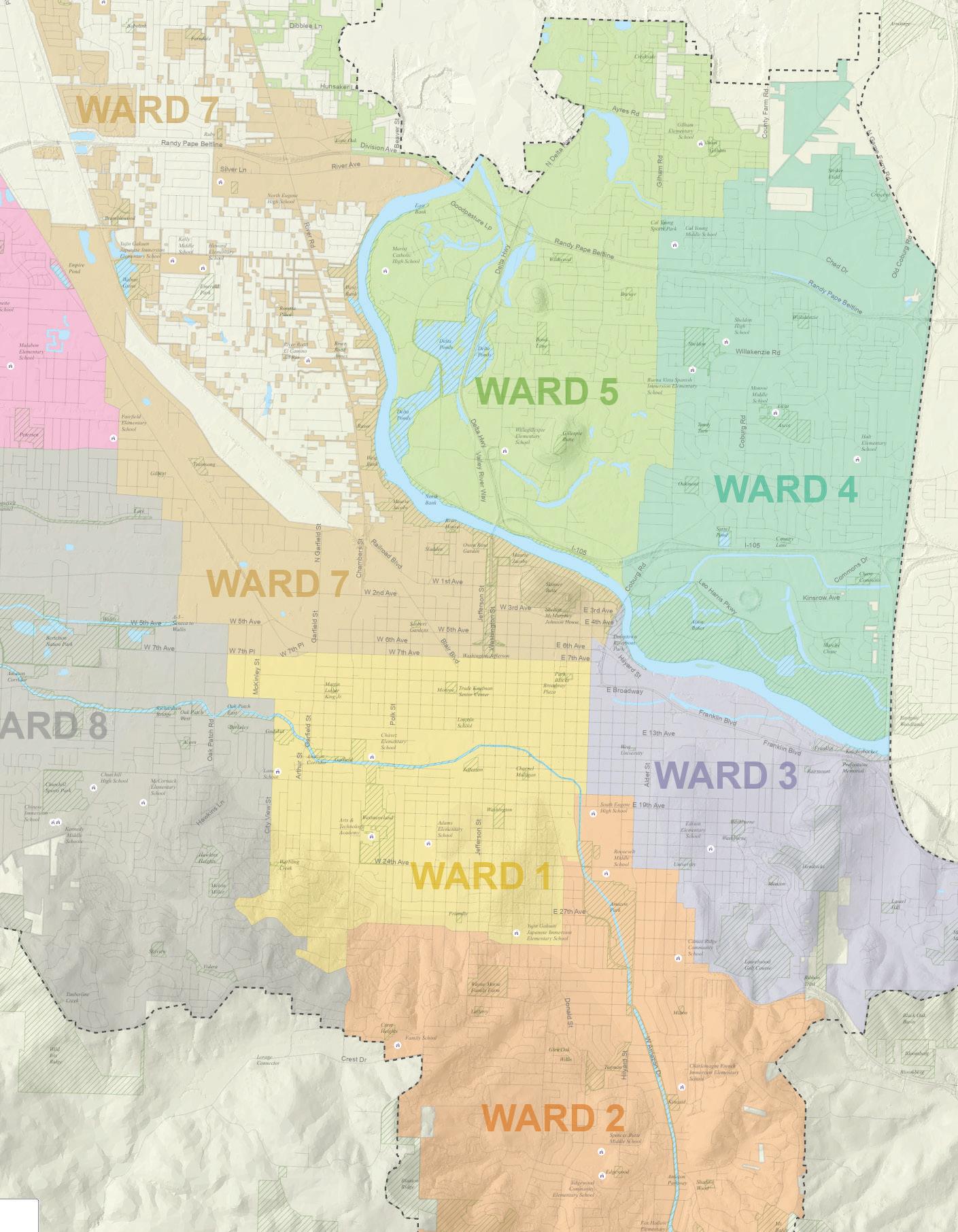
The Daily Emerald has profiled candidates for four wards in Eugene that will hold contests in Oregon’s May 19 primary elections. Ward 5 encompasses the Cal Young area.
Three candidates are running for the ward’s office: incumbent City Councilor Mike Clark, Athena Aguiar and Jasmine Hatmaker.
The Emerald reached out to all candidates for interviews with the same set of questions. For candidates that did not respond for an interview, The Emerald is using available information from their campaign websites and public history.
Ward 5 candidate Mike Clark did not respond to The Emerald’s request for an interview.
What are the biggest issues facing your ward, and Eugene, as a whole?
Mike Clark:
Councilor Clark believes there are three most critical issues facing Eugene: economic development, housing and public safety.
“The loss of CAHOOTS was a tragedy, and that’s what I’ve been trying to lobby to bring back for the past many months, somewhat successfully, mostly unsuccessfully,” Aguiar said. “I have not felt that listened to.”
She also plans to target condemned homes as a method of opening up housing space to ease the city’s homeless population and clean up the city’s neighborhoods.
“A lot of voters live right near a condemned home and it’s really difficult for them to see that condemned home that’s been there for 20 years or whatever it might be, and then go downtown and see people living on the literal street when there’s a space where a home could be.”
Jasmine Hatmaker:
Hatmaker’s main priorities are affordable housing and livability.
Developing relationships with essential city services like Willamette Valley Crisis Care has also helped Aguiar understand the relationship between city officials and the public.
Jasmine Hatmaker:
Although she was born in Eugene, Hatmaker has a diverse living background. Her family has lived in Guam for a large part of her life, and in adulthood she lived in various different states.
“I think just with the experiences and the background that I have, it gives me the perspective of considering issues and people that would normally (think) that their voices don’t matter,” Hatmaker said. “I myself experienced housing instability and food insecurity, and I can kind of have the perspective that a lot of our community members are going through right now.”
Q Q“The city has had the budget deficit for a very long time, and there have been so many times that our public services have been at risk,” Hatmaker said. “When we’re looking at having a stronger local economy, we’re also considering ideas to generate more revenue for the city so that we don’t have to worry about cutting those kinds of services.”
“We have a structural deficit in how we pay for our city services that is simply not sustainable,” Councilor Clark said. “We see every year the cost of running the city increases between 7-8%, and property taxes, which are 75-80% of where the money comes from, are limited to increase no more than 3%.”
Councilor Clark worries Eugene isn’t prepared for the growing population. Part of this issue, he believes, can be resolved by building more housing.
“Economic development is a strong and important part of how we sustain our community into the future and a big part of that economic development needs to be not just manufacturing growth, jobs and wages, but also building more housing for people.”
When it comes to public safety, Councilor Clark is focused on solidifying the Eugene Springfield Fire Department by helping create an intergovernmental entity that can better manage the department, rather than two separate governmental administrators.
Athena Aguiar:
Aguiar says that her priorities have evolved since getting out and speaking with voters, each with different concern. What was voiced in a consensus, she said, was concerns about the gap left behind by CAHOOTS, Eugene’s former mobile crisis intervention service.
Mike Clark
Educational Background: University of Oregon
Occupation Experience:
Eugene City Councilor, Ward 5 Budget Committee
Citizen Member of Eugene Budget Committee
Eugene Human Rights Commission
Kids’ First (Lane County Child Advocacy Center)
Eugene Capital Improvement Program
Subcommittee
Political Campaign Consultant and Communications Director
Endorsements:
Former State Senator Chris Edwards
Lane County Commissioner Pat Farr
Eugene Area Chamber of Commerce President & CEO Brittany Quick-Warner
Former Chair of Northeast Neighborhood Association Kevin Reed
Campaign Website: electmikeclark.com
Hatmaker believes supporting small businesses, developing the workforce and giving workers livable wages will benefit the entire community. Part of that is making sure working families have reliable childcare options while they work, she said.
Why do you think you’re best fitted to address those issues?
Mike Clark:
Councilor Clark believes that the council needs familiar faces as the new city manager adjusts to working for Eugene.
“She’s going to need to know some of the things we’ve done before, where we’ve made good decisions and bad ones, so we don’t have to repeat past mistakes,” Councilor Clark said. “We can move forward with some new and innovative answers.”
Athena Aguiar:
Aguiar says that her established community presence has helped give her an insight into how the community is thinking about the city’s top issues.
“I think my experience on the library board is really valuable because it allowed me to see a little bit more of the inner workings of the city,” Aguiar said. “It has allowed me to see how hard the city staff are working to try to resolve these issues already.”
Hatmaker worked for her mother’s family business, and later began her own small business, which she says has given her a better insight into how businesses operate.
“I just know how important it is to really make sure that we’re concerning everyone when we make decisions on city council,” Hatmaker said.
University of Oregon
Athena Aguiar
Hometown: South Dakota; resident of Eugene for past decade
Educational Background: Coe College
Occupation Experience:
Environment Oregon
Oregon State Public Interest Research Group
Environmental Restoration Steward for Walama Restoration
Field Manager for Fund For the Public Interest
Endorsements:
Eugene City Councilor Matt Keating
Eugene Tenant Alliance
Working Families Party
SEIU 503
Democratic Party of Lane County
EWEB Commissioner Sonya Carlson
Campaign Website: athena4eugene.com
Jasmine Hatmaker
Hometown: Eugene, Ore.
Educational Background: University of Oregon
Occupation Experience: Eugene Mortgage Brokers Committee Member of Local Government Affairs Council
Member of Leadership Eugene Springfield Program
Endorsements:
Mayor of Eugene Kaarin Knudson
Lane County Commissioner Laurie Trieger
Eugene City Councilor Lyndsie Leech
Eugene City Councilor Jennifer Yeh
Eugene City Councilor Eliza Kashinsky
Former Eugene Mayor Lucy Vinis
Former Eugene Mayor Kitty Piercy
Democratic Party of Lane County
Working Families Party
Eugene Tenant Association
Campaign Website: jasminehatmaker.com
(Courtesy City of Eugene)
NEWS /ARTS & CULTURE
UO fined by Department of Environmental Quality for lead contamination
Lead was found in wastewater, debris and equipment from Villard Hall and University Hall renovations.
By Sasha Love Senior News Reporter
The notice of the penalty was issued in February and the contaminated articles included soil, worker protective equipment and approximately 3,000 gallons of washwater.
In the 2024 restoration of Villard and University Hall, Technical Waterproofing, Inc., a subcontractor working on the project, power washed the lead-contaminated exterior of the building which created approximately 3,000 gallons of contaminated washwater, according to DEQ.
This waste was then transported to the subcontractor’s Portland facility without correct permits or labeling in what DEQ described as “negligent” conduct.
The university appealed the penalty, which DEQ Public Affairs Specialist Dylan Darling said is a common course of action following penalties.
“Most enforcement cases are settled through this process,” Darling said in a statement to The Daily Emerald.
If a settlement is not reached, the parties can resolve the dispute in court.
In its appeal, Douglas Park, UO’s deputy general counsel, stated that the university was not aware of contamination on employee’s personal protective equipment and other surfaces, nor that the building would be power washed.
“The university was attempting to act with diligence in ensuring that its contractors were complying with applicable environmental regulations,” the appeal states in part.
ARTS & CULTURE
‘Wake up ser!’ George R.R. Martin and HBO do it again
“A Knight of the Seven Kingdoms,” which has already been renewed for a second season and is available on HBO Max, is a lighter-hearted addition to the “Game of Thrones” universe.
By Bella Graham Associate Arts & Culture Editor
Choose your fighter: a markedly tall, naive and newly-dubbed knight, or a surprisingly worldly and deeply animated child. Welcome to “A Knight of the Seven Kingdoms,” a prequel to “Game of Thrones” that takes place about a century earlier and feels more like a buddy comedy with Robin Hood and Little John than a high fantasy epic.
Set in the world of Westeros, we follow Ser Duncan “Dunk” the Tall (Peter Claffey) from when his mentor dies shortly after knighting him. He travels to a tournament to compete in as his first foray into knighthood and along the journey, he stumbles across Egg (Dexter Sol Ansell). Presumably a stableboy, Egg convinces Dunk to be his squire.
Despite the doubt cast over his actual title, it’s not for lack of honor, at times to a fault. That honor leads him to believe that knights always do what is right — which isn’t always the case, and Claffey makes your heart hurt with the realization that the world isn’t as good as he thought it was.
Where he believes the various lords should remember his mentor because he was wounded in service for them, those very same lords have no recollection of him, and they don’t lose any sleep over it. That recurring let-down from the world bubbles up to an epic monologue in episode four and Dunk finds steady ground in a foreign social sphere, ironically, on the muddy jousting field.
Darling said DEQ would be meeting with the university on Thursday to discuss the appeal.
Angela Seydel, a UO spokesperson, said all the hazardous waste that UO handled directly and was stored onsite were disposed of “appropriately” through UO’s environmental health and safety hazardous waste disposal program.
Seydel also said that, following the DEQ notice, subcontractors involved in the renovations “were provided additional training on hazardous waste determination and transportation requirements.”
UO is currently renovating Friendly Hall and tearing down Hamilton Hall, which both contain asbestos.
Seydel said the lead exterior of Villard and University Hall are “unique,” but did not further elaborate on hazardous waste management in current construction projects.
The university is inspected by DEQ every 3 to 5 years, according to Darling, but UO is also inspected following complaints, as was true in this case.
( ABOVE) The building underwent construction through much of 2024 and reopened at the beginning of the 2025 school year.
(Alyssa Garcia/Emerald)
“A Knight of the Seven Kingdoms” follows Dunk and Egg’s exploits amid the tournament, with jousting, melees and puppet shows to boot. Dunk just wants to be a knight, and Egg desperately wants to be a squire: no high-stakes politics, powerful families and the occasional dragons that the franchise is known for.
“We try not to get too bogged down in history. These are nice, little contained journeys. It’s an action adventure series, almost. It’s Dunk and his squire having fun and adventures, getting into trouble… Hopefully you’ve enjoyed it, and you can come back and see their journey next time,” showrunner Ira Parker said in an interview with Variety.
The show is told from Dunk and Egg’s perspective, which is part of what makes the show so engaging. Ansell is a highlight — seeing his bald little head (shaved for reasons we find out later) bobbing across a field as he practices handing off lances for the joust and weaving through sheep he’s about the same size as only brushes the surface of his charm.
Despite being out of his depth at an event that heavily favors strength, Egg makes up for it in heart: hanging on with both his arms and legs to a tug of war rope and rattling off swear words when the situation calls for it.
Reminders of his youth in asking how magic tricks work and dressing up in Dunk’s armor (which he’s nearly drowning in) add nuance to this child in a very adult world, and Ansell portrays that nuance deftly.
Claffey also handles Dunk’s blind courage of a young knight beautifully. He gives off the impression that insults from nobles and other knights perpetually go over his head (which is hard to do, considering Claffey is 6 foot 5). To Dunk, this tournament isn’t just his first joust; it’s proving that he deserves to be a knight. With no House and no one else to vouch for his knighthood, Dunk struggles to even enter the tournament.
The relationship between Dunk and Egg is what makes the show, and it is a reversal of the typical roles of the trope: a less experienced but politically savvy character guiding a lowborn but honorable and physically imposing knight, and they’re adorable. Egg teases Dunk for his lack of everything — tent, armor, etc.
“I think one of my favorite (parts) is Dunk and Egg imitating each other. That wasn’t written in the script. We just asked them on the day of filming to do that, and that’s what Peter and Dexter turned out,” Parker said in an interview with AV Club.
Egg being the brains of the operation is also amusing; the wiser among the duo is a child barely reaching 5 feet tall. Yet, he still looks at Dunk like he hung the moon and the stars, even when Dunk threatens to give him “a clout on the ear.”
The magnetism of the characters in this show doesn’t end with these two, with standouts being Lyonel Baratheon (Daniel Ings), a lord at the tournament, and Aerion Targaryen (Finn Bennett), a prince of Westeros.
The wild, dizzying feel that Ings exudes makes you feel as though you’re being reeled into a second coming of the dancing plague, and the regal cruelty Bennett emanates (aptly physicalized through his perpetually mussed crew cut with the Targaryen signature platinum blonde hair) makes him the clear antagonist of the show, yet his unpredictability gives him staying power.
“A Knight of the Seven Kingdoms” eases you into the provincial countryside of Westeros and previews the powerful families that take a larger role in the other two shows. If you’re looking to get into this franchise, this newest addition wouldn’t be a bad place to start, and it’ll leave you ready to take the pledge of knighthood and be charged to be brave, just and to defend the innocent.
ARTS & CULTURE
What’s better, cheap food or cheap drinks? How about both?
Pegasus Pizza on East 14th, a staple for students, serves a bang-for-your-buck deal every Wednesday from 6 p.m. to 8 p.m., and five dollars is all you need.
By Henry Perrine Arts & Culture Writer
What do college kids love more: cheap food or cheap drinks? On Wednesday afternoons at Pint and Slice, students can enjoy both.
Bar by night, pizza joint by day, Pegasus Pizza has cemented its name as a classic spot for University of Oregon students. Founded in Eugene in 1989, they specialize in serving pizzas, sandwiches and drinks. Every Wednesday, the restaurant on East 14th Street offers up a deal that could be hard to pass up. From 6 to 8 p.m., a slice of cheese pizza and domestic beer is only $5.
“It’s a great deal and just easy,” James Cecil, a senior at UO, said. Cecil has been at Oregon for almost four years and only recently stumbled upon Wednesday’s Pint and Slice. As a college student, Cecil emphasizes the need for an affordable price.
Domestic beers are priced at $5 and craft beers cost $7, but they have a wide variety of options for customers
to choose from. Sunshine returns to campus and students emerge from winter hibernation at the beginning of the spring term. Pegasus Pizza not only offers its Pint and Slice deal, but also acts as a place to hang out and decompress after classes.
“After a long 6-hour lab period, I went to Pint and Slice with a classmate to get some beer and pizza,” Cecil said. “He’s now one of my good friends, and I don’t think I would have had that connection otherwise.”
An interior filled with red padded booths, ambient lighting and countless neon signs, accompanied by an outdoor area to soak up the sun, Pegasus Pizza offers a space for students to enjoy a cheap meal and relax among friends.
Alongside the meal, Pegasus hosts trivia, great for getting a group together of one’s smartest friends or trivia enthusiasts looking for a quick bite. Questions range from historical specifics to guessing songs based on a small segment. As each round becomes increasingly difficult, teams have to answer a series of diverse questions to reach the end.
A variety of prizes are set aside for the few lucky trivia winners. Sponsors from Two Towns and Ninkasi give customers samples of Oregon-crafted beverages and encourage competition with merchandise as prizes for the best trivia team in the room. Winning might not come easy, so be sure to brush up on all-things general knowledge before coming to the event.
For Ruby Jones, an employee of Pegasus Pizza and a senior at UO, Wednesday afternoons, as college students hustle in and out, is a highlight of having the job.
“It’s honestly the best midweek pick-me-up,” said Jones. “There are always good vibes, and I love getting to know the regulars and seeing the community it creates.”
Community is apparent at the weekly event. Whether it’s the sound of clashing pool balls or the dozens of conversations transpiring over good food, an affordable deal is just the foundation for a good time. It’s the company you’re surrounded by that makes it worth it.
Career Closet Pop-up: Free, accessible and professional clothes
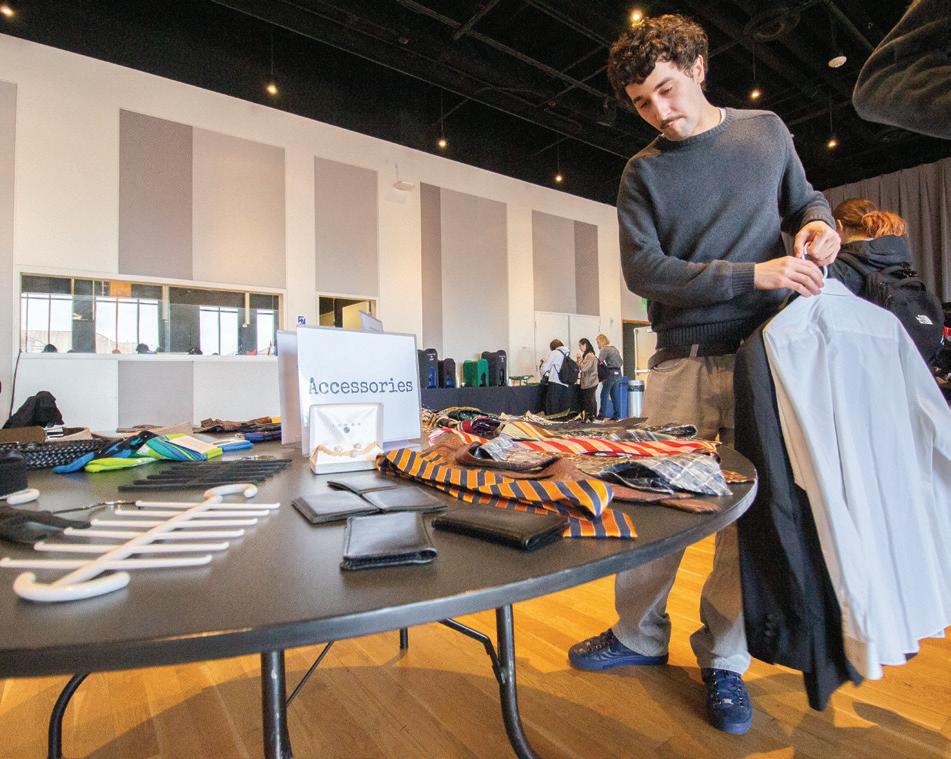
On April 9, with the help of the Career Center and Student Sustainability Center, the EMU will host an event providing free interview-ready clothes for students.
By Gray Vanderpoel Arts & Culture Writer
Interviews can be daunting. With the entire process of applying for jobs, perfecting resumes and rehearsing interview questions over and over, finding professional attire can be overwhelming. Interview-ready clothes that fit your personal tastes can be difficult to find, not to mention the clothes themselves rack up in price.
Luckily, the UO Career Center and Student Sustainability Center are trying to help out. On April 9, from 12 to 3 p.m. in the EMU, these two UO groups are planning a Career Closet Pop-up event. Free interview-ready clothes will be available for students and staff to peruse and add to their wardrobe in preparation for upcoming career opportunities.
The Student Sustainability Center has said this pop-up is
an important event in showcasing their goals and intentions. Taylor McHolm, director of the SSC, started this event with the Career Center around 2020 with the main goal of helping students and educating them on sustainability efforts.
“A clothing swap is a key component in sustainability,” McHolm said. “It has the dual function of both reducing the amount of waste that is produced around clothing and also making sure that that clothing is accessible to students who need it.”
The SSC also works on multiple other events and efforts to promote sustainability. In the Rose Room, located at Prince Lucien Campbell Hall room 182, they have free clothes, supplies and home goods for students and staff. Any clothes donated to the Career Clothes Pop-Up event that were not approved to be “interview-ready” can be found in the Rose Room.
The SSC hopes to expand students’ idea of sustainability with this clothing pop-up. They want to spread the message that students don’t need to spend a lot of money getting into an already difficult workforce. Through the event, they hope to help students avoid the roadblocks of finding expensive professional attire before they even have the job.
“Ride a bike, use a reusable water bottle, yes, do those things, but also, really think about the systems that are involved,” McHolm said. “The system’s approach: what are the social elements that are producing those problems?”
The Career Center shares a similar motivation to this upcoming accessible event. Maddy Nelson, the career readiness technology manager, chose to create this career clothes pop-up, despite the event being outside their job responsibilities, because of the positive impact free professional clothes can have for students.
“I used to be a student who was on grants, and I was lucky enough to get the Pathway scholarship,” Nelson said. “I knew next to nothing about what to do for an interview or what to wear for an interview. When I got this professional job, I really took it upon myself to make sure I could help as many students in similar predicaments as I was.”
Nelson works meticulously in preparation for the event, accepting donations while taking into consideration a range of styles and audiences. They ensure that every article of clothing is professional and interview-ready, while being versatile in colors and styles. Nelson’s own office is filled with 17-20 bags of clothing for the event, not to mention the other offices and spaces they have around campus.
“If a student can’t go into an interview feeling confident, and they can’t feel confident in what they’re wearing, then the interview probably isn’t going to go very well,” Nelson said.
Whether you are looking for something nice to wear, you have an upcoming interview or maybe need some advice on career readiness, Nelson and her team are there to help. If you have the time or space in your closet, consider stopping by the pop-up and picking out an outfit that can come in handy in the future.
“It’s the community helping the community,” Nelson said. “When students can come in and get a nice interview outfit for free that was completely donated, I would hope that that is something they can keep with them for their first interview and maybe a couple more.”
A slice of peperoni pizza and pint of raspberry cider lie in from of the Pegasus Pizza sign. The pint and slice deal is offered Wednesdays to students near the University of Oregon campus. (Rowan Campbell/Emerald)
Nag: Oregon’s constitutional
By Aishiki Nag Opinion Columnist
In 1963, the U.S. Supreme Court, in the landmark decision “Gideon v. Wainwright,” held that when someone is accused of a crime and cannot afford a lawyer, the courts cannot assume a fair trial unless counsel is provided. And under the Sixth Amendment, everyone is entitled to a fair trial and due process, creating a responsibility for the state to ensure defendants are represented. Oregon’s constitution has guaranteed this right since 1857, and in 1969, Oregon’s Supreme Court, three years ahead of the U.S. Supreme Court, extended the right to all misdemeanors that could result in jail time.
Public defenders are the backbone of the justice system in this country, covering a myriad of cases from misdemeanors to felonies. They protect your rights, regardless of your income level, and they ensure that the state doesn’t have an unfair advantage during criminal trials.
In 2019, the Sixth Amendment Center released a report on Oregon probing whether it was meeting its constitutional obligation to provide effective legal counsel. The report found that it was not.
Oregon fulfills its Sixth Amendment obligation through a complex contract system through the Office of Public Defense Services; these contractors include public defender offices, private law firms, groups of independent private attorneys called consortia and individual attorneys appointed per case.
The Sixth Amendment Center also conducted a case study of counties across Oregon and found that attorneys had excessive caseloads to meet demand. In a study of the Public Defender Services of Lane County, it was
noted that 10 of 22 attorneys had caseloads exceeding national standards; some exceeded 150-175% of national limits in felonies alone.
In 2022, the American Bar Association published a report concluding that Oregon has only 31% of the number of contract attorneys needed to provide adequate representation. The report showed that the pandemic further worsened case backlogs in the system, and the state is now struggling to recruit staff due to low pay and heavy workloads.
Public defense attorneys are also underpaid for the work that they do. Attorneys used to be paid a flat fee per case, which didn’t account for the time or resources a particular case would require. Although this system has changed to account an hourly basis, problems with paying public defenders adequate wages and supporting them with resources remain.
Lawyers have reported that Around 90% of public defense clients are represented by contractors who are paid flat rates per FTE/attorney, not hourly, leading to public defenders still being underpaid for the work they complete.
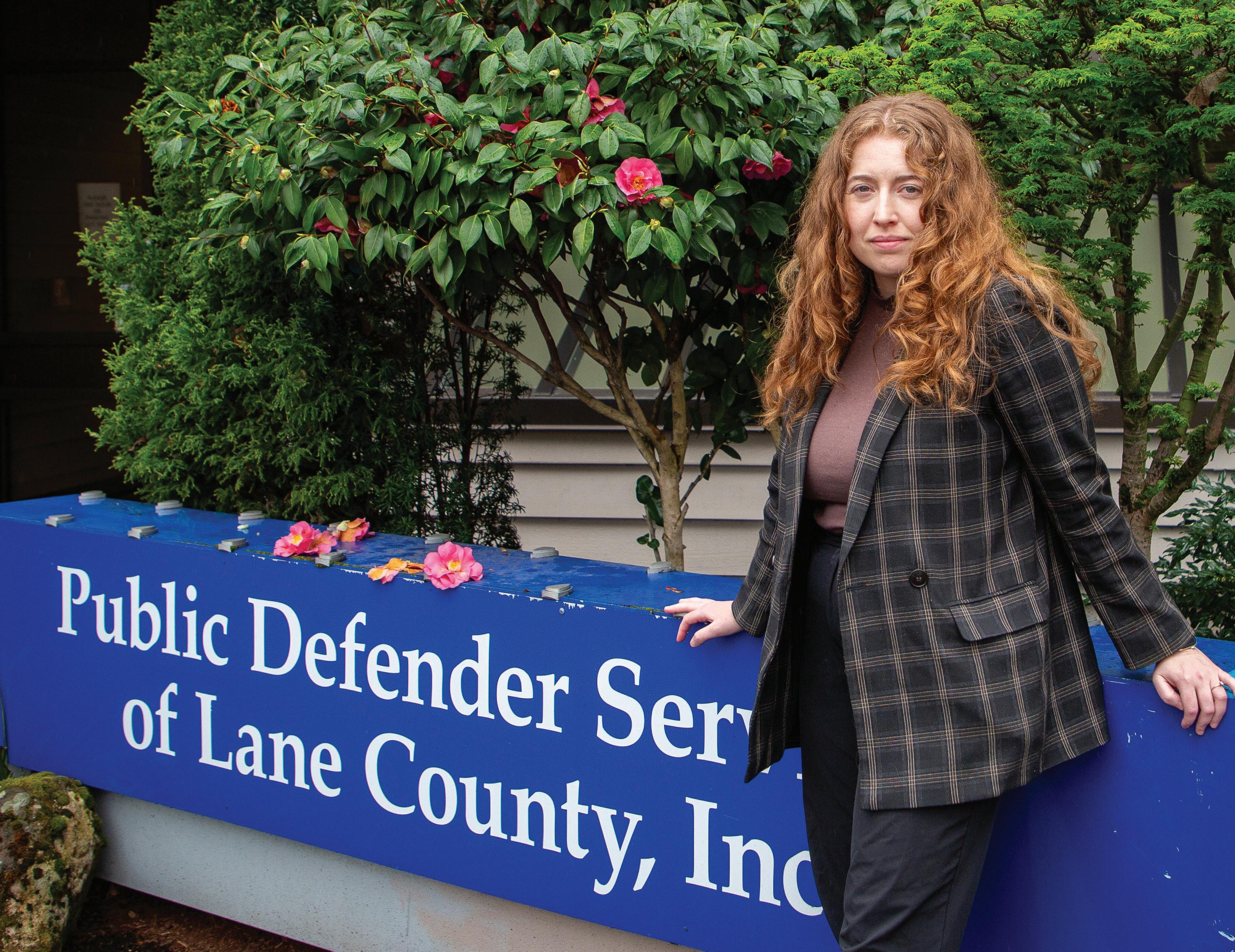
Karmen Pacheco, an attorney with the Public Defender Services of Lane County, commented on the practical challenges lawyers face within the system.
“The public defender crisis really has to do with whether or not people are getting paid enough – the amount of workload and stress makes this difficult,” Pacheco said. “Part of the current crisis is also the burnout rate.”
Attorneys and other legal professionals who are working with clients have suffered hardship, immense stress from the workload and secondary trauma when working on cases.
“It is a social work; you are working with people in the lowest parts of their lives – people who are struggling to
We need longterm solutions to the public defender shortage, and improving the pipeline of law students into indigent defense is vital.
Tom Lininger
Oregon Public Defense Commissioner “
constitutional crisis
get housing, struggling heavily with addiction and struggling to get their basic needs met,” Pacheco said. “The burnout aspect comes from wanting to help everyone.”
Caseloads are determined by the OPDC and are assigned based on the type of law an attorney practices. Pacheco notes that misdemeanor attorneys have heavier caseloads than attorneys handling higher-sentence clients.
Pacheco gave an example of how the current system is failing Oregon’s public defenders: if an attorney has around 80 clients, they should, at a minimum, be contacting 40 people a week. This is often difficult or unattainable with current workloads. This means they are going to court every day, and if there’s a day out of court, defenders schedule time to meet with clients at the jail – which, for Pacheco, holds 10 to 20 adults in custody at a time.
It would take a minimum of 30 minutes per person, and scheduling times to meet with 10-20 clients adds up. Meetings with clients occur after attorneys have reviewed all discovery material, including body camera footage, and are ethically required to take place before trial. Attorneys like Pacheco regularly work 60-hour weeks to keep up with their case loads.
Ben Haile from the Oregon Justice Resource Center also noted that public defense has long been overdue for adequate funding, and the current legislature has been unwilling and unable to meet the system’s current demands.
“Most long-term public defenders accept a lower pay than they could get doing other types of law because they care so much about justice and the well-being of their clients. There is simply not a big enough budget to hire enough lawyers.” Haile said in a statement to The Emerald. “The government funds prosecution much more robustly.”
The Prosecutor’s office has a large publicly funded budget for discovery, filings and investigations. On the other hand, defendants have to go out of their way to find resources to meet their clients’ needs. In an example given by Carl MacPherson, the executive director at Metropolitan Public Defender, prosecutors in Multnomah County have approximately a 100:1 advantage in resources (i.e., police officers) compared to the investigators assigned to the defense.
“The reason that our society recognizes a right to an attorney, even if you can’t afford one, is that our entire criminal legal system is structured around the premise of an adversarial system, where truth and justice are supposed to be sifted from the struggle between opposing forces,” Haile said. “When the defendant has no one on their side and the entire weight of police, jails and prosecutors is stacked against them, justice is not served, very bad outcomes happen and everyone loses confidence in the system.”
Another fault within Oregon’s public defense system is the lack of diversionary programs. Many states across the U.S. have addressed their public defense crisis by establishing diversionary programs to avoid triggering legal recourse before or after an arrest.
“Many states have a strong diversion program and there are pre-arrest and post-arrest diversion programs, which would take people out of the criminal legal system and lower the number of trials that you would be having,” MacPherson said. Without strong diversion programs, when the prosecutor’s office brings a case forward, it triggers all the legal and constitutional obligations required for trial. This further overwhelms the system, and pre- and post-arrest diversion programs would alleviate the ongoing crisis.
Law Enforcement Assisted Diversion is a pre-arrest program for people who use drugs and risk low-level criminal charges. Instead of arresting individuals for offenses like drug possession, petty theft or sex work, law enforcement officers refer them to case managers who connect them to behavioral health treatment and support services, a great example of harm reduction within the criminal justice system. Further emphasis on LEAD would significantly reduce the need for public defenders. Services such as CAHOOTS act as pre-arrest diversion programs, which connect strug-
gling community members to the resources they would need instead of deploying the criminal legal system.
Oregon struggles to meet the demand for public defenders and has turned to sourcing potential candidates from universities. Lawmakers and public defenders address the long-term shortage of public defenders by creating clinic programs within Oregon’s three law schools.
The University of Oregon School of Law, the Lewis & Clark Law School and Willamette University School of Law all have legal clinics where current law students can help practicing attorneys with cases.
“The main driver behind the creation of the law school clinics was the recognition that we need to be more deliberate in creating a pipeline into public defense.” Ken Sanchagrin, the executive director of the Oregon Public Defense Commission, said. “Law school, in many ways, is very theoretical in what it teaches. And even if they have trial practice classes or practicums in school, none of that is a substitute for being in the courtroom or working on cases with an attorney or with clients and learning how to manage and work with clients.”
Under Oregon State Bar rules, once you have a certain amount of time in law school, you can qualify to represent clients while under supervision in one of these programs. So, through these programs, clients are matched with current law students, who gain more responsibility and more opportunity to work independently as they move through the program.
“Most of the three programs start with a boot camp, where folks come in and get some basic training. Then they may start off merely doing legal research or maybe doing some very basic work for clients. The goal would be that by the end, under your supervising attorney, you might be trying to run a client’s case file essentially on your own,” Sanchagrin said.
Commissioner Tom Lininger from the Oregon Public Defense Commission said in a statement, “Law school clinics are a crucial part of the strategy to strengthen indigent defense in Oregon. Not only can clinical students do valuable work for clients, but the experience of working in a clinic increases the likelihood that a law student will go on to full-time work as a public defender upon graduation. We need long-term solutions to the public defender shortage, and improving the pipeline of law students into indigent defense is vital.” Commissioner Lininger also serves as a UO Law professor.
Law clinics are an important part of addressing the lack of public defense retention in Oregon and inspiring young legal minds to enter the legal field as public defenders. However, this serves as a longer-term solution towards addressing issues, and there are important gaps to fill through legislative action now.
Public defenders are fundamental in protecting justice in our communities, and they deserve more resources and attention to address the current crisis.
“I want to represent people in some of the hardest times of their life; I want to protect them from prosecution and just make sure everyone gets a fair trial,” Pacheco said. “It is difficult when the work isn’t valued enough, 90% of people going through the criminal justice system qualify for a public defendant, and I think a lot of people don’t understand how integral we are to the system in how we protect them.” American Bar Association’s Analysis of the Oregon Public Defense System and Attorney Workloads Standards
Currently, Oregon is short
1,296 full-time public defense attorneys (FTEs) – the system only has about 31% of the attorneys it needs
With the current (2022) demand, Public defenders would need to work
6,632 hours per year each, which averages about 26.6 hours per day
Public defenders take on around
156 cases per year, only allowing defenders to spend 13 hours per case*
*ABA recommends:
Low-level misdemeanor: 22.26 hours
Mid-level felony: 47.73 hours
High-level felony: 148.95 hours
Homicide/sex cases: 552.46 hours
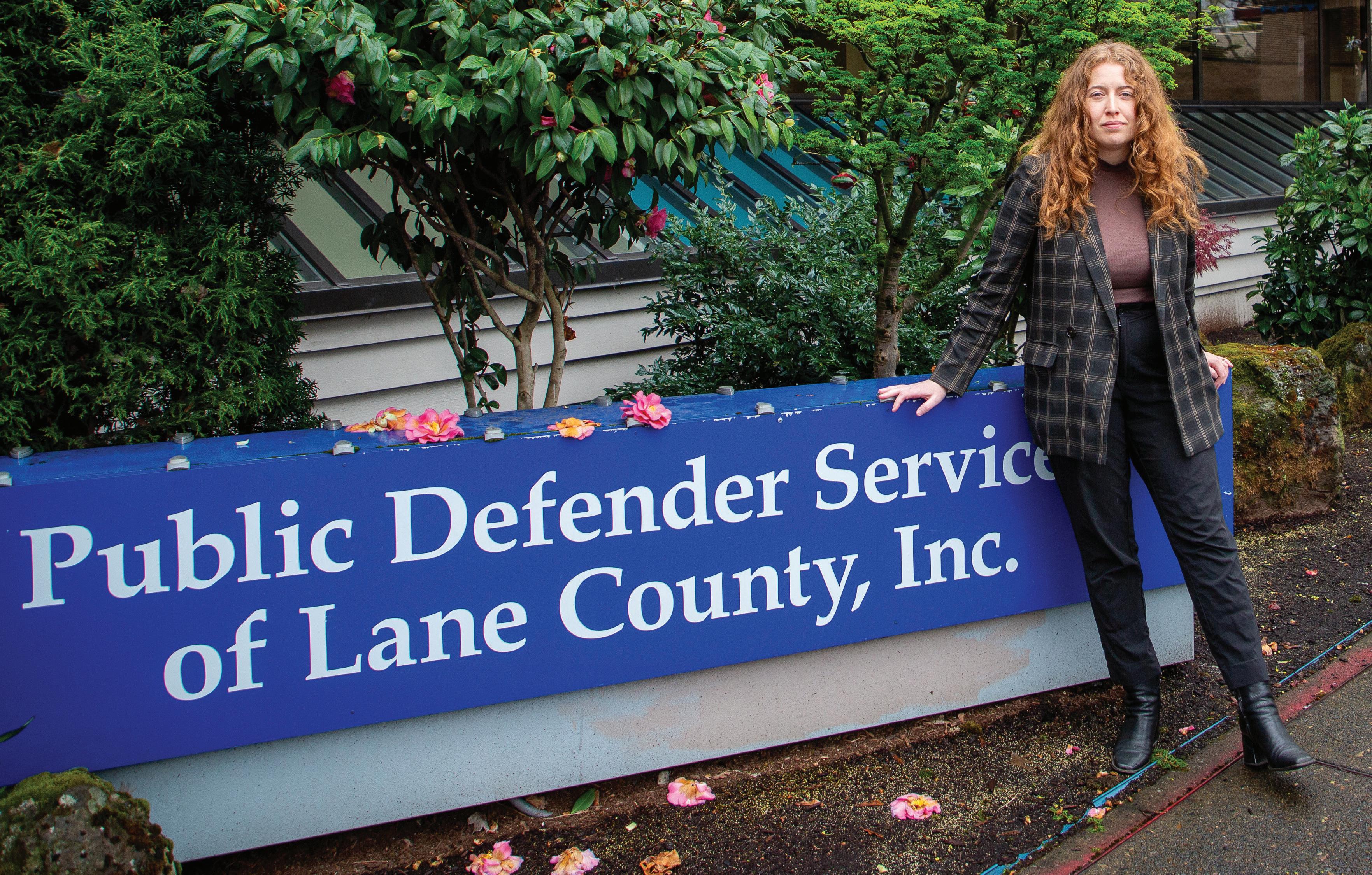
(ON THE COVER, LEFT) Lawyer Karmen Pacheco stands outside the Public Defender Services of Lane County. The American Bar Association concluded that Oregon only has 31% of the number of contract attorneys needed to provide adequate representation. (Corey Hoffman/Emerald)
APRIL
OPINION
Mitrovcan Morgan: How we lost the soul of music
David is an opinion columnist for The Daily Emerald and a senior studying data science, economics and philosophy. In his writing, he enjoys finding the abstract relationships between systems and the decisions we make everyday, weaving them into a tangible story readers can easily digest.
By Mitrovčan Morgan Opinion Columnist
Music used to be more campfire than playlist: something you gathered around and added to. You did not need to be good. You just needed a voice, a table to tap, half-remembered lyrics and a room willing to be imperfect together.
For most of human history, music was less a product than a social act. Before recordings, streaming and the convenience of pressing play, music had to be made to be heard.
Ordinary people sang at work, church, weddings, funerals, taverns and kitchens. They often sang badly, but that was not the point. Music was less a performance than a communal experience, woven into the fabric of everyday life.
Now music arrives like takeout: frictionless, personalized and sealed for consumption. We have more music than any civilization in history, yet many of us make less of it than peasants did.
The average person’s role in music has shrunk to thumb movements. Scroll. Tap. Skip. Repeat. We carry symphonies in our pockets and still somehow end up alone with them.
That did not happen all at once. It happened in installments, each new device quietly loosening music from the people and places that made it. The first rupture came in 1877 with “the introduction of the phonograph,” Jon Bellona, a University of Oregon assistant professor of music technology, said.
Once music could be recorded, it no longer had to live and die in the room where it was made. It could be detached from the singers, players and walls that gave it shape, then stored, sold and replayed at will. A communal act had begun its long conversion into an object.
A century later came the next contraction with “the Sony Walkman, invented in 1978,” Abigail Fine, a UO assistant professor in musicology, said. “For the first time, you could… take music on the go… this is when music became a film soundtrack to our lives.”
Then came the final enclosure; not a machine you could hold, but a logic you could live inside: the algorithm. The old work of finding a song — following a recommendation, lingering in a record store — started to fade. Now, “Spotify’s algorithms feed us what they think we like, sealing us up in… a prison of our own making,” Fine said.
This gradual shift toward passive consumption means not only that people make less music, but that music is increasingly seen as a specialized, professional domain. Contemporary music is highly polished and exceptional.
But that refinement makes participation feel illegitimate for ordinary people. Music has become something performed by the highly skilled for an audience, rather than something practiced broadly among nonexperts in social settings.
The implications extend beyond music. A society organized around spectatorship loses fluency in shared creation and increasingly delegates expressive life to specialists. The experts make; everyone else consumes.
Art becomes something someone else makes, which we receive, assess, maybe applaud and move on from. The habit of shared creation does not vanish at once, but weakens from disuse.
But the story is not terminal. Technology has changed the way we meet music, but it has not fully severed music from the instinct to gather. “Look at how many people are going to shows… just to have that experience of live music… (it) still continues to
Gaviglio: Cigarettes are becoming way too cool again
Opinion: From taverns and kitchens to headphones and streaming, music has drifted from shared practice toward solitary consumption.
be… one of the ways in which we connect.”
The communal instinct still flickers, so how do we feed it further? The answer may be simply to make music again. Poorly, even. That is part of the point: to treat music less like a performance to admire and more like a thing people are still allowed to do together. “Just get started doing it… it’s fun, and you’ll meet great people,” Jackie Overall, a third year popular music major, said
And if singing is not your thing, then show up anyway. Go to the house show. Sit in the listening club. Support the local band. Ultimately, “it’s on the consumer to change their listening habits … (like) supporting local artists and attending events like the many, many house shows we have in Eugene,” Overall said.
We must collectively refuse the idea that music exists only to be delivered to us, polished and finished, while we stand at a safe distance. Because the soul of music was never just the song, but the circle around it, too.
Opinion: Despite the introduction of vapes and Zyns into the world of nicotine, the younger generation is turning to cigarettes to get their fix. Why the sudden comeback?
By Amelia Gaviglio Opinion Columnist
The smoke of cigarettes once again crowds the air at house shows and the patios of college students. After decades of public health campaigns against cigarettes, it seems it hasn’t amounted to much, as America’s youth are smoking them once again. With the ongoing quest to be cool, combined with 18 to 20-somethings feeling invincible as ever, cigarettes are back in fashion.
Why are they considered so cool? For decades, cigarette companies worked to shape that perception. “For much of the 20th century, smoking was… a cinematic shorthand for allure, danger, introspection and control. Cigarettes weren’t just props, they were character cues, emotional punctuation marks and marketing tools,” Adriana Albini wrote in Cancerworld Magazine. Because they are considered cool, people are inclined to try them, leaving them vulnerable to getting “hooked.”
“You’ll never forget the feeling of your first cigarette,” Hayden Drew, who has smoked for two years, said.
Gen Z now associates cigarettes with a cooler time, whether it be the 90s, the 50s and so on. We tend to romanticize an older time, and in these older times, people smoked cigarettes — a lot.
One of the most prevalent reasons why people have started smoking again is the social aspect. Many report it’s a unique way to talk with someone that cannot really be replicated.
“(Smoking) only ever happens when I’m with my friends who are consistent cigarette smokers and we are out doing something. We take a break from the action… The cigarette has a lifespan of 5-10 minutes and for those minutes you get to have nice conversation with whoever you’re smoking with,”
Robert Kelley said.
“When I get home and (my roommate) is here, I say ‘Wanna go smoke a cigarette?’ I wonder if we’d have that same length of a chat without the cigarette. I’d hope so.” Jensen Corella said.
Proximity is also important in determining whether you become a cigarette smoker or not. If your friend group smokes, you are more likely to join them. If your friend group does not smoke, you likely don’t either.
“I definitely wouldn’t be a cigarette person if I hung out with different friends,” Corella said. Kelley reported he picked up smoking right when he started hanging out with a certain friend group during spring term of 2025.
There is an element of bonding over this shared bad habit. “You get to connect over it. You don’t feel as bad about it… all of those other people are doing it too,” Lucia Cunha said.
But why are all of these people suddenly smoking cigarettes again — why not vaping or Zynning?
It may have to do with Gen Z’s lack of personal experience with the adverse effects of smoking. Gen X witnessed the real physical effects of cigarette smoking in their parents and grandparents, which scared most of them enough to not pick up the habit.
However, since Gen Z’s parents skimped out on smoking, they are largely unaware of the harmful effects. But deep down, the comeback of cigarettes boils down to the fact that they are generally viewed as cooler.
Whether you’re a smoker or not, you cannot deny that cigarettes are here, and perhaps here to stay.
Amelia is a junior studying advertising with a food studies minor. In her writing, she enjoys pieces on culture and the human condition. In her free time Amelia enjoys journaling, cooking and sketching landscapes.
4
5
6
Guevara
Partake in larceny 4 Small green vegetable 7 Most important “muscle” for musicians 8 Ancient 9 Like a sedan trying to fit 6 people 11 “I’m ___ loss for words” 12 Obstinate 16 13th or 16th, for example
17 Kanga’s child in Winnie the Pooh 18 Recent 19 Have a taste of
DOWN 1 ___ center (UO building with a swimming pool)
2 Paddle
3 Bikini top
4 Toaster pastry
5 “___ Rigby”Beatles
6 Contribute 10 ___ Tai
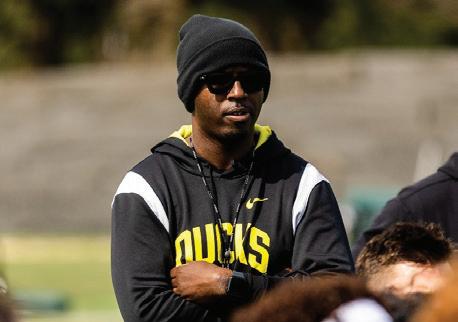
12 Ducks coach Lanning
13 December 24 is a famous one
14 Scant
15 Silly putty or Barbie Dreamhouse, ex.
Emma Kahl is an opinion columnist for The Daily Emerald. She is currently a senior, majoring in written journalism and minoring in global studies. Her writing focuses on social commentary, culture and politics.
Kahl: Our coinless, cashless parking meters are leaving people behind
Opinion: Eugene’s parking meters limit accessibility and disadvantage those with cash-based incomes by accepting only debit cards.
By Emma Kahl Opinion Columnist
A few weeks ago, a friend of mine was visiting from out of town and pulled out her quarters to pay for parking while in downtown Eugene. She paused, realizing that there was no slot for coins, only a screen prompting payment by card. At that moment, we both realized how strange it was that so many systems are moving away from accepting physical cash. As cities continue to modernize infrastructure, cashless systems — while convenient for some — are exposing accessibility concerns. In a town filled with college students and people of all incomes, it’s important to have conversations about equity and access.
The city of Eugene’s website states that the switch to a card-only system was due to a large amount of meter vandalism and coin theft. While these concerns are understandable, completely removing cash places a burden on residents who rely on it.
A year ago, a Reddit thread with over 170 replies discussed Eugene parking meters only taking cards. The initial post said, “As annoying as it is when private businesses don’t accept cash, I feel like that is their prerogative, but public gov(ernment) entity pulling this seems discriminatory at best.”
Another user responded, “I miss being able to drop a couple of quarters in and run an errand. Involving a card makes me avoid the area.” This issue has clearly concerned members of the community for some time.
Anne Brown is an associate professor at UO’s School of Planning, Public Policy and Management with a focus on transportation equity and travel behavior. She spoke on how card-only access affects unbanked populations.
“Unbanked households make up a declining share of American households, about 4.2% in 2023; this totals 5.6 million households nationwide,”
Professor Brown said.
“I’d argue that parking access is not curtailed by a move to card-only meter parking in Eugene,” Brown said. She noted there are cash options at off-street garages and “multi-space kiosks in other city-owned parking lots.”
Brown offered a few alternate solutions Eugene could implement to maintain efficiency while ensuring the system remains inclusive. These included
cash-loadable cards, integrating LTD’s tap card to be compatible with parking meters and postal banking.
However, the discussion surrounding cashless systems goes beyond just parking access.
Associate Professor of Sociology Jill Harrison specializes in studies of inequalities, occupations, labor and working class studies. She explained how there are important issues and inequalities created within public cashless systems.
Professor Harrison explained that credit, debit and prepaid cards all have fees or interest set by private companies, adding a cost to transactions. The shift to cashless systems works to increase profits for these companies. “There are clear inequalities present here,” she said.
Harrison also mentioned how using cashless systems requires technological literacy. She shared the example of her own mother, who is in her 70s and only uses cash or checks, and isn’t “technologically savvy.”
Access differences can leave some community members feeling excluded from an increasingly digital system.
“Cities definitely have responsibility for ensuring accessibility across a variety of domains of public life,” Harrison said. “The key is, we need people in positions of power that think and make decisions about issues like these.”
Ehly: On-campus jobs are great, but not the only option
Opinion: Students often emphasize finding jobs on campus during part-time job searches. But the application process is stressful for sought-after on-campus positions that have a pay cap that and don’t always cover basic necessities.
By Rachel Ehly Opinion Columnist
I started looking for part-time jobs in Eugene before I even set foot on campus.
I was worried about the financial strain students often face that causes unnecessary stress in the transition to university life.
Luckily, I was in just the right place at the right time and got my first on-campus job in the spring term of my freshman year.
Thankfully, when I started the job, I was living on campus and didn’t have to pay for rent or groceries. But if I had, there was no feasible way for me to support myself.
On-campus jobs often don’t support students enough financially, and many students take on multiple jobs to pay for their necessities on top of classes.
Sophomore Shamica Tendolkar has two on-campus jobs and said the pressure of paying for rent, groceries and necessities while also funding a social life would be incredibly difficult with only one income.
“I would say about 70% (of both on-campus incomes) go toward paying my rent… but if I didn’t have (both of) my jobs, the financial (aspect) would be hard,” Tendolkar said.
The demanding schedule that comes with any on-campus job, especially those in the dining halls and programs like Basic Needs and housing, is also difficult to balance.
One of the primary benefits of working an on-campus job is the prioritization of class schedules before work.
Tendolkar is often on campus 12-14 hours a day between classes, work and extracurriculars. Without the support of her bosses altering her work schedule around her academic schedule, working more than one job may not have been practical.
“I have other friends who kind of say the opposite (about support from their bosses)… especially in places like the dining halls… where it’s mandatory to be there and there’s greater consequences (for absences).”
Junior Hannah Baniani, a student worker in the Lundquist College of Business, said finding a community of other students was a main priority during her job search, and is the reason why she sought out an on-campus position.
“I wanted the network that having an on-campus job gives me,” Baniani said. “I wanted the assurance that I would also be working with other UO students, so I could build more of a community on campus.”
Many students are looking for this aspect of community in their workplace, which is why so many people gravitate toward on-campus jobs, despite these positions being highly sought after and very difficult to obtain.
Baniani said it took her over a year to even get an interview for an on-campus position.
“I have been on-and-off applying for specifically on-campus jobs since I was a winter-term freshman, and it took me until I was a spring-term sophomore to land an interview,” Baniani said.
While on-campus jobs seem to be the best option for students, the stress that comes with applying and interviewing for them, while not knowing if a $16.00/hour salary capped at 25 hours a week will be enough to cover monthly expenses, can be difficult to deal with.
Obtaining an on-campus position is often the priority for students looking to work their way through their studies. But the reality is that on-campus jobs have the potential to be just as or more stressful as off-campus positions.
The only true benefits of on-campus jobs are convenience and the community.
Rachel Ehly is an opinion columnist for The Daily Emerald and is studying journalism and political science. She could talk for hours about all things politics, pop culture and music.
(Kate James/Emerald)
940 Hilyard Street, Eugene, OR 97401
4–5 bed town house-style units with large bedrooms and spacious living areas. A popular location for students looking to live with friends!
Units include washers and dryers, dishwashers, private patios or balconies and secure garages with space for multiple vehicles.
11th and Ferry Lofts
1125 Ferry Street, Eugene, OR 97401
Modern, spacious design with beautiful loft or studio floor plans, large windows, furnished interiors, and pet-friendly!
Shared kitchens, tenant laundry facilities, secure entry and bike storage.
In the heart of Eugene - just walk to campus or easily access transport options.
Midtown Apartments 362 East 12th Ave, Eugene, OR 97401 University Manor 745 East 15th Ave, Eugene, OR 97401
1–3 bed units in downtown Eugene just a short walk from campus.
Secure entry, elevator, and assigned parking. Units feature in-unit washer/dryer, and spacious layouts. Select units include balconies and A/C.
Perfect for college life or young professionals!
1–3 bed newly renovated units—perfect for a first-time student home!
Conveniently located right by campus with in unit washer/dryer, dishwasher and all new appliances. Bright, clean and modern with just the right touch of homey, these units are a great spot to start your studies at the University of Oregon.
Parking is first-come, first-served for $60 a month.
MLB Draft preview: Oregon baseball
Which Ducks are projected to land in pro ball next season?
By Joe Krasnowski Senior Sports Writer
Five Ducks started their pro seasons this past week as Major League Baseball kicked off its season on Thursday, March 26. That number is soon to skyrocket, with recent drafts featuring numerous Oregon selections thanks to the Ducks’ savvy approach in the NIL era and transfer portal, as well as the program’s overall rise under head coach Mark Wasikowski.
While this year’s Ducks’ team isn’t generating quite as much buzz in MLB circles as in years past (mostly due to a lack of home runs), there’s still a good number of players likely to take the next step and see their names called at the draft in July.
Drew Smith is the team’s biggest riser, with the outfielder slashing 0.427/0.525/0.841 through 82 at-bats, and walking nearly one time for every strikeout. He’s also seen his power numbers skyrocket, blasting a team-high nine homers that have him close to the top of the conference leaderboards.
Dominic Hellman is the Ducks’ other main power hitter, who projects to have an interesting draft profile. For as limited as Hellman is as a fielder (he is either a designated hitter or a defensively-limited first baseman), his bat is special. He’s had an average start to the season by his standards, and is still batting over 0.300 with nine homers thus far.
Hellman’s best draft profile might just be his former teammate Jacob Walsh, who blasted 19 homers in his draft year. Despite similar defensive limitations, Walsh was drafted in round No. 15 by the Washington Nationals. As is the case with all players, a mid-season hot streak would do wonders for Hellman’s draft odds.
Perhaps Oregon’s most MLB-projectable player, Maddox Molony, is a sure-fire selection after the season or next
Across the globe to Eugene
How Oregon women’s tennis players have found their way to Oregon from four different continents.
By Max Koebel Senior Sports Writer
The Oregon women’s tennis team is made up of players from the United States, Sweden, Japan and Australia. For many, the U.S. is the place to go for a full-ride scholarship to get an education while playing tennis.
“We don’t have that in Europe,” Tilde Jagare, the No. 1 player in the Ducks’ lineup said. “It’s an amazing opportunity to get a degree and get to play tennis and have a lot of resources behind us like our trainer and our coaches. Just getting that support that you need to become a better athlete.”
Jagare grew up in Gävle, Sweden and has been with the Ducks her entire college career. As a junior, she has moved up to the top spot in the singles lineup, where she sits at 8-4. As a freshman, Jagare went 5-4 in the sixth spot, and gradually moved up to the third spot throughout her sophomore year while going 14-9.
In doubles, Jagare and Olivia Symons have spent the season in Oregon’s top spot and are currently sitting at 11-6.
Symons is a redshirt senior from Leopold, Australia. This is her third season at Oregon after starting her college career at the University of Tennessee. In the No. 2 singles spot, Symons is sitting at 7-6. Injuries have limited Symons’ time on the court throughout her career. In her first season in Eugene, she played in just four matches, posting a record of 1-2 in singles and 2-1 in doubles. Last season, Symons was only able to participate in preseason tournaments, but this year she has a full green light.
Symons is one of three Oregon players out of Australia.
At the bottom of the singles lineup, sophomore Bridget Mihulka has thrived at giving the Ducks that extra push,
currently sitting at 12-5. This is a tremendous step forward from last season, when she finished 4-8. Before arriving in Oregon, the Maribyrnog, Australia-born athlete competed in the World Tennis Association and was ranked No. 381 in the International Tennis Federation junior rankings.
Also in the sophomore class is Juliet Santitto from Forest Glen, Australia. Santitto has only played in one singles match this season, which she won in three sets against Arizona. Her primary role on the team is in the second doubles spot with Hinata Furutani, where they hold a 10-3 record. Santitto saw action in nine singles matches last year, where she went 5-4. Before starting college, she was a Queensland State schools champion and Queensland Regional Female Player of the Year. Santitto doesn’t remember a time when tennis was not in her life.
“I have three older brothers that grew up playing tennis,” Santitto said. “I’ve been around it since I’ve been in diapers. I’ve been at the courts all my life.”
Like many of her teammates, Santitto saw coming to the U.S. as an opportunity that couldn’t be turned down.
“There’s great opportunities here,” Santitto said. “Traveling and competitive play.”
Santitto’s doubles partner Furutani is a freshman from Tokyo, who has already found herself consistently in the lineup for doubles and singles. In the No. 5 spot in the lineup, she holds a record of 6-5 in singles. As an ITF junior player, Furutani played in several countries in East Asia before coming to the U.S.
“I started when I was 15 or 14,” Furutani said. “We went to a lot of countries. I don’t want to stay in just Japan. I want to play outside the country.”
Some of the players come from similar parts of the world, and others couldn’t be farther apart. Regardless of where their journey began, they all chose Oregon to accomplish one common goal.
year, should he elect to return. The Springfield athlete has been on scouts’ watchlists since his breakout freshman year, and although limited as a quick-twitch athlete, Molony is a smooth defender and could stick at shortstop at the next level. Despite having a slow start to his junior year, Molony’s six-foot-two-inch frame is extremely translatable.
The pitching side of things for Oregon is much more complicated, as most of the Ducks’ top arms, headlined by Cal Scolari, have options to return to school for another season. Despite being effective, most of Oregon’s relievers likely do not throw hard enough to stick at the next level, and may be intriguing undrafted free agent signings for clubs.
Walsh; Mason Neville, (Cincinnati Reds, round No. 4); Jason Reitz, (Minnesota Twins, round No. 4); Grayson Grinsell, (Detroit Tigers, round No. 6) and Anson Aroz, (Los Angeles Dodgers, round No. 19) were the five Ducks selected in the 2024 MLB Draft.
The 2026 MLB draft will take place from July 11 to 13, 2026, in Philadelphia.
( LEFT ) Oregon infielder Maddox Molony
winds up
(Charlie Mack/Emerald)
(9)
into a batting stance against Indiana as he prepares to receive a pitch. The University of Oregon Ducks baseball team defeated the Indiana University Hoosiers 5-1 in Eugene, Ore., on March 14, 2026.
Fist pumping, junior Tilde Jagare celebrates after winning a point. The University of Oregon Women’s tennis team defeated Rutgers University 4-0 at the Student Tennis Center in Eugene, Ore. on March 8, 2026. (Lilly Wall/Emerald)
Anna Simmons leads from the heart of the field
A
Meet Oregon football’s new defensive coordinator
FRIDAY April 3, 2026
Oregon vs. Michigan
Pro Ducks: MLB Opening Day
Five former Oregon baseball players appeared on MLB opening day rosters, with several more on their way.
By Henry Light Sports Writer
The recent success of the Oregon baseball program has created a wave of prospects rising through the minor leagues, but five familiar faces represented the Ducks on 2026 Opening Day rosters.
David Peterson SP, New York Mets
Peterson made his All-Star game debut in his fifth big league season last year, but enters 2026 looking to correct course after a poor second half. After earning the All-Star nod with a 3.06 ERA at the break, Peterson ended the season with a still solid but disappointing total of 4.22 in a career-high 168.2 innings. The 30-year-old left-hander has developed into one of the best ground ball pitchers in the league over the past two seasons, giving him good odds to at least split the difference between last season’s ERA and the career-best 2.90 he posted in 2024. Oregon’s most recent first-round draft pick has become a mainstay in the Mets’ rotation, and their offseason teardown left Peterson as the team’s longest-tenured player entering 2026.
Garrett Cleavinger RP, Tampa Bay Rays
Cleavinger rode a career 2025 season to the international stage, pitching a scoreless inning in the United States’ World Baseball Classic group stage win over Mexico. After breaking out in his first healthy season in Tampa, Florida in 2024, Cleavinger took another step in 2025, pitching to a 2.35 ERA and striking out 82 batters in 61.1 innings. The Rays’ excellent pitching development unleashed the left-hander by reducing the usage of his four-seam fastball to 12% and building his arsenal around his slider and sinker, adjustments that helped him limit the walk issues he struggled with earlier in his career. Cleavinger has taken a long road to big league success since the Baltimore Orioles drafted the Ducks’ closer in the third round in 2015, but he enters the 2026 season as a key piece of one of the league’s best bullpens.
Jonny DeLuca OF, Tampa Bay Rays
Joining Cleavinger on the Rays’ opening day roster was DeLuca, who was off to the best offensive start of his career in his third major league season before shoulder and hamstring injuries limited him to just 20 games. DeLuca has already established his elite speed and defense in MLB, but he never got a chance to prove if his .333/.356/.456 slash line hinted at more offensive upside last season. The Rays feature a deep outfield in 2026, but DeLuca got the opening day start in right field and went 2-4 at the plate while collecting three RBIs. DeLuca’s defense and base running should keep him in the lineup this season, providing another opportunity for the offensive breakout he hinted at last year.
Ryne Nelson SP, Arizona Diamondbacks
Nelson’s career-best 3.39 ERA in 154 innings last season earned him the No. 2 spot in Arizona’s 2026 rotation. The Diamondbacks sent Nelson to the bullpen at the beginning of the 2025 season, but the 28-year-old right-hander became one of the team’s most important players as its projected frontline starters struggled with injuries and poor performance. After moving to the rotation full-time in June, Nelson used a suddenly elite four-seam fastball to cruise to a 3.16 ERA as a starter. The next step for Nelson will be improving his breaking and offspeed stuff, and if he does, he could soon be in line for an ace role.
Spencer Steer
1B/OF, Cincinnati Reds
In 2025, Steer’s 21 home runs continued his three-year streak of hitting over 20 since his debut 2023 season garnered Rookie of the Year votes. Steer hasn’t topped the full offensive output from his rookie season, but his consistent ability to pull the ball in the air has remained valuable in the Reds’ lineup. Steer is already the most successful hitter drafted out of Oregon since the program returned in 2009, and returning to aspects of his approach that worked at the big league level in the past could accelerate the growth of the leads he holds in nearly every career statistical category.
( ABOVE) Oregon Ducks outfielder and infielder Jonny Deluca (5) swings to hit the ball. Oregon Ducks baseball took on UCLA at PK Park in Eugene, Ore. on May 23, 2019.
(Devin Roux/Emerald)
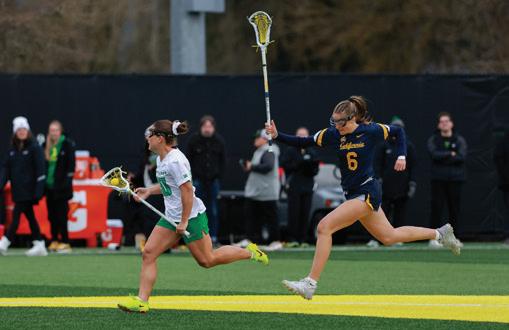
senior midfielder and captain, Simmons has become Oregon lacrosse’s focal point on both ends of the game.