Incumbent Gov. Tina Kotek talks student issues ahead of midterm election Read on page 5
MONDAY, OCT. 5, 2026
UO Board of Men’s basketball preview: Ducks new look in Trustees discusses face the Big Ten looming budget cuts SPORTS
Tenure cuts, graduate program reductions and merging colleges proposed.
Oregon will face a changing group of Big Ten contenders while trying to find its identity with a revamped roster. By Hannah Hiiva
Sports Writer
As Oregon enters its third season in the Big Ten conference, the Ducks will face a league that looks considerably different from the one they joined in 2024. The Ducks will face many high-quality teams that are at the top of the conference, including Illinois, Michigan and Michigan State, who headline the group, while USC, UCLA and Purdue are among the other teams expected to compete near the top of the conference. Like any season, several of the players who defined the league last season are gone. Michigan is coming off a national championship but lost much of the roster that carried them to a 37-3 record. Purdue lost All-American guard Braden Smith, while UCLA, Illinois and Wisconsin also enter the season without some of their most prominent players from the previous year. Michigan enters the season in an unusual position. The Wolverines are defending national champions after beating Connecticut in last season’s national championship game, but the roster that played a key part in their trophy is largely gone. Oregon will travel to Ann Arbor on Jan. 19 for its only meeting with the Wolverines during the regular season. Michigan State also provides another difficult road test. The Spartans finished third in the Big Ten last season, and reached the Sweet 16 before their season came to an end. Oregon will visit East Lansing on Jan. 16, just three days before traveling to Ann Arbor to face the Wolverines. Several opponents will also be traveling to Eugene, including Illinois on Feb. 20. Projected to be one of the teams to compete near the top of the conference, this home game may test Oregon late in the season. Continue story on page 10
College Happens All Over Town From game days and coffee runs to hidden gems, favoriteL study spots, and weekend adventures, M there’s more to discover beyond campus.
A B C
N
D E F
O P
G H I J
K
Get your Free LTD bus pass* and plan your trip using the Duck Around map. *In partnership with the ASUO
LTD.org/College
NEWSROOM
DAILY EMERALD
Monday, Oct. 5, 2026
page 3
EDITOR-IN-CHIEF Eva Andrews PRINT MANAGING EDITOR Ty Tilden NEWS EDITOR Corey Hoffman A&C EDITOR Bella Graham SPORTS EDITOR Joe Krasnowski OPINION EDITOR Rachel Ehly PHOTO EDITOR Katie Poluyanksy COPY CHIEF Lucy Forest VIDEO EDITOR Jake Nolan PODCAST EDITOR Bayley Burnham SOCIALS EDITOR Ana Páramo VISUALS EDITOR Sofia Campbell DESIGN EDITOR Asha Mohan DESIGNER Ellery Burton-Tillis
BUSINESS
PUBLISHER AND PRESIDENT Eric Henry ehenry@dailyemerald.com VP OPERATIONS Kathy Carbone kcarbone@dailyemerald.com DIRECTOR OF SALES & DIGITAL MARKETING Shelly Rondestvedt srondestvedt@dailyemerald. com CREATIVE & TECHNICAL DIRECTOR Anna Smith creative@dailyemerald.com STUDENT SALES MANAGER Elliot Byrne ACCOUNT EXECUTIVES Ava Mreen Daniel Petilli Tyren Viloria
THE DAILY EMERALD
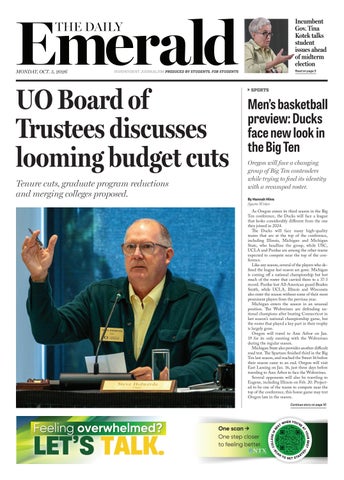
The Daily Emerald is published by Emerald Media Group, Inc., the independent nonprofit media company at the University of Oregon. Formerly the Oregon Daily Emerald, the news organization was founded in 1900. Emerald Media Group 1395 University St.,#302 Eugene, Or 97403 (541)-357-6569 (ON THE COVER) Chair of the University of Oregon’s Board of Trustees Steve Holwerda speaks during public comment during the Board of Trustees meeting on Sept. 29, 2026 in the Ford Alumini Center located in Eugene, Ore. (Charlie Mack/Emerald)
Campus construction projects wrap up over summer Residence halls, academic buildings and the Knight Library received makeovers while students were off campus. By Billie Corsetti
Associate News Editor
As students went home for the summer, construction crews at the University of Oregon took advantage of the empty campus to work on finishing various projects. Summer is typically the time for hallways to be repainted and offices redone, but students came back to campus for the 2026-27 school year with a few more significant changes. Most notably, phase three of the Hamilton-Walton Transformation Project was finally completed.
Hamilton-Walton Hall After years in the works, the project that removed Hamilton Hall and Walton Hall was completed over the summer. A new beach volleyball court and large green space sit where Hamilton Hall once stood. The first phase of the project began in 2019, with the construction of Unthank Hall on the Humpy Lumpy Lawn, and was completed in 2021. Phase two came with the removal of Walton Hall, replaced with Yasui Hall and Cedar Hall, previously known as New Residence Hall, in August 2023. Michael Harwood, university architect and associate vice president of Campus Planning and Facilities Management, said the removal of these old residence halls was sad for alumni and upperclassmen, but necessary for incoming freshmen to receive a good firstyear experience. “People have a real emotional attachment to where they spend their first year … There was a lot of that dynamic of people like, ‘Well, wait, why? That was good enough,’” he said. “But for (incoming freshmen), peak dorm living is not Hamilton and Walton.” The university also didn’t want aging residence halls to affect student recruitment, according to Harwood. Hamilton Hall had been known to contain asbestos. The third and final phase of the project started in 2025, with the removal of Hamilton Hall and the development of a green
space to make up for the loss of Humpy Lumpy Lawn. The green space was always the intended replacement for Hamilton Hall, ensuring that students living in Unthank Hall had easy access to a green space like students in Justice Bean Hall, Global Scholars Hall, Kalapuya Ilihi Hall and Carson Hall. The removal of Hamilton Hall was originally slated to begin in September 2023, but was delayed to allow space for incoming students while Kalapuya Ilihi was closed for two years to repair cracked walls. The final phase broke ground in November 2025. In summer 2026, construction crews worked to establish three new beach volleyball courts atop Hamilton Hall’s old footprint. The competitive courts will serve as the UO women’s beach volleyball team’s facility and court, reserved for their use Monday through Sunday from 8 a.m. to 2 p.m. The courts had a dedication ceremony on Sept. 23. The green space surrounding the courts is also now open to the public and students. “We hope this year’s freshmen will really populate it; they’ll be the first ones to kind of claim it for their own,” Harwood said. As a dedicated green space, Harwood said the area is a “no building” zone, prohibiting construction in the area for as long as possible. The total cost of the construction for the third phase of the transformation project was $6.2 million, less than the previously approximated placeholder cost of $10 million, according to Harwood.
New windows and roofs Another older dormitory on campus, Earl Hall, received a small revamp during the summer. All the windows in the residence hall were replaced, a project that’s been worked on in two phases in the past two summers. “The windows were past their useful life, and they were single-pane windows — meaning they were not energy efficient,” Harwood said. “The rooms should be much more comfortable this winter.”
Over the summer, Esslinger Hall also got a new roof. Every two years, the university receives funding from the Oregon legislature to fix things like roofs, elevators and other infrastructure. “We don’t get enough money to fix everything, so we’ve got a long list, and we just kind of keep ticking away at the things at the top of the list,” Harwood said.
Knight Library plaza Most students have already noticed one major change on campus during their first week back: the trees in the Knight Library plaza have been dug up. The four Japanese cherry trees in front of the Knight Library were removed. Harwood said the trees weren’t expected to survive construction being done on the plaza’s concrete. However, Harwood said the same species will be replanted as saplings within the first few weeks of fall term. Irrigation will also be installed to finally bring water to the fountain in front of the plaza. “I think it’s been the ‘80s since water actually flowed; it’s just been sitting there empty for decades now,” Harwood said. Construction crews removed and replaced the old concrete in front of the library, which Harwood said had been “eaten away” by winter salting. Although the project isn’t technically finished, Harwood said he would categorize it as finished. New lights were installed to help with dark staircases, a long-time safety concern. “If you’ve ever walked in front of the library, going just off campus, there’s two steps that are really dark,” Harwood said. “We’d added lights to solve that safety problem.” The university campus has multiple ongoing construction projects around campus, including more student housing and the restoration of Friendly Hall. Construction on Alder Street near campus is also continuing. (ABOVE) After a summer of construction, the new green space area replaces Hamilton Hall. The space is north of Unthank Hall and west of the Ford Alumni Center. (Lilly Wall/Emerald)
NEWS
DAILY EMERALD
Monday, Oct. 5, 2026
page 5
Incumbent Gov. Tina Kotek talks student issues ahead of midterm election Kotek, the current democratic governor running for reelection, discussed affordability, career preparation and artificial intelligence. By Billie Corsetti
Associate News Editor
Editor’s note: The following responses have been edited for brevity and clarity. Ahead of the gubernatorial debate at the University of Oregon, The Daily Emerald spoke with incumbent Gov. Tina Kotek for an exclusive interview. The upcoming midterm elections include a rematch of the 2022 governor’s race between Democrat Kotek and Republican state Sen. Christine Drazan. The event was organized and hosted by the UO School of Journalism and Communication, Oregon Journalism Project, KVAL CBS 13 and Lookout Eugene-Springfield.
Emerald: Could you speak to how you’ve helped students struggling with prices as governor, and how you hope to accomplish a better economy for students to enter into as they graduate? Kotek: I think it’s important, when you have spent all
this time investing in your education, that you can leave on time, leave without a lot of debt and have that kind of career step. I think that’s just a lot harder today. I think one of the things I worry most about for our students is making sure they can afford where they live. Most people live off-campus, so trying to make sure that rent is reasonable, right? When I was in the legislature, I tried to make sure that we would cap how much rent would go up every year, so people had some predictability. I think the other piece is with food costs. I’ve been a strong advocate of making sure students, if they need a little help, can get (Supplemental Nutrition Assistance Program) food benefits. That’s obviously been cut and made harder by the Trump administration, so I think that is a big challenge. I’m a big supporter of making sure there are navigation programs, making sure that students can get connected to whatever type of help is out there that they need, whether it’s food or housing assistance. Your number one goal when you’re in school is just to be able to focus on your studies, but most people are going to have to work and we have to have a stronger economy. Really trying to support the institutions like UO to be able to hire more students, treat them fairly on the job, make sure they have good pay because they might not have as many hours, but making sure they have a good wage going into that job.
Emerald: The job market right now is a little tough to break into. How do we prepare students right now to enter into adulthood? Kotek: One of the expectations I have for our universities here in the state of Oregon which, as you know, are independent, but making sure that there’s a lot of intentionality into how the programs that students have and the degrees they’re pursuing are going to be connected to something when they leave. I think that it is up to the university to help with that. It’s not just saying, ‘Hey, you’ve hit your credits, you’ve graduated, good luck!’ There should be a handoff, I think that is an expectation I have of our universities One of things that I’m focused on and will be in my second term is really growing the number of jobs in our state, growing the current strengths that we have like in semiconductors and the apparel industry. Those things that we’re already good at, like agricultural science, and then making sure that we’re growing those good living-wage jobs. I’m particularly interested in life science. I’ve been spending a lot of time focused on, and that’s not just engineering jobs, but those are jobs that, if you have a college degree and you’re interested in learning how to understand systems and
technology, those are really great jobs. So the ($1) billion dollar investment that Phil and Penny Knight are making in the Knight Campus and in bioengineering, that’s one pathway that I think we need to do more of. I was just in Hillsboro earlier last week, where there was a groundbreaking $750 million investment for Genentech. Those are the types of jobs I want to see students go to. If you are getting your education here in Oregon, I’d like you to stay in Oregon. I’d like you to contribute and give back and stay in the state. That’s certainly what I did when I came here and finished my college degree –– I stayed here. I love the state and I want to create that environment for students to get the jobs they want
Emerald: UO is facing both financial challenges, and a $1 billion donation from Phil and Penny Knight for an engineering school. How are you looking at the recommended Higher Education Coordinating Commission budget and where Oregon stands with the rest of the universities on the West Coast with public funding? Kotek: Every two years, I have to put forward a budget by December that is a balanced budget which says how we’re going to pay for things for the next two years, and then the legislature will do what they will. But it’s important for me to continue to support the really core funding that our universities and community colleges need. Because they are facing some budgetary challenges. I don’t want to be adding onto that. So trying to meet that basic level of funding in my budget is going to be key. Higher education is just changing. Enrollment is down; I think because students are trying other things. Not everybody wants a four-year degree. So when you have less students, less funding, that affects your ability to do all the things that a university does. So that’s a challenge. You have President (Donald) Trump, who is literally attacking universities and going after free speech and some of their research funding, so that’s a big factor for stabilizing the budget. The University of Oregon in particular has projected their ability to provide education based on international students. Well, with the Trump administration, international students are not coming to the United States. They were paying out-of-state tuition, helping balance the budget for the instate students. All of that is kind of up in the air right now. I think my message to universities across the state is: Figure out what your basics are, figure out what your core programs are. How can you do them as effectively and efficient-
ly as possible? Make sure that students get what they need. The focus should always be on the student. Is it affordable? Can they get it done in a reasonable time frame? And are we helping them get into employment?
Emerald: One of the things affecting higher education right now is artificial intelligence. It’s a big question right now of statewide policies, local policies and university policies. I’m curious as we enter this new age, how would you collaborate with universities when it comes to those policies? Kotek: About two and a half years ago, I did an executive order where I established a council within the state government to say how we should use artificial intelligence when we’re doing the work of the people in the state government, so we got a set of recommendations there. We want to make sure we’re protecting people and the type of work that AI could do in state government should be a value add, and not necessarily a takeaway from that human-to-human contact. But if we can free up state workers from not having to do as much paperwork because they can spend more time talking to people, that’s a benefit. I guess a couple of weeks ago now, I did an executive order on artificial intelligence, specific to what the state is going to do to protect us from frontier AI, where there’s a lot of concern that artificial intelligence might run amok. So we’ll be having a policy that says if we can’t guarantee that you’re going to be protecting us with your AI, then we don’t want you to be working with the state. Ideally the president of the United States would be doing that, but he’s kind of all over the map about AI, so my job as a state is to say we’re going to do what we can to protect Oregon. Emerald: UO students are coming from all over the state and the nation. What would you say to motivate students to go vote, and why might your campaign attract them? Kotek: In Oregon, we believe in people being engaged in democracy. We have automatic voter registration when you go to the (Department of Motor Vehicles), we have vote by mail. I want people to vote. It’s the fundamental core of who we are as a democracy, and that’s all under threat right now. This midterm election, I think, is going to be so important for the future of our state, the future of our country. The authoritarianism coming out of the Trump administration is real, and so people need to have their voices heard. So figure out how you can go online, change your address, so you can get your ballot here if you need it, or get your family member to send it to you. But please vote, it’s so incredibly important. I’ve been working hard for this day for four years. We’re making some progress, but there’s more to do.
(Courtesy/Jeremy Parker) Tina Kotek sits down with Daily Emerald Associate News Editor Billie Corsetti before the gubernatorial debate on Oct. 1, 2026.
ON THE COVER
UO Board of Trustees discu Tenure cuts, graduate program reductions and merging colleges proposed. munity engagement and public feedback will be gathered. Final reports will be presented to the UO Senate on Dec. 2. The board of trustees meeting the following week, Dec. 14 and 15, will see discussion on the proposed budget and a final vote. UO Senate President Edward Davis explained that one reason for forming AMAC was to reduce the “trust gap” that exists between some faculty and administrators. “I understand everyone here is working in earnest with the best interest of the university, but not everyone in my constituency agrees with me,” Davis said. Davis asked the board to consider extending the deadline for final budget decisions, as “A lot of people's lives are going to be profoundly affected by this process.” Davis later shared that faculty cuts could be “the end of their story,” as rehiring in higher education remains difficult. Davis explained that while the process and timeline outlined by AMAC is helpful, collaboration is necessary to ensure its success, and issues are already arising with delays. “We’ve only heard from three of the deans so far, and we’re supposed to be transitioning,” Davis said. Because a vote to extend the timeline was not on the agenda, the board could not give an answer on an extension during the Tuesday meeting. Even if further time was granted, Chief Financial Officer Jamie Moffitt said the cost of delay could be over $5 million per month. But that number is not set in stone, Moffitt said –– modelling for ambiguous future cuts is difficult. “I want to make sure that the community is thinking about that. There is a fiscal impact, even if we can’t model it out,” Dennis Worden, a trustee, said. Many trustees said they wanted to stick to the current December timeline. Some reasoned it might be helpful to end the uncertainty of budget cuts sooner rather than later. “I don't think it's a healthy decision for our community to add another three, six, nine months of uncertainty,” trustee Elisa deCastro Hornecker said. “So besides the financial, I think there's a human element there too.” Other trustees wanted more clarity on the process, including graduate student and trustee Mohammed Shakibnia, who said the process felt too rushed. “I would be of the opinion, based on the feedback that I've also received, that having more input and feedback would be helpful to see how we can strengthen our new programs with the existing programs that we already have,” Shakibnia said.
By Sasha Love, Audrey Lynch & Justice Escobedo
Associate News Editor & News Reporters
The University of Oregon board of trustees met on Sept. 28 and 29 amid a projected $65 million budget deficit, discussing proposed cuts, including faculty and graduate programs, and reviewing the fiscal impact of 2025 reductions. During his address, UO President Karl Scholz urged the university community to hold “two truths.” “One truth is that we face budget challenges, and the work to meet these challenges will be hard on people across the university,” Scholz said. “The other is that the University of Oregon has a bright future.” In light of the upcoming changes, the president emphasized the limits of the university. “We cannot be all things. Concentrating on what we do best is not a retreat from ambition,” Scholz said. “It's how we can be ambitious.”
Proposed reductions The university will not make final decisions on which programs and positions to cut until the December board of trustees meeting, but Provost Christopher Long explained that, as of right now, there are a few key reductions they are considering. These include shrinking the number of existing tenured faculty, future graduate employee positions and merging colleges to reduce administrative costs. The provost also said UO is looking into restructuring and sunsetting existing Ph.D. programs. Related programs could be consolidated into a single, smaller, “higher quality” program, Long said. During public comment, Carver Goldstein, the president of Graduate Teaching Fellows Federation, which represents graduate employees, urged the university to remember the importance of its graduate programs. “Graduate students are an essential part of a functioning R1 university,” Goldstein said. After presenting on the potential cuts to tenured faculty and graduate employees and merging colleges, the provost echoed Scholz. These proposed changes, Long said, will help the university be “excellent in what we emphasize.”
Call for more time A committee consisting of several faculty, staff and ASUO President Quadrian Gill is reviewing which areas of UO may face cuts. The Academic Modification Advisory Committee will act as an advisory group and present recommendations to the university president later this fall, before Scholz and the board of trustees make final decisions. AMAC, which was formed in May, will present its proposed plan to the UO Senate and release a preliminary report in late October. Following that presentation, com-
A $1 billion donation to engineering: a juxtaposition? On Sept. 23, UO received a $1 billion donation from Phil and Penny Knight to establish a college of engineering. Donations are often restricted funds, and can only be used for specific donor-designated programming and projects, but
some professors said they want to see a bigger push toward supporting existing faculty when working with donors. "I'm genuinely excited about this donation. I mean, who doesn't want to celebrate. And, I'm genuinely excited to have new colleagues on campus, to attract more students to a major that's focused on problem solving,” United Academics President Kate Mills said. "This gift is meant to improve the labor force in Oregon in the future, but what about our current workers on campus who are essential to the function of this university?” Mills said the university should “negotiate” more with donors, so that current faculty salaries can also be supplemented. “As we all know, a functioning campus is a prerequisite for building a new college,” Mills said. Scholz said that the UO already approved an undergraduate bioengineering degree several years ago, so the new school wouldn’t be an entirely new endeavor. Scholz also said the donation funds faculty positions in the school. “Nothing will be drawing from other programs on the campus to feed whatever happens in the future with the college of engineering at the University of Oregon,” Scholz said. “And so there won't be grabbing from ‘here’ to fund ‘there.’”
Current budget standing State appropriations to fund UO came in almost $1 million higher than expected for the fourth quarter of fiscal year 2026 because specific university programs were valued more by the state than expected, according to Moffitt. Net tuition revenue came in as expected, at around $534 million for the fourth quarter. The total Education & General fund was about $124 million. Brian Fox, associate vice president for budget, financial analysis and data analytics, said this means the university could operate at its current expenditure level for a little over two months, if no more money were flowing into the system. The total general expenses decreased by about 2% from fiscal year 2025 to fiscal year 2026, after measures were taken because of the projected budget deficit.
Fiscal impact of fall 2025 budget cuts A total of $29.2 million of university spending was cut from the university in summer 2025 and fall 2025, including $24.9 million in personnel costs. The economic impact of these cuts is still playing out, as some of the 117 professors and staff with slashed positions received year-long layoff notices. Nearly 60 positions were also left vacant to cut costs. “Personnel is by far our largest expense category, so when we go through an expense reduction process, it really is the place that we have to make reductions in order to bring our expenses in line with our revenues,” Fox said.
AMAC BUDGET TIMELINE The AMAC committee formed; UO Senate President Edward Davis spoke to the board's timeline.
May
Oct. 28 AMAC will present their proposed plan to the UO Senate as well as release its preliminary report.
The month will consist of community engagement and public feedback, ending Nov. 30.
November
Dec. 2 AMAC will present their final report to the UO Senate
Scholz issues formal response to AMAC’s final report
Dec. 7
Dec. 14-15 The Board of Trustees meeting will see discussion on the proposed budget and a final vote.
DAILY EMERALD
Monday, Oct. 5, 2026
page 7
usses looming budget cuts KEY TERMS University Senate A shared governance body representing faculty, students, staff and administrators. Meet weekly on Wednesday evenings.
HECC
Higher Education Coordinating Commission Sets state policy and funding strategies, administers numerous programs and convenes partners working across the public and private higher education arena to achieve state goals.
Run Rate (Charlie Mack/Emerald)
Revenue minus expenses
Ben Elias speaks to the University of Oregon’s Board of Trustees on Sept. 29, 2026 in the Ford Alumni Center located in Eugene, Ore.
Officers of Administration and classified staff faced the heftiest reductions, along with 20 career faculty. Fourteen tenure-track positions were left vacant to reduce costs. The rest of the cost-cutting came from accounting adjustments and “supplies and services” reductions. The total run rate from fiscal year 2025 to fiscal year 2026 flipped from negative $4 million to positive $4 million. Moffitt attributed this to employee cuts, the hiring freeze, shifting donation use and “asking people to think very carefully” about travel costs, as well as an unexpected federal change in the timeline for approving funds. Looking toward future cuts, Moffitt said some of these changes that saved UO money during the last fiscal year might only be “one-time” possibilities. “I think the issue with things like travel and hiring is what's your recurring activity in the future,” Moffitt said. “So it really depends what decisions are made about open positions –– which ones we eliminate, which ones continue forward –– and then budgets that departments have for travel, whether they're restricting those on an ongoing basis as part of budget cuts, or whether that's something that will come back.”
University debt capacity lower than peers Jeff Schumacher, UO’s director of treasury operations, reviewed the university's debt and capacity for borrowing. While Schumacher said UO has a “fair amount” of debt capacity, meaning the university could keep on issuing debt for upcoming projects, UO also has a significantly higher
debt ratio compared to peer institutions. “When we compare ourselves, we are seeing positive improvements, but when we compare ourselves to our peer institutions, we have a long way to go,” he said. In the long run, this would mean that UO may be in a worse place to borrow than other comparable public universities. Holwerda noted the gap. “Consistently, we look bad, or we look over-levered, in our cash and investments,” Holwerda said. Moffitt said agencies that grade the UO institution on its debt ratio have concluded that the level of university assets versus the university’s level of loans and debt is “not very strong for our rating.” A stronger rating usually allows an institution to borrow more money at a lower interest rate. UO is kept at a higher rating or grade partly because of the UO “brand,” as a large Oregon university. Moffitt said the “vast majority” of UO’s debt comes from auxiliaries, including housing, the Erb Memorial Union and athletics spending. “We’re specifically modelling out what is the revenue that is supporting that debt,” Moffitt said. “So the question of how much debt we should be issuing for me is a question of what we should do and not what we could do. And it’s based on if we are issuing it for housing, for example, ‘What are the revenue streams that are coming in?’”
AMAC
Academic Advisory Modification Committee Designed to “provide meaningful advice and input to the University President specifically related to significant academic changes,” according to the UO website.
ICC revenue Indirect Cost Credits Overhead charge for research activities and operations.
NEWS / OPINION
DAILY EMERALD
Monday, Oct. 5, 2026
page 8
NEWS
UO students may be affected by wildfire smoke through mid-October As Oregon recovers from a record-breaking fire season, experts warn of lingering effects as the school year starts. By Carys Sexton-Sayler
News Reporter
(Nathan N
guyen /Em
erald)
As students return for fall term, they are arriving in the aftermath of Oregon’s worst wildfire season on record. More than 2.5 million acres have burned across Oregon and Washington this year, a total the Bureau of Land Management has called an exceptionally active wildfire season. Most of the smoke stayed east of the Cascade Mountains, but Eugene wasn’t entirely spared, and local officials say students shouldn’t let their guard down. Fire season lasts through mid-October.
Lane Regional Air Protection Agency Communications Manager Matt Sorensen said locals should continue monitoring air quality and the weather, watching for late-season smoke. LRAPA recommends limiting outdoor time for sensitive groups, young children, older adults, pregnant people and anyone with breathing complications once the air quality index, a measure of pollutant concentration, hits 100. LRAPA recommends everyone limit outdoor time once the AQI hits 150. N95 masks can help filter air when exposed, Sorensen said. Sorensen also said HEPA air purifiers are “one of the best things people can do” to create “a healthy space to retreat to when moving indoors is the right call.” UO’s Environmental Health and Safety Department serves as “a sort of central clearing house” for wildfire smoke guidance, according to UO Environmental Health and Safety Director Steve Stuckmeyer, but doesn’t have the final say over school policy and activities itself. EHS reviewed its outdoor event guidance in the spring, ahead of forecasts for a bad fire season, a routine review. Cora Bennett, executive director of student orientation programs, said her office watches air quality “closely all summer,” since much of the program’s work — student employee training, campus visits and orientation programming — happens outdoors. Most summer events are small enough that an indoor backup is simple, Bennett said. But heading into fall, as students come back to campus, things are “more complex.”
Bennett said her team leans on the same EHS guidelines and gets real-time texts and emails from EHS “when they are aware of concerning forecasts.” If an event were affected, Bennett said her office could notify students “quickly through text messages and emails.” UO’s policy for in-person class cancellations is based on Eugene’s AQI. Professors and instructors cannot penalize students for skipping class if the AQI is above 150, but classes can be moved online for credit. Outdoor field research also cannot be mandatory when smoke is above AQI 150. Perci Ereth, co-director of the AccessABILITY Student Union, recommends using N95 masks for smoke exposure, since basic medical masks don’t filter out wildfire smoke. However, Ereth added, masking for long stretches of time is difficult for students with sensory sensitivity or claustrophobia, something Ereth said they personally struggle with. For Ereth, wearing a mask can feel like “gasping for oxygen.” Moving events indoors to dodge smoke also means trading one risk for another: crowding and germ exposure. AccessABILITY keeps a supply shelf in its Erb Memorial Union office stocked with masks and mini air purifiers for students who need them. Heidi Huber-Stearns, who directs UO’s Center for Wildfire Smoke Research and Practice, thinks UO should do a better job alerting the UO community of poor air quality, especially during sporting events. “The guidance is not clear,” Huber-Stearns said. Factors such as rainfall, temperatures and fuel moisture are all used to determine the end of a fire season, Sorensen said in a press release. Until such a call is made, all backyard debris burning is prohibited, even in areas with low fire danger.
OPINION
Betts: Save the Roadless Rule to protect our forests The USDA plans to roll back a rule safeguarding American forests; we don’t have long to stop them. By Reed Betts
Associate Opinion Editor
Forty five million acres — about the size of Oklahoma — is at stake, unless we can save the Roadless Rule from destruction. The Roadless Rule is a federal regulation enacted by the Clinton administration to protect what’s left of America’s uninterrupted forest ecosystems. It places 45 million acres under the care and protection of the United States Forest Service, banning any new roads or industrial development. Two million of those acres are in Oregon alone. This rule has had profound positive impacts: creating a safe haven for numerous wildlife species, providing outdoor recreation opportunities and delivering fresh, clean water to 25 million people through protected waterways. Our forests are a source of national pride, but even more so a local one. The Eugene area is called the “Emerald Valley” for a reason, and UO’s famous green is no coincidence. We live in an evergreen state, which makes what the federal administration is trying to do all the more concerning. On June 23, 2025, U.S. Department of Agriculture Secretary Brooke Rollins signaled that the Trump administration would be looking into repealing the Roadless Rule; in August, that plan was officially filed. In a statement, Rollins claimed that this move would “restore authority to local forest managers who know the land,” and that we have to “turn the page on the failed Roadless Rule and return
our forests to health and productivity.” She cited specifically poor fire management as evidence of this “failure.” This logic is completely faulty, and little more than a veil for the government’s true intent. There is zero evidence of past mismanagement, including poor fire control; wildfires are a natural and healthy occurrence regardless of the Roadless Rule, and humans disrupt that balance. This decision is drenched in greed, a product of decades of lobbying by loggers and vehicle promoters eager to wreak havoc on what little remains of our natural world for short-term profit. Rollins even appointed a lumber executive to oversee the Forest Service, an unfathomably corrupt and unethical move that is sadly one example of many of the Trump administration’s profit-oriented decision-making. As Justin Boyles, conservation advocate at Environment Oregon, put it, “To be surrounded by wildlife, and to experience complete solitude, is something Oregonians should be able to share for generations to come. It’s absurd to think that some of the wildest, roadless places in Oregon … could be destroyed for short-term economic gain. Oregon does not need to trade our clean water, wildlife habitat and wild places for more roads into our backcountry.” However, despite the impending doom, there is still a chance. USDA has approved a public comment period to be extended to Oct. 6, allowing the people to voice their opinions on the repeal. So far, an incredible 1.6 million public
comments have been filed, 99% of which are in support of the roadless rule, an incredible showing. But, we still need more, as our outcry needs to overcome deeply rooted lobbyists and industry plants. Everyone, if they have the chance, should write a comment. Save Our Roadless Forests has a website that lets you do so in mere seconds. To get even more involved, events to boost support are all over Eugene, such as public comment workshops held by the student activist group OSPIRG. Oregonians need to step up to protect what makes Oregon special, and as Kali Klevin of OSPIRG put it succinctly, “We must protect these special areas for the generations of Oregonians to come.”
(Kai Kanzer/Emerald) Mount Halo lays deep in the Umpqua National Forest Southeast of Eugene, Ore.
Reed is a second-year political science student who’s interested in unusual historical facts and sharing the stories behind them. He plans to pursue law in the future, but for now, he enjoys exploring Eugene, trying out new clubs, and diving into any friendly debate that comes his way.
505 Willamette Street #110 Eugene, Oregon 97401 www.eugenegeartraders.com
BRE AK IN G S! G NEW KIN A E BR
BREAKING NEW S!
OCTOBER 3RD & 4th
S! W NE
SALE
BR E A KI NG
MOVING
BREAKING NEW S! WS! G NE KIN EA BR
Eugene Gear Traders
S! W E N
SPORTS
DAILY EMERALD
Monday, Oct. 5, 2026
page 10
Men’s basketball preview: Ducks face new look in the Big Ten Continued from page 1
The Ducks will also host Purdue on Feb. 24. That stretch could be especially important for Oregon. Four of the Ducks’ final five conference games are against Illinois, Purdue, USC and UCLA, proving a difficult ending to the regular season. Oregon enters the season with a roster built around a mix of transfer and returning players as well as young talent. Sophomore guards Jasper Johnson and Jerry Easter II are among the newcomers expected to play important roles for the Ducks. Johnson joins the Ducks from Kentucky, while Easter is a transfer from USC. Forward Dwayne Artistode, another sophomore, transferred to Oregon from the University of Arizona. The Ducks also have senior forward Sean Stewart, who transferred to Oregon after stops at Duke and Ohio State, while senior guard Fred Payne arrives in Eugene from Boston College. Taylor Bol Bowen, Andrew Meadow and other upperclassmen provide additional experience to the roster, with several players entering their debut or second seasons in Eugene. The biggest question may be how quickly can the group can develop into a cohesive rotation.
Oregon has several players capable of taking on larger roles, but the Ducks will have to consistently create offense and, defend at a high level to earn them a spot amongst a highly competitive conference. This is also influenced by the schedule. Oregon’s conference season begins with UCLA on Dec. 1. The Ducks will then return home to Eugene for a Dec. 5 matchup against USC before traveling to Ohio State and Penn State later in the month and early January. January will be a particularly challenging stretch for the Ducks. After hosting Indiana on Jan. 6 and Nebraska on Jan. 10, Oregon travels to Michigan State on Jan. 16 and Michigan on Jan. 19. Northwestern will then arrive in Eugene on Jan. 23 before the Ducks host Rutgers four days later on Jan. 27. Oregon’s schedule also includes a Jan. 30 neutral-site matchup with Gonzaga at Climate Pledge Arena in Seattle. The Ducks will then travel to Wisconsin on Feb. 3, Iowa on Feb. 10 and Minnesota on Feb. 13 before returning home to face Maryland, Illinois, and Purdue. Oregon then closes the regular season with road games against USC and Washington as well as a home match against UCLA. The Big Ten tournament will then follow, from March 9 through 14,
(Owen Burriss/Emerald) Oregon's lineup takes the court after a break in play. The Oregon Ducks men’s basketball hosted the Minnesota Golden Gophers at Matthew Knight Arena in Eugene, Ore. on Feb. 17, 2026, losing 44-61.
With a new looking roster and a challenging schedule, Oregon enters the season with plenty to prove. The Ducks will have opportunities to test themselves against the conference’s top teams.
Oregon men’s basketball predictions for the 2026-27 season With one of the largest transfer classes to the men’s basketball program, here are some early predictions about how the Oregon Ducks men’s basketball team may perform this coming season. 2026-27 TRANSFER CLASS Dwayne Aristode Previous: Arizona
Taylor Bol Bowen Previous: Alabama
Pharaoh Compton Previous: San Diego State
Jerry Easter II Previous: USC
Jasper Johnson Previous: Kentucky
Andrew Meadow Previous: Boise State
Fred Payne Previous: Boston College
Tyrone Riley IV Previous: San Franisco
By Bel Perez
Sports Writer
The buzz around men’s basketball in Eugene has found itself muddied in the background of Oregon Athletics after a devastating last year. Finishing No. 16 in the Big Ten with a record of 5-15, the Ducks are looking to perform better this year. As last year’s roster has changed drastically, not many fans know what to expect out of all these new players. Built up of nine transfer players and only four returning players from last season’s roster, here are some way too early predictions about what could happen during the season.
Senior Transfer Fred Payne becomes the new “star” of the Ducks Senior Fred Payne, who transferred from Boston College, could be the one leading the Oregon offensive charge this season. The four-star recruit had his best season of basketball during his previous season with the Boston College Eagles. Payne played an average of 34.7 minutes and scored around 15.8 points per game. Looking to stamp an exclamation mark on his final season of college basketball, Payne can do a lot for this team. As long as he carries his momentum from last season and plays for the collective effort, the sky’s the limit for Payne this coming season.
Oregon will finish in the top ten of the Big Ten Conference With a nearly brand-new roster for this coming basketball season, how this team will perform is up in the air. But from the outside, this team could easily slide their way to the top ten of the Big Ten Conference. Last season, transfers Tyrone Riley IV, Fred Payne, and Andrew Meadow all put up an average of double digits in points every night with their former teams. Meadow, who transferred from Boise State, could provide valuable depth while bringing the ability to make big plays when the team needs them most. With a field goal percentage last season of .510, he could assist the team with the “easy buckets” that can make or break a game. Even head coach Dana Altman expressed his confidence during his preseason review interview regarding the team he has in front of him. As everyone is trying to adjust to this new group, that could mean more opportunities for the new guys. Filled with some of the top players all across the country as well as some multi-star recruits, this team has the star power and the depth to bring basketball excitement back to Eugene.
Tajh Ariza breaks out from the beginning True freshman Tajh Ariza is making his college basketball debut this year in Eugene. Ranked No. 36 in the nation by ESPN and having over ten Division I offers, Ariza ultimately landed on Oregon for the next four years. With many other prestigious programs trying to recruit his talent, Oregon won him over with head coach Altman’s winning reputation as well as the future direction of the program. Attending Link Academy in Missouri for his senior year of high school, a program with quite the reputation for producing D-I athletes, and with NBA legend Trevor Ariza as a father, he has been in every environment that could’ve provided the best chance for him to succeed further in his basketball career. Regarding Ariza’s talent, he should make a strong impact on the team. Though he’s young and has no collegiate experience, his background should have prepared him well for how well he will be able to produce points for the Ducks this season. The season ahead will be an interesting one for sure. This specific Ducks team doesn’t have much to lose due to the developing identity that they are working to write. But with trust in head coach Altman and trust in each other, this team has the ability to reach new heights this season.
Weekly Crossword 1
2
3
7
8
Puzzles Master, Nate Wong 4
5
18
19
6
9
10
11 12
13
ACROSS
1 Former Ducks wide receiver and Bo Nix’s adopted brothe 4 Western UO hall with the most floors 7 x-___ or y-___, in precalc class 9 “Hello!” in Capri 10 “Delivered!” 11 Insects with bullet or fire varieties 12 Ryan who now hosts Wheel of Fortune 14 Lil ___ X 15 Like a certain spooky horseman 20 Cassette intake 21 “What a shame”, in a Shakespearean way 23 Arbor Day honoree 24 Ripped to shreds 25 “thx” partner 26 Peach or avocado’s seed
DOWN
1 Student graders, for short 2 Former couples 3 Homebrewed publication 4 State tree of Maine 5 Back muscles, briefly 6 “I’ve won... but at what ___?” 8 Many a stadium filler during COVID 9 ___ Headrest (“Twin Fantasy” band) 13 Lo-___ (lite) 15 Web address starter 16 Hall adjacent to Straub 17 Simians 18 Mindless generative AI output 19 Indian garment 22 List of performed songs, for a band
14 15
16
17
20
21
23
24
25
26
Sudoku 1 9
Unscramble
6
5
2
6 3
3 9
8
8
7 2 5
22
6
4
5
7
9
8
7
4 6
1
6
5
8
7
A L C E M
H F S I
N A M
4
1
3
3
8
7
2
Sudoku4024
Answers
A E B R R T
By Nate W
What did the computer hacker use to hang up photos? A
!
By Nate W
MAINFRAME BARTER, CAMEL, FISH, MAN
Sudoku4024
6
3
9
7
8
5
5
1
3
2
4
6
7
9
2
4
1
8
1 2 4 8 9 7 3 5 6
5 4 9 3 6 8 2 1 7
8 6 2 7 4 1 5 3 9
7 3 1 9 5 2 8 6 4
4 8 3 2 1 9 6 7 5
2 1 7 6 8 5 4 9 3
9 5 6 4 7 3 1 8 2
T E Z P L C A X I S C I A O S E N T A N T S S E A C R E S T N A S H E A D L E S S T A P E A L A S T R E E T OR E P L S P I T
B:11.25" T:11" S:10.5"
T:16"
B:16.25"
S:15.5"