JAN. 3, 2022
Week of Welcome
Emerald Media
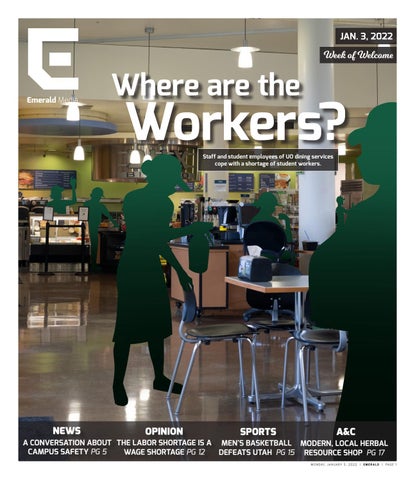
Where are the
Workers? Staff and student employees of UO dining services cope with a shortage of student workers.
NEWS
OPINION
SPORTS
A&C
A CONVERSATION ABOUT THE LABOR SHORTAGE IS A MEN'S BASKETBALL MODERN, LOCAL HERBAL CAMPUS SAFETY PG 5 WAGE SHORTAGE PG 12 DEFEATS UTAH PG 15 RESOURCE SHOP PG 17 M O N D AY, J A N U A R Y 3 , 2 0 2 2
|
EMERALD
|
PA G E 1
FROM YOU
LETTER TO THE EDITOR Oregon’s New Climate Protection Program Gives Hope and Opportunity
VOL. 123, ISSUE NO. 17
By Helen Kennedy Marcola, Oregon Environmental Quality Commission
GET IN TOUCH
EMERALD MEDIA GROUP 1395 UNIVERSITY ST., #302 EUGENE, OR 97403 541.346.5511
NEWSROOM EDITOR IN CHIEF
Sarah-Mae McCullough MANAGING EDITOR
Jael Calloway ENGAGEMENT EDITOR
Sarah Matlick NEWS EDITORS
Duncan Baumgarten Leo Baudhuin A&C EDITOR
Grace Murray SPORTS EDITORS
Shane Hoffmann Mojo Hill Charles Gearing OPINION EDITOR
Francis O'Leary PHOTO EDITOR
Ian Enger
DESIGN EDITOR
Kira Chan COPY CHIEF
Amanda Lurey VIDEO EDITOR
Marcus Ren PODCAST EDITOR
Meaghan FitzPatrick DIGITAL EDITOR
Rikiya Klasen
BUSINESS PUBLISHER & PRESIDENT
Bill Kunerth X317
bkunerth@dailyemerald.com VP OPERATIONS
Kathy Carbone X302
kcarbone@dailyemerald.com DIRECTOR OF SALES & DIGITAL MARKETING
Shelly Rondestvedt X303
On Dec.16, 2021 the Environmental Quality Commission made history. It approved climate regulations that push to reduce greenhouse gas (GHG) emissions from transportation and heating fuels and from large factories. This long overdue program gives me hope that Oregonians will have more job opportunities in our transition off fossil fuels. It will infuse $200-500 million annually into our economy through the Community Climate Investment (CCI) Program, unique to Oregon, in which the fuel suppliers will pay certified nonprofits to implement GHG emissions reduction projects. CCI projects must help residents, businesses and nonprofits in rural, low income, tribal and coastal
communities. The possibilities are bountiful – from electric heat/AC pumps, electric cars, trucks and tractors, to small/medium solar and wind power systems, including homes, barns, apartments, restaurants, groceries, gyms, hotels, schools, clinics, hospitals and more, such as low emissions farming practices. Now is the time for young entrepreneurs, students and graduates to help turn the tide on climate in their “hometowns.” Tap these funds to launch new nonprofits, or transform established ones, and transition Oregon (and the U.S.) off fossil fuels. Oregon is poised for greatness in reducing emissions. Let’s thank the Commissioners and staff, and get to work!
LOOK ONLINE Most read story last week: “Report: Oregon football hires Tosh Lupoi as defensive coordinator” by Aaron Heisen
(Ian Enger/Emerald)
Voices of UO
Scan here or visit the Emerald’s social media to participate in our next Voices of UO. How are you responding to the Omicron variant and UO’s COVID-19 vaccine booster shot requirement?
srondestvedt@dailyemerald.com
Student Recommends
CREATIVE & TECHNICAL DIRECTOR
Sam Rudkin X327
creative@dailyemerald.com STUDENT SALES MANAGER
Patrick McCumber
BY JOANNA GARCIA • TWITTER @JOSCRABSHACK
ACCOUNT EXECUTIVES
Melanie Lopez Riley Valle Kevin Sullivan Amy Menendez Keaton Roberts Jen Caplan
MOVIE RECOMMENDATION: "IT'S A WONDERFUL LIFE"
THE DAILY EMERALD
The Daily Emerald is published by Emerald Media Group, Inc., the independent nonprofit media company at the University of Oregon. Formerly the Oregon Daily Emerald, the news organization was founded in 1900.
Summary: This 1946 holiday classic tells the story of George Bailey, a businessman who's done several good deeds throughout his lifetime such as saving his younger brother, Harry, from drowning and preventing the town's pharmacist from accidentally poisoning a child's prescription. However, Bailey initially fails to realize how much value his actions have on his community and declares himself a failure until he experiences an intervention from a guardian angel.
(Julia Stalnaker/Daily Emerald)
We want to hear from you: Email editor@dailyemerald.com to submit a tip or a letter to the editor. The ideal length for a letter is 200-500 words, but we publish letters of various lengths online.
ON THE COVER
(Photo by Serei Hendrie/Emerald, illustration by Oscar Zurita/ Emerald)
Recommended by: Sriram Nathan, a freshman majoring in architecture "The film is about the character realizing his worth and how much the people around him need him," Nathan said. "I think it's a very important message for mental health. It is so easy to get caught up in your shortcomings and not see how important and valued we all are."
PA G E 2
|
EMERALD
|
M O N D AY, J A N U A R Y 3 , 2 0 2 2
(Maisie Plew/Emerald)
Spaces Filling Fast You’ve never lived like this. Walk or bike to class
Amenities for a fit and healthy lifestyle
Private bedrooms and bathrooms available
Academically oriented environments
Fully furnished apartments
Swimming pools with sun decks
Hardwood-style flooring
Individual liability leases and roommate matching available
Learn more and apply online today at
AmericanCampus.com/Eugene
Amenities are subject to change. See office for details.
M O N D AY, J A N U A R Y 3 , 2 0 2 2
|
EMERALD
|
PA G E 3
W I N T E R T E R M T E X T B O O K S O N L I N E O N LY
Order Your Books Now This term, textbooks and ebooks are available online only. Most orders ship FREE* from The Duck Store, or choose In-Store Pickup from the Flagship Campus or EMU locations.
UODuckStore.com/books Textbooks are available online only
IN-STORE PICKUP FREE In-Store Pickup, plus FREE shipping on orders $50 or more*
Orders available to pick up by next business day
houseofrecords.wixsite.com/store *Free shipping available on orders of $50 or more and applies to standard shipping anywhere in the U.S. including Alaska & Hawaii. PA G E 4
|
EMERALD
|
M O N D AY, J A N U A R Y 3 , 2 0 2 2
NEWS
A CONVERSATION ABOUT CAMPUS SAFETY
BY GAVIN GAMEZ • TWITTER @GAV_GAMEZ
ORIGINALLY PLANNED FOR THE FALL, ASUO CONTINUES PLANNING ITS COUCH TALK, WHICH IS SET FOR WINTER TERM.
Originally planned to be a town hall, ASUO’s “couch talk” — a less formal alternative — has shifted its focus from the University of Oregon Police Department's Community Service Officers to the wider topic of campus safety. ASUO plans to hold the couch talk at some point during winter term for students to discuss the campus safety issues they’re most concerned about. “There are a lot of students on this campus that have issues that they feel like need to be addressed that relate to campus safety that don’t connect to CSOs,” ASUO President Isaiah Boyd said. He said it would be a disservice to students to focus solely on CSOs when there are other campus safety issues. “Students might be concerned about features of the campus where lighting is terrible,” he said, “or some students might say, ‘I don’t feel comfortable seeing a police officer with a gun.’” Boyd said he thought town halls offered a limited amount of time for speakers and audience members. “There is not really a natural conversation, it's more of a ‘we are just going to give you all of the information that we know, and you have to take it and do with it as you please,” he said. The couch talk is meant to create an interactive space for students to feel their ideas are being listened to, Boyd said. He hopes the talk will provide a framework for students to have their questions heard. ASUO Communications Director Sam Simonett said the structure of the talk will have a traditional questions and answers section that will shift into a more candid conversation. “We’ll be moderating to make sure the conversations remain on track and productive, but the central goal of the couch talk format is to make a space for students to express their concerns and feel heard,” Simonett said. Simonett said this and future couch talks will be in conjunction with different departments on campus. “There will likely be messaging within their department as well, to faculty and students alike,” Simonett said. ASUO will release a survey during the winter term to determine what topics they want to discuss during the couch talk. “If we get a lot of feedback around UOPD specifically, it’ll be a UOPD lens” Boyd said. “You have concerns about UOPD? We are going to get them into that space so you can talk to them.” He said the survey will examine campus safety from a variety of different angles — including UOPD. “The theme I’m trying to push forward is UOPD isn’t the end all be all solution for safety on campus,” he said. Boyd said ASUO is working with groups like the Multicultural Center, the Black Cultural Center, the Ethnic Studies Department, the Dean of Students and the University Health Center. “If students relate or express concerns around mental health, I want to make sure
that we get a counselor from the University Health Center to say, ‘Hey, look, your students are telling you this is an issue,’’’ he said. While ASUO is communicating with campus groups for the couch talk, they aren’t a big part of the planning process. “Right now all of our partners are kind of on the outside of the project,” Boyd said. “We want it to be very student driven and student built so haven’t let them dive deep into the planning phase.” Following UOPD Chief Matthew Carmichael’s departure from UO, Captain Jason Wade said he plans on attending the couch talk as acting chief and is eager to hear student feedback. UOPD also has an online feedback form for students to share their thoughts about CSOs. Boyd said he hopes to have the couch talk in the middle of winter term before students become too preoccupied with finals. “I want to give our team enough time to where after the couch talk we can then reassess and coordinate another event or smaller events or even just take the data we get from the couch talk and take it to administrators,” he said. Simonett said students should be on the lookout for posts on the ASUO Instagram page as well as future ASUO newsletters containing information on the couch talk. ASUO President Isaiah Boyd is helping organize the couch talk about campus safety. (Will Geschke/Emerald)
UOPD Community Service Officers Manu and Galick mainly operate out of the East Station, about two minutes away from campus. CSOs will be one topic of discussion at ASUO's couch talk. (Maddie Stellingwerf/Emerald) M O N D AY, J A N U A R Y 3 , 2 0 2 2
|
EMERALD
|
PA G E 5
EDITORIAL
NEWSROOM DEMOGRAPHICS AND NEXT STEPS The Emerald’s second census shows that, like in spring 2021, our average employee is a White woman in an unpaid role. BY THE EMERALD ETHICS BOARD
Daily Emerald staff, students and other community members gather at Falling Sky on Oct. 9 2019 (Madi Mather/Emerald). The Emerald’s second census results are in, reflecting our newsroom from fall 2021. One of the biggest findings: The Emerald is still too White, with a racial demographic gap between our newsroom staff and the student body who we strive to represent and serve. This is concerning because when a newsroom doesn't reflect its readership, it reports with more blindspots and less awareness of the breadth of issues affecting its communities. For example, reporters and editors may weigh White issues more heavily and miss stories that matter to community members of color. On June 1, 2021, the Emerald conducted our first census followed by an editorial reflecting on the results. With fall term behind us, the Emerald Ethics Board, a body of student staff who address ethical issues facing the newsroom, reflects on our newsroom’s demographics and sets goals moving forward. We aim to hold ourselves accountable in creating a newsroom that is not only more diverse by the numbers, but is a space where people of all backgrounds feel comfortable expressing themselves and their viewpoints. We conducted the census in October 2021, and 67 out of about 95 employees responded, a rate of about 70%. The statistics mentioned in this editorial represent the demographics of respondents, but not necessarily our newsroom as a whole. Key Findings: Here are the key findings and how they compare to the spring 2021 newsroom census: More than four out of five respondents (83.6%) are White. This means a greater percentage of our respondents are White compared to the spring term census where 78.8% identified as White. Half (50.7%) are women, with another 6% identifying as nonbinary and 4.5% identifying as transgender. About half (52.2%) identify as heterosexual, meaning more of our respondents identify as LGBTQ+ than in the spring. PA G E 6
|
EMERALD
|
M O N D AY, J A N U A R Y 3 , 2 0 2 2
The majority (83.6%) do not consider themselves to have a permanent or temporary disability. The number of respondents who identify as having a disability has grown. Similarly to spring term, nearly two-thirds (65.7%) of respondents identified as “very liberal” and few respondents (4.5%) identified as either “very conservative” or “slightly conservative.” About 39% of respondents have UO need-based scholarships or grants, 10.4% are not using financial aid and 65.7% have some kind of loan. Over three-quarters (77.6%) of respondents do not receive a regular paid stipend. 13.4% of respondents identify as non-traditional college students. About 18% of respondents identify as firstgeneration college students. Some of this data aligns with the student body, based on the University of Oregon’s own demographic data. Some are difficult to compare because the university’s Demographics and Diversity report includes information on fewer demographic categories and only has categories for people who identify as male or female, excluding people whose gender identity does not fall into one of these two binary categories. The Emerald does have a similar amount of female-identified employees as UO which reported 55.4% of the student body to be female. While UO as a whole is predominantly White, with over half (about 60%) of the student body being White, according to the Demographics and Diversity report, the Emerald is about 23% Whiter than the school as a whole. This is something that the Ethics Board is striving to change. So where do we go from here? It is not enough to simply reflect upon the data. The Ethics Board is committed to creating a more diverse newsroom, and that means setting goals and holding ourselves accountable. Currently, White students are overrepresented
in our newsroom in comparison to the UO student body. Our goal is for our newsroom staff to represent the diversity of the student body, including racially, as closely as possible, so we can thoroughly tell the stories that matter to our readers. One way we plan to do this is by forming relationships with a diverse range of organizations around campus and using those relationships to share opportunities at the Emerald and recruit staff. Cultivating these relationships is important for working together and creating a newsroom that people want to write for. When we are not in the process of hiring, we want to encourage more letters to the editor so we can highlight the voices of those outside of our staff and welcome feedback for the newsroom. Change also starts with the culture of our newsroom. Throughout the year, we plan to hold trainings related to diversity and bias. During fall term, we held a training session on the importance of newsroom diversity led by former-Oregonian reporter Eder Campuzano. In winter and spring terms we want to expand on this with trainings about implicit bias and engaging community members of different backgrounds. Our newsroom is overly White which is easy to blame on the makeup of the UO student body, but we must also take accountability. It is our job to change the culture of the newsroom and make it a more diverse space that is more diverse in all aspects – and make the Emerald a paper that People of Color want to write for. In writing this editorial, we hope to hold ourselves accountable to the community at large. We will write at least one more editorial during spring term to check our progress. Editor’s note: Emerald style capitalizes all ethnicities, including Black, Brown and White when they refer to ethnicity. This decision was made by Emerald editors with consideration of outside perspectives, such as the National Society of Black Journalists, which recommends this approach.
M O N D AY, J A N U A R Y 3 , 2 0 2 2
|
EMERALD
|
PA G E 7
PA G E 8
|
TICKET HOLDERS MUST PROVIDE PROOF OF FULL VACCINATION (+14 DAYS) OR A NEGATIVE LAB TEST NO LATER THAN 48 HOURS PRIOR TO SHOW IN ORDER TO ATTEND. MASKS ARE REQUIRED. FOR COMPLETE INFORMATION AND UPDATES PLEASE GO TO WOWHALL.ORG. TICKET HOLDING PATRONS WILL BE INFORMED OF ANY CHANGES VIA THE EMAIL USED AT TICKETWEB. EMERALD
|
M O N D AY, J A N U A R Y 3 , 2 0 2 2
Voted #1
Best Pizza
Vegan, organic, woman owned, and locally owned
Acai Bowls
Smoothies
$
Cold-Pressed Juices
AVOCADO TOAST and more!!!
LARGE SINGLE TOPPING
located inside the Eateries and Bar at the 5th Street Public Market. maisjuicecafe.com
15
1809 Franklin Blvd. • 284-8484 • tracktownpizza.com
*Not valid with any other offer or discount. Expires 6/30/22
mention this coupon to receive offer. Valid for walk-in or deliveries.
@maisjuicecafe
Eugene’s
Flower Home
Order online
or for best selection call us.
We Deliver
541-485-3655
1193 Harlow Rd. Springfield OR. 97477
HERBIVORE
CARNIVORE
LOCAVORE
New Haven inspired apizza, pub brewed beer
390 Lincoln St. @4th
541.735.3860 530 BLAIR BLVD EUGENE (541) 735-3520
TACOVOREPNW.COM
LUNCH & DINNER EVERYDAY
DINE IN | CARRY OUT thewheelapizzapub.com M O N D AY, J A N U A R Y 3 , 2 0 2 2
|
EMERALD
|
PA G E 9
COVER
UO’S DINING HALLS
GRAPPLE WITH A SHORTAGE
OF STUDENT EMPLOYEES
BY ALEXIS WEISEND • TWITTER @WEISEND_ALEXIS
Staff of UO’s dining halls amp up hiring efforts with incentives amid a student employee shortage. Remaining employees said the shortage makes work stressful and that UO needs to increase their pay to attract more workers. Editor’s note: The Emerald interviewed eight current or former UO dining student employees for this story, and five current employees wished to remain anonymous. In cases where employment or housing could be impacted by someone telling their story, the Emerald allows the use of anonymous sources to avoid retaliation. University of Oregon dining services faces a staffing shortage and has amped up efforts to attract student workers. However, students working in the dining halls said the lack of staffing combined with lower-than-average pay has created stressful work conditions. “UO dining has been operating with fewer employees this fall amid a staffing shortage that has been noted locally and nationwide,” UO Director of Dining Services Tom Driscoll said. About 750 students were employed by dining services prior to the pandemic, Driscoll said. At the start of fall term, dining services had about 100 student employees. That number increased to 550 over the course of fall term. During the staffing shortage, student dining service workers said the dining halls have been high-stress environments. They said UO needs to increase its pay to attract more student workers. A strenuous workload Many student employees said that Unthank Hall, which has nine dining venues, especially struggles with the staffing shortage. A student employee working in Unthank Hall said her job was more stressful fall term than during remote learning last year. “A lot of people quit before starting, which they probably expected,” she said. “But, within the first month, people were dropping like flies.” Another student employee who works in food preparation at Unthank Hall said she feels like she is doing multiple people’s jobs due to the staffing shortage. “The reason I stayed in the dining halls for so long is because of the friends and the connections I made,” she said. “Because Unthank is just so big,
PA G E 1 0
|
EMERALD
|
M O N D AY, J A N U A R Y 3 , 2 0 2 2
Fresh Coffee, located in Global Scholars Hall, is one choice for food for on campus students. Dining halls on the University of Oregon campus struggle with understaffing. (Serei Hendrie/Emerald)
and we are poorly run and just disjointed, I'm kind of separated from my friends who really made this job a lot more fun.” UO junior Harrison Wood worked in Hamilton’s dining hall for two years before he became a student shift lead at Unthank Hall during fall term. He left to pursue another job after working three shifts. But those shifts involved extremely long work hours in a stressful environment due to the staffing shortage and student excitement over a new dining hall, he said. “Everybody wants to eat there, and we don't have enough people to serve them,” Wood said. “Venues would just close once they ran out of food for hours until more food was cooked, and then they would reopen again, run out of food and close again.” Wood said staff had difficulty fitting in breaks because of the staffing shortage. Student workers would often have to stay past their shift to wait for another worker to come in, he said. A student employee working in Unthank’s dish room said keeping up with dishes is one of the main problems to arise from the hall’s staffing shortage. In the weeks before fall term began, he routinely worked 40 hour weeks, he said. He said things are smoother now. “Previously, there would be mountains of dishes that were left for the next day or things would not be able to get cleaned that should be cleaned,” he said. “People would leave
at 2 a.m. because they had no way of getting all the work done.” Driscoll said three venues in Unthank Hall’s new PNW Public Market have not yet been opened due to the staffing shortage. The student employee in Unthank Hall who works in food preparation said Unthank has more new hires than workers with previous experience in the dining halls. She said the new hires cannot always cook on the line or produce food quickly, which slows operations down. “You can hire all the people you want,” she said, “but if you don't hire the people that I actually need, then that doesn't help me.” Driscoll said hiring efforts have been centralized so dedicated staff can work full-time hiring students. The student employee in Unthank’s dish room said not allowing individual dining halls to hire students leaves certain areas in more need of staffing than others. “One of the problems that we faced in the middle of the term was we had a lot of new hires, which we desperately needed, but they were all being sent to places where it made no sense for them to be,” he said. “They would just stand around and do nothing because there was no work to do. They would send them to the venues that weren't visited frequently.” He said the dish room is essentially the backbone of Unthank, but it was left understaffed with about three workers on a good day. “There’s a complete disconnect in how things would flow and move from
COVER one place to the other,” he said. Leaving for higher pay UO increased the minimum starting wage for student employees from $12.75 an hour to $13.25 an hour to retain and attract additional staff, Driscoll said. The university also offered various incentives to increase staff numbers, including a $200 student staff retention incentive for students who joined on or before Nov. 1, 2021 and worked through Dec. 4, 2021, up to three $50 payments for referring friends to University Dining and a $50 bonus after joining if students meet certain employment requirements. Driscoll said the hiring, referral and retention bonuses offered to student employees will continue in winter term. UO dining will also hold a student job fair Jan. 7 from 3 to 6 p.m. in the EMU Crater Lake room, and all new hires will receive a $100 signing bonus. Michael LaQuay, a student employee at Unthank’s dining hall, said the perks UO offers have helped improve the staffing shortage and will continue to help as time goes on. Driscoll said dining hall positions offer reduced price meals for student employees on every day they have a shift, as well as significant flexibility to accommodate their class schedules. Many University Dining student employees said they want their wages to be increased to attract more workers and to be compensated for the amount of work the staffing shortage puts on them. Multiple student employees said their co-workers have left for places like Target and McDonald’s because they can receive higher wages.
“I think pay and just simply not wanting to put yourself through an unnecessarily high-stress environment are probably the two main reasons why I would say a lot of people are leaving and trying to find work elsewhere,” a student employee working at Fresh Marketcafé said. She said she tries to work as many hours as she can to compensate for what she could be making elsewhere. Eliza Reyes said she quit working in Hamilton’s dining hall last year, and pay played a large factor
"EVERYBODY WANTS TO EAT THERE, AND WE DON'T HAVE ENOUGH PEOPLE TO SERVE THEM." HARRISON WOOD UO Junior
in her decision to leave. “I wouldn’t have been able to afford food and groceries this year if I was still working at the dining halls, so I left,” she said. The student employee in Unthank’s dish room said, despite the wage increase, his co-workers have been attracted to jobs offering $15 an hour so they can make rent and pay for food. “No one showed up, and everyone was surprised. They thought, ‘We’re only paying $13.25, and then you
have to do double the work that you would expect to do and take up everyone else’s work.’ To me, it didn’t really make sense why they’d be surprised,” he said. Students employees in the dining hall work alongside classified employees — full time, unionized employees. The Oregon union SEIU Local 503’s higher education bargaining team, which negotiates contracts between unionized higher education employees and some public universities including UO, reached a tentative agreement with the universities on Dec. 3, 2021. The tentative agreement includes a selective salary increase of one salary grade for classified food service workers and a $15 an hour minimum wage for all classified staff. Members of SEIU 503 are in the middle of voting whether or not to ratify the new contract, which will go into effect the first day of the month after ratification. The contact wouldn’t directly affect student workers, who aren’t unionized. A level two classified food service worker currently has a salary that ranges from $13.73 to $16.49 an hour, while student employees’ wages range from $13.25 to $15 an hour. “They essentially do the exact same work,” the student employee in Unthank’s dish room said, “although our compensation is quite different.” Wood said he does not think the classified workers’ wage increases will lead to wage increases for student employees in the dining halls because students are not equipped to organize like a union to demand more pay. “They might be afraid of losing a job or whatever because they might need it to survive,” he said. “It might be difficult to try and demand something like that.”
Dux Bistro, located in the Living Learning Center dorm, is one option for students to get food on campus. Dining halls on the University of Oregon campus struggle with understaffing problems. (Serei Hendrie/ Emerald)
Dining halls on the University of Oregon campus struggle with understaffing problems. (Serei Hendrie/ Emerald)
A sign in the Living Learning Center advertises work for students. Dining halls on the University of Oregon campus struggle with understaffing problems. (Serei Hendrie/Emerald)
M O N D AY, J A N U A R Y 3 , 2 0 2 2
|
EMERALD
|
PA G E 1 1
OPINION
THE LABOR SHORTAGE IS A
WAGE SHORTAGE Wheeler: The campus’ labor shortage is a wage shortage. The University of Oregon has enough to fund its hundred million dollar projects, so why doesn’t it have enough to pay its workers? BY PORTER WHEELER • TWITTER @DOCBATTINGTON The university does not have enough food service workers to staff its campus. Restaurants in the shiny new Unthank Hall remain closed, and wait times are often over an hour. UO regards this as a labor shortage and attempts to bolster recruitment with bonuses, but this is an obfuscation from the truth: This is a wage shortage. Workers, on campus or otherwise, are financially unable and unwilling to toil under poverty pay that undervalues their labor. UO as an institution has enough money to finance a $219 million dollar renovation of campus but somehow not enough to entice broke college students to serve pizza. UO is a microcosm of nationwide struggles for workers rights and higher wages that are often portrayed in the media as a labor shortage. This framing shifts the blame for a shortage onto the worker and neglects the true solution: Pay people more. If a company cannot attract or keep its labor force, it is not because the composition of the average worker has unknowably changed; it's because the employer does not pay enough. In September, 3% of all employed workers — 4.4 million Americans — quit their jobs. In response, employers have tried to attract their workforce back with minimally increased pay. October's average hourly earnings jumped 4.9% over the previous year. Yet this fails to even meet inflation which grew 6.2% in the same time. Effectively, hourly wage earners face a pay cut to continue working. Hourly campus wage grew from $12.75 to $13.25 this year – yet it is still not enough during an ongoing pandemic where good jobs are needed to support students as prices increase on all goods. If we take UO at its word that its collegiate purpose is to prepare students for future employment, then it is preparing its current employees to be underpaid, undersupported and underappreciated. Miles Slayton, an employee of the Pacific
Unthank Hall is the newly built dorm at the University of Oregon and doubles as a dining hall on campus. The dining hall, The Pacific Northwest Marketplace, faces struggles being understaffed and having long wait times. (Serei Hendrie/ Emerald)
Northwest Market in Unthank, is adamant that an increased wage is necessary for employees. “Not only a wage which may ensure our survival, but one which would allow us to thrive through our college years,” Slayton said. “To work for less is not only undervaluing the price of our labor, it is directly harmful to current employees and to the prospects of any future ones.” Work is not just a pastime, it is you selling labor and time you will never get back. By not properly compensating that labor, UO alienates its workers from their ability to provide for themselves now and in future careers. Because if students are paid the full worth of their labor in college, they have more power to leverage higher wages later. Samantha Lyon, an employee for the EMU’s Fresh Corner Market, enjoys the convenience of her job but says the main setback is the pay and benefits. “My biggest complaint is the pay; we are paid $13.25, but there’s really no benefits to working,” Lyon said. “At my previous job at least I got tips. Here we’re not allowed to get tips or allowed to have a shift meal.” There are also reports that UO venues are mismanaged and hostile in their desperate attempts to staff workers. For instance, a third-year student quit their position at Drake’s Deli before even starting. “I said my max availability was 10 hours a week, and they scheduled me for like 30 hours the week before classes started without asking me,” the student said. “They called me and were like ‘where are you?’ They got mad and said they had a worker shortage and I had to come in, so I quit.” According to Emerald reporting last May, Director of Dining Services Tom Driscoll said the university was “gearing up to be back at full staffing capacity by September.” Obviously, this hasn’t happened. Driscoll did not respond to requests for an
interview, but a press release from the Dining Services office stated UO dining has “taken measures to retain and attract additional staff.” These measures include: a maximum of three $50 referral bonuses, a $50 new staff bonus, a $200 retention if they stay on through the winter term and a food discount program. These bonuses are enticing up front but will always be less than a simple wage hike in the long term. Moreover, the discount is a wholly convoluted system that is intentionally obtrusive, offering a $0.60 per point markdown up to 5 meal points. Further, it’s not competitive when compared to alternatives like Starbucks, where employees earn $15 an hour with full benefits. The lengths UO has gone with the bonuses is emblematic that it is not only aware of the real solution, but dancing around it. In a worst case scenario, we will see the outsourcing of campus jobs, taking positions once available to our neighbors and forcing us to work in a ‘race to the bottom.’ Workers will have to compete for the lowest benefits they are willing to endure in fear of being replaced with another who would work for less. We students should exercise solidarity with the workers who staff the dining halls, clean the residence halls and allow our university to operate. These laborers face the same strains and economic uncertainty we do as students. We have more in common with the worker who serves us pizza than with our favorite professors. Porter Wheeler is an opinion columnist at the Daily Emerald. As a student of Global Studies and Cultural Anthropology, he writes passionately about politics and culture through an intersectional lens.
EDITORIAL CARTOON "Why we keep losing" Ian Proctor is an editorial cartoonist for the Daily Emerald. He is a freshman with interests in journalism, political science and animation, as well as paleontology and biology. Ian’s comics may appear bizarre, but this is just the way he tends to draw things.
PA G E 1 2
|
EMERALD
|
M O N D AY, J A N U A R Y 3 , 2 0 2 2
SPONSORED BY
proudly presents
DUCKS TAKING FLIGHT
UO Alumni share career lessons they’ve learned
Written by Lizzy Lee
Andrew Blume, BS 2012
Job Title: Strategic Sales Manager for Iron Ox Major: Business Administration
Nominate your hero!
Andrew Blume graduated from the University of Oregon in 2012 and majored in business administration, but says food has always been his lifelong passion.
When times are tough, who motivates you to be kinder, work harder, or just be a better person? Tell us who your inspiration is. These stories will be published on the Daily Emerald website, with many of those stories also appearing in a special print edition on Jan. 24. Go to dailyemerald.com/emerald_hero/ Nominations in by January 10
What skills or key takeaway did you gain from your time at the UO that you now implement in your career?
This image was originally posted to Flickr by MTAPhotos at https://flickr.com/photos/61135621@N03/49750647937. It was reviewed on 3 May 2020 by FlickreviewR 2 and was confirmed to be licensed under the terms of the cc-by-2.0.
DUCK
LIVING FAIR
2022 DUCK LIVING FAIR Thursday, Feb 3rd, 11am - 3pm EMU Ballroom
FREE FOOD WIN VALUABLE PRIZES OVER $1500
Today, he combines his love for cuisine and skill with business as the strategic sales manager for Iron Ox, growing fresh and beautiful sustainable produce out of California.
In business school, I took a business writing class that taught me how to be concise. In the real world, everything moves too fast for a full analysis. At UO, I learned how less is more. I think also joining clubs, joining trade associations, that kind of stuff will really give you a lot of exposure.
Your company, Iron Ox, is leading the way in solving global climate issues through renewably grown food. How is this done? What can we as consumers expect from future farming techniques?
Based in California’s Silicon Valley, Iron Ox is an agriculture technology startup with deep expertise in robotics and artificial intelligence. The company’s mission is to make growing fresh produce carbon negative. Iron Ox has redesigned every step of the farming process, from seed to store to shelf, achieving levels of precision that are impossible through conventional farming.
How important is it to network and sell yourself?
I think it’s absolutely critical. If I just came and said I have passion, that wouldn’t have been enough. Not only do I have passion, but I have combined that with the skills that I learned in Oregon and parlayed all of that into networking, and building a digital portfolio of all my career accomplishments and learnings into blog posts. You need a really unique perspective and a place where you are asking the right people the right question at the right time. This allows me to sell myself and tell my own story with proof points along the way.
IN PRIZES Prizes include:
50” Samsung TV | Kitchen Aid Mixer | Knife Set | Air Fryer | Apple Airpods | and More!!
Alumni Spotlight is a collaboration between UOAA and Emerald Media Group. M O N D AY, J A N U A R Y 3 , 2 0 2 2
|
EMERALD
|
PA G E 1 3
Spaces Filling Fast You’ve never lived like this. Walk or bike to class
Amenities for a fit and healthy lifestyle
Private bedrooms and bathrooms available
Academically oriented environments
Fully furnished apartments
Swimming pools with sun decks
Hardwood-style flooring
Individual liability leases and roommate matching available
Learn more and apply online today at
AmericanCampus.com/Eugene
Amenities are subject to change. See office for details.
PA G E 1 4
|
EMERALD
|
M O N D AY, J A N U A R Y 3 , 2 0 2 2
SPORTS
OREGON OFFENSE COMES ALIVE, DEFEATS UTAH 79-66 BY ERIC BERNIKER
Ducks guard De'Vion Harmon (5) goes for a layup through contact with a Utah player. The Oregon Ducks Men’s Basketball team faces the Utah Utes on Jan.1, 2022, at Matthew Knight Arena. (Serei Hendrie/Emerald)
The crowd at Matthew Knight Arena roared as Oregon point guard Will Richardson hit a step-back three pointer. A lack of offensive production has plagued Oregon all season, but Saturday night looked promising for the Oregon squad, proving its ability to score as they beat the Utes, 79-66. “It has been coming together slowly,” Richardson said. “It builds your confidence, I like to say it's your swagger… walking around like you belong here.” The Preseason No. 12 team in the nation entered the first game of 2022 with a 7-6 record, going 0-2 in Pac-12 play. For the Ducks, Saturday night was a tale of two different teams on the offensive side of the ball. Sometimes they were able to score by exploiting opportunities to play inside out in transition. Other times, the Ducks looked hesitant, holding the ball for too long in the wings and looking for entry passes to the post but failing to create space to run a pick and roll. They opened the night shooting one of 10 from the field. A slow pace and nine first half points to Utah forward Branden Carleson fronted the Utes a 35-29 lead going into halftime. Coming out of the break, Jacob Young set the tone for the Ducks on the defensive end, using his lightning speed to cause three Utah turnovers with his suffocating on ball defense. Young finished the night with a season best 22 points and a game-high 4 assists. “He changed the game,” Oregon head coach Dana Altman said. “We were stuck in
the mud and he got a steal and the rest of the guys followed his example.” In the second half, the Ducks played with better energy. They continued to harass Utah ball handlers as Altman’s teams have done for years, forcing bad shots and 9 second half turnovers. The change in defensive strategy made room for the offense en route to a 50 point, 64% shooting second half in which the Ducks shot 75% from beyond the arc. “We got some layups off of steals which really got us going,” Altman said. “We would like to get out and have a little better transition game than what we’ve had… the defense initiated most of those opportunities.” Will Richardson had a career night, tallying 26 points on 8 for 8 from the field in the second half, helping to seal the win for the Ducks. A preseason Bob Cousy award watch list player, Richardson has struggled with consistency thus far. His offensive production was a welcome addition on Saturday. “Will can be his own worst enemy sometimes,” Altman said. “Putting pressure on himself, the anxiety that creates… he was upbeat in practice the last couple of days, trying to lead, and it carried over to the game.” Oregon claimed a 79-66 victory for their first win of Pac-12 play. The Ducks outscored Utah by 19 in the second half, but this Oregon team still has room for improvement, especially in the settled half-court offense. The Ducks will look to build on their momentum when Colorado comes to Eugene on Monday, Jan. 2 at Matthew Knight Arena. M O N D AY, J A N U A R Y 3 , 2 0 2 2
|
EMERALD
|
PA G E 1 5
SPORTS (Photo by Eric Evans/GoDucks.com)
Hoffmann: OREGON MUST REDISCOVER WEDNESDAY'S SECOND HALF EXPLOSIVENESS IN 2022
(Photo of Dont’e Thornton by Eric Evans/GoDucks.com)
A depleted Ducks defense allowed a season-high in points in the 47-32 Alamo Bowl loss, but it’s the Ducks’ second half performance, especially offensively, that added fuel to an already salient offseason. BY SHANE HOFFMANN • TWITTER @SHANE_HOFFMANN Credit to Oregon. It’s not the lopsided Utah losses or the abysma first half of Wednesday’s 47-32 Alamo Bowl loss I'll remember. It’s that offensive explosion in the second. That brief salute to more potent Ducks’ offenses of years past. For the first time this season, there was a true aura of confidence. Just get the ball back to the offense. No shred of a doubt that each offensive drive would end in seven points. “We just needed one stop,” All-American safety Verone McKinley III, who is still undecided on whether to return for his final season, said. “We needed more time. And that’s just how football is… That feeling after the Pac-12 championship – we didn't like it,” McKinley III said. “And this one is a little different because we didn't give up in the second half.” That’s the taste left in my mouth, the prevailing memory as Oregon enters the offseason — the first of the Dan Lanning era. Interim head coach Bryan McClendon added: “We’ve come too far to let a bad half define us.” Those final 30 minutes felt different. Looked different too. It was a pleasure to watch. I’ve found myself circling back to one answer Lanning gave in his introductory press conference some days back. He was asked about the philosophy which he hopes to use when PA G E 1 6
|
EMERALD
|
M O N D AY, J A N U A R Y 3 , 2 0 2 2
constructing his team’s identity. Without hesitation, he detailed his No. 1 focus. “The No. 1 indicator right now in college football in wins and losses is explosive plays,” he said. “We’re going to be a team that’s built off explosive plays on offense, defense and special teams. You have to be able to push the ball down the field; you have to be able to attack in the air and on the ground.” After the Alamo Bowl, Oregon has a tried and true blueprint. And while you'd be hard pressed to find an explosive play from Oregon’s defense Wednesday — which allowed Oklahoma to score on eight straight possessions — many of the 30-plus Ducks absent hailed from that side of the ball. The decimated unit — starting a tight end and offensive guard along the defensive line — had glimpses early but understandably wore down. I’m willing to bet the defensive mind of Lanning can construct a formidable unit with the resources and personnel Oregon has returning. Noah Sewell, Justin Flowe, Jeffrey Bassa, Brandon Dorlus, Popo Aumavae, Dontae Manning, Bennett Williams –– that’s a sturdy foundation. That’s why that second half fight the Ducks lacked in both losses to Utah, but displayed in those final 30 minutes in San Antonio, is key. It was the first time all season the Ducks looked like an offensive force capable of consistently pushing the ball down field through the air.
There was an aggressiveness, both in play calling and decision making, nowhere to be found in the blowout losses to Utah. The offense played its most inspired ball all season. “Truly you have everything right now telling these guys not to go out there during this time and give it all that they have,” McClendon said. “They were able to block out everything.” That wide receiver group looks special. Ninety yards for true freshman Dont’e Thornton, 65 for fellow freshman Troy Franklin and 55 for sophomore Kris Hutson. A touchdown bomb to each. It’s a young trio and, at times Wednesday, that showed. But the speed is a recipe for the explosive offense Lanning envisions. The unit offensive coordinator Kenny Dillingham has the keys to, and the offseason with which to find the heir apparent to quarterback Anthony Brown. That’s really all that matters at this point, right? The offensive line enters 2022 virtually unchanged. The stable of running backs is deep enough and plenty talented to withstand possible departures from CJ Verdell and Travis Dye. The receiving corps, and tight end room for that matter, are built to play down the field. Rearing to open things up and assault the scoreboard with a daunting defense on the sideline. Whoever finds themselves under center next year must reignite that brief stint of second half magic discovered in the closing moments of the 2021 season.
A&C The store has a wide selection of herbs, teas, minerals and more that serve as modern medicine. Mountain Rose’s vintage and warm atmosphere offers a welcoming feeling as costumers shop around for natural and safe products. (Mary Grosswendt/Emerald)
A MODERN, LOCAL HERBAL RESOURCE SHOP BY BRANDON ROTH • TWITTER @BRANDON.ROTH
Mountain Rose Herbs Mercantile makes it simple for people to buy organic and sustainable items such as teas and bath products. Entering into the Mountain Rose Herbs Mercantile shop, you are immediately surrounded by various sized glass containers of herbs, salts and oils. Spices such as chili peppers and basil are displayed in clear valves attached to the walls and dried tea buds fill the exposed shelves underneath the check-out desk. High glass ceilings supply natural lighting to the shop, giving the interior an open atmosphere. There is a vintage feeling throughout the store — old cash registers are decorated throughout and bronze phonograph light fixtures hang low from the roof. The merchandise is organized under specialized signs and is stacked on top of aged wooden wagons and shelves.
Lydia Fish, store retail manager, believes strongly in the value of the shop’s natural products. “There is always a time and place for Western medicine eventually, but what's available to us naturally is usually undermined,” she said. Eugene’s Mountain Rose Herbs Mercantile ensures its botanical and herb products are USDA Organic, non-GMO and Kosher certified. Customers can buy all types of products such as herbal lozenges and extracts to help treat common colds or headaches. Some customers come in to buy seasonings while others make their own face cream concoctions with the butters and waxes from the store.
Connor Holt, a customer who works for a tea company, makes the trip down to Eugene every few weeks to buy his favorite tea. Holt said he does not know much about herbal products but tries his best to buy products that are “environmentally conscious.” “I like how the store is organic and local in the community,” Holt said. “You can get whatever you want here related to herbalism.” Fish said she is “always learning new stuff” at Mountain Rose. Fish believes there are millions of ways to use the products in the store such as creating bath bombs, skin creams and pill capsules. For thousands of years, plants and minerals were the only
M O N D AY, J A N U A R Y 3 , 2 0 2 2
|
EMERALD
|
PA G E 1 7
A&C This apothecary shop can be found on 5th Avenue in Eugene. Mountain Rose’s vintage and warm atmosphere offers a welcoming feeling as costumers shop around for natural and safe products. (Mary Grosswendt/Emerald)
cure for ailments. Natural ingredients are powerful in their own right, she said. Fish wants people to apply the benefits of plants to their daily skincare or diet regimen. “When working with plants, you have to trust time,” she said. “A remedy needs to be kept up regularly and people choose not to use these methods because they want instant results.” Mountain Rose is a company that puts “people, plants and our planet” before profit, according to their website. Fish said their first brick and mortar store opened in 2016, but originally operated as a catalog business by famed herbalist Rosemary Gladstar in 1987. The current CEO, Shawn Donnille, created the online store in 1999 and allowed the company to be accessible nationwide ever since. Fish said the herbs and materials of Mountain Rose are sourced from foreign farms as far as India. The company upholds ethical standards by investing in plants that grow in their native lands and providing social benefits for growers through their participation in the Fair for Life program. Herbal experts also inspect the products before packaging to verify it is free of chemically-laced substances. “All of the botanicals we get are identified by PA G E 1 8
|
EMERALD
|
M O N D AY, J A N U A R Y 3 , 2 0 2 2
The store has a wide selection of herbs, teas, minerals and more that serve as modern medicine. Mountain Rose’s vintage and warm atmosphere offers a welcoming feeling as costumers shop around for natural and safe products. (Mary Grosswendt/Emerald)
professional herbalists,” Fish said. “They are able to look through it in a microscope-type of level. We pass everything through third-party testing to check for heavy metals. Everything here is pretty high quality.” Caity Huff, a retail associate and University of Oregon senior education student, has worked at Mountain Rose for over two months. Huff’s interest in herbalism compelled her to apply there. Surrounded by medicinal plants all day, she has become well versed with the products in the store. Huff likes the idea of the store as an apothecary where she can “take herbs off shelves and mix around with them” to produce medicinal remedies. “Since working here, I drink tea almost every day and make my own herbal infusions that way,” Huff said. “I also like making my own natural perfumes and taking certain supplements and tinctures. It is really fun to mix stuff and find new ways to
incorporate everything.” Mountain Rose encourages people to be mindful of what they put in their bodies. Huff said everyone can improve their quality of life by applying one's “backyard plants” into their healing treatments. She is motivated to get more Oregonians to look into their environment and become versatile in what they can create. Huff recommends new customers begin with edible products such as tea or seasonings because of their easy application to our health. “Tea is something that people can definitely get into,” Huff said. “It is a gateway into herbalism. Herbs you can eat or drink have really good properties for you.” Mountain Rose Herbs Mercantile, located on West 5th Avenue and Charnelton Street, is open Monday through Saturday from 10 a.m. to 6 p.m. and Sunday from 10 a.m. to 5 p.m. Products are also available through its website.
University
A
OF HOM E M E
S
Visit the Duck Nest Wellness Center in the EMU! and Remotely at https://health.uoregon.edu/ducknest
G
Health Services OUR SERVICES
Primary Care Acupuncture Allergy/Asthma Birth Control Colds/Flu Dental Diabetes Management Energy Healing
Massage Therapy Medical Lab Tests Medical Records Meditation Nutrition Pharmacy Physical Therapy Psychiatry
Sexual Health Sports Medicine STI Screening Clinic Stress Management Tobacco Cessation Travel Clinic Vaccinations X-ray
Follow us: @healthyUO (Facebook and Instagram) and @HealthCenterUO (Twitter) University Health Services
Rental season is coming Accepting Applications Jan. 24th
Search. See. Live. 1301 FERRY STREET #2 VONKLEINRENTALS.COM
541-485-7776 DON’T BE SHY
health@uoregon.edu • 541-346-2770 EO/AA/ADA institution committed to cultural diversity
Locally owned! Pizza Salad Pasta Sandwiches Beer & wine on tap
DAILY SPECIAL Slice, salad and soda: $9 * only available
Family founded, owned & locally operated since 1989!
PLUMBING HOUSEWARES ELECTRICAL HARDWARE LAWN & GARDEN TOOLS PAINT
at EMU location
Pizza by the slice: $4-$4.50
Located in the EMU on the ground level TRIVIA FRIDAY NIGHTS AT 6 P.M.
2825 Willamette • Eugene, Oregon • 541-342-5191 M O N D AY, J A N U A R Y 3 , 2 0 2 2
|
EMERALD
|
PA G E 1 9
THE ORIGINAL NORTHWEST SUSHI BURRITO
WINNER 2019 2020 2021 SUSHI BURRITOS
TRY OUR
AND BOWLS STARTING AT
FAMOUS GARLIC & CAJUN CHICKEN
$8.50
Order online at eatsubo.com for exclusive Specials
Burrito sized sushi rolls Delicious Bowls and salads Famous House made sauces
3
LOCATIONS TO SATISFY YOUR
CRAVINGS
SPRINGFIELD 42nd and Main
PA G E 2 0
|
EMERALD
|
M O N D AY, J A N U A R Y 3 , 2 0 2 2
EUGENE 3rd and Van Buren
NEW LOCATION 2568 Willamette