JAN. 10, 2022 Monday Edition
Emerald Media
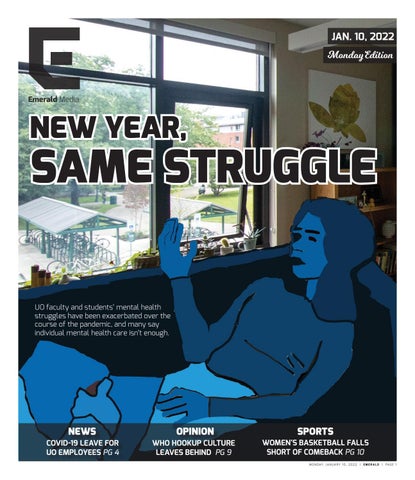
NEW YEAR,
SAME STRUGGLE UO faculty and students’ mental health struggles have been exacerbated over the course of the pandemic, and many say individual mental health care isn’t enough.
NEWS
OPINION
SPORTS
COVID-19 LEAVE FOR UO EMPLOYEES PG 4
WHO HOOKUP CULTURE LEAVES BEHIND PG 9
WOMEN'S BASKETBALL FALLS SHORT OF COMEBACK PG 10 M O N D AY, J A N U A R Y 1 0 , 2 0 2 2
|
EMERALD
|
PA G E 1
Eugene’s
Flower Home
PLUMBING HOUSEWARES ELECTRICAL HARDWARE LAWN & GARDEN TOOLS PAINT
2825 Willamette • Eugene, Oregon • 541-342-5191 HERBIVORE
CARNIVORE
Order online
or for best selection call us.
We Deliver
541-485-3655
1193 Harlow Rd. Springfield OR. 97477
houseofrecords.wixsite.com/store
LOCAVORE
New Haven inspired apizza, pub brewed beer
390 Lincoln St. @4th
541.735.3860 530 BLAIR BLVD EUGENE (541) 735-3520 PA G E 2
|
EMERALD
|
M O N D AY, J A N U A R Y 1 0 , 2 0 2 2
TACOVOREPNW.COM
LUNCH & DINNER EVERYDAY
DINE IN | CARRY OUT thewheelapizzapub.com
FROM YOU
VOICES OF UO
Opinions from community members VOL. 123, ISSUE NO. 22
Question: How are you responding to the COVID-19 Omicron variant?
GET IN TOUCH
EMERALD MEDIA GROUP 1395 UNIVERSITY ST., #302 EUGENE, OR 97403 541.346.5511
NEWSROOM EDITOR IN CHIEF
Sarah-Mae McCullough MANAGING EDITOR
Jael Calloway ENGAGEMENT EDITOR
Sarah Matlick NEWS EDITORS
Duncan Baumgarten Leo Baudhuin A&C EDITOR
Grace Murray Nika Bartoo-Smith SPORTS EDITORS
Shane Hoffmann Mojo Hill Charles Gearing OPINION EDITOR
Francis O'Leary Parsa Aghel PHOTO EDITOR
Ian Enger
“The new COVID variant has definitely made an impact on our community as new cases have soared in recent weeks. I have seen how it has affected family and friends, and it is sincerely scary to think that you could be positive and not even know how it got to you. With that being said, it is a new normal, but I still keep precautions like wearing a mask, limiting my outings and simply trying to stay safe.” “I feel like now is the time to learn from past mistakes and utilize the resources and knowledge that we’re better equipped with now to get through this, while also maintaining some semblance of a normal life.”
LOOK ONLINE Instagram poll: Did you make a New Year's resolution for 2022? Yes: 66% No: 34%
Related opinion story: Hot or Not from the Emerald’s opinion desk
(Kira Chan/Emerald)
Top read story in the past seven days: “Opinion: Dutch Bros. founder robs income from Native tribes” by Emma J Nelson
Rocio Moctezuma junior studying family human services and psychology
DESIGN EDITOR
Kira Chan COPY CHIEF
Amanda Lurey VIDEO EDITOR
Marcus Ren PODCAST EDITOR
Meaghan FitzPatrick DIGITAL EDITOR
Rikiya Klasen VISUALS EDITOR
Sam Lazo freshman studying finance
Julia Stalnaker
BUSINESS PUBLISHER & PRESIDENT
Bill Kunerth X317
bkunerth@dailyemerald.com
(Mary Grosswendt/Emerald)
Voices of UO
Scan here or visit the Emerald’s social media to participate in our next Voices of UO.
VP OPERATIONS
Kathy Carbone X302
kcarbone@dailyemerald.com DIRECTOR OF SALES & DIGITAL MARKETING
Shelly Rondestvedt X303
srondestvedt@dailyemerald.com CREATIVE & TECHNICAL DIRECTOR
Sam Rudkin X327
Reader Recommends BY NIKA BARTOO-SMITH
creative@dailyemerald.com STUDENT SALES MANAGER
Patrick McCumber ACCOUNT EXECUTIVES
Melanie Lopez Riley Valle Kevin Sullivan Amy Menendez Keaton Roberts
THE DAILY EMERALD
The Daily Emerald is published by Emerald Media Group, Inc., the independent nonprofit media company at the University of Oregon. Formerly the Oregon Daily Emerald, the news organization was founded in 1900.
ON THE COVER
Photo: (Will Geschke/Emerald) Illustration: (Lynette Slape/ Emerald)
BOOK RECOMMENDATION: “EUPHORIA” Summary: The show follows the main character Rue, played by Zendaya Coleman, a high school student who struggles with addiction and anxiety. She falls in love with Jules, played by Hunter Schafer, and they have a complicated love affair. “Euphoria” is a show that addresses real issues with empathy and honesty through the eyes of teenagers in the midst of their coming-of-age years. Season two, episode one, was released Jan. 9.
We want to hear from you: Email editor@dailyemerald.com to submit a tip or a letter to the editor. The ideal length for a letter is 200-500 words, but we publish letters of various lengths online.
Genre: Drama, Teen Recommended by: Athena Scribner, UO freshman studying business marketing “It starts the conversation for a lot of new topics that aren’t on TV as much,” Scribner said. “It shows body positivity; it’s very progressive.”
(Maisie Plew/Emerald)
M O N D AY, J A N U A R Y 1 0 , 2 0 2 2
|
EMERALD
|
PA G E 3
NEWS
'FAR FROM ENOUGH' IN SOME CASES When the University of Oregon felt the first effects of COVID-19 in March 2020, UO employee Mohamed Mounir used all 80 hours of his available COVID19-specific leave to care for his daughter as she transitioned to remote learning. Mounir is currently an account technician in the chemistry department, but he was working as a custodian at the time. He said his time went quickly between helping with homework, setting up the computer, cooking food and entertaining his daughter. “It wasn't enough,” he said. “Yes, I was thankful for being able to take some time and help with my daughter’s homework. It helped to get some things done, but it's not enough because they stayed off school for six months or more.” Full time UO employees have 80 hours of COVID-19 leave to use “for an employee’s own COVID-19 exposure or diagnosis or to care for a dependent family member living in the home who needs to quarantine or isolate,” for the 2021-22 academic year. This can be used in addition to other types of employee leave. UO granted 80 hours of COVID-19 leave in March 2020, and another 80 hours in April 2020 due to a clerical error. Some employees say their leave hours don’t go far enough. Johnny Earl has worked at UO for 20 years and currently serves as chair of the Service Employee International Union’s higher education bargaining team. He said many SEIU members shared Mounir’s experience. “I remember specifically having various conversations with various people, especially when COVID-19 first came around, about how two weeks Johnny Earl is a member of the Service Employee International Union. The SEIU stems far beyond the University of Oregon, and its mission is to fight for fair treatment for healthcare, public sector and property service workers from their employers. Full time UO employees have 80 hours of COVID-19 related leave to use by June 2022. (Serei Hendrie/Emerald)
PA G E 4
|
EMERALD
|
M O N D AY, J A N U A R Y 1 0 , 2 0 2 2
BY ABBY SOURWINE
elapsed in no time just dealing with what they have to deal with at home,” Earl said. Mounir said coming to work after the hours were up felt “futile” at times because there were only groundskeepers, gardeners and custodians on campus. The first 80 hours offered were based off of the federal Emergency Paid Sick Leave Act, Hubbard said. Earl described these hours as “use it or lose it.” “Some of our members used it almost immediately; most of our members held on to it,” he said. The most recent issuance of 80 hours can’t be used for child care; it’s for when an employee or a family member who lives with them contracts COVID-19. It can also be used if an employee experiences side effects of the booster shot, which UO requires for students, faculty and staff. It is common for SEIU members to use COVID-19 leave for booster shot side effects, Earl said. Earl has noticed an overall decrease in members who used this round of COVID-19 leave versus the first round, in part because employee vaccinations have been effective — over 95% of UO faculty and staff are vaccinated — and in part because of the stricter nature of the terms of use. Some are also hesitant to use time away because they don’t want to run out of it, he said. “I know for a fact that there is a low rate of people using the 80 hours of COVID-19 leave that they have presently, because it's much more guarded,” he said. “While the university has not actively aggregated the use of these leave options, we estimate around 500 employees have taken COVID-19 leave during the 2021-22 academic year,” UO spokesperson Saul Hubbard wrote.
Full time UO employees received 80 hours of COVID-19 leave in March 2020 and 80 more in September 2021. Some employees say it’s not enough.
Outside of COVID-19 leave, full time employees receive eight hours of sick leave per month. The Oregon Family Leave Act also allows up to 12 weeks of unpaid leave for employees to care for their sick children. Earl said he’s thankful for the university’s generosity when it comes to COVID-19 leave. UO granted time off to people who ran out of leave and still needed it and made it easier for individuals who customarily do not work remotely to do so, he said. “So, I don't want to try to state that they have not tried to be as flexible as possible and try to make everyone get what they need to get through this financially,” Earl said. “But there's also situations where it was far from enough.” It can be harder for newer employees who have not accumulated as much sick time outside of COVID-19 leave to take time off, Earl said, and some SEIU members who contracted COVID-19 reported side effects a month later. UO Provost Patrick Phillips announced Jan. 6 that UO is now following the updated guidance from the CDC, and employees should isolate themselves away from campus for five days if they have COVID-19. Mounir contracted COVID-19 in November 2020 and had to use 40 hours of his own accumulated sick time. Mounir said it’s easier to come to work and feel safe in the chemistry department, where everyone is wearing a mask and distancing and a few employees work remotely. “While that's possible in the department of chemistry, when you think about custodian services, is that something that they can do? They can’t work remotely,” he said. “They can just keep wearing their masks and hope for the best.”
DUCK
LIVING FAIR
2022 DUCK LIVING FAIR Thursday, Feb 3rd, 11am - 3pm EMU Ballroom
FREE FOOD WIN VALUABLE PRIZES OVER $1500
IN PRIZES Prizes include:
50” Samsung TV | Kitchen Aid Mixer | Knife Set | Air Fryer | Apple Airpods | and More!!
M O N D AY, J A N U A R Y 1 0 , 2 0 2 2
|
EMERALD
|
PA G E 5
COVER
FACULTY, STAFF AND STUDENTS GRAPPLE WITH
MENTAL HEALTH
Some say the individual support provided at UO isn’t enough and that structural changes are needed. BY AISHA GHORASHIAN • TWITTER @AGHORASHIAN19 According to a Healthy Minds Study, during the winter and spring of 2021, 47% of UO students reported having major or moderate depression, 41% reported having generalized anxiety and 25% reported having positive mental health. We as a society are currently on “season 3” of this pandemic amid new surges, and mental health on college campuses does not seem to be getting better. Students, staff and faculty at UO say their mental health challenges, often fueled by high workloads or performance expectations, have been exacerbated by the pandemic. Many believe that structural changes, in addition to individual mental health support, are needed. Heightened challenges Many faculty, staff and students continue to face intense workloads and high expectations that impact their mental health, and the pandemic has amplified this. Mariko Linn, assistant director and education and prevention outreach director at Counseling Services, has worked at the university since 2010. She said students and counselors around the country are struggling right now. “Demand for more mental health support is nationwide, and we do feel that at the University of Oregon,” Linn said. Linn explained there has been a change in the type of support students need. Many students do seek long-term therapy, but currently there is an increase in need for direct, immediate support. The number of students that come in as “in-crisis” and need to talk to someone immediately has drastically increased since the pandemic started, she said. Graduate Employee and student Rajeev Ravisankar expressed that being a graduate student is difficult. He said the lack of adequate resources from the university and the pandemic has made that harder. “There is natural stress that comes along with being a graduate student and a GE, but all of these sorts of stresses such as food, income, housing, taking care of kids, etc. have been exacerbated because of the pandemic,” Ravisankar said. Many undergraduate students are feeling an increased weight of stress, anxiety and burnout, the feeling of being worn down from work that tends to lead to exhaustion. Angelica Meija, a fourth-year pre-medical student, said, while online classes may have been easier for some, school is still quite hard on students. “Previous generations don’t understand. My dad
PA G E 6
|
EMERALD
|
M O N D AY, J A N U A R Y 1 0 , 2 0 2 2
always gets surprised by the number of hours I work, but it’s necessary to get a future job or secondary degree,” Meija said. In her experience, most graduate programs and jobs require students to have extensive work and extracurricular experience, on top of doing well in their courses. “Honestly the majority of burnout concerning work doesn’t necessarily stem from school but rather the extra stuff that we were expected to have,” Meija said. Professors have also been impacted. Dr. Leslie Jo Weaver, a global studies professor whose research focuses on mental health, said she has to battle to take care of her own needs and her students' needs. “Students see a slice of what professors do and aren’t aware of the service-related obligations that we have. We have research expectations, we may sit on committees or have other leadership obligations. It’s always been a juggling act, but it’s been exacerbated because of the pandemic,” Weaver said. “Professors are real people who are taking care of children who are out of school or a parent who is ill or whatever it
might be. We struggle too.” Throughout the pandemic, professors have had to figure out how to adequately teach students online and support those who are struggling more than usual, while continuing to handle high expectations for their research. Many professors are still feeling that strain nearly two years in. Additionally, Weaver said faculty and staff do not have the same resources and access to counseling as students, but they do have some, such as a robust insurance plan that covers mental health. One way that faculty and staff cope is with each other, finding community between one another. “Personally, I have colleagues and friends where I share triumphs and struggles, but it’s a little harder because we don’t go to conferences or have face-toface meetings,” Weaver said. “But these communities are very important.” Workload and mental health issues have also contributed to staffing shortages. Linn said the university is losing student affairs and support
Rajeev Ravisankar, a PhD student at the University of Oregon, is a member of the Graduate Teaching Fellows Federation, which advocates for mental health services for its own members, as well as the wider UO community. Mental health continues to be an important topic on the University of Oregon campus, especially during the COVID-19 pandemic. (Will Geschke/Emerald)
COVER
Lesley Jo Weaver is a professor of global studies at the University of Oregon who focuses on mental health research. Mental health continues to be an important topic on the University of Oregon campus, especially during the COVID-19 pandemic. (Will Geschke/ Emerald)
services staff members who are “reevaluating what their values are with work and family.” According to Linn, “Those who are in student affairs and support services are relying on each other or what is left of our team to continue to provide the same level of support. How do we continue to provide quality support knowing we are lacking resources and staff?” More than an individual approach With many individuals struggling, faculty, staff and students say larger, structural changes — in addition to individual support — need to be made. Ravisankar was the Graduate Teaching Fellows Federation president last year and has worked closely with the university, health care and resources. He said the university tends to handle mental health on an “individual-level” rather than focusing on “material needs” and communal support. An individual level of support means looking at mental health as a personal endeavor, such as going to therapy or attending a wellness workshop. However, only tailoring mental health support to the individual ignores the external factors that impact someone’s wellbeing, Ravinsankar said. “I don't see that many resources available on campus, other than too many workshops that focus on stress on an individual level,” Ravisankar said. “Yes, that is part of mental health, but it has become too much a part of the university's approach to dealing with mental health. There should be more
Angelica Mejia is a fourth year biology major and the chair of the Student Health Advisory Committee or SHAC. Mental health continues to be an important topic on the University of Oregon campus, especially during the COVID-19 pandemic. (Will Geschke/ Emerald)
support for the Duck Nest and similar initiatives on campus that can meet students' needs.” Ravisankar also mentioned seeing material needs addressed, such as food insecurity and having options like subsidized meals or free meals. UO provides support for students like mental health consultations, an after hour crisis and support line, counseling sessions and wellness events and workshops. While classes were online between winter 2020 and spring 2021, the university made academic accommodations such as suspending academic disqualifications for the 2020 winter term, refunding the online credit fee, extending the deadline for spring 2020 graduates to complete requirements and allowing students to take more classes pass/no pass during certain terms. Another example of a structural change is that UO allowed faculty on tenure track to pause their timelines. Weaver said that there should also be an increase in salary for career instructors not on tenure track. “That is a big equity issue that is not specific to the UO,” she said. “There also needs to be better support for students because students will confide in us about their struggles, and sometimes we don’t know where to send them or how to help.” Kate Mills, assistant professor of psychology, echoes the same sentiment as Ravisankar and Weaver. Mills has been working in academia her whole career, starting as an undergraduate, earning a Ph.D. and now working as a professor. “Mental health has been something that, it’s interesting, it’s often a point of research in many of
the labs I have been a part of, but interestingly it is not a focus in conversation on how the structure of academia impacts mental health,” Mills said. Since the pandemic hit, meeting the high performance standards of academia has become harder for many. “[COVID] has been personally very difficult. There was an internal motivation to push through and to handle things,” Mills said. Mills’s feelings of working to push through and expand personal capacity are something that many people are currently going through. Circumstances have changed, but the structure of academia has not adjusted, Mills said. “For instance, we get messages and emails that say ‘take care of yourself,’ but at the same time there is an increase of expectation to deliver, but the structure did not change,” Mills said. “The burden was placed on individuals rather than the structure to change. Few initiatives were fantastic, but they were only awarded to some faculty.” Throughout the pandemic, UO faculty, staff and students have faced heightened mental health challenges, and many say that addressing mental health on an individual level isn’t enough. They want to shift the focus of the conversation to structural and cultural changes that will improve community members' well-being. Mills, Ravishankar and Weaver say that work expectations have remained high despite pandemicrelated challenges — or, as Ravishankar said, “Everything kept moving, nothing slowed down.”
M O N D AY, J A N U A R Y 1 0 , 2 0 2 2
|
EMERALD
|
PA G E 7
italian crafted Scratch-made pastas, appetizers, salads and desserts
University
Health Services
Visit the Duck Nest Wellness Center in the EMU! and Remotely at https://health.uoregon.edu/ducknest Oakway Center | (541) 505-8556 | pastini.com
Vegan, organic, woman owned, and locally owned
Acai Bowls
Cold-Pressed Juices
Smoothies
AVOCADO TOAST and more!!!
OUR SERVICES Primary Care Acupuncture Allergy/Asthma Birth Control Colds/Flu Dental Diabetes Management Energy Healing
Massage Therapy Medical Lab Tests Medical Records Meditation Nutrition Pharmacy Physical Therapy Psychiatry
Sexual Health Sports Medicine STI Screening Clinic Stress Management Tobacco Cessation Travel Clinic Vaccinations X-ray
Follow us: @healthyUO (Facebook and Instagram) and @HealthCenterUO (Twitter) University Health Services
located inside the Eateries and Bar at the 5th Street Public Market.
health@uoregon.edu • 541-346-2770 EO/AA/ADA institution committed to cultural diversity
@maisjuicecafe
maisjuicecafe.com
Voted #1
Best Pizza
$
15
LARGE SINGLE TOPPING 1809 Franklin Blvd. • 284-8484 • tracktownpizza.com
*Not valid with any other offer or discount. Expires 6/30/22
mention this coupon to receive offer. Valid for walk-in or deliveries.
GREAT STRESS REDUCTION Cat Rescue and Adoption Network (CRAN)
We are looking for volunteers to to hang out with our kitties in the PetSmart Catteries. Theres nothing more relaxing than a purring cat in your lap. Minimum 2 hours per week- choose from 3 shifts per day/7 days a week!
Sign up here: catrescues.org/volunteer
The Daily Emerald Presents
Asking for a Friend
Asking for a Friend is the Daily Emerald’s sex and relationship column. Every other week, Aisha Ghorashian answers anonymous questions about anything from how to date, to sex, to how to heal a broken heart. Scan the QR code to submit a question! PA G E 8
|
EMERALD
|
M O N D AY, J A N U A R Y 1 0 , 2 0 2 2
OPINION
WHO HOOKUP CULTURE LEAVES BEHIND
Cossette: Hookup culture on college campuses can be a fun and liberating experience for students. However, when further examined, identity can play a significant role in who can truly participate in the culture. BY SOPHIA COSSETTE • TWITTER @SOPHIACOSSETTE
(Oscar Zurita/Emerald)
Editor’s note: Ava Weinreb, one of the sources in this story, is a member of the Emerald’s digital team. She had no role in the writing or editing of this story. Throughout our adolescence, popular culture sells college to us as a free-for-all cultural experience where we are finally at liberty to indulge in all things deemed previously taboo. This free-for-all includes everything from partying and drinking to no-stringsattached sex and one-night stands. And, while this newfound sexual liberation appears positive on the surface, the rules and realities of college hookup culture prove less than ideal for many students. Hookup culture is the current acceptance and trend around casual sex minus relationships, commitment and emotional intimacy. This attitude dominates student life throughout most American college
campuses, especially with the rise of apps such as Tinder and Grindr. However, Occidental University sociology studies have shown that hookup culture is more attainable for cisgender and heterosexual White students, while other groups are often left out. At predominately White institutions, such as the University of Oregon, minority groups often face their own set of complicated issues regarding hookup culture. Lisa Wade, a professor of sociology at Occidental University who studies hookup culture, explained to NPR’s Hidden Brain podcast, “People of color are pushed out because of racism and an erotic hierarchy that privileges whiteness.” Some groups, such as Black men and Asian women, are eroticized by popular culture and deemed more sexually desirable. Others, such as Black women and Asian men, are less embraced sexually by White culture and thus participate less in hookup culture. And, while being included in the culture seems better than being left out, both are equally damaging, as being racially fetishized can be dehumanizing. Bella Guinto, an Asian American UO student, agrees with this sentiment. “While it is fun to be desired and able to participate in the culture, I often find it damaging to my mental health as I wonder if men are actually pursuing me for me, or because they want to explore and experiment outside of their race, and I’m simply another box on their checklist,” she said. People of color aren’t the only ones who feel a disconnect from the typical campus hookup culture, as members of the LGBTQ+ community experience similar problems. While there are many spaces for members of the LGBTQ+ community to engage in hookup culture, college campuses remain a relatively unwelcoming space. Wade explained the college
hookup scene is “hyper-heterosexualized,” and in order to hook up, LGBTQ+ students either “participate at their own risk, risking homophobia in either behavior or attitude, or they go off campus.” Second-year student Ava Weinreb also often feels frustrated with the narrow definition of hookup culture, explaining, “as a gay woman, it is different than the average heterosexual experience. Typical spaces for hookup culture like fraternity parties or bars don’t always cater to the LGBTQ+ community. Personally, I have found my experience to be much more complex as many people still have internalized homophobia that is projected especially when drugs and alcohol are involved.” This isn’t to say hookup culture doesn’t have its upsides; we are lucky to live in a day and age where sexual promiscuity is welcomed and accepted for all genders, and we are free to use our bodies for expression. However, we must also examine the exclusive nature when discussing the topic. Inclusivity and representation are becoming increasingly important in all aspects of life, and we must reflect on how this manifests in the hookup culture on our campus. Sophia Cossette is an opinion columnist for the Daily Emerald. She is a second-year student and proud Oakland native, majoring in journalism and geography. Sophia writes most passionately about issues of social justice and intersectionality.
EDITORIAL CARTOON The reality of single-sex organizations
"We got our bathrooms, but it doesn't stop there, does it?"
Green Johnson is a firstyear editorial cartoonist for the Daily Emerald. With a major in media studies and minor in art, they love to analyze trends through the lens of drawing. He will take any opportunity to talk about his favorite cartoons, so be warned!
M O N D AY, J A N U A R Y 1 0 , 2 0 2 2
|
EMERALD
|
PA G E 9
SPORTS
OREGON FALLS SHORT OF COMEBACK TO NO. 2 STANFORD 80-68 The Ducks hot streak came too late as Stanford denied the comeback with back-to-back 3s from the player Oregon they couldn’t afford to leave open: Stanford star guard Lexie Hull. BY GABRIEL MARVIN
The Oregon Ducks Women’s Basketball team takes on the UC Davis Aggies on Dec. 1, 2021 at Matthew Knight Arena. (Serei Hendrie/Emerald)
In their Pac-12 season opener, the Oregon Ducks women's basketball team lost a spirited battle against No. 2 ranked Stanford 80-68 in Maples Pavilion that was nearly empty due to COVID-19 restrictions. The Ducks came into the matchup having not played a Division I opponent since mid-December, and the recent lack of formidable competition certainly played a factor Friday. Oregon also played without one of its key post-presences in Sedona Prince, who was sidelined after testing positive for COVID-19 just hours before the game. Freshman center Phillipina Kyei was a late scratch as well. The Cardinal on the other hand came ready and fully healthy fresh off their first conference win against Washington State on Sunday. The game started out as a track meet, and Oregon’s lack of depth at center was evident early as Nyara Sabally, who was on a minutes restriction, struggled to hold down the paint by herself. Sabally was able to overcome the setbacks to net 19 points and eight rebounds. “Nyara is one of the best players in the conference,” Oregon head coach Kelly Graves said. “But when they threw the help at her she struggled a little bit.” The Ducks were able to stay competitive offensively throughout the contest, but their transition defense held them back from completing the comeback as Stanford PA G E 1 0
|
EMERALD
|
M O N D AY, J A N U A R Y 1 0 , 2 0 2 2
continued to capitalize off of Oregon’s 14 turnovers. Oregon trailed 42-31 at the half. Stanford’s star senior guard Lexie Hull seemingly couldn’t miss; she poured in 33 points. She recorded a career-high in points and 3-pointers made with seven. A bright spot for the Ducks Friday night was junior guard Endyia Rogers, as she controlled the offense and put up a season-high 22 points. The Cardinal went on some vital scoring runs that the Ducks were unable to answer without some of their best players down low, ultimately making the biggest difference in the end result. Coach Graves addressed some of those injuries and lineup issues postgame. “We haven’t played without our three best players, who combined for 55 tonight,” Coach Graves said. “But we showed glimpses tonight of being capable of beating a pretty good team.” Stanford had chances to put the game away late, but costly turnovers allowed Oregon to sneak back into it down the stretch. In the end, the Ducks hot streak came too late as Stanford denied the comeback with back-to-back 3s from the player Oregon couldn’t afford to leave open: Hull. The Ducks look to bounce back this Sunday at 1:00 p.m. PST against Cal at Haas Pavilion.
NEWS SPORTS
A SCORE FOR A GREENER FUTURE
BY ALEXIS WEISEND • TWITTER @WEISEND_ALEXIS
Eugene City Council is considering a program that would require homeowners to disclose how energy efficient their homes are.
The Eugene City Council is moving closer to requiring a home energy score for home sellers after passing three motions on the issue at a Nov. 17 work session. Eugene would be the fourth city in Oregon to pass the requirement, behind Milwaukie, Hillsboro and Portland. A home energy score rates how energy efficient a home is by taking into account its physical characteristics like window type, heating and cooling systems, square footage and level of insulation, according to the work session’s agenda. “I really like moving forward on other ideas besides the Northwest Natural franchise agreement, which seems like that’s all we’ve been talking about for the past two years,” Councilor Alan Zelenka said. “It’s good to see us move forward on some really important initiatives.” For the past two years, the city of Eugene has engaged in unsuccessful negotiations with Northwest Natural, a natural gas company which had a 20-year franchise agreement with the city of Eugene that expired in 2019. If the council passes the home energy score requirement, sellers of residential, single-family homes will have to obtain and disclose an energy performance rating from a state-certified assessor prior to publicly listing the home for sale and include the rating in sale listings. The proposed program is meant only to increase transparency encourage upgrades and The Oregon Ducksand Women’s Basketballefficiency team takes on the UC Davis Aggies on Dec. 1, 2021 at Matthew Knight Arena. (Serei Hendrie/Emerald)
change,” Syrett said. “Allowing a potential buyer to does not require any efficiency upgrades, according understand the energy cost of a particular home they to the agenda. are considering allows them to make a wiser choice The first motion, proposed by Councilor Jennifer and understand up front the cost they might face.” Yeh, directed City Manager Sarah Medary to Clark said Syrett’s comment about savings made complete a community engagement process, as well sense to him. as schedule a work session to share feedback from The council unanimously passed two other that process and develop the framework of a draft motions: one to direct the city manager to bring back ordinance. The motion passed unanimously, but an implementation plan including potential funding councilors did bring up concerns. sources for the mandatory home energy score Councilor Matt Keating said renters are noticeably program, and another directing the city manager absent from the motion, and he supports applying the to develop additional home energy score program requirement to rental units as well as single-family options for renters. The program for renters must be homes. Councilor Randy Groves said he also supports in alignment with Climate Action Plan 2.0 Action B3, including renters, which make up 52% of Eugene’s which requires the city to report to the city council population. options and funding strategies to support programs Councilor Mike Clark said he is concerned that for low income Eugene Water and Electric Board or adding a required expense would fall back on the Northwest Natural customers. person purchasing or renting a home and worsen the The proposed energy score program’s cost to the housing crisis in Eugene. city as well as other actions that support the Climate In other Oregon communities, obtaining a home Recovery Ordinance and Climate Action Plan 2.0 is energy score costs between $150 and $300, city of estimated at $130,000, according to the agenda. Eugene Sustainability Manager Chelsea Clinton Although the proposed home energy score said. The average cost per score in Portland is $125, requirement does not apply to rental units yet, the according to the agenda. city of Eugene funds the Score Program with the Councilor Claire Syrett said a home energy score University of Oregon and EWEB, which offers free, may result in a net gain in savings for buyers. voluntary home energy scores to both renters and “It needs to be considered in the context of all the property owners. additional costs we are all bearing because of climate The Oregon Ducks Women’s Basketball team takes on the UC Davis Aggies on Dec. 1, 2021 at Matthew Knight Arena. (Serei Hendrie/Emerald)
Sudoku
herbivore. Carnivore. Locavore.
tacovorepnw.com 541.735.3518 12pm-9pm daily 530 Blair Blvd. Eugene OR 97401 M OMNODNAY, D AY, N OJ V AENM UBAERRY 21 0 9 , 2 0 2 12 || EEM MEERRAALLDD || PA PAGGEE 1151
THE ORIGINAL NORTHWEST SUSHI BURRITO
WINNER 2019 2020 2021
SUSHI BURRITOS
TRY OUR
AND BOWLS STARTING AT
FAMOUS GARLIC & CAJUN CHICKEN
$8.50
Order online at eatsubo.com for exclusive Specials
Burrito sized sushi rolls Delicious Bowls and salads Famous House made sauces
3
LOCATIONS TO SATISFY YOUR
CRAVINGS
SPRINGFIELD 42nd and Main
PA G E 1 2
|
EMERALD
|
M O N D AY, J A N U A R Y 1 0 , 2 0 2 2
EUGENE 3rd and Van Buren
NEW LOCATION 2568 Willamette