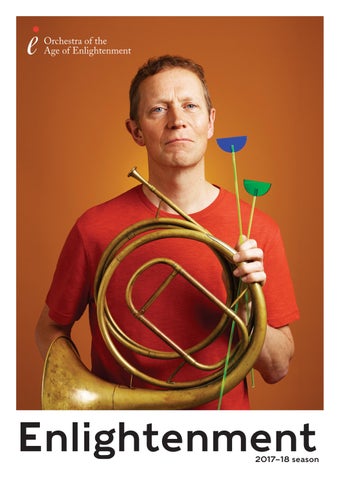
Enlightenment
2017–18 season
A message from Crispin Woodhead, CEO
“
2
In his Letter on the Blind (Lettre sur les aveugles à l’usage de ceux qui voient) of 1749, the great French philosophe and encyclopédiste, Denis Diderot, challenged fundamental assumptions about our perception of the world around us. As so often happens, quantum leaps in science open radical new avenues of thought. Today we are concerned with Moore’s law, the rise of artificial intelligence, the imminence of the singularity and the struggle with the virtual imprint of our actual physical and moral existence. Then it was the breakthrough of cataract surgery, pioneered in the 1740s, that was opening eyes. Would a man, who by this surgical miracle had been given the gift of sight after a life of blindness, be able to identify by sight alone those objects previously only familiar to him by touch? It is the question, more than any immediate answer, that stands significant in an age of remarkable enquiry, the Enlightenment, whose enduring intellectual energy animates the way we live and think today. It was high time, in our artistic planning, that we
It was high time, in our artistic planning, that we directly addressed what the Enlightenment means to us now and how, in carrying its name, we can relate its grand questions to the music we play.
directly addressed what the Enlightenment means to us now and how, in carrying its name, we can relate its grand questions to the music we play. Until 2023 we will be working through Six Chapters of Enlightenment, each year exploring different notions bequeathed to us by the great authors of social freedom, human rights and equality and the pioneers who gave us vaccination, the encyclopaedia and fizzy drinks. So, in this 1718 season, we open our first chapter, Visions, Illusions and Delusions, and examine Judas, Semele and Berenice – who can we trust? What is truth? What is right and what is wrong? We turn to great works, composers and artists and ask if perception ever obscures the truth, if our attempts to define might thwart deeper understanding. Do we shape the things we observe into what we would prefer them to be rather than interpret them honestly as they actually are? Are we even capable of that honest interpretation? As with Diderot, it is the questions we ask that provide the illumination; it is the spirit of enquiry that leads us to enlightenment and new life. G.K. Chesterton had it perfectly: “The world will never starve for want of wonders; but only for want of wonder*.” I hope that you will enjoy this wonderful discursive adventure as much as I will.
*G.K.Chesterton, Tremendous Trifles
A few words from the curators Lisa Beznosiuk Principal Flute Working on the OAE’s 17-18 season with co-curators Colin Kitching and Crispin Woodhead over the last couple of years has been exhausting, exhilarating, infuriating and rewarding. I won’t say whether or not in equal measure (!) but I hope that you will be as thrilled as we are with the results. As we all know, the proof of the pudding is in the listening!
We are extremely lucky to co-curate with Crispin, our imaginative and dynamic CEO, and have him to thank for dreaming up two attractive new initiatives this season:
Rising Stars
Bach, the Universe and
We will appear with Everything the OAE’s new scheme for regular guest and a Sunday morning series in the brilliant young singers to principal artists wonderful acoustic of Hall One perform on the main stage including Sir Andras at Kings Place, presenting Bach alongside established artists. Schiff, Marin Cantatas in a scientific context Many of you will already have Alsop, Sir Roger with illuminating talks from heard some of these select Norrington, John eminent experts with a gift for singers in their impressive Butt, Ádám Fischer communication. contributions to our recent and Mark Padmore. Prom Israel in Egypt. The Star violinist Nicola Also at Kings Place we continue scheme provides wonderful Benedetti will play our popular Turning Points performing opportunities for Beethoven with us series with Great Balls of Fire young vocal talent whilst giving on tour in the USA, (Bach, Handel & Scarlatti) on OAE fresh excitement and acclaimed mezzo1 March 2018, and First and flexibility. soprano Christine Last of a Great Genius (Haydn’s Rice will sing Mozart Symphonies No.1 and No.104) We talk to the singers on pages arias and Haydn’s on 12 May 2018, where we 8 and 9. dramatic Scena introduce the music inviting the di Berenice, and audience to contribute to the luminous young discussion. soprano Louise Alder will take the title role in Handel’s Semele. In exciting new ventures This season we tackle some of the big we collaborate with baroque dancer Hubert Hazebroucq in questions that the scientists, philosophers French Divertissment and with and thinkers of the Enlightenment explored. conductor Thomas Kemp on a Throughout the magazine we put these film project.
questions to our players and staff - look out for their answers in the dashed boxes!
3
Colin Kitching Librarian
I
never cease to be amazed at how each new season is so different: challenging new pieces mixed with wellknown gems we haven’t played for years. It is always a repertoire to excite - and I am saying that as a listening consumer! As one of the curators, I am often conscious of the journey a programme takes from inception to the finished article and how between us three there are different enthusiasms and knowledge. So our individual input varies depending, but it is a challenging and satisfying job.
“
The world premiere of The Judas Passion by Sally Beamish is an extraordinary way to begin our season. It is such a privilege to bring a piece into the world. Just recently we repeated her Spinal Chords (another OAE commission) at the Ryedale Festival and everyone was so struck by its quiet intensity. The much more substantial Passion will surely have an enormous impact. Handel’s Semele on October 18th - what’s not to like? And it is in English - hooray! Words are meant to be spontaneously understood, so it is a treat to include Handel’s only opera written with an English text. Listening to the Israel in Egypt Prom recently, I was struck by how naturally the OAE takes to Handel; after our many long runs at Glyndebourne the clothes are so familiar, and the result is top of the league.
4
detail in Hall One’s spectacular acoustic. Another outstanding acoustic – and what a treat just to look at the ceiling! – is Oxford’s Sheldonian Theatre. On February 3rd, we are joined by Nicola Benedetti and Marin Alsop for the incomparable Beethoven violin concerto. Thanks to the new wide oak floorboards, expect the ultimate in rich and refined violin tone supported by the warmth of classical winds. What a start to their ten-city British and American tour!
It is always a repertoire to excite - and I am saying that as a listening consumer! Connoisseurs of Haydn will not dream of missing the New Year’s Creation at Kings Place on January 6th, directed by Eisenstadt’s favourite successor to Haydn himself, Ádám Fischer. What a chance to hear every
Who Can I Trust? There’s something in our DNA that puts us on alert. We are designed to be ready for danger, because when we became human beings the world was trying to kill us in every conceivable way. In order to grow as a species we had to learn to trust one another, to band together, which in turn made us tribal. So then we learned to distrust other tribes. The challenge
My last unmissable is the extraordinary French programme at Queen Elizabeth Hall on June 26th – reopened at last! It has been dreamed up by Crispin, all things French music expert Lisa and the very special French dancer and choreographer Hubert Hazebroucq. There will be costumed dancers, Anna Dennis demonstrating her immaculate intonation in French, and by far not least, the galvanic John Butt leading the troops! What a selection – and there are five more equally attractive programmes to come to tempt the world.
facing us today is that we have to let go of our tribalism and trust everyone. So we can face the reality that we all share one planet. I think it’s the only way we’re going to survive. Making music is a constant game of getting over one’s fear and trusting the other musicians. When I manage to let go of my fear and trust my colleagues on stage with me, that’s when real connections happen and when real art can flourish.
The other lesson from years of performing is to trust the audience. If you offer them something sincere and open, they’re ready to listen. In short my answer is “I can trust everyone (if I can just get over myself)”. Max Mandel, Co-principal viola
Bach, the Universe and Everything
Later this year, we’re launching Bach, the Universe and Everything, a new Sunday morning series at Kings Place. Mixing performances of Bach cantatas with talks from guest scientists that explore the wonders of the universe, it’ll be an inspiring new way to start your Sunday.
experience, created by an artist working at such an intense rate over such a span of time. They form a complete expression of a people and its concerns: the crisis between body and soul, between seen and unseen, faith and doubt.’
Article by Helen Wallace/ Kings Place. Longer version first published in Kings Place Autumn 2017 What’s On @Kings Place
Our Chief Executive Crispin Woodhead explains: ‘I can’t claim credit for the idea,’ confesses Crispin: ‘It was Andrew Watts, our very brilliant associate principal bassoon, who suggested that we try reimagining a Sunday service which included a Bach cantata, communally sung chorales and a stimulating secular sermon or lecture.’ It was a concept that resonated strongly with Crispin, offering an opportunity to juxtapose the Cantatas with lectures by some of today’s leading thinkers, from fields as diverse as physics and psychiatry, medicine and politics. ‘We want to give people a flavour of congregational engagement. We’ll invite them to join the chorale singing, to reflect on inspiring discoveries and intellectual challenges, and to talk afterwards over coffee and cake.’ Written each week by Bach to fulfil his duties as a Kantor, the Cantatas are exquisite meditations on Biblical texts and remain one of the great wonders of western music, an inexhaustible trove of art and ideas: ‘They are a distillation of human life
Enlightenment thought is inspiring because it was a time of coherence, not separation.’ We’re hoping this series will become a regular date in your diary, bringing the curious and open-minded together in a new Sunday morning community.
Sunday 23 October 2017 Origin of Galaxies with Professor Carlos Frenk Sunday 26 November 2017 What is Light? with Professor Sir John Pendry
In the first season, leading physicists such as Sir John Pendry, Tara Shears and Dame Jocelyn Bell Burnell will be invited to talk about their area of work. For Crispin, mixing music and science in this way makes complete sense for an Orchestra inspired by the Age of Enlightenment. ‘I think there is a problem in extreme specialisation today. I’m always being told by people that they ‘don’t know enough about music’ and feel that’s a barrier to attending concerts. And you find this in the scientific community too: people are so specialised, they feel illequipped to explore other areas, strands of work become isolated in silos and important connections are missed.
Sunday 17 December 2017 Antimatter Matters with Professor Tara Shears Sunday 14 January 2018 Time and Vision with Professor Helen F Gleeson Sunday 18 February 2018 Seeing Life in a New Light with Professor Kishan Dholakia Sunday 18 March 2018 We Are All Made of Star Stuff with Dame Jocelyn Bell Burnell Each event starts at 11.30am and lasts approximately one hour. Tickets £16.50. Book three, save 15% or book all six, save 25% kingsplace.co.uk / 020 7520 1490.
5
1
You’re doing a whole programme of Mozart, what do you think will make the concert exciting for audiences? Roger Montgomery It may be a whole evening of Mozart but the style of the works is so varied, as are keys in which they are written. The richness or brightness of music written in a particular key is accentuated when performed particularly on historical wind and brass instruments. I hope that we will excite the audience by giving performances that best present the depths beneath the fascinating surface.
2
What do you think makes the OAE’s approach to Mozart different from other orchestras?
Roger Montgomery It’s hard to speak for other orchestras and I wouldn’t like to misrepresent anyone else’s approach, but with the OAE there is no fixed attitude to the music of Mozart. For sure, the historical instruments provide our framework to an extent, but after that the members of the orchestra are always very open to discover what is in the music and go with that. Roger Norrington It is likely to be a special An all-Mozart programme is more revelation with Sir Roger than ever enjoyable today. Not just and I expect that we because the music is so varied and will not be relying amazing, but because nowadays upon our stock we are so much better informed notions of Mozart. about how it should be played.
“
6
...it is always a pleasure to work with OAE players again, returning as it were to the source.
Roger Norrington When I was starting out in the 1960s I was just guessing about everything. The advent of historical instruments gave us the opportunity, maybe the duty, to reexamine every aspect of performance style: numbers, seating, bowing, gesture, articulation, and above all sound and tempo, have become enormously easier to understand and use intelligently. Andantes, for instance, have to really move along, Allegros are not very fast unless so indicated, Alla Breve is simply twice as fast as Common Time. Things like this are crucial to Mozart performance. A group like OAE is traditionally seriously involved in this activity, and has the advantage of early instruments to help them.
Two R 3
What kind of tricks and surprises did Mozart put in his scores?
Roger Montgomery In the concertos, there are some exceptionally overt tricks and surprises as they are all written for his lifetime friend Josef Leitgeb. The affectionate banter has perhaps misled commentators to suppose that
Leitgeb was something of a fool, but this is most probably a too literal interpretation of the ease with which Mozart flung insults at him. Nowhere is this more apparent than in the D major Concerto. Mozart’s original sketches of the Rondo have a ribald and increasingly obscene running commentary directed at Leitgeb. Much of Mozart’s original material is omitted in the most
Rogers commonly played version of this movement which was completed by Süssmayr at Mozart’s behest. He not only introduced a plain chant, the ‘Lamentations of Jeremiah’ (which also forms the basis of the 2nd
movement of Haydn’s 26th Symphony) but falsified Mozart’s signature (and dated it posthumously!). More speculation has arisen as to whether Mozart was actually the originator of this work or whether his sketches are his attempts to assist Leitgeb with a composition of his own. The surviving parts of the manuscript of the E flat Concerto K495 is inexplicably rendered in four different coloured inks. Possible proffered reasons are that it may be secret coding of dynamics/tones or alternatively merely a personal joke, possibly a gift...the work coming from the year of Leitgeb’s second marriage.
4
What do you enjoy about working with the OAE?
Roger Montgomery The people, obviously, and the cooperative spirit in which everyone undertakes a new musical journey. Also, one of my favourite things about the orchestra is the sheer variety of the repertoire. The different approach required by historical and geographical variance of pieces makes any new patch an investigation of any particularly appropriate styles, techniques and nuances, all balanced by ‘Is this possibly what the composer wanted?’ vs ‘Is what we are doing coherent and sufficiently satisfying for the listener?’ Roger Norrington Since I spend all my time these days teaching modern orchestras about historical style, it is always a pleasure to work with OAE players again, returning as it were to the source. We should have a fulfilling Mozart tour to Europe this season. I look forward to it.
5
For our Visions, Illusions and Delusions seasons, this concert is being billed under the heading ‘Is seeing believing?’ What’s your response to that question? Roger Montgomery Seeing is believing Well...I don’t want to detract from the visual experience of a concert, but I would probably say that really ‘hearing is believing’! Roger Norrington Seeing is not believing. The language of music has changed significantly in the 200 years since Mozart’s time, but at last we can begin to read that language.
Mozart: Master of Deception with Sir Roger Norrington Wednesday 11 April 2018 Queen Elizabeth Hall, 7pm Mozart - Symphony No.33 Mozart - Horn Concerto No.4 Mozart - Horn Concerto No.1 Mozart - Symphony No.36 Sir Roger Norrington - conductor Roger Montgomery - horn
Should we really judge by appearances?
What is right and what is wrong?
Yes but only until you have something else to judge by
Depends who and where you are. But usually your gut tells you.
Emily Stubbs
Kati Debretzeni
Director of Development
Leader
7
Rising Stars of the Enlightenment Rising Stars of the Enlightenment is the OAE’s programme for developing the next generation of world-class singers. Earlier this year the Orchestra appointed eight brilliant and emerging vocal talents to the programme. Keep an eye out: they’ll be performing with us across the 2017–18 season. Here we speak to five of them.
1
Why did you apply for this Rising Stars of the Enlightenment scheme with the OAE?
2
What is it about the OAE that you think makes it stand out from other ensembles?
3
What are you most looking forward to about the scheme?
8
Charlotte Beament (Soprano) In my final year of postgraduate study aged 23 I started working as a chorister for the OAE and as a member of the chorus at Glyndebourne. Now I am itching to explore even more aspects of the profession and take the next step in my career by branching out into solo work. The OAE Programme is a fantastic launch pad for singers, like me, who are making the leap from choral to solo, so I feel incredibly grateful to have been accepted onto the programme.
James Newby (Bass) The scheme is one of the most exciting opportunities for young singers as it offers the chance to work with one of the world’s leading ensembles as well as many internationally acclaimed conductors and singers. It also offers the chance to work in some of the premier music venues in Europe and further afield. I don’t think it was ever a case of why would you apply, but more, why wouldn’t you apply!
I have always adored working with the OAE. Their sound is so vivacious and fresh. But the thing I am most passionate about is opening classical music to a wider audience and the OAE strive to do just that by keeping their music-making so diverse. They inspire traditionally hard to reach audiences by making worldclass classical music accessible with projects like The Night Shift and their various education workshops. Just check out their OAE in 60 seconds clip on Youtube.
The OAE always gives such a fresh and vibrant quality to their playing, it feels extremely playful. They of course attract the best singers, players and conductors to work with them but it’s really the fearless way in which they perform and interpret all the music they play which is really thrilling to be a part of.
The OAE is the premier ensemble of its kind and having the opportunity to perform regularly with them on the concert platform is an awesome challenge and privilege. I can’t wait to start working with and learning from the many distinguished artists associated with the programme. I really enjoy interacting with audiences and I’m always interested to see their reaction to me as a human being as well as a performer.
The performances will all be fantastic, I’m sure. The Sally Beamish premier at the end of September I think will be especially exciting. However, I’m most looking forward to just working with and alongside all of the phenomenal musicians and hoping to learn from the way they make music.
Nick Pritchard (tenor) The obvious professional opportunity of singing in the kind of venues and for the kind of conductors that the OAE is consistently involved with is priceless. I’ve also worked with the OAE before singing in the choir, and I think it’s important to continue these kind of working relationships whenever the chance presents itself.
Dingle Yandell (Bass) I was recommended to apply by a good friend. I wanted to give myself the chance of working with such a fine orchestra and to improve my skills as an early music singer. Sometimes it is tricky for an up-and-coming singer to find centre stage opportunities and this programme really offers that. I am pleased I applied and was accepted.
Helen Charlston (Mezzo) I applied to the scheme as I saw in it an opportunity to really put myself in an area of music that I relish and love to sing.
I love the fact that it’s playerlead, in that there’s no principal conductor. You’ll rarely see a group play the breadth of repertoire that they do, and to such a high standard.
Most notably the absence of a conductor in residence. This is exciting because visiting conductors are able to apply their own interpretations to great baroque and early classical pieces. For the audience it is exciting to know performances differ in fresh and original ways.
They are a period ensemble who are keen to expand the boundaries that they explore. It’s exciting to get the chance to work with an ensemble who are so keen to challenge and charm an audience in performance.
Working with other artists on the programme for a two-year period at such an important time in all our careers will be very interesting and rewarding. Between the eight of us, I think there’s a real range of strengths and interests in different repertoire, which will make for some really exciting work.
I am most looking forward to being accompanied by such talented musicians as a soloist in some beautiful masterpieces played the way they would have been played at the time. The OAE has interesting creative ideas of how to combine this music with other things. For example, I will be involved in the Bach cantata series that will be accompanied by lectures from leading scientists on the Universe and the Cosmos, which really appeals to my scientific curiosity!
The cantata series was a huge draw for me, and not just because the music is so very good. I have explored a number of Bach’s cantatas with my ensemble Amici Voices, and I was keen to snap up the chance to work through more of these beautiful and amazing works with an ensemble who know the idiom so well.
9
Martin Lawrence on Music Performance Anxiety as Communication and Wisdom Martin Lawrence, OAE horn player, has just submitted a 38,000 word PhD thesis on Music Performance Anxiety. Here, he gives a short introduction into his research. As a teacher and performer, I proposed in my thesis that the symptoms of performance anxiety are not a form of selfsabotage but a legitimate and specific reaction to the performing situation that may actually help the performer. Rather than hide, control or cope with these symptoms we might experiment with welcoming them, performing from them and see what happens. At the very least this would surely make a more honest relationship between performer and audience. Classical music does after all have a presentation problem, where there is seen to be a gulf between what the performer really thinks and what they are prepared to
“
10
show an audience. One reason I am attracted to performances in small spaces, or that have a ritual, spiritual or cultural significance to the performer, is the feeling of genuine contact with something real, the minimum of artifice. Western music has the maximum of artifice: witness the highly accomplished orchestral player who produces a perfect performance while thinking about his electricity bill or her irritation with the conductor. This may apply less to solo or chamber musicians (or the OAE!), who may have more commitment to the performance, but even they usually cultivate a bubble to perform in, not letting their personality or current mood into the relationship with the audience. Perhaps there is the possibility of killing two birds with one stone here? If we don’t fight to suppress our anxiety symptoms and instead admit them into our interaction with the audience, this could perhaps give classical music the authentic connection with an audience it often lacks, and at the same time make that anxiety into a non-problem.
Western music has the maximum of artifice: witness the highly accomplished orchestral player who produces a perfect performance while thinking about his electricity bill or her irritation with the conductor.
I decided to carry out a series of ‘experiments’ to test my hypothesis. These consisted of performing music to camera and enhancing any anxiety symptoms, noting the effect. This produced some notably good results. For instance, ‘the shakes’, when permitted and even enhanced, became a subtle and expressive vibrato. On another occasion,
a stiffness in the chest region rewarded me with greater air compression and therefore a more focussed sound. I started to focus on other details. Once, fatigue made me unable to provide enough lip tension to play the higher notes. Frustrated, I decided to enhance this too, playing with lips and facial muscles as slack as I could. The result was magical. My breathing transformed to provide the required pressure to produce the notes. This could seriously increase my stamina – lower facial tension equals less fatigue and less bruising. But also, the enhanced breathing gave me a tonal quality and security that I had always wanted, but had almost given up on. I loved the way my own body compensated for its own shortcomings. Perhaps one could even say that my body gave me the symptoms of lip slackness so I could discover better breathing? How does my body know how to compensate? Is there a deep impulse to make the sound I always wanted to make? I certainly wasn’t aiming to do it consciously. Perhaps this impulse is too often buried by trying to play ‘correctly’. Can we access it by following the ‘difficult’ or ‘unwanted’ symptom? Is it just a coincidence that this particular symptom occurs, or is there some purpose to it? If there is a purpose, does it come from an internal source; the unconscious, or some type of embodied wisdom? Or is it external; our fate, the Tao, or God? I felt I had discovered something more important than an interesting theory about performance anxiety.
An Interview with Christine Rice
What are you most looking forward to about performing with the OAE and what do you think the differences are performing with an historically informed orchestra? Well, any soloist will tell you that working with the OAE is a remarkable experience. Quite apart from its distinguished reputation, it’s the sound of the band and the integrity of the players that makes such a difference. You know that you are going to hear details in the score that you often miss with other orchestras, however good they might be. So much comes from the original instruments and the dedicated commitment to prime intentions of the score – the harmonic rhythm and the shape of the phrase. For a singer, it can be life-changing to work on repertoire with a band like the OAE because so many challenges of performance, how to manage the breath over a long phrase for example, are solved for you, because everyone is thinking the same line in the same way. It all becomes a natural experience. Authentic, you might say!
The Corridors of Power Tuesday 27 February 2018 Royal Festival Hall, Southbank Centre, 7pm Mozart – Arias from La clemenza di Tito Mozart – Symphony No.38 Haydn – Scena di Berenice Haydn – Symphony No.103 Drumroll Ádám Fischer – conductor Christine Rice – mezzo-soprano
What can you tell us about the role of Berenice? I have always been someone who feels most at home on the operatic stage, so when I have the chance to take on a dramatic scena with an orchestra, I am delighted. Scena di Berenice, like Britten Phaedra or Berlioz La Mort de Cléopatre, is an intense dramatic experience, the challenge being to identify
“
themselves rigid if they really thought through the immensity of the exposure and the number of colleagues you might fail when performing in a large venue with a big orchestra. You have to keep yourself as calm and as focused as possible. In the end, if the correct preparation has taken place, you must trust yourself to be in the moment. Self-reviewing is for rehearsals only, not performance. For our Visions, Illusions and Delusions season, this concert is being billed under the heading ‘Who can I trust?’ What’s your response to that question?
For a singer, it can be lifechanging to work on repertoire with a band like the OAE
the human being beneath the historical icon. It’s an amazing opportunity to revel in soliloquy. Eventually the grand themes are always the simple ones and it’s basic human emotions that drive the apparently more subtle and sophisticated matters of state, duty and loyalty. There is something confessional about taking on dramatic figures in the eye of the storm and I love the journey it takes me on. You are no stranger to performing in large venues with big orchestras, how do you prepare yourself for that? Well, usually a nice cup of tea in the dressing room helps! I’m not being flippant. I think any soloist has the potential to scare
What a pertinent question that is in our day and age! After all, we are still feeling the after effects of the 2008 subprime mortgage crisis, we have the campaign untruths of Brexit, and President Trump’s inauguration crowd being the “biggest and best EVER!” The most useful part of my degree education at Oxford was that we were required to enter the library and find the relevant book to answer the tutorial questions set that week. The content of those books had been vetted by peer scientists on behalf of the publishers. The internet is a miraculous tool, but the same rigour is not applied to the information you can find published on it, and ‘fake-news’ is one of the more dangerous and disturbing features of it. We should always question whether we can trust what we are told. And to do that we need to know who it is that is doing the telling. 11
Where will the OAE Play this season? No. of concerts in
ENGLAND Darlington:1 Birmingham:1
Manchester: 1
Hereford: 1 Stamford: 1
Cambridge: 1 Saffron Walden: 2
Cheltenham: 1
London: 27
Bristol:1 Bath: 1
Lewes: 25 (Glyndebourne)
Should we really judge by appearances?
Oxford: 4 Bradford on Avon: 1
Basingstoke: 2
Of course not.... but......ignore them at your peril! I did on one occasion, when my rational side talked down my gut instinct. It led to our children being looked after by an au pair who would give them cold cucumber soup. They were not impressed. Cecelia Bruggemeyer Double Bass
12
AUSTRALIA AUSTRIA BELGIUM CHINA DENMARK FRANCE GERMANY POLAND HOLLAND HUNGARY MONACO USA
THE WORLD Is love what you think it is? In Handel’s Semele, the heroine falls in love with the god Jupiter, and gets lost in the peculiar combination of suffering and delight that is infatuation. If it were a 21st century romcom, Jupiter would probably return his love by giving up his divine powers, and they’d set up home in Muswell Hill. But as this is Ancient Greece the story serves as a warning. You can’t really buy a house and start a family when you’ve fallen for a god. Roman Krznaric, who’s doing our pre-concert talk for Semele on 18 October, thinks we could learn a great deal from the way the Greeks thought about love. While we have one word for love covering many different meanings, the Greeks had at least six. Eros – that fiery, passionate love Semele experiences and many of us seek in romantic relationships – is just one type of love, and the Greeks actually thought it was dangerous. Pragma, the deep understanding that can develop in long-term relationships, is a different type of love entirely. The lesson? That perhaps you need a balance of different types of love to lead a happy life. And, of course, try to avoid falling in love with gods. John Holmes – Director of Marketing and Audience Development
13
A PROGRAMME TO INVOLVE, EMPOWER and INSPIRE Over the past twenty years OAE Education has grown in stature and reach to involve thousands of people nationwide in creative music projects. Our participants come from a wide range of backgrounds and we pride ourselves in working flexibly, adapting to the needs of local people and the places where they live. The extensive partnerships built up
over many years help us engage fully with all the communities where we work to ensure maximum and lasting impact. This year our FLAGSHIP project, Musical Landscapes, saw us building a new partnership in County Durham and deepening our relationships in Norfolk and Suffolk.
To Make the OAE Local
OUR AIMS
To complement the OAE’s concert activity
To make our offer unique
Since September 2016 we have undertaken:
14
30
TOTS & Family concerts
12
Special needs concerts and care home visits
16
Schools concerts
2
Events in unusual settings (pubs & museums)
4
Community concerts
5
Concerts in our Nurturing Talent strand
And have worked with over
delivered
performed a total of
20,500 people
252 workshops
82 concerts
A photo summary of the year
Growing our Band, Royal Albert Hall Musical Landscapes 2017 Community Concert, Corn Exchange King’s Lynn
Music is Special, Camden
TOTS Concert Going on a Journey, Wiltshire Music Centre
King Arthur, Brighton
Looking ahead to 2017-18: Vision 4 Music In 2017-18 we will be creating a programme of events inspired by the question we asked ourselves in our Musical Landscapes flagship project.
“
What world do we want to create for tomorrow?
Vision 4 Music will encompass all our strands in our Residency work. Our TOTS programme will be based on ‘Stories of Old’ and a rollout of our Apple Tree workshops and concerts. Our OPERA programme will focus on a newly written opera based on Purcell’s Fairy Queen.
Our SCHOOLS programme will focus on The Fairy Queen. Our SPECIAL NEEDS programme will be extended to 7 groups across the country.
in 22 cities, towns and villages across England
Our NURTURING TALENT programme will be extended to include general teacher training, endangered instrument work and a new summer school for post A Level students.
15
Open Rehearsals Dates and Times
Christmas Concerts
Please contact Danielle Robson (Danielle.robson@oae.co.uk / 020 7239 9386) for more information or to book your place(s)
The Corridors of Power Tuesday 27 February 2018, 2-5pm Royal Festival Hall
Bach’s Christmas Oratorio Thursday 21 December 2017 Saffron Hall (parts 1, 2, 3 & 6)
All Friends
AND
What wins – love or duty? Haydn’s concert aria Scena di Berenice forms part of our exciting programme exploring the clash between love and duty – what will win out? Join us to find out!
Friday 22 December 2017 St John’s Smith Square
The Judas Passion Wednesday 20 September 2017, 10am-1pm The Warehouse Studio 1 Silver and Gold Friends Only Can the ultimate betrayal ever be forgiven? Join us for an exclusive sneak peek ahead of the world premiere of this provocative new chronicle of Jesus’ final days told through the eyes of his betrayer. Handel’s Semele Wednesday 18 October 2017, 3-6pm Royal Festival Hall All Friends Be careful what you wish for. A sensuous evocation of the illusions and delusions of love. Mozart: Master of Deception with Rachel Podger Monday 27 November 2017, 2-5pm St John’s Smith Square All Friends There is more to Mozart than meets the eye. OAE’s longstanding collaborator Rachel Podger leads this exploration into the hidden secrets of Mozart’s familiar scores.
St Matthew Passion Tuesday 20 March 2018, Morning (Time TBC) The Warehouse Studio 1 Silver and Gold Friends only A powerful depiction of the Easter story. Join us for one of the iconic pieces of classical music that still retains huge emotional impact even 300 years on from the premiere; Bach’s St Matthew Passion. Dangerous Liaisons Tuesday 26 June 2018, 2-5pm Queen Elizabeth Hall All Friends The sights and sounds of Versailles. Mixing the best of Lully, Rameau, Campra, Charpentier and more into a golden jukebox of French baroque accompanied by authentic choreography as it was seen in the Royal palaces of the 17th century, for the last of our 2017/18 open rehearsals.
Bach Christmas Oratorio Stephen Layton conductor Anna Dennis soprano Helen Charlston mezzo soprano Gwilym Bowen tenor Matthew Brook bass Choir of Trinity College, Cambridge Handel’s Messiah Saturday 23 December 2017 St John’s Smith Square Handel Messiah Stephen Layton conductor Anna Dennis soprano Helen Charlston mezzo soprano Gwilym Bowen tenor Matthew Brook bass Polyphony In the beginning… The Creation Saturday 6 January 2018 Kings Place Haydn The Creation Ádám Fischer conductor Charlotte Beament soprano James Way tenor James Newby bass
Please note that all open rehearsals are subject to change. You will be notified if this is the case.
Season imagery: Art direction – LucienneRoberts+, Photography – Angela Moore 16