

The Traditions & Compliance Committee (“TCC”) was established by the Board of Governors (“BOG”) to assist the BOG in promoting and maintaining the Club’s traditions, values and standards of conduct. The TCC will be responsible for translating the club by-laws, code of conduct and other relevant policies as they pertain to Club traditions, values and member conduct (collectively, “TVMC Policies”).
This document will cover the following components related to the purpose and function of the committee:
I. Composition and charter of the committee
II. TVMC policies and procedures related to handling violations
III. Club management or BOG member handling inbound complaints
IV. TCC to investigate and review alleged violations of TVMC policies
V. TCC to provide a summary of findings to the BOG and categorize the violation
VI. Violation categories and range of consequences
VII. BOG to determine consequences and implement any required disciplinary action
VIII. Additional considerations related to the process
I. Composition and Charter of the Committee
The TCC shall consist of (1) Committee Chairman, (5) At Large members, and (1) BOG Liaison (VP). The TCC Chair and Members should be individuals of high integrity and ethical standing, with a diverse range of perspectives and experiences. They should not have any conflicts of interest with the Club or its members, including personal involvement in the matter under consideration or any relationship that would impair their impartiality. All committee members must be primary active members (not spouses).
The charter of this committee includes the following:
• Prioritize the well-being of members, their families and guests, and staff
• Protect the Club from avoidable legal and reputational risks
• Provide a safe and trustworthy forum for any member of the Club community to express concerns about potential violations of TVMC Policies
• Maintain confidentiality regarding all matters
• Keep all parties updated throughout the process
• Strive for consistency and fairness in all matters
• Resolve matters professionally and expeditiously
• Make recommendations based on facts determined after appropriate investigation
Each committee member serves at the pleasure of the BOG. The BOG may add or remove members at any time they deem necessary. At Large members shall serve a term of two (2) years. The Committee Chairman shall serve a term of three (3) years and previously must have served at least one (1) year as an At Large member of the committee. The BOG Liaison will rotate annually to the current Vice President.
A minimum of five (5) members must be present at any internal review for the committee to have “quorum” and a valid forum to conduct business.
II. TVMC Policies and Procedures Related to Handling Violations
The Orchard Lake Country Club Member Handbook clearly establishes club rules, etiquette, traditions and other helpful information ranging from minor dress code violations up to gross violations of club rules and / or local law.
The Member Handbook will supersede this document regarding any specific information related to established decorum or club rules.
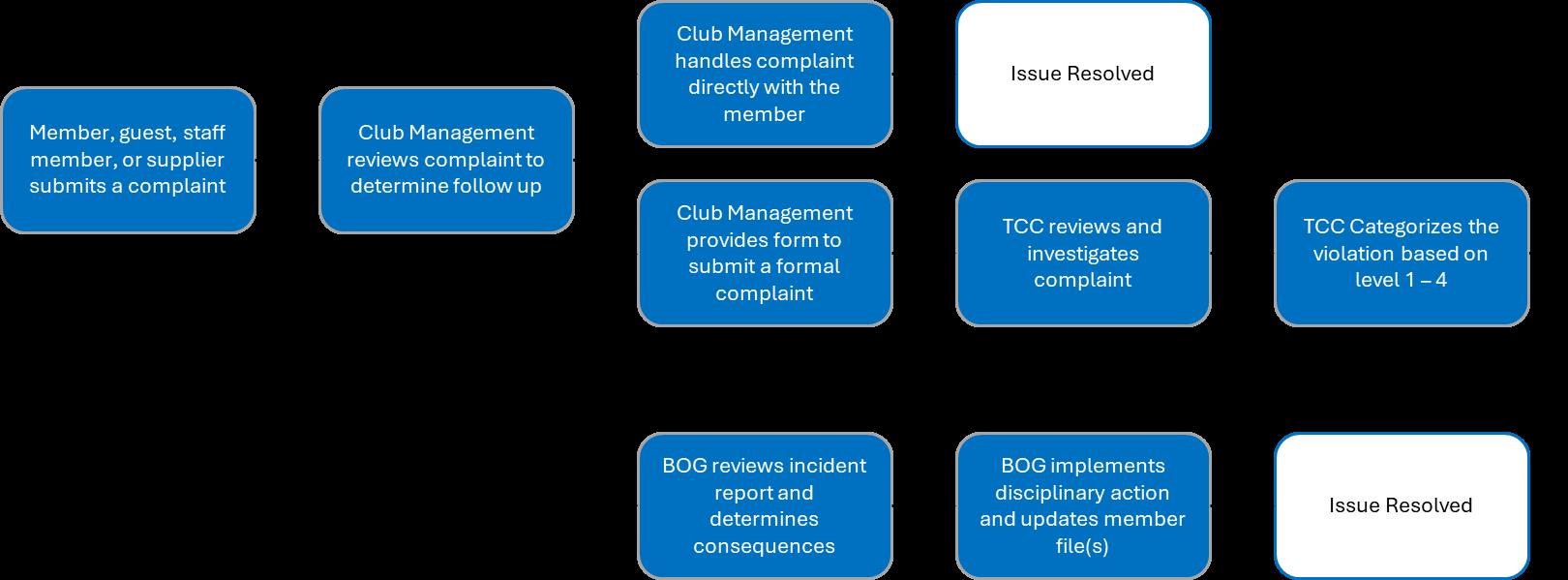
The process depicted below outlines each step that follows an official complaint submitted by a current member in good standing, guest, staff member, or supplier. Additional information detailing each step is included in subsequent sections.
III. Club Management or BOG Member Handling Inbound Complaints
Any member, guest, staff member, or supplier may make a complaint regarding an alleged violation of TVMC Policies. Complainants are expected to be as truthful, candid, and factual as possible when making complaints or providing information regarding an incident.
If the matter appears to involve an imminent threat of harm to any person or property, Club Management shall (1) notify law enforcement immediately, (2) take reasonable precautions to safeguard the Club community, and (3) notify the BOG as soon as possible. Further action should be pursued only after consulting the Club's legal counsel.
Initial Complaint
Complaints often begin with verbal communication with club management or a BOG member. This provides an opportunity to diffuse situations quickly and not let it escalate to a formal process. This is the preferred outcome in most cases.
Club members are expected to resolve minor differences among themselves, without formal TCC intervention. The TCC Chair, or another TCC member, may encourage members to meet and confer to resolve a complaint before the TCC takes further action.
The TCC may, in its discretion, investigate anonymous complaints, recognizing that anonymous complaints can be less reliable and are inherently more difficult to assess.
Formal Complaint
If a complaint is deemed to require additional review, Club Management will provide the form to submit a written complaint. This form will serve as the basis of communication with the TCC regarding a specific incident and shall include the following information:
Formal Complaint Form:
Date: Date the complaint was filed
Complainant: Name of the individual filing the complaint
Complainant Contact Info: Phone number and email address
Alleged Offender: Name(s) of the offender
Incident Date & Time: Exact date and approximate time the alleged incident occurred
Incident Location: Location where the alleged incident occurred
Description of the Incident:
Witnesses:
Supporting Evidence:
A detailed description of the alleged violation, including the nature of the violation, the actions taken by the accused, and the impact on the complainant.
Name(s) of any witnesses to the alleged incident
Reference to additional information supporting the complaint such as witness statements, documentation, photographs, etc.
Signature: Complainants signature
Incident Reference Number: (to be assigned by club management)
Once a formal complaint is filed, Club Management will expeditiously send it to the BOG Liaison (VP) and confirm receipt. The BOG Liaison will determine if the BOG will handle the incident or if it should be referred to the TCC for further action.
If an incident is referred to the TCC, Club Management will send it to the TCC Chairman and confirm receipt. This will formally initiate the TCC review process.
IV. TCC to investigate and review alleged violations of TVMC policies
Once a formal complaint is filed and an investigation is initiated, TCC shall gather quorum and review the formal complaint. A representative shall be designated to notify the alleged offender that a complaint has been filed against them and gather their perspective on the incident and complete a Witness Interview Form.
Any objections to specific TCC members participating in the investigation or resolution of the matter should be asserted by the alleged offender at the outset. The investigation shall be stayed until assertions of conflicts are resolved.
Additionally, a representative shall be designated to interview the complainant and each of the identified witnesses to gather their perspective on the incident and complete a Witness Interview Form. The alleged offender, the complainant and witnesses should be reminded not to discuss the complaint while the matter is under investigation.
Witness Interview:
The TCC will fairly and impartially gather all relevant information, including reviewing documents, photographs, recordings and other tangible evidence, interviewing witnesses, and, if relevant, visiting the site of an alleged violation. All aspects of the investigation should be respectful to all concerned, maintain the confidentiality of the investigation, and protect the privacy of any personal information obtained.
Witness Interview Form:
Date:
Name of Interviewer:
Name of Interviewee:
Role in Incident:
Relationship with the Complainant:
Relationship with the Alleged Offender:
Interviewee Contact
Information:
Description of the Incident:
Supporting Evidence:
Date of the interview
Name of the TCC member conducting the interview
Name of the person being interviewed
Alleged Offender / Complainant / Witness
Self /Family Member / Friend / Bystander / Staff
Self /Family Member / Friend / Bystander / Staff
Phone number and email address
A detailed description of the witness's account of the incident, including the date, time, and location, the actions of the parties involved, and any other relevant details.
Reference to any additional information related to the incident
Incident Reference Number: (provided from Formal Complaint Form)
V. TCC to provide a summary of findings to the BOG and categorize the violation
Once the investigation is complete, the TCC will prepare a written report of its findings and recommendations. The TCC should endeavor to conclude all aspects of its work as expeditiously as possible, preferably within thirty (30) days of the date of the complaint.
Report on Findings
The Report on Findings will include a summary of the evidence, detailed findings on material issues of fact, and assignment of a violation level Findings of fact will be based on a preponderance of the evidence (i.e., considering all available evidence, the fact is more probable than not).
If the matter appears to involve non-exigent criminal activity, the TCC Chair will consult with the General Manager and the Board about further actions, which may include making a report to law enforcement and consulting with the Club’s legal counsel.
Report on Findings:
Date:
Complainant:
Date the report was completed / submitted to the BOG
Name of the individual filing the complaint
Alleged Offender: Name(s) of the offender
Incident Date & Time: Exact date and approximate time the incident occurred
Incident Location: Location where the incident occurred
Summary of the Complaint:
Investigation Findings:
TCC Summary / Conclusions:
Recommended Violation Level:
A detailed description of the violation, including the nature of the violation, the actions taken by the accused, and the impact on the complainant.
A detailed summary of the investigation findings, including witness statements, evidence collected, and any other relevant information.
TCC conclusions regarding whether the incident occurred and the overall nature of the incident
Level 1 / Level 2 / Level 3 / Level 4
Based on the criteria outlined in the section below
Incident Reference Number: (provided from Formal Complaint Form)
The alleged offender will be provided with a copy of the Formal Complaint and the Report of Findings if they agree in writing to maintain its confidentiality.
VI. Violation categories and range of consequences
The Member Handbook outlines club rules, etiquette, and traditions to be upheld by all members and staff at Orchard Lake Country Club. However, it does not categorize violations in terms of severity or potential consequences for violating them. The purpose of this section is to apply a level of violation to various incidents to provide guidance to the TCC when completing the Report on Findings for the BOG.
The Member Handbook will supersede this document regarding any specific information related to established decorum or club rules.
Sample violation categories and associated levels are outlined below. This information is meant to be guide for use by Club Management, the TCC, and BOG when determining the severity of an incident and the subsequent disciplinary action (if warranted). It is not intended to be a comprehensive list of potential violations and additional interpterion will be required in some instances.
Violation Level 0
Violations falling into this category are handled by club management directly with a member. Level 0 violations typically fall into the category of “break of decorum” and do not result in any harm to fellow members or staff.
Level 0 Examples:
• Dress code (clubhouse) – denim worn outside of “allowed” events, (M) hats, or (W) athletic wear
• Dress code (golf) – (M) untucked shirts, cargo shorts, (W) athletic wear or leggings
• Dress code (tennis) – not wearing tennis whites
• Dress code (waterfront) – (M) shirts in the lake house, (W) thong swimsuits
• General conduct (clubhouse) – cell phone not on silent
• General conduct (golf course) – loud music in common areas (not on course)
• General conduct (waterfront) – unsupervised children misbehaving on the practice putting green or waterfront
• General conduct – inconsistent with family friendly environment, for example, inadvertent profanity
All written warnings will be kept on file by club management. At the discretion of Club Management, repeat Level 0 offenders can be referred to the BOG for a higher-level violation and potential consequences.
Violation Level 1
Violations falling into this category are the most minor, however they may need more than a verbal reminder or warning from Club Management. In some cases, these incidents can still be handled directly unless it is deemed to require additional corrective action. In these instances, a formal complaint must be filed to prompt additional action.
Level 1 Examples:
• General conduct (golf) – proven manipulation of the handicap system when entering events
• General conduct (golf) – pace of play repeat offender
• General conduct – loud / offensive profanity in public areas in earshot of members or staff
• General conduct – smoking / vaping outside of designated areas (golf course, picnic grounds)
• General conduct (children) – being disruptive, minor destruction of the waterfront bathroom
• General conduct (children) – not abiding by staff directive or club rules
• General conduct (guests) – having a guest more than once per month (outside of events)
• General conduct (guests) – more than ten (10) guests per member (outside of sponsored events)
At the discretion of the BOG, repeat Level 1 offenders can be escalated for a higher-level violation and potential consequences.
Violation Level 2
Violations falling into this category are considered moderate in nature and typically involve highly inappropriate behavior unbecoming of an Orchard Lake member. These incidents rise above those that can be handled discretely and require review from both the TCC and the BOG. In these instances, a formal complaint is required to initiate the review process.
Level 2 Examples:
• General conduct – obvious intoxication resulting in rude behavior such as loud and obnoxious demeanor
• General conduct (guest) – rude or obnoxious behavior by a guest of a member
• General conduct (minor) – underage drinking by a child or guest of member, whether the member knows about it or enables it
• General conduct – any incident that results in more than minor damage to club property (e.g. more than $100 in damage, intentional damage to the golf green, etc.)
• General conduct – broad gambling outside of commonly accepted wagers (e.g. golf wager among a group, organized at golf events, cards or dice in the locker room or halfway house)
• Communication – improper use of the club directory for internal club campaigns or third-party solicitation
At the discretion of the BOG, repeat Level 2 offenders can be escalated for a higher-level violation and potential consequences.
Violation Level 3
Violations falling into this category are considered more serious in nature and typically result in harm coming to a fellow member, staff member, or club property. The incidents require urgent review from both the TCC and the BOG. In these instances, a formal complaint is required to initiate the review process.
Level 3 Examples:
• General conduct – any incident that results in more than minor damage to club property (e.g. more than $1,000 in damage)
• General conduct – any incident that involves harassment of a fellow member by a member
• General conduct – any incident that involves harassment of a staff member by a member
• Disparagement – any incident where a member (or family member) knowingly disparages another member or the club either directly or indirectly (e.g. via social media)
At the discretion of the BOG, repeat Level 3 offenders can be escalated for a higher-level violation and potential consequences.
Violation Level 4
Violations falling into this category are considered the most serious and typically result in potential or actual harm coming to a fellow member, staff member, or club property. The incidents require urgent review from both the TCC and the BOG. In these instances, a formal complaint is required to initiate the review process.
Level 4 Examples:
• General conduct – any incident involving a physical altercation
• General conduct – any incident involving sexual harassment
• General conduct – any incident involving a member taking inappropriate pictures or videos of a person on club property
• Illegal activity – any incident involving the possession or use of illegal drugs on club property
• Barred activity – any incident involving the possession of weapons or firearms on club property
• Illegal activity – any incident involving illegal activity of any kind on club property
VII. BOG to determine consequences and implement any required disciplinary action
Only the BOG will deliberate and determine consequences for a specific incident. They will consider the violation level recommended in the Report on Findings from TCC. The BOG reserves the right to modify the violation level and make the final ruling on consequences for a given incident.
Initially, the BOG will (1) review the TCC's report, (2) in its discretion, meet with the TCC to discuss it, and (3) make a final decision regarding any disciplinary action as expeditiously as possible, preferably within fourteen (14) days of the date of the TCC report and recommendation.
Implementing Disciplinary Action
The BOG will take the decision to implement disciplinary action very seriously and with sensitivity to the members involved and the well-being of the broader club. When determining the recommended disciplinary action, the TCC will consider the following factors:
• the impact of the violation on other members, staff, guests, suppliers, or the reputation of the Club
• the intent of the accused (as gathered through interviews)
• whether Prompt, appropriate and voluntary restitution or other amends have been made to the victim of the violation, including the Club, if applicable
• the strength of evidence of the violation
• the frequency, nature, and severity of the violation(s)
• the accused’s disciplinary history, including whether there was prior discipline (including warnings) for a related violation or a pattern of violations of Club rules
• any mitigating factors, such as contrition or personal circumstances of the person accused of a violation
Consequences of Violations
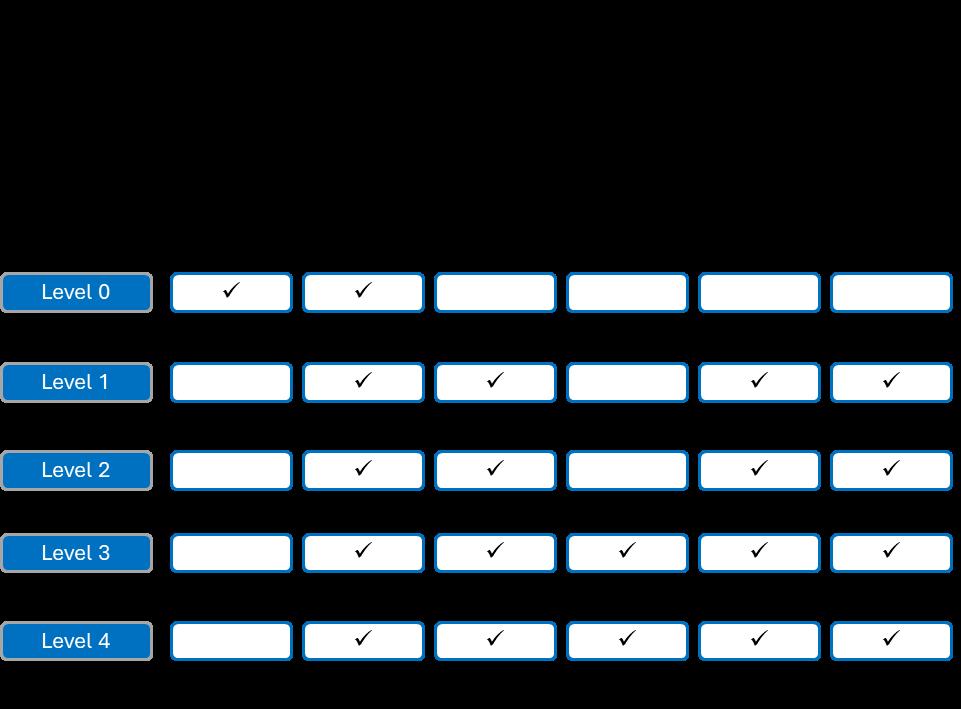
The consequences for violations of TVMC Policies should be proportional to the offense and consistent across comparable cases. The BOG will have discretion to implement any discipline or other consequence that it deems appropriate under this Charter, but will usually select from the following options:
• Verbal Warning. This is the most minor consequence and typically involves a reprimand from a club official outlining the violation and the expectation of future compliance. An oral warning may be combined with a request for an apology to the person(s) most affected by the violation.
• Written Warning. This is a more serious consequence and involves a formal written notification of the violation, outlining the details and potential consequences of future violations. The warning may be accompanied by a period of probationary status.
• Suspension of Privileges This could involve temporary suspension of access to some or all the Club’s facilities, services, or activities. The length of the suspension can depend on multiple factors but may not exceed six months.
• Restitution. Depending on the alleged violation, it may be appropriate for the BOG to require restitution for damages caused as a condition to reinstatement of Club privileges.
• Expulsion. This is the most severe consequence and involves permanent termination of membership. Expulsion is reserved for the most serious or recurring offenses not incidental mistakes, but violations indicating that the accused member does not uphold the Club’s ethical values as stated in TVMC Policies.
• Other actions. Separately or in addition to the above, the TCC may recommend other actions, such as temporarily barring a member from participating in a specific event or holding an office or committee position with the Club
Disciplinary Action Form:
Date:
Date of confirmation of disciplinary action
Offender: Name(s) of the offender
Incident Date & Time: Exact date and approximate time the incident occurred
Incident Location:
Location where the incident occurred
Cause for Discipline: A detailed description of the cause for discipline, including the nature of the violation, the actions taken by the accused, and the impact on the complainant.
Disciplinary Action: A description of the disciplinary action taken, such as a warning, fine, suspension, or expulsion.
Effective Date and Duration: Date the disciplinary action will take effect and the duration of the action.
Follow Up Action:
Signature:
Any information related to a follow up action with the BOG
Signature of the BOG Liaison
Incident Reference Number: (provided from Formal Complaint Form)
Once the Disciplinary Action Form is communicated to the Offender, at the BoG’s discretion, they will have a full and fair opportunity to appear before the BOG to respond to the complaint, comment on the evidence, and present additional evidence (which may include identifying additional witnesses) The accused will not be allowed to have representatives present or cross-examine witnesses. Additionally, the BOG will identify any required follow up action by the offender and the timeline for action.
BOG will then review the information provided during this meeting and then consider whether to modify the disciplinary action or maintain the existing action.
Implementation of Disciplinary Action; Records
The General Manager will be responsible for implementing any disciplinary action imposed by the BOG and keeping a written record of discipline imposed, including oral and written warnings. All documents concerning matters reported to the TCC shall be maintained by the General Manager in a confidential and secure file and shall be accessible only to the General Manager and the BOG.
Range of Consequences Based on the Violation Level
The BOG has the sole and final determination of consequences for each violation. This chart establishes a range of consequences based on the level of violation including the range of disciplinary actions available to the BOG.
VIII. Additional considerations related to the process
Communication
BOG will communicate TVMC Policies and this TCC charter to all members and staff. The Member Handbook will remain the primary source of information related to member conduct; however, this charter will supplement the Handbook as appropriate.
The TCC and BOG will maintain an open-door policy and encourage members and staff to report any concerns they may have regarding ethical conduct. TCC will respond to all inquiries from the BOG promptly and professionally.
Conflicts of Interest
TCC should not allow conflicts of interest to impact on the overall review process, and the following conditions should apply:
• Members of the TCC must disclose any potential conflicts of interest
• Members of the TCC must recuse themselves from any matter in which they have a conflict of interest
• The BOG Liaison shall have the responsibility to resolve any actual or alleged conflicts of interest and may, on his or her discretion, appoint temporary members to the TCC to fill vacancies created by recusals to maintain quorum
Review and Evaluation
TCC and BOG will have an annual review of the effectiveness of the committee and the overall process. Ongoing process improvement is paramount when dealing with sensitive issues. The following process controls will govern the overall process:
• TCC will review and evaluate its effectiveness regularly. At least annually, the TCC will review prior matters and make recommendations for improving consistency and fairness
• TCC will advise the BOG on any trends that may deserve additional attention from the BOG or Club management
• TCC will recommend changes to TVMC Policies and this Charter as needed
• TCC will report its activities to the BOG regularly
• This charter may be amended by a majority vote of the BOG