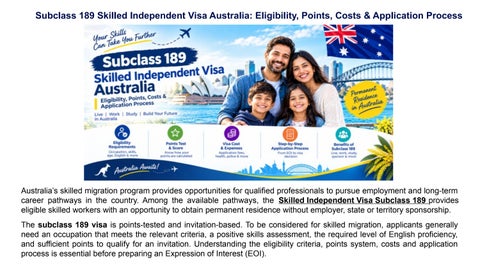
Subclass 189 Skilled Independent Visa Australia: Eligibility, Points, Costs & Application Process
Australia’s skilled migration program provides opportunities for qualified professionals to pursue employment and long-term career pathways in the country. Among the available pathways, the Skilled Independent Visa Subclass 189 provides eligible skilled workers with an opportunity to obtain permanent residence without employer, state or territory sponsorship. The subclass 189 visa is points-tested and invitation-based. To be considered for skilled migration, applicants generally need an occupation that meets the relevant criteria, a positive skills assessment, the required level of English proficiency, and sufficient points to qualify for an invitation. Understanding the eligibility criteria, points system, costs and application process is essential before preparing an Expression of Interest (EOI).
What Is the Skilled Independent Visa Subclass 189?
The Skilled Independent visa subclass 189 is a permanent visa option for eligible skilled professionals who receive an invitation to apply and meet the applicable occupation, skills, and visa requirements. One of the key features of the 189 visa is that applicants do not need an employer or state or territory to nominate them. After approval, eligible visa holders can establish their lives in Australia with the right to remain, work, and live permanently across the country. It can also provide access to study, the ability to sponsor eligible relatives for permanent residence and, if eligibility requirements are met, a pathway towards Australian citizenship. However, meeting the basic requirements does not automatically result in an invitation. Applicants are ranked through SkillSelect, and invitations depend on factors including available places and the relevant invitation arrangements.
Book A Discovery Call
Who Is Eligible for a Subclass 189 Visa?
To apply for a points-tested subclass 189 visa, you must first meet the applicable eligibility requirements. Generally, applicants need to: ● ● ● ● ● ● ● ●
Choose an occupation that appears on the applicable skilled occupation list. Secure a valid skills assessment that confirms your qualifications and experience for the nominated occupation. Submit an Expression of Interest through SkillSelect. Receive an invitation to apply. Meet the applicable points-test requirement. Be younger than 45 years of age when the invitation to apply is issued. Demonstrate at least competent English proficiency when invited to apply. Meet health and character requirements.
The Department of Home Affairs currently specifies that applicants must be able to score at least 65 points to be eligible for an invitation. Importantly, the points score stated in an invitation can be higher than 65 depending on the applicant’s EOI claims and invitation circumstances.
How Is the Points Test Calculated for the 189 Visa? The points test is a central part of the 189 visa pathway. Your indicative points score is calculated when you submit your EOI. Points may be available for factors such as: Age - Your age can contribute to your overall points score. Applicants generally need to be below 45 years of age at the time they receive an invitation to apply for the visa. English Language Ability - At the time of invitation, applicants must generally demonstrate at least competent English. Higher English proficiency may contribute additional points where the relevant requirements are met. Skilled Employment - Eligible skilled employment experience in Australia or overseas may contribute points, subject to the applicable rules and evidence requirements. Educational Qualifications - Eligible qualifications, including certain Australian or overseas qualifications, may contribute towards your points score. Australian Study and Other Factors - Additional points may be available for qualifying Australian study, specialist educational qualifications, accredited community language skills, professional programs, regional study and eligible partner skills, depending on your circumstances. Because every applicant’s circumstances are different, points should be calculated carefully before submitting an EOI. You must later provide evidence supporting the claims made in your EOI.
What Is a Skills Assessment? A suitable skills assessment is an important requirement for the subclass 189 visa. The relevant assessing authority examines your qualifications and professional experience to determine whether they meet the requirements for your nominated occupation. The appropriate authority depends on your occupation. For the points-tested stream, the Department states that applicants must declare that they have a suitable skills assessment when invited. Generally, the assessment must have been obtained within the three years before the invitation, subject to the applicable rules. Applicants should therefore identify the correct assessing authority and understand its documentation requirements before submitting an EOI. What Level of English Is Required for the 189 Visa? English language ability is another important part of the skilled independent visa subclass 189 process. Applicants generally need at least competent English at the time of invitation. Depending on the evidence provided and the applicable points-test rules, a higher level of English may also help an applicant claim additional points. English test requirements and accepted evidence can change, so applicants should check the current Department of Home Affairs requirements before relying on a particular test result.
How Much Does the Subclass 189 Visa Cost?
The current base application charge for the subclass 189 visa starts at AUD 6,135 for the primary applicant. Additional charges apply when eligible family members are included in the application. The overall cost of applying can be higher because applicants may also need to pay for: ● ● ● ● ● ● ●
Skills assessment English language testing Health examinations Police certificates Biometrics, where applicable Professional migration assistance, if used Additional applicant charges
Visa charges can change, so applicants should confirm the applicable amount using the Department of Home Affairs Visa Pricing Estimator before lodging an application.
What Is the Process for Applying for a Subclass 189 Visa? The 189 visa application process generally follows a structured sequence. 1. Check Your Occupation - Confirm that your nominated occupation is included on the relevant skilled occupation list for the pointstested stream. 2. Obtain a Skills Assessment - Submit your qualifications and relevant evidence to the appropriate skills assessing authority to obtain a valid assessment for your nominated occupation. 3. Calculate Your Points - Review your age, English ability, qualifications, employment experience and other eligible factors to determine your indicative points score. 4. Submit an EOI - Lodge an Expression of Interest (EOI) through Skill Select, providing accurate details about your qualifications, skills, work experience, and other relevant eligibility factors. An EOI is not a visa application and there is no fee for submitting it. 5. Receive an Invitation - If your Expression of Interest is chosen, you may be issued an invitation to submit a formal application for the subclass 189 visa, subject to the applicable selection criteria. The invitation specifies the points score you need to demonstrate. 6. Lodge Your Visa Application - After receiving an invitation, you generally have 60 calendar days to submit your visa application online through ImmiAccount. You must provide valid documentation to substantiate the information included in your EOI and satisfy all other applicable subclass 189 visa requirements. 7. Complete Health and Character Requirements - You and any eligible family members included in the application may be required to meet the applicable health and character criteria before the visa can be granted. 8. Wait for the Decision - The Department of Home Affairs assesses the application and may request additional information or documents before making a decision.
What Are the Benefits of the 189 Visa?
A successful subclass 189 visa application can provide several significant benefits, including: ● ● ● ● ●
Permanent residence in Australia The freedom to live, work, and establish your career in any part of Australia. The ability to study in Australia The opportunity to sponsor eligible family members for Australian permanent residence, subject to the applicable sponsorship requirements. Potential eligibility to apply for Australian citizenship, subject to separate requirements
Unlike state or territory-nominated skilled pathways, the points-tested 189 pathway does not require state or territory nomination
Could the Skilled Independent Visa Subclass 189 Suit Your Circumstances?
The skilled independent visa subclass 189 may be relevant to skilled professionals who meet the occupation, skills assessment, English, age and points requirements and want an independent skilled migration pathway. Achieving the minimum 65-point threshold makes you eligible to be considered, but it does not ensure that you will receive an invitation to apply. Applicants are invited based on the applicable Skill Select arrangements, available places and their circumstances. Before submitting an EOI, it is important to verify your occupation, obtain the appropriate skills assessment, calculate your points accurately and prepare evidence for your claims
Final Thoughts
The subclass 189 visa provides a permanent skilled migration option for eligible professionals, allowing them to live and work across Australia without requiring employer or state or territory nomination. From checking your occupation and completing a skills assessment to calculating points, submitting an EOI and responding to an invitation, each stage requires careful preparation. If you are considering the 189 visa, reviewing the current requirements before taking action can help you understand your potential pathway and identify the documents you may need. Australian visa rules, fees and migration arrangements can change, so always verify the latest requirements with the Department of Home Affairs before lodging an application.