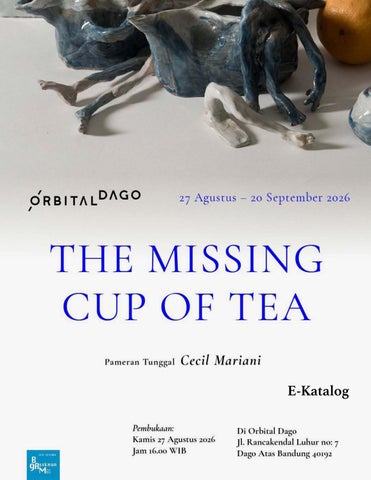
E-Katalog
“The Missing Cup of Tea” (Cangkir teh yang absen) Pengantar oleh Rifky “Goro” Effendy Karya-karya dalam pameran The Missing Cup of Tea berangkat dari perjumpaan Cecil Mariani dengan tanah liat bakaran tinggi (Stoneware) pada suatu masa perubahan hidup dan krisis keberfungsian. Bagi Cecil, praktik ini bukan refleksi yang mengambil jarak, melainkan refraksi: pembiasan pengalaman hidup, yang berkelindan dengan soal kerja, tubuh sosial, kota, polusi, limbah algoritmik, dan ingatan tentang kegunaan diri melalui teknologi tanah dan api. Pusat dari rangkaian ini adalah benda keramik teko. Pada mulanya, keinginan untuk membuat teko tumbuh dari kedekatan yang sederhana dengan kegiatan menyeduh teh: sebuah penanda kenyamanan, perjumpaan, perawatan, dan kemungkinan hidup yang baik-baik saja. Teko stoneware dibayangkan sebagai benda yang dapat digunakan di rumah, dihadiahkan kepada ibu, atau dipakai untuk menyambut kawan dan tamu. Namun, setiap usaha untuk merapikan dan mematuhi fungsi teko justru memunculkan gangguan. Dalam proses membentuk tanah liat, selalu ada dorongan untuk membuat bentuk yang melenceng dari kegunaan, seolah material menolak menjadi benda yang jinak. Cecil menuliskan pengalamannya : Ketika belajar keramik awalnya saya terjangkar hasrat ingin membuat teko teh bukan membuat barang seni. Teko teh tanah liat adalah obyek sehari-hari yang punya fungsi, dan kegiatan menyeduh dan meminum teh kebetulan saya sukai, semacam jangkar afirmasi bahwa hidup baik-baik saja ketika saya bisa santai menyeduh dan meminum teh untuk sendiri, untuk kawan/keluarga/tamu yang mampir di rumah. Saya membayangkan membuat teko stoneware dan menggunakannya di rumah juga dapat memberikannya sebagai hadiah untuk ibu saya yang suka mi-
Namun dalam proses membuat teko saya selalu merasakan
num teh tiap hari.
semacam ‘glitch’/ gangguan/penolakan internal ketika berkutat merapihkan dan mematuti fungsi teko. Alhasil saya tergoda terus membentuk yang liyan dari sekedar fungsi dalam menyelesaikan tiap teko, dan godaan ini terus ulang berulang setiap kali saya mencoba lagi dan lagi membuat teko yang jinak dan berfungsi. Dari gangguan inilah lahir “gejala-gejala teko”: wadah-wadah yang memiliki cerat, pegangan, tangan, tungkai, lipatan, dan permukaan menyerupai tubuh. Mereka tetap membawa intensi awal sebagai teko, tetapi hadir dalam keadaan kuasi-fungsi— mungkin dapat menampung, mungkin tidak; mungkin melayani, mungkin justru menuntut untuk diperhatikan. Bentuknya rentan, riskan, dan ganjil, tetapi juga hidup. Ia menggemakan pengalaman tubuh kerja yang terus dituntut berfungsi, walau berlangsung dalam situasi yang tidak nyaman dan pilihan yang terbatas. Ia mengungkapkan lagi: Saya berpengalaman bekerja profesional sebagai perancang grafis, desainer yang selalu mengedepankan sistem, nilai guna dan fungsi ketimbang kosmetik atau dekorasi di realitas yang jenuh noise dan medan perang pemaknaan agency dan branding, segala cangkang hiasan dan ke-seolah-olahan impresi rupa. Di bidang ini saya terbiasa ‘berguna dan berfungsi’, idiom itu
pun terdengar ‘design is your cup of tea”, tapi kerja-kerja berdekade ini terasa hampa, tak pernah senyaman atau sememuaskan teh seduh yang hangat. Teko dan cangkir bagi Cecil merupakan benda-benda keseharian yang sejak kecil ia temui di rumahnya. Sang ibu mengoleksi benda-benda itu yang kebanyakan dari keramik atau porcelain bergaya Tiongkok dan menjadi ritual minum teh. Pengalamannya ketika menjaga dan merawat sang ayah yang sakit keras di rumah sakit hingga meninggal dunia tahun 2022, membawanya kepada kesedihan yang mendalam dan menjadi titik terendah dalam kehidupan pribadinya. Sehingga ia banyak “mengurung diri” , menolak banyak pekerjaan desain. Tahun 2023 ia mengisi waktu-waktu sulit itu dengan banyak menggambar dan mulai tertarik mengolah tanah liat di sebuah studio keramik bernama Kolekan yang tak jauh dari rumahnya. Sempat juga beberapa bulan ia tinggal di Bali, yang kemudian berkesempatan mengeksplorasi seni cetak grafis di Devfto, Ubud. Di studio ini ia memulai seri karya dengan tema “nenek moyang” (ancestor) dimana Cecil membuat rekayasa dijital menggunakan teknologi artificial intelegence (AI) tentang nenek moyang yang kemudian hasilnya di cetak dengan teknik gum-oil diatas kertas. Ia mengemukakan bahwa seri “nenek moyang” justru muncul dari gagasan tentang teko dan upacara minum teh yang menjadi kebiasaan sang ibu. Rangkaian karya-karya fotografi yang berkolaborasi dengan fotografer Paul Kadarisman, Still Afterlife , Cecil memperluas gejala tersebut ke dalam lanskap benda. Keramik, telur, ikan, buah, kain, daun, dan benang disusun seperti still life, tetapi tidak pernah sepenuhnya diam. Garis biru dan merah bergerak seperti cairan, saraf, urat, simpul, atau peta relasi. Benda domestik tidak lagi hadir sebagai alat yang tenang dan berguna; ia menjadi tubuh, makhluk, sisa, dan kemungkinan kelahiran kembali. Dalam “Still Afterlife: the Pear Stalker” maupun “Still Afterlife: awaiting rebirth with Bao and century egg”, konsumsi, perawatan, pembusukan, dan transformasi bertemu dalam satu ruang yang puitis sekaligus mengganjal. Pada rangkaian karya drawing atau gambar-gambar pensil, tinta, dan embosser atau cap/stamp
diatas kertas menjadi jejak lain dari bahasa yang sama. Garis-garisnya tidak membangun figur yang stabil, melainkan arus, tekanan, dan bentuk yang sedang menjadi. Sementara itu, keramik tidak tampil sebagai ilustrasi dari gambar, dan fotografi bukan sekadar dokumentasi dari keramik. Ketiganya bekerja bersama sebagai pembiasan: bentuk bergerak dari tangan ke tanah liat, dari tanah liat ke susunan benda, lalu dari susunan benda ke citra. Gambar-gambar Cecil dipengaruhi oleh kondisi pasca kepergian ayahandanya pada 2022. Kedukaan, rasa kehilangan dan ketakutan akan kematian menjadi realitas dan fiksi baru yang mesti dihadapi. Dalam tulisan di situs ARTJOG 2024 diungkapkan; Garisgaris panjang yang lentur menjulur, mengait dan menjalin, membentuk sesuatu yang tidak terduga mencitrakan bentuk-bentuk fiksional, wujud-wujud rupa enigmatik. Ada penerimaan dan penolakan, penekanan dan pelepasan di dalam teka-teki bentuk itu. Motif enigmatik merupakan dorongan ketidaksadaran pada tubuh yang melahirkan jalinan cerita fiksi pada bidang gambar Cecil. Daya ramal yang tidak sepenuhnya bisa diramalkan oleh penggambarnya, di dalamnya fakta dan fiksi berkelindan. Di balik seri ini bergema idiom kolokial “your cup of tea”—sesuatu yang dianggap sesuai dengan minat, fitrah, atau bidang seseorang. Sebagai perancang grafis yang lama bekerja melalui sistem, nilai guna, dan fungsi, Cecil mengalami idiom tersebut secara ambigu. “Art is your cup of tea” atau “design is your cup of tea” terdengar seperti afirmasi, tetapi juga menyimpan tuntutan agar seseorang menemukan dan patuh pada slot peran yang tersedia dalam mesin ekonomi, industri, dan pasar. Teko-teko ini lahir dari keraguan terhadap tuntutan tersebut. Menariknya, dalam pengulangan membuat teko, cangkir justru tidak hadir. Secara konvensional, teko ada untuk melayani cangkir; tetapi di sini, ketiadaan cangkir membuka pertanyaan: teko-teko ini hendak menuang untuk siapa? Cangkir milik siapa yang dilayani oleh kerja dan fungsi kita? Bagaimana jika cangkir itu belum ditemukan, belum terwujud, atau bahkan tidak pernah ada?
Melalui pemikiran Julia Kristeva seorang teoreti-
kus, ahli linguistik, kritikus sastra, dan filsuf yang berdarah Bulgaria, karya Cecil dapat dibaca sebagai perjumpaan dengan abjeksi: keadaan ketika sesuatu yang biasanya kita tolak atau singkirkan justru muncul dekat sekali dengan diri kita. Abjek bukan sekadar benda menjijikkan; ia mengganggu batas yang membuat kita merasa utuh dan aman—batas antara tubuh dan benda, dalam dan luar, hidup dan mati, fungsi dan kegagalan.
sayur, serta fragmen-fragmen keramik dalam fotografi still afterlife juga bekerja secara abjek. Mereka mengingatkan pada urat, lendir, darah, jaringan, sisa/ residu konsumsi, atau kehidupan yang sedang membusuk dan tumbuh kembali. Namun karya ini tidak menghadirkan abjeksi secara brutal. Ia mengemasnya dalam suasana hening dan teliti seperti still life, sehingga rasa tidak nyaman muncul perlahan: yang domestik dan indah ternyata menyimpan tubuh yang rentan, tak stabil, dan tidak sepenuhnya terkendali.
Dalam karya Cecil, teko adalah titik utama gangguan itu. Teko semestinya merupakan benda domestik yang akrab, bersih, dan melayani ritual yang menenangkan: menyeduh teh, memberi minum, menerima tamu. Namun bentuknya mengalami penyimpangan. Cerat dapat menyerupai organ, pegangan menjadi anggota tubuh, dan wadah bertumbuh menjadi figur yang rapuh atau ganjil. Benda yang mestinya “di luar” tubuh mulai tampak seperti tubuh; tubuh pun hadir sebagai wadah. Batas keduanya runtuh.
Dalam pengertian ini, karya Cecil tidak memuliakan kegagalan begitu saja. Ia menjadikan kegagalan fungsi sebagai ruang material untuk membentuk ulang subjek. Teko yang cacat, hibrid, dan tidak selesai menjadi “gejala” dari tubuh yang menolak dibersihkan sepenuhnya oleh tuntutan produktivitas. Abjeksi di sini bukan akhir, melainkan ambang—tempat bentuk, relasi, dan kemungkinan hidup lain mulai muncul. Dalam peta seni rupa kontemporer Indonesia sekarang, praktik Cecil dapat dibaca sebagai seni keramik ekspansif yang berangkat dari tubuh kerja dan benda domestik. Karyanya mempertemukan kepekaan
Benang merah dan biru, cairan, telur, ikan, kain,
Krisis fungsi yang menjadi dasar praktik Cecil juga dapat dipahami melalui abjeksi. Dalam masyarakat yang menuntut subjek untuk selalu produktif, berguna, dan sesuai peran, tubuh yang lelah, ragu, atau “tak berfungsi” berisiko dianggap sebagai sesuatu yang harus disingkirkan. Teko-teko kuasi-fungsi Cecil justru memberi bentuk pada kondisi tersebut. Mereka tidak memenuhi standar benda pakai yang ideal, tetapi juga tidak berhenti menjadi teko. Mereka berada di ambang: antara berguna dan tidak, berhasil dan gagal, benda dan makhluk hidup. Ketiadaan cangkir membuat pembacaan ini semakin tajam. Secara normatif, teko ada untuk menuang ke cangkir; ia dipahami melalui fungsi melayani sesuatu yang lain. Ketika cangkir tidak hadir, teko kehilangan tujuan yang lazim—tetapi justru memperoleh kebebasan menjadi bentuk lain. Pertanyaan “teko ini hendak menuang untuk cangkir siapa?” berubah menjadi pertanyaan tentang tubuh kerja: untuk siapa kita diminta berfungsi, dan apa yang terjadi ketika wadah penerima fungsi itu tidak ada atau tidak lagi kita percayai?
kriya, cara pikir desain, pengalaman afektif, serta kritik terhadap tuntutan kebermanfaatan, atau soal benda fungsional. Pameran ini tidak menawarkan jawaban yang final. Ia menimang gejala-gejala tubuh yang mencari bentuk lain: tubuh yang letih, tidak selalu becus, tidak sepenuhnya berguna secara sosial, tetapi tetap membentuk, mengulang, dan hidup bersama material. Dalam pengulangan teko yang tak pernah sama, karya-karya ini mengusulkan kemungkinan bahwa fungsi tidak harus menjadi takdir—dan bahwa ketidaknyamanan dapat menjadi jalan untuk menemukan bentuk kehidupan yang belum diberi nama. Cecil Mariani (lahir di Jakarta, 1978) adalah seorang desainer, seniman, peneliti, dan pelaku seni dan budaya. Cecil juga merupakan pengajar dalam program sarjana dan pascasarjana di Fakultas Seni Rupa di Institut Kesenian Jakarta. Ia memperoleh gelar Master dari School of Visual Arts, New York pada tahun 2013. Ia pernah menjadi bagian dari Komunitas Salihara pada tahun 2008-2011, lalu menginisiasi TuaTuaSekolah bersama Lisabona Rahman dan Felencia Hutabarat, sebuah program beasiswa independen untuk melanjutkan pendidikan pascasarjana bagi rekan-rekannya. Selain bekerja sebagai strategist designer di Mariani Witabora, Cecil memulai inisiatif Arisan Desainer Upacita yang bergerak di bidang ekonomi-produksi alternatif. Ia juga salah satu dari dewan pertimbangan organisasi untuk serikat Sindikasi (Serikat Pekerja Media dan Industri Kreatif untuk Demokrasi). Sumber: - Tulisan Cecil Mariani, Agustus. 2026 - Wawancara dengan Cecil Mariani. Agustus 2026 - Website ARTJOG. 2024 - Website TINEMU.COM - Kristeva, Julia. Powers of Horror: An Essay on Abjection. Translated by Leon S. Roudiez. New York: Columbia University Press, 1982.
“The Missing Cup of Tea” (Cangkir teh yang absen) Introduced By Rifky “Goro” Effendy The works in the exhibition The Missing Cup of Tea emerge from Cecil Mariani’s encounter with high-fired clay (stoneware) during a period of life change and a crisis of functionality. For Cecil, this practice is not reflection from a distance, but refraction: the bending of lived experience, entwined with questions of work, the social body, the city, pollution, algorithmic waste, and memories of one’s usefulness through the technologies of clay and fire. At the center of this body of work is the ceramic teapot. Initially, the desire to make teapots grew out of a simple affinity for brewing tea: a marker of comfort, encounter, care, and the possibility that life might be all right. A stoneware teapot was imagined as an object to be used at home, given to one’s mother, or used to welcome friends and guests. Yet every effort to refine it and conform to the teapot’s function produced a disturbance. In the process of shaping clay, there was always an impulse to create forms that deviated from usefulness, as though the material refused to become a tame object. Cecil writes of her experience: “When I began learning ceramics, I was initially anchored by the desire to make teapots, not art objects. A clay teapot is an everyday object with a function, and I happen to enjoy brewing and drinking tea—something like an anchor affirming that life is all right when I can leisurely brew and drink tea for myself, or for friends, family, or guests who stop by the house. I imagined making stoneware teapots, using them at home, and also giving them as gifts to my mother, who drinks
Yet in the process of making teapots, I always felt a kind of ‘glitch’/disturbance/ internal resistance whenever I was occupied with refining them and making them con-
tea every day.
form to the teapot’s function. As a result, I was continually tempted to shape something other than mere function in finishing each teapot, and this temptation recurred again and again whenever I tried to make a tame, functional teapot.” From this disturbance arose “teapot symptoms”: vessels with spouts, handles, hands, limbs, folds, and surfaces resembling bodies. They still carry the original intention of a teapot, but appear in a state of quasi-function—perhaps able to hold liquid, perhaps not; perhaps serving, perhaps instead demanding attention. Their forms are vulnerable, precarious, and strange, yet also alive. They echo the experience of the working body, continually required to function even under uncomfortable conditions and limited choices. She further explains: “I have worked professionally as a graphic designer, a designer who always prioritizes systems, utility, and function over cosmetics or decoration in a reality saturated with noise and a battlefield of agency and branding, of every ornamental shell and semblance of visual impression. In this field I am accustomed to being ‘useful and functional’; the idiom ‘design is your cup of tea’ even resonates with this. Yet decades of such work have felt empty, never as comfortable or satisfying as a warm cup of brewed tea.” For Cecil, teapots and cups are everyday objects she encountered at home from childhood. Her mother collected these objects, mostly Chinese-style ceramic or porcelain pieces, and made them part of the ritual of drinking tea. Her experience of caring for her critically ill father in the hospital until his death in 2022 brought Cecil profound sorrow and marked the lowest point in her personal life. She consequently spent much time “shut away,” declining many design jobs. In 2023, she filled those difficult days
by drawing extensively and began to take an interest in working with clay at a ceramics studio called Kolekan, not far from her home. She also lived in Bali for several months, where she had the opportunity to explore printmaking at Devfto in Ubud. At this studio she began a series titled “Ancestors,” in which Cecil created digital constructions of ancestors using artificial intelligence (AI), then printed the results on paper using the gum-oil technique. She notes that the “Ancestors” series in fact emerged from ideas about teapots and the tea-drinking ritual practiced by her mother. In the photographic series Still Afterlife, made in collaboration with photographer Paul Kadarisman, Cecil expands these symptoms into a landscape of objects. Ceramics, eggs, fish, fruit, fabric, leaves, and thread are arranged as still lifes, yet never entirely still. Blue and red lines move like fluids, nerves, veins, knots, or maps of relations. Domestic objects no longer appear as calm, useful tools; they become bodies, creatures, remains, and possibilities of rebirth. In “Still Afterlife: the Pear Stalker” and “Still Afterlife: awaiting rebirth with Bao and century egg,” consumption, care, decay, and transformation meet in a space that is at once poetic and unsettling. The series of drawings—pencil, ink, and embossed or stamped works on paper—forms another trace of the same language. Its lines do not build stable figures, but currents, pressures, and forms in the process of becoming. Meanwhile, the ceramics do not appear as illustrations of the drawings, and the photographs are not merely documentation of the ceramics. The three work together as refractions: form moves from hand to clay, from clay to arrangements of objects, then from those arrangements to images. Cecil’s drawings are shaped by the period following her father’s death in 2022. Grief, loss, and fear of death became new realities and fictions that she had to confront. As a text on the ARTJOG 2024 website states: “Long, supple lines extend, hook, and intertwine, forming unexpected things that picture fictional forms and enigmatic visual entities. Within the riddle of these forms lie acceptance and refusal, pressure and release. The enigmatic motif is an unconscious impulse of the body, giving rise to intertwined fictional narratives in Cecil’s pictorial field. Its prophetic force cannot be fully foretold even by the person drawing it; fact and fiction are interwoven within it.” Behind this series echoes the colloquial idiom “your cup of tea”—something considered suited to one’s interests,
nature, or field. As a graphic designer who has long worked through systems, utility, and function, Cecil experiences the idiom ambiguously. “Art is your cup of tea” or “design is your cup of tea” may sound like affirmations, but they also contain the demand that one find and comply with an available role slot in the machinery of the economy, industry, and market. These teapots are born of doubts about that demand. Intriguingly, amid the repeated making of teapots, the cup is absent. Conventionally, a teapot exists to serve a cup; but here, the cup’s absence opens a question: for whom are these teapots meant to pour? Whose cup is served by our work and function? What if that cup has not yet been found, has not yet come into being, or never existed at all?
Through the thought of Julia Kristeva—a Bulgarian-born theorist, linguist, literary critic, and philosopher—Cecil’s work may be read as an encounter with abjection: a state in which something we would normally reject or cast aside appears uncomfortably close to us. The abject is not merely a disgusting object; it disrupts the boundaries that make us feel whole and safe—the boundaries between body and object, inside and outside, life and death, function and failure.
In Cecil’s work, the teapot is the central point of this disturbance. A teapot is supposed to be a familiar, clean domestic object, serving a calming ritual: brewing tea, offering a drink, receiving guests. Yet its form undergoes deviation. The spout may resemble an organ, the handle may become a limb, and the vessel may grow into a fragile or strange figure. The object that should be “outside” the body begins to look like a body; the body, in turn, appears as a vessel. The boundary between them collapses. Red and blue threads, fluids, eggs, fish, fabric, vegetables, and ceramic fragments in the still afterlife photographs also operate abjectly. They recall veins, mucus, blood, tissue, the residue of consumption, or life decaying and growing again. Yet these works do not present abjection brutally. They frame it within the quiet, attentive atmosphere of a still life, so that discomfort emerges gradually: the domestic and beautiful prove to contain a vulnerable, unstable body that is not fully controlled. The crisis of function underlying Cecil’s practice can also be understood through abjection. In a society that demands subjects always be productive, useful, and suited to their roles, a body that is tired, doubtful, or “non-functioning” risks being regarded as something to be cast aside. Cecil’s quasi-functional teapots give form to this condition. They do not meet the ideal standard of utilitarian objects, yet they do not cease to be teapots either. They remain on a threshold: between useful and useless, success and failure, object and living creature. The absence of the cup makes this reading sharper. Normatively, a teapot exists to pour into a cup; it is understood through the function of serving something else. When the cup is absent, the teapot loses its customary purpose—yet precisely then gains the freedom to become another form. The question “for whose cup is this teapot meant to pour?” becomes a question about the working body: for whom are we asked to function, and what happens when the vessel that receives that function does not exist or is no longer trusted? Cecil’s work, in this sense, does not simply glorify failure. It makes failure of function into a material space for reshaping the subject. Defective, hybrid, and unfinished teapots become “symptoms” of a body that refuses to be completely purified by the demands of productivity. Here, abjection is not an end but a threshold—a place where new forms,
relations, and ways of living emerge. In the map of contemporary Indonesian art today, Cecil’s practice may be read as an expansive ceramic art rooted in the working body and domestic objects. Her work brings together the sensitivity of craft, a design way of thinking, affective experience, and a critique of demands for usefulness, or of functional objects. This exhibition offers no final answers. It cradles the symptoms of bodies seeking other forms: bodies that are tired, not always capable, not wholly socially useful, yet still forming, repeating, and living with material. In the repetition of teapots that are never the same, these works propose that function need not be destiny—and that discomfort can become a path toward discovering forms of life not yet named. Cecil Mariani (born in Jakarta, 1978) is a designer, artist, researcher, and cultural practitioner. She also teaches in the undergraduate and graduate programs of the Faculty of Fine Arts at the Jakarta Institute of the Arts. She received her Master’s degree from the School of Visual Arts, New York, in 2013. She was part of the Salihara Community from 2008 to 2011, then initiated TuaTuaSekolah with Lisabona Rahman and Felencia Hutabarat, an independent scholarship program supporting peers pursuing postgraduate education. Alongside her work as a design strategist at Mariani Witabora, Cecil initiated Arisan Desainer Upacita, which works in alternative economics and production. She is also a member of the organizational advisory board for Sindikasi (the Media and Creative Industries Workers’ Union for Democracy). Sources: - Statement texts by Cecil Mariani, Agustus. 2026 - Interviewed with Cecil Mariani. Agustus 2026 - Website ARTJOG. 2024 - Website TINEMU.COM - Kristeva, Julia. Powers of Horror: An Essay on Abjection. Translated by Leon S. Roudiez. New York: Columbia University Press, 1982.
CERAMICS
Ceramics Installation glazed stoneware mixed media Variable Dimension 2024 - 2026
glazed stoneware plate 16 x 5x10 Cm 2025
glazed stoneware plate 18 x 5 x12 Cm 2025
glazed stoneware plate 16 x 5 x 10 Cm 2025
glazed stoneware plate 18 x 4 x12 Cm 2025
glazed stoneware vessel (teapot) 26 x 22 x 9 Cm 2025
Divination Ware glazed stoneware vessel (teapot) 18 x10 x 8 Cm 2025
glazed stoneware vessel (teapot) 27 x 17 x 8 Cm 2026
glazed stoneware vessel (teapot) 26 x 24 x 8 Cm 2026
glazed stoneware vessel (teapot) 25 x14 x 7 Cm 2026
glazed stoneware vessel (teapot) 18 x 28 x12 Cm 2026
glazed stoneware vessel (teapot) 28 x 26 x 8 Cm 2026
glazed stoneware vessel (teapot) 14 x 25 x 10 Cm 2026
glazed stoneware vessel (teapot) 23 x 13 x 8 Cm 2026
glazed stoneware vessel (teapot) 14 x 28 x 13 Cm 2026
glazed stoneware vessel (teapot) 26 x 20 x 10 Cm 2026
a pair of glazed stoneware teaspoons 2025
Seduhan Kala 4 glazed stoneware vessel (teapot) 21 x 30 x14 Cm 2024
Seduhan Kala 3 glazed stoneware vessel (teapot) 22 x 27 x 11 Cm 2024
Divination Ware glazed stoneware vessel (teapot) 28 x 26 x12 cm 2025
Seduhan Kala 2 glazed stoneware vessel (teapot) 25 x 20 x 12 Cm 2024
Seduhan Kala 1 glazed stoneware vessel (teapot) 17x 25 x10 Cm 2024
PA I N T I N G S and D R AW I N G S
figurasi tuangan 12 H and B Pencil on paper 105 × 148 mm 2026
figurasi tuangan 11 colored pencil, coffee and ink on paper 21 x 15 cm 2026
figurasi tuangan 6 colored pencil and ink on paper 105 × 148 mm 2026
unbearable plumbing of being 1 colored pencil and ink on paper 29.7 × 42 cm 2026
figurasi tuangan 1 colored pencil and ink on paper 105 × 148 mm 2026
figurasi tuangan 10 colored pencil and ink on paper 105 × 148 mm 2026
figurasi tuangan 3 colored pencil and ink on paper 10x8cm 2026
figurasi tuangan 9 colored pencil and ink on paper 105 × 148 mm 2026
unbearable plumbing of being 2 acrylic, pastel on canvas 100 x 80 cm 2026
figurasi tuangan 8 colored pencil and ink on paper 21x15 cm 2026
figurasi tuangan 7 colored pencil and ink on paper 105 × 148 mm 2026
figurasi tuangan 4 colored pencil and ink on paper 10 x 9 cm 2026
figurasi tuangan 2 colored pencil and ink on paper 10 x 8 cm 2026
PHOTOGRAPHY Collaboration with Paul Kadarisman
Cecil Mariani X Paul Kadarisman At EDISII
Cecil Mariani X Paul Kadarisman Still Afterlife: the pear stalker Fotografi still life, digital print on hahnemule 76 x 60,8 cm 2026 2/6 +2 AP
Cecil Mariani X Paul Kadarisman Still afterlife: A defensive pommegranate fotografi still life, digital print on hahnemule 24 x 30 cm 2026 1/6 +2 AP
Cecil Mariani X Paul Kadarisman Still afterlife: ikan bandeng with legs fotografi still life, digital print on hahnemule 80 x 100 cm 2026 1/6 +2 AP
Cecil Mariani X Paul Kadarisman Still afterlife: Votive assemblage for laboring things fotografi still life, digital print on hahnemule 76 x 64 cm 2026 1/6 +2 AP
Cecil Mariani X Paul Kadarisman Still afterlife: a tea set without a cup fotografi still life, digital print on hahnemule 24 x 30 cm 2026 1/6 +2 AP
Cecil Mariani X Paul Kadarisman Still Afterlife: awaiting rebirth with Bao and century egg fotografi still life, digital print on hahnemule 80 x 100 cm 2026 2/6 +2 AP
Cecil Mariani X Paul Kadarisman Still Afterlife: One less egg to fry fotografi still life, digital print on hahnemule 138 x 110 cm 2026 1/5 +2 AP Printed by EDISII
Cecil Mariani X Paul Kadarisman Still afterlife: post longevity tableau fotografi still life, digital print on hahnemule 76 x 60,8 cm 2026 1/6 +2 AP
Cecil Mariani (lahir di Jakarta, 1978) adalah seorang desainer, seniman, peneliti, dan pelaku seni dan budaya. Cecil juga merupakan pengajar dalam program sarjana dan pascasarjana di Fakultas Seni Rupa di Institut Kesenian Jakarta. Ia memperoleh gelar Master dari School of Visual Arts, New York pada tahun 2013. Ia pernah menjadi bagian dari Komunitas Salihara pada tahun 2008-2011. Beberapa kali berpameran seperti di ArtJog 2024, Pameran Tunggal di Galeri Kertas , Jakarta tahun 2018. Rubanah, Jakarta 2019, dan di Srisasanti Gallery di Yogyakarta tahun 2025.