Icebox Projects
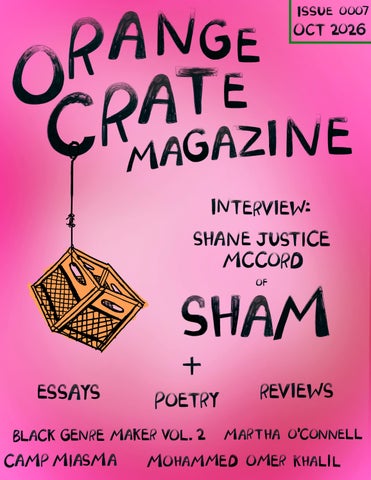
COVER CRATE ART: DAN JORDAN HEAR HERE: YURI SEUNG . . . . . . . . . . . . . . . . . . . . . . . . . . . . . . . . . . . . . 4-5 POETRY PAGES: JODI BOSIN, REVA, FROM MERCURY!, CLICKBAITVICTIM2226 . . . . . . . . . . . . . . . . . . . . . . . . . . . . . . . . . . . . . . 6-8 TEENAGE SEX AND DEATH AT CAMP MIASMA: FILM REVIEW STEPH DAVIES . . . . . . . . . . . . . . . . . . . . . . . . . . . . . . . . . . . . . . . . . . . . . . . 9 INTERVIEW: SHANE JUSTICE MCCORD/SHAM LOGAN CRYER . . . . . . . . . . . . . . . . . . . . . . . . . . . . . . . . . . . . . . . . . . . . 10-12 YOU ARE NOT BROKEN: MARTHA O’CONNELL . . . . . . . . . . . . . . . . . . . . 14-15 BLACK GENRE MAKER VOL. 2: TAFARI ROBERTSON . . . . . . . . . . . . . . . 16-18 ETCHING IS AN INSCRIBED BODY: MOHAMMED OMER KHALIL MAI ELTAHIR . . . . . . . . . . . . . . . . . . . . . . . . . . . . . . . . . . . . . . . . . . . . . . . 19
After you’ve read the mag, and if you decide that you like it after all, please come back here and make a donation to help keep it going. No amount is too small, everything helps.
Well, this summer was...a lot. It’s all good though. There’s a group of people, whom I am very lucky to call friends, that know how to drape language and art over the experience of life, the way a favorite blanket is draped over a child. Yeah, it’s been a tender time. When you go throguh this magazine, I hope you feel tucked in by the people who have dedicated their hours towards becoming strong communicators. I hope that it inspires you to pause, consider and reconsider how you will express your truth this fall. Truly Truly, Logan Cryer Future advertiser? Future contributor? Future friend? orangecratemag@pm.me
hear here: mini-interviews yuri seung i’m endlessly fascinated by the ways we engage with our sonic environment—the feedback loop of how sound shapes us, how we shape it, and the ephemeral sound memories that linger without intent or structure. these mini-interviews explore the ambient pockets within the sonic worlds of friends and artists, focusing on sounds that haven’t gone unnoticed. –yuri seung.
after nomon’s philly show at asian arts initiative in august, i wanted to keep listening! for this special edition, sisters and percussionists shayna and nava dunkelman answer questions separately about their individual practices, their collaborations, and the music they make together. their latest release: echoes of breakage, is out now at otherly love records.
is there a sound you would describe differently in Japanese and English? In English, an explosion is typically rendered as “boom” or “kaboom.” In Japanese, we use dokkan ( , )! Beyond its literal definition, dokkan carries a visceral weight and immediacy that English onomatopoeia lacks. I find myself turning to dokkan even when describing an internal, emotional jolt - an explosive moment of feeling because “kaboom” simply doesn’t convey that depth of impact. when you think about the sound of your childhood, which one seems to have followed you into adulthood?
4
Growing up, my mother wore an ankle bracelet adorned with a small bell, and I wore a matching one as a child. That sensory connection made bells a deeply comforting element for me. Recently, a close high school friend who crafts silver bell accessories gifted me a keychain for my bag. While a friend once pointed it out as an unexpected high-pitched noise (she kept searching for the source, and thought she was losing her mind), to me it remains grounding and peaceful. Naturally, that connection extends into my work as a percussionist. I’ve developed an enduring obsession with bells in all their forms. what does the producer in you notice that the percussionist in you might miss? It comes down to a fundamental dynamic: addition versus subtraction. The percussionist operates in an additive mindset, focusing on momentum, driving the groove, and injecting energy into a live session. The producer, however, acts as a subtractive editor or curator. Even when tracking my own full compositions layer by layer, the producer mindset steps in to evaluate spatial balance and revisit how each instrument or sound meshes. Where the performer pushes forward, the producer curates and distills. what feels immediately familiar to you in Nava’s playing, even if you can’t explain why? The sheer power. Circling back to the concept of dokkan, Nava possesses an exceptionally explosive, passionate, and resonant style. The intentionality and weight behind every note she plays make her sound instantly recognizable from miles away. does playing in NOMON change what you notice about your own playing? It demands a unique balance between two extremes: navigating an organic, intuitive sisterhood alongside structured electronic elements. While Nava and I design these electronic textures ourselves, they remain inherently foreign compared to live human interplay. Because we both operate in rhythmic roles (shaping live beats alongside electronic synthesis) our sonic space is precise and focused. It forces hyper-awareness around timbre and frequency. Our goal is to blend those sources so seamlessly that the origin of any given sound blurs, creating a rare dynamic you don’t typically experience outside of NOMON. what is your favorite onomatopoeia and why? Currently, it’s gucha gucha ( ), which describes something chaotic, messy, or disorganized. Lately, my toddler son has taken to describing his pruney, water-wrinkled fingers after a long bath as gucha gucha with a puzzling face. The linguistically more accurate phrase would be shiwa shiwa ( ), but I don’t want to correct him. It’s so funny. —Shayna Dunkelman
did moving from japan to the united states change the way you heard the music you grew up with? I’m not sure if moving from Japan to the U.S. necessarily changed how I hear the music I grew up with, but I think it’s more that the musical environments I was in then and now are very different. I grew up more classically trained, playing in concert band and marching band, while also playing percussion and some gamelan instruments along with our Indonesian mother’s music, and I think all of those experiences became a foundation for how I hear and make music now. When I played with my mother, I would accompany her without a score, just listening and following along, and while it wasn’t exactly improvisation in the way I perform now, looking back, I think that kind of listening was already there. Even the way I set up my instruments now is influenced by the sounds I grew up hearing. After moving to the U.S. and being exposed to very different ways of making music, I think those foundations just continued to expand. has working with so many different collaborators changed what you notice in your own playing? Working with different collaborators has made me more aware of how dynamic I am as a player, especially when I improvise, and how wide the emotional and expressive range within my playing can be. How I experience sounds with each person is different, so naturally, the way I speak through my own sound is different too. Sometimes it brings out something very calm or playful in me, other times something more intense or aggressive, and I can even discover new sounds in my own playing that I didn’t expect. It almost feels like there’s always a hidden box, and I don’t know what side of myself might come out, but through improvising with so many different people, I think I’ve become more aware of all these different sides of my own playing. when you play with someone for the first time, what do you listen for? is it different with shayna, whose sound you’ve known for most of your life? There’s nothing in particular that I consciously listen for, but when I play with someone for the first time, I think I naturally gravitate toward how they relate to their own sound, and how much depth or feeling they put into it. I think someone’s sound can really mirror something about who they are, and I think that’s what I’m most drawn to. Sometimes it’s a gradual process, but I like getting to know someone in this way. With Shayna, of course, it’s very different. Obviously, I’ve known her sound for most of my life, but I’ve also experienced her sound through so many different phases, eras, and genres, so the way I hear and feel her sound has many dimensions. There’s so much familiarity there, but now that we live in New York and play and make music together, I’ve been genuinely enjoying listening for what’s new in each other and discovering what we can create together, and I’m looking forward to wherever that continues to take us. what feels immediately familiar to you in shayna’s playing, even if you can’t explain why? This question actually connects to how I answered the previous question about how someone’s sound can mirror something about who they are. Shayna’s playing is powerful, fierce, precise, and confident, and I even hear a sense of responsibility in it. I think those qualities feel so familiar to me because they’re also how I’ve always known her as a person, as my big sister who I respect so much, and I’ve always felt in her this strength and determination to keep moving forward. does playing in NOMON change what you notice about your own playing? When I think about my other projects, NOMON is definitely the most percussive, rhythmic, and beat-oriented, and I notice that it really brings out my percussionist self. I also notice that my brain works a little differently when I play in NOMON, because there are more practical things I have to remember or memorize, like the music itself or electronic triggers, while there’s also room to improvise. I feel like I’m constantly engaging different sides of myself as a percussionist at the same time. It’s also just really fun, and I actually notice myself smiling more while we’re playing than I usually do when I’m performing. Playing in NOMON reminds me how much I love being a percussionist and how fun it is to simply play percussion. what’s your favorite onomatopoeia and why? I never really thought about this before, but when I started thinking about it, it felt more natural for me to think of Japanese onomatopoeia because I grew up with the language, but also simply because I think Japanese has so many more onomatopoeic words than English, and we use them a lot. The one that instantly came to mind was sara-sara. It describes something with a smooth or silky texture, even hair, but it can also depict water or another liquid flowing freely, both visually and sonically. The sound of water has always been something I love listening to, and flowing water gives me a sense of calmness and comfort, with nothing getting stuck, just flowing smoothly and freely but still reaching where it needs to go. I like how sara-sara gives me that feeling. —Nava Dunkelman
5
POETRY PAGES
ClickBaitVictim2226
[CONTROL / DON’T BLOW OVER] Shame cannot coexist amongst lessons learned
6
about self i protect my inner child she is the embryo,
i am the shell
smooth & kind, reflective —
& my higher-self is the stem
that remains firmly connected
to external stimuli, even after the mighty oak tree
lets go
Jodi Bosin mr. infinity “The truth is always something that is told, not something that is known. If there were no speaking or writing, there would be no truth about anything. There would only be what is.” –Susan Sontag wake up dumb brain, rosewater spray now you’ve been spritzed by a rose on the gray good morning to the tiny silver hexagon still on my leg my mistakes like glitter go all over the place i’m saying “yes that’s how your body regulates itself” but what the hell do i know no i didn’t name my car i’m not into anthropomorphism the keys on the phone type slow and press themselves on their own, like ghosts bryce has two rings, one hematite and one an eye just like mine, what does it “all mean” if you’re smart you’ll go straight to the source but still there is no knowing at least not in the traditional sense there are only perspectives we tell ourselves there is meaning in life in the fact that it is finite but of course we cannot know we have no idea what it might be like to be infinite
7
reva, from mercury! ugly
my ugly wants me to move my body wants me to make shapes with it like a trapeze artist my ugly wants me to lift up my titties and find where my hills begin my ugly wants me to know i’m not touch starved because i got spirit fingers that know tricks my ugly wants to teach me how to hold myself how to put me in an envelope and save it for later my ugly wants me to introduce my fingers to my labia, they’ve been scared to go on a date my ugly wants me to take the gobstopper out my left eye socket and chew on it like a now & later my ugly wants me to watch the power puff girls but for mojo jojo and the power puff boys my ugly would like a night out on the town a date by the swamp a dinner
8
and a show my ugly wants a quickie in the elevator and 2 rounds on the floor of my room 1 kinky tussle between the sheets my ugly wants to scream and flap around and retreat backwards into my skull and hibernate my ugly wants to touch your ugly and my ugly wants to go on all fours wants to step on all the cracks my ugly wants to bump pussies with someone while the tea kettle boils my ugly wants to sit with my legs open in my rocking chair my ugly wants to compliment lil kids on they ugly wants hair like weeds and joints like branches my ugly wants to grow and hug me and write poems into law my ugly sits on my back at night and on my bladder in the morning my ugly whispers in my ear “i’m not going anywhere”
TEENAGE SEX AND DEATH AT CAMP MIASMA: FILM REVIEW
STEPH DAVIES Turned me on, which I can’t say for many theatrical releases. The latest from Jane Schoenbrun (I Saw the TV Glow) follows an emerging director, Kris Williams (Hannah Einbinder), tasked with revitalizing the fictional “Camp Miasma” franchise. Kris suspects she’s been chosen for the job in the hopes that her queer arthouse cred – in a word, ‘wokeness’ – will unburden the franchise from its misogynist and transphobic reputation. Yet Kris comes to the project with an altogether different and more personal motive, one which sends her in search of Billy Presley (Gillian Anderson), the reclusive star of the first “Camp Miasma” film – now living on its abandoned set. What starts as a professional meeting soon devolves, in a knowingly pornographic sort of way, into a smoldering mutual passion, leading both women to the sources of their dormant sexualities – mysteriously intertwined through the Miasma franchise itself. Einbinder is an extraordinary performer. The pivotal central scene between her Kris and Anderson’s Billy — not a sex sequence so much as a rehearsal — is almost unbearably erotic. Anderson’s own magnetism seems a little tempered by her odd accent work and her character’s otherworldly composure, an odd choice for a woman seeming to symbolize the allure of raw, non-conceptual sex. Yet this is exactly what I find perplexing about this story. We watch Billy play a sort of mentor or therapist role, talking Kris through her intellectual defenses against prohibited sexual fantasies formed by the misogynistic violence of the “Miasma” films. Yet Billy, we come to learn, lives in her own isolating avoidance against an unwanted heterosexual encounter captured forever in her breakout role. One suspects that even Billy’s mentorship to Kris, insofar as it involves a kind of detachment from her own bodily pleasure, locks her further into this defensive escapism. Dissociation, the ultimate enemy of TV Glow, is reclaimed for Camp Miasma as the necessary condition of fulfilled sex – a way to play with violence without doing harm. It seems natural to go a step further and ask whether this retreat to fantasy can realistically succeed; whether it isolates these characters too deeply from their pasts and from a world beyond their affectionate play. But the option to explore these questions seems closed off in favor of a happy ending, whose surreality, in what may be a nod to Blue Velvet, feels ominous. I come away from it as from an ambivalent hookup, or one of Kris’s interrupted orgasms; feeling that the most important things were never said, like the word “transition,” which remains prohibited in Schoenbrun’s trans allegories.
9
ON ORDINARY WORSHIP:
INTERVIEW WITH SHANE JUSTICE MCCORD OF THE BAND,
SHAM
LOGAN CRYER The trophy could say something like, “2026 Album with the Most Beautiful First Ten Seconds.” With a hearty congratulations, it should be handed to Sham for their selftitled record, released on September 25th via Tree of Heaven Recordings. The opening track, “In Ordinary Fashion” starts with a soft creak and a silent count. Then, a rush! Whirling wind instruments, a steady double bass and exuberant hand-picked guitars cascade from the hilltops. The instruments momentarily quiet for the opening avowal, “The architecture of eternal life.”
10
Photo by Brett Naucke
This lyric is sung by frontperson, musician and composer, Shane Justice McCord. He started Sham in 2019, after recording a series of songs with childhood friend, Mikey Powers, and roommate/producer, Robby Grote. McCord and Powers went on to settle within the Asheville-region of North Carolina, where they now work on an assortment of musical projects, both together and with other local improvisatory musicians. Sham dares to make the convergence of ecstasy and refinement, simple. The result is as spectacular as a magic trick and as mundane as magic itself. McCord and I hopped on our respective featurephones to discuss the new album, what it means to be a fan in a DIY context and how to talk about the integrated daily meditations without going too far out there. Spoiler, we may have failed; our conversation literally ends talking about granola. --In the writing you shared on Bandcamp about the new record, you articulated wanting to “make an album without expanding the songs into huge recordings composed of dozens of overdubs.” Can you talk more about your approach for Sham? Every album I want to do something different. The last album, Machine Simple, three years ago, I was like, “I want to have everything be really big and have all these different instruments and all these different songs.” And I’m really happy with how it turned out. I got a record player recently and I listened to the Machine Simple record for the first time in years. I was like, “This is awesome. I’m having a great time!” I guess this group of songs just felt a bit more organic and I wanted to record everything live to start. Everything was recorded live as a duo. There’s me and Charlie [Boss] doing four of the songs, me and Mikey doing four of the songs, me and Dave [Portner] doing two of the songs to start. Then, Sammy [Weissberg] wrote wind arrangements to the bare-bones song of just the duos and my vocals. That was recorded and then we did overdubs after that, but we tried to leave space and not to make it this big thing. We actually figured out a way to play everything live with the group of people who are doing all the duos. We have a band, a four piece. I think it depicts the music pretty well, which is the first time that there’s ever been a Sham live-band that actually sounds remotely like the recording. That’s funny to think about, the math of figuring out how can four people can represent the sound. I mean, I guess it takes more rehearsal, but then once you do it’s good...I think rehearsal is awesome. And I think Sham as a live group has been chronically under-rehearsed the entire time until this year, basically. When we did the four piece this spring, we had a fair amount of rehearsals and it was just so cool to feel prepared. Because the songs have weird
stuff, there’s weird time signatures and very specific lengths of parts, et cetera. So to feel really stable on everyone’s part, that felt good. Charlie Boss, who plays bass, has been a really great influence, because they’re really down and excited about rehearsing music and is kind of like, “Yeah, let’s practice as much as we can.”
impose my own interpretation on.
I’ve been enjoying the practice of rehearsal because it’s just so fun to play music. And the one show you get to play — it’s like, well, but what about the hours of practice leading up to that altogether? That’s actually what it’s all about. I mean, the show’s great too, but last night we had a rehearsal for a band. Charlie and I ran with two other friends, it’s this person, Sally and Morgan’s band. We’re recording, but we had a rehearsal and it was just like, “Yeah, this rocks.” We just play. I really like rehearsing.
There’s a woman named Lucia Berlin whose writings I particularly enjoy. And I’ve been reading her short stories for years. I feel like actually now I have this imagined idea of her whole life from reading all her stories because her stories are all mostly in the first person. She always changes the name a little bit, but it’s also the story of her life with her four kids and three divorces. I love reading her stuff almost because I feel like I’ve gotten to know her through that.
How do you think about audience, fans and listeners in your music making process?
And I guess it feels true to represent myself in that way, lyrically and through the music and through images that are things that just happen in my little day-to-day life. Sometimes the images and everything is used to get at a greater point. And sometimes the greater point is the accumulation of everything. Life is just a collection of days.
I think of a listener as a slightly more passive thing where there’s a lot of listeners to certain music, but they don’t even necessarily know what they’re listening to. Listeners can tap into the internet streaming stuff. I feel like the concept of fan is a level of removal in a way that can only really happen through commercialized art or music. I mean, I’m a fan of my friend’s music, but I don’t know if they’d call me a fan. They’d probably be like, “My friend who likes my music.” The concept of fan doesn’t really seem that fitting to what the project is doing or on the scale of the project. Everything feels kind of small scale in the grand scheme of things, which is fine. I know people with fans. One of my closest friends is definitely in a band with fans, but then sometimes he’ll become friends with one of the fans and then they transition to a different title. Obviously, I don’t know everyone personally listens to the music I make, but I probably know 80% of them. Because there is such an integration between yourself and the people who listen to your music, do you feel the need to maintain a level of privacy within your songwriting? I’ve never really spent that much time thinking about that. I mean, there’s been songs where I’m like, “Oh, I feel like this one is just too cheesy or something.” I remember saying that with a couple of lyrics, and I remember Andy [Loebs] or Mikey, I can’t remember who, was like, “I have no idea what that song’s about.” I took probably a year and a half off from writing songs with words after I finished this last album. The song “The World is Ending”, which is on the new Sham album, was the last song I wrote with words until at some point this year, and I wrote that in 2024. In [that song] I have my roommate’s name in it. It was written after Hurricane Helene and she had said at some point, “Oh yeah, the world is ending.” In it, there’s a couple images: there’s one of, “Casey smokes a cigarette on the back porch,” and, “Casey’s cooking something in the kitchen.” In the new song I wrote, “Madeline’s on the blanket.” Madeline’s my partner, but even if Madeline wasn’t a real person, to me, it doesn’t even matter. I like hearing music with really specific references that I can kind of almost
My hope with any lyric is if I was to die and everyone forgot that I existed for 30 years or something, and then someone found some of the music, these small specific things are relatable on a bigger level.
I find that in your music and in talking with you, there’s a kind of worship that’s always at play. I like that. I want to hear you talk about it, but it kind of starts to move towards the things that can’t be articulated, which is why you play music. I really do think that the experience of music can’t be put into words, and that’s part of why I’m freaking hooked on it. But I do feel my relationship to creating music and playing music, and even in the sense of playing music with my friends, feels very parallel to a version of a spiritual practice. I guess I’m a little on the fence about stating that because of the fear of sounding cheesy or sounding overdramatic. I mean it in really casual way, where it’s like, “Oh yeah, yesterday I got together with Nick, Charlie, and Sally and we jammed for three hours and it was great. And then I left and I was feeling a lot better, feeling a lot more embodied, feeling a lot more in touch with being present and more appreciative afterwards.” I’ve had different periods of my life where I feel like there’s more divine access. That sounds really dramatic, or it can be a little woo, but I do feel it’s part of the human experience is to navigate towards experiences that bring that mindset or presence into your life in ways integrates into your life the best way. I do find music to be a spiritual and divine experience. I also feel a lot of my lyrics, and the state I am in whenever I write songs, feel very present and observing in a way that’s similar to states of meditation or maybe states of my mind right after meditation. There’s been times when I’ve had more regular meditation practices. I haven’t lately as much. I’ve been really into the elliptical at the YMCA the last two years. Lately not as much in a spiritual way, because lately now, I just use it to catch up on my freaking emails. They got wifi at YMCA. But maybe
11
running is a better analogy for that because being outside and touristic to space, getting into a trance-like state. I did sound at a Unitarian-type spiritual center for a little while and I really liked what they said on Sunday mornings, which is like, “God, or whatever that means to you! Love, et cetera…” Just really like God as this much more broad thing. I don’t really use that word very often, but I would say music could be a God for sure. Maybe that’s going too far with the worship, but what’s worship? Worship is attention and presence, right? If you worship something, you’re giving it a lot of your attention, giving a lot of your presence and giving it your energy. Lyrically, it’s fun to do that with the apple I’m about to eat or the bench I’m sitting on. But then also it’s cool to do that musically too, playing guitar. I worship running, I worship talking and eating. I appreciate the reminder to myself to worship the small things that happen on a daily basis that are easy to overlook. Some of the music is definitely from that angle. You’re keeping the perspective that allows the mundane to become spectacular. I really feel like a lot of my approach to writing lyrics and music and my personal perspective is exactly that. I wrote “The World is Ending” after I fell off of my scooter and landed on my head. If I wasn’t wearing a helmet, I probably would have died. I broke my elbow. It was like a month after the hurricane, where there was so much devastation and already an insane emotional experience for everyone here. And then for that to happen where I was really like, “Wow, if I didn’t strap on my helmet, I might be fucking dead right now.” I feel like it was hard for me to process that, still it kind of is, but when something like that happens, it makes all the mundane things in life, or just the things you’re used to, become spectacular and really wild. I’m looking at a brick building. I’m like, “Yeah, that’s so normal. Yeah, of course there’s a brick building right there.” But when you almost die and you’re like, “Whoa, this is crazy. That’s a crazy thing…” It’s also crazy to think about all the elements that led you to having a helmet, someone who invented the helmet, every time, since you were a kid, you heard anyone say, “put on a helmet,” people in your life who also wear helmets-The influence I received as a young child, because actually so many people don’t wear helmets. Right, yeah.
12
That is crazy. It’s thinking about what goes into everything, especially nowadays. I bought granola today and I’m like, “Jesus Christ, I don’t even know how many people...” It’s like, the oats are harvested, but it’s like, what about the machine that the oats are harvested with? Where’d the rubber come from? Who designed the fucking wheel? The interconnectivity of everyone, everything.
Photo by Charlie Boss. Standing (from left to right): Charlie Boss, Mikey Powers and David Portner. Sitting (from left to right): Libby Rodenbough and Shane Justice McCord
MARTHA O’CONNELL, “You Are Not Broken”
BLACK GENRE MAKER VOL. 2: SOUTHERN COMFORT BLUES AS A CLUB GENRE TAFARI ROBERTSON
The Southern Black Genre Maker We never learned about the end of the Great Migration. Arriving north feels like participation in a historical legacy. All the relief, the challenges, the missing, the learning and embracing, it must’ve been this way before too. At once, reasons for leaving were so clear. Whether escaping or seeking, Black communities have been in a state of transience for much of our global history. In the context of the U.S. a story of Blackness begins in the south or at least heavily relies on it. Skilled workers, artisans, families and friends that have been stolen and dissipated taking on the task of inventing a culture. How would they go about it? Photo by James Izlar. Dj Ivy Sole represents North Carolina at Southern Comfort. Aug. 2026. Philadelphia
16
Through music and rhythm you can communicate across long distances, where you’re from, who you know, your mood or disposition, what’s happened lately and information on what to expect next among other messages. It comes built in with a secure form of encryption that could allow an internal sense of freedom. Even humming in a particular way can tell a story to those with familiar ears. This could be considered the birth of Black genre making. A way of organizing the sounds that connect people to each other at a time when reconnection is an imminent duty. Black genre making is a communal task representative of collective memory. It works best when you get the references.
Genre as Location For one Black genre maker, sound is an indicator of region. Whether as a reference to inspiration or home, certain sonic motifs are used to identify with a location. For instance, all chopped and screwed music would point back to the legacy of Dj Screw and the sounds he and members of the Screwed Up Clique cultivated in Houston regardless of where the producer is actually from. The same happens throughout blues, jazz and rock. The Piedmont blues is a bouncing finger style guitar forward genre rooted in the Carolinas and heavily influential on Appalachian blues and folk. This genre includes artists such as Elizabeth Cotton, Blind Boy Fuller, Algia Mae Hinton and Etta baker. It has a distinct style from the slower, melodic trill and bass-y drive of Texas Blues displayed by artists such as Lightnin’ Hopkins. One expanding factor is the reality that Black communities don’t adhere to the imposed borders of city or state lines. Musical patterns are sometimes better identified by broader regional terms like the delta blues (referencing the Deep South Mississippi River delta). Blues is especially representative of a foundational Black genre because of the way it shifts and evolves throughout the southern region and maps the great migration. Wherever black people are in the U.S., Blues is nearby. Up the eastern corridor it transforms as it makes its way to New York and beyond, fusing with Afro Caribbean musical traditions along the route, planting the seeds of funk, gogo, soul and hip hop. Up the midwest corridor, Blues makes it way to Chicago where it lives for a while and spreads around the region to Gary, Indiana, and Detroit, Michigan birthing Motown and some of the most important pop icons of the 20th century. From Arkansas and Texas, Blues heads west to California, taking the easy riding highway sound to create funk and rock, that then becomes the basis for west coast rap, Boogie, G-funk and hyphy. However, Blues never actually left the south. Most of it stayed, creating spacious club scenes with room for the smooth southern soul, country, zydeco, jazz and funk that pulses alongside trap, bounce, chopped n’ screwed, jig, trill, and bass genres amongst many others still breathing life into the deepest swamps, farms, woods, and cities.
Black Gothic Macabre I’m Geek′d up, I can’t make it on my own I′m Geek’d up, I wish these haters leave me alone Help me, help me, help me, help me Help me, help me, help me, help me (I just wanna be, free) - ”Geeked up” by Fabo The southern concoction of pan-african spiritualism, afro-indigenous commingling, biodiversity, space, and trauma became a recipe for the Black gothic tradition. Communities of maroons formulated untraceable infrastructures within swamps and deep southern woods that had to be somehow both findable by those escaping from slavery and mystic to those hunting Black people. This sort of encryption is embodied by semi vagrant traveling black artists that cultivated lavish personal mythologies while depicting existential realities of cumulative epigenetic trauma. Artists to Map: Bessie Smith Mississippi John Hurt Screamin’ Jay Hawkins Ma Rainey Lucille Bogan Nina Simone Joe Tex
Gangsta Boo Sissy Nobby 21 Savage Future Three 6 mafia Crime Mob Ray Charles
Tommy Wright III Le Chat BKTHERULA ABRA Vickeelo Glorilla Sexy Red
Note: How much of Black club music utilizes melodies in a minor key? The legacy of the maroons is relatively unwritten but very much embodied as much of the Black southern experience is still unannounced to the broader world, even amongst Black communities in other regions. Though the majority of our direct lineages or cultural contexts can be traced through the southern regions of the U.S., a continuous effort seems committed to disconnecting Black cultures from one another. … It’s important to note that the south is just as diasporically intertwined as any other global Black community. Many of the most economically and historically noted Black southern cities are also port cities along major coastlines. The Gullah Geechee Corridor along the coast of North and South Carolina, Georgia and down through Florida is both the most profitable region of the Antebellum south and directly in conversation with the West Indian agricultural imports and exports. Reading between the lines here, Blackness along the south eastern U.S. coast is fundamentally intertwined with West Indian culture because the people sustaining and interacting with each other to produce this economic and cultural fervor were Black slaves. The same goes for New Orleans and those working throughout the Mississippi delta and can also be said about the Black cowboys and slaves sustaining the Livestock and agricultural economy as it pushed westward. Their skills and ability to exchange with the indigenous and hispanic peoples throughout the southwest became a part of the dna of the music we enjoy today.
Who gets to tell the story of the south? The characterized image of the Black Southern American culture that comes to mind most dominantly is a worn much older Black Man or Woman, traumatized, traditionalized, and deeply religious. While that may be some people’s reality, it isn’t mine.
What does your southern community look like? Describe them or include a picture
As in any other geographic context, cultural production is led by those on the fringes with a reason to make new spaces where they can experience freedom for themselves. However quietly, Black southern club culture is guided and developed by the women, queer, trans, disabled, and otherwise marginalized many. Unfortunately much of this work is under documented or under circulated.
Whose legacy does your southern experience include? Write their names and stories if ya got em.
17
What Makes A Club Genre? Place + Rhythm + Movement + Play Place: A home region or location of reference, can be as specific as a single block or broad as a coast line Rhythm: A familiar, repeating beat or pattern that can be reproduced across a community Movement: A deliberate call to action for dancing, shaking, freaking, or grooving Play: An open ethos of leisure and expansion. Allowance for exploration and contribution Try it: [ _________________ ] + [ _________________ ] + [ _________________ ] + [ _________________ ]
[ _________________ ] + [ _________________ ] + [ _________________ ] + [ _________________ ]
18
Photo by James Izlar. Southern Comfort. Aug. 2026. Philadelphia
When does southern become club? Right now, when I think of raves or club music, it feels like a distinctly Northern transformation of genre. Dense communities of Black people affected by industrial work conditions with access to electricity and empty warehouses, city clubs or basements are the only way club music can form with legitimacy. So then what of trail rides, parking lots, backyards, woods, and open fields? What’s happening there and how do we describe those sounds and scenes? Even in the north and around the world there’s a processing necessary for Black music to be accepted as EDM or techno worthy of the club or rave nomenclature. Why so? The same financial dominance is in play as was when Black folk, blues, and country artists were sought out by white folklorists only after they’d aged well beyond the infrastructure that was around to benefit from the support or recognition. White audiences are not interested in paying for things that could establish sustainable Black cultural production that protects itself from them. They’d rather excavate it in the aftermath and organize it on their own terms. Perhaps that is the fate of the abundance of Southern club genres that continue to develop intra-comunally.
EXCERPT: ETCHING IS AN INSCRIBED BODY MAI ELTAHIR I am from here – is this not reality enough? I too had lived with them. But I had lived with them superficially, neither loving nor hating them. I used to treasure within me the image of this little village, seeing it wherever I went with the eye of my imagination … [Abroad] I would breathe in the smell of it, and at odd fleeting moments before sunset I would see it. - (Season of Migration to the North, Tayyib Salih, pg 49) In Tayyib Salih’s 1966 post-colonial novel, Season of Migration to the North, the narrator, left unnamed, returns to Wad Hamid, a small village in Northern Sudan, and, through his meeting with Mustafa Sa’eed, is dislodged from the portrait of a pre-colonial past, untainted by colonial psyche, into a whirling state of disillusionment and instability. For artist Mohammed Omer Khalil, this dislodgement unfolds as an experience with the sublime throughout his printmaking and collage practice. It is no surprise that Tayyib Salih’s novel is dear to his heart. In his solo multi-site exhibition, Common Ground at Twelve Gates in Philadelphia, he traces his output from the late 1980s to 2017, presenting his prints, “Season of Migration to the North I & II”. He pays homage to the themes of migration and dislocation in the novel, journeying from the South to the North through prints that indulge the visual and emotional elements in connection to his life. In these prints, the novel and the metal plate blur into one another meeting at the body. The world impresses itself on the flesh of Mustafa Sa’eed, the protagonist of Season of Migration to the North, as the press of the flesh imprints on Omer Khalil. The narrator presses too. Three bodies bleeding in the bite of the acid, one sinking further into black than the others. The flesh is pressed, sinks into bones, patterns into unresolved terrains of ruins and devastation, throbbing until left tender. Once in the North, Sa’eed in London and Khalil in Italy, the roiling commences with “… being nowhere, alone, before and behind me either eternity or nothingness. The surface of the sea when calm is another mirage.” The quiet disquiets. The strangers become strange. Florence becomes a place of countless encounters and exclusions, and the trance rips. To name the texture of Khalil’s tread in Florence: he made his first etching, “Still Life (Cafe Roma), in 1964, and then, notably, “Self-Portrait” in 1965. The relation between press and crush, grit and polish. The moments when the body is laboring to gather itself. Etching does as etching does to itself. A toothed precipice of wounding with scraped horizons of ghamm. The grief is ingested into the plate before it can be seen, weathering beneath, surfacing and surfacing. “In Compositions with Arabic Calligraphy”, he engraves God in declaration to witness the disquiet and erasure. The inscription moves obliquely against the metal plate, fabricating concealment and presence, and mingling with chaos on the paper. Rarely does he set down words, but when he does, his abstraction endures in both Quranic Arabic and standard Arabic, where meaning proliferates, history is arrested, and form is recaptured. The word ghamm generates Khalil’s phantom encroaching on homeland and its alienated dispersals. Each of Omer Khalil’s works embodies speech, splinters with every etching; a vernacular is made. Mohammed is made present.
19 17