CAVES, SONGS, LAYERS AND GREEN: INTERVIEW WITH CAULEEN SMITH LANE SPEIDEL
CONCERT REVIEW: CARLOS ÑINO AND SAUL WILLIAMS AT SOLAR MYTH STEPH
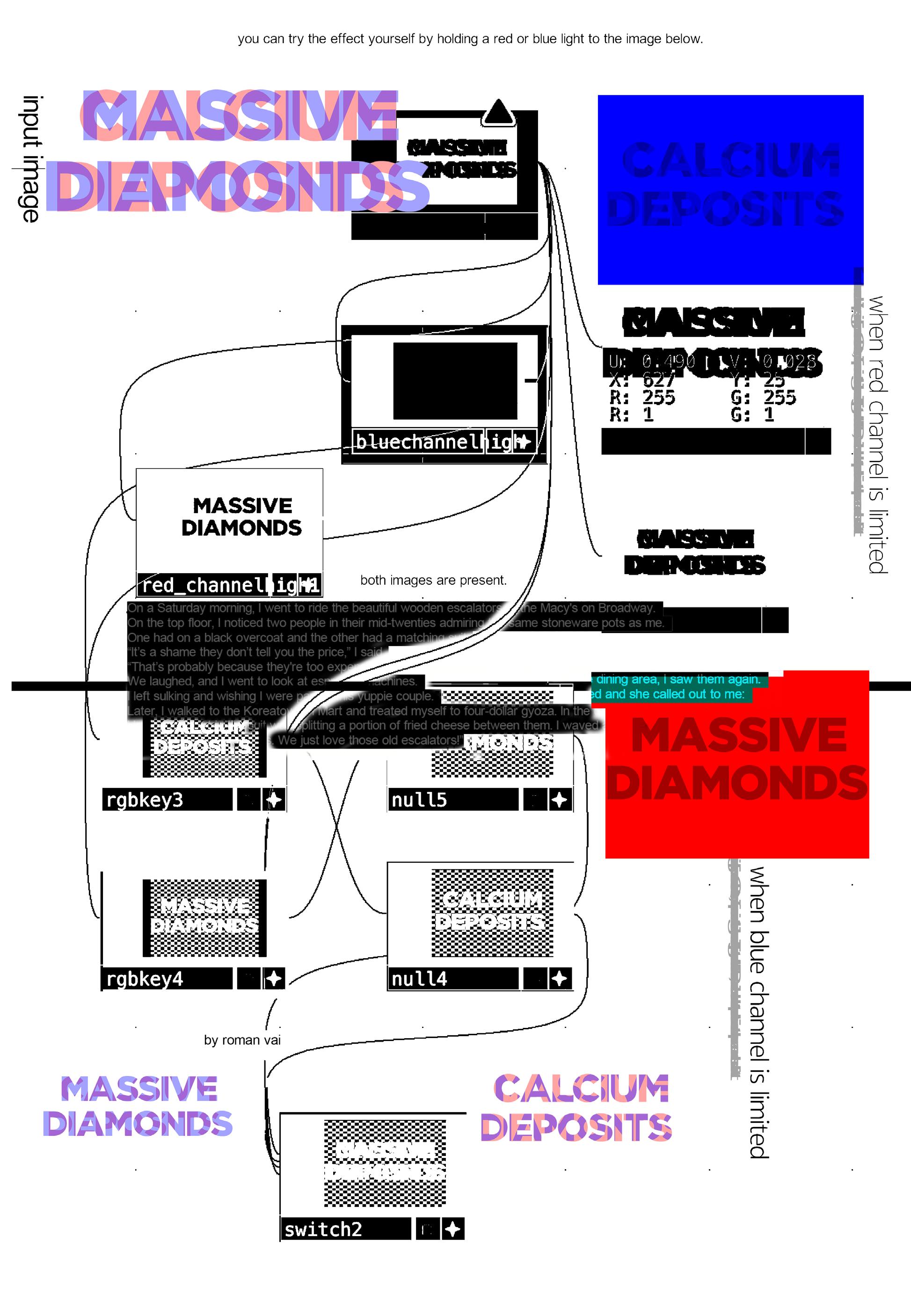
POETRY PAGES: JODI BOSIN, ROMAN VAI, REVA, FROM MERCURY!, CLICKBAITVICTIM2226
After you’ve read the mag, and if you decide that you like it after all, please come back here and make a donation to help keep it going. No amount is too small, everything helps.
This might be the most iconic issue of Orange Crate Magazine yet? Peep the table of contents, the contributors really went for it this summer. Many thanks to all of you. I mean it.
To the Orange Crate Steering Group, thank you for making this a tenable endeavor. Special shout out to Akili, Tafari and Yuri. Y’all did incredible work and I am so humbled by your generosity.
Thank you to all of advertisers. Reader, please pick at least one business advertised here and figure out when you will stop by their shop/gallery/brick and mortar next.
Thank you Alexa Colas of Clubfriends for hosting us for the launch of this issue. And lastly, thank you, reader, for spending some time with us.
Truly
Truly, Logan Cryer
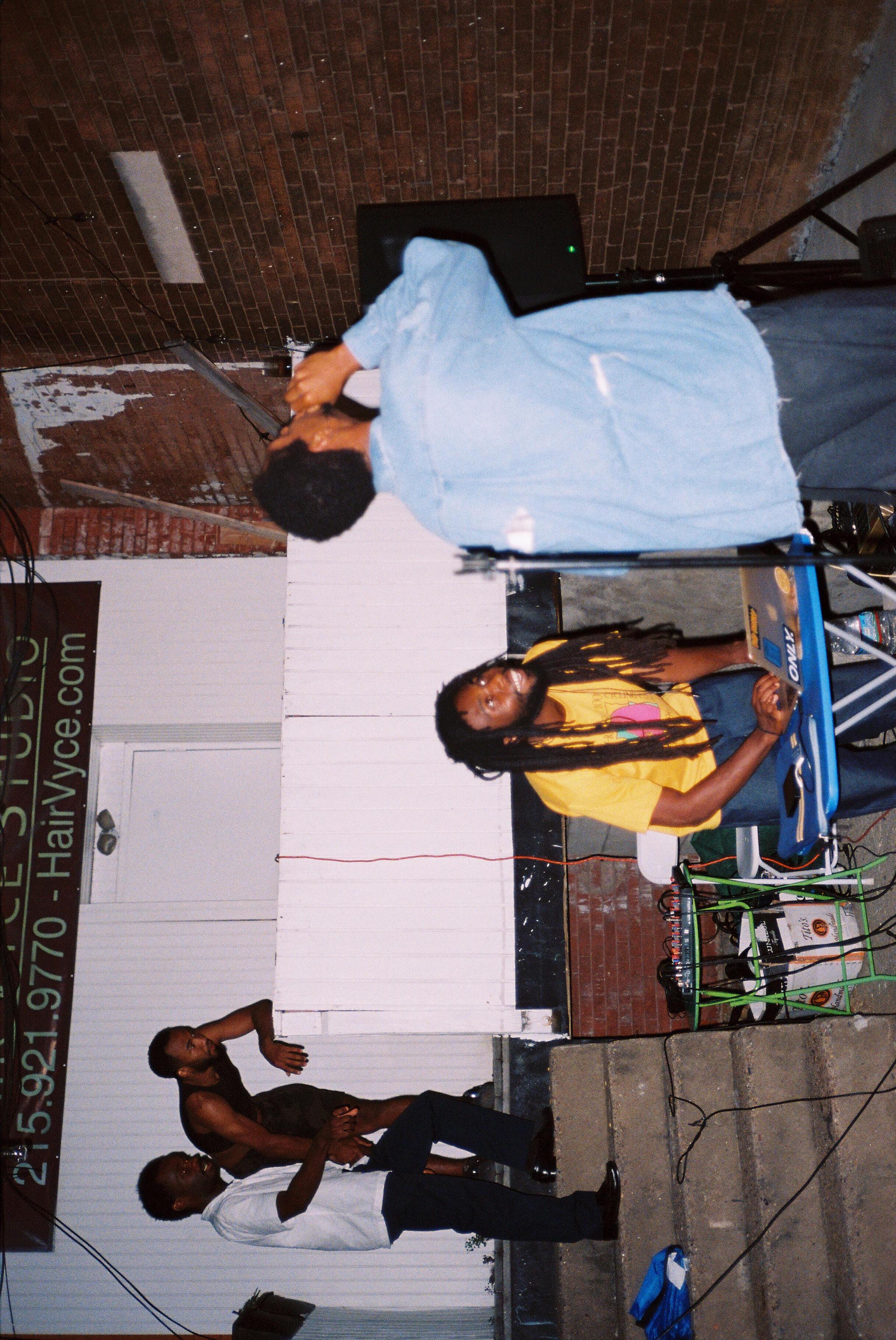
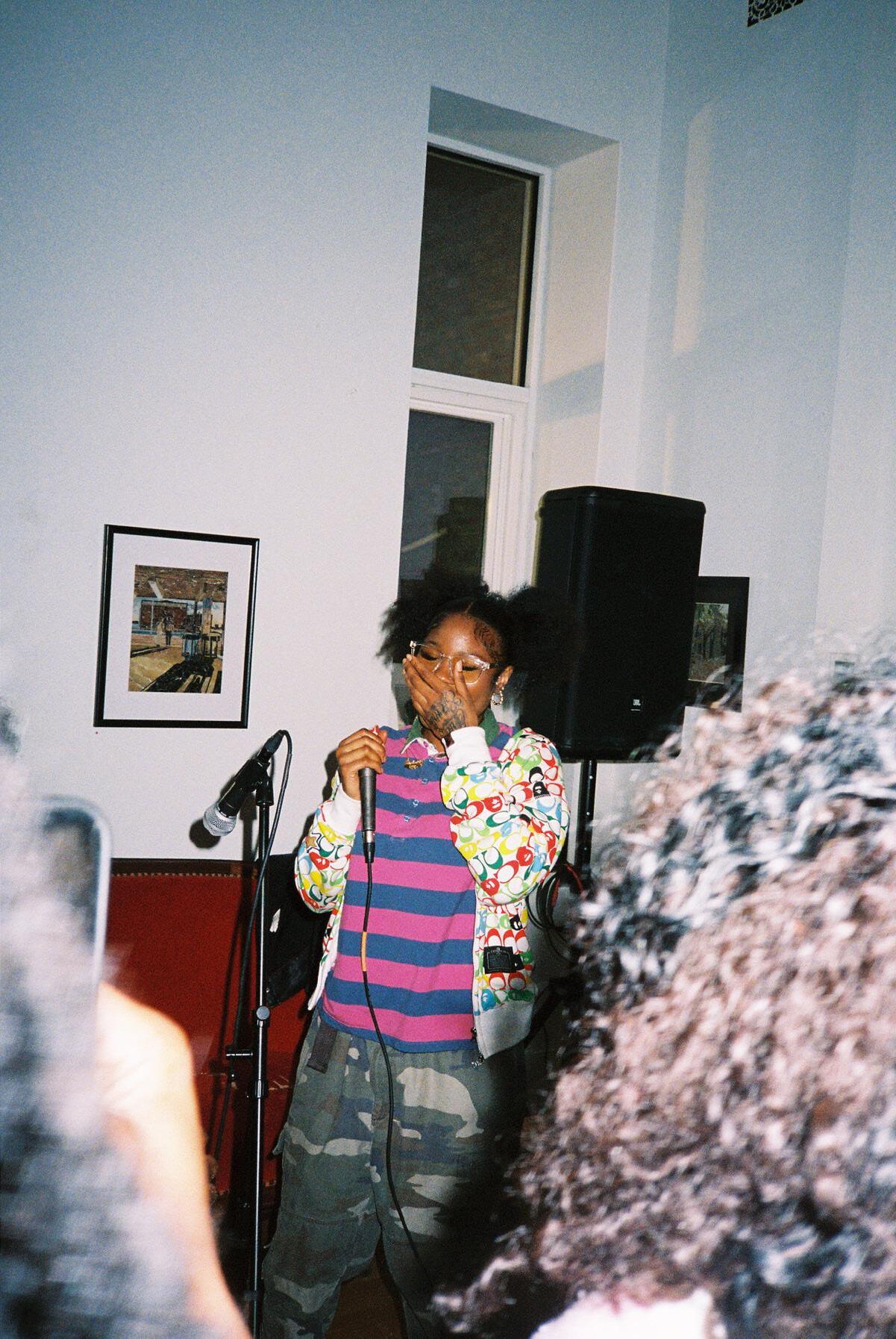
PHOTOS BY LOW KEITH
1. LIVERELL (RAPPING WITH MIC), ZEKEULTRA (DJ’ING), HOUSING & FREE OBSERVING. AT INDIE HOUSE SHOW PUT TOGETHER BY HOUSING
2. TANA RAXX PERFORMING AT SPACE 1026
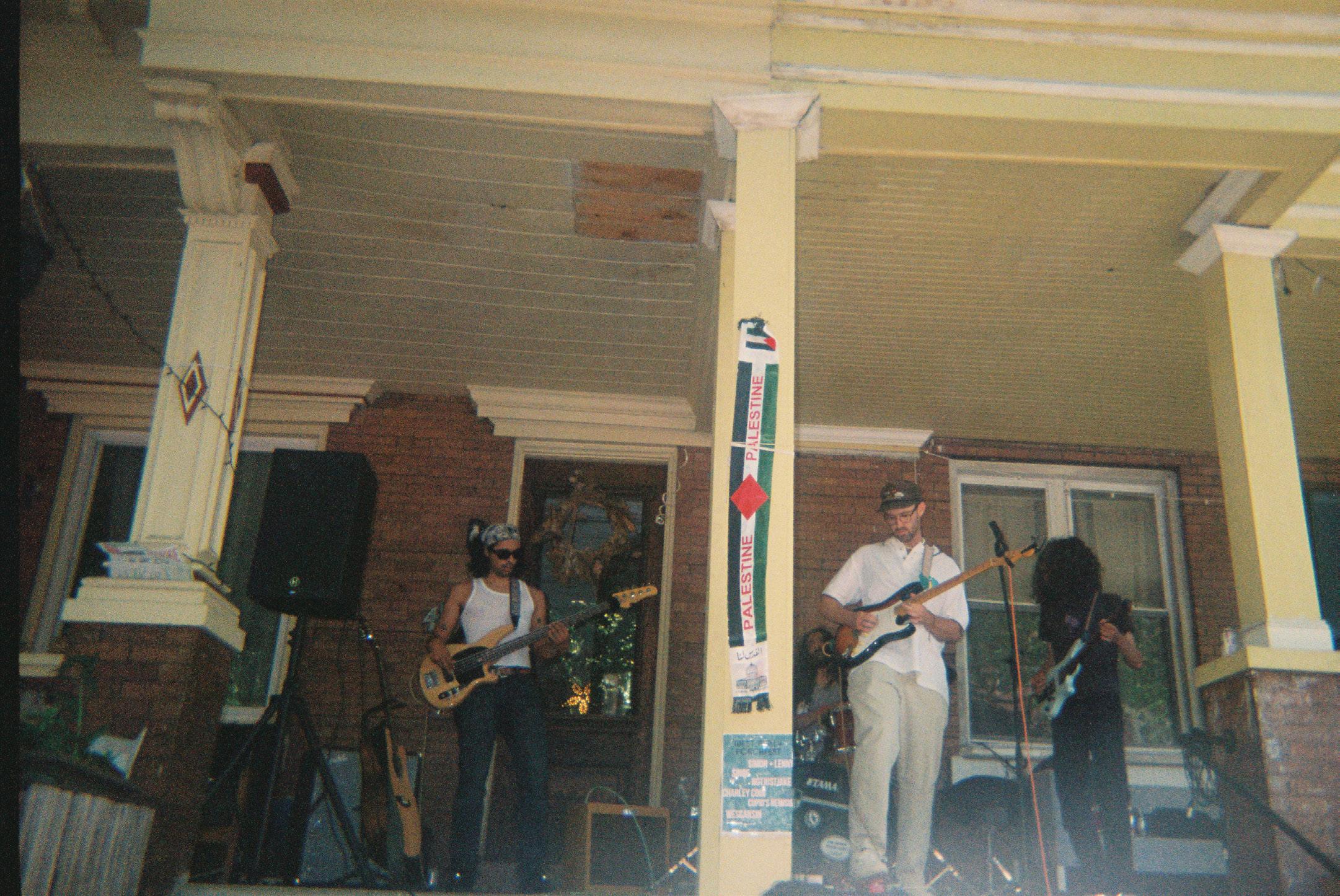
3. CHARLEY COIN AND HIS BAND PERFORM AT 2024 WEST PHILLY PORCHFEST
SAVORING LIVE MUSIC AGAIN: CMAT AT UNION TRANSFER CONCERT REVIEW
AKILI Z. DAVIS
The show begins with members of The Very Sexy CMAT Band filling the Union Transfer stage, each in eclectic outfits. They start to play the opening notes of “Janis Joplining”, the closing track of CMAT’s latest album EURO-COUNTRY. Just as the song’s intro ends, a spotlight reveals CMAT standing within the crowd. The track functions as the conclusion of the album, leaving listeners wondering and yearning with the repetitive ending line, “Stick with me for the night.” As the setlist opener, it does the opposite, inviting the audience into CMAT’s world.
The slow, emotional tone lasts only briefly, and the moment she finishes, CMAT bounds onstage and reunites with her band to launch into “The Jamie Oliver Petrol Station”, a nonsensical comedic rockand-roll banger. The rest of the show continues to bounce from soft, measured melodies to explosive pop rock numbers showcasing CMAT’s vocal agility.
Over the past year I’ve found myself distinctly underwhelmed at the quality of live performances that I’ve attended. The artists themselves are not to blame, but the crowds continue to disappoint. People don’t know what’s appropriate anymore, and are scared to be seen as “cringey” or “embarrassing” just for enjoying the show by screaming along to the lyrics and dancing beside strangers that become your best friends for the duration of the set. This show made me realize how much I’d been missing that energy. The people who gathered at Union Transfer that night were there to have fun, and that directive came first from the artist herself.
The performance was participatory theater with all of the crowd work and invitations to join in on the tomfoolery onstage. Between almost every song, CMAT and her band would stop to chit chat with the crowd, making a point to read aloud people’s signs or calling out interesting outfits people wore. That night we all collectively adopted a charming older woman named Judy who crafted a CMAT headpiece that the artist asked to wear onstage for a while. Throughout the night she continued to shout out Judy for her wit and charm, eventually directing a crew member to bring Judy a margarita from the bar because it’s what she deserved. By the end of the show, audience members would randomly start chanting “Judy! Judy! Judy!” in observance of our collective delight at this lovely woman coming to rock out with us on a Tuesday night. It was ridiculous and silly, but it gave us a positive icon to rally around – someone that all of us younger folks hoped we would one day be.
While CMAT fully leans into the quirky and satirical elements of her music, she’s also a serious performer with nearly two decades of experience. The saccharine elements of her music often work to cushion the harsh realities she speaks of, like in her most recent viral hit “Take A Sexy Picture of Me”. The lyrics detail the crushing nature of living life in the public eye as a woman who isn’t skinny and must therefore be the subject of constant abuse online, and even in person. The music is as pop as it gets, but the lyrics are full of vexation with the chorus repeating, I’ve been having a horrible time / Of late, I get none of your sympathy / But all of the pain hits and the fog lifts / And then it’s too much for therapy.
The show ends the same way it began, with CMAT coming to join the crowd. This time her energy is high, overflowing from the crowd’s feedback. She closes with “Stay for Something”, a reflection on a relationship gone sour. In it, the singer concedes that she can’t bring herself to hate this former partner even though she should. This gospel of self-empathy rings true throughout the set, and in this grand finale the singer resigns herself to the reality that indecision and conflict are necessary parts of life; since we can’t ignore it, we might as well rock with it in the meantime. As the crowd parts to allow her space to run through, I wonder if our collective healing might be in need of this perspective. Complaining about the way people show up to live music doesn’t change anything, but artists have the opportunity to push their audiences to express themselves more fully by modeling the behavior onstage. CMAT brought herself to the level of the audience, equating her experience with ours. When she lets loose, suddenly we have permission to do the same.
SIRĀT MOVIE REVIEW: I LIKE TO RAVE AS MUCH AS THE NEXT GUY BUT WE CAN’T GET FREE UNTIL ALL OF US ARE FREE
CAITLIN WONG
Weathered hands move in steady ritual, speakers creak into place. Blocks of a handmade soundsystem covered in dust relay power as the tower grows taller, revealing the team setting up the scene. Silence — then the massive wall of speakers falls foreground to an even more impressive wall of desert mountain, as a rumbling sub bass washes over the land. Dark and ambient, the swelling low-end frequency strikes straight to the chest. The viewer is hit with this vast and ominous sound before a four-on-the-floor releases the pressure, giving the heartbeat somewhere to land.
The opening sequence of Sirāt preludes the film to come, where the score does the storytelling. Composed by Kangding Ray, the tracks move between dark industrial techno and hypnotic ambience, forcing the viewer into the experience of rave, transcendence, collapse — themes the characters chase and lose. The arc of Sirāt is surprising and devastating in its destruction of redemption, stripping away the ego of characters lost in a desert they think they know.
The narrative echoes an actual experience of a rave, a reality making the film more haunting. The actors are real ravers, called by their real names, introduced in a dance scene shot over the course of an actual three-day party of non-stop music. Following the establishing soundsystem shot, we get the first view of the crowd as a groove cuts over the growling bass. Watching from above, the movement of bodies is animalistic. It feels like something we are not meant to see, dancers in a deep trance, raw, ungraceful, and free. The film plays with techno as a vessel for transcendence, summed up best by one of the most endearing characters, Jade, who explains to the out-of-place father that techno, “No es para escuchar, es para bailar” — it’s not for listening, it’s for dancing. But to what end can you take this freedom?
While there is a current mainstream appeal of electronic music — proliferated by the evolution of music consumption and digital accessibility to the aesthetic “rave” trend — anyone who’s witnessed a dance floor wane into early hours of the morning knows real diehards are here for transcendence. The phenomenon unlocked through endurance on the dance floor, the marvel in letting your body flow to a set that loses track of time. Releasing the mind to unfiltered movement has the power to release the ego. Here, nothing matters — not how you look, how the person next to you looks — except this ancient human thing that needs to dance.
Sirāt turns this question of transcendence on its head. The film’s positioning is complex, attempting to address a postcolonial issue. We follow a group of white Europeans, Spanish and French, who travel with a certain bravado through the deserts of North Africa. The film establishes an “unnamed conflict” in the background preventing them from reaching the next rave. Their obsolescence isn’t unpunished, as the drama of the film surrounds retribution for the anarchical rule-breaking in a land that is not the characters to know or own.
Part of the power of rave is the inherent anarchy, the right to make space for the weird and unconventional, for a self that might otherwise have to hide, and the built community committed to such freedom. However, the film questions who has access to this freedom — to what extent is this rulebreaking a product of negligence? Following a freedom to go anywhere, do anything, might lead to a minefield. Sirāt’s
characters are punished for their egoic attitude as they move with a blindness to their geopolitical environment, a portrayal diluting the potential of genuine anarchism behind renegade raves. Their actions are not a defiance of the societal bounds made by hierarchy, but rather a hedonism accessible to them because of their privilege.
Where the film’s content falls short in rounding out a real postcolonial critique, its importance lies more in reception. After Sirāt screenings reached Philly, at local theaters and even a dancer’s-haven warehouse space popular in the scene, I encountered numerous ravers and organizers in deeper thought of the point of this all — why do what we do. The scene thrives on community-held promoters and spaces, people not even officially involved offering hands and skills. Dancers are here to dance, let the motherbeat free the freak. Djs speak of that moment that should happen at every party, where attendees seem joined in a deep appreciation of the music. However, as renegades rely on finding uncharted space to put on a party, when does putting on a rave cross lines into a pursuit of escapism, unconscious to the colonial attitude underlying taking space that is not yours?
Contemplation on the core dilemma of Sirāt — the tension in pursuing transcendence from this realm while neglecting the land and its people around you — feels apt in a time where underground music culture exists in the clutches of large corporations making imperialist moves. Wielding the rave aesthetic to disguise the commercialization of largescale parties, companies like LiveNation and Superstruct Entertainment are profiting on widely known platforms like Boiler Room. Commercial “raves” are being held at cultural heritage sites like the Pyramids in Egypt and Petra in Jordan, threatening to destroy both environment and sanctity as mindless tourists and hungry business owners chase spectacle.
Where these productions adopt the trendy label of rave while disjointed from the true renegade and its communitycentered origins, these increasingly common events raise the bigger issue cast in the shadow of Sirāt. Who has a right to the space? And how does rave, whether commercial festivals or genuine renegades, proliferate a tourist and colonial attitude? As much as I’d like to separate the two, this aspect of underground nightlife is intertwined, and trends and commercialization impact both. When the internet acts as a primary means for people to find such events, when rave relies on carving out land that is not your own, this context cannot be ignored.
At the very least, Sirāt’s success is in its disturb. It paints a portrait of the strong community attracted to a soundsystem, the bonds of found family in a rejection of convention. It refuses to idealize the rave aesthetic, exchanging the performativity of commercial festivals with the grime of true commitment to getting lost in music. It depicts what is so special about the way bodies can release through dance. I like to rave as much as the next guy. And we need this release. But we can’t get free until all of us are free. I hope the film lets anyone engaged in nightlife walk away holding onto this disturb, motivating ravers and organizers to move with these issues in mind. In weighing the price of transcendence, find the true mission for freedom.
SHE SAID, “DON’T BE A WAX FIGURE, BE A WHACK FIGURE” LOGAN CRYER
So I ended up at the Whack’s Museum Listening Party at the African American Museum. It was as simple as receiving a VIP invite email from a UMG employee the day of. Uh…hell yeah? Thanks for the offer. I’ll bring a plus one too.
Interestingly, the press release described Whack’s Museum as the followup to her “2024 debut World Wide Whack.” Even on Apple Music they credit her 2018 mixtape Whack World as the Philly rapper’s debut. I guess that’s the funny thing about the music industry. Is a mixtape really a debut? Someone ask Chance the Rapper.
Either way, Whack’s Museum is being promoted as a gamechanger, the release that will prove once and for all that Whack has legit bars and that you gotta put her in your mouth when talking about the top emcees out right now. It’s a dense 12-track mixtape where Whack spits nearly nonstop for 27 minutes over boom bap beats. We’re not doing pop or R&B this time. Rapid hearty versus; she hitting you with the one-two.
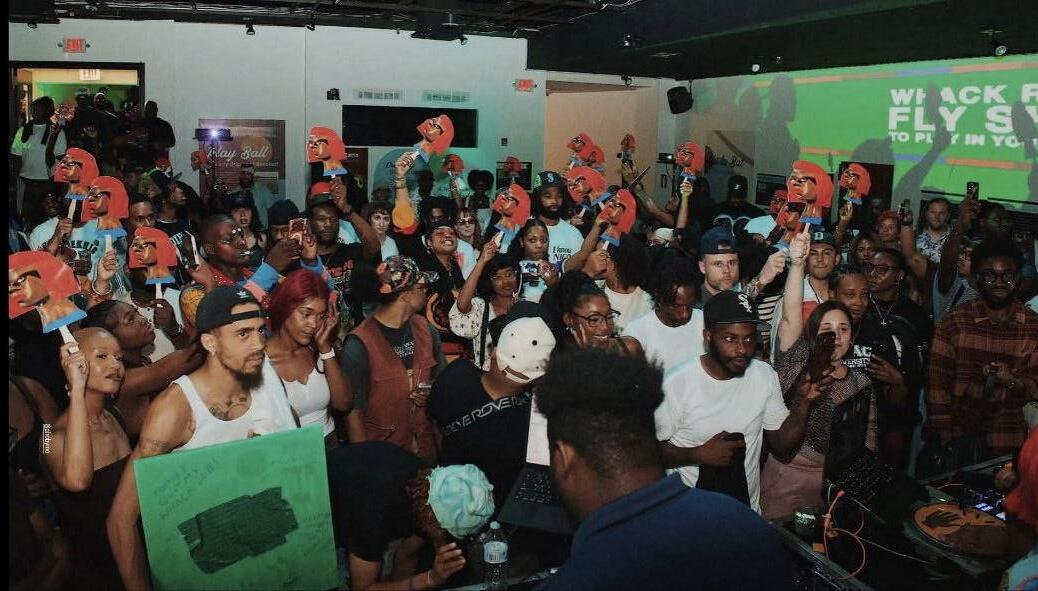
The Listening Party took place two days before the Juneteenth release of Tierra Whack’s latest mixtape. In AAMP’s downstairs auditorium, DJs warmed up the room with iconic rap tracks while the crowd sipped custom RedBull cocktails. The sound was, to quote a friend, “dangerously loud” and reached all the way up the three floors of the museum. Painful in the tight room, but kinda cool when you’re looking at the costumes from Do The Right Thing. (Y’all gotta see the Ruth E. Carter exhibit before it closes in September. I know you want to.)
Tierra Whack walked out and blessed the room with her gratitude. “This feels bigger than a listening party,” she read off of a sheet of paper, “this feels like freedom. Freedom to be loud. Freedom to be weird. Freedom to be vulnerable.” She then proceeded to guide the room in a Whack-style listening mediation of the unreleased mixtape:
Play the track. Y’all like that? Let’s run it back. Who can come up here and do a verse from this single? Wait, pause—did any of y’all catch a bar on this track? Tell me what you heard me say. This is hot right?
The record is simple and solid like a bento box. The beats and flows are easy on the aux and perfect for summer rotation. For some, the ceaseless word play will be a bit too much but Whack commits to the bit with ease. Anything less and, honestly, it wouldn’t even be a Tierra Whack release.
That night, Whack’s fit was giving head curator of The Museum of Earnest Fun; blunt read bob and chunky glasses, a floor length custom trench cape with prints of The Cat in the Hat, Minnie Mouse, Spiderman, Big Bird and friends. I get why this release needs to get pushed as the one that will make people take her seriously as an artist. The majority of consumers coast in the middle between high brow and low brow taste. Merging the two, as Whack does, creates something completely new and it’s not always clear how to sell or celebrate that.
Sometimes museums add a piece of art to their collection because they know it may take decades before people gain enough perspective to appreciate it. On the closing track of Whack’s Museum, “Flowers”, Whack implores the world to give her the flowers she deserves, now. Sure, it might be the most Philly thing she could do to remain an underdog in the industry, but like really imagine what it would feel like if she transcended that. Might feel like you won too.
CAVES, SONGS, LAYERS AND GREEN: INTERVIEW WITH CAULEEN SMITH LANE SPEIDEL
My first encounter with Cauleen Smith’s work was in a multimedia installation at ICA Philadelphia in 2017 called Give It or Leave It. It was a hard, hot day in the city and my first association with her work will always be the feeling of the coolness of the room, blue mirror ball reflections, the softly crashing wonder of Alice Coltrane’s music, piano, and a violet halo. Ever since, I’ve been a seeker of her work. At BlackStar Film Festival in 2025, I was able to see The Volcano Manifesto (2025), which is comprised of three films: My Caldera (2022), Mines to Caves (2023), and The Deep West Assembly (2024). The films are a deeply saturated exploration of Blackness, color, time, history, geology, and collectivity. They are experimental, the images created with contemporary technology like digital phone videos and inkjet printers, as well as pre-film technology like moving panoramas. I was excited to discuss song, community, and music in her body of work, as well as the moving use of a signing choir to perform a Nina Simone song, which concludes The Deep West Assembly
What is the role of music in your work?
I’m trained in film, and I think film, moving images and music are made for each other. They’re both time-based and they both have the capacity to be really descriptive and emotive. And so they’re just a natural pairing in terms of how I think of image making.
The first exhibition I saw of yours used an Alice Coltrane song, and that was so meaningful to me because that was also my first introduction to Alice Coltrane as well as to your work. How do you choose what music to use or reference in your work?
Still from The Deep West Asembly (2024). Courtesy of the artist and Morán Morán.
For the films, Pilgrim (2017) and Sojourner (2018), the research was very specifically about visual, spiritual, visionary people who made communal spaces, not just for themselves but for others through their creative work. So I started with Alice Coltrane because of her work with the ashram, which was my primary interest, and how she used her music and her spiritual practice to bring people together. So that was just embedded into what that whole film was about, where I don’t look just at Alice Coltrane, but lots of other people: from Noah Pierre Floyd, Simon Rodia, Rebecca Cox Jackson, to the Combahee River Collective.
All these different people are dealing with bringing people together to make space, not just for themselves, but for others. And fortunately for me, Alice is also a musician, so I could use her work for the soundtrack.
For The Volcano Manifesto, the Nina Simone track [“22nd Century”] came about very late in the game, and like pure luck. A friend of mine was like, “Oh, I think you’re gonna really like this song, have you ever heard it?” I never had,
but I’ve been a Nina Simone fan for 40 years because my parents had all of her records when I was a kid, so I stole their records and then listened to them.
I was blown away and did a deep dive. And it’s actually not an original song by her. It was a cover from this really interesting Caribbean artist named Exuma. But her cover is really true to his original, which is really unlike Nina, who is known for her amazingly creative covers. In this song, she’s very, very true to his styling and musical arrangement and everything, which I thought was very telling about the song itself. That the song itself was like a true sort of vision quest.
It was totally speaking exactly to so many of the themes that I was trying to get at in my film to the point that when I first heard that, I was like, “Oh wow, I don’t even have to make the work. Just play the song! I’m done. This is amazing!” So that last third of the film is really that song and we spend all of it with those sign language interpreters, who then had to design the signage to interpret the song so that [d/Deaf] people not only understand what’s being said, but how it’s being said and what it means for it to be said in that particular signage or gesture. So that became really interesting to me as well; it’s an Exuma song, and then Nina interprets it, and then the sign language interpreter interprets it, and then the performers bring themselves into it. I loved all those different levels of moving through a text or a piece of creative work.
know how filmmakers feel about that.” And in that moment, I was really like, Oh man, I really believe in accessibility, and this is important. However, it should be thought through. It shouldn’t be just tacked on. So that led me to decide that I was gonna try and invent a captioning system for my films to use all the time for myself from then on. People think that the words on the screen interfere with the image, and that can happen, but it’s really about practice, like being able to watch an image and then consult a line. It’s just a muscle you have to exercise. And now I feel like not only do the subtitles not hurt the image, but they really enhance it. I can embed things into the captions that aren’t in the picture or even in the sound. So I really love it now that I have a third layer of information that I can use to make meaning in the work. I felt it was just an ethical issue of accessibility, and now I really like to think of it creatively from the beginning of the work.
I loved working with the sign language artists. I learned a lot. It was very humbling. And I would like to try and do it
better so that I wouldn’t be such an ignorant person.
There are so many interlocking layers in your work, and also how thoroughly collaboration and community are part of your work. I think about a lot of what you said at the BlackStar Q&A; I believe you said that you’re interested in film as a way of people living together. If you were able to describe or share your experiences working in that way, working with these collaborative voices.
I did notice with The Volcano Manifesto, there was a lot of care towards accessibility for the viewer. There were subtitles, and as you mentioned, the sign language and how thoroughly it was interpreted. Was that something that you were thinking of in the beginning of the work?
It was something that was imposed on me in a good way. When I screened Sojourner at the Whitney, they wanted to put subtitles on the film. They said, “It’s your choice. We
I don’t know if I’m really comfortable in describing it in terms of working with communities, but it makes it sound like I’m really embedded in the community. I’ve earned some kind of in-group engagement with them, and that’s usually not the case. Usually, I’m very much an outsider, and I’m inviting people into my practice, and I pay them, and I’m directing them. What I try to do, is do that in a particular way, with a particular ethic, so that it’s not entirely transactional, that there’s more happening than just the transaction of an
Still from My Caldera (2022). Courtesy of the artist.
exchange of their presence for the image, or they get paid, and I take their image.
I try to make it much more of a conversation — like when working with the ASL performers, they started directing the piece for themselves. They had very clear ideas about what would make sense, what should be shown, and how it should be shown. To me, that was invaluable, not a problem. That was a gift. I was really happy that they felt like a kind of space to be that creative and take that kind of initiative. That’s the kind of stuff I think of as maybe not being in community, but trying to just make community while making the work, which I think is really different.
When I made Drylongso (1998), we shot that in a neighborhood that I had lived in. For me and many of the crew we felt like we were a part of that community and we were treated that way. But that’s really different than how I’m usually working, which is, “Oh, I’m very curious about these people,” or “Oh, I need a group of women of color, various ages, sizes, colors, and let’s see who comes together, and maybe we can cast it based on affinity. Like, maybe we can cast 12 women who just happen to like each other. And then see what happens.” You know what I mean?
I wanted to make the distinction because I do know a lot of filmmakers, particularly documentary filmmakers, who really pride themselves on embedding themselves in communities. I actually try not to do that because unless you’re gonna stay there forever, it’s like really questionable — to insert yourself into the center of something, get what you want, and then leave. So I’d rather just be more transparent about what I’m doing.
I really appreciate you elaborating on that in such a thorough and investigative answer. I’m curious, in Mines to Caves do you see that [incantation] as a song?
That’s a great question. I hadn’t, but I’m willing to consider that. That is a very peculiar film in that it was initially made as nine separate, very short, tiny loops. The tiny loops were playing inside an actual mine in Colorado. As you move through different tunnels and caverns, you would encounter these film loops.
To me, each loop is like its own phrasing, which, when I reshaped it into the film, things do come back as a chorus or kind of repeat. It’s funny now that I’m saying this, I call the film quite literally an incantation and in the root of “incantation” is the word “song,” of course. It’s supposed to be like a magic spell to transform the mind into a cave. I guess in those kinds of rituals, you are often singing. I don’t really know ‘cause I’m not a witch, but that is a thing as far as I know.
So that’s an interesting question. It definitely is a film that’s attempting to have a particular function in terms of transforming one thing into another thing, at the very least in our minds. And then I guess that’s what songs do also. So yeah, maybe, if I’m lucky, it is a song.
I love that. The last two questions I have are
more like silly questions, just for me. If you sing to yourself—
Oh god no. I have a terrible singing voice. Really awful. Horrible. No, I try not to inflict that on the world at all. But I do listen to music as much as I can.
What do you like to listen to when you’re alone?
Oh, it shifts. I just got back from Cape Town in South Africa. I was there for about a month, really learned about this whole parallel history of free jazz in South Africa. So now I’m really trying to learn more about that and collect music from these legends. I’m trying to learn as fast as I can because it’s really beautiful music.
The last question is mostly because I never hear interviewers ask artists this; What is your favorite color?
I think that my favorite color is definitely green. Apparently, green is the color that we can see with the most variation. I think it has a lot to do with living on a green planet. Like that on this planet the reason we can have life is because of chlorophyll. I also really like the way that some people are actually really uncomfortable with green and have negative associations with it, even though it is literally the color of life on this planet, and that kind of disassociation and estrangement. The most literal color of life is fascinating to me, and it speaks to the dysfunction of the human species and how humans are so estranged from their actual origins in place, in the universe.
I was wearing a pair of green pants, and someone on the street told me that green is the color of the heart chakra. I didn’t know that.
I didn’t know that either vut it makes sense. That’s the thing that keeps you pumping, right? Alive. So it makes total sense.
Still from Mines to Caves (2023). Courtesy of the artist.
CONCERT REVIEW: CARLOS ÑINO AND SAUL WILLIAMS AT SOLAR MYTH STEPH DAVIES
On April 2nd of this year – the day our president threatened to bomb Iran “back to the stone age” – I saw the poet Saul Williams join an ensemble led by the percussionist Carlos Niño for an evening of music at Solar Myth. That the relationship between this performance and its historical context was more than coincidental was one of the contentions of Williams’s poetry, which harnessed the associative power of language to link “this theater and their theater of war” in an unbroken chain of domination leading back to the colonial encounter. Poised with authority at the front of the stage, Williams gladly took on the roles of conjurer, storyteller, and bearer of bad news.
Against Williams’ poetry, Niño, keyboardist Surya Botofasina and reeds player Aaron Shaw wove a dense interplay of energetic improvisation that seemed to transform the very space of the room. Niño’s drumming obscured a straightforward pulse in favor of the naturalistic textures of rustling trees or the surging vibrations of a drifting continent. Rather than keeping time for the march of progress, he suspended us in the hushed anticipation of an eternal Now. Botofasina and Shaw, their interplay ranging from contemplative to furious, recalled the spiritual ecstasy of Swamini Turiyasangitananda (Alice Coltrane) or the speculative improvisations of Sun Ra’s Arkestra.
In this synthesis of avant-garde jazz and revolutionary politics, one recognized the influence of the revolutionary Black Arts Movement of the Sixties. The continued urgency of that aesthetic speaks to the unhappy endurance of the regime that Williams named as racial capitalism. Drawing on Black radical tradition, he challenged us to consider our fascist present as not a break with, but a radicalization of this capitalist norm. Fascism, in this view, is a sort of emergency brake pulled to halt the threat of communism. In naming “communism” as a projected utopia, Williams invited us to look past its Marxist form, with its continued attachment to industrial modernization and towards the communal, indigenous lifeways of Palestine or our own Turtle Island — modes of life which even now resist the danger of annihilation. The past then reveals not only a history of violence, but the continued possibility of authentic freedom.
Neither art nor revolution allows any individual the last word. A performance is always left unfinished in the expectation of a transformed consciousness or a liberated society. Williams and Niño’s art allowed us, temporarily, to experience this utopian future as a moment of our real lives. In dispelling the world they conjured for an evening at Solar Myth, they left to us the ask of redeeming our own.
toontown
Jodi Bosin
the new york times says elon musk is “a digital citizen kane” john bartram was a botanist, just like ET the bartrams were abolitionist but still had slaves
i am googling “credenza” and “bay of pigs” crinkling sound in the world around me jessica rabbit: “i’m not bad, i’m just drawn that way” have you heard about imcdb, the internet movie car database where you can, for example, see all movies with toyota corollas in them
the license plate in front of me says CNTEMPT nature is never ever silent did you know that a cupola often serves no purpose, is only ornament why does a country need “global influence” who the fuck cares way too many options of floss at cvs supremo plays wrecking ball and then the theme from footloose eight hours, FOR WHAT?
i remember pieces of stories but not where they come from my friend was blinded in one eye when working at forever 21 pessimism is statistically more common what if it turns out i am just like everybody else what if that’s just fine
reva, from mercury! magic man!
my pubic hair stands in a spiral like a wiggly flower i love me
i love me not i always land on i love me i am a masterpiece and the clouds take my shape to remind me i’m the ultra nebulous very funky
i made the stars on my off day and built your favorite bridge on my lunch break i accidentally on purpose gave jack them magic beans because i knew the giant was getting lonely sixty leven gnomes dance in my honor every time i sing and each time i move my body rub my belly and hug myself the clouds morph into shapes to replicate me as if to say, go head magic man! dance your funky groove there is so much feeling there is so much feeling and fatness that these poems could never be done what’s done? i’ve been laying undone writing sacred poems since i got here!
ROMAN VAI
[the flower does not wait to bloom]
the flower does not wait to bloom they know who they are, without fear, trial, tribulation self-afflicted / egocentrically torn consciousness stay near to the point, where flora & fauna joint where you’ll find the vibrancy of self ecocentric they know who they are, the flower not waiting for the right conditions, never questioning their rich fibers, their vast network of conduits firmly planted roots run deep implicate order a primal pattern of integrity weaving a cocoon of impossible dreams ever repeating cycles, a non-repeating trajectory of evolution they simply do not know the vulnerability of becoming lost, unable to find their ultimate place no, because a flower does not wait to bloom.
hear here: mini-interviews yuri seung
i’m endlessly fascinated by the ways we engage with our sonic environment—the feedback loop of how sound shapes us, how we shape it, and the ephemeral sound memories that linger without intent or structure. these mini-interviews explore the ambient pockets within the sonic worlds of friends and artists, focusing on sounds that haven’t gone unnoticed. –yuri seung
what has the act of rewinding cassettes taught you about how you listen?
Rewinding is part of the experience of patiently respecting the format’s precarity. Because I learned to listen with patience, my listening can be deep and respectful of the music itself and the vessel that carries it.
what kinds of listening become possible when access is slower or more limited?
There is freedom in the surrender to the chronological order of the tape’s contents. I think it’s a relief to not always have the responsibility of playlist tracking at the changing of whims.
when listening to pop on its own terms, what should we be paying attention to?
Pop music is much like a simple order made from complicated ingredients: the history and the context of pop songs, the moment in the zeitgeist songs speak to, samples, chart histories and trajectories--these can be emphasized, but really I think pop listening is all about developing a personal and intimate relationship with songs we love.
now i’ve got to know...what’s your favorite onomatopoeia and why?
Right now, it’s the tonal quality of Mariah’s pre-chorus on “Sugar Sweet” on her newest studio album, Here For It All. Something about her intonation when she sings “But I don’t say a thing,” just gives me chills. I am a victim of Mariah Carey, the vocal assassin.
Kwame Kruw Ocran, Penn PhD Candidate and founder of PopMusicology, LLC
where in philly are your favorite soundscapes, and what are you listening to? tell all, dear reader, i would love read your thoughts:
hear.here.yuri@proton.me
how does listening through FM radio differ from listening through recommendation algorithms?
To put it simply, FM listening offers the magic of serendipitous discovery and unlikely connection with people in your locale. Algorithms do not foster community - people do, and FM radio finds listeners who would never be reached online.
what makes two records sound right next to each other, even if they come from different places?
Sometimes it’s just that hard-toarticulate “mood” two tracks evoke. Sometimes it might be a common sonic element that appears across styles. That could be a particular drum machine sound, a guitar tone, a similar recording/ production quality, or even tempo.
after years of programming radio, what do you hear now that you didn’t before?
I have an even greater appreciation of and ear for DJs who not only curate great sets, but approach announcing from a place of participatory, mutual enjoyment. Like, “let’s all discover and appreciate this music together.”
what does playing guitar give you that listening to records can’t?
Playing guitar of course offers me a creative voice, but it also gives me a deeper understanding of music I love. Since middle school, one of my favorite ways to spend time with it is to learn favorite songs by ear - nailing it feels like cracking a code, and gives me a sense of how another artist felt playing their part.
what kinds of rhythmic ideas or gestures keep returning in your playing, and what do you notice about them?
Lately I’ve been returning to left handed light snare drag rolls where you just let the stick bounce at whichever velocity the moment it hits at but in hopes of producing a pleasantly long drawn out buzz while the right hand is cruising the ride with doubles and triples and flowing along the toms.
are there ever sounds you feel connected to before you fully understand why?
I’m sure there are. I think it’s always rewarding when I’m perusing the goodwill bins and find a metal bowl or pot lid or random object that has a perfect pitch when I tap it and then it winds up at home in my arsenal of noise makers and it will be played in all of my future improv sets like it was always meant to be there.
when sound is loud and continuous, where does your attention settle as you play?
I think my brain goes towards a phrase or drone in the other persons playing when it’s loud and cathartic and I hone in on that. Or if I’m practicing alone I’ll end up attaching to a phrase pattern that I calm down on and can then go into repetition and find new ways of improvising with that and I’ll usually discover something new which is absolutely always fun!
is unpredictability in your playing something you invite, or something you manage once it arrives?
Unpredictably is incredibly encouraged in my playing. Embrace the mysterious and the unknown forever and always! I think that keeps my brain active and continues the path of creativity and not getting stuck on the same rhythms and always discover something new. So yes it is always welcomed and playfully managed when it arrives.
what’s your favorite onomatopoeia and why?
Haiyaa! Just because I’m an Uncle Roger fan and it’s always fun to say. Does that count as one?
Thom Nguyen. “Hot dice, wok fire and tequila enthusiast.”
Allison Durham of WPPM 106.5 FM and Mesh
SONIC RESOURCE GUIDE TOM BAUMSER
During Robert Christgau’s time working at The Village Voice he created “The Consumer Guide”, a monthly piece of journalism in which he graded both popular and niche records on a scale of A to F. Anything above a “B+” was a record he’d recommend fans of music to listen to. Typically these dense pieces ran under 100 words per record and spoke to presumptive fans of the artist, if not fans of Christgau’s writing. His tone was often cranky, deeply intelligent, witty and at times frustratingly insular – you’d have to do some Googling if you weren’t already up to date on an artist’s life or sound. Any music journalist working today is in part influenced by him whether they know it or not and he’s the only one I can think of who has given both The Beatles and Chappell Roan “A” grades when their records came out. The editors of Orange Crate have been kind enough to indulge me in cosplaying as/paying homage to the Dean of American Rock Critics.
Anguine De Poitrine – Vol II
[Self Released 2026]
Prog revival with visual flair; for the era of aura farming edits. It’s more Frank Zappa than Tool, thank God. There’s a sense of humor. And it’s more Daft Punk than GWAR, which, thank God, means the mask schtick isn’t tied to subject matter. If microtones mean anything to you then by all means chat your local jazz fusion fan’s ears off about it. Me? I like that it makes me want to bounce off the walls like I’m a 12-year-old at a Skyzone birthday party. B+
Fcukers – Ö [Ninja Tune 2026]
A boy-girl duo from New York City whose Wikipedia history section claims that they wanted to focus on beats and dubstep because they were “over indie shit”. There’s an occasional dub-influenced sound and they’ve got some bounce as well. There isn’t much depth to be plumbed from lyrics like “I’ll never leave you lonely/Just keep your hands around my body,” but if you’re someone who likes to turn off your brain and move your body you’ll find enough here to work with. B
Twisted Teens – Blame the Clown [Jazz Life 2026]
Two New Orleans rock ‘n’ roll fellas – a white punk-lifer with a hoarse voice and an eternally suited up Filipino who knows when to use his lap steel like a saucier knows when to add salt – fuse short bursts of lo-fi crunch, warm noise and melody into notes on individual liberation that sound like a BBQ at a friend’s house in the summer. Topics covered include: circumcision, substance abuse, and scene politics – if they work on hooks and thematic clarity they might just blow you away next time. B+
Slayyyter - WOR$T GIRL IN AMERICA – [Columbia 2026]
The latest in our current era of Peak Girlie Pop (like Chappell) is a queer woman from Missouri and (like Charli) pulls from a sonic palette influenced by 2000’s electroclash that’s raved-up to emphasize
vulnerability on the slower ones. Her name is Catherine Grace Garner and unlike the aforementioned artists she’s more aggressive, more toxic, more willing to perform narcissism in both its self-aggrandizement and shame to convey her damaged humanity over beats so big they threaten to overwhelm her. Which is good, noise like this needs a big personality to go toe-to-toe with it and she delivers. The formula is a classic in pop: Tension and Release.
For every time she gets gay off tequila and blows a stranger in an elevator there’s a context-providing follow up on abandonment, and both make you want to shake your ass. And she also made “BEAT UP CHANEL$” which is, like, the best song of the year. A-
Underscores – U [Mom+Pop 2026]
Underscores is the stage name for April Grey, a trans woman from Michigan. This album, U, is a follow up to her last record, Wallsocket. Whereas Wallsocket was a narrative driven album about a small Michigan town told in vignettes, U is a cosmopolitan recitation on the forming and shattering of young love. The tender moments will get you, like when they share a vape and when she wishes him well on the denouement. Amongst the usual neurodivergent tickles, the sonics have a bounce that splits the difference between danceable and listenable. It’ll probably be a holy bible to a heartbroken terminally online high schooler. B