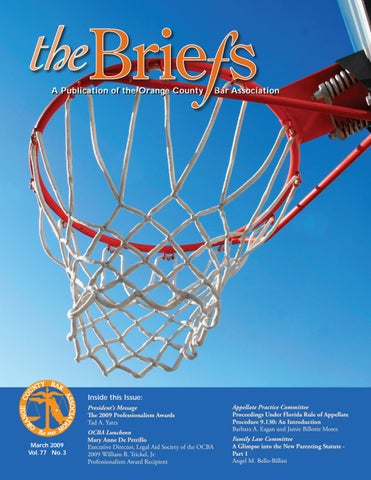
A Publication of the Orange County
Bar Association
Inside this Issue: President’s Message The 2009 Professionalism Awards Tad A. Yates March 2009 Vol. 77 No. 3
OCBA Luncheon Mary Anne De Petrillo Executive Director, Legal Aid Society of the OCBA 2009 William B. Trickel, Jr. Professionalism Award Recipient
Appellate Practice Committee Proceedings Under Florida Rule of Appellate Procedure 9.130: An Introduction Barbara A. Eagan and Jamie Billotte Moses Family Law Committee A Glimpse into the New Parenting Statute - Part 1 Angel M. Bello-Billini
Graham, Builder, Jones, Pratt & Marks is proud to join forces with Burr & Forman. With the new year, Graham, Builder, Jones, Pratt & Marks, LLP has a new name – Burr & Forman LLP. While our sign and stationery will change, the Graham Builder personal attention you’ve come to expect won’t. Instead you’ll find it complemented by the added resources, experience and knowledge of Burr & Forman, a century-old firm with a roster of attorneys throughout the Southeast. To get to know our new team, visit burr.com or call 407-647-4455.
ALABAMA
FLORIDA
GEORGIA
MISSISSIPPI
Located in Winter Park serving Central Florida.
TENNESSEE
JESSICA HEW for
OCBA President - Elect
“For 13 years, I’ve served at almost every level of the OCBA. Now I’m ready for the next big step. Please vote for me as your next President - Elect.”
Jessica Hew. A proven leader for The OCBA. • OCBA Treasurer, 2008-Present.
• Inaugural Strategic Planning Chair, 2008-Present.
• Served as OCBA Secretary, 2007-08. • Served as Inaugural Co-editor of OCBA’s The Briefs Magazine, 2005-07 • OCBA Executive Council 2003-Present. • Received the OCBA President’s Award for Outstanding Service, 2005-06. • Received the OCBA Outstanding Executive Council Member Award, 2004-05.
• Received the OCBA Award of Excellence as a Member-at-Large, 2004-05. • Served as OCBA’s Inaugural Social Committee Chair, 2004-05. • Citizens Dispute Settlement Mediator, 1998-2000. • Guardian Ad Litem, 1997-98.
For more information on qualifications or to discuss platform or issues, please contact Jessica at 407-647-4455 or jessica.hew@burr.com
BURR7441 Jessia_Hew_Ad_v4.indd the Brie 2009 Vol. 77 No.13 fs March
1
www.orangecountybar.org
1/16/09 5:08:02PAGE PM
Table of Contents:
the Briefs
3
President’s Message The 2009 Professionalism Awards Tad A. Yates OCBA Luncheon Mary Anne De Petrillo Executive Director Legal Aid Society of the OCBA 2009 William B. Trickel, Jr. Professionalism Award Recipient Professionalism Committee Dreams from my Father, Nightmares from my Lawyers’ Rules Dennis J. Wall Celebrating 75 Years of Excellence To Infinity and Beyond... Jessica K. Hew Celebrating 75 Years of Excellence Past Presidents: Guiding the Future Amy Guy, FRP Family Law Committee A Glimpse into the New Parenting Statute-Part 1 Angel M. Bello-Billini Legal Aid Society News What We Do... Donna Graf Judicial News The Honorable Jenifer Davis Tries Three Bears vs. Gold E. Locks Legal Aid Society News Pro Bono Spotlight: Fishback Dominick Wins Statewide Pro Bono Award Appellate Practice Committee Proceedings Under Florida Rule of Appellate Procedure 9.130: An Introduction Barbara A. Eagan and Jamie Billotte Moses Roof Crush Standards Inadequate Roof Crush Standards Lead to Death and Serious Injuries in Rollover Crashes Henry N. Didier, Jr. FindLaw Three Keys to Successful Online Marketing Hearsay Nicholas A. Shannin YLS on the Move Spring Events Bridget Heffernan Labutta The New Franchise Disclosure Document: The Next Generation in Franchisee Protection Installment #2: Modified Disclosures Under the New Rule Neal J. Blaher Side Bar Jessica K. Hew Presentation Skills for Lawyers Responding to Difficult Questions Elliott Wilcox Rainmaking Public Relations - Part 2: The Press Release Mark Powers and Shawn McNalis New Members
©2009
Co-Editors Kristyne E. Kennedy & Thomas A. Zehnder
7
Associate Editors LaShawnda K. Jackson & Kimberly D. Healy Communications Manager Peggy Storch
10
Side Bar Columnist Jessica K. Hew
12
Hearsay Columnist Nicholas A. Shannin
14
YLS Columnist Bridget Heffernan Labutta •w OFFICERS Tad A. Yates, President Diego “Woody” Rodriguez, President-Elect Jessica K. Hew, Treasurer Thomas A. Zehnder, Secretary w
16 18
EXECUTIVE COUNCIL Frank M. Bedell Wiley S. Boston Meenakshi A. Hirani Kristyne E. Kennedy Paul J. Scheck Nicholas A. Shannin William D. Umansky William C. Vose Esther M. Whitehead C. Gene Shipley, Ex-Officio Chelsie J. Roberts, President, YLS w
20 21 22 29
EXECUTIVE DIRECTOR Brant Bittner
30 32 35
880 North Orange Avenue • Orlando, FL 32801 (407) 422-4551 • Fax (407) 843-3470 Legal Aid Society Citizen Dispute Family Law Mediation Lawyer Referral Service Legal Placement Service Young Lawyers Section
36 38 39 40
Announcements Classifieds
OCBA Calendar PAGE 2 3
42 48 51 52
407-841-8310 407-422-4551 407-422-4551 407-422-4551 407-422-4551 407-422-4551
DEADLINE INFORMATION Advertising - 10th of the month prior to the month of publication Copy - 15th of the month six weeks prior to the month of publication The deadline for each edition is the first day of each month. If that day falls on a weekend or holiday, the deadline is the next business day. Publication of advertising herein does not imply any endorsement of any product, service or opinion advertised. The opinions and conclusions, including legal opinions and conclusions contained in articles appearing in The Briefs, are those of the authors and do not reflect any official endorsement of these views by the Orange County Bar Association or its officers and directors, unless specifically stated as such. All contents ©2009 Orange County Bar Association. All rights reserved. Designer: Catherine E. Hebert Cover Photo: Flickr
www.orangecountybar.org
the Briefs March 2009 Vol. 77 No.
President’s
Message
The 2009 Professionalism Awards
March 2009
T
he three most significant awards bestowed by the OCBA upon its members are the William Trickel, Jr. Professionalism Award (given to an attorney who has been in practice for 15 or more years), the Lawrence G. Mathews, Jr. Young Lawyer Professionalism Award (given to a lawyer who has been in practice fewer than 15 years), and the James G.
Glazebrook Memorial Bar Service Award. On March 26, 2009, at our monthly luncheon, I will have the
privilege of presenting these awards to three outstanding members of our organization.
The Trickel and Mathews awards each seek to recognize an attorney currently in practice who possesses the following attributes: career service, services to the community, services to the profession, consistently ethical conduct, courteous demeanor, high moral standards, and professional behavior that transcends mere ethical standards and rules. In summary, the award seeks to recognize a practicing attorney whose conduct and career stands as a model of success built on unquestioned professionalism. Past recipients of the Trickel Award include the following attorneys: David King (1994); Jules Cohen (1995); The Honorable Gregory A. Presnell (1996); The Honorable John Marshall Kest (1997); Darryl B. Bloodworth (1998); Chandler R. Muller (1999); R. Lee Bennett (2000); The Honorable Sally D.M. Kest (2001); Ava K. Doppelt (2002); Bruce B. Blackwell (2003); Warren W. Lindsey (2004); Michael P. McMahon (2005); Bill Wilson (2006); Kirk Kirkconnell (2007); and Council “Butch” Wooten, Jr. (2008). This year’s William Trickel, Jr. Professionalism Award recipient is Mary Anne De Petrillo. As you all know, Mary Anne is the Executive Director of the Legal Aid Society of the OCBA. This month marks Mary Anne’s 25th anniversary with the Legal Aid Society. There is no question that she has dedicated her life to the cause of providing legal representation to those whose voices might otherwise go unheard. Over the years, Mary Anne has inspired hundreds of lawyers to join her in this cause. She manages an incredibly talented staff of lawyers and non-lawyers on a budget that does not permit for the compensation the rest of us enjoy. Longtime Legal Aid Board member, past president of the Legal Aid Society and pro bono lawyer extraordinaire, Chuck Stepter, has said of Mary Anne that in the workplace she insists on the full measure of devotion to the ideals of Legal Aid, but has created a fun and professional work environment that has resulted in more longevity of lawyers and staff than any other legal services program of which I am aware. Professionalism isn’t so much something you the Briefs March 2009 Vol. 77 No. 3
can see and touch, it’s a feeling imparted by the professional. It’s about making those around you feel good about who you are and who they are and I can’t think of anybody who does that better than Mary Anne.
Tad A. Yates I couldn’t agree more with Chuck. Mary Anne, I’m proud to call you a friend and I congratulate you on this well-deserved honor. This year’s Mathews Young Lawyer Professionalism Award recipient is Heather Pinder-Rodriguez of Holland and Knight. I was honored to have been the first recipient of the Mathews Award in 2004. Since then, the award has been presented to: Nicholas A. Shannin, Thomas A. Zehnder, Diego “Woody” Rodriguez and Elizabeth F. McCausland. Heather is the type of attorney that this award was created to recognize. She has excelled in every area of her young career by already obtaining Board Certification in her field of construction litigation, serving on numerous Florida Bar and OCBA committees, and she is currently the presidentelect of the Legal Aid Society. However, it speaks volumes that she was nominated for this award by former client, Liz McCausland. According to Liz, she knew of Heather’s “balanced disposition, demeanor and attention to detail from serving on the YLS board with her.” However, it was not until she was Heather’s client that she fully appreciated “her ability to motivate through inspiration, her preparedness and her hard work ethic.” Heather truly strives each day to advance our profession and for that we are please to honor her with this award. The James G. Glazebrook Memorial Bar Service Award seeks to recognize a member of our judiciary who is a state or federal judge (including state magistrates, county court and circuit judges, and appellate judges; and federal magistrates and district court and bankruptcy court judges) serving Orange County or hearing cases in a district which includes Orange County, who best embodies the following characteristics: service to and support for the legal profession and/or the Orange County Bar Association and/or The Legal Aid Society of the OCBA; dedication to professionalism, both in and out of the courtroom; and leadership in promoting the qualities that heighten professionalism, including civility, integrity, and respect for our system of justice. Last year this award was presented for the first time and was given to the Honorable Emerson R. Thompson, Jr. This year’s recipient of the Glazebrook Award is Judge Alice Blackwell. Judge Blackwell has served both bench and bar
www.orangecountybar.org
continued page 8
PAGE
2. View a realtime feed of the deposition testimony from your laptop.
3. Export Westlaw® research directly into your Case Notebook files. 4. Take your Case Notebook on the road and access files anywhere – your hotel, the airport, your home office.
1. Enter, access, share and search all essential documents – briefs, pleadings, filings, hot documents and more – in a click.
EVERYTHING IMPORTANT TO YOUR CASE. ALL IN ONE PLACE. Introducing West Case Notebook™ with LiveNote™ technology. Now all your essential case information is organized in a usable electronic format and accessible in a single click. So you and your team can enter and share key facts, legal documents, main characters, transcripts, evidence, pleadings, legal research and more. You can search across all this and find what you need instantly, including that hot document that may have taken you hours to locate before. All of which means you can be confident you’ve missed nothing. Call 1-800-762-5272 or visit west.thomson.com/casenotebook for more details.
WEST.THOMSON.COM
© 2009 Thomson Reuters L-346687/1-09 Thomson Reuters and the Kinesis logo are trademarks of Thomson Reuters.
PAGE 4 3
www.orangecountybar.org
the Briefs March 2009 Vol. 77 No.
the Briefs March 2009 Vol. 77 No. 3 PAGE 5
www.orangecountybar.org
ADV-0408-0019 ORLANDO litigation:Layout 1
4/25/2008
10:27 AM
Page 1
Building Stronger Cases Right in your Neighborhood At Rachlin LLP, we’ve been helping attorneys build stronger cases for more than 35 years. And now, we’ve moved into the neighborhood. Our professionals, including highly experienced CPAs, retired IRS criminal investigators, receivers and a Chapter 7 Panel Trustee, offer specialized services across a variety of disciplines to support every facet of the litigation process. They dig deep to unearth facts and get the information attorneys need to build a stronger case. Call today to learn more about the depth of our knowledge and scope of our services. Our experience may be your greatest asset.
Bankruptcy & Insolvency
Business Valuation
Receivership
Forensic Accounting
Expert Testimony Call 407.926.4012
M I A M I
n
F O R T
www.rachlin.com
L A U D E R D A L E
n
W E S T
P A L M
B E A C H
n
O R L A N D O
1 ACRE SITE - BUILD YOUR OWN BUILDING HIGH VISIBILITY ON FAIRBANKS AVE., WINTER PARK • Great location for your office • Located on the south side of Fairbanks Ave., just west of Hwy. 17-92; adjacent to Wachovia Bank, Publix, Walgreens, with immediate access to I-4 and major thoroughfares • Site can support a 15-16,000 SF building up to 55 feet (4 stories) w/ retention • Over 33,000 vehicles/day pass the site • O-1 and C-3 zoning allows many uses • Sale Price: $1.995 mill. (below appraised value of $2.2 mill.)
For More Information Contact:
Christi Davis, CCIM or Damien Madsen cdavis@morrisoncre.com
dmadsen@morrisoncre.com
Commercial Real Estate
407.219.3500 PAGE 6 No. 3
Licensed Real Estate Broker www.orangecountybar.org
the Briefs March 2009 Vol. 77
OCBA Luncheon March 26, 2009
Mar y Anne De Petrillo
Executive Director Legal Aid Society of the OCBA
2009 William B. Trickel, Jr. Professionalism Award Recipient
M
ary Anne Curtis De Petrillo was born January 11, 1952 in Jacksonville, Florida. The eldest of six children born to a career U.S. Marine, she grew up living primarily in Southern California, the Eastern Carolinas, and Florida where her father was stationed. Before going to college, she attended nine different schools, including three high schools. Her parents wanted her schooled by Jesuit priests and so the decision was made that she attend a Jesuit college in Spring Hill College in Mobile, Alabama. There she spent four happy years, graduating Magna Cum Laude with a B.S. in Political Science in 1974. When it was time for law school, Loyola University in New Orleans became the Jesuit school of choice. She graduated from Loyola with a J.D. degree in 1977. Mary Anne remembers very clearly the day she decided to become an attorney. It was the day President Kennedy was assassinated. She still remembers the gripping, momentary fear that the country would fall into violence and chaos. Yet, the knowledge of our system of government came back to her as a quiet comfort. She knew from her studies that the defenders of our form of government, those who would protect the Constitution, and especially the Bill of Rights, were members of the legal profession. She became determined on that day to become one of them. The turmoil of the 1960s only reinforced her desire to serve the country through the legal profession. After law school, Mary Anne took a position as a legal aid lawyer for two years until the program ran out of money. She was offered a position at an AV rated firm in the same community, where later she became a partner and a very active pro bono attorney. At age thirty two, she realized she wanted to go back to practicing poverty law full time; she answered an advertisement for a Litigation Director at the Legal Aid Society of the
Law Suits: Remember to bring your donations of suits and business attire to March’s luncheon! The clothes drive benefits participants in the Community Service Center of Central Florida’s Job Rehabilitation Program. the Briefs March 2009 Vol. 77 No. 3 7
Orange County Bar Association and began in March 1984. Mary Anne became Executive Director in 1985 and was charged with ensuring that the four-attorney organization became the best public interest law firm possible with a strong pro bono component. Since that time, the firm has grown to 18 attorneys and 24 support staff, with more than 900 attorney-volunteers providing quality legal services to literally thousands of low income clients and abused and neglected dependent children annually. Mary Anne has been an active volunteer throughout her career in local and statewide bar association, non-profits, and other groups. She currently serves on the Florida Legal Services Board of Directors and the Community Leadership Council of the Howard Phillips Center for Children and Families. She has been married since 1978 to John De Petrillo, an artist and the Exhibit Coordinator for the Orange County History Center. They have one child, David, who resides with his wife, Kelly, and daughter, Skyler, in Amherst, New Hampshire.
The Ballroom at Church Street
11:45 a.m. - 1:00 p.m. 225 S. Garland Avenue Orlando, FL 32801
Please RSVP to reservations@ocbanet.org by Friday, March 20, 2009 Main Entrance: Garland Avenue between Church Street and South Street To ensure a proper luncheon count, RSVPs and CANCELLATIONS are requested no later than Friday, March 20, 2009. The OCBA is happy to provide 11 luncheons as part of your member benefits, but noshows incur additional charges for the Bar and walk-ups cannot be guaranteed a seat. Please keep us upto-date on your reservation status!
www.orangecountybar.org
PAGE
President’s Message continued from page 3
a Circuit Judge in 1991. Since her investiture, she has been named the ABOTA Trial Judge of the Year, and served as the president of the George C. Young First Central Florida Inn of Court, and first president of the Central Florida Family Court Inn. She has chaired the OCBA Professionalism Committee, and most recently chaired the Executive Committee of the Florida Conference of Circuit Judges. Judge Blackwell is also the first woman in the Ninth Circuit to become the Administrative Judge, serving the Domestic Division in that capacity since 1998. Judge Blackwell has been instrumental in many innovative programs in the domestic courts, and is a genuine role model to her peers, the lawyers who appear before her, the litigants who daily utilize the courts, and the staff of Court Administration, as well as the Clerk’s office. Judge Blackwell epitomizes the criteria for the Glazebrook Award. As Mayanne Downs recently observed, “Judge Blackwell is a lawyer’s judge. She has a measured and thoughtful demeanor, together with an incisive ability to analyze and decide the issues before her. She is an exceptional jurist and we are very fortunate to have her.” Judge Blackwell, like most leaders, is busy. Perhaps her service as Children’s Choir Director at Emmanuel Episcopal Church demonstrates her exemplary character and the ideals of service. In 2009, we honor the Honorable Alice L. Blackwell as the recipient of the James G. Glazebrook Memorial Bar Service Award. I hope you will join us for the presentation of these awards at our luncheon on March 26. A special thanks to Magistrate Judge Howard Friedman, chair of the OCBA Professionalism Committee, and to Jules Cohen, chair of the Professionalism Awards Sub-committee, for their hard work in guiding us through the selection process for these awards. Also, a final congratulations to our award recipients!
LITIGATION SUPPORT SPECIALISTS
OUR FIRM SPECIALIZES IN COMPREHENSIVE SERVICES INCLUDING:
FORENSIC ACCOUNTING BUSINESS VALUATIONS STANDARD OF LIVING
FINANCIAL AFFIDAVITS FAMILY LAW FORMS EXPERT TESTIMONY
ADAM T. MAGILL, MBA, AVA, CBA 1234 EAST CONCORD STREET, SUITE B, ORLANDO, FL 32803 | 407-233-4180 | 407-233-4182 FAX http://www.valuation-litigation.com | info@valuation-litigation.com
Tad A. Yates is a partner with Kirkconnell, Lindsey, Snure and Yates, P.A. He has been a
PAGE 8 3
www.orangecountybar.org
the Briefs March 2009 Vol. 77 No.
the Briefs March 2009 Vol. 77 No. 3 9
www.orangecountybar.org
PAGE
Professionalism
Committee
Dreams from my Father, Nightmares from my Lawyers’ Rules
R
ules of Procedure are written with a purpose in mind. It is often easier to follow a Rule if a lawyer knows the purpose behind it. Further, successful lawyers try very hard to assist Judges or their clerks, if any, in deciding cases. These themes overlap in many ways and two areas of focus selected for this article are legal research, and certifying service.
Some Issues of Professionalism in Providing Legal Research It can be professionally appropriate for lawyers to think outside the box and beyond the Bluebook. For example, there is a debate about whether to include so-called subsequent history in the citation of a case. In this debate, “subsequent history” is a reference to non-precedential results from later appeals or reports of judicial action in the same case. The judicial actions dispose of the case, but they are not themselves binding as precedent. These results include judicial orders stating, simply, “review denied,” “appeal dismissed,” or “certiorari denied,” among other non-precedential dispositions. In practice, subsequent history is important to Judges, and thus to lawyers and to clients. Not every Judge, to be sure, wants to know whether review was denied by the Fifth District Court of Appeal in a particular case, for example, but they want to know that the citing lawyer has likely researched that case and they know that if the subsequent history is given by that lawyer. This is not a matter of persuading Courts or anyone else by the use of non-precedential dispositions. Rather, it is a distinction that exists almost if not all the time between lawyers who are perceived as trying to be accurate, and lawyers who are not. The edge is invariably given on legal issues to the lawyer who is noted for being unfailingly accurate in her or his legal research. The difference in successful outcomes over the course of a legal career is far greater than the slight increase in billable time it takes to display accuracy. The question also arises whether there is a duty to the Florida Courts to disclose opposing cases that were decided in other jurisdictions. Florida Bar Rule of Professional Conduct 4-3.3(a)(3) clearly requires lawyers subject to it, not to knowingly “fail to disclose to the tribunal legal authority in the controlling jurisdiction known to the lawyer to be directly adverse to the position of the client and not disclosed by opposing counsel”. Orange County Bar Association members have always considered the “controlling jurisdiction” in State Court cases, to mean “Florida”. However, there is a good question when the “controlling jurisdiction” is still Florida but the Florida Courts and the Florida Legislature have not addressed the particular issue, so that the lawyers rely on authorities decided outside of Florida. It is not the purpose of this article to try to lay down a binding conclusion about whether Rule 4-3.3(a)(3) addresses this situation. Instead, the purpose behind this article is to offer guidance on how professionals in The Florida Bar might successfully address the issue. To resolve that question, it is not necessary to try to limit Rule 4-3.3(a)(3) to the borders of Florida as the “controlling jurisdiction”. Professionalism requires at a miniPAGE 10 No. 3
mum that if there is no Florida law on point, meaning that this is a situation which has not yet been addressed by the Florida Courts or the Florida Legislature, then when a Florida lawyer of necessity must argue on the basis of authorities decided outside of Florida, professionalism strongly suggests this answer or one like it: At the least, the lawyer should inform the Court or other tribunal that there is a split of authority in the course of nonetheless arguing that the line of authority which favors her or his client’s position is the line that should Dennis J. Wall, Esquire be followed under the facts of that situation and that Florida law should and even would follow in that particular case. The unprofessional lawyer may remain silent. Silence in this instance runs the risk that opposing counsel may have the cases or statutes or other authorities that take the other side. If opposing counsel in your case informs the Court of authorities contrary to your client’s position, and you have chosen not to inform the Court or tribunal yourself (perhaps because you slipped and entered the academic “controlling jurisdiction” debate), it is doubtful that the Judge or tribunal will have any reason to trust you in that or any other case from that point on. Besides, there is even support for the seemingly academic argument about what is “the controlling jurisdiction” under Rule 4-3.3(a)(3): Misleading legal argument Legal argument based on a knowingly false representation of law constitutes dishonesty toward the tribunal. A lawyer is not required to make a disinterested exposition of the law, but must recognize the existence of pertinent legal authorities. Furthermore, as stated in subdivision (a)(3), an advocate has a duty to disclose directly adverse authority in the controlling jurisdiction that has not been disclosed by the opposing party. The underlying concept is that legal argument is a discussion seeking to determine the legal premises properly applicable to the case.
Two Issues of Professionalism for a Lawyer Certifying Service Florida Rule of Civil Procedure 1.080(f ) contains the standard rule language that when any attorney shall certify that a copy of something has been “furnished” to someone else by mail, then the lawyer’s certificate “shall be taken as prima facie proof of such service in compliance with these rules.” The rule does not contain the statement that it shall be prima facie proof of compliance with the rules governing service, if the lawyer simply drops off a pleading in a mailbox on a day or at a time when there was no mail service available to furnish the
www.orangecountybar.org
the Briefs March 2009 Vol. 77
mail. Some lawyers interpret the service rule to allow pleadings to be dropped off in a mailbox at any time on any date, so long as it was the date that was certified. Many of those following this ‘interpretation’ justify it by expediency, i.e., that delegating to others the task of dropping off the mail, is just one of the many things that large law firms must do if they are to make money in the practice of law. While that may be an interpretation, it is not necessarily a reasonable or professional interpretation. A lawyer’s certificate of service is prima facie proof that service was accomplished in accordance with the Rules of Civil Procedure, not a license to drop dead letters into a mailbox knowing that they will not be “furnished” by mail on that date, or perhaps for several days thereafter. The lawyer should be reasonably certain that the people to whom she or he delegates the task of service actually perform that task, before the lawyer certifies that a pleading or other document was served in compliance with the Rules of service. The same Florida Rule of Civil Procedure 1.080(f ) makes the lawyer’s certificate of service that a document is “furnished” by Facsimile Transmission “prima facie proof of such service in compliance with these rules.” Middle District of Florida Local Rule 1.07(c) goes further. It provides that service may be made by “transmitting” pleadings “by facsimile,” in pertinent part. If prejudice is required for noncompliance with this Local Rule, then prejudice is provided from the fact that under the same Local Rules, if service is made by facsimile in accordance with the Local Rule, and before 5:00 P.M., then there shall be no additional mailing time given to the opposing counsel to respond and, in the Middle District, failure to timely respond may be treated as failure to oppose at all. See Local Rule 3.01. Even occasional users of facsimile machines know that when the fax machine of the intended recipient is switched off -- as many members of the Orange County Bar Association report is the practice in their offices, each day at about 5:00 P.M. and especially on Fridays at 5:00 P.M. -- then the sending facsimile machine is, first, unable to send the facsimile and, second, the sending machine will print out a “facsimile report” confirming that the transmission was not successful. Similarly, when the facsimile machine of the intended recipient is unplugged from its electric outlet, once again the sending machine is the Briefs March 2009 Vol. 77 No. 3 11
not only unable to send but it will print out a facsimile report notifying the sender that the transmission was not successful. Professionalism steps in to provide guidance as to the lawyer’s course of action in such a situation, even if it does not provide concrete answers to questions of the effects of noncompliance with particular Rules. Regardless of whether busy Judges and tribunals are the appropriate arbiters of unprofessional behavior, including possible noncompliance with Rules, it is manifestly clear, or ought to be, that in this specific instance lawyers in firms small and large cannot truthfully certify that something was “transmitted” by fax when it was not, nor that documents were “furnished” by fax when that is not the case. The service rules simply do not contain any leeway to comply with them by certifying that someone either intended or was told to put a pleading on the facsimile machine. When the lawyer knows that her or his pleadings have neither been “transmitted” nor “furnished” to opposing counsel by fax, and that lawyer has already certified that they have, it is strongly suggested by concepts of professionalism that the certifying lawyer serve a Corrected Certificate of Service and stating the reason for the correction. This is neither difficult nor burdensome. In most cases it will probably take no more than a minute or two, and cost as much as another 42¢ stamp.
of material fact or law to a tribunal”); and Rule 4-4.1 (a)(a lawyer representing a client shall not knowingly “make a false statement of material fact or law to a third person”). The purpose of this article has been simple: To illustrate some areas in which lawyers fail to practice professionalism because they are too focused on academic debates involving rule interpretation. Professionalism requires lawyers instead to understand the purpose behind the rule, so to speak, because most if not all rules are written on the basis of reallife experiences, and are intended to assist lawyers, their clients, the Courts and tribunals to resolve actual controversies in an amicable way. COPYRIGHT © DENNIS J. WALL 2009 All rights reserved. No part of this publication may be reproduced or transmitted in any form or by any means, electronic or mechanical, including photocopy, recording, or any information retrieval system, without permission in writing from the author.
Dennis J. Wall, Esquire has been a member of the OCBA since 1977.
Independent Financial & Accounting Expertise
Conclusion Professionalism is not honored by silence in the face either of what is not fully accurate, or in the face of what has become incorrect. Telling no-one while waiting to be found out is not an option for a professional. Cf. Florida Bar Rule of Professional Conduct 3-3(a)(1) (a lawyer shall not knowingly “make a false statement
Forensic Accounting Damage Analysis Business Valuations Fraud Litigation Support Expert Testimony
Call Bob Morrison 407.898.2727 - Robert.Morrison@rsmi.com
RSM McGladrey, Inc.
Accounting • Tax • Business Consulting
www.orangecountybar.org
www.rsmMcGladrey.com
PAGE
C e l e b r a t i n g 7 5 Ye a r s o f E x c e l l e n c e
To Infinity and Beyond!1 (Part Two of a Two-part Series) Jessica K. Hew
O
ver the past year in The Briefs, we have been celebrating the 75th Anniversary of the Orange County Bar Association (“OCBA”), including a history and retrospective of the OCBA and our community. Last month we examined the millennium years: 2000 to the present. This month we take a look at who we are now and where we are going in the future: our strategic plan that is currently under construction (the “Plan”).
The History and Future of the Plan is alive and well within our membership. Last year, as we were preparing the budgeting for the current OCBA year, OCBA officers noted that our association has a two-year cyclical budget without a Plan in place. While a two-year budgeting cycle plan is helpful, it does not account for future financial planning beyond the twoyear cycle (despite the OCBA having a reserve fund for unplanned or non-timed but known contingencies). This is particularly important in the OCBA’s case, as we own an asset consisting of a significant piece of real estate in the form of our OCBA building. Ownership of this building lends itself to additional issues beyond maintenance and life cycles of the building systems, which should be timely planned for contingencies. It also lends itself to the need for upgrades to the existing building, modifying its functionality and usage to adapt to growth. The financial planning aspect of the Plan is important because it will dictate other areas of the Plan, but it is not the OCBA’s only concern. Policy planning must also be considered as an important part of the Plan – without a purpose, the financial planning will be meaningless. The Plan will be insufficient and incomplete if it does not consider what the OCBA plans to do with the funding. The officers of the Executive Council recognized the need to organize a committee devoted to planning for our organization’s future and we established the OCBA Strategic Planning Committee (“Committee”). After an open invitation to the OCBA membership, we met to evaluate and discuss various issues – both financial and policy – that have been at the forefront of the OCBA’s consciousness. As chair of this committee, I was pleased with the level of participation from our members and proud to see that the commitment and enthusiasm we feel as board members PAGE 12 3
Many attended brainstorming sessions and enthusiastically volunteered for several sub-committees (broken down by topic to study and evaluate specific identified issues). After the sub-committees report to the Committee for further review and comment, the Committee will reduce the Plan to writing as a living document subject to change and refinement as goals are reached or revised. The Committee and Executive Committees will review the Plan at least twice a year to ensure compliance and monitoring of the Plan’s progress. The work of the Committee will thus be continuous in nature – as the OCBA evolves and changes, so will the Plan. The financial aspects surrounding ownership of the OCBA building is one of the major issues facing the Plan. Although the building is relatively new, every component of it has a life cycle just as the items in your home do. From the air conditioner to the carpeting, every item in the building will eventually need to be replaced. Planning for the replacement of these items can and should be addressed in advance, rather than relying on emergency use of reserve funds for such expenses that arise. The OCBA building also has meeting rooms available for rent, frequently hosting meetings, mediations, arbitrations – and even weddings and birthdays. Although these are potential revenue sources, such functions add “wear and tear” expenses to the building. Moreover, our technologydriven world today means that competitive marketing of our facilities will inevitably require significant upgrades in technology. The OCBA building now has Wi-Fi and tele-conferencing abilities, but keeping up with the technological demands of our members and clientele (e.g., video-conferwww.orangecountybar.org
The Committee is currently reviewing these and other issues, evaluating the remaining life cycle of components of the building and estimating replacement costs. Knowing when and how much is needed for required systems, and planning for other “wish list” items (such as display cases for the numerous OCBA items), will help the Committee to formulate an effective strategic plan. Working such items into the Plan will significantly aid the OCBA’s financial planning more effectively than a two-year budgeting cycle does.
Programming, Membership and Benefits, Communications and Economics
The Building
encing and upgraded computer equipment and software) can be very expensive. To remain competitive, the funding for these upgrades will need to be planned.
Programming is a direct function of the OCBA. From pure community service (such as the LawSuits clothing project, the YLS’s Rock Lake Elementary School programs, and the education outreach activities of Law Week) to helping provide the community with access to legal services (via Lawyer Referral or Modest Means), the OCBA provides immeasurable services to the community. While the community service projects of the OCBA include award-winning programming such as Law Week, we continue to evaluate all of these efforts to seek areas of improvement (e.g., more professionalism programming, possibly including a bench/bar program). Let’s also not forget our award-winning and nationally recognized pro bono requirement of membership through the Legal Aid Society of the OCBA, Inc. (LAS). Each OCBA “regular” member is required to provide either a minimum amount of pro bono service with the LAS or a financial contribution in lieu of services. In September of 2008, the Supreme Court/Florida Bar’s Standing Committee on Pro Bono Services released its commissioned study, Pro Bono Legal Services at a Crossroads[:] A Challenge for Florida’s Legal Community to Assure Equal Justice for the Poor. This report recommends the increase of minimum pro bono service requirements (and the increase of the “in lieu of ” the Briefs March 2009 Vol. 77 No.
services fees”). This is another issue that the Committee will continue to analyze and further review along with the OCBA Executive Council and the LAS Board of Trustees. Another OCBA member benefit is the availability of reasonably priced continuing legal education and placement services for staffing. The Committee is reviewing the OCBA’s continuing legal education programming, looking for ways to improve the quality of both content and format (e.g., whether there are other viable options such
as webcast or podcast, in addition to live, audio or video presentations). Pure member benefits also include other aspects of the OCBA’s mission for an inclusive, professional atmosphere. The OCBA provides social events and an annual Gala for networking. The Committee is also reviewing changes to paralegal membership status in light of the upcoming changes to the Florida Bar’s classifications of paralegals and the newly certified paralegals’ request for section status with the OCBA. The communications of the OCBA are also an integral part of the Plan. In addition to providing valuable substantive articles and timely information regarding the OCBA and its community, The Briefs is also a revenue source through its advertising. The OCBA’s e-mail blast, Discovery, also provides reminders about activities and other important information to OCBA members. The Committee is evaluating cost-cutting and technological advances in this area, including possible online publications, branding and frequency of The Briefs and Discovery. The current technological environment requires the maintenance of an OCBA website that is useful to its members and the community in a format that effectively communicates information regarding the services we offer. The OCBA website is the Briefs March 2009 Vol. 77 No. 3 13
also under review, including an evaluation of substantive content and its ease of use. The website is an integral part of the OCBA’s organizational image and helps to shape public perception of our association. A highly functional, interactive and informative website will keep members and non-members informed about the association’s benefits to the community and the hard-working and philanthropic nature of our OCBA members. Not quite the same as the finances, the OCBA’s economic issues are being evaluated in conjunction with these items. From the marketing and branding of the OCBA and review of integrated sponsorship packages; to the review of insurance policies to potential increases in dues and lunches, these items are necessary components of the economics of the Plan. These items directly impact the revenues and expenses for the OCBA. The evaluation of these items assists with both financial and policy planning, as they can help fund other policy items (e.g., communications, programming and member benefits discussed herein). The OCBA’s goals can only be reached with appropriate funding, and integration into the Plan of economic review is tantamount to what the OCBA can do for its membership and the community.
directly traceable to the mission statement. The future of the OCBA is also being planned for compliance with the mission statement.
Where to go from here?
The Committee is committed to a full evaluation of key issues that are central to the OCBA’s success and implementation of a Plan as a roadmap for change. The Executive Committee is also committed to the creation and implementation of the Plan and its continuing evolution as the OCBA progresses toward its 100th Anniversary. We welcome any comments, questions or suggestions you may have about the Plan or the Committee. If you are interested in volunteering to serve on the Committee or its sub-committees, please contact me at jessica.hew@burr. com or 407-647-4455. Jessica K. Hew is a partner with Burr & Forman LLP (formerly Graham, Builder, Jones, Pratt & Marks, LLP). She has been a member of the OCBA since 1995. Buzz Lightyear, A Toy Story (Disney/Pixar TM & © 1995). 1
Pure Policy
There also exists purely policy issues as to who we are as an organization. These items include the OCBA’s mission statement, inclusiveness of other legal organizations, community, bylaws, governance, and the branding of the OCBA. These issues are being reviewed for a cohesive commitment to the fundamentals of the OCBA, but with a fresh look consistent with the current environment of change and evolution of our organization. The history and future of the OCBA are directly tied to its mission statement, which is: The mission of the Orange County Bar Association is to promote honor, dignity, truth, and professionalism within the legal community; to promote improvements in the law and aid in the administration of justice; to enhance the delivery of and access to quality legal services; to educate the public about the legal system; to provide for an inclusive bar; and to promote camaraderie, a forum for discussion on issues pertaining to the legal system and education for its members. Our review of past and current programming, events and goals of the OCBA are www.orangecountybar.org
PROFESSIONAL SERVICE AVAILABLE • Realtime Reporters • Court/Deposition & Convention Reporting • Videoconferencing • Conference Suites • Legal Videography
COUNTIES SERVED Orange, Osceola, Seminole, Volusia, Brevard, Lake, Polk, Hillsborough
State of the Art Court Reporting Technology 407/422-2953 407/422-2990 Fax barbaraperryandcompany.com NCRA Certified Members 3101 Maguire Blvd. Ste. 150 • Orlando, FL 32803
PAGE
C e l e b r a t i n g 7 5 Ye a r s o f E x c e l l e n c e
Past Presidents: Guiding the Future Amy Guy, FRP
A
s part of the 75th Anniversary of the Orange County Bar Association (OCBA), I was delighted to have an opportunity to research our association’s history and meet many of the fine individuals involved with the organization’s continued excellence through community involvement and membership initiatives. Throughout the years, the OCBA’s membership has exploded to over 3,000 professionals, who contribute to the needy through service efforts that include donations of time, money, goods, and services. The Bar’s service efforts have also been focused inward. Over the years, OCBA leaders have formed various committees and sections, such as the Gender Bias Committee, the Young Lawyers’ Section, and extended its membership to law students and paralegals through affiliate membership offerings. These progressive initiatives can be traced to past presidents of the OCBA, many of whom have achieved local and national notoriety through their contributions to the practice of law and commitment to community. I recently interviewed seven of the OCBA’s past presidents who candidly shared their stories.
Justice Charles T. Wells (19891990) Former Florida Supreme Court Chief Justice Charles “Charley” Wells is a native Floridian, born and raised in Orlando. Justice Wells obtained his law degree from the University of Florida Levin College of Law in 1964. But he said if he had not become an attorney, he would have liked to have coached basketball. (Perhaps that is why he still enjoys following the Gators on the weekends.) He started practicing law with Maguire, Voorhis and Wells in 1964 and remained there until 1976, save for working one year as a trial attorney for the Department of Justice. In 1976, Justice Wells formed Wells, Gattis, Hallowes & Carpenter, P.A. Justice Wells served on the OCBA Executive Council for four years before becoming president in 1989. He also made an impact by serving with the Orange County Legal Aid Society for over twenty years (1968-1994) and participating in the Guardian Ad Litem program PAGE 14 3
(1985-1994). His passion for pro bono work garnered the attention and admiration of the Orange County legal community. He was chosen to receive the Legal Aid Society’s Award of Excellence in 1989 in recognition of his outstanding service. Justice Wells told me that he believes this type of work is a great tradition and there is nothing more important than having an active membership that reaches out to the community. Reflecting on his tenure with the OCBA, Justice Wells said he truly enjoyed being a part of the organization, especially with the help of the dynamic then Executive Director, Eloise Fox - a “taskmaster” who loved keeping things moving. He also had fond memories of Judge Patricia Fawsett’s leadership in spearheading the drive to move the Bar to its new building. Justice Wells also led the organization to take the first steps toward including nontraditional members to join the OCBA, including law clerks, law students, and paralegals. On June 16, 1994, Justice Wells left Orlando to assume his duties as a Justice of the Florida Supreme Court. From June 2000 through June 2002, he served as the 49th Chief Justice. During his tenure on the high court, he presided over cases garnering national attention such as the Bush v. Gore recount and the Terri Shiavo life support controversy. To today’s generation of lawyers, he wishes to pass on some of the best advice he received as a young attorney: 1. Always remember it takes a long time to build a reputation, and only one misstep to ruin it. 2. Treat each client’s case as if it were your own; for many clients, this is their only case that they will ever have so it is extremely important to them. 3. Return your phone calls! On March 3, 2009, after nearly 15 years of service to our Supreme Court, Justice Wells will be retiring and coming back to Central Florida.
be heading there to take on a new leadership position. Mayanne Downs, a partner at King, Blackwell, Downs & Zehnder, P.A., will become President-Elect of The Florida Bar in June and will be The Florida Bar President in June 2010. Ms. Downs will become the fourth female president since The Florida Bar’s inception. Ms. Downs is accustomed to breaking the glass ceiling – she became the OCBA’s third female president in 1997. As part of her involvement with the OCBA, she participated in many committees and initiatives, including the initiation of “A Place for Children,” providing child care at the Orange County Courthouse, the Civil Courts Commission, and the Gender Bias Committee, which helped raised awareness of and sensitivity to gender issues in our local legal community. She started the OCBA Gala as a fundraiser for the Legal Aid Foundation, with the first gala being held at the brand-new Orange County Courthouse. During her presidency, Ms. Downs reinstituted the Orange County Courthouse access pass, which helps generate revenue without raising membership fees. Another of her accomplishments was to arrange for Hillary Clinton to speak at a 1992 OCBA luncheon, which was the first luncheon that was jointly hosted by the Central Florida Association for Women Lawyers (CFAWL) and the OCBA. Ms. Downs believes that making time to be a part of volunteer organizations is very important for members. She recognizes that everyone’s time is becoming more and more scarce, but she hopes that many others will find that the work is its own reward.
Michael P. McMahon (19901991) Michael McMahon served as OCBA President five years before Ms. Downs. He worked closely with her in the early 1990s on projects like the OCBA’s Child Care Committee as well as many others during his involvement with the OCBA. Born in Kentucky, Mr. McMahon graduated from the University of Pennsylvania Law School in 1975. He started his career
Mayanne Downs (1997-1998) As one Orlando attorney is leaving a position in Tallahassee, another one will
www.orangecountybar.org
the Briefs March 2009 Vol. 77 No.
Mahon is married to Susan Murphy (who is also an attorney) and has a daughter who will graduate from Auburn this spring. Mr. McMahon’s first major project with the OCBA was to create the Membership Directory. Economically minded, he found a company to take members’ photos for free and convinced legal support companies, such as court reporting agencies, to advertise in the publication. The initial goal of the project was simply to cover the cost of the directory. In the end, however, the OCBA realized a profit from the venture. In addition to the directory, Mr. McMahon founded another OCBA staple – the Legal Placement Service. Today, the program is still regarded as a great staffing resource for attorneys to find prescreened applicants at a reasonable rate. The program, like others started by Mr. McMahon, was intended as a member benefit but ended up earning revenue. The profits realized helped the OCBA to be more self sustaining, keep dues low, and allow for more benefits such as OCBA luncheons.
John E. Fisher (1986-1987) John Fisher also started at Akerman
Senterfitt, after graduating from Yale University in 1965. He remained at Akerman until 1984 when he formed his own firm, now known as Fisher, Rushmer, Werrenrath, Dickson, Talley & Dunlap, P.A. He is married with three children (all boys), who are now a felony prosecutor, a Presbyterian minister, and a lively 13 year old. He also has a stepson who recently played football for the New Orleans Saints. Mr. Fisher served as OCBA President from 1986 to 1987. In the 1980s, he worked with others in the association to create a video highlighting OCBA members’ efforts, through its member attorneys, to make a difference in Orlando through the Legal Aid Society and other community programs. The video, shown to potential jurors as part of the orientation program, educated citizens about the good work attorneys can do. The project was regarded as a success, based on the positive feedback received. Also during Mr. Fisher’s tenure, the OCBA started the Citizen Dispute Settlement program. Using the existing Family Law Mediation program as a template, the program proved to be a lowcost means of resolving small cases.
Bruce B. Blackwell (19871988) Bruce Blackwell worked together with Mr. Fisher on many OCBA projects and even made an appearance in the Bar’s public service video shown to jurors. Mr. Blackwell, a fifth generation Floridian, obtained his law degree from Florida State University in 1974. After graduating, he worked at Southern Bell’s legal department in Atlanta before becoming an antitrust attorney with AT&T during the dismantling of the Bell System. He has been in private practice since 1981 and is currently a partner with the law firm, King, Blackwell, Downs & Zehnder, P.A. Mr. Blackwell enjoys gardening, reading intricate novels, watching Florida State football, and spending time with his granddaughter. His law partner, David King (OCBA President from1980 to 1981), first got him involved with OCBA in 1980. Mr. Blackwell served as OCBA President from 1987 to 1988 and was committed to breaking down gender discrimination in the profession. His work did not end with his presidency, however. In 1992, he served on a special Ombudsman Committee established as continued page 19
Thirty past presidents, including Warren H. Edwards (1954 to 1955, second from left in front row), attended the Past Presidents Dinner on February 13, 2008, at the Courtyard at Lake Lucerne in Orlando. Courtesy Kathryn Kelly Photography
the Briefs March 2009 Vol. 77 No. 3
www.orangecountybar.org
PAGE 15
Family Law
Committee
A Glimpse into the New Parenting Statute - Part 1
T
his is the first of a two-part article dealing with the new parenting law and recent amendments to Chapter 61. Part 1 will address the substantial change in terminology and the requirements of the new Parenting Plan. Part 2 will address the new upgraded factors and other changes in the law. I. Introduction Effective October 1, 2008, the Florida Legislature substantially amended the parental responsibility provisions of Chapter 61. Many of these changes also affect other child-related provisions in Chapters 409, 414, 445, 742, and 753 of the Florida Statutes. This article is not a comprehensive review of every change, but rather a tool to alert the non-expert to some of the new provisions having a significant impact. This review will not dwell on the “why” or the major philosophical reasons for this legislation. Practitioners intent on family law representation involving these matters are highly encouraged to read Elisha Roy’s November 2008 article in The Florida Bar Journal describing the changes and the reasons for them. However, one should note that some of the opinions stated therein are not universally shared in the State. Finally, when referring to changes to the “parenting law,” we speak not only of the changes to Chapter 61, but as noted above, to relevant changes in other statutes containing parenting-related provisions, such as Chapter 742. These changes were contained in the 2008 Senate Bill #2532. One of the most visible changes between the previous and current parenting law is the almost total elimination of the familiar terms that were in existence prior to October 2008. Such terms as “custodial/non-custodial,” “primary/secondary residence,” and “visitation” are no longer used in the new law. Moreover, there are really no equivalent terms, making it impossible for us to attempt to learn and apply the new law by simply using the tried and true method of the past, i.e., referring to a new glossary of replacement terms and inserting the new language in place. It is strongly suggested that any serious attempt to come to understand the changes must include, as soon as possible, a repeat reading of the amended statutes, particularly Chapter 61. At the same time that these deletions were taking place, new and key terms were introduced. Among the new terms: “Parenting Plan,” “Time Sharing,” and “Time Sharing Schedule.” The parenting plan is simply a document that lays out all of the necessary details related to the upbringing of the child. A well laid out parenting plan will include an exact schedule of the time that the child will spend with each parent, designation of such tasks as, for example, which address will be used for the child’s schooling, and in general which parent will be responsible for each child-rearing task. It is a mandatory document, and each final judgment must have one. Time Sharing, as the name suggests, is the time that the child will spend with each parent. Time Sharing must be laid out in a specific Time Sharing Schedule. The past practice of leaving the specific details to the “further agreement” of the parents is no longer available. One of the most significant results of the change in language in the new law is that the “home” of the child is not clearly defined as in the previous law. However, despite the suggestion of some PAGE 16 3
that the child now has multiple homes, or no home, the residence where the child spends most of his time will still be treated as his home, and the parent providing for most of his needs will generally still be viewed as the care-taking parent, unless the parenting plan has provided otherwise. In Angel M. Bello-Billini most cases, so long as common sense prevails, at least among the attorneys, this should not be difficult. However, care must be exercised so as not to “play games” in the drafting of the parenting plan. There may be a tendency, among the less scrupulous, to place the actual child-rearing work and burden on one parent, but still retain an unreasonably high degree of control coupled with minimal or no support from the other parent, something that the newly revised factors, the other area of major changes, clearly disfavor. This is supposed to be about the child and her/his needs, not about parent power and control. Notwithstanding this change in language, it should be noted that these developments do not change Florida’s concept of shared or sole parental responsibility, as a review of the factors in 61.13(3) clearly indicates. Why are these factors important? As you may recall, parental responsibility decisions are to be determined based on what is in the child’s best interest. Because making this determination without guidelines can be an endless and unproductive misery, the legislature, many years ago, enacted a list of factors that everyone is to examine and apply in making this assessment. These are the guidelines that the courts use in making the best interest decision, which essentially boils down to where the child is most likely to be properly nurtured and protected. To put it bluntly, this is make or break in a parental dispute determination. Failure to measure up to the factors will have negative consequences and will affect the court determination. This section is the other big area of change in the new law, and one that is particularly significant for any attorney practicing family law, however casually. The number of statutory factors has gone up from 13 to 20. There are at least ten completely new factors, and many of the remaining previous factors have had their language upgraded. This upgrade in language greatly favors parents who have actively and constructively participated in the upbringing of their children, and is bad news for parents with a history of limited or no participation in their children’s lives. One way to put it would be that if your history did not impress under the old statute, it may be fatal under the new one! This should serve as a warning to those who may misconstrue the intent and meaning of the changes in the first part of the statute, where the terms were eliminated. It should also be pointed out that the factors make it clear that the changes in the law were not intended to create de facto 50/50 custody, neither as a starting point nor at any other point, and the statute makes very clear that there are no presumptions. The changes give parents and the courts the opportunity to fashion a balanced plan for the upbringing of the child that is focused on the child. The parenting plan may also provide the parents with a more equal sharing of the time and responsibilities if this can be done consistent with the parents’ history and the very detailed requirements of 61.13(3). continued page 50
www.orangecountybar.org
the Briefs March 2009 Vol. 77 No.
We’re Growing Our Mediation Practice… Fisher Rushmer is pleased to announce that John Fisher, James Talley and Rick Smith are now Florida Supreme Court Certified Civil Circuit Mediators, growing the Fisher Rushmer Mediation Practice Group to seven shareholders.
JOhN FiSheR
GARy RuShMeR
JAMeS TAlley
kARel AveRill
RiCk SMiTh
eMeRy ROSeNbluTh
JOe AMOS
• Available for mediations of state circuit matters throughout Florida. • Available for mediations of federal civil matters throughout the Middle District. • Spacious and comfortable conference facilities conveniently located in downtown Orlando. • No “administration charge” for scheduling conferences or coordinating with parties. Available in the areas of • complex multiparty matters • catastrophic injury cases • wrongful death • wage and hour disputes • employment disputes
• personal injury • medical malpractice • legal malpractice • nursing home disputes • presuit claims
• dental malpractice • products liability • business/commercial disputes • corporate disputes • insurance/bad faith claims • property & construction disputes
Fisher, Rushmer, Werrenrath, Dickson, Talley & Dunlap, P.A.
(407) 843-2111
Committed to Clients. Proven Results.
www.fisherlawfirm.com the Briefs March 2009 Vol. 77 No. 3
www.orangecountybar.org
PAGE 17
Legal Aid Society
News
What We Do
O
ne of the greatest reasons to donate to a charity is to help the less fortunate. If you have been blessed, making a decision to donate to charity helps you give back and enrich your community. You also will gain certain tax benefits. Poverty is an important and emotional issue. When an applicant is screened to become a client of a pro bono or in-house lawyer through the Legal Aid Society, inquiries are made to ensure financial eligibility for our scarce resources. Each case is given the appropriate intake time to ensure clients are handled in a caring, professional manner. While Legal Aid communicates with thousands of applicants each year, each person’s legal issues are significant and challenging to that carrier. While procedurally “divorce” is “divorce,” when broken down as a family issue divorce becomes very personal. The measurable outcome that results is often food, housing or safety for our neighbors. At Legal Aid, pro bono attorneys, volunteers and staff make difficult eligibility determinations during the challenging intake process. One member of the OCBA has been doing Saturday phone screenings for 11 years and plans to continue. This lawyer says: The intake process is designed to educate residents about the type of cases that are handled and it is designed to make referrals to other community resource that may be available to them if they don’t qualify for the services of an in-house or pro bono Lawyer. She further notes that ... lives are affected in a positive way. Sometimes, we are in a position to give folks “bad news,” but we also try to help them identify how not to end up in the same situation again. Also, often times when we represent a client, they are positively impacted just by knowing that we are there to help. Finally, many folks are grateful for the community referrals they receive through intake as it is usually information they were not aware of. For most, the word “poverty” suggests destitution: an inability to provide a family with nutritious food, clothing and reasonable shelter. Not only is this dispiriting, the official poverty measures tell only part of the story--it is viewed as a flawed metric measure of hardship. Research consistently shows that, on average, families need an income of about twice the federal poverty level to make ends meet. I have been asked, “What does Legal Aid do to avoid destitution?” My answer is always: “We change lives.” The federal poverty level for a family of four is less than $500 a week. The economic hardships faced by impoverished children in Orange County PAGE 18 3
Donna Graf
include lack of affordable housing, insurance, food and medical care. To understand how we change lives, you need to look at the types of cases handled. Legal Aid and pro bono attorneys handle family law cases, including divorce, custody, guardianships and domestic violence. The staff and pro bono lawyers work on private tenant problems and foreclosures, with consumer advocates handling personal bankruptcies, debt collection, disputed contracts and warranty cases. Our public benefits work includes Temporary Assistance to Needy Families (TANP), food stamps, Medicaid, Social Security Income and Supplemental Security Income. Immigration cases include adjustment of status, citizenship and Violence Against Women Act (VAWA). Staff and pro bono attorneys handle wage claims and unemployment compensation, and our guardian ad litem cases are handled only through judicial appointments. (Legal Aid, however, does not handle criminal cases, child support enforcement, workers’ compensation, personal injury, auto accidents, medical malpractice, civil rights claims or any fee-generating case.) The featured lawyer states that she is “deeply affected by the number and the types of case we see as many of our clients could not navigate the system pro se. Through intake, we do a lot to identify clients and issues that can be helped pro se and those that cannot.” Court systems are difficult to navigate, even with professional advice. Without pro bono and Legal Aid Society attorneys, low-income citizens represent themselves in court and fill out legal documents on their own, causing aggravation, emotional stress, unnecessary paperwork and, in some cases, property loss. Even more troubling, some individuals may choose not to pursue the help they need. Since research is clear that poverty is the greatest threat to children’s well being, your financial and volunteer support is integral to the delivery of legal services to our low-income neighbors. Without your support, many client needs go unmet, resulting in denials of justice that could have tragic repercussions for families in our community. We can save a home, assist the elderly and disabled, prevent homelessness, protect those who have been abused and prevent the destruction of families! But, we cannot do it without your donation of time and money. In case you were wondering, the attorney featured in this article is OCBA member and Legal Aid Society attorney, Larri Thatcher.
www.orangecountybar.org
LAS attorney Larri Thatcher Photo courtesy of Donna Graf
the Briefs March 2009 Vol. 77 No.
Our lawyers walk the walk! You are invited by Larri Thatcher to “come spend some time with us to see what kind of clients and cases we see. You will be deeply affected and it will instill in you a desire to do pro bono work.” For more information on how to assist the Legal Aid
Society, please contact Cathy Tucker, Deputy Director/Pro Bono Coordinator at ctucker@ legalaidocba.org, or Donna Graf, Manager of Development, at dgraf@legalaidocba.org. Donna Graf, Manager of Development at the Legal Aid Society, has been a member of the OCBA since 2008.
Past Presidents continued from page 15
from the 1991 Gender Bias Committee. In that capacity, Mr. Blackwell assisted in resolving gender bias issues that arose from time to time within the local legal community. Mr. Blackwell served as co-chair of the OCBA Fair Judicial Campaign Practices Committee from 1998 to 2001. He has also been recognized on multiple occasions for public service efforts, receiving the 1996 Judge J. C. “Jake” Stone Legal Aid Society Distinguished Service Award and The Florida Bar’s 1997 Pro Bono Service Award. In 2008, Mr. Blackwell’s efforts were celebrated with three prestigious awards – the ABA Grassroots Advocacy Award, Past Volunteer Bar President Award, and the Judge George C. Young First Central Florida Inn of Court Award. Some of the best advice Mr. Blackwell has received and would like to pass along to the membership is: lawyers should remember that the practice is a lifelong journey, driving recklessly will eventually show; always be prepared; and never mislead a judge or your opponent. Mr. Blackwell also recommends that all new OCBA members should “volunteer, volunteer, volunteer” to become better leaders and give 110% all the time.
Judge Kest served as OCBA President from 1991 to 1992. He thoroughly enjoyed his experience, but found that one year was not enough time to accomplish all of his goals as president. “To establish committees and see results in such a short span of time is difficult,” he said. The jurist witnessed the creation of the Young Lawyers’ Section, which, at the time, was only a committee. He felt that the young lawyers were so full of ideas that being able to tap their enthusiasm was to the OCBA’s benefit. Also, with the implementation of the affiliate membership, Judge Kest has seen this segment help bridge the gap between attorneys and support staff. He envisions the OCBA continuing to grow and becoming stronger in these areas. Judge Kest’s most memorable experiences as a lawyer have been through his work as a guardian ad litem. He recalled a few child abuse cases where he really felt as though he made a difference. In fact, he recently saw one of those children again - with her own children - and felt she had completely turned her life around. The best piece of advice Judge Kest has received and wanted to share is simple: it is the Boy Scout motto, “Be Prepared.” According to Judge Kest, “if you are prepared, you can hold your own no matter what.”
Judge Maura T. Smith (1995Judge John M. Kest (19911996) 1992) Judge Maura Smith is originally Judge John Marshall Kest is originally from the Washington, D.C. area. She from Poughkeepsie, New York. He regraduated from Florida State University ceived his law degree from Florida State in 1980. After graduation, Judge Smith University in 1972 and began practicing was a Federal law clerk in Tallahassee until in Central Florida after graduation. He is 1983, when she came to Central Florida married to Judge Sally Kest and together to practice law. Early in her career, Larry they have three children (Kristopher, Mathews (OCBA President, 1988-1989) Michael, and Danielle) and two grandserved as Judge Smith’s mentor and children. On the weekends, Judge Kest eventually motivated and inspired her to likes to snow ski and golf when he can run for OCBA president. pry himself from work (being a confessed Judge Smith’s initial involvement with workaholic). the Briefs March 2009 Vol. 77 No. 3 www.orangecountybar.org
the Orange County Bar Association was serving as The Briefs editor with Kim Ashby. Judge Smith also served as secretary on the Legal Aid Society Board. She became the OCBA’s second female president and served from 1995 to 1996. The proudest moment Judge Smith says she experienced with the OCBA was starting the Summer Law Intern Program in 1995. The Bar arranged for 15-20 inner city high school students each summer to have paid internships as runners at local law firms. The program was expanded to include weekly projects within the local legal system and ran for a number of years. Although it took effort to put together, the program allowed kids, who otherwise would not have had access to jobs, an opportunity to have a great summer experience. It gave the participants exposure to the profession and an entrée into Orange County’s law firms and legal community. Best of all, she recalled, the participants reported it was a lot of fun!
The Future Presidents of the OCBA These past OCBA presidents understood that the organization’s strengths are its inclusiveness, community outreach, sound fiscal operation, and innovation. Today’s leaders are following that tradition as they welcome the next generation of members and continue the Bar’s commitment to the profession and to the community. Looking back, we can see that the accomplishments of the past allow us to look forward with enthusiasm and optimism for the good things to come. Amy M. Guy is a paralegal with Hendry, Stoner, Calandrino & Brown, P.A. She has been a member of the OCBA since 2007.
PAGE 19
Judicial
News
O
The Honorable Jenifer M. Davis Tries Three Bears vs. Gold E. Locks
n January 28, 2009, Ninth Judicial Circuit Court Judge Jenifer Davis presided over the highly controversial case of the Three Bears vs. Gold E. Locks, wherein the Three Bears sought damages against Ms. Locks for “bad manners,” including trespassing, eating all of Baby Bear’s porridge, breaking a chair, and sleeping in Baby Bear’s bed without making it! Gold E. Locks, a.k.a. Evelyn Turner, was represented by her parents, local attorneys Rogers and Hilary Turner, along with Ken Gluckman. The Three Bears were represented by Woody and Heather Rodriguez and Victoria Spetter, with the “The Law Firm of Victoria C. Spetter, P.L.” All of the attorneys were parents of members of the Sunshine Girls, a group of local 1st graders who meet monthly to learn about the community and civic service. The Sunshine Girls served as the parties, witnesses, bailiff, and jury. In addition to presiding over the trial, Judge Davis spoke to the girls about the importance of the judicial system, and her courtroom deputies gave the girls a first-class tour of the courtroom. At the conclusion of the trial, each girl was presented with a pencil and a ruler. Because the jury was unable to reach a verdict, it looks like Judge Davis may be trying this one again! Attorneys Vicki Spetter, Kenn Gluckman, Hilary Turner, Rogers Turner, Judge Jenifer Davis, Heather Rodriguez , Woody Rodriguez and The Sunshine Girls
JANUARY LUNCHEON
When not thin practicing la king about UF, w, OCBA, Tad or running the plays “hook y” and lands the b ig one!
Henry Didier, Didier Law Firm, P.A., receives a 100% Club certificate from Tom Zehnder at January’s bar luncheon. The OCBA’s Nick Shannin and Tad Yates enthusiastically welcome Robert Jerry, Dean of the UF College of Law, to January’s luncheon. PAGE 20 3
www.orangecountybar.org
the Briefs March 2009 Vol. 77 No.
Legal Aid Society
News
T
Pro Bono Spotlight Fishback Dominick Wins Statewide Pro Bono Award
he Chief Justice Law Firm Commendation was presented to the law firm of Fishback, Dominick, Bennett, Stepter, Ardaman, Ahlers, Bolton & Langley LLP in a ceremony at the Supreme Court on Thursday, January 29, 2009. Accepting the award for the firm was Charles R. “Chuck” Stepter, Jr., and attending the ceremony for the firm were Kurt Ardaman, Mark Ahlers and Daniel Langley. Fishback Dominick was established in 1935 in Orlando, Florida, and the firm’s attorneys practice in a variety of legal areas, including appellate practice, commercial and construction, government law, labor and employment, real estate, wills, trusts and probate. As a small firm of seven to nine members, they have been active participants of the pro bono panel with the Legal Aid Society, all accepting cases or serving in projects. During the last 20 years they have accepted over 259 cases and contributed over 4,411 hours on closed cases. Current members of the firm are: John F. Bennett, Chuck Stepter, A. Kurt Ardaman,
Mark F. Ahlers, Brian B. Bolton, Richard S. Geller, Daniel W. Langley, Gayle A. Owens, Brian T. Hanley, John G. Chumley, Michael D. Tompkins, and John Finnegan.
In recognition of its pro bono work, the firm received the Legal Aid Society’s Law Firm Award of Merit in both 2002 and 2008. In addition, individual attorneys have been recognized for their outstanding pro bono efforts. John Bennett, who has served as a guardian ad litem for more than 50 children, received an Individual Award of Merit in 2001. Mark Ahlers, who has also served as a guardian ad litem, received an Individual Award of Merit in 2007. Gayle Owens received a New Lawyer Award in 2004. Chuck Stepter received the Legal Aid Society’s highest honor - the Judge J.C. “Jake” Stone Distinguished Service Award - in 1992, and Individual Awards of Merit in 2001 and 2007. Kurt Ardaman has been an active participant on the pro bono panel for over 20 years, handling landlord tenant cases. The firm’s associates, and its former partners, are also active pro bono attorneys. In 2002 and 2008, the Legal Aid Society recognized the firm because 100% of its attorneys either accepted cases or participated in projects. Fishback Dominick has been a leader in the Central Florida community in advocating by example and actively providing free legal services to the poor and working poor. Submitted byof theFishback, Legal Aid Society The law firm of the OCBA. Dominick, Bennett, Stepter, Ardaman, Ahlers, Bolton & Langley LLP
at Lake Ivanhoe is prestigious and conveniently Renaissance at Lake Ivanhoe Renaissance located. Full time concierge staff, 24 hour monitored security, 7.5” x 3.25”
fitness center, heated pool, tennis court, conference room and game room. Call today to view the following available units. PENTHOUSE WITH 3 BEDROOMS, 3/1 baths, grand salon for formal living and dining, large kitchen with breakfast area. 10’ ceilings, wood and marble floors, granite counters, lots of crown moulding. Beautiful views from all 4 balconies. �1,275,000.00
THIRD FLOOR CORNER UNIT, completely renovated, with 3 bedrooms 2/1 baths. Dual fireplace in living room and master bedroom. Separate formal dining room plus large kitchen with eating area and family room. Wet bar, butler bar, granite counters, tray ceilings, 18 Schonbek chandeliers and travertine floors in living area. �1,099,000.00
Lila Driscoll & Associates Realtor 407-999-5656 the Briefs March 2009 Vol. 77 No. 3 21
www.orangecountybar.org
PAGE
Appellate Practice
Committee
Proceedings Under Florida Rule of Appellate Procedure 9.130: An Introduction
T
he judge ruled against you on a pre-trial motion which, in your learned estimation, compromises the potential for a favorable outcome in your case. You leave the courtroom with shoulders slumped and head bowed, dreading calling that important client with the sorry news. You are convinced you were right and the trial court erred. You vow to appeal. Not so fast, Buckaroo! As a matter of first order, you must determine if the non-final order causing your dismay is subject to appellate review. Most are not, for good reason. Those which are will confront you with an array of technicalities, specific elements, and sometimes, practice-specific considerations, which vary significantly from those posed in appeals from final orders. In other words, before you fire the first volley, you face some significant hurdles to cross. You are not in this alone, however. The members of OCBA Appellate Practice Committee (who have crossed the hurdles many times) are here to assist. Over the coming months we will present a series of articles examining the substantive provisions of Rule 9.130. This article, the first of the series, will provide a procedural overview of the rule, highlight considerations applicable and summarize the limited remedies for interlocutory appeal.
Interlocutory Review in a Nutshell By way of introduction, non-final orders may be reviewed by the appellate courts in one of two ways. The order may be reviewed by appeal or through an original proceeding in the appellate courts. An appeal of a non-final order is, with few exceptions, limited to a Florida Rule of Appellate Procedure 9.130. However, non-final orders may also be subject to review in a Rule 9.100 original proceeding (think writ of mandamus, certiorari or prohibition). Each review option is extremely limited and can be technically and substantively challenging. Also, bear in mind that where neither will suffice for your purposes, there may be a practice-specific option available by rule or statute (for example, workers’ compensation) not available in general practice. PAGE 22 No. 3
While this article will only address Rule 9.130, the authors suggest that you always carefully consider what other remedy might be available if Rule 9.130 presents no authority for your appeal. When in doubt, consult an appellate specialist. According to its 1977 Committee Note, Florida Rule of Appellate Procedure 9.130 was adopted in 1977 to apply to all non-final orders entered in civil cases, except for those “specifically governed by Rules 9.100 and 9.110.” The Rule was not designed to abolish the common law writ of certiorari. It was designed to alleviate the “heavy burden of showing clear departure from essential requirements of law has resulted in irreparable harm to the petitioner,” for certain designated non-final orders. In sum, the Rule was designed to insure that the “most urgent” interlocutory orders are appealable, leaving certiorari as a very limited basis for relief. It is important to note (as your authors have experienced during their terms on The Florida Bar Appellate Court Rules Committee), Rule 9.130 is constantly in a state of flux with amendments and revisions seemingly contemplated, or occurring, in every rule cycle. In fact, in November 2008, the Supreme Court amended the Rule to clarify proceedings from certain non-final orders in proceedings involving writs of replevin, garnishment or attachment, as well as non-final orders determining a party’s entitlement to appraisal pursuant to an insurance policy. So never assume you know what the Rule covers from year to year: always read it thoroughly. An appeal from a non-final order is not mandatory. Error can always be raised before the trial judge (let us know how that works for you) or on plenary appeal from the final judgment. When contem-
www.orangecountybar.org
plating an appeal, you must first consider the species of order you are handling. In other words, are you sure it is a non-final order and not a partial final judgment? Partial final judgments may (or may not) require immediate appellate review as set forth in Rule 9.110. Now, on to the nuts and bolts.
Applying Florida Rule of Appellate Procedure 9.130 Rule 9.130 is a multi-faceted rule. It applies to appeals of non-final orders to the district courts of appeal and to appeals to circuit courts in their appellate capacity. Rule 9.130 expressly names the types of orders which can be appealed to the district courts of appeal. As for non-final orders appealable to the circuit court, one must turn to general law. In contrast, non-final administrative action is covered in Rule 9.110, except workers’ compensation, which is primarily covered in Rule 9.180 (b)(1). Juvenile dependency appeals are performed as in civil cases, except, as modified by Rule 9.146 or Rules of Juvenile Procedure. Piece of cake, huh? It gets better. Non-final order appeals under Rule 9.130 are limited to those which concern venue; grant continue modify deny or dissolve injunctions, or refuse to modify or dissolve injunctions; determine the jurisdiction of the person, right to immediate possession of property, right to immediate monetary relief or child custody, entitlement to arbitration, lack of entitlement to workers’ compensation immunity; grant or deny class certification; establish, as a matter of law, a person is not entitled to absolute or qualified immunity (but only in a civil rights claim arising under federal law); or, establish that a governmental entity has taken action that inordinately burdened real property (but only within the meaning of section 70.001(6)(a), Florida Statutes). In addition, a Rule 9.130 appeal may also be taken from orders that grant or deny the appointment of a receiver, and terminate or refuse to terminate receivership; as well as, certain non-final orders entered after final order but only on authorized motions, or motions pursuthe Briefs March 2009 Vol. 77
1.540, Small Claims Rule 7.190, Rule of Juvenile Procedure 8.270, and Family Law Rule of Procedure 12.540. Orders entered after final order on motions that suspend rendition are not reviewable under Rule 9.130. Orders that determine existence or non-existence of insurance coverage in certain instances may be appealed pursuant to Rule 9.110 or 9.130. Each of the substantive areas, with its pitfalls and special considerations (of which there are many), will be discussed in detail by experienced appellate practitioners in later articles, so do not despair. Furthermore, once you are assured you have an appealable order, the procedure is fairly straightforward.
Proceeding Under Rule 9.130 To initiate your appeal, file a notice of appeal within 30 days of rendition of an order, just as you would in plenary appeal. Multiple non-final orders can be reviewed by a single (but timely to each order) notice of appeal. After filing, however, do not sit back and rest on your laurels. No clerk will be preparing your record for you. It is your responsibility to prepare the record in appendix form, as specified in Florida Rule of Appellate Procedure 9.220. Before we turn to specific procedure, it is important to note one common pitfall which has destroyed jurisdiction in too many otherwise viable cases. As everyone should know, all non-final orders are subject to reconsideration (in fact this is why most are not appealable). Reconsideration does not – we repeat – does not suspend rendition of the order. The non-final order is considered rendered when it comports with the Rule 9.020(h) definition. Despite the pendency of a motion for reconsideration, the non-final order must be appealed within 30 days. This, because a motion for reconsideration (unlike a motion for rehearing of a final judgment) is not one of those motions authorized by the Rules to suspend rendition. Only final orders are suspended while the court decides any authorized and timely motions; nonfinal orders are not. Remember this, period. Now back to procedure. After filing the notice of appeal compile your record appendix. Papers included in the appendix must have been filed and considered in the court below. The appendix may also include a transcript of proceedings (but be sure it is filed in the Briefs March 2009 Vol. 77 No. 3 23
the lower court). In addition, you may include pertinent legal authority argued in your brief, if a particular authority is obscure or difficult to locate by citation only. A conformed (signed copy) of the order you are appealing, also must be included. The rules allot only a brief time span for preparation of the appendix and the initial brief. Both are due to be served within 15 days of the filing of the notice of appeal. The answer brief must be served within 20 days from service; and, the reply brief within 20 days of service of the answer brief. This is one appellate situation where the appellant has less time than the appellee to perform. It differs vastly from the 70 days generally allowed in appeals from final orders. If you are not able to meet the deadline, request an enlargement of time from the appellate court. These are freely granted in the first instance, even if opposed by your opponent. However, they may greatly delay proceedings. Do not forget to request oral argument by separate motion (pursuant to Rule 9.320). Finally, you must realize that unless a stay is entered, or the parties agree otherwise, the case proceeds below as if no appeal has been filed, including trial and final hearing. However, the lower tribunal shall not render a final order during pendency of the appeal.
Barbara A. Eagan, of Eagan Appellate Law, PLLC, is Florida Bar Board Certified in Appellate Practice, and a Vice-Chair of The Florida Bar Appellate Court Rules Committee (2004-2006). She also serves on the Bar’s Appellate Practice Section Executive Council and is Chair-Elect of OCBA Appellate Practice Committee. She has been a member of the OCBA since 1995.
Jamie Moses, of Fisher, Rushmer, Werrenrath, Dickson, Talley & Dunlap, P.A., founded the OCBA Appellate Practice Committee and is serving her second term as Chair. She is a member of The Florida Bar Appellate Court Rules Committee and has been a member of the OCBA since 1995.
Conclusion That’s it! You have now concluded the first portion of the series. As you can see, non-final appeals are topic specific and advance quickly. Read the Rule each time you are faced with an interlocutory ruling which you would like to challenge, or your opponent is challenging. Read the committee’s upcoming installments if you would like to learn more. We think you will find them helpful.
Litigation Support Services &
Private Wealth Services Ira Silver,CPA, Partner isilver@mbafcpa.com Orlando Office 200 South Orange Avenue, Suite 1445 Orlando, FL 32801 Tel: (407) 237-3600 MIAMI | FT. LAUDERDALE | BOCA RATON | ORLANDO | BALTIMORE | BOULDER | INDIA
www.mbafcpa.com
EAGAN APPELLATE LAW A Professional Limited Liability Company Celebrating 20 Years in Practice! Past Vice-Chair, Florida Bar Appellate Court Rules Committee Executive Council, Appellate Practice Section Chair-Elect, OCBA Appellate Practice Committee 2008 Florida Super Lawyer - AV - Rated
Barbara A. Eagan
Florida Bar Board Certified, Appellate Practice (407)286-2204
APPEALS - TRIAL SUPPORT General Civil, Commercial, Family, Injury/Malpractice, Worker’s Comp
beagan @EaganAppellate.com
www.orangecountybar.org
PAGE
I am a civil trial lawyer practicing in Orlando continuously for over 45 years. I have an AV Martindale rating and am certified in civil trial law.
W. David Rogers, Jr. Ce r t if ie d C i vi l C i rcu i t Me d i a t or
I am now changing my practice to mediation exclusively and would like to use my experience to help resolve your case. PAGE 24 No. 3
1801 Lee Road, Suite 360 Winter Park, FL 32789 Phone (407) 772-8181 Fax (407) 772-8179 Email:wdrogers@wdrogersjrpa.com
www.orangecountybar.org
the Briefs March 2009 Vol. 77
the Briefs March 2009 Vol. 77 No. 3 25
www.orangecountybar.org
PAGE
PARRAMORE KIDZ ZONE On January 28, 2009, Orlando Magic CEO Alex Martins, Commissioner Daisy Lynum, Judge Faye Allen, Dwight Howard, Mayor Buddy Dyer, Judge Bob LeBlanc, Commissioner Samuel Ings and Commissioner Tony Ortiz were among those attending the ribbon cutting ceremony for the PKZ Teen Shack. PKZ Teen Shack is funded by the Dwight D. Howard Foundation, Inc.
Dwight Howard, Judge Bob LeBlanc and teens from the Parramore Kidz Zone Teen Shack
Ashlee Lewer of Roetzel & Andress, LPA with Dwight Howard
The HBA held its Annual Installation Dinner at the Disney Yacht and Beach Club in January.
The HBA held its Annual Installation Dinner at the Disney Yacht and Beach Club in January. Orange County Judge Wilfredo Martinez installed the officers, and Frank Angones, the first Hispanic president of the FBA, gave the keynote address. Anna Lopez was recognized for her outstanding community service. Be sure to read SideBar for the names of the HBA’s new officers and chairs!
PAGE 26 No. 3
www.orangecountybar.org
the Briefs March 2009 Vol. 77
e s e e h C & e n i W r e t Win
The OCBA Social Committee hosted its annual Winter Wine & Cheese event on January 29th at Ember in downtown Orlando. Many thanks go to Charlie Kiester and Westlaw, the event sponsor!
the Briefs March 2009 Vol. 77 No. 3 27
www.orangecountybar.org
PAGE
OCBA Paralegal Committee members outdid themselves at their annual holiday party and charity event, as shown by the abundance of teddy bears! Pictured are Lori Spangler, her daughter, Sara, and committee chair, Risa Reynolds. The party was held at GrayRobinson. The committee extends a sincere thanks to its numerous sponsors.
Downtown Winter Park Offices Available for Rent!!
BOTH TRADITIONAL AND EXECUTIVE OFFICE SPACES ARE AVAILABLE. FULLY BUILT-OUT AND READY TO GO OR SHELL BUILT-OUT TO SUIT. SPACES START AT $19.00/SQ. FT. AND GO UP TO $28.00/SQ. FT. LET THE SYDGAN CORPORATION FIND THE PERFECT OFFICE SPACE FOR YOU IN THE BEAUTIFULLY REDEVELOPED HANNIBAL SQUARE DISTRICT. FIND OUT MORE AT: WWW.SYDGAN.COM AND PLEASE CONTACT US AT: 407-644-3151 OR EMAIL US AT: INFO@SYDGAN.COM TO SET UP AN APPOINTMENT TODAY!
PAGE 28 No. 3
www.orangecountybar.org
SYDGAN C O R P O R AT I O N
the Briefs March 2009 Vol. 77
Roof Crush Standards Devastating Injuries and Deaths Demonstrate that Roof Crush Standards Remain a Weak Link in Vehicle Safety Inadequate Roof Crush Standards Lead to Deaths and Serious Injuries in Rollover Crashes Henry N. Didier, Jr.
W
ith a disproportionate number of deaths occurring on our nation’s highways each year due to rollover accidents, vehicle safety concerns must remain a top governmental priority. In rollover accidents, roof strength is a critical component to ensure occupants are protected. Recent testing and data show that roof strength has a significant effect on whether occupants in a rollover will be severely injured or killed. The National Highway Traffic Safety Administration (NHTSA) is set to issue a new roof crush rule by the end of the year, marking the first update to rollover safety standards in over 35 years. The proposed revision would require that roof structures support 2.5 times the vehicle’s weight, up from the current standard of 1.5 times. The rule has been delayed at least twice due to continuing concerns and complaints from consumer advocates and members of Congress who contend that the proposal is not strong enough. Critics assert that most new cars already conform to a 2.5 standard and that the standard should be raised as high as 3 or 4 times a vehicle’s weight. Such recommendations are consistent with a study released earlier this year by the Insurance Institute for Highway Safety which found that the stronger the roof, the lower the risk of injury to occupants of a vehicle. Additionally, safety advocates stress that the method of testing itself needs to be addressed in any new rule. The current strength-to-weight testing protocol involves the application of forces downward upon the roof itself utilizing a flat panel while the vehicle sits stationary on a flat surface. Supporters of roof strength and rollover safety state that even with increased static testing requirements using existing protocols, it also remains necessary to require more realistic, dynamic testing to evaluate how vehicle roof structures will perform in real world crashes. While the debate continues over what should be required by the new roof crush rule, the simple fact remains that the Briefs March 2009 Vol. 77 No. 3 29
the strength of a vehicle’s roof is critical during a rollover crash. The Department of Transportation has stated that rollovers are the most dangerous type of collision when the number of fatalities and serious injuries per the number of occupants in crashes is considered. It has long been recognized by safety advocates that roof intrusion can have devastating consequences for both belted and unbelted occupants. With belted occupants, serious injuries or death can occur when the roof intrudes, impacting and compressing the occupant’s head, neck, and spine. With unbelted occupants, the compression risk decrease, but the deforming roof often causes the windows and surrounding vehicle structures to break and deform, creating dangerous “ejection portals.” Recent data shows that 73% of Americans wear their seatbelts. Assuming that to be true, 73% of people are at risk of literally being crushed by their roofs should they be involved in a rollover accident in a vehicle with a weak roof. The remaining 27% of Americans remain at risk of being ejected during a rollover because of the ejection portals that can be created as the weak roof fails. Over 10,000 people die in rollover crashes every year. Safety advocates argue, though, that rollovers are by their nature survivable crashes if reasonable steps are taken to provide occupants protection. Although rollovers are relatively infrequent, they currently account for one-third of all fatalities in accidents. This need not be the case. In a rollover as compared to a sudden frontal collision, the forces exerted on the vehicle’s occupants in a rollover crash should actually be less severe as the forces are dissipated by the rolling motion over time. As a consequence, most occupants should be able to survive these crashes with
www.orangecountybar.org
stronger roofs and improved occupant safety restraint systems. Despite the obvious implications of a roof crushing into the survival space of a vehicle’s occupants, auto manufacturers continue to argue that roof strength is not related to safety in rollovers.1 However, recent tests done by the Insurance Institute for Highway Safety show that roof strength is related to surviving a rollover accident. The Institute stated that “the main finding is that injury risk went down as roof strength increased.”2 Researchers agree that the stronger the roof, the greater the survival rate in a rollover. While auto manufacturers maintain that stopping rollovers is their priority, safety advocates argue that roof strength will remain an important aspect of occupant protection until rollovers are completely stopped. Litigation will
continue until auto manufacturers take responsibility for the deaths and serious injuries that occur because of poor roof strength in rollovers. Recent data supporting the correlation between serious injuries and deaths in a rollover and the roof strength are likely to help litigants in lawsuits against car manufacturers. Numerous cases have found in favor of roof crush victims, including a verdict of $12 million for a 28 year-old man who was left a paraplegic after his Ford F-150 rolled over and a verdict of $18.6 million for a 20 year-old woman who was left a quadriplegic after a Chevrolet S10 she was riding in rolled over.3 continued page 31
PAGE
FindLaw
Three Keys to Successful Online Marketing
T
he number of people going online – to get information, comparison-shop and make important decisions about their lives – continues to increase. Nearly 73% of American adults (91% college-educated Americans) are now are online according to a Harris Interactive poll. And they’re not there to surf: 89% of online consumers use the Internet for research while 81% make purchasing decisions. So it’s easy to conclude that the Internet is where prospects are and that finding them and converting them to clients is critical to your long-term growth. But that conclusion leaves key questions unanswered, such as … • In the fast-growing free-for-all of the Internet, how do you connect with your potential clients (and more of them)? • While good looks are great, do eye-catch ing web sites add real value?
• And what strategies convert site visits into actual cases? The fact is that successful online legal marketers focus on three related areas: building visibility via search engines and directories; using distinctive site design to set the firm apart; and delivering persuasive content that engages prospects and deepens client relationships.
In addition to client-facing keywords, search engines also rank sites using the behind-the-scenes information in title tags, alt tags and other “hidden” elements of HTML code. Inbound links – links from other web sites that direct users to your site – also factor in. The more quality links you have from relevant, law-related sites, the higher you’re likely to rank. Attracting the attention of search tools is important not only due to the sheer number of competing web sites, but also the behavior of web-site visitors. Research indicates that more than 60% of Internet users click on a search result in the first page of results. A search-engine friendly web site will help you reach those quick-to-click prospects. To gain even more exposure, however, law firms should also consider paid advertising opportunities like banner ads and top listings, as well as legal directories (sites where individuals and businesses can research legal issues and browse firm profiles). Linking your site to a directory connects you with highly motivated prospects who are actively looking for representation. Frequently, listings that appear on the most-visited legal directories such as findlaw. com rank higher in searchengine results than a law firm’s own site.
Visibility More than two-thirds of all law firms now have a web presence. If you’ve been online to survey the competition, you know the importance of visibility – of taking steps to ensure you stand out. You should be aware that a) most prospects will locate you via legal directories or search engines; b) the ranking of law firms on those search tools does not occur by chance; and c) you can improve your ranking and drive more prospects – qualified prospects – to your site. One key is ensuring that your site is updated and uses a high percentage of keywords and key phrases unique to your practice areas, geographic locations and client base. That’s critical because on an ongoing basis, search engines use software “spiders” to examine web sites, then use that information to respond to search queries. While the formulas are complex, sites with fresh, keyword-rich content typically rank highest. To use keywords and key phrases effectively: • Cast a wide net. Non-attorneys may not always search by legal terms of art. Include “lawyer” and “attorney” on your site. Reference “car crash” and “auto wreck” in addition to “automobile accident.” By using the language of your future clients, you’ll rank higher in their search results. • Cover your geographic area (e.g., “Milwaukee,” “Wisconsin,” “eastern Wisconsin,” “Midwest”). • Don’t overdo it. Stilted text containing too many keywords may attract more hits from search engines, but those visitors won’t stay long. PAGE 30 No. 3
Design The most important choice a law firm makes in designing its web site is what it leaves out. That’s because on the Internet, being all things to all people is a great way to reach no one. Effective design zeroes in on the attributes that set you apart and communicates that unique identity through words, images and the organization of your site. Your window of opportunity is small. On the Internet you have just seconds to make a positive impression with site visitors before they click away. Every photo and headline – even your color scheme – counts. Select images that reflect your practice areas or the city you serve. Reinforce those messages through headlines, section heads and other prominent blocks of copy. And think in terms of your prospect’s expectations. While an aggressive tone and bold colors can work for a criminal-law firm, visitors to a family-law site may be swayed by a softer approach. Above all, make it easy. Is your contact information displayed prominently on every page? If you have special expertise – Spanish-language capabilities, for example – do you say so? Can a visitor easily navigate your site without clicking the “Back” button? Clear, straightforward site design also promotes visibility. Complicated multimedia bells-and-whistles, for example, often drive search-engine rankings down, besides making for a dubious customer experience. Plus let’s face it, many people find the law intimidating. Your site shouldn’t reinforce that view.
www.orangecountybar.org
the Briefs March 2009 Vol. 77
FindLaw
✰✰✰✰
Content Effective site design encourages prospects to stay for a closer look. But content converts them to clients and turns new business into long-term relationships. Newsletters and articles, for example, can position you as a subject-matter expert, while case results and FAQs are a chance to demystify your firm and speak directly to prospects. Have a key niche? Consider creating a unique landing page for it.
Election Ballots Have Been Mailed!
Content is also an important client-development tool – an opportunity to keep them “coming back for more” via: • Client-only areas. • Collaborative extranets where you can share documents. • E-mail newsletters and other informal channels that start conversations and generate leads. These interactive tools simultaneously showcase your tech-savvy and help you build closer connections to clients. Another benefit of fresh, relevant content is visibility – search engines reward sites that have it and assign a low rank to old, outdated material. The bottom line? Today’s web-savvy consumer clicks past outdated articles and cliched marketing-speak. Online success depends on engaging people with content that’s relevant, timely and in dynamic formats that encourage repeat visits. The best information is wasted, of course, if the right prospects aren’t finding your site at the right time. Conversely, attracting thousands of visitors to your site, but then providing little of value when they arrive, also won’t add to your bottom line. But firms that address all three aspects of successful online marketing – visibility, design and content – have a great opportunity to win business and maximize the return on their Internet investment. FindLaw, a Thomson Reuters business, helps law firms use the Internet to connect with more well-qualified clients. As a division of West, FindLaw creates Web sites and other online marketing strategies that combine technological expertise with a deep knowledge of the legal industry. FindLaw’s Web specialists and local consultants provide the service and innovative solutions to make every law firm stand out from the crowd, turning the power of the Internet into effective clientdevelopment tools for attorneys. For more information about law firm marketing, visit www.lawyermarketing.com or call 866-44-FINDLAW (866-443-4635)
Roof Crush Standards continued from page 29
Until dynamic testing is utilized and higher strength-to-weight ratios are enforced as part of vehicle safety compliance testing, litigation will remain the only available remedy for many victims of roof crush. It is the hope that lives will be saved on the roads with changes that require realistic testing and greater roof strength. Henry N. Didier, Jr. of the Didier Law Firm, P.A. has been a member of the OCBA since 1996. Tom Incantalupo, Group Calls for Stronger SUV Roofs, Newsday. com (Mar. 12, 2008).
1
2
Id.
Self-made Activist to Raise Roof at Summit; The ‘Erin Brockovich’ of Vehicle-Roof Safety Seeks Stiffer U.S. Standard, Automotive News (July 16, 2007). 3
the Briefs March 2009 Vol. 77 No. 3 31
www.orangecountybar.org
If you haven’t voted yet, take a minute to look at the candidates for the following offices and cast your ballot today! ORANGE COUNTY BAR ASSOCIATION OCBA Officers (* Uncontested) Vice-President / President Elect Frank M. Bedell Jessica K. Hew Treasurer Thomas A. Zehnder * Secretary Kristyne E. Kennedy * OCBA Executive Council (Vote for 3) Meenakshi A. Hirani Gary S. Salzman Kimberly D. Webb LEGAL AID SOCIETY OF THE OCBA, INC. Board of Trustees Charles R. Stepter, Jr. * YOUNG LAWYERS SECTION OF THE OCBA (Only attorneys eligible for designation as a young lawyer may vote.) At-large Board of Directors Members (Vote for 5 only) Brice L. Aikens Lauren F. Carmody Eduardo J. Fernandez Shane E. Fischer Kimberly D. Healy Lauren C. Heatwole Sunny A. Hillary Bridget Heffernan Labutta Laura Lee Shields Anthony F. Sos Jonathan A. Stimler Eric J. Trabin Sasha A. Watson For your ballot to be counted, you MUST sign the back of the return envelope. Voted ballots must be returned to the Association office no later than 5:00 p.m. on March 26, 2009.
PAGE
Hearsay
festivities were held at Ember (remember the ol’ Kate O’Briens? Ah, that was a lunch buffet that made everyday St. Patty’s! But I digress….) Hundreds of OCBA’ers braved inclement weather and were rewarded for doing so, as the pictures in this issue demonstrate. Ember had the vino flowing, the birro flowing as well for the grape-challenged amongst us, and even the cheese was up to high Wisconsin standards! Amongst others, spotted there was Judge Michael Murphy (I ask you, can you get a more Irish name than that?), and recurring The Briefs columnist Elliott “read my column right after reading Nick’s” Wilcox, who had just returned from the Isle next to the Emerald one (read Boddington’s instead of Guinness!). Standing in the middle of it all was Charlie “Where’s my Angels?” Kiester of Westlaw, who providently elected to bring as the tchoske of choice – Westlaw umbrellas! His Boolean search may not always draw the magic case on the first try, but clearly Charlie had this one figured just right – no database change necessary! Seriously, an amazing evening was had at essentially no cost to the OCBA’s members because Westlaw has shown us the love – thanks be unto sy (West! /3 OCBA /s partner).
Tour-a-loo, Tour-a-loo, Tour-a-loo, Tour-a-lama, There’s no one so Irish As Ba-rack O’Bama!
-- Traditional Irish Pub Song (circa 2008)
Seriously – I did not make that up. Type “Irish Obama” into
YouTube and you’ll get a treat from bonnie ol’ Donegal, where brogues thicker than anything I can conjure up are extolling the Emerald heritage of Commanderin-Chief #44. So, as we rrrroll into March, you can know that this year, apparently, wearing the green can be uniquely patriotic if you choose to view it so! Speaking of #44, I had promised in my last column that time-traveling Nick, writing to you from the New Year, would report back upon my return from The District, and I dutifully can do so and keep with my March Irish theme at the same time. How, you ask? Well, by relaying this bit of serendipity for I and the Traveling Shannins. While we got no closer to Mr. O’Bama than the Pennsylvania Avenue front of the Newseum would let us, we did get a wee bit closer to a small Irish band that you may have heard of (pictured here.) No, not the big 400,000-person concert you saw on HBO – though we were there for that, too - just much, much
U2 live for the Shannins!
farther back! Instead, the day before, our decision to visit the Lincoln Memorial paid unexpected dividends – we and 100 random visitors landed front row seats for an impromptu sound check/dress rehearsal for Bono and his mates, where they PAGE 32 3
Nicholas A. Shannin
sang both of their songs for the next day – twice – prior to entreating us to get out of the cold and go find a bar with Irish whisky! So on a project to get the kids to witness history, they got a bonus batch of rock ‘n roll to boot! Ok, anything else happen in January? Aye, that. First, Mark Lang completed his 22nd marathon. That’s, um, lets see, 26 x 22, carry the 4, um, a whole lotta miles run! Now Wert will have to write in and try to one up him, but for now, Mr. Lang is winning the unofficial “Hearsay” superrunner award. (Feel free, you crazy triatheletes out there – give us your reports of derring-do as well.) Next, there was the feats of the mind instead of the feats of the feet, with Zimmerman’s Robert Dietz and Bob Brightman hosting a trivia contest of their own making for charitable activities of the local Civitan clubs. For the hosts, a good tuneup for Social’s midsummer trivia classic, and for the charity, money was raised and a good time was had – well done!
So if Social is going gangbusters in January, what’s left for the rest of the year? Well, in just a few weeks from when you get this copy of The Briefs, you can test your ability to dance with Lady Luck at the always popular and usually sold-out OCBA Poker Tournament. The tourney, returning this year to Slingapours (Wall Street Cantina), will again offer the opportunity to find out if you’ve the luck of the Irish as the cards and chips fly on the green felt. Better still, a date chosen for bluffers the world over – April 1! Details may be obtained from “Sheriff ” Woody Rodriguez at woodyocba@ aol.com, Bill “the U” Umansky at bill@ thelawman.net, or Shayne “Gunslinger” Thomas at sthomas@ralaw.com.
Zimmerman wasn’t done, however, since it was named the HBA firm of the year at the HBA’s magnifico installation dinner. Judge Wilfredo Martinez did the swearing in, Cindy “Big sister Marsha’s not president, is she?” Duque was the one getting sworn is as president, and the guest speaker was immediate past president of The Florida Bar, Francisco “Frank” Agnones. Quite an evening, and we look forward to a lot of synergy this year between the HBA and OCBA. Congrats, Cindy!
Oh, wait, almost forgot – while speaking of Sheriff Woody, we must mention the high honor bestowed upon him (albeit in abstentia) at the January bar luncheon. The guest speaker, asked to speak about changes and challenges to legal education in the new millennium, was UF College
January closed out with a bang, as we return us to the OCBA Social Committee. Let’s hear it for Kimberly Webb 2.0 and her Social crew who outdid themselves by breaking open 2009 with a fantastic Wine and Cheese event! The
www.orangecountybar.org
the Briefs March 2009 Vol. 77 No.
of Law Dean Robert Jerry. Dean Jerry took the podium, and even before providing his speech or taking questions, he informed the audience that he understood that our president-elect had received many honors, but never one from the University of Florida. Accordingly, in front of 400 witnesses, Dean Jerry removed his own Gator pin and declared that the pin now belonged to Woody, the newest honorary member of the UF family. Of all the honors Sheriff Woody may have hoped might come his way, I daresay he never dreamed of this one! Congratulations, Woody! (We’ll teach you the chomp and fight song at a later date….)
Separated at Birth? Kristen Cox and Courtney Cox
Taking the natural segue from the phrase “president-elect,” the Mayanne Downs countdown is in effect, and the “Hearsay” clock shows her having passed the t-minus three months and counting mark until installation as the President-Elect of The Florida Bar! To make it even better for Orlando, we’re host to The Florida Bar meeting in June when she’ll be part of the ceremonial gavel pass that will make her the chief-in-waiting. (Which will start another “Hearsay” countdown clock, but one timepiece at a time!) Last but not least, a reminder to get your tix to what is always the best-bash-of-the year, the OCBA Gala, this year to be held at the spectacular Gaylord Palms hotel, April 18, 2009. Gala chairs Vivian Cocotas and Kristen Cox have secured very special room rates for early bookers who mention the OCBA Gala to the reservations desk. (Hmmm, we haven’t done our separated-at-birth yet have we? Has anyone ever seen both
the Briefs March 2009 Vol. 77 No. 3 33
Kristen Cox and Courtney Cox in the same room? Perhaps that last name thing is a little toooo coincidental!) At any rate, everyone knows Monica, er, Kristen can throw a party, and Vivian is a returning chair bringing her mad skills from last year’s Gala, meaning this one will be even better! Seriously, get your firm to sponsor a 6- or 10-pack of tickets, and come join the bar for a great time!
Alright lads and lassies – that’s all I’ve got in this here basket o’ hearsay for March. Please, don’ forget to send me all your news about your friends and partners, or those who may na be your friends but you’d drink a pint with ‘em anyway! Send the news via carrier pigeon, email to nshannin@floridalawonline.com, or send a message on Facebook (yes, you addicts out there can find me that way too), and they may make their way in to a “Hearsay” column soon. May the road rise to meet you, fellow travelers, and celebrate safely! See you in April! Nicholas A. Shannin is a Board Certified Appellate Attorney and a partner with Page, Eichenblatt, Bernbaum & Bennett. He has been a member of the OCBA since 1995.
www.orangecountybar.org
PAGE
PAGE 34 3
www.orangecountybar.org
the Briefs March 2009 Vol. 77 No.
YLS on the move Spring Events Ahh…spring is in the air. Being from “up north,” I should be used to cold weather, and this past winter in Orlando should not have bothered me as much as it did. I have to admit, though, that the frost and freezing temperatures were shocking to the system, and I’m happy they are in the past. Now we can all look forward to the warm spring and summer months, which are full of fun and exciting YLS events. YLS hosted its annual Evening with the Judiciary reception on February 18 at Citrus Restaurant, and we owe a big thanks to our event chairwomen Kim Healy and Melanie Andre for organizing such a wonderful event. It was great to see so many local judges, as well as all the attorneys and guests who came out to honor our hard working judiciary. As reported in last month’s column, many YLS members attended The Florida Bar Young Lawyers
Night with the Seminole County YLS,
and we appreciate the efforts of our own Maria Hale for her hard work in getting these two groups together for a night of fun. Hopefully we will continue to reach out to other local organizations for similar events.
YLS member Krista Bartholomew and guest (her sister!) enjoy the YLS Night at the Orlando Magic game on January 27. Divisions’ Affiliate Outreach Conference, which took place in
January at the Orlando Hard Rock Hotel. This event drew young lawyers and law students from across the state together to apply for grant money, compete for YLD awards and network. I am pleased to report that our YLS grant proposal was well received, and we were honored to receive funds to support next year’s Seniors First project. This project will help deliver meals and clothing to deserving individuals throughout the Orlando community, notably during the holiday season. Our February YLS social event was a joint Bowling
On behalf of the HBACF, OCBA YLS member Felipe Guerrero accepts an honor for top grant proposal at the YLD Affiliate Outreach Conference in January. 35
The YLS March Luncheon will take place on March 19, 2009, at 11:45am. Email your RSVP to ocbayls@gmail. com. The cost is $18 if you RSVP on or before March 16 or $20 at the door; $10 for sole practitioners, law students and government attorneys and judges. If you want to find out more about our section and its committees and events, please call me at 407-841-2330, ext. 111 or email me at blabutta@addmg.com. If you are not receiving the YLS email blasts, send an email to me or ocbayls@gmail. com to sign up. Bridget Heffernan Labutta is an associate with Allen, Dyer, Doppelt, Milbrath & Gilchrist, P.A. She has been a member of the OCBA since 2006.
LaShawnda Jackson, Chelsie Roberts (YLS President) and Felipe Guerrero enjoy dinner at The Florida Bar’s YLD Conference at the Orlando Hard Rock Hotel.
the Briefs March 2009 Vol. 77 No. 3
YLS will be sponsoring a team at this year’s Relay for Life of Winter Park for the American Cancer Society® to be held Saturday, May 2, 2009, at 2:00 p.m. at Showalter Field in Winter Park. We will walk around the track, bond with fellow team members and meet new people. This is an incredible tribute to cancer survivors and caregivers that starts in the afternoon and ends with a moving ceremony at sunset honoring those who have fought the disease. The theme for the event will be the 1980s, so please come out and join YLS in its fight against cancer in your favorite ’80s gear! If you have any questions about the event or would like to join the committee, please contact Amber Neilson at aneilson@iplawfl.com or Samantha Powers at spowers@foley.com.
www.orangecountybar.org
PAGE
The New Franchise Disclosure Document: The Next Generation in Franchisee Protection Installment #2:
I
Modified Disclosures under the New Rule
Neal J. Blaher
n the initial installment of this article last month, we looked at the origins of franchise regulation. Such regulation began with state securities commissioners (now known as NASAA, or the North American Securities Administrators Association), who adopted the Uniform Franchise Offering Circular (UFOC) on August 27, 1974. The Federal Trade Commission (FTC) entered the regulatory field four years later with its own enactment of “The Franchise Rule.” The FTC Rule supplemented the states’ earlier creation of a disclosure document form with certain requirements surrounding presentation and dissemination of that document. Effective in 2007, the FTC promulgated its most far-reaching revision of its Franchise Rule in effectively adopting a revised UFOC, which it renamed The Franchise Disclosure Document (FDD).
FDD: The FTC’s Revision of the UFOC
The FTC made a number of changes to the 23 items in the UFOC. Five of those changes are particularly critical to practitioners. Item 3’s requirement for disclosure of certain litigation has been expanded to include litigation brought by the franchisor against one of its franchisees over the prior year.1 In addition, the distinction between a renewal, termination and transfer has been clarified in Item 17.2 This second change is further reflected in Item 20, which deals with statistical information on other franchisee and company-owned outlets.3 These clarifications allow potential franchisees to get a more accurate picture of the true number of units leaving or changing their status within the franchise system. This is achieved, for example, by eliminating overlap between franchisees who left the system via non-renewal versus premature termination.4 One of the greatest complaints among franchisees is the fact that franchisors take advantage of their freedom to refrain from making any written disclosures on the financial potential of the franchise. On occasion, franchisors will exploit their right to omit financial information by advising potential franchisees that the law bars them from doing so. To respond to these concerns, the new FTC Rule requires Franchisors to affirmatively disclose to franchisees in Item 19 that franchisors in fact are permitted to make financial performance disclosure. This allows the potential franchisee to draw appropriate conclusions from the franchisor’s decision to withhold such information.5 Item 20 is highlighted once again through the addition of two more disclosure requirements. First, franchisors much disclose the existence of any confidentiality agreements with franchisees, so as to once again allow potential, new franchisees draw the PAGE 36
appropriate conclusions when a particular existing franchisee declines to provide certain information during the course of the potential franchisee’s due diligence.6 The second added disclosure requirement mandates that franchisors give notice of the existence of so-called “trademark-specific” associations – franchisee associations within the particular franchise system.7 The final particularly noteworthy addition to federal franchise regulations created by the 2007 FTC Franchise Rule is the antifraud provisions. These essentially codify prohibitions often found under state law against (1) statements that contradict what is found in the disclosure document (particularly financial performance representations); (2) use of a person to impersonate or indicate actual experience or satisfaction as a franchisee; (3) baseless financial performance representations, or the absence of available written substantiation of such representations; (4) an unwillingness to provide an updated disclosure document; (5) provisions in the final version of the franchise agreement being placed in front of the potential franchisee for signature that are materially and unilaterally changed from the franchise agreement form attached to the disclosure document originally given to the buyer; and (6) application of the franchise agreement’s integration clause to override or escape any representations made in the disclosure document.8
The Weaknesses in the FTC’s Changes
It is this author’s opinion that the newly revised FTC Rule has brought about some positive changes. At the same time, however, the author believes that the Commission erred in declining to make any changes to one specific Item, as had been suggested by a number of parties who submitted comments on the proposed new Rule during the public comment period. Item 12 addresses issues involving the grant of territory -- a hotly-debated issue in franchising for some time now.9 The FTC for the most part left Item 12 intact, even though it does not adequately address a number of these territorial issues, including (1) exclusive versus non-exclusive territory; (2) the impact of new distribution channels on territory;10 and (3) the effect of a franchisor’s purchase of a competing franchise system, particularly where the purchased system will be converting an outlet of the former system located in an existing franchisee’s territory to the new franchisor’s system. Another failing of the FTC’s 2007 Rule is the creation of exemptions to the Rule that strongly resemble exemptions carved out long ago for private securities offerings under the federal securities laws. Franchising is by no means subject to the level of regulation that is found in the securities industry. Therefore, the application of securities-like exemptions to franchising poses the same danger inherent in the lack of any comparable level of regulation.
www.orangecountybar.org
the Briefs March 2009 Vol. 77 No. 3
Thus, exempted from the disclosure requirements described in this article are (1) franchise purchases of $1,000,000 or more; (2) franchisees who enter into a franchise agreement with a $5,000,000 net worth of their own, plus five years experience in any business; and (3) purchases by insiders such as an officer, owner or manager of the franchise, who has served in that position for at least the prior two years.11 One problem with these exemptions is that the expenditure of $1,000,000 no longer is an unusual or outrageous sum to get a franchise started. As inflation rears its ugly head, more and more franchises – including “run of the mill” franchises – will include start-up expenses in the $1,000,000 range. In this way alone, the first exemption casts far too wide a net in eliminating disclosure requirements that, prior to the 2007 Rule, would have been mandatory. Similarly, the $5,000,000 net worth/five-years’ experience loophole is unlikely to eliminate enough potential franchisees to warrant this very broad exemption. Only the exemption for principals who already have been a part of the franchise would seem to serve any practical use.
Conclusion
© 2008 Neal J. Blaher - All Rights Reserved. Neal J. Blaher is Of Counsel with Allen, Dyer, Doppelt, Milbrath & Gilchrist, P.A. He has been a member of the OCBA since 1988.
37
Statement of Basis and Purpose, 72 Fed. Reg. 15444, 15495-15496, 16 CFR §436.5(q), FTC, March 30, 2007, Business Franchise Guide (CCH) ¶6062, at 9129-10 to 9129-12 (2007).
2
Statement of Basis and Purpose, 72 Fed.Reg. 15444, 15501, 16 CFR §436.5(t), FTC, March 30, 2007, Business Franchise Guide (CCH) ¶6062, at 9129-18 (2007).
3
Statement of Basis and Purpose, 72 Fed.Reg. 15444, 15501-15503, 16 CFR §436.5(t), FTC, March 30, 2007, Business Franchise Guide (CCH) ¶6062, at 9129-18 to 9129(2007). 4
21
Statement of Basis and Purpose, 72 Fed.Reg. 15444, 15500, 16 CFR §436.5(s), FTC, March 30, 2007, Business Franchise Guide (CCH) ¶6062, at 9129-16 to 912917 (2007). 5
Statement of Basis and Purpose, 72 Fed.Reg. 15444, 15504-15506, 16 CFR §436.5(t), FTC, March 30, 2007, Business Franchise Guide (CCH) ¶6062, at 9129-22 to 9129-25 (2007). 6
Statement of Basis and Purpose, 72 Fed.Reg. 15444, 15507-15509, 16 CFR §436.5(t), FTC, March 30, 2007, Business Franchise Guide (CCH) ¶6062, at 9129-25 to 9129-28 (2007). 7
Statement of Basis and Purpose, 72 Fed.Reg. 15444, 15530-15536, 16 CFR §436.9, FTC, March 30, 2007, Business Franchise Guide (CCH) ¶6066, at 9129-56 to 912963 (2007). 8
Statement of Basis and Purpose, 72 Fed.Reg. 15444, 15491, 16 CFR §436.5(l), FTC, March 30, 2007, Business Franchise Guide (CCH) ¶6062, at 9129-5 to 9129-6 (2007). 9
The prime example of this is a fast food franchise located in an outparcel of a shopping center where a supermarket is offering the same food as that which is available at the fast food franchise located just outside in the parking lot. 10
The FTC finally has created some degree of unity to franchise regulation by combining its mandatory disclosure timeframes with an improved version of the UFOC so as to ensure complete disclosure to, and informed decisions by, potential franchisees faced with a new business opportunity. Although the Rule “promotes” NASAA’s UFOC to the federal level, and in the process makes certain improvements to it, it fails to address some of the problems that have arisen increasingly in recent years with respect to territorial issues. The revised Rule further deserves mixed reviews for codifying anti-fraud provisions, while adding exemptions to disclosure requirements that reflect insufficient deliberation and cast far too wide a net. All this accomplishes is the elimination of countless situations where disclosure would have been required and would have made the potential franchisee an informed investor. If the FTC’s long-awaited revision is to be effective, these issues need to be placed in an amendment, so that the positive changes will not have been made in vain.
the Briefs March 2009 Vol. 77 No. 3
Statement of Basis and Purpose, 72 Fed. Reg. 15444, 15480-15483, 16 CFR §436.5(c), FTC, March 30, 2007, Business Franchise Guide (CCH) ¶6061, at 9118 to 9122 (2007).
1
Statement of Basis and Purpose, 72 Fed.Reg. 15444, 15522-15529, 16 CFR §436.8(a)(5) and (a)(6), FTC, March 30, 2007, Business Franchise Guide (CCH) ¶6065, at 9129-45 to 9129-54 (2007). 11
RICHARD B. LORD Full time mediator since 1999 Certified Circuit Civil Mediator Also Qualified to Mediate Florida Appellate and Federal Court Cases Panel Member / Shareholder Upchurch Watson White & Max 800-863-1462 uww-adr.com NEUTRAL FACILITIES AVAILABLE Maitland Daytona Beach Miami Birmingham
www.orangecountybar.org
PAGE
Can you believe it’s already spring? We are still working on and recovering from all the great holiday and late winter activities of the local bar associations. Without further ado, there are more!
T
he Central The Central Florida Real Florida Estate Council (CFREC) Jessica K. Hew Association presented an important CLE, of Women Lawyers Navigating the Bankruptcy (CFAWL) hosted its Annual Professional Maze: A Practical Guide for the Real Women’s Exchange, as well as continuing Property Practitioner. its “Table for 8” program. On March The Federal Bar Association (FBA) 26, 2009, CFAWL will host its Annual recently hosted a special seminar to review Judicial Reception at 5:30 p.m. at The the 2007Courtyard at Lake Lucerne. CFAWL’s 2008 U.S. Administrative Assistant’s Day will be held Supreme April 22 at 11:30 a.m. at Citrus. Court term The Central Florida Gay and Lesbian Law Association (CFGALLA) participated in the Second Annual Central Florida Diversity Picnic at the Stetson University College of Law, Tampa Law Center. Students from all Florida law schools were invited to attend the event, which gave law students from diverse backgrounds an opportunity to meet and establish mentoring relationships with attorneys and members of the judiciary from Central Florida. CFGALLA also participated in a networking event with the Metropolitan Business Association at Universal Studios Florida and with The Blue Man Group. The group also sponsored a Happy Hour and is scheduled to be a Silver Co-sponsor of CFAWL’s Judicial Reception.
president; Felix T. Aguilu as presidentelect; JoAnn Guerrero as secretary; Karla Valladares as treasurer; Laura Pichardo as membership chair; Nicole Sbert as fundraising chair; Jose Garcia as community service chair; Felipe Guerrero as by-laws chair; Marcio Valladares as judicial relations chair; Corina CastilloJohnson as public relations chair; and Andrea Caro as immediate and consider past president. what issues The HBA also might be made a monetary considered contribution to during the the Baez Law Firm 2008-2009 in support of the U.S. Supreme firm’s annual Toy Court term, Drive benefiting as well as a the Jail Ministries The HBACF made a contribution to The Baez Law reception to of Orange and Firm’s holiday toy drive, which benefitted the Jail welcome the Osceola Counties, Ministries of Orange and Osceola counties. Pictured new District which helped are Gabriel Adam and Jose Baez of the firm, Karla Judge, the more than a Valladares, HBACF treasurer; Jose Garcia, HBACF Honorable dozen families community relations chair, also of the firm; and Mary S. and 40 children, Scriven, and Pedro Salim, FAMU HALSA president. whose parents are U.S. Attorney A. Brian Albritton incarcerated, have a joyous holiday. and Public Defender Donna L. Elm. FBA’s Board of Directors also served The Paul C. Perkins Bar a meal to the Association (PCP) recently hosted In residents of the the Trenches: Fighting the Foreclosure War Ronald McDonald in Florida-An Overview with the Legal House. Advocacy Center of Central Florida, Inc. and Community Legal Services of The Hispanic Mid-Florida, Inc. Volunteer Lawyer’s Bar Project. This important program offered Association CLE credit for a primer on aspects of the (HBA) recently current foreclosure crisis. installed its new
The Federal Bar Association’s Board served food to residents at the Ronald McDonald House in January. Pictured are FBA members Jim Skuthan, Sarah Newcomer, Lauren Robertson, Andrew Sorrell, Marilyn Moran, Richard Dellinger and Gary Wilson
PAGE 38 No. 3
officers at its Annual Installation Dinner, featuring Frank Angones, Florida Bar past-president. Congratulations to the 2009 HBACF board members: Cindy Duque as
www.orangecountybar.org
If you have any legal organizational news to share, please email Jessica K. Hew at jessica.hew@burr.com.
Jessica K. Hew is a partner with Burr & Forman LLP (formerly Graham, Builder, Jones, Pratt & Marks, LLP). She has been a member of the OCBA since 1995.
the Briefs March 2009 Vol. 77
Presentation Skills
for Lawyers
I
Responding to Difficult Questions
Have you ever found yourself “on the spot,” forced to respond to difficult questions? Regardless of whether the questions came from clients inquiring about their cases, from a senior partner asking about a brief you wrote, or from a judge cross-examining you during a motion hearing, it’s always a frustrating experience when you’re asked difficult questions that you haven’t anticipated and aren’t fully prepared to answer.
t’s even worse when you know that you know the correct answer, but for whatever reason, can’t seem to coax it to the surface from within the dark recesses of your brain. What do you do in those situations, when you need to buy some extra time to gather your thoughts? If you’re like many lawyers, you probably stumble and stammer your way through a jumble of meanderings and half-processed ideas until you can finally find your train of thought and begin answering intelligently. Unfortunately, the first few moments of your answer are far too precious to waste on disconnected thoughts and random musings. You can’t afford to begin with a bad impression. You need the first words out of your mouth to not only demonstrate your knowledge of the topic, but to also display your command of the situation. How can you do that when you have no idea what to say and desperately need a few extra moments to gather your thoughts? Lucky for you, there are some simple techniques you can use to buy that extra time you need before responding to a difficult question. 1. Pause (Part 1). Why do so many lawyers feel the need to immediately respond after they’ve been asked a question? Is it a need to demonstrate their command of the situation? Because they’re afraid someone else will jump in and dominate the conversation? Or maybe it’s because silence feels so awkward? Whatever the reason, many lawyers cannot resist the urge to fill the silence with mindless noise. As soon as the question has been asked, they feel obligated to fill the gap with sound. But yielding to that temptation robs you of the opportunity to gather your thoughts and organize your response.
individual, but if you ever find yourself speaking before a large audience, this technique is essential. In a larger room, many audience members won’t hear the question the first time it’s asked. By repeating the question, you’ll not only include the entire audience in the conversation, you’ll also buy yourself precious time to plan your response. 3. Pause (Part 2). Sometimes you’ll need more than three or four seconds to respond. It’s appropriate to tell the questioner that you’ll be taking more time (“Let me think about that for a moment before I respond…”), but you can also remain quiet and think about your response. As we mentioned earlier, most people are uncomfortable with silence. If you maintain eye contact while pausing to collect your thoughts, your questioner will often feel the need to fill the void of silence. When that happens, they’ll usually provide you with more information, such as “I’m asking because...” or “What I’m trying to determine is...” This additional information will often help you tailor your response to the questioner’s actual needs. 4. Ask the questioner to repeat their question. Asking your questioner to repeat the question can be perceived as an obvious delay tactic, so don’t use this technique too often. It’s best to limit your use of this technique to those situations where you honestly don’t hear the entire question.
You would be amazed at what your brain can process in the span of a few seconds. If you would allow yourself just two or three seconds to compose yourself and think about what you intend to say, your brain will usually find the correct answer for you. Unfortunately, few speakers are willing to be quiet long enough to let themselves think.
5. Clarify the question. Presumably, the reason you’re being questioned is because someone wants an answer, not because they enjoy harassing you. If that’s true, there’s nothing wrong with clarifying the scope of their question so that you can provide them with a more relevant response. Asking clarification questions (e.g., “When you say, ‘injuries,’ are you referring to all reported on-the-job injuries, or only those that required medical treatment?” or “Define for me what you mean by ‘web presence.’ Are you referring to just our website, or to all of the inbound links and AdWords campaigns we’ve created?”) not only gives you more time to think, it also allows you to present a more targeted and valuable answer.
How you handle those few moments of silence depends on your level of confidence. For the uncertain speaker, those three seconds can feel like an eternity, especially when a judge or a senior partner is the person who asked the question. For the confident lawyer, however, that same three or four second pause feels completely natural.
© 2009 Elliott Wilcox – All Rights Reserved
To immediately improve your ability to handle difficult questions, strive to become accustomed to silence and comfortable with moments of silence during a conversation. Develop the habit of waiting for a moment or two before responding to questions (regardless of their difficulty), and pausing will soon become second nature to you.
As a lawyer, you’re probably going to find yourself answering lots of difficult questions throughout your career. Apply these techniques and you’ll not only appear more confident and more authoritative, but your responses will become better organized and more persuasive.
Elliott Wilcox is the editor of Trial Tips Newsletter. To get a free copy of his special report, “The Ten Critical Mistakes Trial Lawyers Make (and How to Avoid Them),” visit www.TrialTheater.com.
2. Repeat the question. In conjunction with a pause, this technique can buy you plenty of time to formulate your response. Repeating the question is optional when speaking to a single the Briefs March 2009 Vol. 77 No. 3
www.orangecountybar.org
PAGE 39
Rainmaking
Public Relations Campaign Part 2: The Press Release
I
n the first article in this series on public relations we discussed the various ways community involvement could benefit not only the community but your law firm and its reputation. Media-related public relations efforts involve formulating a message about the service you provide and delivering it in large scale via print, radio or television and reaching a significantly larger audience. General print publications such as your local newspaper, for example, will be read by a wide variety of people whose demographics might be a good fit for your potential clients and possible referral sources. In your local newspaper there are most likely opportunities to be quoted in front page news stories or features in the business, financial, real estate or lifestyle section. In order to communicate your message to the press, one of the most important skills someone on your team will need is the ability to write a press release. Basically a written summary of an upcoming event or client-related news, the press release is how most small and mid-sized firms create a presence in the media. In order to enhance the chance your press release will be published, and this is very important, cultivate a relationship with editors in your target publications and make your release equal in length to the articles they usually publish. Since these editors are very busy people – don’t make them read a page and a half to find your ‘news’ – they’ll pick up someone else’s release, or bypass yours in the future if you make them too wordy. In spite of the fact your release will not be published every time it’s submitted, be persistent with your submissions and aim for a specific number of media placements a year. To make distribution easy, compile a group of contacts to whom you can e-mail your releases with the push of a button. Keep your list current, as editors and staff writers change, and you want your releases to reach the proper person. (‘Blind’ emails are also appreciated when sending mass mailings). If your news release is not hard news and doesn’t contain “breaking” news, submit it as a feature distribution. Submit it to the business section if your news is business related. If it’s event related, submit it to a calendar section, as well as to the appropriate editor. If your release is about an event you’re hosting, make sure to extend an invitation to the editor – they may assign someone to cover it and write a story. A real estate attorney might contribute to or write an article on how to avoid predatory lending practices for the real estate section. An elder law attorney might be quoted in a story on the sandwich generation: middle-aged parents who are trying PAGE 40 No. 3
to raise children and care for aging parents at the same time. A criminal defense attorney might comment on the link between illiteracy and criminal tendencies among young offenders. On Law Day some firms regularly place articles educating the public about the inner-workings of the law. If, however, you are an estate planning attorney and wish to cultivate more CPAs, you might have more success if you target their local, state or national publications. Often, these professional publications are sought by or trusted by your referral sources and have the greatest impact.
Components of a Press Release When you are involved in a newsworthy event, write a press release following the format below.
FOR IMMEDIATE RELEASE Capitalize all letters in this headline and place this title in the upper left-hand margin. The Headline A single sentence that summarizes the essence of your text. Put in lowercase any articles, prepositions or conjunctions of three letter words or less. The Dateline List here the date of your press release and the city it is issued from. Lead Paragraph Write a strong introductory paragraph to grab the reader’s attention. Format your story to follow the Five Ws: who, what, when, where and why. While this paragraph should be a summary of what’s to come in the rest of the text, it should hook your reader and encourage them to read on. Body This is where you expand upon your news. Many journalists use the inverted pyramid technique in which the most critical information and any pertinent quotes are placed at the beginning. Firm Information End your press release with a brief paragraph that describes your firm and its practice areas. Include a short history of the firm Contact Information List the name, e-mail address and phone number of the person who wrote the press release and is qualified to discuss the subject matter.
www.orangecountybar.org
t he Briefs March 2009 Vol. 77
If you follow this press release format and develop good working relationships with the media contacts in your area, you’ll raise your profile in the community, increase your exposure to potential clients and referral sources and greatly increase the chances of seeing your firm in the spotlight.
Mark Powers
Shawn McNalis
41
390 North Orange Avenue 23rd Floor Orlando, FL 32801 Tel (407) 956-1111
Mark Powers, President of Atticus, Inc., and Shawn McNalis coauthored "The Making of a Rainmaker: An Ethical Approach to Marketing for Solo and Small Firm Practitioners" and are featured writers for Lawyers, USA and a number of other publications. To learn more about the work that Atticus does with attorneys or the Atticus Rainmakers™ program, please visit www.atticusonline.com or call 352-383-0490 or 888-644-0022.
The Honorable Lydia Gardner took the Oath of Office as Clerk of the Circuit and County Courts of the Ninth Judicial Circuit on January 12, 2009, at the Orange County Bar Association center. She was sworn in by the Hon. John L. Mica, U.S. Congressman, 7th Congressional District. OCBA President Tad Yates welcomed guests, including members of Lydia’s family: Bebe Gardner, Courtney Gardner, Lucy Eckbert and Haden Eckbert. The Orange County Sheriff ’s Office provided a color guard, and Clerk of Court employees James Christie, Tangie Kaigler and Jancyn Moore sang the national anthem. Bruce Blackwell gave the invocation and Lydia made remarks to those in attendance.
the Briefs March 2009 Vol. 77 No. 3
PHILIP L. PARTRIDGE, PA
ALTERNATIVE DISPUTE RESOLUTION Mediations/Arbitrations
FLORIDA SUPREME COURT CERTIFIED CIRCUIT MEDIATOR * FIFTH DCA APPROVED & QUALIFIED APPELLATE MEDIATOR * FLORIDA SUPREME COURT APPROVED ARBITRATOR * CERTIFIED BBB AUTOLINE ARBITRATOR BBB PANEL MEDIATOR & ARBITRATOR * ROSTER MEDIATOR & ARBITRATOR FOR NATIONAL ARBITRATION AND MEDIATION (NAM) * 17 YEARS CIVIL LITIGATION EXPERIENCE
-----------------------------------------------UPDATED & IMPROVED MEDIATION CALENDAR AT
WWW.PHILPARTRIDGE.COM
www.orangecountybar.org
PAGE
New
Members Regular
Lee Karina DANI Korshak & Associates, P.A. 8680 Commodity Cir., Ste. 200B Orlando FL 32819 407-855-3333
Hope Ranti REDDING Hope R. Redding, Esq. 2006 Diamond Dr. Orlando FL 32807 407-310-6351 Amy R. RIGDON Holland + Knight LLP 200 S. Orange Ave., Ste. 2600 Orlando FL 32801 407-425-8500
Nancy J. ABERNATHY deBeaubien, Knight, Simmons, et al. 332 N. Magnolia Ave. Orlando FL 32801 407-422-2454
Dawne DUCARPE Dawne Ducarpe, Esq. 14433 Fawn Haven Ct. Orlando FL 32828 407-249-2704
Brice L. AIKENS Public Defender’s Office 435 N. Orange Ave., Ste. 400 Orlando FL 32801 407-836-4768
Russell J. FRANK Public Defender’s Office 435 N. Orange Ave., Ste. 400 Orlando FL 32801 407-836-4768
Rachel M. ALVAREZ The Alvarez Law Firm 174 W. Comstock Ave., Ste. #205 Winter Park FL 32789 407-970-2954
Gilmer M. HEITMAN Moye, O’Brien, O’Rourke, et al. 800 S. Orlando Ave. Maitland FL 32751 407-622-5250
Sandra C. UPCHURCH Upchurch Watson White & Max 125 S. Palmetto Ave. Daytona Beach FL 32114 386-253-1560
Matthews R. BARK Jaeger & Blankner, P.A. 217 E. Ivanhoe Blvd., N. Orlando FL 32804 407-894-0341
Shane P. MARTIN Roetzel & Andress, LPA 420 S. Orange Ave. CNL Center II, 7th Flr. Orlando FL 32801 407-896-2224
Affiliates
George L. METCALFE Law Offices of George L. Metcalfe 189 S. Orange Ave., Ste. 1850-S Orlando FL 32801 407-333-3211
Robert G. HICKS RH Guardian, LLC 443 N. Hampton Ave. Orlando FL 32803 407-739-5934
Morgan G. BOURDAT Shepard, Smith & Cassady, P.A. 111 S. Maitland Ave. Maitland FL 32751 407-622-1772 Mario A. CEBALLOS The Sanchez Law Group 35 W. Pine St. Orlando FL 32801 407-236-0502 Seldon J. CHILDERS Winderweedle, Haines, et al. 390 N. Orange Ave., Ste. 1500 Orlando FL 32801 407-423-4246
Gladys D. SMITHMANGAN
LaGamba Law Firm, P.L. 611 N. Wymore Rd., Ste. 105 Winter Park FL 32789 407-644-2315
Linda M. GUILLIAM Legal Aid Society of OCBA 100 E. Robinson St. Orlando FL 32801 407-841-8310
Law Students Tanya N. CASWELL 2402 Granger Rd. Cocoa FL 32926 321-720-1145 Julie C. HANCOCK 25116 DePauw Ave. Orlando FL 32804 321-689-0712 Scott T. SCHMIDT 1123 Pt. Newport Terr., #207 Casselberry FL 32707 215-803-9602 Quinton J. SHEER 1972 Lake Heritage Cir., #131 Orlando FL 32839 407-247-6340
Paralegal Students Stacy M. HASTINGS 1770 White Cloud Ave. Apopka FL 32712 302-562-5996 Jennifer J. HEALEY Principle Legal Offices, P.A. 1709 Providence Blvd. Deltona FL 32725 386-837-6840 Sim F. SUTTERBY, II 880 Seminola Blvd. Casselberry FL 32707 407-962-8284
Kristina NUBARYAN Urban & Thier, P.A. 200 S. Orange Ave., Ste. 2025 Orlando FL 32801 407-245-8352
MEDIATION
COMMERCIAL, CONSTRUCTION, MALPRACTICE & PERSONAL INJURY
JAMES A. EDWARDS Certified Civil Mediator & Certified Civil Trial Lawyer Trial, Appellate, Pre-Suit & Federal Mediations Downtown Conference & Media Facilities
407.872.7300 PAGE 42 3
www.orangecountybar.org
jedwards@rumberger. the Briefs March 2009 Vol. 77 No.
Computer Forensic Services Search and Seizure
Data Carving
Analyzing User Activity
Internet Usage Reports
Recovering Deleted Data
IM/Chat Retrieval
Accessing Password-Protected Files
Criminal, Civil, Domestic
Secure Chain of Custody Customized Reports Expert Witness Testimony Forensic Imaging
Certified Computer Examiner
esi@esiconsultingfl.com
Phone: 407-740-7163 Fax: 407-740-5805 955 South Orlando Avenue Winter Park, FL 32789
www.esiconsultingfl.com
the Briefs March 2009 Vol. 77 No. 3
www.orangecountybar.org
PAGE 43
Upchurch Watson White and Max M EDIATION G ROUP is pleased to announce that
S a n d r a C . U p c h u rc h has been appointed to the firm's mediation panel. Sandra comes with thirteen years of experience in government law beginning with the Florida Attorney General's Office where she specialized in the defense of class action claims. She continued working on local government issues as an Assistant City Attorney for the City of Tallahassee followed by a position in Ormond Beach where she practiced as the Deputy City Attorney for seven years. In addition to governmental matters, Sandra will entertain a wide variety of insurance, accident related and commercial matters.
supchurch@uww-adr.com 800-264-2622
www.uww-adr.com
For Upchurch Watson White & Max, the road to resolution is well traveled. DAYTONA BEACH
MAITLAND/ORLANDO
MIAMI
BIRMINGHAM
OFFICE SPACE FOR RENT First month’s rent FREE w/ a 12 month lease!
224 Annie Street, Orlando, FL, 32806
Specializing in: ■ Commercial Building Assessments ■ Distressed Property Evaluation & Management ■ Short Sale Inspection Residential & Commercial
Historic office space for rent near the Cherokee and Delaney historic districts. Near Court House / ORMC / I-4 and the E/W Expressway. Offices available range from 92 to 281 square feet, and include use of copier, breakroom and recently renovated reception area and conference room. Good parking / possible attorney referrals / other amenities.
Contact Us for Our Workout Experience Resume
(407) 841-3900
info@commercialbuildingconsultants.com www.commercialbuildingconsultants.com
407.447.5881
590 N. Semoran Boulevard Orlando, FL 32807
Contact Ray A. Barber
PAGE 44 No. 3
www.orangecountybar.org
the Briefs March 2009 Vol. 77
9014_OCBA
2/11/09
10:25 AM
Page 1
On Saturday, March 21, 2009, Barry University Dwayne O. Andreas School of Law will recognize The Honorable Winifred J. Sharp (Ret.) for her dedication to public service. The Allies for Justice Award is given to an individual who has demonstrated a lifetime commitment to social justice, exceptional advocacy for the voiceless, and the promotion of harmony and reconciliation in accord with the demands of justice.
The Honorable Winifred J. Sharp (Ret.)
Through her work on behalf of women’s and children’s causes, as well as her tireless efforts in the areas of mental health and education, Judge Sharp exemplifies these ideals. Join the Barry University School of Law on Saturday, March 21, 2009, at 7:00 pm at the Ballroom at Church Street as we honor Judge Sharp and others who are setting the example for community service. Enjoy Dinner, Dancing, and Casino Gaming, featuring a Texas Hold ’em Poker Tournament Tickets are $100 per person, $130 for tickets including poker tournament entry All proceeds go to the Law School Innovation Fund For tickets or sponsorship opportunities, please contact: Leslie Golden Director of Institutional Advancement 321-206-5604 lgolden@mail.barry.edu
the Briefs March 2009 Vol. 77 No. 3 45
www.orangecountybar.org
PAGE
PAGE 46 No. 3
www.orangecountybar.org
the Briefs March 2009 Vol. 77
the Briefs March 2009 Vol. 77 No. 3
www.orangecountybar.org
PAGE 47
News to Note Law Suits - (clothes drive) Remember to bring your donations
of suits and business attire to the OCBA’s March 26th luncheon! The clothes drive benefits participants in the Community Service Center of Central Florida’s Job Rehabilitation Program. Let’s help to make this program a success! The Barry University School of Law Trial Team recently
Kristina Bellock - Foley & Lardner
finished in the finals at The Florida Bar Chester E. Bedell Mock Trial Competition. Held in Miami Jan. 14-15, Barry’s team continued its strong performance streak, this time facing Florida’s nine other law schools before being defeated in the final round by Stetson University.
New Partners
Do your bookshelves need purging? The Boone High School Law Magnet program would like to create a lending
New Associates
A N N O U N C E M E N T S
LLP
Ryan T. Santurri
library of magazines, fiction, and non-fiction books with a law theme or law angle to encourage students to read about the law. Donations of law books for the school’s law library are also welcome. Please contact Cindy Schmidt, instructor, at cynthia.schmidt@ocps.net.
Peter Schoemann - Broad and
Seminars
Daniel Bachrach - Foley & Lardner
LLP
- Allen, Dyer, Doppelt, Milbrath & Gilchrist, P.A. Cassel
Mar. 4 - The Exploding Realm of Employment Legislation: What
Speaking Engagements David W. Henry of Allen, Dyer,
Doppelt, Milbrath & Gilchrist, P.A. presented Big Bombs Need Long Fuses: Preparing for Effective Mediation for the Orange County Bar Association Young Lawyers Section on January 15, 2009. Clement L. Hyland of Hyland
Mediation, LLC has recently spoken on Ethical Considerations at a “No Fault Law” seminar presented by the National Business Institute. Scott Johnson, a partner at Holland
& Knight LLP, spoke at the annual ALI-ABA Eminent Domain and Land Valuation Litigation seminar in Miami on January 8, 2009, on the topic, Mediation of an Eminent Domain Case. Suzanne Meehle of Shuffield,
Lowman & Wilson, P.A., gave a speech on the topic, Legal Liability and Data Retention to KForce Professional Staffing in Ybor City in January. Lawrence M. Watson Jr., principal
with Upchurch Watson White & Max Mediation Group, presented Lessons, Pitfalls and Tips for Mediators - The Florida Experience on Thursday, January 22, at the 2009 MidWinter meeting of the American Bar Association (ABA) Forum on the Construction Industry. PAGE 48 No. 3
Every In-House Counsel Needs to Know. OCBA In-House Counsel Committee. 5:30 p.m. with reception to follow. OCBA Center. 1.0 CLE pending. Speaker: Susan McKenna. Sponsored by Jackson Lewis LLP. Mar. 13 - Part 1: The Basics - Marketing Your Law Firm Online.
11:30 a.m.-1:00 p.m. OCBA Center. 1.0 CLE pending. Fee: $35. Sponsored by FindLaw. RSVP to Marie at marieb@ocbanet.org. Mar. 18 - Mediation: From Defense and Others’ Perspective. OCBA
Insurance Law Committee. 11:30 a.m.-1:00 p.m. OCBA Center. 1.0 CLE pending. RSVP to Marie at marieb@ocbanet.org. Mar. 20 - Court Technology. OCBA Family Law Committee.
12:00 p.m.-1:30 p.m. OCBA Center. 1.0 CLE pending. RSVP to Deborah Poindexter at deborah@poindexterlaw.com. Mar. 27 - Understanding Electronic Evidence. Vestige Computer
Forensics. 10:30 a.m.-1:30 p.m. OCBA Center. 3.0 CLE. Speaker: Russ Davis. Fee: $45. RSVP by Mar. 20 to Marie at marieb@ ocbanet.org. Apr. 9 - Update on Land Development. OCBA Real Property
Law Committee. 12:00 p.m.-1:00 p.m. OCBA Center. 1.0 CLE pending. RSVP to Marie at marieb@ocbanet.org. Apr. 10 - Part 2: The Basics - Marketing Your Law Firm Online.
11:30 a.m.-1:00 p.m. OCBA Center. 1.0 CLE pending. Fee: $35. Sponsored by FindLaw. RSVP to Marie at marieb@ocbanet.org. Apr. 28 - The Florida Bar Discipline System. OCBA Solo & Small
bbbb
Firm Committee. 11:30 a.m.-1:00 p.m. OCBA Center. 1.0 CLE. RSVP to Marie at marieb@ocbanet.org.
www.orangecountybar.org
the Briefs March 2009 Vol. 77
LAS Free Lunchtime Training Mar. 10 - Guardianships/ Seniors First. CLE pending.
OF ThE OCBA’s 5
Annual Texas Hold ‘Em th
Presenters: Edward Casoria, Jr., Attorney at Law, Jenny Shuff of Seniors First, Mary Lynne Jewell, Clerk of the Courts, Assistant Division Manager, Probate Mental Health.
Charity Poker Tournament
Mar. 20 - (Friday) Human Trafficking. CLE pending.
& Happy Hour
Mar. 24 - Termination of Parental Rights. CLE pending. Apr. 7 - Unemployment Compensation Basics. Presenter:
Sarah L. McArthur, Attorney at Law.
Sponsored by FindLaw
Wednesday, April 1, 2009
♦ Slingapours on Wall Street ♣ Registration: 5:30 p.m.
Apr. 21 - GAL 101 Basics. Apr. 21 - BETA Center – Counseling Services. May 5 - Preserving Income for Low Income Clients. CLE
pending. Presenters: Larri Thatcher, Attorney at Law and Michael Resnick, Attorney at Law. Training sessions are held from 12:00 p.m-1:30 p.m. at the First Presbyterian Church, 106 East Church Street, Orlando, FL 32801. For more information and to RSVP, please email: ctucker@ legalaidocba.org or mcarbo@legalaidocba.org or merazmus@ legalaidocba.org.
♥ ♠
25 per player in advance ($35 at door) $ 10 per person (non-player) $
Send RSVP to Shayne Thomas at sthomas@ralaw.com. For information about sponsorships, contact Bill Umansky at bill@thelawman.com. Look for event details on the OCBA website!
Allen, Norton & Blue, P.A. N. Diane Holmes, P.A. Billings, Morgan, Boatwright & Hernandez, LLC Nardella Chong, P.A. Chaires, Brooderson & Guerrero, P.L. Ossinsky & Cathcart, P.A. Cohen Battisti, Attorneys at Law Page, Eichenblatt, Bernbaum & Bennett, P.A. DeCiccio & Johnson Perla & Associates, P.A. Dellecker Wilson King McKenna & Ruffier, LLP Quintairos, Prieto, Wood & Boyer, P.A. Diaz & Moss Roetzel & Andress, LPA Didier Law Firm, P.A. Schlegel Caplan, L.C. Faddis & Warner, P.A. Stovash, Case & Tingley, P.A. Fishback, Dominick, Bennett, Stepter, Ardman, Ahlers & Langley, LLP Sublette Law Offices Fisher, Rushmer, Werrenrath, Dickson, Talley & Dunlap, P.A Tangel-Rodriguez & Associates Fowler White Boggs Banker P.A. The Brennan Law Firm Graham, Builder, Jones, Pratt & Marks, LLP The Carlyle Appellate Law Firm Grower, Ketcham, Rutherford, Bronson, Eide & Telan, P.A. The Carr Law Firm, P.A. Halim & Pratt, LLC The Draves Law Firm, P.A. Harris, Harris, Bauerle & Sharma The Law Office of Frank A. Hamner, P.A. Jill S. Schwartz & Associates, P.A. The Law Offices of Terry L. Bledsoe, P.A. King, Blackwell, Downs & Zehnder, P.A. The Marks Law Firm, P.A. Kirkconnell, Lindsey, Snure & Yates, P.A. The Morsch Law Group Law Office of David Maxwell, P.A. The Rosenthal Law Firm, P.A. Law Office of Jeffrey Feulner, P.A. The Skambis Law Firm Law Offices of Blair T. Jackson, P.A. The Zeini Law Firm, P.A. Law Offices of Farr and Bowen, P.L. Vose Law Firm Law Offices of Neal T. McShane, P.A. Wendy L. Aikin, P.A. Law Offices of Raymond Bodiford, P.A. West, Green & Associates, P.L. Legal Aid Society of the OCBA William G. Osborne, P.A. Lewis & Crichton, Attorneys at Law Wolff, Hill, McFarlin & Herron, P.A. Lynum & Sanchez, P.A. Wooten, Honeywell, Kimbrough, Gibson, Doherty & Normand, P.A. Marcus, McMahon & Myers, PL Yergey and Yergey, P.A. Marshall, Dennehey, Warner, Coleman & Goggin, P.A. Is your firm part of the 100% Club? Firms with Martinez, Manglardi, Diez-Arguelles & Tejedor, P.A. two or more attorneys and 100% membership in the OCBA McMichen, Cinami & Demps can belong! If you believe your firm is eligible, e-mail a typed McMillen Law Firm Michael R. Walsh, P.A. list of attorneys’ names to Charlotte Mason, Membership Murrah, Doyle and Wigle, P.A. Manager, at charlottem@ocbanet.org.
the Briefs March 2009 Vol. 77 No. 3
www.orangecountybar.org
PAGE 49
Family Law Committee continued from page 16
II. Basic Requirements of a Parenting Plan Florida Statute section 61.046(13) defines what a parenting plan is and section 61.13(2)(b) provides a fairly simple and straightforward description of what a parenting plan should generally cover. Basically, this document should cover the tasks associated with the upbringing of a child, including not just such details as the schedule for time sharing, but details such as who will be responsible for taking the child to the doctor, how will school responsibilities be addressed, et cetera. There is no mandatory template to be followed, primarily because each family is different and some families will need less management than others. Furthermore, although an entire set of new forms to go with the new law have been submitted to the Supreme Court for review and adoption as approved forms, including a proposed parenting plan, as of the time of this writing there has been no decision on the proposal. There are, however, forms available from other counties and private attorneys. You may want to look at the proposed plans drafted in Florida’s 15th and 17th Judicial Circuit, among others. There is also a much more elaborate plan created by the Academy of Matrimonial Lawyers that is available at the website of the Family Law Section of The Florida Bar. Nevertheless, as with all lists and suggestions, these parenting plans should be used merely as guidelines -- checklists to be looked at while considering the facts and habits of the family before you. There is always a very dangerous tendency in these matters to micromanage every family simply because a plan is called for, but the parenting law does not require that, for example, you list the exact weekly luncheon menu for the child. One way to appreciate what needs to be done is to take a look at your own family, or your close relatives or friends if you do not have children, and try to figure out all the things, all the tasks and responsibilities involved, that parents have to do in order to safely bring up their children, and then try to assign duties for these responsibilities to each parent. In other words, create a parenting plan for your family. Significantly, one of the things that you will find yourself doing, unless there is a crying need for change, is following established family habits and routines, to the extent that the breakup of the intact relationship allows you to do so. This is usually a good exercise in that it will show you the difficulty and sometimes folly of trying to completely reinvent the wheel when it comes to child-rearing details.
III. Tools when Parents are not in Agreement There seems to be some confusion, some would say conflict, in the amended statute relating to how many tools are available when parents are unable to agree and help is needed in trying to fashion a suitable parenting plan. Florida Statute section 61.046(14) and section 61.122 state that the court may use the services of a psychologist to obtain a recommendation regarding the most suitable parenting plan, and this may be interpreted as saying that only these professionals can assist the court. However, no changes were made to section 61.20 regarding social investigations, or to section 61.401 regarding guardians ad litem. One might conclude that they remain available for possible use, despite the troubling language of section 61.046(14) and section 61.122. There is currently an effort to cure this and other unclear or potentially conflicting provisions of the new law, by way of further legislation. It is quite possible that there may be a resolution by the end of PAGE 50 No. 3
the 2009 legislative session, which will likely include both social investigations and guardians ad litem as additional tools for the court. We will, with this cautionary note, proceed on the assumption that they are currently available, particularly since the courts are likely to take the more expansive view.
a. Psychologists The law provides and authorizes the court to appoint psychologists to prepare and recommend a parenting plan when the parents are not in agreement, and these professionals can provide valuable service in this area, assuming proper training and familiarity with the subject area -- something not to be presumed. However, the use of these professionals is often severely limited by the expense involved and the frequent requirement of full or substantial advance payment. Therefore, this option may be of little use in cases of middle class litigants because of the lack of funds.
b. Social Investigations in Contested Cases Section 61.20 gives us another option when parents cannot agree on the details of a child’s upbringing, namely, social investigations. However, the fact that this is one of the least used provisions of the recent past is telling. First, while you can have social workers and mental health counselors to do the investigations, they are entitled to charge for their services and will thus add to the expense of the case. If one has the money, they are probably going to invest the money into something they think is more productive than this investigation. If one does not have the money, then this option would not be available to them. The statute does provide for “qualified staff of the court” to perform this service or for the Department of Children and Families (hereinafter, “DCF”) to perform the study in cases of indigent litigants. The fallacy of the latter two “options” is evident during a time when courts are extremely short-funded and are letting go of extremely capable assets, including hearing officers. To suggest that an even more strapped agency, such as DCF, undertake the task of these investigations seems farcical; the agency has fiercely resisted such assignments from outside the Juvenile Court System for excellent reasons.
c. Guardians Ad Litem Florida Statute section 61.401 still allows the court to make use of guardians ad litem (“GAL”) as an aid in determining what is going on in the life of the child and how to protect and promote the child’s best interests. GALs would appear, at least in Orange County (where almost all have a family law background), to be tailor-made for the task of recommending to the court what a parenting plan should look like in a contested matter. In essence, this seems to be the same valuable function they have been performing for many years. It would be reasonable to expect an increased use of GALs to address the best interests of the children and parenting plan recommendations. However, the use of GALs is limited due to the fact that they, too, are entitled to be paid for their services. Unfortunately, at this time, outside the Juvenile Court System, there are no provisions for GAL services where the litigants are unable to pay for the services. The same care in choosing a well-trained and experienced professional in other specialties should be exercised when choosing a GAL.
Part 2 of this article will address the new upgraded factors to be considered in the structuring of the parenting plan as well as other changes in the law. Angel M. Bello-Billini is an attorney with the Legal Aid Society of the OCBA. He has been a member of the OCBA since 1987. The author would like to thank Annabelle Pratt for her editorial assistance.
www.orangecountybar.org
the Briefs March 2009 Vol. 77
To reply to BRIEFS box number, address as follows: Briefs Reply Box # _____ c/o Orange County Bar Association, P.O. Box 530085 • Orlando, FL 32853-0085
EMPLOYMENT LAW OFFICE ADMINISTRATOR – litigation firm, 18 attorneys. Responsibilities in all areas of firm management. Degree and minimum five years’ law firm management experience required. CLM a plus. DFW. Submit resume to ereide@growerketcham. com; fax: 407-425-7104; mail: P. O. Box 538065, Orlando, FL 32853-8065.
OFFICE S PAC E OFFICE SPACE: LAKE HIGHLAND PREP. AREA. Completely Renovated and Upgraded Old House (Circa 1925), HARDWOOD FLOORS/ WOOD TRIM - Copier, fax, phone, furnished, reception and law library, free parking. Share utilities (25%). (407)648-1500. FERNCREEK PROFESSIONAL CENTER – FIRST MONTH FREE. Office space available just minutes from downtown Orlando. Free parking and signage on busy road. Receptionist, conference rooms, phone system, fax machine, copier, high speed DSL, and other services provided. Call (407) 898-4848 DOWNTOWN OFFICE BUILDING FOR SALE: 6,503+ SF on Magnolia Ave. @ Orange Ave. & I-4. Highly visible pylon sign and building signage.Free parking on-site (18 spaces) GREAT PRICE! Christi Davis/MCRE, LLC, Lic. R.. Broker 407-219-3500, cdavis@ morrisoncre.com DOWNTOWN OFFICE BUILDING FOR SALE: 5,834 SF (2 stories/mezzanine). Jackson St.Next to Grand Bohemian Hotel, across from City Hall And Performing Arts Ctr. PRICE REDUCED! Christi Davis/MCRE, LLC, Lice. R.E. Broker.407-219-3500, cdavis@ morrisoncre.com NEAR DOWNTOWN & ORMC First month’s rent free
the Briefs March 2009 Vol. 77 No. 3
with 12 month lease. 1928 building near Cherokee and Delaney historic districts. 2 spaces available: 1 approx. 92 sq. ft. and 1 approx.281 sq. ft. Amenities include recently renovated conference room and reception area, good parking, copier, research materials, break room, reception for your clients and possible referrals. 224 Annie Street. Orlando 32806 (407) 841-3900 FOR SALE (Owner Financing) or LEASE - Downtown Orlando - 1800 s.f. bldg - 8 private offices, ample free parking, close to courthouse. Call (407) 843-1723 OFFICE SPACE- WEST ORANGE COUNTY – Ideal for solo practitioners or small law firm to share office space. Offices available with shared conference room, kitchen and receptionist area. Call 407-877-7317 FOR SALE (Owner Financing) or RENT--Downtown Orlando - 1800 s.f. bldg - 8 private offices, ample free parking, close to courthouse. Call (407) 843-1723 DOWNTOWN OFFICE BUILDING FOR SALE. Approximately 2,500 sq. ft. Completely renovated in 2004. Prime location at 1517 E. Robinson Street. 15 parking spaces. $675,000. Call Tom Osborne 407-865-1415
Winter Park Law Firm Close to I-4 –
Share Space Office available with 1-2 paralegal stations, telephone service, T1 internet, copier, fax, 2 conference rooms, receptionist, kitchen, & parking included. Furnishings also available no extra charge. Prefer 6 mo. Minimum sublease. Please call for more information (407) 629-2484 ext. 124. Downtown Orlando Office Space for Rent-Office space across from Lake Eola for rent. $850 a month, includes utilities and reception service. Corey Cohen at 407-246-0888.
COMMERCIAL RENTAL Free standing office building with reserved parking in downtown Orlando. Two large rooms with cathedral ceilings, large storage areas and private bath. Walking distance to the Courthouse. 407649-4949. FOR LEASE - Parking Spaces available in downtown Orlando. $85.00 a month / 6 month minimum. Walking distance to Courthouse. 407-649-4949. DOWNTOWN ORLANDO LAW FIRM- Space Share: Large luxury Offices with 2 to 4 paralegal stations, best views, telephone service (including LD), DS3 internet, copier, fax, 3 conference rooms, network, receptionist, kitchen, and parking included. (407) 425-5775 DOWNTOWN OFFICE CONDO FOR SALE/ LEASE: 1200 sq.ft., 1-3 offices, 2 persons secretary built in work area, built in file cabinets, conference room, kitchen area, reception area, parking. Call 407849-7072 FOR LEASE: 3300 square foot professional office building; close to courthouse; ample parking. Contact: David A.Yergey,Jr., 407843-0430, ext. 303; 407-2478756 (cell). GREAT LOCATION. CLASS “A” WINTER PARK – Many lease options from 500 to 5000 sq. ft. Beautiful, distinctive M&I Bank Building – 1211 Orange Avenue. Please call Harvey Cohen at 407478-4878
PROFESSIONAL SERVICES THE LEGAL MEDICINE GROUP, LLC - “Excellence in Medical Records Pre-Screening and Affidavits”. * Plaintiff and Defense Litigation Support Services * Board Certified Reviewers and Expert Witness * Medical Malpractice and Personal Injury Specialists. 727-430-6008 www. legalmedicinegroup.com.
www.orangecountybar.org
BARRY RIGBY - DISCIPLINARY DEFENSE and Bar Admission matters. Former Florida Bar Chief Headquarters Discipline Counsel. 407-9992630. www.barryrigby.com. EDWARD C. BESHARA, P.A. - Exclusive & Experienced Immigration Attorney. Current Vice President and Past President, American Immigration Lawyers Assoc. (Central Florida Chapter). For direct inquiry call 407-5716878. CARLOS TORRES, Attorney Discipline, UPL, and Bar Admission matters. Former TFB Ethics Prosecutor 407-849-6111.
WA N T E D WANTED: USED WOODEN FIVE-SHELF LAW BOOK BOOKSHELVES IN GOOD CONDITION; PLEASE CALL 407-539-1992.”
PA R K I NG FOR LEASE - Parking Spaces available in downtown Orlando. $85.00 a month / 6 month minimum. Walking distance to Courthouse. 407-649-4949.
Put a Classified Ad to Work! Need to rent office space? Hiring a new employee? Searching for support staff? Have a specialized service to offer? Contact Mente Connery today. mentec@ocbanet.org 407-422-4551 ext. 244
Affordable. It Makes Perfect Cents! PAGE 51
f
OCBA CALENDAR MARCH-APRIL 2009
March
AS Lunchtime Training 10 LGuardianships/Seniors First
12:00 p.m. • First Presbyterian Church
Executive Council Meeting 4:30 p.m. • Bar Center
11
Estate Guardianship & Trust Committee 12:00 p.m. • Bar Center
Judicial Relations Committee 12:15 p.m. • Courthouse 21st Flr. Conference Rm.
12
Social Security Committee 12:00 p.m. • Bar Center
OCBA Paralegal Committee 5:30 p.m. • Bar Center
YLS Executive Board Meeting 5:30 p.m. • 300 S. Orange Ave., #1300
FindLaw Seminar 13 Overview Part 1: The Basics – Marketing
Your Law Firm Online 11:30 a.m. • Bar Center
Workers’ Compensation Committee 11:45 a.m. • Smokey Bones
Professionalism Committee 17 8:00 a.m. • Bar Center
Mediation: From Defense and Other Perspectives 12:00 p.m. • Bar Center
Thursday, March 26, 2009
Mary Anne De Petrillo
Executive Director, Legal Aid Society of the OCBA 2009 William B. Trickel, Jr. Professionalism Award Recipient RSVP by March 20 to: reservations@ocbanet.org
LAS Lunchtime Training 24 Termination of Parental Rights
Executive Council Meeting 14 4:30 p.m. • Bar Center Insurance Law Committee 15 12:00 p.m. • Bar Center YLS Luncheon 16 11:45 a.m. • Citrus Club
f
12:00 p.m. • First Presbyterian Church
Business Law Committee 25 1:00 p.m. • Location varies.
Contact Chairperson
OCBA Luncheon 26 Mary Anne De Petrillo
William B. Trickel, Jr. Professionalism Award Recipient 11:30 a.m. • The Ballroom at Church St.
10:30 a.m. • Bar Center
Bankruptcy Law Committee 12:00 p.m. • Bar Center
April
1
Elder Law Committee 12:00 p.m. • Bar Center
LAS Lunchtime Training Unemployment Compensation Basics 12:00 p.m. • First Presbyterian Church Estate Guardianship & 8 Trust Committee 12:00 p.m. • Bar Center
Real Property Law Committee 9 Mini Seminar
Social Security Committee 12:00 p.m. • Bar Center
OCBA Paralegal Committee 5:30 p.m. • Bar Center
YLS Executive Board Meeting 5:30 p.m. • 300 S. Orange Ave., #1300
Family Law Committee Mini Seminar 20 Court Technology
12:00 p.m. • 425 N. Orange Ave., #2310
LAS Lunchtime Training Human Trafficking 12:00 p.m. • First Presbyterian Church
LAS Lunchtime Training GAL 101 Basics 12:00 p.m. • First Presbyterian Church
LAS Lunchtime Training BETA Center Presentation 12:00 p.m. • First Presbyterian Church
Social Committee 6:00 p.m. • TBA
Update on Land Development 12:00 p.m. • Bar Center
The Florida Bar Discipline System 11:30 a.m. • Bar Center
Law Committee 29 Business 1:00 p.m. • Location varies.
Workers’ Compensation Committee 10 11:45 a.m. • Smokey Bones
Convention Center
Labor & Employment Law Committee 22 12:00 p.m. • Bar Center Bankruptcy Law Committee 24 12:00 p.m. • Bar Center Solo & Small Firm Committee 28 Mini Seminar
YLS Luncheon 19 11:45 a.m. • Citrus Club Appellate Practice Committee 12:00 p.m. • Bar Center
Your Law Firm Online 11:30 a.m. • Bar Center
Professionalism Committee 21 8:00 a.m. • Bar Center
FindLaw Seminar 17 Overview Part 2: The Basics – Marketing
Texas Hold ’Em Charity Poker Tournament 5:30 p.m. • Slingapours
Appellate Practice Committee 12:00 p.m. • Bar Center
Law Committee Family 12:00 p.m. • 425 N. Orange Ave., #2310 OCBA Annual Gala 18 6:30 p.m. • Gaylord Palms Resort &
Criminal Law Committee 12:00 p.m. • Courthouse 23rd Flr. Judges’ Conference Rm.
7
Computer Forensics 27 Vestige Understanding Electronic Evidence
Social Committee 6:00 p.m. • TBA
Insurance Law Committee 18 Mini Seminar
OCBA Luncheon
Contact Chairperson
Labor & Employment Law Committee 12:00 p.m. • Bar Center
Luncheon 30 OCBA Law Week Luncheon
11:30 a.m. • The Ballroom at Church St.
Note: If you have not pre-registered for seminars, please plan to arrive 30 minutes in advance of listed time. PAGE 52 No. 3
www.orangecountybar.org
the Briefs March 2009 Vol. 77
PRSRT STD U.S. POSTAGE PAID ORLANDO FL PERMIT 2530
880 North Orange Avenue Orlando, Florida 32801
Anatomy of a Rollover... Seatback Failures
Roof Crush
Occupant Ejections
Glass/Glazing Claims Seatbelt Defects Side Airbag Claims
Dissecting your Rollover Case In most rollover accidents, more than just one defect theory exists. Numerous factors may have contributed to your client’s injuries. Let us help you evaluate your rollover case today.
Tread Separations
Vehicle Stability (ESC)
We’re Committed to Your Referral Business. “Your Partner in Products.”
You may have a product defect case.
ASK THE QUESTION. Call 407.895.3401 or visit ProductSafetyAttorneys.com /ROLLOVER Let us help evaluate your product defect claim today. 1203 North Orange Avenue • Orlando, Florida 32804
© 2009 Didier Law Firm, P.A.