BR I D GI N G
alter nativ e v ie w p oin t s
For Upchurch Watson White & Max,
the road to resolution is well traveled. Navigating a settlement between parties who don’t agree can be a rocky road. We can help. For Upchurch Watson White and Max, the road to resolution is paved with thousands of agreeable outcomes. Upchurch Watson White and Max specializes in settling disputes—anywhere. Considered by many as the go-to mediation and arbitration firm, our team of attorneys and former judges has handled many of the most high-profile cases undertaken over the past 20 years. We are committed to the satisfactory resolution of every case, from the simplest to the most complex. Our Supreme Court certified mediators will help you and your clients find the road to common ground. DAY TONA BE AC H
M AITL AND / ORL AND O
WE ST PAL M BE AC H
uww-adr.com MIA MI
BIR MINGHA M
Complimentary CLE Seminar APRIL topic: “ Comparative Negligence in Florida: How it affects case evaluation, negotiations & settlement at mediation”
SPEAKER: Stephen G. Fisher CLE = 1.5 Hours (Applied For)
Wednesday, April 2, 2008 11:45 am - 1:00 pm Upchurch Watson White & Max 1060 Maitland Center Commons Suite 440 Maitland, FL 32751
Please visit our website for updates to our CLE Presentations and for additional information regarding our Mediation Advocacy Series CLE program. www.uww-adr.com
Lunch Provided RSVP Requested E-mail Reservations to: cmmcc@uww-adr.com
For questions regarding this seminar series, contact Patti Moten: 386-253-1560 The Briefs, March 2008, Vol. 76 No. 3
PAGE 1
Table of Contents President’s Message
3
OCBA Luncheon Speaker
5
Promoting Camaraderie C. Gene Shipley
Justice Harry Lee Anstead Florida Supreme Court
Professionalism Committee
The 2008 OCBA Professionalism Awards The Honorable Howard D. Friedman
Celebrating 75 Years of Excellence
1946 to 1960 History of the Orange County Bar Association Christine L. Weingart
Family Law Committee
The Presumptions Against Rotating and Split Custody Arrangements and the Non-statutory Child Support Computations When These Arrangements Do Occur Susan W. Savard
Entertainment Law Committee
Florida's Financial Incentive Program Lures Film & Entertainment Production to the State with Good Ol' Cash Rebecca Martel Koegel
9
15
OFFICERS C. Gene Shipley, President Tad A. Yates, President-Elect Diego “Woody” Rodriguez, Treasurer Jessica K. Hew, Secretary
24
YLS on the Move
27
Legal Aid Society News
28
Side Bar
29
Florida Bar Pro Bono Awards
30
Law Day 2008
31
Presentation Skills
33
March Madness Taylor C. Kessel
LAS Christmas Tree Project Jessica K. Hew
Heather Pinder Rodriguez and John Hamilton Win Pro Bono Awards Two Orange County Judges Champion Law Day Lori M. Spangler and Lissa C. Bealke Eliminating, uh, Verbal, um, Clutter Elliott Wilcox
35
Financial Planning
37
Announcements
39
New Members
40
Classifieds
41
OCBA Calendar
44
Demystifying Financial Advice Delivery Andrew C. Orr, CFP®, CLU, ChFC, AIF®
PAGE 2
EXECUTIVE COUNCIL Frank M. Bedell Wiley S. Boston Kristyne E. Kennedy Paul J. Scheck Nicholas A. Shannin William D. Umansky William C. Vose Esther M. Whitehead Thomas A. Zehnder Thomas P. Wert, Ex-Officio Elizabeth F. McCausland, President, YLS EXECUTIVE DIRECTOR Brant Bittner
Page 11
880 North Orange Avenue Orlando, FL 32801 (407) 422-4551 • Fax (407) 843-3470 Legal Aid Society Citizen Dispute Family Law Mediation Lawyer Referral Service Legal Placement Service Young Lawyers Section
Page 15
Rainmaking
Marketing Alliances - A Little Help From Your Friends Mark Powers
Page 9
22-23
What We Do . . . A Family's Journey Robert B. Storrs, Jr.
Hearsay Columnist Nicholas A. Shannin YLS Columnist Taylor C. Kessel
21
Nicholas A. Shannin
Page 5
11
Ninth Judicial Circuit News Hearsay
Features Editor Judith Garabo Hayes Communications Manager Peggy Storch
17
Judicial Investitures
Affiliate Bar Editor Jessica K. Hew
7
Thoughts from a Colleague The Paragon of Lawyers Aristides J. “Kico” Diaz
Co-Editors Kristyne E. Kennedy & Thomas A. Zehnder
407-841-8310 407-422-4551 407-422-4551 407-422-4551 407-422-4551 407-422-4551
DEADLINE INFORMATION Deadline for May Issue: 04/01/2008 The deadline for each edition is the first day of each month. If that day falls on a weekend or holiday, the deadline is the prior working day. Publication of advertising herein does not imply any endorsement of any product, service or opinion advertised. The opinions and conculsions, including legal opinions and conclusions contained in articles appearing in The Briefs, are those of the authors and do not reflect any official endorsement of these views by the Orange County Bar Association or its officers and directors, unless specifically stated as such. All contents ©2008 Orange County Bar Association. All rights reserved.
Page 17
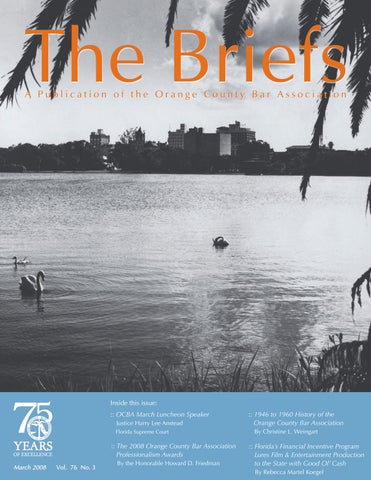
March Cover – Lake Eola in the 1950’s Cover photo courtesy of the Orange County Regional History Center The Briefs, March 2008, Vol. 76 No. 3
President’s Message
March 2008
Promoting Camaraderie C. Gene Shipley Camaraderie – a spirit of familiarity and closeness. When I am asked by my friends outside of the legal profession to describe what is most difficult about being an attorney, my response is easy: conflict and consumption. As advocates, we are charged with zealously representing our clients’ interests. To do so, we typically serve in a manner that is in opposition to the interests of another party, also represented by counsel. As a result, we encounter a hazard particularly prevalent in the legal community: conflict. We often see expressions of conflict between clients and can also experience conflicts that arise among ourselves as we strive to protect our clients’ interests and rights. Another unfortunate consequence of being an attorney is the amount time we must devote to our practice. As former “1-L’s,” many of us remember our professors’ frequent refrain that “the law is a jealous mistress.” I expect most of the recent law school graduates who took the Florida Bar Exam in February are beginning to appreciate the truth of this. After taking the Oath of Admission and swearing to uphold the standards of professionalism it imposes, these new attorneys are discovering that time, energy and hard work are required of those of us who have chosen to be officers of the court. Of course, representing clients does not take into consideration the time required to manage the business of running a law firm. Being a responsible, successful lawyer is a consumption of time and energy. While there will always be adversarial assignments and heavy demands on our time, the practice of law is often more enjoyable when counsel and the court are familiar with each other. As noted in our Mission Statement, one of the OCBA’s goals is promoting camaraderie - helping members to develop familiarity and friendship with one another. The OCBA and its Young Lawyers’ Section (YLS) offer a number of opportunities throughout the year for members to meet in social settings and develop both personal and professional friendships that, quite likely, will last a lifetime. For example, the YLS is famous for its happy hours and pub crawls. Although this might not be a preferred activity for all OCBA members, it certainly brings together our young (and some not-so-young) colleagues on a regular basis for a little fun. The YLS organizes events like happy hours for our members and other young professionals in the community, and an annual summer Law Clerk’s Reception to thank the up-and-coming future attorneys for their work and introduce them to potential future employers and members of the judiciary. YLS’s Evening with the Judiciary is one of the OCBA’s most popular annual events, The Briefs, March 2008, Vol. 76 No. 3
often drawing over 250 attendees. For each of the past several years, members of the local judiciary and the OCBA have gathered in a relaxed atmosphere to enjoy each other’s company and establish a respectful camaraderie that fosters goodwill within the legal community and, by extension, the larger community. It might take another page to list all of the YLS’s activities, because our young attorneys are also involved in many education programs and community service projects. Each summer, the YLS hosts “An Afternoon at the Courthouse,” which provides new attorneys, law clerks and paralegals a chance to tour the Orange County Courthouse, learn about the Ninth Judicial Circuit’s procedures and protocols, meet with court administration and “learn the ropes.” The program, in effect, extends a hand to legal professionals who might not otherwise be involved in the bar yet. The YLS also fosters camaraderie among OCBA members by inviting them to participate in numerous community service projects, such as Habitat for Humanity, Seniors First, Backpacks for Kids, Holidays in January, Relay for Life (to benefit the American Cancer Society) and the Great Oaks Village Fun Day- to name just a few. Lest you think the “Big Bar” is snoozing, the OCBA’s Social Committee is also dedicated to bringing members together for a chance to network and have a good time. This past year brought us annual events including the Summer Happy Hour and Team Trivia contest, a joint happy hour with members of other local bars, the Texas Hold ‘Em Poker Tournament and the Winter Wine & Cheese Party. This year, for the first time, the Social Committee also hosted a Law Student Reception and a book signing happy hour event. The OCBA’s big event, however, is still to come... the Gala. The Eleventh Annual OCBA Gala is scheduled for April 12, 2008. By the time you read this column, I trust you have purchased your tickets for our yearly fundraising event to benefit the OCBA Foundation. The Gala begins at 7:00 p.m. and will be held at the beautiful, new George C. Young U.S. Courthouse and Federal Building Annex. As in the past, we will have a wonderful martini bar, excellent food and music by the popular band, The Boomers. Many of you and your firms have helped to sponsor this event in the past, and we look forward to your support again this year. One of the most visible ways the OCBA promotes camaraderie is through our luncheons. Each month, nearly 300 members get together to “break bread” and to make or renew friendships. This year, we have been pleased to provide speakers at our luncheons including Tom Continued on page 6 PAGE 3
PAGE 4
The Briefs, March 2008, Vol. 76 No. 3
Sponsored by
OCBA Luncheon Speaker March 27, 2008
Justice Harry Lee Anstead Florida Supreme Court Harry Lee Anstead was raised as the youngest of six children by his mother, Loretta, in Jacksonville’s Brentwood housing project just after the Great Depression and in the years during and after World War II. He began work at a young age, cutting lawns, moving furniture, doing anything to help support himself and his family and build a future career as a lawyer and public servant. He advanced to the highest judicial office in state government on July 1, 2002, when he became Florida’s 50th Chief Justice. Justice Anstead worked his way through both undergraduate and law school at the University of Florida, and he later was the first sitting judge in the United States to earn an academic degree in the judicial process when he was awarded a Master of Laws degree at the University of Virginia. Between undergraduate and law school he served with the National Security Agency in Washington, D.C. Justice Anstead was a trial and appellate lawyer in South Florida until 1977 when he became a judge of the Fourth District Court of Appeal, where he served as Chief Judge and, from time to time, as a circuit and county judge throughout the district. As an appellate judge, he was especially noted for the many dissenting and other opinions later approved or adopted by the Florida Supreme Court. During his tenure he was honored by being nominated for appointment to the Supreme Court by four successive statewide nominating commissions. As a citizen, lawyer, and judge he served his community and profession in a host of ways, including service to charities, government, church, schools, children, and other community-building institutions. He is a direct descendant of veterans of the American Revolutionary War and the Civil War and is a member of the Sons of the American Revolution. He and his wife Sue, who is also a lawyer, have been life-long child advocates, and the Chief Justice has been inducted into the Hall of Fame of the Boys and Girls Clubs of America in recognition of his service. On August 29, 1994, Justice Anstead was appointed to the Florida Supreme Court by Governor Lawton Chiles. While on the Court, Justice Anstead has initiated a number of changes to the Court’s internal procedures to improve the quality and efficiency of the process. He also initiated a comprehensive statewide program to improve professionalism among judges, lawyers, and law schools in the state. His initiative included the creation of a Supreme Court Commission on Professionalism and a permanent Center for Professionalism at The Florida Bar. The American Bar Association has recognized this initiative as the most significant recent professionalism initiative in the nation, and Justice Anstead has been recognized by Florida lawyers as the father of the modern professionalism movement in Florida. He has served on the Judges Advisory Committee to the ABA Committee on Ethics. He is the author of numerous publications on the law and has served on the boards of trustees of two Florida law schools. During his judicial tenure, he has consistently ranked among the highest in statewide polls. The major priority of his administration as Chief Justice has been maintaining the excellence of Florida’s trial courts during a time of transition and improving the lot of children whose lives are affected by the courts. Under a 1998 constitutional amendment, funding for Florida’s trial courts shifted from local budgets to the state budget by 2004, and the Chief Justice led the effort to protect Florida’s trial courts during this critical time. Justice Anstead and his wife Sue have five children and four grandchildren. Chris is a graduate of the U.S. Military Academy at West Point and the University of Florida Levin College of Law. Jim is a graduate of Florida State University. Laura is a graduate of Florida State University and South Texas College of Law. Amy is a graduate of Arizona State and a student at the University of Miami College of Medicine. Michael is a graduate of the University of Florida.
The Ballroom at Church Street • 11:30 a.m. - 1:00 p.m. 225 S. Garland Avenue • Orlando, FL 32801 There’s no such thing as a Free Lunch! Please RSVP to reservations@ocbanet.org by Thursday, March 20, 2008. To ensure a proper luncheon count, RSVPs and CANCELLATIONS are requested no later than Thursday, March 20, 2008. The OCBA is happy to provide 11 luncheons as part of your member benefits, but no-shows incur additional charges for the Bar and walk-ups can’t be guaranteed a spot. Please keep us up-to-date on your reservation status! Thank you. The Briefs, March 2008, Vol. 76 No. 3
PAGE 5
President’s Message
Continued from page 3
Hurlburt, Otis Smith, Lou Frey, Jr., Carolyn Fennell, Rocky Rodriguez, Buddy Dyer, Jeremy Foley and Dennis Archer. We are looking forward to welcoming Florida Supreme Court Justice Harry Lee Anstead as our speaker this month, and Randall James in April. We are lining up more great speakers for next year, such as Bob Graham, Val Demings, Jason Gonzalez and Jim Bacchus. I recently had the privilege of attending an event that perhaps best evidences the lasting effects of friendships developed through the OCBA - the Past President’s Dinner. Although one of our goals for arranging the evening was to bring the OCBA’s past leaders up to date on the state of the OCBA in 2007-2008, I must admit that our past presidents seemed less impressed by our “state” than they were by being together again as a group. Every smile I saw and every word of appreciation I heard from our past presidents related to their pleasure in being able to visit with old friends. It was quite an impressive testament to the value of friendship, and it gave me confidence that my fondest memories will also be of the personal and professional relationships I’ve developed with fellow OCBA members. Our hope is that it will be the same for you as well. C. Gene Shipley is a shareholder with Nardella Chong, P.A. He has been a member of the OCBA since1997.
Insurancethat’s beenaround,staysaround. Malpractice coverage that goes the distance: that’s Lawyers Direct, an insurance program created for lawyers, by lawyers. Lawyers Direct is backed by a highly rated, financially strong insurance company that has an established record of providing coverage for law firms throughout the country. Small firms (one to ten attorneys) seeking dependable coverage should call 800.558.6688 or visit www.LawyersDirect.com.
Lawyers Direct
Lawyers Direct is underwritten by Professionals Direct Insurance Company, a member of The Hanover Insurance Group, Inc., and is rated A- (Excellent) by the A.M. Best Company.
PAGE 6
The Briefs, March 2008, Vol. 76 No. 3
Professionalism Committee
The 2008 Orange County Bar Association Professionalism Awards And the Winner Is . . . Winners Are . . . The Honorable Howard D. Friedman On behalf of the OCBA and the Professionalism Committee, we are pleased to announce this year’s recipients of the 2008 William J. Trickel, Jr. Professionalism Award, the Lawrence G. Mathews, Jr. Young Lawyers Professionalism Award, and the James G. Glazebrook Memorial Bar Service Award. We had a great response to our call for nominees for this year’s professionalism awards. All of the nominees were outstanding. Each nominee possessed qualities deserving and receiving serious consideration in the awards selection process. A lot of thought and care went into this year’s selections. I would like to thank those of you, including many prior Trickel and Mathews Awards recipients, who participated in the process of selecting this year’s awards finalists. Also, I would like to specially thank 1995 Trickel Award winner, Jules Cohen, for chairing this year’s OCBA professionalism awards subcommittee and additionally thank Jules and his firm, Akerman Senterfitt, for hosting the meetings. If you made a nomination or otherwise knew that you were nominated and you didn’t receive the award this year, don’t lose heart, feel slighted or think that there has been some outright rejection of the nomination. The fine work and commitment to professionalism of all those nominated has been noted by your local bar association through the awards selection process. If you were one of the nominees who didn’t receive an award this year, please understand that you may be in line to receive an award in the future. To this year’s recipients - a hearty congratulations. You
have made a difference in your community. You embody through your actions the ideals of professionalism to which we all should be striving, and you should be viewed as role models for our OCBA members. The Trickel and Mathews Awards recipients join the crème-de-la-crème group of well-respected and prominent lawyers who have achieved these honors in prior years. And, of course, the inaugural recipient of the Glazebrook Award sets the standard of professional achievement and service against whom future jurists will be measured. I can keep silent no more. So without further ado . . . The recipients of the OCBA’s annual professionalism awards are: The 2008 William J. Trickel, Jr. Professionalism Award: Counsel Wooten, Jr. The 2008 Lawrence G. Mathews, Jr. Young Lawyers Professionalism Award: Elizabeth F. McCausland And, the first James G. Glazebrook Memorial Bar Service Award: Judge Emerson R. Thompson, Jr. Please join us at the March 27, 2008, OCBA Bar Luncheon to honor this year’s OCBA Professionalism Awards recipients. Howard D. Friedman is a Magistrate in the Ninth Judicial Circuit. He has been a member of the OCBA since 2005.
Candidate for OCBA Treasurer
Jessica K. Hew
Put proven leadership to work for the OCBA in 2008-2009. • 2005-06 Recipient of the OCBA President's Award for Outstanding Service to the Orange County Bar • 2004-05 Recipient of the OCBA Outstanding Executive Council Member Award • 2004-05 Recipient of Award of Excellence for Outstanding Service as Member-at-Large OCBA Young Lawyers' Section Board of Directors • OCBA Secretary (2007-08); Executive Council (2003-Present) • OCBA Young Lawyers' Section Secretary (2002-04); Board of Directors (2001-05) • OCBA Young Lawyers' Section ABA Affiliate Representative (2002-2005) • OCBA The Briefs Editor (2005-2007); SideBar Columnist (2007-Present) Director (2003-04); Hearsay Columnist (2000-05); YLS: Columnist (2001-02) • OCBA Inaugural Social Committee Chair (2004-05); Member (2004-Present) • OCBA Brown v. Board Community Liaison (2003-2004) • OCBA Diversity Committee (2002-2004) • Citizens Dispute Settlement Mediator (1998-2000) • Guardian Ad Litem (1997-1998)
Thanks for your support! The Briefs, March 2008, Vol. 76 No. 3
For more information on qualifications or to discuss platforms or issues, please contact Jessica at 407-647-4455 or jhew@grahambuilder.com PAGE 7
L-332449_SzA.qxd
7/30/07
2:30 PM
Fully tible compa rosoft ic M with Vista!
Page 1
Serious leverage at depositions
LiveNote® gives your side a distinct advantage before, during and after depositions. This powerful yet easy-to-use software connects your laptop directly to the court reporter’s machine and the videographer’s camera during a deposition. So you can edit, sort and organize the testimony as it’s given, save video clips and later embed them in PowerPoint® for presentation at trial.
(LiveNote software fully complies with Microsoft® Vista.) Even better, you can send a live, realtime feed of the deposition – both video and transcript – to remote attorneys. Now that’s serious leverage. For more information, call 1-800-762-5272 or visit livenote.com.
© 2007 West, a Thomson business L-332449/8-07
PAGE 8
The Briefs, March 2008, Vol. 76 No. 3
Celebrating 75 Years of Excellence
1946 to 1960 History of the Orange County Bar Association1 Christine L. Weingart Post-war Orlando experienced a period of growth and industry as an economic boom contributed to a population explosion. The growth was so significant that by the 1950s, Orange County was the financial, retail and transportation center for all of Central Florida and had a population of 51,826 (nearly double that of 1930!). Orlando, for the first time, qualified under the Census Bureau’s definition as a metropolitan area. These decades were called the “Furious 40s” and “Fearful 50s,” a reflection of the post-WWII and Cold War fear and paranoia that spread throughout the United States, as well as the unrest surrounding the burgeoning civil rights movement. Echoing this emotional climate, many of the notable events in the legal community in Central Florida reflect a Hollywoodesque drama that would have made great viewing on the silver screen. The headlines might have read something like this: Dashing Heroes! Although born in Charleston, South Carolina, B. Cambell Thornal became one of Florida’s favorite sons, earning his J.D. from the University of Florida and embarking on distinguished legal career as partner in the Orlando law firm of Baker & Thornal. He later entered public service, where he served as both an attorney for the City of Orlando and as an Orange County attorney for various terms in the 1940s and ‘50s, taking time out from this civicmindedness to serve as a Navy lieutenant in World War II. However, during his terms as a city and county attorney, Thornal played a major role in helping to manage issues related to rapid growth, such as traffic and expansion, which were a constant challenge to the burgeoning metropolitan area. From his positions of local importance, Thornal went on to serve as a Justice on the Florida Supreme Court from 1955 to 1970, serving as Chief Justice from 1965 to 1967. In recognition of his many achievements, Justice Thornal was honored by the University of Florida College of Law, which named its Moot Court Team for him. Another notable OCBA star who went on to serve honorably at the state level was Heskin Whittaker, who was president of the OCBA in 1953 and served three terms on the Florida Bar Board of Governors. Feisty Heroines!
Another standout star from this period was Beth
The Briefs, March 2008, Vol. 76 No. 3
Johnson, a noteworthy woman who, although not an attorney herself, was married to one. This starlet of the legal and civic community was involved in a number of Orlando area works, from serving as president of the Orlando Junior League to working with the League of Women Voters. In 1952, one of Johnson’s eclectic positions was as a delegate to the Democratic National Convention. On July 30, 1953, Johnson was named chairman of Orlando’s first municipal planning board, and a few years later, in 1957, was elected to the Florida House of Representatives. Johnson was the first woman to serve in the House in 35 years, after the historic election of the first woman representative, Mrs. Edna Giles Fuller, another notable Orange County daughter. Johnson would go on to be elected Florida’s first woman Senator in 1962. Notorious Criminals! Not to be out done by the aforementioned outstanding citizens, Orlando also had its fair share of crooked ne’er-do-wells. In February 1947, Orlando had its very first bank robbery when professional burglars looted the night depository vault at the First National Bank and escaped with an estimated $91,600 (which would be nearly $900,000 in today’s terms) after entering through the Church Street door. One of the most notorious Central Florida criminals of this period was Harlan Blackburn (nicknamed “the Colonel”), who was the face of organized crime in Orlando, leading his so-called “Cracker Gang.” From the 1940s through the 1960s, Harlan Blackburn, an old-style mobster associated with the equally notorious Tampa mob lord Santo Trafficante, Jr., was a gambling boss who ran a million dollar gambling racket in Central Florida. Blackburn’s game of choice was Bolita, a numbers game based on the Cuban national lottery, which was played by members from all levels of society. In the 1950s, Blackburn’s notoriety in Central Florida was heating up. An associate of Blackburn’s, Frank Duskin of Winter Park, was a clothing salesman and evangelist who had turned state’s evidence against Blackburn. The trial was one of the most talked-about events of the time, setting the scene for a dramatic flurry of activity among local criminals Continued on page 10 The following sources were consulted during the preparation of this article: Eve Bacon. Orlando, A Centennial History. Chuluota, Florida: The Mickler House Publishers, 1977; http://www.law.ufl.edu/leadership/thornal.shtml; Roger Roy, Orlando’s most colorful mobster dies, Orlando Sentinel, Nov. 7, 1998; 1
PAGE 9
Celebrating 75 Years of Excellence
Continued from page 9
vying for the position of heir-apparent to Blackburn’s Bolita business. A newspaper article in June 1953 declared that there were “16 In Line For Racket Boss in Central Florida if Blackburn Is Jailed,” including in the list such colorful characters as Pete the Tailor and Big Rabbit Holland. One of those who might have been likely to succeed Blackburn was Ed Milan, who got a “one-way ride” in 1953. Amid rumors circulating that he had been cut from a racketeering deal meant to cement his importance in the postBlackburn flurry, Milan’s body was discovered in a swamp south of Kissimmee. Blackburn eventually was convicted on racketeering charges in Polk County, although that did not prevent his crime career in the least. Blackburn’s career in organized crime peaked in the 1960s, and he was in and out of jail until 1993, when he finally was convicted on cocaine possession. He died in prison in 1998 at the age of 79, a larger than life figure who was, ironically, largely forgotten in his later years. (Allegedly) Crooked Cops! A crime in nearby Lake County brought the national spotlight to Central Florida in 1949, when a 17-year-old Groveland woman by the name of Norma Padgett accused four African American men of rape, thus instigating the dramatic story of Willis McCall and The Groveland Four. Within ten days of the report of the alleged rape, one of the suspects was shot dead by a sheriff’s posse, and the other three suspects had to be hidden, allegedly in McCall’s own home, from another posse intent on taking the law into its own hands. McCall, who served as Sheriff of Lake County from 1944 until 1972, was a controversial figure in his time, although he was never formally indicted for any of the crimes of which he was accused through the years. In 1951, while transporting two of the Groveland Four to a retrial, McCall shot the two handcuffed prisoners, later claiming the shooting was in self-defense. This claim was understandably met with skepticism from the public, given that McCall had a history of blatant racist behavior. One of the two prisoners died from the wounds. The two remaining members of the Groveland Four went on to be convicted of the rape, and the entire incident brought the national spotlight, already focused on the growing civil rights movement, to the Central Florida area. Although he was investigated, McCall was never convicted of any crime relating to the shooting. Despite the controversy surrounding him, McCall continued to serve as Sheriff of Lake County for many years. Time Travel!
The story of the new (at the time) courthouse, which
PAGE 10
first broke ground in 1958, is a colorful tale of the attitudes that prevailed in the 1950s. The original courthouse, a Romanesque brick building constructed in 1892, complete with a booming clock tower and stained glass windows, had become a lynchpin that tied the bustling Orlando metropolis of the mid-20th century to the small town of the late 19th century. Despite the nostalgia surrounding the building, by the mid-1950s a debate was raging about whether or not to tear down the crumbling building, when an unexpected event put a halt to all discussion. All arguments for keeping the building in place were silenced when a falling brick almost took out a juvenile court judge who was exiting the building. The old brick courthouse was demolished in 1957, with pieces of the brick rumored to be sold at booths set up by entrepreneurial members of Boone High School’s Key Club. The demolition of the old courthouse, however, did allow Orlandoans to peek into the past: a time capsule embedded in the cornerstone of the old building at the time of its construction in 1892 was unearthed. The cornerstone contained a variety of objects straight from the 19th century, including newspapers, an Orlando directory from 1891, an Indianhead penny and an 1831 Libertyhead half-dollar coin, all of which were donated to the Orange County Historical Commission. Inspired by their forefathers, when the new courthouse annex foundation was laid in 1958, the movers and shakers of the time decided to create their own capsule for the future. The 1958 cornerstone, scheduled to be opened in 2058, contains some of the same types of items, such as coins and maps, as did the earlier capsule. It also preserves a message for future residents of Orlando: letters from the county commissioners to the county commissioners of 2058, a letter from Representative Jack. C. Inman to his future successor, and numerous business and campaign cards. Now, halfway through the 100 years between the year the new courthouse annex was laid and the year the 1958 time capsule is scheduled to be opened, it is interesting to imagine what the next fifty years has in store. In the fifty years since the cornerstone was laid, we have transformed from a society in which Bolita was a hotbed of criminal activity into one where legalized gambling is sweeping the state. In the 1950s, women were just beginning to make a break-through into the Central Florida legal community, and today the Orange County bar is a rich field of diversity on all levels. The heroes and villains of the era are certainly worthy of their own golden-age cinema masterpiece. Christine L. Weingart, an attorney with Dean, Mead, Egerton, et al., has been a member of the OCBA since 2007. The Briefs, March 2008, Vol. 76 No. 3
Family Law Committee The Presumptions Against Rotating and Split Custody Arrangements and the Non-statutory Child Support Computations When These Arrangements Do Occur Susan W. Savard The Rebuttable Presumption Against Rotating Custody
Langford, 654 So.2d at 1238.
It is well settled Florida law that rotating custody arrangements are strongly disfavored and ordinarily may not be sustained. Bienvenu v. Bienvenu, 380 So.2d 1164, 1165 (Fla. 3rd DCA 1980). Rotating custody is presumptively not in the best interest of a child. Langford v. Ortiz, 654 So.2d 1237 (Fla. 2nd DCA 1995) and Garvie v. Garvie, 659 So.2d 394 (Fla. 2nd DCA 1995). In 1997, the Florida legislature enacted Florida Statute 61.121 which provides that a trial court may order rotating custody when in the best interests of the minor child. The statute does not abolish the presumption that rotating custody is not in the best interest of the minor child. Mandell v. Mandell, 741 So.2d 617 (Fla. 2nd DCA 1999). Nothing in the section detracts from the long-standing presumption frowning upon a rotating custody arrangement. Chapman v. Prevatt, 845 So.2d 976 (Fla. 4th DCA 2003), Mancuso v. Mancuso, 789 So.2d 1249 (Fla. 4th DCA 2001). The presumption that rotating custody is not in the best interest of a child may be overcome only upon a showing of the specific factors outlined in Langford v. Ortiz, 654 So.2d 1237, 1238 (Fla. 2nd DCA 1995). The Langford court instructed as follows:
An eighth factor was also enunciated in Hosein v. Hosein, 785 So.2d 703 (Fla. 4th DCA 2001), providing that in addition to the factors noted above, the court should also consider “the parents’ attitude toward each other, and how their attitudes might affect and be perceived by the children.” Several courts have recognized that a hostile environment would actually jeopardize a rotating custody arrangement. “[T]he animosity of the parties and the way they were trying to use the child in a possessive manner ... militate against rotating custody.” Lamelas v. Granados, 730 So.2d 387, 388-89 (Fla. 2d DCA 1999) (citing psychologist’s report that joint custody works only when there is good communication between the parents); Garvie v. Garvie, 659 So.2d 394, 396 (Fla. 2d DCA 1995) (court “can reasonably foresee that this mutual antagonism [between the parents], coupled with this inability to communicate, would have a distressing effect on the child in a rotating custody arrangement”); see also Bienvenu v. Bienvenu, 380 So.2d 1164, 1165 (Fla. 3d DCA 1980) (rotating custody arrangement would be “rendered even more distressing [to the children] by the fact that their mother and father are so mutually antagonistic”). The issue of whether animosity is a reason for the court to approve rotating custody (which could be utilized by one of the parties to engage in untoward conduct with the hope of gaining rotating custody) or whether animosity between the parents is a reason to disapprove of it is a question of certified conflict. See, Boardman v. Roy, 775 So.2d 334 (Fla. 2nd DCA 2000).
Rotating custody, such as the lower court ordered here, is presumptively not in the best interest of a child. Courts have, however, discussed several factors that could overcome this presumption: (1) that the child was older and mature, Bienvenu v. Bienvenu, 380 So.2d 1164 (Fla. 3d DCA 1980); Gerscovich v. Gerscovich, 406 So.2d 1150 (Fla. 5th DCA 1981); (2) that the child was not yet in school, Parker v. Parker, 553 So.2d 309 (Fla. 1st DCA 1989); Alexander v. Alexander, 473 So.2d 236 (Fla. 2d DCA 1985); Wilking v. Reiford, 582 So.2d 717 (Fla. 5th DCA 1991); (3) that the parents lived near each other, Gerscovich; Parker; Bienvenu; (4) that the child preferred rotating custody, Gerscovich; (5) that rotation would not have a disruptive effect on the child, Gerscovich; Bienvenu; (6) that the periods of time spent with each parent were reasonable, Gerscovich; and (7) that the periods of custody were related to divisions in the child’s life, such as the school year, Bienvenu. The Briefs, March 2008, Vol. 76 No. 3
Child Support Computations In Rotating Custody Scenarios When The Presumption Is Overcome Should the Court find that the presumption against rotating custody of the minor child(ren) has been overcome, the computation and calculation of child support between the parties then needs to be closely examined. Because there is no designation of primary residential parent under a rotating custody scenario, the substantial contact adjustment under F.S. 61.30 is inapplicable and case law requires another method of computation: The former husband argues that in computing child support, the trial court incorrectly relied upon the guideline formula utilized in cases where one parent has been designated as the primary residential parent. See § 61.30 (11) (b), Fla. Stat. (2004). We agree because here, the parties had rotating custody of their two children. Continued on page 13 PAGE 11
PAGE 12
The Briefs, March 2008, Vol. 76 No. 3
Family Law Committee
Continued from page 11
Jaworski v. Jaworski, Florida Second District Court of Appeal, Case Nos. 2D05-4717 and 2D05-5277 consolidated, Opinion Filed January 25, 2008 (subject to Motions for Rehearing, if any, at the time of this writing). The computation of child support in a rotating custody situation is based upon the following calculations: 1) calculate the total child support award, and each parent’s share under the guidelines as it is presently done; 2) determine the amount of time each parent has the child and reduce it to a percentage, e.g. each parent has the child 50% of the time; 3) proportion the total child support award to each parent, based on the percentage of time each parent has the child with him or her; and 4) offset each parent’s dollar responsibility under the guidelines. Rainsberger v. Rainsberger, 819 So.2d 275 (Fla. 2nd DCA 2002); Jones v. Johnson, 747 So.2d 1066, 1068 (Fla. 5th DCA 2000) and Cole v. Cole, 792 So.2d 605 (Fla. 2nd DCA 2001)1. Notably absent from the above computation is the “gross up” computation whereby each parent’s base guideline amount is multiplied by 1.5 in accordance with the substantial contact adjustment of F.S. 61.30 (11)(b). This “gross up” is inappropriate in a rotating custody situation as no designation of primary residential parent has been made. The computations set forth above should be utilized. Split Custody Arrangements A split custody arrangement arises when each parent has primary residential responsibility for one or more of the children. The children are literally split between households. There is no statutory provision specifically authorizing the Court to make this award; it is strongly disfavored, and utilized in only the most exceptional of cases. Likewise, there is no legislative mandate for calculation of child support under a split custody scenario, and thus, an examination of precedent is required. In the rare instances when split custody is approved by the Court, the child support computation is as follows: (1) Determine the net monthly income of each party and the combined net monthly income; (2) Determine the base guideline amount pursuant to F.S. 61.30(6); (3) Allocate the base guideline support amount to the number of children involved. (This is the only scenario where a per capita allocation of child support is permissible.); (4) Multiply the support allocated to each child by the number of children in each parent’s care; (5) Apply the parental payor percentages to each parent’s child support obligation to the other parent; (6) Adjust each parent’s obligation for contribution toward health and medical insurance and daycare costs incurred by applying the parental payor percentages; (7) Credit each parent for payments actually made for health and medical insurance The Briefs, March 2008, Vol. 76 No. 3
premiums and daycare costs; (8) Calculate the difference between each parent’s obligations for child support. Winters v. Katseralis, 623 So.2d 613 (Fla. 2nd DCA 1993). Winters was later modified by Gingola v. Velasco, 668 So.2d 1054 (Fla. 2nd DCA 1996) to include a ninth step: the net amount to be paid from one party to the other is one-half of the difference between the two child support amounts. The opinions in Winters and Gingola were both authored by Judge Alterbernd, who acknowledged that the Winters opinion contained a mathematical error and stated “Having established his mathematical prowess in Winters, the author suggests that even he might benefit from an article on this complex subject written by a lawyer who paid better attention in high school algebra.” Gingola, 668 So. 2d at 1055. Failure to consider applying one-half of the difference of the support obligations between the parties (step 9 above) constitutes manifest injustice. Logue v. Logue, 766 So. 2d 313 (Fla. 4th DCA 2000). At about the same time the Second District Court of Appeal was grappling with the split custody child support calculation in Winters, the Fourth District Court of Appeal was also addressing the same issue in Simpson v. Simpson, 680 So. 2d 1085 (Fla. 4th DCA 1996). The majority opinion in Simpson opined that because child support statute does not address a calculation in split custody arrangements, an argument based upon inappropriate deviation from the guidelines could not prevail, and the trial court was left with discretion in the split custody child support computation. The court then opined that the Simpson trial court’s methodology was not arbitrary and unfair and upheld the computation. The majority opinion did not, however, specifically explain the trial court’s methodology. The well reasoned dissenting opinion of Judge Warner provides helpful insight into the trial court’s methodology and the drastic differences in the amount of child support to be exchanged between the parents resulting from differing methodologies of the split custody child support calculation. While rotating custody and split custody arrangements are disfavored, they do occasionally arise based upon extenuating circumstances. When this occurs, calculation of the appropriate child support amounts to be exchanged between the parents can be a complex issue. The practitioner should be aware of these complexities in the child support computations and how to properly calculate the correct amount of child support. It may be questioned whether the Cole court had the benefit of the substantial contact adjustment statute at the time the opinion was rendered, as they were in close proximity in time. The Cole opinion and methodology for rotating custody child support calculations was rendered shortly after the enactment of the statute. The methodology of Cole, however, was approved by Rainsberger, and most recently by Jaworski). 1
Susan W. Savard is an associate with Michael R. Walsh, P.A. She has been a member of the OCBA since 2005. PAGE 13
Independent Financial & Accounting Expertise
Forensic Accounting Damage Analysis Business Valuations Fraud Litigation Support Expert Testimony
Call Bob Morrison 407.898.2727 - Robert.Morrison@rsmi.com
RSM McGladrey, Inc.
Accounting • Tax • Business Consulting www.rsmMcGladrey.com
PAGE 14
The Briefs, March 2008, Vol. 76 No. 3
Entertainment Law Committee Florida’s Financial Incentive Program Lures Film & Entertainment Production to the State with Good Ol’ Cash Rebecca Martel Koegel The State of Florida recently revised its Entertainment Industry Financial Incentive Program, which became effective July 1, 2007, and can be found at §288.1254, Florida Statutes (hereinafter, the “Incentive Program”). The revised Incentive Program was a complete overhaul from the previous incentive, touting substantial changes. Former State Film Commissioner Paul Sirmons said it was his mission when he took the position to do just that. Today, the majority of states in this country provide some form of monetary incentive, often tax credits or cash reimbursements, to entice productions to choose their state over the rest of the country (or other countries) as a production’s location.1 Incentive programs are known to have a quick and powerful economic impact on the state in which they operate.2 For example, production companies spent more than $300 million to make movies, television shows and commercials in Connecticut since a 30% tax credit took effect in July 2006.3 Compare this to just $1 million in the first six months of 2006 (before the tax credit was in effect) and it is clear to see the economic benefits of a generous tax incentive program.4 Each incentive program varies widely, ranging from rebates on labor and expenditures, sales and use tax abatements, loans, free police and permits, and transferable tax credits.5 Most programs include qualifying requirements such as a certain percentage of production to take place in the state, while others set a minimum threshold for spending. Florida’s Incentive Program Florida’s Incentive Program was created within the Governor’s Office of Film and Entertainment (OFE) to “encourage the use of this state as a site for filming and to develop and sustain the workforce and infrastructure for film and entertainment production.”6 To further support this mission, the Governor and the Florida Legislature provided $25,000,000 in funding for the 2007-2008 fiscal year, which is up $5 million from the previous fiscal year. Reimbursement through the Incentive Program is first come, first served; therefore, reimbursements will continue to be processed until all money is spoken for or until June 30, 2009, whichever is sooner.7 See Association of Film Commissioners International, at www.afci.org; see also The Center for Entertainment Industry Data and Research, at www.ceidr.org; and The Global Success of Production Tax Incentives and Migration of Feature Film Production from the U.S. to the World, Year 2005 Production Report, by Stephen M. Katz at www.ceidr.org. 2 The Global Success of Production Tax Incentives and Migration of Feature Film Production from the U.S. to the World, Year 2005 Production Report, by Stephen M. Katz at www.ceidr.org. 1
See Movies Stampede to States with Generous Tax Incentives by Julie Moran Alterio published in The Journal News on Sept. 16, 2007. 3
The Briefs, March 2008, Vol. 76 No. 3
Program Overview Florida’s Incentive Program is basically a “cash rebate” program and generally works as follows: Before production takes place, a company producing a “qualified production” may submit a program application to the OFE for determination of certification.8 A production is deemed a “qualified production” if it meets the minimum qualified expenditures for its type of production (more fully discussed below), more than 50% of the positions that make up its production cast and below-the-line production crew are filled by Florida residents, and it is not deemed to contain obscene content as defined in Florida Statutes §847.001(10).9 The application must include information regarding the production’s estimated qualified expenditures, which are defined as production expenditures incurred in the state for: (1) goods purchased or leased from, or services provided by, a Florida vendor or supplier and (2) payments to Florida residents including salary, wages or other compensation up to $200,000 or $400,000 per resident depending on the type of production.10 The OFE must review the application within ten business days after receipt and, upon determination that the application meets the requirements and contains all necessary information, OFE must qualify the applicant and recommend to the Office of Tourism, Trade, and Economic Development (OTTED) that the applicant be certified for a maximum amount of available funds.11 Within five business days, the OTTED must reject or certify the applicant. Upon certification, the money the production qualifies to receive as a cash rebate after production (determination of amount discussed below) is set aside and earmarked for that applicant. The certified production and the OFE enter into a written agreement, setting forth the terms and conditions of the incentive program and to assure compliance with same. If all incentive funds in the queue are certified to other productions, subsequent applicants will be placed on a wait list. After production takes place, the certified production seeking reimbursement prepares a list of its actual qualified expenditures, which must then be submitted to an independent certified public accountant (at its own cost) Continued on page 16 See Movies Stampede to States with Generous Tax Incentives by Julie Moran Alterio published in The Journal News on Sept. 16, 2007. 5 The Global Success of Production Tax Incentives and Migration of Feature Film Production from the U.S. to the World, Year 2005 Production Report, by Stephen M. Katz, p. 61.s 6 See Fla. Stat. §288.1254. 7 Fla. Stat. §288.1254(4)(a). 8 Fla. Stat. §288.1254(3)(a). 9 Fla. Stat. §288.1254(3)(a). 10 Fla. Stat. §288.1254(1)(g). 11 Fla. Stat. §288.1254(3)(d). 4
PAGE 15
Entertainment Law Committee
Continued from page 15
to conduct an audit of the qualified expenditures and the substantiating data. The audit report and data must then be submitted with an application to the OFE for processing. Upon review by the OFE, it must report to the OTTED the final verified amount of actual qualified expenditures and OTTED determines and approves the incentive amount to each certified applicant. A qualified production can lose its qualification and forfeit any certified funds in some circumstances, such as where the OFE or OTTED determines that the production does not start principal photography within 45 calendar days either before or after the date specified in the application or if the production is determined to be pornographic or to contain obscene content, as defined by Florida’s Supreme Court.12 Reimbursement Amounts The reimbursable amounts vary depending on the type of production, time of year and other factors. For productions shot from December 1 to May 31, generally the reimbursable amount is 15% of total qualified expenditures. An additional 5% reimbursement of total qualified expenditures, for a total of 20%, is provided if production is shot from July 1 to November 30 (intended to reward those willing to brave our Florida summers and hurricane season).13 This off-season bonus has been so successful under the revised Incentive Program that as of the end of September 2007 fifty productions already applied and are scheduled to shoot.14 Further, productions of films and television programs can apply for an additional 2% reimbursement if the production is found to be “family friendly,” defined by statute to mean productions “that have cross-generational appeal; would be considered suitable for viewing by children age five and older; are appropriate in theme, content, and language for a broad family audience; embody a responsible resolution of issues; and do not exhibit any act of smoking, sex, nudity, or vulgar or profane language.” The decision about whether a production qualifies as family friendly is made by the Commissioner of Film and Entertainment, with input from the Florida Film and Entertainment Advisory Council.15 Production Categories and Specific Requirements Production types are divided into categories for review and processing. Queues C and D were major additions to the revised Incentive Program. • Queue A includes the general production of films, television, commercials and music videos with qualified expenditures totaling $625,000 or more and eligible for up to a maximum of $8 million in incentive funding. The minimum qualified expenditures was lowered from $850,000 to See The Governor’s Office of Film & Entertainment, at www.filminflorida.com. “An off-season certified production that does not complete 75 percent of principal photography due to disruption caused by a hurricane or tropical storm may not be disqualified from eligibility for the additional 5-percent incentive as a result of the disruption.” See Fla. Stat. §288.1254(4)(b)3. 14 Governor’s Office of Film & Entertainment. 12 13
PAGE 16
$625,000 to allow for smaller films to qualify.16 This queue is eligible for 15-22% reimbursement (base 15%, plus 5% off-season if applicable, and 2% family-friendly if applicable).17
• Queue B includes the general production of multiple commercials and music videos with $500,000 or more in combined qualified expenditures and with a minimum of $100,000 in qualified expenditures per production (commercials can be added together to reach the minimum expenditure). This category is eligible for 15-20% reimbursement (base 15%, plus 5% off-season if applicable).18 • Queue C includes feature films or documentaries 70 minutes or longer made by independent Florida filmmakers with qualified expenditures between $100,000 and $625,000 (independent productions with over $625,000 in qualified expenditures must apply in Queue A). To qualify under this queue, all major post production work must be done in Florida and at least six of the eight key positions (writer, director, producer, director of photography, lead actors, unit production manager, editor or production designer) must be filled by Florida residents. This category is eligible for 15-17% reimbursement (base 15%, plus 2% family-friendly if applicable).19 • Queue D includes digital media projects with a minimum of $300,000 in qualified expenditures, which can qualify for a 10% reimbursement up to $1 million per production. Digital media projects include productions of “interactive entertainment which is produced for distribution in commercial or educational markets, including a video game, simulation, or animation, or a production intended for Internet or wireless distribution.”20 Marketing Requirements As a condition to receiving incentive funds, marketing materials promoting the state of Florida as a tourist destination or a film and entertainment production destination must be included when appropriate, including placement in the end credits of a “Filmed in Florida” logo (provided by OFE) with size and placement commensurate to other logos in the credits. If no logos are used, the following statement, or a similar statement approved by the OFE, must be included in the credits: “Filmed in Florida using Florida’s Entertainment Industry Financial Incentive.”21 Further, among other requirements, the production must provide high-resolution Continued on page 18 Fla. Stat. §288.1254(4)(f). Governor’s Office of Film & Entertainment. 17 Fla. Stat. §288.1254(4)(b)(1) - (5) 18 Fla. Stat. §288.1254(4)(b)(1) - (5) 19 Fla. Stat. §288.1254(4)(c)(1) - (4) 20 Fla. Stat. §288.1254(4)(d). 21 See Fla. Stat. §288.1254(3)(g). 15 16
The Briefs, March 2008, Vol. 76 No. 3
Thoughts from a Colleague
The Paragon of Lawyers Aristides J. “Kico” Diaz A paragon is a model or pattern of excellence or perfection. In Hamlet, William Shakespeare described man thusly: What a piece of work is man! How noble in reason! How infinite in faculty! In form and moving how express and admirable! In action how like an angel! In apprehension how like a god! The beauty of the world! The paragon of animals!
expenses. Money and paying clients are power in a law firm. Ever wonder why an obnoxious partner is tolerated or why a technically inferior lawyer is praised or promoted? Look at that lawyer’s client base and collections. Numerous lawyers are uncomfortable with thinking about or discussing the business of law, but that does not change the fact that most lawyers work for a living and have a mortgage to pay. Much like discussing life insurance and death, a lawyer must overcome any squeamishness about the business of law. After mastering the first two levels, a remarkable few find that the job and money are not enough. The work and the money do not make them happy or fulfilled. These lawyers yearn to serve and grasp that they have skills that are sorely needed in the community. They break the familiar pattern of work, couch, and sleep to become part of something greater than themselves. They connect with the community they serve and become better individuals and more effective lawyers. Participating in too many professional activities while ignoring or failing to master the practice and business of law can also be a trap. Lawyers who become overly involved become recognized figures in the community, but often these activities can cause financial stress and resentment within their firm. Orlando’s legal community is strewn with presidents and chairpersons who have been fired or forced out of their firms. While it is difficult to balance the three facets of the law, think about all the lawyers who are well known, and more importantly, well respected in Central Florida. They have all attained excellence in the practice of law, the business of law and the profession of law. They are the Paragon of Lawyers.
But what is the Paragon of Lawyers? I believe the Paragon of Lawyers is someone who has attained excellence in the practice of law, the business of law and the profession of law. By practice of law, I mean the nuts and bolts of being a lawyer – drafting a motion or contract, appearing in court or consulting with clients. The business of law is the obtaining of clients, collecting bills and making everyday business decisions related to running a legal practice. The profession of law involves engaging in activities that enrich the legal profession or the local community, such as joining voluntary bar associations, the Inns of Court, the Legal Aid Society, a church group or serving on the board of a charitable organization. Unfortunately, most lawyers are unaware, uninterested or unable to achieve excellence in all three areas. Fledgling lawyers focus primarily on the practice of law. They are driven by partners or supervisors to concentrate on billing hours, managing cases and performing “good work.” Eventually, these lawyers mature and become technically proficient or even excellent practicing attorneys. However, many fail to progress beyond this point. They fail to grasp the importance of the business side of the law or the sense Aristides J. “Kico” Diaz, Diaz & Moss, as been an OCBA member since 1998. of fulfillment the profession can provide. Stunted in their growth, these lawyers work hard, overlong hours but possess little influence or control over their income or legal career. Moreover, lacking the emotional satisfaction the profession of law can provide, many suffer from burnout and become bitter or change careers. “Put my experience to work for you today” A few lawyers early on, but most • Certified Public Accountant in the middle years of their practice, • Certified Family Mediator discover the importance of the business • Certified Parenting Coordinator side of the law. They come to understand 1211 Orange Ave.,Suite 104 that it is not how many hours you bill or Winter Park, FL 32789 how many hours you collect, but rather whether your collections exceed your Phone: (407) 774-4949 Fax: (407) 774-4960 ajd.lawfirm@gmail.com The Briefs, March 2008, Vol. 76 No. 3
PAGE 17
Entertainment Law Committee
Continued from page 15
still production photos or full-size posters to OFE before public distribution of the production.22 Conclusion Florida’s revised Incentive Program was an instant hit and Queue A was fully allocated within six weeks of July 1, 2007, which was ten weeks faster than last year’s full allocation at the end of October.23 Although not as lucrative as some other states, Florida’s revised Incentive Program is quite generous and Florida makes up for any monetary differences by offering terrific locations, great weather, and an established infrastructure. However, competition is stiff and increasingly more producers are looking for the best deal as the sole influence for choosing their production location.24 The more generous the incentive, the more productions that will choose Florida - which means more business and
employment for Florida’s actors and trained professional crews. Further effort to tailor Florida’s Incentive Program and increase incentive funding will greatly benefit Florida’s economy. Applications and detailed information can be found online at www.filminflorida.com. Inquiries can also be made by contacting the Governor’s Office of Film & Entertainment at 1-877-FLA-FILM. See The Governor’s Office of Film and Entertainment website, at www. filminflorida.com, for further information. 23 The Governor’s Office of Film & Entertainment. 24 The Global Success of Production Tax Incentives and Migration of Feature Film Production from the U.S. to the World, Year 2005 Production Report, by Stephen M. Katz at www.ceidr.org. 22
Rebecca Martel Koegel is an associate with Holland + Knight LLP. She has been a member of the OCBA since 2007.
2 STORY OFFICE BUILDING 1415 E. ROBINSON STREET ORLANDO, FLORIDA Private Offices, Reception Area and Storage/File Room 9 Parking Spaces • Total Size: 3,318 +/- SF Conveniently Located Minutes from Downtown Orlando Trendy Thornton Park within Walking Distance
Sale Price: $835,000
Call: 407.849.0102 Marc Cook, CFP® - mc@tomcookcommercial.com Angela Chrispens - ac@tomcookcommercial.com PAGE 18
The Briefs, March 2008, Vol. 76 No. 3
The Briefs, March 2008, Vol. 76 No. 3
PAGE 19
PAGE 20
The Briefs, March 2008, Vol. 76 No. 3
Ninth Judicial Circuit Court News
Judicial Investitures Submitted by the Ninth Judicial Circuit Court
Two circuit judges and one county judge were invested into office on Friday, February 22, 2008, at the Orange County Courthouse. The Honorable C. Jeffery Arnold, the Honorable Rand F. Wallis and the Honorable Heather L. Higbee took their ceremonial oaths of office with enrobings by their families conferring the authority and symbol of the high office. Judge Arnold has served as a County Judge since 1994 and was recently appointed to the circuit bench by Governor Charlie Crist. He received a bachelor’s degree from the College of William and Mary and graduated with a Juris Doctor from Florida State University College of Law. “I appreciate the confidence Governor Crist has in me in making this appointment,” said Judge Arnold. “It has been a privilege and honor to serve the citizens of Orange County for over 14 years. I look forward to continuing my service to the citizens of Osceola and Orange Counties for the years to come.” Judge Wallis comes to the bench after 13 years in private practice. He holds a bachelor’s degree in Political Science from Furman University in South Carolina and received his Juris Doctor from Stetson University College of Law. He also served as a prosecutor in Seminole County from 1993-1995. In a statement about his appointment, Judge Wallis said, “I am both humbled and excited about my judicial appointment. I will strive to be a great benefit to both the court and the people of Central Florida.” Judge Higbee served for five years as an Assistant State Attorney in the Gainesville area and for one year as an Assistant Statewide Prosecutor in Orlando. She received her undergraduate degree in English from Duke University and her Juris Doctor from the University of Florida College of Law. Over the past ten years, she owned and operated her own law firm here in Orlando where she primarily handled domestic relations cases. “I am very excited to transition my history as a legal advocate onto the bench,” said Judge Higbee. “My hope is that I can take that knowledge and apply it in a positive way to the area of public service.”
The Briefs, March 2008, Vol. 76 No. 3
PAGE 21
“Only Irish coffee provides in a single glass all four essential food groups: alcohol, caffeine, sugar and fat.”
Jeremy Foley, University of Florida Athletic Director, kept everyone entertained at the January 31st Bar Luncheon.
Gator fans John Cash and his dad, Johnny Cash, flank Jeremy Foley. The duo accompanied Foley to Orlando for his luncheon talk to nearly 300 OCBA members and guests.
The Hon. C. Jeffery Arnold was invested as a Judge of the Circuit Court by the Hon. Patricia C. Fawsett on February 22, 2008.
Heather Pinder Rodriguez received the Florida Bar’s YLD Pro Bono Service Award in January. Pictured at the Supreme Court are her family (left to right): Hutch Pinder, Woody Rodriguez, Heather, parents Gail and John Pinder, and daughter Ella Grace. PAGE 22
- Irish author Alex Levine
Yes, lads and lassies, St. Valentine has left the building and April showers have not yet arrived. It must be March, the time for three of the finest of rituals. The first, of course, is the celebration of St. Patrick. Drove the wicked asp right out of the Emerald Isle he did, and we celebrate that feat by raising a glass or three in his honor and a cheer of Sliante before trying to remember what the next line of “Danny Boy”1 is supposed to be. If you’re lucky, it’s Guinness or Harp on tap. If you’re not, it’s Natty Light with one-too-many squirts of Green No. 2. added for the occasion. Regardless of the beverage chosen, Hearsay of course reminds everyone to celebrate responsibly, and that March 18 is “buy-your-designated-driverlunch” day. March tradition #2? Hint: It fills the whole month and doesn’t require an accent. It’s March Madness, Baybee, and by the time this issue gets to you, Selection Sunday is either right around the corner, or a short seven days have passed that mark and your bracket is already looking like a Battleship board when you’ve only got your submarine left. I was in Hotlanta for last year’s tourney - a wee bit of fun that was! (Quoth the Guinness Guys: Brilliant!) Anyhow, let’s go ahead and clear out this month’s trivia question early: Name the only 16th-seeded David to take out a number 1-seeded Goliath in the first round of an NCAA March Madness Tournament? First correct answer e-mailed to me at nshannin@ floridalawonline.com gets his or her name in the May issue. And March tradition #3? The selling of the Gala Tickets! So glamorous that Fergie should write a song about it, the Eleventh Annual OCBA Gala is back, and promises to be another smash success. Chaired this year by Tom “Roetzel like Pretzel” Wert and K-Square (Briefs Editor Kristyne Kennedy for those not following along with the nicknames), the Grand Gala will be held on April 12, 2008 and, with those two in charge, a good time will be guaranteed. Get your ducats early and prepare to enjoy our most social event of the year. To RSVP, call the OCBA at 407-422-4551. For more information or sponsorship information, please contact either Tom or K2 at twert@ralaw.com or kennedyk@jacksonlewis.com, respectively. Alrighty then, since we’re sticking to traditions of sorts, let’s go with a long-standing Hearsay tradition: the assignment of the Kudos. First stop is Charles “McNally Who?” Rand of Charles M. Rand, P.A., who has taken hold of the Rotarians wheel and is going to give it a Bob-Barkeresque spin. He was recently appointed to be the District Governor Nominee Designate, which means he will take over as the Guvernator for da District soon. Vay to go, Charlie! Also on the Kudos list is Benjamin “Hello” Newman of Bobo, Ciotoli, Bocchino, et al., for his help in organizing the attorney participation at the “Out of the Darkness Community Walk” around Lake Eola. The walk was held to benefit the American Foundation for Suicide Prevention, and their cause should not be lost on our profession or our bar. Keep up the good advocacy, Ben. Lastly, Kudos to Holland and Knight’s Min Cho for coaching up The Briefs, March 2008, Vol. 76 No. 3
Past President’s Dinner Feb. 13, 2008 Nicholas A. Shannin Florida A&M’s Trial Team to battle away in Statewide Competitions. Since Florida A&M supplies the manpower for our law library, the least we can do is spotlight its Trial Team and its local volunteer attorney! Now just fly ‘em out to Blarney Castle to kiss the legendary stone and they’ll be unstoppable. Another informal Hearsay tradition: Describing a great OCBA Social event in every column. This is possible because it turns out the inspired fusion YLS-style social derring-do works rather well with the full-scale breadth of the full OCBA behind it. The reasons for this success lie in getting YLS-trained experts in the art to carry over their mad party-throwing skills to the not-necessarily-YLS. (That, and the fact that “Social/Networking” is one of the three fundamental corners to “The Organizational Triangle” - but we’ll have to save that explanation for another column!) Anyhow, back to the subject at hand, the Social Committee led by Kim Webb “2.0” started the year off right with the 4th annual OCBA Wine and Cheese Gathering. This year’s festivities took place on a perfect evening on the shore of Lake Eola at the new Spice restaurant where ol’ Lee’s Lakeside used to be. The usual suspects were there: loads of lawyers, plenty of vino varietals and, of course, some of Wisconsin’s favorite culinary export. The unexpected add, however, came in the form of finecrafted ales on tap, providing a serious second option to the savvy beverage consumer. A choice between a fine Pinot Noir and a Dogfish Pale Ale on draft is a mighty fine choice to be confronted with! Thus our thanks to Kim and the whole of the Social Committee for confronting us with such wonderful decisions to make, to the evening’s primary sponsor, TuckerHall, and to our contributing sponsor, CNL Bank. What, only time left for one more Hearsay tradition? Well then, here it is: The Hearsay request for news of all sorts regarding OCBA members far and wide. Let me reinforce my request for all of you readers to rat out your firm colleagues – or yourself if necessary – regarding professional, community or social activities of any interesting stripe. I must apologize in advance – lists or ratings will rarely get published, but most other tidbits are given serious consideration. As much fun as I have musing on all things legal or otherwise, I need your Hearsay to give the column the meaning it needs to make the other paragraphs relevant! Send any and all information to nshannin@floridalawonline.com. Thanks! And on that note, I’ll sign out as traditionally as possible: 1
Warren H. Edwards (1954-1955) and C. Gene Shipley (2007-2008)
Kristyne E. Kennedy, Wayne L. Helsby (2004-2005), Paul J. Scheck and Jessica K. Hew.
Kristyne E. Kennedy and Thomas A. Zehnder
May the road rise to meet you May the wind be always at your back May the sun shine warm upon your face And good clients you never lack Until we meet again in the fold of the April Briefs! The song is all about Wuerffel, isn’t it?
Nicholas A. Shannin is a Board Certified Appellate Attorney and a partner with Page, Eichenblatt, Bernbaum & Bennett. He has been a member of the OCBA since 1995. The Briefs, March 2008, Vol. 76 No. 3
2007-2008 OCBA officers and executive council: P. Scheck; W. Boston; K. Kennedy; D.W. Rodriguez; W. Umansky; T. Zehnder; F. Bedell; W. Vose; T. Yates; N. Shannin. PAGE 23
What We Do . . .
A Family's Journey Robert B. Storrs, Jr. When Victor Rodriguez first came to his new home in the United States, life looked promising. He had a steady job waiting for him. He worked hard, sending money back to his parents in Salguero, Mexico. He began learning English. He filed for and became a United States citizen. Then came the automobile accident, late one rainy night in 1992. His cousin, who was driving the car, was killed instantly. Victor was hurled through the window of the vehicle. When emergency workers found him, he was near death. He was rushed to the hospital and placed in intensive care. A month later, after several surgical procedures, he awoke from a coma to discover that he was a quadriplegic. His father, Belen Rodriguez, made a trip to the U.S. to take care of Victor and to help him adjust to a very challenging life in a wheelchair. Because his son could not eat, bathe or take care of himself alone, Belen overstayed his visa, and thus acquired illegal status. He did eventually return to Mexico, leaving his wife, Filemon, to care for Victor alone. But when Dad tried to come back to relieve his wife, he learned that he had been barred from entry into the U.S. because he had previously overstayed his visa. Thus began a period of hardship and separation for an entire family. Rehabilitative services of the kind Victor needed were not available to him in Mexico. So they made the decision to stay in the U.S., at least for the time being. His mom, Filemon, applied for and received permanent resident status. For the next five years, Filemon and Belen endured a forced separation. He was barred from travel to the U.S. and, after the expense of caring for Victor, there was no money available for her to visit her husband in Mexico. They were miserable. In addition, Filemon’s own growing health problems meant that she could no longer provide the physical assistance that an adult male quadriplegic needed. In 2004, a friend of Victor’s who was a former legal aid attorney suggested they contact the Legal Aid Society of the OCBA, which is responsible for immigration issues in several central Florida counties. Belen’s application was reviewed and the case PAGE 24
was assigned to Ana Bernal, a staff attorney at the Legal Aid Society. Ana knew that a waiver to the ten-year bar is available if (1) the alien has a spouse or parent who is a United States citizen or a legal permanent resident and (2) the denial of the waiver would result in “extreme hardship” to the spouse or parent of the alien. She also knew that examiners review thousands of these cases, so it is important to make the case different and compelling. Ana immediately filed an I-601 application for Waiver of Grounds of Inadmissibility, stating that Belen’s wife was the only person taking care of their son and that his condition was worsening. She explained how Victor needed full time care. Furthermore, she provided affidavits from both Filemon and Victor, detailing the daily activities of their lives and explaining everything Filemon had to do to take care of her son on her own. (There were instances where she was not strong enough to get him in the bath tub and he had fallen, etc.). Ana provided pictures, as well as all of Victor’s medical records. She also submitted Filemon’s medical records to prove the nature of her “extreme hardship.” Filemon has a heart condition and she had also broken her elbow when trying to move Victor. Ana filed a completed biographical information form for Victor’s father as well as two Affidavits of Support. Thankfully, after review, the waiver of inadmissibility was granted, a visa was issued, and Victor’s father was allowed to join his family in Lakeland. Life will never be the same for them after Victor’s accident but, because of Ana’s work and the support of the Legal Aid Society, they are together - a family again. Congratulations, Rodriguez Family Thank you, Ana! Robert B. Storrs is the Director of Development for the Legal Aid Society of the OCBA. He has been a member of the OCBA since 2007. The Briefs, March 2008, Vol. 76 No. 3
Orange County Bar Association Past Presidents Dinner February 13, 2008 • The Courtyard at Lake Lucerne
Daniel L. DeCubellis (1998-99) Frank M. Bedell
Paul J. Scheck, William D. Umansky, William C. Vose
Russell H. Troutman (1968-69) Hon. Patricia C. Fawsett (1981-82)
Justice Charles T. Wells (1989-90) Leon Handley (1963-64)
Jane Edwards, Warren H. Edwards (1954-55), Hon. Robert J. Pleus, Jr. (1976-77)
Hon. Robert J. Pleus (1976-77) C. Gene Shipley (2007-08)
Paul L. SanGiovanni (2003-04) Warren W. Lindsey (1996-97)
Hon. Maura T. Smith (1995-96) Robert W. Duckworth (1977-78)
Dan H. Honeywell (1978-79) Leon Handley (1963-64)
Diego “Woody” Rodriguez Mary Ann Morgan (2001-02) Nicholas A. Shannin
Lee J. Colling (1965-66) Hon. John M. Kest (1991-92) Dan H. Honeywell (1978-79) Hon. C. Jeffery Arnold (1984-85)
Scott R. McMillen (1999-2000) Julia L. Frey (2000-01) Thomas P. Wert (2006-07)
The Briefs, March 2008, Vol. 76 No. 3
PAGE 25
35
PAGE 26
The Briefs, March 2008, Vol. 76 No. 3
YLS on the Move! March Madness Taylor C. Kessel Time to print out those brackets, do your research on the upset of the year and stake your claim to the winning entry for yet another episode of March Madness - remember, it’s never over until someone cues up Luther Vandross! YLS recently had its own “shining moment” as the Orange County Bar Association’s Young Lawyers’ Section won the Affiliate of the Year award at the Florida Bar Young Lawyers’ Division’s Affiliate Outreach Conference! YLS President Elizabeth McCausland, YLS President-Elect Chelsie Roberts, and YLD Board of Governors Member Heather Rodriguez attended the conference in St. Petersburg on January 24-27, and brought home the coveted award for the best Young Lawyers Section in the state of Florida. Through Liz’s presentation on Orange County’s Law and Technology Enrichment program and the hard work of Ryan Davis, they also received an award of $1,450.00 to purchase computers for Great Oaks Village. These computers will be presented at the annual Great Oaks Village Fun Day. Thank you Ryan and Liz! Liz would also like to thank all of you who have worked so hard over the years to create and improve upon the projects we have. Thanks to OCBA President Gene Shipley as well for nominating us for affiliate of the year, his assistant Cherita for making sure it got there on time, and to Chelsie for doing an excellent job on the nomination speech. More thanks to all of you who helped at our January YLS luncheon by bringing numerous donations for the Helping the Homeless project. We will continue to take donations by collecting new travel-sized toiletries, which will be included in care packages that include travel-sized soap, deodorant, shampoo, toothpaste and toothbrushes. We also need your help collecting toiletry cases and lanyards. The toiletry cases will be used for the care packages. The lanyards will be a part of these care packages and can be used to hold important documents such as identification, medical information and emergency phone numbers. Donations can be made at the YLS luncheon in March. Not able to attend the YLS luncheons? That’s okay! You can also bring your donations to the OCBA luncheons on the dates below. Simply drop off your donations at the Legal Aid Society pro bono information table at the OCBA luncheon on Thursday, March 27, 2008, where Florida Supreme Court Justice Harry Lee Anstead will be the guest speaker. For more information about making donations to the Helping the Homeless project, please contact Jennifer Wimberly at the Legal Aid Society at: jwimberly@legalaidocba.org or 407841-8310 ext. 3167. On January 24, the YLS hosted its annual Holidays in January and threw a pizza party complete with presents for The Briefs, March 2008, Vol. 76 No. 3
the Boys and Girls Club. Thank you to Molly Young, Lisa Geiger, Kara Rogers, Anna Engelman, Anthony Sos and Jacquelynne Jordan for all of their help with the event. On February 22, YLS hosted a Happy Hour at the Harp and Celt. We had a great turnout, and YLS members enjoyed pints and good times. Our thanks go to Kristen Cox for organizing another successful YLS social event! At the January YLS Luncheon, Wynne McFarlin of Legal Talent presented the results of a confidential salary survey taken among YLS members in Orange County. This was a great start to what we hope will be an annual occurrence that showcases the legal market trends over time. If you would like a copy of the survey results or a copy of the survey itself, please email ocbayls@gmail.com. Thanks again to Wynne for taking the time to create this informative survey! All three of our candidates for Orange County Sheriff will be in attendance at the March YLS Luncheon as special guests. If you are interested in attending the March 20, 2008, YLS luncheon, please RSVP to ocbayls@gmail.com by Tuesday, March 18. The cost is $18 if you RSVP on or before March 18; $20 at the door; or $10 for solo practitioners, law students and government attorneys and judges.
Don’t forget to save the date for April’s YLS Luncheon on Thursday, April 17. Department of Children and Families (DCF) Secretary Bob Butterworth will be the special guest speaker. Butterworth is in the process of revitalizing DCF. He has had one of the most successful legal careers of any Florida lawyer, having served as a sheriff, a judge, Continued on page 29 PAGE 27
Legal Aid Society News
LAS Christmas Tree Project Tiffany Smith The holidays are such a joyous time for most of us, but what about the less fortunate? During the holidays some may forget that there are people in need; the saddest of those are children. This past holiday some children were forced to pack their things in a used paper bag or plastic garbage sack, move to a home filled with strangers and sleep in unknown surroundings. Other children were placed with relatives who struggled to provide them with basic necessities. This year the Guardian ad Litem (GAL) Program at the Legal Aid Society was able to identify 70 children who were in need of a Christmas gift. Members of the legal community were happy to make donations so the children’s Christmas wishes could come true.
PAGE 28
Thanks to a monetary donation from the Association of Legal Administrators (ALA), gift donations from the Central Florida Paralegal Association (CFPLA), and both financial and gift donations from another group that wishes to remain anonymous, we were able to provide a warm Christmas to all 70 children. These organizations and individuals made a real difference in the lives of real children with real needs. Legal Aid is proud to be a part of a community that cares and knows how to join together in time of need. On behalf of the Legal Aid Society and the children, we thank all the supporters of this year’s Christmas project! Tiffany Smith is the Volunteer Coordinator of the Legal Aid Society’s Guardian ad Litem Program. She has been a member of the OCBA since 2007.
The Briefs, March 2008, Vol. 76 No. 3
YLS on the Move! Continued from page 27 Florida’s Attorney General for 16 years and the Dean of St. Thomas Law School. Also mark your calendars for the YLS Spring Party on Friday, April 18, 2008, at a downtown location TBD. And don’t forget to sign up for the Relay for Life in Winter Park, to raise funds for the American Cancer Society, on Saturday, April 19, 2008. Volunteers, sponsors, walkers and donations are welcome! Please contact Samantha Powers (spowers@foley.com) for information on either of these April events. The Young Lawyers Section of the OCBA invites you to its annual Evening with the Judiciary, a casual get together with the state and federal judiciary. Please join us for an evening of Florida-inspired cuisine, beer, wine, refreshments and great conversation in a relaxed atmosphere. This year’s annual Evening with the Judiciary will be held on Tuesday, April 29, 2008, from 5:30 p.m. to 8:30 p.m. at Doc’s Restaurant (across from ORMC). The price is $30 for government lawyers and solo practitioners and $35 for everyone else. The deadline to RSVP for this great event is Wednesday, April 16. To RSVP, please contact Mike Remensnyder at miker@ocbanet.org. Be on the look out for more information and a registration flyer in upcoming YLS email blasts. As an additional reminder, the Florida Bar Young Lawyers’ Division is continuing to accept submissions for its quarterly newsletter, “Across the Bar.” If you have an article or photo of interest to young lawyers across the state that you would like to be considered for publication, please send it to Chelsie Roberts at croberts@fordharrison.com. So, good luck to everyone out there attempting to pick the big upsets and hold those precious bragging rights for another year. Whether you root for the Cinderella team or the traditional powerhouse, we hope everyone has a great March Madness and congrats again to OCBA YLS for climbing to the top of our own “statewide bracket”! If you are a YLS member but are not receiving the YLS e-mail blasts, please send an email to ocbayls@gmail.com to sign up. Also, if you have an exciting story to share about a YLS member, or know of an award or accolade presented to one of our members, please email me and I will be sure to include it in the next month’s YLS on the Move. Until next time, if you have any questions or want to find out more about our section, please contact me, Taylor Kessel, at 407-540-7595 or e-mail at taylor.kessel@cnl.com. Taylor C. Kessel is an attorney in the acquisitions department at CNL Income Company, LLC. He has been a member of the OCBA since 2005.
Probate & Trust Litigation Support • Forensic Investigations Serving as a Trustee & Personal Representative Fiduciary Accountings • Tax Filings & IRS Representation
JEROME P. McCAULEY, C.P.A., P.A.
421 Montgomery Road, Suite 135 • Altamonte Springs, FL 32714
407-869-0052 • fltaxpert@aol.com The Briefs, March 2008, Vol. 76 No. 3
Jessica K. Hew After a little holiday hiatus, SideBar is back! Check here for all of the latest news on the local bar associations’ events and activities. They are plentiful! The Hispanic Bar Association (HBA) will be hosting a happy hour on March 27 (location TBD). Also, mark your calendars for the HBA’s upcoming annual Domino Tournament, to be held on May 3, 2008. For more information about these events, contact Nicole Sbert at sbertn@jacksonlewis.com. On Saturday, April 19, 2008, the Central Florida Gay and Lesbian Law Association (CFGLLA) will participate in AIDS WALK Orlando 2008, benefiting the Hope and Help Center of Central Florida (www.hopeandhelp.org), at Lake Eola in Downtown Orlando. Registration is at 8:00 a.m. and the walk begins at 9:00 a.m. Over the past three years, CFGLLA walkers have raised thousands of dollars to benefit Hope and Help. Please e-mail Ken Bryk at kbryk@flabar.org if you will be participating. On Saturday, February 23, 2008, CFGLLA and Paul C. Perkins Bar Association (PCP Bar) participated in the first annual Central Florida Diversity Picnic at Stetson University College of Law (Tampa Campus). The event was sponsored by the Tampa Bay Hispanic Bar Association, George Edgecomb Bar Association, Clearwater Bar Association, Hillsborough County Bar Association’s Diversity Committee, Sarasota County Bar Association’s Diversity Committee, West Pasco Bar Association, Carlton Fields, P.A., and the Florida Bar Young Lawyer’s Division. Minority students from Florida law schools were in attendance to meet with local attorneys and judges. Central Florida Association of Women Lawyers (CFAWL) held its Professional Women’s Exchange on February 27, 2008, at the Taproom at Dubsdread. The PWE encompassed a wine tasting, auction and networking for professional women. Funds raised benefited A Place for Children. On Thursday, March 13, 2008, CFAWL will hold its annual Judicial Reception at the I.W. Phillips House at the Courtyard at Lake Lucerne beginning at 5:30 p.m. Law firms interested in sponsoring this event should contact Keersten Martinez at kmartinez@fisherlawfirm.com. Central Florida Paralegal Association, Inc. (CFPA) hosts regular lunches at four locations: Winter Park/Maitland (2nd Thursday of the month), Downtown Orlando (2nd Wednesday of the month), South Orlando (quarterly) and Altamonte Springs (final Friday of the month). CFPA will present Super Saturday “CLA/CP Review Course - Short Version” on March 15, 2008, and “Organizing a Limited Liability Company (LLC)” on March 27, 2008. Community service projects for March will benefit the Harbor House and Cystic Fibrosis Foundation. CFPA’s Membership Mixers/Happy Hours are on the 3rd Thursday of the month. For more information on all of these events, please visit CFPA’s Continued on page 32
PAGE 29
Florida Bar Pro Bono Awards
Heather Pinder Rodriguez and John Hamilton Win Pro Bono Awards Legal Aid Society of the OCBA On January 31, 2008, the 2008 Pro Bono Service Awards were presented by The Florida Bar at a ceremony at the Florida Supreme Court in Tallahassee. Heather Pinder Rodriguez of Holland & Knight was named the recipient of the Young Lawyers Division Award. John Hamilton of Foley & Lardner received The Florida Bar President’s Award for the Ninth Circuit. Sylvia Hardaway Walbolt of Carlton Fields, Tampa, received the 2008 Tobias Simon Pro Bono Service Award, the highest individual recognition for an attorney in Florida. The Florida Bar’s Young Lawyers Division has presented an award to a young lawyer with an outstanding record of pro bono work for several years. Heather was nominated for her individual pro bono work, her work within her firm as the coordinator of the Orlando office’s pro bono work, and her leadership within the YLD on pro bono issues. Heather handles pro bono cases through Legal Aid and represents tenants and serves as a guardian ad litem. She worked with the pro bono team at her firm in advocating and obtaining the release of Cuc Foshee, an American citizen who was imprisoned in Vietnam for over 14 months. (Ms. Foshee is Liz McCausland’s mother.) Heather coordinated
PAGE 30
and volunteered with the YLD Disaster Relief Program and Hotline, which assisted Florida residents during the hurricane seasons. She is a member of the Board of Trustees of the Legal Aid Society. John Hamilton received the award for the Ninth Circuit for his varied pro bono work in family, juvenile and appellate cases. He has handled over 100 cases with over 3000 hours. John has also assisted other pro bono attorneys with appellate issues, especially with the Guardian ad Litem Program. He organized a training on appellate issues for legal services program staff. John has been a member of the pro bono panel of Legal Aid for 20 years and received the New Lawyer Award in 1992 and the Individual Award of Merit in 2005. In 2007, he received Legal Aid’s highest honor, the Judge J.C. ‘Jake’ Stone Distinguished Service Award. He has also assisted the Seminole County Bar Association Legal Aid Society and received its 2005 Outstanding Pro Bono Attorney Award. John also received the 2007 Pro Bono Award from the Appellate Section of The Florida Bar. He is currently a member of the Legal Aid Society Board of Trustees and served as its President in 2001-2002. Submitted by the Legal Aid Society of the OCBA.
The Briefs, March 2008, Vol. 76 No. 3
Law Day 2008
Two Orange County Judges Champion Law Day Lori M. Spangler and Lissa C. Bealke While legal professionals nationwide are only beginning to make plans to celebrate Law Day on May 1, two Orange County judges are well ahead of the pack having already presented their first law day program to Parramore community teenagers. The Pathways in Law program was designed to showcase the Orange County Bar Association’s commitment to the local community. The OCBA, which is celebrating its 75th anniversary this year, partnered with the League of Women Voters and the Paul C. Perkins Bar Association to present a program specifically targeted at crime prevention. Circuit Court Judge Bob LeBlanc and County Court Judge Faye Allen are responsible for the development and implementation of their highly-acclaimed Pathways in Law program. The program’s inaugural presentation, the first in a year-long series of presentations, drew over 90 participants from the Parramore Kidz Zone. Dedicated community leaders, ranging from City of Orlando Mayor Buddy Dyer to Roger Chapin of Mears Transportation, participated in the event. The first program was held in November at a series of venues that included the Jackson Street Community Center, the Orange County Courthouse, City Hall, and Orange County Corrections facilities. The League of Women Voters, which was a staunch supporter of this endeavor, sponsored a reception immediately following the program. The reception included special guest speakers District 5 Commissioner Daisy Lynum, County Court Judge Faye Allen and League member, Lynn Eberle. Ms. Eberle ended the program on a positive note as she spoke to the children about the aspects and rewards of being an active citizen in
the community. The intent of this year-long program is to raise crime prevention awareness as well as the importance of the U.S. legal system and the freedoms it affords. In honor of Law Day 2008, the OCBA Law Week committee decided to incorporate this program into its line up of events. Detailed below is the 2008 Law Week event calendar. For more information on the OCBA’s Law Day program, visit the bar’s website at orangecountybar.org. March 27, 2008 Pathways in Law Program Orange County Courthouse April 17 and 18, 2008 DUI Mock Trial Program Orlando City Hall April 24, 2008 Bring Your Daughter to Work Day “A Day in the Life of a Judge” Orange County Courthouse May 22, 2008 Naturalization Ceremony Orange County Convention Center Linda Chapin Theater Lori M. Spangler, a paralegal with Roetzel & Andress LPA, has been a member of the OCBA since 1996. Lissa C. Bealke, a paralegal with GrayRobinson, P.A., has been a member of the OCBA since 2000. They are co-chairs of the OCBA Law Week Committee.
OFFICE BUILDING 2300 E. CONCORD STREET ORLANDO, FLORIDA 8 Parking Spaces • 2 Restrooms • 4 Private Offices, Reception Area and Kitchen • All Areas wired for Network Access • Total Size: 1,200 +/- SF Located 2 blocks south of Colonial and Bumby Just minutes from the CBD
Lease Rate: $2,250 NNN • Sale Price: $399,900
Call: 407.849.0102 Marc Cook, CFP® - mc@tomcookcommercial.com Angela Chrispens - ac@tomcookcommercial.com
The Briefs, March 2008, Vol. 76 No. 3
PAGE 31
Continued from page 29
website at www.cfpainc.org. PCP Bar held its Annual Black Law Student Association Reception on January 31, 2008, at Urban Flats Downtown. The reception was sponsored by Conroy, Simberg, et al. Students from Barry University Law School, Florida A&M University Law School and members of PCP Bar were in attendance. The purpose of this event is to facilitate the bond between students and practicing attorneys to help strengthen our legal community. PCP Bar members participated with the January 29, 2008 Primary Election at the Pine Hills Community Center. Donell Hicks, Esq., this year’s Chair of PCP Bar’s Las Vegas Night, announced that the annual event will be held on May 17, 2008, from 8:00 p.m. to 11:00 p.m. at the Disney Beach Club Resort. Tickets are $50.00 (or $75.00 after May 1). Heavy hors d’oeuvres are included with a cash bar. Semi-formal attire is requested. Proceeds from the event will benefit the PCP Bar Scholarship Fund. Tickets may be purchased at www.pcpbar.com. If you have any legal organizational news to share, please email Jessica K. Hew at jhew@grahambuilder.com.
Congratulations to the members of the OCBA’S 100 Club
Jessica K. Hew is a partner with Graham, Builder, Jones, Pratt & Marks, LLP. She has been a member of the OCBA since 1995.
Providing mediation services exclusively throughout Central Florida with an emphasis in Personal Injury, Insurance, & Commercial cases. (407) 210-6520 • www.lizgillham.com
Is your firm part of the 100 Club? Any firm with two or more attorneys and 100% membership in the OCBA can be a member of the 100 Club. If you think your firm is eligible, e-mail a typed list of your attorneys to Susan Laviolette at susanl@ocbanet.org and she’ll let you know! PAGE 32
The Briefs, March 2008, Vol. 76 No. 3
Presentation Skills for Lawyers
Eliminating, uh, Verbal, um, Clutter Elliott Wilcox Uh, the, uh, most important, ah, thing that you need to know, um, about speaking persuasively, ah, as a, um, lawyer, is that it’s not just, uh, what you say, but um, how you say it. As an audience member, doesn’t it, um, drive you nuts when the, ah, speaker’s presentation is filled with “um’s” and “ah’s”? We’re not talking about the occasional “ah” or “um” that sneaks into every presentation. What we’re talking about are those speakers who refuse to let even a moment of silence enter their presentations, instead choosing to fill every available pause with vocalized clutter. Vocalized clutter isn’t limited to nonsense sounds like “ah,” “uh,” and “um.” Many speakers clutter their presentations with useless phrases like “basically,” “like,” or “you know.” These phrases fill the air with sound, but add nothing to the content of the presentation. When excessive verbal clutter creeps into your presentation, it muddles your message, distracting your audience from focusing on the important content of your presentation. Typically, there’s an inverse relationship between the amount of verbal clutter in your presentation and your presumed level of expertise. The fewer “ah’s” and “um’s” in your speech, the more knowledgeable the audience presumes you are. That’s why it’s important to reduce the “ah’s” and “um’s” in your presentations. Years ago, I was sitting in the courtroom watching one of my colleagues argue to the judge regarding a minor issue. Her argument was less than two minutes in length, yet it was filled with “ah’s” and “um’s.” The verbal clutter was so prevalent (and so distracting) that I started counting all of the “ah’s,” “uh’s,” and “um’s.” In less than two minutes, I counted more than 48 distinct “ah’s” and “um’s.” If the average person speaks at a rate of 125 words per minute, that means almost every fifth word she uttered was either an “ah” or an “um”! When I approached her afterwards to tell her what I’d observed, she was taken by surprise and said that she had absolutely no idea that her presentation was so cluttered with vocalized pauses. She’s not alone. Speakers who use excessive “ah’s” and “um’s” are similar to loud snorers. If you’ve ever shared a room with a loud snorer, you know how painful it can be. Often, it’s so bad that you can’t even get to sleep. Yet these snorers are blissfully unaware of the problem. When you confront them about it, they typically respond, “I don’t know what you’re talking about, because I don’t snore.” Speakers who use excessive “ah’s” and “um’s” usually aren’t aware of the problem, either. Their audiences suffer through every presentation, yet the speaker usually has no idea how bad the problem is. The Briefs, March 2008, Vol. 76 No. 3
You may have a problem with verbal clutter and not even realize it. If you do, here’s a simple plan you can follow to reduce the verbal clutter in your presentations and enhance your credibility with the audience. First, you must become aware of the problem. How much verbal clutter do you add to your presentations? There are two simple ways to find out: either ask someone to evaluate your next speech, making a special effort to note how many “ah’s” and “um’s” you utter, or record your speech and count them yourself. One of the most effective ways to recognize verbal clutter in your presentations is to have someone ding a glass or make a sound every time you say “ah” or “um.” (This is a common practice at Toastmasters meetings.) Hearing that interruption every time you say “um” can be very distracting, but it forces you to recognize how much clutter you’re adding to your presentations. By simply becoming aware of how often you say “ah” and “um,” you’ll automatically begin reducing your verbal clutter. Once you’ve recognized how much clutter you’re adding to your presentations, your next goal should be to replace the clutter with something better. “Ah’s” and “um’s” are merely vocalized pauses. Try filling those pauses with something more persuasive: silence. When you find yourself searching for a word or phrase, don’t fill the air with nonsense. Instead, remain quiet until you find the proper phrase, and then continue speaking. By filling those pauses with silence rather than vocalized noise, your audience will think that you’re smarter and more eloquent. Please note that your goal should be to reduce the “ah’s” and “um’s” from your presentation, not to eliminate them. If you focus all of your attention on eliminating them, you won’t have any energy left to focus on the content of your presentation. Your goal should be to reduce them to an acceptable level, so that they no longer prevent your audience from focusing on your message. The most effective speakers aren’t the ones who completely eliminate verbal clutter from their presentations. The most effective speakers are the ones who speak powerfully and persuasively, connect with their audiences and share their passion about a topic. As you become a more dynamic and engaging speaker who connects with your audience, they’ll forgive a little verbal clutter. Just don’t, um, overdo it. © 2008 Elliott Wilcox - All Rights Reserved Elliott Wilcox publishes the weekly Trial Tips Newsletter with 2000+ subscribers. If you’re ready improve your courtroom presentation skills, persuade jurors, and win more jury trials, collect your FREE tips now at www.TrialTheater.com. PAGE 33
PAGE 34
The Briefs, March 2008, Vol. 76 No. 3
Rainmaking
Marketing Alliances - A Little Help From Your Friends Mark Powers In 2001, a family law attorney in Dallas, Texas assembled a group of interested attorneys to discuss practice management issues. The plan was to meet once a month in a member’s office and either discuss a business book or listen to a guest speaker. The idea was to hone their legal skills, learn from one another and work “on” their practices. What he didn’t anticipate is that the group would develop into an informal referral network. The more they got together, the more they became invested in one another’s success and the result was a steady stream of referrals. Without realizing it, our friend from the Lone Star state started a “marketing alliance,” which can be loosely defined as any group of two or more people who come together to support each other’s success. Like many things in life, developing new business is easier if you get a little help from your friends. Teaming up with even one other person can make all the difference. According to the attorneys who have tried it, there is safety – and success – in numbers. Anxious to capitalize on his many contacts, a business and patent attorney in Jacksonville, Florida set out to intentionally start a networking group. Comprised of solo and small firm attorneys, the once-small group has grown over the years, both in size and in their ability to refer clients to one another. Crediting nearly a third of his business to members of this group, he considers their referrals a tremendous boon to his practice. Aware that there could be problems with competition, he handpicked the original members so their practice areas wouldn’t conflict with one another and create trouble within the ranks. Now, when a new member is proposed, a fiveperson membership council reviews the candidate. If the candidate is considered to have high service standards and a good reputation, the council then invites him or her to attend a meeting. From there the entire group votes on allowing the candidate to join. A unanimous vote is required for membership. This group, like the others mentioned, strives to pre-empt any negligent referral issues by maintaining high standards of service and competency. Although this is purposely an informal organization, the members want to protect what has become a source of camaraderie and good business for all of them. If you want to start your own marketing alliance, first make sure your plans don’t conflict with any local bar regulations. Once you are clear on the rules, an easy approach to creating an alliance involves inviting one or two existing referral sources to lunch and discussing how you can help one another with referrals. A variation of this format is commonly seen within large firms where two partners, whose practice areas compliment each other (such as estate planning and elder law), form an alliance and refer The Briefs, March 2008, Vol. 76 No. 3
clients to one another. Since referral relationships thrive on trust – trust that you will take good care of each other’s clients – it is smart to proceed with caution and know the other person’s commitment to client service up front in order to avoid a negligent referral situation. In an alternate approach, you may already have an existing network of professionals, colleagues and business contacts that already send work to each other. Here you may want to take the initiative to form a group, institutionalizing this collective relationship by meeting on a regular basis and making a point to look for referral opportunities for each other. Generally, alliances both large and small benefit from having a central theme or a target market. A group focused on “small businesses,” for example, might include litigators who work with small business owners plus accountants, bankers and others who serve the small business community. Another target market might be “financial services,” which would include estate planning attorneys, insurance brokers, CPAs, etc. There are five key ingredients to maintaining a successful marketing alliance: 1. Each member should regularly attend whatever meetings, lunches or breakfasts are scheduled. It should be an easy commitment to make for all parties. Examples: a. Lunch once a month b. Breakfast every Friday c. A meeting and tour once a quarter in one member’s office 2. Each member should be genuinely committed to helping the others succeed - mutual benefit should be a guiding theme. 3. Each member should be committed to referring high quality business to one another. The client’s best interests should outweigh the attorney’s interests when a referral is considered. 4. Each member should be committed to treating referred clients with great care: a. The referred attorney should see clients as quickly as possible. b. The referring member may call ahead or bring clients and introduce them in person, when appropriate. c. The referrer should be endorsed strongly and respected as the principle relationship, ensuring Continued on page 36 PAGE 35
Open Letter to Members Dear Friends,
...We’ll focus on your space
I was quite shocked to learn, earlier this year, that my friend Bob Wattles was diagnosed with lymphoma. I became familiar with the disease/cancer last year when another friend of mine battled leukemia. That friend has won the battle, and after four bone marrow transplants, has been cancer free for over one year. I hope the same for Bob, and know that his strength and upbeat demeanor will lead to the same result. My small part in helping is to dedicate my climb of Mount Kilimanjaro in February to Bob Wattles and the Leukemia and Lymphoma Society. As I train, sweat and go through the mental toughness necessary, I can only think of those who are working as hard if not harder to accomplish mere survival from life threatening diseases like cancer. My last climb of Mount Ranier, in Washington State, left me tent bound for over 24 hours. Three of us were shoulder to shoulder in a small tent, while 40 mile per hour winds blasted us. Apart from the mind numbing boredom, we were in fear that the wind would uproot our tent and blow us into a crevasse ten yards away. While I knew that the storm would end at some point, and we would be able to climb down, I began to appreciate the fear that a leukemia and lymphoma victim must deal with on a lifetime basis. While my storm ended and I was able to get down safely, I can only hope and pray that the storm ends for Bob and others with the cancer. Along with hoping and praying, we all can do something more. We can contribute money to a wonderful organization that is working tirelessly to find a cure for the two cancers. As I attempt to summit the tallest freestanding mountain in the world, and the tallest mountain on the African Continent, I know that all of you can participate in the adventure of the climb by helping with the adventure in finding a cure. I am dedicating this climb to Bob Wattles and to all of the people in our lives battling leukemia and lymphoma. I am asking you to contribute...any amount will make the difference. If research dollars were not there, Bob could not have had the treatment options available to be here. Your checks can be made payable to: The Leukemia and Lymphoma Society and mailed to me at 1521 Mt. Vernon ST, Orlando, FL 32803. Thank you for joining in the climb! Sincerely, Mark S. Blechman Attorney and OCBA Member
PAGE 36
The Briefs, March 2008, Vol. 76 No. 3
Financial Planning
Demystifying Financial Advice Delivery Andrew C. Orr, CFP®, CLU, ChFC, AIF® Imagine a world where anyone could represent himself or herself to the public as a doctor or lawyer without having to first graduate from a medical or law school. All of the supposed professionals would look alike. Doctors would be wearing white jackets and would have a stethoscope draped around their necks, while the lawyers would all be wearing suits. The public, in fact, would not be able to distinguish any differences within each group. Because this is a world where anyone could call himself a doctor or lawyer, many individuals would enter these professions in pursuit of the above-average incomes that were possible. The result would be a situation where the majority of professionals were made up of these professionally-uneducated individuals who were driven by economic motives and self-interest, not by the Hippocratic Oath or the pursuit of justice. Organizations would develop with the sole purpose of moving the most legal services, medical exams, x-rays, or whatever drives revenue most for the group. These “pseudo-professional” groups band together to co-opt advertising muscle so as to deliver their message, build a brand image, and continuously promote that image to the public. The image is one of professionalism, focus on the client or patient, and any other positive attribute promoted to get the greatest number of people in the door and to get them to open their wallets. This becomes very effective and, by and large, most consumers would not be able to distinguish friend from foe. Yet, as these individuals practiced their profession, a startling realization would occur to many, such as the press, the educated, and the well-informed. And the realization would be that these pseudo-practitioners would be, in fact, highly incompetent, chock full of conflicts of interests, and with no professional training or degree. As a result, many would feel these pseudo-professionals are posing a real danger to the public. And they would be correct. Oh, word would get out, mind you, especially as people read and hear about the botched surgeries or inept handling of legal matters. And because of these stories, a kind of resistance would be created on the part of the most educated and aware among us. The resistance to go to the doctor, in other words, for fear of what you might get. The resistance to call an attorney, not knowing how capable the individual might be. The resistance to be sold something you either do not need or that is not in your best interests. This would become a strong resistance indeed and present just one more obstacle that the pseudo-professionals would need to overcome to get traffic into their offices. Many sales techniques would be employed to overcome these and other “objections” that people would have before The Briefs, March 2008, Vol. 76 No. 3
agreeing to hire an attorney or doctor. Over time, these pseudo-professionals would, in fact, turn into professional salespeople, with the most successful - the ones who earn the highest incomes – being the ones who have best mastered the art of persuasion and sales manipulation. The real professionals could not compete with this situation, having eschewed manipulation and selling in favor of professional ethical codes of conduct, fiduciary principles, and commitment to client/patient protections, so they fall further and further behind. Meanwhile, society becomes less healthy, life expectancy starts declining, litigation is more rampant, estate planning is left undone, real estate transactions are continuously botched, malpractice is the norm as opposed to the exception, and on and on. It would be a real disaster. Thankfully, this is only an imaginary world of the fields of medicine and law. Thankfully, we do have state licensing requirements for doctors and lawyers. Nobody can simply “hang a shingle” and start practicing. But this imaginary world is not so imaginary in the financial profession. Everything I have depicted up to this point is true in the financial world. Indeed, there exists no Florida state law requiring a financial planner license. Nor is there a law requiring a professional degree or certification, such as a CFP (Certified Financial Planner), peer review, or strict professional oversight. And there does not exist a state law mandating a fiduciary standard to be applied in all instances where financial services are rendered. Financial planners are professionals who have a duty to protect clients so that they can most cost-effectively plan for a long life, an unexpected demise, funding educations, managing investments, planning taxes, a disability, a divorce, a windfall, or whatever life throws at them. From the financial planer’s perspective, there are many opportunities for manipulation and for personal gain because the subject matter is highly complex and not fully understood by the public. Just as law is complex and medicine is vastly complicated, financial planning is similarly labyrinthine. Fiduciary standards and state licensure should be a nobrainer considering the societal harm that is possible. Yet, what exists statutorily are laws based on the products being sold (insurance, stocks and bonds, mortgages, etc.). Licenses must be obtained if one wishes to sell these products, yet almost everyone passes these tests with a perfunctory effort. That’s it. Once licensed, it’s off to Men’s Warehouse to buy a suit. Everyone in the financial world looks alike. Most are, in fact, in suits. One cannot easily discern a newly-licensed stock broker from a seasoned fee-only financial planner Continued on page 38 PAGE 37
Rainmaking
Continued from page 35
that the client returns to the referring attorney when the work is complete. d. The referrer should be kept informed, when ethically appropriate, of progress, new developments or changes as they occur with the referred client. 5. Each member should be committed to giving honest feedback about the standard of care provided by each person and receiving feedback about his own. There are some strategies for benefiting from a marketing alliance. The most obvious and directly beneficial means of supporting other members is to provide them with client referrals. But that’s not all they can do. Resourceful members can help their marketing partners in several innovative ways: 1. Alliance members can set up a lunch and introduce others to their law firm or professional partners. 2. Members can introduce others to their friends, family and community contacts, when and where appropriate. 3. If a member is a part of group, such as a bar committee or a local Inns of Court, they may invite another member to be a guest speaker, allow him to make an announcement about an upcoming event or invite him as a guest for a special meeting. By providing an additional platform, other members can help increase their colleague’s visibility and credibility. 4. Those in the group can encourage their clients to use the services of others by handing out appropriate literature, be it a business card or brochure.
Financial Planning
Members can co-lead or co-sponsor educational events such as seminars (e.g., the divorce attorney who joins with a family therapist to host a lecture on “Helping Children Survive Divorce,” the banker who joins with the business lawyer to host a lecture for small business owners on “How to Avoid Costly Litigation,” the PI attorney who joins with a bicycle shop to host “Safe Biking Day,” or the Elder Law attorney who joins with a financial planner to host a “Don’t Outlive Your Money” seminar).
6. Large signature events such as golf tournaments, an outdoor barbeque, a day at the races, a charity auction, etc., can be co-hosted by members.
Business-savvy attorneys have depended on referral relationships for many years. Giving and receiving client referrals is a healthy business practice. An informal marketing alliance happens when attorneys and other professionals recognize that client development efforts are easier when they work together and create a little more structure around what has worked in the past. Alliances are one of the most proactive forms of marketing; they require trust in others to whom you are bound out of mutual benefit. Take a look around in your community - are there individuals on your list of referral sources with whom you might form an informal alliance? It would benefit you and your firm to find out. Mark Powers, President of Atticus, Inc., co-authored “The Making of a Rainmaker: An Ethical Approach to Marketing for Solo and Small Firm Practitioners,” is a featured marketing writer for Lawyers, USA and a number of other publications. To learn more about the work that Atticus does with attorneys or the Atticus Rainmakers™ program, please visit www.atticusonline.com or call 352-383-0490 or 888-644-0022.
Continued from page 37
who is held to a fiduciary standard. The law doesn’t require such a distinction. Thus, almost anyone can hang a shingle and almost everyone does. The financial services companies are groupings of these salespersons that drive powerful media buys to paint an exceptional portrayal of their competencies and sincerities. Brand advertising fools consumers into thinking that their best interests are at heart when, legally, representatives of these organizations have a duty to the organization, not to the client. One-hundred percent commission is the norm and only the best salespeople survive. As the salespeople call everyone in town starting at 9 a.m. each day, as sales pressure is exerted on the public when insurance or investment matters are discussed, and as we read about financial settlements from the brokerage world, subprime mortgage sales to the unsuspecting, and downright immoral senior citizen abuses with annuity products, the public has developed a resistance to proper planning. You can’t blame them really. PAGE 38
5.
What is needed is a state license for financial planners that has rigorous testing and education requirements, including the earning of a CFP designation, only allows for a fee-only compensation model and no commissions, requires a fiduciary standard of care, mandates peer review, and designates the CFP Board of Standards located in Denver, CO as the self-regulatory organization that policies and monitors licensed financial planners through their respected disciplinary rules and procedures process. If we had such a law, then there would be a clear delineation between the professionals who can be trusted to do what is in your best interests and those who are likely only pursuing their selfinterests. Andrew C. Orr, CFP®, CLU, ChFC, AIF®, is an independent, fee-only financial planner and accredited investment fiduciary located in Orlando. He is president of ORRGROUP, a registered investment adviser and financial life planning firm providing comprehensive financial management services to individuals and businesses. For more info, visit: www.orrgroup.com. The Briefs, March 2008, Vol. 76 No. 3
Announcements New Associates Vanessa J. DiSimone - Winderweedle, Haines, Ward & Woodman, P.A. Timothy J. Kiley - Winderweedle, Haines, Ward & Woodman, P.A.
New Partners Kirk D. Johnson - Baker Hostetler LLP Jennifer B. Locke - Cabaniss, Smith, Toole & Wiggins, PL. Julie E. Singer - Baker Hostetler LLP
Shareholders/Partners Suzan Abramson - Lowndes, Drosdick, Doster, Kantor & Reed Peter E. Reinert - Lowndes, Drosdick, Doster, Kantor & Reed
Of Counsel Frank Mock - Lowndes, Drosdick, Doster, Kantor & Reed
Speaking Engagements Clement L. Hyland of Hyland Mediation LLC has recently spoken at seminars presented by the National Business Institute on Winning Trial Techniques and Ethical Issues In The Courtroom, for Lorman Education Practices on Employment Policies and Handbooks, and for Sterling Education Services on Employment Issues In The Paperless Law Office. Stephen R. Looney, shareholder with the law firm of Dean Mead, recently sat as a panelist for an S Corporations’ Committee presentation titled Limited Liability Companies Classified as S Corporations - Part II. He was also a panelist for a Closely-Held Business Committee presentation titled S Corporation Update at the ABA Tax Section’s Midyear Meeting in Lake Las Vegas, NV.
Wireless Internet access is now available throughout all courtrooms, hearing rooms, the Court Resource Center, the Jury Assembly Room, and most conference rooms within the Orange County Courthouse, the Osceola County Courthouse, and the Thomas S. Kirk Juvenile Justice Center. This service is free and available to the public. Additional information can be found on the “Attorneys” tab of the court’s new website, NinthCircuit.org. Congratulations - Barry Law School Mock Trial Team finished in the top four at the Chester Befell Memorial Mock Trial Competition in Miami. Out of eight law schools consisting of 16 teams, Barry’s two teams finished in the top four at the January competition, which was sponsored by the Florida Bar Association. Other participating schools were: Stetson University, FSU, University of Miami, UF, FIU, FAMU and Florida Coastal. Do your bookshelves need purging? The Boone High School Law Magnet program would like to create a lending library of fiction and non-fiction books, and magazines, with a law theme or law angle (i.e., John Grisham, Barry Scheck, etc.) to encourage students to read about the law. Donations of law books for the school’s law library are also welcome. Please contact Cindy Schmidt, instructor, at cynthia.schmidt@ocps.net. Corrections - William Dymond recently was selected to serve as president of Lowndes, Drosdick, Doster, Kantor & Reed. Mr. Dymond’s name was misspelled in the Hearsay column in February’s issue of The Briefs. We regret the error. The OCBA Paralegal Committee (not the Central Florida Paralegal Association) held its holiday party at GrayRobinson, P.A. We regret the error and extend our thanks on behalf of the committee to the firm and event sponsors.
Robert L. Taylor and Patrick C. Howell, partners in the law firm of Taylor & Carls, P.A., recently served as faculty presenters at the Orange County Homeowners Association Alliance’s “Board Member Bootcamp” held in Orlando on February 23, 2008. Mr. Taylor spoke on How to Avoid Being Sued – Roles and Responsibilities of Association Board Members. Mr. Howell spoke on Understanding Your HOA Budget and How to Collect What Your Association is owed.
News to Note Seminars - Please be sure to visit the OCBA website at www.orangecountybar.org for details and registration information for upcoming OCBA Committee seminars. The Briefs, March 2008, Vol. 76 No. 3
PAGE 39
New Members
Regular Members Marlen Acosta-Garcia Perez-Calhoun & Acosta-Perez, P.A. 20 S. Rose Ave., St. 7 Kissimmee FL 34741 407-344-4772 Jackson W. Adams U.S. District Court 401 W. Central Blvd., Ste. 6-600 Orlando FL 32801 407-835-4260 Robert M. Baldwin Law Office of Robert M. Baldwin 970 Laurel Oaks Ln. Orange City FL 32763 330-608-8400 Jessica C.R. Buonauro Jessica C.R. Buonauro, P.A. 390 N. Orange Ave., Ste. 1630 Orlando FL 32801 407-841-1940 David R. Carls CNL Income Company LLC 450 S. Orange Ave., 12th Flr. Orlando FL 32801 407-540-7560 Laura S. Davis Circe Zamora and Associates 2120 E. Hillcrest St. Orlando FL 34787 407-541-2005 Sarah E. Egan Alvarez, Sambol, Winthrop & Madson, P.A. 100 S. Orange Ave., Ste. 200 Orlando FL 32801 407-210-2796 Bennett R. Ford, III Law Office of Mark L. Horwitz, P.A. 17 E. Pine St. Orlando FL 32801 407-843-7733
Phyllis Harley Perez-Calhoun & Acosta-Garcia, P.A. 20 S. Rose Ave., Ste. 7 Kissimmee, FL 34741
Kathryn A. Terry Ford & Harrison, LLP 300 S. Orange Ave., Ste. 1300 Orlando FL 32801 407-418-2300
Thomas P. Hockman The Hockman Firm 2670 W. Fairbanks Ave. Winter Park FL 32789 407-647-3200
Mary J. Walter Bell, Roper & Kohlmyer, P.A. 2707 E. Jefferson St. Orlando FL 32803 407-897-5150
Barbra R. Joyner Law Offices of Barbra R. Joyner, P.A. 1470 E. Michigan St. Orlando FL 32806 407-481-7997 James B. Kelly, III deBeaubien, Knight, Simmons, et al 332 N. Magnolia Ave. Orlando, FL 32801 407-422-2454 Shannon Kelly Allen, Norton & Blue, P.A. 1477 W. Fairbanks Ave., Ste. 100 Winter Park FL 32789 407-571-2152 Alberto J. Morales Greenberg Traurig, P.A. 450 N. Orange Ave., Ste. 650 Orlando FL 32801 407-422-1000
Cinammon A. Baker Barry University School of Law 6441 E. Colonial Dr. Orlando FL 32807 321-206-5628 Patricia M. DePalma Lowndes, Drosdick, Doster, et al. 450 S. Orange Ave., Ste. 250 Orlando FL 32801 407-843-4600 Marcia A. Fleminger Wyndham Vacation Ownership, Inc. 8427 S. Park Cir. Orlando FL 32819 407-370-5167
Law Student Members Jonathan C.A. Blevins 6708 Imperial Oak Ln. Orlando FL 32819 941-704-8852 Marivette G. Powell FAMU College of Law 201 Beggs Ave. Orlando FL 32801 Jason W. Power 11001 Pondview Dr., Apt. E Orlando FL 32825 407-926-8418 Amity L. Rohlfing 1612 E. Harding St. Orlando FL 32806 407-926-1769 William B. Wynne 646 E. Livingston St. Orlando FL 32803 301-524-4771
Jessica L. Mullins Jessica Mullins, P.A. 195 Wekiva Springs Rd., Ste. 208 Longwood FL 32779 321-460-6590 Gina R. Perez-Calhoun Perez-Calhoun & Acosta-Perez, P.A. 20 S. Rose Ave., St. 7 Kissimmee FL 34741 407-344-4773 Brandon S. Peters Brandon Peters Trial Group, LLC 2305 Edgewater Dr., #1713 Orlando FL 32804 407-999-7997 Thomas B. Petrino Korshak & Associates, P.A. 8680 Commodity Cir., Ste. 200B Orlando FL 32819 407-855-3333
Linda J. Frosch Linda J. Frosch, Esq. 305 W. George Ave. Maitland FL 32751 407-629-7091
Andrew C. Steele Andrew C. Steele, P.C. 150 N. Orange Ave., Ste. 414 Orlando FL 32801 407-999-9739
Kathryn M. Gissy Greenspoon Marder, P.A. 201 E. Pine St., Ste. 500 Orlando FL 32801 407-422-6583
Mark W. Terrell Dean, Mead, Egerton, et al. 800 N. Magnolia Ave., Ste. 1500 Orlando FL 32803 407-841-1200
PAGE 40
Affiliate Members
Adam T. Magill Valuation & Litigation Services, LLC 1234 E. Concord St., Ste. B Orlando FL 32803 407-426-1191
The Briefs, March 2008, Vol. 76 No. 3
Classifieds To reply to BRIEFS box number, address as follows: BRIEFS Box# _____ c/o Orange County Bar Association, P.O. Box 530085 • Orlando, FL 32853-0085
Employment ALVAREZ, SAMBOL, WINTHROP & MADSON, P.A., A Full Service AV rated firm has immediate openings for the Orlando Office for the Commercial Litigation and General Liability Practice Groups. Successful candidates will have two to five years’ experience. Please forward resume in confidence to, Firm Administrator,. Alvarez, Sambol, Winthrop & Madson, P.A., P.O. Box 3511, Orlando, Florida 32802 or email to hrf@aswmpa.com. SPECIALTY DEFENSE FIRM seeks associate attorneys with 2-5 years litigation experience for its Maitland and Tampa offices. SIU/anti-fraud insurance defense experience preferred. Fax/mail resume to: Office Manager (407) 647-9966, Kingsford & Rock, P.A., 1760 Fennell St., Maitland, FL 32751. AV–RATED MULTISTATE FIRM seeks experienced, energetic, and qualified litigation attorneys with 8 years or more litigation experience. Insurance defense background a plus. Positions available in expanding Orlando & Fort Myers offices. Excellent benefits. Other part-time attorney research, writing and reporting positions available – that attorney could possibly work virtually through firm internet portal. Florida Bar required. Fax resume in confidence to managing partner. 407-209-1001.
BANKRUPTCY ASSOCIATE – Winderweedle, Haines, Ward and Woodman seeks an associate for its bankruptcy department, preferably with 1 - 3 years experience in bankruptcy or commercial litigation. E-mail resume to Jrichmond@WHWW.com or fax (407) 645-3728
Office Space OFFICE SPACE FOR RENT: 2 offices with 2 built in work stations available in nicely decorated suite with conference room. One block from courthouse with 12th floor views of Lake Eola/ downtown and ample parking. Will rent offices separately or together. For information please call (407) 426-8551, Ext. 25. DOWNTOWN ORLANDO OFFICE SPACE: Large office, secretarial area, conference room or 2nd office, kitchenette, bathroom, and 8’x8’ storage room. Includes receptionist, utilities, pest control, alarm monitoring, & yard maintenance. Near courthouses. Contact Nelson at 321-438-5694 or nllabona@ yahoo.com for more information. $1,300/mo. OUTSTANDING LEGAL LOCATION - Between both courthouses. Easy I-4 access. 2500 sqf. $16.00 psf base rent, plus CAM and taxes. Ample parking and exceptional building amenities. Available beginning of 2008. 407-831-7734 x300. FERNCREEK PROFESSIONAL CENTER - Office space available just minutes from downtown Orlando. Free parking and signage on busy road. Receptionist, conference rooms, phone system, fax machine, copier, high speed DSL, and other services provided. Call (407) 898-4848.
ALTAMONTE SPRINGS law firm looking for lawyer with 3-5 years experience in commercial and/or construction litigation. Salary and benefits commensurate with experience. Send resume to: Attorney, 986 Douglas Avenue, Suite 102, Altamonte Springs, FL 32714.
3 RM OFFICE SUITE, Thorton Park Area, Parking and Utilities, $1,100.00 Monthly. (407) 426-8278
MAITLAND LAW FIRM seeks LITIGATOR with 3 years minimum experience in first party insurance claims for growing plaintiffs’ firm. Must be self-motivated, work independently, and be result oriented. Complete caseload responsibility and no limit competitive bonus program with benefits. Huge professional growth opportunity. Please send cover letter, resume and salary requirements, in confidence, to: Jay M. Fisher, Jay M. Fisher, P.A., 875 Concourse Parkway South, #195, Maitland, Florida 32751 or email to jmfpa@jaymfisherpa.com.
VIRTUAL OFFICE - STARTING AT $100/mo. Call 407-6829600.
LITIGATION ASSOCIATE sought by Mateer & Harbert, P.A., a downtown Orlando AV rated firm. 3 plus years commercial litigation experience preferred and construction litigation experience is a plus, although other areas of practice considered. Competitive compensation and benefits and a great work environment. Fax resume to Firm Administrator, 407-423-2016, or email to mhudkins@mateerharbert.com.
EXECUTIVE SUITES - Full service. Convenient location. Starting at $425/mo. 407-682-9600.
DOWNTOWN OFFICE SPACE, 1,223 sq. ft. to 5,200 sq. ft., Five downtown locations - contact Bill at Bywater Co. 407-206-7300. DOWNTOWN OFFICE: Free standing, 2 story “move in ready” professional building, approximately 3400 square feet (may subdivide). 2 blocks from courthouse on limo path, includes onsite parking. Contact 407-843-0430, ext. 303 or david@yergeyandyergey.com for further details. DOWNTOWN SMALL OFFICE BUILDING, Lake Lucerne at Delaney. Approx. 1500 sq ft, furnished. Includes utilities, janitorial, receptionist service and free parking. Call Sandy at 407-843-7060.
ATTORNEY: Ambitious civil litigator needed for small AV rated firm. At least two years experience. Trials upcoming. Meek need not apply. Opportunity to learn and excel. Send resume to Box 435.
PART-TIME OFFICES AND CONFERENCE ROOMS: Plans starting at $50 per month! The Premier DOWNTOWN LOCATION across from the Orange County courthouse, 23rd and 24th floors of the Bank of America building. Contact Kenn Gluckman, Esquire, kgluckman@LawOfficesAmerica.com or 407-956-1000.
INTERNATIONAL LAW FIRM with offices in Orlando and Germany is searching for a 5-10+ year commercial litigation attorney to join the Orlando office. Own book of business is appreciated but not necessary. The ideal candidate is an entrepreneurial self-starter with trial experience and good computer skills. Send cover letter and resume in confidence to info@urbanthier.com. See www.urbanthier.com for firm profile.
OFFICES STARTING AT $500 PER MONTH. CLASS “A” – DOWNTOWN ORLANDO offices available for sole-practitioners or small firms, 23rd and 24th floors of the Bank of America building. We have 55 attorney offices with windows, conference rooms, onsite parking, full service copy center, kitchen and secretarial spaces, etc. Contact Kenn Gluckman, Esquire, kgluckman@LawOfficesAmerica.com or 407-956-1000.
The Briefs, March 2008, Vol. 76 No. 3
PAGE 41
2180 SF Free-Standing Downtown Office: NOT A CONDO! Elevator, Covered Parking. $295,000 for lot and approved Permit Documents.
CORB SARCHET REALTOR® 407-648-9636
CENTRAL FLORIDA REGIONAL TRANSPORTATION AUTHORITY D/B/A/ LYNX REQUEST FOR PROPOSAL No. 08-R03 GENERAL COUNSEL LEGAL SERVICES RFP 08-R03 will be issued on March 3, 2008 and may be obtained from Demandstar by calling 800-331-5337 or at www.demandstar.com. You may also obtain a copy by contacting Allyson Briggs, Senior Contracts Administrator, at (407) 254-6226, fax (407) 254-6439 or via email to abriggs@golynx.com. A pre-proposal meeting will be held on March 17, 2008 at 2:00 pm at the LYNX Central Station at 455 North Garland Avenue, Orlando, Florida 32801 (intersection of Amelia Street and N. Garland). Parking is available at the Centroplex II located at the corner of Hughey Avenue and Alexander Place. Attendance is not mandatory but is recommended. Proposals are due on April 4, 2008 at 2:00 pm EST. PAGE 42
The Briefs, March 2008, Vol. 76 No. 3
PRESTIGIOUS BALDWIN PARK: Office space located in downtown Baldwin Park. Ample on-site parking. On-site amenities: conference room, reception area, kitchen and bathrooms. Space available March 30, 2008. For rental information call (407) 896-9810. GREAT LOCATION. CLASS “A”- WINTER PARK - Many lease options from 500 to 5000 sq. ft. Beautiful, distinctive M&I Bank Building--1211 Orange Avenue. Please call Harvey Cohen at 407-478-4878. DOWNTOWN MAITLAND SunTrust Office Building - up to 5000 sf available @ $19/sf; all included except sales tax, elevator access; ample parking. Great location! Next to future Maitland Town Center. For more info call (407) 702-6702. LAKE MARY/HEATHROW OFFICES: Share luxurious office at Heathrow with established practitioner. Full access to copier, conference rooms, fax and phone system. One attorney office and 2 secretarial spaces available. E-mail: Kdm@morselaw.com to inquire.
OFFICE SPACE FOR RENT - 2816 E. Robinson Street. Approximately 4600 square feet. Set up for law office, 11 offices, conference room, kitchen, etc. Call Teresa at 407-897-5150. DOWNTOWN OFFICE: 1 to 2 offices with optional secretarial workstation available. Enjoy great views and luxury amenities - Orlando’s newest most exciting property. Shared reception, conference rooms, kitchen, copy room. Contact Madeline at 407-426-5757 or mh@LongwellGentle.com. TWO EXECUTIVE SUITES AVAILABLE in downtown law firm office located in high rise. Large offices (14’ X 14’) with secretarial space for each office. Phone service, fax service and copy machine available. Receptionist included. $1,000/mo. per office. $250/mo. per secretarial space. Please call 407-849-1555 for more information. WINTER PARK: Office with secretarial space available in Winter Park. Shared use of reception areas, conference rooms, telephone system and high speed internet access. Free parking. Call 407/629-5008.
DOWNTOWN OFFICE SPACE 2 blocks from courthouse on E. Jefferson St. 5600 sq ft FOR LEASE (9 offices and separate secretarial stations) 2 law libraries/conference rooms; large reception area; storage and kitchen. Copier and telephone system w/voice mail and internet access. 407-832-0454.
Office Space to Share
WINTER PARK LAW FIRM currently seeking Office Manager. Responsible for day to day operations, including personnel, financial/payroll management, policy & procedure implementation, and supervision of accounting, administrative & legal support staff. Prefer Bachelor’s degree in Business Administration or related field. 5 years related business management & supervisory law firm experience, knowledge of accounting principles, compliance requirements of governmental labor law regulations and employee benefit administration. Excellent salary, benefits and work environment. Fax resume to Personnel Manager 407-571-0530.
SHARE DOWNTOWN OFFICE: Luxurious offices with established sole practitioner. Full access to copier, conference room and kitchen. One attorney office and one secretarial space. E-Mail kdm@morselaw.com to inquire.
OFFICES MICHIGAN/FERN CREEK: 6 blocks from Juvenile Justice. Two upstairs offices approximately 10’ x 15’ each. DSL, parking, utilities, reception area, use of conference room included. $450/mo each. (407) 928-3766. DOWNTOWN OFFICE BUILDING FOR LEASE. 1 block from courthouse. 600 square feet. Great for sole practitioner. 533 N. Magnolia Ave. (407) 649-4949. THREE OFFICES w/ private entrance 24/7 access. Some storage, upstairs, conference room available. $1500.00 - 1419 E. Robinson Street or call 407 894-1285.
ALTAMONTE SPRINGS/ORLANDO: Space sharing & legal offices in class A, beautiful, new, upscale building. Kitchen, receptionist, library, copier, internet, fax. (407) 331-6620.
Professional Services BARRY RIGBY - DISCIPLINARY DEFENSE and Bar Admission matters. Former Florida Bar Chief Headquarters Discipline Counsel. 407-999-2630. www.barryrigby.com. THE LEGAL MEDICINE GROUP, LLC - “Excellence in Medical Records Reviews”. * Plaintiff and Defense Litigation Support Services * Board Certified Reviewers * Medical Malpractice and Personal Injury Specialists. 407-949-9160 www.legalmedicinegroup.com. CARLOS TORRES, Attorney Discipline, UPL, and Bar Admission matters. Former TFB Ethics Prosecutor (407) 849-6111. EDWARD C. BESHARA, P.A. - Exclusive & Experienced Immigration Attorney. Past President, American Immigration Lawyers Assoc. (Central Florida Chapter) For direct Inquiry call 407-571-6878.
DOWNTOWN OFFICE: 1 to 2 offices with optional secretarial workstation available. Enjoy great views and luxury amenities - Orlando’s newest most exciting property. Shared reception, conference rooms, kitchen, copy room. Contact Madeline at 407-426-5757 or mh@LongwellGentle.com.
MEDIATION
COMMERICAL, CONSTRUCTION, MALPRACTICE & PERSONAL INJURY
JAMES A. EDWARDS Certified Civil Mediator & Certified Civil Trial Lawyer Trial, Appellate, Pre-Suit & Federal Mediations Downtown Conference & Media Facilities
407.872.7300
jedwards@rumberger.com
The Briefs, March 2008, Vol. 76 No. 3
PAGE 43
OCBA Luncheon • Thursday, March 27, 2008
Justice Harry Lee Anstead Florida Supreme Court
March-April Calendar
11
Appellate Practice Committee 12:00 p.m. • Bar Center
March Executive Council Meeting 11:30 a.m. • Bar Center
Paul C. Perkins Bar 12:00 p.m. • TBA
Legal Aid Society Lunchtime Training for Pro Bono Attorneys 12:00 p.m. • First Presbyterian Church
Entertainment Law Committee 12:00 p.m. • Urban Flats Downtown
OCBA Paralegal Committee 5:30 p.m. • Bar Center
12
RSVP by March 20th to reservations@ocbanet.org
Estate Guardianship & Trust Committee 12:00 p.m. • Bar Center Judicial Relations Committee 12:15 p.m. • Courthouse
Social Committee 5:30 p.m. • TBA
21
12:00 p.m. • First Presbyterian Church
Aid Society Executive Meeting 13 Legal and Employment Committee 26 Labor 4:00 p.m. • 100 E. Robinson St. 12:00 p.m. • OCBA Center
Social Security Committee 12:00 p.m. • Bar Center YLS Executive Board Meeting 5:30 p.m. • Bar Center CFAWL Judicial Reception 5:30 p.m. • I.W. Phillips House at Lake Lucerne
Business Law Committee 12:00 p.m. • Baker Hostetler
27
How Good Attorneys Become Great Marketers Seminar 9:00 a.m. • Bar Center Legal Aid Society Board Meeting 11:45 a.m. • 100 E. Robinson St. Entertainment Law Committee 12:00 p.m. • Bar Center
3 4
Inn of Court 6:30 p.m. • Dubsdread
19
Solo and Small Firm Committee 12:00 p.m. • Bar Center Insurance Law Committee 12:00 p.m. • Bar Center
Luncheon 20 YLS 11:30 a.m. • Citrus Club PAGE 44
OCBA Luncheon Justice Harry Lee Anstead 12:00 p.m. • Church Street Ballroom
Law Committee 28 Bankruptcy 12:00 p.m. • OCBA Center Board Meeting 31 CFAWL 12:00 p.m. • OCBA Center
Compensation Committee 14 Workers’ 11:45 a.m. • Smokey Bones Committee 18 Professionalism 8:00 a.m. • Bar Center 1
April Criminal Law Committee 12:00 p.m. • Bar Center
Estate Guardianship & Trust Committee 12:00 p.m. • Bar Center
Property Law Committee 10 Real 12:00 p.m. • Bar Center Social Security Committee 12:00 p.m. • Bar Center YLS Executive Board Meeting 5:30 p.m. • Bar Center
11
Workers’ Compensation Committee 11:45 a.m. • Smokey Bones Legal Aid Society Executive Meeting 12:00 p.m. • 100 E. Robinson
GALA 12 OCBA 7:00 p.m. • George C. Young Federal Courthouse Annex
Committee 15 Professionalism 8:00 a.m. • Bar Center Legal Aid Society Board Meeting 11:45 a.m. • 100 E. Robinson St. Entertainment Law Committee 12:00 p.m. • Bar Center Inn of Court 6:30 p.m. • Dubsdread and Small Firm Committee 16 Solo 12:00 p.m. • Bar Center
OCALSS 5:30 p.m. • Bar Center
Insurance Law Committee 12:00 p.m. • Bar Center
Elder Law Committee 12:00 p.m. • Bar Center
The Employment Relationship During a Workers’ Compensation Case Seminar 3:00 p.m. • Bar Center
Project Management & Electronic Discovery Seminar 11:30 p.m. • Bar Center CFAWL Luncheon 11:30 p.m. • Citrus Club
8
9
Family Law Committee 8:00 a.m. • 425 N. Orange Ave. #2310
Aid Society Lunchtime 25 Legal Training for Pro Bono Attorneys
Real Property Law Committee 4:00 p.m. • Bar Center
OCBA Paralegal Committee 5:30 p.m. • Bar Center
Executive Council Meeting 11:30 a.m. • Bar Center Legal Aid Society Lunchtime Training for Pro Bono Attorneys 12:00 p.m. • First Presbyterian Church
Luncheon 17 YLS 11:30 a.m. • Citrus Club Appellate Practice Committee 12:00 p.m. • Bar Center Paul C. Perkins 12:00 p.m. • TBA Social Committee 5:30 p.m. • TBA The Briefs, March 2007, Vol. 76 No. 3
Are there rip-offs lurking in your 401(k)? Congressional hearings and a recent Supreme Court decision have revealed the hidden costs of many 401k plans. It’s been our experience that the bigger the brand name company, the more expensive the plan. That means plan participants will find it harder to reach their retirement goals. Free yourself from these hidden fees and conflicts of interest. Our RightPath401k platform uses openarchitecture with full fee disclosure and transparency. The best web technology with daily valuation and personal return calculations. No-load mutual funds through the exclusive Dimensional and Vanguard fund families (although any funds may be used). Our goal is to help employees achieve low-cost investing, avoidance of speculation, cost transparency, actual on-premises investment advisement by a fiduciary, and an average all-in expense ratio of less than 1%. This will make it easier to accumulate a nest egg for retirement.
Call us today or visit www.RightPath401k.com. Andrew C. Orr, CFP ®, CLU, ChFC, AIF ® President
www.orrgroup.com
201 East Pine Street, Suite 450 • Orlando, FL 32801 • 321.332.7179 • Fax: 800.878.0773 • Toll-free: 866-NEED PLAN (633-3752) • Email: info@orrgroup.com
Do you know why?
For help evaluating potential products liability cases call 888.808.5977
www.ProductsLiability.net
PRSRT STD U.S. POSTAGE PAID ORLANDO FL PERMIT 2530