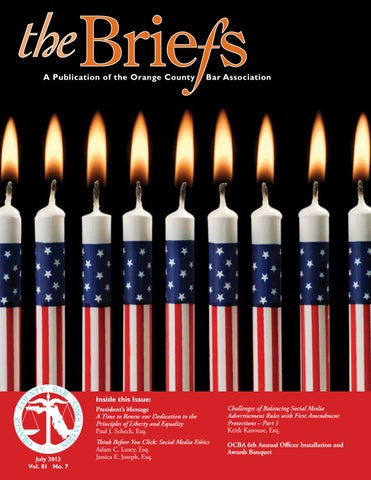
A Publication of the Orange County
Bar Association
Inside this Issue:
July 2013 Vol. 81 No. 7
President’s Message A Time to Renew our Dedication to the Principles of Liberty and Equality Paul J. Scheck, Esq.
Challenges of Balancing Social Media Advertisement Rules with First Amendment Protections – Part 1 Keith Kanouse, Esq.
Think Before You Click: Social Media Ethics Adam C. Losey, Esq. Jessica E. Joseph, Esq.
OCBA 6th Annual Officer Installation and Awards Banquet
There’s nothing small about small business. It might be called a small business, but it’s a big deal to you. BMO Harris Bank shares that mindset. And our full range of small business services can help your business succeed. Working together, we’ll help keep your small business right where you want it.
Visit your local BMO Harris branch or go to bmoharris.com/smallbusiness.
Preferred Banking Institution and Proud Sponsor of the Orange County Bar Association
Christopher Dale • Premier Banker • 407-513-9590 Tom Bacchus • Business Banker • 407-529-2004
BMO Harris BankSM is a trade name used by BMO Harris Bank N.A. Member FDIC.
2012_676_Orange_County.indd 1
bmoharris.com
12/10/12 1:13 PM
E R G
PRSRT STD U.S. POSTAGE PAID MID-FL FL PERMIT NO. 581
880 North Orange Avenue Orlando, Florida 32801
ECONOMIC RECOVERY GROUP
E R G ECONOMIC RECOVERY GROUP
Helping F Profession BP Settle
Helping Florida Businesses Professionals Navigate the BP Settlement Program
ARE YOUR CLIENTS ELIGIBLE?
erg is a statewide law firm representing business
IT’S WORTH THE LOOK.
all along florida’s west coast who suffered d
economic losses after the april 20, 2010 b
The BP spill was a disaster, not o but also its economy. Now, after
indirect economic impacts of erg is a statewide law firm representing businesses and professio businesses and consumers have ERG ISflorida A STATEWIDE LAW FIRMwho REPRESENTING BUSINESSES all along ’s west coast suffered direct or indirect
A Business and Consumer Law Firm
AND PROFESSIONALS ALL ALONG FLORIDA’S WEST COAST economic losses after the april 20, 2010 bp oil spill. WHO SUFFERED DIRECT OR INDIRECT ECONOMIC LOSSES June 4, 2012, under a ne AFTER THE APRIL 20, 2010 BPBeginning OIL SPILL.
businesses who The BP spill was a disaster, not only forsuffered Florida’s financial environm
PENSACOLA
Many west coast companies saw a more
toNow, make claims. The but also itsMARIANNA economy. after 2 years of Settlement litigation, thePr b
west coast and profess JACKSONVILLE on all type indirect economic TALLAHASSEE impacts of businesses this disaster
FT. WALTON BEACH
significant decline in their business in 2010 as
PERRY
PANAMA CITY
businesses and consumers have GAINESVILLE finally been acknowled GAINESVILLE
compared to the rest of the country due to the
ERG is dedicated to helping client
APALACHICOLA
trickle-down effects of the BP oil spill.
CROSS CITY
ORMOND BEACH
are working in referral relationsh OCALA
Economic Loss Settlement Zones
A new class action Settlement Program, that received final Court approval on December 21,
Beginning June 4, 2012, underSPRING a new class action law settlemen litigation, and consumer firms Zone A HILL Henry “Hank” Didier
Henry “Hank” Didier
2012, is working to provide financial relief to help
litigation, and consumer law firms across the State
MELBOURNE
TAMPA
LAKE OKEECHOBEE
CAPE CORAL
ERG is dedicated to helping clientsFT.who wish to be evaluat MYERS
visit erglawfirm.com
for more information about how we FORT LAUDERDALE
are working in relationshipsNAPLES with business, com Gureferral lf of Mexico MIAMI
litigation, and consumer law firms across the State of Flori
Gulf Coast. All businesses should be evaluated for
VISIT ERGLAWFIRM.COM
ST. PETERSBURG SARASOTA
of Florida that have clients located along Florida’s a potential BP claim, and ERG is here toHenry help. “Hank” Didier
Zone D
Jay M. Fisher to make claims. The Settlement is broad in scope, to helpingProgram you.
west coast businesses and professionals should be evaluat
Florida businesses recover. ERG is working in referral relationships with business, commercial
ORLANDO
Zone B
LAKELAND businesses suffered in 2010 now Zonewho C CLEARWATER havefinancial clients losses located alongare Florida
Jay M. Fisher
Jay M. Fisher
have clients located along Florida’s Gulf Coast. We look f to helping you.
1
KEY WEST
more how we are MORE INFORMATION HOW WE information ARE HELPING about FLORIDA RECOVER. visitFOR erglawfirm .comABOUTfor
helping florida rec
SERVING FLORIDA’S WEST COAST | Offices: Tampa • St. Petersburg • Sarasota • Cape Coral • Ft. Myers • Naples • Orlando Direct Mail to: 1936 Lee Road, Suite 105 Winter Park, FL 32789 | Phone: (888) 270-6288 | info@ERGLawFirm.com
“Our Neutrals Are Privileged To Serve At The Level Our Clients Demand”
John Upchurch
Lawrence Watson
Terrence White
Rodney A. Max
Michelle Jernigan
Richard Lord
Kimberly Sands
Michael Orfinger
The sole focus of Upchurch Watson White & Max is settling disputes—anywhere. For over 20 years, the principals and panelists at our firm have guided clients and attorneys through the field of conflict resolution.
Our experienced mediators will help you and your clients find the road to common ground.
uww-adr.com
MEDIATION
ARBITRATION
SPECIAL MASTERS Daytona Beach theBriefs July 2013 Vol. 81 No. 7
Maitland / Orlando
Jacksonville
www.orangecountybar.org
Miami
Birmingham
PAGE 1
3
Contents 18
President’s Message A Time to Renew our Dedication to the Principles of Liberty and Equality Paul J. Scheck, Esq.
Teen Court 16th Annual Judge Thomas S. Kirk Teen Court Scholarship Fundraiser S. Brendan Lynch, Esq.
4
19
Professionalism Committee Winning or Losing... “Fagetaboutit.” Dan H. Honeywell, Esq.
5
2013-2014 Legal Aid Society of the Orange County Bar Association Officers & Board of Trustees 2013-2014 OCBA Foundation Officers & Board Foundation News Supporting Civics Education Through High School Mock Trials: Report from the 2013 Florida High School Mock Trial State Finals Richard S. Dellinger, Esq.
YLS Columnist Jill D. Simon, Esq. w OFFICERS Paul J. Scheck, Esq. President Nicholas A. Shannin, Esq. President-Elect Jamie Billotte Moses, Esq. Treasurer Wiley S. Boston, Esq. Secretary w EXECUTIVE COUNCIL Linda Drane Burdick, Esq. Philip K. Calandrino, Esq. Richard S. Dellinger, Esq. Mary Ann Etzler, Esq. LaShawnda K. Jackson, Esq. Kristopher J. Kest, Esq. Elizabeth F. McCausland, Esq. Nichole M. Mooney, Esq. Eric C. Reed, Esq. Gary S. Salzman, Esq. William C. Vose, Esq. Kristyne E. Kennedy, Esq. Ex Officio Lauren Heatwole McCorvie, Esq. YLS President w EXECUTIVE DIRECTOR Brant S. Bittner w Communications Manager Peggy Storch
28
34 Rainmaking The Laser Talk Michael Hammond, Esq.
12
Legal Aid Society News A “Funny thing” Happened on the Way to Foreclosure... We Reached a Settlement! Michael L. Resnick, Esq.
36
New Members
Developing Distinction in Women: Progressing as a Professional, Networking, and Staying Safe, Healthy, and Sane Along the Way Jessica D. Thomas, Esq. Legal Aid Society What We Do... Speaking for this Child Donna A. Haynes Susan Khoury, Esq.
Leadership Law 2013 Another Success!
Paralegal Post Assembling, Processing, and Organizing Electronically Stored Information Michelle Gerena
Challenges of Balancing Social Media Advertisement Rules with First Amendment Protections – Part 1 Keith Kanouse, Jr., Esq.
16
Side Bar Columnist Sunny Lim Hillary, Esq.
32
10
15
23
Veterans Committee Representing Veterans with Disability Claims – Why the Spider Web is so Complicated for Lawyers to Manage Everett L. McKeown, Esq. Ralph Bratch, Esq.
Think Before You Click: Social Media Ethics Adam C. Losey, Esq. Jessica E. Joseph, Esq.
37
Announcements
39
Communications Assistant Nancy Barnette
40
Marketing & Sponsorship Coordinator Chelsie Sloan
Classifieds Calendar
Membership/Marketing Assistant Marcel Evans
Residential Mortgage Foreclosure Program 407-649-1833 880 North Orange Avenue • Orlando, FL 32801 (407) 422-4551 • Fax (407) 843-3470 Legal Aid Society 407-841-8310 Citizen Dispute 407-423-5732 Family Law Mediation 407-422-4551 Lawyer Referral Service 407-422-4537 Orange County Foreclosure Mediation 407-422-4551 Young Lawyers Section 407-422-4551
DEADLINE INFORMATION
Advertising - 10th of the month prior to the month of publication Copy - 15th of the month six weeks prior to the month of publication If the deadline falls on a weekend or holiday, the deadline is the next business day. Publication of advertising herein does not imply any endorsement of any product, service or opinion advertised. The opinions and conclusions, including legal opinions and conclusions contained in articles appearing in The Briefs, are those of the authors and do not reflect any official endorsement of these views by the Orange County Bar Association or its officers and directors, unless specifically stated as such. All contents ©2013 Orange County Bar Association. All rights reserved. Designer: Catherine E. Hebert Cover photo: iStock ISSN 1947-3968
PAGE 2
Associate Editors Elizabeth Collins Plummer, Esq. & Carrie Ann Wozniak, Esq. Hearsay Columnist Christine A. Wasula, Esq.
30
8
Co-Editors ©2011 Vincent Falcone, Esq. & Ian D. Forsythe, Esq.
OCBA 6th Annual Officer Installation and Awards Banquet
YLS on the Move Jill D. Simon, Esq.
7
the Briefs
www.orangecountybar.org
theBriefs July 2013 Vol. 81 No. 7
President’sMessage
July 2013
A Time to Renew our Dedication to the Principles of Liberty and Equality And for the support of this Declaration, with a firm Reliance on the Protection of divine Providence, we mutually pledge to each other our Lives, our Fortunes, and our sacred Honor. – Declaration of Independence, July 4, 1776
Paul J. Scheck, Esq.
theBriefs July 2013 Vol. 81 No. 7
A
s we flipped our calendar (or swiped our smartphone) to the month of July, it meant that it was time for us, as Americans, to celebrate the Fourth of July and our country’s independence. The Fourth of July is not only arguably the most important day in American history, but because the United States has emerged as the most powerful nation the world has ever known, it is surely one of the most important days in world history as well. The Declaration of Independence legally created the United States of America and announced to the world (in Thomas Jefferson’s words) that Americans were assuming “among the Powers of the earth, the separate and equal station to which the Laws of Nature and Nature’s God entitle them.” The Declaration of Independence also infused into our culture most of what we have come to believe and value as Americans, namely the God-given ideals and aspirations of liberty, equality, and individual rights, including the right of every person to pursue happiness. As the great historian Samuel Eliot Morrison wrote, “If the American Revolution had produced nothing but the Declaration of Independence, it would have been worthwhile.” The name that most of us associate with the Fourth of July is Thomas Jefferson, the primary author of the Declaration of Independence. Jefferson drafted the Declaration of Independence over the course of approximately 18 days in June of 1776, and it became at once our nation’s most cherished symbol of liberty and arguably Jefferson’s most enduring legacy. We owe Thomas Jefferson a great debt of gratitude for boldly espousing such foundational truths, including the high value he placed in the presence of an independent judiciary, as reflected in his comments to James Wythe in 1776 that “[T]he dignity and stability of government in all its branches, the morals of the people and every blessing of society depend so much upon an upright and skillful administration of justice.” The Fourth of July is a great opportunity to renew our dedication to the principles of liberty and equality enshrined in what Thomas Jefferson called “the declaratory charter of our rights.” As lawyers, we have been called to be guardians and advocates of these rights for those who have been denied them, which lawyers
have proudly and nobly done since 1776, and will continue to do into the future. While many of us have been applying sunscreen, touring national parks, or searching for our favorite fishing spot during these hot summer months, the OCBA staff has been spending the past few weeks applying the final touches to our inaugural “New Lawyer Training Program: The Fundamentals of Practice in Orange County,” which is scheduled for August 2nd and 3rd. This is a two-day program geared toward young lawyers, as well as students preparing to graduate from law school or sit for the bar exam. This program is a response by the OCBA to the practical reality that not all new lawyers are hired by established firms and thus do not have the opportunity and privilege to be mentored in the essential “nuts and bolts” of the practice of law. By offering these individuals the opportunity to meet and learn from the clerk of court, the state attorney, the public defender, judges, judicial assistants, and senior members of the bar, we hope to help bridge the gap between the legal training lawyers receive in law school and the practical knowledge necessary to navigate the court system, practice with professionalism, and be effective advocates for their clients. I strongly encourage all young lawyers and graduating law students to take advantage of this wonderful and innovative opportunity that will start them on the path toward becoming professional, confident, and successful practitioners. So, summer has fully arrived. The kids are celebrating their independence and the freedom that comes with no school, no homework, and lots of free time. Families are celebrating summer with vacations, trips to the beach, and a more casual approach to life. We at the OCBA hope that everyone has a safe and rejuvenating summer full of special memories with family and friends. We also hope that each of you has the opportunity over the long, lazy days of summer to reflect on the many blessings and talents that have been bestowed upon us not only as Americans, but as lawyers. Enjoy! Paul J. Scheck, Esq., is a partner with Shutts & Bowen, LLP. He has been a member of the OCBA since 1993.
www.orangecountybar.org
PAGE 3
ProfessionalismCommittee
F Dan H. Honeywell, Esq.
PAGE 4
Winning or Losing… “Fagetaboutit.”
agetaboutit. It is not a lawyer’s job to “win” anything. And, no attorney should ever fear the simple act of “losing” – not a trial, not a hearing, not an arbitration loss, and not a mediation “failure.” If you are one of those who measure everything you do in these simplest of terms of winning or losing, you will likely have a very short litigation career. Worse, you will never achieve the satisfaction that those who understand the realities of what good litigators really do, find. Although difficult for many in our profession to accept, much less the uninformed public, the lawyer’s responsibility in prosecuting or defending any claim is NOT to win or lose. It is simply to present the maximum, ethical, legal effort that can be made to ensure that a claim or defense is appropriately and fully considered by those who must make the final decision. Lawyers do not get to make any final decision – except, maybe, to accept the challenge of any representation. They aid others to make the proper final decision. Despite the nature of the American jurisprudence system that requires attorneys to “contest” claims and charges to ensure their validity, it was never intended that the outcome of any phase of any litigation or dispute should rest solely upon the shoulders of the legal representative. Even the knights of old England, the foundation of our legal system, who physically fought – literally – to “find” justice, were not charged with winning. In the end of each mortal contest, it was presumed that it was God who made any final decision about the combat, not the knight! Yet today, many in our profession still equate the outcome of too many legal matters solely upon their role of counsel for one side or the other. If you think about it, isn’t it somewhat egotistic to think that one person’s actions or efforts, alone, can really overcome actual facts or law, or both, of any particular dispute? Clients’ causes, claims, or defenses are reviewed and rejected everyday by one group of lawyers, only to be accepted by others the next day. Wouldn’t that suggest that those facts and that law, at least in the opinions of others, weighed against success from the beginning? Litigators (and mediators) often cite the popular, “If you tried the case ten times, what would be your outcome?” test. The clear import of this
www.orangecountybar.org
“test” is that if you try a perfect case, over and over, you will still clearly get different outcomes every time, despite your personal input! The fact that different judges and different juries can totally nullify both fact and law in any matter should also permit you to see the weakness in just what real, ultimate effect the best attorney can really have in any specific contest. Too many mediation participants often complain that someone “didn’t get it done.” The implication: The lawyers, the mediators, or someone, didn’t “succeed” at the mediation tasks; they didn’t win! Nothing could be further from the truth. The fact is, every human associated with the mediation may well have performed flawlessly and still have not found resolution at mediation. Don’t get me wrong. I am not suggesting that an attorney’s efforts cannot affect any given issue or even the contest itself. I am not implying that attorneys’ comparable efforts cannot produce different outcomes. Comparable better effort can impact some outcomes. And, clearly, any lawyer owes his/her best efforts to any issue of any client. But, once you have given your best efforts, truly your best efforts, you must recognize that ultimately your efforts cannot change either the facts of your issue or the law to be applied to those facts. And, of course, you have no direct control over the final choice of your decision maker or his/her decision. In short, regardless of your best efforts, after offering them, you can do no more. The answer? If you are going to be successful in the practice of law, long-term, your only real professional target should/must be solely the admiration and respect of your opposition. It is by your peers, your opposition, that your efforts, including your professionalism, will be truly judged. If you are in or planning a career in law, particularly in contested matters, keep this simple “professional trial lawyer’s goal” in mind. I didn’t make it up. It was “revealed” to me as I began my own initial journey as a trial lawyer, long ago, by another who had already traveled the long road ahead of me. And, he had done it well. I now reveal it to you. If you have truly fully prepared for, well and wisely presented your client’s position, and intelcontinued page 6
theBriefs July 2013 Vol. 81 No. 7
2013-2014Legal Aid Society of the Orange County Bar Association, Inc. Officers & Board of Trustees Officers
Glenn A. Adams, Esq. President Holland & Knight LLP 200 S. Orange Ave., Ste. 2600 Orlando, FL 32801 407-425-8500 glenn.adams@hklaw.com
William A. Davis, Jr., Esq. President-Elect Cole, Scott & Kissane, P.A. Tower Place 750 1900 Summit Tower Blvd. Orlando, FL 32810 321-972-0026 william.davis@csklegal.com
Richard S. Dellinger, Esq. Treasurer Lowndes, Drosdick, Doster, Kantor & Reed, P.A. 215 N. Eola Dr. Orlando, FL 32801 407-843-4600 richard.dellinger@lowndes-law.com
DAVID E. CANNELLA, Esq.
Norberto S. Katz, Esq.
Secretary Carlton Fields, P.A. 450 S. Orange Ave., Ste. 500 Orlando, FL 32801 407-849-0300 dcann@carltonfields.com
Immediate Past President Ninth Judicial Circuit 425 N. Orange Ave., Ste. 540 Orlando, FL 32801 407-836-2287 ctadnk1@ocnjcc.org
Board of Trustees Joseph L. Amos, Jr., Esq.
Taylor C. Kessel, Esq.
Fisher, Rushmer, Werrenrath, Dickson, Talley & Dunlap, P.A.
Ruth’s Hospitality Group, Inc.
John R. Hamilton, Esq.
Lowndes, Drosdick, Doster, Kantor & Reed, P.A.
Meenakshi “Meena” Hirani, Esq.
Dellecker, Wilson, King, McKenna, Ruffier & Sos, LLP
Melody B. Lynch, Esq.
Foley & Lardner LLP
Meenakshi A. Hirani, P.A.
Elizabeth F. McCausland, Esq.
Eric C. Reed, Esq.
Nichole M. Mooney, Esq.
Ana E. Tangel-Rodriguez, Esq.
Liz McCausland, P.A.
Dean, Mead, Egerton, Bloodworth, Capouano & Bozarth, P.A.
W. Doug Martin, Esq.
Shutts & Bowen, LLP
Tangel-Rodriguez & Associates
Betty Jackson Lay Trustee
Paul C. Perkins, Jr., Esq. Paul & Perkins, P.A.
Chris Pantano Suntrust Bank
2013-2014OCBA Foundation Officers & Board Officers
THOMAS A. ZEHNDER, Esq.
President King, Blackwell, Zehnder & Wermuth, P.A. 25 E. Pine St. Orlando, FL 32801 407-422-2472 tzehnder@kbzwlaw.com
Wiley S. Boston, Esq. Vice President Holland & Knight LLP 200 S. Orange Ave., Ste. 2600 Orlando, FL 32801 407-425-8500 wiley.boston@hklaw.com
JAMIE BILLOTTE MOSES, Esq.
Treasurer Fisher, Rushmer, Werrenrath, Dickson, Talley & Dunlap, P.A. 390 N. Orange Ave., Ste. 2200 Orlando, FL 32801 407-843-2111 jmoses@fisherlawfirm.com
Richard S. Dellinger, Esq.
Meenakshi A. Hirani, Esq.
Immediate Past President Lowndes, Drosdick, Doster, Kantor & Reed, P.A. 215 N. Eola Dr. Orlando, FL 32801 407-843-4600 richard.dellinger@lowndes-law.com
Secretary Meenakshi A. Hirani, P.A. 2265 Lee Rd., Ste. 109 Winter Park, FL 32789 407-599-7199 hiranimeena@yahoo.com
Board Members The Hon. Faye Allen Ninth Judicial Circuit
The Hon. Julie O’Kane
Jessica K. Hew, Esq. Burr & Forman, LLP
Norberto S. Katz, Esq.
Ninth Judicial Circuit
Ninth Judicial Circuit Hearing Officer
The Hon. Wilfredo Martinez
Kristyne E. Kennedy, Esq.
Ninth Judicial Circuit Court
Frank M. Bedell, Esq.
Cole, Scott & Kissane, P.A.
R. Gavin Mackinnon, Esq.
Bedell Dispute Resolution
Wicker, Smith, O’Hara, McCoy & Ford, P.A.
Amy M. Guy
Elizabeth F. McCausland, Esq.
Calandrino Law Firm, P.A.
theBriefs July 2013 Vol. 81 No. 7
Janie Phelps
Paul J. Scheck, Esq.
Antoinette Plogstedt, Esq. Eric C. Reed, Esq.
Shutts & Bowen, LLP
William E. Sublette, Esq. Sublette Law Offices
Shutts & Bowen, LLP
Diego “Woody” Rodriguez, Esq.
Thomas P. Wert, Esq.
Orange County Public Schools
Roetzel & Andress, LPA
Cynthia G. Schmidt, Esq. University of Central Florida
Liz McCausland, P.A.
www.orangecountybar.org
PAGE 5
GoldilocksMock Trials Rely on Blue Hill Estate Sales, LLC for Professional, Reliable and Experienced Service in conducting Estate Sales. For Estate Settlements in cases such as Probate, Divorce, Foreclosure, Assisted Living Transition, Moving or Downsizing, your client benefits from our Estate Sales service. Our Professional, Reliable, and Experienced Estate Sale Company has assisted clients since 2005 with their personal property by organizing, marketing and holding a private Estate Sale in their home. Upon Death or Probate, an Estate Sale conducted professionally by Blue Hill can ease the emotional distress of liquidating assets and property from the estate. In cases of Divorce Settlement, selling marital assets and possessions may be an ideal solution as an alternative to dividing them.
Participants in the Goldilocks Mock Trial held at Waterbridge Elementary School on May 21, 2013, were Min Cho, Esq.; Brian Hanafin, Esq.; Victoria Newman, Esq.; Shawn Jewell, Esq.; Lindsey Gergely, and Jessica Hoch, Esq.
When Moving, Downsizing or in the event of Foreclosure, holding an Estate Sale can lesson the burden and raise money without delay.
Our company will: • Organize entire contents. • Price all items according to fair market value. • Arrange and display items to stimulate buyers. • Attract customers with photographs of sale items displayed on our website. • Use professional signs and advertising to guide customers to the sale location. • Conduct the sale with our experienced team. • Handle the removal of remaining goods per client’s instructions.
Waterbridge Elementary School Goldilocks Mock Trial
Contact Pamela Allemeier for a free consultation.
Phone: 407.894.5524 E-mail: pam@bluehillestatesales.com
www.bluehillestatesales.com ProfessionalismCommittee continued from page 4
ligently negotiated your client’s efforts at mediation – particularly at mediation – you have done all that can be professionally expected of you. In the end, in mediation, you control only 50% of whether or not your client achieves “success by complete resolution.” In any other contested setting, if your client must “lose” his claim or defense, at the least your personal and professional goal must be to solely make sure the opposition PAGE 6
Lockhart Elementary School Goldilocks Mock Trial
knows it had nothing to do with your representation – only the facts, or the law, or both, that YOU could not overcome simply with your exceptional preparation and presentation effort. In short, your goal is for every prevailing opposition to truly believe that with the efforts you made, they were “really lucky, this time.” Then, “fagetaboutit,” – win or lose – and move on to your next best effort. You will enjoy your practice far more by simply gaining the respect of your peers than
www.orangecountybar.org
keeping score of your wins and losses. You will always sleep well knowing you gave it your all. Dan H. Honeywell, Esq., has been a Board Certified Civil Trial Lawyer since 1983 and currently practices ADR. He is certified by the Florida Supreme Court in Circuit Civil and Appellate Mediation and by the U.S. District Court, Middle District of Florida, as a Federal Mediator. He has been a member of the OCBA since 1984.
theBriefs July 2013 Vol. 81 No. 7
FoundationNews
E Richard S. Dellinger, Esq.
Supporting Civics Education Through High School Mock Trials: Report from the 2013 Florida High School Mock Trial State Finals
very year, high school students from across the state of Florida cross over the bar in our courtrooms and deliver opening and closing statements, conduct direct examination and cross examination, object, and wait for verdicts. The participants are professional, competition is fierce, but the cases are fictional. From March 7 through March 9, 2013, the Orange County Courthouse was the host venue for these high school students’ state championship. The 2013 Florida High School Mock Trial State Finals, held this year at the Orange County Courthouse, consisted of students from sixteen of Florida’s twenty circuits in four rounds of competition in a three-day program. The event was organized by the Florida Law Related Education Association, Inc. (FLREA). The FLREA is a private, non-profit 501(c)(3) civics education association established in 1984 to improve justice and expand education for democracy through the development and implementation of law-related education programs for Florida youth. The Orange County Bar Association (OCBA) provided many of the volunteer judges for the competition. More than 100 attorneys and judges participated in the four rounds of the competition. Leadership from throughout the OCBA, including the OCBA Young Lawyers Section president Tony Sos, and OCBA Foundation board member Meena Hirani, were among the OCBA attorneys who donated their time to help further this civics education initiative. The event started with a training session for the competitor judges by FLREA’s Annette Boyd Pitts and Manatee County Judge Doug Henderson. From there, in multiple courtrooms, lawyer volunteers were separated into a judge and twoperson jury. Community paralegals served as timekeepers for the competitions. All of the participants argued the same case. The case involved an alleged stabbing by a politically connected college-aged friend at a music festival. When the trial started, the courtroom was full of student lawyers, their classmates, and their families. Students acted as counsel and as witnesses, while proud parents and siblings watched from the gallery.
theBriefs July 2013 Vol. 81 No. 7
www.orangecountybar.org
The trial started with the students’ well-prepared opening statements. Students appeared at ease in the courtroom as they advocated for their clients with eloquent pronoucements of what the evidence would soon show. Next, each side called three witnesses and alternated between direct examination and cross examination. The students made well-researched objections. Documents were introduced into evidence using the perfect authentication questions. In fact, some of the lawyers in the room refreshed their own trial advocacy skills by watching the students properly authenticate, then introduce exhibits into evidence. The mock trial concluded with passionate closing statements, leaving participants feeling like they were hearing a real case instead of just a mock trial. After closing arguments, the participants were judged and were given feedback from the lawyers, judges, and jury. Critiques were provided in a “closed session” so the students could learn from their mistakes and grow as advocates. With declining Florida Bar Foundation Funds, the FLREA has appealed to the public for support of its programming. This year, the Orange County Bar Foundation, Inc. served as a major sponsor of FLREA projects, including the Statewide Mock Trial Competition. Using funding from the Foundation and the American Board of Trial Advocates, FLREA was able to provide t-shirts and bags, certificates, and trophies for the participants and videography for the final round of the competition. The 2013 mock trial competition winner was American Heritage High School from Planation, Florida. Boone High School represented the Ninth Judicial Circuit and finished in fourth place. The Orange County Bar Foundation, Inc. is a 501(c)(3) charitable organization that is responsible for community civics programming. The Foundation is a beneficiary of OCBA social activities and the OCBA Annual Gala. Richard S. Dellinger, Esq., is immediate past president of the Orange County Bar Foundation and a shareholder at Lowndes, Drosdick, Doster, Kantor & Reed, P.A. He has been a member of the OCBA since 1999.
PAGE 7
SpecialFeature
F Adam C. Losey, Esq.
Jessica E. Joseph, Esq.
PAGE 8
Think Before You Click: Social Media Ethics
lorida lawyers should think twice before clicking “accept” to a friend request on Facebook or diving into any social media site for the first time. For those unaware, Facebook is a social networking service launched in 2004, currently with over a billion users. The building blocks of Facebook (and most social sites) are user profiles. Users of the site can then link to others’ profiles by propounding what Facebook terms a “friend request” to another user. Once the user accepts the request, certain information is made available between the newly linked users, which all depends on the individual user’s privacy settings. Most Facebook friends probably better fit the moniker of acquaintance, and users commonly have hundreds or thousands of Facebook friends. Facebook social norms make it difficult to refuse a friend request (it is considered fairly rude to reject a friend request from even a casual acquaintance), and thus the title of “Facebook friend” does not fit the average person’s definition of actual friendship. From advertising issues (The Florida Bar’s new advertising rules explicitly apply to Facebook and other social media per rule 4-7.11(a)), to lawyerjudge social media connections, these evolving social media norms and uses are rife with legal and ethical land mines. For example, in a recent Broward County criminal case, a criminal defendant argued for disqualification of the presiding judge due to the judge’s Facebook friendship with the prosecuting attorney. The defendant argued that his own Facebook “friends” consisted “only of his closest friends and associates, persons whom he could not perceive with anything but favor, loyalty, and partiality” and thus he believed the judge could not be fair and impartial.1 The judge declined to recuse himself, and the issue wound up in front of the Fourth District Court of Appeal. The Fourth DCA, considering an opinion issued in 2009 by the Florida Supreme Court’s Judicial Ethics Advisory Committee, agreed with the criminal defendant and held that the presiding judge should be disqualified.2 In the Judicial Ethics Advisory Committee opinion, the JEAC concluded that the Florida Code of Judicial Conduct does not allow a judge to add lawyers who may appear before the judge as “friend” on a social networking site; nor does it permit such lawyers to add the judge as their “friend.” The Fourth DCA and the JEAC noted that it is simply the appearance of undue influence evi-
www.orangecountybar.org
dently created by social media friendships that is the cause of concern, rather than any actual bias. “[A] judge’s listing of a lawyer as a ‘friend’ on the judge’s social networking page – ‘to the extent that such identification is available for any other person to view’ – would violate Florida Code of Judicial Conduct Canon 2B.”3 Canon 2B of the Florida Code of Judicial Conduct provides that “[a] judge shall not . . . convey or permit others to convey the impression that they are in a special position to influence the judge.”4 The JEAC’s conclusion (relied upon by the Fourth DCA) is that when a judge lists a lawyer who appears before him as his “friend” on a social networking page, it conveys the impression that such a lawyer “friend” is in a special position to influence the judge.5 According to the JEAC, whether the lawyer “friend” actually has the ability to influence the judge is irrelevant; it is the mere appearance of impropriety that creates the problematic issue. This standard is somewhat unusual, as presumably one could potentially avoid the prohibition by making one’s “friend” list completely private – thereby making it so the identification of the online friendship was not publicly available – and thus avoiding the appearance of impropriety or undue influence discussed by the Fourth DCA and the JEAC. There also appears to be a disconnect between the underlying JEAC rationale and the actual, everyday use of social media. While Facebook friendship might mean more to some than to others, the belief that a lawyer’s status as a Facebook friend of a judge would create an impression that the lawyer has some sort of special influence is not an objectively reasonable one in light of how Facebook is actually used. The Florida Supreme Court voted 5-2 against hearing an appeal of the Fourth DCA’s decision, but the Domville case remains a cautionary tale for judges and lawyers using social media sites like Facebook. Social media issues do not end with lawyer-judge online connections. There are a wide variety of socially awkward (and legally awkward) situations that social media-savvy lawyers deal with daily. For example, if you are Facebook friends with a lawyer, should you de-friend that lawyer if he or she takes the bench? Per Florida’s rule, this is the safest route, yet the act of de-friending is essentially a social snub. Additionally, Facebook has a feed that constantly updates friends as to what other friends are doing – i.e., Adam is at the beach, Jessica is in court –
theBriefs July 2013 Vol. 81 No. 7
and if you are Facebook friends with a judge, you may accidentally be engaged in unauthorized ex parte communications when you have done nothing intentional to communicate with your judicial social media connection. Florida’s new advertising rules also create issues. For example, on LinkedIn, a popular business-oriented social media site, a user’s default listing on the LinkedIn page contains a category called “Specialties[,]” which then lists areas in which the individual does business. According to LinkedIn’s current site, “[t]o help streamline how your profile is displayed, we’ve combined specialties with [your] summary section.” Thus, without the user’s knowledge, LinkedIn may have populated many users’ profiles with a listing of “Specialties[,]” such as “commercial litigation” or “eDiscovery[.]” The problem? You generally can’t list legal “specialties” online per new Rules 4-7.11(a) and 4-7.14(a)(4). Rule 4-7.14(a)(4) states that potentially misleading advertisements include statements that a lawyer is “board certified, a specialist, an expert, or other variations of those terms” unless any of the following are true: (1) the lawyer has been certified under the Florida Certification Plan; (2) the lawyer has been certified by an organization whose specialty certification program has been accredited by the ABA or The Florida Bar – such advertisements for lawyers whose specialty is certified by the ABA but not The Florida Bar must include the statement “Not Certified as a Specialist by The Florida Bar” in reference to the specialization or certification – or (3) the lawyer has been certified by another state bar, if the bar program grants certification on the basis of
standards “reasonably comparable” to the standards used by The Florida Bar’s certification program. Additionally, the rule requires all advertisements of “specialties” to include the area of certification and the name of the certifying organization. There are undoubtedly many Florida lawyers on LinkedIn who are currently out of compliance with Florida’s advertising rules and who have no idea that they have an automatically populated list of “specialties” on their LinkedIn page. You might want to take a look at yours, if you have one, and correct your profile accordingly. Finally, though the rules are a good source of guidance, it’s best to make sure you use common sense in all of your online interactions. A Miami-Dade county public defender recently caused a mistrial and was subsequently fired, all because of a Facebook posting. This particular public defender was representing a man accused of murdering his girlfriend. The defendant’s family brought him a bag of clean clothes to wear during trial, and as officers were holding up the various pieces for routine inspection, the public defender took a picture of the defendant’s leopard-print underwear with her cell phone. Then, while on break, she posted the picture on her own Facebook page, along with a caption belittling her client’s family for thinking the briefs were “proper attire for trial.” The public defender’s Facebook page was private and could only be viewed by her friends, so she likely thought she was safe; however, someone who saw the post alerted the judge, who eventually declared a mistrial. After the offending attorney was fired, the Miami-Dade public defender stated that “when a lawyer broadcasts disparaging and humiliating words and pictures, it undermines the basic client relationship and gives the appearance that he is not receiving a fair trial.”6 Again, much
like in the context of lawyer-judge online “friendships,” it is the appearance of impropriety that seems to be at issue here. So, how to handle social media? Lawyers: De-friend members of the judiciary, and decline friend requests if you are a litigator. However, there is nothing wrong with letting the judge know it is nothing personal and that you are just being cautious and complying with Florida’s ethics rules. Keep on eye on your social media profiles and connections, and read Florida’s new advertising rules so you can ensure you don’t run afoul of them. Be careful of what you post, even if you think your page is private. Judges: The most prudent path given Florida’s highly restrictive rule is to be wary of dipping your toe in social media, and if you do, it is best to stay away from online friendships with lawyers who may appear before you. Adam C. Losey, Esq., and Jessica E. Joseph, Esq., are attorneys with Foley & Lardner LLP. They have been members of the OCBA since 2009 and 2013, respectively. Domville v. State, 103 So. 3d 184, 185 (Fla. 4th DCA 2012). 2 Id.; see also Fla. JEAC Op. 2009-20 (Nov. 17, 2009). 3 Domville, 103 So. 3d at185. 4 Id. 5 Id. at186. (citing Fla. JEAC Op. 2009-20). 6 David Ovalle, “Lawyers Facebook Photo Causes Mistrial in Miami-Dade Murder Case,” The Miami Herald, Sep. 13, 2012, available at: http://www.miamiherald. com/2012/09/12/2999630/lawyers-facebook-photocauses.html. 1
ANNOUNCEMENT The Courthouse Resource Room will be closed now through November 1, 2013, while it is being used as an additional hearing room for foreclosure matters. The CRC will reopen to the general public upon the completion of the 14th floor build-out. If you have any questions, please contact Julio Semino at 407.836.0403
theBriefs July 2013 Vol. 81 No. 7
www.orangecountybar.org
PAGE 9
SpecialFeature Challenges of Balancing Social Media Advertisement Rules with First Amendment Protections – Part 1
T Keith Kanouse, Jr., Esq.
Nothing is more fundamental to Americans as individuals and a society as the First Amendment; it is so fundamental that it was placed as the First Amendment in our Constitution. The legal community has a long and storied history of fighting for First Amendment rights in free speech. This is the right stating that even if I disagree with the message, I still want a government that allows you to voice that message. We are attorneys, like Burton Joseph, who even though he was of Jewish decent, fought (and won) the rights of American Nazis to march in Skokie, Illinois.4 We are judges who vote to uphold the right of a self-described communist to burn the American flag.5
he law may be the only industry that looks where it is heading by constantly looking in the rear view mirror. Our judicial system is built upon looking at past precedents in order to predict future outcomes. Our legislative system can take years, if not decades, to address needs in new laws or update existing statutes, if needs are addressed at all. Then when these new laws hit the books, they may be already outdated or not dynamic enough to adjust to future fact patterns. Just as we have prescribed inefficiencies in place via checks and balances in our separate but equal branches form of government, our legal system of inefficiencies, precedents, and slowness for change helps provide stability. This stability is needed for individuals and businesses to plan for any anticipated litigation and criminal consequences of their potential activities. Challenges of Keeping Up with Ever-Changing Technology With the laws and procedures of contracts, torts, and criminal law having centuries of history for the legal system to build upon, statutes and case law have just a few decades dealing with technology in the computer age. In addition to computer-age technology law being in its infancy, technology itself changes and evolves at a speed rarely seen in other arenas. The computer chip maker Intel’s co-founder, Gordon Moore, wrote in 1964 that in his observation of the history of computing hardware, the number of transistors on integrated circuits doubles approximately every two years and would continue to do so.1 This was later coined as Moore’s Law2 and nearly a half-century later, the principle of computing power doubling every two years remains as Moore predicted. Compounding these challenges of hitting the moving target of technology is that the legal community is not known as the most technologically savvy. The vast majority of those in the legal field have a non-technical background, with a technical/engineering degree not even breaking the top twenty of undergraduate degrees by lawyers.3
Laws that restrict the First Amendment normally face strict scrutiny, which is the most stringent of tests to uphold the law. The courts allow a less restrictive standard of scrutiny for commercial speech. In concluding that expression proposing a commercial transaction is a different order of speech, the Supreme Court upheld a city ordinance prohibiting distribution on the street of “commercial and business advertising matter.”6 The Court has clearly held that commercial speech is not wholly undifferentiable from other forms of expression; it has remarked on the commonsense differences between speech that does no more than propose a commercial transaction and other varieties. The Court has developed a four-pronged test to measure the validity of restraints upon commercial expression. Under the First prong of the test as originally formulated, certain commercial speech is not entitled to protection; the informational function of advertising is the First Amendment concern and if it does not accurately inform the public about lawful activity, it can be suppressed. Second, if the speech is protected, the interest of the government in regulating and limiting it must be assessed. The State must assert a substantial interest to be achieved by restrictions on commercial speech. Third, the restriction cannot be sustained if it provides only ineffective or remote support for the asserted purpose. Instead, the regulation must “directly advance’’ the governmental interest. The Court resolves this issue with reference to aggregate effects, and does not limit its consideration to effects on the challenging litigant.
Regulating Freedom of Speech in a Commercial Context The above factors may help explain the challenges The Florida Bar through the Standing Committee on Advertisement (SCA) faces in formulating advertising rules for social media use. While there is an important need for regulation in how an attorney advertises, this regulation must balance itself against one of the most American of freedoms, the freedom of speech. PAGE 10
www.orangecountybar.org
theBriefs July 2013 Vol. 81 No. 7
Fourth, if the governmental interest could be served as well by a more limited restriction on commercial speech, the excessive restriction cannot survive. The Court has rejected the idea that a “least restrictive means’’ test is required. Instead, what is now required is a “reasonable fit’’ between means and ends, with the means “narrowly tailored to achieve the desired objective.’’ 7 Using the above test, the Courts have found a State over regulating a profession, specifically the practice of law. The Supreme Court held that a state could not forbid lawyers from advertising the prices they charged for the performance of routine legal services.8 Nor may a state categorically prohibit attorney advertising through mailings that target persons known to face particular legal problems,9 or prohibit an attorney from holding himself out as a certified civil trial specialist.10 However, a State has been held to have a much greater countervailing interest in regulating personto-person solicitation of clients by attorneys. Since in-person solicitation is “a business transaction in which speech is an essential but subordinate component,’’ the State interest need only be “important rather than compelling.11 Current Florida Social Media Advertisement Rules The reason for this article, and for tying the First Amendment with Technology and The Florida Bar Social Media Advertisement Rules, originates from a March 2013 CLE that was given by the OCBA Technology Committee. The CLE topic was Legal Implications of Social Media for Your Clients and Your Firm. A video of the presentation can be purchased from the Orange County Bar Association. The author’s part of the presentation was on social media use by attorneys and The Florida Bar advertisement rules that would apply. In January 2013, and effective May 1, 2013, the Supreme Court of Florida issued new lawyer advertising rules.12 Other than allowing for testimonials in all forms of advertisements, subject to specific restrictions and disclaimers, the advertisement rules applicable to social media remain the same. In addition to examining The Florida Bar material on the topic, the author contacted The Florida Bar, whose representatives were very helpful in answering questions dealing with specific real-life scenarios. Some of the current advertisement rules on social media advertisement are as follows, followed by potential issues on applicability of these rules. Pages of individual lawyers on social networking sites that are used solely for social purposes, to maintain social contact with family and close friends, are not subject to the lawyer advertising rules. Pages appearing on networking sites that are used to promote the lawyer or law firm’s practice are subject to the lawyer advertising rules.13
nization. For most attorneys, their career is a major part of their days and lives; however, attorneys are not allowed to share the ups (and downs) of this important part of their lives with their friends and families. Invitations sent directly from a social media site via instant messaging to a third party to view or link to the lawyer’s page on an unsolicited basis for the purpose of obtaining, or attempting to obtain, legal business are solicitations in violation of Rule 4-7.18(a), unless the recipient is the lawyer’s current client, former client, relative, has a prior professional relationship with the lawyer, or is another lawyer.14 The purpose of this rule is to prohibit unwanted solicitation from a lawyer via a social media invitation to a potential client whom the lawyer has had no previous contact. Kathy Bible, Advertising Counsel of The Florida Bar, who handles prosecutions for advertisement rules violation, answered in response to the author’s email inquiring where the biggest areas of violations were occurring: “The biggest issue with social media is to avoid direct solicitation through inviting people who are known to be injured to a personal injury website or Facebook page. Also, lawyers cannot directly solicit clients on a discussion board or chat room.”15 However, the rule that limits who a lawyer may contact via social media has an attorney’s friend noticeably missing. Jeff Hazen, Assistant Ethics Counsel Ethics and Advertising of The Florida Bar, informed the author that this applies to all friends, including the specific situation of a lawyer’s best friend who the lawyer has known for decades and even a groomsman in his wedding. The rules prohibiting an attorney from proactively connecting a professional social media account with his/her personal friends’ accounts unduly burdens the growth of an attorney’s practice. For
The purpose of this rule is to counter any social media accounts for a lawyer masquerading as a personal account, but actually is used primarily for business purposes. An example would be John Doe of John Doe, P.A. who only has a “personal” John Doe account, but uses his personal account as he would John Doe, P.A. This would open a prima facie loophole that the owner or title of the social media account alone could dictate whether advertisement rules would apply. However, the word solely gives the impression that there is no leeway to allow for attorneys to use their personal account to share anything of a professional nature. An attorney would not want to lose the safe harbor protection of a personal social media account and therefore will not post any updates to his/her family and friends regarding his/her career. Such posts to one’s personal account can reflect updates in their career such as joining a new law firm, receiving a promotion, winning a big case, or even posting a picture of himself or herself receiving an award from the Orange County Bar Association or any other professional orgatheBriefs July 2013 Vol. 81 No. 7 www.orangecountybar.org
continued page 14
PAGE 11
Legal Aid SocietyNews
P Michael L. Resnick, Esq.
PAGE 12
A “Funny Thing” Happened on the Way to Foreclosure Mediation... We Reached a Settlement! owners in foreclosure are: (1) the person on the telephone (the customer service representative) is “not knowledgeable about my financial situation” and/or the person on the telephone “doesn’t have the legal authority to resolve any of the problems associated with my loan;” (2) the “bank always loses my documents” or the “bank wants me to send more and more documents to them;” and (3) “I want a chance to really negotiate a settlement of my dispute with my bank!” Thankfully, the RMFM program solves these problems by providing a focused and thoughtful mediation process that brings homeowners and lenders to the table so that homeowners can have a meaningful chance to reach a resolution of their financial predicament. My clients (clients of the Legal Aid Society) are, by definition, low income. As a result, they have a difficult time obtaining loan modifications because of their lack of income. However, the RMFM program offers my low-income clients great hope for a successful resolution that allows them to keep their home. I have two examples: 1. I recently represented a husband and wife in an RMFM mediation. A “funny thing” happened on the way to this RMFM mediation! At the mediation conference, my clients were notified by their lender that the lender had already approved their loan modification request a day earlier. That was surprising to my clients since they had no knowledge of the loan modification approval. How did this loan modification occur? Was it just coincidence that the loan modification was approved a day before the mediation conference? Apparently, the lender approved my clients’ loan modification request as a result of the lender having reviewed my clients’ financial documents in preparation for the RMFM mediation. As a result, the actual holding of the RMFM mediation conference was the catalyst that generated the appropriate review by the lender that then resulted in the loan modification approval. Had my clients not taken advantage of the RMFM program, then it is unlikely they would have been approved for a loan modification in the manner that they were. 2. My Legal Aid clients often do not get loan modifications or other settlements at mediation because of their lack of income. How-
rior to the economic and housing crisis that has gripped our nation it was unheard of to have mediation as part of a foreclosure action. Rather, the norm in a foreclosure case was simply to bring the foreclosure case to a final conclusion since “there isn’t anything to mediate” in a foreclosure case. However, as a result of our sustained housing crisis, the concept of foreclosure mediation took shape. In December 2009, the Florida Supreme Court mandated statewide mediation as a way to ameliorate the negative impacts of the foreclosure crisis. However, in December 2011, the Florida Supreme Court terminated statewide mediation in foreclosure cases because of the “ineffectiveness” of statewide mediation. While terminating statewide mediation, the Florida Supreme Court authorized each chief judge to re-impose mandatory mediation in his or her circuit. In April 2012, Chief Judge Belvin Perry, Jr. re-imposed mandatory mediation in Orange County (Administrative Order No. 2012-06). Judge Perry’s administrative order created a new foreclosure mediation program in Orange County that appointed the Orange County Bar Association (OCBA) as the program manager for the Residential Mortgage Foreclosure Mediation program (RMFM). The program manager for RMFM is attorney Kim Homer, the OCBA’s assistant executive director. Orange County is one of only a few counties in Florida that now has mandatory foreclosure mediation. I have the opportunity of lecturing about foreclosure-related issues on a weekly basis. I’m often asked, “How successful is the mediation program in Orange County?” Obviously, this is a loaded question since success can often be measured in different ways. In my opinion, the RMFM program that we have in Orange County is highly successful. The RMFM program affords homeowners the chance to sit down with their lender, and their lender’s attorney, for the purpose of negotiating a settlement of the homeowners’ financial predicament. Such a settlement might be a loan modification, approval of an outstanding short sale contract, waiver of monies owed (deficiency), or the giving back of the property to the lender via a deed-in-lieu of foreclosure. The RMFM program provides homeowners with the opportunity to actually speak with their lender, face-to-face, in the hope of saving their home or reaching some other settlement. The most common complaints I hear from home-
www.orangecountybar.org
theBriefs July 2013 Vol. 81 No. 7
ever, one of the great benefits of the RMFM program is that my clients can often determine the information they will need after the mediation is completed in order for them to obtain a loan modification. What is this information that my clients can obtain at the mediation conference? Often times a lender will inform my clients of the target income they need to make in order to obtain a loan modification. Sometimes, my clients’ expenses are too high. At the mediation conference, the lender will often disclose the debt-toincome ratio that my clients need to fall within in order to obtain a loan modification. With this information in hand, my low-income clients are often able to obtain loan modifications after the conclusion of the mediation conference. Once again, had my clients not taken advantage of the RMFM program, it is unlikely they would have had this opportunity to reach a loan modification. I encourage everyone who represents homeowners in foreclosure cases in Orange County to take advantage of our RMFM program. In my opinion, RMFM is one of the best ways to obtain
a successful outcome for our foreclosure clients. Please contact Mike Resnick at mresnick@legalaidocba.org for more information. To make a donation to Legal Aid, contact Donna Haynes at dhaynes@legalaidocba.org. Michael L. Resnick, Esq., is the housing attorney at the Legal Aid Society of the Orange County Bar Association, Inc. He has been a member of the OCBA since 1999.
It’s Time to Update Your Photo for the OCBA Online Membership Directory RCL Portrait Design will be at the OCBA on the following dates to take your free professional portrait for the OCBA Online Membership Directory: Monday, July 22 – Friday, July 26 Monday, July 29 – Thursday, August 1
An RCL representative will contact you in the near future to schedule an appointment. However, feel free to contact RCL directly at 800-580-5562 to schedule your sitting. All sittings are free of charge and the photo you select for the Online Membership Directory will be published online at no charge. RCL will also take additional shots and provide you with an opportunity to purchase a photo package for your professional or personal use. We are pleased to bring you this free member service. RCL has produced professional portraits for more than 21 state and local bar associations and 22 medical facilities across the nation. We look forward to seeing you at the OCBA Center in July or August. (For professional photos, appropriate dress is suggested. Ladies: a bold or bright colored long sleeved outfit. Gentlemen: a dark jacket and tie.)
With more than 30 years legal experience in various matters including:
www.patrickcrowell.com Patrick C. Crowell, P.A. 4853 S. Orange Avenue, Suite B Orlando, FL 32806 theBriefs July 2013 Vol. 81 No. 7
www.orangecountybar.org
PAGE 13
Special Social Media Advertisement continued from page 11
many attorneys, especially those just starting out who may not have many “previous clients or professional relationships,” the ability to rely on friends for referrals might make a difference in their career growth in these challenging times. Pages appearing on networking sites that are used to promote the lawyer or law firm’s practice are subject to the lawyer advertising rules. These pages must therefore comply with all of the general regulations set forth in Rules 4-7.11 through 4-7.18 and 4-7.21.16 This rule is in place to ensure that all the baseline advertising information is provided regardless of the networking site. With technology and social media ever changing, this rule serves as a “catch-all” that ensures that there are no loopholes with different types of social media and communications. There are two distinctions to be made with social media and how information is communicated to the public. One is the homepage (primary landing page) for the social media account. This is the profile page that is similar to the individual website page for an attorney or law firm, and the same website rules should apply to that profile page for each social media platform. The other means by which communication is made from social media is done via posts that are received by a person who has previously freely chosen to follow/friend/ connect with that account. Any follower of a social media account can choose at his/ her discretion to “un-follow” that account. However, the rule above treats each social media post as unsolicited pages and sets requirements that are geared towards unsolicited communications instead of treating such posts as “information provided upon request.” Moving Forward A solution that would best balance the need to have rules on advertisements and a lawyer’s First Amendment rights is to change the Advertisement Rules from a “zero-tolerance” stance to one that better incorporates discretion on behalf of attorneys and The Florida Bar Rules enforcers. Each restriction should be re-analyzed against the four-prong test given to regulation of commercial speech. If the governmental interest could be served as well by a more limited restriction on commercial speech, the excessive restriction cannot survive. Each restriction must be a “reasonable fit’’ between means and ends, with PAGE 14
the means “narrowly tailored to achieve the desired objective.” Balanced advertisement regulations would provide for rules that allow differentiations between an attorney sending a social media connect request to his best friend and an attorney sending a social media connect request to an accident victim whom the attorney has never met; rules that allow an attorney to post a picture of himself receiving a bar association award on his personal social media account; rules that reflects that social media posts are not considered unsolicited because the viewee of the post has already requested to be connected to the attorney’s social media account; and rules that reflect that there is a difference between an advertisement of an attorney’s services and general social media posts used to help communicate and discuss topics that are relevant to an attorney’s practice. The Florida Bar is made up of more than 90,000 attorneys from whose expertise in technology, First Amendment issues, and other relevant practice areas the SCA should draw when drafting Rules revisions. Rules dealing with social media combine both the challenges of dealing with everchanging technology, but also the protections of the First Amendment. Because of these challenges, The Florida Bar should put in extra due diligence in formulating rules dealing with social media. Florida Legislators have directly solicited The Florida Bar’s Computer/Technology committee for its feedback on proposed laws dealing with technology. It can be helpful for the legislators who may not have such a background to get legal analysis of unintended consequence or constitutional issues of a bill before it is voted upon. While any Florida Bar member can provide his/her individual opinion on proposed advertisement rules changes, these opinions are provided at the tail end of the enactment process. This current process, however, has received minimal responses from attorneys. Mediator Lawrence Kolin, who served for two terms on the Civil Procedure Rules Standing Committee of The Florida Bar says, “We very rarely received more than a few letters – and a note from Prof. Trawick – druing the comment period on important rule amendments, including those very recently adopted by the Supreme Court of Florida regarding electronically stored information. It is imperative that members of the Bar take part in shaping the future of their profession.” When The Florida Bar is proposing to enact a new rules on attorneys, the SCA should proactively reach out to Florida Bar
www.orangecountybar.org
committees that are focused on these specific practice areas to help the SCA better understand the ramifications of such an enactment. This involvement should occur at the beginning rather than tail end of the rules change process. With the above-enacted rules changes, The Florida Bar will be doing for its members what its members do so well for their clients, protecting their most fundamental of rights. This concludes part one of a two-part series. Part two, entitled Balancing Judicial Criticism Rules with First Amendment Protections in the Internet Age, will appear in a future issue of The Briefs. Keith Kanouse Jr., Esq., is attorney with The Tech Law Firm. He has been a member of the OCBA since 2012. Moore, Gordon E., Cramming more components onto integrated circuits, Electronics Magazine Vol. 38, No. 8, at 4 (April 19, 1965). 2 Excerpts from A Conversation with Gordon Moore: Moore’s Law, Intel Corporation. 2005. p. 1., available at ftp:// download.intel.com/museum/Moores_Law/Video-Transcripts/Excepts_A_Conversation_with_Gordon_Moore.pdf 3 Leach, Carol, available at http://www.eduers.com/Law/ faq_q2.html. 4 National Socialist Party of America v. Village of Skokie, 432 U.S. 43 (1977). 5 Texas v. Johnson, 491 U.S. 397 (1989). 6 Valentine v. Chrestensen, 316 U.S. 52 (1942). 7 Analysis and Interpretation: Annotations of Cases Decided by the Supreme Court of the United States, 203d Congress, Document No. 103-6, p. 1113-1118, available at http://www.gpo.gov/fdsys/pkg/GPO-CONAN-1992/pdf/ GPO-CONAN-1992.pdf 8 Bates v. State Bar of Arizona, 433 U.S. 350 (1977). 9 Shapero v. Kentucky Bar Ass’n, 486 U.S. 466 (1988). Shapero was distinguished in Florida Bar v. Went For It, Inc., 115 S. Ct. 2371 (1995), a 5-4 decision upholding a prohibition on targeted direct-mail solicitations to victims and their relatives for a 30-day period following an accident or disaster. The ban struck down in Shapero was far broader, both in scope and in duration, the Court explained, and was not supported, as Florida’s was, by findings describing the harms to be prevented by the ban. Dissenting Justice Kennedy disagreed that there was a valid distinction, pointing out the Court’s previous reliance on the mode of communication (inperson solicitation versus mailings) as “mak[ing] all the difference.’’ 115 S. Ct. at 2382 (quoting Shapero, 486 U.S. at 475). 10 Peel v. Illinois Attorney Registration and Disciplinary Comm’n, 496 U.S. 91 (1990). 11 Ohralik v. Ohio State Bar Ass’n, 436 U.S. 447 (1978). But compare In re Primus, 426 U.S. 412 (1978). The distinction between in- person and other attorney advertising was continued in Zauderer v. Office of Disciplinary Counsel, 471 U.S. 626 (1985) (“print advertising... in most cases... will lack the coercive force of the personal presence of the trained advocate’’). 12 In re: Amendments to the Rules Regulating The Florida Bar - Subchapter 4-7, Lawyer Advertising Rules, 38 FL. L. Weekly S47 (FL. Jan. 31, 2013). 13 Id. 14 Id. 15 Email from Kathy Bible, Advertising Counsel of The Florida Bar, to Keith Kanouse Jr., Esq. (Mar 27, 2013, 12:12 PM). 16 Id. 1
theBriefs July 2013 Vol. 81 No. 7
Special
Developing Distinction in Women:
E Jessica D. Thomas, Esq.
Women from among a variety of professions and in different points in their careers enjoyed interactive workshops on health, safety, and mental health-related issues. The event was a great success!
Barbara Leach, Esq. Jacquelynne Regan, Esq.
theBriefs July 2013 Vol. 81 No. 7
Progressing as a Professional, Networking, and Staying Safe, Healthy, and Sane Along the Way
arly Saturday morning, May 18, 2013, more than 80 young lawyers, professionals, and students gathered at the Orange County Bar Association center in downtown Orlando. The event, “Developing Distinction in Women: Progressing as a Professional, Networking, and Staying Safe, Healthy, and Sane Along the Way!” was co-hosted by the Central Florida Association for Women Lawyers (CFAWL) and the Orange County Bar Association. At first, the guests were seated in rows of chairs as Jessica Thomas, the event chair, and CFAWL Young Lawyers director, along with Kristyne E. Kennedy, then president of the OCBA, welcomed attendees and introduced the speakers. Speakers included Calvin and Theresa Curameng from College Park Yoga; Deputy Melissa Belmont with the Orange County Sheriff’s Office; Patrick Faulk of Florida Hospital’s Healthy 100 Institute; Orange County Commissioner Tiffany Moore Russell; Judge Faye L. Allen; Dr. Heather Crider, N.D., with Mid-Florida Medical Group; and Barbara Leach from Barbara Leach Law, P.L. The occasion was not an ordinary networking event. Within minutes after the introduction, the charming and charismatic teachers from College Park Yoga had guests off their chairs and on their feet, involving them in corrective breathing exer-
cises, balancing techniques, yoga poses, and core workouts. Calvin and Theresa expressed the idea that we all can face any challenges or stressors in our lives if we develop a confident, strong, and vibrant mindset. Patrick Faulk discussed ways to cope with life’s challenges through the use of stress management techniques. He gave us pointers on ways to live a healthy lifestyle. Dr. Crider conveyed helpful tips on how to thrive and remain healthy. Advice included replacing caffeine with vitamin B12 and soaking almonds in water to effectively obtain more nutrients when consumed. Deputy Melissa Belmont spoke to the group about how to spot suspicious activities, how to be more aware of our surroundings, and ways to prevent violence in mediation. Commissioner Tiffany Moore Russell and Judge Faye L. Allen each spoke from the heart and discussed how important it is to create an action plan and put dreams into motion. They shared amazing stories of triumph, leaving attendees inspired, motivated, and some even in tears. Last, but not least, Barbara Leach presented insights for effective networking and encouraged guests not to be afraid of being themselves. Although many women who attended did not know each other, the event concluded with attendees exchanging contact information, making friends, and lunching together at nearby restaurants. The event facilitated professional relationship building and symbolized the encouragement of working together. For more information about CFAWL, please visit cfawl.org. For more information about the OCBA, please visit orangecountybar.org. Jessica D. Thomas, Esq., Camy B. Schwam-Wilcox, P.A., has been a member of the OCBA since 2012. This article was submitted on behalf of the Central Florida Association for Women Lawyers.
Jessica Thomas, Esq. and Patrick Faulk
www.orangecountybar.org
Jacquelynne Regan, Esq. Jessica McGinnis, Esq.
PAGE 15
Legal Aid SocietyWhat We Do...
K Donna A. Haynes
Susan Khoury, Esq.
PAGE 16
Speaking for this Child
ate York is a Guardian ad Litem staff attorney who began working with the Legal Aid Society in 2011. Kate, a graduate of the University of Central Florida with a bachelor of science in psychology, obtained her juris doctor from Florida Coastal School of Law. As a Guardian ad Litem attorney, Kate not only serves as the assigned GAL for several children ranging in age from four to seventeen years old, but she also provides litigation and case management support to all the pro bono GALs who represent the best interests of dependent children in cases assigned to the Hon. Thomas Turner. Kate came straight out of law school hoping to find a position where she could not only work as a litigator but also serve as an advocate for abused and neglected children. When Kate was asked to describe her position at the Legal Aid Society and share why this particular type of legal work is important to her, she stated: I love getting to attend court every day and advocate for the safety and well-being of children. It is extremely rewarding to be a part of an organization like the Legal Aid Society where I have the opportunity to work every day with pro bono GALs who share my passion for this type of work and who care about making a positive difference in the lives of foster children. Being in the courtroom every day, I see the changes unfold right before my eyes when GALs are able to get appropriate services ordered for children and parent(s). My primary focus is to help children achieve permanency as soon and as safely as possible, and I do this by investigating other placements and advocating in court for the correct placement. I feel it is a huge responsibility to be the voice of abused children. I want these children to have a say in what happens to them. Two cases Kate shared show the impact a GAL can make. Kate worked with a sixteen-year-old truant girl who had a severe heroin addiction. She was missing school because of this addiction, and her parents were unable to help her because of their own drug addictions. Kate assisted her in getting treatment at the Center for Drug Free Living and accompanied her every step of the way toward recovery. The young lady completed treatment and her truancy case was closed.
www.orangecountybar.org
Kate is more than a voice for a child – often she is the one who keeps vulnerable children safe and alive. One of her cases involves “Kristen,” a twelve-year-old girl with a life-threatening illness. Kristin, who is from Honduras, arrived in the United States at age five when she crossed the Mexico/Texas border with her mother. At nine years of age, Kristen was sexually abused by her mother’s boyfriend, who then fled to South America to escape prosecution. Kristin was removed from her mother’s custody and placed in foster care because she was not being given her essential, life-saving medications and because the mother was not following up on the child’s sexual abuse therapy. On top of feeling isolated because of the limited contact she was allowed to have with her family, Kristen contracted lice while in foster care. Both of these factors contributed to Kristen losing focus and resulted in her falling middle school grades. With permanency as her guidepost, Kate began by looking at Kristen’s placement to see whether it was having a positive effect on her. Kate started spending time with Kristin to find out more about her and her life. Kristen told Kate about the lice, about how she was not doing well in school, and about how she was feeling sad and isolated. Kate also found out that Kristen had a sister. Sensing that this foster home was not contributing positively to Kristen’s well-being, Kate started to investigate whether Kristen’s sister might be a better placement and discovered that she was, in fact, willing and available to care for Kristen. Kate recommended that the court change Kristen’s placement to her sister and the court agreed. Because of Kate’s courtroom advocacy, Kristen’s life changed dramatically. Kristen was placed in the custody and care of her sister, where she is thriving. Kristen is doing great in school, is taking the daily medication required to prolong her life, and has renewed the positive friendships that she had before she was removed from her mother’s home. Kristen has an in-home therapist who she meets with weekly to work on the sexual abuse issues. Kate brought in other services for this child, and as a result of her work a Special Immigrant Juvenile’s (SIJ) application for legal immigration status has been filed on Kristen’s behalf. This is where the partnerships that Legal Aid has with continued page 26
theBriefs July 2013 Vol. 81 No. 7
Insur ance Cover age and Bad Faith We represent individual and corporate policyholders in disputes with insurance companies. For more information about our practice, please visit our website at
www.vpl-law.com
or call us at 407.380.9312
Capital Plaza Two 301 East Pine Street, Suite 790 Orlando, Florida 32801
Helping businesses and individuals in coverage and bad faith disputes with their insurance companies since 1995. The hiring of a lawyer is an important decision that should not be based solely upon advertisements. Before you decide, ask us to send you free written information about our qualifications and experience.
theBriefs July 2013 Vol. 81 No. 7
www.orangecountybar.org
PAGE 17
TeenCourt
T S. Brendan Lynch, Esq.
Hon. Alan S. Apte
16th Annual Judge Thomas S. Kirk Teen Court Scholarship Fundraiser
he 16th Annual Judge Thomas S. Kirk Teen Court Scholarship Fundraiser was held on April 25, 2013, at Barry University Dwayne O. Andreas School of Law. This event was a celebration of the high school students who have put in hundreds of hours with the Teen Court program, as well as lawyer volunteers who have committed years of pro bono service to the organization. The Hon. Alan S. Apte gave an inspirational talk about the value of Teen Court, particularly as it relates to preventing juveniles from being a part of the delinquency system. Honored with the 2013 Founders Award was Abigail Marie Johnston of Johnston Law Firm, P.A. Johnston has been a staunch supporter of Teen Court for more than a decade. Others receiving Outstanding Volunteer awards were Jonathon C. A. Blevins, Judge Keith A. Carsten; Carolyn R. Haslam, S. Brendan Lynch, and Kimberly J. Mann. These individuals served both as Teen Court judges and jury advisors, as well as provided behind-thescene program support. The focus of the evening was on raising money for the teenage volunteers who have been involved in the program. Teen volunteers are trained to serve as prosecutors, defense counsel, bailiffs, and clerks for
the Teen Court trials. Ten graduating high school seniors received stipends toward college in recognition of their Teen Court involvement throughout their high school careers. Highlighting this stellar group was Elizabeth Lorenzo, who received a four-year scholarship to the Florida public university of her choice. Teen Court is a voluntary diversion program developed to provide a forum for first-time teenage offenders in the criminal justice system. It grants the opportunity for these defendants to accept responsibility for their actions by admitting their guilt and fulfilling the jury’s sentence of community service hours and future Teen Court jury duty assignments. The defendents may also be required to comply with other sanctions including drug urinalysis, boot camp, counseling, mentorship, essays, letters of apology, and restitution. This process enables Teen Court to dispose of actual cases in one-third the time of conventional Juvenile Court. If the defendant completes all sanctions, the original charge is dropped. If you are interested in learning more about the Teen Court program, please contact David Medvec at ctaddm1@ocnjcc.org. S. Brendan Lynch, Esq., Lowndes, Drosdick, Doster, Kantor & Reed, P.A., has been a member of the OCBA since 2007.
Elliot Johnston, Liam Johnston, Abigail Johnston, Esq.
PAGE 18
www.orangecountybar.org
theBriefs July 2013 Vol. 81 No. 7
OCBA 6th Annual Officer Installation and Awards Banquet May 30, 2013 The Ballroom at Church Street
Nicholas A. Shannin, Esq., OCBA President-elect, Kristyne E. Kennedy, Esq., OCBA President 2012-2013, Paul J. Scheck, Esq., incoming OCBA President The Hon. John Antoon, II, Judge James G. Glazebrook Memorial Bar Service Award
Outstanding Service Awards presented by Paul Scheck, Esq., incoming OCBA President Rev. Gerald E. Scheck
Tad A. Yates, Esq., President’s Award
Jill S. Schwartz, Esq., Gala Committee John E. Robinson, III, William A. Davis, Jr., Esq., Law Week
C. Todd Smith, Esq, Technology Committee
Installation photos courtesy of Flo Boehm
theBriefs July 2013 Vol. 81 No. 7
Anthony F. Sos, Esq., YLS President
www.orangecountybar.org
Amy M. Guy, Social Committee, with Richard S. Dellinger, Esq.
PAGE 19
Legal Aid Society Outstanding Service Awards presented by Glenn Adams, Esq., incoming LAS President
Tad Yates, Esq., Board Member Lauren McCorvie, Esq. (not pictured) Nancy E. Flora, Volunteer Advocate of the Year Ana E. Tangel-Rodriguez, Esq., Board Member and Committee Co-chair
Norberto S. Katz, Esq., outgoing Legal Aid Society President
Chris Pantano, Esq. (not pictured)
Legal Aid Society Awards of Excellence
Pro Bono
Amber L. Sliger, Law Student
Glenn A. Adams, Esq., Legal Aid Society President
Frank C. Wesighan, Esq., Judge J.C. “Jake” Stone Award
Philip J. Wallace, Esq. Michael Gay, Esq. (not pictured)
Guardian ad Litem Ava K. Doppelt, Esq., Homeless Advocacy and Business Law Project Frank L. Schiavo, Esq., Earned Income Tax Project Chris N. Kolos, Esq.
Charles R. Stepter, Jr. - Lifetime Achievement Award (not pictured)
John S. Lord, Jr., Esq. (not pictured)
Steven S. Eichenblatt, Esq. PAGE 20 www.orangecountybar.org
theBriefs July 2013 Vol. 81 No. 7
Swearing-in
Justice Peggy A. Quince
OCBA Executive Council
OCBA Paralegal Section
OCBA Young Lawyers Section Legal Aid Society OCBA Foundation
Law Firm Award of Merit
Tangel-Rodriguez and Associates: John D. Boulden, Esq., Ana E. TangelRodriguez, Esq.
McMichen, Cinami & Demps, PLLC: Sonica Rhodes Cinami, Esq., Dorothy J. McMichen, Esq., Melanie M. Demps, Esq.
New Attorney Luis A. Gonzalez, Esq.
Alvin F. Benton, Jr., Esq. Shawn T. Jewell, Esq.
theBriefs July 2013 Vol. 81 No. 7
Kristopher J. Kest, Esq. (not pictured)
www.orangecountybar.org
PAGE 21
JUMP START YOUR CAREER! Do you know New Lawyer Training Program
The Fundamentals of Practice in Orange County August 2 & 3, 2013
Take this dynamic, two-day training program & learn how to practice with confidence and success in Orange County! · Learn how to navigate the legal system from the experts – judges, court officials, & seasoned attorneys · Tips on court procedures & processes · The nuts & bolts of starting your own practice
OCBA New Lawyer Training Program
Fee: $150, may be paid in two installments
Come out and prove it! ANNUAL TRIVIA CONTEST July 31, 2013
Includes breakfasts, lunches, receptions, & OCBA student membership! For more information and to apply, visit the OCBA website at http://orangecountybar.org/newlawyertraining, or contact Karen Fast, Membership Manager, at karenf@ocbanet.org or 407-422-4551, ext. 225. Sponsored by:
The Orange County Bar Association Virtual Office N e w at t h e O C B a C e N t e r !
Virtual Office
The Orange County Bar Association
Now you can meet clients in a professional atmosphere and have the amenities you need right at your fingertips! The office is equipped with an in-house laptop. A Vendor Marketplace is at your fingertips with information and tutorials from companies and services such as: WestlawNext Westlaw Transactional Drafting Assistant Westlaw Form Builder FindLaw Virtual 317 (phone & scheduling service) First-time users have complimentary 3-day use of WestlawNext.
+
more than your opposing counsel?
Stocked with the things you need in a working office, including: Legal pad, folder, pen, paperclips, bull clip, sharpie, three-hole punch, stapler, tape dispenser ...water and coffee!
5:30 p.m. check-in 6:00 p.m. trivia begins with Todd Bryant as host Harry Buffalo 129 West Church Street Downtown Orlando NEW AND IMPROVED THIS YEAR - We will have a second floor with its own bar for those who want to watch their friends below. Light Bites and 2 drink tickets included with registration fee per person $75 for a 5-person team; $10 per non-player Prize giveaways, raffles and much more! Proceeds will benefit the OCBA Foundation LIMITED TO 22 TEAMS SO REGISTER EARLY!
RSVP to http://ocbatrivia2013.brownpapertickets.com/
Add-on amenities for a small charge, including: Copies, faxes, scans, and notary public
OCBA Members: $30 per two-hour minimum ($10 per additional hour) Non-members: $50 per two-hour minimum ($15 per additional hour)
Sponsored by:
Book your virtual office today! Contact Marie West at 407-422-4551, ext. 233 or mariew@ocbanet.org. 880 N. Orange Ave., Orlando, FL 32801
PAGE 22 www.orangecountybar.org
theBriefs July 2013 Vol. 81 No. 7
Leadership Law2013 The course was expertly run by the bar and was both educational and enjoyable. The time and knowledge afforded the group by the seasoned experts was exemplary. No question was deemed unimportant! I have certainly changed the way I approach many subjects and problems, due largely to the insights gained from this pioneering program. I highly recommend Leadership Law to fellow professionals. – Nick Grounds
Another Success!
T
he OCBA’s 2013 Leadership Law program finished its second season amid a flurry of networking, a graduation ceremony presided over by the Honorable Belvin Perry, Jr., and a fabulous reception catered by Morton’s The Steakhouse! Leadership Law, the award-winning, innovative leadership course developed last year by members of Orlando’s legal community specifically for business men and women, offered this year’s 45 participants a unique opportunity to go behind the scenes and discover how the legal system works to benefit them as they make everyday business decisions. Classes – which ranged from sessions on complex business law, employment law, contract negotiation, ADR, and more – were held once a month from January through May. As with last year, some of the most popular sessions included a presentation by Dr. Jan C. Garavaglia (Dr. G) at the ME’s office, a lively exploration of issues pertaining to youth presented by the Honorable José Rodriguez at the Thomas S. Kirk Juvenile Justice Center, and a demonstration on how to read body language. Among all of the great presenters – judges, attorneys, and laymen and women – kudos go again this year to attorney Mary Ann Etzler, program facilitator and moderator extraordinaire, for her enthusiasm and leadership!
Applications are now being accepted for the 2014 class. We recommend Leadership Law to students and adults who are not business managers or owners. There’s something valuable in the program for everyone! If you know a friend, neighbor, or young adult who wants to learn more about our legal system in an engaging, hands-on way, please have them contact Karen Fast, marketing and membership manager, at 407-422-4551, ext. 225, or visit the OCBA website at http://leadershiplaworangecountybar.org for details. Leadership Law is the recipient of the 2012 National Association of Bar Executives/Lexis Nexis Community & Educational Outreach Award.
Judge Belvin Perry, Jr., Mary Ann Etzler, Esq., Mike Ison Special thanks to: BMO Harris Bank Lowndes, Drosdick, Doster, Kantor & Reed, P.A. Prudential Financial
Dr. Jan Garavaglia, Medical Examiner
Thank you to our vendors: A Cake to Remember Apple Spice Junction Cathee Brady Catering Costco HoneyBaked Ham Mattie’s Delectable Desserts Krystol Sanders, Vice President & Branch Manager, West Oak Ridge Lisa Sanchez, Branch, Popular Practice Manager, Community Bank; Covelli Clinic; Gary W. Cain, Nick Grounds, President & CEO Financial Central Florida Boys Associate, & Girls Club; Tracy Prudential G. Watkins, Owner, Financial ARCpoint Labs
theBriefs July 2013 Vol. 81 No. 7
www.orangecountybar.org
Morton’s The Steakhouse Panda Express Panera Bread Sam’s Club Upper Crust Desserts
PAGE 23
Friday, September 27, 2013
PAGE 24 www.orangecountybar.org
theBriefs July 2013 Vol. 81 No. 7
PhotoOps
Dean Mead created the Robert W. Mead endowed scholarship for a student attending the University of Central Florida’s College of Medicine. The Mead scholarship is one of only two endowed scholarships in the college. Virgil Secasanu, an electrical engineering student from Georgia Tech, was the first recipient of the Mead scholarship. Mr. Secasanu has been accepted to practice internal medicine at the University of Colorado, Denver.
(From left) Robert Mead, Esq., from Dean Mead; recent UCF Medical School graduate and Dean Mead scholarship recipient Virgil Secasanu, and Michael Minton, Esq., from Dean Mead.
On May 18, 2013, the Paralegal Section hosted its 2nd Annual Hats off to Mothers Tea. This year’s event was held at the Plymouth Apartments in Winter Park, and two dozen residents – dressed to the nines – enjoyed a lovely afternoon. Paralegal Section members Phil Gordon and Risa Harrell organized the event, and Tim Dunlap was on hand to take this great shot!
theBriefs July 2013 Vol. 81 No. 7
www.orangecountybar.org
PAGE 25
LASWhat We Do... continued from page 16
pro bono attorneys carry weight. Kristen has been provided with the services of pro bono attorney Jean Chery who is in the process of applying for the SIJ application. Special Immigrant Juvenile Status allows an undocumented, unmarried person under the age of 21 to live and work legally in the United States, even after “aging out” of the foster care system. When successful, the youth is given a green card. Without that status, the juvenile might be subject to deportation. Two primary conditions must exist in order for a child to qualify for this status: 1.) The child must be declared dependent by the juvenile court and deemed eligible by that court for long-term foster care because of abuse, neglect, or abandonment; and 2.) The court must determine that it would not be in the child’s best interest to be returned to his or her country of origin. Kristen walks a tenuous path. To be as young as she is and living with a terminal illness is horrible. Sexual abuse is an atrocious event that no child should be subjected to. Sadly, this is her story. These unspeakable, appalling, horrendous acts happened to her through no fault of her own. Kristen is now dealing with the consequences. Kristen does not know whether she will be granted SIJ status and allowed to remain in the United States or whether she will be returned to Honduras, a place that she does not even recall. She does not know whether she will be given the opportunity to attend college as she would like. As with most things in her life, this is complicated because of her lack of legal status. Kristen
PAGE 26
needs to obtain legal permanent residence or citizenship status to go to college. She does not know what her life expectancy is. She does not know whether attending college is an option. She does not know whether she will be deported. She does, however, know this: There are two advocates looking over her shoulder to explore what can be done to rehabilitate her life and, thanks to Jean Chery and Kate York, there are two people who care about her. Thankfully, two lawyers speak for this child. If you would like more information about Guardian ad Litem issues, contact Kate York at Kyork@legalaidocba.org. For additional information about immigration matters, contact Camila Pachon Silva at cpachon@legalaidocba.org. Donations can be made online at www.legalaidocba.org or by contacting Donna Haynes at 407-515-1850 or dhaynes@legalaidocba.org. Donna Haynes is the LAS manager of development and has been a member of the OCBA since 2008. Susan Khoury, Esq., is the Legal Aid Society Guardian ad Litem Program Director. She has been a member of the OCBA since 1988.
www.orangecountybar.org
CLARAMARGARET H.GROOVER Certified Circuit Civil and Appellate Mediator Florida Bar Board Certified Construction Lawyer Complex multi-party matters – Commercial, Real Estate, Construction
(407) 808-7656 or contact chgroover@grooverlawfirm.com
theBriefs July 2013 Vol. 81 No. 7
PhotoOp
The 2013 recipients of the Zimmerman Kiser Sutcliffe Winter Park Road Race scholarships were recognized at the May 15, 2013, Winter Park Meridian Club meeting. The students earned their rewards based on academic excellence and demonstration of superior ability to overcome obstacles. They were commended for their hard work. Pictured from left to right are Judd Hedrick, Esq., Zimmerman Kiser Sutcliffe shareholder and attorney; Sam Morris, Edgewater High School; Sabrina Jerome, Winter Park High School; Rachel Friant, Edgewater High School; John Hursh, Winter Park High School; Cooper Devlin, Winter Park High School, (not pictured – Shelby Lucia, Lake Howell High School).
theBriefs July 2013 Vol. 81 No. 7
www.orangecountybar.org
PAGE 27
YLS on the move
O
Jill D. Simon, Esq.
n April 27, 2013, YLS was proud to participate in the American Cancer Society’s Relay for Life at Lake Eola. YLS contributed $1,500 to get the team started and then offered $50 for every person who attended (capped at $1,500). The cap was met, and the YLS contributed $3,000 total. With the YLS contribution, the YLS team donated a total of $5,250 to Relay for Life. Thank you and congratulations to Jen Smith for organizing the YLS team and chairing this event. On Thursday, May 16, 2013, Judge John Marshall Kest presented his monthly Brown Bag Luncheon on “Depositions of Lay Witnesses and Parties: Some Thoughts and Recommendations.” Attorneys Ed Normand and Tyrone King assisted with the presentation. Brown Bag Luncheons are held monthly in the Judicial Conference Room on the 23rd Floor of the Orange County Courthouse from 12:00 to 1:15 p.m. For more information, please contact Judge John Marshall Kest’s judicial assistant, Diane Iacone, at 407836-0443 or ctjadi1@ocnjcc.org. On Friday, May 17, 2013, during the May YLS Luncheon, Tony Sos, the 2012-2013 YLS president, passed the gavel to Lauren Heatwole McCorvie, the new YLS president, at the Passing of the YLS Gavel Ceremony. Past YLS presidents attended to offer their invaluable advice to Lauren, and Lauren gave her inaugural speech. The YLS thanks Tony for his year of service as president. On May 21, 2013 and May 22, 2013, the inaugural YLS Diversity in the Pipeline Committee, Min Cho, Brian Smith, Jessica Hoch, and Ryan Waters wrapped up the year with mock trials at Waterbridge Elementary School and Lockhart Elementary School. The YLS Diversity in the Pipeline committee is devoted to presenting Orange County youth, particularly those from predominately minority and/or impoverished areas, with a positive view of the legal profession. The goal is to demonstrate that the law is a viable career path and to plant the seeds which will ultimately result in a more diverse legal community in Central Florida. The committee and volunteers presented mock trials based upon Goldilocks and the Three Bears. After the presentation, attorneys answered questions from the children and shared their own personal experiences and paths to the legal profession. The YLS congratulates Min, Brian, Jessica, Ryan, and the following attorney volunteers who helped make the mock trials a success: Elizabeth
Dorworth, Lindsey Gergely, Brian Hanafin, Shawn Jewell, Keith Kanouse, Kelli Murray, Victoria Newman, Darryl Smith, Joanne Wilson, and Melissa Youngman.
Florida Coastal School of Law for an Orlando Networking Club Happy Hour & Networking Reception sponsored by the Career Services De-
partment of Florida Coastal School of Law. The new YLS board of directors was sworn in at the OCBA 2013-2014 Officer Installation and Awards Banquet on May 30, 2013: Lauren Heatwole McCorvie, president; Lauren Carmody, president-elect; Daryl Gottlieb, treasurer; Karen Persis, Secretary; Tony Sos, immediate past president; Jill Simon, communications coordinator; Doug Martin, Legal Aid Society liaison; Amber Davis; Eric Elms; Melanie Griffin; Skinner Louis; Chanel Mosley; Jacquelynne Regan; Brett Renton; and Amy Rigdon. The annual YLS Great Oaks Village Fun Day was held on Saturday, May 18, 2013 at Great Oaks Village (GOV), a foster care facility that houses over 100 abused and/or neglected children in Orange County. Members of the YLS, along with Judge Jeanette Dejuras Bigney and Judge Deb Blechman, spent the afternoon with 20 boys and 20 girls from GOV. The kids enjoyed a water slide, snow cones, cotton candy, basketball, and kick ball. The YLS provided each child with a new pair of Nike shoes and a new beach towel, and GOV was provided new basketballs, footballs, soccer balls, Frisbees, kites, sidewalk chalk, and other recreational items. Michael Barber and Jennifer Belbeck organized this great event. The YLS would like to thank Brad Wells, the district manager for Sports Authority, 3230 East Colonial Drive in Orlando, for giving the YLS an amazing deal on brand new children’s Nike shoes for the YLS to donate. On June 7, 2013, local attorneys, law clerks, paralegals, and law students attended the Afternoon at the State Courthouse, where they received valuable insight into judicial policies, procedures, and courtroom decorum directly from circuit and county court judges. Thank you to committee chair Jeffrey S. Elkins for organizing the event. The YLS Pub Crawl took place on June 7, 2013, following the Afternoon at the State Courthouse. YLS members, law clerks, friends, and colleagues visited four great downtown Orlando hotspots. Thank you to Bart Vickers for organizing a successful pub crawl. The June YLS Luncheon was held on June 14, 2013 at the Orange County Courthouse. The luncheon included a roundtable discussion with members of the judiciary regarding the expectations of ethical conduct and the practice of professionalism. The YLS thanks Judge Alan S.Apte,
Judge Jeanette Dejuras Bigney, Judge Andrew L. Cameron, Judge Heather L. Higbee, Judge Adam McGinnis, and Judge Donald A. Meyers, On May 23, 2013, the YLS teamed up with the Jr. for participating in this valuable luncheon. theBriefs July 2013 Vol. 81 No. 7 PAGE 28 www.orangecountybar.org
in our bar association. The event is also a great opportunity to network with area judges, attorneys, and law clerks in a relaxed, fun setting. To inquire about sponsorship opportunities or to RSVP, please contact
Heather Kozlowski at heather.ko-
zlowski@csklegal. com or (321) 9720029. The YLS July Luncheon will take place on July 19, 2013 , at the Citrus Michael Barber, Esq., co-chair of the Great Oaks Village Fun Day Club from 11:30 The YLS will be hosting its annual Young a.m. to 1:00 p.m. Casual attire is perfectLawyers and Law Clerks Reception on ly appropriate. For a three-course meal, Thursday, July 18, 2013, from 6:00 p.m. the cost is only $10 for all young lawyers to 8:00 p.m., at The Abbey (see below). and for judges. Please RSVP to yls.ocba@ This is one of our biggest events of the year gmail.com no later than July 16, 2013. and is an excellent recruiting tool to keep A late charge of $4 will be added for all top talent in the Orlando area and active
theBriefs July 2013 Vol. 81 No. 7
www.orangecountybar.org
RSVPs made after the deadline. YLS is charged for anyone who RSVPs, so show up if you RSVP, or let us know if you cannot make it. We look forward to seeing you at the luncheon! The 22nd Annual YLS Charity Golf Tournament will be held on Friday, September 27, 2013, at the Ritz-Carlton Golf Club. There will be a shotgun start at 8:00 a.m. Each year, more than 140 lawyers, judges, and other leaders in the community play in this highly entertaining golf tournament, which is followed by a buffet luncheon and awards ceremony. If you are interested in playing, sponsoring, or volunteering for the committee, please contact Jerry Hanbery at jlhanbery@gmail.com. Jill D. Simon, Esq., Lowndes, Drosdick, Doster, Kantor & Reed, P.A., has been a member of the OCBA since 2009.
PAGE 29
VeteransCommittee Representing Veterans with Disability Claims – Why the Spider Web is so Complicated for Lawyers to Manage
Everett L. McKeown, Esq. Ralph Bratch, Esq.
T
he Department of Veterans Affairs (DVA), formerly the Veterans Administration (VA), provides medical care for veterans and their dependents and pays various benefits to veterans, including compensation for service-related disabilities. The Veterans Health Administration (VHA), a division of the DVA, is responsible for providing medical care for veterans, and the Veterans Benefits Administration (VBA) is responsible for administering various other benefits, including disability benefits. This article will discuss the functions of the VBA. The VA acronym is commonly used by veterans and advocates alike to refer to the DVA and respective divisions. A veteran, veteran’s spouse, or dependent of a veteran may be entitled to disability benefits if the veteran suffers a service-connected disability resulting from disease or injury incurred in or aggravated during active military, naval, or air service.1 It is important to note that it is not required that the disease or injury occur in the line of duty (on the job), but only that the person be in active military service. For active military this means at any time of the day or week, whether at work, at home, or elsewhere. For guardsmen/reservists, the same rules apply when on active duty, but are more limiting during periods of active duty for training (ADT) and individual duty training (IDT) (a/k/a drill or battle assembly). In all cases, for the veteran to qualify to apply for disability benefits the veteran must have been discharged under conditions other than dishonorable conditions.2
Lawyer Representation: A Brief History From 1862-1988, an archaic and draconian CivilWar-era statute effectively excluded lawyers from initial administrative appeals of disability claims. Initially, fees were limited to $5 and increased to $10 in 1864. They remained unchanged until 1988. From 1988-2006, the Veterans Judicial Review Act of 1988, specifically 38 U.S.C. 5904, only allowed a veteran to have paid legal representation after the Board of Veterans Appeals first made a final decision in the case and even then only within one year after receiving an unfavorable decision, with one exception: Attorneys could represent claimants before the regional offices and the Board if their services were rendered for free.3 At the end of 2006, Congress passed legislation to allow veterans to have legal representation earlier in the appeal process. The new legislation contained in the Veterans Benefits, Health Care, and InforPAGE 30
www.orangecountybar.org
mation Technology Improvement Act of 2006, S. 3421 as amended, essentially repealed the limitation of 38 U.S.C. § 5904. This new law allows veterans to have fee-charging legal representation following their first adverse ruling, usually an NOD filed after June, 22, 2008. This new legislation is not a wholesale repeal of the law restricting legal representation. The new law still does not permit veterans to have paid legal representation in the initial claim stage, which is arguably the most important stage. How the Typical Case Gets to an Attorney A veteran files a claim for veterans disability benefits at any time after departure from military service by filing an application with the nearest VA Regional Office (RO). The Florida RO is located in St. Petersburg, Florida.4 A claim may be for an original determination of service connection5 and/ or an increased rating for an existing service connected condition. Upon receipt of the claim, the RO will process the claim by gathering evidence to include: in-service personnel and medical treatment records, VA medical treatment records, and private medical records identified by the veteran. This file is known as the claims file, referred to as the C-file. The C-file also contains all correspondence to and from the VA and the veteran. The claim will be adjudicated by a rating officer in the RO. Pursuant to Robertson v. Principi, 251 F.3d 1378, 1384 (Fed. Cir. 2001), the VA has a duty to “determine all potential claims raised by the evidence, applying all relevant laws and regulations.” The rating officer will review the claim using a preponderance of the evidence standard and issue a written rating decision. The rating decision should include references to the specific law and facts relevant to the decision and address the three primary issues, including service connection, disability percentage rating, and the effective date of disability.6 If the rating officer issues a rating decision that states the veteran’s claim(s) are not service connected and/or the veteran is not satisfied with the rating percentage assigned or that the effective date of the claim should have been earlier, a lawyer may now be hired by the veteran and charge a fee.
The Appeals Process The veteran has one year from the date of the notification of a VA rating decision to file an appeal. The first step in the appeal process is for the veteran or his or her representative to file a writ
theBriefs July 2013 Vol. 81 No. 7
ten Notice of Disagreement (NOD) with the RO who made the decision. Following receipt of the NOD, the attorney may embark on one of three appeals paths. An attorney may go directly to Path 1, 2, or 3 or may step consecutively to one after the other. Path 1: Ask for reconsideration from the rating officer (generally this is only if the veteran has new evidence to present in consideration of the original claim or if the veteran has strong facts). If the rating decision remains the same the veteran may proceed to 2. Path 2: Ask for de novo review of the claim by a Decision Review Officer (DRO). A DRO is generally a senior rating officer. If the DRO decision remains unchanged, the VA will furnish the claimant a Statement of the Case (SOC) describing what facts, laws, and regulations were used in deciding the case and discussing any evidence submitted after the rating decision. Some attorneys may submit a small brief in response to the SOC. If a brief is submitted or if additional evidence becomes available (from either the VA or the veteran) after the SOC has been issued, a Supplemental Statement of the Case (SSOC) is required. The most significant aspect of the SOC is that it triggers the tolling of time for when a formal appeal by the veteran must be filed. A veteran must file a formal appeal 60 days from the date on the cover letter to the SOC, or one year from the date of the original rating decision. Path 3: Traditional Appeals Process. To go directly to this step, the attorney either requests an SOC or files a VA Form 9 within one year of the rating decision. Filing the VA Form 9 moves the case to the Board of Veterans Appeals (BVA). To preserve the appeal, the VA Form 9 must be filed within 60 days of the mailing of the SOC, or within one year from the date the VA mailed its rating decision, whichever period is later. The Board of Veterans Appeals, located in Washington, DC, makes decisions on appeals on behalf of the Secretary of the Department of Veterans Affairs. After the RO receives a VA Form 9, it eventually reviews the file for completeness and then certifies the appeal and notifies the BVA that there is an appeal so the BVA can docket the case. During the pendency of the appeal, the BVA will ask for any additional argument and may also order its own independent medical opinion (IME). If an IME is requested, the veteran will be given an opportunity to review and respond. Unlike most appellate rules, the veteran appellant may submit additional evidence during the appeal. If new evidence is submitted, the RO must then issue a Supplemental Statement of the Case (SSOC), re-adjudicating the claim with the new evidence, unless waived. During this theBriefs July 2013 Vol. 81 No. 7
process, the appellant has a right to a hearing, if requested, and may present his or her case in person to a member of the Board at a hearing in Washington, DC, at the RO7 or by videoconference. At the hearing witnesses may testify, and additional documents may be submitted, including affidavits. However, the BVA may only consider this additional evidence if the veteran waives consideration by the RO. Otherwise, the case must be returned to the RO for evaluation of the new evidence and issuance of an SSOC. The appellant may also waive the hearing, but may change his or her mind and request one in writing at any time before the BVA issues a decision.8 The BVA ultimately issues a decision that is very similar to the SOC. It references applicable laws and regulations, identifies the evidence considered, and provides an explanation of the basis(es) of its decision. The BVA may deny the claim, remand the claim for further development, or grant the claim either in whole or in part. If the BVA rules in favor of the veteran, the case is sent back to the RO for calculation and payment of benefits.9 If the veteran appeals the BVA decision, the veteran has 120 days from the date of the BVA decision to file an appeal with the U.S. Court of Appeals for Veterans Claims (CAVC). Authors’ Comments Statistics have shown that veterans appealing alone are denied more than 34% of the time versus 15% for veterans who are represented by a lawyer. This statistic was issued by the VA. Having a lawyer makes a big difference, more than doubling the chances of success. An initial claim may take up to a year or more to process. An RO reconsideration and/or a DRO review can take up to two years or more to process. A BVA appeal can take as long as two and a half years or more to process and issue a decision. Over the past several years, the VBA has experienced a steady increase in workload in claims receipts and claims complexity for increasing numbers of veterans. The VA currently has an extensive backlog of
pending claims and appeals submitted by returning war veterans, as well as from veterans of earlier periods. The representation of veterans in this process is complex, long, and frustrating for veterans, as well as for the veteran’s attorney. Screening and evaluating a case is complex. The case itself can be a time consuming, document intensive, complex web of statutes, regulations, and procedures. Attorneys working on a contingency fee basis may wait years before being paid. Success is tantamount to the spider walking the web, not the fly caught in it. Everett L. McKeown, Esq., is a veteran and owner of Veterans Legal Advocates, P.A., representing veterans’ legal needs in Central Florida, including Military Law and VA disability claims appeals. He is a longtime member of the OCBA. Ralph Bratch, Esq., is a veteran and the managing partner of Bosley & Bratch, a nationwide law firm dedicated to representing veterans with their VA disability claims appeals. See 38 U.S.C. §101(2); 38 C.F.R § 3.1(d). Id. 3 See 38 U.S.C.. § 5904(c); 38 C.F.R. § 20.609(d)(2) (2005). 4 75% of initial claims are submitted pro se. Veteran Service Organizations such as the American Legion, Disabled American Vets (DAV), or Veterans of Foreign Wars (VFW) may assist the veteran in filing and developing the claim and is free to the veteran. 5 Establishing a service-connected disability, the veteran must establish that he/she has a current disability that was precipitated by a disease, injury, or event that was service-connected. The disability must result from disease or injury sustained in or aggravated during active duty, active duty for training, or inactive duty for training. These terms are defined in 38 U.S.C. § 101. The service records of the service member are generally controlling on the issue of a veteran’s status. 6 The VA recently began using a new format in its rating decisions that is much less detailed. 7 Referred to as a Travel Board. 8 Board decisions are reported at www.va.gov/vbs/bva. This website also contains a plain language pamphlet, Understanding the Appeal Process. A copy of the pamphlet may also be obtained by requesting it in writing at Chief Bailiff (011), Board of Veterans Appeals, 810 Vermont Ave., N.W., Washington, DC 20420. 9 If the RO determines a percentage of disability that the veteran disagrees with, the process starts all over by filing a NOD. 1 2
HONEYWELL MEDIATION & Other Alternative Dispute Resolution Services
Care to know how to improve your success in mediation? Like all attorneys and judges, mediators also compare notes and have ideas on what works and what doesn’t. At your convenience, read my ongoing Educational Blog at my website: www.honeywellmedition.com to gain some free Mediator’s insight from the privacy of your computer. DAN H. HONEYWELL Visit my website: www.honeywellmediation.com to find who I am, my online schedule, my educational blog, and what I offer you and your client who may be seeking success without trial. My unique credentials and experience can be a useful and valuable added resource in finding resolution to your client’s dispute. • Certified Circuit Civil Mediator • Certified Appellate Mediator • Certified Federal Court Mediator • Board Certified Civil Trial Lawyer
Call Honeywell Mediation/Mediation, Inc: Winter Park: 407-647-5155 Orlando-Central Florida: 407-294-7000 • Statewide-National: 800-741-7000 Neutral, convenient conference facilities on Lee Road in Winter Park. Available anywhere in Central Florida without travel charge.
www.orangecountybar.org 2103 1/6 page horizontal OCBA The Briefs July
PAGE 31
ParalegalPost
I Michelle Gerena
Assembling, Processing, and Organizing Electronically Stored Information
n today’s digital age, electronically stored information (ESI) produced could equal 7.5 million or more documents. How, then, can huge amounts of electronic data be assembled, processed, and organized in an efficient and effective manner? On July 5, 2012, the Supreme Court of Florida approved the proposed amendments to the Florida Rules of Civil Procedure addressing discovery of electronically stored information. Rule 1.200 (pretrial procedure) and Rule 1.201 address the exchange of ESI, specifically how ESI will be preserved and the form in which it should be produced. Rule 1.280 (general provisions governing discovery) authorizes discovery of ESI. Rule 1.340 (interrogatories to parties) and Rule 1.350 (production of documents and things and entry upon land for inspection and other purposes) allow for the production of ESI either as an answer to an interrogatory or in response to a specific request. Traditionally an assigned team would review an entire body of documents produced to prepare for a case by reviewing each document, page by page, line by line. Today’s amount of electronically stored information makes the traditional, linear review an impossible task and economically unfeasible. The question then becomes how to best search, de-duplicate, prioritize, process, analyze, and generate custom reports or indices of voluminous amounts of electronic data. The answer is a combination of the lawyer, paralegal, and/or case expert’s knowledge of the case and a software application capable of predictive coding. Predictive Coding Software1 Predictive coding predicts, codes, and processes huge amounts of ESI. It is a process that combines people, technology, and workflow to find key documents quickly. Predictive coding has three components: • Case experts use predictive analytics to find key documents. • Keyword agnostic machine learning finds relevant information. • Results are delivered to a statistical certainty. Predictive coding does not replace human review; it optimizes it. The software ranks and tags ESI so the human reviewer can look it over and confirm its relevance. The technology requires that a person with knowledge of the case teach the computer, making the relevancy suggestions more accurate over time.
PAGE 32
www.orangecountybar.org
Managing Electronic Records2 – Generally accepted recordkeeping principles (GARP): • Assign who will oversee the records, delegate responsibility, guide personnel, and ensure compliance. • Authentic record reliably. • Ensure reasonable level of protection to records and information that are private, confidential, and privileged. • Comply with applicable laws, binding authorities, and organization policies. • Ensure timely, efficient, and accurate retrieval of needed information. Know the What, Why, When, Who, and How • Theme of the case • Legal issues • Primary issue • Secondary issue, etc. • Case strategy For example: Facts to Establish Product Liability3 • The defendant manufactured or sold the product. • The product is defective or dangerous. • The defect was a hidden defect, or the product was dangerous and had no WARNING labels. (Instructions may not constitute a warning.) • The product, because of the defect, caused injury or damage to plaintiff. The plaintiff used the product in the way and in the manner for which it was intended or in a reasonably foreseeable manner. (Allegations or proof of this need to be made only if the manufacturer or seller claims, as an affirmative defense, that the product was not properly used.) Defense of the Manufacturer or Seller May Be: • Assumption of risk • Unreasonable or unforeseeable use of the product • Comparative negligence • Commonly-known danger • Knowledgeable user • Statute of limitations
theBriefs July 2013 Vol. 81 No. 7
Organize the Data4 • Have a standard structure or indexing procedure. • Have a process for naming records and records set. • Provide “how-to” instructions for the above. Choose a Predictive Coding Software5 Ask yourself what task you are trying to accomplish. • Will this application perform that task? • How will we have to configure it to make it do the task? • What other applications will we need to make this application work properly? • Is this software compatible with the other software we already have? • Do we have the manpower to manage this software effectively? Success in assembling, processing, and organizing huge amounts of electronic data relies on a combination of human and technological components. We must be knowledgeable about the legal issues of
the case, have a policy for electronic record management, a procedure to organize data, and the right software to perform the task in an efficient and effective manner. Technology is only as good as we make it. It does not replace the human component. It optimizes our practice and procedure by giving us a tool that allows us to perform a task more quickly with fewer errors, making the legal professional more efficient, effective, and productive. Michelle Gerena, billing manager at Broussard & Cullen, P.A., has been a member of the OCBA since 2011.
Richard S. Graham
“Predictive Coding,” Recommind.com., http://www.recommind.com/predictive-coding (Accessed March 20, 2013). 2 “Managing Electronic Records,” Alanet.org., http:// www.alanet.org/conf/2013/handouts/OM12_Managing_Records_Principles.pdf (Accessed March 22, 2013). 3 “Strict Liability and Product Liability,” October 12, 2011, aug.edu/–sbadph/mgmt2106/chapter10.pdf (Accessed March 20, 2013). 4 John Montaña, “Electronic Records Management in a Small Office,” Americanbar.org., https://www.americanbar.org/newsletter/publications/gp_solo_magazine_ home/gp_solo_magazine_index/electronicerecordsmanagement.html (Accessed March 20, 2013). 5 Ibid. 1
Sandra C. Upchurch
OCBA Display & Classified Ads Contact : Chelsie Sloan 407-422-4551 ext. 244 chelsies@ocbanet.org Proven results. Call or email!
Orange County Bar Association
Vendor Marketplace
John Briggs
The Orange County Bar Association maintains a list of vendors that provides Central Floridians with time-tested, quality products and services. These vendors may offer special promotions or discounts to help you continue to grow your practice and be successful in both the legal field and the community.
Protechnica is Orange County Bar’s IT Provider OCBA’s Members ONLY 10% Off Annual Service Fee 12 or 24 Month Agreement
theBriefs July 2013 Vol. 81 No. 7
M E D I AT I O N G RO U P
PROFESSIONAL TECHNOLOGY SUPPORT
Contact@Protechnica.net www.Protechnica.net
uww-adr.com
(407) 345-5636 Option 2 www.orangecountybar.org
PAGE 33
Rainmaking
H Michael Hammond, Esq.
The Laser Talk
aving completed the “Who To Talk To” series of articles in our discussion of word-ofmouth marketing, we began the “What To Say” series with the last article on the art of asking questions as a way to develop relationships. In the next three articles we will explore three strategic conversations that successful rainmakers incorporate into their referral-based marketing activities. The first in this trio of strategic conversations is the “Laser Talk.” The Great One About a hundred years ago in New York City, lived a then-famous, but now-forgotten Broadway producer who would not give any up-andcoming playwright the time of day unless the author could convey in a compelling way the essential idea behind his play in writing on the back of a business card. Only the few who passed this deceptively simple test would get an audience with The Great One. This little vignette illustrates the power behind clear, concise, and compelling communication – it can be the difference between winning and losing, making it or breaking it, going on or going home. It’s What You Do, Not Who You Are At first glance, the Laser Talk is nothing more than a brief description – a response to the question, “What do you do?” to which most lawyers respond by telling the listener “who” they are, not “what” they do. The common reply is, “I’m a lawyer.” Or, “I’m an estate planning attorney.” Or, “I’m a trial lawyer.” Typically, the listener replies, “Oh, that’s interesting,” and moves on. The opportunity to communicate is lost – the listener
may know who you are, but he or she has no real idea of what you do, or who you help or why. The lawyer doesn’t realize that he or she just failed The Great One’s test. He or she does not yet grasp what Emerson meant when he said: “Speech is power: speech is to persuade, to convert, to compel.” The savvy marketer sees the “What do you do?” question as an opportunity to go beyond the typical, uninformative, “I’m a lawyer” response. A well-crafted and well-spoken Laser Talk – one that doesn’t sound phony or canned – allows you to speak powerfully, passionately, even humorously about what you do. The mediator who opens with, “I’m a recovering litigator,” or the estate planning attorney who responds with, “I help people who don’t want to outlive their money,” tend to be much more memorable and generate more interest. Why would a lawyer want to describe his or her practice this way? To increase what is known as top-of-mind-awareness, that is, to make such a good impression that people remember them, want to use their services, and tell others about them. The Laser Talk = Your Marketing Plan Careful thought must go into the creation of your Laser Talk. First, you have to answer the following questions: Whom do you help? (This is your target market.) What problems do you resolve and how do your clients benefit? (These are the benefits you provide.) How do you resolve a client’s problem? (This is your feature.)
The Simple Formula Formula The Simple The way to start crafting your Laser Talk is to follow this simple formula: “I work with ___________________________________________________________________ (specific description of client) in their desire to ________________________________________________________________ (benefit statement) by means of ___________________________________________________________________. (how you deliver the benefit) What’s unique about my practice is ________________________________________________.” (your USP or Unique Selling Point) PAGE 34
www.orangecountybar.org
theBriefs July 2013 Vol. 81 No. 7
What makes you uniquely qualified to do so? (This is your “USP” or unique selling point.) In effect, the Laser Talk is a miniature marketing plan because it compels you to identify your target market, articulate the service you provide, and highlight what makes you unique among providers of that service. It doesn’t matter if it’s for a Fortune 100 corporation or Joe Blow, Attorney at Law; every marketing plan must incorporate these essential elements by answering these basic questions. It’s a powerful and effective way to differentiate yourself. The attorney who says, “I work with high net worth individuals and families to protect their wealth and pass it on to their children intact,” is pinpointing his or her client and speaking directly to the client’s concerns. It sure beats, “I’m an estate planning attorney.” It will also linger in the memory of the potential client or referral source, thereby creating top-ofmind-awareness. Audience, Benefit, Feature First, describe the client you work with in terms he or she would use to describe themselves. Think in terms of the people you work with, not the companies, organizations, or institutions. Second, try to describe the benefit from the client’s perspective, not yours as their lawyer. In a matrimonial practice, for example, clients don’t perceive the divorce as the benefit; the divorce is the legal process which eventually allows them to get on with their lives. Identify how your clients can benefit from what you do. Communicate your services to them in more emotionally oriented language such as, “We give our clients peace of mind,” instead of emphasizing the technical, legal work you do. The third step – how you deliver the benefit – distinguishes the features of what you do. So, if the benefit for the matrimonial client is getting a fresh start, the lawyer’s “feature” may be “by being a powerful advocate who focuses on my client’s best interests.” The “USP” Finally, once you’ve identified the clients you serve, the services you offer, and how you deliver them, it is important to further differentiate yourself by defining your “USP” – what is unique about you or your firm? What sets you apart from all of the other providers of your services? You do this by including in your Laser Talk some aspect of your personal history, training, family background, life experience, or special interest that differentiates you from your peers. theBriefs July 2013 Vol. 81 No. 7
For example, the criminal attorney who mentions that he is passionate about criminal law because of his own mistakes as a teenager. Or the family lawyer who explains how her own divorce left her with great compassion for those going through the process. This kind of personal sharing leaves a more memorable, meaningful, and human impression with the listener. Often what you might consider a weakness, a flaw, or even a quirk in your background is what makes you more interesting and appealing to a potential client. Narrowing your focus to a particular practice area can sometimes help define your uniqueness. Focusing on your primary practice area or, perhaps, two complementary practice areas, allows you to refine your Laser Talk and market your practice more powerfully. You may also discover that it’s more effective to have a couple of different versions of your Laser Talk, with each one containing minor variations depending on what practice area you’re focusing on for your audience. A Verbal Form of Branding Once you can identify your clients, define your services, describe how you help people, and state what makes you unique, put your own spin on the phrases, and tie them together in a natural-sounding 30-second message. Think of your Laser Talk as a verbal form of branding – when it’s clear, compelling, and memorable, it can be a powerful tool in cultivating clients. Draft a few versions of the script of your talk, and then listen to how you say it out loud – you will automatically give voice to a version that’s more comfortable for you. Experiment with your Laser Talk on family members and friends first, and then try it out with people you meet in the courthouse, at social gatherings, or in business meetings. With practice, you will speak with ease, comfort, and confidence. Your Laser Talk will be the seed from which all of your subsequent marketing efforts grow and become the centerpiece of your word-of-mouth marketing campaign. Michael Hammond, Esq., is a “founding father” of Atticus and is a Certified Practice Advisor. A licensed attorney since 1983, he has spent his entire career either practicing law or supporting and promoting the practice of law. Michael has a depth of experience in lawyer marketing, one-on-one business coaching, and strategic planning. He is currently a featured writer for Lawyers, USA and a number of other publications. To learn more about the work that Atticus does with attorneys or the Atticus Rainmakers™ program, please visit www.atticusonline.com or call 352-383-0490 or 888-644-0022.
www.orangecountybar.org
Kimberly Sands
Richard B. Lord
A. Michelle Jernigan
M E D I AT I O N G RO U P
uww-adr.com
PAGE 35
Ne w M e mbe rs
Regular
Jacob A. BRAINARD
Business Law Group, P.A. 301 W. Platt St., #375 Tampa, FL 33606 813-379-3804 Alexis S. COOPER
Wright, Fulford, Moorhead & Brown, P.A. 505 Maitland Ave. Altamonte Springs, FL 32801 407-425-0234 Matthew T. Girardi
Cole, Scott & Kissane, P.A. 1900 Summitt Tower Blvd. Ste. 750 Orlando, FL 32810 321-972-0000 Maureen E. HAAS
Haas Law, P.A. 3830 S. Highway A1A #4-158 Melbourne Beach, FL 32951 321-327-3512 Nick S. HARRIS
Hill, Rugh, Keller & Main, P.L. 390 N. Orange Ave., Ste. 1610 Orlando, FL 32801 407-926-7460 Joseph P. HUNCHUCK
Joseph Hunchuck P.A. 10308 Manderley Way Orlando, FL 32829 321-231-9093
Maureen J. WHELAN ANOUGE
Brittany M. JULIACHS
855 Nottingham St. Orlando, FL 32803 305-790-2025
Anthony W. LOGAN
The Logan Law Firm, P.L. 37 N. Orange Ave. Orlando, FL 32801 407-568-5475 Erika M. RECEK
Law Office of Elayne Perez, P.A. 746 N. Magnolia Ave. Orlando, FL 32803 407-545-4400 Tara L. STEPHENS
Wicker, Smith, O’Hara, McCoy & Ford, P.A. 390 N. Orange Ave., Ste. 1000 Orlando, FL 32801 407-843-3939 Jessica S. SWANN
US District Court, Middle District of Florida 401 W. Central Blvd. Orlando, FL 32801 407-835-4264 Stephanie L. VOLLRATH
Hayes Law, P.L. 830 Lucerne Terr. Orlando, FL 32801 407-649-9974
Law Student
The Anouge Law Firm 1130 Kelton Ave. Ocoee, FL 34761 407-258-8707
Brittany G. MELENDEZ
Mark WISNIEWSKI
Joseph NEPOWADA
Shuffield, Lowman & Wilson, P.A. 1000 Legion Pl., Ste. 1700 Orlando, FL 32801 407-581-9800
Associate Jonathan P. KINSELLA
551 Walden View Dr. Sanford, FL 32771
Affiliate Lorraine HERNANDEZ
deBeaubien, Knight, Simmons, Matanza & Neal, LLP 332 N. Magnolia Ave. Orlando, FL 32801 407-992-3529 Tara K. SLOCUM
Legal Realtime Reporting, Inc. 622 E. Central Blvd. Orlando, FL 32801 407-440-3822 Cindy VALENTIN
Orange County Public Schools 445 W. Amelia St. Orlando, FL 32802 407-317-3200
320 Ferdinand Dr. Longwood, FL 32750 407-760-5946
7818 Winter Song Dr. Orlando, FL 32825 321-247-1915 Caitlin L. SNELSON
985 Tildenville School Rd. Winter Garden, FL 34787 321-960-5467 Ian C. WALTERS
3550 Esplanade Way Unit 9303 Tallahassee, FL 32311 352-283-5298
Paralegal Student Thomas R. LANDEN
2438 Sweetwater Club Cir. #51 Kissimmee, FL 34746 407-319-1274 April PHILLIPS
2272 Windsor Crest Loop Apopka, FL 32712 407-383-5627 Diana PINA
Disney Vacation Club 1390 Celebration Blvd. Celebration, FL 34747 321-939-4491
FIND COLLEAGUES ONLINE! OCBA Online Membership Directory Real-time accuracy! Easy to access! App available!
Always available - always current! Contact: Karen Fast, Membership Manager, at karenf@ocbanet.org. PAGE 36
www.orangecountybar.org
theBriefs July 2013 Vol. 81 No. 7
Associates
Esq., CLE: pending. Marks St. Senior Recreation Complex, 99 E. Marks St., Orlando, FL 32803. To register, contact: Marilyn Carbo at mcarbo@legalaidocba.org or 407-841-8310, ext. 3121.
Alyssa J. Flood, Esq. – Southern Trial Counsel, PLC Catherine T. Hollis, Esq. – The Health Law Firm William J. Tonelli III, Esq. – Dellecker, Wilson, King, McKenna, Ruffier & Sos, LLP Kimberly Van Der Riet, Esq. – Killgore, Pearlman, Stamp, Ornstein & Squires, P.A.
Shareholders William H. Robbinson, Jr., Esq. – Zimmerman, Kiser & Sutcliffe, P.A.
Speaking Engagements Merrell Bailey, Esq., managing partner, Bailey Zobel Pilcher, was one of four panelists who participated in an event hosted by the Central Florida Gay & Lesbian Law Association (CFGALLA) on May 17, 2013. The panelists discussed the potential impact of the upcoming Supreme Court rulings in Windsor and Hollingsworth on bankruptcy, estate planning and tax law. Earnest DeLoach, Jr., Esq., Andre Young, Esq. and Nikie N. Lomax, Esq., Young DeLoach, PLLC, offered free legal advice on various topics on April 12, 2013, at Free Lawyer Friday at the Dickerson Center in Daytona Beach, FL. Nikie N. Lomax, Esq., Young DeLoach, PLLC, presented an Estate Planning Seminar to the employees of Osceola County School District on May 8, 2013. Her presentation on wills and trusts featured a discussion that included a definition of what constitutes an estate, consideration of assets, and the benefits of professional legal assistance. Michael L. Smith, Esq., The Health Law Firm, recently gave a lecture to Florida Hospital’s Family Medicine Department on medical staff credentialing, privileging, and peer review.
Published Larry Roth, Esq., a partner with Rumberger, Kirk & Caldwell, P.A., had his article, “Florida’s Motor Vehicle Crashworthiness Enhanced Injury Doctrine: Wanted Dead or...” published by Barry University Law Review’s spring 2013 edition. The article argues for a change in the Florida substantive law relating to crashworthiness and enhancement of injury in product liability cases.
Events July 18 – YLS Young Lawyers & Law Clerks Reception. 6:00 p.m. The Abbey, downtown Orlando. July 18 – Happy Hour in Havana. Paralegal Section. 5:30 p.m. 7:30 p.m. Don Jefe’s Tequila Parlor. $5 minimum. July 31 – OCBA Trivia Contest & Happy Hour. 5:30 p.m. Harry Buffalo’s. Sponsored by BMO Harris Bank. Aug. 2 & 3 – New Lawyer Training Program. OCBA Center. Apply by July 15. See ad in this issue of The Briefs. Aug. 22 – OCBA Luncheon. 11:30 a.m. The Ballroom at Church Street.
Seminars July 9 – Administrative Hearings for Public Benefits. LAS Lunchtime Training. 12:00 p.m. - 1:30 p.m. Speaker: Edward Dimayuga,
July 9 – Recent Developments: Caselaw Update. IP Committee Lunch and Learn Seminar. 11:45 a.m. - 1:00 p.m. Speaker: Cian O’Brien, Esq. OCBA Center. Sponsored by: Corsearch Screening. RSVP by July 5, 2013 to Barbie Mahan at bmahan@iplawfl.com. July 11 – Cross-Examination of Vocational Experts at Social Security Disability Hearings. Social Security Committee Seminar. 1:00 p.m. - 4:00 p.m. OCBA Center. Speakers: James Auffant, Esq., Carmen Rose, Esq., Richard Culbertson, Esq. CLE: pending. $35 for OCBA members only. July 12 – Common Legal Issues in Domestic Violence Cases: A Judge’s Perspective. Criminal Law Committee Seminar. 12:00 p.m. - 1:00 p.m. Speaker: Hon. Alice Blackwell. CLE: pending. RSVP to Jessica Travis at jessicatravispa@gmail.com. July 12 – Openings and Closings – Primacy and Recency. Brown Bag Lunch with Judge J. Kest. 12:00 p.m. - 1:15 p.m. CLE: 1.5. Orange County Courthouse, 23rd Flr., Judicial Conf. Rm., 425 N. Orange Ave., Orlando, FL 32801. To register, contact Diane Iacone at ctadi1@ocnjcc.org. July 16 – Time Management: How to Control Your Business Instead of Having Your Business Control You. Solo & Small Firm Committee Seminar. 11:45 a.m. - 1:00 p.m. Speaker: Joan R. Bullock, Esq. CLE: pending. RSVP to ocbasolos@gmail.com. July 23 – Topic 1: How to Conduct Effective Home Visits; Topic 2: Dependency Staffings 101. LAS Lunchtime Training. 12:00 p.m. - 1:30 p.m. Speakers: Doris Mackey, GAL Case Coordinator; Heather Brangwin, VAC Coordinator. CLE: pending. Marks St. Senior Recreation Complex, 99 E. Marks St., Orlando, FL 32803. To register, contact: Marilyn Carbo at mcarbo@legalaidocba.org or 407-841-8310, ext. 3121. Aug. 8 – How to Use Depositions at Trial. Brown Bag Lunch with Judge J. Kest. 12:00 p.m. - 1:15 p.m. CLE: 1.5. Orange County Courthouse, 23rd Flr., Judicial Conf. Rm., 425 N. Orange Ave., Orlando, FL 32801. To register, contact Diane Iacone at ctadi1@ocnjcc.org. Aug. 12 – eFiling Portal Training – Criminal Division and eService. Florida Clerks and County Comptrollers facilitator, Carolyn Weber. 2:00 p.m. – 4:00 p.m. OCBA Center. CLE: 2.0. Aug. 13 – Defenses to Garnishments & Debt Collection. LAS Lunchtime Training. 12:00 p.m. - 1:30 p.m. Speaker: Michael Resnick, Esq. CLE: pending. Marks St. Senior Recreation Complex, 99 E. Marks St., Orlando, FL 32803. To register, contact: Marilyn Carbo at mcarbo@legalaidocba.org or 407-841-8310, ext. 3121. Aug. 27 – General and Special Education: Improving Outcomes for Dependent Youth. LAS Lunchtime Training. 12:00 p.m - 1:30 p.m. Speaker: Tenesia C. Hall, Esq. CLE: pending. Marks St. Senior Recreation Complex, 99 E. Marks St., Orlando, FL 32803. To register, contact: Marilyn Carbo at mcarbo@legalaidocba.org or 407841-8310, ext. 3121. Aug. 27 – Florida Bar Disputes: Arbitration Procedures. Solo & Small Firm Committee Seminar. 12:00 p.m. - 1:00 p.m. Speaker: Louise Zeuli, Esq. CLE: pending. OCBA Center. RSVP to ocbasolos@gmail.com.
An no u n cem ents
theBriefs July 2013 Vol. 81 No. 7
www.orangecountybar.org
PAGE 37
100%
McMichen, Cinami & Demps Allen, Norton & Blue, P.A. McMillen Law Firm, P.A. Amy E. Goodblatt, P.A. McShane & McShane Law Firm, P.A. Anderson & Ferrin, Attorneys at Law, P.A. Men’s Divorce Law Firm Banker Lopez Gassler P.A. Michael R. Walsh, P.A. Benitez Law Group, P.L. Mooney Colvin, P.L. Benkiran Law Firm, P.A. Morgan, White-Davis & Martinez, P.A. Beshara, P.A. Murrah, Doyle and Wigle, P.A. Billings, Morgan & Boatwright, LLC N. Diane Holmes, P.A. Bodiford Law Group Congratulations to Members Neduchal & MaGee, P.A. Bonus McCabe Law Firm of the OCBA’s 100% Club Nishad Khan, P.L. Bull and Associates, P.A. Ossinsky & Cathcart, P.A. Burr & Forman LLP Page, Eichenblatt, Bernbaum & Bennett, P.A. Calandrino Law Firm, P.A. Provencher & Simmons, P.A. Camy B. Schwam-Wilcox, P.A. Ringer Henry Buckley & Seacord, P.A. Carr Law Firm, P.A. Rumberger, Kirk & Caldwell, P.A. Carsten & Ladan, P.A Sawyer & Sawyer, PA Chaires, Brooderson & Guerrero, P.L. SeifertMiller, LLC Cole, Scott & Kissane, P.A. Snure & Ponall, P.A. Colling Gilbert Wright & Carter, LLC Southern Trial Counsel, PLC Cullen & Hemphill, P.A. Stovash, Case & Tingley, P.A. DeCiccio & Johnson Swann Hadley Stump Dietrich & Spears, P.A. Dellecker Wilson King McKenna Ruffier & Sos, LLP Tangel-Rodriguez & Associates Dewitt Law Firm, P.A. The Aikin Family Law Group Eagan Appellate Law, PLLC The Brennan Law Firm Faddis & Faddis, P.A. The Carlyle Appellate Law Firm Fassett, Anthony & Taylor, P.A. The Draves Law Firm, P.A. Fishback, Dominick, Bennett, Stepter, Ardman, Ahlers & Langley, LLP The Elder Law Center of Kirson & Fuller Fisher, Rushmer, Werrenrath, Dickson, Talley & Dunlap, P.A. The Johnston Law Firm, P.A. Frank A. Hamner, P.A. The Llabona Law Group Frank Family Law Practice The Law Offices of Terry L. Bledsoe, P.A. Giles & Robinson, P.A. The Law Offices of Trevett and Bonham, P.L. Gregory S. Martin & Associates, P.A. The Marks Law Firm, P.A. Grossman & Grossman, P.A. The McMahon Law Group, P.A. Harris, Harris, Bauerle & Sharma The Orlando Law Group, P.L. Higley & Szabo, P.A. The Rosenthal Law Firm, P.A. Hilyard, Bogan & Palmer, P.A. The Skambis Law Firm Infocus Family Law Firm, P.L. The Smith Family Law Firm, P.A. James H. Monroe, P.A. The Tech Law Firm, PLLC Jill S. Schwartz & Associates, P.A. Troutman, Williams, Irvin, Green, & Helms, P.A. Kelley, Kronenberg, Gilmartin, Fichtel, Wander, Vose Law Firm, LLC Bamdas, Eskalyo & Dunbrack, P.A. Walton Lantaff Schroeder & Carson, LLP King, Blackwell, Zehnder & Wermuth, P.A. Warner + Warner, P.L. Korshak & Associates, P.A. West, Green & Associates, P.L. Kosto & Rotella, P.A. Wicker, Smith, O’Hara, McCoy & Ford, P.A. Law Offices of Thomas H. Justice III, P.A. Wieland, Hilado & DeLattre, P.A. Law Offices of Walter F. Benanati Credit Attorney, P.A. William G. Osborne, P.A. Legal Aid Society of the OCBA Wilson McCoy, P.A. Lewis & Crichton, Attorneys at Law Winderweedle, Haines, Ward & Woodman, P.A Lynn B. Aust, P.L. Wolff, Hill, McFarlin & Herron, P.A. Marcus & Myers, P.A. Wooten, Kimbrough and Normand, P.A. Mark M. O’Mara, P.A. Yergey and Yergey, P.A. Marshall, Dennehey, Warner, Coleman & Goggin, P.A. Young DeLoach, PLLC McClane Partners, P.A.
Is your firm part of the 100% Club? Firms with two or more attorneys and 100% membership in the OCBA can belong! If you believe your firm is eligible, please call the Membership Department at 407-422-4551, ext. 225.
PAGE 38
www.orangecountybar.org
theBriefs July 2013 Vol. 81 No. 7
CLASSIFIED ADS EMPLOYMENT A-V rated law firm in Orlando seeks attorney with
three or more years of experience in labor and employment law, representing employees and employers. Creative compensation packages available with excellent benefits and working conditions. Please send resume in confidence to reply box 703.
Bogin, Munns & Munns seeks attorney with 3
plus years experience for its commercial litigation practice. Some portable business preferred but not required. Creative incentive based compensation arrangements available. Excellent opportunity to join growing, dynamic firm. Reply in confidence to denise@boginmunns.com or fax to 407-578-2128.
Exciting Opportunity in Orlando to Join a Growing Firm! Pearson Bit-
man LLP is seeking attorneys with a portable book of business ($200k+) looking to transition to a firm that prides itself on its great atmosphere/culture as much as its great work. Practice areas include employment (plaintiff or defense), corporate, commercial litigation, financial services, personal injury (plaintiff of defense), among others. Apply in confidence to rbitman@pearsonbitman.com. SPECIALTY DEFENSE FIRM
handling first party property/liability coverage issues and com-
To reply to BRIEFS box number, address as follows: Briefs Reply Box # _____ c/o Orange County Bar Association, P.O. Box 530085 • Orlando, FL 32853-0085
fice Buildings ranging from 800 sq. ft. to 2300 sq. ft... Great value in Downtown Orlando. Free Parking; Please call Tim Leffler at (407) 947-6485.
torney with Plaintiff’s Personal Injury as well as PIP experience. Trial experience preferred, but not required. This individual must be a self-starter and highly motivated. Please submit your resume for our review to reginiakelly@gmail.com.
ing areas: drafting and analyzing commercial real estate documents, leases, loan documents, examining title and preparing title commitments and policies; reviewing and analyzing surveys, handling closings and tracking deadlines. Position requires excellent organizational and communication skills with keen attention to detail and the ability to multi-task. Send confidential resume and salary requirements to Lenita McFeron at Lenita. McFeron@Gray-Robinson.com. GrayRobinson is an Equal Opportunity Employer.
OFFICE SPACE FOR SALE/RENT/LEASE
The Martindale Law Group seeks an associate attor-
$1250 - Shared office space for attorney (downtown
(or space for 1-3 individual attorneys and support staff), reception, copier, phone, conference room and easy parking. E-mail: Dweiss@wgworl.com.
plex contractual/tort litigation seeks attorneys for its Maitland office. Insurance defense experience preferred. Fax/Mail resume to: Office Manager (407) 6479966, The Rock Law Group, P.A., 1760 Fennell St., Maitland, Florida 32751. Winter Park plaintiff personal injury law firm is seeking a 3-5 year at-
ney with 3-5 years of insurance defense experience. Our law firm represents injured plaintiffs and also litigates first party insurance claims. Compensation includes base salary and percentage of recovery bonuses, as well as health insurance (70% firm-paid) and 401k. Please email your résumé to rick@martindalepa.com. NO HEADHUNTERS OR RECRUITERS SHOULD EVEN THINK OF CALLING. Commercial Real Estate Paralegal - Orlando
-GrayRobinson, an AV rated law firm with 11 offices in Florida, has opening in Orlando for an experienced Commercial Real Estate Paralegal with 7+ years of experience. Ideal candidate will possess strong skills in the follow-
Orlando). Professionally decorated, newly refurbished beautiful office in downtown Orlando just north of the intersection of Central and Summerlin Avenue. Across the street from Starbucks, Hue, and Tijuana Flats. Second floor with established lawyer. Fully furnished or bring your own furniture for your office. Shared conference room, break room, meeting room, reception area and copy room. Secretarial space available if required. Free parking on site. Please call Chris Weiss 407-928-6737.
Office Space Available;
this is an incredible Downtown Location in a serene historical setting. Easily accessible for your clients, easy in and out, close to the Court House. Historical Of-
WINTER PARK OFFICE SPACE TO SHARE – Near I-4.
Furnished or unfurnished office with secretarial area(s). Share 2 conference rooms, reception area, full kitchen, phone, internet, large on-site parking area, and utilities included. Monthly rent negotiable. For info call Marc at 321-397-2966.
For Lease: Maitland Center - Up to 2500 sq ft
Fully furnished office for rent in downtown Orlan-
do near courthouse. FREE PARKING. Lots of perks. Please email for details. pac_law@yahoo.com.
NEW LAWYER PROGRAM Jump start your career!
Participate in the 2013 New Lawyer Training Program and learn how to navigate the Ninth Judicial Circuit Court, what it takes to start your own firm, and much more. Only $150 for this two-day event on August 2 and 3. For more information and to enroll, contact Karen Fast at karenf@ocbanet.org or 407-4224551 x 225.
Happy Hour in Havana July 18 5:30 - 7:30 Presented by the Paralegal Section 41 W. Church Street, Downtown Orlando $5 minimum. theBriefs July 2013 Vol. 81 No. 7
www.orangecountybar.org
PAGE 39
No July Luncheon
OCBA Calendar
OCBA August Luncheon August 22, 2013 Chief Justice Ricky Polston Florida Supreme Court
JULY - AUGUST
July
Sponsored by BMO Harris Bank
Social Security Committee Meeting 12:00 p.m. • OCBA Center Estate, Guardianship & Trust Committee 12:00 p.m. • OCBA Center
Insurance Law Committee 12:00 p.m. • OCBA Center
2 3 4 8 9
Professionalism Committee 12:00 p.m. • OCBA Center
Business Law Committee 12:00 p.m. • OCBA Center Independence Day Holiday OCBA Office Closed
18
Technology Committee 12:00 p.m. • OCBA Center
12
YLS Law Clerks Reception 6:00 p.m. • The Abbey
eFiling Portal Training – Criminal Division and eService 2:00 p.m. • OCBA Center
Estate, Guardianship & Trust Committee 12:00 p.m. • OCBA Center
Paralegal Section Happy Hour in Havana 5:30 p.m. • Don Jefe’s Tequila Bar
Intellectual Property Committee Seminar Recent Developments: Case Law Update 12:00 p.m. • OCBA Center
19
LAS Lunchtime Training Administrative Hearings for Public Benefits 12:00 p.m. • Marks St. Senior Center
10
Lawyers Literary Society 12:00 p.m. • OCBA Center Veterans Committee VA Benefits Presentation 12:00 p.m. • OCBA Center
11
Social Security Committee Seminar Cross-Examination of Vocational Experts at Social Security Disability Hearings 12:00 p.m. • OCBA Center
23
14
24
16 22
17
OCBA Executive Council 4:30 p.m. • OCBA Center YLS Luncheon 11:30 a.m. • Citrus Club
Judicial Relations Committee
12:15 p.m. • Orange County Courthouse, 23rd Flr. Judicial Conf. Rm.
August
Elder Law Committee 12:00 p.m. • OCBA Center
Lawyers Literary Society 12:00 p.m. • OCBA Center
LAS Lunchtime Training Topic 1: How to Conduct Effective Home Visits; Topic 2: Dependency Staffings 101 12:00 p.m. • Marks St. Senior Center Appellate Practice Committee 12:00 p.m. • OCBA Center
Brown Bag Lunch with Judge J. Kest Openings and Closings – Primacy and Recency 12:00 p.m. • Orange County Courthouse, 23rd Flr. Judicial Conf. Rm. Solo & Small Firm Committee Seminar Time Management: How to Control Your Business Instead of Having Your Business Control You 11:45 a.m. • OCBA Center
Social Committee Meeting 11:45 a.m. • Location Varies
YLS Luncheon 11:30 a.m. • Citrus Club
12
16
LAS Lunchtime Training Defenses to Garnishments & Debt Collection 12:00 p.m. • Marks St. Senior Center
Family Law Committee 12:00 p.m. • OCBA Center
26 31
Criminal Law Committee Seminar Common Legal Issues in Domestic Violence Cases: A Judge’s Perspective 12:00 p.m. • OCBA Center
13
Bankruptcy Law Committee 12:00 p.m. • OCBA Center
OCBA Luncheon Chief Justice Ricky Polston Florida Supreme Court 11:30 a.m. • Church Street Ballroom Sponsored by BMO Harris Bank
27
LAS Lunchtime Training General & Special Education: Improving Outcomes for Dependent Youth 12:00 p.m. • Marks St., Senior Center
Annual Trivia Contest & Happy Hour 5:30 p.m. • Harry Buffalo’s
2 3 8
New Lawyer Training Program – Day One 8:00 a.m. • OCBA Center New Lawyer Training Program – Day Two 8:00 a.m. • OCBA Center Brown Bag Lunch with Judge J. Kest How to Use Depositions at Trial 12:00 p.m. • Orange County Courthouse, 23rd Flr. Judicial Conf. Rm.
Solo & Small Firm Committee Seminar Florida Bar Disputes: Arbitration Procedures 12:00 p.m. • OCBA Center Appellate Practice Committee 12:00 p.m. • OCBA Center
28
Elder Law Committee 12:00 p.m. • OCBA Center
Please check the OCBA website calendar for updates on events and seminars.
Seminar and event information must be submitted at least six weeks in advance of publication in order to be listed on The Briefs calendar. PAGE 40
www.orangecountybar.org
theBriefs July 2013 Vol. 81 No. 7