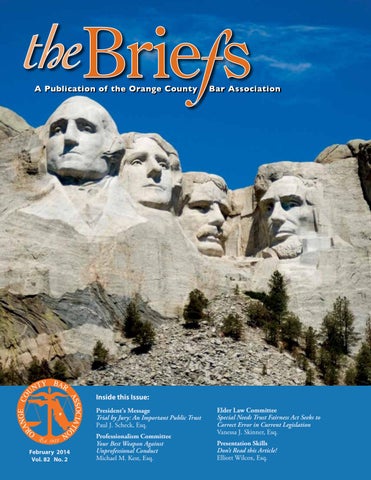
A Publication of the Orange County
Bar Association
Inside this Issue: President’s Message Trial by Jury: An Important Public Trust Paul J. Scheck, Esq.
February 2014 Vol. 82 No. 2
Professionalism Committee Your Best Weapon Against Unprofessional Conduct Michael M. Kest, Esq.
Elder Law Committee Special Needs Trust Fairness Act Seeks to Correct Error in Current Legislation Vanessa J. Skinner, Esq. Presentation Skills Don’t Read this Article! Elliott Wilcox, Esq.
Even if you run a small business entirely alone, you don’t have to feel that way. BMO Harris Bank is a proud sponsor of the Orange County Bar Association. Our Small Business Bankers are always here to help. Talk to one today. Tom Bacchus, Business Banking | 407.529.2004 Stop by your nearest branch or visit bmoharris.com/smallbiz.
BMO Harris Bank N.A. Member FDIC
PRSRT STD U.S. POSTAGE PAID MID-FL FL PERMIT NO. 581
880 North Orange Avenue Orlando, Florida 32801
Jonathan R. Simon
Kerstin L. Morgan
Michael J. Vaghaiwalla
Refer Your Family Law Matters With Confidence Complimentary Consultations for All Referrals Litigation | Mediation | Qdro
TheOrlandoFamilyFirm.com 1 2 1 S . O r a n g e Av e n u e , S u i t e 1 5 0 0 | O r l a n d o , F L 3 2 8 0 1 | 4 0 7. 3 7 7. 6 3 9 9
Legal Aid Society of the Orange County Bar Association, Inc.
february 4 Public Assistance Programs: A Look at Medicaid, Food Stamps, and Social Security
may 20 Best Interest Advocacy for Babies and Drug-Dependent Newborns: Dependency Court and Drug Court
september 23 Human Trafficking, Sexual Abuse and Keeping Children Safe Act Certification for GALs
february 18 2014 Extension of Foster Care: A Legislative Review
june 10 Dissolution of Marriage Part 2
october 14 Guardianship of a Person
june 24 Securing Appropriate Psychotropic Medication and Enhanced Placement for Youth with Mental Health Needs: A Step-By Step Guide
october 28 Changes in Interstate Compact for the Placement of Children (ICPC) and Out of Town Inquires (OTI) for Placement Procedures
july 8 Defense to Debt Collection Cases
november 4 Immigration Relief for Victims of Domestic Violence and Other Violent Crimes
*march 4 Legal Issues Involving Children with Disabilities - Day 1 (For details, please email mcarbo@ legalaidocba.org) march 18 Ethical Issues in GAL Representation: GAL, DCF, and Judicial Panel april 8 Dissolution of Marriage Part 1 *april 22 Legal Issues Involving Children with Disabilities - Day 2 (For details, please email mcarbo@ legalaidocba.org) may 6 Representing Survivors of Human Trafficking
july 22 Immigration Law and Dependent Youth: Special Immigrant Juvenile Petitions august 5 GAL 101: Best Interest Advocacy In and Out of Court august 19 Paving the Road to Permanency In and Out of Dependency Court september 9 Sealing and Expungement
november 18 Termination of Parental Rights: Case Preparation for GALs december 2 Special Legal Issues Impacting Dependent Youth with Delinquency Involvement: The Crossover Effect december 16 GAL 101: Best Interest Advocacy In and Out of Court
For OCBA members, the training is free. For non-OCBA members participating in the LAS pro
bono program, the training is free. Pre-registration is required for the free lunch and requested for training (or subject to space availability if not pre-registered). For more information, please email: ctucker@legalaidocba.org or mcarbo@legalaidocba.org or merazmus@legalaidocba.org.
theBriefs February 2014 Vol. 82 No. 2
www.orangecountybar.org
PAGE 1
Contents
3
President’s Message Trial by Jury: An Important PublicTrust Paul J. Scheck, Esq.
4
Professionalism Committee Your Best Weapon Against Unprofessional Conduct Michael M. Kest, Esq.
5
OCBA Luncheon Eugene K. Pettis, Esq. President, The Florida Bar
9
20
Legal Aid Society Teaching Tips A Tip for Pro Bono Attorneys Assisting Debtors in Claiming Exemptions Larri T. Thatcher, Esq.
21
Legal Aid Society GAL Teaching Tips Legislative Appropriation Facilitates Permanency for Developmentally Disabled Youth Ericka C. Garcia, Esq.
22
Breakfast of Champions
25
InnSider The Florida Bar News George C. Young Inn of Court Selects Board of Governors Actions for the New Year Two for Awards Roger B. Handberg, Esq.
10
Barry Law School Dean is Named Professional of the Year at Don Quijote Awards
11
28
Presentation Skills for Lawyers Don’t Read this Article Elliott Wilcox, Esq.
The Honorable Donald E. Grincewicz Honored with Distinguished Service Award Rainmaking Social Arbitrage: What It Means, Intellectual Property Committee How It Works, and Why It Matters Is Your Federal Trademark Registration Michael Hammond, Esq. Doomed from the Beginning? Ryan Santurri, Esq. Allison R. Imber, Esq. YLS on the Move Jill D. Simon, Esq.
30
12
31
14
Judicial Relations Committee Interview with the Honorable Patricia A. Doherty Crystal Espinosa Buit, Esq.
16
Akerman LLP Remembers Jim Foster with $10,000 Gift Designated for Children’s Legal Services
32
Paralegal Post Capturing Billable Time – What Story Are You Telling? Michelle Gerena
34
New Members
41 17 Announcements Elder Law Committee Special Needs Trust Fairness Act Seeks to 43 Correct Error in Current Legislation Vanessa J. Skinner, Esq.
18
Legal Aid Society What We Do... Voices for the Voiceless – In More Ways than One Donna A. Haynes
the Briefs
©2011 Co-Editors Vincent Falcone, Esq. & Ian D. Forsythe, Esq.
Associate Editors Elizabeth Collins Plummer, Esq. & Carrie Ann Wozniak, Esq. Hearsay Columnist Christine A. Wasula, Esq. Side Bar Columnist Sunny Lim Hillary, Esq. YLS Columnist Jill D. Simon, Esq. w OFFICERS Paul J. Scheck, Esq. President Nicholas A. Shannin, Esq. President-Elect Jamie Billotte Moses, Esq. Treasurer Wiley S. Boston, Esq. Secretary w EXECUTIVE COUNCIL Linda Drane Burdick, Esq. Philip K. Calandrino, Esq. Richard S. Dellinger, Esq. Mary Ann Etzler, Esq. LaShawnda K. Jackson, Esq. Kristopher J. Kest, Esq. Elizabeth F. McCausland, Esq. Nichole M. Mooney, Esq. Eric C. Reed, Esq. Gary S. Salzman, Esq. William C. Vose, Esq. Kristyne E. Kennedy, Esq. Ex Officio Lauren Heatwole McCorvie, Esq. YLS President w EXECUTIVE DIRECTOR Brant S. Bittner w Communications Manager Peggy Storch Communications Assistant Nancy Barnette Marketing & Sponsorship Coordinator Chelsie Sloan
Classifieds
44
Calendar
DEADLINE INFORMATION
Advertising - 10th of the month prior to the month of publication Copy - 15th of the month six weeks prior to the month of publication If the deadline falls on a weekend or holiday, the deadline is the next business day. Publication of advertising herein does not imply any endorsement of any product, service or opinion advertised. The opinions and conclusions, including legal opinions and conclusions contained in articles appearing in The Briefs, are those of the authors and do not reflect any official endorsement of these views by the Orange County Bar Association or its officers and directors, unless specifically stated as such. All contents ©2014 Orange County Bar Association. All rights reserved. Designer: Catherine E. Hebert Cover illustration: iStock
Residential Mortgage Foreclosure Program 407-649-1833 880 North Orange Avenue • Orlando, FL 32801 (407) 422-4551 • Fax (407) 843-3470 Legal Aid Society 407-841-8310 Citizen Dispute 407-423-5732 Family Law Mediation 407-422-4551 Lawyer Referral Service 407-422-4537 Orange County Foreclosure Mediation 407-422-4551 Young Lawyers Section 407-422-4551
ISSN 1947-3968
PAGE 2
www.orangecountybar.org
theBriefs February 2014 Vol. 82 No. 2
President’sMessage
February 2014 Trial by Jury: An Important Public Trust
A Paul J. Scheck, Esq.
I consider trial by jury as the only anchor ever yet imagined by man, by which a government can be held to the principles of its constitution. – Thomas Jefferson, 1789
s lawyers (particularly litigation attorneys), we take for granted that a jury will be impaneled to hear and resolve our case, if the case reaches that stage. We also take for granted that the judge assigned to hear and rule on our case, whether at the motion or trial stage, will be impartial and resolve our case based on the law. The protection of our rights and liberties, as well as the resolution of financial and property disputes, are largely achieved through the teamwork of a judge and a jury who, working together in a common effort, put into practice the principles of our great heritage of freedom and justice. My recent experiences have made me revisit these fundamental truths and have given me a newfound appreciation for them. During colonial times, the jury became a symbol of rebellion against the English king as colonists complained they were being denied the right to a jury trial guaranteed to all other Englishmen. In response to this abrogation of their rights, in their earliest documents the colonists included guarantees of the right to trial by jury. For instance, in the Declaration of Independence Thomas Jefferson listed among the various complaints against King George III that he had been “depriving us in many cases of the benefits of Trial by Jury.” As a result, the right to a jury trial was subsequently made a priority in the Constitution and the Bill of Rights. Equally as important, a fair and independent judicial branch has also been a cornerstone of our system of government. A second grievance referenced against King George in the Declaration of Independence was that he had made judges “dependent on his will alone.” Thus, the framers wanted to ensure that the judiciary would not be prejudiced by the political will or other outside influences. A fair and independent judiciary requires not only the freedom for judges to make case decisions without outside influence, but also the recognition of the judicial branch as a coequal branch of government, separate from the legislative and executive branches, responsible for governing itself and accountable to the public. Over the past few months, two events reinforced to me the importance and uniqueness of these two essential components of our American judicial system. First, this past fall I received a jury
theBriefs February 2014 Vol. 82 No. 2
summons in the mail instructing me to report to the Orange County Courthouse for potential jury service. My first reaction was probably a common reaction to such a notice, namely that the notice was an inconvenience and I did not have time for jury service. Despite my initial reluctance however, I showed up at my designated time and enjoyed a day in the very comfortable (and technologically advanced) jury assembly room at our courthouse. I was called up twice for potential jury selection and participated in the voir dire process from the other side for a change. Once my fellow potential jurors discovered I was a lawyer, I instantly became a sounding board for questions and insights about the process. Through it all, however, I was greatly impressed by the serious, yet excited manner in which the potential jurors approached the process. Their view of the process humbled me and reminded me of the importance of jury service in the administration of justice. I was also privileged last December to participate in the investiture ceremony for Judge Christi Underwood. Though this ceremony was indisputably an acknowledgement of Judge Underwood’s personal achievement in reaching this career milestone, the investiture itself was also an opportunity to show our high regard and respect for all members of our judiciary. There is perhaps no greater example of public service and contribution to the public welfare than that of our judges. Judges serve the unique and crucial role in our judicial system of remaining impartial, fair, and unbiased, while being presented with contrary arguments from very biased and self-serving parties. This is why their independence is vital to our system of justice, so they can render decisions solely in accordance with the law and not based on external factors or style. So, the next time you receive a jury summons in the mail or appear before our fine Orange County judges, do so with pride and say thank you to the framers of our Constitution for allowing us to be participants in the finest legal system in the world! Have a great February and Happy Valentine’s Day! Paul J. Scheck, Esq., is a partner with Shutts & Bowen, LLP. He has been a member of the OCBA since 1993.
www.orangecountybar.org
PAGE 3
ProfessionalismCommittee
I Michael M. Kest, Esq.
PAGE 4
Your Best Weapon Against Unprofessional Conduct
n the course of litigation you are going to have disagreements with opposing counsel regarding scheduling, discovery, and other procedural issues. Most of the time, the attorneys will work in good faith to agree on these issues. As long as the other attorney is an “honest broker,” most issues will be resolved without the court’s assistance. But what do you do when the other side is being difficult? The answer may surprise you. You play by the rules. Remember back (way back for some of us) when you were a 1L and took civil procedure? Was that the last time you really looked through the rules? If you find your self dealing with a difficult attorney (or an opposing counsel who has a difficult client), it might be time to crack open your rules book. Most civil trial1 attorneys have a general familiarity with the Florida Rules of Civil Procedure, but many don’t look at them on a regular basis. When dealing with most attorneys, it is simply not necessary. The rules are there for when the parties cannot resolve issues on their own. We tend to concentrate on the substantive law of a case, probably because some idealism left from law school tells us that cases should be decided on the merits.2 However, when you get “that attorney” on the other side, it is time to turn your focus to the procedural rules. The rules are designed to get the parties to settle the dispute on the merits.3 When one party is actively attempting to thwart the process, the rules provide enforcement mechanisms to get the case back on track. Discovery is one of the biggest causes for invocation of the rules. The reason for this is simple: Discovery is what allows the parties to get to the facts and have the case decided on the merits. An attorney (or party) who knows he or she does not have the facts or law on his or her side may try to delay or obscure discovery in an attempt to frustrate the other side. The rules specifically allow for discovery to be served with the complaint.4 While it seems to be a common argument, there is no provision in the rules that allows for a party to delay responding to discovery until a motion to dismiss has been heard. There is also no requirement that discovery be taken in any particular order (i.e., that interrogatories must be served prior to a deposition being taken, etc.). In fact, the only real restriction on limiting discovery after the filing of a complaint is Fla. R. Civ. P. 1.310(a), which states:
[a]fter commencement of the action any party may take the testimony of any person, including a party, by deposition upon oral examination. Leave of court, granted with or without notice, must be obtained only if the plaintiff seeks to take a deposition within 30 days after service of the process and initial pleading upon any defendant… In other words, once your complaint is served, you are free to schedule any depositions you deem necessary as long as they are at least 30 days out. An attempt should be made to coordinate the scheduling of depositions with opposing counsel.5 What do you do if the opposing party will not respond to your requests for setting a deposition, will not agree to a date, or will only agree to dates far off in the future? While each of these situations needs to be dealt with in a separate manner, the common element of all three is your attempts to communicate with opposing counsel. In the first situation, I would suggest looking to Ninth Circuit Administrative Order 2012-03. While technically the order deals with the necessity for discussing a motion prior to setting a hearing, it presents a pretty good framework for handling most situations where you have a nonresponsive opposing party. The order says that you should make three “good faith” attempts to discuss the motion prior to moving forward unilaterally.6 The order also states that attorneys are to respond promptly to phone calls or correspondence from opposing counsel.7 If you still don’t get a response after three attempts, set the deposition unilaterally. Once you do, you are likely to get a response, something to the effect of “my client cannot do the deposition on the date set, but here are additional dates.” If you do get that, you have a decision to make. I would suggest that if you are able to change it to one of the provided dates and it will not prejudice your client, change the deposition to the date provided by opposing counsel. I suggest this for two reasons. First, it is the professional thing to do. Everyone makes mistakes and it is a small concession, again assuming there is no prejudice to your client. Second, at some point in your career – or
www.orangecountybar.org
continued page 26
theBriefs February 2014 Vol. 82 No. 2
OCBA LuncheonThursday, February 23, 2014 Eugene K. Pettis, Esq.
E Eugene K. Pettis, Esq.
President, The Florida Bar
ugene K. Pettis, Esq., a co-founder of Haliczer Pettis & Schwamm, P.A., focuses his practice in the areas of medical malpractice, personal injury, commercial litigation, professional liability, and employment law. Mr. Pettis attended the University of Florida, where he received a bachelor’s degree in political science in 1982 and graduated from the University of Florida’s Levin College of Law in 1985. He co-founded Haliczer Pettis & Schwamm, P.A., in 1996. Mr. Pettis, in June 2013, was sworn in as president of The Florida Bar, becoming the first African-American to serve in this position. His role at the helm of The Florida Bar, which governs nearly 100,000 attorneys, is clear evidence of his impressive leadership abilities and his passion for giving back to his profession and his community. He was elected by his peers in 2005 to The Florida Bar’s Board of Governors. Just six years after graduating from law school, he was appointed by former governor Lawton Chiles as the first African-American on the South Florida Water Management District’s governing board (1991-99), where he eventually served as vice-chairman. Mr. Pettis supports higher education, serving on the University of Florida Foundation’s board of directors for eight years and currently on the board of trustees at the University of Florida’s Levin College of Law.
Mr. Pettis has earned Martindale-Hubbell’s top AV rating for his high professional and ethical standards. Throughout his career, he has earned numerous legal awards and accolades, including perennial selection by his peers for inclusion in The Best Lawyers in America in areas of medical malpractice and personal injury, and employment litigation; Florida Super Lawyers; the South Florida Legal Guide “Top Lawyers” list; and Florida Trend’s “Legal Elite.” In 2013, Mr. Pettis was recognized by the Best Lawyers in America as the Lawyer of the Year for Employment Law in his locality. He was a 2007 inductee to the exclusive invitation-only American College of Trial Lawyers and elected by his peers into the American Board of Trial Advocates (ABOTA). In January, 2013, he was recognized by his ABOTA chapter as The Trial Lawyer of the Year in Ft. Lauderdale, Florida. In recognition of his commitment to community service, Mr. Pettis was recognized in 2012 by the Urban League of Broward County with the Margaret Roach Humanitarian Award. Mr. Pettis was admitted to The Florida Bar in 1985. He is admitted to practice in all of Florida’s district courts, including the Southern District, Middle District, and Northern District. Mr. Pettis lives in Fort Lauderdale with his wife and two daughters.
The Ballroom at Church Street Co-hosted by the Paul C. Perkins Bar Association
11:30 a.m. - 1:00 p.m. 225 S. Garland Avenue • Orlando, FL 32801 Please RSVP by Friday, February 21, 2014 RSVPs will not be accepted after February 21, 2014 RSVP through the OCBA Store at www.orangecountybar.org/store CANCELLATIONS must be recceived no later than February 21, 2014. To cancel, contact Marie West at mariew@ocbanet.org. The OCBA is happy to provide 10 luncheons as part of your member benefits, but no-shows incur additional charges for the Bar and walk-ins cannot be guaranteed a seat.
Sponsored by: BMO Harris Bank
theBriefs February 2014 Vol. 82 No. 2
www.orangecountybar.org
PAGE 5
NIGHT
AT THE
MUSEUM
Tuesday, March 4, 2014, from 5:30 p.m. - 8:30 p.m. at the Orlando Museum of Art, 2416 North Mills Avenue, Orlando, FL 32803 This an opportunity for lawyers of all ages to meet and mingle with judges and colleagues in a relaxed, social setting while enjoying the exhibits at the Orlando Museum of Art. Food and drinks (alcoholic and non-alcoholic) will be served and are included in the price of admission. ****The entire museum, including all galleries, will be open to attendees. **** Fees: Judges: Free Solo/Government/Law Students: $30 Private Practice/All Guests (including judges' guests): $35 At the Door: $40 for all attorneys, law students, and guests RSVP requested by February 26, 2014. Please note: Payment must be received to confirm reservation. Make checks payable to the OCBA and mail to the event chair: Jen Smith, 205 S. Eola Dr., Orlando, FL 32801. Please provide a list of all attendees with payment, or pay online at http://ocba2014ewj.bpt.me. Judges may RSVP directly to Jen Smith at the email below. Questions/Volunteers? Contact Jen Smith at jennifer.ashley.smith@outlook.com
PAGE 6
www.orangecountybar.org
theBriefs February 2014 Vol. 82 No. 2
Uncomplicating the Complicated.
For 25 years, our mediators have helped attorneys and their clients through the maze to settlement. From seven offices in Florida and Alabama, Upchurch Watson White & Max has become a top mediation firm nationally, known for effectively and efficiently facilitating agreements to resolve complex and routine issues alike. Our Supreme Court certified attorney-neutrals can serve as courtappointed or privately employed mediators as well as arbitrators and third-party case managers.
Become an appreciated client by calling 800-863-1462 or visiting us online.
M E D I AT I O N
| A R B I T R AT I O N | E - D I S C O V E R Y | S P E C I A L M A S T E R S | C O N S U LTA N T S Successfully Resolving Conflicts In Florida, Alabama & Nationwide Since 1988 CALL TOLL FREE: 800-863-1462 | READ MORE & SCHEDULE: WWW.UWW-ADR.COM
linkedin.com/company/upchurch-watson-white-&-max
theBriefs February 2014 Vol. 82 No. 2
www.facebook.com/UWWMMediation
www.orangecountybar.org
@UWWMmediation
PAGE 7
PAGE 8
www.orangecountybar.org
theBriefs February 2014 Vol. 82 No. 2
The Florida BarNews
T
Board of Governors Actions for the New Year
he Florida Bar Board of Governors met on December 13, 2013. Major actions of the board and reports received included: New Guidelines for Advertising Past Results were approved. Based on a recommendation of the Board Review Committee on Professional Ethics, the guidelines generally do not allow television and radio ads and billboards as acceptable advertising media for past results because sufficient explanations on the difference between net and gross awards and additional information necessary to prevent the ads from being misleading cannot be included. Ads in other media may contain past results with appropriate disclaimers and following specific additional guidelines. The guidelines are posted on the website and members may contact the Ethics Hotline with questions. The board requested that the Standing Committee on Advertising prepare an advisory opinion on implications of bar members using the LinkedIn social and professional networking site. The board also voted to revoke a staff advisory letter stating that the use of LinkedIn violates bar rules. The Florida Bar News covered this issue in the November 15, 2013 edition. Adding public record information about pending disciplinary actions on attorney profile pages on the bar’s website and a new status listing were approved. The recommendations were developed by the board Communications Committee with The Florida Bar Citizens Advisory Committee to readily provide key grievance documents to consumers pertaining to filed consent judgments, reports of referees with guilt findings, and final court orders of discipline. In cases with filed consent judgments and referee reports of guilt, membership status will indicate that a disciplinary proceeding is pending. Details on the implementation were published in the January 1, 2014 issue of The Florida Bar News.
theBriefs February 2014 Vol. 82 No. 2
www.orangecountybar.org
A Special Committee on Technology was approved to work with the Vision 2016 Commission to identify technology tools for lawyers and to examine methods to provide communications, resources, and assistance with technology-based issues within the legal profession. Goals include helping bar members become better educated in preparing their firms and law offices to meet the challenges of the evolving practice of law. Members may now access technology tips on www. floridabar.org. New tips are posted every Tuesday. For the 2014-15 bar year, the membership of Wm. Reece Smith, Jr., Leadership Academy will be increased from a maximum of 60 to 75 fellows. Bar sections will be asked for increased involvement in the program, which is designed to assist a diverse and inclusive group of lawyers in becoming better leaders. Extensive information on the academy can be found at www.floridabar. org/leadership academy. A request from the Young Lawyers Division is being studied that may allow online attendance at the Practicing with Professionalism program because of the difficulty some new lawyers have attending in person. The one-day seminar, which currently requires in-person attendance, provides a broad overview of ethical and professional issues for new lawyers in fulfillment of phase 1 of the Basic Skills Course Requirements (BSCR). A tentative schedule of basic skills courses and Practicing with Professionalism courses is available on www.floridabar. Submitted by Francine Andía Walker, APR, CPRC, Director of Public Information and Bar Services for The Florida Bar.
PAGE 9
Special
L
Leticia M. Diaz, Esq.
Barry Law School Dean is Named Professional of the Year at Don Quijote Awards
eticia M. Diaz, Esq., dean of the Barry University Dwayne O. Andreas School of Law, was named the 2013 Professional of the Year at the 16th Annual Don Quijote Awards. The awards, announced December 7, 2013, during a gala at Epcot’s World Showplace Pavilion, celebrate the achievements and entrepreneurial spirit of individuals in the Central Florida business community. The Don Quijote Awards are presented by the Hispanic Chamber of Commerce of Metro Orlando and the Hispanic Business Initiative Fund of Florida, Inc. The Professional of the Year Award recognizes Hispanic men and women who have achieved distinction in their profession, demonstrated leadership or community involvement, and made innovations or notable contributions to their field. Diaz and her fellow honorees in other categories were chosen from more than 150 nominees. “I am deeply honored to receive this award,” Diaz said. “The Hispanic business community has made incredible strides in Central Florida, and I
am proud to be associated with such outstanding professionals. At Barry School of Law, I am surrounded by students who dare to dream big. In the spirit of Don Quijote, they inspire all of us to make our dreams a reality through hard work and determination.” Diaz is the first Cuban-American woman to hold the position of dean at an ABA-accredited law school in the United States. She has been a leader and advocate on Hispanic issues and serves on the advisory committee for the American Bar Association Commission on Hispanic Legal Rights & Responsibilities. Diaz has been an advocate for immigration reform, penning an article on the DREAM Act that was entered into the Congressional Record in 2010 and hosting a White House Hispanic Action Summit at the law school in 2011.
◆ Florida Supreme Court Certified Circuit Mediator ◆ Florida Supreme Court Certified Appellate Mediator ◆ Florida Supreme Court Certified Family Mediator ◆ Certified Federal Court Mediator – Middle District ◆ Patient – Perceptive – Prepared
PAGE 10
www.orangecountybar.org
theBriefs February 2014 Vol. 82 No. 2
JudicialNews
T The Hon. Donald E. Grincewicz
The Honorable Donald E. Grincewicz Honored with Distinguished Service Award
he Honorable Donald E. Grincewicz received the Distinguished Service Award from the Florida Council on Crime and Delinquency on July 24, 2013. The award is presented to individuals who provide remarkable contributions in their respective fields. Judge Grincewicz was commended for his efforts in the criminal and juvenile divisions of the Ninth Judicial Circuit Court. Judge Grincewicz founded the Adult Felony Drug Court and has served as a drug court judge in the criminal and juvenile divisions. He has actively contributed to adolescent drug awareness and treatment and solving jail and corrections issues. He has served as chairman of the DUI Adolescent Committee, the Jail Oversight Commission, and is a long-
Orange County Bar Association
Election Notice The names of nominees for the following offices will be announced on the OCBA website on Wednesday, February 5, 2014:
OCBA Vice President /President-Elect OCBA Treasurer OCBA Secretary OCBA Executive Council (3 seats) Legal Aid Society Board of Trustees (2 seats) Young Lawyers Section At-Large Board Members (5 seats)
standing member of the board of directors of the Florida Safety Council. Judge Grincewicz has established numerous restorative justice programs that hold the defendants accountable while restoring the victim and the community. “I believe we are a country that provides second chances to those who choose to participate,” stated Judge Grincewicz. “It has given me immense satisfaction to implement programs that provide a second chance to those who want to become productive, law-abiding citizens.” Submitted by Julio Semino, Court Support Manager, Ninth Judicial Circuit Court of Florida.
Voting shall be by electronic ballot emailed to each Regular and Judicial Honorary member of the Association (eligible voters) on Monday, March 3, 2014. Members eligible to vote will receive, via email, a secure, nonidentifying link to the electronic ballot. By February 17, 2014, members eligible to vote must have a current, working email address on file in the BUSINESS EMAIL ADDRESS line in their membership record. To update their record, members must go to the OCBA website (www.orangecountybar.org), login to their record, select “Edit your information,” and update the information. Eligible voters who do not have a working email address will receive a paper ballot. Voting will close on March 31, 2014. Electronic ballots must be cast no later than midnight March 31, 2014, and paper ballots must be received in the OCBA office no later than 5:00 p.m. March 31, 2014. This election is being conducted on behalf of the OCBA by Intelliscan, Inc., an independent election services provider. All voted ballots, whether cast electronically or via paper ballot, will be certified by the Secretary of the OCBA. If you have any questions, please contact the communications manager at 407-422-4551, ext. 227, or peggys@ocbanet.org.
theBriefs February 2014 Vol. 82 No. 2
www.orangecountybar.org
PAGE 11
Intellectual PropertyCommittee
“V Ryan T. Santurri, Esq.
Allison R. Imber, Esq.
PAGE 12
Is Your Federal Trademark Registration Doomed from the Beginning?
oid ab initio” is a Latin phrase meaning “void from the beginning.” While federal trademark registrations are presumed valid (44 U.S.C. §1507), certain errors made during the application process may render the registration void regardless of the applicant’s good-faith intent. In such cases, nothing short of refiling the application without the initial error can cure it. The most common errors relate to inaccurate statements of ownership of the mark and use of the mark in commerce, as well as whether the use of the mark at issue has been properly controlled by the owner. In some circumstances, these questions can sometimes be difficult to answer. For example, when there are a number of companies and/or subsidiaries involved in the use of the mark, which entity is the proper owner? When a mark is used by a company, but also used personally by the owner of the company, who is the proper applicant, and is the proper first use by the company or owner? These questions, if answered incorrectly, could result in the loss of the registration for the mark. Thus, great care should be exercised in both communicating the requirements of trademark applications to clients, as well as documenting any factual statements made in the application itself. Pertinent Requirements in the Application Process The necessary requirements for a U.S. trademark application are listed in 15 U.S.C. §1501. The chief requirements are that the applicant be the person or entity actually using or intending to use the mark, that the applicant verify the use of (or intent to use) the mark in commerce, and that the applicant believe to the best of his or her knowledge that “no other person has the right to use” the mark in commerce. All trademark applicants who file based on actual use must state the date of use of the mark in commerce and in interstate commerce; otherwise they jeopardize the validity of their registration.1 Similarly, an applicant who has filed an application based on intent to use the mark must possess a bona fide intent to use the mark, and a failure to possess this intent can likewise render the mark void.2 Cases finding a trademark void ab initio have focused on the need for accuracy and honesty in fulfilling these requirements. Selection of the Proper Applicant is Critical Understanding the requirements for use of the mark in interstate commerce (and its impact on ownership) is critical at the application stage.
www.orangecountybar.org
The decision of Great Seats, Ltd. v. Great Seats, Inc., 2007 TTAB LEXIS 68, *2 (TTAB June 14, 2007), is instructive in this regard. Great Seats involved a cancellation petition for the mark GREAT SEATS as used in connection with ticket agency services for entertainment events.3 The record owner of the mark, a ticket brokerage business, was one of two such businesses owned by Danny Matta.4 One of Mr. Matta’s brokerages was using the mark in commerce (and later became the record owner of the registration by assignment), but the second of his brokerages was the original applicant.5 There was no question that the mark was used in commerce by one of Mr. Matta’s companies; the question was whether the one using the mark was the one that actually filed the application. Ultimately, the TTAB found that the wrong entity was the original applicant and, although the application was later assigned to the actual user of the mark, the registration was void ab initio and, therefore, invalid.6 It is important to identify and file the application naming the proper applicant with not only a use-based application, but also with intent to use applications. In Sanders v. American Forests, 2000 U.S. App. LEXIS 3692, *1 (Fed. Cir. Mar. 10, 2000), the federal circuit reviewed a TTAB decision in an opposition proceeding for the mark LEAF RELEAF & Design. The issue in Sanders was not simply the question of whether there was indeed a bona fide intent to use the mark, but whether this intent was possessed by the named applicant. In Sanders, the applicant was an individual, but the mark was intended to be used on products manufactured by the applicant’s spouse.7 The application was held void ab initio for failing to evidence a bona fide intent to use the mark by the applicant as opposed to her spouse without a formal business partnership.8 The Applicant Must Not Allege Use of a Mark Unless it is Actually Being Used For use-based applications, the applicant must actually be using the mark as claimed on (or before) the date claimed. One example of a misunderstanding (or misrepresentation) of the date a mark was first used in interstate commerce is illustrated in the cancellation action of Choice First Distribution, LLC v. Brown.9 In 2002, a trademark application for the mark CHRONIC 187 as used on soda and energy drinks was filed by John Brown.10 The applicant claimed the mark had been used in commerce since February of 2000, but the speci
theBriefs February 2014 Vol. 82 No. 2
men of use submitted during the application process suggested only preparation to use the mark on the goods rather than actual use.11 Nonetheless, the examiner accepted the specimen and, in November of 2003, U.S. Trademark Registration No. 2,780,780 was issued for CHRONIC 187.12 About a year and a half later, Choice First Distribution, owner of U.S. Trademark Registration No. 2,886,508 for the mark KRONIK for energy, sports, and soft drinks petitioned to cancel the CHRONIC 187 mark.13 During the cancellation proceedings, the TTAB analyzed the CHRONIC 187 specimen of use, as well as other alleged evidence of use submitted by the mark owner, but found that the evidence did not support use of the CHRONIC 187 mark in commerce until late 2004.14 Accordingly, the TTAB held “there was not use in commerce at the time respondent filed his Statement of Use, [and therefore] the resulting registration is void ab initio.”15 Which Came First, the Chicken... or the Chicken? Not only must the application contain correct first use dates in order to withstand a validity attack, but it must also be accurate with respect to the applicant’s assertion that it is entitled to exclusive use of the mark. In C.F.M. Distributing Company, Inc. v. Costantine, 2013 TTAB LEXIS 133 (TTAB Mar. 20, 2013) (non-precedential), the TTAB attempted to sort out ownership rights to a number of applications containing the mark for MARYLAND FRIED CHICKEN. Simply summarizing the history between the parties consumed two dozen pages of the opinion, complete
theBriefs February 2014 Vol. 82 No. 2
with charts and graphs attempting to track ownership by competing family members and their purported licensees/franchisees. Several applications were at issue, with various parties claiming rights to the marks.16 Although the applicant was indeed making use of the mark, the applicant knew of (but failed to acknowledge) that numerous other users also existed.17 After wading through various usages of the mark MARYLAND FRIED CHICKEN for more than 40 years, the TTAB focused on naked licensing – the “uncontrolled use of an alleged mark by many different parties” as well as failure to police – to find the application at issue void ab initio.18 Because of the fog cast over ownership of the marks by the applicant’s naked licensing, failure to police, and failure to evidence a clear chain of title ending with applicant, the TTAB concluded that “applicant was not the owner of these marks at the time the applications were filed, and consequently, both of these involved applications are deemed to be void ab initio.”19 Conclusion Although at first glance a trademark application seems straightforward, the devil is in the details. It is imperative that the proper applicant be ascertained and that there be a thorough understanding of how the mark has been and will be used prior to filing the application. Best practices include documenting all statements of facts sworn to in the application and educating clients as to the potential implications of listing incorrect information. As void ab initio challenges often come forward in litigation to enforce trademark rights, these practices will help to ensure that your cli-
ents will be able to enforce their trademark rights when they need to. Ryan T. Santurri, Esq., a shareholder at Allen, Dyer, Doppelt, Milbrath and Gilchrist P.A., is Board Certified by The Florida Bar in Intellectual Property Law. He has been a member of the OCBA since 2006. Allison R. Imber, Esq., Allen, Dyer, Doppelt, Milbrath and Gilchrist P.A., has been a member of the OCBA since 2007. 15 U.S.C. §1501(a); Bauer Bros. LLC v. Nike, Inc., 2012 U.S. Dist. LEXIS 72848, *16 (S.D. Cal. May 24, 2012), citing Aycock Eng’g, Inc. v. Airflite, Inc., 560 F.3d 1350, 1357 (Fed. Cir. 2009). 2 15 U.S.C. §1501(b); Sanders v. Am. Forests, 2000 U.S. App. LEXIS 3692, *1 (Fed. Cir. Mar. 10, 2000). 3 Great Seats, Ltd. v. Great Seats, Inc., 2007 TTAB LEXIS 68, *2 (TTAB 2007). 4 Id. at *6-7. 5 Id. at *10-13. 6 Id. at *10. 7 Sanders, 2000 U.S. App. LEXIS 3692, at *3. 8 Id. 9 Choice First Distribution, LLC v. Brown, Cancellation No. 92044116 (TTAB Apr. 23, 2008). 10 Id. at 5. 11 Id. at 10. 12 Id. 13 Id. at 3-4. 14 Id. at 14. 15 Id. at 17; see also Chere Amie, Inc. v. Windstar Apparel, Corp., 2002 U.S. Dist. LEXIS 17825 (S.D.N.Y. Sept. 20, 2002) (cancelling registration upon finding that token use is not sufficient to satisfy the use in commerce requirement); Burlington N. Santa Fe Corp. v. Purdy, 1998 U.S. Dist. LEXIS 23537, *8 (N.D. Tex. Dec. 7, 1998); Bright Beginnings v. Care Comm., 1994 U.S. Dist. LEXIS 17914, *7 (C.D. Cal. Feb. 28, 1994). 16 C.F.M. Distributing Company, Inc. v. Costantine, 2013 TTAB LEXIS 133 (TTAB Mar. 20, 2013). 17 Id. at *43. 18 Id. at *67. 1
19
Id. at *69-70.
www.orangecountybar.org
PAGE 13
Judicial RelationsCommittee
A
Interview with the Honorable Patricia A. Doherty
ppointed to the bench in 2010 by former governor Charlie Crist, the Honorable Patricia A. Doherty is a circuit judge for the Ninth Judicial Circuit and is currently assigned to the civil division. Judge Doherty received her undergraduate degree from the University of Florida, where she also attended law school.
Crystal Espinosa Buit, Esq.
Q: Where did you grow up? A: I am originally from a small town in upstate New York. My family moved to a few other states while I was growing up, and I graduated from high school in North Fort Myers, Florida. Q: Can you tell me about your years of practice before becoming a judge? A: I practiced for twenty-seven years with the same law firm before I was appointed as a Ninth Circuit Court judge. The name of the law firm when I was hired was Wooten, Honeywell, Kest & Martinez, two of the named partners being Mel Martinez and Judge John Kest. Mel Martinez was the partner who initially interviewed me and was my mentoring partner when I joined the firm after graduating from law school. I consider myself very fortunate to have practiced with this law firm. They were not only excellent lawyers but excellent people as well.
Q: What kind of law did you practice? A: I had a civil practice primarily handling The Hon. Patricia A. Doherty cases with medical issues. I received my bachelor’s degree in physical therapy and this practice area allowed me the benefit of using my undergraduate education in my law practice. Q: Can you tell me about some of the changes you experienced while transitioning from attorney to judge? A: A primary change is going from the position of an advocate to that of a neutral decision maker. Another change is that there is little control over the finances, including the budgeting and use of financial resources, which is a concern for the courts and judiciary. There is also less control over your schedule. As a judge we have a schedule in place for months in advance and, in some cases, more than a year in advance, that must be followed and which allows very little flexibility. Q: Why did you want to become a judge? A: I think it’s an honor and a privilege to serve PAGE 14
www.orangecountybar.org
as a judge. It is an honor given by the public, attorneys and, if you have been appointed, the governor. Personally, I felt it was a way to use my twenty-seven years of legal experience in a different way. It’s one of the most interesting and challenging jobs that anybody can have. It is also very humbling in that the decisions you make impact people’s lives. Q: What would you say is the hardest part about being a judge? A: One of the most difficult aspects of being a judge is working within the court’s budget limitations, which, administratively, is challenging for the whole circuit as well as the county. The limited budget restricts the number of judges and the resources, resulting in very full dockets that affect everybody ‒ not just the judiciary, but also the lawyers and the litigants. It’s a challenge to manage the dockets with the limited available financial resources. Q: On a daily basis, what do you enjoy most about being a judge? A: I enjoy the interesting legal and factual issues and intellectual challenges. I hate to use the cliché “intellectually stimulating,” but it truly is. Q: What do you know now that you didn’t know before becoming a judge? A: When I was “on the other side of the bench,” I didn’t fully appreciate how hard the judges work. I didn’t realize the number of hours they put in, not just conducting trials and hearings, but in legal research, preparation for trials and hearings, and writing orders and judgments. I also did not appreciate the work judges put in during evenings and weekends. With dockets being so full, you want to make sure people get their day in court and ensure everyone is given your attention and consideration, which requires time beyond the traditional work week. Q: What do you wish attorneys would do more of or better in your courtroom? A: First, I want to say that we have many excellent lawyers in our circuit, and I appreciate the time spent by them preparing. I think a better way to answer the question is to say what I appreciate about attorneys. I am appreciative when attorneys are prepared, when they know their Rules of Civil Procedure and Rules of Evidence, and when they provide their memoranda and research ahead of time versus the night before or the morning of theBriefs February 2014 Vol. 82 No. 2
a hearing. I know attorneys work hard in preparing for hearings, and I want to make use of the work they’ve put in. The other thing I appreciate is when attorneys are civil and professional while still advocating for their clients. Q: What advice would you give to young attorneys? A: I would advise them to find a good mentor who combines professionalism with advocacy and knowledge of the law. I would also suggest that young lawyers get involved in the legal community early in their career through professional groups and community groups that they are interested in. It’s important to get involved early and make friends and connections, which will be there throughout your career to support you in friendship, in legal practice, and in business. Q: How do you deal with the burden of deciding cases or issues that are important to people’s lives? A: I try to educate myself and understand the applicable law and the facts for each specific case, and have that basis when I listen to the presented arguments. I also try to give each party a chance to be heard and the opportunity to present or explain why they think the law does or does not apply to its particular case. I want to approach each case individually, thoughtfully, and with an open mind. Q: What would you say are the strengths and, conversely, the weaknesses of the legal system in America today? A: The weakness with the court system is the budgeting constraints and lack of financial resources. Our circuit is working hard, under Judge Perry’s guidance, to work within the budget given to us, but it remains an issue impacting the entire system. As far as its strengths, now having the perspective from this side of the bench, I think locally our judiciary is very collegial, hard-working, conscientious, and concerned. I think the Ninth Circuit is very fortunate in this regard. As judges we are fortunate to have so many good lawyers who take their practice seriously, are prepared, and do a good job representing their clients. Q: Who was the biggest influence in your legal career? A: There are many who influenced my career, including my law firm partners, my parents, my husband, and other women attorneys entering practice at the same time I started practicing. It was because of my mother that I initially went to law school. My
mother wanted her daughters to be educated and have the ability to choose their life path independently. When I made the decision to go to law school, my mother took an extra job to help with the expense. When I became a lawyer, the biggest influences in my legal career were my law partners. They set the example and a high bar for professionalism, integrity, preparation, and intelligence, and I will always be grateful for their influence, guidance, and friendship. Crystal Espinosa Buit, Esq. is an attorney with the law firm of Lowndes, Drosdick, Doster, Kantor & Reed, P.A. She has been a member of the OCBA since 2009.
Running? If you’re running for
OCBA, LAS, or YLS office, place your ad in The Briefs! Deadline: NOW!!!! for the March issue
Don’t come in last! Run your ad today!
Contact Chelsie Sloan at chelsies@ocbanet.org or 407-422-4551, Ext. 244
With more than 30 years legal experience in various matters including:
www.patrickcrowell.com Patrick C. Crowell, P.A. 4853 S. Orange Avenue, Suite B Orlando, FL 32806 theBriefs February 2014 Vol. 82 No. 2
www.orangecountybar.org
PAGE 15
The Florida Bar FoundationNews Akerman LLP Remembers Jim Foster with $10,000 Gift Designated for Children’s Legal Services
Jim Foster, Esq.
PAGE 16
During his 16 years at Akerman LLP, attorney Jim Foster was someone colleagues and friends often turned to for advice. “He was very much a mentor to younger lawyers and even to more experienced lawyers,” said Charles Brumback, Esq., managing partner of the Orlando office. “Having practiced for 40 years, he had a wealth of experience, and his background was such that if you asked Jim a question, he had probably done it, and if he hadn’t done it, he knew somebody who had. So people were very quick to seek him out and ask for his advice on a variety of topics, legal and otherwise.” When Foster passed away March 16, 2013, at the age of 65, the firm decided to honor him with a $10,000 memorial gift to The Florida Bar Foundation designated for its Children’s Legal Services
www.orangecountybar.org
Grant Program, which funds projects to protect the legal rights of foster children and children with special education, mental health, and medical needs. The Foundation established the program in the early 1990s to create and energize a statewide network of children’s legal services providers. The Legal Aid Society of the Orange County Bar Association, Inc. received a $60,264 Children’s Legal Services grant from The Florida Bar Foundation in 2012-13 for its Guardian ad Litem Project. “In our view, this was an opportunity to make something good happen out of a very, very sad situation. We found an excellent, if not the perfect recipient for this contribution,” Brumback said.
theBriefs February 2014 Vol. 82 No. 2
Elder LawCommittee
S Vanessa J. Skinner, Esq.
theBriefs February 2014 Vol. 82 No. 2
Special Needs Trust Fairness Act Seeks to Correct Error in Current Legislation
enator Bill Nelson (D-FL), chair of the Senate Special Committee on Aging and member of the Senate Finance Committee, along with Senators Chuck Grassley (R-IA), Jay Rockefeller (D-WV), and Mike Enzi (R-WY), have introduced the National Academy of Elder Law Attorneys’ (NAELA) Special Needs Trust Fairness Act in the United States Senate. In 2013, Representatives Glenn Thompson (R-5th-PA) and Frank Pallone (D-6th-NJ), the ranking member on the House Energy & Commerce Subcommittee on Health, introduced the companion bill in the United States House of Representatives (H.R. 2123). This new legislation seeks to correct what appears to be a drafting error in existing federal law, which presumes that a person with disabilities lacks the ability or mental capacity to independently create a certain type of special needs trust (SNT). In 1993, Congress added the concept of a SNT to the Omnibus Budget Reconciliation Act of 1993 (OBRA 1993). A SNT is designed to aid disabled individuals who receive Supplemental Security Income (SSI) benefits at the federal level and/or Medicaid health benefits at the state level to preserve their assets and use such assets to enhance their quality of life. The trust pays for healthcare expenses and other daily living expenses, such as toiletries and entertainment, that are not covered by their government benefits. Both SSI and Medicaid are needs-based benefits and, therefore, in order to receive such benefits, a person must meet certain financial thresholds. The assets held in a SNT are not counted when determining whether the person has more than the $2,000 in allowed, countable assets for either of these benefits programs. In exchange for this exclusion of the SNT from the asset calculation, upon the death of the disabled individual, the state is reimbursed from the trust assets for the Medicaid benefits paid to the individual during his or her lifetime. This payback provision must be included in SNTs that are funded with the assets of the disabled beneficiary ‒ (d)(4)(C) pooled trusts and (d)(4)(A) trusts. The former type of SNT is administered by a non-profit organization, and each disabled individual has his or her own subaccount within the trust; however, the trust assets are pooled together for investment purposes. The latter type of SNT, which is frequently used when the disabled individual is the recipient of a legal settlement, is managed by a trustee, such as
a family member, for the sole benefit of the disabled individual.1 The Special Needs Trust Fairness Act of 2013 seeks to address the disparity in the current legislation regarding who can establish (d)(4)(A) and (d)(4)(C) trusts. In addition to the provisions established by OBRA 1993, USC §1396p(d)(4)(A) provides that a d(4)(A) trust must be established by a parent, grandparent, legal guardian of the individual, or a court. Noticeably absent from this list of approved individuals is the disabled individual. Therefore, a disabled individual cannot create his or her own (d)(4)(A) trust even if he or she is mentally competent. In contrast, USC §1396(d)(4)(C) provides that a (d)(4)(C) trust must be established by a parent, grandparent, legal guardian of such individual, the individual, or a court. Therefore, (d)(4)(C) pooled trusts allow the disabled individual to create the trust. There does not appear to be any reason why “by the individual” was left out of USC §1396p(d) (4)(A), yet included in §1396(d)(4)(C). It is believed this omission was simply a legislative drafting error during the writing of OBRA 1993. As a result of this legislative error, disabled individuals who have the requisite mental capacity, but may not have a living or willing parent or grandparent to create their (d)(4)(A) trusts, are forced to petition the court in order to get these trusts established, a process which can take a significant amount of time and results in thousands of dollars of unnecessary legal costs for the disabled individuals. The Special Needs Trust Fairness Act seeks to amend Title XIX of the Social Security Act to extend the Medicaid rules regarding supplemental needs trusts for Medicaid beneficiaries to trusts established by those beneficiaries. In particular, it provides that Section 1917(d)(4)(A) of the Social Security Act (42 USC §1396p(d) (4)(A)) is amended by inserting “the individual,” after “for the benefit of such individual by.” The amendment shall apply to all trusts established on or after the date of the enactment of the Special Needs Trust Fairness Act. “The Special Needs Trust Fairness Act is a common sense solution that will save individuals with disabilities from unnecessary legal costs and time spent in petitioning the courts, and gives them back their dignity and constitutional right,” stated NAELA board member Michael Amoruso, Esq. He continued, “Without this bill, I, a blind and
www.orangecountybar.org
continued page 29
PAGE 17
Legal Aid SocietyWhat We Do...
I Donna A. Haynes
Kerry Monz
Voices for the Voiceless – In More Ways than One
n life, we come across stories that touch our hearts. Kerry Monz is one person whose story touched mine and countless others’ at the November 7, 2013, Breakfast of Champions. Kerry spoke with her computer-generated voice to a roomful of more than 550 members of the business and legal community. It was 7:30 a.m. She joined us to ask for donations and spread the word about the work of the Legal Aid Society. The following are the short, simple, and poignant words Kerry chose to tell her story. Good morning. I am Kerry Monz. I am here today to share my story so that you better understand how important every donation to the Legal Aid Society is. While I was living in New York I developed throat cancer. I was in my late 30’s. I went for treatment and after a few years of surgery and chemotherapy, I was pronounced cancerfree. The treatment took a toll, however. I have limited use of my left arm and I have concentration issues. I have a hole in my throat and have to use this electronic voice box to speak. As part of my post-cancer recovery, my doctors recommended I move to Florida so I would not have to be in such dry air up north. While in New York, I was able to draw Social Security disability benefits while receiving cancer treatment. When I arrived in Florida, the local Social Security office performed a continuing disability review to determine whether I still met the disability “standards.” The person reviewing the file – without meeting me – decided to terminate my benefits. That also ended my Medicare coverage. Now, I needed continuing Medicare coverage because I have to receive treatment every few months for hormone therapy and have additional tests to make sure the cancer does not return. My Legal Aid lawyer, Ed Dimayuga, appealed this decision and appeared with me before a federal administrative law judge.
PAGE 18 www.orangecountybar.org
That judge met with us, reviewed the medical evidence, and decided that I did indeed met the disability standards. Without the Legal Aid Society my physical health would be in jeopardy. I do not have the money to pay for medical care. I do not have the health necessary to work a full or part-time job. What I do have is a voice – not the generated one you hear today – but rather an advocate through the great works of the Legal Aid Society of the Orange County Bar Association. Legal Aid provides the voice to the voiceless. More than they will ever know. Thank you for your time. These eloquent words put a face to the case. Instead of being one of many social security disability cases, Kerry Monz became an advocate for Legal Aid. The numbers that we share explain the need for donations. While poverty increases, our dollars decrease, and the demand for services becomes something beyond what we can provide. The 6th Annual Breakfast of Champions was a resounding success. More than $102,000 was raised for our nonprofit charity by members of our legal and business communities. The list of participating sponsors and donors is published in this issue of The Briefs. On behalf of the Legal Aid Society’s board of trustees and executive director, I thank you for supporting the 6th Annual Breakfast of Champions. Please “save the date” for the 7th Annual Breakfast of Champions to be held on Thursday, November 6, 2014. If you missed this year’s fundraiser and are interested in making a donation, please visit our website at www.legalaidocba.org. No donation is too large or too small. Please select “2013 Breakfast of Champions” for our recordkeeping purposes. For more information about this event or other opportunities to support the Legal Aid Society, please feel free to contact me at dhaynes@legalaidocba.org, or 407-515-1850. Donna A. Haynes, Manager of Development, Legal Aid Society of the Orange County Bar Association, Inc., has been a member of the OCBA since 2008.
theBriefs February 2014 Vol. 82 No. 2
Legal Aid SocietyTeaching Tips
T Larri T. Thatcher, Esq.
A Tip for Pro Bono Attorneys Assisting Debtors in Claiming Exemptions
he Florida legislature recently enacted changes to Chapter 77 of the 2013 Florida Statutes – the garnishment statute. The revisions took effect on July 1, 2013. If you are a pro bono attorney representing a debtor claiming exemptions to garnishment, you should be aware of the changes to 77.041 (1) and 77.041 (3). These two subsections deal with the notice given to the debtor informing him or her of the right to claim an exemption, the form to be filed claiming an exemption, and the time for answering a claim of exemption. If the debtor is an individual, 77.041 (1) requires the clerk of court to attach a “Notice to Defendant” to the writ of garnishment. The statute requires specific language that must be in the Notice to Defendant. One of the requirements is that the Notice to Defendant must include a form called “Claim of Exemption and Request for Hearing.” Prior to the recent changes, the form for claiming an exemption included the following language: The statements made in this request are true to the best of my knowledge and belief. The revisions now require that the debtor sign under oath and penalty of perjury that the statements made in this request are true to the best of my knowledge and belief. (Emphasis added.) Another change is that the Notice to Defendant must now contain language notifying the debtor that he or she is required to complete a certification that he or she mailed or hand-delivered copies of their Claim of Exemption and Request for Hearing to the plaintiff or plaintiff’s attorney and
theBriefs February 2014 Vol. 82 No. 2
the garnishee or the garnishee’s attorney. Prior to the changes, the Notice to Defendant instructed debtors to mail or deliver a copy of their Claim of Exemption but did not require them to complete a certificate of service. Under the recent revisions, the Claim of Exemption now includes a certificate of service under oath and penalty of perjury that they have indeed provided their Claim of Exemption to the appropriate parties. Some debtor’s attorneys have created their own forms for claiming an exemption. Most of them mirror the form required by the statute, but also add language not required by the statute. If this is your practice, you will want to update your forms accordingly. Finally, you should note that the time for the plaintiff/creditor to answer to the Claim of Exemption and Request for Hearing has been increased. If the Claim of Exemption was hand delivered, the plaintiff now has eight business days to answer, and 14 business days if the Claim of Exemption is mailed. Please contact Larri Thatcher, Esq., at lthatcher@ legalaidocba.org for more information on debtor relief issues, community education, or intake. Larri T. Thatcher, Esq. is the Director of Intake and Community Education for the Legal Aid Society. She has been a member of the OCBA since 1976.
www.orangecountybar.org
PAGE 19
Legal Aid SocietyGAL Teaching Tips
A Ericka S. Garcia, Esq.
PAGE 20
Legislative Appropriation Facilitates Permanency for Developmentally Disabled Youth
mong the most vulnerable children in foster care are those with developmental disabilities such as an intellectual disability, autism, spina bifida, cerebral palsy, Down syndrome, or Prader-Willi syndrome. Although all children in foster care experience significant turmoil upon entering the dependency system, children with developmental disabilities are in need of additional, specialized, targeted services. These services, such as educational services, behavioral supports, and physical, occupational, and speech therapy, are critical to stabilizing children with developmental disabilities so that they may return to their home or find a forever family. While a number of organizations such as public school districts and Medicaid collaborate to provide these essential services for developmentally disabled youth, the Agency for Persons with Disabilities (APD), a state agency, provides the majority of these services so crucial to developmentally disabled children’s well-being. Services may include residential habilitation, supported employment, specialized therapies, and even behavior support, among others. Currently, there are 22,000 people who have been deemed eligible for services but are on a waiting list. Most of our foster children are waiting for services on this long list, just like everyone else. The Florida Legislature, however, understanding that our dependent children with developmental disabilities are in such enormous need of assistance, mandated an appropriation, virtually without strings, to ensure that permanency occurs as quickly as possible. Effective July 1, 2013, Chapter 2013-41 of Florida Senate Bill 1502 provides that children in foster care “at the time of finalization of an adoption
www.orangecountybar.org
with placement in the family home, reunification with family members with placement in a family home, or permanent placement with a relative in a family home, shall be moved to the waiver.” In essence, if a family is in need of APD services in order to safely care for the child, the family shall receive APD services once the dependency court either reunifies the child with a parent, places a child in a permanent guardianship with a relative, or the child is adopted. APD has already identified and set aside funds for 190 foster children in Florida who have a permanency goal that fits within this new appropriation. One such child is Stephen, who has significant needs and is being adopted by his foster parent, Ms. Smith. Ms. Smith has extensive experience caring for children such as Stephen. His guardian ad litem, Christina Green, Esq., contacted the Legal Aid Society upon hearing that we could assist. The Legal Aid Society was able to ensure that Ms. Smith would obtain waiver services on Stephen’s behalf after finalizing the adoption. Ms. Smith, committed to adopting Stephen, is delighted to receive this assistance. With these additional services, Ms. Green is helping to make sure that Stephen can continue to thrive with his new family, long after his dependency case closes. For more information on developmental disabilities law, please contact Ericka Garcia at egarcia@ legalaidocba.org. Ericka S. Garcia, Esq. is the Legal Aid Society’s GAL Program developmental disabilities attorney. She has been a member of the OCBA since 2009.
theBriefs February 2014 Vol. 82 No. 2
ATTORNEY AT LAW
Civil Appeals
Trial Consultation
Extraordinary Writs
Florida Trend’s “Legal Elite” – selected for 2011-13
Top 2% of Florida attorneys as chosen by their peers
Thompson Reuters “Florida SuperLawyers” – recognized for 2011-13
Top 5% of Florida attorneys by peer review & independent evaluation Florida Bar Certified in Appellate Practice since 1994 AV Rated Martindale Hubbell since 1988 Bar Register of Preeminent Lawyers since 2004 30+ Years of Appellate Experience
www.appellatepartner.com 407-688-2700 Local | 855-407-2700 Toll Free Marcia K. Lippincott P.A. | P.O. Box 953693 | Lake Mary, Florida 32795
theBriefs February 2014 Vol. 82 No. 2
www.orangecountybar.org
PAGE 21
The 2013 Breakfast of Champions To benefit the Legal Aid Society of the Orange County Bar Association, Inc. Special thanks to our event sponsors: Platinum - $2,500 Foley & Lardner, LLP Holland & Knight, LLP The SunTrust Foundation Gold - $1,000 BMO Financial Group - Tom Bacchus Cole, Scott & Kissane, P.A. Curtis Protection Services, Inc. - John Campbell Dean Mead Dean, Ringers, Morgan & Lawton, P.A. Fisher, Rushmer, Werrenrath, Dickson, Talley & Dunlap, P.A. GrayRobinson, P.A. Hilton Corporation Lowndes, Drosdick, Doster, Kantor & Reed, P.A. Orange County Bar Association, Paralegal Section Orange County Bar Association, Young Lawyers Section Prudential Financial - Nick Grounds The Martin Andersen - Gracia Andersen Foundation, Inc. Universal Orlando Resort Silver- $500 American Bar Association Retirement Funds Program AmeriFactors Financial Group, LLC/BB&T – John Lane Baker Hostetler BKHM CPA - Neal Renaurt First Green Bank GellerRagans, CPA
Gerard F. “Gerry” Glynn, Esq. Hale, Hale & Jacobson, P.A. HD Supply Solutions - Law Department Kimberly E. Hosley of the McMillen Law Firm Johnston Law Firm, P.A. King, Blackwell, Zehnder & Wermuth, P.A. The KMB Law Firm, P.A. - Krista Bartholomew Weiss Legal Group, P.A. - Kevin B. Weiss, Esq. Zimmerman, Kiser & Sutcliffe, P.A. Bronze - $250 Allen, Dyer, Doppelt, Milbrath & Gilchrist, P.A. Allen, Norton & Blue, P.A. ARCPoint Labs, Altamonte Springs Baldwin-Fairchild Cemeteries, Funeral Homes & Crematory - Sally Kopke Brown & Brown of Florida, Inc. - Matt Hall Fishback Dominick Galt Mile Media - Nick Roy Highwoods Properties Meenakshi A. Hirani, P.A. Hurley, Rogner, Miller, Cox, Waranch & Westcott, P.A. InFocus Family Law Firm, P.L. KEL Law Offices of Tad A. Yates Hon. Robert LeBlanc and J.A. Cindy Brown Legal Talent, LLC - Wynne E. McFarlin, Esq. New England Financial - Terry Bitner, CLU, ChFC Mikaela Nix, P.A. O’Connor & O’Connor Raymond James Financial Services, Inc. – Anne Marie Williams Anne Marie Rossi Jill S. Schwartz & Associates, P.A. The Umansky Law Firm, P.A. TJM Communications, Inc. TWI Services, Inc. Yergey & Yergey, P.A.
Bethanie Barber, Esq., with client, Taj Banks Edward Dimayuga, Esq., with client, Kerry Monz
PHOTOS: Flo Boehm
PAGE 22 www.orangecountybar.org
theBriefs February 2014 Vol. 82 No. 2
Breakfast of Champions November 7, 2013 The Ballroom at Church Street Mary Anne De Petrillo, Esq., Executive Director of the Legal Aid Society of the OCBA
Chief Judge Belvin Perry, Jr.
Glenn A. Adams, Esq., President, Board of Trustees of the Legal Aid Society of the Orlando Bar Association and Paul J. Scheck, Esq., President, Orange County Bar Association
Tatum Homer leading the Pledge of Allegiance Michael L. Resnick, Esq., with client, Marilyn Caswell
Bruce B. Blackwell, Esq.
theBriefs February 2014 Vol. 82 No. 22
www.orangecountybar.org
PAGE 23
When: Thursday, February 27, 2014 Where: Harry Buffalo, 129 W. Church Street Orlando, FL 32801
5:30PM REGISTRATION BEGINS 6:0 0PM POKER TOURNAMENT BEGINS 5:30-8:0 0PM HAPPY HOUR AND COMPLIMENTARY FOOD Tournament Directed by
Register at www.orangecountybar.org/store
Registration Fees:
Awards:
$30 player (advance) Top Woman $35 play (at the door) Top Law Firm S$15 non-player Top Non-Lawyer
Sponsored By:
Great Raffle Prizes!!!
50/50 Raffle $10 Losers’ Lounge Extra $25 chip for each Final Table Winners Top Player receives $150 can of food you donate
Proceeds Benefit:
restaurant gift card
PAGE 24 www.orangecountybar.org
For more information, contact Camy Schwam-Wilcox at camy@cbswlaw.com
theBriefs February 2014 Vol. 82 No. 2
InnSider
George C. Young Inn of Court Selects Two for Awards
T Roger B. Handberg, Esq.
Hon. John E. Jordan, III and Jacqueline Dalton
The Hon. Thomas Smith with his wife, Jill Smith
he George C. Young First Central Florida American Inn of Court honored two individuals at its end of the year banquet. Jacqueline Dalton of the Children’s Visitation Center was selected as the recipient of the Arnie Wilkerson Memorial Court Service Award, and U.S. Magistrate Judge Thomas B. Smith was given the James G. Glazebrook Professionalism and Service Award. Each year, the First Central Florida American Inn of Court solicits nominations for the two awards. The Arnie Wilkerson Award is named after Orange County Sheriff’s Deputy Arnie Wilkerson, who was killed in the line of duty on January 10, 1984, while serving as a bailiff at the Orange County Courthouse. In recognition of his selfless sacrifice and his exemplary public service, the First Central Florida American Inn of Court created an award in his honor. The award honors individuals (excluding lawyers and judges) working in the judicial system who display the highest standards of character, integrity, and ongoing dedication to the judicial system. Past recipients have been long-term models of excellence in their work within the judicial system and have also been extremely active in some dimension of community service outside of the judicial system. Jacqueline Dalton, this year’s winner of the Wilkerson Award, is the program coordinator of the Children’s Visitation Center for Families of Domestic Violence. The Children’s Visitation Center opened in Osceola County in February 1999. It emerged as a result of an epidemic of domestic violence and out of a concern for the safety of victims and children. The center helps families experiencing separation and divorce when conflict between the parents necessitates an “outside resource” to allow the child peaceful contact with a parent. There are currently 75 children visiting through the visitation center. In 2011, the Children’s Visitation Center had 464 monitored exchanges and 1,392 supervised visits. Jacqueline has been the program coordinator for the last ten and a half years. During that time, she has successfully supervised thousands of visitations. In her role, Jacqueline meets with prospective parents on weekdays at the courthouse to screen
theBriefs February 2014 Vol. 82 No. 22
them and to identify any potential problems. She also testifies in court on how visitation is working, and she is responsible for notifying the Family Court judges of any potential situation that may require judicial intervention. Her work is year-round, including almost every weekend. Circuit Court Judge John E. Jordan worked firsthand with Jacqueline when he was in charge of Family Court. Judge Jordan said, “Emotions are running high in domestic violence and divorce cases, with each parent often making allegations about the other. The judge almost never has time to meet the children involved. I relied on Jacqueline Dalton to be my eyes and ears on how the kids were doing and as my first line of defense if there was a problem.” Judge Jordan praised Jacqueline on her dedication and hard work: “Ms. Dalton loves the kids and wants the best for them. She is no coward. If a situation arises, she will protect the child and try to convince the parents to do the right thing. Ms. Dalton is an invaluable asset to the Ninth Judicial Circuit.” The Glazebrook Award is dedicated to the memory of U.S. Magistrate Judge James G. Glazebrook, who was a longtime member of the First Central Florida American Inn of Court. The purpose of this award is to honor a current or former Inn member whose combination of service to the Inn and professionalism and integrity in practice display a course of excellence. This year’s winner of the Glazebrook Award was Judge Thomas Smith. In presenting the Glazebrook Award to Judge Smith, Circuit Judge John Marshall Kest noted Judge Smith’s service as a member of the Inn of Court’s board of directors and his efforts to mentor young attorneys. Judge Kest told a story of how he holds up Judge Smith as an example of a model attorney whom young lawyers should strive to emulate. Inn of Court president Gary S. Salzman agreed, “Judge Smith is an outstanding jurist who is committed to the Inn’s mission of mentoring young lawyers to help them understand the critical importance of practicing law with honor and integrity. He is truly deserving of the Glazebrook Award. It is an honor to have him in our Inn of Court.” Roger B. Handberg, Esq., U.S. States Attorney’s Office, has been a member of the OCBA since 2003.
www.orangecountybar.org
PAGE 25
continued from page 4
maybe at some point in the same case – you are going to need an extension, or change a date, or something will come up where you are going to want a concession from the other side. A little goodwill in this situation will go a long way later on. On the other hand, if the new deposition dates opposing counsel proposes will prejudice your client, you now have the documentation to show the court that prior to setting you made every attempt to agree on a date. Opposing counsel is going to have the burden on his/her presumptive motion for protective order, and it is not going to help that he/she was unresponsive when you attempted to coordinate the deposition. The second situation that arises is when the opposing party responds but will not agree to any dates. In this case, you need to determine whether there is any merit to opposing counsel’s assertion as to why he/she is not willing to provide dates. If there is no legitimate basis for refusal, you are free to set the deposition unilaterally. However, make sure you set the deposition at least ten days from the date of the notice, as is required in the Orange County Uniform Circuit Court Rules.8 Again, this shifts the burden on opposing counsel to show some legal basis as to why his/her client will not submit to a deposition. The third situation that commonly arises is the most difficult. The opposing party responds to your requests to take a deposition and even provides dates it is available. However, those dates are months into the future. While you certainly have the right to take a deposition sooner than that in most circumstances, if the other side has legitimate conflicts, the court is probably not going to require opposing party to appear. So what do you do? The first thing you need to do is to determine whether it is a battle you want to fight. In other words, is getting the deposition taken quickly absolutely necessary, or is getting a date locked down a few months in the future sufficient for what you need? You determine this is by looking at the prejudice to your client. If there is no prejudice, you may not be successful forcing the issue.9 My suggestion is to save that battle for another day. However, if it will prejudice your client, do everything you can to accommodate whatever issues the other side has (including offering to set the deposition on a weekend) before going to the judge. If you simply cannot agree to a sooner date, you really have no choice but to ask the court for help. C
M
Y
CM
MY
CY
CMY
K
While this article has only looked at a small sampling of issues that can arise, the general premise is that knowledge of the procedural rules can help you bring the case back to the merits. Of course, this is all dependent on having a judge who will actually enforce the rules. Michael M. Kest, Esq. is chair of the Professionalism Committee. He has been a member of the OCBA since 2012. I am focusing on the civil rules simply because that is where my familiarity lies. However, the general ideas of this article are also supported by the Florida Rules of Family Procedure, Florida Rules of Criminal Procedure, etc. 2 While the tone of that statement may have seemed sarcastic, I do not mean it as such. I truly believe that if we, as practitioners, held on to more of that idealism we had in law school, the practice of law would not only be more fulfilling, but also more enjoyable. 3 See Tortura & Company, Inc. v. Williams, 754 So. 2d 671, 677-78 (Fla. 2000) 4 Fla. R. Civ. P. 1.340(a), 1.350(b) and 1.370(a). 5 Uniform Administrative Policies and Procedures of the Civil Division the Circuitad_landscape_3.pdf Court, Orange County, FlorAcer ofMagazine 1 ida, Section 14. Deposition Guidelines, paragraph (A) Scheduling: “If the time for taking a deposition cannot 1
19 years serving Central Florida
be coordinated with other counsel in advance, at least ten (10) working days notice should be given.” 6 There is no definition as to what a “good faith” attempt is. However, it is unlikely that calling three times within three hours on the same day would qualify. 7 Again, there is no definition as to what constitutes a prompt response, but waiting two weeks to respond will probably not qualify. 8 If you plan to serve a duces tecum with the notice, make sure you leave at least 35 days from the date of the notice to allow opposing counsel the time under the rules for production. See Fla. R. Civ. P. 1.310(b)(5) and Fla. R. Jud. Admin. 2.514(b). 9 From personal experience, you might want to make sure that the deponant, if local, will still be local at a later date. If the other side is not willing to agree that the deposition will take place locally (assuming they are currently local), you may have your prejudice.
10/15/13
11:35 AM
Acer Legal Resources, Inc
ACER
ProfessionalismCommittee
Process Serving & Investigations
407- 895 - 5200
www.acerlegal.com Orange, Seminole & Osceola
Nationwide 617 Irvington St. Orlando, Fl 32803
Investigative #A2700002
“Our Business let’s you Focus on Your Business” Dytech has been helping law firms take advantage of the latest technology in the market while ensuring their networks are managed, secure and reliable. Laptops, Smartphones, Tablets and other technologies have become important tools for your business. As this technology evolves, the security risks they present are often overlooked. We understand how today's regulations apply to you and your business.
OCBA Members ONLY ! One Month Free with a 12 Month Contract
IT Provider for the Orange County Bar Association
Sales@Dytech.com • www.Dytech.com • (407) 678 - 8300
PAGE 26 www.orangecountybar.org
theBriefs February 2014 Vol. 82 No. 2
A Good Next Move • Extensive experience in insurance and labor related mediation • Board Certified Workers’ Compensation Lawyer since 1992 • President, Professional Mediation Institute • Florida Supreme Court Certified Circuit Civil Mediator • Mediated more than 1,300 cases Robert L. Dietz
DIETZ MEDIATION 407-257-2951 • robert@dietzmediation.com www.dietzmediation.com
theBriefs February 2014 Vol. 82 No. 2
www.orangecountybar.org
PAGE 27
PresentationSkills for Lawyers
D Elliott Wilcox, Esq.
Don’t Read this Article!
id you know that there are special words your jurors, judges, and clients are unable to hear? I stumbled upon these secret words while talking with my research assistant. We were sitting in my office, discussing important issues, when he suddenly reached across my desk and pulled my Costco-size jar of Jelly Belly jellybeans toward him. With a big smile, he exclaimed, “Jellybeans!” and opened the jar. (Oh, I may have forgotten to mention that he’s only 3 years old!) I quickly told him, “Don’t eat the jellybeans.” He smiled as if to say, “I hear you loud and clear,” then reached inside the jar. Repeating myself, I said, “Don’t eat the jellybeans!” With an even bigger smile on his face, he stretched his fingers wide to grab as many jellybeans as his little hand could hold. With extra emphasis, I warned him, “Don’t eat the jellybeans!” If you have kids – or have ever been a kid – you already know what happened next. He paused for a moment, looked me square in the eyes, and then... Stuffed the entire handful of jellybeans into his mouth. But why? Why would he so deliberately ignore me and do the exact opposite of what I said? Well, the first reasons are obvious… Jelly Belly jellybeans are delicious, and, for goodness sake, he’s only 3 years old. But the second (and more important) reason why he ignored me is because he never heard the word “don’t.” Let me explain. Your brain works in pictures. If I ask you to think about Cookie Monster chugging a can of Dr Pepper while sitting atop a Clydesdale horse in the shallow end of your pool, your brain won’t process those concepts as words or theoretical constructs. Instead, your brain creates pictures to process information. As you read that paragraph, your brain develops the bizarre picture of Cookie Monster astride a Clydesdale. That’s why you might have a difficult time re-
PAGE 28 www.orangecountybar.org
membering someone’s name (i.e., “Larry Baker”) just minutes after meeting him, because your mind doesn’t easily process the name and convert it to an image. But, if you learn that he bakes for a living, you’ll probably remember that fact hours, days, or even weeks later. Even though it’s the same word – Baker – your brain does a much better job with processing the second version. That’s because your brain creates a vivid picture (probably with a big chef ’s hat and flour on his clothes) that makes it easy to process. (It’s the same reason why Rosetta Stone works so well for learning the fundamentals of a new language, because it uses pictures to cement the new vocabulary into your mind.) But here’s the critical limitation with how that entire process works: Your brain only creates positive images. You only “see” what’s described and what’s supposed to be there. Your mind doesn’t see an inverted version of the picture or create a redacted version with blacked-out elements. Here’s why that’s important. If I ask you not to think about Cookie Monster chugging a can of Dr Pepper while sitting atop a Clydesdale horse in the shallow end of your pool, your brain probably creates the exact same image as it did before. Yes, your eyes see the word “not” written on the page, but since your brain doesn’t know how to create a visual image for that concept, it skips it, and then proceeds to draw the rest of the picture. The result is that both requests create the same pictures in your mind, even though they are 180° opposite from each other. That’s probably why my son jammed a fistful of jellybeans into his mouth, because, in his mind, Daddy kept insisting, “Eat the jellybeans.” (And when Daddy demands that you eat a fistful of jellybeans, well, what choice do you really have?) But there’s another problem with telling people what “not” to do. The reason why using negative words like “don’t” and “not” causes problems is because many people never actually hear the words in the first place. Unless you have the voice of James Earl Jones and the looks of [fill in your own favorite here], chances are, most people you’re speaking with won’t be listening to you with 100% rapt attention, hanging on your every word.
theBriefs February 2014 Vol. 82 No. 2
501 N. Magnolia Ave • Orlando, FL 32801
Ph: (407) 774-4949 Fax: (407) 774-4960 AnthonyDiaz@attorney-cpa.com
For most people, their attention drifts in and out, depending on what else is going on with their lives and how much they can piece together from the context of your conversation. So not only do they have trouble processing the “don’t” command in your sentence, they probably never heard the modifier in the first place! Here’s the solution. If you want people to do what you say, minimize your use of negative modifiers like “don’t,” “not,” and “stop.” Instead, tell them what you want them to do. Rather than telling your jurors, “Don’t find him guilty,” ask for what you want: “Return a verdict of not guilty.” Rather than endorsing a colleague online by writing, “I would not hesitate to recommend this lawyer,” write what you really mean: “I wholeheartedly recommend this lawyer.” Rather than telling the judge, “Don’t send my client to prison,” tell her what you really mean, “Give him probation so he can keep working and pay my fee.” Once you start creating positive images and telling people what you want them to do, they’ll “see” what you want them to see and hopefully, do what you ask. Who knows, you may even be able to convince them to leave your jellybeans alone!
“Put my experience to work for you today” Certified Family Mediator Certified Circuit Civil Mediator Approved Ninth Circuit Residential Mediator Certified Mediator for Middle District of Florida Qualified State Arbitrator
• • • • •
501 N. Magnolia Ave • Orlando, FL 32801
Ph: (407) 774-4949 Fax: (407) 774-4960 adiaz@orlandomediationarbitration.com
Elliott Wilcox, Esq. has been an OCBA member since 2001.
Elder LawCommittee continued from page 17
and moderately deaf attorney who regularly drafts SNTs for clients, would not be able to sign my own SNT in the future.” Vanessa J. Skinner, Esq., Winderweedle, Haines, Ward & Woodman, P.A., has been a member of the OCBA since 2003. A third type of SNT, called a third-party SNT, need not include the mandatory payback provision to the state as these SNTs are funded with the assets of the disabled individual’s family members, rather than the disabled individual.
1
PhotoOps Tequila & Turkey Legs Joint Happy Hour November 20, 2013 Don Jefe’s Tequila Parlour Best Turkey Leg: OCBA Paralegal Section Thanks to our sponsors! BKHM CPAs Professional Litigation Support, LLC
theBriefs February 2014 Vol. 82 No. 2
Congratulations to Lisa Franchina, Esq., Law Offices of Lisa A. Franchina, P.A., the winner of Dytech Group’s OCBA luncheon drawing for a 1 TB hard drive.
www.orangecountybar.org
PAGE 29
Rainmaking
T Michael Hammond, Esq.
Social Arbitrage: What It Means, How It Works, and Why It Matters
hink of marketing as a game. A game in which the open flow of information, the constant trading of ideas, and the exchange of small gestures among those in your social and professional network add up to business success. To play the game you follow this cardinal rule: When you meet someone during the course of business, you draw upon your knowledge, experience, and connections to help them instead of waiting to see how they could help you first. You consciously put solving their problems and helping them with their needs ahead of your own. And you do this with no expectation of getting anything in return. Social Arbitrage Redux Sound too idealistic? Maybe even naïve? Not according to Keith Ferrazzi, the co-author of the national bestseller, Never Eat Alone: And Other Secrets to Success, One Relationship at a Time. Ferrazzi transformed professional networking with this best-selling book about the power of combining marketing acumen, true generosity, and the ability to connect with others. Ferrazzi’s ideas are still discussed and debated today since Never Eat Alone has been recognized by Forbes as one of “the best business books” every year since 2005. According to Ferrazzi, real power comes from being indispensable. How do you become indispensable? By being a human switchboard that freely parcels out as much information, contacts, and goodwill to as many people, in as many different arenas, as possible. Ferrazzi calls this “social arbitrage” – engaging in the constant and open exchange of favors, connections, and intelligence. Ferrazzi says, “Think of well-executed social arbitrage as a sort of career karma. How much you give to the people you come into contact with determines how much you’ll receive in return. If you want to make friends and get things done, you have to put yourself out to do things for other people – things that require time, energy, and consideration.” The Career Karma of Vernon Jordan To illustrate the power of social arbitrage, Ferrazzi recounts the story of Vernon Jordan, Esq., an attorney with the Washington, D.C. firm of Akin Gump, who became an advisor in the Clinton administration. Jordan’s penchant for helping others stretched back to the earliest days of his career. As a young NAACP field secretary who ultimately became head of the Southern Regional Council’s Voter Education Project, Jordan learned early in his career how to forge relationships between people. He developed relationships between high-level businessmen and the leaders of civil rights organi-
PAGE 30 www.orangecountybar.org
zations he met in the course of his work. In 1966, Jordan was invited to President Lyndon Johnson’s White House Conference on Civil Rights, which was also attended by a large group of corporate CEOs. For the next two decades, Jordan carefully cultivated relationships in both the corporate and civil rights circles. Jordan’s knowledge and connections in one circle made him invaluable to the other. Networkers who can connect people from different worlds have a competitive advantage. These relationships allow them to communicate directly with decision makers without being thwarted by bureaucracy, the chain of command, or other barriers to communication. When asked: Is it who you know or what you know, Ferrazzi quotes Ron Burt, a professor at the University of Chicago Graduate School of Business, who says it’s both. “Who you know determines how effectively you can apply what you know. Getting things done, and climbing the walls of your company, require having the right relationships,” says Burt. Akin Gump recognized Jordan as a master of this skill, and when he was hired in 1982 the partners agreed to carry him for a few years, at a hefty salary, knowing that his networking skills would carry the firm for many years to come. Spending your professional life willingly sharing information, helping others solve their problems first, and successfully forging connections between people, pays off in the end – that’s career karma. The Hard Lesson of Keith Ferrazzi Burning with ambition and anxious to make a name for himself at Deloitte Consulting, Ferrazzi did not start out knowing that social networking would be crucial to his success. He learned that lesson the hard way. Relying on an old school approach to gaining power promoted by Michael Korda’s 1975 book, Power! How to Get It, How to Use It, Ferrazzi quickly learned what not to do. According to Korda: “Master players… attempt to channel as much information as they can into their own hands, then withhold it from as many people as possible.” Ferrazzi soon discovered that following this path left nothing but a trail of angry people – people who were hardly anxious to help him get ahead. Thankfully, his first boss intervened: “Stop driving yourself – and everyone else – crazy thinking about how to make yourself successful. Start thinking about how you’re going to make everyone else successful first.” Taking this advice to heart, Fercontinued page 36
theBriefs February 2014 Vol. 82 No. 2
YLS on the move
I
n response to Typhoon Haiyan, the YLS board of directors reached out to the affiliate bars in Orange County in an effort to pool resources and donate to the cause. The YLS, the Greater Orlando Asian American Bar Association (GOAABA), and the Hispanic Bar Association of Central Florida (HBACF) are
Jill D. Simon, Esq.
proud to announce that together the organizations and private contributions donated a total of $4,000 to the American Red Cross Disaster Relief efforts in the Philippines. The money will be used to provide assistance and aid to the victims and their families during the ongoing recovery effort. If you are interested in donating, please visit https://www.redcross.org. On Thursday, November 14, 2013, the YLS held its Fourth Annual Dodgeball Tournament. Ten teams competed, and the winner was the team representing The Maher Law Firm (the “Juris Dodgers”). The runner up was the team representing Shutts & Bowen (“Dodge & Balls”). The “Most Spirited” award went to the team from Cole, Scott & Kissane, P.A. (the “Arsenio Balls”), with the team representing the Central Florida Association for Women Lawyers
(the “Bop-its”) as a very close second. The YLS thanks Judge Alan Apte and Judge Adam McGinnis for serving
as guest referees. The YLS also thanks the Dodgeball Tournament sponsors: Cen-
tral Florida Investigative Services, LLC, Joel Wilson, Esq. of the Wilson Law Firm, Ricoh USA, Inc., and Discovery Litigation
The Maher Law Firm
Services, LLC. In connection with the Dodgeball
Tournament, the YLS held a raffle at the event to raise money for Cannonball Kids’ Cancer to bring awareness to pediatric cancer. Congratulations to the Dodgeball Tournament chairs, Amanda Sampaio, Esq., and Heather Kozlowski, Esq., on a successful event! The YLS November Luncheon was held on November 15, 2013. The YLS welcomed guest speaker Brandon S. Peters, Esq., mediator and former civil trial lawyer. Mr. Peters spoke about ways to maximize the benefits clients derive from mediation and ways young lawyers can become better rainmakers for their law firms. Mr. Peters shared tools for success at mediation, including the FBI’s cutting-edge Behavioral Change Stairway Model of negotiation. The YLS thanks
theBriefs February 2014 Vol. 82 No. 2
Mr. Peters for his participation. As always, the YLS would like to thank its luncheon sponsors: BMO Harris Bank, Cross, Fernandez & Riley LLP, Florida Lawyers Mutual Insurance, ProServe USA, Raymond James, Ricoh Legal, Smith Group Investigative Services, U.S. Legal, and Westlaw. The YLS Holiday Party was a success! The event was sponsored by U.S. Legal Support and was held at Ceviche. YLS members and their guests donated unwrapped toys and monetary donations to benefit the children served by Community Based Care of Central Florida (CBC). CBC serves approximately 2,500 children who are victims of abuse or neglect by providing services ranging from mentoring and tutoring to foster care and adoptions. YLS Holiday Party attendees donated two large boxes full of toys, $40 in checks, $95 in gift cards, and $390 in cash. Thank you to U.S. Legal Support and to all who attended! The next Brown Bag Lunch with Judge John Kest will be held on February 13, 2014, from 12:00 p.m. to 1:15 p.m. at the Orange County Courthouse, 23rd Floor Judicial Conference Room. The February topic will be “Pre-Trials and Case Management: Uses, Expectations and Requirements.” While not required, an RSVP to Judge Kest’s judicial assistant, Diane Iacone (407836-0443 or ctjadi1@ocnjcc.org), would assist in assuring sufficient copies of the outlines, chairs, and bottled water will be available. Please feel free to bring lunch and eat while you learn. The YLS February Luncheon will take place on February 21, 2014, at the Citrus Club from 11:30 a.m. to 1:00 p.m. Casual attire is perfectly appropriate. For a three-course meal, the cost is only $10 for all young lawyers and for judges. Please RSVP to yls.ocba@gmail.com no later than February 19, 2014. When you RSVP, please provide a practice area or hobby to be included on your nametag. A late charge of $4 will be added for all RSVPs made after the deadline. YLS is charged for anyone who RSVPs, so show up if you RSVP, or let us know if you cannot make it. We look forward to seeing you at the luncheon! Mark your calendar now for Evening with the Judiciary. This popular event will be held on March 4, 2014 from 5:30 p.m. - 8:30 p.m., at the Orlando Museum of Art. See the ad on page 6 in this issue of The Briefs for all the details! Jill D. Simon, Esq., Lowndes, Drosdick, Doster, Kantor & Reed, P.A., has been a member of the OCBA since 2009.
www.orangecountybar.org
PAGE 31
ParalegalPost
Capturing Billable Time – What Story Are You Telling?
E Michelle Gerena
ach individual billing statement tells a story of how efficiently a file is moved toward a negotiated or litigated closure. A billing statement has within it case development, staffing philosophy, reporting requirements, and billing procedures. In addition, the billing statement captures the value of the ability to resolve a critical problem for a client as well as it produces a profitability analysis and legal record. With these things in mind, a timekeeper should understand that capturing billable time, resolving a critical problem for a client, and managing the firm’s finances are interrelated. There are many reasons timekeepers may not be capturing time. Timekeepers may not be taking care of themselves, resulting in fatigue and burnout; they may not have enough access to the attorney handling the file; they may be working as individuals rather than as part of a team; they may not have the appropriate software or understand the full capabilities of the software that is available; and finally, they may not be investing in their professional development. Take care of yourself There are a few easy steps you can take – every day – to take better care of yourself. Limit your sugar intake, move your body thirty minutes a day, and sleep at least six hours a night. Sleep restores your body. Manage stress by being mindful and paying attention to what you say. Every morning, say aloud five things you are grateful for. Be sure to socialize, and laugh for fifteen minutes a day – it does wonders! Build a relationship with the attorney you work with Stay in front of the attorney assigned to the file. Attorneys are busy and may ask you to come back at a later time on numerous occasions. Always come back and if need be, sit in the attorney’s office, and inform the attorney that it is either something that needs his or her attention now, or that you are unable to proceed without guidance. Find out from the attorney what you are doing right and what you are doing incorrectly. Ask the attorney what he needs. While one attorney may be on top of his calendar and completely hands on, another may be completely hands off and rely heavily on you to be on top of deadlines. Learn how the attorney manages his time and work with him accordingly. Work as a team rather than as an individual There will be times that you will need to take the
PAGE 32 www.orangecountybar.org
lead. Initiate action by identifying who is assigned to complete particular tasks. Make a plan by listing the tasks, creating a schedule, and then executing it. Sometimes that’s easier said than done. Here are a few tips: • determine task start and end dates • identify resources • manage task progress • meet regularly • identify changes • recognize accomplishments • identify next task deadline • determine what issue needs attention • review changes Even the best plans don’t always run like clockwork! Anticipate obstacles by scheduling additional time on your calendar to handle unanticipated challenges, and be willing to adapt to changes and interruptions by monitoring your activities and prioritizing the tasks that still need to be completed. Technology Technology plays a huge role in the law office. Be aware of the impact technology has on productivity. Use a software or device that works for you. Train and re-train on the software capabilities of capturing time and managing a litigation file. When you begin to feel comfortable with the features of the software you are using, ask the vendor what else the software is capable of doing. Case management software generally has the following productivity components: an electronic version of the litigation file; the ability to capture billable time as you go, even from a mobile device; and what are called “Triggers and Chains” that automatically add important deadlines or routine follow ups to the calendar. For example, you may create a chain for a Uniform Order Setting Case for Jury Trial that will trigger when you add the trial date to the matter form in the case management software. This will automatically add to the calendar all deadlines leading up to the trial date. Case management software has merge templates for routine correspondences, pleadings, and documents that allow a user to generate a group of documents at one time, such as subpoenas for trial and letters to witnesses enclosing witness’ fees and round-trip theBriefs February 2014 Vol. 82 No. 2
mileage to the courthouse. The software can time-track every minute you spend on the computer, it can be accessed using a mobile device, and it can generate inactivity reports. Invest in yourself We are professionals! Stay informed about changes, new rules, and trends by joining a professional association and attending network events, luncheons, seminars, we-
binars, or telephonic seminars. Meet others in the field, and have some fun at the same time. What story are you telling? In the billing statements, are you telling a story of a paralegal who is on top of deadlines, works well with the litigation team, is using technology for the benefit of the firm’s client expectation of litigation cost, and is knowledgeable about new or
amended court rules? If the answer is yes, then you are capturing billable time as well as moving a file to closure, being productive, and creating a legal record that justifies the legal fees requested. Michelle Gerena, Financial Manager at Broussard & Cullen, P.A., has been a member of the OCBA since 2011.
Members of the OCBA Paralegal Section and their friends gathered in downtown Orlando to present gifts to the U.S. Marine Corps’ Toys for Tots holiday collection efforts.
OCBA Paralegal Section 2nd Annual Joy of Giving November 14, 2013
Howard R. Marsee MEDIATOR | ARBITRATOR | SPECIAL MASTER Certified Circuit Civil Mediator Since 1996 – Over 1,000 Mediations AV Rated Civil Trial Attorney Qualified to Mediate State & Federal Cases Experienced Special Master and Arbitrator of Complex Matters Tiered Rate Structure to Accommodate Both Small and Large Cases Upchurch Watson White & Max | Maitland | 800-863-1462 | uww-adr.com Conference Facilities Available theBriefs February 2014 Vol. 82 No. 2
www.orangecountybar.org
PAGE 33
Ne w M e mbe rs
Regular
Elizabeth J. AIRES
NeJame Law 189 S. Orange Ave., Ste. 1800 Orlando, FL 32801 407-245-1232 Roberta ALFONSO
Orange County Attorney’s Office 201 S. Rosalind Ave. Orlando, FL 32801 407-836-7320 Laila ARCHER
Law Office of Patrick H. Willis 150 N. Orange Ave. Ste. 418 Orlando, FL 32801 407-903-9939 Walter S. BAGG
741 Garden Plaza Orlando, FL 32803 607-341-2571 Erin C. BARTHOLOMEWCOOK
State Attorney’s Office 415 N. Orange Ave. Orlando, FL 32801 407-836-1232
Allison BEKAVAC
Public Defender’s Office 435 N. Orange Ave. Ste. 400 Orlando, FL 32801 407-836-4797 Anita BING
Bing Legal, P.A. P.O. Box 20341 Tampa, FL 33622 813-463-8162 Christopher H. BLOCK
Block Law Firm, PLLC P.O. Box 989 Ocoee, FL 34761 407-308-2529 Kirsten D. BLUM
Stovash, Case & Tingley, P.A. 220 N. Rosalind Ave. Orlando, FL 32801 407-316-0393
PAGE 34
Senly BONNY
Edward P. DABDOUB
Jonathan T. GILBERT
Jared BROOKS
Michael R. DAVIS
Brian C. GUPPENBERGER
Sara A. BRUBAKER
Eric J. DIRGA
Department of Children and Families 609 Powers Dr., Ste. B-324 Orlando, FL 32818 Orange County School Board 445 W. Amelia St. Orlando, FL 32801 407-317-3411 Akerman Senterfitt LLP 420 S. Orange Ave., Ste. 1200 Orlando, FL 32801 407-419-8404
Wagar Dabdoub Law Firm 5801 Biscayne Blvd. Miami, FL 33137 305-754-2000 McIntyre Roy, P.A. 1003 Orienta Ave. Altamonte Springs, FL 32701 407-869-1414 733 W. Colonial Dr. Orlando, FL 32804 407-841-5555
Barbara M. CALDWELL
Valerie R. EDWARDS
Tyler J. CHASEZ
McIntyre Roy, P.A. 1003 Orienta Ave. Altamonte Springs, FL 32701 407-869-1414 Robert A. CRABILL
Railey, Harding & Allen, P.A. 15 N. Eola Dr. Orlando, FL 32801 407-648-9119 Jeanne CRANDALL
Killgore, Pearlman, Stamp, Ornstein & Squires, P.A. 2 S. Orange Ave., 5th Fl. Orlando, FL 32801 407-425-1020 Elaine CRANDALL
National Reporting Service 66 W. Flager St., #310 Miami, FL 33130 305-373-7295 Darick CRUMBLY
State Attorney’s Office 415 N. Orange Ave. Orlando, FL 32801 407-836-2422
The Umansky Law Firm 1945 E. Michigan St. Orlando, FL 32806 407-228-3838
Hanna M. EDEBACK
Lowndes, Drosdick, Doster, Kantor & Reed, P.A. P.O. Box 2809 Orlando, FL 32802 407-843-4600
Icardi & Icardi, P.A. 549 Wymore Rd., N109 Maitland, FL 32751 407-647-1859
Brent D. HARTMAN
Koeller Nebeker Carlson & Haluck, LLP 1800 Pembrook Commons Dr. Ste. 300 Orlando, FL 32810 407-345-5501 Stacy G. FALLON
State Attorney’s Office 415 N. Orange Ave. Orlando, FL 32801 407-836-1375 Burr & Forman LLP 200 S. Orange Ave., Ste. 800 Orlando, FL 32801 407-540-6600 Dewey FOWLER
Dewey Law 10337 Manderley Way Orlando, FL 32829 404-226-4660
Yvonne HUA
The Michael Brady Lynch Firm 127 W. Fairbanks Ave., #528 Winter Park, FL 32789 407-413-9488 Rumberger, Kirk & Caldwell, P.A. 300 S. Orange Ave., Ste. 1400 Orlando, FL 32801 407-872-7300 Parker G. JORDAN
BakerHostetler 200 S. Orange Ave. Ste. 2300 Orlando, FL 32801 407-649-4142
Juliette M. KOVES
de Beaubien, Knight, Simmons, Mantzaris & Neal, LLP 332 N. Magnolia Ave. Orlando, FL 32801 407-422-2454
Jason R. FRAXEDAS
The Maher Law Firm, P.A. 631 W. Morse Blvd. Ste. 200 Winter Park, FL 32789 407-839-0866
Rumberger, Kirk & Caldwell, P.A. 300 S. Orange Ave., Ste. 1400 Orlando, FL 32801 407-872-7300
Dara L. JEBROCK
Steven W. FERRELL, JR.
www.orangecountybar.org
Wicker, Smith, O’Hara, McCoy & Ford, P.A. 390 N. Orange Ave. Ste. 1000 Orlando, FL 32801 407-317-2007 Dana HARRIS
Albertelli Law P.O. Box 23028 Tampa, FL 33623 813-221-4343
Claire M. BRUECK
Colling Gilbert Wright & Carter 830 N. Orange Ave., Ste. 830 Orlando, FL 32801 407-712-7300
Lance O. LEIDER
The Health Law Firm 1101 Douglas Ave. Altamonte Springs, FL 32714 407-331-6620
theBriefs February 2014 Vol. 82 No. 2
Mercedes L. LEON
Constatine W. PAPAS
Carr Law Firm, P.A. 189 S. Orange Ave. Ste. 1520B Orlando, FL 32801 407-426-9300
CPLS, P.A. 201 E. Pine St., Ste. 445 Orlando, FL 32801 407-647-7887
Robert W. PARSONS
Alicia K. WARNER
Aboubakr MAAROUFI
Cameron, Hodges, Coleman, Lapointe, & Wright, P.A. 111 N. Magnolia Ave., #1350 Orlando, FL 32801 407-841-5030
Alberto E. LUGO-JANER
2627 Ambergate Rd. Winter Park, FL 32792
Kimberlee A. MARTIN
Public Defender’s Office 435 N. Orange Ave., Ste. 400 Orlando, FL 32801 407-836-4865 Kendra G. MCCAN
de Beaubien, Knight, Simmons, Mantaris & Neal, LLP 609 W. Horatio St. Tampa, FL 33606 813-251-5825 Steven C. MILLER
State Attorney’s Office 415 N. Orange Ave. Orlando, FL 32801
Matthew S. MOKWA
The Maher Law Firm, P.A. 631 W. Morse Blvd., Ste. 200 Winter Park, FL 32789 407-839-0866 Colin M. MOORE
3618 Corrine Dr. Orlando, FL 32803
Geoffrey MOORE
The Maher Law Firm, P.A. 631 W. Morse Blvd., Ste. 200 Winter Park, FL 32789 407-839-0866 Robert M. NORWAY
GrayRobinson, P.A. P.O. Box 3068 Orlando, FL 32802 407-843-8880
Jeffrey D. OSTLIE
Law Office of Jeffrey D. Ostlie, P.A. 19 E. Central Blvd. Orlando, FL 32801 407-330-5255 theBriefs February 2014 Vol. 82 No. 2
7220 Westpointe Blvd., #1431 Orlando, FL 32835 Julia PINNELL
Robert K. PASKE
Broussard & Cullen, P.A. 445 W. Colonial Dr. Orlando, FL 32804 407-649-8717
Affiliate
Leia B. VILLASENOR
Law Offices of Constantine W. Papas, P.A. 1277 N. Semoran Blvd., Ste 106 Orlando, FL 32807 407-347-6502
The Leon Law Center, P.A. 20 S. Rose Ave., Ste. 5 Kissimmee, FL 34741 407-483-1182
Heather R. BAXLEY
Bodiford Law Group 121 S. Orange Ave., Ste. 1150 Orlando, FL 32801 407-423-9728
Office of Criminal Conflict 5th DCA 101 Sunnytown Rd., Ste. 310 Casselberry, FL 32707 407-389-5140
The Schiffrin Law Firm, PLLC 9200 S. Dadeland Blvd. Ste. 208 Miami, FL 33156 305-539-0000 Dylan R. SHEA
Lowndes, Drosdick, Doster, Kantor & Reed, P.A. P.O. Box 2809 Orlando, FL 32802 407-843-4600 Scott A. SHELTON
Warren & Skaggs, PLLC 2816 E. Robinson St. Orlando, FL 32803 407-792-5659
Sandra K. ARTRECHE
Siemens Energy, Inc. 4400 Alafaya Trail MC Q1-239 Orlando, FL 32826 407-736-4478
FAMU College of Law 201 Beggs Ave. Orlando, FL 32801 407-254-3286
Rania ARWANI
1636 Glenwick Dr. Windermere, FL 34786 407-413-2878
Shawn A. WAYNE
West Green & Associates, P.L. 801 N. Orange Ave., Ste. 700 Orlando, FL 32801 407-425-8878
Eva M. GRAHAM
Anne M. WEDGEMCMILLAN
Daniel J. KAVANAUGH
Jessica L. McMENEMY
25 Michaels Ct., Apt. 306 Winter Springs, FL 32708
Sean B. WIGGINS
Paula SILVA
Wilson McCoy, P.A. 711 N. Orlando Ave., Ste. 202 Maitland, FL 32751 407-803-5400
Associate
Brian F. SMITH
Law Offices of J. Bernard Chery, P.A. 1310 W. Colonial Dr., Ste. 10 Orlando, FL 32804 407-487-1630 Luis M. VENTURA
Anthony-Smith Law, P.A. 5401 S. Kirkman Rd. Ste. 610 Orlando, FL 32819 407-299-8589
State Attorney’s Office 415 N. Orange Ave. Orlando, FL 32801 Karina S. XART
1542 Almond Ave. Orlando, FL 32814 407-952-9865 519 Horseman Dr. Oviedo, FL 32765 407-421-1590
The Umansky Law Firm 1945 E. Michigan St. Orlando, FL 32806 407-228-3838
Cole, Scott & Kissane, P.A. 1900 Summit Tower Blvd. Ste. 750 Orlando, FL 32810 321-972-0000 Men’s Divorce Law Firm 938 Lake Baldwin Ln. Orlando, FL 32814 407-896-2677
Wharton Law Group, P.A. 456 S. Central Ave. Oviedo, FL 32765 407-365-7193
Law Student
Jerry M. WARREN
John P. WASHINGTON
Jessica SCHIFFRIN
Lisa McCRYSTAL
Alberto H. OLIVERI
151 E. Washington St., #317 Orlando, FL 32801 Celeste A. THACKER
23 Adams Ave. Kissimmee, FL 34744 407-908-3711 Lisa A. THOMAS
Lawrence GONZALEZ
Roetzel & Andress 420 S. Orange Ave. Orlando, FL 32801 407-896-2224
Colling Gilbert Wright & Carter 801 N. Orange Ave., Ste. 830 Orlando, FL 32801 407-712-7300
James A. MANTIA
Keith J. VIOLANTE
U.S. Dept. Veterans Affairs 5201 Raymond St. Lakemont, Rm. 202A Orlando, FL 32803 321-397-6477
www.orangecountybar.org
1210 Altaloma Ave. Orlando, FL 32803 772-200-7822
PAGE 35
Rainmaking continued from page 30
razzi shifted his perspective and soon learned that he had a knack for helping people by introducing them to others he knew. Opportunities started to open up when he put the needs of others before his own. Colleagues began to support his ideas once he demonstrated he cared about theirs as well. Above all, he found he actually enjoyed cultivating relationships and subsequently built a massive network. In fact, both Forbes and Inc. have called him “one of the world’s most connected individuals.” The Rules of Social Arbitrage Here are Keith Ferrazzi’s rules for social arbitrage: 1. “How can I help?” – When someone mentions a problem, try to think of solutions that come from your experience, knowledge, or your network of friends and associates. Think of it as an ongoing puzzle: matching the right people with the right opportunities. 2. Just do it! – Don’t wait to be asked to help. Most people aren’t used to looking for help beyond their own small, immediate circle of family and friends, so they usually won’t think of it or they’ll be too polite to ask for your help. 3. Bridge different worlds – Make a point of getting to know as many people from as many different professions, business, community, and social groups as possible. The ability to bridge different worlds and different people within the same profession through your contacts is key – just remember Vernon Jordan’s story. 4. Be a Knowledge Broker – Take time to identify some of the thought leaders and subject matter experts in the legal profession or in your practice area. Read their books and
PAGE 36
articles; follow their blogs and make mental notes as you learn more. Knowledge brokers should be prepared to pass along useful information whenever they hear about someone’s problem because social arbitrage is about providing solutions. Being a knowledge broker takes time and a certain amount of thoughtfulness, but that’s exactly why it’s appreciated so much. 5. Carpe Diem – When you realize that someone in your network can help a friend in need, don’t wait. Pick up the phone, make the call, introduce them to one another; then give your friend the contact information so he or she can follow up as he or she chooses – make it comfortable for your friend to reach out. The three basic elements of social arbitrage – staying in touch with people, using your network to make meaningful connections, and helping others willingly without knowing how it might benefit you – are not only the right things to do, they’re all important elements in successful marketing as well. Social arbitrage not only inspires others to help you by following your example, it also builds your reputation as someone who is generous, well-connected, and at the top of his or her game. And that’s the kind of lawyer others want to know, referral sources want to meet, and clients want to hire. As Winston Churchill said: “We make a living by what we get, but we make a life by what we give.” Michael Hammond, Esq., is a “founding father” of Atticus and is a Certified Practice Advisor. A licensed attorney since 1983, he has spent his entire career either practicing law or supporting and promoting the practice of law. Michael has a depth of experience in lawyer marketing, one-onone business coaching, and strategic planning. He is currently a featured writer for Lawyers, USA and a number of other publications. To learn more about the work that Atticus does with attorneys or the Atticus Rainmakers™ program, please visit www.atticusonline.com or call 352-383-0490 or 888-644-0022.
www.orangecountybar.org
theBriefs February 2014 Vol. 82 No. 2
OCBA Foundation, Inc.
Commercial Litigation | Bankruptcy
Marital Dissolutions | Estate & Gifting Expert Witness Testimony 8626 N. Himes Ave. | Tampa, FL 33614 ph 813-936-0313 121 S. Orange Ave., Suite 1500 | Orlando, FL 32801 ph 407-217-6900
www.stahlconsulting.com theBriefs February 2014 Vol. 82 No. 2
www.orangecountybar.org
PAGE 37
PAGE 38
www.orangecountybar.org
theBriefs February 2014 Vol. 82 No. 2
CONTACT US
REPRESENTATION OF HEALTH PROFESSIONALS
WEBSITE
Available to accept referrals, consult or co-counsel on cases involving physicians, nurses, health professionals or health facilities.
REFERRAL FEES PAID TO REFERRING ATTORNEYS PURSUANT TO BAR RULES
George F. Indest III, J.D., M.P.A., LL.M.
Joanne Kenna, R.N., J.D.
• Board Certified by The Florida Bar in Health Law • More than 30 years of legal experience • LL.M. from George Washington University • Admitted in Florida, Louisiana and D.C.
• J.D., Stetson University College of Law • Diploma, St. Anne’s Hospital School of Nursing • R.N., Illinois • Attorney licensed in Florida
• Medical Board Cases
• Administrative Hearings
• Opinion Letters
• DOH Investigations
• Contracts & Contract Litigation
• Disciplinary Hearings
• Medical Board Cases
• DEA Defense
• Peer Review Defense
• HIPAA Defense
• Medicare/Medicaid Audit Defense • Professional Licensing • Medical Malpractice Defense
• Hip Implant Litigation
• Commercial Litigation • Nursing Board Cases • Dental Board Cases
• Restrictive Covenants
MAIN OFFICE • 1101 DOUGLAS AVENUE • ALTAMONTE SPRINGS, FL 32714 TELEPHONE: (407) 331-6620 • (850) 439-1001 • TELEFAX: (407) 331-3030 BY APPOINTMENT • 37 N. ORANGE AVE., STE. 500 • ORLANDO, FL 32801 BY APPOINTMENT • 201 E. GOVERNMENT STREET • PENSACOLA, FL 32502 BY APPOINTMENT • 155 E. BOARDWALK DRIVE, STE. 424 • FORT COLLINS, CO 80525 www.ThehealThlawFirm.com
theBriefs February 2014 Vol. 82 No. 2
www.orangecountybar.org
PAGE 39
PhotoOps The Christian Legal Society held its First Annual Give Love On Christmas (G.L.O.) event in late November 2013. The event was created to provide financial support to aid in the purchase of Christmas presents for the boys and girls at the Edgewood Children’s Ranch in Orlando. Each participating student and faculty member adopted a star for $2 or $5, wrote a personal message on the stars to the children, and received a raffle ticket. The raffle tickets were entered in a drawing, and children received one of the many prizes donated by local attorneys and businesses. Some of the stars were hand-framed by the event committee, and the framed stars now hang on the wall at the ranch. The other stars were given to the children to hang in their rooms. The Christian Legal Society raised hundreds of dollars for the ranch. The fundraising committee, chaired by Barry University School of Law student Karrie Goldwire-Simmons and co-chaired by Merline Delva, looks forward to holding the event again next year.
Holiday Spirit! Burr & Forman, LLP, welcomed students from the Orange Center Elementary School chorus to its Orlando office in November. The students, many of whom had never been in a downtown building, were given a tour of the SunTrust Tower before performing several holiday songs for the attorneys and staff. Following the performance, Denise Dell-Powell, Esq., a partner with the firm, presented a $2,500 holiday donation to the school. Santa Claus also made an appearance, presenting the students with books donated by Houghton Mifflin Harcourt. The visit concluded with holiday treats and a small reception. “We are honored to have this opportunity that we hope will make a difference for these young students by encouraging them to make good life decisions,” said Jim Pratt, Esq., managing partner of Burr & Forman’s Orlando office. The holiday visit was part of the firm’s ongoing commitment to Central Florida’s education programs.
GrayRobinson, Orlando, continued an 18-year tradition of donating toys so all students in the pre-kindergarten, kindergarten, and first grade classes at Orange Center Elementary school received a gift. For the past several years, Scott Shearer has dressed up as Santa Claus and given each student an opportunity to meet with Santa. The trip to Orange Center is the highlight of the Christmas season for many GR Orlando employees. After delivering gifts, Santa Scott made the rounds in the Orlando office, ringing Christmas bells and spreading the Christmas spirit. GrayRobinson employees – standing, left to right: Judy Braithwaite, Mayra Negron, Lenita McFeron, Melanie McCallum, April Stringer, Tina Shannon, Suzie Seagraves, Jacque Denton, and MaryEllen Noris-Adams. Seated, left to right: Ellen Diaz-Peralta, Janet Dawson, Scott Shearer (as Santa), Nancy Zogran, and Julie Benedict. PAGE 40
www.orangecountybar.org
theBriefs February 2014 Vol. 82 No. 2
Associate Jonathan Blocker, Esq. – Page, Eichenblatt & Bennett, P.A. Wade F. Johnson III, Esq. – Winderweedle, Haines, Ward and Woodman, P.A. Julie A. Tyk, Esq. – GrayRobinson
Partner Robert A. Crabill, Esq. – Railey, Harding & Allen, P.A.
Managing Partner Gina M. Jacobs, Esq. – Adelson, Testan, Brundo, Novell & Jimenez
New Shareholder Justin M. Luna Latham, Esq. – Shuker, Eden & Beaudine, LLP
Transitions Daniel M. Hunter of Hunter & Marchman, P.A., Winter Park, Florida, passed away on November 21, 2013. Mr. Hunter was a member of The Florida Bar for 57 years and had been a member of the OCBA since 1972. He was an active member of his community and, among many positions and achievements, he served as a city commissioner and mayor of Winter Park. He is survived by five children, eleven grandchildren, and seven great-grandchildren, as well as his companion, Cynthia Mortensen.
Speaking Engagements Gregory W. Herbert, Esq., Joshua Brown, Esq., and other attorneys at Greenberg Traurig, P.A., presented “Defending Against Online Attacks, Gripe Sites and Cyber-Smears,” and “Top Ten IP Protection Mistakes for In House Counsel to Avoid” to the Central Florida Chapter of the Association of Corporate Council in November 2013. Gregory Herbert is a shareholder with the firm.
Events Feb. 15 – Cars & Coffee Social to benefit the OCBA Foundation. 9:00 a.m.-11:00 a.m. University Club, 150 E. Central Blvd., Orlando, FL 32801. For details, see ad in this issue of The Briefs, or contact Steve Klein at sklein@rumberger.com. To register, go to the OCBA Store. Feb. 27 – 10th Annual Texas Hold’em Charity Poker Tournament & Happy Hour to benefit the OCBA Foundation. 5:30 p.m.-8:00 p.m. Harry Buffalo, 120 W. Church St., Orlando, FL 32801. Sponsored by BMO Harris Bank. For details and to register, go to the OCBA Store. Mar. 4 – YLS Evening with the Judiciary. 5:30 p.m.-8:30 p.m. Orlando Museum of Art. 2416 N. Mills Ave., Orlando, FL 32801. For details and to register, please see ad in this issue of The Briefs.
Seminars Feb. 4 – Public Assistance Programs: A Look at Medicaid, Food Stamps, and Social Security. LAS Lunchtime Training. 12:00 p.m.-1:30 p.m. Marks St. Senior Recreational Complex, 99 E. Marks St., Orlando, FL 32803. Speaker: Edward Dimayuga, Esq. CLE: pending. To register, contact Marilyn Carbo at mcarbo@legalaidocba.org. Feb. 7 – Gun Trusts. Estate, Guardianship & Trust Committee Seminar. 12:00 pm.-1:00 p.m., OCBA center. Speaker: David M. Goldman, Esq. CLE: 1.0 pending. Registration: Free for OCBA members; $20 for nonmembers. To register, go to the OCBA Store. Feb. 13 – Pre-Trials and Case Management: Uses, Expectations and Requirements. Brown Bag Lunch with Judge John Kest. 12:00 p.m.-1:15 p.m. CLE: 1.5. Orange County Courthouse, 23rd Flr. Judicial Conf. Rm., 425 N. Orange Ave., Orlando, FL 32801. Please feel free to bring a sandwich; water will be provided. To register, contact: Diana Iacone at ctjadi1@ocnjcc.org, or 407-836-0443. Feb. 13 – Cloud 9 Talks Professionalism and Ethics in the Virtual World. Professionalism & Technology Committees Major Seminar. 11:30 a.m.3:50 p.m. Reception following seminar. Speakers: Michael G. Kest, Esq.; Thomas W. Young, Esq.; C. Todd Smith, Esq; and Daniel Whitehouse, Esq.
CLE: 4.0 general, including 3.0 ethics, 1.0 professionalism (pending). Registration: $35 for OCBA members; $45 for non-members. Lunch sponsored by Florida Lawyers Mutual Insurance Company. To register, go to the OCBA Store. Feb. 14 – Domestic Violence Cases. Criminal Law Committee Seminar. 12:00 p.m.-1:00 p.m. OCBA Center. Speaker: Hon. Nancy L. Clark. CLE: 1.0 pending. Registration: Free for OCBA members; $20 for non-members. To register, go to the OCBA Store. Feb. 18 – 2014 Extension of Foster Care: a Legislative Review. LAS Lunchtime Training. 12:00 p.m.-1:30 p.m. Marks Street Senior Recreation Complex, 99 E. Marks St., Orlando, FL 32801. Speakers: Gerard F. Glynn, Esq. and Bethanie Barber, Esq. CLE: pending. To register, contact Marilyn Carbo at mcarbo@legalaidocba.org. Feb. 18 – How to Negotiate a Lease. Solo & Small Firm Committee Seminar. 12:00 p.m.-1:00 p.m. OCBA Center. Speaker: Shannon Hoagland, Esq. CLE: pending. Registration: Free for OCBA members; $20 for nonmembers. To register, go to the OCBA Store. Feb. 20 – Continuing Mediation Education. Major Seminar sponsored and presented by Castagna Mediation, Inc. 8:00 a.m. – 3:45 p.m. OCBA Center. CLE: 7.5. Registration: $249 for OCBA members; $279 for non-members. Continental breakfast and lunch included. To register, go to the OCBA Store. Feb. 21 – The Hague Convention, Uniform Child Custody Jurisdiction & Enforcement Act and the Parental Kidnapping Prevention Act. Family Law Committee Seminar. 12:00 p.m.-1:00 p.m., OCBA Center. Speakers: Caryn M. Green, Esq. and Susan W. Savard, Esq. CLE: pending. Registration: Free for OCBA members; $20 for non-members. To register, go to the OCBA Store. Feb. 28 – Judicial Assistants Educational Seminar. Presented by the Judicial Assistants Association of Florida, Central Florida Chapter. 1:00 p.m.-4:30 p.m. Orange County Courthouse Jury Assembly Room, 425 N. Orange Ave., Orlando, FL 32801. Seminar is open to attorneys and law office staff. For seminar details and to register, see the OCBA website calendar. Mar. 4 – Legal Issues Involving Children with Disabilities – Day 1. LAS Lunchtime Training. 11:30 a.m.-5:00 p.m. (Day 2 will be held on April 22, 2014.) Marks Street Senior Recreation Complex, 99. E. Marks St., Orlando, FL 32803. See OCBA web calendar for topics and speaker details. CLE: pending. To register, contact Marilyn Carbo at mcarbo@legalaidocba.org. Mar. 10 – Finality in Probate and Guardianship Cases: When It’s Time to Appeal Under New Rule. Estate, Guardianship & Trust and Appellate Practice Committees Joint Seminar. 12:00 p.m.-1:00 p.m. OCBA Center. Speaker: Stacy Ford, Esq. CLE: 1.0. Registration: Free for OCBA members; $20 for non-members. Mar. 18 – Ethical Issues in GAL Representation: GAL, DCF, and Judicial Panel. LAS Lunchtime Training. 12:00 p.m.-1:30 p.m. Marks Street Senior Recreational Complex, 99 E. Marks St. Orlando, FL 32803. Speakers: Ericka Garcia, Esq. and Stephanie Stewart, Esq. CLE: pending. To register, contact Marilyn Carbo at mcarbo@legalaidocba.org. Mar. 18 – Billing Made Easy. Solo & Small Firm Committee Seminar. 12:00 p.m.-1:00 p.m. OCBA Center. Speaker: Elisa A. Singer, Esq. CLE: 1.0 pending. Registration: Free for OCBA members; $20 for non-members. Lunch sponsored by Elisa A. Singer, P.A. To register, go to the OCBA Store. Mar. 21 – Guardian Ad-Litem, Social Investigation Parenting Plans & Parenting Coordination: What Does My Case Need? Family Law Committee Seminar. 12:00 p.m.-1:00 p.m. OCBA Center. Speakers: Deborah O. Day, Psy.D, LMHC licensed psychologist and Kyle J. Goodwin, Psy.D., licensed psychologist. CLE: pending. Registration: Free for OCBA members; $20 for non-members. To register, go to the OCBA Store.
Correction: On page 21 of January’s issue of The Briefs, attorney Kerstin Morgan’s name was misspelled, and her area of practice is family law rather than immigration law. We regret the error.
An no u n cem ents
theBriefs February 2014 Vol. 82 No. 2
www.orangecountybar.org
PAGE 41
Congratulations to Members of the OCBA’s 100% Club McMichen, Cinami & Demps PLLC
Alladi & Patel Allen, Norton & Blue, P.A. Amy E. Goodblatt, P.A. Anderson & Ferrin, Attorneys at Law, P.A. Banker Lopez Gassler P.A. Benitez Law Group, P.L. Benkiran Law Firm, P.A. Beshara, P.A. Billings, Morgan & Boatwright, LLC Bodiford Law Group Bonus McCabe Law Firm Bull and Associates, P.A. Burr & Forman Calandrino Law Firm, P.A. Camy B. Schwam Wilcox, P.A. Carr Law Firm, P.A. Chaires, Brooderson & Guerrero, P.L. Cole, Scott & Kissane, P.A. Colling Gilbert Wright & Carter, LLC
Cullen & Hemphill, P.A. DeCiccio & Johnson Dellecker Wilson King McKenna Ruffier & Sos, LLP Dewitt Law Firm Faddis & Faddis, P.A. Fassett, Anthony & Taylor, P.A Fishback, Dominick, Bennett, Ardman, Ahlers, Langley & Geller, LLP Fisher, Rushmer, Werrenrath, Dickson, Talley & Dunlap, P.A. Frank A. Hamner, P.A. Frank Family Law Practice Giles & Robinson, P.A. Grossman & Grossman P.A. Harris, Harris, Bauerle & Sharma Higley & Szabo, P.A. Hilyard, Bogan & Palmer, P.A. Hornsby Law Infocus Family Law Firm, P.L. James H. Monroe, P.A. King, Blackwell, Zehnder & Wermuth, P.A. Korshak & Associates, P.A. Kosto & Rotella, P.A. Law Offices of Thomas H. Justice, III, P.A. Law Offices of Walter F. Benenati Lawyer Today.Com Legal Aid Society of OCBA Lewis & Crichton Lynn B. Aust, P.L. Marcus & Myers, P.A. Mark Lang & Associates Mark M. O’Mara, P.A. Marshall, Dennehey, Wamer, Coleman & Goggin McClane Partners, P.A.
McMillen Law Firm, P.A. McShane & McShane Law Firm, P.A. Men’s Divorce Law Firm Michael R. Walsh, P.A. Mooney Colvin, P.L. Morgan, White-Davis & Martinez, P.A. Murrah, Doyle & Wigle, P.A. N. Diane Holmes, P.A. Neduchal & Magee, P.A. Nishad Khan, P.L. Ossinsky & Cathcart, P.A. Page, Eichenblatt, Bernbaum & Bennett, P.A. Palumbo & Bertrand, P.A. Provencher & Simmons, P.A. Ringer Henry Buckley & Seacord, P.A. Sawyer & Sawyer, P.A. SeifertMiller, LLC Snure & Ponall, P.A. Southern Trial Counsel Stanton & Gasdick, P.A. Stovash, Case & Tingley Swann Hadley Stump Dietrich & Spears, P.A. Tangel-Rodriguez & Associates The Aikin Family Law Group The Arnold Law Group The Brennan Law Firm The Draves Law Firm, P.A. The Elder Law Center of Kirson & Fuller The Johnston Law Firm The Law Offices of Terry Bledsoe The Law Offices of Trevett & Bonham, P.L. The Llabona Law Group The Marks Law Firm The McMahon Law Group, P.A. The Skambis Law Firm The Smith Family Law Firm, P.A. The Tech Law Firm Troutman, Williams, Irvin, Green &Helms, P.A. Walton Lantaff Schroeder & Carson, LLP Warner & Warner, P.L. West, Green & Associates, P.L. Wicker, Smith, O’Hara, et al. Wieland, Hilado & DeLattre, P.A. William G. Osborne, P.A. Wilson McCoy, P.A. Winderweedle, Haines, et al. Wolf, Hill, McFarlin & Herron, P.A. Wooten, Kimbrough & Normand, P.A. Yergey & Yergey, P.A. Young DeLoach, PLLC
Is your firm part of the 100% Club? Firms with two or more attorneys and 100% membership in the OCBA can belong! If you believe your firm is eligible, please call the Membership Department at 407-422-4551, ext. 225.
PAGE 42
www.orangecountybar.org
theBriefs February 2014 Vol. 82 No. 2
CLASSIFIED ADS EMPLOYMENT Associate Attorney Needed Immediately to
work with AV rated solo practitioner, David Allen, in Winter Park. Minimum 2 years’ experience in family law. Send Resume with Salary requirements to: kate@lawyerallen.com.
Rissman, Barrett, Hurt, Donahue & McLain, P.A.
seeks an attorney with experience to work in its liability section.Qualifications must include experience in civil trial law with a concentration in areas of medical malpractice, product liability, automobile negligence and premises liability. Please email resume to dick. womble@rissman.com for consideration. All responses to be treated with confidentiality. SPECIALTY DEFENSE FIRM
handling first party property/ liability coverage issues and complex contractual/tort litigation seeks attorneys for its Maitland office. Insurance defense experience preferred. Fax/ Mail resume to: Office Manager (407) 647-9966, The Rock Law Group, P.A., 1760 Fennell St., Maitland, Florida 32751. Bogin, Munns & Munns
seeks attorney with three plus years experience in real estate, estate and probate, for our Village’s office. Outstanding opportunity for attorney willing to work hard and grow our practice. Send reply in confidence to reply box 704.
Bogin, Munns & Munns, P.A. -Orlando law firm with 10
Central Florida offices, seeks experiences domestic attorney to head up its domestic practice. Prefer 5+ years experience. Great opportunity to join growing practice. Email resume to Mary@boginmunns.com. Orlando law firm seeks Immigration Attorney with minimum of 3
years experience. Great opportunity to join growing Central Florida law firm. Email resume to Bogin, Munns & Munns at KBJ@boginmunns.com.
Miscellaneous -Konica Minolta Model DF320 in perfect condition. -Multi-paper drawer feeder system to accommodate both legal and standard size paper. Double sided printing, collating, etc. Manuals included. Fax function has delay, billing codes and many other feature -5 Multi-line, multi extension phone system also in perfect condition. -Office Depot, Vertical Locking 4-Drawer metal file cabinet. Retails price new is 250.00 Entire lot of equipment is included for 550.00 OBO!!! Contact Gina Simms at 407595-8986.
OFFICE SPACE ORLANDO – LEE ROAD AND I-4 580 SF to 13,968 SF (5405
Diplomat Circle). Beautiful
Classified Ads Display Ads Sponsorship Oppor tunities Contact: Chelsie Sloan
Marketing & Sponsorship Coordinator
407-422-4551 x. 244 chelsies@ocbanet.org theBriefs February 2014 Vol. 82 No. 2
building. Class “A” lobby. Numerous amenities. Highly visible signage visible facing I-4. Great lease rate. Christi Davis/ Morrison Commercial Real Estate 407-440-6644. DOWNTOWN OFFICE SPACE AVAILABLE FOR RENT. 20 x 24 sq. ft. office for
rent in the North Tower Plaza. $1,200/month. Includes utilities, kitchen facilities, WIFI, copy machine, receptionist, and use of two conference rooms. Please email Debbie Benton at dbenton@vaughanpa.com or call Debbie at 407648-4535.
Office Space Available;
Office Equipment:
PROVEN RESULTS!
To reply to BRIEFS box number, address as follows: Briefs Reply Box # _____ c/o Orange County Bar Association Orlando, FL 32801
this is an incredible Downtown Location in a serene historical setting. Easily accessible for your clients, easy in and out, close to the Court House. Historical Office Buildings ranging from 800 sq. ft. to 2300 sq. ft... Great value in Downtown Orlando. Free Parking; Please call Tim Leffler at (407) 9476485.
OFFICE SPACE SHARED (2-3 attys) Downtown Orlando, fully equipped Wifi, copier/ Fax, kitchen, Cable TV, Conference, Parking, support of Bilingual staff Call: (407) 6498389 (407) 761-8260.
OFFICE SPACE SHARED
Downtown law office.
Orlando
Secured building w/elevator & parking. Furnished/unfurnished office
available, perfect for attorney, sole practitioner or professional. Rent includes utilities, copy machine, phone line and WIFI, with conference room & kitchen privileges. $600.00 per month. Please email ljparente@skturnerlaw.com, or call Lori at 407-894-4114. Downtown Office – Use
Kissimmee
of Conference Room, Reception and Break Area included. Most Utilities Included. Referrals Possible $500 Monthly 407-518-7160 OFFICE SPACE AVAILABLE FOR RENT. Close to Down-
town Orlando. Easily accessible with free parking. Conference and kitchen facilities. Copier/ fax available. Reception area. Please call John Pierce at (407) 898-4848.
Class A office space available in Uptown Or-
lando (801 N. Orange Ave.) Two brand new offices (153 s/ft each) available within a modern/contemporary, boutique law firm. Use of amenities, conference rooms; parking. Very close to I-4. $650.00 p/mo.
SHARE OFFICE SPACE – Near 1-4 and Colonial Drive. 3 offices with 3 secretarial areas with private parking. Shared conference room and kitchen facilities. Call Michael Nebel at (407) 540-1411.
Friendly Reminder: OCBA ELECTIONS Electronic Ballots Eligible voters will be receiving electronic ballots this year. Please update the BUSINESS EMAIL ADDRESS in your membership record no later than February 17. Need your username and/or password? Contact Karen Fast at karenf@ocbanet.org, or Peggy Storch at peggys@ocbanet.org.
www.orangecountybar.org
PAGE 43
OCBA Calendar February
OCBA February Luncheon February 27, 2014 Co-hosted by the Paul C. Perkins Bar Association
FEBRUARY – MARCH
4
LAS Lunchtime Training Rublic Assistant Programs: A Look at Medicaid, Food Stamps, and Social Security 12:00 p.m. • Marks St. Senior Center Professionalism Committee 12:00 p.m. • OCBA Center
5 6 7
Business Law Committee 12:00 p.m. • OCBA Center
Eugene K. Pettis, Esq. President, The Florida Bar RSVP by February 21, 2014 to www.orangecountybar.org/store
LAS Lunchtime Training 2014 Extension of Foster Care: A Legislative Review 12:00 p.m. • Marks St. Senior Center
Sponsored by BMO Harris Bank
10
Estate, Guardianship & Trust and Appellate Practice Committees Joint Seminar Finality in Probate and Guardianship Cases: When It’s Time to Appeal Under New Rule 12:00 p.m. • OCBA Center
Solo & Small Firm Committee Seminar How to Negotiate a Lease 12:00 p.m. • OCBA Center
19
Elder Law Committee 12:00 p.m. • OCBA Center
20
12
Lawyers Literary Society 12:00 p.m. • OCBA Center
Law Week Committee 12:00 p.m. • OCBA Center
Continuing Mediation Education Sponsored by Castagna Mediation, Inc. 8:00 a.m. • OCBA Center
Estate, Guardianship & Trust Committee Gun Trusts 12:00 p.m. • OCBA Center
YLS Luncheon 11:40 a.m. • Citrus Club
21
Social Security Committee 12:00 p.m. • OCBA Center
ADR Committee 7:30 a.m. • Dean, Ringers, Morgan & Lawton, P.A.
11
Social Committee 11:45 a.m. • Contact Chair Intellectual Property Committee 12:00 p.m. • OCBA Center
12
Lawyers Literary Society 12:00 p.m. • OCBA Center Veterans Committee 12:00 p.m. • OCBA Center
13
Professionalism & Technology Committees Major Seminar Cloud 9 Talks Professionalism and Ethics in the Virtual World 11:30 a.m. • OCBA Center
Brown Bag Lunch with Judge John Kest Pre-Trials and Case Management: Uses, Expectations and Requirements 12:00 p.m. • Orange County Courthouse 23rd Flr., Judicial Conf. Rm. Social Security Committee 12:00 p.m. • OCBA Center
14
Criminal Law Committee Seminar Domestic Violence Cases 12:00 p.m. • OCBA Center
15 17 18
Family Law Committee Seminar The Hague Convention, Uniform Child Custody Jurisdiction & Enforcement Act and the Parental Kidnapping Prevention Act 12:00 p.m. • OCBA Center
25 26 27
Real Property Committee 12:00 p.m. • OCBA Center
Veterans Committee 12:00 p.m. • OCBA Center
13 18
LAS Lunchtime Training Ethical Issues in GAL Representation: GAL, DCF, and Judicial Panel 12:00 p.m. Marks St. Senior Center
Appellate Practice Committee 12:00 p.m. • OCBA Center
Solo & Small Firm Committee Seminar Billing Made Easy 12:00 p.m. • OCBA Center
OCBA Luncheon Eugene K. Pettis, Esq. President, The Florida Bar 11:30 a.m. • Church St. Ballroom
Elder Law Committee 12:00 p.m. • OCBA Center OCBA Luncheon 11:30 • Church St. Ballroom
10 Annual Texas Hold’em Charity Poker Tournament & Happy Hour 5:30 p.m. • Harry Buffalo th
28
Judicial Assistants Educational Seminar 1:00 p.m. • Orange County Courthouse Jury Assembly Rm.
March 4 LAS Training Legal Issues Involving Children with
Cars & Coffee Social Event 9:00 a.m. • University Club Paralegal Section Membership Meeting 11:45 a.m. • OCBA Center
Evening with the Judiciary 5:30 p.m. • Orlando Museum of Art
ADR Committee 7:30 a.m. • GrayRobinson
25 26
Real Property Committee 12:00 p.m. • OCBA Center Appellate Practice Committee 12:00 p.m. • OCBA Center Judicial Relations Committee 12:15 p.m. • Orange County Courthouse, 23rd Flr. Conf. Rm.
27 28
5 6
Business Law Committee 12:00 p.m. • OCBA Center
Technology Committee 1 2:00 p.m. • OCBA Center
Bankruptcy Law Committee 12:00 p.m. • OCBA Center
Law Week Committee 12:00 p.m. • OCBA Center PAGE 44 www.orangecountybar.org
Family Law Committee Seminar Guardian Ad-Litem, Social Investigation Parenting Plans & Parenting Coordination: What Does My Case Need? 12:00 p.m. • OCBA Center YLS Luncheon 11:40 a.m. • Citrus Club
Disabilities – Day 1 11:30 a.m. • Marks St. Senior Center Professionalism Committee 12:00 p.m. • OCBA Center
19 20 21
theBriefs February 2014 Vol. 82 No. 2