A Publication of the Orange County
Bar Association
Inside this Issue:
February 2009 Vol. 77 No. 2
OCBA February Luncheon Chief Justice Peggy A. Quince Florida Supreme Court
Elder Law Committee What is So Special about Special Needs Trusts? Hallie L. Zoebel
Celebrating 75 Years of Excellence Y2K: The New Century, The New Millennium and Beyond Jessica K. Hew
Legal Aid Society News Breakfast of Champions Donna Graf
Evening with the Judiciary presented by OCBA Young Lawyers’ Section
WHEN
The Young Lawyers’ Section
of the OCBA invites you to its annual Evening with the Judiciary. Please join us for an evening of wonderful cuisine, refreshments, and conversation at Citrus Restaurant.
For further information and RSVP, please contact
Kim Healy – khealy@kbdzlaw.com, 407-422-2472; or Melanie Andre – mfa@aswmpa.com, 407-210-2796; or mail the form below and payment to: Kim Healy, 25 East Pine Street, Orlando, FL 32801.
Names of Attendees*:
*Please print names as you want them to appear on nametags.
Firm Name: Address: Phone:
Amount Enclosed: $
Wednesday, February 18th 5:30 pm
WHERE
Citrus Restaurant 821 North Orange Avenue
PRICE $35; $30 (for Government Lawyers and Solo Practitioners)
RSVP Wednesday, February 11th
JESSICA HEW for OCBA President - Elect
“For 13 years, I’ve served at almost every level of the OCBA. Now I’m ready for the next big step. Please vote for me as your next President - Elect.”
Jessica Hew. A proven leader for The OCBA. • OCBA Treasurer, 2008-Present.
• Inaugural Strategic Planning Chair, 2008-Present.
• Served as OCBA Secretary, 2007-08. • Served as Inaugural Co-editor of OCBA’s The Briefs Magazine, 2005-07
• Received the OCBA Award of Excellence as a Member-at-Large, 2004-05.
• OCBA Executive Council 2003-Present.
• Served as OCBA’s Inaugural Social Committee Chair, 2004-05.
• Received the OCBA President’s Award for Outstanding Service, 2005-06.
• Citizens Dispute Settlement Mediator, 1998-2000.
• Received the OCBA Outstanding Executive Council Member Award, 2004-05.
• Guardian Ad Litem, 1997-98.
For more information on qualifications or to discuss platform or issues, please contact Jessica at 407-647-4455 or jessica.hew@burr.com
the Briefs February 2009 Vol. 77 No. 2
www.orangecountybar.org
PAGE 1
the Briefs
Table of Contents: President’s Message Law Week Tad A. Yates OCBA Luncheon Chief Justice Peggy A. Quince Florida Supreme Court Professionalism Committee Professionalism in the Here and Now Magistrate Howard D. Friedman Celebrating 75 Years of Excellence Y2K: The New Century, The New Millennium and Beyond Jessica K. Hew Elder Law Committee What is So Special about Special Needs Trusts? Hallie L. Zoebel Legal Aid Society News Breakfast of Champions Donna Graf Legal Aid Society: A Profile Where There’s a Will, There’s a Way Betty Jackson Appellate Practice Committee The Comparatively Rational World of Appellate Attorneys’ Fees John R. Hamilton Hearsay Nicholas A. Shannin YLS on the Move Events Galore! Bridget Heffernan Labutta The New Franchise Disclosure Document: The Next Generation in Franchisee Protection Installment #1: Some Background and an Introduction to the New Rule Neal J. Blaher Side Bar Jessica K. Hew Presentation Skills for Lawyers Are You Involving Your Audience? Elliott Wilcox Rainmaking Public Relations Campaign Mark Powers and Shawn McNalis New Members Announcements Classifieds OCBA Calendar
©2009
3
Co-Editors Kristyne E. Kennedy & Thomas A. Zehnder
Associate Editors LaShawnda K. Jackson & Kimberly D. Healy
5
Communications Manager Peggy Storch
7
Side Bar Columnist Jessica K. Hew Hearsay Columnist Nicholas A. Shannin
12-15
YLS Columnist Bridget Heffernan Labutta w OFFICERS Tad A. Yates, President Diego “Woody” Rodriguez, President-Elect Jessica K. Hew, Treasurer Thomas A. Zehnder, Secretary w
16-17 18
EXECUTIVE COUNCIL Frank M. Bedell Wiley S. Boston Meenakshi A. Hirani Kristyne E. Kennedy Paul J. Scheck Nicholas A. Shannin William D. Umansky William C. Vose Esther M. Whitehead C. Gene Shipley, Ex-Officio Chelsie J. Roberts, President, YLS w
20 24-27 28 29
EXECUTIVE DIRECTOR Brant Bittner
32-33 34 35
880 North Orange Avenue • Orlando, FL 32801 (407) 422-4551 • Fax (407) 843-3470 Legal Aid Society Citizen Dispute Family Law Mediation Lawyer Referral Service Legal Placement Service Young Lawyers Section
37 38-39 40 44-45 48
407-841-8310 407-422-4551 407-422-4551 407-422-4551 407-422-4551 407-422-4551
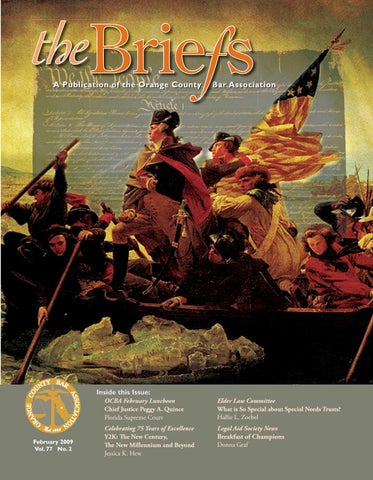
DEADLINE INFORMATION Advertising - 10th of the month prior to the month of publication Copy - 1st of the month prior to the month of publication The deadline for each edition is the first day of each month. If that day falls on a weekend or holiday, the deadline is the next business day. Publication of advertising herein does not imply any endorsement of any product, service or opinion advertised. The opinions and conclusions, including legal opinions and conclusions contained in articles appearing in The Briefs, are those of the authors and do not reflect any official endorsement of these views by the Orange County Bar Association or its officers and directors, unless specifically stated as such. All contents ©2009 Orange County Bar Association. All rights reserved. Designer: Catherine E. Hebert Cover: Based on Washington Crossing the Delware by Emanuel Gottlieb Leutze, Public Domain.
PAGE 2
www.orangecountybar.org
the Briefs February 2009 Vol. 77 No. 2
President’s
Message
Law Week
February 2009
E
ach year Law Day is celebrated on the first day of May. Law Day is, of course, a national celebration promoted and sponsored primarily by the ABA and other voluntary bar associations. Fifty-one years ago, President Eisenhower proclaimed the first Law Day a “day of national dedication to the principle of government under law.” Although the ABA and many voluntary Bar Associations will celebrate Law Day on May 1, 2009, we at the Orange County Bar Association are overachievers. We can’t see fit to confine our celebration to a single day... or even a single month for that matter. The OCBA has “Law Day” events planned for March, April and May of this year – a special year during which the ABA and the OCBA will celebrate the 200th anniversary of Abraham Lincoln’s birth with Law Day 2009: A Legacy of Liberty. I encourage each of you to consider participation in these events. Before I describe our Law Day events for you, I would like to thank Catrina M. Chapin for chairing the OCBA’s Law Day celebrations. Catrina is a paralegal with Roetzel & Andress, LPA. I would also like to thank OCBA Executive Council members Paul Scheck and Jessica Hew, pastOCBA Law Day Chairs Lissa Bealke and Lori Spangler, Judges Faye Allen and Bob LeBlanc and the entire OCBA Paralegal Committee. The following Law Day Programs would not be possible without this great collaborative effort. •Pathways in Law Program – Members of the judiciary developed this program, which is specifically targeted at crime prevention. More than 90 children affiliated with the Office of Farmworker Ministry are expected to participate in this program, which includes a mock trial program at the Orange County Courthouse and a special tour of the Orange County Jail. Look for further details about this program, which will take place during the month of March 2009. •LawSuits (clothes drive benefitting the Community Service Center of Central Florida) – At our 2009 Professionalism Luncheon, to be held at the Ballroom at Church Street on March 26, 2009, the OCBA will collect suits and business attire for the Community Service Center of Central Florida. The clothing collected will be used for the Community Center’s Job Rehabilitation Program participants. At this luncheon, the OCBA will award the 2009 Lawrence G. Mathews Young Lawyer Professionalism Award, the 2009 William Trickel, Jr.
Professionalism Award and the 2009 James G. Glazebrook Memorial Bar Service Award. •Goldilocks Mock Trials – Please consider volunteering for the Goldilocks Mock Trials. Details on this annual Tad A. Yates favorite will be available at a later date. The Goldilocks Mocks Trials will be conducted by members of the judiciary, attorneys and others in the legal profession for elementary-aged students in our community. All rise for the matter of Wolf v. Pig! •A Day in the Life of a Judge – On April 30, 2009, judges from the Ninth Judicial Circuit will host students from the Office of Farmworker Ministry and the Parramore Kidz Zone for a special job shadowing program. Following a morning at the Courthouse, each participant will accompany his or her judge to the Orange County Bar Association’s Luncheon as our special guest. •Law Day Luncheon – At the April 30, 2009, luncheon of the Orange County Bar Association, we will celebrate Law Day and present the 2009 OCBA Liberty Bell Award. The Liberty Bell Award recognizes a person, persons or an organization that has promoted a better understanding of the rule of law, encouraged a greater respect for law and the courts, stimulated a sense of civic responsibility and contributed to good government within the community. In addition, children, their parents and their teachers will be invited to the luncheon and will be recognized for winning entries in our countywide poster and essay contests. •DUI Mock Trial Program – On May 6, 2009, a special DUI Mock Trial will be held at the Orange County History Center for several groups of local high school students. The mock trial will be conducted by members of the judiciary, attorneys and others continued page 8
the Briefs February 2009 Vol. 77 No. 2
www.orangecountybar.org
PAGE 3
We’re Growing Our Mediation Practice… Fisher Rushmer is pleased to announce that John Fisher, James Talley and Rick Smith are now Florida Supreme Court Certified Civil Circuit Mediators, growing the Fisher Rushmer Mediation Practice Group to seven shareholders.
JOHN FISHER
GARY RUSHMER
JAMES TALLEY
KAREL AVERILL
RICK SMITH
EMERY ROSENBLUTH
JOE AMOS
• Available for mediations of state circuit matters throughout Florida. • Available for mediations of federal civil matters throughout the Middle District. • Spacious and comfortable conference facilities conveniently located in downtown Orlando. • No “administration charge” for scheduling conferences or coordinating with parties. Available in the areas of • complex multiparty matters • catastrophic injury cases • wrongful death • wage and hour disputes • employment disputes
• personal injury • medical malpractice • legal malpractice • nursing home disputes • presuit claims
• dental malpractice • products liability • business/commercial disputes • corporate disputes • insurance/bad faith claims • property & construction disputes
Fisher, Rushmer, Werrenrath, Dickson, Talley & Dunlap, P.A. (407) 843-2111
Committed to Clients. Proven Results.
www.fisherlawfirm.com PAGE 4
www.orangecountybar.org
the Briefs February 2009 Vol. 77 No. 2
OCBA Luncheon
Chief Justice Peggy A. Quince
FEBRUARY 26, 2009
Florida Supreme Court
Chief Justice Peggy A. Quince was born in Norfolk, Virginia, in 1948. She is married to Fred L. Buckine, attorney-at-law, and they have two daughters, Peggy LaVerne, a graduate of Florida A&M University, and Laura LaVerne, a graduate of the University of Central Florida. Justice Quince graduated in 1970 from Howard University with a B.S. degree in zoology. She received her J.D. degree from the Catholic University of America in 1975. While a law student, she was active in Phi Alpha Delta Law Fraternity and the Black American Law Students Association and she received an award for her work with Catholic’s Neighborhood Legal Services Clinic. In 1999, she received an honorary Doctor of Laws degree from the Stetson University College of Law. In 2004, she received an honorary Doctor of Laws degree from St. Thomas University School of Law. Justice Quince began her legal career in Washington, D.C. as a hearing officer with the Rental Accommodations Office administering that city’s new rent control law. In 1977 she entered private practice in Norfolk, Virginia, with special emphasis in real estate and domestic relations. She moved to Florida in 1978 and opened a law office in Bradenton, Florida. There, she practiced general civil law until 1980. In February, 1980, Justice Quince began her tenure with the Attorney General’s Office, Criminal Division. As an assistant attorney general, she handled numerous appeals in the Second District Court of Appeal, the Florida Supreme Court, including death penalty cases, the Eleventh Circuit Court of Appeals, and the United States Supreme Court. Her thirteen-year tenure at that office included five years as the Tampa Bureau Chief. Additionally, three years were spent handling death penalty cases exclusively, on direct appeal and in post-conviction proceedings. Justice Quince is a member of The Florida Bar, Virginia State Bar, the National Bar Association, the Tallahassee Women Lawyers, and the William H. Stafford Inn of Court. She is an active member of the Governthe Briefs February 2009 Vol. 77 No. 2
ment Lawyers Section, the Criminal Law Section, and the Equal Opportunity Section of The Florida Bar. She is a former member of the George Edgecomb Bar Association, the Hillsborough County Bar Association, Hillsborough Association of Women Lawyers, and the Tampa Bay Inn of Court. Justice Quince’s former Florida Bar activities include membership on the Gender Equality Committee, the Criminal Law Certification Committee, and the Executive Councils of the Government Lawyers and Criminal Law Section. Presently, Justice Quince is on the executive counsel of the Appellate Section of The Florida Bar and is the Supreme Court liaison to the Workers’ Compensation Committee, the Judicial Ethics Advisory Committee, and the Supreme Court’s Family Court Steering Committee. She has lectured at a number of Continuing Legal Education programs on issues involving search and seizure, probation and parole, use of peremptory challenges, postconviction relief, professionalism and ethics, and the independence of the judiciary. In 1993, Justice Quince became the first AfricanAmerican female to be appointed to one of the district continued page 8 The February Luncheon is Co-hosted by the Paul C. Perkins Bar Association
The Ballroom at Church Street 11:45 a.m. - 1:00 p.m. 225 S. Garland Avenue Orlando, FL 32801
Please RSVP to reservations@ocbanet.org by Friday, February 20, 2009 Main Entrance: Garland Avenue between Church Street and South Street To ensure a proper luncheon count, RSVPs and CANCELLATIONS are requested no later than Friday, February 20, 2009. The OCBA is happy to provide 11 luncheons as part of your member benefits, but noshows incur additional charges for the Bar and walk-ups cannot be guaranteed a seat. Please keep us up-to-date on your reservation status!
www.orangecountybar.org
PAGE 5
Building Stronger Cases Right in your Neighborhood At Rachlin LLP, we’ve been helping attorneys build stronger cases for more than 35 years. And now, we’ve moved into the neighborhood. Our professionals, including highly experienced CPAs, retired IRS criminal investigators, receivers and a Chapter 7 Panel Trustee, offer specialized services across a variety of disciplines to support every facet of the litigation process. They dig deep to unearth facts and get the information attorneys need to build a stronger case. Call today to learn more about the depth of our knowledge and scope of our services. Our experience may be your greatest asset.
Bankruptcy & Insolvency
Business Valuation
Receivership
Forensic Accounting
Expert Testimony Call 407.926.4012
M I A M I
PAGE 6
n
F O R T
www.rachlin.com
L A U D E R D A L E
n
W E S T
P A L M
www.orangecountybar.org
B E A C H
n
O R L A N D O
the Briefs February 2009 Vol. 77 No. 2
Professionalism
Professionalism in the Here and Now
Committee
U
ndoubtedly we live in stressful times. Many of us have seen our investments in the market take a big hit. We hope those we have chosen to lead can come up with the best plan to boost consumer confidence and help our American industries remain comGeneral Magistrate petitive and superior in Howard D. Friedman the world market. Until the economic recovery theories become implemented – or metaphorically, until the rubber hits the road--we weather through the tribulations of this global recession. Many of us are now re-evaluating our investment strategies and retirement plans. On top of this, many of us have to deal with the uncertainty in our revenues and job security. As a result, many of us are on edge. Now, when something doesn’t go well in our practice, we may be quicker to get angry and upset. We all know in our law practices things will not always go right. You’ve all heard we call it the “practice” of law, because it is not to be confused with perfection (or words to this effect). When things go wrong, who should bear the brunt of our frustration? Well, where this all leads is. . . We, as professionals, must take into account that we should try not to beat up on each other and also consider that our adversaries and colleagues all share, in some fashion, the effects of this recession.
pass and become a faded memory. In the meantime we will all find a way to endure. We must consider that our reputation for professionalism in the community must as well endure. It just makes good business sense to be collegial with your adversaries. You are more likely to receive client referrals from fellow attorneys if you have a good reputation for professionalism. Although perhaps some attorneys may not rely substantially on attorney referrals, burning your bridges and limiting your potential client base is not typically sound business judgment. So, it is in your own selfinterest to avoid needlessly taking someone’s head off. As uncertain as these times may be for us, consider that we are blessed as attorneys with intelligence and savvy that comes along with the territory. We have the ability to establish a practice merely by hanging up our shingle and having a go at it. If we find the right niche, we can do quite well. Remember, there are many highly educated people without this luxury. I hear the talking heads describe why we’re in this global recession in terms of fear, corporate greed, trade deficit, oil dependence, regulation or lack thereof, or any combination of these things. Like most everyone else I can come up with my version of what we need to do to improve this sluggish economy. I’ll commit to this and hope you will too – I will strive to not be part of the problem, but rather part of the solution.
I
n the context of professionalism and professional practice, being part of the solution means simply treating others as you would reasonably We must consider that during these challenging economic expect to be treated. Honesty and integrity should times, which we all hope are fleeting, our professionalism must remain a constant component of who we are as be considered a given. If you desire to be part of attorneys. We shouldn’t blast people because we’re angry the solution in the context of legal professionalism, about something else. We need to be mindful of this clasconduct yourself consistently with the ideals of sic passive-aggressive attribute. This economic recession will professionalism set forth in the OCBA Rules of Professionalism, LITIGATION SUPPORT SPECIALISTS Professional Courtesy and Courtroom Decorum. OUR FIRM SPECIALIZES IN COMPREHENSIVE SERVICES INCLUDING:
FORENSIC ACCOUNTING BUSINESS VALUATIONS STANDARD OF LIVING
FINANCIAL AFFIDAVITS FAMILY LAW FORMS EXPERT TESTIMONY
ADAM T. MAGILL, MBA, AVA, CBA 1234 EAST CONCORD STREET, SUITE B, ORLANDO, FL 32803 | 407-233-4180 | 407-233-4182 FAX http://www.valuation-litigation.com | info@valuation-litigation.com the Briefs February 2009 Vol. 77 No. 2
www.orangecountybar.org
Well, I must leave you now and return again to my Bloomberg.com webpage obsession and check on the market. Have a great month everyone. Submitted by Magistrate Howard D. Friedman, chair of the OCBA Professionalism Committee. Magistrate Friedman has been a member of the OCBA since 2005. PAGE 7
OCBA Luncheon continued from page 5
courts of appeal with her appointment by Governor Lawton Chiles to the Second District Court of Appeal to a term effective January 4, 1994. She was retained in office by the electorate in November 1996. On December 8, 1998, Justice Quince was appointed by the late Governor Lawton Chiles and Governor-elect Jeb Bush to the Florida Supreme Court. Justice Quince is a member of New Hope Missionary Baptist Church. Her civic and community activities include membership in Alpha Kappa Alpha Sorority, Inc., Jack and Jill of America, Inc., the Urban League, the NAACP, and The Links, Inc. Justice Quince has received the following honors and awards: Florida Commission on the Status of Women, 2007 Florida Women’s Hall of Fame Award; American Bar Association Commission on Women in the Profession, 2006 Margaret Brent Women Lawyers of Achievement Award; 2006 Rickards High School Outstanding School Volunteer Award; 2005 Key to the City of Winter Haven; 2005 Richard W. Ervin Equal Justice Award; 2004 Key to the City of Panama City, Florida; 2004 Catholic University of America, Columbus School of Law, Black Law Student Association Alumni Achievement Award; 2004 Lee County Association for Women Lawyers and the Lee County Bar Association Award for dedication to the promotion of equality in law and outstanding service as a distinguished member of the Florida judiciary; 2002 Florida Bar Equal Opportunities in the Profession Award; 2002 Florida Girls State Award; 2003 Helping Hand Award; 2003 Southern Women in Public Service Pacesetter Award; 2003 Florida Girls State Award; 2003 Pioneering the Future in our Community Award; 2003 Outstanding Jurist and Howard University Alumna Award; 2001 William H. Hastie Award from the National Bar Association Judicial Council;
National Bar Association Presidential Achievement Award; Girl Scouts, Woman of Distinction Award, 2001; National Bar Association Women Lawyers Division Jurist Award for Outstanding Leadership Achievements and Dedicated Service to the Community At Large; Florida Chapter of the National Bar Association for Service on the Bench; Virgil Hawkins Bar Association Award for Community Service and Advancement of Equal Justice Under Law; Virgil Hawkins Bar Association Certificate for Achievement in Jurisprudence; Fort Lauderdale High School Award for participating in the School Law Magnet Program; Broward County School Board Appreciation Award for Inspiration and Devotion to Our Youth; Award of Distinguished Service and Continuing Commitment to the People of Florida from the Fort Lauderdale B’nai B’rith; Proclamation from the Broward Board of County Commissioners stating February 28, 1999, as “The Honorable Peggy A. Quince Appreciation Day;” Hillsborough County Sheriff’s Black Advisory Council Appreciation Award; Lakeland NAACP Award for Contribution to Civil Rights; African-American Production Company Personal Achievement Award; Paul C. Perkins Bar Association Appreciation Award; Florida State University College of Law Appreciation Certificate for Contributions made to Summer Law Program For Undergraduate Students; Certificate from the Office of the Attorney General, Florida Crime Prevention Training Institute for Exemplary Contributions to Crime Prevention in the State of Florida.
President’s Message continued from page 3
in the legal profession. Following the mock trial demonstration, students will view a documentary entitled “Jane: A Film,” in which Jane Dwyer details her harrowing experience of having driven into a concrete embankment at the end of the old Seven Mile Bridge in the Florida Keys; her life-threatening injuries and painful recovery; the five-year prison sentence she served for the unintentional death of her boyfriend, who was a passenger in the vehicle; and the unusual consequences of having PAGE 8
lost her driving privileges for life. Immediately following the documentary, Ms. Dwyer will hold a Q&A session for the students. •Naturalization Ceremony A special Naturalization Ceremony will be held in honor of Law Day, as immigrants to the Central Florida area pledge their Oath of Allegiance in a moving ceremony, which will be held at the Orange County Convention Center. We will provide additional information on this event as it becomes available. www.orangecountybar.org
A final thanks to The Foundation of the OCBA and its President, Tom Wert. The Foundation, in keeping with its mission of educating the public about our justice system and the rule of law, generously supports these various Law Day events. For more information on our three months of “Law Day” programs, please contact Law Day Chair Catrina Chapin at cchapin@ralaw.com. I hope to see you at our next luncheon and at our various Law Day events. Tad A.Yates is a partner with Kirkconnell, Lindsey, Snure and Yates, P.A. He has been a member of the OCBA since 1994.
the Briefs February 2009 Vol. 77 No. 2
the Briefs February 2009 Vol. 77 No. 2
www.orangecountybar.org
PAGE 9
OCBA Online Courses & Services
MEDIATION
PRODUCT LIABILITY, PERSONAL INJURY, COMMERCIAL & CONSTRUCTION
WENDY VOMACKA Certified Civil Mediator Pre-Suit, Trial & Federal Mediations Downtown Conference & Media Facilities
407.872.7300
Go to the OCBA website at www.orangecountybar.org and click on Legal Resources. Sign up to become a Notary Public or renew your commission. Conduct your Florida MVR searches online. Refer your clients to the parenting course or the traffic safety course. It’s easy, convenient and cost effective!
PAGE 10
www.orangecountybar.org
wvomacka@rumberger.com
Grow Your Business NOW IS THE TIME to ADVERTISE in
the Briefs Contact:
mentec@ocbanet.org 407-422-4551, ext. 244 the Briefs February 2009 Vol. 77 No. 2
the Briefs February 2009 Vol. 77 No. 2
www.orangecountybar.org
PAGE 11
C e l e b r a t i n g 7 5 Ye a r s o f E x c e l l e n c e
Y2K: The New Century, The New Millennium and Beyond!1 (Part One of a Two-part Series) Jessica K. Hew
W
here were you at the historic turn of the century, which coincided with the beginning of and the promise of a new millennium? Were you in a bomb shelter awaiting the apocalypse? At Times Square in New York City? Sitting by your computer waiting for it to literally explode? At the international dateline to be the first to experience the new millennium? Where were you? The Orange County Bar Association (OCBA) was awaiting the millennium, just as the rest of us were. Fully dedicated to the membership and its professional demeanor, the OCBA was moving toward the future with aplomb. Where were we? More importantly, where are we going? Since 2000, the practice of law continued on its evolutionary path. We have seen many changes to our practices, and there will likely be many more to come.
Changes to the Practice On the forefront at the millennium was the concept of multidisciplinary practice for lawyers in step with the evolution of the practice of law as a “profession” versus that of a “business.”2 This dichotomy of “profession” versus “business” saw career changes for some of our members.3 Marina Nice Pittman went from her law practice to working at Rollins College with its grant programs, and then Orlando Regional Healthcare System as the Foundation’s Chief Financial Officer, managing the Planned Giving Program and grants. H. Richard Bates went to Romania, where he performed missionary work. Prior to moving and discussing his prior mission trips with his family, Richard stated, “During each of those visits, we felt increasingly the call of God in our lives to commit ourselves fully to ministry in Romania.”4 Randall Ellington founded the Strategic Financial Group, Inc., focused on estate planning, retirement and business succession. Stephanie Howell, after leaving her litigation practice to be a lobbyist, went to Baker & Hostetler’s PAGE 12
Orlando office…but in marketing. Carol Shannin went to work for the Orange County Public Schools for the law magnet program. According to Carol, “Teaching was a rewarding alternative to practicing law. I was able to put my legal training to good use in education and still devote time to family.” Incidentally, the American Bar Association (ABA) found that at that time more than three-fourths of all young lawyers were satisfied with practicing law, although large firm associates were less satisfied than their small firm counterparts.5 Multidisciplinary practice, however, is the integration of lawyers or legal services into non-lawyer or partly non-lawyer owned businesses, wherein there is a “share” of legal fees by lawyers and non-lawyers - which is prohibited under the ethical rules. Hotly debated by the ABA during its study of the issue for changes in the Model Rules of Professional Conduct,6 the Florida Bar also participated with the ABA’s study7 and solicited the OCBA for its opinions.8 Both the ABA and the Florida Bar ultimately recommended that multidisciplinary practices were inconsistent with the core values of the legal profession.9 Despite the ABA and Florida Bar’s findings as to lawyers’ participation in multidisciplinary practices, both approve lawyers’ participation in ancillary businesses10 provided that such businesses conform to the applicable ethical rules.11 Although alternative dispute resolution (ADR) has been with us prior to the 2000s, new steps have been taken to ensure ADR will remain a viable option for our clients, thus creating a new pathway for attorneys. The Florida Supreme Court set up its own ADR organization in 1986, the Florida Dispute Resolution Center,12 to help with ADR in Florida courts. The Florida 5th District Court of Appeal instituted and adopted a mediation program, which they www.orangecountybar.org
first tested as a pilot program in 2001.13 Not only did these programs help maintain the courts’ dockets and allow the parties’ assisted mutual self-determination of their dispute(s), it opened up a sub-category of practice areas for attorneys. Many OCBA members are now full-time mediators and/or arbitrators, and others (like myself ) maintain these practice(s) with a traditional law practice. The OCBA Judicial Relations Committee even offered attorney and/or jurist mediation to handle disputes of a sensitive and confidential nature between or amongst them.14 Business Court in the Ninth Judicial Circuit was the ground-breaking pilot program for the Florida State Courts. Approved in 2003, the Business Court was designed to streamline business litigation matters to allow for effective and efficient use of time through greater court involvement.15 Initially staffed by the Honorable Renee Roche, Judge Roche remained on the Business Court bench until December of 2008. Prior to her rotation to the Family Law Division, the OCBA and the Florida Bar recognized her many contributions to the creation and refinement of the Business Court for the Ninth Circuit, and then across the State, at the November 2008 OCBA luncheon. These contributions included her efforts implementing the Ninth Circuit’s Business Court Procedures, which are similar to those of the local Federal Court.16 Another change to the Orange County courts was the addition of the Magistrate program.17 Funded by the Florida Legislature in 2004, the Ninth Circuit started with the appointment of an Administrative General Magistrate and subsequently added five more magistrates. The magistrates hear items referred from the Civil Division judges, as well as matters in the Domestic Relations, Mental Health and Juvenile Dependency Divisions. After a hearing on a disputed issue, a magistrate issues a Report & Recommendation to the referring circuit judge and the parties for further action. The magistrates have become a vital key in assisting with and efficiently implementing case management, especially given the burgeoning caseload of the judiciary. the Briefs February 2009 Vol. 77 No. 2
Technological Advances A big evolutionary item for the OCBA and the practice of law is technology. Remember the introduction to the then-futuristic cartoon, The Jetsons? It is becoming reality. Really - I am just awaiting my “Rosie” to help clean up my office (it needs it!). At its debut in 1999, the Orange County Courthouse’s Courtroom 23 was described as “the most technologically advanced courtroom in the world.”18 Courtroom 23 allowed for many functions never before seen in Orange County: evidence presentation systems, Internet and remote broadcast, real-time court reporting, desktop technology, plasma monitors, video annotation, video conferencing, digital court reporting, computer legal research, advanced audio and touch screen integration (it has also since evolved to include additional capabilities).19 On the heels of Courtroom 23, the Honorable Lydia Gardner, Clerk of Court for the Ninth Circuit and Orange County, began to implement a plan for electronic filing as early as 2000. The Middle District Clerk of Court led the way for local electronic filing, however. In 2003, it was announced that electronic filing of documents with the United States Middle District of Florida would begin in July of 2004.20 And, it did! Today, electronic filing has changed the practice of law. Remember late afternoon mad dashes to the courthouse to get that document filed timely? No more. Electronic filing allows you to file 24/7, even on holidays (and I’ve done that!), and you can do it from the convenience of your own computer. No running required. Although Lydia Gardner hoped to follow in the fall of 2004, electronic filing was first introduced to her office via the Business Court in March of 2006.21 Electronic filing of documents for circuit civil cases, excluding probate, mental health, guardianship and family court domestic relations and domestic violence cases, and documents relating to them were permitted to be filed as of January of 2007, and initial case filings were subsequently also permitted as of July of 2008 for the same types of circuit civil cases. The Judicial Calendaring System made it on-line, though, in December of 2003.22 The system allowed easier coordination of hearings by allowing counsel to review the judge’s available hearing schedule, coordinate available dates, and confirm the selected date with the judicial assistant. Voila! A hearing is scheduled. Legal assistants across Central Florida rejoiced (at least mine did!) in the time savings and efficiency in securing hearing time. the Briefs February 2009 Vol. 77 No. 2
Building on a Foundation In 2000, the Honorable Patricia Fawsett (a Past-President of the OCBA), who had been planning for the acquisition of land and the construction of a new Federal Courthouse, came closer to her goal: the new facility was finally commissioned and set for a target completion date in 2007.23 The new Federal Courthouse was dedicated on September 21, 2008, with Supreme Court Justice Clarence Thomas in attendance.24 The U.S. General Services Administration gave an acknowledgment of gratitude to Judge Fawsett for “…her commitment and dedication to a building of outstanding quality that is a tribute to the role of the judiciary in our democratic society and worthy of the American people.”25 Judge Fawsett was not only instrumental in getting a courthouse built, but along the way she also secured art and culture - literally within the courthouse’s walls. The Art in Architecture Program was literally integrated into the courthouse walls, allowing the Federal Courthouse to serve as a location of art in public places.26 The walls of the courthouse contain six laminated blown art glass windows by the late artist, Al Held. At the top of the grand staircase, a 20x50 foot Untitled window faces east and bathes the multi-storied white interior atrium in beautiful color. The remaining five windows, each also Untitled, are intermittently located along the south atrium wall at ground level, adding to the kaleidoscope of color from its grand sister. The tragic terrorist attacks on September 11, 2001, meant more stringent security measures in place for both the State and Federal courthouses. Remember trying to get to Monday ex parte hearings at the Orange County Courthouse while waiting in line with the juror pool? The security lines became long – waiting to get through security could last longer than your hearing. In a joint effort between the OCBA and www.orangecountybar.org
the Orange County Courthouse Court Administration and Security, Court Access Cards for the Orange County Courthouse were the answer. Court access cards, still issued through the OCBA, allow applicants who are pre-screened via a background check to use a separate security process and entrance for access to the courthouse. The new Federal Courthouse was not the first legalrelated building Judge Fawsett was instrumental in building - the first one was the OCBA’s original building. After four years of planning, the original OCBA building was demolished in 2002 and reconstructed. The new two-story OCBA building houses administration and office facilities, a conference center with a kitchen, and smaller rooms for meeting space. The building was completed in 2003 and is used frequently by OCBA members for OCBA and personal functions. It is also used by other legal groups, local community groups and individuals for events, meetings, mediations and arbitrations.27 While our membership thrived and the OCBA was winning local, statewide and national recognition, support for the OCBA also changed. Do you know what the Orange County Bar Auxiliary (Auxiliary) was? It was a hold-over support organization for the spouses (translation: wives) of members of the OCBA. With the changing faces of the OCBA membership, the Auxiliary was phased out. Instead, we now have a diverse and unified OCBA working together toward a common goal. “We Can Do It!”28 Within the OCBA, support has never waned for its members. Remember the OCBA Standards of Professional Courtesy? They continue to be the benchmark of the minimum professional courtesy recommended in certain disputed situations and are adopted by the Ninth Judicial Circuit Civil as a part of their Local Rules.29 continued page 14 PAGE 13
Y2K:The New Century continued from page 13 Reporting date for your continuing legal education (CLE) credits approaching? Not to fear! The OCBA’s many substantive law committees30 routinely prepare and present seminars which can fulfill your every hour of need for credit. These seminars may be obtained from the OCBA, which also maintains a list of nonOCBA sponsored CLE.31 OCBA’s very active committees help provide these CLEs as well as substantive articles for The Briefs and professional networking within your practice area. Need some social networking opportunities? The OCBA’s monthly luncheons have seen not only lawyer a cappella groups (who raise money for pro bono services),32 but many informative keynote speakers including judges, politicians, elected officials, businessmen, coaches, military officers, athletes, Florida Bar presidents, sports analysts, educators, communications experts, economists, and many others. Let’s not forget the standing-room only, wait-listed, inaugural Social Committee’s first event: The Wine & Cheese Social in 2005. I had the honor of chairing the incredible initial Social Committee, working with Kristyne Kennedy as the Event Chair for the 2005 Wine & Cheese event. That event foreshadowed great things to come; the Social Committee continues to hold quarterly events that should not be missed! Another important addition to the OCBA in the 2000s was its current Executive Director, Brant Bittner, in December of 2003. Brant came to us, via the OCBA Selection Committee with approval of the Executive Council, with 30 years of management experience. Brant (whose wife, Linda Bittner, is an attorney and OCBA member) has strong marketing and public communications skills. Upon his hiring, Brant stated, “Working with our leadership and Bar members, I look forward to continuing to uphold and increase the [OCBA’s] national reputation for service and excellence.”33
January 2006 the newsletter became a four-color glossy magazine with substantive information and more photos. Even better, it was to be self-supporting in terms of cost - we’ve even made a profit on it! During the transition from newsletter to magazine, however, Connie Becerra retired from the OCBA after decades of service. Connie was instrumental in The Briefs throughout her tenure with the OCBA.
Integrated in the Community The Briefs is one way the OCBA is inclusive within our legal community. Each month, The Briefs provides a forum for other legal organizations to publish their news via the SideBar column that I author.35 Florida Agricultural & Mechanical University Law School (FAMU) was introduced to our local legal community; FAMU gave Orlando local access to two law schools, the other being Barry University, which was established in the 1990s. Both law schools are encouraged to participate with the OCBA, and they do. The OCBA supports its local community, both with legal and non-legal services. Although Law Day is officially May 1st of each year, the OCBA’s Law Day was traditionally a “Law Week” to allow time for all of its activities. Today, OCBA’s Law Week is so successful that it runs over months. OCBA’s Law Week has received national recognition, including the ABA’s 2005 Outstanding Law Day Activity Award, which was awarded based on the number and breadth of the programs and activities offered. To kick off 2009 Law Week, I am reviving the dormant LawSuits. OCBA members are encouraged to bring their used business attire to the March 26, 2009, luncheon, for an acknowledged receipt for the donation. These clothing items will then be placed within the Community Service Center of Central Florida’s (CSCCF) Clothes Closet. CSCCF gives those items to graduates of CSCCF’s job rehabilitation program who are in need of appropriate business attire. Law Week will also feature its traditional programming, including educational programs (such as mock trials) for students, participating in the naturalization ceremony for new United States citizens, and the OCBA Law Day Luncheon featuring the student winners of the Law Day Poster and Essay Contest.36
The OCBA’s Young Lawyers’ Section (YLS) has also continued to be a vital part of the OCBA, organizing innovative programs with other charities on behalf of the OCBA. A few charitable programs with whom they participate are the American Cancer Society (participates with a happy hour to benefit the organization in conjunction with an all night walk-a-thon infield camping experience), Habitat for Humanity (young lawyers literally hammering, painting, planting, and performing construction and manual labor), and SeniorsFirst (a multitude of projects – clothing drives, holiday present collections, fundraising, etc.). There are One of the OCBA’s most remarked-upon changes thus far in the also individual projects throughout the year, such as the Rock 2000s (I am proud to say) is what you are reading now, The Briefs. Lake Backpack Project (providing school supplies to the poorest Formerly a black and white newsletter with many loose pages public school in Orange County). Let’s also not forget the YLS’s of flyers stapled within it, Tad Yates (my then-co-editor) and I Scholarship Program, which continues the tradition of raising planned for and implemented a new and fresh The Briefs in 2005 at funds for a scholarship endowment, to annually award a four-year the request of then-President, Bill Sublette. Moving away from college scholarship to a deserving Orange County graduate who has a black and orange theme of mostly announcement materials, in faced and overcome adversity. The candidates are so competitive the Briefs February 2009 Vol. 77 No. 2 PAGE 14 www.orangecountybar.org Brant’s effective service to the OCBA led to his invitation to serve on the ABA and the National Association of Bar Executives’ Program Committee, which selected program speakers for future ABA conferences. Brant was among only 20 state and local bar leaders chosen to participate. Not only that, Brant is our very own “Michael Phelps”! In 1988, Brant won the World Master’s Swimming Championship for the 800 meter freestyle in Brisbane, Australia, his mother’s hometown. The record held for about five years. Brant also swam for the University of Florida. (Okay, I’ll do it – if just this once…“Go Gators!” Happy, Tom Zehnder?)34
that sometimes more than one scholarship has been awarded in a given year. The OCBA still maintains its close ties with the Legal Aid Society of the OCBA (LAS). Although OCBA members are required to provide pro bono services to the LAS as a condition of their OCBA membership, in 2001 a two-year limitation period was placed on guardian ad litem cases due to the length of some cases.37 Independently, the OCBA still implements the Citizens Dispute Settlement mediation program, allowing relatively minor items to be resolved without court intervention and facilitating resolutions prior to the filing of litigation. Relatively new to the OCBA as of 2006 is the Modest Means program, which allows low-income clients to be matched with an attorney who has a lower agreed upon rate established by the Modest Means panel. These programs are integral to the OCBA in its commitment to the legal profession and the assurance of options for legal services for the community.
Where Are We Going? Stay tuned for Part II of Y2K: The New Century, the New Millennium and Beyond!, entitled To Infinity, and Beyond! 38 (Part Two of a Two-part Series), that is scheduled for the March 2009 edition of The Briefs. To Infinity, and Beyond! will address the current plans of the OCBA and the Strategic Planning Committee’s (SPC) exciting plans for the future of this great organization. As chair of the SPC, I hope you will join us for the next installment of the 75th Anniversary articles addressing the OCBA’s past and its bright future. Jessica K. Hew is a partner with Burr & Forman LLP (formerly Graham, Builder, Jones, Pratt & Marks, LLP). She has been a member of the OCBA since 1995.
1
Although the change from 1999 to 2000 (January 1, 2000) was hailed as the beginning of the new millennium, not everyone subscribed to such a theory, including me. See United States Naval Observatory (USNO) website at http://www. usno.navy.mil/millennium/whenIs.shtml. The USNO claims that the beginning of the millennium was on January 1, 2001, not January 1, 2000. On a personal note, in Asian societies you are deemed to be one at birth, so this theory of 2001 being the beginning of the millennium is more plausible to my Asian-American heritage sensibilities (and my Chinese immigrant grandparents whole-heartedly support and agree with this). 2 See The Briefs, Vol. 86, No. 42 at Page 8, for a discussion. 3 See The Briefs, Vol. 89, No. 45 at Pages 3 to 5, for a discussion on transitioning careers and the experiences of Ms. Pittman and Messrs. Bates and Ellington. My best friend from Tulane Law School practiced law unhappily for 3 years, but is now happily a dermatologist. As a physician, she admits that the practice of law was harder than her medical practice. My brother, a Texas Board Certified Immigration
the Briefs February 2009 Vol. 77 No. 2
attorney, is also much happier spending his summers teaching his kids how to ride their bikes; he is an immigration clinic law school professor and gets more time off than any attorney should! 4 Id. 5 See The Briefs, Vol. 93, No. 49 at Page 13. 6 See the American Bar Association website at http://www.abanet.org/cpr/mdp/home. html. 7 See the Florida Bar website at http://www.floridabar.org/tfb/TFBComm.nsf/ basic+view/9377C1F9B6040EC685256EE70064E686?OpenDocument. 8 See The Briefs, Vol. 81, No. 37 at Page 4. 9 See the Florida Bar website at http://www.floridabar.org/tfb/TFBComm.nsf/ basic+view/9598735D2E196A8385256EE70064E683?OpenDocument; American Bar Association website at http://www.abanet.org/cpr/mdp/mdp-report10f.html. 10 Ancillary businesses allow lawyers to participate in non-legal business ventures. 11 See the Florida Bar website at http://www.floridabar.org/tfb/TFBComm.nsf/ basic+view/9598735D2E196A8385256EE70064E683?OpenDocument; American Bar Association website at http://www.abajournal.com/magazine/the_real_deal_ breakers/. The Florida Bar recommends that lawyers use an “Affiliated Business Disclosure” form to disclose the lawyer’s association with an affiliated business, while using an “Affiliated Law Firm Disclosure” form for the disclosure of the customers of the ancillary business informing them that there is no attorney-client relationship between the lawyer and the affiliated business’ customers. Links for these forms may be found at the Florida Bar website at http://www.floridabar.org/tfb/TFBComm. nsf/basic+view/9598735D2E196A8385256EE70064E683?OpenDocument. 12 For a link to the website, go to http://www.flcourts.org/gen_public/adr/adrintro. shtml. 13 See The Briefs, Vol. 98, No. 54 at Page 10; Vol. 136, No. 92 at Page 6. 14 See The Briefs, Vol. 114, No. 70 at 7. 15 See The Briefs, Vol. 124, No. 80 at 4. 16 The Business Court Procedures are published on the Ninth Judicial Circuit website at http://www.ninthcircuit.org/research/orders/downloads/Business%20Court%20P rocedures.pdf. 17 See The Briefs, Vol. 141, No. 97 at Page 11. 18 See The Briefs, Vol. 82, No. 38 at Page 6, citing to The Orlando Business Journal, December 10-16, 1999, “Courtroom Takes Legal Proceeding to New Level[.]” 19 See The Ninth Judicial Circuit of Florida website at http://www.ninthcircuit.org/ programs-services/courtroom23/index.shtml . 20 See The Briefs, Vol. 125, No. 81 at Page 3. 21 See The Ninth Judicial Circuit of Florida website at http://www.myorangeclerk. com/ecfinfo/Electronic_filing.shtml. 22 See The Briefs, Vol. 127, No. 83 at Page 5. 23 See The Briefs, Vol. 74, No. 3 at Page 6. 24 See The Briefs, Vol. 75, No. 11 at Page 11. 25 United States Courthouse, Orlando Florida, U.S. General Services Administration at inside cover (2007). 26 For additional information, including photographs, see United States Courthouse, Orlando Florida, U.S. General Services Administration at 21 (2007). 27 If you are interested in renting space from the OCBA, contact Marie Bacazehuatl, Events Manager, 407-422-4551, Ext. 233. 28 The phrase is taken from the Rosie the Riveter “We Can Do It!” illustration by Howard J. Miller. The sign originally debuted during World War II. At the time, women were supporting the war effort and the loss of manpower (literally) by working outside of the home, in aircraft factories, shipyards, even military cockpits. The illustration remains as a defiant symbol of female pride and power. 29 See The Briefs, Vol. 91, No. 47 at Page 9. 30 For a list of the substantive committees and chair contact information, see the OCBA website at http://www.orangecountybar.org/Members/Committees/Default. asp. 31 For a list of available continuing legal education programs, see the OCBA website at http://www.orangecountybar.org/Members/CLE/Default.asp. 32 See The Briefs, Vol. 95, No. 51 at Page 1; Vol. 128, No. 84 at Page 1. 33 See The Briefs, Vol. 127, No. 83 at Page 1. 34 During the 2002-03 year, Tom Zehnder was the columnist for YLS: On the Move, which is still published in The Briefs. Controversy began with Tom’s first column, wherein he signed off with “Go Gators!” 35 SideBar first appeared in The Briefs in June of 2007 to allow for the inclusion of other legal organizations’ information in a fiscally responsible manner for the OCBA.
www.orangecountybar.org
continued page 20 PAGE 15
Elder Law
Committee
N
avigating the world of planning for a disabled person can be complex and confusing. The purpose of this article is to define special needs trusts, discuss the history of special needs trusts and discuss the case law interpreting special needs trusts. A trust is created when one holds property for the benefit of another. A special needs trust is a trust that provides for a disabled beneficiary who is obtaining or who may be obtaining public benefits in the future. It contains language that protects the beneficiary from jeopardizing benefits received from the government. Most people find it difficult to even contemplate their death and, as a result, planning can be an upsetting experience for families. You need not be wealthy or old to begin considering the need to write a will and a special needs trust if you have a family member who needs government benefits to ensure that he or she receives the care and support necessary over a lifetime when you are gone. The process of proper estate planning for a person with a disability is often misunderstood. For most families with a disabled dependent, the primary goal of planning is to ensure that the person receives a lifetime of care and support that eligibility for governmental benefits can offer. Two types of planning frequently heard is disinheritance of the disabled child, leaving money to the well child/sibling, to “take care of ” the disabled child and “support” trusts. Generally, these are trusts that instruct the trustee to provide for the beneficiary’s health education, and maintenance. These trusts could jeopardize benefits for a beneficiary. Neither plan is an advisable planning tool. A good starting point in this discussion is a brief review of public benefits. Social security disability benefits (SSD or SSDI) are entitlement benefits paid if you have worked a certain period of years and paid into the Social Security system during your working life. GenPAGE 16
What is So Special about Special Needs Trusts? erally, after two years of receiving SSD, one will qualify for Medicare. Medicare is health insurance for the disabled or persons over age 65. Supplemental Security Income benefits (SSI) are those benefits that are paid to persons who cannot work or can only work part time due to a disability. If you qualify for one dollar of SSI, you can receive Medicaid in the state of Florida. Medicaid is health insurance for the disabled and poor. Prior to 1993, a disabled person under the age of 65 who received a direct inheritance, law suit settlement, divorce settlement or other financial windfall, would become disqualified from Medicaid and lose benefits. In August of 1993, Congress passed sweeping changes to this law by enacting the Omnibus Budget Reconciliation Act (referred to as OBRA ’93), which changed the Medicaid rules pertaining to assets. Under the old law, a person could not qualify for Medicaid if he transferred assets to another person within a certain time frame of applying for Medicaid. The only recourse with a financial windfall was to spend down the asset to the requisite amount or wait 30 months (the applicable law at that time) to qualify for Medicaid. Further, Congress eliminated a person’s ability to disclaim any inheritance. Previously, if a person with a disability received an inheritance which would jeopardize his or her eligibility for government benefits, he could disclaim the inheritance. With OBRA ’93, disclaimers are treated as a transfer of assets and one will lose his or her eligibility for Medicaid if he or she disclaims an inheritance. Two important exceptions came out in the new legislation which significantly helped individuals with disabilities and parents of persons who are disabled. The first exception allowed an individual with disabilities under age of 65 who receives funds to remain eligible for Medicaid by transferring his www.orangecountybar.org
Hallie L. Zoebel. Esq. funds to an irrevocable OBRA ‘93 trust. The trust is called a payback trust because if any funds remain in the trust when the beneficiary dies, the state is entitled to be paid back for the full amount of the Medicaid monies expended on behalf of the beneficiary before any other beneficiaries can inherit. This trust is referred to as a “d4A” trust, payback trust or first party special needs trust. The second exception allows parents, who require long term nursing home care, to transfer their own funds to an OBRA payback trust for the sole benefit of a child who is disabled and becomes eligible for Medicaid without a waiting period. This legislation offered exciting opportunities for lawyers working with disabled persons and their families in the area of guardianship, personal injury, estate planning and elder law planning. There are three types of “self settled” or “first party” trusts that were defined in the OBRA 1993 legislation. Self settled trusts refer to assets that belong to the disabled persons and not someone else (third-party). The requirements of this first trust are detailed at 42 U.S.C. §1396p(d)(4)(A), which establishes an exception to the general rule which would otherwise define a self settled trust as a transfer resulting in a penalty period being assessed. The general requirements are as follows: 1) The trust is funded with the assets of the individual with a disability. 2) The trust is established for the sole benefit of the individual with a disability. the Briefs February 2009 Vol. 77 No. 2
3) The disabled individual is under age 65 when the special needs trust is funded. 4) The individual is disabled as defined in U.S.C. §1382c(a)(3). 5) The trust is established by a parent, grandparent, legal guardian, or court. The disabled person may not establish his or her own special needs trust. 6) The trust must include a payback provision that will reimburse the state Medicaid from remaining principal and interest at the beneficiary’s death.1 7) Statutory liens must be paid before the trust can be funded.2 These types of trusts are commonly used when someone receives a personal injury settlement or award, or when an individual on public benefits receives an inheritance. The two advantages to these type of trusts are that the individual can maintain eligibility for public benefits and medical care reimbursement is deferred until the death of the beneficiary. The second trust defined in 42 U.S.C. §1396p(d)(4)(B) is known as a Miller trust (named after case law) or Qualified Income Trust or the “d4B” trust. It allows individuals in “income cap” states to qualify for nursing home Medicaid even though their countable income exceeds the applicable income cap. This type of trust is restricted to nursing home Medicaid benefits. The third trust defined in 42 U.S.C. §1396p(d)(4)(C) is known as a “d4C” trust or a pooled trust. It is a self settled trust that is funded with the assets of the individual. These pooled trusts will be exempted if 1) they are funded with the assets of an individual with a disability, 2) the trust is established and maintained by a non-profit association, 3) a separate account is maintained for each beneficiary of the trust, 4) the trust account is established by the parent, grandparent, legal guardian of the individual, a court or by the individual himself, and 5) the State must be reimbursed for the amount of medical assistance advanced to the individual.3
In pooled trusts, the funds that are added are accounted for by individuals but are combined for management and investment purposes. The individual signs a joinder agreement in which he or she agrees to the terms of the trust. These non-profit associations administering these trusts are scrutinized carefully by the government, and they must be in compliance to function as administrators of the pooled trust. Each state allows the pooled trust to retain a certain amount of trust assets when they pass away. This is called the “retention amount.” The joinder agreement may also allow family members to inherit funds after death, but only after the state is reimbursed. Generally, the pooled trust is used for smaller inheritances and personal injury settlements. A special needs trust can be created by a third party or someone other than the disabled person. Any individual with capacity can create a special or “supplemental” needs trust. Typically, this trust is used by parents of a disabled child as part of their estate plan. The disabled child is receiving or going to be receiving public benefits, and when they die, the disabled child will receive his inheritance in this trust and not his individual name. Generally, it has been found that parents of disabled children are extremely concerned about health care costs wiping out an inheritance for their child. This trust can be created within a parent’s revocable living trust or as a separate, stand alone trust. The advantage of the stand alone trust is that family members, such as grandparents, aunts and uncles, can leave or gift assets to this disabled individual by way of the trust, insulating these assets from government claim. There would not be any type of “payback” to the government, as these assets belong to persons other than the disabled individual.
select a trustee who is familiar with special needs trusts, as the tax and administrative rules can be complex. A family member could become overwhelmed with the duties. More and more financial institutions are offering trustee services in this arena. The advantage of using a financial institution is for objectivity, professionalism and knowledge. Sometimes a family member serves alongside a financial institution as co-trustees. The premise of the special needs trust is that the assets are never available for the beneficiary for any item that is provided for by SSI or Medicaid, but only to “supplant” what public benefits cannot provide. Very little case law in the state of Florida has developed in interpreting these trusts, but elsewhere in the nation, Courts have ruled on issues arising from special needs trusts. An interesting case has been heard in New Mexico, Hobbs v. Zendeman, #06-CIV-0985__ F. Supp.__(Dist. N.M., Mar 31, 2008). A minor child suffered a head injury and lives with his parents. His home was purchased by a “d4A” trust; the trust was also paying his mother’s monthly caretaker’s fee of $2,200. The child was receiving SSI and Medicaid benefits, but these benefits were terminated by the state Medicaid agency because of the mother’s caretaker’s fees. They determined that the trusts assets were therefore available. The child filed a Section continued page 31
When naming persons who will be involved with the trust, it is important to
In the state of Florida and certain other states, if the person establishing it is over age 65, a penalty could be triggered. the Briefs February 2009 Vol. 77 No. 2
www.orangecountybar.org
PAGE 17
Legal Aid Society
News
Breakfast of Champions
Cham´pi`on
noun. 1. One who now acts or speaks on behalf of a person or a cause, a defender; an advocate; a hero.1
T
he OCBA Legal Aid Society Board of Trustees, led by Nick Shannin, held its first annual Breakfast of Champions on November 12, 2008. The event was developed to assist the Legal Aid Society with its public relations and fundraising efforts. To accomplish its goals, the LAS initiated a Development Committee, chaired by Jack Lord, who was ably assisted by Special Events Chair Bill Umansky and Team Member Glenn Adams. In addition to giving generously of their time by handling pro bono work and serving on the LAS Board of Trustees, they, like so many other OCBA attorneys, also have supported the LAS with monetary contributions.
action – for the poor and the wealthy alike – a call to change our world so that many more may have enough to eat, adequate shelter, access to education and health, protection from violence, a voice in what happens in their community with Equal Access to Justice. Attendees also watched a video that featured LAS and OCBA leaders and highlighted some very special individuals who were helped by Legal Aid when they had nowhere else to turn. The video was an in-kind donation from Gary Yordon of the Zachary Group. We will use the video presentation in the coming months and years to let our community know who we are and what we do to help Central Floridians see, hear and feel the impact of what the LAS accomplishes every day.
Glenn Adams, Bill Umansky, Law Office of William D. Umansky, P.A. the breakfast’s keynote speaker, spoke about the accomplishments of Legal Aid and why funding is crucial to its continued existence. He noted that [d]uring the past year, we were only able to serve 5,059 new clients out of the 17,491 applicants who sought our assistance. In particular, last year, 5,503 families sought our assistance in family law matters, and we were only able to assist 1,430 of those families. Bill Umansky spoke eloquently about the nature of poverty: Poverty is hunger, a lack of shelter, and being sick without care. Poverty is being unemployed, powerless and restrained....Poverty has many faces, changing from place to place and has been described in many ways. Poverty is not a disease and, in light of recent economic times, I believe it has brought home to most of us that we can all be susceptible to poverty no matter our skill, our hard work, our pride and experience. Most often, poverty is a situation people want to escape. Poverty is a call to PAGE 18
Donna Graf
Three hundred and eighty-four people attended our first Breakfast of Champions, and the event made an impression on nearly everyone. Jack Lord leveraged his social networks and cultivated donors from The Arthur I. DuPont Testamentary Trust, Foley & Lardner LLP, John & Carolyn Lord, and the Edythe Bush Charitable Foundation, to name a few. Personal and corporate donations and pledges ranged from $5 to $25,000. With donations still coming in, part of our funding gap will be closed.
When we conceived our Breakfast of Champions some people said we would never meet our goal. But they did not account for the Glenn Adams, Holland & Knight LLP forces of Jack, Glenn, Bill and many other OCBA members. As I looked around the room and saw the passion and outpouring of financial support, I knew the truth of another saying: Whatever we possess becomes of double value when we share it with others.
www.orangecountybar.org
the Briefs February 2009 Vol. 77 No. 2
As I write this, I wonder how to properly thank people who change lives. A plaque seems so insignificant and a handwritten thank you card surely is not enough. What I can say is this: The Legal Aid Society will be a good steward of your donation, whether it’s a gift of time, creativity, or money. Simply put, if it were not for the members of the Orange County Bar Association and their capacity to give in so many ways, Legal Aid would not exist. Health, Happiness and Prosperity in 2009! You are our “Champions.” For more information about making a contribution, please contact Cathy Tucker, Deputy Director/Pro Bono Director, at ctucker@legalaidocba.org, or me at dgraf@legalaidocba.org. Visit www.legalaidocba.org. Donna Graf is the Manager of Development at the Legal Aid Society. She has been a member of the OCBA since 2008. 1
“champion.” Dictionary.com Unabridged (v 1.1). Random House, Inc. 24 Nov. 2008. <Dictionary.com <http://dictionary.reference.com/browse/ champion>.
Jack Lord, Foley & Lardner LLP
OCBA Membership Directory RCL Portrait Design will be at the OCBA from March 16 through March 27, 2009, to take your free professional portrait for publication in the OCBA Membership Directory. The Directory is one of our most valued member benefits. In fact, many members use the Directory daily to locate colleagues, put a “face to a name,” and conduct business. Publishing a current photo, along with your name, firm name, address and contact information will make the Directory more valuable than ever. An RCL representative will contact you in the near future to schedule an appointment. However, feel free to contact RCL directly at 800-580-5562 to schedule your sitting. All sittings are free of charge, and the photo you select for the Membership Directory will be published at no charge. RCL will also take additional shots and provide you with an opportunity to purchase a photo package for your professional or personal use. We are pleased to bring you this free member service. RCL has produced professional portraits for more than 21 state and local bar associations and 22 medical facilities across the nation.
We look forward to seeing you at the OCBA Center in March. (For professional photos, appropriate dress is suggested. Ladies: a bold or bright colored long sleeved outfit. Gentlemen: a dark jacket and tie.) the Briefs February 2009 Vol. 77 No. 2
www.orangecountybar.org
PAGE 19
Celebrating 75 Years of Excellence
Highlights of the 2000s
Y2K:The New Century continued from page 15 36
2000: • • • 2001: • • • 2002: • • 2003: • • • • 2004: • • • 2005: • • • • 2006: • • • 2007: • • 2008: •
The (Fake) Millennium1 Multidisciplinary Practices Addressed New Federal Courthouse Plans Commissioned
Details and the schedule for the OCBA’s 2009 Law Week will be published in the March 2009 edition of The Briefs. An introduction to these forthcoming events may be reviewed in this month’s President’s Message. 37 See The Briefs, Vol. 95, No. 51 at Page 10. 38 Buzz Lightyear, A Toy Story (Disney/Pixar TM & © 1995).
The (Real) Millennium2 Increased Courthouse Security Measures Due to the Terrorist Attacks on the United States Guardian ad Litem Cases Restricted to Two-year Service Terms FAMU School of Law Opens Demolition of Original OCBA Building Business Court Begins Ninth Circuit Judicial On-line Calendaring System Begins New OCBA Building Completed Brant Bittner Becomes OCBA Executive Director Ninth Circuit Magistrates Funded Middle District Begins Electronic Filing OCBA’s Social Committee Formed Planning for The Briefs Transition Begins Connie Becerra Retires from OCBA Law Week Wins ABA’s 2005 Outstanding Law Day Activity Award Social Committee Presents its First Event
Do You Have a Case That Needs to be Settled? • Personal Injury • Wrongful Death • Malpractice • Nursing Home
• General Civil • Commercial • Appellate • Employment Cases
CIR. CIVIL / 5th DCA / M. DIST. FL.
Mediator
Paul Shoucair www.fraxedas.com • ORLANDO
(407) 661-5757
Business Court Begins Electronic Filing The Briefs Magazine Debuts OCBA’s Modest Means Program Implemented Certain Ninth Circuit Civil Cases Begin Electronic Filing on Certain Documents SideBar Debuts in The Briefs Dedication of the New Federal Courthouse
1 See Footnote 1 of the article, Y2K: The New Century, the New Millennium and Beyond! 2
Id.
PAGE 20
www.orangecountybar.org
the Briefs February 2009 Vol. 77 No. 2
Legal Aid Society
News
A Profile Where There’s a Will There’s a Way Betty Jackson
A
s I was growing up, my parents – Alex and Callie Godwin – always told me, “Where there is a will, there is a way.” Their words spurred me to action on a cold February morning in 1994, when I awakened to find the car that was critical to sustaining the wellbeing of the three young children in my single-parent household had been unlawfully repossessed. The impact upon our household was devastating because, at that time, I was a high school teacher with limited resources, I had one son with severe asthma, and I had another son who was autistic and was hospitalized with pneumonia. The collection agent for the finance company responsible for the repossession literally laughed, “Ms. Jackson, if you can’t pay your car note, how in the world do you think you can find the money to pay an attorney to help you get your car back?” I hung up and called Legal Aid. That was nearly 15 years ago, and I am still connected in a meaningful way to the organization that came to my rescue with the resources of a dedicated legal assistant, Millie Gonzalez, and then staff attorney, Alana Brenner. They stood with me throughout the legal process and ultimately placed me back in the vehicle that had been unlawfully removed from our possession. That act of restoration, supported by the Legal Aid Society at our time of great need, was instrumental in setting a stage for long-term success in the lives of members of the Jackson household. Although I still consider myself an educator in a broader sense, I am a performance consultant, specializing in human resources and employee development. My children are now adults: Brianna is a sophomore at University of South Florida and is majoring in psychology; Jordan is in his final year at Mid-Florida Tech where Betty Jackson, Lay Trustee of the Legal Aid Society he is studying digital printing; and John is a U.S. Navy medic embedded with the Marine Corps’ 26 Battalion and is fighting the global war on terror in the Middle East.
Brianna Jackson
Jordan Jackson
For more than a decade, as a Lay Member of the Board of Trustees, I have been blessed with the opportunity to serve the people of Orange County in support of legal assistance to the poor, the elderly, the working poor, and abused and neglected children. To be a successful board member requires an understanding of the ever-changing needs of our community as the greatest shift in demographics is also impacted by the direct economic John Jackson indicators of recent history. More than ever, our Legal Aid Society Board of Trustees is required to remain responsive and agile in order to be available to those who will most likely have their legal needs neglected due to a lack of funding. I am committed to assuring that the help that existed for me will continue to be there for others. Betty Jackson is a Lay Member Board of Trustees Legal Aid Society of the Orange County Bar Association.
the Briefs February 2009 Vol. 77 No. 2
www.orangecountybar.org
PAGE 21
RICHARD B. LORD Full time mediator since 1999 Certified Circuit Civil Mediator Also Qualified to Mediate Florida Appellate and Federal Court Cases Panel Member / Shareholder Upchurch Watson White & Max 800-863-1462 uww-adr.com NEUTRAL FACILITIES AVAILABLE Maitland Daytona Beach Miami Birmingham
Litigation Support Services &
Private Wealth Services Ira Silver,CPA, Partner isilver@mbafcpa.com Orlando Office 200 South Orange Avenue, Suite 1445 Orlando, FL 32801 Tel: (407) 237-3600 MIAMI | FT. LAUDERDALE | BOCA RATON | ORLANDO | BALTIMORE | BOULDER | INDIA
www.mbafcpa.com
PAGE 22
www.orangecountybar.org
the Briefs February 2009 Vol. 77 No. 2
The OCBA Appellate Practice Committee “adopted� a child from Devereux for the holiday season. Pictured with the goodies are Jamie Billotte Moses (Chair), Nick Shannin and Jessica Hew.
the Briefs February 2009 Vol. 77 No. 2
www.orangecountybar.org
PAGE 23
Appellate Practice
Committee
The Comparatively Rational World of Appellate Attorneys’ Fees
L
ast month, I wrote about the subject of appellate costs – a zany area in which the rules are often counterintuitive and the results sometimes appear arbitrary. By comparison, the world of appellate attorneys’ fees seems quite ordinary and rational. To be sure, there are still pitfalls – rules that bring woe to those who run afoul of them – but they are relatively easy to remember. Nevertheless, the law of appellate attorneys’ fees will sometimes display an odd quirk, as if to show its more carefree sibling, the law of appellate costs, that it too can go a little crazy now and then.
Appellate attorneys’ fees are governed by rule 9.400(b) of the Florida Rules of Appellate Procedure. The rule requires a party seeking appellate attorneys’ fees to file a motion to that effect in the appellate court. A trial court cannot award appellate attorneys’ fees without being granted authority to do so by the appellate court.1 There are few, if any, exceptions to that rule. For example, even if an award of attorneys’ fees is purportedly mandatory by statute (such as in cases under the Government in the Sunshine Law), a trial court cannot award appellate attorneys’ fees if the appellate court did not authorized the award.2 Similarly, there is no exception for fees awardable under an offer of judgment or proposal for settlement; even in those cases, there must still be a motion for appellate attorneys’ fees filed in the appellate court.3 And remember that the request for appellate attorneys’ fees must indeed be made in a separate motion; it is improper and ineffective to include such a request within the appellate brief itself.4 That motion must be served no later than the date the reply brief is served – even when the opposing party is the party serving that brief.5 A motion for appellate attorneys’ fees can properly be denied solely because it was not timely served.6 The courts are serious in their insistence upon timely service of a motion for appellate attorneys’ fees. For example, if a reply brief is filed late – and the court, on motion, allows it to be filed tardy – that does not necessarily mean that a motion for appellate attorneys’ fees, filed with that brief, will also be deemed timely. The Fifth District Court of Appeal has held otherwise.7 The service deadline for a motion for appellate attorneys’ fees presents a potentially problematic situation for an appellant who wishes to file a motion for appellate attorneys’ fees under section 57.105 of the Florida Statutes based on something in an appellee’s answer brief. The appellant’s reply brief is due 20 days after service of the answer brief,8 but the appellant cannot properly file its motion until after it has given 21 days of its intention to do so.9 In other PAGE 24
words, compliance with the statutory requirement could render the motion untimely under rule 9.400(b). The reported decisions have not yet addressed, let alone resolved, this dilemma, but they are aware of its existence. If you are confronted with it, one ap- John R. Hamilton proach may simply be to move for an enlargement of time to file the motion for appellate attorneys’ fees – and explain that you are statutorily prohibited from filing your motion under section 57.105 within the time period prescribed by rule 9.400(b).10 The motion for appellate attorneys’ fees must specify the legal ground for the recovery of appellate attorneys’ fees. Rule 9.400(b), by itself, provides no basis for the recovery of appellate attorneys’ fees; the entitlement must instead arise from some other source, usually a statute or a contractual provision. Be aware that the motion can (and probably will) be denied if the legal basis for the recovery of fees is not adequately set forth in the motion.11
And don’t make the mistake of thinking that a right to appellate attorneys’ fees will exist at the appellate level when no ground existed for the recovery of fees at the trial level. That’s just not true. On the flip side, don’t think that the appellate court will automatically grant appellate attorneys’ fees merely because the trial court granted fees. That’s not true either. It’s a brand new fight at the appellate level. The appellate court may or may not agree with the trial court’s resolution of questions concerning entitlement to attorneys’ fees – and the appellate court certainly isn’t bound by the trial court’s determinations on issues of that nature. If you are the appellate level and the opposing party files a motion for appellate attorneys’ fees, you probably should file a timely response to the motion. Any objection to the motion must be raised in that response.12 A motion for appellate attorneys’ fees could essentially be granted by default if it is not timely opposed. In addition to the obvious grounds for opposing a motion – such as untimeliness of the motion, the movant’s failure to adequately identify the basis for the recovery of fees, or the substantive inappli-
www.orangecountybar.org
the Briefs February 2009 Vol. 77 No. 2
cability of the statute or contractual provision upon which the movant has relied—look for other grounds for opposing the motion. For example, make sure that the contractual or statutory ground for the recovery of attorneys’ fees also extends to attorneys’ fees incurred on appeal.13 Or if the movant is seeking attorneys’ fees based upon an unaccepted proposal for settlement under rule 1.442 of the Florida Rules of Civil Procedure, look for some basis for arguing that the proposal was invalid or ineffective.14 But one argument that you should not make in opposition to a motion for appellate fees is that the moving party somehow waived its right to recover appellate fees because it failed to file a timely motion for attorneys’ fees in the trial court under rule 1.525 of the Florida Rules of Civil Procedure. That failure may bar a party from recovering fees in the trial court, but it has no bearing on that party’s ability to recover appellate attorneys’ fees.15 Once the appellate court has granted a motion for appellate attorneys’ fees, it usually entrusts the trial court with the authority to adjudicate the actual amount to award.16 But there is no particular time frame within which the trial court must make that determination. For example, there is not a 30-day time limit (or other time limit) for filing a motion in the trial court to determine the amount of appellate attorneys’ fees.17 In fact, unlike awards of appellate costs, the actual award of appellate attorneys’ fees must usually await the conclusion of the entire case in the trial court in any event – after the ultimate prevailing party in the entire case can be determined.18 This concept – that further proceedings will occur in the trial court after an appellate proceeding is concluded – leads to the appellate phenomenon known as “provisional” or “conditional” awards of appellate attorneys’ fees. The idea is that a party moves for, and obtains, an order from the appellate court allowing the moving party to recover the attorneys’ fees incurred in the appeal if, but only if, that party is ultimately the prevailing party at the conclusion of the case. If the statutory or contractual basis for the recovery of appellate attorneys’ fees requires a party to be the “prevailing party” in the case (as most do), then a party cannot recover its appellate attorneys’ fees until the case is concluded – and it has indeed has achieved the status of ultimate “prevailing party.”
this principle miss opportunities for their clients. They frequently file motions for appellate attorneys’ fees in which they request an award of fees only if their clients prevail – without adding that their clients should also be granted a provisional award of fees even if the other party prevails in the appellate court.21 Be aware that some special rules come into play in domestic relations cases governed by Chapter 61 of the Florida Statutes. Formerly, the appellate court had the exclusive authority to make an award of temporary appellate attorneys’ fees necessary to enable an appellant to prosecute an appeal; however, the party requesting temporary appellate fees typically needed to satisfy the court that the appeal was brought in good faith and that there were reasonable grounds to believe that the appeal might be successful.22 But the statute, section 61.16(1), was amended in 1994 to allow trial courts to make such awards. An implementing amendment to rule 9.600(c) of the Florida Rules of Appellate Procedure followed.23 These provisions can be invoked only while an appeal is pending; they become unavailable after the appeal is concluded. At that point, a party is entitled to appellate attorneys’ fees only if that entitlement has otherwise been established under rule 9.400(b).24 The question is apparently open as to whether a party can “lose” its temporary appellate fees if it does not follow its rule 9.600(c) motion in the trial court with a motion in the appellate court under rule 9.400(b).25 Further, awards of appellate attorneys’ fees in domestic relations cases under Chapter 61 are generally not governed by a “prevailing party” standard. Instead, unless the court says otherwise, those awards are made according to the “need and ability to pay” standard. That determination is generally made by the trial court, along with the amount of any award.26 In all cases, once a trial court makes an actual award of appellate attorneys’ fees, the procedure for obtaining appellate review is the same as the one that governs appellate review of awards of appellate costs.27 Specifically, the party seeking review must file a motion for review in the appellate court within 30 days after rendition of the order.28 That 30-day filing deadline is jurisdictional, and it is not subject to a five-day mailing rule.29 A judgment for appellate attorneys’ fees, like any other money judgment, can be stayed pending appellate review. The method for doing so is prescribed by rule 9.310(b)(1)
A somewhat counterintuitive quirk that arises in this context is that a party can lose an appeal yet still successfully move for a provisional award of appellate attorneys’ fees.19 In other words, a party need not be the prevailing party in an appellate proceeding to recover the attorneys’ fees incurred in that appeal.20 Attorneys who are unaware of the Briefs February 2009 Vol. 77 No. 2 www.orangecountybar.org
continued page 26 PAGE 25
review denied, 670 So. 2d 939 (Fla. 1996).
Appellate Practice Committee
3
See Respiratory Care Services, Inc. v. Murray D. Shear, P.A., 715 So. 2d 1054, 1056 (Fla. 5th DCA 1998).
continued from page 25
of the Florida Rules of Appellate Procedure. Assuming the judgment for appellate attorneys’ fees contains no non-monetary component, the party seeking the stay will be required to post a supersedeas bond for the amount of the judgment, plus twice the statutory rate of interest.30 If a party erroneously seeks appellate review of a judgment for appellate attorneys’ fees through a notice of appeal rather than a motion for review, it is unclear whether that party will be barred from obtaining review. Arguably, appellate courts are required to treat a notice of appeal as the equivalent of a timely-filed motion for review if an appeal is erroneously filed from an order awarding appellate attorneys’ fees.31 But the First District Court of Appeal has, on at least one occasion, refused to do so (in the context of appellate costs).32 The appellate court’s review of the award of appellate attorneys’ fees will be governed by the familiar abuse-of-discretion standard of review.33 The amount of attorneys’ fees, even appellate fees, is largely discretionary with the trial court, and its determination will generally not be disturbed unless no reasonable jurist could reach the decision that that the trial court reached.34 Finally, be aware that law of the case can likely be created by the appellate court’s disposition of a motion for review of a judgment for appellate attorneys’ fees.35 Thus, there may be long-term consequences to a motion for review beyond the mere determination of whether a judgment for appellate attorneys’ fees will remain intact in the amount that the trial court awarded. That consideration should certainly be taken into account in determining whether to file a motion for review. See, I told you. Other than some of the principles that are peculiar to domestic relations cases and the one strange principle that potentially allows the recovery of appellate attorneys’ fees even in appeals that you lose, the rules governing appellate attorneys’ fees are rather simple and straightforward. In most instances, the procedure for recovering appellate attorneys’ fees boils down to four basic requirements: (1) file the right thing (2) at the right time (3) in the right court (4) with the right information in it. The vast majority of blown opportunities to recover appellate attorneys’ fees can be traced to a mistake in one or more of those four areas. Don’t make any of them.
4
See McCreary v. Florida Residential Property & Cas. Jt. Underwriting Ass’n, 758 So. 2d 692, 696 (Fla. 4th DCA 1999). 5
See Fla. R. App. P. 9.400(b). Presumably, in extraordinary writ cases, the counterpart would be the due date for the reply to the response to the petition. The rule is somewhat deficient in failing to contemplate the possibility that attorneys’ fees could be recoverable in extraordinary writ cases. 6 See Lobel v. Southgate Condo. Ass’n, Inc., 436 So. 2d 170, 171 (Fla. 4th DCA 1983). 7 See Barrett v. Barrett, 951 So. 2d 24, 24 (Fla. 5th DCA 2007). In such a case, a party could (and should) ask for leave to file both the reply brief and the motion for appellate attorneys’ fees out of time. The court may allow both; the deadline for service of a motion for appellate attorneys’ fees is not jurisdictional, and it will likely be a rare case in which the other party has been prejudiced by the moving party’s failure to serve the motion by the deadline established by the rule. I still recall, with little fondness, a case in which a district court of appeal allowed opposing counsel to file a motion for appellate attorneys’ fees on the day of oral argument, even though the deadline for the motion had long since passed. 8
See Fla. R. App. P. 9.210(f ).
9
See § 57.105(4), Fla. Stat. (2008).
10
My discussion of section 57.105 motions at the appellate level should not be construed as a suggestion from me that those motions should be frequent or encouraged. My opinion is otherwise. Perhaps I’ve merely been lucky, but I have rarely been involved in appellate proceedings in which I thought someone crossed that line.
11
See Hembd v. Dauria, 859 So. 2d 1238, 1240 (Fla. 4th DCA 2003); Sumlar v. Sumlar, 827 So. 2d 1079, 1086 (Fla. 1st DCA 2002); Lehigh Corp. v. Byrd, 397 So. 2d 1202, 1205 (Fla. 1st DCA 1981) (“If a statutory ground exists, the motion should refer to the statute, as well as specifying the appropriate sections and subsections of the statute, along with the year of the statute”). It is insufficient to simply cite rule 9.400(b) or to cite only to another court’s order. See United Servs. Auto. Ass’n v. Phillips, 775 So. 2d 921, 922 (Fla. 2000) (motion must “specify the particular contractual, statutory, or other substantive basis for an award of fees on appeal”). 12
See Specialty Restaurants Corp. v. Elliott, 924 So. 2d 834, 838 (Fla. 2d DCA 2005).
13
See § 59.46, Fla. Stat. (prevailing party fees provisions construed to include fees of prevailing party on appeal “[i]n the absence of an expressed contrary intent”); see, e.g., Starkey v. Linn, 727 So. 2d 386, 388 n.3 (Fla. 5th DCA 1999) (construing § 742.045, Fla. Stat., and holding that it does not provide a basis for recovering appellate attorneys’ fees).
14
See Barrero v. Ocean Bank, 729 So. 2d 412, 414 (Fla. 3d DCA 1999).
15
See Superior Protection, Inc. v. Martinez, 930 So. 2d 859, 860 (Fla. 2d DCA 2006). There are exceptions—usually when the lower tribunal, such as an administrative body, is not equipped to adjudicate the issue of appellate attorneys’ fees. Moreover, as a pure matter of jurisdiction and authority, the appellate court certainly can determine the amount of attorneys’ fees to be awarded, after requiring the submission of supporting evidence (which will usually be affidavits)—although the amount of the fees can also be the subject of a stipulation. See Sierra v. Sierra, 505 So. 2d 432, 434 (Fla. 1987). One could possibly object to proceeding on the basis of affidavits. See Locke v. Rooney, 508 So. 2d 467, 468 (Fla. 1st DCA 1987) (provisionally granting appellant’s motion for appellate attorneys’ fees and giving parties 20 days to either file a stipulation of amount or affidavits as to value of services on appeal; remanded to deputy commissioner to determine fees if no response filed within 20 days or if either party objects to proceeding by affidavit).
16
17
See Computer Task Group, Inc. v. Palm Beach County, 809 So 2d 10, 11-12 (Fla. 4th DCA 2002).
18
John R. Hamilton is a partner with Foley & Lardner LLP. He has been a member of the OCBA since 1991. 1
See Hollub v. Clancy, 706 So. 2d 16, 19 (Fla. 3d DCA 1997) (fees for prior interlocutory appeal); Garcia v. Garcia, 570 So. 2d 357, 359 (Fla. 3d DCA 1990).
2
See School Bd. of Alachua County v. Rhea, 661 So. 2d 331, 332 (Fla. 1st DCA 1995),
PAGE 26
There is an exception. If appellate attorneys’ fees were awarded as a sanction under section 57.105, the prevailing party is entitled to an immediate award of appellate attorneys’ fees and need not await the ultimate outcome of the case in the trial court. See Bridgestone/Firestone, Inc. v. Heron, 828 So. 2d 414, 418 (Fla. 1st DCA 2002), review dismissed, 920 So. 2d 626 (Fla. 2005).
19
This principle was first announced in the groundbreaking decision in Aksomitas v. Maharaj, 771 So. 2d 541 (Fla. 4th DCA 2000) (en banc), review denied, 790 So. 2d 1105 (Fla. 2001). The Supreme Court of Florida has seemed (arguably) to agree with
www.orangecountybar.org
the Briefs February 2009 Vol. 77 No. 2
Aksomitas. See Brass & Singer, P.A. v. United Auto. Ins. Co., 944 So. 2d 252, 253 n.3 (Fla. 2006). Further, obtaining the provisional award of appellate attorneys’ fees is only part of the battle. The trial court still has the power not to award those fees if it finds that the appeal was not “reasonably necessary.” See JPG Enterprises Inc. v. Viterito, 841 So. 2d 528, 530 (Fla. 4th DCA), review denied, 855 So. 2d 621 (Fla. 2003). 20
Again, there are exceptions. For example, the rule is inapplicable to situations in which the entitlement to fees arises under section 627.428 of the Florida Statutes, because that statute, by its terms, requires an insured to prevail in an appeal before it has an entitlement to appellate attorneys’ fees. See Brass & Singer, P.A. v. United Auto. Ins. Co, 944 So. 2d 252, 254 (Fla. 2006); Progressive Express Ins. Co. v. Miami Dade Health & Rehab Servs, 922 So. 2d 221, 222 (Fla. 3d DCA 2005), review dismissed, 954 So. 2d 28 (Fla. 2007); Nationwide Mut. Ins. Co. v. Nu-Best Diagnostic Labs, Inc., 810 So. 2d 514, 516 (Fla. 5th DCA 2002).
Elliott, 924 So. 2d 834, 838 (Fla. 2d DCA 2005); Starcher v. Starcher, 430 So. 2d 991, 993 (Fla. 4th DCA 1983). This exception actually applies quite frequently, because an award of appellate attorneys’ fees is often contained within a final judgment in which the other claims and issues in the case are resolved as well. 29
See Bell v. U.S. Acquisition Co., 734 So. 2d 403, 412-13 (Fla. 1999).
30
See generally Philip J. Padovano, Florida Appellate Practice § 12.4 (2007-08 ed.). The rules governing stays pending review are slightly different in the Second District. See Platt v. Russek, 921 So. 2d 5, 7-8 (Fla. 2d DCA 2004). 31
See Pellar v. Granger Asphalt Paving, Inc., 687 So. 2d 282, 284 (Fla. 1st DCA 1997); see also Fla. R. App. P. 9.040(c) (“[i]f a party seeks an improper remedy, the cause shall be treated as if the proper remedy had been sought”). 32
See Browning v. New Hope South, 785 So. 2d 732, 733 (Fla. 1st DCA 2001) (“We decline to approve appellant’s theory that the notice of appeal should be treated as a motion for review”).
21
A response to a motion for appellate fees may be particularly appropriate when the movant has not made an Aksomitas-based argument in its motion. It is worth pointing out to the appellate court that the movant has asked to be awarded fees only if it prevails.
33
See Lone Star Industries, Inc. v. Liberty Mut. Ins. Co., 688 So. 2d 950, 952 (Fla. 3d DCA), review denied, 698 So. 2d 838 (Fla. 1997).
22
See Boyer v. Boyer, 588 So. 2d 615 (Fla. 5th DCA 1991), review denied, 599 So. 2d 654 (Fla. 1992); Miller v. Miller, 586 So. 2d 1315, 1316-17 (Fla. 5th DCA 1991).
23
See Fla. R. App. P. 9.600(c)(3).
34
See General Cap. Corp. v. Tel Service Co., Inc., 239 So. 2d 134, 135-36 (Fla. 2d DCA), cert. denied, 240 So. 2d 815 (Fla. 1970); see generally Canakaris v. Canakaris, 382 So. 2d 1197, 1203 (Fla. 1980). 35
See Borack v. Orovitz, 963 So. 2d 802, 804 (Fla. 3d DCA 2007), review denied, 980 So. 2d 1070 (Fla. 2008)
24
See Kasm v. Lynnel, 975 So. 2d 560, 563 (Fla. 2d DCA 2008).
25
See id. at 565 n.1.
26
See White v. White, 695 So. 2d 381, 382-83 (Fla. 4th DCA 1997) (on rehearing en banc).
27
Rather than cite back to the discussion of this point in last month’s article, I decided to make this article more self-contained, which necessarily led me to repeat some of what I wrote last month. I apologize to those whom I’ve offended with that approach. 28 See Fla. R. App. P. 9.400(c); Bell v. U.S. Acquisition Co., 734 So. 2d 403, 412-13 (Fla. 1999). Moreover, there is, of course, an exception. If the judgment taxing appellate attorneys’ fees contains other matters that can properly be the subject of a separate, independent appeal (and they are in fact appealed), then the award of appellate fees can be raised as an additional point in that appeal. See Specialty Restaurants Corp. v.
the Briefs February 2009 Vol. 77 No. 2
www.orangecountybar.org
PAGE 27
Hearsay Time is too slow for those who wait, too swift for those who fear, too long for those who grieve, too short for those who rejoice, but for those who love, time is eternity. ~ Henry Van Dyke
Listen.
Nick Shannin has come unstuck in time. With renewed apologies to Vonnegut, I have found this column to be a unique, unidirectional, time-travel device. How so? When you read this column, I will have returned from our Nation’s Capital, having had the opportunity to witness history. Maybe. You see, present me is still at the nascent dawning of the New Year and right now I can’t know what I will actually see with the Family Shannin up in The District. But future me – the one you can e-mail right now – has already gone and returned, having seen Obama take the stage. Or ride in the parade after. Or maybe I was just in the general vicinity of it all. Either way, I was there. Even though I haven’t gone yet. Gotta love this time travel thing! Normally, the time-travel dilemma inherent in all “Hearsay” columns – or really any column, other than one in the Weekly World Sun [“Earth in Peril from Alien Space Litter!”] - often becomes moot because the purpose of the column is usually not to go forward, but to go back. Reporting on what was seen and heard (preferably out-of-court and not intended for the truth of the matter asserted) is entirely the focus of “Hearsay.” But it was a quiet December. Although this year many parties were either limited or cancelled altogether, the pre-planned holiday affair at the home of Carlos Diaz Arguelles and Maria Tejedor proved to fill the void. Sponsored by friends of the Central Florida Trial Lawyers, er, Justice Association, the evening was a festive open-air occasion with much merriment for all. Last word on the fete regards a pleasant conversation with Simon “and Simon” Wiseman, who was still PAGE 28
Nicholas A. Shannin trying to perfect that British accent he’s been working on. A few more listen-ins on BBC Radio 1 and you’ll have it spot on, I say. Cheers!
to this state’s continued success to allow another fifty years to pass before the next Orlando bar leader serves in this capacity. Way to grab the banner and represent proudly for the original “OC.” Way to go, Mayanne! Good luck and Godspeed! Speaking of attorneys representing our city on a big scale… do you get any bigger than Tom “Citrus Sports Rules” Wert, whose mug was simultaneously transmitted into all of our living rooms in his “crazed lawn-painting fan” ad for the two Citrus Sports bowls? Okay, in HD that was a little scary, granted, but still - way to put your sweat and Orange and Yellow paint to good use for our community! His big line, by the way, was “Yes!” - exclaimed with an emphatic elbow pump. Alastair Cooke had never seen such thespian skills on display!
Back stateside, a few new kudos to mention: Michael L. Moore was recently appointed as the Chairman of the Florida Bar Association Grievance Committee “D” in the Ninth Judicial Circuit in and for Orange and Osceola County Florida for 20082009. Kristyne Kennedy was elected to the Board of Directors of Ok, enough kudos for now. Let’s talk the Central Florida Human Resources trivia! Congratulations go to Association, as Director Jamie “My Irish won a Bowl of Legislation. The Game?” Moses and Bill Central Florida YMCA “My Rice Owls won a Bowl announced that Game?!?” Davis for being the J. Jeffrey Deery two football fans to correctly is the 2009 Youth recall the third team to play a Scholarship Chair Thanksgiving Day home game committed to raising prior to the NFL network: the $3.75 million to benefit pre-deserted-to-the-desert St. less fortunate kids by Louis Cardinals. What, you providing them with want a trivia question for this the area’s leading health, Mayanne Downs, King, month too? You got it: If you wellness, education and Blackwell, Downs & have a band with Amy Wilson prevention programs Zehnder, P.A. on Vocals, Tom Petty’s Bassist, at one of 27 local Joan Jett’s Drummer, William YMCA Family Centers. Wallace on Bagpipes, all introduced by And “Hearsay” gives a hearty huzzah! Entertainment Tonight’s hostess, would to Mayanne “Ms. President-Elect your poker hand beat a straight? Designate” Downs for getting the City Since I’ve room to spare, I’ll go ahead Beautiful back into the center square and close the loop on an earlier bit of by winning outright election to the “Hearsay” about the “Hearsay” guy, post of President-Elect Designate for where I relayed my exciting project with the Board of Governors for The Florida West Orange Habitat for Humanity to Bar. For those who don’t understand build a home for Sergeant Joshua Cope, the historical significance of this, the Iraq veteran and amputee. Well, I can last Orlandoan to hold the office was relay the great news that this mission Russell “Leon’s got nothing on me” really was accomplished - prior to Troutman, who proudly served for Christmas I had the honor of emceeing the 1961- 62 term. Orange County is an event with more than 400 attendees too important, too central and too vital to witness the passing of the keys to www.orangecountybar.org
the Briefs February 2009 Vol. 77 No. 2
Nick Shannin presents keys to a new home to Sergeant Joshua Cope and his wife Erica at the dedication ceremony for the West Orange Habitat for Humanity Home at Last project.
Sergeant Cope, West Orange County’s newest resident. Many thanks to the firms who generously donated to this cause, or who have otherwise contributed or worked with Habitat to make events like this possible. In a year with less to cheer about for many, this was a spectacular example of people doing good for a great result, and I was glad that I got to be a small part of it. I have faith in my fellow lawyers that next month I’ll have more good tidings and other interesting tidbits of hearsay to distribute to everyone. Can’t happen without you relaying it to me though, so send in your messages by e-mail, Facebook or conversation hearts to nshannin@floridalawonline.com so we can get it into the next issue or so. I’ll warn you in advance, however: the next issue is March, so get ready for the Guinness references aplenty and we’ll see you right here. Nicholas A. Shannin is a Board Certified Appellate Attorney and a partner with Page, Eichenblatt, Bernbaum & Bennett. He has been a member of the OCBA since 1995.
the Briefs February 2009 Vol. 77 No. 2
Independent Financial & Accounting Expertise
Forensic Accounting Damage Analysis Business Valuations Fraud Litigation Support Expert Testimony
Call Bob Morrison 407.898.2727 - Robert.Morrison@rsmi.com
RSM McGladrey, Inc. Accounting • Tax • Business Consulting
www.orangecountybar.org
www.rsmMcGladrey.com
PAGE 29
YLS on the move Events Galore! This past holiday season was a difficult one for all of us. With the growing economic tensions, it was more difficult than normal to have a stressfree holiday with all the food, fun and gifts that many of us may have started to take for granted. Nonetheless, the YLS saw its members and colleagues step up once again this year and help those who are a little less fortunate. We want to send a huge thanks to all of you who volunteered your time and made donations to those in need during the holiday season. Your support and dedication during the holidays, and yearround, are invaluable. YLS was incredibly proud to support two successful events this holiday season: Seniors First, a clothing drive to benefit senior citizens, which ran throughout the season, and Holidays in January, a big party celebrating the children of the Downtown and Parramore Boys & Girls Club, which took place on January 15, 2009. Our gratitude goes out to Allison Imber and Molly Young who organized these events, respectively. Several YLS members also assisted with the Angel Tree Project benefiting Rock Lake Elementary, a project organized by the Central Florida Association of Women Lawyers (chaired by Melissa Cupps and Kellie Symons Hall). Rock Lake is a local school to which many low-income PAGE 30
families send their children, and the toy donations – including nearly 40 bicycles! – and clothing donations may have been the only new items these children received this year. Back in November, several YLS members also participated in the Orange County Teach-In at Rock Lake Elementary, which was organized by our very own Melanie Shoemaker. The volunteers each taught two classes ranging from second to fifth grades. Not only did we educate the students about our profession, we empowered them to follow their dreams. For instance, the book “The Places You’ll Go” by Dr. Seuss was read to the students to let them know that each one of them has a bright future ahead. In December, we were very honored when the Rock Lake students presented the YLS with an award in appreciation of YLS’s dedication to the success and happiness of its students and school. The school credits our volunteer efforts with the Back Pack Project, Angel Tree Project, and Teach-In as contributing to their “A” school standing. In January, many YLS members attended The Florida Bar Young Lawyers Divisions’ Affiliate Outreach Conference, which took place at the Orlando Hard Rock Hotel. This event drew young lawyers and law
students from across the state together to apply for grant money, compete for YLD awards, and network. Our YLS applied for several grants, and we are optimistic that our proposals will be as successful as they have been in years past. Grants from the The Florida Bar YLD help support our local YLS charitable endeavors throughout the year. In conjunction with the YLD AOC, YLS hosted its January Happy Hour at Jimmy Buffett’s Margaritaville at Universal CityWalk and, of course, a great time was had by all! The YLS recently teamed up with the Orlando Magic to provide “a night of magic” at the January 27 game against the Indiana Pacers. The Magic provided discounted tickets to YLS members and guests, and our group took over a section of the lower bowl. We hope this event becomes an annual one!
We are pleased to announce that YLS will host its annual Evening with the Judiciary reception on Wednesday, February 18, 2009, at Citrus Restaurant, 821 North Orange Avenue, Orlando. Festivities begin at 5:30 p.m. Join local judges, fellow attorneys, and guests for this much-anticipated evening of wonderful food, fun, and conversation. The
www.orangecountybar.org
cost is $35 ($30 for government attorneys and solo practitioners). Please RSVP by Wednesday, February 11. RSVP forms have been sent in YLS and OCBA email blasts, but if you didn’t get one or need another, see the inside front cover of The Briefs! Questions? Don’t hesitate to contact event chairs Kim Healy (khealy@ kbdzlaw.com) or Melanie Andre (melaniefandre@ msn.com). Our February social event will be a joint Bowling Night with the Seminole County YLS. Again, keep your eyes peeled for further information in your YLS email blasts, or contact Maria Hale (maria@ bradfordlaw.com) directly. Our January luncheon featured a mediation CLE presented by attorney Dave Henry of Allen, Dyer, Doppelt, Milbrath & Gilchrist, P.A. Many thanks to Mr. Henry for sharing his expertise and enthusiasm! YLS hopes to feature additional CLEs at future luncheons, and we welcome your comments on particular topics in which you would be interested. The YLS February Luncheon will take place on February 19, 2009 at 11:45 a.m. Email your RSVP to ocbayls@gmail. com. The cost is $18 if you RSVP on or before February 13, or $20 at the door; the Briefs February 2009 Vol. 77 No. 2
$10 for sole practitioners, law students, government attorneys, and judges. If you want to find out more about our section and its committees and events, please call me at 407-8412330 x111 or email me at blabutta@ addmg.com. If you are not receiving the YLS email blasts, send an email to me or ocbayls@gmail.com to sign up. Bridget Heffernan Labutta is an associate with Allen, Dyer, Doppelt, Milbrath & Gilchrist, P.A. She has been a member of the OCBA since 2006.
Students and YLS volunteers - including Melanie Shoemaker, Jack Adams, Jaisen Stango and Will Jay - at the 2008 Orange County Teach-In at Rock Lake Elementary School
PHILIP L. PARTRIDGE, PA
YLS members participated in the Angel Tree Project benefiting Rock Lake Elementary, which saw dozens of bicycles (and helmets!) given out to students for Christmas.
390 North Orange Avenue 23rd Floor Orlando, FL 32801 Tel (407) 956-1111
ALTERNATIVE DISPUTE RESOLUTION Mediations/Arbitrations
Elder Law Committee continued from page 17
FLORIDA SUPREME COURT CERTIFIED CIRCUIT MEDIATOR * FIFTH DCA APPROVED & QUALIFIED APPELLATE MEDIATOR * FLORIDA SUPREME COURT APPROVED ARBITRATOR * CERTIFIED BBB AUTOLINE ARBITRATOR BBB PANEL MEDIATOR & ARBITRATOR * ROSTER MEDIATOR & ARBITRATOR FOR NATIONAL ARBITRATION AND MEDIATION (NAM) * 17 YEARS CIVIL LITIGATION EXPERIENCE
-----------------------------------------------UPDATED & IMPROVED MEDIATION CALENDAR AT
WWW.PHILPARTRIDGE.COM the Briefs February 2009 Vol. 77 No. 2
1983 action in the Federal District Court in New Mexico. The Judge ruled that the state of New Mexico could inquire about the administration of the special needs trust and could impose restrictions like the limitation on payments to his caretaker mother. In sum, payment of a salary to Plaintiff’s mother for caretaker service, while certainly in the Plaintiff’s best interests, is not for his sole benefit as contemplated by 42 U.S.C. §1396p(d)(4)(A). The court held that it provides too much direct financial benefit to Plaintiff’s family, the entity that is liable for Plaintiff’s medical expenses if his trust is not excluded as a resource. This case is currently on appeal to the Tenth Circuit. We could very well see more of this type of litigation in the upcoming years, as Medicaid, due to budget cuts and shrinking government assets, becomes stricter on what is and is not allowable expenditures from these trust assets. To date, there have not been any significant cases arising in the state of Florida. Hallie L. Zobel, Esq., is an associate with Estate Planning & Legacy Law Center, PLC. She has been a member of the OCBA since 1992. The author would like to acknowledge Bradley J. Frigon, Esq. and Theresa M.Varnet, Esq. for their contribution to this article. 1
42 U.S.C. §1396p(d)(4)(A) 42 U.S.C. §1396p(a)(1) 3 42 U.S.C. §1396p(d)(4)(C)
2
www.orangecountybar.org
PAGE 31
The New Franchise Disclosure Document: The Next Generation in Franchisee Protection Installment #1:
Some Background and an Introduction to the New Rule
I
n the wake of the economic boom that followed the end of World War II, franchising increasingly became the route of choice for those who wished to pursue the American Dream of starting their own business.1 With more extensive use of franchising in the 1950s and 1960s came abuse of the system and investment scams that only dashed many of these dreams. States enacted laws to address the problems, but their impact was limited, particularly given the increasingly interstate nature of franchise systems. A more concerted effort by the former Midwest Securities Commissioners Association2 resulted in the adoption of the Uniform Franchise Offering Circular (UFOC) on August 27, 1974.3 As the states were formulating a uniform template for disclosure in the 1970s, the Federal Trade Commission (FTC) entered the fray, eventually enacting “The Franchise Rule.”4 The Franchise Rule mirrored NASAA’s creation of a regulatory scheme based exclusively on disclosure by requiring franchisors to provide potential franchisees, in a clear and concise written document, with certain prescribed information about the business opportunity being offered.5 However, the Commission went further in requiring that the document be furnished at least 10 business days prior to the signing of a franchise agreement or the payment or exchange of money, and in any event prior to any face-to-face meeting that delved into the details of the business.6 The UFOC became the disclosure document of choice in the 1980s and 1990s, as its continued revision and evolution took place.7 It required each and every franchisor to provide information on 23 specific categories of information.8 The intent was to give a potential franchisee the information necessary to make an informed decision about the business opportunity he or she was assessing and evaluating. Although perhaps 30 years in the making, the logical union between the FTC’s Franchise Rule and NASAA’s UFOC finally came to pass in 2007, with the effective date of a revised Franchise Rule, including the adoption of virtually all elements of the UFOC.9 This new FTC document has its own name: The Franchise Disclosure Document (FDD). The first installment of this article discusses the revised FTC Rule, and sets the stage for next month’s installment by identifying the types of disclosures mandated by the states’ original UFOC. Next month’s installment will then describe the FTC’s changes to the UFOC in formulating the new FDD, and will include a critique of those changes.
The Starting Point: The 3 Elements of a Franchise
important warning to those who offer business opportunities and want to know the extent of their liability under the franchise laws. If a particular business opportunity contains the three elements of a franchise, it is a franchise, regardless of what the parties call it, or how they try to characterize it. The three franchise elements include: (1) the seller’s licensing of a trademark or trade name; (2) the purchaser’s payment of at least $500 within the first six months of operation; and (3) the seller’s substantial assistance to, or substantial control over, the offered business opportunity.10 If all three elements are met, the business opportunity will be deemed a franchise, and thus subject to state and federal franchise laws and regulations.
UFOC: The Original Disclosure Document The original 23 items of NASAA’s UFOC can be logically grouped into 10 categories: 1. Experience and qualifications of the franchisor’s principals; 2. Recent and relevant litigation and bankruptcies of both the franchisor and its principals; 3. An estimate of all start-up costs, including the flat, initial franchise fee, and ongoing royalty and advertising fees; 4. Restrictions and parameters imposed on the franchised business, such as sources of purchasing merchandise, fixtures and equipment, and permissible and impermissible products and services; 5. The parties’ respective obligations under their contracts; 6. The geographical scope and limitations of the territory granted by the franchisor; 7. Trademarks, copyrights and patents that come with the franchised business; 8. Provisions for renewal, termination, transfer and dispute resolution; 9. Earnings claims (optional and usually not included); and 10. Statistics as to prior (terminated), existing and anticipated franchise and company-owned outlets, including contact information to allow franchisees to conduct due diligence.
The New FTC Rule The FTC’s 2007 Rule adopts these disclosure requirements from the UFOC, effective on a voluntary basis as of July 1, 2007. The changes became mandatory on July 1, 2008.11 As the Briefs February 2009 Vol. 77 No. 2 www.orangecountybar.org
If it looks like a duck, walks like a duck, and acts like a duck, it is a duck. This well-known, well-worn expression offers an PAGE 32
Neal J. Blaher
OCBA member Patrick Muldowney presents a token of appreciation to U.S. Secretary of Labor Elaine L. Chao, guest speaker at the Central Florida Human Resources Association (CFHRA) dinner in December. Patrick is the immediate past president of the Association.
previously noted, the new Rule makes changes both to the original FTC Rule’s disclosure requirements, as well as to portions of NASAA’s UFOC disclosure form, renamed the FDD. The requirement of providing the disclosure document prior to signing a contract or paying any money has been changed from 10 business days to 14 calendar days.12 The requirement of providing the document prior to any meeting between the parties at which details of the opportunity are to be discussed has been eliminated altogether.13 This latter change is attributed to the greater access to information that is made available to potential franchisees through franchisor websites. Consistent with the conversion from “business” days to “calendar” days, the franchise agreement must be furnished 7 calendar days before contract signing, rather than the prior requirement of 5 business days.14 In addition, the new 7calendar day clock may start to run once the “generic” version of the franchise agreement that is included as an exhibit in the disclosure document has been furnished to the potential franchisee, provided that no material changes are made to the generic agreement in the actual version presented to the franchisee for signature.15 Next month, we will examine the FTC’s adoption of the UFOC, and the changes the Briefs February 2009 Vol. 77 No. 2
it made to that document in formulating its own, substantially similar but re-titled, FDD. © 2008 Neal J. Blaher - All Rights Reserved. Neal J. Blaher is Of Counsel with Allen, Dyer, Doppelt, Milbrath & Gilchrist, P.A. He has been a member of the OCBA since 1988.
1
Statement of Basis and Purpose Relating to Disclosure Requirements and Prohibitions Concerning Franchising and Business Opportunity Ventures, Chapter II, FTC, August 22, 1974, Business Franchise Guide (CCH) ¶6302, at 9205 (2007). 2
The Midwest Securities Commissioners Association was the predecessor of the North American Securities Administrators Association (NASAA).
3
Statement of Basis and Purpose Relating to Disclosure Requirements and Prohibitions Concerning Franchising and Business Opportunity Ventures, Chapter V(M)(2), FTC, August 22, 1974, Business Franchise Guide (CCH) ¶6364, at 9376 (2007). 4
16 CFR §436. The Franchise Rule was promulgated on December 21, 1978. It became effective on October 21, 1979. 5
The basis for the Rule was the Commission’s jurisdiction to enforce the prohibition in Section 5 of the Federal Trade Commission Act, 15 U.S.C. §45, against unfair or deceptive acts or practices. Thus, the Rule deems it an unfair or deceptive act or practice to fail to furnish a prospective franchisee with the prescribed disclosure, “accurately, clearly, and concisely stated, in a legible, written document.” 16 CFR §436.1(a), Business Franchise Guide (CCH) ¶6191, at 9135 (2007).
payment of “any consideration in connection with the sale or proposed sale of a franchise.” 16 CFR §436.2(g), FTC, 1979, Business Franchise Guide (CCH) ¶6192, at 9146 (2007). A “personal meeting” is a face-to-face meeting “held for the purpose of discussing the sale or possible sale of a franchise.” 16 CFR §436.2(o), FTC, 1979, Business Franchise Guide (CCH) ¶6192, at 9147 (2007). Not just any face-to-face meeting triggers this provision, however. The Commission’s Interpretive Guides recommend that franchisors use “common sense precautions” and consider such factors as whether the franchisor actually states at the meeting that it is ready to discuss a possible sale at that time; whether the meeting was initiated by the prospective franchisee rather than the franchisor; and whether the content of the meeting extended beyond a brief and generalized discussion of the opportunity and included earnings claims. Interpretive Guides to Franchising and Business Opportunity Ventures Trade Regulation Rule, 44 Fed. Reg. 49966, IC1, FTC, August 24, 1979, Business Franchise Guide (CCH) ¶6222, at 9157 (2007). 7
See, e.g., Informal Staff Advisory Opinion 94-1, FTC, Jan. 28, 1994, Business Franchise Guide (CCH) ¶6457, at 9637 (2007) (recognizing the Commission’s approval on December 30, 1993, of NASAA’s 1993 amended UFOC). 8
Guidelines for Preparation of the Uniform Franchise Offering Circular and Related Documents, NASAA April 25, 1993, Business Franchise Guide (CCH) ¶¶5750 to 5782, at 8411-8461 (2007). 9
Statement of Basis and Purpose, 72 Fed.Reg. 15444, 15449, FTC, March 30, 2007, Business Franchise Guide (CCH) ¶6056, at 9078 (2007). 10
See 16 CFR §436.2(a), Business Franchise Guide (CCH) ¶6192, at 9144 to 9145 (2007). 11
Disclosure Requirements and Prohibitions Concerning Franchising, The Franchise Rule, 16 CFR Part 436, 72 Fed.Reg. 15444, FTC, March 30, 2007, Business Franchise Guide (CCH) ¶6011, at 9011 (2007).
12
Statement of Basis and Purpose, 72 Fed.Reg. 15444, 15468-15469, 16 CFR §436.2(a), FTC, March 30, 2007, Business Franchise Guide (CCH) ¶6061, at 9103 to 9104 (2007).
13
6
The original Rule mandated delivery of the disclosure document “at the earlier of the ‘time for making of disclosures’ or the first ‘personal meeting’.” The Franchise Rule, 16 CFR §436.1(a), FTC, 1979, Business Franchise Guide (CCH) ¶6191, at 9135 (2007). The “time for making of disclosures” was defined as 10 business days before the earlier of the prospective franchisee’s execution of a franchise agreement and the www.orangecountybar.org
Id.
14
Statement of Basis and Purpose, 72 Fed.Reg. 15444, 15470-15471, 16 CFR §436.2(b), FTC, March 30, 2007, Business Franchise Guide (CCH) ¶6061, at 9105 to 9106 (2007).
15
Id. PAGE 33
T
he holidays have come and gone, but the legal community here in Orlando is still in full swing. From celebratory receptions to networking picnics … from topical lectures to continuing legal education, it’s all here. Take a look at what’s going on! The Federal Bar Association (FBA) invites you to attend a Welcome Reception for Recently Appointed Federal Officers: Judge Mary S. Scriven, U.S. Attorney A. Brian Albritton and Public Defender Donna L. Elm on February 4, 2009, in the Federal Courthouse Atrium from 5:30 p.m. to 8:30 p.m. For reservations please contact Sheri Jones at (407) 418-6452 or sheri.jones@ lowndes-law.com. The FBA also hosted a special seminar to review the 2007-08 U.S. Supreme Court term and consider what issues might be considered during the 2008-09 U.S. Supreme Court term. Our local legal professors, Professor Patricia Broussard and Professor Terri Day, well regarded in the field, discussed Heller’s Second Amendment decision, Bournediene’s Guantanamo Bay case, and the criminal sentencing opinions of Begay, Gall, and Kimbrough. The Hispanic Bar Association (HBA) announced and installed its new officers. The installation, held at the Disney Yacht and Beach Club Convention Center on January 17, 2009, recognized the following: President Cindy Duque; PresidentElect Felix Aguilu; Treasurer Karla Valladares; Secretary JoAnn Guerrero; Community Services Chair Jose Garcia; Bylaws Chair Felipe Guerrero; Fundraising Chair Nichole Sbert; Membership Chair Laura Pichardo; Judicial Relations
Chair Marcio Valladares; Public Relations Chair Corina CastilloJohnson; and President Exofficio Andrea Caro.
Jessica K. Hew
The Paul C. Perkins Bar Association (PCP) cosponsored the CLE, Foreclosure Defense, with the Community Legal Services of Mid-Florida in January.
film, Milk, and a production of the Orlando Gay Chorus, Twisted Tinsel – Holidays from a New Angle, followed by dinner. The Central Florida Diversity Picnic will be held on February 28, 2009, at the Stetson University College of Law, Tampa Law Center. The event allows law students from diverse backgrounds to establish mentoring relationships with attorneys and members of the judiciary from Central Florida. For more information, contact Tony Cabassa at lcabassa@tsg-law.com.
If you have any legal organizational The Central Florida Association news to share, please email Jessica K. of Women Lawyers (CFAWL) will Hew at jessica.hew@burr.com. hold its annual Professional Women’s Exchange on February 26, 2009, at Jessica K. Hew is a partner with Burr & Forman LLP (formerly Graham, Builder, Jones, 6:00 p.m. at the Lowndes Shakespeare Pratt & Marks, LLP). She has been a member Theater in Loch Haven Park. Please of the OCBA since 1995. hold the date of March 26, 2009, for CFAWL’s annual Judicial Reception at the I.W. Phillips House at the Courtyard at Lake Lucerne The OCBA announces the formation at 5:30 p.m. of its newest committee, the CFAWL members In-House Counsel Committee Barbara Leach and Melanie Shoemaker will host a “Table for On March 4, 2009, 8” small group dinner on March the committee will hold its first seminar: 18, 2009.
New Committee!
Save the date!
The Central Florida Gay and Lesbian Law Association (CFGALLA) participated in “A Day Without a Gay” program on December 10, 2008, International Human Rights Day. Also during December, the group saw the
“The Exploding Realm of Employment Legislation: What Every In House Counsel Needs to Know” presented by Susan K. McKenna, Esq. Jackson Lewis LLP
For more information about the seminar or participating on this committee, please contact Taylor Kessel at taylor.kessel@cnl.com
Presentation Skills
for Lawyers
Are You Involving Your Audience?
It’s no secret that your audience’s minds can wander. Just poke your head into any boardroom or courtroom shortly after lunch and you’ll see audience members mentally “checking out” and letting their brains wander away. The important question you need to ask is, “How can I keep their minds focused on my presentation?”
O
ne solution is to get your audience more involved in your presentation. When they are actively engaged in your presentation, it’s impossible for their minds to wander away. One of the best ways you can get them involved is by turning them into demonstrative aids during your presentation so that they are forced to participate. For example, let’s say that you want them to envision sizes or distances. You could physically engage them in your presentation by asking them to use their own bodies as a measuring device: •“How big was the rock that he threw at the car? If you were to make a fist with your right hand, that’s about the same size.” •“How close were the two cars as they raced down the highway? Just a few inches away from each other. If you reach out towards the person seated in front of you, that’s about how close the cars were.” •“The child was delivered 16 weeks early, so she was incredibly small. Cup your hands together to form a bowl – she could have fit right there in your hands.” By forcing them to use their own bodies as measurement instruments, they become an integral part of your presentation. Once you’ve engaged their bodies, their brains will quickly follow. Even if your presentation doesn’t involve distances, you can still get them physically involved. Let’s say that you need your audience members to understand a foreign concept. One of the best ways to help them understand an unknown object is by comparing it to something they already understand: • “The material was soft and spongy, but it had a dense core underneath. If you touch your forefinger against the tip of your nose and press until you feel the cartilage, you’ll get an idea what it feels like.” •“There were two different types of hinges we’ll be talking about. The first one is like your knee – it can bend or straighten, but it’s not designed to rotate. The other type of hinge is more like your shoulder joint – it is more flexible and can rotate around.” By forcing your audience to actively participate in your presentation, you’re guaranteed to engage them and keep them interested in what you’re saying. But don’t limit this technique to those times when you’re standing behind a lectern and giving a formal presentation. You can also use this technique in the courtroom during direct examination when you present the testimony of your witnesses. Here are three the Briefs February 2009 Vol. 77 No. 2
Elliott Wilcox
examples of how you could use this interactive technique to enhance a witness’s testimony: Help them understand foreign terminology. Imagine that you’re examining a doctor who is describing a broken bone. You could involve the audience by having the doctor show the jurors how to locate the same bone on their own body: “The bone that was broken in Johnny’s forearm was the ulna. If you hold your left arm out in front of you in the ‘thumbs-up’ position, when you touch your left forearm, the bone on the bottom side of your forearm (the pinkie side) is the ulna.” Emotionally engage them. “The first thing we do when we find the patient on the ground is check for a pulse to see if he’s alive. We don’t check the wrist. Instead, we check the carotid pulse. It’s easy to do. Just take your index and your middle finger and place them right here, in the hollow between the windpipe and the large muscle in the neck. That’s it. Press lightly until you feel a pulse. When I placed my fingers against his neck, I couldn’t feel anything, so I knew I had to start CPR.” Show them how to conduct a procedure. If you were examining the treating physician who conducted a knee jerk reflex test on your client, you could get the doctor to instruct the jurors how their legs should be positioned, how he conducts the test, how and where he strikes the knee, what the expected results should be, what your client’s results were, etc. Done well, your jury will feel like they’re in the examination room with him when he performs the evaluation. As he describes the reflex test, some of them will probably even try tapping their own knees. (An additional benefit of turning your jurors into visual aids or demonstrative aids is that your aids will definitely be allowed back into the jury room.) To be a successful presenter, it’s essential that your audience listens to what you say and remembers what you say. If they’re not engaged and actively listening to you, they may miss your most important points. For your next presentation, think of three different ways to actively engage your audience in your presentation. Once you accomplish that, you’ll hold their attention for your entire presentation, and your success as a presenter will be ensured! © 2009 Elliott Wilcox – All Rights Reserved Elliott Wilcox is the editor of Trial Tips Newsletter. To get a free copy of his special report, “The Ten Critical Mistakes Trial Lawyers Make (and How to Avoid Them),” visit www.TrialTheater.com.
www.orangecountybar.org
PAGE 35
Computer Forensic Services Search and Seizure
Data Carving
Analyzing User Activity
Internet Usage Reports
Recovering Deleted Data
IM/Chat Retrieval
Accessing Password-Protected Files
Criminal, Civil, Domestic
Secure Chain of Custody Customized Reports Expert Witness Testimony Forensic Imaging
Certified Computer Examiner
esi@esiconsultingfl.com Phone: 407-740-7163 Fax: 407-740-5805 955 South Orlando Avenue Winter Park, FL 32789
www.esiconsultingfl.com
PAGE 36
www.orangecountybar.org
the Briefs February 2009 Vol. 77 No. 2
Rainmaking
Public Relations Campaign Part 1
T
he need to have a well thought out plan for public relations and community involvement is no longer restricted to large firms with hefty budgets. Even small and midsized firms stand to benefit enormously when they increase their profile in the community and gain exposure to potential clients and referral sources. Take the small firm attorney in upstate New York who focuses his practice on estate planning and elder law. Recently, he was asked to join the board of the local Alzheimer’s Association. Not only is Mark Powers he passionate about the fundraising work done by the association, being a board member constantly puts him in front of his target market. Shawn McNalis His desire to give back to the community is satisfied, and his position exposes him to people who need his expertise. This article will be the first in a series of three which will attempt to explain the art of public relations. In the first article we’ll explore one of the easiest pieces of the PR puzzle -- community relations. In the next we’ll discuss how to effectively use a press release and develop reporters to increase your media presence. Finally we’ll talk about how to have the press seek your opinions. It’s important to understand what public relations, or “PR,” means. In the Briefs February 2009 Vol. 77 No. 2
relationship to your firm, it is the ability to increase Top-of-Mind Awareness (TOMA) within your targeted community and generate a positive public image for the firm using print, radio, TV or community events. The non-media-related activities, which we’ll discuss here, include becoming an active, high-profile member of your community by sponsoring local events such as concerts or contests, for example, or volunteering for a community cause. Fundraising efforts for charity, participating in committees and being a board member are also tried and true ways to gain more exposure. These activities and associations present a positive picture of you as a supporter of the community in contrast to paid promotional activities that are only law firm or practice-related.
Most of your PR efforts should be aimed at cultivating more desirable referral sources, while other efforts should focus on increasing your contact with potential clients. It is essential that you understand who your targeted market is, what journals they read, what they care about and where they go for information.
If joining a board isn’t for you, there are many alternatives. For example, another one of our clients, who is very charitable by nature, partners with a local organization that funds scholarships for children. Another attorney sponsors a bike safety day in which he and his team join with a charity and pass out helmets to needy children. There are endless opportunities out there – you just have to find those that work for you and your firm. To get started, read through the sample goals below and ask yourself what kind of PR objectives you could formulate to support the growth of your practice and attract good clients: • This year, each partner will join the board of a community or charity organization. • This year, our firm will sponsor two tables at the annual Cancer Society Dinner and invite twenty select clients and referral sources to join us. Whatever you and your firm decide to take on in the way of community or charity events, make it something you can be authentically excited about. You’ll be energized by participating in causes you truly support and drained by those you don’t.
We work with a real property attorney in Florida who works primarily with high net worth buyers in a popular seaside community. He joined not only the country club in his area, but also accepted a position on the local hospital board. Both positioned him to be in contact with doctors, hospital administrators, golf fanatics, retirees and corporate executives – all potential clients.
Once you find something you think will be a good fit, join a committee, offer to sponsor an event or raise money. Make a small investment of time and money to test the waters and evaluate whether or not you’ve found a good cause. We think you’ll find that doing good will not only benefit the community, it will benefit your firm as well.
Typically, attorneys are welcome additions to any board they join. If you are interested in joining a local board, casually inquire with friends, family, partners and referral sources that are active in the community. Very often one of them will be on a board, or know of a board seeking new members. They can then submit your name for consideration.
Mark Powers, President of Atticus, Inc., and Shawn McNalis co-authored "The Making of a Rainmaker: An Ethical Approach to Marketing for Solo and Small Firm Practitioners" and are featured writers for Lawyers, USA and a number of other publications. To learn more about the work that Atticus does with attorneys or the Atticus Rainmakers™ program, please visit www.atticusonline.com or call 352-383-0490 or 888-644-0022.
www.orangecountybar.org
PAGE 37
New
Members Regular Chmari L. ANDERSON The Law Office of Chmari L. Anderson 1906 Hillcrest St. Orlando FL 32803 407-894-1441 Julie A. ANGELINI Foley & Lardner, LLP 111 N. Orange Ave., Ste. 1800 Orlando FL 32801 407-244-3267 Matthew D. ARMSTRONG Lowndes, Drosdick, Doster, et al. 215 N. Eola Dr. Orlando FL 32801 407-843-4600 Shana Kelley CARSON 1507 Ensenada Dr. Orlando FL 32825 321-235-9226 Lauren A. CASCINO Snell Legal 160 E. Granada Blvd. Ormond Beach FL 32176 386-677-3232 Lillian CLOVER Lillian Clover Attorney at Law 2323-S Washington Ave., Ste. 203 Titusville FL 32780 321-267-8833 D. Michelle CONE Shuffield, Lowman & Wilson, P.A. 1000 Legion Pl., Ste. 1700 Orlando FL 32801 407-581-9800 Dixie DAIMWOOD State Attorney’s Office 415 N. Orange Ave., Ste. 1673 Orlando FL 32801 407-831-1369
PAGE 38
Jill C. DAVIS Lowndes, Drosdick, Doster, et al. 450 S. Orange Ave., Ste. 250 Orlando FL 32801 407-843-4600 Tushaar V. DESAI Attorneys Desai & Maya, P.A. 4767 New Broad St. Orlando FL 32814 407-514-2633 Christina V. DiFONTE 16981 Deer Oak Ln. Orlando FL 32828 407-382-3616 Ronald D. EDWARDS, JR. Lowndes, Drosdick, Doster, et al. 215 N. Eola Dr. Orlando FL 32801 407-843-4600 Richard E. ENGLEBRIGHT, JR.
Lowndes, Drosdick, Doster, et al. 215 N. Eola Dr. Orlando FL 32801 407-843-4600
Cari D. HENRI Hill, Adams, Hall & Schiefflein, P.A. 1030 W. Canton Ave., Ste. 200 Winter Park FL 32789-1755 407-628-4848 Harley S. HERMAN deBeaubien, Knight, Simmons, et al. 332 N. Magnolia Ave. Orlando FL 32801 407-422-2454 Andrew W. HOUCHINS Rush, Marshall, Jones and Kelly, P.A. 109 E. Church St., 5th Floor Orlando FL 32801 407- 425-5500 Meredith C. HUDSON Stovash, Case & Tingley, P.A. 200 S. Orange Ave., Ste. 1220 Orlando FL 32801 407-316-0393 Jeffrey S. KAUFMAN, JR. Kaufman, Englett & Lynd, LLC 151 Wymore Rd., Ste. 2100 Altamonte Springs FL 32714 407-513-7147
Tyler EVERETT Akerman Senterfitt 420 S. Orange Ave., Ste. 1200 Orlando FL 32801 407-419-8539 Patricia M. FLANAGAN Akerman Senterfitt 420 S. Orange Ave., Ste. 1200 Orlando FL 32801 407-419-8546 Allison P. GALLAGHER Akerman Senterfitt 420 S. Orange Ave., Ste. 1200 Orlando FL 32801 407-423-4000 Kenneth C. GALLAGHER Law Offices of Kenneth C. Gallagher 1729 W. Broadway St., #3 Oviedo FL 32765 407-897-1119
Emily R. KATZ Grower, Ketcham, Rutherford, et al. 901 N. Lake Destiny Rd., Ste. 450 Maitland FL 32751 407-423-9545 Demone LEE State Attorney’s Office 415 N. Orange Ave. Orlando FL 32801 407-742-5216 Jessica M. LILLESAND Sawyer & Sawyer, P.A. 8913 Conroy Windermere Rd. Orlando FL 32835 407-909-1900 Scott R. LILLY GrayRobinson, P.A. 301 E. Pine St., Ste. 1400 Orlando FL 32801 407-843-8880
www.orangecountybar.org
Mindy A. McLESTER Alvarez, Sambol, Winthrop & Madson, P.A. 100 S. Orange Ave., Ste. 200 Orlando FL 32801 407-210-2796 Brian N. MALEC Dean, Mead, Egerton, et al. 800 N. Magnolia Ave., Ste. 1500 Orlando FL 32803 407-841-1200 Flavia Z. MARCUS Martinez, Maglardi, Diez-Arguelles & Tejedor 903 N. Main St. Kissimmee FL 34744 407-846-2240 David H. MARGOLIS State Attorney’s Office 425 N. Orange Ave. Orlando FL 32801 407-836-2410 Carolyn MAYA Attorneys Desai & Maya, P.A. 4767 New Broad St. Orlando FL 32814 407-514-2633 David A. MEEK, II Akerman Senterfitt 420 S. Orange Ave., Ste. 1200 Orlando FL 32801 407-419-8539 Astrid C. MILLIORD Legal Aid Society of OCBA 100 E. Robinson St. Orlando FL 32801 407-841-8310 Victoria H. MITCHELL Holland + Knight LLP 200 S. Orange Ave., Ste. 2600 Orlando FL 32801 407-425-8500 Jennifer L. MORANDO The Rosenthal Law Firm, P.A. 4798 New Broad St., Ste. 310 Orlando FL 32814 407-488-1220
the Briefs February 2009 Vol. 77 No. 2
Tineshia D. MORRIS State Attorney’s Office 415 N. Orange Ave. Orlando FL 32801 407-836-2422 Omar PEREZ Lowndes, Drosdick, Doster, et al. 215 N. Eola Dr. Orlando FL 32801 407-843-4600 Michael S. PROVENZALE Lowndes, Drosdick, Doster, et al. 450 S. Orange Ave., Ste. 850 Orlando FL 32801 407-843-4600 Camille SEBRETH Camille Sebreth, Esquire 31 S. Main St., Ste. 1 Winter Garden FL 34787 407-556-7589 Jennifer A. SMITH Kosto and Rotella, P.A. 619 E. Washington St. Orlando FL 32801 407-425-3456 Alisha D. STEVENSONROUNTREE
Stevenson Rountree Law Offices, P.A. 506 Terrace Cove Way Orlando FL 32828 407-381-4769
Tania M. VARELA Foley & Lardner, LLP 111 N. Orange Ave., Ste. 1900 Orlando FL 32801 407-244-3272 Joshua B. WALKER Dean, Ringers, Morgan & Lawton, P.A. 201 E. Pine St., Ste. 1200 Orlando FL 32801 407-422-4310 Cameron H. P. WHITE Miller, South & Milhausen, P.A. Gateway Center, 1000 Legion Pl., Ste. 1200 Orlando FL 32801 407-539-1638 Kevin W. WIMBERLY Buesse Welter Sanks Mora & Maire 390 N. Orange Ave. Orlando FL 32801 407-926-7714 Hewett G. WOODWARD Latham, Shuker, Eden & Beaudine, LLP 390 N. Orange Ave., Ste. 600 Orlando FL 32801 407-481-5800
Jonathan E. WRIGHT Grower, Ketcham, Rutherford, et al. 901 N. Lake Destiny Rd., Ste. 450 Maitland FL 32751 407-423-9545
Law Students
Tracy M. WYNTER Floyd, Sammons & Spanjers, P.A. 1556 6th St., S.E. Winter Haven FL 33880 863-293-3801
Jessica D. CORACE 431 E. Central Blvd., Apt. 304 Orlando FL 32801 301-367-0971
Melissa YOUNGMAN Wolf, Hill, McFarlin & Herron, P.A. 1851 W. Colonial Dr. Orlando FL 32822 407-648-0058
Associates Sidney A. ROMAN Roman Legal Outsourcing 5434 Chiswick Cir. Belle Isle FL 32812 407-251-1200 Gail S. SEERAM Law Offices of Gail S. Seeram, P.C. 1013 N. Pine Hills Rd. Orlando FL 32808 407-292-7730
Kendell K. ALI 4971 N.W. 44th Ln., Apt. 101 Gainesville FL 32806 407-443-8459
Brian D. KOZLOWSKI 6008 Bent Pine Dr., #2314 Orlando FL 32822 860-966-9414 Heather M. MEGLINO 12613 Victoria Pl. Cir., Apt. 3220 Orlando FL 32828 813-810-7530 Ryan W. MOODY 8131 Vineland Ave., #125 Orlando FL 32821 407-504-5648 Juliana ZACH 987 Kerwood Cir. Oviedo FL 32765 407-365-1104
Firm Partner Brian Wilson, Leslie and Michael Poole
Orange County Mayor Richard Crotty, U.S. Senator Mel Martinez, Firm Partner Ken McKenna, George Rodon
the Briefs February 2009 Vol. 77 No. 2
Dellecker, Wilson, King, McKenna & Ruffier’s annual holiday party in November raised $5,000 for the March of Dimes.
www.orangecountybar.org
PAGE 39
Published Dennis Wall of Winter Springs and Orlando announced the publication of “CAT Claims: Insurance Coverage for Disasters” online and in print by Thomson West. Dennis co-authored the book in response to recent hurricanes and other catastrophes. Thompson West has also published the Third Edition of “Litigation and Prevention of Insurer Bad Faith.”
Seminars New Associates
A N N O U N C E M E N T S
Seldon J. Childers - Winderweedle, Haines, Ward & Woodman, P.A. Christopher A. Roach - Ruden McClosky
New Partners Hewett G. Woodward - Latham, Shuker, Eden & Beaudine, LLP Suzanne E. Paulus - Latham, Shuker, Eden & Beaudine, LLP
New Shareholders Richard Blackstone Webber, II - Zimmerman Kiser Sutcliffe
Speaking Engagements Jill S. Schwartz of Jill S. Schwartz & Associates, P.A., recently presented “Mediation in the Public Sector” to the 34th Annual Public Employment Labor Relations Forum sponsored by the Florida Bar. Kellie Symons of ShuffieldLowman, and other attorneys at the firm, presented a seminar held at Colonial Bank for small business owners entitled, From the Inception to Succession: The Journey of a Small Business Owner. Louise B. Zeuli, Esquire, of Louise B. Zeuli, P.A., recently presented a seminar on Titling Property: Does it Matter? to the professional staff of Glickstein, Laval, Carris, P.A., a Certified Public Accounting firm in Maitland, Florida.
PAGE 40
Feb. 13 - Product Liability Seminar. From Road to Courtroom: A Diverse Seminar on Product Safety Innovations and Trucking Litigation, and the Effective Use of Life Care Planning and Structured Settlements. 9:00 a.m.-1:00 p.m. (registration: 8:30 a.m.). OCBA Center. 4.0 CLE (pending) Speaker: Henry Didier. Fee: $35. Please register by Feb. 6; contact Marie at marieb@ocbanet.org. Sponsored by Delta Settlement Solutions. Mar. 4 - OCBA In-House Counsel Committee. The Exploding Realm of Employment Legislation: What Every In-House Counsel Needs to Know. 5:30 p.m.-6:30 p.m. OCBA Center. 1.0 CLE (pending). Presenter: Susan K. McKenna, Esq., Jackson Lewis LLP. Networking reception to follow at Citrus. Please RSVP to Taylor Kessel at taylor.kessel@cnl.com by Feb. 18. Sponsored by Jackson Lewis LLP. Mar. 27 - Electronic Evidence Seminar -Understanding Electronic Evidence. 10:30 a.m. - 1:30 p.m. (registration: 10:00 a.m.). OCBA Center. 3.0 CLE. Presenter: Russ Davis, Vestige, Inc. Fee: $45. Please register by Mar. 20 to Marie at marieb@ ocbanet.org. Sponsored by Vestige, Inc.
News to Note LawSuits (clothes drive benefitting the Community Service Center of Central Florida) - The OCBA will collect suits and business attire at its March 26 luncheon. The clothing will be used for the Center’s Job Rehabilitation Program participants. 2009 Florida High School Mock Trial State Finals - Mock trials will be held March 26-28, 2009, at the Orange County Courthouse. CLE is available for participating attorneys. For information about volunteering as a judge, please contact program director Tiana McGlockton at tmcglockton@ flrea.org. The Barry University School of Law’s Juvenile Justice Center has received a $100,000 grant from the John D. and Catherine T. MacArthur Foundation to lead efforts in helping to reform juvenile justice issues through the State of Florida’s newly created Models for Change Juvenile Indigent Defense Action Network.
www.orangecountybar.org
the Briefs February 2009 Vol. 77 No. 2
Judge Leon Cheek III and Judge Alan Apte were among those who attended the Legal Aid Society’s Breakfast of Champions fundraising event in December.
N. Diane Holmes, P.A. Allen, Norton & Blue, P.A. Nardella Chong, P.A. Billings, Morgan, Boatwright & Hernandez, LLC Ossinsky & Cathcart, P.A. Chaires, Brooderson & Guerrero, P.L. Page, Eichenblatt, Bernbaum & Bennett, P.A. Cohen Battisti, Attorneys at Law Perla & Associates, P.A. DeCiccio & Johnson Quintairos, Prieto, Wood & Boyer, P.A. Dellecker Wilson King McKenna & Ruffier, LLP Roetzel & Andress, LPA Diaz & Moss Schlegel Caplan, L.C. Didier Law Firm, P.A. Stovash, Case & Tingley, P.A. Faddis & Warner, P.A. Sublette Law Offices Fishback, Dominick, Bennett, Stepter, Ardman, Ahlers & Langley, LLP Tangel-Rodriguez & Associates Fisher, Rushmer, Werrenrath, Dickson, Talley & Dunlap, P.A The Brennan Law Firm Fowler White Boggs Banker P.A. The Carlyle Appellate Law Firm Graham, Builder, Jones, Pratt & Marks, LLP The Carr Law Firm, P.A. Grower, Ketcham, Rutherford, Bronson, Eide & Telan, P.A. The Draves Law Firm, P.A. Halim & Pratt, LLC The Law Office of Frank A. Hamner, P.A. Harris, Harris, Bauerle & Sharma The Law Offices of Terry L. Bledsoe, P.A. Jill S. Schwartz & Associates, P.A. The Marks Law Firm, P.A. King, Blackwell, Downs & Zehnder, P.A. The Morsch Law Group Kirkconnell, Lindsey, Snure & Yates, P.A. The Rosenthal Law Firm, P.A. Law Office of David Maxwell, P.A. The Skambis Law Firm Law Office of Jeffrey Feulner, P.A. The Zeini Law Firm, P.A. Law Offices of Blair T. Jackson, P.A. Vose Law Firm Law Offices of Farr and Bowen, P.L. Wendy L. Aikin, P.A. Law Offices of Neal T. McShane, P.A. West, Green & Associates, P.L. Law Offices of Raymond Bodiford, P.A. William G. Osborne, P.A. Legal Aid Society of the OCBA Wolff, Hill, McFarlin & Herron, P.A. Lewis & Crichton, Attorneys at Law Wooten, Honeywell, Kimbrough, Gibson, Doherty & Normand, P.A. Lynum & Sanchez, P.A. Yergey and Yergey, P.A. Marcus, McMahon & Myers, PL Marshall, Dennehey, Warner, Coleman & Goggin, P.A. Martinez, Manglardi, Diez-Arguelles & Tejedor, P.A. McMichen, Cinami & Demps McMillen Law Firm Michael R. Walsh, P.A. Murrah, Doyle and Wigle, P.A.
the Briefs February 2009 Vol. 77 No. 2
www.orangecountybar.org
PAGE 41
MEDIATION SERVICES
Construction • Commercial Real Estate CLARAMARGARET H. GROOVER Board Certified in Construction Law Certified Circuit Civil Mediator 407-422-6100 // Fax: 407-956-1005 E-mail: chgroover@grooverlawfirm.com
OCBA
Legal Placement Service Do you need qualified, professional legal support staff, but lack the time to recruit and screen applicants? Allow our Placement Service Manager to work with you to find full-time and part-time permanent and temporary professionals: ✥ Paralegals ✥ Secretaries ✥ Legal Assistants ✥ Receptionists ✥ Word Processing & Data Entry Staff For a small fee –generally 5% to 10% less than fees other agencies charge – we will advertise, pre-screen and administer assessments for applicants who contact the OCBA for employment openings, as well as screen and test candidates referred by your firm. Our goal is to refer only qualified candidates for your employment consideration. We promise timely followup and attention to your needs! PAGE 42
For details, to begin a candidate search, or to inform us of openings at your firm, contact Charlotte Mason, the OCBA Placement Service Manger at 407-422-4551.
For additional information and forms, go to: www.orangecountybar.org and click on Placement Service. Another Great Benefit Supported by Your Executive Council!
www.orangecountybar.org
the Briefs February 2009 Vol. 77 No. 2
Florida Board of Governors’ Children’s Holiday Party
O
n December 11, 2008, Santa Claus made a special trip to Orlando to brighten the holidays for 58 children in need. John G. White, President of the Florida Bar Association and The Florida Bar Board of Governors (BOG), donned a Santa suit and handed out presents to the delighted children.
The holiday party is a BOG annual event created to ensure that needy children receive Christmas gifts. Earlier in the year, Santa’s wish lists were sent to 52 board members, who then shopped for special gifts for “their child.” Orlando representatives Dan DeCubellis, Scott McMillen, and Mayanne Downs participated in the holiday event, and OCBA President Tad Yates and Florida Bar Foundation Executive Director Jane Curran welcomed the children and their families. After the gift giving, everyone enjoyed singing and refreshments, with cookies donated by Albertsons. One child told his mom that he “wanted cookies for dinner every night,” and later was heard saying, “Mommy, there is a Santa Claus, there really is!” Thanks to the generosity of Santa, his 52 merry helpers, Brant Bittner, OCBA Executive Director, Mary Ann De Petrillo, LAS Executive Director, and Susan Kohury, LAS Guardian Ad Litem Program Director, the holidays turned into a merry time for some very special children!
the Briefs February 2009 Vol. 77 No. 2
www.orangecountybar.org
PAGE 43
To reply to BRIEFS box number, address as follows: Briefs Reply Box # _____ c/o Orange County Bar Association, P.O. Box 530085 • Orlando, FL 32853-0085
EMPLOYMENT LAW OFFICE ADMINISTRATOR – litigation firm, 18 attorneys. Responsibilities in all areas of firm management. Degree and minimum five years’ law firm management experience required. CLM a plus. DFW. Submit resume to ereide@growerketcham. com; fax: 407-425-7104; mail: P. O. Box 538065, Orlando, FL 32853-8065. ALVAREZ, SAMBOL, WINTHROP & MADSON, P.A., A Full Service AV rated firm has immediate openings for the Orlando Office for the Commercial Litigation and General Liability Practice Groups. Successful candidates will have two to five years’ experience. Please forward resume in confidence to, Firm Administrator, Alvarez, Sambol, Winthrop & Madson, P.A., P.O. Box 3511, Orlando, Florida 32802 or email to hrf@aswmpa.com. BANKRUPTCY ATTORNEY- Small but rapidly growing practice is seeking a bilingual (Spanish) attorney for its Tampa and Orlando office. Excellent opportunity and growth potential. Applicants must currently be licensed to practice law in the state of Florida and admitted to the Middle District. Please send all resumes to trankin@pantaslaw. com. COMMERCIAL LITIGATION AND CREDITOR’S RIGHTS: AV rated well-respected law firm seeks associate with 2 to 5 years experience for Orlando office. Applicants must be a member of the Florida Bar and possess superior communication skills. Send letter of interest (not just a cover letter) and resume to alfred.frith@rissman.com. FISHER, RUSHMER, WERRENRATH, DICKSON,TALLEY & DUNLAP, P.A. - an AV rated, 25 year Central Florida law firm has immediate openings for attorneys with 2 - 5 years of civil litigation experience. Great benefits package, competitive salary PAGE 44
and bonus incentives offered. Fax resume to 407-535-4801 or email to llong@fisherlawfirm.com - Attn: Firm Administrator.
OFFICE S PAC E DOWNTOWN OFFICE CONDO FOR SALE/ LEASE: 1200 sq.ft., 1-3 offices, 2 persons secretary built in work area, built in file cabinets, conference room, kitchen area, reception area, parking. Call 407849-7072. FOR LEASE: 3300 square foot professional office building; close to courthouse; ample parking. Contact: David A. Yergey, Jr., 407-843-0430, ext. 303; 407247-8756 (cell). COLLEGE PARK OFFICE SPACE. 2 Executive ofcs with 3 offices with built in desks. Use of Common areas, Conference rooms, kitchen and Parking. Great access to Downtown. One story building. $3200.00 plus a % of utility bill. Please call 407841-0200 for information. OFFICE SHARING – DOWNTOWN ORLANDO: Class A+ office space with incredible views. Available immediately – 3 executive offices, 3 built-in support spaces, shared reception/conference room, breakroom, copy/file room, high speed DSL and reserved parking available. Call 407-426-9300. OCOEE OFFICE SPACE: Share an office with a solo attorney in Ocoee. Great location at the corner of Maguire Rd & Roberson Rd. Easy access to SR429, SR408, and the Turnpike. Furnished office available. Call 407-694-9083 or email dennis@ delsim.com. OFFICE SHARING OPPORTUNITY: Two beautiful offices for rent. May rent one or both offices available in office park by Orlando Fashion Square Mall, convenient to highway 50 and Downtown Orlando. Amenities
include furniture, computer, e-mail/internet access, printer, use of copy room facilities, fax, telephone, use of conference room(s), library, secretarial area, receptionist and ample parking. Courthouse approximately four miles from building location. For more information, please contact the Administrator: 407-4256880. ONE BLOCK FROM COURTHOUSE: Office and secretary’s work station with beautiful views of Lake Eola. Conference room, internet access, and copier. $700 per mo. 407-4268551, Ext. 25, or e-mail: Bill@ SubletteLawOffices.com. GREAT LOCATION. CLASS “A” WINTER PARK – Many lease options from 500 to 5000 sq. ft. Beautiful, distinctive M&I Bank Building – 1211 Orange Avenue. Please call Harvey Cohen at 407-478-4878. EXECUTIVE SUITES - Full service. Convenient location. Starting at $425/mo. 407-6829600. FOR RENT – One furnished office in downtown Winter Park; amenities; $1000/month; call Mrs. Goodwin at 407-599-4433. DOWNTOWN ORLANDO LAW FIRM - SHARE SPACE: Large Luxury Offices with 2 to 4 paralegal stations, best views, telephone service (including LD), DS3 internet, copier, fax, 3 conference rooms, network, receptionist, kitchen, and parking, included. 407-425-5775. DOWNTOWN OFFICE BUILDING FOR SALE: 6,503± SF on Magnolia Ave. @ Orange Ave. & I-4. Highly visible pylon and building signage. Free parking on-site (18 spaces). MCRE, LLC/Christi Davis. 407219-3500 cdavis@morrisoncrecom Lic. RE Broker. DOWNTOWN OFFICE BUILDING FOR SALE: 5,834 SF (2 stories/mezzanine). Jackson St. next to Grand Bohe-
www.orangecountybar.org
mian Hotel, across from City Hall and Orlando Performing Arts Ctr.Christi Davis/MCRE,LLC, Lic. RE Broker 407-219-3500 cdavis@morrisoncre.com. DOWNTOWN ORLANDO OFFICE: Up to two offices, secretarial area, conference room, kitchenette and bathroom. Located on Robinson Street. Receptionist, utilities, monitored alarm, pest control and yard maintenance included. Call Lusan Llabona, 407-894-6003. DOWNTOWN SPACE FOR RENT CHEAP! 407-999-2239. OFFICE SPACE TO SHAREThorton Park location, reception area, kitchen, conference room, one attorney office and secretarial space available. Call ! 407-8392000. OFFICE SPACE FOR RENT – 3 – 5 offices Morse Blvd., Winter Park; 407-310-5300. MAITLAND OFFICE: Share stand alone professional building with established sole practitioner (John Finnigan). The space is approximately 1,100 square feet (half of the building) with shared use of the common areas, i.e. reception, conference room, break room, outside gazebo. Plenty of free parking, monument signage on Maitland Avenue and easy access to I-4 and both Orange and Seminole County State Courts. The space is available 2/1/09 or sooner as current attorney tenant is flexible on his move out date. The rent is $1,500 per month plus sales tax ($105) and the rent includes all utilities except phone and internet. Call 407-478-3700 or email: John@finniganlaw.com. FOR RENT- Professional office space just south of downtown, fully renovated and updated. Some legal support available. 2 large offices, reception area, conference room, ample storage area and 4-5 parking spaces Below market at $1,500 monthly. Call (407) 3412242 or e-mail Rhayes@constructionlawyers.pro.
the Briefs February 2009 Vol. 77 No. 2
COMMERICAL RENTAL Free standing office building with reserved parking in downtown Orlando. Two large rooms with cathedral ceilings, large storage areas and private bath. Walking distance to the Courthouse. 407649-4949. FOR LEASE - Parking Spaces available in downtown Orlando. $85.00 a month / 6 month minimum. Walking distance to Courthouse. 407-649-4949.
VIRTUAL OFFICE VIRTUAL OFFICE - Starting at $100/mo. Call 407-682-9600.
EMPLOYMENTSUPPORT STAFF SMALL DOWNTOWN ORLANDO civil and criminal litigation firm seeks full time paralegal. Competitive salary and benefits. Prior experience in a civil litigation firm required, along with good computer skills. Must be flexible, detail oriented,
the Briefs February 2009 Vol. 77 No. 2
with excellent verbal, written, and proof-reading skills. Fax resumes to 407-648-0071. WILL PERDICHIZZI Office Support Services Rissman, Barrett, Hurt, Donahue & McLain 201 East Pine St., 15th Orlando, FL 32802 Phone 407-839-0120 ext.3135 Fax 407-841-9726 e: william.perdichizzi@rissman.com.
PROFESSIONAL SERVICES THE LEGAL MEDICINE GROUP, LLC - “Excellence in Medical Records Pre-Screening and Affidavits”. * Plaintiff and Defense Litigation Support Services * Board Certified Reviewers and Expert Witness * Medical Malpractice and Personal Injury Specialists. 727-430-6008 www. legalmedicinegroup.com.
EDWARD C. BESHARA, P.A. - Exclusive & Experienced Immigration Attorney. Current Vice President and Past President, American Immigration Lawyers Assoc. (Central Florida Chapter). For direct inquiry call 407-5716878. CARLOS TORRES, Attorney Discipline, UPL, and Bar Admission matters. Former TFB Ethics Prosecutor 407-849-6111. TYPING/TRANSCRIPTION Service Provided – $25.00/hr. If interested, please call Elisa Atan at 407-832-0959.
BARRY RIGBY - DISCIPLINARY DEFENSE and Bar Admission matters. Former Florida Bar Chief Headquarters Discipline Counsel. 407-9992630. www.barryrigby.com.
www.orangecountybar.org
Put a Classified Ad to Work! Need to rent office space? Hiring a new employee? Searching for support staff? Have a specialized service to offer? Contact Mente Connery today. mentec@ocbanet.org 407-422-4551 ext. 244
Affordable. It Makes Perfect Cents!
PAGE 45
PAGE 46
www.orangecountybar.org
the Briefs February 2009 Vol. 77 No. 2
the Briefs February 2009 Vol. 77 No. 2
www.orangecountybar.org
PAGE 47
OCBA CALENDAR
OCBA Luncheon
Thursday, February 26, 2009
FEBRUARY-MARCH 2009
The Honorable Peggy A. Quince Chief Justice, Florida Supreme Court RSVP by February 20 to: reservations@ocbanet.org
The February Luncheon is Co-hosted by the Paul C. Perkins Bar Association.
February
Law Committee 4 Criminal 12:00 p.m. • Courthouse
23rd Flr. Judges’ Conference Rm. Law Updates 6 Immigration for Attorneys
Law Committee 20 Family 12:00 p.m. • 425 N. Orange Ave., #2310 Workers’ Compensation Committee 13 Labor & Employment Law Committee 11:45 a.m. • Smokey Bones 25 12:00 p.m. • Bar Center Committee 17 Professionalism 8:00 a.m. • Bar Center Business Law Committee 1:00 p.m. • Location varies. Contact Chairperson
9:00 a.m. • Bar Center
Council Meeting 10 Executive 4:30 p.m. • Bar Center Estate Guardianship & 11 Trust Committee 12:00 p.m. • Bar Center
12
Legal Aid Executive Meeting 8:00 a.m. • 100 E. Robinson St. Real Property Law Committee 12:00 p.m. • Bar Center Social Security Committee 12:00 p.m. • Bar Center
Luncheon 26 OCBA Chief Justice Peggy A. Quince
Florida Supreme Court 11:30 a.m. • The Ballroom at Church St.
27
Bankruptcy Law Committee 12:00 p.m. • Bar Center
March
YLS Executive Board Meeting 5:30 p.m. • 300 S. Orange Ave., #1300 Liability Seminar 13 Product 9:00 a.m. • Bar Center Workers’ Compensation Committee 11:45 a.m. • Smokey Bones Committee 17 Professionalism 8:00 a.m. • Bar Center Social Committee 6:00 p.m. • TBA Law Committee 18 Insurance 12:00 p.m. • Bar Center Luncheon 19 YLS 11:45 a.m. • Citrus Club Appellate Practice Committee 12:00 p.m. • Bar Center PAGE 48
Law Committee 18 Insurance 12:00 p.m. • Bar Center Luncheon 19 YLS 11:45 a.m. • Citrus Club Appellate Practice Committee 12:00 p.m. • Bar Center
Law Committee 20 Family 12:00 p.m. • 425 N. Orange Ave., #2310 Law Committee 25 Business 1:00 p.m. • Location varies.
Law Committee 4 Criminal 12:00 p.m. • Courthouse
23rd Flr. Judges’ Conference Rm.
OCBA Paralegal Committee 5:30 p.m. • Bar Center
Social Committee 6:00 p.m. • TBA
In-House Counsel Committee Seminar The Exploding Realm of Employment Legislation: What Every InHouse Counsel Needs to Know 5:30 p.m. • Bar Center
Contact Chairperson
Luncheon 26 OCBA Professionalism Award Winners 11:30 a.m. • The Ballroom at Church St. Understanding Electronic 27 Evidence Semnar
10 Guardianship & 11 Estate Trust Committee
Executive Council Meeting 4:30 p.m. • Bar Center
8:00 a.m. • Bar Center Bankruptcy Law Committee 12:00 p.m. • Bar Center
12:00 p.m. • Bar Center Judicial Relations Committee 12:15 p.m. • Courthouse 21st Flr. Conference Rm. Security Committee 12 Social 12:00 p.m. • Bar Center
Note: If you have not pre-registered for seminars, please plan to arrive 30 minutes in advance of listed time.
OCBA Paralegal Committee 5:30 p.m. • Bar Center YLS Executive Board Meeting 5:30 p.m. • 300 S. Orange Ave., #1300 www.orangecountybar.org
the Briefs February 2009 Vol. 77 No. 2
Q: Which of these tires can put you at risk for a tread separation due to their age? A. B. C. D.
You may have a product defect case.
ASK THE QUESTION.
Tires over six years old Your unused spare tire Old tires with good treads All of the Above
Tire aging is a very real risk. Most consumers do not know that tires have a shelf life like many other products.
Call 407.895.3401 or visit ProductSafetyAttorneys.com Let us help evaluate your product defect claim today. 1203 North Orange Avenue • Orlando, Florida 32804
© 2009 Didier Law Firm, P.A.
880 North Orange Avenue Orlando, Florida 32801
PRSRT STD U.S. POSTAGE PAID ORLANDO FL PERMIT 2530